



Abstract
The Kentish flats off the coast of Southeast England have long been associated with oyster cultivation, with the fishery companies at Faversham, Reculver and especially Whitstable enjoying national renown during the nineteenth and early twentieth century before overfishing, disease and changing culinary fashions put paid to the industry. Yet in the twenty first century, oyster cultivation has enjoyed an unlikely revival with the heritage of the industry enrolled in place marketing and tourism efforts including the annual Whitstable Oyster Festival: though this has been largely reliant on imported oysters, the establishment of trestle tables on the foreshore at Whitstable Beach since 2009/2010 has been a tangible indicator of the revival of aquaculture. Yet this has been controversial: some regard the trestles as unsightly, a hazard for local water sports, and an industrial imposition on a leisure-based coast. Moreover, some are concerned the oysters being cultivated are not Kentish Natives but imported triploid Pacific oysters. This paper explores these controversies, and their attempted resolution through planning processes, conceptualising the oyster as a ‘lively commodity’ whose presence at the coast appears strongly determined by human geographies of taste, class and (national) identity that regard the oyster as cultivated seafood rather than as an agential, living being.
Introduction
August 2021. A small crowd gathers under grey, muggy skies on a pebbly, weed-strewn beach. They are dressed in dry robes, in wet suits or swimwear, some clutching bodyboards or oars. At the same time, a smaller group arrives at the beach, a central figure clutching a clipboard, looking officious (Figure 1). As the latter group proceeds out onto the muddy tidal flats towards a large array of trestle tables, dressed in waders and wellingtons, the former group turns to face them, six of them hoisting large placards above their head to spell out DANGER in bright red letters. A photographer from the local press captures the moment, getting the protestors to pose for more shots as the now-distant group consult maps and charts as they wander around a large tidal array of metal trestle tables that extends nearly as far as the eye can see.

Planning inspector, mid-inquiry field visit, August 2021.
This is a decisive moment in a long ‘battle’ for Whitstable beach. The battle lines are drawn thus: on the one side, those who argue that the trestle tables are unsightly, potentially dangerous to water sports enthusiasts including swimmers, sailors and windsurfers, and have deleterious impact on other local wildlife. On the other, the Whitstable Oyster Fishery Company, headed by James Green, who have invested in an estimated five thousand trestles since 2009, reviving oyster production by introducing ‘French-style’ production methods in which genetically modified triploid Pacific oysters are cultivated in plastic mesh bags suspended in the intertidal zone (in contrast to more traditional methods of offshore dredging). Adjudicating in this instance is Katie Peerless, a planning inspector appointed by the government (via the Planning Inspectorate) to judge whether the oyster trestles above the low mean water mark, and hence under the jurisdiction of Canterbury City Council, should be removed following the latter’s decision in 2017 that their construction required prior planning permission.
In many parts of the world, overfishing and habitat destruction significantly reduced native oyster populations over the course of the twentieth century. 1 While oysters are being successfully being reintroduced in many contexts as part of twenty-first century rewilding efforts, and with seeming popular support, the expansion of commercial oyster fisheries is often viewed with more antipathy. 2 Indeed, protests against commercial oyster fisheries have arisen in many different contexts: for example, in Bogue Sound, North Carolina, local condo owners argued successfully against the expansion of floating cages and oyster trestles on the basis of unsightliness in 2019, resulting in a moratorium on new leases for oyster farming, while in Humbolt Bay, California, 2017, the coastal commission revoked Coast Seafoods’ permit when they planned to expand their oyster farm by 82 acres. 3 In many instances, however, the rights of fishery companies are reinforced: for example, in Craughnagee, County Donegal, a three thousand-signature petition in 2015 failed to prevent the development of a 42-acre oyster farm accused of despoiling the ‘wild Atlantic beauty’ of Loch Swilly. 4
In such conflicts, both sides tend to assemble evidence in favour or against oyster cultivation based on its impact on the local environment and economy, with producers arguing that oysters support job creation and boost local economies by attracting visitors keen to consume seafood in its local context. Against this, protestors tend to emphasise the negative impacts of commercial fisheries on residential amenity; the impact of noise, litter and pollution on local wildlife, or contend that the expansive cultivation of oysters limits the use of inshore waters for recreational purposes. 5 But in this paper, I focus on the case of Whitstable to suggest that such discourses are connected to wider systems of signification and meaning – particularly those concerning class, history and national identity – that identify the oyster as pivotal to the place-based politics that have shaped coastal communities, past and present. In such battles, the oyster is a slippery, visceral signifier of middle-class consumption and taste, as well as being an ‘authentically’ cultivated foodstuff whose history connects the contemporary coast with the traditions of a working-class English fishing industry.
Yet while emphasising these place conflicts reduces the oyster to the status of a signifier, the paper argues that this emphasis on human associations needs to be accompanied by theorisation of the oyster as a ‘lively commodity’ whose contribution to the ecological infrastructure of coastal communities is often ignored, effectively reproducing distinctions in which human life is privileged over that of the non-human. 6 Here, the paper draws on emergent work exploring the way oysters are entangled in socionatural relations that often exceed their mere valuation as human foodstuff. For example, Stephanie Wakefield has shown oysters can be crucial in creating and sustaining the coastal ecosystems which bind people to the coast, conceiving oyster beds as an ‘infrastructure’ that prevents sea level inundation. 7 Yet this is just one example of how oysters and shellfish can be seen to exert agency within coastal communities given they are active, autonomous agents, not just raw material for human consumption. As will be shown through the example of Whitstable, like other fish and shellfish, oysters have a distinctive socio-materiality that is politically and culturally consequential, being active in a variety of strong ways in wider processes of capital accumulation, forms of biopolitical regulation and modes of environmental management. 8 As such, this paper argues that grasping this material liveliness is important given debates on aquaculture are too often understood solely in terms of human belief systems and place perceptions rather than any consideration of the life and liveliness of oysters themselves.
Seeking to reposition the oyster within debates about aquaculture, this paper hence examines the recent controversies about oyster cultivation at Whitstable. The aim is to show that these controversies are not just about aquaculture per se, but are stuggles in which certain uses – and users – of the coast become privileged over others in ways that effectively reduce the status of the oyster to that of a social signifier, stripped of its inherent liveliness. This case study draws from an eleven-year period (2010–2021) of engaging with the beach as an occasional recreational walker/swimmer, interviews with some of the key individuals arguing the beach should be opened-up to a wide range of uses/users, and textual analysis of key documents submitted as evidence to a variety of planning applications and public inquiries concerning the beach’s future. The fieldwork notably included observer-participation in the two-week planning inquiry in July to August 2021, held online because of COVID-19 distancing regulation, and throughout this paper refers to this inquiry and the many thousands of pages of evidence submitted by interested parties about the legality – or otherwise – of the Whitstable Oyster Fisheries Company’s trestles.
Theorising the oyster as ‘lively commodity’
In recent decades, non-human and other-than-human life has been accorded an increasingly pronounced role in studies of place, space and infrastructure. Indeed, outside its traditional place in zoogeography and ethology, animal behaviour now constitutes a significant foci for anthropological, sociological and geographic inquiry, with post-humanism and multispecies ethnography important for shedding light on the role of non-human agency in shaping society and space through ‘corporeal, geotechnical . . . pathological and myriad other processes’. 9 As Donna Haraway, Anna Tsing and other influential scholars have shown, distinguishing the affective energies of humans and non-humans is highly problematic, but what is now generally agreed is that our world is configured by animals as much as through other forms of non-human agency, be it that associated with ‘vehicles, infrastructures, computer programs, legislation’. 10 As such, there is now a sizeable body of research on place as a ‘bio-social’ becoming, but this has generally neglected shellfish as active agents. 11 This oversight has been unfortunate given this positions oysters (and other bivalves) as passively manipulated by humans (i.e. present in the landscape solely as cultivated foodstuff) without any meaningful consideration – or explanation – of their spatial affects and capacities.
Yet in many ways, this neglect of oysters as ‘lively commodities’ is not surprising. Research with non-human animals poses methodological and theoretical challenges, with these challenges arguably more pronounced when one considers the oyster in contrast to some of the ‘charismatic’ and obviously ‘intelligent’ species that have formed the foci of studies where researchers have attempted a ‘being with’ or attunement to the non-human Other. Indeed, work that has figured animals as knowledgeable agents in the making of space has mainly focused on the presence of charismatic species in urban space: feral cats, mountain lions, macaque and rhesus monkeys, fruitbats and so on. 12 This work explores the extent to which humans tolerate and even encourage the presence of such animals in the city, but also imbues animals with agency and cunning in terms of their ability to adapt to the urban environment, often inhabiting the interstices and edgelands of urban life in their search for sustenance and shelter. In the context of coastal communities, this fixation with the ability of animals to scavenge is manifest in studies of seagulls, with herring gulls having increased dramatically in number in North America and Europe over the last century, to the extent that architectural and legal measures are commonly pursued to mitigate human/gull conflict. 13 Seagulls thus provide obvious evidence of the ability of animals to change the appearance of coastal communities, with the sonic landscapes they create also contributing to distinctive place identities.
In such contexts, the agency of animals and their ability to sense and shape the atmosphere of place can be revealed through research that exposes animals’ sociability and their attachment to place through fieldwork. The applicability of such approaches are, however, less apparent when considering ‘non-charismatic’ animals like fish and shellfish, despite the fact the presence or absence of different species at the coast can encourage the development of particular human practices (e.g. fishing, snorkelling, angling, bait-digging), as well as changing the nature of marine ecosystems though feeding and filtering, invasion and succession. Yet this is not readily visible to the researcher, let alone the wider public: in the case of the oyster, the lack of obvious limbs or a face makes it appear less ‘animal’ than some other shellfish, and the fact that it is eaten alive, though it appears inert, suggests few seemingly regard the oyster as in any way sentient. Against this, some research suggests oysters are capable of responding to environmental changes, noting that as larvae or spate, they swim towards ‘noisy’ reefs where they sense there will be the most nutrient-rich waters. 14 In short, in the public imagination oysters appear to be widely considered as lifeless, and their apparent lack of sentience means many vegetarians incorporate them in their diet without qualm. 15 Slippery and awkward, neither male or female, oysters are then regarded as uncharismatic, generally seen as commodities that are effectively ‘grown’ and ‘harvested’ for dietery consumption rather than being thought of as living animals. Here, the distinction between the living/nonliving is, as Yusoff notes, based more an aesthetic and moral differentiation than one based on scientific understanding. 16
Setting aside these questions as to whether oysters are worthy of moral consideration, there are good reasons why the agency of oysters needs to be taken seriously in planning and legal debates. Oyster population reduction has been noted as one of the most dramatic declines of a foundational species in recent times, with the oyster reef providing valuable ‘ecosystem services’ such water filtration and habitat provision as well the aforementioned shoreline protection. 17 Emergent theorisations of shellfish as ‘lively commodities’ hence offer a productive conceptual language for exploring how oysters are entangled in all number of social relationships, including those which exceed their ascribed role as ‘seafood’. In a rare account of shellfish agency, Chris Bear has explored the presence of scallops in Cardigan Bay, showing how their increased dredging has had impacts not just on the local bottlenose dolphin population but also shaped the seabed, fishing practices and wider modes of marine management. 18 Moving beyond the idea of the sea as a bounded space, Bear conceptualises the sea as constituted by mobile and emergent human/non-human associations in and outside the water, a framework taken up by Satizábal and Dressler when they consider the active role of fish in sustaining or constraining Afro-descendant coastal communities. 19 Both studies draw on assemblage thinking, particularly Michel Callon’s famous study of scallops in St Breiuc bay. 20 In this study, Callon tells of the efforts of scientists, fishermen and scallops themselves to boost their diminishing numbers, and outlines how the attempt to introduce Japanese breeding methods on the French coast was thwarted by the ‘refusal’ of the scallops to attach to the breeding containers put into the bay. This, among other works, begins to offer a perspective on shellfish which suggests their enrolment into human processes of commodification is a process of ‘domestication’ that is never complete, despite constant attempts to control the oyster and increase its value as foodstuff. 21
The Oysteropolis of England
Whitstable, on the north coast of Kent, in the south-east corner of England, is a small coastal town of some thirty thousand population whose identity has been indelibly shaped by traditions of aquaculture. Though Whitstable has been associated with diverse forms of fishing down the years, alongside Falmouth (Cornwall) and Maldon (Essex) it is now one of the few places in England where European flat oysters (ostrea edulis) continue to be harvested from traditional oyster beds, which are typically formed of ‘cultch’ (discarded oyster shells) on which farmed ‘spat’ or ‘seed’ oysters are deposited to grow before being dredged when of sufficient size. These beds are on the Kentish flats, a large, shallow flat sub-marine plateau of 6 to 8 m maximum depth where the Swale channel meets the Thames Estuary and North Sea, an area traditionally rich in nutrients whose relatively warm waters support oyster cultivation.
The trade in Kentish oysters is believed to date back to the Roman occupation when oysters from north Kent were reputedly exported to Italy and regarded as delicacies. Through the Middle Ages, the Kentish flats remained a plentiful source of oysters, and, in 1,574 a royal charter was granted defining fishing rights over the oyster beds in the manor of Whitstable, defining its fishing ground and the boundaries between it and the nearby oyster beds of Faversham (the Pollard Grounds), with detailed maritime charts of these grounds existing from at least the 1620s. 22 Cases of fishermen intruding onto Whitstable waters were heard by a manorial court (‘The Water Court’) headed by the twelve principal ‘free fishers’ (only the freemen of Whitstable, their widows and their eldest sons were permitted to dredge the Kentish flats). At the time, oysters were cultivated principally as affordable foodstuff for the working poor: most were pickled rather than eaten raw, sent to London for distribution via Billingsgate fish market, and ended up as snacks for Shakespearean theatregoers or in one of the staple dishes of working classes, the steak-and-oyster pie. Whitstable oysters were also exported to the Netherlands, where English natives were particularly sought after. 23 The Whitstable oysters were particularly renowned for their metallic, meaty taste, said to be derived from the warm, nutrient rich waters off the Kent coast. The trade hence supported a small fleet of dredgers and ‘flatsmen’ who moored on Whitstable beach, with itinerant fishermen swelling these numbers seasonally.
Such was the ease of dredging from the Kentish flats that the number of free fishers rose dramatically as London’s population, and demand, boomed: overfishing in the mid- to late-eighteenth century led to the Whitstable Oyster Fisheries Company (hereafter, the WOFC) buying the manorial oyster beds in 1791, and subsequently being granted exclusive rights to fish these in the interests of the Crown by Act of parliament. 24 A key legal case – Gann v Free Fishers of Whitstable (1865) – later established their fishing rights as a property right, ruling the inland coastal waters had been transferred not for the Crown but in the interest of the public defended by the Crown, namely the maintenance of oyster stocks at a time of over-fishing. 25 Hence, while the public has a right to swim and sail in the tidal waters off Whitstable, or dig bait when the tide is out, legally they have no general right to go onto the beach or foreshore for these purposes, with the beach and tidal waters effectively owned and managed by the WOFC. 26
The Whitstable oyster trade received a major boost when George Stevenson oversaw the construction of one of the first railways in Britain, the Canterbury and Whitstable Railway. Completed in 1830, the ‘Crab and Winkle’ line connected Whitstable to the Old Kent Road (now A2), and, from 1846, the South East Railway, both of which provided a route to London. At the peak of production in the 1850s, it is estimated that around eighty million oysters were sent annually from Whitstable to Billingsgate Market: with around three hundred fishers in the town working for, or paying rent to, the WOFC at that time, overfishing of stocks continued, leaving some of the beds in poor condition and forcing the company to lease the neighbouring Seasalter beds to meet demand. 27 Nonetheless, by this point, Whitstable was known as the ‘capital of Oysterland’, and dubbed ‘Oysteropolis’, much to the chagrin of the Essex fisherman who cultivated oysters on the other side of the Thames Estuary on the Blackwater Estuary. 28
But across the twentieth century, health scares associated with sewage contamination, pit disease (hexamitiasis), and increased predation by invasive species such as the starfish, meant that oyster production in Whitstable, and the British coast more generally, plummeted, with most commercial fisheries closing and native cultivation becoming increasingly rare. 29 Indeed, most oysters cultivated in British waters are now the more robust Pacific oyster (crassostrea magallana) first introduced in the early 1900s in small numbers at Poole harbour (Dorset), and then cultivated extensively following a 1965 government initiative designed to replenish the nation’s oyster stocks. 30 These oysters are typically grown in hatcheries and then transferred to the seabed or trestles in the intertidal zone when of sufficient size. The Pacific (or rock) oyster has advantages over the native given it has a faster growth rate, typically reaching edible size in two years (as opposed to four-to-five). It is also available for harvest all year round given the sea temperatures of the UK rarely encourage it to spawn, whereas the native tends to be inedible in the summer when spawning, initially as a male, then in following years as a female. 31
Given decreasing demand for natives, and the harsh winters in the 1960s that decimated the Kentish flats, the Whitstable oyster industry withered in the late twentieth century. The WOFC itself was sold for a nominal fee in 1978 to business partners Barrie Green and James Knight, continuing harvesting oysters only on a small scale through a single boat. From the 1980s, it was legally constituted as a property development company rather than a fishery. Ironically then, while oyster cultivation dwindled, the WOFC developed a series of leisure-oriented businesses in the town which traded on the town’s singular association with the oyster. Beginning with the Royal Native Oyster Stores restaurant in the late 1980s, which served mainly imported shellfish, the WOFC expanded to employ over 150 staff in their various businesses, including a hotel, cafes, a beachfront oyster shack, and, from 2024, a ‘nano-brewery’. All these ventures sell oysters in some form, but they also sell an ‘experience economy’ that trades on ideas of oyster fishing as part of Britain’s maritime heritage. 32 The oyster enables the WOFC’s properties to be furnished with a marine-heritage aesthetic, replete with memorabilia of the oyster industry: old boats, nets and weathered signs populate the foreshore, and the iconography of the oyster is used to brand local beer and Kent crisps, and bags of oyster shells are left around the foreshore in branded bags awaiting return to the offshore flats (Figure 2).
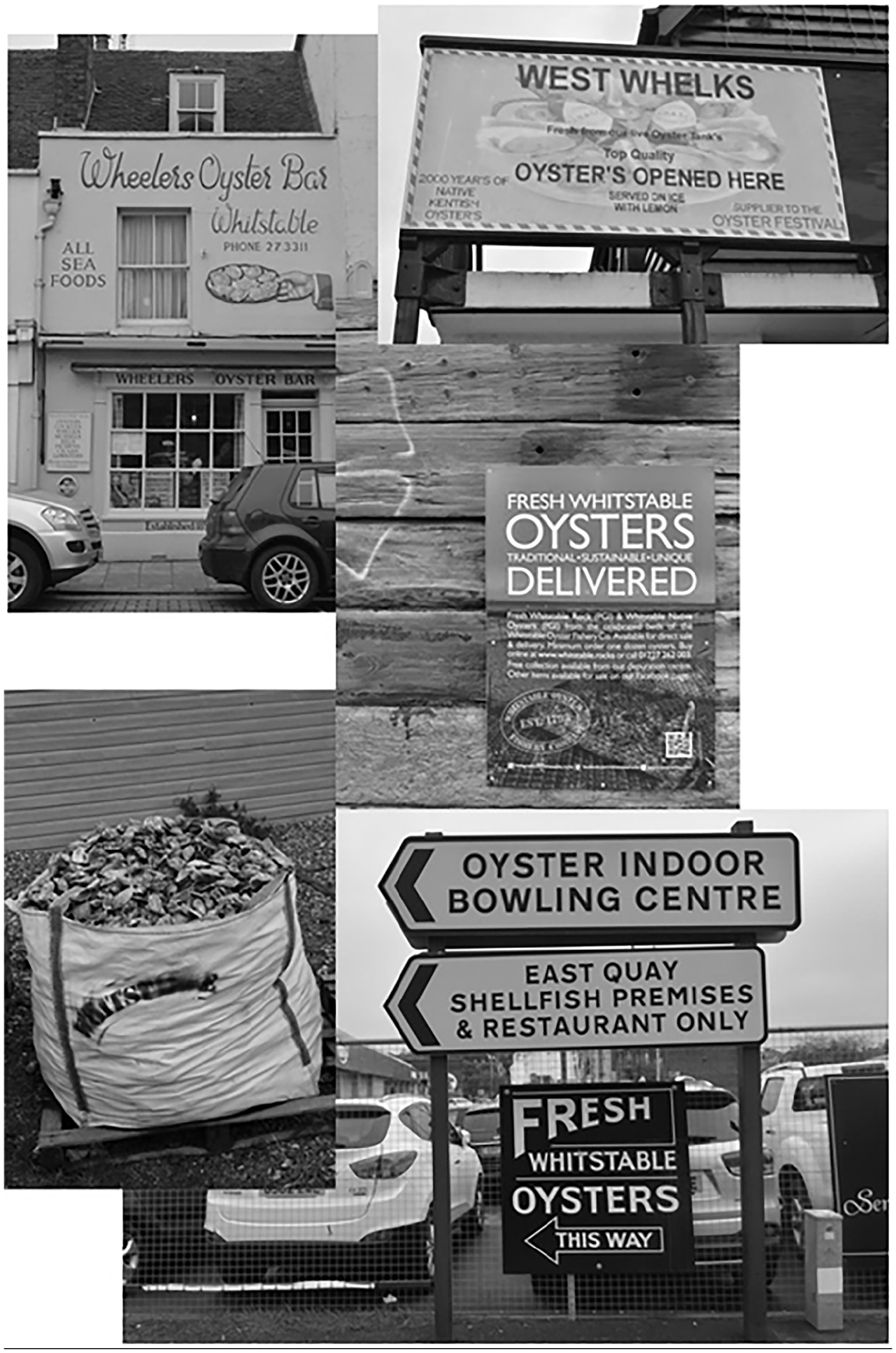
The oysterfication of Whitstable.
This heritage is also celebrated via the Whitstable Oyster Festival, begun by local volunteers in 1985 as a summer festival coinciding with traditional St. James’ day celebrations when oyster fishermen would receive their annual dividend from the WOFC. 33 This attracts huge crowds of DFLs (‘Down from Londons’) who swell the narrow streets of Whitstable consuming seafood, beer and wine in a weekend of celebration kicked off by the symbolic landing of the ‘year’s first catch’ and the ‘blessing of the waters’ by the local clergy. Children make ‘grotters’ (shell grottos) from discarded oyster shells, there are crabbing competitions and live music fills the streets. Much of this is of course an ‘invented tradition’, of recent provenance but made to look ancient: traditionally no dredging occurred in July given at this time of the year oysters in Whitstable are in spate and considered inedible, meaning that at the festival visitors are typically eating imported oysters, not Whitstable Natives. 34
Whitstable’s association with oysters has hence allowed it to cultivate a distinctive coastal imaginary, not as a run-down or faded resort (cf. its Kentish neighbours Margate and Herne Bay), but as a post-productivist space where the ‘authenticity’ of aquaculture is integrated into an ‘experience economy’ that offers pleasurable, upmarket forms of seaside consumption. 35 Oysters are now seen as gourmet foodstuff, and coverage of the oyster festival in the national media offers a seductive vision of al fresco consumption of oysters and champagne on the seafront. Even when served from seaside shacks made from faux driftwood, oysters sell for £2 each, and there are few restaurants in the town which cater to those on tighter budgets. In this sense, there appear to be connections between the promotion of Whitstable’s oyster heritage and the rapid gentrification of the town that saw house price growth of 360% from 2000 to 2019, outstripping the Kent average of 226%. In Harbour ward (which covers central Whitstable), the proportion of NS-SeC1 (higher professional, administrative and professional workers) increased from 6.7% to 11.3% between 2001 and 2011. In the same period, the number of properties with no usual resident, a figure which includes holiday lets and second homes, rose from 172 to 415 in Harbour ward. Here, it is notable the Whitstable Biennale visual arts festival began in 2002, attracting a growing population of former London ‘creatives’, many of whom have drawn direct inspiration from the fishing heritage of the town. 36
This suggests important connections are being made between foodism, maritime heritage and a leisured seaside lifestyle that has appealed to many Londoners looking to relocate from the capital (not least during the COVID-19 lockdown when the ‘race for space’ saw many capitalise on their housing wealth). This gentrification has conversely increased the demand for oysters, and as the popularity of its seafood restaurants burgeoned, WOFC began dredging again in 2001, and in 2009 started to cultivate (imported Pacific) oysters on the foreshore of Whitstable town beach, growing these in plastic-mesh bags on metal trestle tables, a method that is more expensive than traditional harvesting but lowers risks of predation and makes collection of oysters easier. The presence of up to five thousand of these trestles on the foreshore makes the (renewed) production of (imported, genetically-modified) oysters highly obvious to any visitor to the town at low tide; at high tide, they are submerged but are surrounding by warning buoys and markers which indicate these as a potential hazard to local sailors and swimmers. 37
Planning disputes and the battle for the beach
The twenty-first century branding of Whitstable as a foodie paradise has clearly had many beneficial outcomes for the local economy. But there is trouble in Oysteropolis: longer-term residents have articulated anxiety about the social impacts of gentrification and the influx of ‘Down From Londons’ who descend on the town in the summer months. By 2024, there were 542 Airbnb apartments listed in the town and many negative headlines circulating about the ‘soul’ of the town having been ripped out by over-touristification, with long-term locals bemoaning the predominance of London second-home owners which leaves the resort desolate in winter. 38 Disquiet has also been registered in relation to the socio-materiality of oysters and the way they ‘take up space’ in the town, not least in the highly visible racks which cover around 16 hectares of the foreshore. 39 Significantly, while it is generally recognised that WOFC’s entrepreneurial activities have boosted local trade and benefitted local employment, their cultivation of Pacific oysters on the foreshore has provoked a series of planning disputes, with some feeling that the WOFC pursues aquaculture in a way that over-privileges oyster cultivation as part of the coastal ecosystem, promoting the harvesting of oyster stocks at the expense of other possible uses of the ‘coastal commons’. 40 Particularly sensitive here has been the matter of their ownership of the beach, with campaigners alleging that WOFC’s use of trestle tables on the foreshore has displaced recreational swimmers and sailors, and reduces the visual and amenity venue of the beach for users (Figure 3).

Contemporary oyster cultivation, Whitstable.
It is here that issues of locality, history and identity begin to get complicated. The Oyster Festival, and the heritage industry that goes with it, celebrates a particular idea of traditional aquaculture, of fishermen in smocks and jumpers bringing their catch ashore in their red-sailed yawls. Children built shell grottos on the beach with a candle inside them to guide the fishers safely ashore. But the modern-day oyster worker is not the fisherman of yesteryear. Wearing waders and dayglo jackets, contemporary oyster fishery workers quad bike across the mudflats to monitor black-plastic mesh bags of lab-hatched oysters on a near-daily basis. These quad bikes churn up the mudflats at low tide, their presence visibly aggrieving some.
Fearful that the construction of trestles was the prelude to ‘unsightly’ agricultural buildings being constructed on the beach, the Whitstable Beach Campaign, who have long fought to establish the beach as a ‘village green’ with unrestricted public access, 42 lobbied the local authority to have the trestle tables removed from the intertidal zone. Here, they contended that the relatively small number of trestles first established on the beach foreshore by the WOFC in 2009–2010 increased to around 320 trestles by 2015. This expansion also led to representations from Whitstable local yacht club, which felt this expansion threatened dingy-sailors and windsurfers. 43 In 2017, independent experts (Marico) commissioned by the Marine Management Organisation (MMO) reported these trestles posed ‘a hazard to navigation’, albeit this was perceived a low risk, with ‘no substantial incident rate or record of vessels contacting the trestles’. 44 Responding, the Royal Yachting Association wrote to the MMO contending the trestles should still require a full marine licence, citing instances where dinghies and surfboards were damaged by partly obscured trestles at high tide. 45 Nonetheless, in 2018 the MMO published an update confirming the trestles met the requirements of the exemption relating to shellfish cultivation under the Marine Licensing (Exempted Activities) Order 2011 (Article 13). 46
But while the development of the trestles was deemed lawful by the governmental organisation charged with regulating and supporting fisheries, the local authority with jurisdiction of the landward side of low mean water ultimately took a different view. In April 2017, Canterbury City Council issued a Planning Contravention Notice, and although the WOFC argued the trestles had been present for at least four years, and should be granted a retrospect certificate of lawful use (CLEUD), its application (29 March 2018) was refused, with Canterbury City Council demanding the removal of the trestles on the landward side of mean low water on the basis that they had been unlawfully-constructed. 47 This led to an appeal against the notice by the WOFC under s.174 of the Town and Country Planning Act 1990 (made through Lee Evans Planning) in August 2018, leading to a two-week public inquiry in July-August 2021 following a COVID-19 enforced delay (Planning Inquiry APP/J2210/C/18/3209297). At the appeal hearing, the Inspector, Katie Peerless heard expert witness evidence as presented by Charles Banner QC on behalf of WOFC, as instructed by George Crofton-Martin of Furley Page LLP. The WOFC asserted that the time of the enforcement notice, the trestles were essential to their operations, enabling the company to produce around 100 tonnes of oysters per year (equivalent to one million oysters) and fulfil both domestic and foreign demand. It also argued that the company had observed due process throughout and approached Canterbury City Council in 2010 about the legality of the trestles, being told at that point that the Council’s initial assessment was that the trestles did not constitute development.
In the first week much of the Inquiry was focused on establishing the facts of the case as they were disputed by different parties, including the extent of the trestles, their expansion over time and the extent to which they fell under the jurisdiction of Canterbury City Council (noting that those below low mean water fell under the jurisdiction of the Marine Management Organisation or MMO) (Figure 4). There was then evidence presented from RNLI volunteers, the local yacht club and town councillors about the risks they pose for swimmers, sailors and beach-users, including boats or recreational users becoming trapped in, or injured by the trestles. Consideration was then to the visual impact of the trestles on the seascape, with a consultants’ report compiled for the appellants suggesting that the trestles actually added to the visual character of the town, and were a tourist spectacle in themselves, a conclusion disputed by representatives of the Whitstable Beach Campaign. There was also brief but heated discussion of the extent of marine littering associated with the development, not least the discarding of the large black rubber bands used to secure oyster bags to the trestle tables, some of which had been found elsewhere on the coast (Figure 5). Here, concern about plastic pollution in general, and the potential for litter to accumulate along coastlines, made this an important consideration in the planning debate. 48

Extent of trestles, 2021.

Mesh bags and rubber banding found outside WOFC territory.
Yet much of the second week of the inquiry focused on disputed evidence of the impact of the trestles on the environment, archaeology and ecology of the Swale Special Protection Area (SPA), the Swale Site of Special Scientific Interest (SSSI), the Swale RAMSAR site and the Swale Estuary Marine Conservation Zone (MCZ) in which the oyster trestles were located. Canterbury City Council’s ultimate decision to refuse retrospective permission for the trestles had concluded that the oyster trestle development was a Schedule 2 (Column 1(c)) Development under the terms of the Town and Country Planning Act (Environmental Impact Assessments) 2017 – i.e. an intensive livestock installation of at least 500 m2 – and that it ‘could not be discounted’ that this was having a negative effect on the wider environment, a designated bird habitat site protected by UK Habitats Regulations. 49
Canterbury City Council’s conclusion was informed by Natural England, the statutory consultee in relation to habitats, who had advised that, when applying the precautionary principle, the risk of an adverse effect on the integrity of the SPA, RAMSAR and conservation area due to disturbance of wintering birds could not be ruled out:
There are concerns with the activity, predominantly the direct loss of habitat in designated sites as well as the disturbance to the features of the SPA and how this disturbance has been assessed. Sufficient information has not been provided to determine whether there is an Adverse Effect on Integrity (AEOI) on the bird features of the SPA. Therefore, from the current information provided, as outlined above, we do not agree with the conclusions of no likely significant effect due to concerns over loss of supporting habitats and displacement.
50
This was disputed by consultants APEM, on behalf for the appellants, who reported in 2019, based on their field visits, that:
The trestle site was found to not be of importance for any particular bird species as a non-breeding or passage location to forage, loaf or roost. It is largely devoid of most of the waterbird species associated with nearby designated sites, though some relatively common and widespread non-breeding species do reside on or within close-proximity to the trestle site in low numbers. . .Overall, it can be concluded that the study area is not a particularly important site for waterbirds and there is currently no evidence of any significant impacts on their distribution or abundance as a result of the Whitstable oyster trestles development or the activities associated with it.
51
In the run-up to the inquiry, Natural England dismissed this report’s conclusions, reiterating their objection to the development on the basis that the risk of adverse effect on the integrity of the SPA could not be ruled out. They stressed they were particularly interested in the likelihood of disturbance and displacement of birds, as well as the effect of the trestles on the levels of benthic invertebrates (which are an integral part of the food chain on which birds rely) in the ground below them. However, they indicated that they would not attend the inquiry.
WOFC, via Furley Page, therefore asked the Inspector (Katie Peerless) to exercise the power under s.250(2) of the Local Government Act 1972 to summon Natural England to attend the inquiry for cross-examination (a power very rarely if ever invoked previously) to outline the basis of their objection under cross-examination. The Inspector invited Natural England to do so, but an hour before they were due to appear, Natural England withdrew their objection to the trestles subject to the imposition of a condition restricting working on the oyster farm in conditions below minus 3 degrees Celsius. This was stipulated as a temperature below which local migrating birds would be adversely affected by any WOFC work on the trestles given the energy birds might require to avoid workers in colder weather. At this point, Canterbury City Council also withdrew their opposition to the trestles given the seeming lack of evidence that there might be any adverse impact on local wildlife. On 25 October 2021 the Inspector hence allowed WOFC’s appeal against the enforcement notice, although refused their application for an award of costs. In her Appeal Decision the Inspector concluded that the ‘numbers of particular species such as dunlin, curlew and sanderling were considered in detail and, while there might have been a fall in the numbers using the trestle site compared to similar adjacent habitat, this was not considered significant, given the extent of such habitat still available to the birds’. 52
Figuring the oyster in a planning debate
In the battle for Whitstable beach, the interests of multiple populations were at stake, both human and non-human. In the submissions of the Whitstable Beach Campaign, for example, the rights of (human) users of the beach were to the fore, whether this concerned the safety of those participating in water sports or the amenity rights of those owning properties in the town for whom the ‘industrialisation’ of the foreshore is perceived as a challenge to their ‘quiet enjoyment’ of the seascape. Conversely, for Natural England, the protection of visiting waterfowl appeared more pressing, with the potential displacement of dulin, plover, sanderling and egrets from the trestle areas by local fishery workers on quad bikes being raised as a major concern. Ultimately the latter was pivotal in the decision made by the planning inspector to allow the development on the basis ‘there are no significant adverse impacts on the conservation objectives of protected sites’, 53 subject to a legal requirement that the WOFC would ‘keep marine debris and litter to a minimum’ and not conduct operations on the oyster fishery in temperatures of less than −3ºC when the impact on the wintering bird assemblage might be particularly signficant. 54
Throughout the appeal inquiry, the oyster was hence central to debate but was rarely discussed as one of the populations that would be impacted by the trestle development. When they were mentioned, it was generally not with any concern for their welfare or quality of their ‘living environment’ but as resource. For example, the owner of the WOFC, James Green, gave detailed evidence over two days outlining the economics of oyster cultivation, providing a careful justification for the landward expansion of the trestle tables and the importance of local cultivation (noting that consumers appear more concerned with provenance or merroir now than they were in the 1990s when they would come to the oyster festival to consume imported oysters). Here, the cultivation of genetically-modified Pacific oysters by the WOFC was justified with reference to the overall economic integrity of a commercial oyster fishery, with James Green suggesting 200 to 300 tonnes per year would be the ideal output to meet market demand and allow for investment in maintenance of Whitstable native oysters cultivated on submarine substrate. The suggestion here was that the work of the WOFC in maintaining native oyster stocks was dependent on the cultivation of imported oysters. 55
Against this, the Whitstable Beach Campaign, objected to the trestles because of the possible disbenefits of inshore cultivation, including negative environmental impacts. Among the 222 public comments on the WOFCs retrospective planning application for trestles on the foreshore (made in 2018) was the frequent objection that WOFC were using trestles to grow imported oysters, not natives, suggesting a strong econationalist discourse which figured the Pacific oysters as invasive. For example:
I am hugely concerned about the growing of non-native Oysters (pacific oysters) in these warm waters. These oysters are not native to Whitstable, so pose a problem to the delicate ecosystem of which the whole town and tourist industry relies on. The Pacific Oysters will grow exponentially. . .across the whole beach, not just within the oyster racks, and will ruin the balance of the sea-life in this area. They also present a safety hazard for use of the beach as the shells are razor- sharp. There are campaigns to stop this spread of Pacific oysters in nearby areas of the coastline. The only Oysters that should be allowed to be grown here are Native Oysters (public comment submitted, 11 May 2018).
Here, a range of arguments were conflated about the ‘dangers’ of the trestles, with the-then Chair of the Whitstable Beach Campaign submitting a similar representation that opposed both the ‘wholesale industrialisation’ of the beach, the dangers posed by hazardous, sharp oyster trestles to sea-users, obstruction to navigation and, crucially, the threat that non-native oysters pose to indigenous fauna and flora. 56 At the inquiry, there was then some (inconclusive) discussion of whether Pacific triploid oysters could actually spawn or escape from bags and spread along the coast, 57 and if the occurrence of ‘razor-sharp’ Pacific oysters along the chalk reefs of the north Kent coast was in any way connected to their cultivation at Whitstable. 58
In general, the ecosystem-wide impacts of Pacific oyster introductions – such as those on ‘flow patterns, sedimentation and nutrient dynamics’ – are still not well understood or agreed on, and as such were not substantively considered in the deliberations of the public inquiry. 59 It is also not clear if imported, triploid oysters are more susceptible to environmental and biological stressors than the natives traditionally found in British waters, or can introduce new pathogens. 60 But the fact that introduced non-native oysters were themselves nearly totally wiped out in Kent in 2010 by the OsHV-1 virus (an especially lethal strain of herpes never seen before in the UK) suggests they could be vectors for disease-causing organisms with devastating impacts. Again, this was not discussed at the planning inquiry, and in her Appeal Decision, the Planning Inspector simply noted that ‘the triploid (i.e. sterile, non-reproductive) Pacific oysters used on the farm are cultivated in many areas of the UK’ and that ‘the regulating authorities have not identified any problems with the farming of triploid Pacific oysters on the Whitstable trestles’. 61 By the same token, the Shellfish Association of Great Britain and Fishmongers’ Company have also repeatedly pointed to the ecological and economic benefits of cultivating Pacific oysters in the UK, and said little of their possible impact on native stocks. 62
In this sense, oysters were ever-present in the planning deliberations but questions of their living conditions, and overall population numbers, were rarely considered, with discussion of the ecological impacts of the trestles ultimately revolving round evidence of the impact of the trestles on other non-human populations. Here, charismatic avian populations – predators – appeared to be valued more than submarine bivalves (reduced to the status of fodder), despite the fact that the birds are seasonal visitors and the oysters permanent residents. In many senses, this ignores the vital ecological ‘work’ that oysters do in the town. 63 Here, the oyster’s filter-fed protein-rich meat is the most obvious ‘ecosystem service’ they provide to humans 64 and their contbution to cultural services (e.g. employment, recreation and tourism) emphasised in much of the WOFC submission that provided evidence of the economic importance of the commercial oyster fishery. 65 But if we consider oyster physiology and its role in delivering wider ecosystem services, we can see oysters as a keystone species in the ecology of Whitstable Bay, with the town’s economy of aquaculture traditionally dependent on the oyster beds which have been constructed by larvae latching onto other oysters, clumping and forming reefs. Here, the waste from dead oysters, and bodies that are not harvested for eating, feeds other trophic levels. But living oysters are not inert, having the ability to ‘collect, divide, dissolve, disperse and transform’ sediments. 66 As oysters suck in and filter out waters, they digest suspended phytoplankton and zooplankton. What they ingest and cannot digest, oysters eject as pseudofeces, which, coated in mucous, fall to the seabed to be processed by anoxic bacteria. The cleaner, deacidified water oysters leave behind is what just about everything else needs to live. 67 Here, local geography is crucial as Whitstable Oysters uniquely suck in and filter the polluted freshwater from the River Thames as it meets the salt waters of the North Sea, cleaning the water, preventing algal blooms and encouraging abundant fish life. This presence of oysters in these shallow waters hence leads to increases of finfish and invertebrates, either as a source of food or through their wider contribution to biodiversity. In turn, this attracts the seabirds and other predators who reduce the number of starfish and slipper limpets that can quickly out-compete oysters in some areas. 68 Through such processes, the presence of oysters enhances recreational and artisanal fishing, and contributes to the growth of avian populations, potentially encouraging birdwatching too. 69
Here it was significant that Natural England’s main objection to the trestles was that the (mechanised) inshore oyster cultivation would actually reduce wildfowl rather than the overall increase in the oyster population attracting additional birdlife. This type of argument hence made a case for refusing development of oyster trestle cultivation with reference to its impact on the number of charismatic seabirds rather than the impact of the trestles on the overall oyster population of the bay in terms of their living conditions. This confirms the idea that oysters were not seen as actors whose specificities shapde the terrain of the planning debate but instead were reduced to the status of industrial livestock. Their welfare was not considered, their life and liveliness overlooked. Even setting aside debates around animal rights and sentience, there is a sense here in which oysters exist beyond the threshold of human comprehension as animals, being rendered as mere commodities. This is perhaps not surprising given the media and policy preoccupation with ‘fostering more ethical and caring relations between humans and wild, native, commensal and feral species’ that tends to overlook instrumentalised, captive and commodified animals. 70
But at the same time their welfare was overlooked, and liveliness ignored, the oyster obviously constitutes an important symbolic presence in the continuing debates about the type of coastal town Whitstable is, and who it belongs to. The fact the oysters being cultivated in the mesh bags on the foreshore were Pacific rather than ‘native’ oysters evidentially became part of a discourse in which ideas of belonging and identity were extended to encompass the provenance of oysters. Here, NIMBY-style arguments entwined with eco-nationalist sentiment to position the Pacific oyster as a ‘foreign other’ with little place within traditions of the Whitstable fishing industry. 71 This implies that the local protest against the development of the oyster trestles was not so much concerned with the welfare of the farmed oysters – itself rarely mentioned – but the protection of the community from changes associated with incomers. Mobilised by local opponents to the WOFC’s inshore trestles as an invasive and non-native species, the Pacific oyster has then been implicitly connected to the threats of gentrification and touristification, equivalent to the non-local incomer (the middle class ‘DFL’) in terms of its threat to local sense of place and ‘traditional’ relations between land and sea. In this sense, the dispute about the oyster trestles in Whitstable is about displacement and displaceability, and the rights of different groups to either use the coast as a productivist space (of aquaculture) or a post-productivist space of leisured tourism (and related property speculation). The way these two entwine and coalesce in complex and contradictory ways – given the expansion and industrialisation of oyster cultivation at Whitstable has itself been fuelled by rapid gentrification and touristification – lends credence to Kristen Ounanian and Matthew Howells’ insistence that ‘inquiries into ongoing and future transitions of coastal communities would benefit from conceptualising change through processes of displacement, specifically through the intersection of ocean grabbing, gentrification and financialisation’. 72
Conclusion
The recent revival of oyster cultivation and aquaculture at Whitstable after years of decline is on the surface a success story of the resurgent interest in local foodstuffs and fishing traditions fuelled by touristification and gentrification. But it also indicates the perverse threat that gentrification poses to those very traditions. As Cameron Thompson et al note, gentrification changes the socio-demography of a community, alters its housing stock, and, fundamentally, the relationship between local people and the sea. 73 In the case of Whitstable, this is made more complex by virtue of the fact that the tourist demand for locally-produced oysters has resulted in the creation of an industrial-scale oyster farm consisting of trestles full of imported Pacific oysters rather than British native oysters. The discussion about the legality of these trestles hence draws on a complex set of appeals to legal authority, underpinned by different claims about Whitstable beach’s histories and geographies. It could be argued this is essentially about residents who use the beach as a space of recreation objecting to the visual intrusion of oyster production on the foreshore and its potential disruption to sailing and swimming, but at the planning inquiry these type of objections were less decisive than the adjudged impact of the trestles on other non-human species, particularly migratory birdlife. In so doing, the welfare of oysters and the impact of trestle-cultivated oysters on native oyster stocks was overlooked, with anthropocentric preoccupations reigning in a planning system that continues to affirm hierarchies between endangered wildlife and those animals ‘off-staged’ because they are considered uncharismatic, lacking in sentience or simply as cultivated foodstuff. 74
This suggests that while the two-week planning inquiry was ostensibly concerned with the environmental impacts of the trestles, especially its impact on the Special Protection Area of the Swale estuary, this inquiry sublimated debates about the future of the town which were in face about questions of class, identity and belonging in which the WOFC stands accused of encouraging, and beneftting from, gentrification and touristification. The oyster – both the imported Pacific and traditional native – was mobilised by those fighting both for and against the trestle development: for the WOFC the genetically-modified Pacific oyster was depicted as an economic necessity, and a means to actually preserve and enhance native stocks, while for the WBC the Pacific was depicted as invasive, enrolled in a form of intensive oyster cultivation felt to be alien to this community. As in Callon’s account of the discourses used to translate the decline of scallops in St Brieuc bay, these different accounts are founded on a certain interpretation of what oysters contribute to the local community, and less about what they need. 75
Oyster cultivation is then central to ongoing questions about Whitstable’s future, and following Maan Barua’s suggestion that non-human animals can be part of the material, aesthetic and sensory infrastructure that supports urban change, we can conclude that this contested process of change involves the oyster as a symbol of class change, a visceral mediator that articulates changing place identities, as well as an (overlooked) working body that changes the quality of the local marine environment. 76 In this sense, the oyster is imbricated all number of wider circuits – supply-chains, tourist investments, media discourses – which are shaping Whitstable. But while the resort’s gentrification and touristification appears entwined with the presence of oyster fishing, the current lack of enthusiasm evident for the WOFC’s methods of trestle cultivation suggests a growing social and cultural ambivalence to commercial oyster cultivation that may ultimately hamper the revival of the town’s aquaculture and fishing industries. Putting the oyster front and central in such debates as ‘lively commodity’ might further limit the scope for commercial aquaculture, but equally it might result in a more meaningful understanding of how human and non-human lives are entangled at the coast, including the role of aquaculture itself in providing a sustainable basis for habitat restoration and species recovery.
Footnotes
Acknowledgements
Thanks to Andrew Brooks who helped develop the ideas in this paper in a related publication on animals and the right to the city. Thanks also to Whitstable Beach Campaign for permission to reproduce some of the images in this paper, and the two anonymous referees for their careful and constructive comments.
Declaration of conflicting interests
The author declared no potential conflicts of interest with respect to the research, authorship, and/or publication of this article.
Funding
The author received no financial support for the research, authorship, and/or publication of this article.
Ethics
This research was conducted via attendance at a planning inquiry, documentary and secondary analysis only and did not involve any research with human subjects in the form of interviews or surveys.
1
See, for example Brian J. Rothschild, Jerald S. Ault, Philippe Goulletquer, and Maurice Héral, ‘Decline of the Chesapeake Bay Oyster Population: A Century of Habitat Destruction and Overfishing’, Marine Ecology Progress Series 111 (1994):29–39; Luke Helmer, Paul Farrell, Ian Hendy, Simon Harding, Morven Robertson, and Joanne Preston, ‘Active Management is Required to Turn the Tide for Depleted Ostrea Edulis Stocks from the Effects of Overfishing, Disease and Invasive Species’, PeerJ 7 (2019): e6431.
2
On rewilding of oysters see: David Smyth, Maria Hayden-Hughes, Jenna Alexander, Philippa Bayford, and Louise Kregting, ‘“Good News Everyone,” the Natives Have Returned: Assemblages of European Flat Oysters Make a Reappearance in Belfast Lough after a Century of Absence,’ Regional Studies in Marine Science 41 (2021): 101585.
3
See Emily Rakestraw, ‘Shell Shock: Oyster Farmers Face Pushback from Critical Property Owners’, Business North Carolina, accessed February 1, 2023, https://businessnc.com/shell-shock-north-carolina-oyster-farmers-face-pushback-from-critical-beach-property-owners/ and Matthew Renda, ‘Coastal Commission Denies Humboldt Oyster Farm’s Permit’, Courthouse News Service, accessed June 8, 2017, 
4
5
In a review of conflict concern oyster fisheries on the East Coast of the US, Katie Hill concludes that for water users and coastal property owners, the economic and/or environmental benefits of oyster cultivation seldom outweigh the impacts to fishing, boating or views from properties: see Katie Hill, ‘Cage Fights: Oyster Farming User Conflicts and Regulatory Responses in Three Southeastern States’, New York University Environmental Law Journal 32 (2024): 207.
6
Rosemary-Claire Collard and Jessica Dempsey, ‘Life for Sale? The Politics of Lively Commodities’, Environment and Planning A 45, no. 11 (2013): 2682–99.
7
Stephanie Wakefield, ‘Making Nature into Infrastructure: The Construction of Oysters as a Risk Management Solution in New York City’, Environment and Planning E: Nature and Space 3, no. 3 (2020): 761–85.
8
But see Kees Lokman, ‘Cyborg Landscapes: Choreographing Resilient Interactions Between Infrastructure, Ecology, and Society’, Journal of Landscape Architecture 12, no. 1 (2017): 60–73; Stephanie Wakefield, David Chandler, and Kevin Grove, ‘The Asymmetrical Anthropocene: Resilience and the Limits of Posthumanism’, Cultural Geographies 29, no. 3 (2022): 389–404.
9
Jamie Lorimer, ‘Nonhuman Charisma’, Environment and Planning D: Society and Space 25, no. 5 (2007): 912. See also: Nickie Charles, Rebekah Fox, Mara Miele, and Harriet Smith, ‘De-Centring the Human: Multi-Species Research as Embodied Practice’, The Sociological Review 72, 6 (2024): 1335–1536.
10
Kaj Zimmerbauer, Sulevi Riukulehto, and Timo Suutari, ‘Killing the Regional Leviathan? Deinstitutionalization and Stickiness of Regions’, International Journal of Urban and Regional Research 41, no. 4 (2017): 676–93.
11
But see Ben A. Gerlofs, Benjamin Lucca Iaquinto, Kylie Yuet Ning Poon, and Cathy Tung Yee Tsang, ‘Tank to Table: Hong Kong’s Wet Markets and the Geographies of Lively Commodification Beyond Companionship’, Annals of the American Association of Geographers 114, no. 4 (2024): 844–62.
12
See, for example, Thom Van Dooren, and Deborah Bird Rose, ‘Storied-Places in a Multispecies City’, Humanimalia 3, no. 2 (2012): 1–27; Lauren E. Van Patter and Alice J. Hovorka, ‘“Of Place” or “of People”: Exploring the Animal Spaces and Beastly Places of Feral Cats in Southern Ontario’, Social & Cultural Geography 19, no. 2 (2018): 275–95; Anindya Sinha and Maan Barua, ‘Nonhuman Lifeworlds in Urban India’, The Philosopher 108, no. 1 (2020): 22–7.
13
Sarah Trotter, ‘Birds Behaving Badly: The Regulation of Seagulls and the Construction of Public Space’, Journal of Law and Society 46, no. 1 (2019): 1–28.
14
Brittany R. Williams, Dominic McAfee, and Sean D. Connell, ‘Oyster Larvae Swim Along Gradients of Sound’, Journal of Applied Ecology 59, no. 7 (2022): 1815–24.
15
See Cecília de Souza Valente, ‘Rethinking Sentience: Invertebrates as Worthy of Moral Consideration’, Journal of Agricultural and Environmental Ethics 38, no. 1 (2025): 3 for discussion of the way the sentience of molluscs can be rethought to recalibrate speciesism.
16
Kathry Yusoff, A Billion Black Anthropocenes or none (University of Minnesota Press, 2018).
17
Andrew van der Schatte Olivier, Laurence Jones, Lewis Le Vay, Michael Christie, James Wilson, and Shelagh K. Malham, ‘A Global Review of the Ecosystem Services Provided by Bivalve Aquaculture’, Reviews in Aquaculture 12, no. 1 (2020): 3–25.
18
Christopher Bear, ‘Assembling the Sea: Materiality, Movement and Regulatory Practices in the Cardigan Bay Scallop Fishery’, Cultural Geographies 20, no. 1 (2013): 21–41.
19
Paula Satizábal and Wolfram H. Dressler, ‘Geographies of the Sea: Negotiating Human–Fish Interactions in the Waterscapes of Colombia’s Pacific Coast’, Annals of the American Association of Geographers 109, no. 6 (2019): 1865–84.
20
Michel Callon, ‘Some Elements of a Sociology of Translation: Domestication of the Scallops and the Fishermen of St Brieuc Bay’, The Sociological Review 32, no. 1_suppl (1984): 196–233.
21
On valuation and domestication of the oyster, see: Sandro Simon, ‘The Art of Gleaning and Not Becoming Domesticated in Mollusc Waterworlds’, Ethnos 89, no. 3 (2024): 480–99.
22
John Adams, ‘Brought to Account-Adley v. the Whitstable Oyster Company’, Cambrian Law Review 33 (2002): 81–91.
23
Rebecca Stott, Oyster (Reaktion Books, 2004).
24
This Act is often taken as an early enactment of ‘public trust doctrine’, cited in relevant cases of riverine and marine access in the US and beyond. See John Sheail, ‘An Historical Perspective on the Development of a Marine Resource: The Whitstable Oyster Fishery’, Marine Environmental Research 19, no. 4 (1986): 279–93.
25
‘The right of taking oysters and other fish within the said manor, and the ground and soil of the said fishery, extending as hereinafter is mentioned, and also the customary payments usually and of right made to the lord of the said manor, for or on account of the anchorage of any ship or vessel, etc., within the said manor’ were declared to be limited to the WOFC in Gann v Free Fishers of Whitstable (1865) 11 HLC 192.
26
See Phil Hubbard, ‘Legal Pluralism at the Beach: Public Access, Land Use, and the Struggle for the “Coastal Commons”’, Area 52, no. 2 (2020): 420–8.
27
Adams, ‘Brought to Account’, 81.
29
See F. Gross and J. C. Smyth, ‘The Decline of Oyster Populations’, Nature 157, no. 3991 (1946): 540–2.
30
Humphreys John, Roger J. H. Herbert, Caroline Roberts, and Stephen Fletcher, ‘A Reappraisal of the History and Economics of the Pacific Oyster in Britain’, Aquaculture 428 (2014): 117–24.
31
In the case of Whitstable, these are genetically modified triploid oysters with three sets of chromosomes. As they are sterile, their metabolism is directed toward growth and fattening. See: Pandora Wadsworth, Alan E. Wilson, and William C. Walton, ‘A Meta-Analysis of Growth Rate in Diploid and Triploid Oysters’, Aquaculture 499 (2019): 9–16.
32
On maritime heritage more generally see: Katherine Georgina Watson, ‘Heritage-Making in the Capitalocene: Deconstructing Fishing Heritage and Regeneration in an English Fishing Port’, International Journal of Heritage Studies 29, no. 7 (2023): 711–27; Julie Urquhart and Tim Acott, ‘Constructing “The Stade”: Fishers’ and Non-Fishers’ Identity and Place Attachment in Hastings, South-East England’, Marine Policy 37 (2013): 45–54.
33
St James is the patron saint of fishermen.
34
Terence Ranger and Eric Hobsbawm, eds., The Invention of Tradition (Cambridge: Cambridge University Press, 1984).
35
Elisabeth Guillou, Adeline Raymond, Nathalie Krien, and Fabrice Buschini, ‘Oyster Eaters: From Consumer Practices to the Representation of Risks’, Appetite 140 (2019): 105–13.
36
37
The trestles are about 0.75 m high and 0.8 m wide, consisting of metal frames on which bags of oysters are stacked, secured by large elastic straps. The frames are linked and arranged in rows with tracks up to 6 m wide between them.
38
39
40
See Hubbard, ‘Legal Pluralism at the Beach’, 426.
41
Ibid.
42
See Donald McGillivray and Jane Holder, ‘Locality, Environment and Law: The Case of Town and Village Greens’, International Journal of Law in Context 3, no. 1 (2007): 1–17.
44
See Marico Marine, Navigation Risk Assessment - Oyster Trestle Foreshore Deployment (Whitstable, Kent, 2017), Report no. 17UK1322.
46
47
Requirements of the enforcement notice were ‘1. Remove all oyster trestles from the Land. 2. Remove all oyster bags, their contents, and any strapping or webbing attached to the oyster trestles from the Land. 3. After the actions of 1 and 2 have been carried out, remove all marker buoys, withies and any other items that warn of the siting of oyster trestles from the land’.
48
See Devin Comba, Terence A. Palmer, Natasha J. Breaux, and Jennifer B. Pollack, ‘Evaluating Biodegradable Alternatives to Plastic Mesh for Small-Scale Oyster Reef Restoration’, Restoration Ecology 31, no. 3 (2023): e13762.
49
The Conservation of Habitats and Species Regulations 2017 require that before deciding to undertake, or give any consent, permission or other authorisation for, a plan or project which is likely to have a significant effect on a European site or a European offshore marine site (either alone or in combination with other plans or projects) the competent authority must make an Appropriate Assessment of the implications of the plan or project for that site in view of that site’s conservation objectives.
50
Natural England, 2018 submission to Canterbury City Council.
51
APEM Ecological Appraisal of Waterbirds for Whitstable Oyster Trestles, September 2019, para 105–6.
52
Appeal Decisions Notice APP/J2210/C/18/3209297, Planning Inspectorate, 25 October 2021 para 39. In the same decision the Inspector dismissed local campaigners fears about the impacts of the trestles on marine safety, claiming ‘any users of the water do have to take some responsibility for their own safety in an inherently dangerous medium. . .there are other locations where the water based activities can take place and I do not consider that the impact on the activities that previously occurred over the intertidal trestles is “significantly” adverse’ (Para 74–5). She also concluded the trestles added to the commercial character of the town and were not having adverse visual impacts.
53
Appeal Decisions Notice APP/J2210/C/18/3209297, para 100.
54
Appeal Decisions Notice APP/J2210/C/18/3209297, para 90. Here, it should be noted that one condition of approval was that within six months of the date of this decision a beach safety assessment for the area of the development was submitted in writing to the local planning authority. This was submitted but not approved by the local authority in October 2022, being described as neither sufficient or robust, resulting in a subsequent appeal which was upheld in 2024 finally making the trestles de facto legal development. See also linked cases APP/J2210/C/18/3209299 & APP/J2210/C/18/3209300.
55
Speaking to the press, Green later went further to criticise the time and expense which the inquiry involved, suggesting ‘at a time when both local councils and employers are financially struggling, the question must be asked as to whether it can be in the public interest to spend substantial sums of public money trying to stop the production of the world-famous Whitstable oyster. . .Surely, with all the associated social, financial, employment and environmental benefits that this production brings to the town, this is senseless’, See Brad Harper, ‘Whitstable Oyster Company Boss Accuses Campaigners of Spending Taxpayers’ Cash in “Senseless” Battle Over Trestles’, KentOnline, February 1, 2024,
56
This did not include any discussion of whether invasive, non-native oysters will ultimately out-compete natives. Here, scientific evidence suggests non-native introductions can sometimes enhance overall oyster populations: see Roger J. H. Herbert, John Humphreys, Clare J. Davies, Caroline Roberts, Steve Fletcher, and Tasman P. Crowe, ‘Ecological Impacts of Non-Native Pacific Oysters (Crassostrea Gigas) and Management Measures for Protected Areas in Europe’, Biodiversity and Conservation 25 (2016): 2835–65.
57
See Marc Suquet, Florent Malo, Claudie Quere, Christophe Ledu, Jacqueline Le Grand, and Abdellah Benabdelmouna, ‘Gamete Quality in Triploid Pacific Oyster (Crassostrea Gigas)’, Aquaculture 451 (2016): 11–5.
58
59
Jennifer L. Ruesink, Hunter S. Lenihan, Alan C. Trimble, Kimberly W. Heiman, Fiorenza Micheli, James E. Byers, and Matthew C. Kay, ‘Introduction of Non-Native Oysters: Ecosystem Effects and Restoration Implications’, Annual Review of Ecology, Evolution, and Systematics 36 (2005): 643–89.
60
Christopher Brianik and Bassem Allam, ‘The Need for More Information on the Resistance to Biological and Environmental Stressors in Triploid Oysters’, Aquaculture 577 (2023): 739913.
61
Appeal Decisions Notice APP/J2210/C/18/3209297, APP/J2210/C/18/3209299 & APP/J2210/C/18/3209300, Planning Inspectorate, October 25, 2021 para 44–5.
63
On animal labour see Maan Barua, ‘Animating Capital: Work, Commodities, Circulation’, Progress in Human Geography 43, no. 4 (2019): 650–69; Charlotte E. Blattner, Kendra Coulter, and Will Kymlicka, eds. Animal Labour: A New Frontier of Interspecies Justice? (Oxford University Press, 2019).
64
See Vazhiyil Venugopal and Kumarapanicker Gopakumar, ‘Shellfish: Nutritive Value, Health Benefits, and Consumer Safety’, Comprehensive Reviews in Food Science and Food Safety 16, no. 6 (2017): 1219–42.
65
On the cultural services associated with oysters, see Adriane K. Michaelis, William C. Walton, Donald W. Webster, and L. Jen Shaffer, ‘The Role of Ecosystem Services in the Decision to Grow Oysters: A Maryland Case Study’, Aquaculture 529 (2020): 735633.
66
Compare with Jacob Bull, ‘Encountering Fish, Flows, and Waterscapes Through Angling’, Environment and Planning A 43, no. 10 (2011): 2267–84.
67
Rachel S. Smith, Selina L. Cheng, and Max C. N. Castorani, ‘Meta-Analysis of Ecosystem Services Associated with Oyster Restoration’, Conservation Biology 37, no. 1 (2023): e13966.
68
Michel Blanchard, Jan A. Pechenik, Emilie Giudicelli, Jean-Paul Connan, and René Robert, ‘Competition for Food in the Larvae of Two Marine Molluscs, Crepidula Fornicata and Crassostrea Gigas’, Aquatic Living Resources 21, no. 2 (2008): 197–205.
69
Olivier van der Schatte, et al., ‘A Global Review’.
70
Paula Arcari, Fiona Probyn-Rapsey, and Hayley Singer, ‘Where Species Don’t Meet: Invisibilized Animals, Urban Nature and City Limits’, Environment and Planning E: Nature and Space 4, no. 3 (2021): 961.
71
This argument is spelt out in more detail in Phil Hubbard, Borderland: Identity and Belonging at the Edge of England (Manchester University Press, 2022). On eco-nationalism more generally – the conflation of ‘native’ ecology with national identities – see Marco Antonsich, ‘Natives and Aliens: Who and What Belongs in Nature and in the Nation?’, Area 53, no. 2 (2021): 303–10 and Jonathan Davies, ‘Brexit and Invasive Species: A Case Study of the Cognitive and Affective Encoding of “Abject Nature” in Contemporary Nationalist Ideology’, Cultural Studies 36, no. 4 (2022): 568–97.
72
Kristen Ounanian and Matthew Howells, ‘Deconstructing and Resisting Coastal Displacement: A Research Agenda’, Progress in Human Geography 48, no. 5 (2024): 636–54.
73
Cameron Thompson, Teresa Johnson, and Samuel Hanes, ‘Vulnerability of Fishing Communities Undergoing Gentrification’, Journal of Rural Studies 45 (2016): 165–74.
74
See Shingne Marie Carmen, and Laura A. Reese, ‘Animals in the City, a Review’, in Animals in the City, ed. Marie Shinge (Routledge, 2021), pp. 3–29.
75
Callon, ‘Some Elements of a Sociology of Translation’.
76
Barua, ‘Animating Capital’.