




Abstract
This paper explores the emerging role of Big Data in environmental governance. We focus on the case of salmon aquaculture management from 2011 to 2017 in Macquarie Harbour, Australia, and compare this with the foundational case that inspired the development of the concept of ‘translation’ in actor-network theory, that of scallop domestication in St Brieuc Bay, France, in the 1970s. A key difference is the salience of environmental data in the contemporary case. Recent dramatic events in the environmental governance of Macquarie Harbour have been driven by increasing spatial and temporal resolution of environmental monitoring, including real-time data collection from sensors mounted on the fish themselves. The resulting environmental data now takes centre stage in increasingly heated debates over how the harbour should be managed: overturning long-held assumptions about environmental interactions, inducing changes in regulatory practices and institutions, fracturing historical alliances and shaping the on-going legitimacy of the industry. Environmental Big Data is now a key actor within the networks that constitute and enact environmental governance. Given its new and unpredictable agency, control over access to data is likely to become critical in future power struggles over environmental resources and their governance.
Introduction
In early 2017, a decade of steady expansion of salmon farming in Macquarie Harbour, on the remote west coast of Tasmania, Australia, shifted suddenly into reverse, with the regulator imposing a 35% cut on previously permitted stocks, with near-immediate effect (EPA Tasmania, 2017). Remarkably, this was followed by one of the companies operating in the area, Huon Aquaculture, initiating legal action against the Tasmanian Government – not opposing the de-stocking order, but calling for levels to be further reduced, arguing that the reductions failed to adequately protect the harbour’s unique environment. 1
Behind these unexpected events is the story of an environmental controversy much like many others, involving the interplay of shifting, complex relations between a variety of both human and non-human actors, including fish farm operators, scientists, the regulator and environmental NGOs, as well as the salmon and various features of their watery domain. However, what makes it particularly interesting is the prominent role played in this case by something that barely existed a decade or even five years previously: an ever-growing mass of environmental digital data, resulting from an unprecedented increase in deployment of sensors across the harbour, that fundamentally altered scientific and regulatory interpretations of the environment, and opened a new front in the debate, around access to data.
The recent events in Macquarie Harbour reflect, in microcosm, a broader phenomenon: the rapid extension of networked sensors or the ‘Internet of Things’ (IoT) into the realm of the natural environment, producing environmental ‘Big Data’ – data that is massive in volume, rapidly updated, diverse and fine-grained in resolution (Kitchin, 2014; Manyika et al., 2011). Whilst neither environmental sensors nor ‘big’ environmental datasets are entirely new, their deployment has undoubtedly accelerated in the last five years or so (Gabrys, 2016). This ever-growing data has the potential to provide us with unprecedented coverage, depth and timeliness of environmental information, transforming the ways in which we seek to govern the environment (Gale et al., 2017). What this implies is that environmental Big Data is likely to interact with both the environment itself and human actors in unexpected ways, generating new matters of concern as well as new possible solutions, and shifting the focus of environmental controversies from environment–human interactions to matters such as data access and interpretation. Even more fundamentally, this raises an important question about the role and status of environmental Big Data as an actor in its own right, which has not yet been adequately theorised: this is the gap that we address in this paper.
To do so, we employ the concept of translation from Actor-Network Theory (ANT) (Latour, 2005; Law and Hassard, 1999; Murdoch, 1997) as our methodological framework. The case of salmon farming in Macquarie Harbour is one in which a sudden, unexpected reversal occurs, where relations between different actors, which had assumed the appearance of long-term stability, dramatically fall apart. The concept of translation was developed specifically to help understand such situations, wherein relatively stable networks of different actors are achieved and maintained, and conversely, why other attempted alignments fail. Furthermore, the key text in which the concept of translation was first developed was a case study of the interactions between scientists, scallops and fishermen in St Brieuc Bay, France, in the 1970s (Callon, 1986). The similarities between this case and our own enable us to highlight, by comparison, what has changed in a contemporary environmental governance setting: notably, the essential role played by environmental data.
Somewhat surprisingly, given that the collection, processing and interpretation of scientific data has long been a subject of interest to ANT scholars, the role actually played by data in the enactment of social relations has been relatively overlooked. The literature typically concentrates on systems or technologies (devices) that produce data and transform it into representations or inscriptions, and thus ‘tend[s] to overlook the role played by other elements populating and enacting data-driven governance, notably digital data’ (Bellanova, 2017: 331; see also Hanseth et al., 2004; Orlikowski and Iacono, 2001). Kitchin (2014: 25–26) likewise observes, ‘There has been remarkably little critical reflection and research on data in and of themselves and on the constitution and operation of the assemblages surrounding them …’ Data in ANT studies has historically been regarded as a mere intermediary (which Latour defines as something that ‘transports meaning or force without transformation: defining its inputs is enough to define its outputs’) rather than an independent actor or mediator (one of a class of things which ‘transform, translate, distort, and modify the meaning or the elements they are supposed to carry’ (Latour, 2005: 39)).
Whether environmental data is in fact a relatively unimportant, predictable intermediary or a crucial, unpredictable mediator in social relations is a question that must be answered empirically, because it depends on the work that data performs in specific situations. For example, in their foundational study of a 1970s biological research laboratory, Latour and Woolgar (1986) portray data as merely an intermediary between the experimented-upon rats and the inscriptions which are reproduced in scientific papers. In our case study, by contrast, we show that in a contemporary environmental governance setting, environmental Big Data has assumed a more complicated ‘life of … [its] own that is beyond our complete control’ (Lupton, 2016: 3).
Our analysis focuses on a single key sector and governance mechanism: state-based (national and sub-national) regulation of salmon aquaculture. 2 Salmon aquaculture management provides an important case study for three reasons: it is the fastest-growing food production system in the world; 3 it has significant environmental impacts (Leith et al., 2014; Lien, 2005; Ross and Macleod, 2017); and it has recently witnessed new developments in sensor technology, including real-time monitoring, leading to the accumulation of large amounts of environmental data. The paper arose from research undertaken during a 20-month project exploring the social implications of environmental Big Data. We have drawn on case-specific documents (academic literature, government and industry reports, and print, TV and online media) and a set of nine interviews with representatives of the groups of actors featured in the case: fisheries scientists (3), fisheries managers (3), sustainability certifiers (2) and an environmental NGO (1). The study was also broadly informed by a further 17 interviews with a range of experts on environmental Big Data, and insights from around 30 invited experts at a two-day international workshop held in February 2016.
The paper is structured as follows. The next section briefly reviews the literature on the role of data in environmental governance. We then provide a brief overview of salmon aquaculture governance in Tasmania before moving on to describe the Macquarie Harbour case study, structured according to Callon’s (1986) stages of ‘translation’ as an analytical framework, followed by our conclusions. A key finding is that environmental Big Data has agency: it increasingly influences the behaviour of other actors as an unpredictable mediator rather than passive intermediary, and thus should be considered as an important actor in its own right, within the network of relationships that together constitute and enact the governance of a particular environmental mechanism.
The role of data in environmental governance
State-based environmental governance has, since at least the 1970s, heavily relied on the collection of environmental data, of two main types: data about specific environmental parameters of interest to regulators, such as water and air quality indicators; and data on activities considered to have important impacts on the environment, such as industrial production levels and discharges or emissions. Mol (2006b: 39) observes how, in the past, environmental data were primarily used internally by state agencies for the purposes of assessing policy outcomes and compliance of regulated entities, and ‘Consequently, most of the raw environmental data collected were kept within the state institutions, and little was released to the public.’
Writing only a few years before the term ‘Big Data’ started to be widely used, Mol (2006a, 2006b, 2008) argues that the role played by information in environmental governance (or ‘informational governance’) changed dramatically during the 1990s and early 2000s due to a convergence of factors, including (inter alia) the well-documented shift from state- to non-state-based and hybrid forms of governance (Lemos and Agrawal, 2006); the globalisation of environmental issues; and various technological developments. This implies that ‘Information and knowledge processes now start to become constituting and transformative factors in environmental governance…’, provoking a change in the nature of environmental conflicts, whereby ‘conventional struggles over environmental laws and state policies relocate to struggles around questions of access to, production and verification of, and control over environmental information’ (Mol, 2006b: 43).
We argue that a further technological step-change – reflected in new terms such as Big Data and the IoT (Kitchin, 2014) – has occurred in the decade since Mol first put forward the concept of informational governance. It has four important dimensions: (1) the proliferation of sensors, driven by cost reductions and advances in miniaturisation and sensing capabilities; (2) developments in wireless telecommunications, which have the potential to make distributed sensor data as readily available as data from conventional ‘wired’ sources; (3) ever-increasing data processing and storage capabilities, as well as new data analytics; and (4) the complex of data, coding and interoperability standards, online user interfaces, and internet connectivity which collectively enables users to access and act on Big Data/IoT information (Kitchin, 2014; Manyika et al., 2011).
The social implications of these technological developments – specifically with respect to environmental data and governance – are just starting to be theorised. For example, Gabrys (2014: 37) explores the implementation of distributed sensor networks in ‘smart cities’ as a technology of governance of urban environments, arguing that these technologies fundamentally alter the socio-material environment in which we live, with largely unpredictable consequences. A special collection of papers in the journal Big Data and Society examines ‘the many ways in which data is increasingly seen to be essential to managing environmental systems, practices and politics’ (Gabrys, 2016: 1). Observing that ‘environmental data has now moved into the terrain of environmental Big Data’, Gabrys (2016: 2,3) notes that: Environmental data practices often engage with environmental problems to generate distinct objects and relations of concern. The materialisations of environmental data can articulate distinct connections and ways of attending to environmental problems, and the ways in which environmental data circulates and is produced can also legitimate or delegitimate actors and approaches to environments. In this way, environmental data and data practices are far from a neutral undertaking, and processes for validating, distributing and acting on environmental data can become key sites of contestation. Instead of being seen as experts whose technologically mediated intimacy with wild animals gave them authority to speak on their behalf, scientists could now be seen as mediators of a kind of virtual intimacy between individual animals and mass audiences … what made the Albatross Project different from the usual methods of science education or communication was that ‘there’s no filter.’ Scientists and schoolchildren were connected to radio-tagged animals in exactly the same way.
Salmon aquaculture governance in Tasmania
Australian salmon aquaculture has grown significantly over the past decade to become a A$631 million industry, with 98% of production being from the state of Tasmania (Savage, 2016: 10). Commercial operations developed quickly from the mid-1980s, and the industry has progressively consolidated, now comprising three main companies – Tassal, Huon Aquaculture and Petuna – that together with two smaller operations form the Tasmanian Salmonid Growers Association (TSGA). The annual harvest has grown from 53 tonnes in 1986/87 to around 55,000 tonnes/year presently. The industry now accounts for 2.3% of Tasmania’s GDP and provides over 2,000 jobs – many in regional areas that have suffered significant declines in employment in traditional agriculture and forestry activities. 4
Aquaculture is regulated in Tasmania under the Marine Farming Planning Act 1995 (MFPA), which provides the legal basis for leasing areas of coastal waterways to industry, subject to individual lease conditions and regional marine farming development plans (MFDPs). There are currently 44 licensed finfish marine farming leases in Tasmania, covering a total of 2,257 hectares in six MFDP areas. 5
One of these areas is Macquarie Harbour: a large bay, approximately 33 km long by 9 km wide, on the west coast of Tasmania (Figure 1). Several characteristics make the bay rather unique, and environmentally sensitive. The bay is only open to the ocean at a single point, known as ‘Hell’s Gates’, where a shallow sill restricts mixing with marine waters, while freshwater inputs are received from the King and Gordon rivers, in the north and south respectively. This creates a pronounced thermocline, with warmer, lighter, freshwater lying on top of colder, heavier, saltwater. The south-eastern end of the bay is within the very high conservation value Tasmanian Wilderness World Heritage Area, and the bay is the home of an endangered species, the Maugean skate, which has only ever been found, in very limited numbers, at one other location.
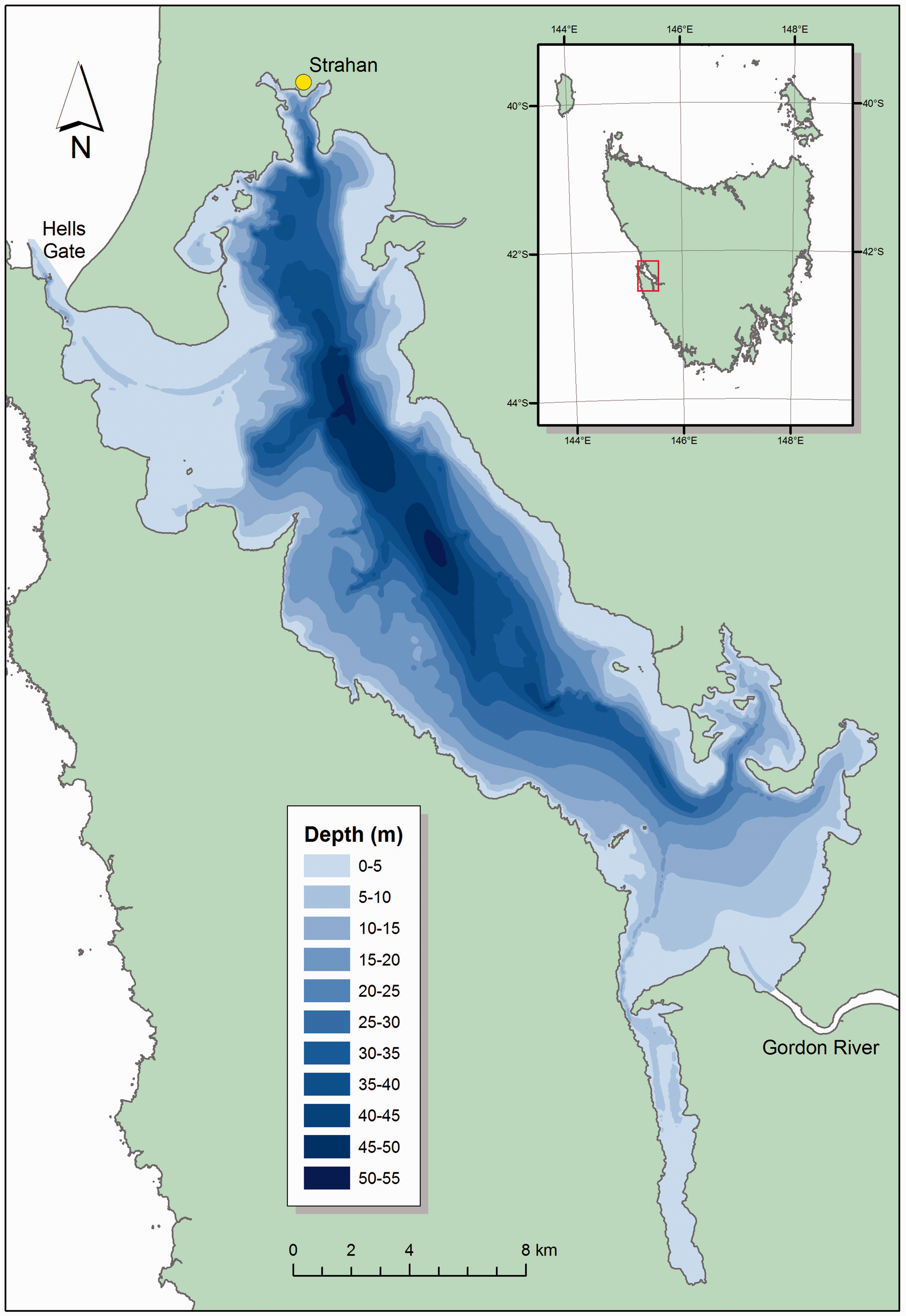
Location of Macquarie Harbour. Source: Lucieer et al. (2017). Reprinted with permission.
The first MFDP was approved for Macquarie Harbour in 1998. From 1998 to 2011 production was allowed to increase gradually to approximately 9,000 tonnes/year, without notable environmental impacts. In early 2011, the industry put the case to the regulator for a major expansion, arguing that various characteristics of the harbour (such as an absence of gill amoeba) provided significant cost benefits for future production. This is the starting point for our analysis.
A translation analysis of environmental governance in Macquarie Harbour
Coastal environments are highly complex, interlinked social and natural systems. They are therefore ideal settings for the exploration of nature–society interactions: thus Callon’s choice of St Brieuc Bay for the exposition of his ‘sociology of translation’ (1986: 196) is not arbitrary. In our case we examine how environmental governance of the complex coastal environment in Macquarie Harbour was enacted between late 2011 and early 2017, through the lens of Callon’s four stages of translation: problematization, interessement, enrolment and mobilisation.
Problematization: Defining the actors and obligatory passage points
In September 2011, the three salmon farm operators in Macquarie Harbour (Petuna, Huon Aquaculture and Tassal) applied for an amendment to the Macquarie Harbour MFDP, expanding the lease area from 564 to 926 ha. The proposed amendment was accompanied by a lengthy (557 page) Environmental Impact Statement (EIS), providing (inter alia) the results of detailed hydrodynamic and ecological modelling, carried out by a third-party consultant on behalf of the three operators. The EIS ultimately made the case for a ‘sustainable carrying capacity’ of farmed salmonids in Macquarie Harbour of 33 tonnes/hectare (Tassal, Huon Aquaculture and Petuna, 2011: 177). Farming at this stocking level would increase overall production in Macquarie Harbour from around 9,000 tonnes to 29,441 tonnes (Department of Primary Industries, Parks, Water and Environment (DPIPWE), 2015: 3).
The central question or ‘problematization’ motivating the salmon farmers’ intervention was essentially, ‘How can we increase salmon production in this area?’ Because increased production would likely have some environmental impacts, the problem became one of convincing the regulator that increased production would not cause significant environmental harm. Thus the concept of the harbour’s ‘sustainable carrying capacity’ became an ‘obligatory passage point’ (Callon, 1986: 205) between the status quo and the salmon farmers’ objective.
In Callon’s (1986) scallop case study, the problematization served to define three key sets of actors (the fishermen, scientific researchers and the scallops themselves), thus linking elements of the social and natural worlds. Here, too, selected aspects of the complex system of Macquarie Harbour and the many communities with an interest in it were reduced to a smaller set of key actors, including:
The salmon farmers. At this point, the three operators speak with one voice and are effectively defined as a single entity: the EIS carries all three company logos, and the possibility of other operators entering Macquarie Harbour is not entertained. The salmon. The problematization presupposes that maintaining the growth rate of salmon is paramount. This in turn implies that an environment conducive to salmon health must be preserved. Thus salmon (an introduced, farmed species) are taken to be the single actor in relation to which the entire concept of ‘environmental impact’ is defined: The notion of environmental impact is typically associated with the tolerance of the receptor … In the particular case of Macquarie Harbour, the organisms most likely to be affected are considered to be the farmed fish (Tassal, Huon Aquaculture and Petuna, 2011: 9). The ‘local community’. The local community is defined in the EIS as ‘a population of about 640 residents’ (Tassal, Huon Aquaculture and Petuna, 2011: 549). Their interests are asserted to include issues such as sound environmental management, continued access to harbour waters, local employment opportunities and the increase in population and services that could flow from this (Tassal, Huon Aquaculture and Petuna, 2011: 420). The regulator. At the time, the regulator was the Marine Farming Branch (MFB) of DPIPWE, reporting to the Minister of Primary Industries and Water. The MFB was responsible for both planning and environmental regulation of aquaculture, despite most other environmental regulation being overseen by the independent Tasmanian Environment Protection Authority (EPA). The scientific community. Various scientists were involved in Macquarie Harbour research. The scientists are connected to the salmon farmers via the TSGA, which overseas industry research activities, and through the Fisheries Research and Development Corporation (FRDC), which is approximately one-third funded by industry (Leith et al., 2014). The FRDC sponsored 96 research projects related to sustainable development of finfish aquaculture with a total value over A$25 million between 1991 and 2015 (Senate, 2015: 11).
In Callon’s case study, he observes that: ‘The scallops, the fishermen, and the scientific colleagues are fettered: they cannot attain what they want by themselves. Their road is blocked by a series of obstacles…’ (1986: 206). Likewise in our case, the local community has few options to attract jobs and services other than through growth in the salmon industry; the salmon farmers cannot expand production without approval from the regulator; the regulator cannot grant approval without considering environmental impacts; the salmon will not survive in increased numbers if their own wastes severely pollute the environment; and the scientists researching these impacts require industry and government funding. All are blocked in some way and rely on others to obtain what they want.
The notion of ‘sustainable carrying capacity’ offers the prospect of removing these obstacles and enabling an alliance to proceed between the actors. It is important to note, however, that the ‘sustainable carrying capacity’ of salmon in Macquarie Harbour is not a known quantity: it is a theoretical construct that provides an impetus for funding further scientific research, and a basis for the regulator to approve the salmon farmers’ desired expansion, which the local community hopes will supply jobs and attract more people and services.
Interessement: Locking the actors into place
While problematization is essentially discursive in nature, Callon describes interessement (drawing on the etymology of ‘interest’ meaning to be in-between or interposed) as involving the application of specific ‘devices’: ‘To interest other actors is to build devices which can be placed between them and all other entities who want to define their identities otherwise’ (Callon, 1986: 208). The example is given of scallop larvae collectors, which served to disassociate scallop larvae from various threats (e.g. predatory starfish, currents and fishing dredges) whilst simultaneously materialising the discursive claims made by the researchers about the threats to scallop larvae.
Callon notes that ‘The range of possible strategies and mechanisms that are adopted to bring about these interruptions is unlimited’ (1986: 208), and he mentions as examples the simple application of force, seduction and solicitation. Likewise in our salmon case, many different examples of interessement can be observed. The most salient of these is the ECO Lab model used by the consultants, commissioned by the salmon farmers, to model the harbour’s ‘sustainable carrying capacity’.
The ECO Lab model is impressive: coupled to a sophisticated hydrodynamic model of Macquarie Harbour, it models the interactions between 185 different ecosystem processes (Tassal, Huon Aquaculture and Petuna, 2011: 107). The model is an interessement device because it is, in effect, interposed between the key actors and the messy, complex reality of Macquarie Harbour, and it is essential for aligning the other actors, in particular the regulator, with the salmon farmers’ desired objective of expanded production. It acts through seduction rather than force: reducing the messy complexity of the harbour to a manageable set of specified parameters, and eliding all its unknowns into precise predictions, maps and diagrams. At this point in time, the model essentially makes up for a lack of measured environmental data: for example, due to limited availability, water quality data from just two sites over a single season were relied upon to calibrate the model. There is a sense that the model’s deterministic ‘whole’ is seen as a more credible reflection of reality than the incomplete and unreliable data. Yet this ‘whole’ was in fact incomplete, leaving out effects on deeper waters, in part due to these being difficult to model (DPIPWE, 2015), but also, it seems, due to being seen as unimportant: ‘Macquarie Harbour is ecologically very different to other farming areas in SE Tasmania; the sediments are inherently depauperate …’ (DPIPWE, 2015: 19, 47).
Enrolment: Negotiation and allocation of roles
Callon describes enrolment as ‘the group of multilateral negotiations, trials of strength and tricks that accompany the interessements and enable them to succeed’ (1986: 211) – providing examples of the many difficulties the researchers experienced with enticing scallops to anchor on the collectors (e.g. unfavourable tidal currents, unwanted visitors and predators). In our case, the interessements achieved initial success relatively easily, with the proposed MFDP amendment being approved by the Minister on 28 May 2012 (DPIPWE, 2015: 5).
However, this did not remove all obstacles to the desired expansion. The Commonwealth Environment Protection and Biodiversity Conservation (EPBC) Act 1999 requires approval from the Commonwealth Environment Minister before an action that is likely to have a significant impact on certain matters of national environmental significance can proceed. The proposed expansion triggered the Act because of its proximity to the Tasmanian Wilderness World Heritage Area, and the potential impact on an endangered species (the Maugean skate). Accordingly, on 29 May 2012 a request for approval under the EPBC Act was submitted.
On 3 October 2012 the Commonwealth Minister approved the expansion, subject to certain conditions, including a programme of video assessment of the benthic (i.e. sea-floor) environment and monthly water quality monitoring, and specifying limit levels that should not be exceeded for certain monitored parameters. The decision also required the total salmon biomass across all lease areas not to exceed 52.5% of the modelled sustainable carrying capacity, until a review in mid-2013 (Australian Government, 2012). These monitoring requirements and limit levels were then legally imposed on the salmon farmers via their licence conditions. From that point, the operators had achieved their main objective: they were able to begin stocking their expanded lease areas. But they also had to accept a new role: the responsibility for increased benthic and water quality monitoring.
Mobilisation: The creation of representatives
Callon describes mobilisation as the process by which a group of actors comes to be represented by a few individuals. In his scallop case, in the early stages of the scientists’ experiments, some larvae are found to anchor on the collectors: [These are then] considered to be the official representatives of an anonymous mass of scallops which silently and elusively lurk on the ocean floor … a handful of larvae … represent all the uncountable others that evade captivity. (Callon, 1986: 214)
In our salmon case we observe that the regulatory institutionalisation of environmental monitoring focused on certain parameters, which were taken to represent whole swathes of the broader ‘environment’ and the many actors contained therein. For example, just three parameters, specified only at shallow depths, come to represent water ‘quality’: nitrate, dissolved oxygen (DO) and ammonia (Australian Government, 2012). DO and ammonia are the two most important water quality factors directly affecting fish growth and mortality, while nitrate (contributed by fish and food waste) indirectly depletes DO through stimulating plant growth and decay. Thus the required monitoring of water quality privileges the needs of the farmed fish, in the surface waters. Furthermore, the quantities established for these limit levels were not based on observational data, as called for in national water quality monitoring guidelines, but solely on the ECO Lab modelling (DPIPWE, 2015). In other words, the model successfully comes to represent and ‘speak for’ the entire complex and messy reality of Macquarie Harbour itself, to the extent that its outputs are used to justify significantly less conservative limit levels than the default levels recommended in national guidelines for data-poor situations such as this. Likewise, a mere three parameters come to represent the totality of the concept of water ‘quality’. However, as we shall see, this apparently successful mobilisation did not last.
Dissidence: Betrayals and controversies
Callon defines controversy as ‘all the manifestations by which the representativity of the spokesman is questioned, discussed, negotiated, rejected, etc.’ (1986: 219). In his account, after the first successful year of the experiment, the scallop larvae fail to continue to anchor on the collectors, and those which anchored in the first year are later ‘shamelessly fished, one Christmas Eve, by a horde of fishermen who could no longer resist the temptation of a miraculous catch. Brutally, and without a word, they disavowed their spokesmen and their long term plans’ (1986: 220).
In Macquarie Harbour, likewise, all went well at first. The operators started to increase stocking levels, and to carry out monitoring of the three water quality parameters (alongside other monitoring, including of the benthic environment and fish health). In 2013, a review of the water quality limit levels was carried out, essentially comparing the predictions of the original EIS model with the new monitoring data. As the two sets of results agreed closely with each other, at least for surface waters, the industry concluded that the interim limit levels, which had originally been derived purely from the model, should be confirmed – and the regulator concurred. In ANT terms, the model as ‘black box’ was beginning to exhibit strong properties of irreversibility.
However, soon data started to appear which did not conform to the model. In late September 2013 the EPA, which had been carrying out water quality monitoring in the harbour for unrelated purposes, advised the MFB of a declining DO trend in middle and bottom waters that appeared to have commenced around 2009 (DPIPWE, 2015: 26). The MFB then examined the industry data and found a similar trend from 2011 to 2013. The MFB requested the salmon industry to investigate, and the industry established a DO Working Group (including representatives from the scientific community, industry and the regulator) in February 2014. The Working Group reported back to the MFB in October 2014, confirming the observed trend, but concluding that ‘knowledge gaps and data limitations … preclude definitive attribution of the recent DO decline’ (DPIPWE, 2015: 28). The reality of the harbour was proving to be far more complex and embedded in a wider network of interactions than originally conceived in the model. For example, the flow regime of the inbound rivers – a key factor influencing both DO renewal and depletion – was found to be influenced by actions taking place thousands of kilometres away across mainland Australia, thanks to the existence of the Basslink cable linking Tasmania to the national electricity market, which in turn influenced the operation and therefore the timing and volumes of water released by an upstream hydroelectric power station.
The next three years saw the steady accumulation of data that was increasingly ‘uncooperative’ (Bakker, 2004) in terms of its fit with the previous modelling. Video monitoring of the benthic environment, initially undertaken only on an annual basis, began to provide evidence of unexpectedly high organic enrichment, such as the presence of extensive bacterial mats and opportunistic polychaete worms, extending well beyond the expected ‘footprint’ below the salmon cages (DPIPWE, 2015: 35). No evidence of these polychaetes had been found in the baseline survey undertaken prior to amendment of the MFDP in 2012, but by November 2014, eight of the nine lease areas were affected (DPIPWE, 2015: 36), and new harbour-wide monitoring discovered high abundances up to 7.5 km from the nearest lease (Knight et al., 2015: ii). The regulator and salmon farm operators responded with remedial actions (for example de-stocking and fallowing cage sites), and also by increasing the frequency, intensity (number of sites), comparability (introducing control sites) and spatial extent of monitoring (Knight et al., 2015: 9).
Although this increased monitoring produced even more ‘uncooperative’ data, it failed for some time to make any real difference to the harbour’s governance: the MFB continued to allow production to increase in line with industry growth demands, up to the cap of 21,500 tonnes imposed in April 2016. Nevertheless, a tipping point was reached in the final months of 2016, which resulted in the remarkable reversal of January 2017, when the regulator demanded urgent de-stocking to a level of 14,000 tonnes within a month. The environmental data that had accumulated by this stage contributed to the reversal in two important ways: on the one hand, through official processes of interpretation carried out by those with access to the data (scientists, industry and the regulator); and on the other hand, through an unofficial chain of political interactions, largely involving parties without access to the data (environmental NGOs, politicians and the media). For these latter parties, the very existence of large sets of data on environmental conditions in the harbour was a sufficient cause for certain actions and demands, regardless of scientific interpretations of what the data might actually mean.
Information about the declining DO trend was closely held between the regulator, scientists and salmon farm operators, but in March 2015, a leaked draft of the DO Working Group’s October, 2014 report was tabled in the Australian Parliament by a Green Senator, who argued that: These leaked documents suggest Macquarie Harbour is potentially a ticking time bomb … If Tasmania’s clean, green brand is to have integrity and longevity, the state and federal governments must work with stakeholders and act quickly to understand and rectify potential environmental problems. And they must do so with transparency.
6
… the third major salmon farming company in Tasmania, Tassal, was about to breach the biomass cap in Macquarie Harbour; and that the Tasmanian regulator was engaged in ‘disingenuous and misleading’ conduct and that this was putting at risk both the health of waterways and the future of the industry (Senate, 2015: 129).
Another important change was the fact that the industry was no longer united in favour of increased production. Although the industry had closed ranks again during the Senate inquiry, this united front was spectacularly broken on 31 October 2016, when Four Corners, a national prime-time TV programme, aired an investigation in which Frances Bender, the CEO of Huon Aquaculture, shared her concerns with the new monitoring data, stating that ‘The science is telling us that Macquarie Harbour is a harbour under stress’: Four Corners interviewer: Tonight Frances Bender is breaking industry ranks … Could this industry be heading for a catastrophe in Macquarie Harbour? Frances Bender: Yes it could be.
8
Returning to the ‘official’ role of environmental data, a key input to the EPA Director’s decision was a summary report provided by independent scientists on the state of the scientific understanding of benthic and water quality conditions in the harbour (Ross and Macleod, 2017). With respect to DO, the report stated that: DO levels are now extremely low throughout the Harbour … All of the independent data sets (industry, EPA, Sense-T, Parks, IMAS and CSIRO) are providing the same picture; DO levels in bottom waters are now worryingly low (2017: 23). Whilst it is clear that farming can affect the DO levels within and under cages, it is not currently clear to what extent individual farms contribute to the low DO water body (bodies) in the broader Harbour, or whether this low oxygen water mass contributes to deterioration of the environmental and sediment conditions under/around farms (2017: 33).
To put this in perspective, up until 2011, DO monitoring in Macquarie Harbour took place only at quarterly intervals, and the resulting dataset is described as fitting on a single CD (Macquarie Harbour Dissolved Oxygen Working Group (MHDOWG), 2014: 13; Tassal, Huon Aquaculture and Petuna, 2011: 13). Monthly monitoring commenced in 2011, the first fixed-site continuous loggers were installed in, 2013 and mobile sensors on ‘sentinel’ fish were introduced in 2015. The real-time DO observation network continues to expand, with sensors now planned to be placed on individual Maugean skate in order to monitor the conditions that they experience in the wild. 10 The spatial resolution of monitoring has also increased, with more stations, more widely dispersed across the harbour, with more detailed depth profiling. A single day’s observations would now produce more data than the entire pre-2011 monitoring programme. The harbour has become ‘visible’ in far more detail and closer to real-time than ever before. As a result – in contrast to the situation in 2011 – environmental Big Data, rather than a model, now constitutes the main way of ‘seeing’ the harbour.
A new problematic: Access to data
With the increasing scope of environmental monitoring comes increasing potential for conflict over access to and interpretation of environmental data. As Leith et al. (2014: 288) observe, specifically in relation to the Tasmanian salmon industry: Environmental science is a potential source of power to change market[s] and politics. Concern about misuse of this power has historically led the information to be held in tight circles of control through institutionalized linkages between the regulator, industry, and science agencies.
These tensions were evident in the Senate inquiry. While acknowledging that some monitoring data is legitimately regarded as commercial-in-confidence, WWF Australia argued that environmental data should not be treated as such – drawing a parallel with wild-capture fisheries data, which is made publicly available (Senate, 2015: 32). However, an industry consultant warned that: one of the risks to the industry and to the environment is that raw data collected from a variety of sources is interpreted selectively, in isolation, or to address issues which it was not designed to address. … raw data should be interpreted and presented by those who have an understanding of why … [and] how the data was collected, the limitations of the data, and provide an explanation of the interpretation. (Senate, 2015: 35) waterway health data … should be assumed to be public data unless there is good reason that it should not be. … The recommendation of the Committee … fails to reflect contemporary approaches to the public availability of data around monitoring and regulation. Governments the world over are moving towards immediate and unfiltered release of public data to facilitate community involvement (Senate, 2015: 133).
Internationally, the Aquaculture Stewardship Council (ASC) has recommended that weekly DO monitoring data be released at least on an annual basis, ideally via a centralised, publicly accessible database, although this policy on data transparency has not yet been finalised (ASC, 2012: 89). Confirming that access to data has become a key local ‘matter of concern’ (Boucquey et al., 2016: 4; Latour, 2004), in February 2017 Tasmania’s opposition Labor Party launched a new salmon policy, calling for real-time environmental data on all salmon leases to be provided to independent scientists for quarterly public reporting (Tasmanian Labor, 2017).
Conclusions
The study of governance is the study of power. We have explored this in our case study through the framework of translation, which is useful in this context because of its attention to non-human actors, and its broad interpretation of agency in terms of whether something makes a difference. Through this lens, the governance of salmon aquaculture in Macquarie Harbour can be seen as the result of a richer and more complex set of interactions than just those motivating the harbour’s human actors and institutions. This approach has enabled us to look more closely at the role played by environmental Big Data in the governance of Macquarie Harbour. We find that it has, indeed, made a significant difference – to the extent that we argue that one cannot properly understand the recent reversal in the harbour’s governance, nor its likely future trajectory, without considering environmental Big Data as a key actor.
We have observed how the initial problematisation of the harbour’s environmental governance was driven by the salmon farm operators, who wanted to increase production, but were constrained by having to convince the regulator that this would not cause significant environmental harm. The salmon farm operators successfully defined their own preferred species (the salmon), as the key ‘receptor’ or representative of the harbour’s entire diverse environment, and the concept of ‘sustainable carrying capacity’ became the obligatory passage point offering a solution to their problem. However, this theoretical concept still had to be translated into a specific amount of fish: a significant challenge, given the paucity of environmental data on the harbour at that point in time. Thus, the ECO Lab model was interposed between the messy complexity of the harbour and the principal human actors, with such success that its purely theoretical outputs were used as if they were real observations to set limit values for a set of three parameters that were mobilised to represent ‘water quality’. Unfortunately, as we have shown, the ‘field of visibility’ (Dean, 1999) established by the model and subsequently institutionalised in the governance regime via the limit values simply did not ‘see’ dissolved oxygen in bottom waters (a limit value was only established at 2 m depth). The existence of a mass of oxygen-depleted water in the bottom of the harbour was therefore overlooked.
This low-DO mass rarely interacted directly with either the salmon themselves, or the farm operators: even when it caused the deaths of 85,000 fish in a single event in 2015, the operator attributed this ‘minor stock loss’ to the unusual weather conditions that stirred up the low-DO water, rather than the low-DO mass itself. 12 Furthermore, the fact that the governance regime had been established on the basis of a model which ignored bottom waters meant that even once the low-DO mass started to become visible – thanks to the implementation of increasingly high-resolution environmental monitoring – it did not immediately lead to any major change in the governance regime: the DO limit in licence conditions was never actually breached.
Nevertheless, the new field of visibility established by environmental Big Data did start to make a difference, through a combination of official processes of scientific interpretation and unofficial political interactions. The scientific perspective treats data as an intermediary: what really matters is authorised interpretations (manifested in various inscriptions) of what the data means about the reality that it is assumed to represent. However, as datasets grow larger, denser in spatial and temporal coverage, and more interconnected, the resulting ‘mass’ of environmental Big Data starts to assume a ‘life of its own’, overflowing into new social domains, with unpredictable effects. While the political interest in environmental Big Data includes what it means, it also is very much concerned with who has access to it, and whose interpretation is to be trusted. From this perspective, environmental Big Data is an unpredictable mediator: its outputs (interpretations) are not straightforwardly determined by its inputs (measurements), but depend on the perspective of the interpreter. As one scientist explained: A lot of people were using the environmental data in the media as a battering [ram], a blunt instrument, against … the industry or the government or the scientists or whatever … we could see, very clearly, people weren’t interested in listening to the whole – they only wanted the bite size piece that supported their particular … advocacy point.
13
Our empirical case adds to both ANT and environmental governance scholarship by demonstrating that the concept of translation can be used successfully to highlight the agency, power and politics of a hitherto largely overlooked, yet increasingly influential, actor in environmental debates: environmental Big Data (Bellanova, 2017; Gabrys, 2016; Kitchin, 2014). Comparing our case with the foundational case that inspired the development of the translation framework, that of scallop domestication in St Brieuc Bay, France, in the 1970s, underscores how radically the role of environmental data has changed over time. In Callon’s account, data is an ephemeral intermediary stage in the production of inscriptions: for example, ‘The larvae anchor themselves and are counted; the three researchers register these numbers on sheets of paper, convert these figures into curves and tables which are then used in an article or paper’ (1986: 215). This likely reflects historical limitations on the potential social interactivity of ‘small’ (especially non-digital) data, vis-à-vis portable inscriptions, such as charts in scientific papers. Before full digitisation, let alone massive online storage and open data initiatives, most data could only practicably be handled by a tiny community of researchers, and as Latour and Woolgar (1986: 63) observed, ‘once the end product, an inscription, is available, all the intermediary steps which made its production possible are forgotten’. Today, however, in a world where over 1.8 trillion gigabytes of data was already on the Internet by 2011 (Kitchin, 2014: 70), it no longer makes sense to regard data as a mere intermediary, but rather as a key mediator in social relations.
Highlighting the agency of environmental Big Data in our case study is not intended to downplay the agency of any of the other actors, or indeed the actor-network as a whole. In fact, as Bear (2013) observes in a comparable case study of a Welsh scallop fishery, agency is co-produced by the interactions between heterogeneous actors that may be widely dispersed in both space and time. Our contribution is to highlight the fact that technological developments are now making previously invisible underwater worlds visible in startling detail (Hussey et al., 2015), generating digital data that now actively interacts with both human and non-human actors in unpredictable ways.
Although our case concerns state-based environmental governance, the increased salience and agency of environmental Big Data is likely to be independent of the mode and scale of governance. Trends towards ever-increasing spatial and temporal resolution of environmental monitoring have been noted elsewhere (see for example Auld and Gulbrandsen, 2010; Gupta et al., 2012; Lövbrand and Stripple, 2009) and new monitoring technologies have been identified as a transformative challenge for private governance via sustainability standards (Gale et al., 2017). Our case therefore contributes to the emerging literature on Big Data and environmental governance (Gabrys, 2014, 2016), supporting the view that the very existence of environmental Big Data has important implications for what we perceive as environmental problems, as well as potential solutions.
Finally, the case points towards possible future directions for environmental governance. In aquaculture, we see the possibility of new approaches to regulation evolving which would be closer to the operators’ own real-time calibration of operating conditions, rapidly reacting to changes in the environment which can be ‘seen’ in ever more detail through data from a variety of sensor networks – in contrast to the traditional approach which was only able to respond to impacts after they were discovered via intermittent surveys. As one interviewee commented: Technologies are allowing a lot of leapfrogging … sensor technology [could] allow regulators to jump some stages and end up using sensors without having to go through the process of building up a huge compliance system.
14
[There used to be a] view that fisheries are different to other sectors such as forestry – with a fishery you can’t audit practices ‘on the ground’. This may have been true in the past, but technology now has the opportunity to give you good data about what is happening in real-time.
15
Footnotes
Acknowledgements
We thank the 'Sensing Natural Capital' project’s industry partners, National Australia Bank (NAB) and the Climate Disclosure Standards Board (CDSB) and all of our interviewees for their support. We are also grateful to the editors and three anonymous reviewers for their constructive comments on earlier versions of this paper.
Declaration of conflicting interests
The author(s) declared no potential conflicts of interest with respect to the research, authorship, and/or publication of this article.
Funding
The author(s) disclosed receipt of the following financial support for the research, authorship, and/or publication of this article: the Australian Commonwealth Department of Infrastructure and Rural Development under the Sense-T ‘Sensing Natural Capital’ project.