




Abstract
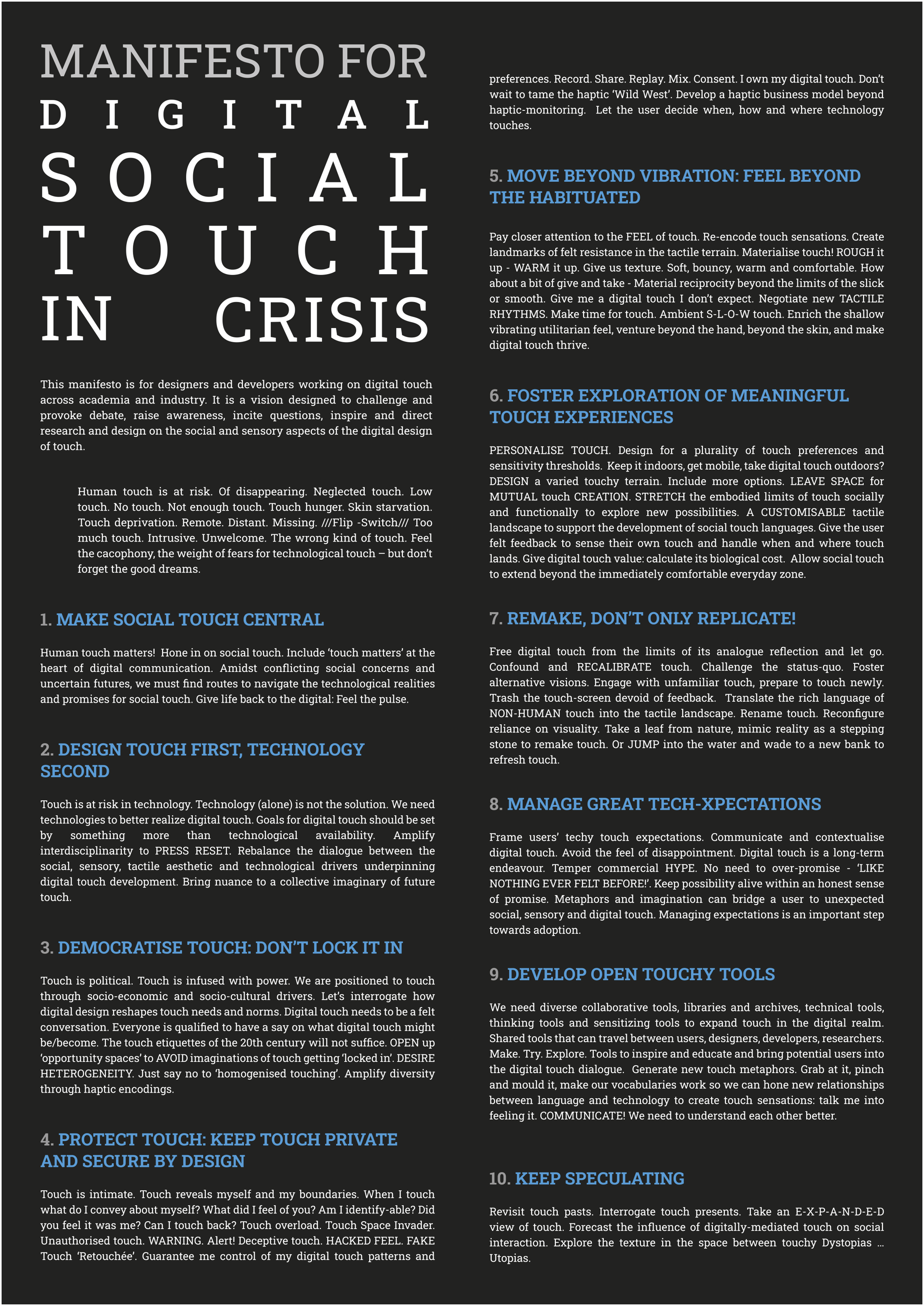
The social and sensory aspects of touch are critical for human communication, yet the challenges of haptic technology development and a focus on the technological means that digital touch communication often fails to realise the potential and promise of touch. The Manifesto for Digital Social Touch in Crisis responds to this through a call to action to rethink and reimagine digital touch. It offers 10 provocative statements as a resource for how haptic designers, developers and researchers might rethink and reimagine the social and sensory aspects of touch, and foreground these more in design.
Keywords
This practitioner reflection show the potential of the manifesto form (see Hanna and Ashby, 2022) to bridge between disciplinary boundaries in this case with attention to concerns about social touch. The Manifesto for Digital Social Touch in Crisis was developed through an interdisciplinary collaboration between computer scientists, designers, engineers, Human Computer Interaction scholars and social scientists from industry and academia. The collaboration and manifesto development method are outlined elsewhere (Jewitt et al., 2021).
The manifesto articulates seven foundational themes related to the key opportunities and challenges raised through the growth of digital touch facing designers, developers and researchers. These themes include the need to (1) broaden the conceptualisation of touch; (2) enrich digital touch experience; (3) engage with the wider socio-political context of touch including the commercialisation of digital touch (a theme also articulated in Golmohammadi’s contribution to this special issue); (4) understand and manage user expectations; (5) consider the design of touch privacy; (6) develop interaction design tools; and (7) encourage interdisciplinary dialogue on the social and sensory aspects of touch.
As society engages with and emerges from the uncertainty of touch in Covid-19 times, the Manifesto for Digital Social Touch in Crisis signals a desire for change and a rethinking and reimaging of the social and sensory aspects of touch through the design process.
Footnotes
Declaration of conflicting interests
Author Carey Jewitt is a member of the Editorial Board of Multimodality & Society. The author did not take part in the peer review or decision-making process for this submission and has no further conflicts to declare.
Funding
The author(s) disclosed receipt of the following financial support for the research, authorship, and/or publication of this article: The manifesto and this multimodal sensation was supported by the European Research Council (ERC) under the European Union’s Horizon 2020 research and innovation programme: In-Touch (PI Jewitt, Consolidator Grant agreement No. 681489) and Interactive Skin (PI Steimle, Starting Grant agreement No. 714797).
Correction (January 2026):
Author disclosure statements have been updated