




Abstract

Keywords
Haptic Care: harm reduction through the arts, an exhibition
Harm reduction happens in the pockets of exquisite care we show our loved ones, without questioning or judging their life choices, or imagining that we know better than they do. It’s extending a belief system of true autonomy and self-determination. I trust you, I’m not afraid of you. Here are tools that might be useful to you, do with them what you will (Hassan, 2022, p. 2).
Haptic Care is an exhibition that invites us to connect with harm reduction advocate-artists based in the U.S. who are using creative means to address drugs, drug policy and drug harms along with testimonies regarding the question: What forms can harm reduction take when we invoke touch? Participants came to explore various touch points to develop a diverse multimodal language of overdose prevention across various lifeworlds. The exhibition employs play as a vehicle for fluidity, enabling participants to explore alternative possibilities within drug policy and its underlying ideologies, even challenging and subverting them by appropriating contexts to reconfigure and transform them.
Harm reduction is a set of bottom-up, community-based empowerment strategies for people who use drugs. It involves the distribution of social and material resources including education and harm reduction supplies like naloxone. It emerged in a political context as a social movement reported first in Western Europe in response to the HIV epidemic. Similarly, in the U.S. context, harm reduction was adopted for public health and human-rights based drug policy with an urgent need to remedy injustices of the War on Drugs and an unprecedented surge of mass incarceration that has been separating people with non-violent drug charges from their social networks and families since the 1970s. The U.S. based advocate-artists in this exhibition embodied a foundational principle of harm reduction by “meeting people where they are” through resource distribution to queer nightlife communities, online followers, attendees at relevant international events, and people at every day, street-based outreach encounters. These strategies involve both tactile information and embodied expressions of touch. We argue that touch is the key intermediary of connectedness that can help deconstruct and question ideologies of the U.S. drug war: its isolating grip and stigmatizing hold that continues to inform security priorities including mass incarceration campaigns imprisoning majority Black, Brown and Indigenous peoples on non-violent, drug-related charges (Alexander, 2010). Touch, for us, is a shift in power away from the putative hands of the state to those of affected communities so we can identify the structures and technologies needed to promote safety. This multimodal experience draws closer people and objects through diverse worlds where care work and community are at the forefront of the struggle to reduce harm.
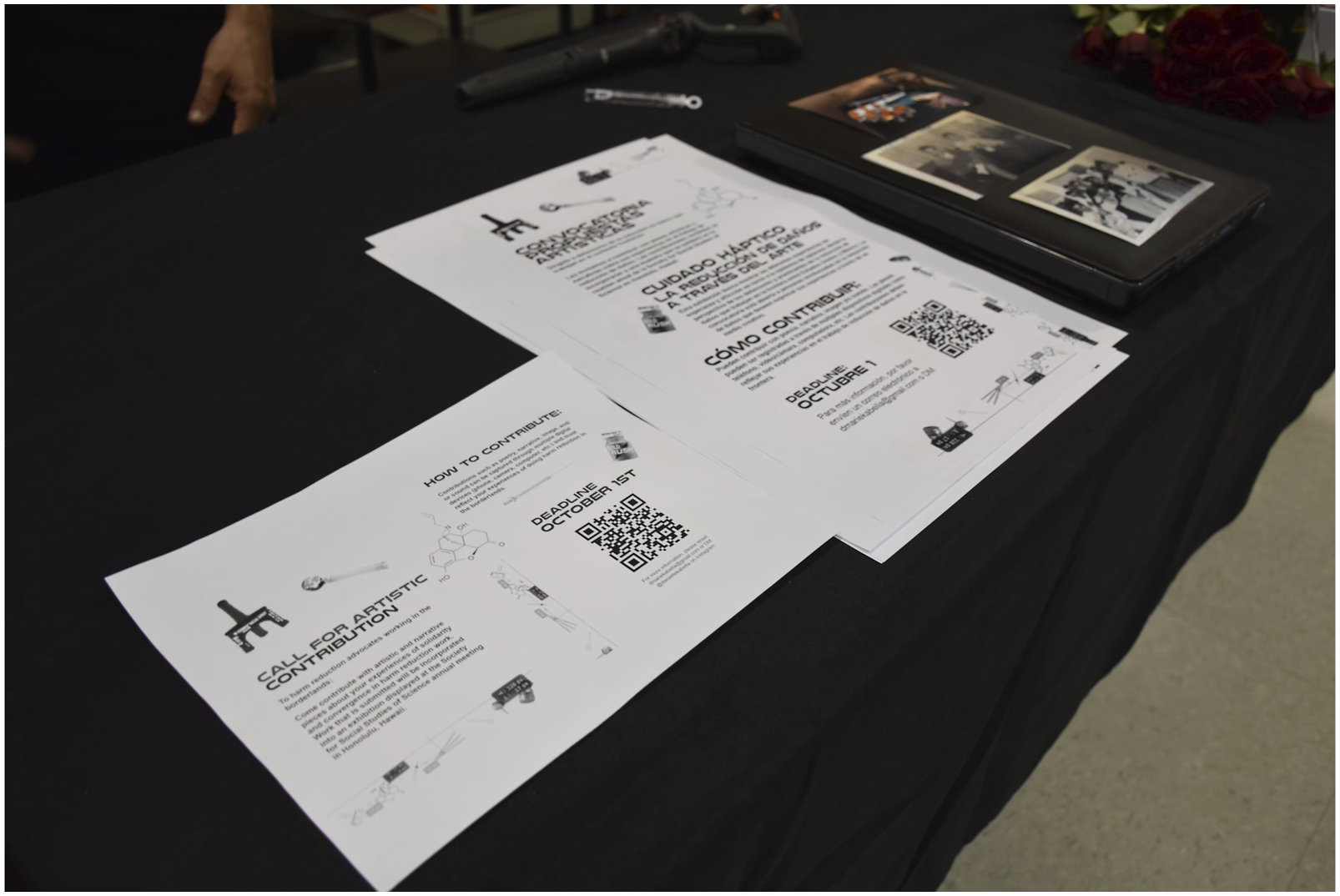
Collaborations with the grassroots organization, Sonoran Prevention Works led to a call for contributions for the exhibition at their annual event, “International Overdose Awareness Day” in Phoenix, Arizona (Figure 1). Work that was submitted was incorporated into an interactive exhibition displayed at the Society for Social Studies of Science (4S) annual meeting’s Making and Doing program in Honolulu, Hawaii in November 2023 (Figure 2). Participants were members of 4S, primarily academics specializing in the field of Science, Technology, and Society (STS). They convened around the exhibition to delve into the complex human and social dimensions of naloxone and other innovations in harm reduction within the United States. Scholars have describe the relational aspects of naloxone as technologies of solidarity (Campbell, 2020) and repair (Kabella, 2024), viewing these innovations as powerful emblems of collective action and social transformation. The exhibition’s multimodal approach enabled participants to engage with innovative methods of STS knowledge production. Call for Contributions recruitment table at Sonoran Prevention Works’ Overdose Awareness Day, August 31, 2023. Photos taken by Maya Salazar. Call for Contributions Flyer posted at Sonoran Prevention Works’ Overdose Awareness Day Event, August 31, 2023. Photos taken by Maya Salazar. Flyer designed by María Torres.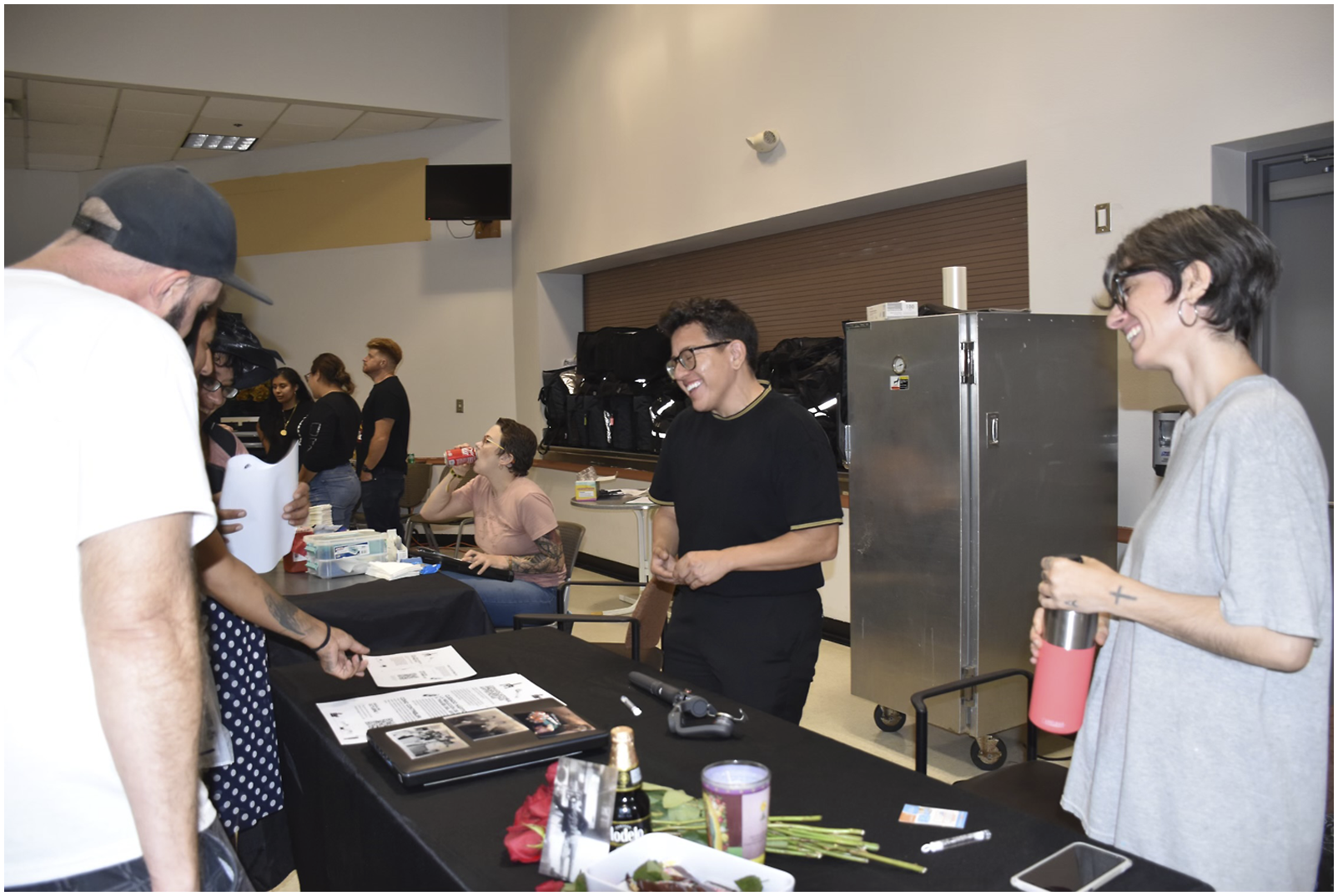
Participants were invited to engage with the exhibition in several ways: via headphones and screen, an interactive digital art archive, and a collage of photographs with accompanied origami making and doing activities. What the participant heard, touched, and viewed was under their influence. They heard audio from a Narcan demonstration performed in drag or a poetic prose which centered on a memorial of lives lost to overdose. Elsewhere in the exhibition, discrete items from harm reduction settings, such as naloxone were available for participants to follow along with the Narcan demonstration and interact with the contributions and each other. Touch was the dominate medium that underscored the project, where participants were invited to make meaning of overdose through new tactile and affective arrangements. We describe the contributions of this exhibition for this multimodal sensation to advance theory, methodologies, and empirical understanding of interaction and communication by showing how naloxone, visual-audio representations, and touch can transform interactions and communication about stigmatizing topics. This challenges societal norms that isolate people with chronic illness, like substance use disorders, by re-embedding them into society through touch, while holding in tension experiences of overdose prevention as a site of exquisite care and despair. Animated by their own histories, expertise, and crafts, all contributors offered expressions that include diverse modes of touch and the meaning and practices of harm reduction (Figure 3). Haptic Care exhibition presented at the Society for Social Studies of Science annual meeting’s Making and Doing in Honolulu, Hawaii. Photo taken by Dan Kabella, November 8, 2023.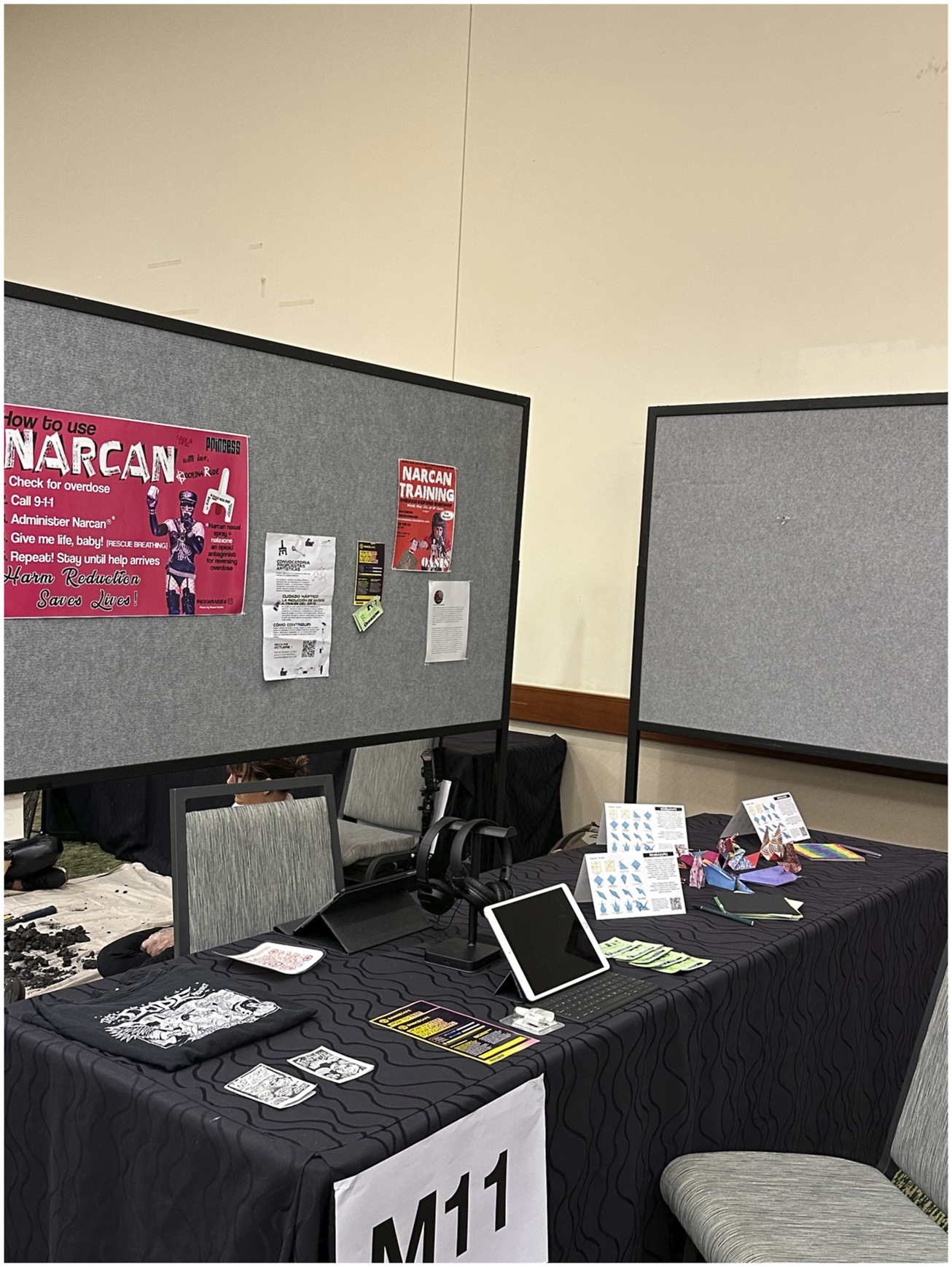
Naloxone: technologies of embodied touch
Harm reduction as a set of strategies and technologies works through contact (haptic) and contagion (of care) which we identify as haptic care. One haptic care technology is naloxone, a medication that is administered by someone other than the person receiving it in the event of an overdose. One of opioid’s friendly foes, naloxone, first to quickly attack by antagonizing opioid receptors at the brain then to protect with greater binding affinity, reversing opioid’s effects of respiratory failure and returning to the lungs some of the breath that was lost. Like its alchemy, two people are linked by antagonized chemical bonds putting into sharp focus naloxone’s dual function. A material bond intended for the body to evade biological death and scaled up to reclaim the living from the violence of isolation and social death. The chemical structures of body and society are (re)articulated when naloxone is administered because the kind of aid work it requires involves an assemblage of our social world that promotes a political economy of mutual aid, trust, and reciprocity. The interactions between objects and bodies aid in the creation of space where fewer deaths take place, and the reproduction of collective strategies keep people safe. Like human affection, naloxone, in its material and social form, draws attention to the seemingly invisible people and the collective strategies we use to take care of ourselves and the people we love within structures of abandonment that hold out the promise of protection against premature death for people who use drugs.
Logics of haptic care
Centering touch as a vital sensory modality for the human experience and for harm reduction work, we wanted to show how the steps needed to enhance naloxone effectiveness reframe the context of contagion. Naloxone, and harm reduction more broadly, work through technologies of contact and contagion. Majority poor and racialized non-white people who use drugs are largely invisible or represented in the most stigmatizing way through biomedical ideas of contagion. In this context, contagion is used to explain drug use and health complications like HIV and Hepatitis C virial infections that spread biological disease and social disorder. Instead, we reclaim contagion here as a decolonial register to transform this singular, damage-centric narrative (Tuck, 2009) of contagion into a desire-centric representation of care work. Contagion in this decolonial register is an important dimension of haptic care. From its Greek etymology, háptô refers to “that which is capable of coming into contact” (Depetris Chauvin, 2016). In this case, an overdose is an event that prompts another person to act, calling for a moment of contact and care that can spread through touch. The contributors’ works take up contagion by revealing everyday haptics of performing, making, scrolling, assembling, copying and reproducing care and desire to unsettle and nuance normative understandings of difficult experiences of using drugs.
The theoretical underpinning of Haptic Care draws on the work of Maria Puig de la Bellacasa (2017) concept of “haptic care.” We use Puig de la Bellacasa to “think with care” that more fully captures what matters to people who are intimately tied to life worlds of substance use. This project is experimental, yet it comes from a foundational literature in intersectional feminist studies and multimodality methodologies to foreground affect and emotion as ways of knowing harm otherwise. Puig de la Bellacasa (2017) argues that haptic engagement conveys the encouragement for knowledge and action to be crafted in touch with everyday practices. The sense of materiality of contact can take different meanings.
Haptic technologies—as matters of care—in this exhibition insist on a notion of care that includes life and living found in Vega’s live painting, Harary’s Celestial Heartbreak social media and Rude’s drag performance as well as death, dying and grieving and the liminal space between life and death in Bushaw’s origami cranes tribute and Kabella’s spoken word memorial to their kin. This multimodal exhibition suspends in time often irreconcilable affective complexities in doing the care work of overdose prevention as not something to be resolved hastily, but rather as a set of inquiries to always return to, asking ourselves, “how do we make visible suffering without taking away human agency of those who press forward for just and livable futures?” Haptic Care finds the memories of life and death; hope and affliction; and stability and precarity that dominant ideologies attempt to erase.
The remainder of the essay will document specific works by contributors organized around five logics of haptic-care: performing, making, scrolling, assembling, and coping-reproducing. Spectators were encouraged to “perceive haptically” haptic performances, images, and audio-visual productions that catalyzed a bond between onlooker and objects. The reception of touch in this way is the “combination of tactile, kinesthetic, and proprioceptive functions” that consist of “the way we experience touch both on the surface of and inside our bodies (Marks, 2000: 177).”
Performing haptically, Narcan and drag
Participants were invited to put on headphones and sit before a tablet screen with two doses of Narcan (nasal formulation of naloxone) nearby to follow along with the Narcan demonstration preformed in drag by Kochina Rude. The video revealed that performance was the driver of touch were care spread through the practical distribution of Narcan from performer to spectator. A laminated document was placed near the tablet for participants to read about the life journey of the contributor (Figure 4). The excerpt below, written by Kochina Rude, highlights this journey through multiple sites of border crossing—mestizx, queer, recovery— that laid down a foundation for educating and distributing Narcan in spaces otherwise ignored in normative public health initiatives—queer nightlife. How to use Narcan with love. Images created by Kochina Rude and Rachel Z Photography. Photo taken by Dan Kabella, November 8, 2023.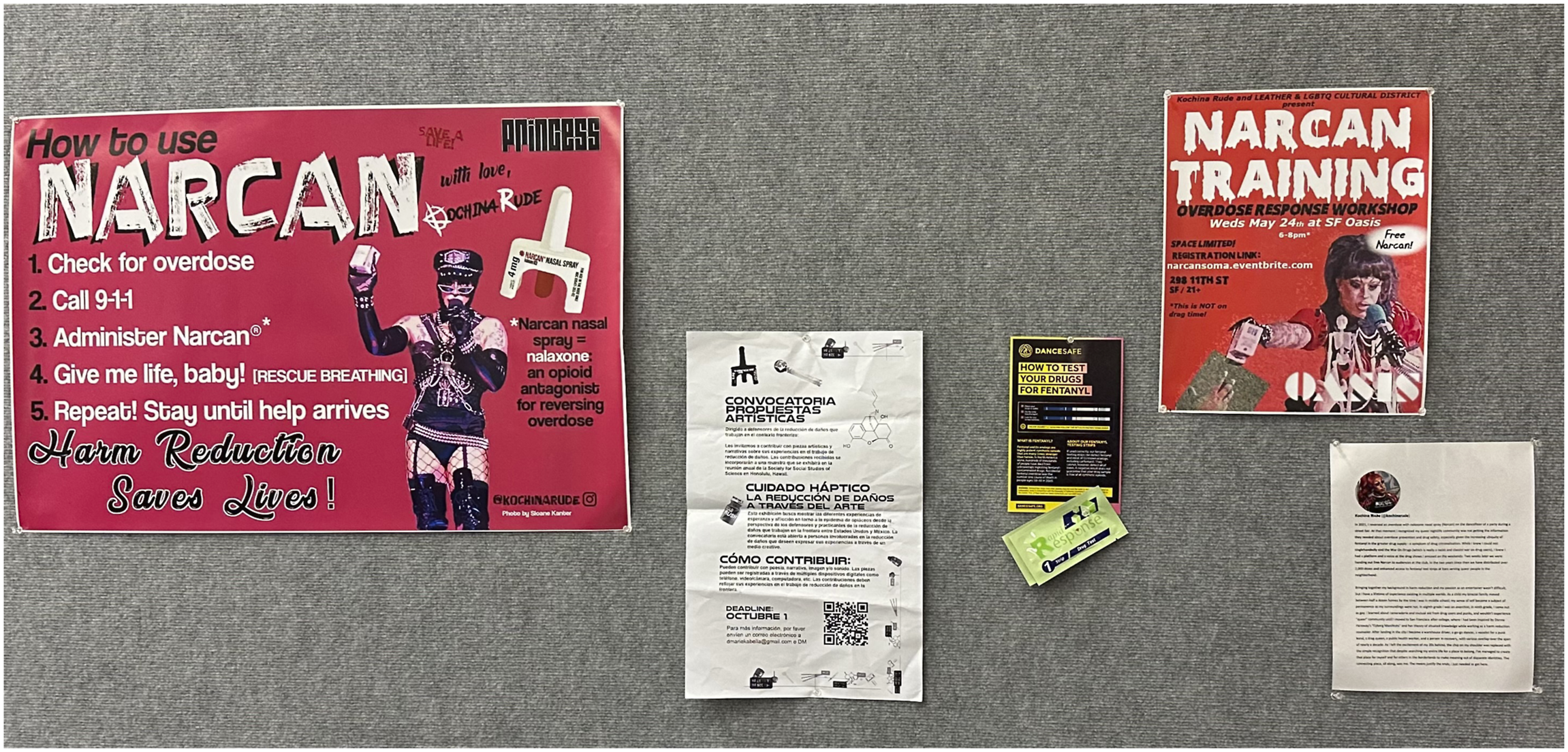
In 2021, I reversed an overdose with naloxone on the dancefloor of a party during Folsom Street Fair in San Francisco. At that moment, I recognized my queer nightlife family was not getting the information that they needed about overdose prevention and drug safety, despite the ever-increasing salience of fentanyl in the drug supply. Though I could not single handedly end the War on Drugs (a racist and classist culture war designed to criminalize drug users), I recognized I had a platform at the drag shows I hosted on the weekends. Two weeks after the incident we were handing out free nasal spray naloxone (brand name “Narcan”) to audiences at the club. Since then, we have distributed an average of 1300 free doses per year and increased access to fentanyl test strips at bars serving queer people in the neighborhood.
Bringing together my background in harm reduction and my passion as an entertainer wasn't difficult, but as a queer biracial person I have a lifetime of experience existing in multiple worlds. In eighth grade I was an anarchist, and in ninth grade I came out. As a teen, I learned about camaraderie and mutual aid from drug users and punks and wouldn’t experience “queer” community until after college when I moved to San Francisco. I was inspired by Donna Haraway’s (2013) “Cyborg Manifesto” and her theory of situated knowledge , as well as Gloria Anzaldúa’s (1987) New Mestiza, concepts I faced while working with drug users as a counselor for an AIDS organization. As a baby harm reductionist, I also became a route sales driver, a go-go dancer, a punk singer, a drag queen, a clinical preceptor, and a person in recovery, with various overlaps between identities within the span of a decade.
Since then, I’ve brushed the chip off my shoulder with a new understanding that despite searching my whole life for a place to belong, I've created that space for myself and for others like me in the borderlands. Between seemingly disparate lives, the connecting thread of my story was me all along. The means justify the ends; I just needed to get here. A link to the Narcan demonstration can be found here: https://www.tiktok.com/t/ZPR7ykPTk/
Making a Senbazuru and embodying 1000 lives
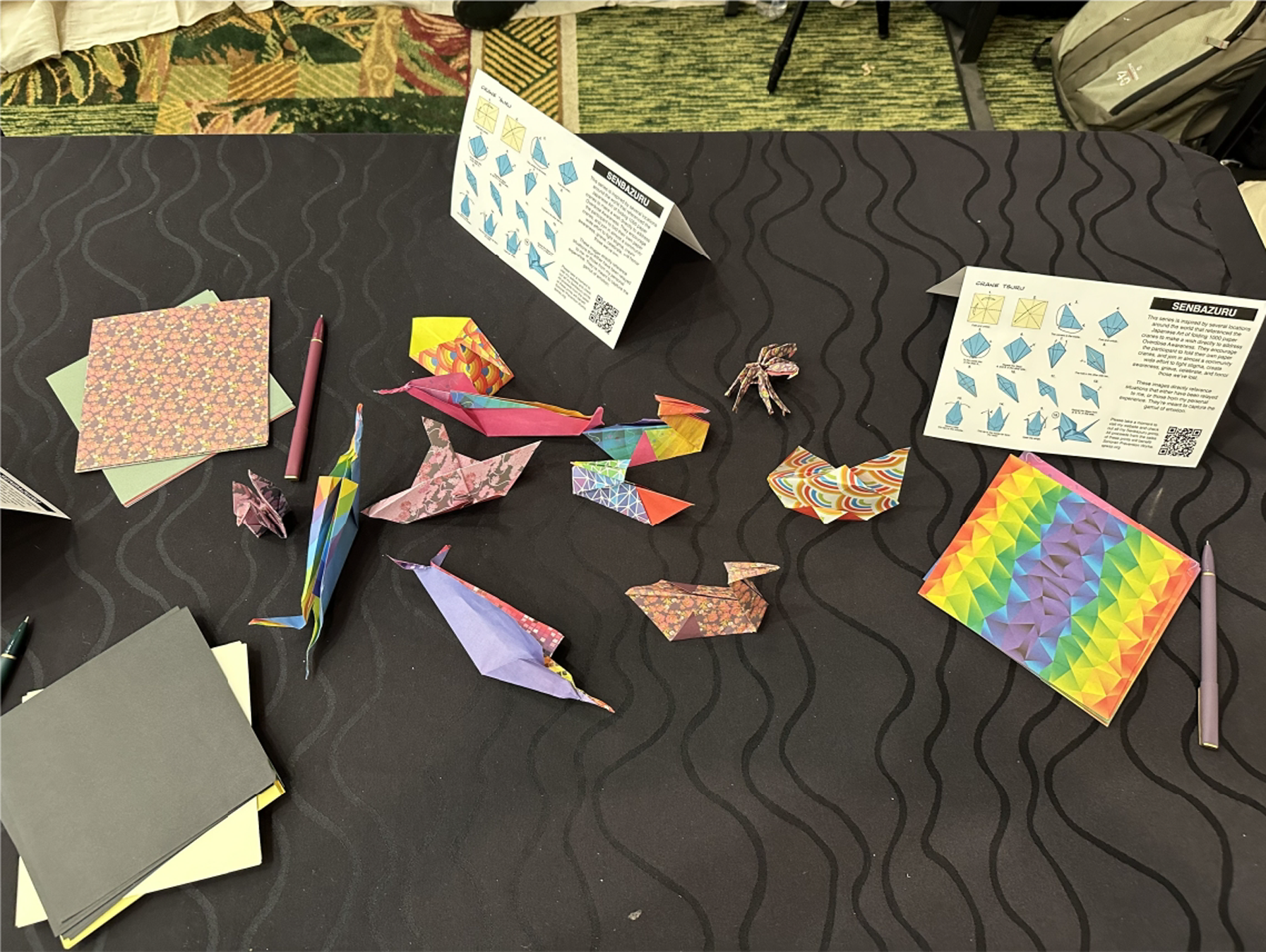
Elsewhere in the installation, acrylic prints from Kevin Bushaw’s series entitled Senbazuru of staged and photographed cranes hung on a platform for participants to observe. Each print represented lived experience and conveyed situations: pleasure, darkness, chaos, and joy. Affective interpretations were up to the viewer. The cranes, Bushaw stages and photographs embody the sensing, moving and relational body as not only situated, fixed within worlds, but in continuous passage through diverging experiential and affective states—through substance use, overdose, resuscitation, recovery, performance, joy, pleasure, isolation, grief, and loss. They capture the full breadth of human expression not just those that are pathologized and stigmatized but rather are involved in states of joy, pleasure, moments of triumph that represent living with drugs as acts of resistance against oppressive regimes and uneven relationships of power (Dennis et al., 2023). Below the prints were colorful origami sheets (Figure 5) with corresponding instructions (Figure 6) on how to fold a paper crane. Bushaw’s series was inspired by the Japanese Art of folding 1000 paper cranes and adapted as community wide effort to fight stigma, create awareness, grieve, celebrate and honor people who lost lives to opioid overdose. Participants were invited to fold their own paper crane in a collective effort. The experience afforded tactile touch and embodied touched of participants own and other’s affective experience through the making and creation process of folding a paper crane in memorial for someone lost to an overdose. Find the link to Bushaw’s Senbazuru book series here: https://issuu.com/kevbushaw/docs/senbazurubook Instructions for Senbazuru. Created by Kevin Bushaw. Making a Senbazuru. Photo taken by Dan Kabella, November 8, 2023.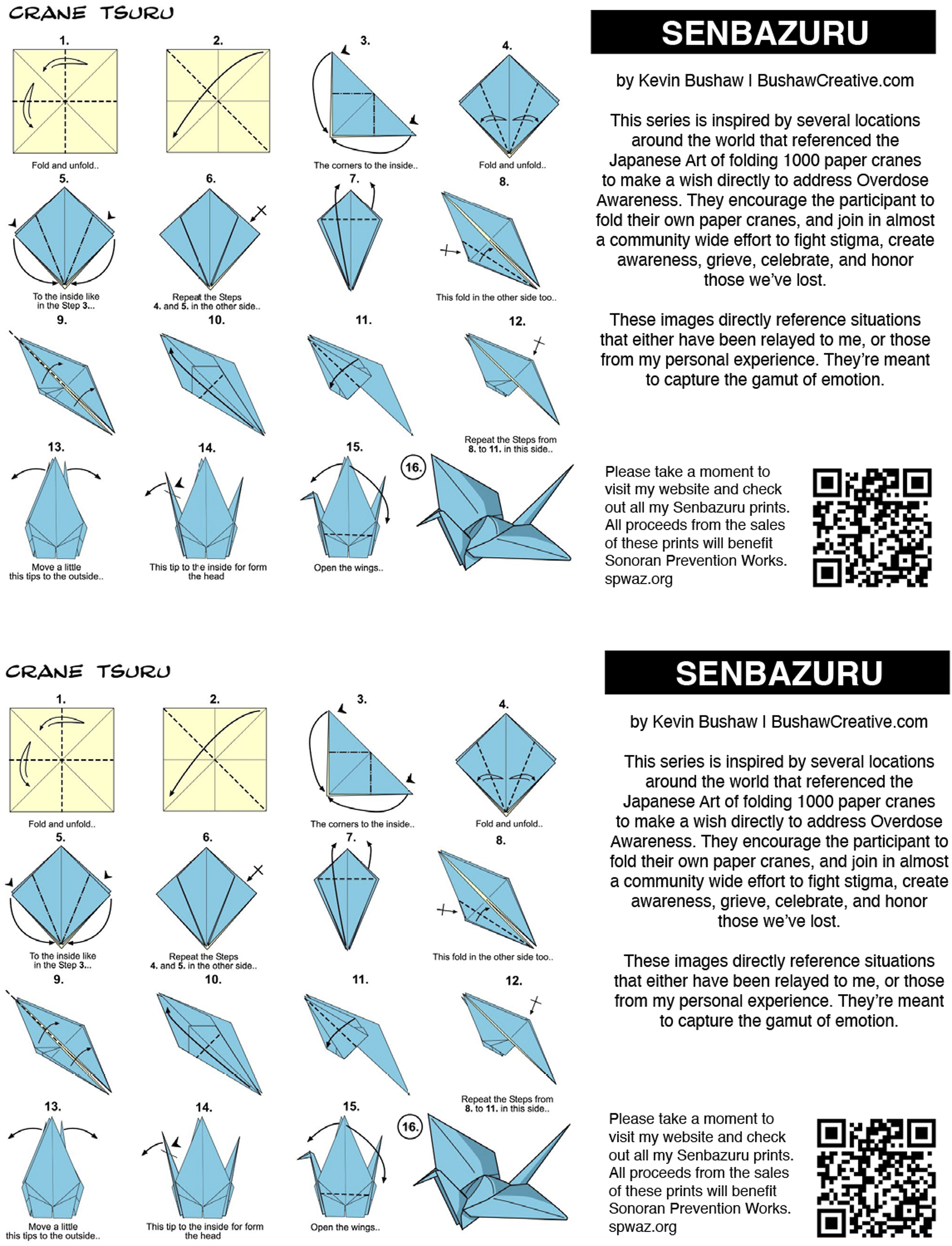
Scrolling the digital commons: never use alone
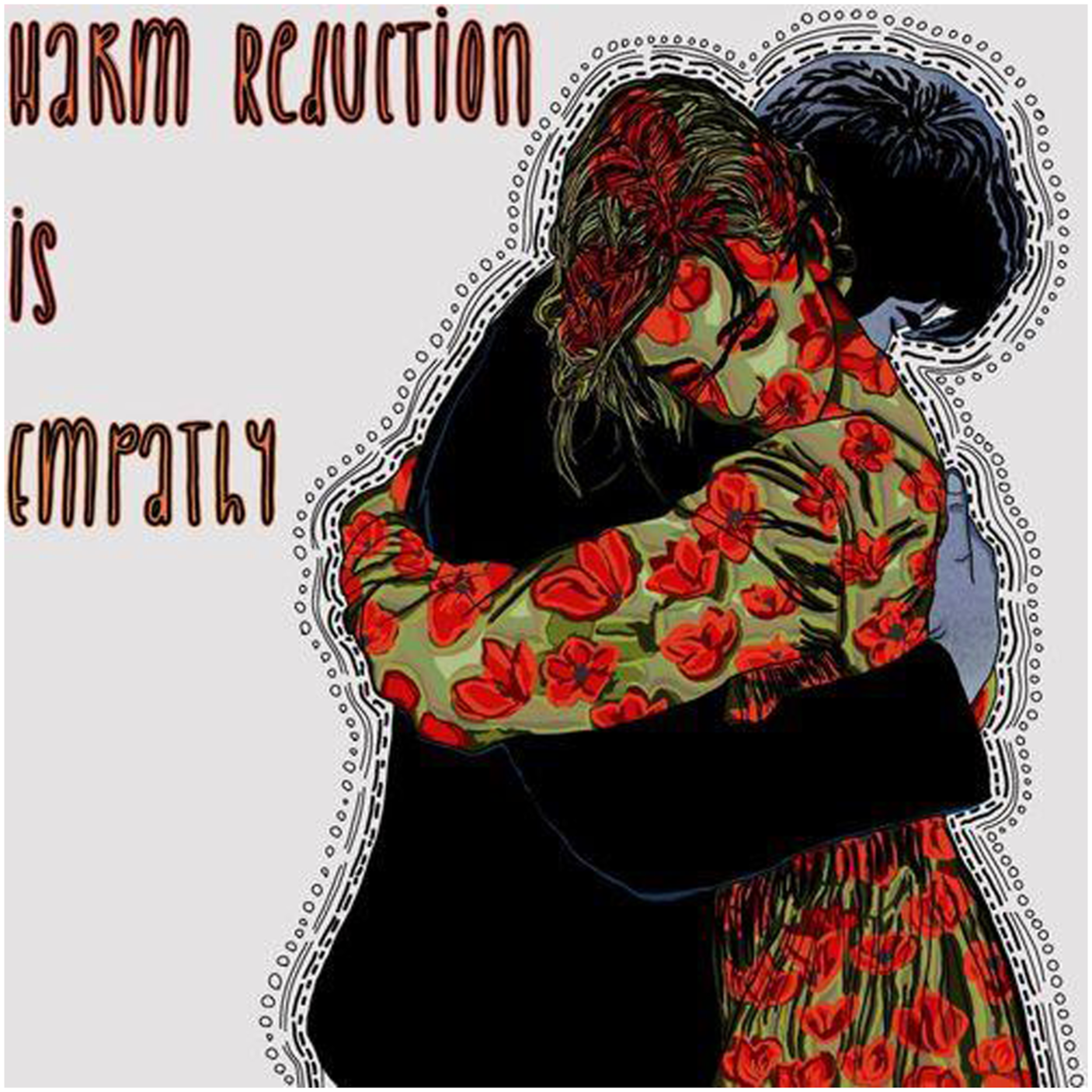
Participants were invited to interact with the harm reduction advocate-artist Jamie Harary’s haptic device and the Celestial Heartbreak social media page that displays her original artwork. Crowed around a tablet touch screen or accessed on their personal digital device by a QR code, participants scrolled the Instagram page curated by Harary herself, following, and liking content representing a range of concepts such as messages of empowerment, graphics encouraging naloxone access and use, and resources including the “never use alone” overdose prevention hotline, run by trained volunteers involved in the community-led campaign. The touch screens from the tablet or their phones augmented participant experiences where social media became a medium through which they can witness sensorial experiences of hope, pleasure, joy and more nuanced affective states (Campbell, 2023). Scrolling these digital commons invoked a sense of collectivity, mirroring aspirational messages that are put into practice on the ground through harm reduction. For example, an online presence, like the never use alone phoneline, is a consciousness-raising practice that directly challenges isolation and instead creates structures of safety needed to prevent overdose (Figures 7 and 8). Find the link to Celestial Heartbreak here: https://www.instagram.com/celestialheartbreak/ Exhibition screen and QR code to scroll Celestial Heart Break. Photo taken by Dan Kabella, November 8, 2023. Harm Reduction is Empathy. Original Artwork by Jamie Harary.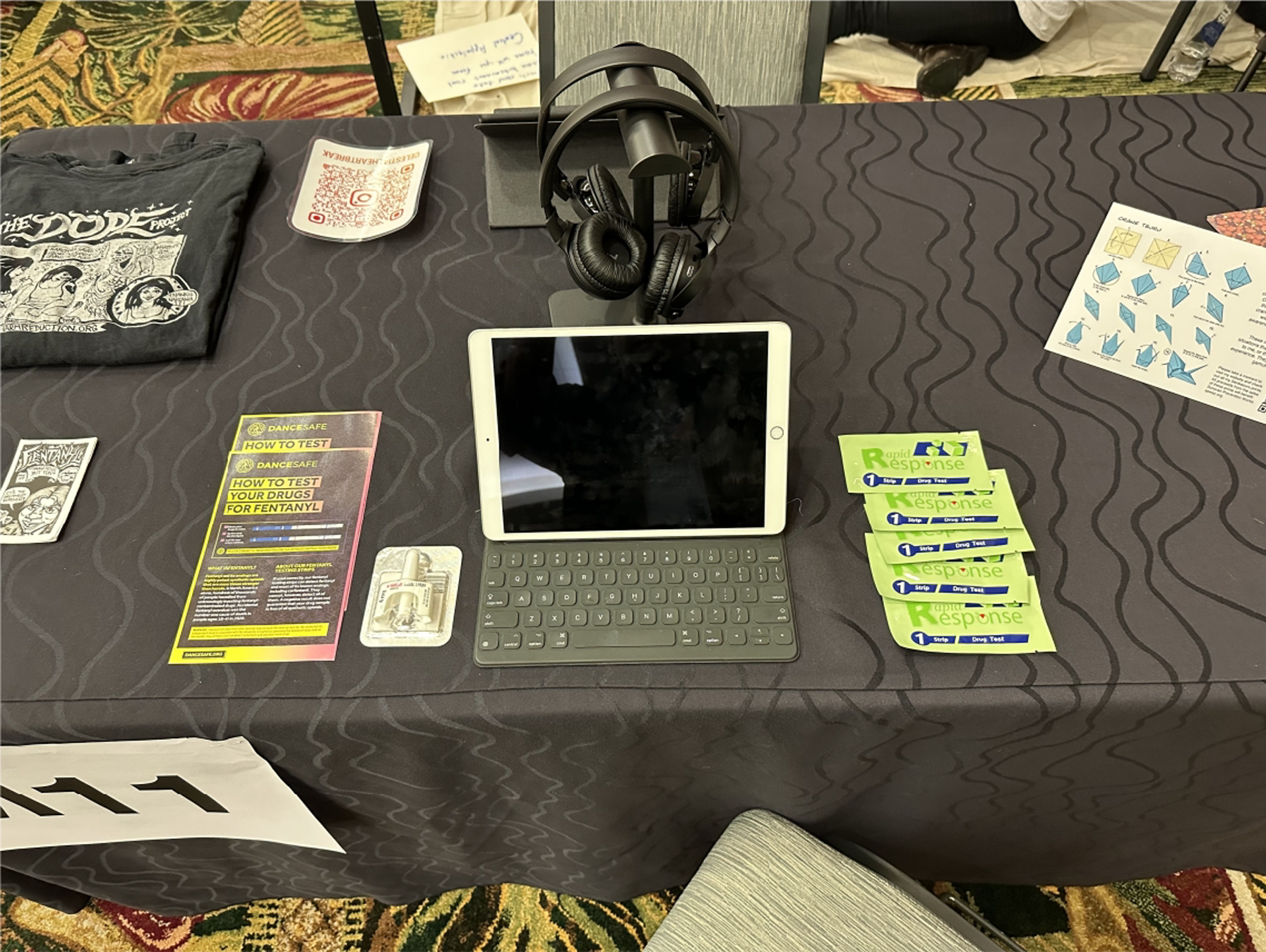
Assembling naloxone, memories and (after)lives
Participants auditory desires were accommodated by a spoken word submission capturing the experience of assembling naloxone as a veneration for the dead. In this case, they invoked the spirits of diseased kin whose lives were lost to an overdose. The entire spoken word submission entitled, “Chemical Encounters: (Re)thinking the Sustainability of Connection,” authored by Dan Kabella, is provided below.
Their bodies may have slipped through our fingers into eternal absence, yet they remain with us as we carry their memories and unfinished dreams to the next day struggling toward horizons in which to say, “these deaths shall not have died in vain”. The strangeness of the near and far of their remaining presence permeates our everyday life in both real and fanciful adaptations to the void that was created in their absence. We may disassociate from the reality of their demise only to hang on to the sound of their voice, the warmth of their hands, vowing to always remember precisely the way they said our names and rehearsing our final conversations over and over again to account for reciprocal moments of affection and love that we sometimes failed to make explicit between the breaths that now only pass through the lungs of the surviving leaving no choice but to carry on through life without them: one inhale and exhale at a time. Bargaining with a higher power our worldly possessions for sublime opportunities to see them so that we can say, “I love you” at least one more time.
While grief is an experience most people can relate to, the political conditions that structure grief are radically uneven. Grief practices for people who use drugs and communities impacted by drugs are often pursued by clandestine means in defiance of others who have shut their eyes to our suffering under the threat of stigma. As subversives, we mourn our dead, distribute naloxone and other tools that desegregate the surviving, and, above all, care for each other. Together we defend that their lives are not expendable and that the circumstances of their lives and deaths are beyond disavowal.
The compounded suffering of erasure and loss may compel people to act: to mobilize collectively against the political forces that perpetuate health and social inequalities that inflict profound harm to individuals and the communities in which they are embedded. To take control over the fragments that is our life, we may channel some of these tender sentiments into direct action carrying with us technological resources like naloxone in the hope that we can rescue another one from physiological decline before succumbing to a fatal overdose. We must not take this encounter lightly. For the benefit of inserting a nozzle tip in the nostril and plunging the medication into the body of another person measures up both with and beyond naloxone’s potent pharmaceutical properties—it renders a connection mediated by touch and passage of life from my breath to theirs. Being in direct line of site of another human is the surest way to prevent an overdose. Don’t let the people we love be claimed by social isolation through incarceration, stigma, discrimination and negative stereotyping that led to high-risk practices such as solitary use of drugs (Hanoa et al., 2024). Instead invite them everywhere that there is another person that is promoted to act, to contagiously care, to love by touch (Figure 9). Before, during and after of Naloxone assembly. Kits were provided by Sonoran Prevention Works. Photos taken by Dan Kabella, March 21, 2023.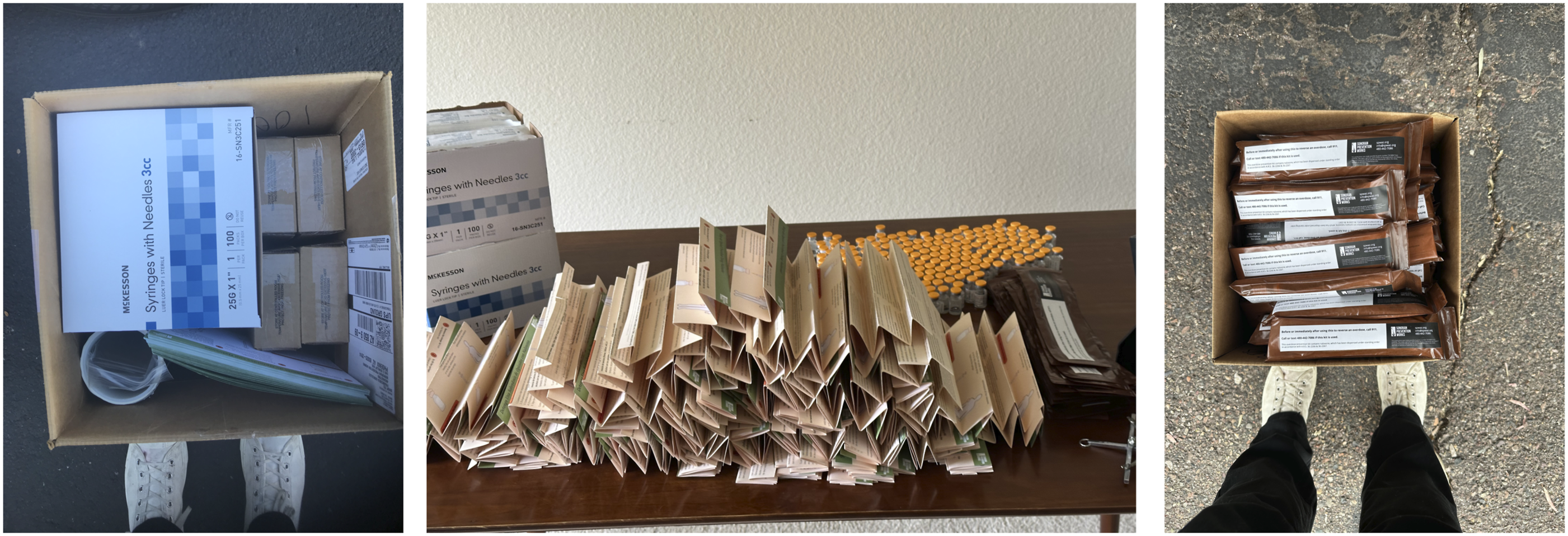
Narcania saves lives: copying and reproducing zines
Folded as a pocket-sized comic zine, Narcania, was placed on the table for participants to read. The comic zine is part of Mission Mini-Comix series produced by Mike Reger based in the San Francisco Bay Area. Their zines are open source and available on their website for download and distribution. Harm reduction organizations reproduce these for events and distribute them wherever they are based nationally and internationally. This process of copying and reproducing is a haptic logic that contributes to the contagion of care. Like how HIV and HCV genes multiply copies of new RNA that spread into new viruses, here, knowledge and resources copy, multiply and reproduce strategies that could aid in the prevention of overdose or uptake of viruses. Harm reduction transforms the context of contagion to the social contagion of care through a mechanism of comic zine that acts as an educational booklet about naloxone. Its storyline involves the fictional superhero “Narcania” who saves a life through the administration of Naloxone. Throughout each comic frame, practical knowledge is carefully written and illustrated about possible causes of an overdose, the use of Narcan as prevention, what Narcan is, how to get it, how to use it, and lists of do’s and don’ts of responding to an overdose (Figure 10). Various zine publications and Narcania t-shirt. Authored and illustrated by Mike Reger and the San Francisco-based cartoonist collective Mission Mini-Comix.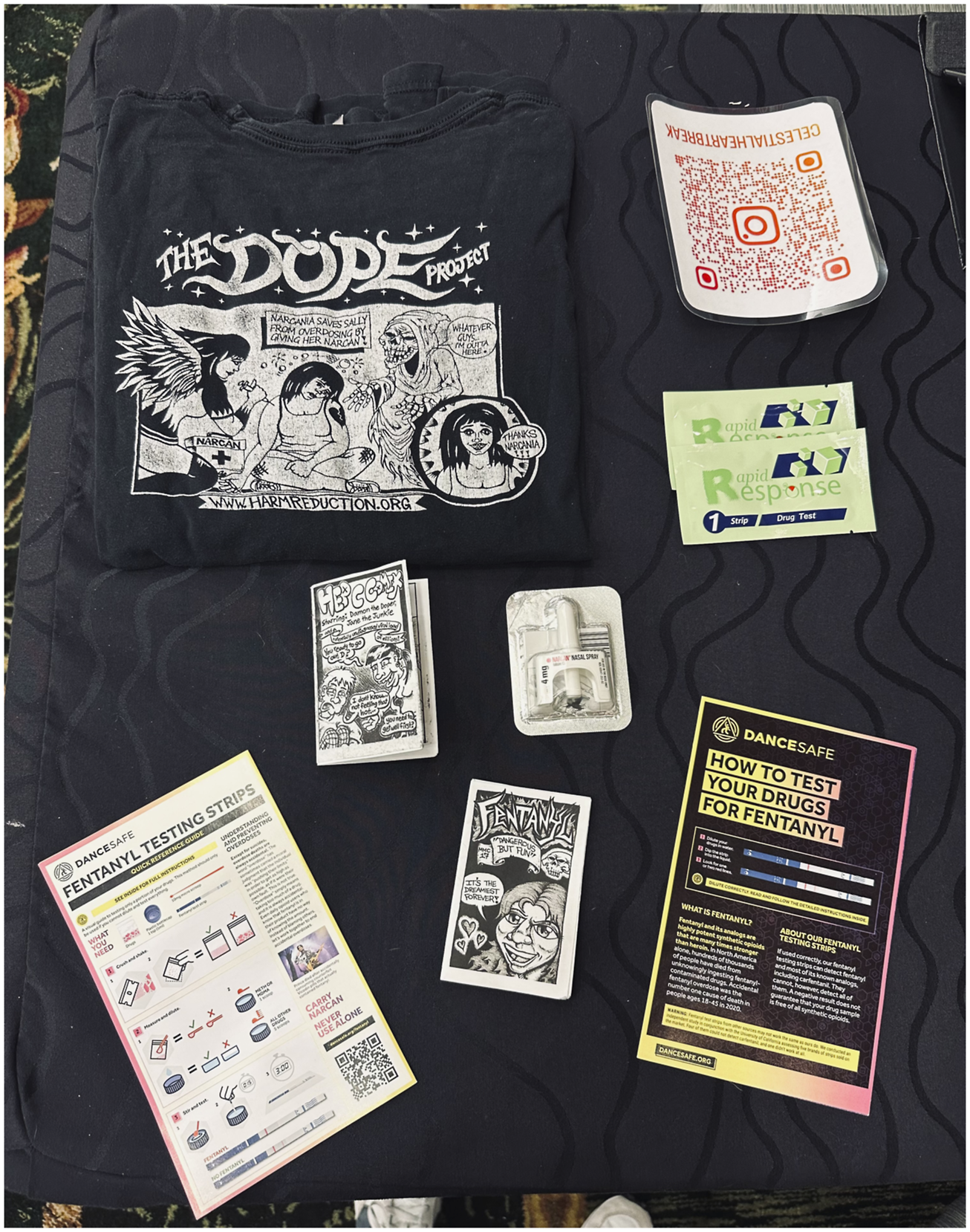
Conclusion: towards a contagion of care
The contributions outlined above articulate a set of social practices providing participants a multimodal language to understand overdose prevention. The exhibition mirrors haptic practices where participants are metaphorically “touched” and “touch” one another. These multimodal interactions and the realities they convey underscore the affective, intimate, and technologically mediated connections between individuals, as well as between people and digital agents, all expressed through an active assemblage of care.
Haptic is the human incorporation and embodiment of touch. This exhibition reveals that touch is not just localized in physical organs or gestures from our hands. Haptic exploration in the context of harm reduction considers and emphasizes care that can be articulated both through praxis and multimodal sensations. In so doing, this exhibition reframes the context of contagion from viral biological disease to viral (haptic) care through five mediated logics of touch: performing, making, scrolling, assembling, and coping-reproducing.
While we aimed to introduce multiplicity into conventional narratives of harm reduction and amplify the voices often excluded from official accounts—including those of the authors—our audience was primarily rooted in a Western perspective, particularly in the U.S., where Naloxone is readily accessible and human rights-based drug policies like harm reduction support the haptic care principles discussed in this paper.
These logics show that practices are not solely reliant on Naloxone (though it is a powerful tool for overdose prevention and should be easily accessible); they emphasize essential life-saving actions, such as restoring breathing and maintaining human (and virtual) contact, critical components of a Naloxone rescue. This implies that social remedies for opioid overdose demand a radical approach to care that goes beyond the limitations of chemical antidotes.
In northern cities of Mexico like Tijuana and Mexicali, restrictive drug policies make naloxone difficult to access, and militarized national police, lacking human rights training, confiscate the medication that is clandestinely brought across the border from the U.S. (Friedman et al., 2022). While social practices may connect with people and areas that naloxone alone cannot reach, this effort may also necessitate approaches that extend beyond care to consider demilitarization and abolition as alternative strategies. The exhibition will focus on these borderlands as a new emphasis, seeking to expand our audience by embracing touch and care from the margins while exploring alternative frameworks.
Still the multimodal approach will continue to emphasize playfulness, highlighting the role of fluidity in helping participants cultivate multiple sensibilities regarding drug use and overdose that extend beyond the confines of biological contagion. This environment invites participants to explore multiple strategies for addressing these urgent issues through various modes of touch—creating a social contagion of care.
Footnotes
Acknowledgements
Haptic Care was made possible by the wonderful contributions and support from Jamie Harary, Kevin Bushaw, Erin Vega, Haley Coles, Sonoran Prevention Works, Maya Montoya, Nicole Salazar, Rachel Sherman, Mission Mini Comix, Mike Reger, and Kelly Ray Knight.
Declaration of conflicting interests
The author(s) declared no potential conflicts of interest with respect to the research, authorship, and/or publication of this article.
Funding
The author(s) received no financial support for the research, authorship, and/or publication of this article.
