




Abstract
This paper, drawing on research from the ‘HANDMADE - Understanding Creative Gesture in Pottery Making’ project (sponsored by the ERC), will attempt to show how a focus on the temporality of touch and the tactility of making can help us disambiguate the often discussed, but little understood, dialogue between maker and material. Our main thesis is that with increasing levels of skill, tactile perception plays an active role in transforming a mere kinetic interaction (where potter and clay are causally coupled) into a multi-modal kinaesthetic transaction (where the potter becomes attentive to the expressive affordances of clay and recursively the clay becomes responsive to the creative affordances of the potter’s hand). We call this situational attunement between the potter and clay haptic attentive unity (HAU). The primary objective of this paper is to explore the links between touch and attentive engagement in the context of pottery making and use the notion of HAU to account for the dialogic character of creative material engagement.
Introduction
It is often claimed, by researchers and skilled practitioners alike, that making is a dialogue between maker and material (Aktaş and Mäkelä, 2019; Brinck and Reddy, 2020; Groth et al., 2013; Ihde and Malafouris, 2019; Ingold, 2013, 2022; Leroi-Gourhan, 1993[1964]; Karana, 2019; Kneebone, 2020; Mäkelä and Aktaş, 2022; Malafouris, 2013; March, 2019, 2021; March and Glavneau, 2020; Pallasmaa, 2009; Petreca, 2019; Ross and Vallée‐Tourangeau, 2021; Sennett, 2009; ValléeTourangeau and March, 2020; Walls, 2019). This statement seems to capture a basic characteristic of making as a relational process. But what does it mean? What kind of dialogue is that? The trouble here is, that in this presumed dialogical interaction between the maker and the material no one is actually talking to each other. In fact, acts of making are famous for how little use they make of language. If there is indeed a dialogue, it is not verbal. It makes no use of words. Any true conversation between maker and material must be expressed through different sensory modalities. Sound and hearing, visual resonance, feel, touch and tactility are some of the prominent candidates. For instance, one may see the foundation of this dialogue in the capacity for attentive listening of the material. This is how the famous Swedish guitar maker Georg Bolin’s describes his ability of listening to wood (Molander, 2018). Or one could follow the anthropologist Tim Ingold and see making as a process of ‘correspondence’ in which sentient practitioners and active materials continually answer to one another in the generation of form (2013; 2017).
This paper, drawing on our ongoing research in the context of the ‘HANDMADE - Understanding Creative Gesture in Pottery’ will attempt to clarify, and if possible to demystify, the meaning of this powerful metaphor of a dialogue between maker and material. When we say that we want to demystify it we do not mean we want to disenchant it. Quite the contrary, we plan to incorporate the enchantment of making in our method of demystifying it. The motivation of our examination is political and ecological as much as it is analytical. Dialogue is the basis of democracy. If form-making is a true dialogue between hands, tools and materials then acts of creation are acts of liberation; making is not the manipulation of matter, or the capturing of form, but the freeing of both. If on the other hand, some of the participants in this process are not allowed to have a ‘voice’, or to exert their agency, then creativity becomes a force of enslavement. In the context of creative material engagement, having an ecology that supports freedom of speech precedes, and is the necessary condition for identifying the capacity for speech in the absence of language.
Our main pathway to explore those issues will be the tactile mode of attentive material engagement. Attentive material engagement, more than a ‘mental’ or ‘visual’ phenomenon, denotes the state of bodily involvement or attunement characteristic of human skilled practices and modes of creative engagement. The logic of attentive material engagement (drawn or captured) is multimodal. It involves the skilled positioning of the whole body (e.g. through posturing, gesturing, active touch or anticipatory sensing) in a given material environment. Attentive material engagement forms a pre-condition of improvisation. Against the background of attentive material engagement this paper attempts to examine how a focus on the temporality of touch and the tactility of making can help us disambiguate this non-discursive dialogue between maker and material which verbal description can hardly attain to. We follow the ways of the hand as it moves with clay and ask about the agency and experience of touch: what touching does, who is doing the touching, what is touched and how it is touched.
Our basic proposal can be summarised as follows: with increasing levels of skill, tactile perception plays an active role in transforming a mere kinetic interaction between the potter and the clay (where potter and clay are causally coupled) into a multi-modal kinaesthetic transaction (where the potter becomes attentive to the expressive affordances of clay and recursively the clay becomes responsive to the creative affordances of the potter’s hand). We call this situational attunement between the potter and clay haptic attentive unity (henceforth HAU) (Figure 6). It should be emphasized here that the drawn distinction between kinetic interactions and kinaesthetic transactions relates with different levels of skilled attentive engagement, as developed with years of practice, rather than with different stages of the process of making. For the expert potter every stage of the form-making process provides its own distinctive affordances for kinaesthetic transactions. 2 In other words, the transition between kinetic interaction and kinaesthetic transaction is essentially a transition associated with different levels of expertise. As we explain below, representational accounts of creativity tend to mis-represent the process of making as a linear sequence of causal interactions thus failing to identify the kinaesthetic transactional logic of HAU.
We suggest, and discuss in the relevant section two major ways that the HAU can be understood. First, HAU denotes the feeling of mindful presence characteristic of the state of attentive material engagement. Second, HAU is also associated with the active exploratory use of touch in the handling of clay, that is, the use of touch as a tool of creative material engagement. Both dimensions of the HAU constitute key diachronic features of human becoming and creative evolution.
Theory and method
Our approach to the study of making follows the principles of material engagement theory (MET) which proposes a radical continuity between thinking and making: Thinking is in the making, or else, making is thinking (Malafouris, 2004, 2008, 2021a, 2021b, 2021c; cf. also Ingold, 2013, 2012). The three core assumptions of the material engagement approach are that: i) mind is not limited by the skin; ii) meaning is enacted through things; and iii) agency is a relational property of people and things (Malafouris, 2013, 2019, 2020) (Figure 1). The term ‘things’ should not be understood in the static sense of passive materials or finished material ‘objects’ but in the active sense of ‘thinging’, i.e., a cognitive ecology of moving materials, emerging forms, environments and techniques (Malafouris 2019, 2020). From the perspective of MET the clay at the potter’s hand is not a passive material for the imposition of form but an active part of the form-making process. Mind and matter form a unity (Gosden and Malafouris, 2015; Malafouris, et al., 2021). These are ideas that draw upon and resonate with new enactive-ecological trends in embodied cognitive science (Baber, 2021; Chemero, 2009; Clark, 1997; Fuchs, 2018; Gallagher, 2017; Glăveanu, 2013; Newen et al., 2018; Rietveld and Kiverstein, 2014; Vallée-Tourangeau and Vallée-Tourangeau, 2020), post phenomenology (Ihde, 1990; Ihde and Malafouris, 2019), and the anthropology of distributed cognition and creativity (Goodwin 1994; Hutchins 2010; Ingold 2011, 2013). The major postulates of Material Engagement Theory. Things are consubstantial, continuous, and coextensive parts of minds in action (the extended mind), agency is not a human property but the relational and emergent product of situated activity (material agency), and things as material signs bring forth rather than simply represent preformed concepts (the enactive sign). (Malafouris, 2013, 2019, 2020; Malafouris and Renfrew, 2010).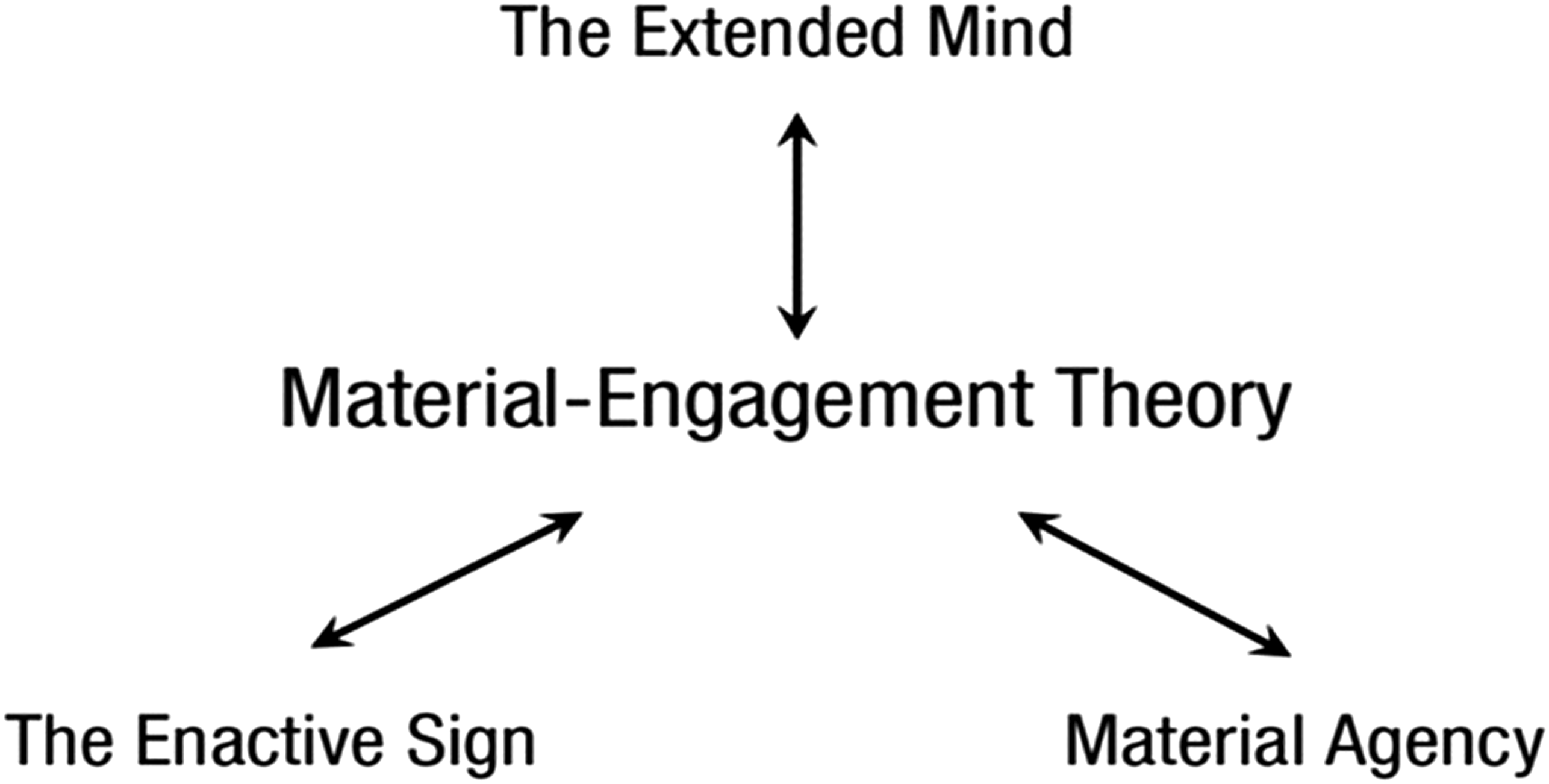
The above theoretical background is in constant dialogue with the project’s methodology. We undertake multi-sited and multi-modal participant observation adapted to the emerging empirical challenges of the HANDMADE project’s focus on the study of making and creative gesture. Essentially, we practice a form of cognitive and anthropological archaeology: we follow the clay and learn (also unlearn) the ways of the hand combining traditional track, collect and compare methods with enactive/ecological approaches that align with the emphasis of the material engagement theory in the mutually constitutive relationship between making and thinking. To that end we have been developing the method of Perspectival Kinaesthetic Imaging (Figure 2) inspired from Ingold’s ‘graphic’ anthropology of lines (2011), as well as from current developments in multimodal (Dicks, 2014; Dicks et al., 2011; Jewitt, 2017, 2019; Jewitt et al., 2020; Jewitt and Leder Mackley, 2018) and multisensorial studies (Pink 2011, Pink et al., 2014, 2016). Perspectival kinaesthetic Imaging is a method designed to facilitate the heightened sensitivity needed for the anthropological study of craft through the assemblage and juxtaposition of multitude view points on the process of making. This perspectival juxtaposition is made possible by a combination of multimodal visual captures (i.e., photography, video, drawing and mobile eye-tracking). Each of these multimodal visual captures affords a distinctive perspective from which to identify and observe events of interest (e.g. creative gestures and modes of enactive signification). Multimodal visual captures are set and employed in the context of multi-sited participatory observation.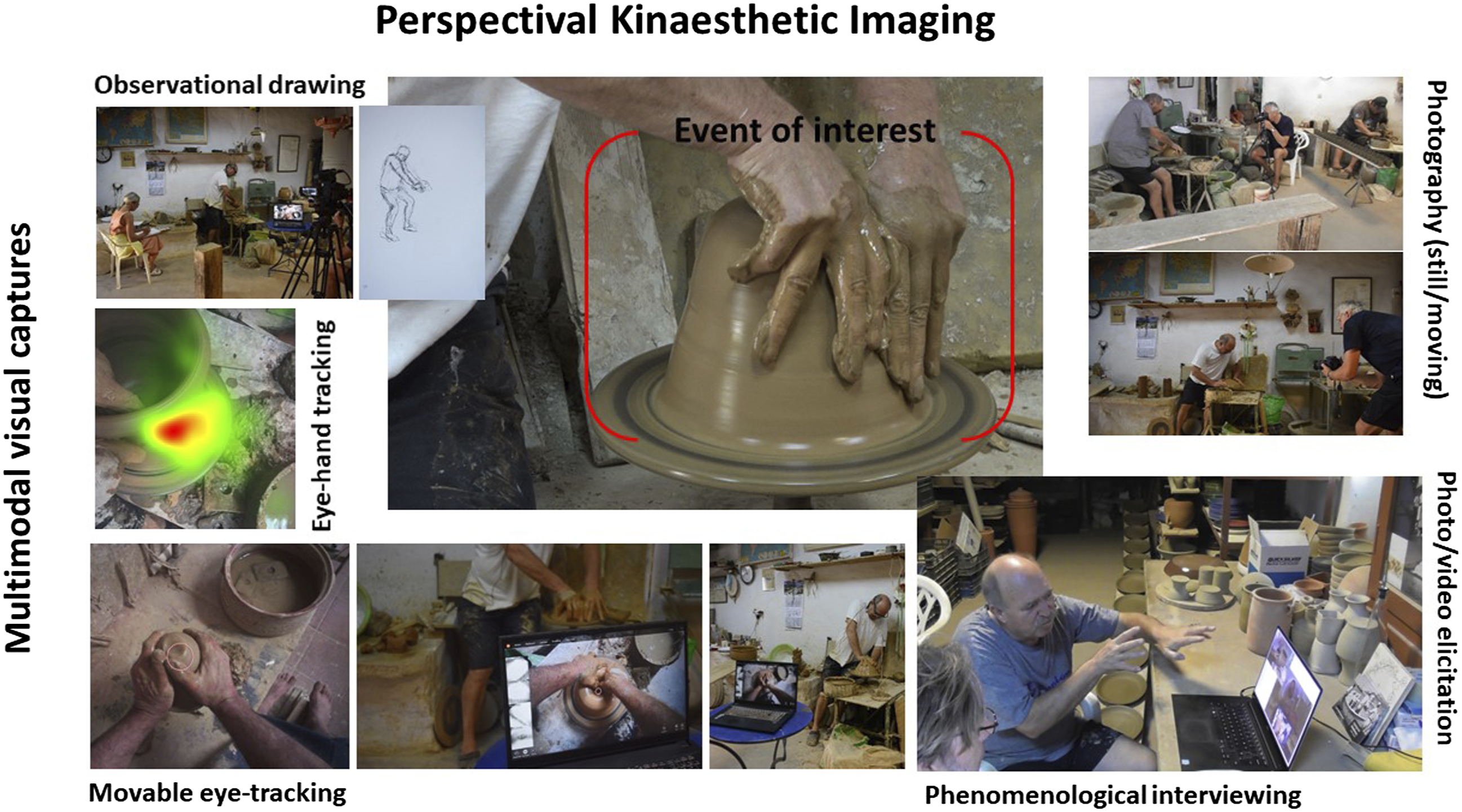
Specifically, Perspectival Kinaesthetic Imaging is an evolving methodological apparatus designed to facilitate the heightened sensitivity needed for the anthropological study of craft through the assemblage and juxtaposition of multitude view points on the process of making. This perspectival juxtaposition is made possible by a combination of multimodal visual captures (i.e., photography, video, drawing and mobile eye-tracking). Each of these multimodal visual captures affords a specific spatio-temporal perspective from which to identify and observe hylonoetic events (from Greek hylē for matter and noêsis for intelligence) of interest (e.g. creative gestures and modes of enactive signification) as well as follow their memory traces.
Perspectival Kinaesthetic Imaging should not be confused for a method targeting primarily the ‘visual’ aspects of making. Quite the contrary, it is a method designed for ‘capturing’ and ‘visualising’ multimodal aspects of creativity and skilled practices (including skilled vision) what often remain invisible or are hard to observe otherwise. The basic idea behind Perspectival Kinaesthetic Imaging is that the juxtaposition and comparison of different media enables the discovery of connections that are often obscured when seen from a single perspectival point. Thus, allowing for a greater understanding of the processes involved.
In particular, at a first level the use of multimodal visual captures allows us to follow and record material transformations and bodily movements as they happen in real time. Multimodal visual captures are moving rather than fixed. Their spatio-temporal positioning needs to resonate with the movements of the potters and the changing rhythms of generative actions that occur in different stages of the process and often have different requirements in terms of skill and attentive material engagement. At a second level, perspectival kinaesthetic imaging, combined with phenomenological interviewing, video/photo elicitation and semiotic analysis, allows us to capture (via tracking and imaging) events of interest that occur at different temporal scales during the process of making. These occurrences may be impossible to observe from a singular vantage point. For instance, some creative gestures are short-lived and leave no visible material trace, while others endure for much longer periods of time, leaving a permanent memory trace long after their completion. Moreover, the use of multimodal visual captures affords us to manipulate the flow of time returning and juxtaposing events of interest as many times as needed exploring their possible (previously unnoticed) connections.
To enhance our ability to study the temporality of touch and the tactility of making we have also introduced and experiment with new techniques such as mobile eye-tracking. 1 Suffice it to state here that the logic behind the use of mobile eye-tracking in the HANDMADE project is different from that we find it the psychological applications of that methodology. We employ mobile eye-tracking in order to follow and track the invisible path created by the eye movements of the potter during the task. This path (made up of fixations strings linked by saccades) tells us where and for how long the potter’ eye is touching the clay which we can then compare with the parallel visible trace left where the hand is touching the clay. This form of real time eye-hand tracking provide useful insights for understanding the temporality of making and the multimodal character of attentive material engagement. It has also proven to be an especially productive source for video elicitation and interviewing.
Overall, Perspectival Kinaesthetic Imaging is a process-oriented method (targeting modes of becoming rather than being) (Malafouris et al., 2021) which allows us to look from the inside out and at the same time looking from the outside in. It provides multimodal depictions that facilitate juxtapositions of events and the discovery of connections without being overly intrusive as a method.
Becoming one with the clay
When asked to describe what is distinctive about clay, or about their relation with this material, expressions like “clay is alive”, “I become one with clay”, and “clay speaks to me” are very common among the potters we have been working with in the context of the HANDMADE project. Ceramists are not alone in confidently professing themselves to see life and agency where other people (non experts) cannot. It is common for the skilled craftsperson to perceive the animate qualities and creative habits of the tools and materials that define their practices and skills. Different crafts and materials have their own affordances and morphogenetic potentials for creative imagination. This applies not only in the case of traditional handmade crafts but also for new modes of creative engagement with digital materiality (Bardt, 2022; Mulder, 2022; Nimkulrat, 2020; Parisi, 2021; Poulsgaard, 2019; Poulsgaard and Malafouris, 2020).
Of course, the potters’ descriptions and subjective self-assessments about the experience of making and the felt qualities of clay cannot be taken at face value. As every anthropologists and social theorists knows well, expressions like ‘clay is alive’ or ‘clay talks to me’ do not carry analytical conviction as such. They do not constitute theoretical descriptions, or explanations of why clay moves or behaves the way it does. Still, these sentences do express how the people who actually work with clay, and know it better, choose to articulate their experiences and should not be dismissed as poetic metaphors or merely things people say. As we came to know first-hand, working for many years and with many potters, these are the people who know clay ‘from the inside’ (Ingold, 2013; cf. also Bloch 2016) which mean that clay is part of who and what they are. They are both skilled makers and concerned observers (Malafouris et al., 2021) who spend their lives constantly learning and experiencing the plasticity, multimodality and multitemporality of this material – obviously we are not referring to those terms as theoretical abstractions but to the actual phenomena that those terms are used to describe. This does not mean, however, that the potters’ explanations are necessarily the best explanations, or that they are always accurate, or that there is a simple way to separate, from an anthropological perspective, one description as being more accurate than another. The potters often see difference where others see continuity and continuity where others see difference. They often unite things that our analytical predispositions may wish to keep separate, but they may also divide things that we seek to unite in our analyses. It is for the anthropologist (or any other concerned participant observer) to figure out what it is about clay and the ways of the hand that the potters are trying to communicate when they speak of the life and agency of clay. To that end, the anthropologist who is lacking the potter’s skilled vision and abilities of haptic perception, must take full advantage of the powers of participant observation, reflexivity and the comparative analytical stance. Naturally, neither the potter nor the anthropologist, in themselves, have the final authority to decide what is the best description or interpretation of the life, agency, or language of clay. Instead, they are both partners in an exploratory process in which potters and anthropologists combine skills and exchange knowledge and ways of seeing.
This is what the HANDMADE project has been trying to achieve by studying creative gesture in pottery making from the ‘inside’, that is, as a ‘concerned observer’(Malafouris et al., 2021). Participatory analysis and methodologies, like that of perspectival kinaesthetic imaging we employ in the HANDMADE project, are the products of this synergy of technical and analytical perspectives. Acknowledging the expertise of the potters and their unique insights is the very basis of our participatory anthropological framework. Once that move is made, and we shall explain below some of the theoretical pre-conditions for that, it becomes clear that the proposed life and agency of clay is not a matter of metaphoric language; or of misattribution of agency. On the contrary, it is the product of ‘education of attention’ (Gibson 1979; Ingold 2000) and the potter’s capacity for attentive material engagement (see section V).
So to give one specific example, when the two potters that you see depicted in Figure 3 (K. Depastas and A. Atsonios) describe the Sifnian clay as ‘alive’ they do not simply use a figure of speech in order to add emphasis to their narrative. Nor do they, as some psychologists are inclined to believe when confronted with similar animistic behaviours, misuse the human capacity of ‘social intelligence’ or of ‘mind-reading’ projecting life and agency to something which has clearly none, namely, clay (e.g. Guthrie 1995). The sociologist or anthropologist may also accuse our Sifnian potters of fetishism — saying that they have projected onto brute matter properties that can correctly only be attributed to human beings and other living creatures. They are also mistaken. Centring clay on the wheel is the foundation for throwing and form-making. The success of centring will facilitate or limit the creative transaction between the potter and clay.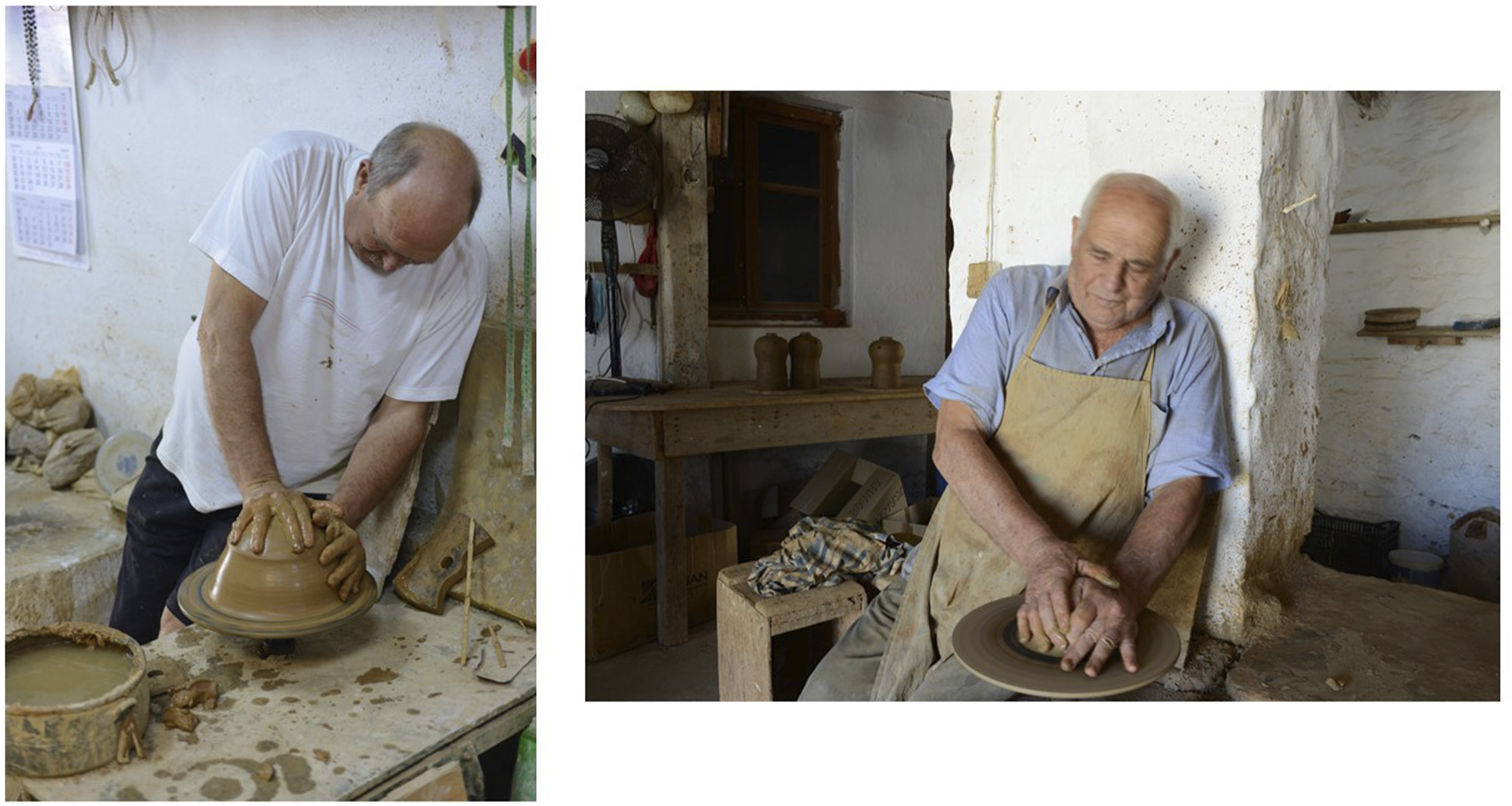
If the potters in our example come to think that the clay is alive is not because they are childishly misguided to animate matter - they do not commit any kind of epistemic mistake and they are more than capable of recognizing where reality ends and its metaphorical representation begins. Rather, their ability to experience the animacy of clay is simply the product of their increased sensitivity and responsiveness to the affordances of clay, or else, the feeling of and for clay (Malafouris 2014). It is that feeling of and for clay that allows them to participate in clay’s becoming and, thus, to imagine for real (Ingold 2022). The more skilled the potters become the more possibilities for the generation of form and material imagination will be forced upon their attention (Koukouti and Malafouris, 2020a; Malafouris and Koukouti, 2020). The active use of animate language serves to emphasise this vitality and multimodality of clay. The clay becomes alive and acquire agency because, like the potter’s body, is being positioned in a hylonoetic field of relations which brings material forms into being (Malafouris, 2019, 2021b). As we discuss below whatever term one may use to describe the exchange of energies between potter and clay it cannot be one that presupposes subjects and objects, rather, it has to be one that express their mutual becoming in form-making.
The potter’s responsibility is to create, and to make things in the ‘right way’. The anthropologist’s responsibility is to observe and to understand. To paraphrase Tim Ingold’s (2013, 6) observation in his book on Making: it is not that anthropologist only think and the craftsperson only makes, “but that the one makes through thinking and the other thinks through making.” Participant observation is a practice that calls upon the anthropologist to attend to people and things, and learn from them. Ingold sees an intricate relation between attending and waiting – to attend the world is to wait and to wait is to attend. Waiting is the vehicle for a special kind of attention, one that includes both the invitation and the potential of participation. This is how anthropology can then respond to the paradox of participating in something (which presupposes involvement in some sort of action), while observing it (which implies detachment) (Ingold, 2014).
The mindful handling of matter
Centring clay on the wheel is recognisably the most basic and difficult techniques in pottery making (Figure 3). It is the foundation for throwing and form-making (Klekot, 2021; Richards, 1989). Centring begins before throwing as the potter situates his/her body relevant to the wheel (side or front) and continuous throughout the process of making. It essentially involves the positioning of clay in between two major forces: the kinetic force of the spinning wheel and the kinaesthetic force of the potter’s hands. This careful emplacement of clay happens in anticipation of the state we describe as Haptic Attentive Unity (HAU). Or to put differently, the centring of clay is remembered in HAU (what in Husserl’s (1966) model of time-consciousness would be expressed as ‘retention’). Thus, the success of centring will facilitate or limit the creative transaction between the potter and clay.
There are two major ways to describe and account for that process. The one we may call representational-interactional and the second we may call performative-transactional. Put it simply, the main difference between the two accounts is the following: According to the representational-interactional account of centring it is the potter who is attuning his/her body with the clay. By contrast, according to the performative-transactional account it is the act of centring that is attuning the potter’s body with the clay. We advocate for the primacy of material engagement, and thus, for the latter view. But let us take a closer look on what both views actually imply.
We begin with the representational-interactional view. The obvious way to describe centring is to look at it as a causal sequential inter-action between potter and clay. This description conveniently presupposes the existence of two well defined and separate entities, i.e., potter and clay. These two entities, one active and the other passive, are given in advance of the creative process, and are interacting during the actual process of making when the potter is acting on clay. This view also implies a clear direction of time and causality: centring is a series of actions caused by the potter’s brain/body that unfords as a succession of isolated moments in time. Here is how the dominant view of mental causation and creative agency has it: sensory information about the clay and the relevant environment enters into the brain of the potter where it is internally processed (also stored) by the relevant neural networks. Partly the job of neural processing is to see if the incoming information matches the potter’s predictions, and partly, to issue further instructions for action. In short, those mental representations will provide the neural basis that will allow the potter to ‘make up her mind’ about how to proceed or respond to the material or the task ahead. Once the relevant neural networks decide or predict a course of action, the execution of a series of bodily movements that will allow the hands to transfer thought from mind to matter follows. If for any reason the hand, or the material, fail to respond as planned, than a new selection of perceptual prompts will be internalised and provide the stimulus for some newly initiated in-the-head response or correction. This is, of course, an oversimplified version of a complicated and heavily contested story of how brains make up their minds (Clark 2015; Freeman 2000; Frith 2013). Still the underlying message or ontology (predictive or merely representational/computational) is simple: thinking takes place inside the potter’s head and simply uses the hand to execute the necessary movements that will allow the mind to act on matter. This separation of the potter from clay, of the subject from the object, also answers the question of agency (i.e., who is the author of the doing?). Clearly, on this construal, it is the potter who imposes form on clay.
Sensible and intuitive this representational description as it may seem we have good reasons to suggest that it is not the most accurate way to describe the coming together of potter and clay. The discussed representational account, although well embedded in the dominant cognitivist ontology of contemporary psychology and cognitive science, fails to explain and largely misrepresents what happens when our potters actually engage with clay. Two major and related shortcoming are especially relevant for our argument in this paper: first, the misrepresentation of temporality (duration) as chronology, and, second, the misrepresentation of hylonoetic consciousness as bodily subjectivity. Taken together those major shortcomings are responsible for misconceiving the temporal co-constitution of potter and clay (their mutual becoming) for a sequential causal interaction between them. Which brings us to the second performative-transactional view of centring.
Look at the gestures depicted in Figure 4. Although they may be seen to represent sequential phases in the making of the pot they are by no means discrete. Creative gestures do not just follow one another in time, rather, each is carried over into the next as a path of movement along a line of clay. In other words, the temporality of pottery making is durational. During the process of centring creative gestures do not just follow one another in time, rather, each is carried over into the next as a path of movement along a line of clay.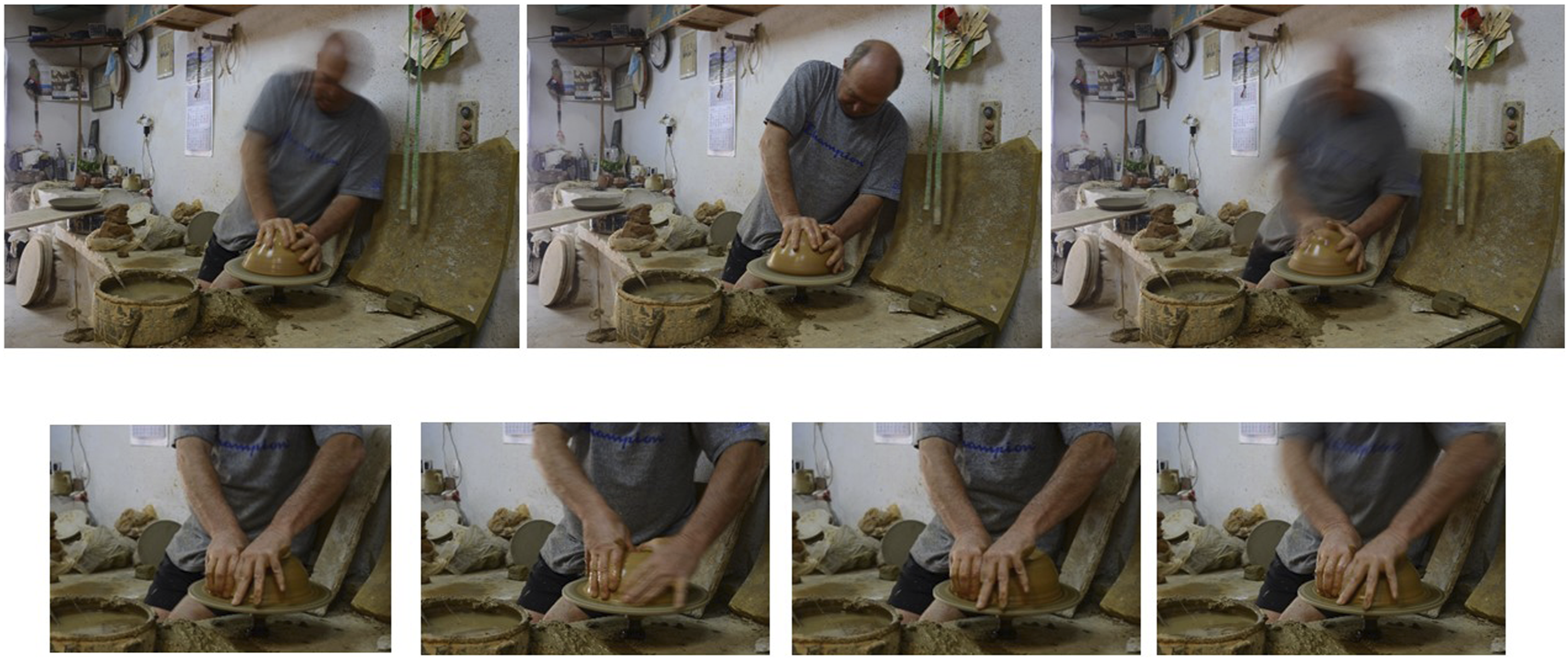
As was pointed out, the basic contribution of centring in pottery making is to establish the necessary material ecology that will allow the intentions or plans of the potter to align with the affordances of clay and the tools involved. The success of making, as an emergent performance, depends on that basic purposeful alignment that the act of centring makes possible. In this connection, an important point about centring that we wish to highlight, as it is often misrepresented, is the following: it is not the potter that is centring the clay; rather, it is the process of centring that allows the movements of the potter, the clay and the wheel to form a temporal alliance establishing the possibility of a meaningful dialogue. The centring of clay is what allows the potter’s mind (brain and body) to transact with those very material and kinetic forces that bring form into being. Centring allows the attunement of the potter’s body with the clay. This is also why centring (at least a successful one) implies an odd sense of decentring. In particular, the centring of clay necessitates the decentring of the potter’s bodily subjectivity. This is how potters become one with clay. This is also why potters often describe pottery making as a struggle. In exchange for this struggle the potter’s body comes to know first-hand what posthumanist theorists, from their own analytical perspective, have been struggling to conceptualise, i.e., “how human bodily contours are constituted through psychic processes” and “how matter makes itself felt” (Barad, 2003, 810). Touching clay, the potter’s hand calls into question the dualisms of mind and matter, knower and known. The potter’s hand (as indeed the rest of the body) is not merely executing orders, or testing predictions issued by the brain, but instead, is doing a great deal of material thinking on its own through the mindful handling of matter. This multimodal material thinking with clay should not be confused with materialist thinking about clay. The latter refers to discourse, that is, the way we think, talk and theorise about things. The former, refers to something more basic and primary, that is, the human (or non human) ability to think with and through (not just about) things (Malafouris, 2019, 2020, 2021a, 2021b, 2021c). In the context of material engament theory this mode of thinking is referred to as thinging. Touch and vision are the main modalities by which thinging is enacted and expressed.
These are issues hard to conceptualise from ‘outside’. For the detached observer, untrained to the secrets of the craft, clay is ‘standing reserve’ (Heidegger’s 1977), namely, a passive material to be manipulated and controlled for human utility or creativity. Looking at the same process from the ‘inside’, working with the skilled potters and adopting (to the degree possible) their temporal perspective, a different vision emerges. According to that vision, clay is simultaneously a force of attraction and resistance as well as inseperable from the potters' capacity for creative imagination.
Most of the potters we have been working with warned against this mistaken tendency, rooted in our modernist capitalist ethos, to take matter as passive and inert, and to treat it like a servant to human creative will. They have done that both explicitly through their mentioned used of animistic language and implicitly through the expressive intensity and shape of their bodily postures and gestures. Moreover, a rich body of anthropological studies have already specified, the need to overcome our ‘modernist’ preoccupations with human agency and creativity (Knappett and Malafouris, 2008; Ingold 2017; Latour 1992; Malafouris 2008). To that end material engagement theory proposes a process ontology (Gosden and Malafouris, 2015; Malafouris, 2021c; Malafouris et al., 2021) that will allow us to think about making differently by shifting attention from thinking to thinging. The terminological shift from thinking to thinging will help us escape representationalism, that is, the need to represent the world inside the head, and focus instead where brain, body and world join forces and exchange properties. Pottery making is now cast in terms of hylonoetic consciousness (Malafouris, 2019, 2020, 2021c, Malafouris and Koukouti, 2018, 2020) and material imagination (Koukouti and Malafouris, 2020a).
Understanding those issues is not easy. It necessitates some unlearning of our modern habits of thinking. One simple way of doing that is to think of form-making on a par with hunting. In particular, the analogy we propose is the following: form is for the potter as the prey is for the hunter. Inside the cognitive ecology of the ceramic craft ‘form’ is the equivalent of prey. Form-making is hunting with clay. To understand the meaning of this analogy the important distinction between a hunter and a predator needs to be made clear. Here is a summary of some major points of contrast (for more detailed discussion see also Koukouti and Malafouris, 2020b): a predator primarily kills; a hunter, by contrast, collects, relates and participates. An act of predation aims at the domination and destruction of prey. An act of hunting, by contrast, is dialogical and participatory. This is why becoming a hunter presupposes the ability to become a prey: the two roles are inseparable, their relationship is one of reciprocity, alliance and sympathy. On the contrary, a predator, never really knows what it is like to be prey. The predator consumes, the hunter exchanges. The hunter feels obliged to reciprocate for being allowed to receive the benefits of food. By contrast, the predator feels no obligation to offering anything in exchange. In the latter sense killing is asymmetrical, and in the former symmetrical and participatory. We suggest that this opposition between ‘hunting’ and ‘predating’ embodies the same logic and thus, can help us explain the opposition between ‘trans-acting’ and ‘representing’. In particular, as we explained before within the confines of cognitivism and the representational paradigm making is presented as a process of domination by which the potter’s mind imposes its will and exercise its agency on clay. On this construal, form-making resembles an act of predation. The potter’s mind is presented as a predator of forms. On the contrary, based on what we have learned by following the potters in action a different picture emerges. In this picture the potter’s actions resemble, instead, those of a skilled hunter moving within a world of sentience, exchanging form and energy with its relevant material environment. In the latter case thinking is participatory, an ecology of mind (Bateson 1973). The domination of mind over matter gives way to a reciprocal exchange of mind with matter. During enactive discovery the potter, like a hunter, assume the viewpoint of their prey (i.e., clay). Form-making, as we discuss below in more details, is more of a gifting.
Haptic attentive unity
As we explained, this paper adhere to that ecological-enactive tradition of thought which holds that the study of making demands an approach which situates skilled practice in the context of material engagement and recognises that it involves multimodal attentive transaction with the tools and materials involved. This transaction, which is often described both as a dialogue between the potter and clay, and as the unifying experience of ‘becoming one with the clay’, is multimodal. Although in this paper we emphasise the tactility of making, it needs to be underlined that the state of situational attunement we call haptic attentive unity (HAU) is cross-modal and extends beyond the point of contact of the hand with the clay. HAU and the related experience of attentive material engagement refers to the whole body-in-movement with its ways of touching and ‘feeling’ the clay (see also Brinck and Reddy, 2020; Koukouti and Malafouris, 2020b; Malafouris, 2014, 2020; March, 2019). A good example of that can be seen in Figure 5 which shows the difference between the visual and the tactile foci of somatic attention during throwing. Very often in the case of making it is vision that works on a par with touch rather than touch that works on a par with vision. Like in the case of the blind person with a stick it is sight that is put in the service of touch (Malafouris 2008b). The eye is touching the surface of clay. It is touch, of course, that provides most information about material composition, texture, weight, or temperature. HAU expresses the integration of these attentive modes. Capturing multimodal attentive material engagement using eye-hand tracking. Notice the constant spatiotemporal distance between the areas where hand touches the clay and the areas the eye touches the clay (in colour).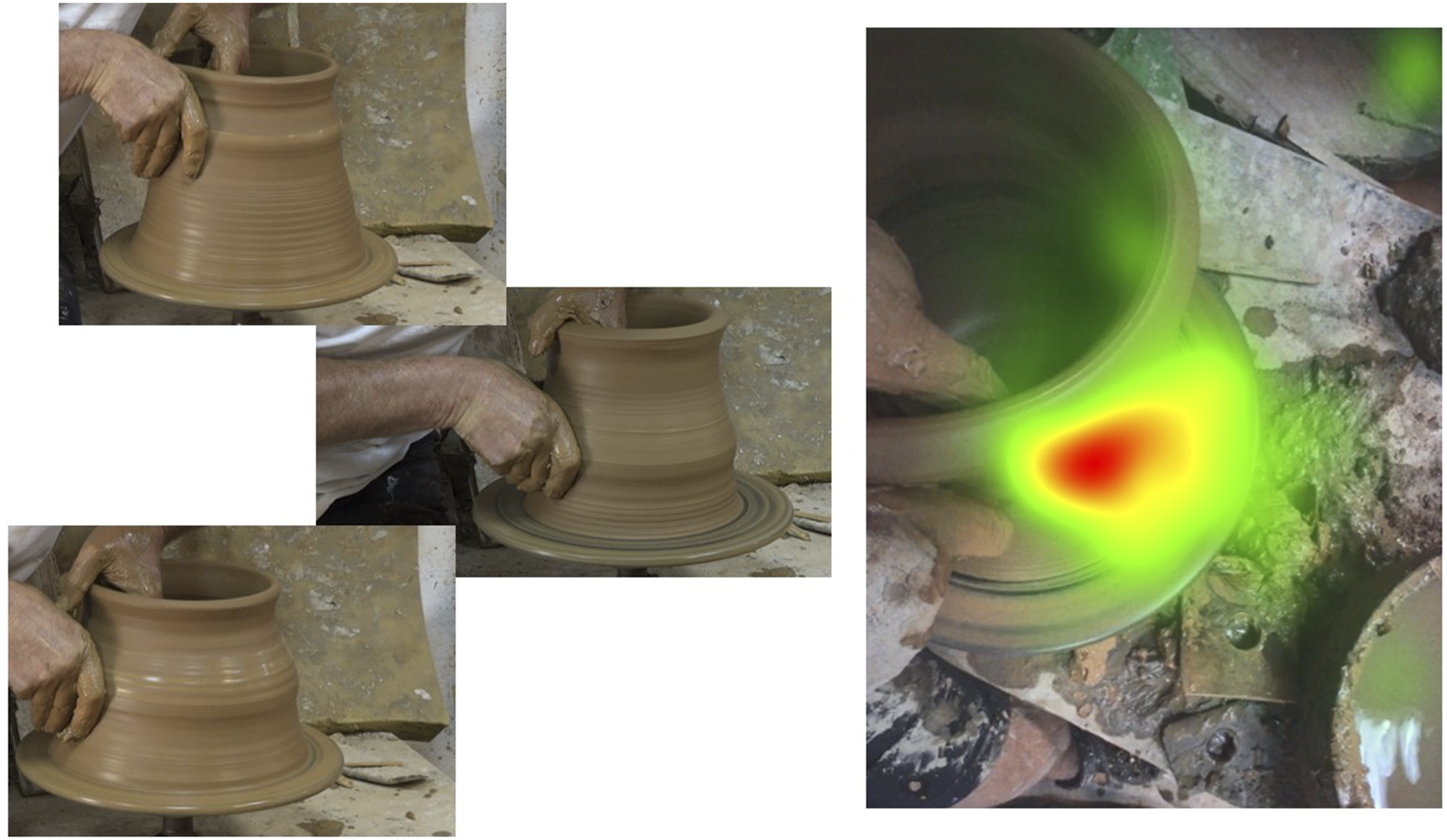
In particular, there are two major ways that the HAU can be understood. First, HAU denotes the feeling of mindful presence characteristic of immersive attentive engagement where the potter’s attention is fully absorbed in the action. Second, HAU is also associated with the active exploratory use of touch in the handling of clay, that is, the use of touch as a tool of creative material engagement (Figure 6). We start with the former. As the potter’s expertise develops the capacity for attentive engagement is also transformed from that of a mere kinetic interaction characteristic of conscious attentive engagement (where potter and clay causally respond to each other) into a multi-modal kinaesthetic transaction characteristic of immersive attentive engagement (where the potter becomes attentive to the expressive affordances of clay and recursively the clay becomes responsive to the creative affordances of the potter’s hand). We call this situational attunement between the potter and clay haptic attentive unity (HAU).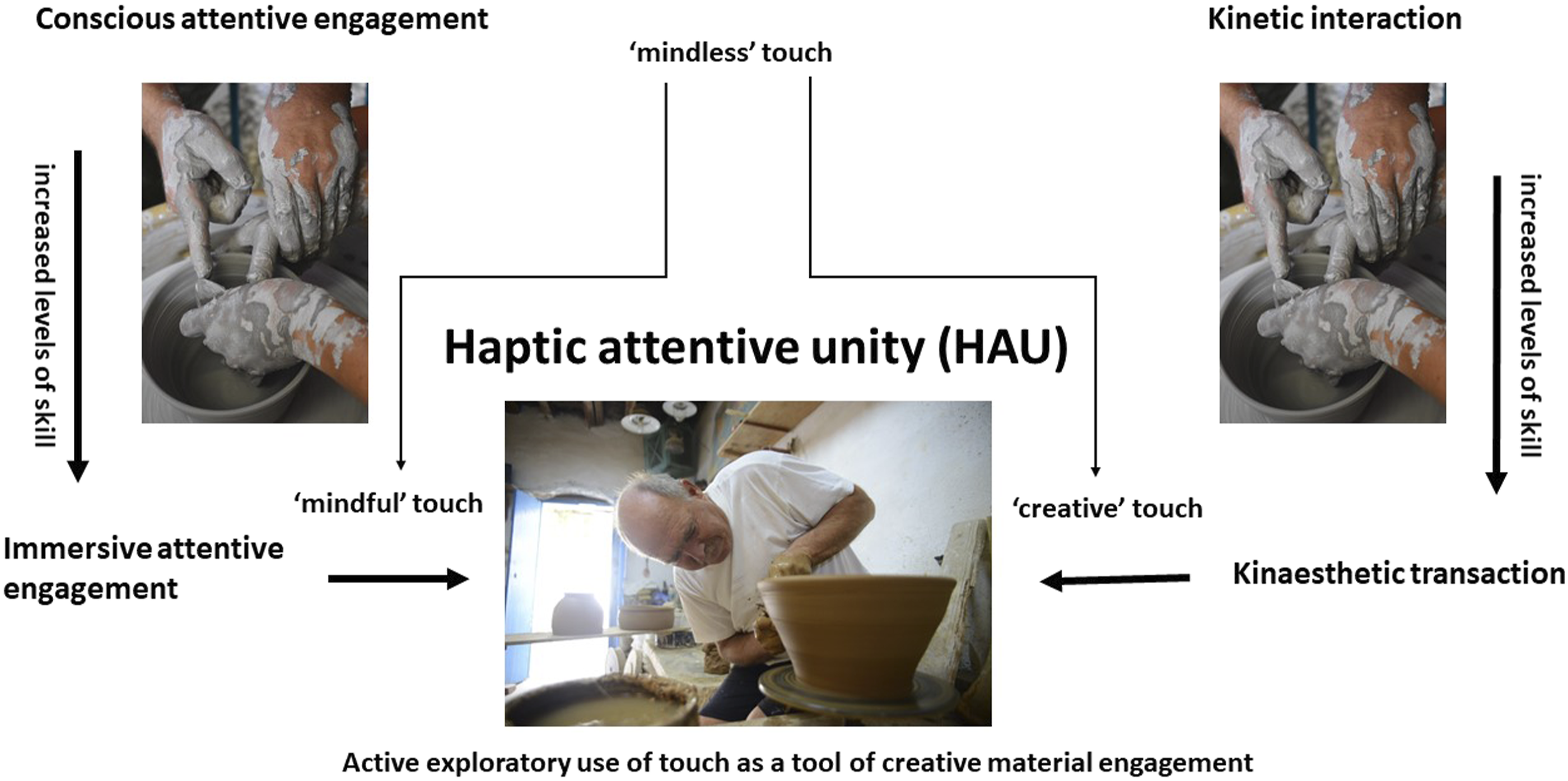
Attentive material engagement, as with the state of attentiveness broadly speaking, can be active (as when we choose to pay attention to something) or passive (as when something captures our attention). Although, from a durational point of view the two process are connected since the capturing of attention brings about the intention to pay attention and vice versa. This is why, contrary to Ingold’s call for attentionality without intentionality (2017) we would argue for the close links between attention and intention. However, we should clarify, that we are not referring to intentionality in the representational or hylomorphic (from the Greek words hylē for matter and morphe for form) sense where the potter’s pre-formed intentions are imposed on clay by means of making (Ingold, 2010). Rather, we are referring to the hylonoetic sense of world-involving enactive intentionality (see Malafouris 2008a, 2013, 2014, 2020), or skilled intentionality (Rietveld and Kiverstein, 2014; Van Dijk and Rietveld, 2021) where the potter’s intention is not pre-formed but performed. According to that hylonoetic view, the potter’s attentiveness and the potter’s intention are often inseparable.
Attentive material engagement can also be differentiated into two major modes, i.e., conscious and immersive (Figure 6). In particular: 1) conscious attentive engagement allows the potter to engage situational affordances that initially are not perceptible, or are only partially perceptible but which, nonetheless, are crucial either for successful skill acquisition or the discovery and creation of new forms. One indicative example that could be used as illustration of that is Charles Goodwin’s exemplary analyses of ‘professional vision’ (1994; see also Streeck 2009; Grasseni 2004). Goodwin, adopting the distributed cognition approach, examined the sociomaterial interactions through which practitioners learn to see those phenomena that constitute the objects of their profession and which in turn co-constitute the practitioners as subjects. The key point is that those phenomena are not pre-existing the actual practices by which they become constituted. For instance, Goodwin describes how the use of the Munsell chart of universal color categories provides the basis for the ‘skilled vision’ which allows the identification and classification of color features of dirt in an archaeological site. Professional vision is not a mere perceptual event but refers to multimodal semiotic capacity for attentive material engagement.
As the potter grows to know clay better the need for conscious attentive engagement drops. Eventually with practice the nature of attentiveness will be reversed turning into the mode we call immersive attentive engagement. What allows this transformation is the re-distribution and re-organisation of the potter’s attention among neural, somatic, and material elements that comes with increased levels of skill. The initial ‘mindless’, but conscious, attentive engagement is turned to un-conscious, but ‘mindful’, immersive attentive engagement. The major difference between the two modes is that while in the former stage the material environment operates primarily as a scaffold, offering stability by limiting and anchoring the action possibilities, during the latter stage, the material environment provide a far more flexible and fluid creative ecology that opens up a new, and previously unrealised, field of possibilities. Richard Sennett in his book The Craftsman describes a similar interplay between tacit knowledge and self conscious awareness at the higher stages of skill as ‘embedding’: “the tacit knowledge serving as an anchor, the explicit awareness serving as critique and corrective”. (Sennett 2009: 50)
This brings us to the second major way that HAU can be understood. This is associated with the active exploratory use of touch in the handling of clay. That is, the use of touch as a tool of creative material engagement which denotes the human disposition to the discovery of new varieties of material signs and modes of enactive signification through a saturated attentive engagement with things and form-generating materials (Malafouris, 2014). The relation between HAU and creative material engagement can be understood as follows: Many times during the process of making clay is not the ‘object’ of the potter’s tactual experience but the very medium of enactive discovery (Malafouris 2011). Although clay is the material touched by the potter’s hand, in those specific occurrences of exploratory activity we call enactive discovery, clay can also be understood as a transparent glove, or a prosthetic tool that the potter is actively using in order to perceive and discover. That is, rather than seeing clay as merely providing the content of the potter’s tactual experience or perception clay now becomes a second skin to touch with. The potter senses through this glove of clay the possible contours of a form. The material is now the prosthesis. The changing vibration, pressure, temperature and texture that the potter experience through touching the clay are no longer properties of the material, rather they are the dynamic properties of the kinaesthetic patterns of movement. The potter’s hand then uses and touches the clay, and at the same time is used and is touched by the clay. Clay is no longer the passive material upon which form is imposed, rather, it is an active tool with which the potter perceives, anticipates, imagines, explores and discovers possibilities of form. The clay is for the potter what the stick is for the blind.
Touching and being touched: the gift of attention
We suggested that the making of a ceramic form depends on a rich haptic exchange between the potter and the relevant material environment. And that a distinctive feature of this exchange is the HAU. In this section we would like to explore the meaning of this exchange further as it can help us understand the process of HAU and the dialogical aspect of making.
Adopting Dewey’s transactional logic of interaction (1925) and drawing on Merleau-Ponty’s (1968, 139) famous example of one hand touching the other, the relationship between the hand and clay could be described as reversible. What that means is that clay perceives (we are referring to tactual perception) the potter's hand as much as the potter perceives clay, and that both the hand and the clay carry the marks of their haptic entanglement. But how can clay perceive anything? No doubt, clay forming is a good example of tactual perception and haptic touch which is defined as ‘an inherently active and exploratory form of perception involving both coordinated movement and an array of distinct sensory receptors in the skin’ (Fulkerson, 2011, 493; Paterson 2009). Most researchers would agree that touch is simultaneously active and passive. One cannot touch without being touched. Touching the clay also means being touched by the clay. But to argue that tactual perception is shared between hand and clay may seem too hard a pill to swallow. We all can touch clay. And we all can, to some extent, imagine that we touch clay. We also can feel ‘as if’ we are touched by clay. But to claim that the clay is actually touching us seems like a step too far. And yet, this is exactly what we would like to suggest. This rare, and rather special occurrence where the clay is actually touching the potter’s hand is precisely what seems to be the distinctive feature of HAU. What does this mean?
The problem is partly perspectival and partly transactional, thus, its theoretical transposition into the anthropological language of exchange may help us to understand it better and perhaps resolve it. We have suggested that HAU, to the extent that is grounded on multimodal exchanges and transactions, resembles a form of gifting. The notion of gift and the process of gifting, or gift-exchange (to give, to receive, and, most importantly, to reciprocate) is well studied and seem of particular relevance – not the least because of Mauss’s influential account of the Maori notion of ‘hau’ (the spirit of the gift) ([1925] 2016).
What we essentially propose is that attentive material engagement resembles in its operation that of gift exchange. We suggest that attention is a gift, attentiveness is a gifting. To be attentive is to anticipate some form of reciprocation. The notion of attentive material engagement and its culmination in haptic attentive unity (HAU) motivates the same question that guided Mauss’ original analysis of the gift in the Trobriand Islands: what force is there in the attention given that makes the recipient give something back? What we borrow from the language of the gift is a way to express the entanglements of attention for which we often lack the vocabulary. Mauss’s account of the Maori notion of ‘hau’ as presented in his famous essay The Gift, speaks also of an intermingling of person and thing ([1925] 2016). We suggest that as the Maussian characterization of the spiritual power of the gift is situated in the absence of an absolute differentiation between persons and things so the attentive power of touch is situated in the absence of an absolute differentiation between the touching and the touched. Of course, gifts are not always reciprocal and necessarily alienable. That is true also for the gift of attention and its complex political economy (Pedersen et al., 2021).
The question is this: what force is there in the potter’s creative gesture which compels the recipient (i.e., clay) to make a return (i.e., to generate form)? We suggest that in the case of attention-gifts, the gift returns in the form of situational affordances and enactive discovery. Technically this is what we described in the previous section as immersive attentive engagement. Attentiveness or some forms of it (esp. attentive engagement in the context of creativity) are inalienable possessions which can never be fully removed from the person who originally owned them. Of course, the meaning of ownership is not very clear in this context. We said at the start of this section that touch is generally understood as the property of the potter’s hand. Touching belongs to the hand like seeing belongs to the eye. But this is not entirely true. Body ownership in the case of the potter, as in all cases of creative thinging, is negotiable and dissociable from agency. The sense of agency, i.e., the sense that I am causing my hand to move, and the sense of ownership, i.e., the sense that it is my hand that is moving, are far from stable during the process of creation and are completely transformed during the experience of HAU. Touch plays a crucial role here (not unlike what we see in the case of rubber hand illusion experiments) (Tsakiris and Haggard, 2005). Attention, agency and ownership are parts of a gift exchange between potter and clay. In the case of making, or creative material engagement, the equivalent of the ‘gift’ is ‘form’. Form is the gift that travels, or the object of exchange between the potter and clay. The HAU of clay is the force that sustains this exchange; the force of attentive material engagement. In particular, the force resides in the HAU which is the condition of inalienability where the gift, i.e., form, contains part of the donor, i.e, the potter.
Final discussion: HAU with clay
It has long been recognized, notably by Leroi-Gourhan in Gesture and Speech (1993) that “the making of anything is a dialogue between the maker and the material employed”. Clay forms, perhaps more than other material forms, are seen as embodiments of this dialectical process or as the products of such a dialogue. Clay is not the kind of material that lives in stillness and silence. The plasticity of clay evokes a sensual understanding of form and materiality. Clay also escapes the predominance of the visual. Tactility is often leading vision in the path of creation. Through the course of our ethnography it became obvious that ‘seeing in order to touch’ and ‘touching in order to see’ are two experiences entangled and interdepended in the process of making. In their own words, the potters also express a deep connection between vision and touch: “In the beginning, I touch the clay in order to see, to know how what I am making looks like, and in the end, I step back and I look in order to touch what I have made” (DA, July 2021).
Clay is multi-temporal and has a pace of its own. With increased levels of skill clay slows down time – or at least the experience of it –to the point that it stops. Clay also extends time. There is a paradox here but also the solution of it. The paradox is that, with the possible exception of learning, skilled practices and their creations make little use of language. That seems to be pretty obvious in the case of materials which by definition lack the ability to talk. But it can also be argued in the case of humans. They too rarely, if at all, use language when they negotiate form with materials. We don’t mean that creation is mute, silent or meaningless. Instead, what we have tried to show is that the creative transactions between makers and materials exceed the confines of a linguistically based notion of dialogue. The notion of ‘dialogue’, in the linguistically based meaning of the term, presuppose separate and identifiable ‘voices’ with the capacity to occupy different positions and roles. However, in the context of creative material engagement such positioning merge into a single voice of becoming and culminates in the haptic attentive unity (HAU) of potter and clay.
The language of clay is tactile rather than verbal. The dialogue between the potter and clay is based on haptic transactions, creative gestures and movement. The potter needs to touch clay in a way that will elicit a response from it that will, in turn, elicit a further response of the potter. Knowing how to touch clay is relatively easy. Knowing how to transact with clay is all together a different challenge. During those tactile dialogic encounters clay responds to touch like humans do. Many times clay is being held, handed and handled like an infant. The potter adds water on its exterior with a sponge not unlike a parent does to her child. The same applies to the amount of strength and pressure, or to the speed of movement which resembles that warm rhythmicity of the parental touch. The potter communicates with clay because she/he senses the expressions of the material in the same way the caregiver senses the facial expression of the infant. HAU is the product of such care and skilled vision. Actualising this tactile mode of communication takes years to learn. Yet it is this affective interconnectedness between the maker and material that make skilled practices capable of speaking in the absence of language.
Footnotes
Acknowledgements
We thank the editors of this special issue, Carey Jewitt and Sara Price, for their kind invitation and the reviewers for their constructive comments. We wish to thank also the other members of the HANDMADE group: Miranda Creswell, Rory Carnegie and Antonis Iliopoulos. Last, Wendy Ross for all the good work with the portable eye tracker.
Declaration of conflicting interests
The author(s) declared no potential conflicts of interest with respect to the research, authorship, and/or publication of this article.
Funding
The author(s) disclosed receipt of the following financial support for the research, authorship, and/or publication of this article: The research and writing of this article was supported by the European Research Council Consolidator Grant HANDMADE (No. 771997; European Union Horizon, 2020 program) awarded to L. Malafouris.