



Abstract
This issue brings together 10 anthropologists who investigate the potential of multimodality and the role of sensing, as situated social practice, in the complex working of memory. Through video, images, texts and sound—and through collage, installations, embroidery, and drawing—we invite the audience of Multimodality & Society to consider: What are some of the complex relationships between memory and the senses? How does multimodality help us approach the study of remembering and forgetting? This introduction frames our work into current debates in multimodal and sensory anthropology, discusses our approaches to memory, and draws some of the common themes that connect our contributions. Collectively, we investigate memory as sensate, emplaced, and affective, and existing in a complex relation with temporality and practices of forgetting. We are particularly interested in the links between multi-sensory approaches and the possibilities offered by multimodality. We argue that the latter can help us think of sensate memory, and vice versa, studying remembering and forgetting as multisensory can demonstrate some of the potential of multimodal scholarship.
This issue brings together 10 anthropologists who investigate the potential of multimodality and the role of sensing, as situated social practice, in the complex working of memory. Through video, images, texts, and sound—and through collage, installations, embroidery, and drawing—we invite the audience of Multimodality & Society to consider: What are some of the complex relationships between memory and the senses? How does multimodality help us approach the study of remembering and forgetting? How can multimodal and multisensory memories help us rethink time and space (see Figure 1), highlight the collaborative nature of ethnography, and be “more generative in forging transformative relations in the world” (Welcome and Thomas, this issue)?
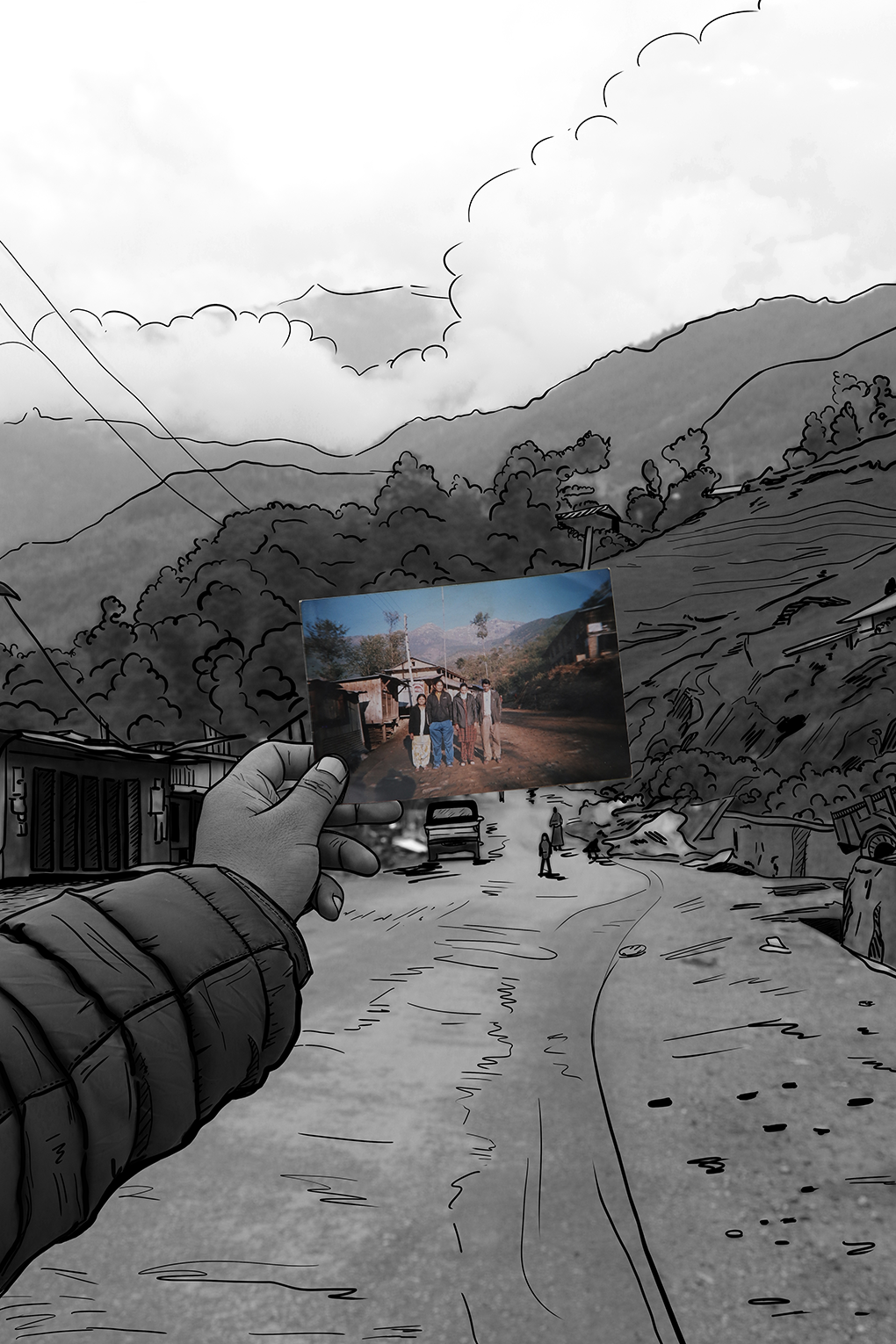
An image from Pigg and Kunwar (this issue). Shyam Kunwar holds an old photo of Khatuwachaur Bajaar, taken before the 2015 earthquake, against the same location in 2019. Photo and drawing by Shushank Shrestha; colorization by Shreya Shrestha.
We situate our work within the emergent and growing field of multimodal anthropology, which shares semiotic approaches’ interest in meaning-making through and across multiple modes (Jewitt et al., 2016), but differs from them in its roots, aims, and theoretical and epistemological directions. Our common ground is a desire to connect multimodality and sensuous experience, which we see as always shaped by culture and power (Elliott and Culhane, 2017; Howe, 2019; Stoller, 1997). Using sensory ethnography’s potential for rethinking what we know and how, we are interested in displacing linear temporality and interrogating our understanding of identity, power, and the social. We argue that multimodality is an important strategy that helps us engage in and understand multisensory practices of remembering in relation to particular histories. It also opens up spaces for the gaps, paradoxes, multiple layers, resonances, and resistance that inhabit remembering—both our own and our interlocutors’.
Multimodal scholarship is particularly important when it comes to memory, because the latter does not operate as a coherent process of accumulation through linear and progressive time, but is, rather, akin to what Elliot (2019) provocatively calls time travel. As Elliot demonstrates, memory is intertwined with moments of forgetting, with ruptures in language and space that allow for the rethinking of commonly held notions of time, the brain, personhood, and experience. Memory includes moments when multiple “other pasts—forgotten, distant or buried—indistinguishably swirl, intermixing with each other and intensifying the lived experience” (Pipyrou, 2015: 48). When encountering “affective landscapes” (Gupta and Medappa, 2020; Navaro-Yashin, 2009), material remains (Yarrow, 2017), silences, and uncanny moments of temporal affinity (Pipyrou, 2015), we can think of memory as a politically charged, lively assemblage “bubbling” up in the present (Harris, this issue). Collectively, then, we are interested in how multimodality participates in projects of “shifting attention from grids and structures of representation to the flow and accumulation of lived sensorial experiences” (Marchetti, this issue).
Our understanding of multimodality is best described by Welcome and Thomas (this issue) as follows: Multimodality—research and pedagogical methods that traverse multiple forms of media and mediations and challenge the centering of the textual in academia—has been a vital part of (…) efforts to decolonize the field. In multimodal practices oriented toward sensory ways of knowing and intervening, anthropologists have found new pathways for collective learning, collaboration, public engagement and reflexivity that attempt to challenge traditional boundaries and renegotiate the relationship between researcher and ethnographic subject.
The multimodal in anthropology
Multimodal anthropology emerged from visual anthropology and sound studies as a way of shifting from a predominant text-only analysis to address culture, social relations, and practices in multiple formats (Collins et al., 2017). As Gupta writes about the rapid transformations of Bangalore (this issue), “Our journal articles did not seem capacious enough to (…) convey their sensorial and embodied dimensions.” Importantly, this development has less to do with an effort to “capture more fully” culture as a system of meanings and more to do with the situated nature of anthropological knowledge and its complex relationships with the communities it engages (Gilbert and Kurtović, 2020; Miyarrka Media, 2019; Vidali and Philip, 2020). In fact, recent work in multimodal anthropology suggests that multimodality could facilitate theoretical and epistemological innovations in the discipline because it could help reimagine how we produce knowledge, with whom, and for what purposes. In Dattatreyan and Marrero-Guillamón’s words, “multimodality offers a line of flight for an anthropology yet to come: multisensorial rather than text based, performative rather than representational, and inventive rather than descriptive” (2019: 220).
In terms of timing, increased attention to multimodality in anthropology parallels important discussions on ontologies, “the multiplicity of forms of existence enacted in concrete practices” (Holbraad et al., 2014; see also Bessire and Bond, 2014; Kohn, 2015). As this “ontological turn” demands rethinking the very categories we employ to understand the social—including linear time, history, agency, social groups, and the natural world (see for example Cadena, 2015; Simpson, LB 2014; Strathern, 1988; Watts, 2013)—it makes the innovative potential of multimodality more attractive and promising. Concurrently, multimodality is also a way to account for how our research collaborators and interlocutors themselves have been involved in multiple modalities, and thus reflects the growing use and accessibility of a variety of media in society (Collins et al., 2017; Pink et al., 2016).
Below, I discuss three important aspects of multimodality: multimodality’s relation with anthropology as a discipline; scholars’ concern with the complex and asymmetrical relations of power inherent in any media; and multimodal anthropology’s interest in more collaborative and publicly accessible research. Then, I focus on the connections between multimodality, sensory anthropology, and ethnography, before summarizing the ways we attend to sensate memory.
First, multimodal anthropology is not a completely new approach; rather, its roots lie in the historical and ongoing concerns of anthropology to address culture holistically, or, more precisely, to show how all modes of expression are culturally shaped—from songs, dance, performance, and oral narratives, to material culture, art, writing, body painting, and more. Generations of anthropologists have been interested in how different meaning-making practices contribute to wider cultural ideas, how they shape and are shaped by a society’s relations of power and social organizations, and how they speak to collective memory. However, anthropology’s attention to diverse modes did not find an easy correspondence in ethnographies and published work. The latter have, for the most part, consisted of written texts, even relegating to the margins, photography and an earlier tradition of sketches and drawings (Hurdley et al., 2017). Ethnographic film—and to a lesser extent ethnographic sound studies—are important exceptions. However, they developed somewhat independently from ethnographic monographs, establishing subfields within the discipline.
The resulting division of labor has had practical as well as theoretical, epistemological, and political consequences: research informants, embodied and emplaced, have been those who practice culture as anthropologists describe this in writing (Magnat, 2021). The latter’s authority as “writers” of culture came under sustained review and criticism not just by the “writing culture” debate in the 1980s but also by postcolonial thinkers, Indigenous scholars, and feminist commentators (see for example Behar and Gordon, 1995; Haraway, 1991; Simpson, A 2014; Smith, 2012; Trinh, 1989). Performative anthropology and sensory ethnography also questioned the division between a disembodied observer and embodied subjects and the way “published ethnographies typically have repressed bodily experience in favor of abstracted theory and analysis” (Conquergood, 2013: 84).
As Conquergood argues, separating the body from the mind (the classic Cartesian dualism at the core of European social theory) went together with denying the coevalness of fieldwork (Fabian, 1983), a practice that served the colonial project. According to Fabian, anthropologists relegated their interlocutors to an unchanging past, which further entrenched the latter’s spatial and political marginalization. These critiques were part of a shift in anthropology that included rethinking the very concept of culture, no longer seen as a “discrete, territorialized” entity (Gupta and Ferguson 1997: 3; see also Abu-Lughod, 1991; Anzaldua, 1987). As Appadurai suggests, culture is more akin to an adjective than a noun: “culture as a noun seems to carry associations with some sort of substance in ways that appear to conceal more than they reveal” (1996: 12). Rather than people having culture, it is best to attend to how actions, identities, stories, relations, and ideas are cultural. “An adjectival approach to culture,” he writes, shows that the latter is a “pervasive dimension” of all people’s lives and practices (1996: 13).
In this context, multimodal anthropology seeks to counter, as Marchetti writes (this issue), the “flattening of the lived experience,” the encounters, and the complex co-production of knowledge in the field. Pigg and Kunwar (this issue) work against this flattening by producing a graphic ethnography of a roadside settlement in Nepal as a way to convey the many layers of memory inhabiting places and their transformations. The different elements of their piece (such as drawings, pictures, annotations, and texts; wide landscapes and close-ups), and the way they create a composition are here intended to “express the work of anthropologists, who turn impressions and conversations into coherent accounts.” Pigg explains how “the textual narration was pieced together from phrases scribbled in our respective notebooks in the moment, from recorded conversations, from Shyam’s [Kunwar] earlier research, and its extension into his explanations of his own understandings to me” (this issue). By bringing to the fore processes such as these, the goal of multimodality is “disrupting the typical epistemological mode characterized by a single ethnographer interpreting through the production of written text” (Hartblay, 2018: 153, cited in Vidali and Philip, 2020: 86). Doing so opens up opportunities for many commentators and scholars to work together on common/public anthropology projects, such as the Anthropocene Primer, Feral Atlas, the online archive on resistance in Chile, or the “Anthropology of smartphones and smart aging” series. 1
Secondly, current debates on multimodality are complicated and enriched by Takaragawa and co-authors’ observations that a multimodal anthropology should also offer an “anthropology of the multimodal” (2019: 518, emphasis in original; Smith and Hennessy, 2020: 117) by interrogating the production, circulation, and dissemination of media in a widely unequal world. In their words, “Multimodal anthropologies can just as easily reinforce existing power structures by dressing up neocolonial practices of extraction, inclusion, and appropriation in new language” (2019: 518). In this respect, multimodal anthropology is close to the interest of multimodal scholars in the fields of semiotics and linguistics, who trace situated and dynamic practices of meaning-making in social contexts, or “the myriad ways in which people re-make signs in conventional and new forms—as linked to power” (Jewitt and Leder Mackley, 2019: 100).
An illuminating example of an “anthropology of the multimodal” (Takaragawa et al., 2019: 518) is Smith and Hennessy’s analysis of “fugitive” objects in archives (2020: 115). Their work, which includes video and installations, shows that archived objects and materials can change over time—becoming dangerous or sticky, and shifting shapes or textures. Older films and photographs that are turning magenta, for example, can no longer claim to be a realist representation of the objects and lives they depict, thus challenging an earlier anthropological drive to preserve cultural expression and deconstructing the permanence of the archive and the epistemic project it represents. Their study is more than an elucidation of materiality. What interests them, more broadly, is the knowledge claim of the discipline. Focusing their attention on processes of decomposition, they interrogate present and future constraints of multimodality.
Takaragawa et al. and Hennessy and Smith demonstrate that if the multimodal is to provide an expanded discussion on culture, social worlds, and meaning-making practices, anthropology cannot forgo its critical examination of the intersecting and multi-layered practices of exclusion implicated in all forms of communication, as well as in the actual material production of media tools and technologies. Welcome and Thomas (this issue), for example, interrogate how realist or “evidentiary” visual representation of violence falls short of changing audiences’ understanding of colonial systems of violence against Black communities in Jamaica and Trinidad. Visual realism, they write, is “conditioned by whiteness.” It also does not convey the “complex, affective, and spatio-temporal layers of state violence.” As an alternative, they experiment with abstraction in film and photography in order to “move audiences (…) to witnessing and repair.”
Robertson (this issue) discusses PowerPoint as a medium for organizing and presenting knowledge that is inextricably tied to the economy of academia and particular forms of intellectual labor. Thinking about the infrastructure, technology, and architecture of an electronic DIY music gathering in São Paulo, Leaha (this issue) addresses the “importance of the materiality of multimodal interactions.” This includes the qualities of sound and light, and the set-up of performances and gathering places (see Figure 2).
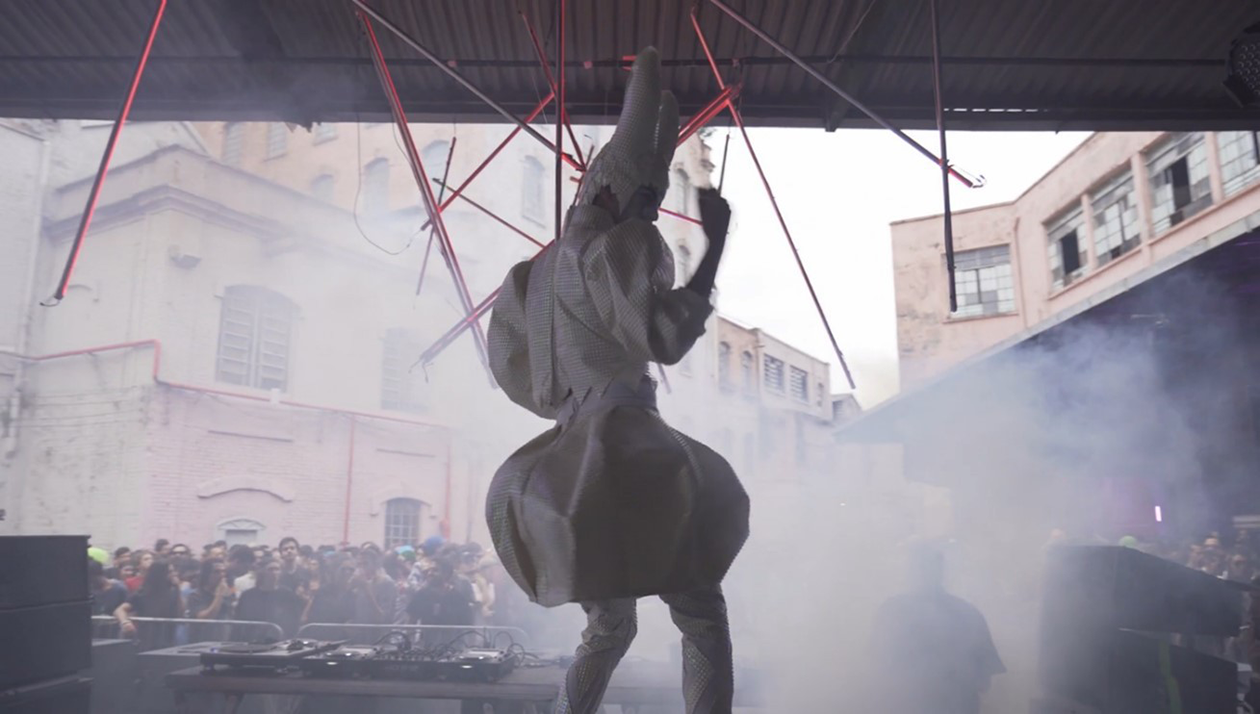
An image from SensoRhythms, a collaborative multimodal project by Leaha (this issue). Photo by Leaha.
Moreover, DIY parties in São Paulo present an alternative to costly music gatherings and mass-produced music and are an important place of sociality for non-normative genders. The intersecting political, material, and experiential aspects of attending these musical gatherings shape remembering, and in turn, sensate memory continues to inform collective resistance to neoliberalism and a particular sense of community “and cultural distinctiveness.”
Takaragawa et al.’s observations are particularly important when considering a third key aspect of multimodal anthropology, namely, its emphasis on anthropologists’ engagements with the people they work with and with broader publics. As Durington et al. (2017) and Dattatreyan and Marrero-Guillamón (2019: 222) argue, this is partly a response to the fact that “ethnographic practices are already taking place in a number of locales” by variously positioned commentators. An instance of this is the Miyarrka Media collective constituted by Australian Yolngu Indigenous people, Dhalwangu elder Paul Gurrumuruwuy, and anthropologist Jennifer Deger. They collaboratively discuss and document how cell phones and their affordances are part of situated cultural practices, enduring social relations, and the performance of Yolngu identity. The resulting book Phone and Spear (2019) is itself multimodal, existing in different versions (as a printed volume and an open-access website), and combining photography, maps, text (in different colors for different speakers), and videos.
This example instantiates a key goal of multimodal anthropology: to facilitate more collaborative scholarship, both by opening avenues for differently positioned cultural commentators to work together and by bringing to the fore the dialogical, multimodal, and sensorial aspects of research itself. Another illustrative example is Gilbert’s and Kurtović (2020) work in Bosnia-Herzegovina, where they worked with artists, workers, scholars, and community activists to resist the closing of the detergent factory Dita in the town of Tuzla. In doing so, their goal was also to reflect on what such a collaboration entails and why it is necessary. Multimodal research and dissemination practices—videos, graphic media, newspaper articles, workshops—went hand in hand with what they call “(re)distributed” political action, including media outreach, workers and community meetings, and rallies. Their work is particularly interesting because it suggests that one of the things multimodality contributes is the possibility of all parties being involved in both knowledge creation and political, public involvement.
This issue’s contributions deploy multimodality to facilitate and/or center research collaborations in a variety of ways. Welcome and Thomas’s work arises from direct engagement with communities in the Caribbean. Marchetti shows how her examination of memory in Argentina cannot be separated from her participation in student protests in Canada; it arises from conversations with people in both countries albeit at different times. Pigg’s graphic ethnography re-presents the research work of Shyam Kunwar via an ongoing collaboration with artists in Nepal, and Harris proposes a distributed microbiological project that reflects on human and non-human assemblages, such as bakers and yeast cultures in sourdough bread starters. Leaha’s work is based on co-remembering shared embodied practices with “fellow clubbers.” The intention in all these examples is for anthropologists to work with “epistemic partner[s]” in projects “constructed around shared concerns” (Dattatreyan and Marrero-Guillamón, 2019: 223, citing Holmes and Marcus, 2008). Moretti’s piece, for example, emerged from questions and inquiries of a collaborator with whom she shares an interest in the links between memory, the senses, and displacements.
Positioning ourselves within these debates, in this issue we seek to contribute to multimodal anthropology by discussing a range of strategies and approaches that examine the links between the sensorial and memory. Our contributions include creating and assembling archives, juxtaposing different kinds of texts—from people’s stories to academic descriptions and field notes, to poetry and autoethnography notes—with images, sound clips, and videos, as well as creating collages and installations. Here I would like to point out that while multimodality in anthropology has developed especially through the use of digital technologies and new tools such as smartphones, the Internet, apps, games and interactive sites, our papers subscribe to an understanding of multimodality that encompasses a wide range of meaning-making practices, including non-digital and arts-based “sense-making” (Varvantakis and Nolas, 2019: 368).
In this collection, Harris uses embroidery and Robertson painting and sculpture. Pigg and Kunwar present a graphic ethnography composed of handmade drawings layered with scanned photographs. The issue also investigates memory as a kinetic engagement in the forms of swimming (Marchetti), drawing and walking (Moretti), dancing and performing (Leaha). The inclusion of what Hurdley et al. call “slowest practice” (2017: 748) is motivated by the ways in which our interlocutors themselves use both digital and non-digital tools. In Moretti’s piece, for example, the handwritten story given to her by one of her collaborators echoes the creation of cards by other interlocutors and Moretti’s drawing and handwritten lists of elements in the landscape. Pigg and Kunwar use collaborator’s photographs and drawings of artists in Nepal. Multimodality in all of these forms helps us to consider the multiple dimensions of memory and to include moments when the latter is in the hand’s movement, the writing on lined paper, and in standing still on a sidewalk.
Multimodality, the sensorial, and fieldwork
Readers of this journal might be accustomed to understanding multimodality’s relation to the senses as it has developed in the fields of semiotics, linguistics, and communications (see for example Jewitt et al., 2016), where multimodality and sensory studies are quite distinct from one another (although Jewitt and Leder Mackley (2019) present persuasive arguments for a constructive collaboration between the two). One reason why the connection between the sensorial and the multimodal developed along different lines in anthropology is because of the central role of ethnographic fieldwork in the discipline and in its theoretical developments (Biehl and Locke, 2017; Malkki, 2007). It also reflects the way decolonial, feminist, and critical approaches have shaped anthropological theory and epistemology and contributed to the changing understanding of the aims and role of ethnography.
It is useful to note that the very concept of ethnography varies between disciplines (Kazubowski-Houston and Magnat, 2018; Pink, 2011) and is currently used by scholars in different traditions. The understanding of ethnography we bring to our work can be described as a reflexive and theoretically grounded “sensibility” shaped by listening closely to our interlocutors’ epistemologies and frameworks (Elliott and Culhane, 2017; Malkki, 2007). It includes multisensorial “arts of noticing” (Tsing, 2015: 17) that require learning how to walk (Ingold and Vergunst, 2008), smell (Tsing, 2015), see (Grasseni, 2004), sense (Ingersoll, 2016), listen (Chao in André-Johnson, 2020), tell time (Zee, 2017), and co-imagine (Moretti, 2017). As Kazubowski-Houston and Magnat write, “Ehnography is largely improvisational, creative, and situated—a sensibility that cultivates a particular understanding, a way of being in, sensing, feeling, and responding to, the world” (2018: 382). This understanding of ethnography is also premised on the fact that culture does not exist “out there” as a system of meanings but is rather an “unfolding performative invention” (Conquergood, 2013: 96) continuously (re)created by specifically situated commentators (Fabian, 1990).
Anthropology’s interest in multimodality as part of ethnography—its double meaning of research practice and dissemination—has been directly related to fieldwork encounters. Importantly, this embeddedness in fieldwork has created strong links between multimodality and sensory approaches, due to ethnography being a necessarily multisensory practice (Culhane, 2017; Howes, 2019; Seremetakis, 2019; Stoller, 2004) that “privileges the body as a site of knowing” (Conquergood, 2013: 82). As Varvantakis and Nolas explain, “As ethnographers, we record what we see, hear, and feel and recount these multisensory experiences through image, text and sound in an attempt to capture some of the depth and multidimensionality of our interlocutors’ lives” (Varvantakis and Nolas, 2019: 367).
This confluence can be traced in several examples. In their research in Egypt, Schielke, Malmström, and Hamdi and Nye, among others, have combined an attention to the sensory aspects of political and social uncertainty with experiments in multimodality. Schielke (2012) chooses the format of the visual essay to depict the sensorium of longing: in her photographs the gaze of young men waiting, everyday scenes, and objects convey the palpable presence of what is missing—be it faraway people, imagined places, or opportunities of migration. Malmström’s video (2014) invites audiences to immerse themselves in the urban scene of Cairo and to cross the street with its residents—as part of a wider reflection on embodied experience in Egypt at a politically tumultuous time. Hamdi and Nye (2017) use the format of the graphic novel to examine the experiences of illness and its wider social and political resonances.
Other examples come from Williams and Chao commenting on activism and anthropology. In a podcast produced by André-Johnson (2020), Williams uses a soundscape to evoke rage as a productive affect in the Black Lives Matter movement. Her soundscape accompanies and recirculates the embodied resistance of a “marade” asking for the release of a tape that contained the last hours of Marshall, who died in police custody in 2016. In Williams’s recording, multimodality and embodied scholarship connect her to “a genealogy and a legacy of black anthropologists, particularly black feminist anthropologists, who taught [her] that anthropology should be grounded in activism and advocacy” (Williams in André-Johnson, 2020). In that same podcast, Chao explains how learning to listen to silence from her West Papuan Marind collaborators prompted her to use cartography and audio recording to document and confront deforestation brought about by palm oil plantations. Her work joins Feld’s research and soundscapes on the correspondence between the sounds of the rainforest and Kaluli people’s lives (Feld, 2012).
To appreciate the impact of the convergence between multimodal and sensuous work in anthropology, it is necessary to consider how sensory ethnography seeks to reframe epistemology rather than simply using sensory descriptions to produce more accurate representations. As Leaha writes in this issue, embodiment and the sensorial are “treated as a form of knowledge.” A “synesthetic,” multisensory engagement with the world poses the question, what does it mean to know through the movement of the wind or the water (Ingersoll, 2016; Ingold, 2011), with textures, smells, tastes, and sounds? In Leaha’s words, sensory anthropology “is a philosophy of the legs, grounded and aery at the same time; [a] phenomenology of the chest, my lungs become a membrane of sonic particles, a reflection of the loudspeakers; [a] hermeneutics of the brain when my horizon of expectation melt into a repetitive palimpsest of me and non-me. Moving in time, with time.” Similarly, Choy and Zee (2015) write that sensing with the atmosphere and understanding through “suspension” might be a particularly fertile way to do research at this historical moment, in a world shaped by greenhouse gases and dust storms—and, we could add, the suspended viral loads of the current pandemic.
Stoller argues that a “sensuous approach” is necessary for the “social analysis of power relations-in-the-world” and to understand “local epistemologies and sensory regimes” (2004: 820). Ruling relations, the structures of power, and the “ever-shifting relationships among domination and cultural memory” are realized in and through the body. Discussing the difficult position of one of his Nigerian Hausa interlocutors, he shows how violence affects and is shaped by sensorial relations and “sensuous perception” and thus demands that we always take into consideration embodied experience. This becomes even more urgent when we consider that “sensuous metaphors” and understandings can be at the same time “tools of power as well as resistance” (Stoller, 2004: 824). Importantly, according to Stoller, an analysis that takes into account the body and the senses not only helps understand power and social inequality but also examines researchers’ positionalities, what he calls “their scholarly being-in-the-world” (2004: 820).
Ingersoll argues for an embodied orientation to scholarship, centered on place and sensing, to affirm decolonial Indigenous epistemologies. She uses the term “oceanic literacy” as a “specific way of reading and interacting with ke kai [the sea]” (2016: 127), which involves sensory awakening, awareness, and connection. In the example of navigation, this means being “able to ‘see’ [one’s] location in the world by reading the yellow stripes painted across the sky, hearing the direction of swells thumping the hulls of the canoe, tasting the water’s salinity, smelling the cool north winds, and feeling the intensity of the sun’s heat” (Ingersoll, 2016: 128). For Ingersoll and the Kanaka (Indigenous Hawaiian) surfers, navigators, and artists she takes inspiration from, this complex literacy is a way “to access (…) Kanaka ontology and epistemology” (2016: 127).
Ingersoll’s work resonates with Howes (2003, 2019), Culhane, (2017) Howes and Classen (2014), Stoller (1997) and others in advocating a culturally specific understandings of the sensorium and a multi-sensory approach, that draws attention to the complex relationships between the senses. Ceraso (2018) and O’Dell and Willim (2013) similarly refer to “composition”—the coming together of multiple senses in lived experience and social encounters. It is important to note that for Ingersoll, an embodied and multisensory relationship is crucial to renewing and nurturing connections—remembered, performed, and felt—with ancestors, community, and place. This, in turn, calls for discussions and engagements through multiple, interconnected avenues and platforms (such as painting, photography, textiles, dance, ceremony, and navigation) that would allow for thinking with and through the senses.
To summarize, multisensorial ethnography can help generate and is allied with a multimodal practice that aims to rethink the kind of knowledges that anthropologists and their interlocutors produce and the contexts in which they emerge. It is in this rethinking of the discipline and its entanglements with the world that multimodal anthropology can offer a significant innovation. It does not simply wish to present insights from fieldwork in more encompassing ways, nor is it “interested in developing multimedia approaches to representing or disseminating anthropological knowledge” (Dattatreyan and Marrero-Guillamón, 2019: 221). Rather, the point is to shift the ways in which we learn about the world and engage with ideas. Dattatreyan and Marrero-Guillamón propose the concept of “invention” to emphasize this openness to new meanings and trajectories: “multimodal inventions (…) enact encounters in which the unexpected, the unforeseen, and the otherwise may be coproduced” (p. 224). As Marchetti (this issue) remarks, “Multimodal here implies a variety of methods and mediums that not only mean but do different things.”
In relation to memory, in this issue we do not turn to multimodality as an “accurate relaying of past memories to present audiences—but rather a fragmentation and diffraction of memories so that they can enter new circuits of meaning and take on new resonances, affective and embodied” (Gupta, this issue). It is in this sense that for Gupta, Welcome, and Thomas multimodality can be a feminist practice: it can displace or at least question the ways stories, lives, events, and histories are usually told and remembered, marginalizing what cannot fit into colonial, white, and patriarchal accounts. In this way, they position themselves in a long-standing tradition of Black, Indigenous, feminist, and queer critiques of anthropology that seek to reframe not just the understanding of gender, sexuality, power, and inequality, but also the relations embedded in research, the way knowledge is produced, and the ends to which it is put (Ahmed, 2006; hooks, 2000; Simpson, A 2014; Stacey, 1988; Thomas, 2019; Visweswaran, 1994; Williams in André-Johnson, 2020).
As Welcome and Thomas write, “photographic and filmic collaging and archiving, for us, constitute a broader practice of affective archiving (…) to intervene in the circulating visual landscape of Black precarity.” It is a form of witnessing that could potentially inaugurate new forms of “sovereignty (…) grounded in quotidian practice, decolonial love, and response-ability.” Welcome argues that “collaging is a Black feminist praxis” because it can open the space for rethinking the aftermaths of violence, centering grief while opening spaces to hope, and to thinking, feeling, and being otherwise. Multimodality is important in their project because it “both produces intimacies (…) and reveals the ways we maintain the conjectures of power within which we live” (Thomas, 2019: 2; quoted in this issue).
Sensate memory: Overview of the papers
(Robertson)
I like to think of the [sourdough] starters as [past memories,] microhistories in a jar, sticky threads of past bodily relations, through the microbiological settings of bakers’ kitchens throughout time and space. (…) They sleep, expand and grow." (Harris)
In this issue, sensate memory is material and embodied, entangled with places and histories, with the dead and the living, with aspirations and moments of grief, and is deeply agentive. Harris’s sourdough starters, created and traded with other bakers, help us to think of memory as not just individual and interior but as something experienced and learned with others, something transformative and more-than-human (Mathews, 2018; Tsing, 2015). Like the bubbling mixes traveling across kitchens, countries, and times (see Figure 3), memories often escape our efforts to grasp them and ascertain their composition. Yet it is precisely this shifting, ephemeral character of remembering that makes memory so good to think with. By growing new relations and engaging in complex assemblages, memory is deployed in nurturing connections to place, reframing ideas of the self, speaking back to oppressive conditions, and inventing new genres and media.
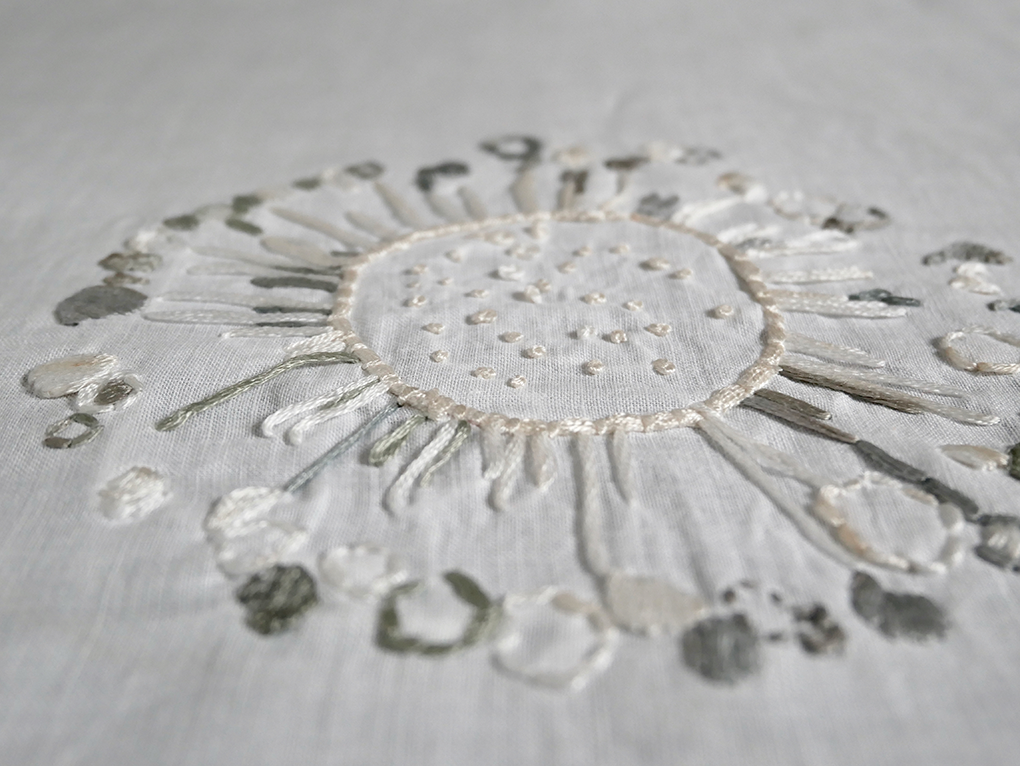
Embroidery of koji microorganisms. Photo and embroidery by Harris.
The authors in this collection engage these aspects of sensate memory in relation to a variety of topics across different research sites. Robertson reflects on a multimedia memoir (in stone, color and text), as a response to what she calls an “event of memory” in the aftermath of a concussion. Her work explores materiality and color as contemplative modes that assist her to trace a “new perceptual repertoire” she experienced. Sculpture and painting help her make sense of the sudden event of a car accident through “existential modalities” which include “imagination, memory, dreaming, and shifting sensorium” (Desjarlais and Throop, 2011: 90, cited in Robertson, this issue). She attends to these in a montage of evocative forms: the materiality of rock (as skull, as mind); “narrative paintings” recalling other sudden events and dreams; “free-form text,” and an animated PowerPoint composition accompanied by sound. Challenged by this methodological experiment, she invokes aesthetics of the surrealist movement and other cultural forms as alternative knowledge practices. Her piece, in turn, interrogates many aspects of anthropological work, from the role of the senses and practices of remembering to academic labor, representation, and ways of knowing.
Pigg and Kunwar juxtapose drawings and photographs to document the arrival of a road and growing bus traffic in a rural settlement in Nepal. The many layers of precarity, poverty, new opportunities for making a living, and insecurity are best appreciated through the lens of an individual life and the material, sensory, embodied traces that entangled histories leave behind. They point to the multiple conversations, and retelling animating their work: when “a snippet of a story” invites the listeners to retell it, “new details come out; new commentaries, too,” showing that “memory is (…) submerged and surfaced in moments of telling.” Their graphic ethnography carries the traces of these encounters: their notes, the co-constructed drawings and compositions, and the snippets of dialogues create open-ended affective layers. Pigg’s reflection, in the last two pages of the piece, becomes an intrinsic part of the graphic ethnography, rather than an academic explanation about and apart from the encounters that generated the piece.
Gupta discusses how residents narrate and remember their neighborhoods amid urban changes that are transforming former mill and rural lands in Bangalore into affluent residential areas. Her interlocutors use sensory memories to situate themselves in particular landscapes at a time of growing insecurity. Neighborhoods are conveyed through remembered smells, sounds, the textures of material forms, the circulation of air, and feeling of freshness. These act of remembering by lower-income residents who will soon be displaced are central to understanding Bangalore’s transformations animated by “speculative urbanism” and “world city” imaginaries. Gupta argues that residents’ remembering is best conveyed through installations, composed of poetry, sounds, textures, videos, and texts, where audiences can relate to the material, the affective, and the “atmospheric” (Stewart, 2011) through multisensorial and multimodal engagements.
Harris discusses the possibilities offered by textures and “textural methods” to convey sensorial remembering. Her “bubbling (…) texts,” embroidery practices, and sensory archives center on sourdough bread starters. She presents her recollections of growing, preserving, and traveling with these microbial assemblages and describes how the living bodies of bakers and yeast mixtures become consubstantial during Covid-19 quarantines. This inspires a microbial project that would further entangle bakers, anthropologists, and “amateur microbiologists.” Harris uses embroidery to reflect on the complex relations between bacteria and humans (see Haraway, 2016, for a discussion of crochet and knitting as “models”). Stitching bacterial semblances on old linens is a way of being with non-human companions, to think through textures, and even imagine “textile based fieldnotes.”
Leaha describes his and his collaborators’ memories of attending in-person electronic DIY music gatherings in São Paulo before the COVID-19 pandemic. While online engagements with DIY music during the pandemic offer a continuing “sense of community among clubbers,” what is missing is the embodied, sensory experience of being there—“the feeling of intensity that comes from the actual presence.” He uses the notion of “saudade” to understand memory not only as a remembering of the past or “a nostalgia for good times,” but also as “a craving and a readiness for the intensity of living.” For Leaha, remembering is an embodied practice, revealing memory as always enacted, contextual, and relational. Leaha also addresses the relationships between sound and other sensory engagements and modalities and between various sensory experiences of electronic music.
Welcome and Thomas write about the impacts and memories of violence. Their work addresses the role of multimodality in generating “new forms of public awareness” and in shaping debates about “the long-term effects and manifestations of political, drug-related, and inter-communal violence.” Thomas, who has been creating multimodal archives with people in Jamaica, explains how she co-organized community events as experimental forms of public engagements in contrast to usual “security-oriented approaches to political and other forms of violence.” Thomas and Wedderburn’s experimental video creates a haunting composition of sound and images that seeks to “interpret violence through the language of witnessing rather than spectacle.” It presents a memory of the Tivoli incursion in Jamaica in 2010, where more than 70 people were killed. Rather than retelling facts in a linear, temporal order, the video works like an “affective archive” inviting audiences to dwell with its haunting recollections and open questions and to relate to the people and communities impacted by the violence.
Welcome’s work in Trinidad brought her to create collages as striking images of grief and hope. In relation to violent death, they go beyond remembering “a particular individual” to “recognize (…) grief for life in the wake of the plantation where Black people found beyond redemption could be, have been, and will be killed in slow and quick ways by the state.” Welcome’s collages combine different elements to situate particular histories and convey their affective impacts. In a single space, her collage depicting the killing of James juxtaposes the location of his death and the view of the sea, “opening up” the former “to light, air, and water.” The past, present, and future—histories and events but also possibilities—“can all exist in a single frame and be felt together.” For Welcome, fieldwork memories can be both hauntings and spark resonances across places and times—evoking another call for multimodal practices that can express and work through the complex entanglements between “life” and “field.”
Marchetti’s piece about the sensorial and affective aftermaths of death and disappearance in Argentina views memories as “fragments of an always incomplete puzzle.” Her curatorial project “explore[s] the memories of the dictatorial beyond the limits of what has already been made into discourse and monuments, beyond existing textures and into that which informs the emotional ties and performative repertoires from which [her] own memories emerge.” She describes how the Argentinian dictatorship and the Canadian Maple Spring—two radically different moments in time and space, as well as in intensity and the extent of violence—resonate with each other in her lived sensorial embodiment. Memories from Argentina—her own and of those around her—shape how she relates to and participates in the Maple Spring, calling her to experiment with multimodal practices to document the corporeal as “a point of impact.”
Moretti uses the concept of echo to think of sensory memories in the context of migration. Her work centers on the questions posed by her collaborator of how the everyday sensorium could help investigate processes of (dis)placement. To attend to these aspects, her piece combines different research moments, modes, and methods. It includes walking, images of places and of research artifacts, conversations with her interlocutors, and two videos—one a multimodal diary of a walking itinerary, and one an evocative reflection. Sensing can help connect with new places; it also recalls familiar smells, sights, taste and textures, thus foregrounding their absence. Like echoes, memory is not simply a repetition of what occurred earlier, but a complex practice entangled with gaps and forgetting—shifting and reframing events, places, and social worlds.
Recalling Harris, we can say that like sourdough starters, sensate memory grows differently in different circumstances, revealing its complexity, persistence, and abundant potential. This is nicely encapsulated by this issue’s contributors who engage with multimodality and sensate memory across a variety of locations: India, Nepal, Canada, Jamaica, Trinidad, the UK, Argentina, the Netherlands, and Brazil. This wide variety of research projects nonetheless shows important lines of convergence—most significantly, how the contributors use multimodality to work with sensate memory as emplaced and affective and the way they disrupt linear temporality.
The authors show that sensorial memory links people to places, speaking to displacements (Gupta, Moretti, Pigg and Kunwar), histories of violence (Marchetti, Welcome and Thomas), and lively entanglements (Harris). It foregrounds the importance of music and performance in creating community and place (Leaha), and shapes perception and ideas of self (Robertson). Sensate and embodied memory are especially important in understanding people’s location in rapidly changing environments (Gupta, Moretti, Pigg and Kunwar). Combining modalities helps the authors foreground these aspects. Importantly, spaces are affective: inhabited by grief, longing, nostalgia, hope, fear and sausade. Swimming in the waters of a river and a lake in Argentina (Marchetti, this issue) that conceal the bodies of people who “disappeared” is a particularly compelling and tragic example. Here Marchetti’s poem brings together a particular place and its sensorium with the affective aftermath and horrors of the dictatorial regime.
Another central convergence in this issue is a realization that by employing a multimodal and sensory approach, we can collectively disrupt and work against linear temporality. The consequences of reframing temporality are important politically, methodologically, and theoretically; for as Welcome and Thomas argue, linear time has often served to uphold a colonial, oppressive, violent enactment of power which has dramatic effects on Black communities and racialized bodies (see also Alves, 2018; Carter, 2014; Ralph, 2017; Ramirez, 2020). In so doing, to borrow Gupta’s words, we aim to create “a space for pasts, presents, and futures to collide and potentially undo each other so that the time–space of memory is not a feature of the past but an animating principle of the present” (this issue). In Gupta’s installation, the juxtaposition of different modalities invites the audience to engage the paradoxical temporalities of rapid urban transformations. Moretti comments on urban change using non-linear temporal frames, and Robertson uses the idea of “suddens” to depict how events happening at different times muddle the easy linearity of passing time.
Harris, Leaha, Marchetti, Moretti, Pigg and Kunwar, and Robertson suggest that textures and objects can allow for a kind of “time travel” (Elliott, 2019; see also Davis, 2017). Leaha, for example, describes how touching party clothes can serve as “a gateway to another temporally expanded dimension” that transforms a “linear (…) script” and an event experienced in the past into a “meshwork of corporeal trajectories” and performances. Harris’ jars of sourdough can work as uncertain time machines. Similarly, Marchetti uses artifacts, including objects that had to be hidden during Argentina’s dictatorship, as complex "mnemonic devices able to express, evoke, provoke, transmit, and communicate historical knowledge as sensed and accrued with/in socially and culturally constituted bodies.”
A key strategy in reframing temporality is working with juxtapositions and montage. In Pigg and Kunwar’s graphic ethnography, the composition of photographs, drawings, dialogues, comments, and the empty spaces between elements allows space for audience engagement and shows how “most often memories told in ethnographic conversation hop back and forth in time.” Thomas and Gupta propose archives and installations as ways to bring together different media. Welcome’s collages combine images that at first might not seem related “to illuminate critical connections that may usually pass unnoticed in a linear progressive model of time.” Creating echoes and resonances is another helpful technique. Resonances across languages in Marchetti and Moretti (see also Taylor, 2020) show interruptions and moments of suspension. Both authors argue that gaps and connections across languages are best apprehended as time traveling (Elliott, 2019), because they help us notice the coming together of affects, experiences, and memories that are often thought as separate.
While memory is often understood as being located in or belonging to the past, it always and necessarily comes to matter in the present. In this issue, we collectively investigate memory as sensate, emplaced, affective, and existing in a complex relation with temporality and practices of forgetting. Robertson’s piece opens interesting questions for ethnographers, whose work often centers around people recalling events, stories, places, relations, and lives. What are the implications for our research practices of acknowledging that memory is always partial, ephemeral, sensorial, affective, and unfinished? How do we deal with mis-remembering (Portelli, 2010), the ghostly (Gordon, 1997), and silences (Kazubowski-Houston, 2018; Pipyrou, 2015)? As Pigg and Kunwar point out, remembering and retelling is rarely a straightforward recalling. The question of how anthropologists attend to people and communities remembering extends to the afterlives of ethnography (Goulet and Miller, 2007).
We hope this issue opens productive questions on how “multimodal forms of ethnographic storytelling (…) can attend to the ephemeral, escapable (…) realm of sensory memory” (Harris, this issue). If multimodality can help to center the collaborative creation of knowledge that is always and necessarily part of ethnography, how does remembering with our interlocutors help us reflect on what these collaborations might look like, and what they could entail? In turn, how might a multimodal investigation of sensory memory help us understand processes of remembering and retelling that are at the heart of ethnography?
Footnotes
Acknowledgments
I am grateful to Stacy L Pigg, Dara Culhane, the contributors of this Special Issue, the editors of Multimodality and Society, and the anonymous reviewers for their insightful comments on this article. Thank you to David Howes, Rose Satiko Hikiji, Anna Harris, and Kathryn White.
Declaration of Conflicting Interests
The author(s) declared no potential conflicts of interest with respect to the research, authorship, and/or publication of this article.
Funding
The author(s) received no financial support for the research, authorship, and/or publication of this article.