



Abstract
In the field of runestone research, the importance of multimodal understanding has been downplayed although it is obvious that several semiotic resources interact when it comes to carving a stone and erecting it in the landscape. This study examines if it is possible to deal with the methodological challenges of a historical material and make a multimodal approach deepen our understanding of the Rök runestone, one of the most famous and enigmatic Viking Age runestones. The study applies Scollon and Scollon’s geosemiotic framework (2003). Through an investigation of how the visual semiotics interacts with place semiotics and interaction order, it turns out that the marked reading direction of the lines of the inscription symbolizes the movement of the sun, and that the change of font size in two lines probably mimics the change of solar brightness at sunrise and sunset. Further, it is suggested that the big crosses of cipher runes and the small crosses between some information units may represent the sun and stars, respectively. The conclusion is that the monument was risen for the enactment of a counsel of the gods with the aim of securing the rhythm of celestial light. Finally, implications for multimodal research are discussed.
Introduction
When approaching a Viking Age (793–1066 CE) runestone, the basic insight of multimodal theory should be evident: that what we call a “text” is an instantiation of several semiotic resources. The characters from the runic alphabet, the so-called futhark, are obviously exploited in meaning-making as only one potential among many. For instance, decisions have been made about the shape of the stone, its form and size, the arrangement of the different characters on its surface and, of course, about its position in the landscape—choices which all contribute to the meaning of the monument.
In runestone research, however, the importance of multimodal understandings has been downplayed, and attempts to use systematic multimodal analysis are rare. There are several reasons for this. The challenge of understanding 1000-year-old monuments has led to a division of labor between academic disciplines, which have tended to split multimodality between them. We find, for example, a spatial focus in archaeology, a visual focus in art history, and a verbal focus in runology and philology. A more holistic approach to the meaning of the monuments has also seemed out of reach because such an analysis cannot draw upon the same wide range of ethnographic methods, nor rely on the same tacit knowledge about the context of literacy practices, as can the analysis of contemporary material. In this study, I argue that a multimodal approach to Viking Age runestones is much underrated and very promising. Although it places high demands on a theoretically-based cross-disciplinary analysis of the inscription, the artifact and the landscape as instantiated potentials for meaning-making. I also argue that a multimodal empirical investigation of historical epigraphy has the potential to contribute to the development of multimodal theory.
The argument will be supported by a multimodal analysis of the Rök runestone, which was carved and erected around 800 CE in a district called Östergötland in today’s Sweden. The impressive stone, a five-ton granite slab, stands over two and a half meters high, and is inscribed on all sides (see Figure 1). Verbally as well as visually, the monument has an extremely complex design, which has led to a long scholarly debate (see, e.g., Bugge, 1910; Harris, 2010; Lönnroth, 1977; Von Friesen, 1920; Wessén, 1958), and has made the monument the world’s most famous Viking Age runestone monument. In recent research, the traditional idea that the inscription mentions the Ostrogothic emperor Theodoric the Great (454–430 CE) and other heroes has been challenged by scholars who instead have argued that the inscription concerns the sun and other heavenly bodies (Holmberg, 2016, 2021, forthcoming 2022; Holmberg et al., 2020; Ralph, 2007, forthcoming 2021; Williams, 2021). The Rök runestone. Second broad side.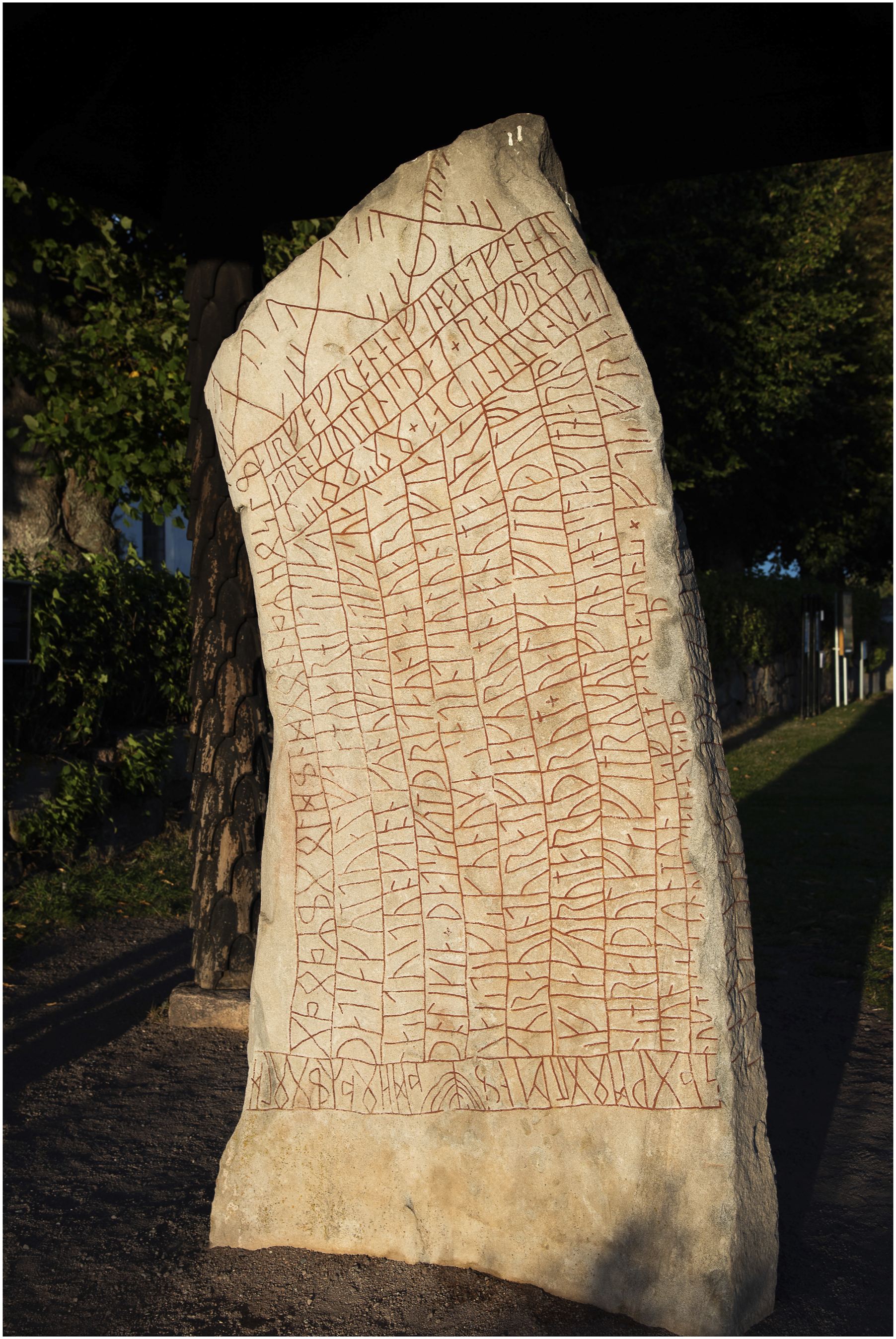
Thus, the specific aim of the study is to explore how a multimodal approach can contribute to the interpretation of the Rök runestone. The challenge is difficult. The study investigates if a multimodal analysis can answer the following questions that have been recognized in previous research but in general considered to be impossible to answer (line numbers refer to Figure 2): i. Why is the first broad side not arranged for vertical reading only, but also in two horizontal bottom-lines (9 and 10)? ii. Why is the last information unit of the first broad side split between the horizontal lines on this side and a vertical line on the closest narrow side (line 11)? iii. Why is the top side used for the inscription (line 12), although it is not visible from the ground? iv. Why are the vertical lines not consistently to be read upwards, but also once (in line 13) downwards? v. Why is the second broad side not arranged in vertical lines only, but also in five horizontal lines (23 and 25–28)? vi. Why is one of the information units on the second broadside split into one horizontal line (23) and one vertical line (24)? vii. Why are the runes of the second broad side’s bottom line (23) as well as yet another line on the same side (28) carved with runes upside-down, to be read backwards? viii. Why are the runes of the first narrow side (line 11) not carved in the same size, but in increasing size? ix. Why are the runes of the second narrow side (line 13) instead carved with runes of decreasing size? x. Why are the top side (line 12) as well as the second broad side’s uppermost line (25) carved with cipher runes in the shape of large crosses? xi. Why does the sign used for segmentation between information units vary between the shape of a dot (in line 5) and the shape of small crosses (in lines 1, 16, 19, 21, 27, and 28)? Reading order of the Rök runestone inscription. (Black arrows indicate reading direction of lines; red arrows clarify the main cycles of the reading process.)
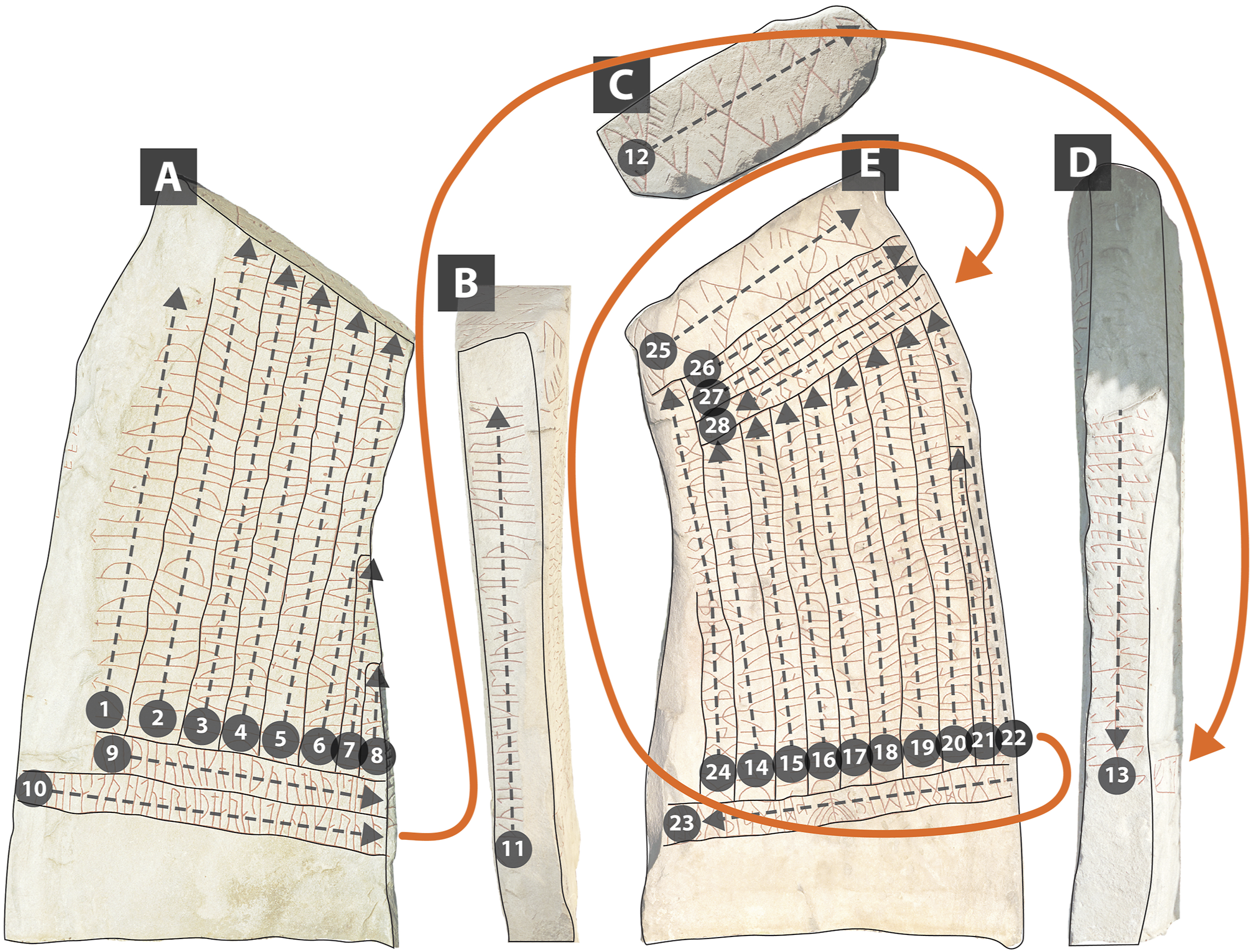
As long as the series of questions is understood as a quest for 11 lost intentions of the carver, they make up a mission impossible indeed. From the analytical perspective of this study, however, the task is in principle solvable, since the multitude of specific interpretative problems opens a possibility to postulate and examine the potential meanings of reading directions (questions i–vii), font size (viii and ix), and cross shape (x and xi) in the inscription.
In addition to the numerical cipher (in lines 12, 13, and 25), there are (at least) two other kinds of ciphers in the inscription which will not be discussed in this study: runes from an older futhark (in lines 23, 24, and 28) and a substitution cipher (in lines 26 and 27). These ciphers raise questions that need to be addressed in a separate study.
Theoretical and analytical framework
The study is informed by the theory of geosemiotics (Scollon and Scollon 2003) which has been elaborated to understand public texts as social action in the material world. The theory has been applied to several kinds of contemporary texts and their places, especially in commercial settings (see Lou, 2017 and references therein) and in the context of schooling (see Jocuns, 2021 with references); however, so far, not to texts with such a long history as the Rök runestone.
Geosemiotics comprises three interacting dimensions of multimodality. In regard to texts that combine verbal language and visual expressions, these dimensions can be presented as follows: the visual semiotics of the inscriptions on the surface of the textual artifacts, the interaction order of reading processes, and the place semiotics which arises through the emplacement of texts in specific material contexts.
For the principles of the first multimodal dimension, the visual semiotics, the theory is indebted to the visual grammar of Kress and Van Leeuwen (1996). This model for understanding any kind of image—from children’s drawings to scientific diagrams—suggests that images are the outcome of choices in three main systems of visual meaning-making: representation, interaction, and composition. In other words, the visual analysis is suggested to examine what is represented and how, how the viewer is positioned, and how the image is composed. In this study, the visual semiotics of representation is focused upon.
With the dimension of interaction order, geosemiotics expands its analytic focus to the social context, primarily based on the work of Goffman (1959) on social interaction. The model differentiates between social groupings which can be used to understand the function of texts in public space, from individual singles to much more complex situations as platform events and celebrative occasions. In this study, the model is used to challenge the traditional idea of runestone readers as more or less isolated individuals.
Finally, place semiotics concerns how the meaning of texts may depend on their emplacement in the material world and their materiality. Within this dimension, Scollon and Scollon (2003: 153–155) also suggest an analysis of possible use of exophoric and situated indexicality. This is important to a study of runestones as any erection of stones in the landscape can be expected to index something outside the text.
It goes without saying that the geosemiotic emphasis on “real world meaning,” is not easy to apply in a historical context, especially when there are no complementary sources about the inscription’s original emplacement or reading practices. However, although it may seem that all 11 questions posed in the previous section are restricted to the dimension of visual semiotics, I argue that none of them can be answered without an examination of the potential place semiotics and interaction order of the monument. Admittedly, these two latter dimensions cannot be studied empirically in this case, but I hope to show that both of them can be used to discuss the potential interface between the monument and its social and material environment, and thus, generate fruitful heuristic starting points for the analysis of the inscription’s visual semiotics.
Accordingly, the interpretative process of the study can be said to constitute a hermeneutical circular movement between a possible understanding of the whole of the text in its context and an understanding of its details (Gadamer, 1975). Based on a dialogue with previous research as well as on some general observations, I will take a provisional stand on some comprehensive issues in regard to the place semiotics, interactional order, and visual semiotics of the Rök runestone monument. I will then turn to the details of its visual design.
The issue of emplacement from the perspective of place semiotics
It is not known where the Rök runestone was originally erected, but most scholars agree that it would have been in the vicinity of the place where it now stands (see Figure 3). At this place, called Rök, the runestone was first documented in the beginning of the 17th century when it was used as a block in the eastern wall of a medieval storehouse for harvest tithes, close to the twelfth-century Rök church. In 1843, when the old church was replaced, and the grain store was demolished, the Rök runestone was put into a wall by the entrance to the new church. After about 20 years, the stone was taken out and re-erected, first at the church yard, and then, in 1933, just outside the cemetery wall where it can now be seen (cf. Wessén, 1975). Map of the Rök region with un-inscribed standing stones along the old east-west road (dots). Comparison of the oblique topline silhouette between the Rök runestone and three of the un-inscribed standing stones.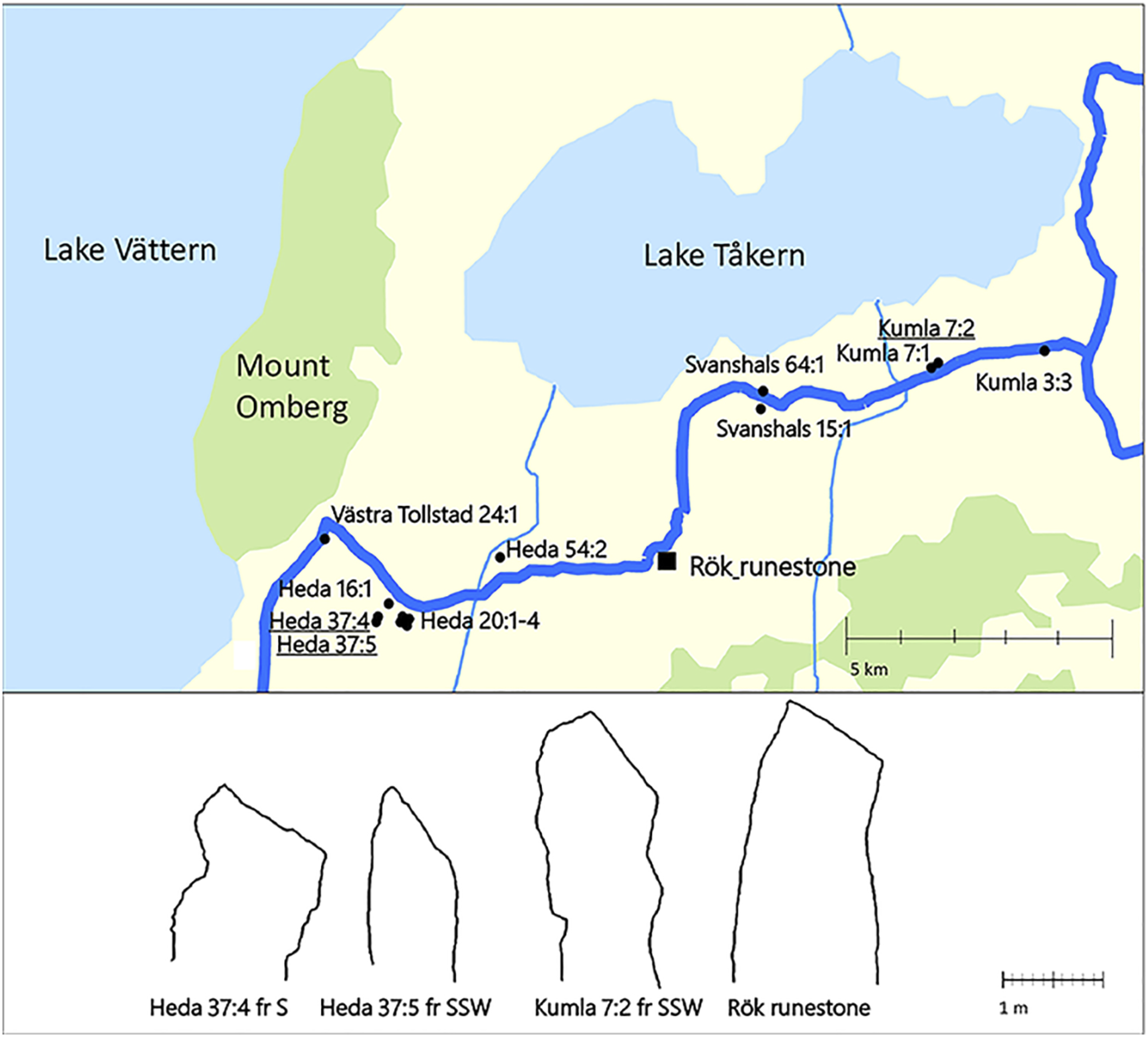
I accept the arguments for assuming Rök as the original site of the runestone. Firstly, there are, of course, some difficulties involved in moving a five-ton slab. Secondly and maybe more importantly, the etymology of Rök derives the place-name from rauk in Old Norse, meaning “peaked rock,” which means that the place has got its name from the monument (cf. Wessén, 1975: 8–11). And finally, it becomes easier to understand the unusual emplacement of the church, unrelated to settlements, if we can assume that the place already had some sort of cultic significance, for which the Rök monument can be taken as support. The expected location of the church would otherwise have been the old village of Hejla east of Rök (Tollin, 2010: 140).
It has been argued that the most probable original position of the stone is about 300 m north of the Rök church, in a depression where the old road crossed a river that flows into the nearby Lake Tåkern (Cnattingius, 1930). This hypothesis is based on a comparison with the typical emplacement of later Viking Age runestones (cf. research overview in Danielsson, 2015). However, from the perspective of place semiotics, I argue that the meaning potential of the stone’s emplacement should be established as it could have been conceived when the stone was erected, not on the basis of a practice that arises 200 years later. At the time of the Rök runestone’s erection, it was yet extremely rare to raise inscribed stones. Therefore, the concept of “runestones” may be somewhat misleading, as it is only in retrospective that the monument has been categorized in this way. The contemporary comprehension should more likely be that the erected Rök stone was a new member in the family of standing stones, although one with the unique ability to speak.
The practice of erecting stones was established in the area together with agriculture, and had a strong continuity through the late Neolithic, Bronze Age, and Iron Age. Within a radius of 10 km, 87 standing (un-inscribed) stones have been documented, which were part of the semiotic landscape at the time of the Rök runestone’s erection; 14 of them are in the vicinity of the old east-west road that passes Rök (see Figure 3). In my ongoing project, the positions and shapes of these stones are investigated. A clear tendency is that the positions have been chosen to promote view and visibility, which speaks against an original position of the Rök runestone down by the riverbed. Instead, it is more likely that the stone was erected closer to the place where it was found and where it is now re-erected; a place with good views in all cardinal directions. Such a position also gives more space for a reading activity in which many people participated.
Another noteworthy observation is that several standing stones have a similar four-sided shape, as was later preferred for the Rök runestone. Further, the Rök runestone resembles some of these earlier monuments in regard to the oblique topline of the silhouette. Three other standing stones along the old east-west road have distinct oblique toplines (see Figure 3). Two of them stand at the Jussberg barrow six kilometers west of Rök, and the other is risen nine kilometers east of Rök (see Heda 37:4, Heda 37:5 and Kumla 7:2 in Figure 3). All three stones, which probably remain in their original positions, are placed so that one gets the impression that their peaks are pointing west (or west-north-west) in direction of Mount Omberg. 1
We cannot, of course, be sure that these similarities in shape of the boulder are purposeful, but it is worth exploring the potential meanings of the Rök runestone’s place semiotics, if this monument is taken to be originally erected pointing west (not as it is now re-erected pointing south) from a place at Rök with good views (near the place where it now stands). Thus, I will, in what follows, talk about the Rök runestone’s four sides as if this was the intended interface between the stone’s four sides and the surrounding landscape.
The issue of right reading path from the perspective of interaction order
The Rök runestone inscription is arranged in 28 lines, of which 20 are vertical and eight more or less horizontal (see Figure 2). There has not been any consensus about the order in which they should be read, except for the 11 first lines. These lines cover the broad side and the narrow side which I tentatively call the south side (A) and the east side (B), respectively. In other words, all scholars agree that the inscription starts mentioning the dead son Vamoth and his father Varin, and that it continues by speaking enigmatically about two spoils that changed owners 12 times, and a champion who once was dead but is now alive (cf. the translation of the text in Figure 4). The debate starts when it is time to find a 12th line that can open the right way through the maze, and almost all new interpretations of the inscription have found their own route (see overview in Åkerström, 2021). English translation of the Rök runestone text.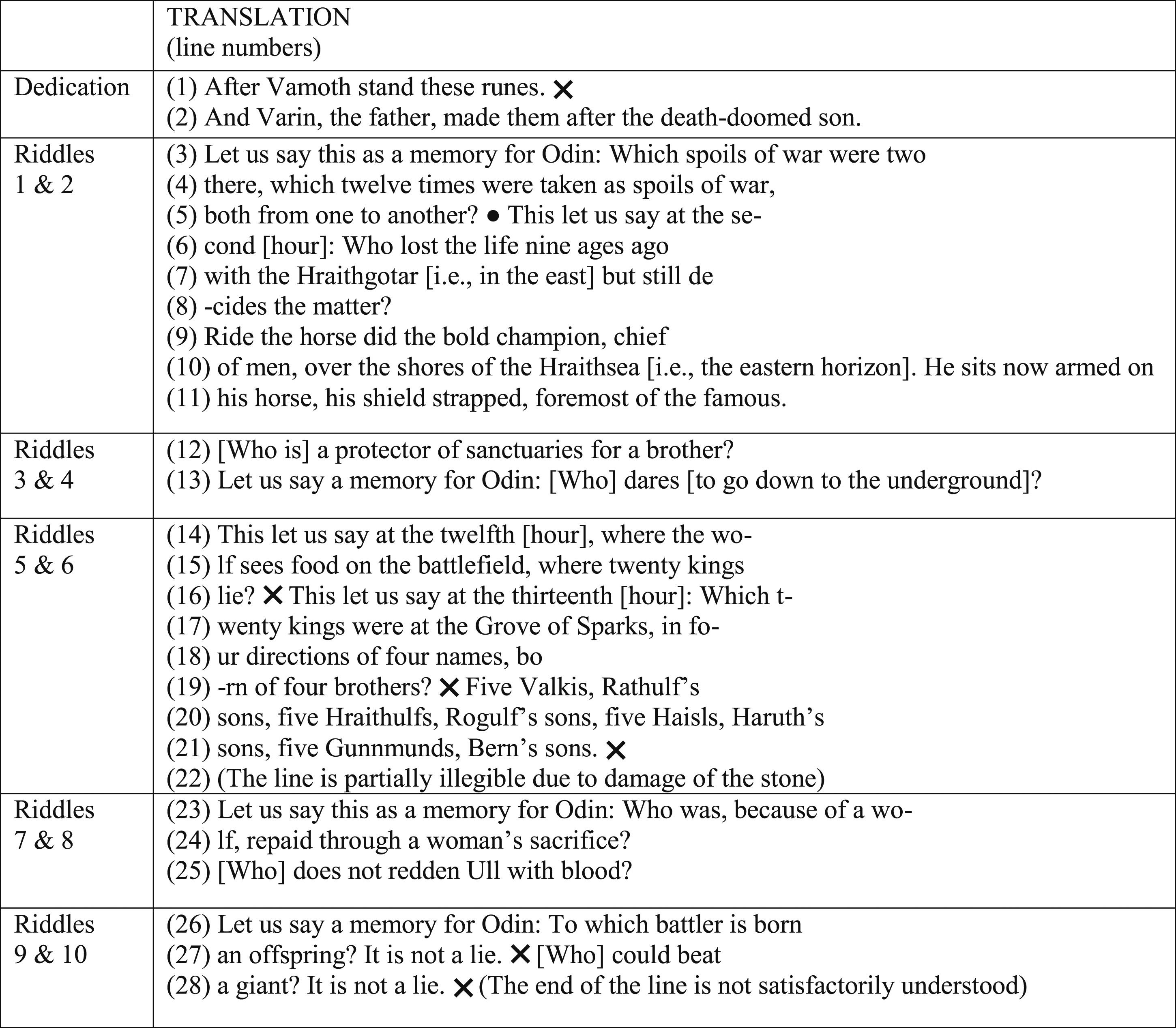
The quest for reading order has been understood in runology primarily as a question about how the inscribed text should be reproduced on lines of a page. I argue that reading order should be reconceptualized as a choreography for readers’ bodily movements in their interaction with the stone (Holmberg, 2013), or, in terms of geosemiotics, as a dimension of interaction order. For the elaboration of this idea, I have been inspired by Bianchi, 2010 study of one-sided runestone inscriptions from the later Viking Age, and the quite simple labyrinth principle he establishes for their reading: the transition between lines should be as short as possible. However, it has proved difficult to manage the complexity which arises when the inscription covers more than one side.
The most thorough investigation of reading order in early Viking Age rune inscriptions has been carried out by Åkerström (2019, 2020, 2021). In a study of 133 rune texts from the period, she investigates the visual semiotic resources for showing the reader where to start and how to proceed the reading (2020). The model of analysis is then applied in an analysis of the Rök runestone (2021). Regarding the point of departure for the reading, Åkerström analytically confirms the strong consensus in previous research (see Figure 2, line 1), but she also points out how the corresponding spot on the opposite side (line 14) is semiotically marked as a potential starting point (ibid: 47, cf. 67). Regarding reading order, she maps all possible relations between lines that can be understood as visually connected in one way or another (see Åkerström, 2021: 59 for a summary), and draws the conclusion that the inscription offers many parallel routes of reading.
It is hard to disagree that different individual readers, “singles” in the terminlogy of Scollon and Scollon (2003: 60–64), may already have taken different reading paths during the Viking Age. However, if we imagine that the stone was produced for a communal social practice, some kind of platform event or celebrative occasion, there are good reasons to maintain the idea of one intended reading path. My assessment is that Åkerström’s analysis of visual connections between lines is very close to finding this path. What is needed is a reanalysis in terms of choreography for readers, an interaction order that involves how the inscription prepares for movements around the stone. From this perspective, the upward movement of reading the 11th line on the first narrow side (B) is the most natural way of reaching the top side (C), and in the same movement, without any change of direction, reach the other narrow side (D). I find the simplicity of this reading path convincing although it would entail that we must accept the idea of an implied airborne reader. What now remains to be read is the second broad side, and its reading order (see Figure 2) follows from Åkerström’s conclusion that the inscription has got a second starting point (cf. also ibid: 67).
The establishment of this reading order does not imply that all participants in the reading event were expected to move this way around the stone. It is more likely that the reading was performed aloud, and that most of the participants were listeners, although their role may probably also have been to respond to what they heard. Neither is it necessary to imagine that the task to give voice to the runes was ascribed to one individual only. The responsibility for different parts may have been distributed in accordance with a prior script for the readers’ participation. The long distance between the point where the reading of side D ends and the starting point for side E (see Figure 2) may indicate a moment when the responsibility to lead the reading activity was handed over from one reader (lines 1–13) to another (lines 14–28).
The issue of main theme from the perspective of visual semiotics
The traditional understanding of the Rök runestone is that its inscription consists mainly of allusions to hero narratives. First in the line of heroes is, according to this line of interpretation, Theodoric the Great, who has traditionally been identified in the first part of the inscription as the legitimate owner of the two precious artifacts and as the riding champion (see, e.g., Bugge, 1910; Wessén, 1958: 15, 24; Lönnroth, 1977). However, several linguistic difficulties on different levels make the text open for many interpretations, and Ralph (2007) showed that a reading without Theodoric is just as likely. This was the key for several proposals regarding other details of the inscription. The 12 changes of ownership were now possible to understand as a riddle about the lunar cycle and the riding champion as an element of a sun-riddle (see Holmberg, 2016: 87–90; Holmberg, 2021; Holmberg et al., 2020: 21–24; Ralph, 2007, forthcoming 2021; Williams, 2021).
Within the hero paradigm, the following parts of the inscription seem to concern another set of celebrities of the time: Ingivald, Sibbi, Vilinn, and the 20 kings (cf. e.g., Wessén, 1958). Inspired of Ralph's (2007) suggestion that the whole inscription consists of riddles, other studies have, however, shown that these heroes can also be replaced or reinterpreted (see the summary in Figure 5). Another sun-riddle was suggested (Holmberg, 2016: 90–91) where previous research had found a reference to the kin of Ingivald (lines 23–24, cf. e.g., Wessén, 1958: 17, 24). Later, scholars (Holmberg et al., 2020: 29–30) identified yet two other sun-riddles in the lines that had previously been read as a statement about Sibbi’s potency (lines 12 and 25, cf. e.g., Wessén, 1958: 17, 24). In the same study, it was suggested (Holmberg et al., 2020: 30–31) that also Vilinn should leave the stage, and that the passage where the name had been read (lines 26–28) is actually two riddles about the god that is assigned by Old Norse mythology the role of killing the sun-hunting wolf in the end of times. Finally, it has proved possible to argue that the 20 kings (in lines 15–21) can be understood as an element of two star-riddles (Holmberg, forthcoming 2022). Thus, the proposed main theme of the inscription has shifted from the glory of human heroes to the rhythm of celestial light. This rhythm of the moon, the sun, and the stars should (according to Holmberg, 2021) be understood from the temporal perspective of the autumn equinox. Summary of the 10 riddles of the Rök runestone inscription and proposed answers.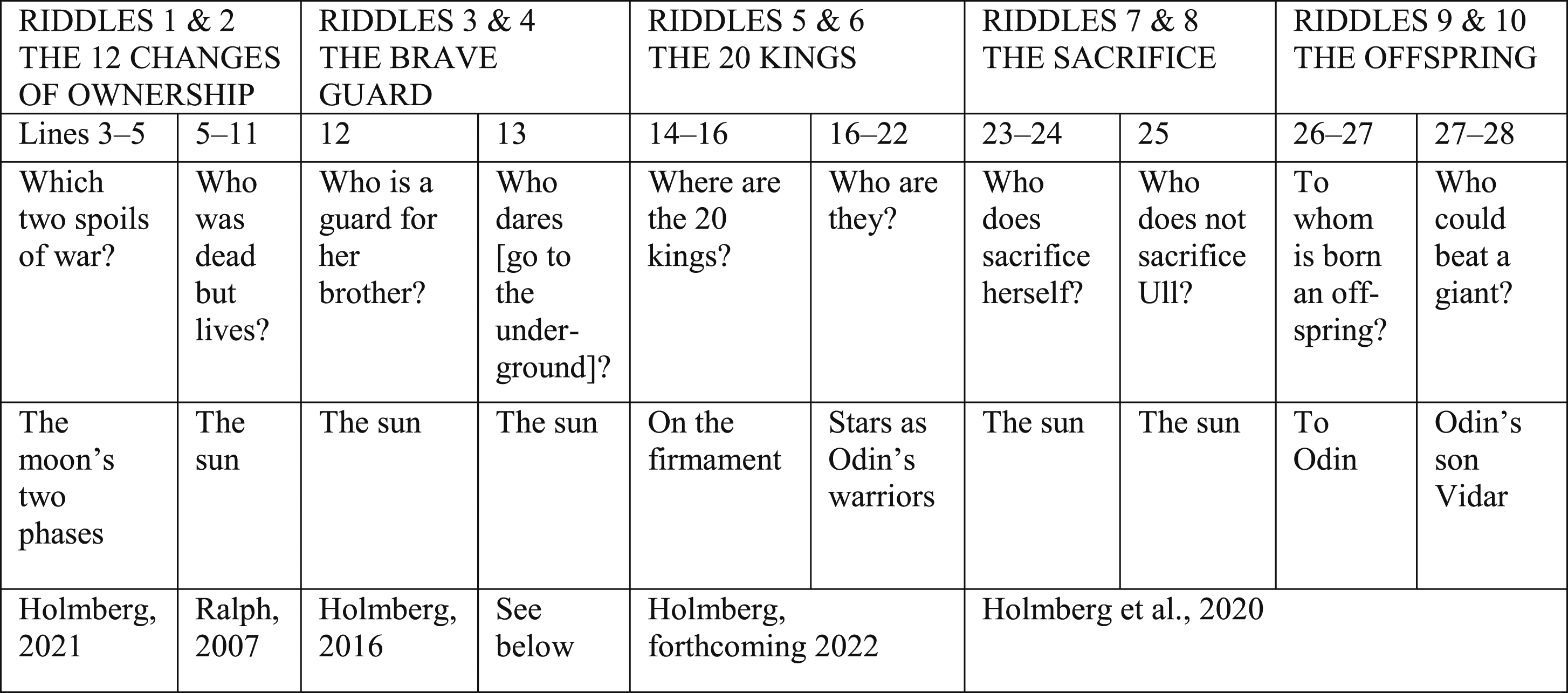
The scholarly evaluation of the interpretative shift away from the traditional hero paradigm is far from finished (see, e.g., critique in Lönnroth, 2017, 2020). If it can be shown, however, that the new understanding of the inscribed runes is consistent with the use of other visual resources, this would be a decisive argument. As a starting point for the analysis of the multimodality of the monument, Figure 4 presents the English translation from Holmberg et al. (2020: 20) in the reading order that is accepted in this study and with some other adjustments, mainly to fit the inscription’s division into lines. 2
Some aspects of the visual design of the Rök runestone inscription have been discussed already in previous research, either as boast (e.g., Wessén, 1958: 20), or as signals to the reading path (e.g., Åkerström, 2021). The importance of both these functions should not be neglected. However, in this study I want to investigate if the visual resources also have a representative function. Based on the conclusion that the main theme of the verbal communication is the cosmological rhythm of heavenly bodies, it will be examined if this might be the theme also for the non-verbal visual communication.
The multimodal meaning of the Rök inscription
The three critical aspects of the visual design will be investigated one at a time: reading direction (questions i–vii), font size (questions vii and ix), and cross shape (questions x and xi).
Reading order as representation of solar direction
The first two riddles of the inscription, which are carved with normal runes in vertical lines on the main part of the south side (A), seem to concern what happens at night to the moon and the sun, respectively. The first riddle reminds readers that the 12 months of the year have been changing their ownership of the two halves of the moon disk. The second riddle concerns the situation 9 months before the autumn equinox New Year celebration, that is, at midwinter, when the sun was dead in the east as it passed well below the horizon. The two horizontal lines that are carved as bottom-lines of the south side seem to give the beginning of a clue to the second riddle. As this is a sun-riddle, it is worth exploring if the choice of a new reading direction symbolizes the direction of the sun. If so, the eastward reading direction may mimic the underground return of the sun to the place for sunrise. It should, though, be noted that the direction is following the left-to-right-norm for writing in horizontal lines, which was established already in early Viking Age Scandinavia (cf. Åkerström, 2019: 75–77).
The clue to the second riddle describes how the sun rides over the eastern horizon (“over the shores of the Hraithsea”) in the sunrise (cf. Holmberg 2016, 89–90; Holmberg et al., 2020: 24). The clue is carved in three lines. Two of them are horizontal (9 and 10), as said, but the last line (11) is carved vertically on the east side of the stone (B). This line should be read from below and upwards, which is in accordance with the general norm in early Viking Age (Åkerström, 2019: 75–77). What is unusual, however, is the transition between the horizontal and vertical lines. It takes place in the middle of a sentence: “[end of line 10, eastward reading:] He sits now armed on [line 11, upward reading:] his horse, his shield strapped, foremost of the famous.” This visual arrangement may form an image of the sunrise moment, especially apt at the equinox when the rising sun shines straight from the east. Thus, the visual can be understood as a reinforcement of the verbal message. Even though the sun was dead in the east at midwinter 9 months ago, she now raises steeply and lightens the eastern side of the stone (B).
According to the inscription, the riddles are told and solved in order to remind the god Odin about cosmological foundations: “Let us say this as a memory for Odin ….” Holmberg et al. (2020) who proposes this interpretation of the phrase, argue that the intended readers are humans in a cultic setting. This may well be combined with the idea that the reading enacted an interaction between gods with different cosmological responsibilities. The god with special responsibility for the daylight in Old Norse mythology is imagined to ride with the sun over the sky (cf. Holmberg et al., 2020: 22–24). If this god is imagined taking part in the reading, it is quite natural to follow the movement of the rising sun to the numerical cipher of the top side (C).
The riddle on the top side asks who is “a protector of sanctuaries for a brother.” The answer to the riddle is the sun, who takes turn with her brother, the moon, guarding holy places. One such holy place may have been the place of the Rök monument. Another is the place called Ullevi (“the sanctuary for the god Ull”) which can be discerned from Rök at the northern horizon. The westward reading direction of the line (12) mimics how the sun continues its celestial journey in the same direction while performing her guard duties.
After day follows dusk and sunset. Thus, it is completely consistent that the numerical cipher of the following line (13), on the west side of the stone (D), is carved to be read downwards, although it violates the norm for reading direction in vertical lines. I take this as one of the strongest arguments for interpreting the reading direction in this sequence of lines (9–13) as a visual representation of the direction of the sun.
Previous interpretations have avoided reading the west side line (13) as a separate information unit since only one word follows the formula “Let us say a memory for Odin ….” The reading order accepted in this study, however, makes such a solution inescapable. Holmberg et al. (2020: 29) take the final word of the line as an imperative of the Old Norse verb þora “to dare, to be brave” (cf. Von Friesen, 1920: 86). Actually, it is easier to read the grammatical form þor as indicative, although this requires that we accept an elliptic subject: “(who) dares?” or “(who) is brave?” (cf. similar ellipse in lines 12, 25 and 27). In this context, the implied daring action should be the steep decline from heaven that is symbolized by the downward reading direction on the west side of the stone. The sunset of the autumn equinox, which takes place in the west, may have been considered as particularly frightening. This was the end of the bright and warm half of the year, which was characterized by sowing, growth, and harvest, and it was the beginning of the dark and cold period that culminates at midwinter (cf. Nordberg, 2006: e.g., 29–36). By the reading of the sunset line (13) we have completed one solar cycle from darkness to darkness.
When the reading starts again on the north side (E), we are challenged by a pair of riddles that are carved in conventional vertical lines (14–22). Just like the two riddles that started the first solar cycle (lines 3–11), they seem to focus on what happens in the night, but now the questions apply to the stars (see below). It will now be examined whether this passage starts a second solar cycle.
The next horizontal line (23) is found at the bottom of the north side (E). Just as do the two bottom-lines (9 and 10) on the opposite side (A), it invites the reader to make an eastward reading. Any attempt to get a horizontal line on the north side (E) to represent the (second) eastward, underground route of the sun, conflicts with the left-to-right-norm, which seems to force any horizontal line on the north side to point west (compare the discussion in Scollon and Scollon, 2003: 153–155). There is one solution, however, and that is to write upside-down. This is exactly what happens in the first horizontal line on the north side of the stone (line 23).
On the south side of the stone (A), it was noted how the lines with eastward reading direction (9 and 10) are followed by a vertical line on the east side (B) whose runes guide the reading upwards (line 11) and thus mimic the rising morning sun. This pattern is now repeated by the sharp turn to the next vertical line (24). This is a strong argument that reading direction in this sequence is representing the route of the sun, its (second) nightly underground journey (line 23) and its (second) rise (line 24).
The two lines (23 and 24) verbally express a sun-riddle that seems to allude to an Old Norse myth that tells how the sun gives birth to a daughter, the new sun, before she is swallowed by the wolf of darkness: (line 23, eastward reading:) “Let us say this as a memory for Odin: Who was because of a wolf (line 24 upward reading) repaid through a woman’s sacrifice?” (cf. Holmberg et al., 2020: 24–26). 3 The choice of motif for the riddle may be explained by the fear about what happens at the night between the last day of the old year and the first day of the new. In this case too, the visual meaning reinforces the verbal: even though the wolf has devoured the sun this night, a new day can dawn with the rise of a new, repaid sun.
If the second solar cycle in the Rök inscription follows the same pattern as the first, the line that follows the sunrise line should be read in westward direction. And yes, the sunrise line (24) takes the reader from the bottom line to the top line of the stone’s north side which turns the reading west again.
The verbal meaning of the numerical cipher of this line (25) is uncertain. Holmberg et al. (2020: 29–30) interpret the line as a sun-riddle but hesitate between different linguistic alternatives. The most straightforward reading seems to be “(who) does not redden Ull with blood?”, which would be a question about a cancelled sacrifice. The authors complain that they could not understand why it would be relevant to mention that the god Ull is not sacrificed by the sun (Holmberg et al., 2020: 30, note 6). Among scholars of the history of religion, Ull has been understood either as a god with some celestial function, for example, a protector of the sun or the moon, or as a god of the winter (cf. the overview in Mollin, 2015). In the context that emerges in this study, it is natural to propose a reconciliation between these two positions. If the function of the god Ull was to protect the winter sky, it is easy to imagine a potential conflict between Ull and the sun, especially in the turn from the bright to the dark half of the year.
The three last lines (26–28) visually express, although the remaining surface of stone is small, a parallel to the sunset and night of the first inscribed sun-cycle. This is accomplished by a sudden change in reading direction. After two lines with westward reading direction, obviously still symbolizing the sun’s day trip, the reader must make a U-turn and follow the inscribed upside-down runes of the last line east, thus ending the second solar cycle of the inscription. (For the verbal meaning of these lines, see below).
Change of font size as representation of solar magnitude
The normal size of the inscriptions’ runes is between 3 and 4 inches (around 8–10 cm). However, the variation between different lines is considerable and in two cases—on the eastside (B) and the westside (D)—the font size changes clearly within a single line.
The first runes of the east side line (11) are approximately the same size as the runes of the previous lines (around 4 inches/10 cm). Then follows a gradual increase to runes that are double in size. This may in part be motivated by the fact that the upper part of the stone is wider. However, it may also be argued that the larger available space has been used to symbolize the gradually stronger light of the rising sun. The proposal is somewhat weakened by the fact that there is no increase in font size in the second sunrise line (24).
The vertical line on the west side (13) implements a numerical cipher whose runes are arranged like a ladder for the descent from the top. A similar change of font size occurs in this line. As the reading direction is the reverse, the reading starts with the large runes (about 8 inches/20 cm) in the upper part of the line, while the later runes are less than half the size (3 inches/8 cm). This might represent the decrease in brightness of the setting sun.
The most impressive runes of the whole monument are the rune crosses, visible to the human eye on the top of the north side (in line 25), but also carved in the top side (in line 12). The cross arms measure between 12 and 15 inches (30–40 cm). In both cases, this can be understood to underscore that these lines are representing the time of day when the sun’s light is strongest.
The cross shape as representation of heavenly bodies
A unique feature of the Rök runestone’s inscription is the arrangement of the cipher runes in large crosses (lines 12 and 25), three in each line. It has been suggested (in Holmberg et al., 2020: 30) that the cross shape may be a clue to the solution of the two sun-riddles they express. This suggestion seems even more likely when it has been shown that each of these two lines is the culmination of a whole inscribed sun-cycle.
I now return to the two riddles that ask for the position and identity of 20 kings (lines 14–22). In (Holmberg, forthcoming 2022), it is argued that the most coherent interpretation is that the kings are stars with the cosmological function to fight against the wolf of darkness (cf. Holmberg et al., 2020: 24–26), and that this threatening wolf, well-known in Old Norse mythology and mentioned in the first of the two riddles, is manifesting itself in the sky as “the Wolf’s Jaw.” This was the name for the Hyades in pre-Christian Scandinavia and, at the Viking Age autumn equinox, this group of stars became visible after dusk over the eastern horizon (“at the 12th [hour]”).
The visual analysis of this study strengthens the star interpretation because this part of the inscription, following the sunset (in line 13), should thematize what happens in the sky at night. Another clue may be the cross shape of the sign that is used three times between information units in this part of the inscription (in lines 16, 19 and 21). If the large crosses symbolize the sun, far the brightest of the heavenly bodies, the lesser magnitude of the stars may motivate much smaller cross symbols. This suggestion may seem too speculative, but it would very nicely explain why the moon-riddle on the opposite side does not end with a cross, but a dot (in line 5).
The same small cross-shaped signs return in the last pair of riddles (in lines 27 and 28), and it is reasonable that the stars return into the inscription when darkness falls again in the second inscribed sun-cycle. However, if the star interpretation of these cross-shaped signs is correct, it would indicate that the last two riddles are also star-riddles. They both seem to concern the same man. The first riddle asks about his father, and the second about his own identity. The only verbal information given about him is that he was able to beat a giant. As the wolf of darkness is one of the giants in Old Norse mythology, Holmberg et al. (2020: 30–31) suggest that the giant slayer of the riddles is Vidar, Odin’s son. His role in the cosmological drama is to ensure the rebirth of the world by killing the wolf. Admittedly, we are now at the end of a long and complex chain of conclusions that must be further evaluated. It should, after all, be noted that the idea that Odins’s warriors, as well as the wolf, were imagined to be visible in the night sky (Holmberg, forthcoming 2022) makes it natural to imply that also Vidar, the main protagonist of this cosmological drama, was thought to have a celestial embodiment. At autumn equinox in early Viking Age, the “Daystar” (Arcturus in the constellation of Boötes) became visible again at dawn above the eastern horizon. This was obviously the sign of an imminent sunrise (cf. Beckman and Kålund, 1916: 72–76).
One of the small cross symbols has not yet been paid attention to in the analysis. It ends the first line of the inscription that dedicates the monument to a dead son: “After Vamoth stand these runes.” Scholars have observed that the small cross at the end of this line is strangely redundant if it is used for segmentation only (cf. e.g., Åkerström, 2013: 42). It has been argued (in Holmberg et al., 2020: 31–32) that the inscription expresses a hope for the dead son’s participation in the Odin warriors’ battle against the wolf. Maybe, this entailed an expectation of a newborn star.
A runestone in the middle of the gods' council—and in multimodal research
The Eddic poem Völuspá, one of the best sources to Old Norse mythology, mentions that the gods are gathering on some occasions that are critical to the world. The first of these councils (str. 5–6) deals with the routes and rhythm of the sun, the moon, and the stars. The result of the multimodal analysis of the Rök runestone suggests that the monument was raised for an enactment of such a council. Not only do the inscribed riddles concern the heavenly bodies, with the aim of reminding Odin how the world is connected, but the arrangement of the riddles too seems to be an attempt to stabilize the cosmos. They form a path, not only for the reader but for the sun itself. In this way, the sun is accompanied when she crosses the border between summer months and winter months, perhaps in a changing of the guard between the gods who are responsible for these halves of the year.
I have argued that the reading direction of lines in several passages symbolizes the route of the sun, that change of font size in two lines mimics the change of brightness of the rising and setting sun, and that the cross shape is used to represent the sun, and possibly also the stars. In this study, I have only tried to show how the instantiation of the meaning potential can be understood in a specific case. Therefore, a possible counterargument is that the runological literature, to my knowledge, does not offer any close parallels. Further research will tell if some of these findings can be generalized to other runestone inscriptions from early Viking Age. Whatever the results of this research will be, this study has shown how a multimodal approach can contribute to both the understanding of the Rök runestone monument and the possibility to ask new empirical questions. Do the runes in the bedrock of Ingelstad (Ög 43), as well as the other inscribed signs (one of them a sun-symbol; one of them a small cross), concern the westward route of the sun? Does the sharp turn of reading direction in the Oklunda runic inscription (Ög N288) indicate the sunset? And so on.
The geosemiotic theory offers a trinocular perspective for multimodal analysis which has been rewarding for this study. However, there is a risk that these three analytical dimensions are reified and understood as existing independently of each other. Such misunderstandings are a consequence of increasingly efficient technologies for reproducing texts. The scholarly reproduction of the Rök inscription (printed and distributed drawings, photos, and transliterations) had made us believe that it was possible to comprehend its verbal message, or its visual semiotics, decontextualized from the bodily interaction with the material artifact. However, in-depth multimodal analysis of historical epigraphy—texts from a time when reproduction required hard work—has the potential to teach us how powerfully the multimodal text keeps readers in place. Thus, it can bring about a Verfremdung of our modern culture of highly specialized literacies and sensitize our understandings and analysis also of contemporary material.
Footnotes
Acknowledgement
This work was supported by The Swedish Research Council (Rök Runestone Revisited 2016-02493). An abstract for the paper was accepted for the Ninth International Symposium on Runes and Runic Inscriptions 2020, but the conference was postponed to June 2022 due to the pandemic. The empirical investigation of standing stones in the Rök region, which is important for the argument of the paper, was carried out by the archaeologist PhD Anna Nykvist Thorsson. The following persons have contributed with the first three figures. Figure 1: Helge Andersson (CC BY). Figure 2: Anna Nykvist Thorsson (CC BY). Figure 3: Marco Bianchi (CC BY) and photo Bengt A. Lundberg, RAÄ (CC BY).
Declaration of conflicting interests
The author(s) declared no potential conflicts of interest with respect to the research, authorship, and/or publication of this article.
Funding
The author(s) disclosed receipt of the following financial support for the research, authorship, and/or publication of this article: This work was supported by The Swedish Research Council (Rök Runestone Revisited 2016-02493).