



Abstract
Pivoting on the body/life of the ethnographer as a point of impact, this article will offer a multimodal account of the ripple effects of state sponsored terror as lived in Argentina (1976–1983) and re-sensed in Canada throughout the Maple Spring and its aftermath (2012). Threading a series of theoretical and ethnographic vignettes, a conceptual weaving emerges that travels back and forth in time, working against the perceptual attack on the population produced by the military regime.
Keywords
Introduction
Working at the threshold of thought and creation provokes an aperture for that which has not been thought. Thought is a lure for feeling that pre-articulates the virtual inflexions of a becoming-work. […] Feeling the world means actualizing its potential affectively. Feeling transduces thoughts into becoming-concepts. Erin Manning in “Creative Propositions for Thought in Motion” (Manning, 2008)
Pivoting on the life/body of the ethnographer as a point of impact, this piece mobilizes multimodality in order to explore the ripple effects of state sponsored terror as lived in Argentina during the last dictatorial regime (1976–1983) and re-sensed in Canada throughout the Maple Spring and its aftermath (2012). 1 Threading a series of theoretical and ethnographic vignettes, a conceptual weaving emerges that travels back and forth in time, composing with documentary materials drawn from personal and cultural “archives of feelings” (Cvetkovich, 2003) in order to work against the perceptual attack on the population produced by the military regime, an attack that Diana Taylor named as percepticide (1997). 2
Multimodal here implies a variety of methods and mediums that not only mean but do different things, activating a diverse range of perceptual and relational systems. The article combines ethnographic narratives with a brief theoretical review of the corporeal in memory studies and a series of video, photo, and curatorial experiments not conceived as methodological deployments but as possible openings for exploring the relationships between bodies and memories, affects and materialities, and the resonances, vibrations, and accruals in between. 3 These exploratory and experimental research-creation practices attempt to follow Manning’s articulation of the potential of thresholds to think, feel, and create otherwise, which in this case seek to move beyond the already articulated memories of the dictatorship.
The prolific social labors of memory (Jelin, 2003) in Argentina have constituted a dynamic field of cultural production in activist, museological, artistic, and academic circles. As evaluated by Jelin and others, this field is not without challenges and limitations, particularly when it comes to identifying whose experiences count as significant during the period in question—traditionally those of the direct victims: the disappeared and their relatives. The academic expansion of the field of “recent history,” as delineated by Franco and Lvovich (2017), to explore everyday life experiences under the dictatorship, as well as what Cecilia Sosa calls the queering of memory (2014) have resulted in the inclusion of other voices, particularly during this last decade, after the “consecration of memory” (Guglielmucci, 2013). The beginning of the research project I describe here is part of this expansive movement, activated by the need to articulate a more inclusive “we” when speaking of who and how the oppressive regime affected the population. 4
In anthropological research, multimodality has been traditionally deployed “in the field,” where-when observing and learning to do and live as/with “others” for extended periods of time is combined with writing observational and interpretative notes, recording conversations or interviews, taking photographs and filming, among other “data-collecting” techniques. Upon returning from the field to the writing desk, anthropologists would traditionally be faced with the challenge of conveying the complexities of these live worlds through textual form. Many found the traditional monograph style of ethnographic knowledge production to be a “flattening” of the lived experience. 5
Although multimodal experiments in anthropological reportage have been part of the discipline, they remained marginal to the well-established and academically prioritized production of ethnographic monographs. 6 During the last part of the 20th century and the first two decades of the 21st, the arrival of decolonial and critical perspectives (including feminist and queer thinking) plus the development of portable audiovisual technologies (videotape cam recorders first, digital everything later on) have pushed the boundaries that set the margins, allowing for different kinds of ethnographic renderings to be made public: from auto-ethnographic spoken-word accounts to choral books or films written and edited in collaboration with those whose lives and mores were traditionally considered the “objects” of research, from revitalizing visual and aural recordings to craft multimedia exhibits that evoke some of the liveness that transpires in the field to mobilizing material artifacts to pose critical questions to audiences, and a big, expansive and sometimes playful etcetera. 7
This expansiveness 8 has allowed me to explore the memories of the dictatorial beyond the limits of what has already been made into discourse and monuments, and into that which informs the emotional ties and performative repertoires from which my own memories emerge. This research is both an experimental digging into archives of unexpressed feelings and a creative search for figures that convey the affective resonances of such silences.
Working with Ann Cvetkovich’s notion of archives of feeling, I am too “claiming archival status for collections that might otherwise be considered personal rather than public” (2014: 275). Many things had to be kept in hiding, closeted and unspoken during the historical period this piece takes as departure point. Cvetkovich notes how “queers have long been collectors […] because they are not the subject of official histories and thus have to make it themselves by saving materials that might be seen as marginal” (275). Marginal and queer here do not refer to gender expression or sexual preference but to non-normative modalities of remembering. This is a point clearly articulated by Cecilia Sosa in her book Queering Acts of Mourning in the Aftermath of Argentina’s Dictatorship (2014). Aiming to contest “the politics of victimization that have become the prevalent mode of engaging with loss” and “the bloodline hierarchy of suffering,” Sosa explores “the constellation of new intimacies […] that touch on less obvious zones of injury.” (3) The everyday haunting presence of state sponsored terror will be thus explored here.
This why poetry and personal experience, photographs of family objects and video installations, as well as my own and my mother’s recollections are gathered here, as fragments of an always incomplete puzzle that attempts to make sense of that which was intensely felt but never quite talked about.
Dictadura
On March 24, 1976, a military junta took over the government of my home country, Argentina, instituting what they called a “National Reorganization Process.”
El proceso as it was called later on, implied a cleansing of the nation from subversive bodies and ideas deemed foreign to the Western and Christian values that the military, the Catholic Church, and good Argentinian citizens upheld as the core of our national identity.
The military’s propaganda machinery put creative minds to work both naming and illustrating the dangers our society was under: contamination, sickness, foreign intrusions were all part their conceptual/affective arsenal. The “Dirty War” was fought against these dangers, incarnated in the guerrilla groups who were trying to provoke a mass revolutionary movement a la cubana 9 and also in multiple forms of social, political and union organization.
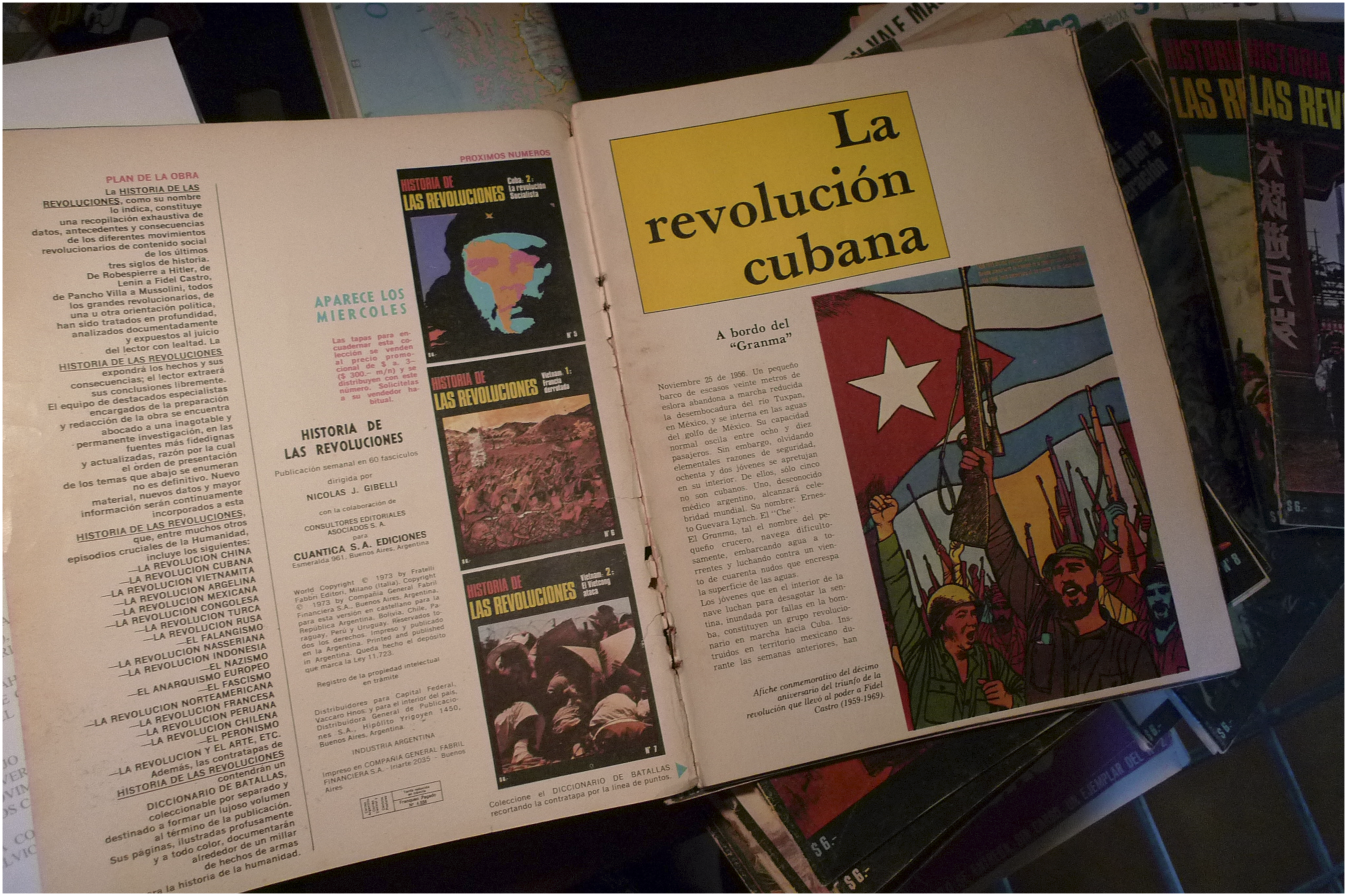
“La Revolución Cubana” Issue 4 in the History of Revolutions series. Part of my father's “subversive library,” which remained hidden in my grandparents’ garage during the dictatorship.
Thousands of citizens were persecuted, many driven onto exile, many taken into clandestine detention centers, held there for days, months or years, without any due process, tortured and abused in the most heinous ways. Many of them are still missing today.
My parents, a young and idealist left-leaning couple who believed that the revolution was just around the corner, lived in fear.
Fear spread like wild fire, like spilled water
torching wetting touching
every surface body thing that
came into contact with it.
The junta reorganized indeed the public and private lives of Argentine citizens under a strictly conservative and vigilant regime that shaped society for years to come.
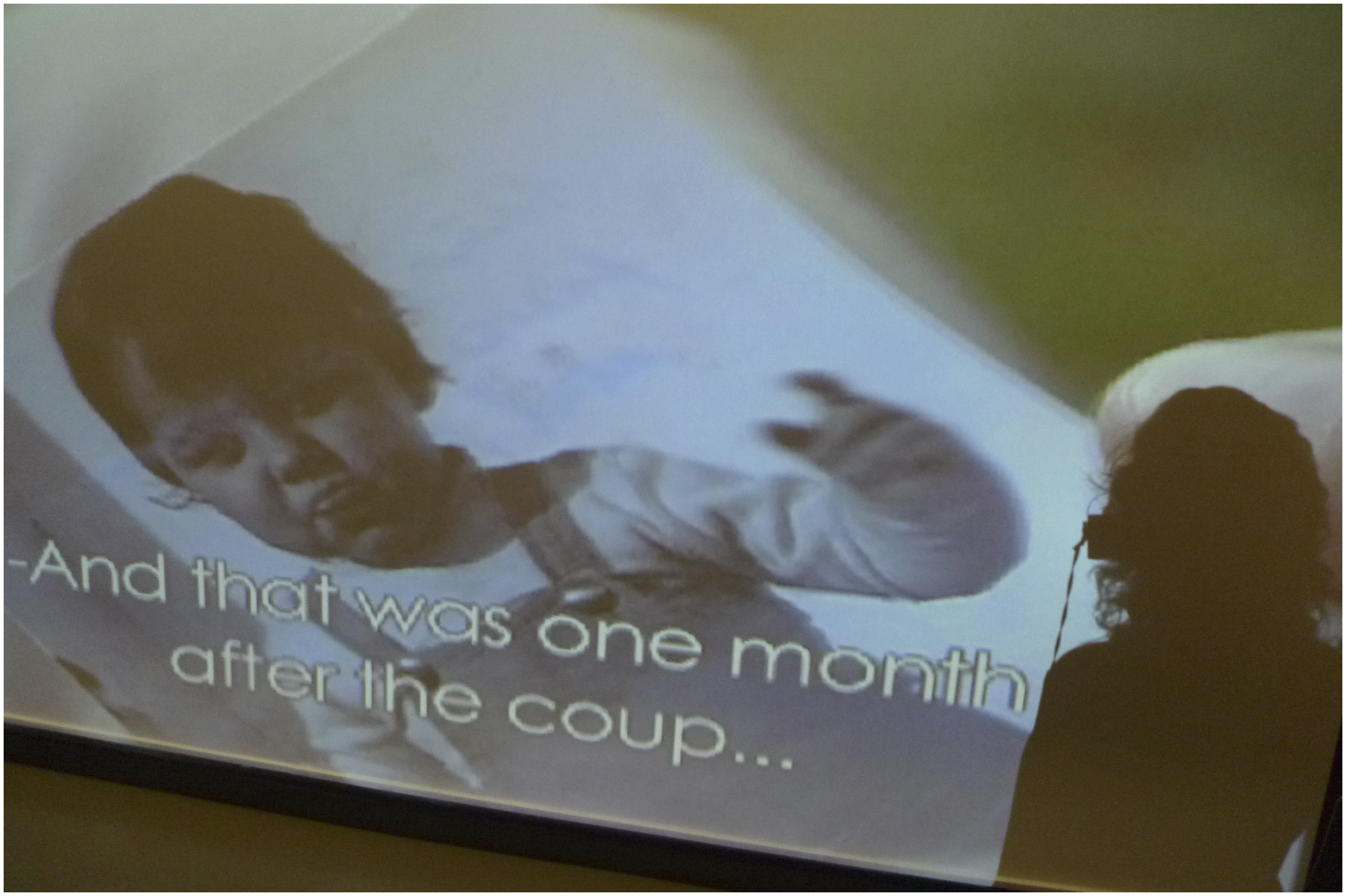
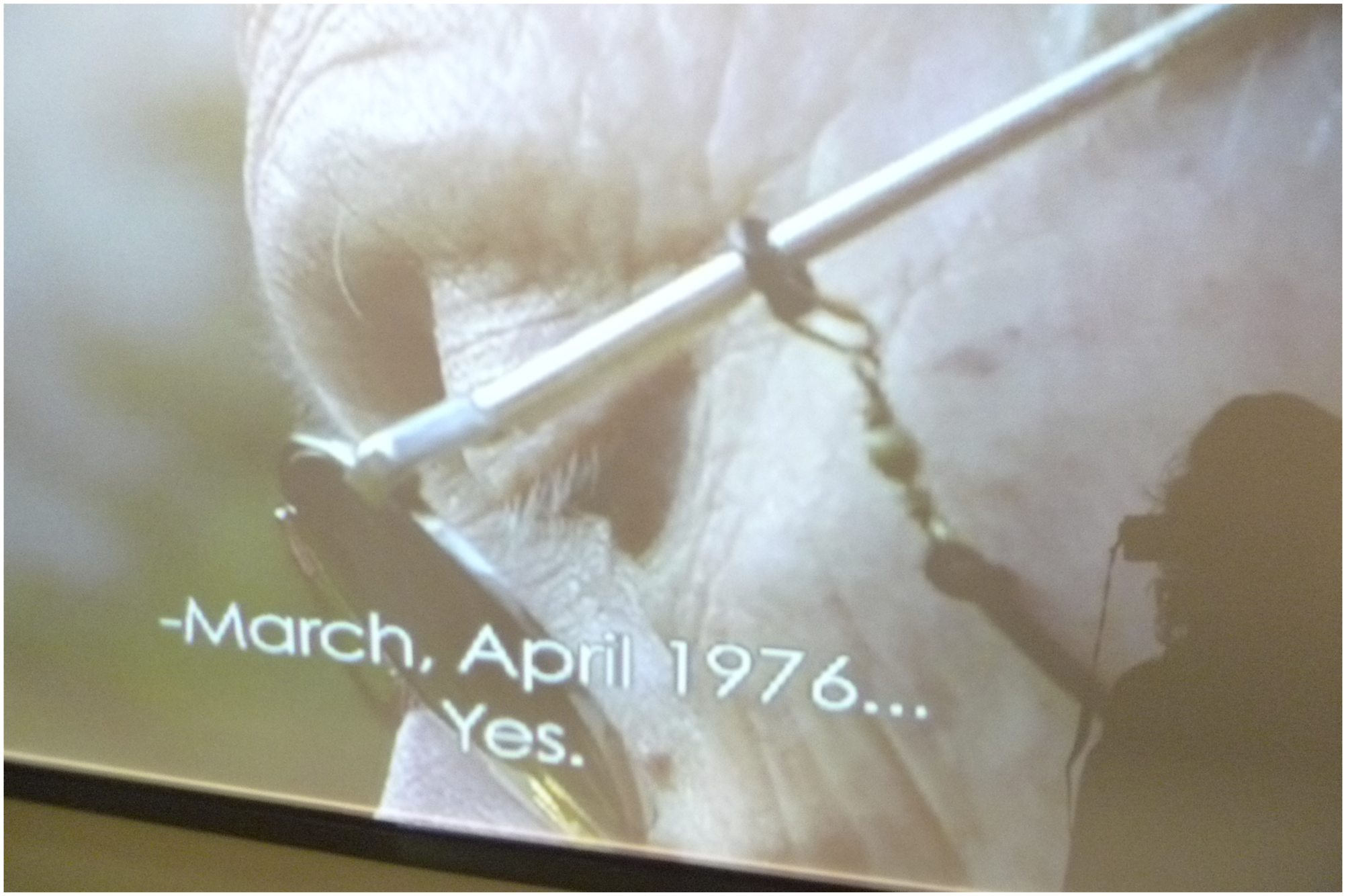
Images from a video interview with my father, conducted in 2007 and showcased as part of the immersive installation “The Ethnographer as Field Site” - CEREV lab, Concordia University, May 7-10, 2013.
“Systems of terror get us where we live, nullifying the existence of any safe space.” Diana Taylor wrote in her book Disappearing Acts: Spectacles of Gender and Nationalism in Argentina’s “Dirty War” (1997). Analyzing Griselda Gambaro’s play Information, the performance studies scholar describes the collapsing of social, familial and individual spaces provoked by the military regime and enacted in this experimental piece of theatre: The play’s use of the house-as-set emphasizes the corrosive and contagious nature of violence that blurs all physical, moral, and judicial frameworks. Scenes of political violence are not limited to prisons and torture chambers but are played out on public streets, in private houses, on human bodies. (1997: 127) Like wild fire
“The violence could have been relatively invisible, as the term disappearance suggests” Taylor continues. “The fact that it wasn’t indicates that the population as a whole was the intended target, positioned by means of the spectacle. People had to deny what they saw and, by turning away, collude with the violence around them.” (123) Taylor mobilizes the notion of percepticide, a term coined by Argentinean psychoanalyst Juan Carlos Kusnetzoff, to name this kind of violence that turns on oneself, a purposeful “attack on the perceptual organs of the population.” [Citizens] knew people were disappearing. [An area was suddenly surrounded by armed forces], closed in on the hunted individual/s and “sucked” them off the street, out of a movie theatre, from a classroom or workplace. And those in the vicinity were forced to notice, however much they pretended not to. Other spectators who have suffered similar violence […] have judged this watching to be the most dehumanizing of acts. To see without being able to do disempowers absolutely. But seeing without the possibility of admitting that one is seeing further turns violence on oneself. (1997/2005: 123, emphasis is mine)
“Percepticide” Taylor wrote in 1997: “blinds, maims, kills through the senses.” (124)
The section that follows presents an auto-ethnographic narrative that delves into the reach of percepticide in my own life. The ripples of the military repressive force still pressing onto my body, folding across temporal and spatial coordinates, modulating my engagement with a new set of conditions and navigational tools.
Printemps Erable: la efervescencia colectiva y el miedo en el cuerpo 10
Not first a body then a world, but a worlding through which bodyings emerge.
Erin Manning, Toward a Politics of Immediation (Manning, 2019)
On the first day of spring 2012, I attended a Humanities Student Assembly held at Student Lounge on the sixth floor of the Library Hall Building, in the downtown campus of Concordia University and voted in favor of the strike against tuition hikes promoted by the Student Union Coalition known as CLASSE (in French Coalition Large de l'Association pour une Solidarité Syndicale Étudiante).
That evening, I posted this photo on my Instagram account (Figure 1): Instagram post: Hoy! Today! Aujourd'hui!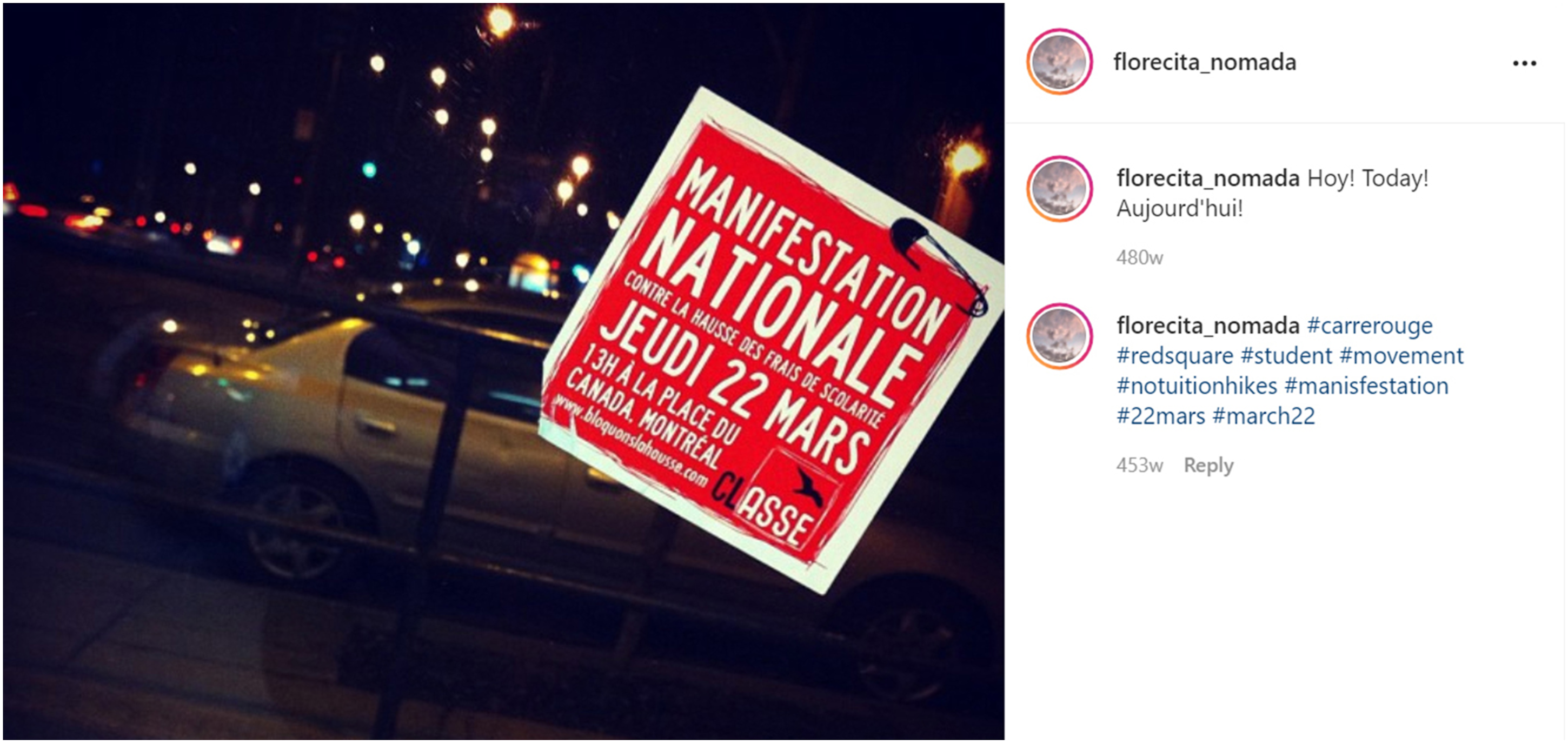
On March 22nd around noon, as I waited for the metro to ride downtown a powerful scene took place.
Student protesters (from the nearby college) arrived en masse chanting: “A qui le metro? A nous le metro!” a version of the popular street protest chant: “A qui la rue? A nous la rue!” which is part of public demonstrations taking over the streets to perform a subversion/disruption of the normal functioning of life (traffic, trade, etc.). The right to perform this subversion, as we will see in a moment, to occupy the streets, and feel safe in doing so will become a central node in this story.
When I hopped off the metro at Concordia, a similar scene took place. People were excited to gather and protest what seemed like a move to make higher education incrementally less accessible. The day was unusually warm for a city where spring means rivers of thawing ice and snow. We were wearing red t-shirts and walking for hours on the streets of Montreal two hundred thousand strong. That day is marked as the beginning of what would be known as the “Maple Spring.”
In the days that followed, the strength in those numbers led most students in the province to push things further and vote in favor of an indefinite strike. Although this meant a disruption in the course of my studies I could not help but be part of it (Figure 2). Marching with HUMA colleagues and friends on Ste-Catherine, downtown Montreal.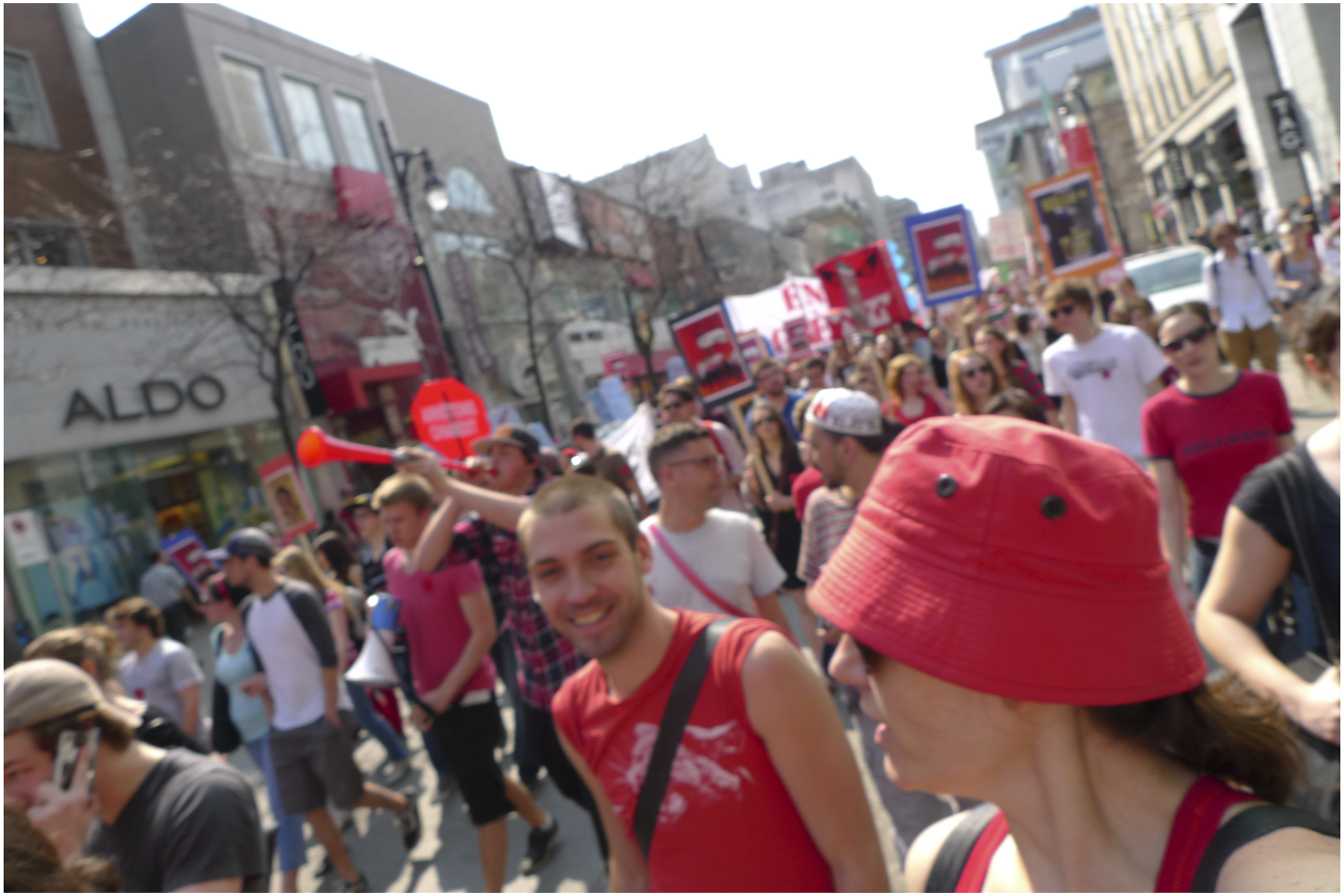
I had already marched and rallied against neoliberal reforms threatening access to higher education twice before in my life: in the mid-1990s, during my undergrad years in Argentina when students decided to strike against Menem’s neoliberal Education Law Reform and their veiled attempts to privatize public education 11 , and then again in the late 2000s when my own position as Field Studies Coordinator for the Community Studies program at UC Santa Cruz was cut and the program put on hiatus (part of budget adjustments made by a neoliberal university administration in the midst of the financial recession).
Although I could not bring myself to do anything that felt mildly confrontational or with too much public exposure (like stand in the picket lines) I was part of every monthly demonstration excited to share in and be part of a movement that felt historic. 12 As such, I took part of strike committees, co-organized our program’s alter conference out of campus so as not to cross picket lines, participated in university-wide assemblies, and assisted a translators collective to bridge the Franco-Anglophone divide. 13
The two seminars I was frequenting made accommodations for the students strikers. One of them changed the requirements of the course and liberated us from attending classes, deeming our political practices part of our learning processes (this was a seminar on Performance Research). The other one, a seminar on Media and Feminist Theory asked students who had been slotted to present on the readings to organize an activity in relation to the strike. On March 26, one of my colleagues proposed a silent march from our University Grounds to the downtown core. I documented the action shooting 10 video clips in which I was working through two related notions that would become central in the research-creation process these experiences would unleash: “point of view” and “situated knowledge.” The very act of walking is investigated in these videos, as it relates to our participation in an action that fuelled a social movement. 14
On the relationship between my camera’s point of view and collective movement.
Change of direction & Re-Grouping.
“Dans la rue avec nous!” Becoming a collective voice.
In the weeks that followed social support for the strike grew in favor to the student’s plight (Figure 3). A broad coalition against the neoliberal administration of Jean Charest gained momentum at the April 22nd March, which was attended by a great number of collectives, each with particular or differently angled claims: unions in lock-outs negotiations, anti-Harper (then Conservative Prime Minister) campaigners, and environmentalists focusing on the new extractive developmental project called Plan Nord—this was a particularly vocal crowd in that march, since the always populous Earth Day’s march was called upon to overlap with the students monthly demo. Instagram post: Red flags everywhere. A beer brand plastered posters with their iconic red man holding a red square, the symbol of the strike, as flag all over town. Many such public gestures of solidarity were seen in the days that followed the multitudinary demonstration. 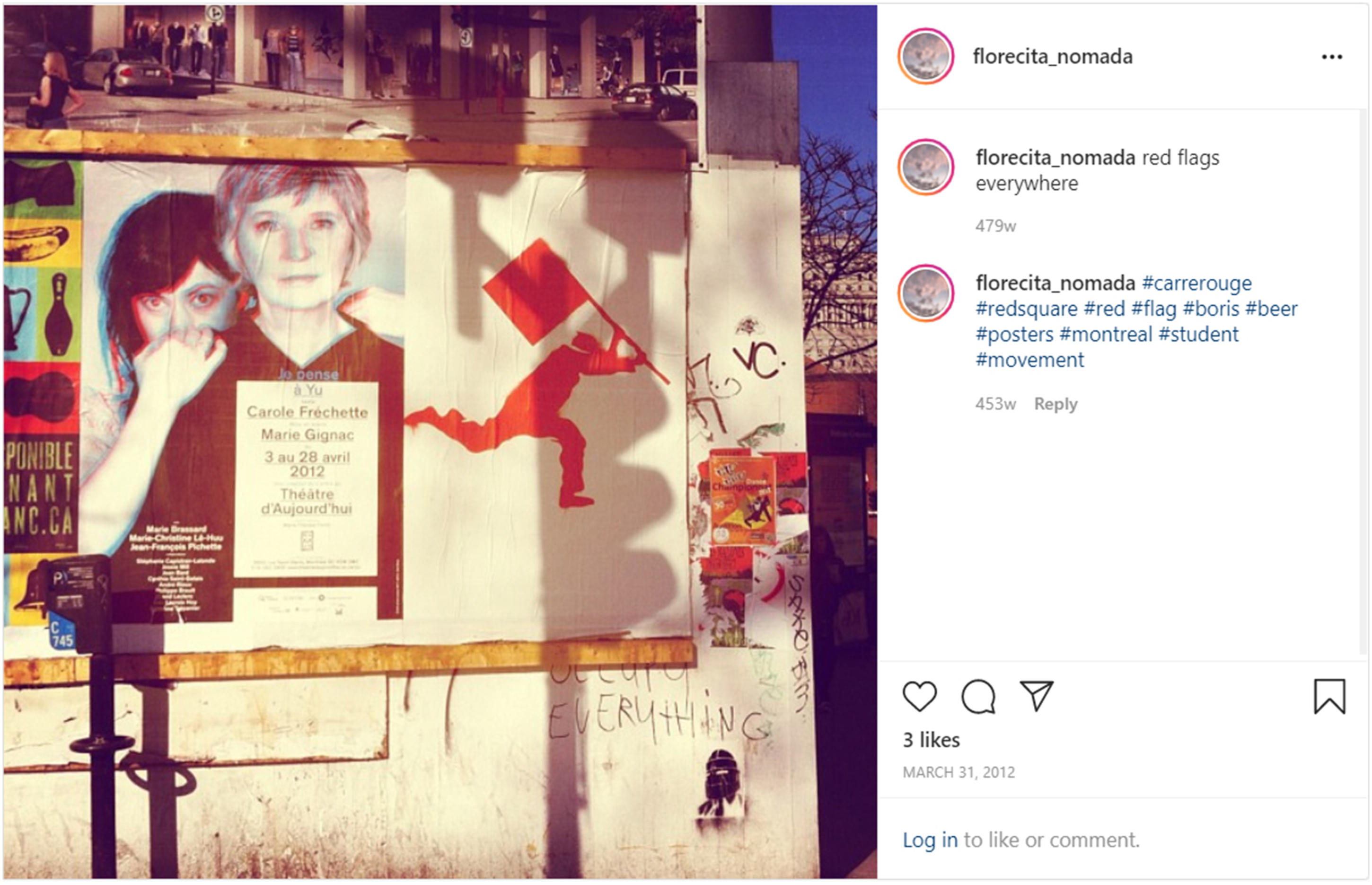
Between April and May things got more intense.
Two months into the strike, negotiations with the government stalled. Fissures between student associations emerged when CLASSE representatives were excluded from the discussions. Student assemblies ended up refusing the government’s offer to delay the increases and vowed to continue with the strike. A heated demonstration in Victoriaville was confronted by police in riot gear and a protester lost an eye. The images of those clashes with young people bumping onto the glass doors are burnt into my mind’s eye (Figure 4). Guerre illimitée Graffiti intervened. Villeray neighborhood. 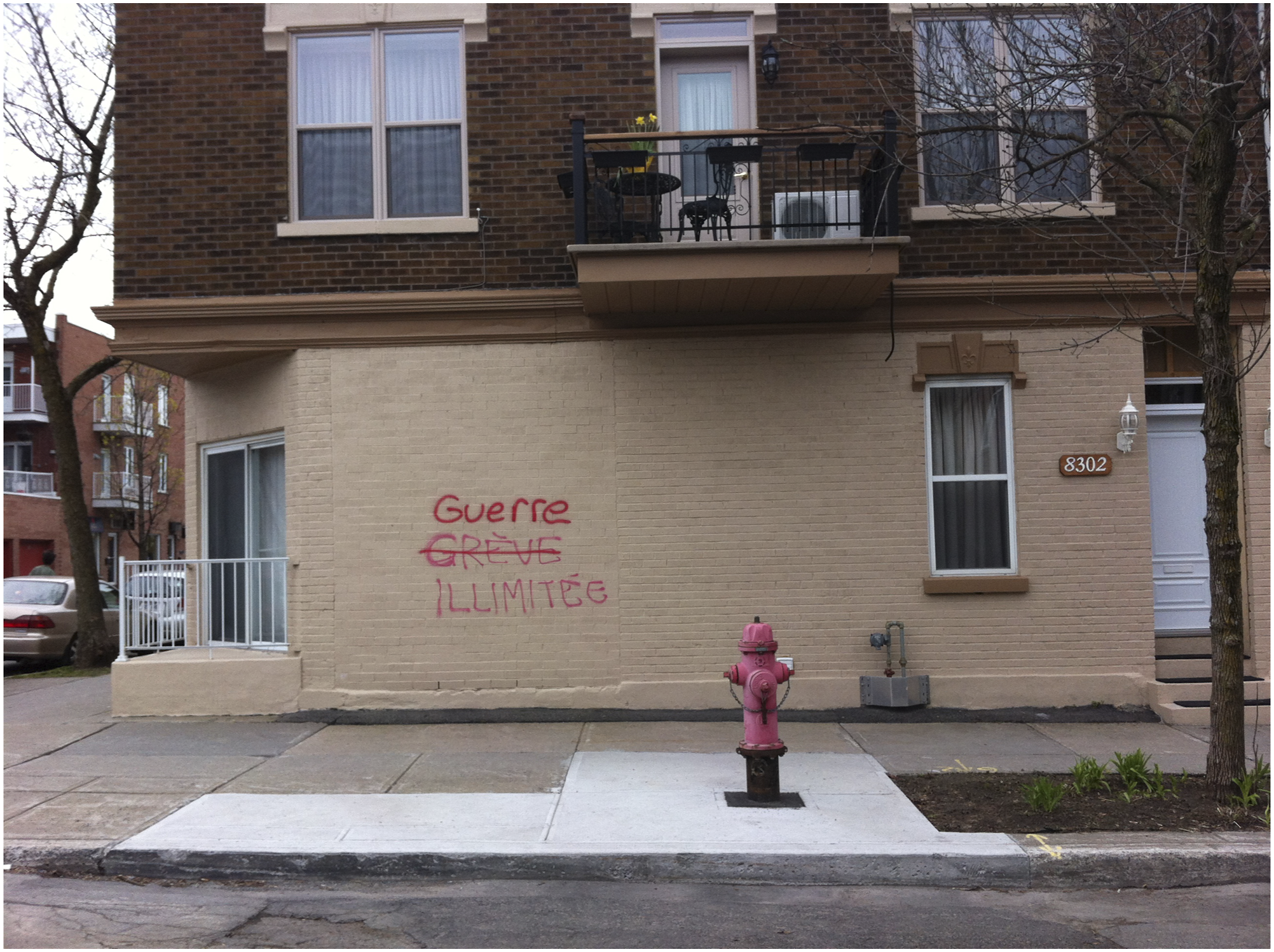
The ministry of education resigned soon after the deal was rejected and a couple of days later, the highly repressive stance (that the police was already enacting) was made into provincial law, the now infamous Bill 78.
—I can’t believe such a law would pass with such speed in a “first world” country such as this!—I said to my housemate as I watch the TV news.
—It’s not that bad—he said.
—But didn't you see? They are already deploying police in riot gear to counter the protests, this is a clear sign of a government leaning towards repressing the movement!
—Nah, you shouldn't worry, nothing is gonna happen to you!
Easy for him to say, a blue-eyed blonde white male French national with a brand new Canadian passport. I, though white appearing, was coming from a much more vulnerable place, a migrant woman with roots in the South of the continent, and a very precarious “study permit” that could be easily revoked at any sign of disciplinary action.
When my friend J called me on a sunny mid-spring morning to tell me about the police kidnapping one of her friends, my first reaction was disbelief. Kidnapped? Indeed. It felt like a scene from another time, from another life, an eerie echo of my country’s past, scenes that I normally tackled as memories, not news. As I heard her telling me the story of this kidnapping I felt appalled that something like this would come to happen here, in the safest city I had ever lived in.
My friend’s friend was coming back home late at night along with his partner and a friend of theirs when they encountered a young cyclist being roughly treated by two cops. They asked him if he was alright and he answered that he thought the reason for the detention was his red square (the insignia used by the student strikers and our allies to signal support to the cause). Upon this my friend’s friends offered themselves as witness, in case the cyclist was to file a complaint against the officers who were clearly mistreating him. The cops did not take these comments well, particularly the fact that my friend’s friend was a dark skinned man (as they made clear soon after when he was already in the car). Without any explanations they redirected their attention and tackled him to the ground, handcuffing and transporting him into the vehicle by force. He was then given “a lesson” (their words): a violent tour known to Indigenous and other racialized people known as a “starlight tour.”
This kind of “tour” involves the police car speeding up and then breaking suddenly, provoking the handcuffed and unbelted person to bump their head or body onto the plexiglass divider over and over again. When the tour is finished, the detainee is dropped in a remote part of town to fend for themselves. After a few kilometers of verbal and physical abuse my friend’s friend was left beyond the limits of the 40 Highway with a fine on his pocket and his Bixi key as the only means to return home.
As my friend finished telling me the story on the phone, she wonders if maybe I could offer some advice, given my expertise on political violence and state repression. I am a bit confused for what I study are histories and memories of such incidents and not so much their present iterations… As we brainstorm ideas of who to get in touch with to initiate some kind of legal action, I get an uncanny sense of deja vu.
Habeas corpus does not apply, since the body is back, maltrecho pero vivo. Perhaps an anti-police violence organization? I still find it hard to believe that we are discussing this, here and now.
15
(Figure 5). Mining the conflict (three posters). Maple Spring, 2012. 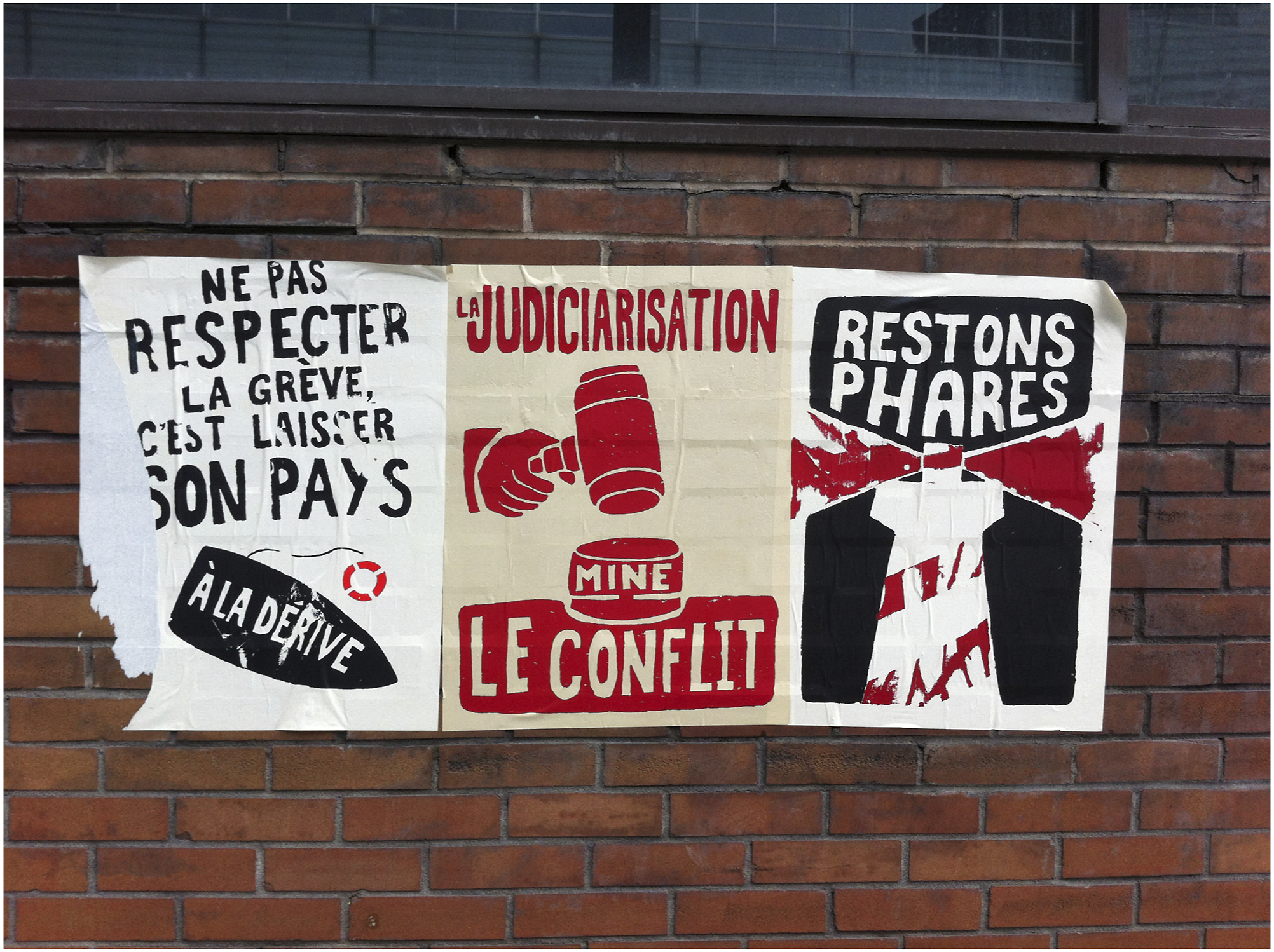
In the days that followed, the city’s government followed the provincial ruling and issued a new municipal regulation that banned the use of masks in public spaces and required demonstrators to file their itineraries with the police in advance of any marches. That very same evening, resistant worldings gave my vulnerable bodying some courage, as people from different neighborhoods marched into the downtown core in clear defiance of the repressive law. Not just students, but Montrealers who would not be told when, where, and how to gather or demonstrate (Figure 6).
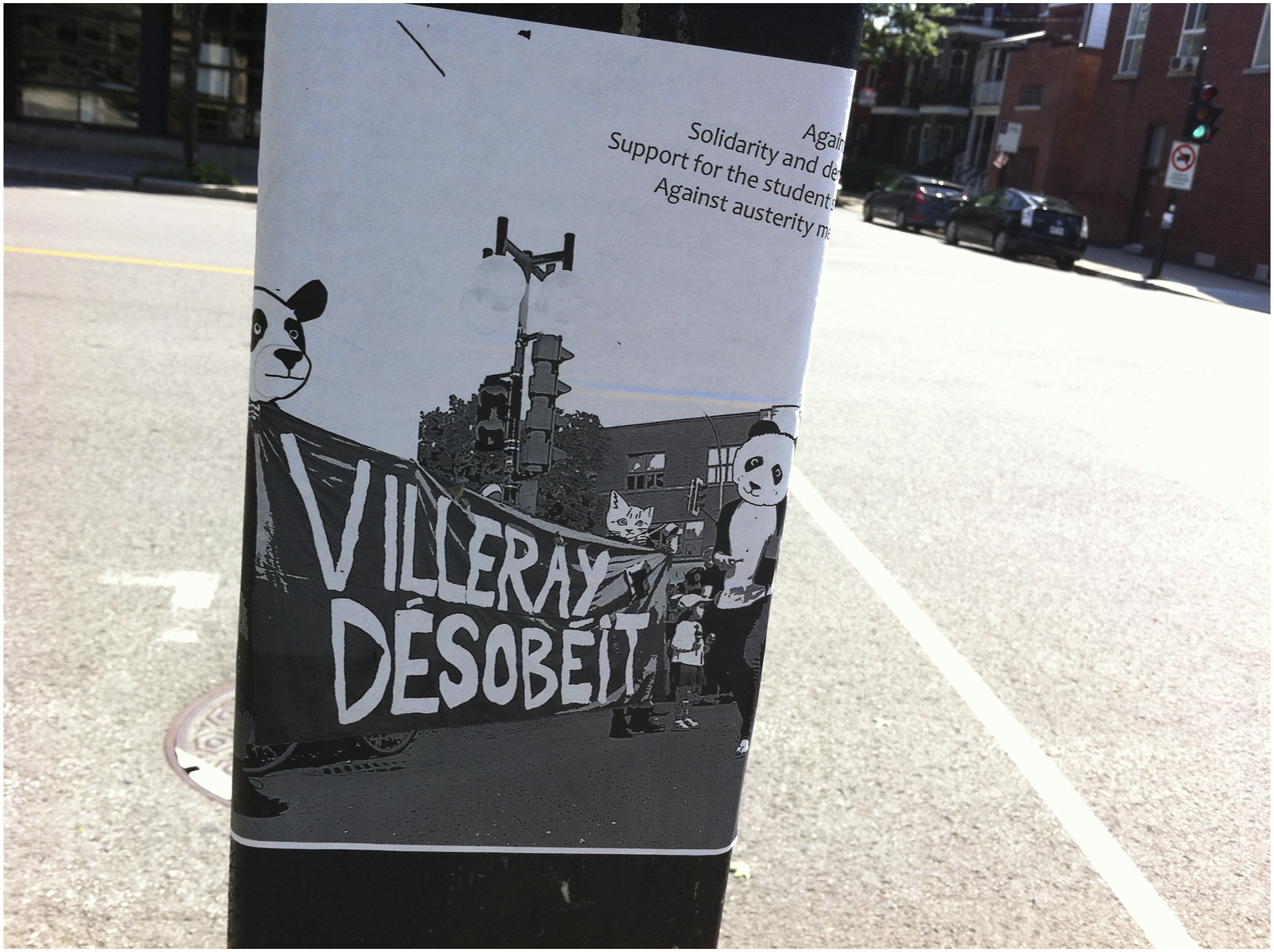
Villeray désobeit.
People began banging pots in their balconies to protest the repressive stances, expressing their support to demonstrators. Night marches continued in spite of the police horses chasing down protesters through the downtown alleys. A HUMA colleague texted me to go on a march together but I couldn’t make myself leave my house after dark. Still, I followed the marches’ trajectories through crowd-sourced maps and the online stream of my university’s TV channel fearinged for and with them.
In spite of provincial and municipal regulations, the May 22nd demonstration was so numerous, it was deemed the largest act of civil disobedience in Canadian history (Figure 7). J and a few other friends convened on a spot beforehand so we could walk together, checking in on each other via text messages during the march (if any of us got lost within the currents of demonstrators, something that may happen to you if you stop to take photos often) and after, once the rain disbanded the crowds under heavy grey skies (Figure 8 “A bas la loi 78 de Charest” Masked protester and sticker intervention. May 22, 2012. 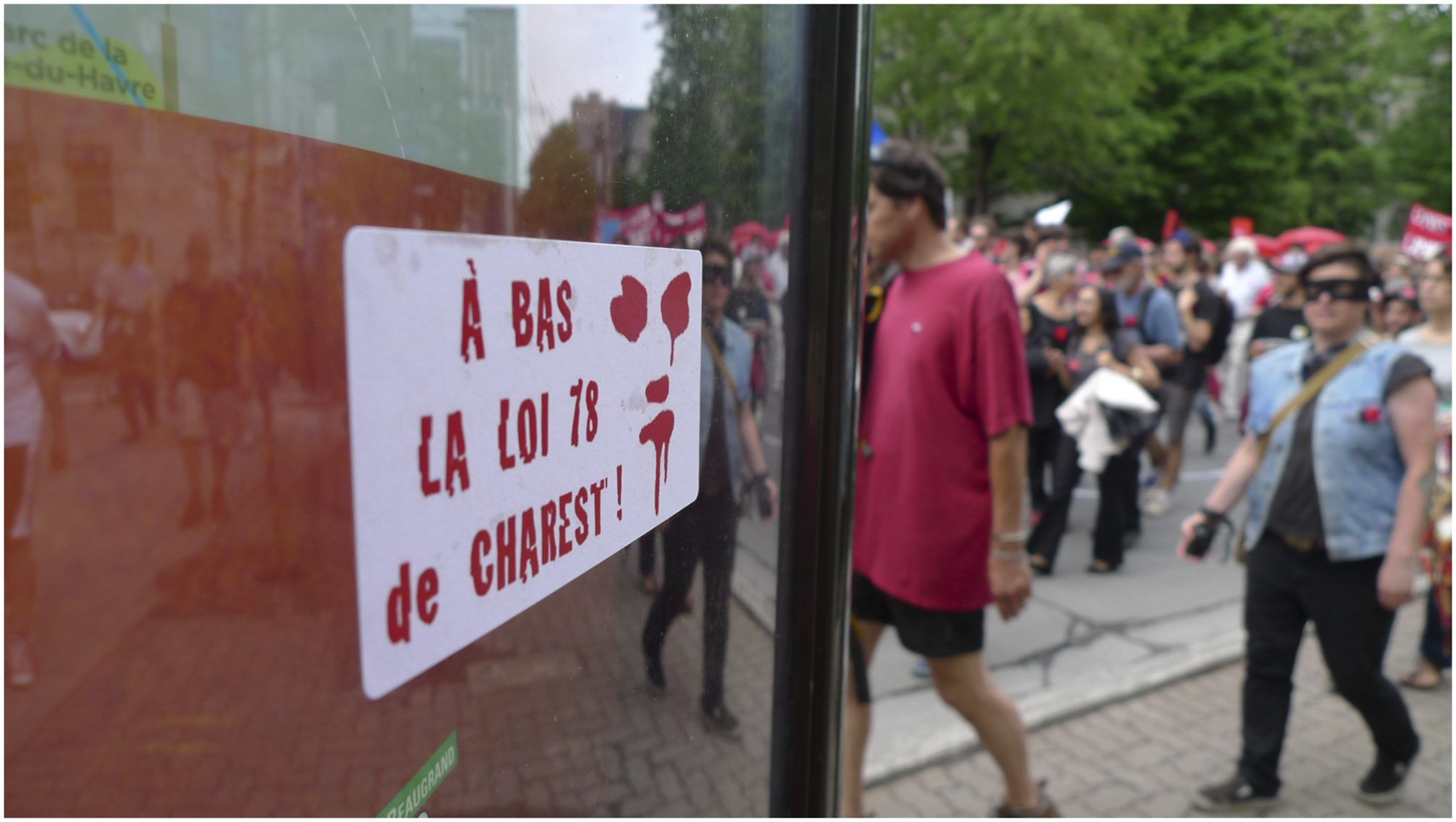
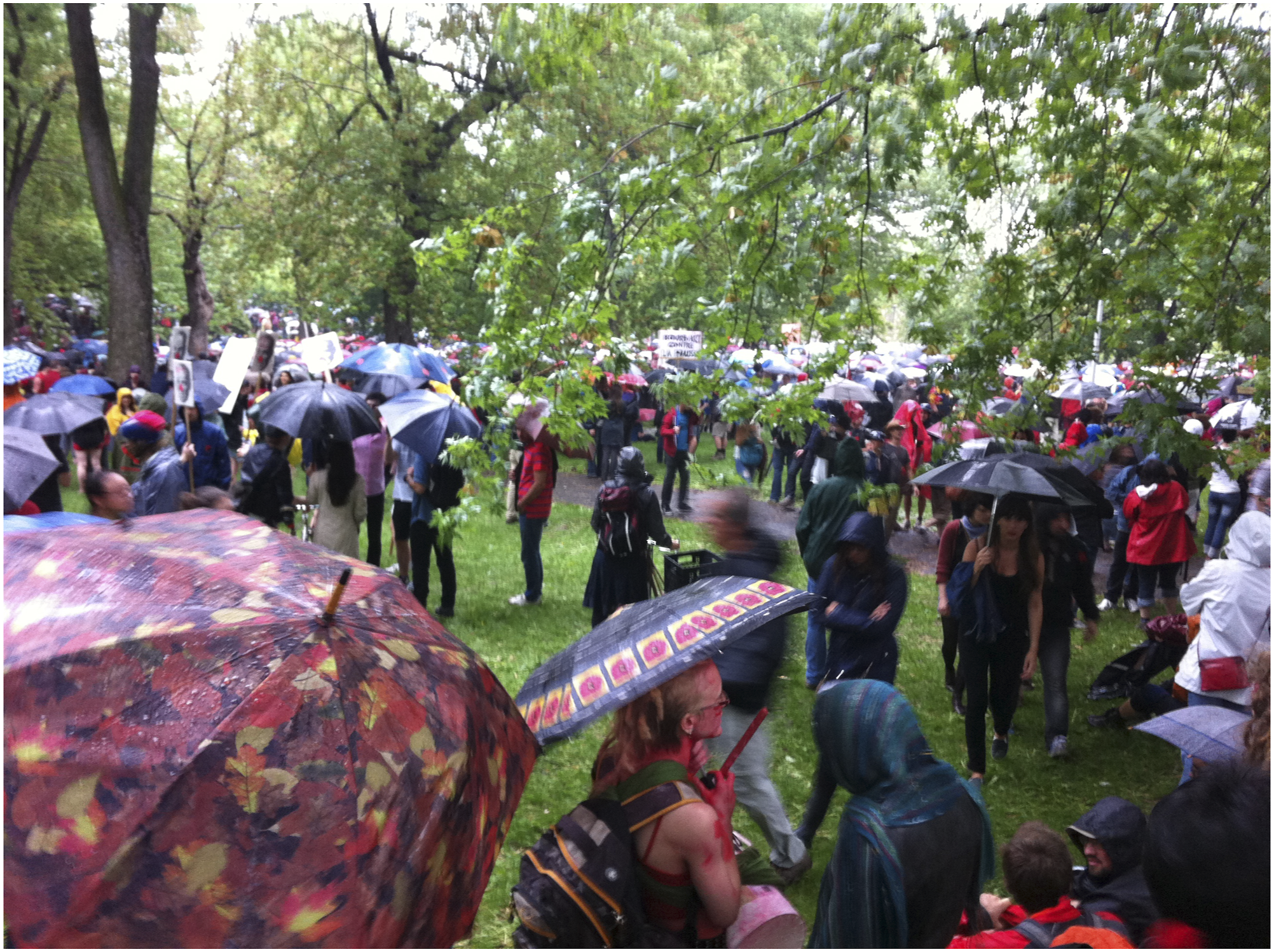
Protesters in the park under the rain.
A few days later, on a hot summer siesta, I decided to bike to an encounter with my friend J, a few kilometers away from my house, in the neighborhood of Hochelaga-Maisonneuve. As I was riding along the railways in a deserted part of the city, I spotted a police car parked at an upcoming intersection. Upon the sighting of the car I began to feel a surge of nervousness and undomitable fear in my body. The red square pinned to my backpack spreading its conflicting message through my spine, tensing the back of my neck, my arms and legs, and slowing my breath while racing my heart… I began to imagine that once I had crossed the intersection they would be able to see the insignia and that profiting from the isolation of this place they could chase me down freely, “accidentally” bumping my bike with their car and leaving me in a ditch on the side of the road or, worst, taking me with them I am still unable to complete that sentence and bring that possible scene to words.
All these different scenarios rushing through my mind in a matter of milliseconds, making me feel a kind of bodily terror I did not recall ever experiencing before. As I arrived at the intersection, I stopped for what felt like the longest second ever and then, without looking into the car, I focused on the road ahead and kept riding, slowly but surely, away from the scene.
Thrown into the field
Looking back, it seems that ready or not, my experiences during the Maple Spring threw me directly into the field. Just like Malinowski in the Trobriand Islands, I had become immersed in a new set of atmospheric conditions that re-oriented my research. 16
As I read Elizabeth Grozs book Volatile Bodies (preparing to write the final paper for the Feminist Media and Theory seminar the strike had interrupted) I began thinking that the ways in which my own body had reacted to the unfolding of events could become a site of sensate memory engagement. The progression from collective effervescence to bodily terror had intriguing resonances with the historical period my research was grappling with and I was determined to dig more out. “Bodies -Elizabeth Grozs wrote- have all the explanatory power of minds. Indeed, for feminist purposes the focus on bodies, bodies in their concrete specificities, has the added bonus of inevitably raising the question of sexual difference in a way that mind does not.” (Grosz, 1994: vii). How to explore the ways in which past experiences inform bodily presents, sometimes as forcefully affecting irruptions, sometimes as more subtle sensorial registers and attunements?
How do we compose with the fears and silences that people breathed in those days? How were they learned, embodied and transmitted? Were they stored and reawakened? Do they work as repertoires of feelings that get deployed in different circumstances? Do they circulate and stick to certain objects, like Ahmed would have it (2004) fielding bodies and atmospheres alike? I was not very sure how, but I knew I had to dig deeper.
The corporeal in memory studies, a brief theoretical review
Many things happened in and through my body in the years that followed the Maple Spring, traversing all sorts of thresholds and even bodying new worlds.
What follows is a brief review of some of the key ideas that I encountered when I finally had dedicated time to read and think about the ways in which the body has been conceptualized in relationship to social memory. 17
The humanities and most social sciences have until somewhat recently conceived the body as “a ‘discursive’ body: one with its signifying gestures, which cultural analysts would read and decode.” (Massumi, 2002:2, emphasis is mine). This is a body constructed by external mechanisms, a “subject” defined in terms of its positioning, a still image of a being that has—more often than not—been pinned down onto a grid of oppositional terms. This kind of thinking brought about geopolitics of cultural difference and a rather fixed set of identity politics to the fore.
While these approaches have been useful to understanding specific cultural and/or political formations and how they structure certain possible trajectories for certain bodies, an embodied and dynamic approach that explores the resonances of state sponsored terror across times and spaces could offer new insights into the impact of particular sensorial regimes. This is important for, as Diana Taylor points out: Terror systems collapse positions into sides. Points of conflict become simplified and crystallized. Under siege, spectacles tend to essentialism, visually reaffirming the “given” and seemingly obvious differences within and between the sexes or the races or the classes, even as they “disappear” the traces of the performativity of that construction. The plethora of images, positions, and voices, the multiple points of conflict, and the shifting coalitions that compete for predominance in “normal” times vanish or go underground in a police state. A cartoon by the internationally known Quino shows a public space tightly packed with Big Bad Wolves and Little Red Riding Hoods. We’re either the persecutors or the persecuted in this picture. We profit from the violence or we’re undone by it. Can we even dream of opening up any other spaces? (1997: 24–25)
Not surprisingly anthropologists seem to have been the firsts to address the gap in attention to embodiment in the transmission of social and cultural memory. As Colin Counsell states in the introduction to Performance, Embodiment, and Cultural Memory: “when anthropologists of the late nineteenth and early twentieth centuries considered the rituals of [first] peoples, they implicitly viewed the bodies involved as the bearers of pre-exiting significance—even as, conversely, they tacitly assumed Western, “civilized” bodies acted in ways that were largely ideationally neutral.” (Counsell and Mock, 2009: 1). 18
In her brilliant book Performing Remains, Rebecca Schneider argues that the equation of flesh as that which disappears and “can house no memory of bone” ends up working as an exclusionary or culturally-relative definition, as it remains “foreign to those who claim orature, story-telling, visitation, improvisation, or embodied ritual practice as history” (Schneider, 2011: 100). Contra-posing this kind of exclusionary theoretical acts into the heart of her native country, Schneider further asserts that this distinction is also […] foreign to practices in popular culture, such as the practices of US Civil War reenactors who consider performance as precisely a way of keeping memory alive, of making sure it does not disappear. In such practices—coded (like the body) primitive, popular, folk, naïve—performance does remain, does leave “residue.” Indeed the place of residue is arguably flesh in a network of body-to-body transmission of affect and enactment—evidence, across generations, of impact. (Schneider, 2011: 100)
Flesh as the place of residue in which the network of body-to-body affect transmissions (or ambiance to body, or objects to body and vice versa) are enacted, registered by the body as point of impact.
Interestingly, it was by examining a variety of written sources on European Modern History through the eyes of the corporeal that British social anthropologist Paul Connerton introduced a very valuable set of insights regarding embodiment and collective remembrance in How Societies Remember, a book originally published in 1989. The volume was written to counter the then prevalent notion that cultural recollections were stored and transmitted through textual inscription only. The introduction hones in on one of the most drastic societal changes in European history, the French Revolution, cleverly observing: One thing that tends to get forgotten about the French Revolution is that like all beginnings it involved recollection. Another is that it involved the severing of a head and a change in the clothes people wore. I believe there is a connection between these two things […] and that the solution to the question posed above—how is the memory of groups conveyed and sustained?— involves bringing these two things (recollection and bodies) together in a way that we might not have thought of doing. (4)
Connerton explains that bodily practices such as clothing had up until that point been studied as social rules or grammatical structures. That is, even when bodies were being examined, they were constituted as objects of interpretive scholarship in the image and likeness of texts. The weakness of these models, Connerton observed, lies in the lack of analysis of the execution of the practice (34).
Analyzing calendrical rituals and bodily practices, Connerton observed how repetitive enactments “automatically imply continuity with the past” (45). 19 In rituals, bodies are scripted to very specific postures, gestures and movements.
French sociologist Pierre Bourdieu’s works famously expanded the understanding of bodily practices as one of the most important aspects of social reproduction. Past, present and future oriented activities are structured by structuring predispositions that constitute the core of his notion of habitus.
20
These temporal dynamics are made explicit here: The habitus, a product of history, produces individual and collective practices—more history—in accordance with the schemes generated by history. It ensures the active presence of past experiences, which deposited in each organism in the form of schemes of perception, though and action, tend to guarantee the “correctness” of practices and their constancy over time, more reliably than all formal rules and explicit norms. (Bourdieu, 1990: 54)
In an article published in 1994, anthropologists Arthur and Jane Kleinman, noted an important gap in these kinds theorizations. Most accounts connecting the symbolic, the social, and the individual had left the processual connections between social and the corporeal unaddressed, the authors argued. Embodiment theories had resorted to “made-to-wear psychoanalytic speculation on the subject, little of which goes much beyond the conceptual impasse Freud himself experienced when he mused about the “conversion” of the symbolic into the somatic.” (Kleinman and Kleinman, 1994: 708) Even Bourdieu, “repeatedly invokes a dialectic between habitus and objective social structures as the source of social incorporation into the body almost as an article of faith.” (Ib., emphasis added).
In order to materialize the way in which this dialectic actually performs (in/as) bodies with feelings, sensations, symptoms and orientations, the authors turn to their own fieldwork. Researching the trauma of political violence in post-Cultural Revolution China, they try to understand “how political processes of terror (and resistance) cross over from public space to traumatize (or reanimate) inner space and then cross back as collective experience” and “how the social disorientation caused by a crisis of cultural delegitimization can become a bodily experience” (711). Rather than asking “what the body’s cultural form means and why its representation differs in different epochs and among different groups” the Kleinmans argued for the importance of addressing what they deem a prior question: “how socio-somatic processes shape the experience of the body in its social context” (711).
Succinctly, the Kleinmans propose to focus on local interpersonal worlds rather than individual or institutional structures. Understanding these worlds as fluid and relational, they theorize experience as an assemblage of social processes, which create a medium of interaction that flows back and forth through the social spaces of institutions and the body-self. This local social medium joins norms to sentiments, social meanings to cognition, social relationships to psychobiological responses. Because it is processual, social experience is about transition, transformation, change. (712)
The Kleinmans’ formulation keeps the interactive and agentic elements of relational social theories in place, while incorporating the back and forth between the social and the body-self as flow, a medium of interaction that is processual and, at the same time, constitutive of social experience.
Abrir las heridas
I always thought I had a happy childhood and that I had grown up protected from the carnage that was happening around me. After the Maple Spring incident, I started to wonder if and how the terror that transpired outside of my love and care bubbles had somehow steeped inside.
The question of the air people breathed in those days had emerged during the making of my documentary Haunting Presence s (2007, 42min). The documentary explored the memories of the neighbors of two dreadful scenarios of military repression during the dictatorship: a former clandestine detention and torture center and a public cemetery where bodies of disappeared people were anonimously disposed into mass graves. The documentary argued for the need to look beyond the prison walls in order to understand how the military had created a climate of oppression for those surrounding it, too. After the Maple Spring incidents, it became clear that although I was an infant throughout the dictatorship, this climate had touched me as well and it was time to turn the lens towards myself and start looking into my own precipices. I recalled an interview I had videotaped with my mother in 2007, in which I asked her whether she had felt fear during those years:
Yes, of course. It was horrible. One night, I was, I think it was in the fifth year, we were drawing [she was an architecture student]. It was 1976 [the year the dictatorship started] and it must have been two or three in the morning… We stayed at night to be able to finish the famous “deliveries” and it was my turn to do the planimetry, and they knock on the door of the house! We did not have large windows facing the street but we had some cracks [gestures as if drawing the lines with her hand traversing the air in front of her] and I look out and see: a Falcon!!! [opens her eyes expressively, at this point it was well known that green Falcons were the cars that the military operative groups used to carry out the kidnappings]. You were sleeping [I was an infant in my crib], so I call dad who comes and well… we really did not know what to do, so your dad summons up the courage and asks… And who was it? Marta! [her long time friend, like an auntie to me]. Marta was desperate because she had been drawing all night and she had dropped a Seven Up let's say, a soda water on her blueprints! And she didn't know what to do, whether to dry it or draw it all over again, because the deadline was the next day! And whose Falcon was it? It was her brother-in-law’s, who had come from Jujuy to visit and I was not aware of it. And it was him who had brought her home to tell me about her problem... But actually in those moments, until… until I woke up your dad and we asked… they were horrible.
¿Con qué fines abre una otra vez las heridas? ¿Para hurgar en los bordes, para excavar hasta
encontrar los modos en que los pliegues de la piel se unieron gracias a la acción de sutura que la
producción social de memoria en Argentina produce?
Abro el juego para expandir el modo en que concebimos la herida o al menos sus ripple effects…
Mi etnografía busca describir no los hechos, sino los modos posibles de circulación e impacto de
los afectos producidos por el régimen, en particular los modos en que pudo haber tocado a lo que
desde el sentido común del campo se denomina “el resto de la población” (que de resto y de homogéneo no tiene nada).
No puedo cubrir, por supuesto, todo el territorio
y necesito ademas desarrollar las técnicas primero,
es por ello que he comenzado por mi propio cuerpo y mis mundos interpersonales, los mundos
que me acuerpan, diríamos con las teorías feministas del hoy. 21
Cuerpo de mujer = territorio. 22
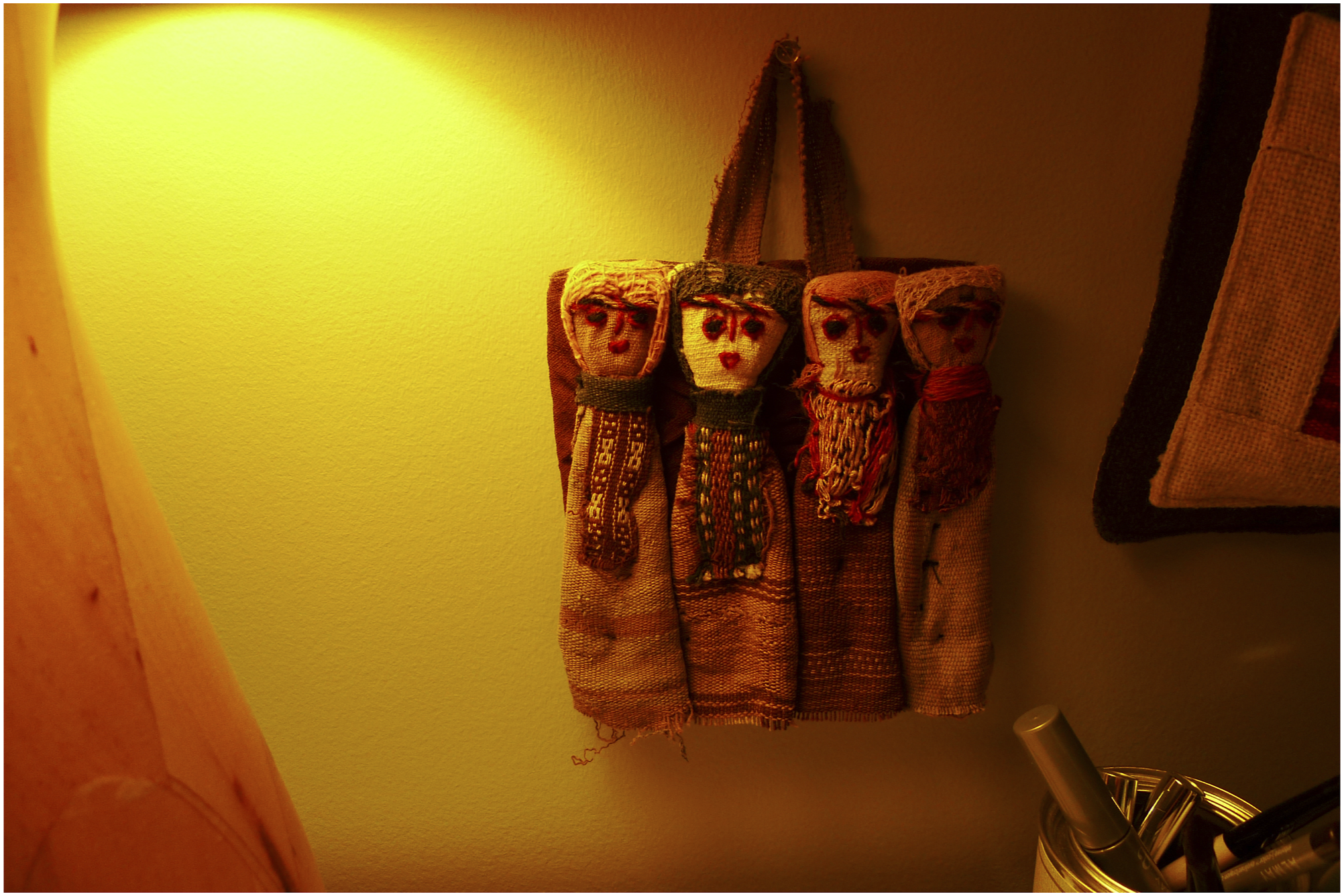
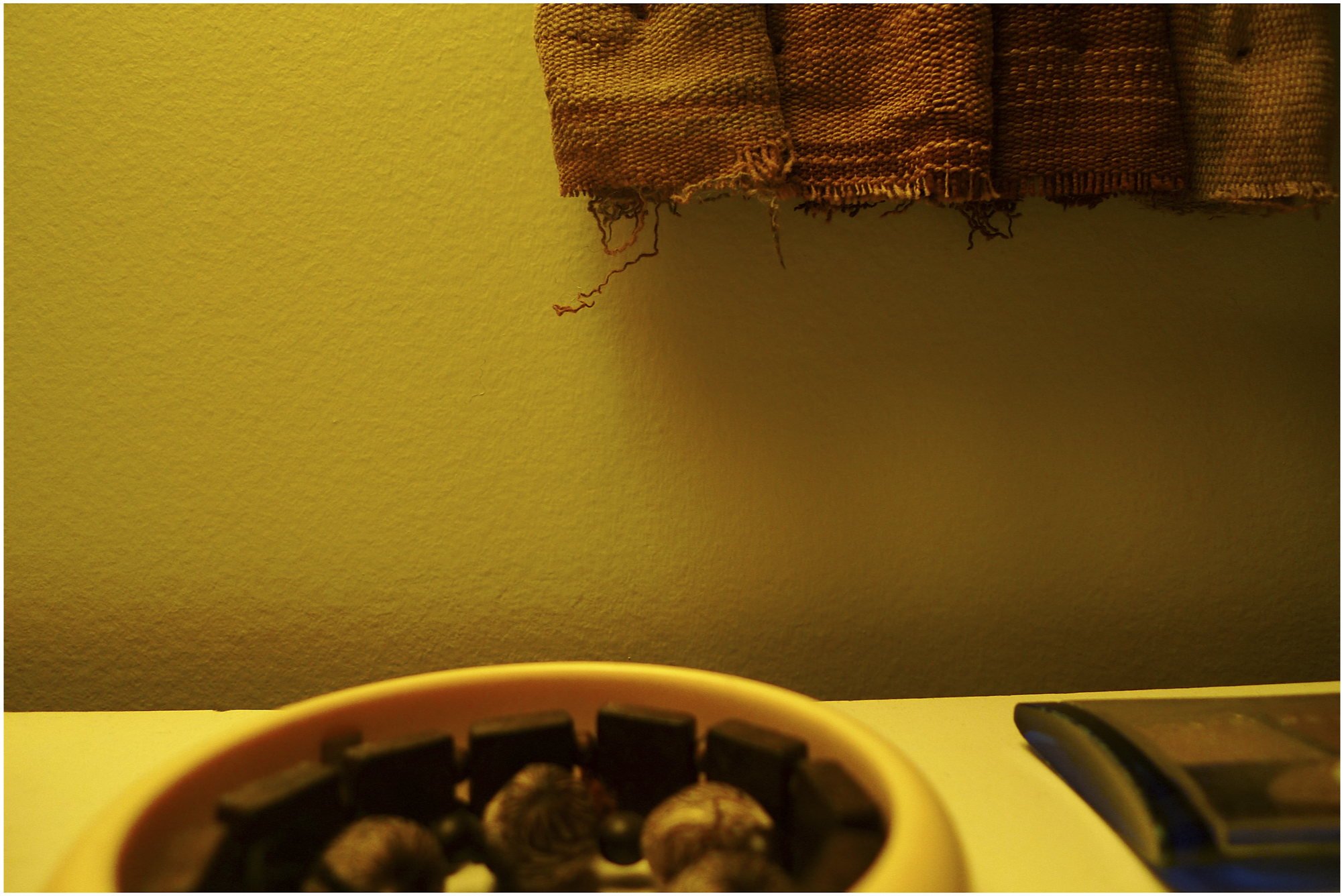

Dolls, threads and seeds. These images are part of the “Intimate Materialities” photo series that I developed as part of a sensory attuned photographic practice in the aftermath of the Maple Spring (2012-2013).
Atmospheric and affective attunements
The waters of the river
where I learned how to swim
when I was a little kid,
flowed onto a lake.
A lake where the bodies
of some of the people
‘disappeared'
by the regime
were laid
to rest.
Their bodies,
rotting,
on the bottom
of that lake,
the same one
that after the dam
feeds another river
that flows into the city
where most of us lived.
The water the city drinks
comes from that second river,
which flows from the lake,
where their bodies
remained. 23
In order to think and work with and through what I call the ripple effects of living under state sponsored terror, a different kind of attention is needed, one that feels and senses the crossings of thresholds through time and place and the already established cartographies of memory.
In 1979, the top commander of the governing Junta, the General Jorge Videla, gave a press conference and addressed the problem of the disappeared in the following terms: As long as he [sic] remains like that, the disappeared is an uncertainty. If the man appeared, then he would have an X kind of treatment. And if his disappearance were to become certain evidence of his death, then it would have a Z kind of treatment. But as long as he is a disappeared, he can have any special treatment. He is an uncertainty, a disappeared. He doesn’t have entity, he is not dead, he is not alive, he is disappeared.
24
In her book Ghostly Matters (1997), American sociologist Avery Gordon articulates a powerful description of the caliber of the operation the military put into motion in order to make progressive forces disappear into thin air (or burn inside the bracing heath of lime kilns, or lay under piles of dirt and kinless bones in common graves, or re-appear as a liveness body floating down the stream of the widest estuary on earth, the River Plate). Gordon defines disappearance as “a state-sponsored procedure for producing ghosts to harrowingly haunt a population into submission.” (115)
The fear of becoming a ghost, of being taken by the military apparatus 25 and disappearing without leaving any trace, could be productively thought of as a structure of feeling in the sense that Raymond Williams articulated throughout his writings. That is as a “structured formation… at the every edge of semantic availability” (Williams quoted by Ngai 2009: 359). The notion is apt here for it designates an experience “still in process” that does “not have to await definition, classification, or rationalization before [it] exert[s] palpable pressures and set[s] effective limits on experience and action” (ibidem, emphasis is mine).
Although my parents were not active militants in any political groups, and thus not directly targeted by the armed forces during the regime, they were in the immediacies of those circles, and by virtue of their status as young people who had shared in the belief of an upcoming revolution, they were indeed subjected to the repressive push of the military regime pressing their Reorganization Process onto the national body politic. Everyday disciplinary acts were enforced in each and every realm of social life. Violence spilling, blurring boundaries and frameworks (as Taylor analyzed).
Cultural repertoires and media discourses were highly surveyed and censored. An entire generation of change-believers were indeed haunted into submission in ordinary and extraordinary ways. These scenes, performed, witnessed, and endured on the daily, particularly during the first years of the dictatorship when the hunting was at its worst, constitute the iterative repetitions that shaped public affective relationalities. Growing up in haunted atmospheres, muted by the effects of the percepticidal state-sponsored attack, certainly affected the experience and engagement in social life and public spaces of many in my generation, intercepting the ways in which police violence is perceived, and producing echoes that reverberate through our body-selves until today.
The fear of disappearing was carefully cultivated by the regime but it did not coalesce into law, rather, it floated as an atmospheric condition designed to discipline the country into silencing and submission to the new order. Conjuring “the living presences beneath and prior the forms, wholes and contracts that make up the warp and weft of cultural activity” (Mülhoff and Slaby: 38), Williams’ notion of structure of feeling is able to capture, I believe, the persistence and re-emergence in multiple bodyings and worldings for Argentinians like myself who were touched by the military's actions and the hauntingly affective atmospheres thereby created.
Concluding remarks
In this article, I have shifted attention from grids and structures of representation that chart the political system of terror the dictatorial regime imposed to the flow and accumulation of lived sensorial experiences associated with the fear of disappearing. This shift is the beginning of a multimodal composition that approaches worlds “not as the dead or reeling effects of distant systems but as lived affects with tempos, sensory knowledges, orientations, transmutations, habits, rogue force fields” as Stewart suggests (2011: 446).
Attuning to objects and stories from my own archives of research and feelings, I have paid attention to the plasticity and density of these lived compositions through poetic and self-reflexive voices, documentary photography and video, as well as oral history interviews with my parents. Following how the senses sharpen on the surfaces of things taking form (Stewart 2011), different scenes or moments in local interpersonal worlds have been evoked at the thresholds of a range of communicative means so the reader may flow with the waters of the river where I learned how to swim, seat with the uneasy knowledge of knowing where the water we drink comes from, feel the impulses of social resistance movements and possibly comprehend the way in which fear can spread like wild fire, like spilled water, torching, wetting, echoing through bodies of flesh and water, and thus rippling through time and space.
Footnotes
Declaration of conflicting interests
The author(s) declared no potential conflicts of interest with respect to the research, authorship, and/or publication of this article.
Funding
The author(s) disclosed receipt of the following financial support for the research, authorship, and/or publication of this article: This work was supported by the Ministère de l'Éducation, du Loisir et du Sport Québec.