




Abstract
Background
Transfusion-transmitted infections (TTI) are among the most critical challenges of blood transfusion. Patients with lower health literacy can have adverse consequences for blood transfusion and due to the lack of standard tools for measuring health literacy related to TTI, this study was conducted to develop a standardized tool for assessing Health literacy associated with TTI.
Aim
This study aimed to develop a standardized tool for assessing Health literacy related to TTI.
Material and Methods
This study was a cross-sectional analytical study of the tool development and validation type, according to the definitions provided for health literacy, questions were designed in the five areas of search, understanding, evaluation, decision-making, and application. The questionnaire was provided to relevant experts to evaluate the content validity with a qualitative and quantitative approach. After making corrections according to the experts’ opinions, the Content Validity Index (CVI) and the Content Validity Ratio (CVR) were checked. It was given to people who were at least literate in reading and writing levels to check the quantitative and qualitative face validity. Finally, the structural validity of the tool was checked by performing a confirmatory factor analysis and its reliability by calculating Cronbach's Alpha.
Results
The CVR and CVI had an average of 0.86 and 0.93 respectively. The reliability of the questionnaire was calculated using Cronbach's alpha coefficient of 0.744. In examining the structural validity of the tool, the root mean squared error (RMSE) index was less than 0.0001, the Goodness of Fit Index (GFI) was 0.975, the Adjusted Goodness of Fit Index (AGFI) was 0.957, Bentler and Bonnet's Normed Fit Index (NFI) was 1 and Comparative Fit Index (CFI) was 0.856.
Conclusion
The tool developed is reliable and valid, and can be used to measure the level of health literacy related to transfusion-transmitted infections.
Introduction
Transmission of infectious agents is one of the most important risks that always threaten blood and blood products and It is one of the most important challenges of blood transfusion in the world. 1 Transfusion-Transmitted Infections (TTI) include the Human Immunodeficiency Virus (HIV), Hepatitis B Virus (HBV), Hepatitis C Virus (HCV), etc The safety of transfusion is directly reflected by TTI. 2
HBV causes 45% of hepatocellular carcinoma cases and 30% of cirrhosis cases worldwide, particularly in low-income countries, and Hepatitis B disease is one of the major health problems in Iran and all around the world. 3 Prevalence of hepatitis B, C, and HIV in the world is about 3, 0.7, and 0.7%, respectively based on WHO Hepatitis reports4–6 and in Iran is about 0.24, 0.11, and 0.07% respectively.7,8 The approximate current per-unit risks for infectious disease transmission in the United States are 1:765,000, 1:1,660,000, and 1:1,860,000 for HBV, HCV, and HIV, respectively. 9
Studies show that the lack of sufficient knowledge about the ways of disease transmission and other related aspects is one of the most important obstacles to dealing with the spread of these infectious diseases in society and blood transfusion organizations.10–12 Therefore, it is essential to provide information and awareness to the people of the society in plain language and according to their level of understanding and knowledge, and health literacy can play an important role as a vital indicator in this direction of public knowledge. 6
Health literacy, which has been introduced as a global issue in the twenty-first century, is defined as the capacity of people to acquire, process, and understand basic health information and services needed for appropriate health decisions in a complex and rapidly growing information environment literacy.13,14 It should be noted that health literacy is a concept that goes beyond the individual abilities of a person and is also related to the abilities, manners, and expectations of providers of information and health care.
In general, three types of skills are necessary to acquire health literacy:15,16 1. having the ability to read consent forms, drug labels and attachments, and other written information about health and hygiene, 2. Having a grasp of both written and oral information provided by physicians, nurses, pharmacists, and insurers 3. Capacity to adhere to medical care and medication instructions. In a report, the World Health Organization (WHO) introduced health literacy as one of the important determinants of health and advised world countries to monitor and coordinate strategic activities to improve the level of health literacy in their society. 17
Shams and colleagues conducted a study in which the ratios and content validity index indicated that the tool developed to measure AIDS literacy had acceptable validity and reliability in Yasuj City in 2015. It covered only the topic of HIV/AIDS. 10
In 2007, Dr Yousefinejad and colleagues conducted a study to determine the knowledge level of blood donors regarding HIV/AIDS and hepatitis diseases as well as the routes through which these diseases can spread. It wasn’t a tool development study. 17
According to a study conducted in 2013 in London, a tool was developed to measure functional, communication, and critical health in primary healthcare settings, but it does not relate to blood transfusions and related diseases. 18
The risk of Transfusion-Transmitted Infection (TTI) has always existed due to the fact that transfused blood products are human-derived biological materials. To prevent TTI, one of the reasonable solutions is to evaluate health literacy and, as a result, take effective measures to promote health literacy at the required times and places. 19
Studies showed that, despite many types of research in the field of investigating the level of awareness of donors, students, and medical groups about blood transfusion medicine and its complications, there is still no standard tool for measuring health literacy related to transfusion-transmitted infections that are easily accessible to members of the community. Considering the importance of blood transfusion medicine as a multifaceted specialty and its application in treatment systems and the topic of transfusion-transmitted infections, which have always been considered as one of the problems of consuming blood and blood products, this study was conducted to develop a standard tool for measuring health literacy related to transfusion-transmitted infections (hepatitis B and C).
The health literacy assessment tool in the field of Transfusion-Transmitted Infection is one of the important standard principles in blood transfusion management, which includes the following applications:
Management of infectious risks of blood transfusion Evaluating the operation of the blood transfusion system and making changes to improve the process Increasing public knowledge after finding deficiencies Gaining community participation to improve quality
Materials and Methods
This study was a tool development study and has been approved by the ethics committee of Yasuj University of Medical Sciences with the ethics ID 1400.075 IR.YUMS.REC
Due to the lack of specific tools to assess health literacy concerning TTI, we began the designing process of such a tool that included searching, drafting the initial format, modifying, face validity, content validity, construct validity checks, and assessing its reliability.
At the beginning of the study, a comprehensive search was carried out in scientific sources and reliable databases to acquire the available tools to measure health literacy. Our study included TOFHLA as a framework model because it has already been used in many studies. Once the framework was chosen, determining the questionnaire's content, structure, and items was on the agenda.
To prepare the content used in the compilation of the questionnaire, first, all sources related to TTI that were considered for use by the general Iranian society (Including books, instructions, and written and audio-visual media related to the subject approved by the Ministry of Health, Treatment, and Medical Education, as well as public sites such as Salamat Iran, Salamat News, Iran Seda, and HealthTube) were searched. After further evaluation by the research team members, the final content was selected and used in the next stages of the study. Then the TOFHLA framework arranged the content into three groups searching and acquiring, interpreting and understanding, and applying skills. The above steps resulted in the creation of 38 items in the field of the mentioned skills, including three-choice answers. In the re-review by the research team, several items that were less related to the study topic were removed and finally, the initial draft of the questionnaire was designed with 11 items.
Validity of Measurement Tool
The process of determining the psychometric characteristics proceeded as follows:
-Face validity and content validity -Reliability assessments: Internal consistency of the tool was evaluated using Cronbach's alpha coefficient, with a coefficient of 0.7 or higher considered indicative of good reliability -Construct validity: Confirmatory Factor Analysis (CFA) was employed to examine the construct validity.
20
Lawshe's model was chosen to assess the questionnaire's content validity. Thus A questionnaire with 11 questions was given to 14 clinicians and expert researchers from diverse specialties of Yasuj University of Medical Sciences, including social medicine specialists (1 person), epidemiologists (1 person), infectious disease specialists (3 people), hematologists (5 people), and physicians working at blood transfusion centers (4 people), and asked them to express their opinions on each question in three fields: 1. degrees of necessity, 2. degrees of clarity and 3. degrees of simplicity. The researcher asked the expert panel to complete and e-mail it within a week. The criteria considered for selecting experts include education, specialization, work Experience, research skills, communication skills, up-to-date knowledge, and teamwork ability.
The member's answers were coded as follows: 3 = completely, 2 = relatively, and 1 = not at all. As part of the instructions of the questionnaire, the members were asked for their corrective comments regarding the items where they were either fairly in agreement or completely disagreed with the statement. Based on the panelists’ votes regarding the “necessity” of each item, the Content Validity Ratio (CVR) was calculated.
Finally, the calculated ratio for each item was compared with Lawshe's table, and according to the participation of 14 specialists at this stage, according to Lawshe's table, the number 0.57 was acceptable. 21
Determining the Content Validity Index (CVI)
To calculate the Content Validity Index (CVI), the simplicity, relevance, and clarity of the items were examined and The specialists were asked to tell their opinion about the relevance of a sample of items to the domain of content represented in the instrument Based on four following statements:
1. irrelevant 2. The need for fundamental reforms 3. Related but needs revision 4. Related
After summarizing the opinions, the CVI was calculated using the following formula:
CVI = The total agreeable score for each item with a rank of 3 or 4 (choosing option 3 or 4) is divided by the total number of answers.
Items with CVI values exceeding 0.70, were retained. 21
Face Validity Check
After confirming the content validity of the questionnaire, to determine the face validity, the final version of the questionnaire was presented to 14 people (related specialties) for their evaluation of the simplicity, being associated with TTI, and clarity of the items in the following manner: 1. Completely related / simple/clear, 2. Related/simple/clear, but needs some amendment, 3. It needs major reform, 4. Irrelevant/simple/clear. Items considered to be confusing, unneeded, or concepts that were neglected were identified. Each item was approved if either 50% of the respondents selected the first option or 70% of them selected the first two options.
Construct Validity Check
AMOS software was used to do Confirmatory Factor Analysis (CFA), the Root Mean Squared Error index (RMSE), the Goodness of Fit Index (GFI), the Adjusted Goodness of Fit Index (AGFI), Bentler and Bonnet's Normed Fit Index (NFI), and Comparative Fit Index (CFI) was reported. A total of 200 questionnaires were completed to do the CFA 22 Through computer-based simple random sampling, 200 subjects with an education level of at least six classes, enrolled in the study. There are four urban health centers in Yasuj City. After calculating the total sample size, based on the frequency of women in each center, it was distributed in proportion. Written informed consent was taken from all participants. A written instruction was given to each participant completing the questionnaire.
Reliability Check
The concept of reliability or internal consistency is the extent to which the measurement tools achieve the same results under the same conditions. Reliability is related to the ability of a tool to measure consistently and is closely associated with its validity. 23 Due to the impossibility of re-examination, we used Cronbach's alpha, the most widely used objective measure of reliability. The data from those who completed the questionnaire were used for reliability assessment.
Questionnaire Scoring
For a Comparative report on health literacy, the method used in Eight European states was applied. In this method, 2/3 and 5/6 of the possible points that could be reached were selected as cutting points. 24 Based on the number of questions 11 and minimum 0 and maximum 22 points, 0-15 was considered as unfavorable health literacy, 16-19 as borderline health literacy, and 20-22 as favorable health literacy.
Data Analysis
To evaluate the factor structure, confirmatory factor analysis by using the Maximum Likelihood Estimation (MLE) method by AMOS software version 24 was used. To evaluate the Goodness of Fit Index, a series of related indexes were used. A P-value less than .05 was considered statistically significant.
Results
Demographic characteristics of people participating in the study:
This study involved 200 individuals, of whom 62.5% (125 people) were women and 37.5%(75 people) were men. The results are shown in Table 1.
Demographic and Clinical Characteristics of Studied People (n:200).

The face validity of the questionnaire was assessed qualitatively by 14 experts, who commented on each item's difficulty, appropriateness, and ambiguity. The average CVR and CVI for the designed questionnaire with 11 questions were (0.86 and 0.93), respectively. The general topics of the questions are as follows: The way to get information about TTI, basic information about the transmission of infectious agents, necessary measures when facing them in the blood transfusion field, and the way of diagnosis and necessary action when facing infectious agents. The reliability of the questionnaire was calculated using Cronbach's Alpha and its coefficient for this questionnaire was 0.744.
To assess the construct validity, a series of indexes were calculated, which are shown in Table 2. The Root Mean Squared Error index (RMSE) was less than 0.0001, the Goodness of Fit Index (GFI) was 0.975, the Adjusted Goodness of Fit Index(AGFI) was 0.957, Bentler and Bonnet's Normed Fit Index (NFI) was one, and the Comparative Fit Index (CFI) was 0.856. All indicators of the Goodness of Fit test of the questionnaire are within the acceptable range.
Construct Validity Assessment.
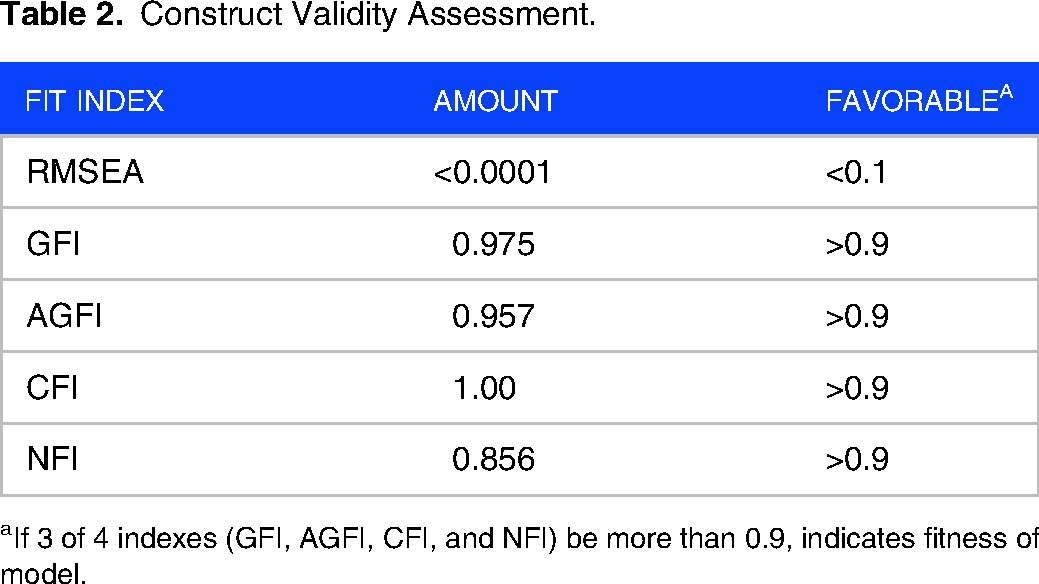
If 3 of 4 indexes (GFI, AGFI, CFI, and NFI) be more than 0.9, indicates fitness of model.
Discussion
As mentioned previously, health literacy is a relatively new concept in today's world, particularly in Iran, and various efforts have been made so far to enhance understanding and measure this concept. Consequently, different tools have been compiled and used worldwide. These tools include both original versions and translated versions of the original tools in a variety of commonly used languages throughout the world. So far, only a few experiments have been carried out to measure health literacy in Iran, and the main tools used are translations of the original ones. This study aimed to develop and validate a health literacy measurement tool related to TTI specifically for Iranian society, which can assess the necessary skills for making informed decisions in the field of TTI, including searching, acquiring, interpreting, and applying it. Considering the importance of TTI in developing countries, such as Iran, effective interventions to reduce its incidence are crucial. By establishing useful communication between health service providers and the target group, as well as providing appropriate educational content, these interventions will have a greater impact. Therefore, designing and implementing these programs will require a specific assessment of health literacy related to TTI. Through the developed tool, the audience can be assessed for their skill level to communicate with service providers and receive better training from them. This would allow health systems to promote preventative measures related to TTI among individuals, groups, and organizations. The calculation of the content validity index and content validity ratio (average CVR and CVI were (0.86 and 0.93) respectively) showed that the developed tool has an acceptable content validity. In other words, as mentioned in the health literacy definitions, this tool can measure these skills precisely. The reliability of the questionnaire was calculated using Cronbach's Alpha coefficient of 0.744, which showed that the instrument has an acceptable internal correlation. 23
According to the acceptable value of the indexes mentioned in Table 2 the designed tool is standard and has the ability to be used in similar researches in the field of TTI. 24
Considering the limitations of infectious agent screening tests in the diagnosis and the constant risk of infectious agents for the blood transfusion, although the designed tool may have limitations in terms of covering the range of blood-borne infections, it can inspire other researchers to improve the construction of a comprehensive and complete tool to minimize the possibility of contamination through blood transfusions.
Conclusion
The standardized tool developed through this study represents a significant advancement in the assessment of health literacy related to TTI. Considering that the developed tool has acceptable validity and reliability, it can be used in research, it could open avenues for improved patient education, better healthcare practices, ultimately, enhancing the safety of blood products and reducing the burden of healthcare costs. Future studies should explore the application of this tool in diverse populations to further validate its effectiveness and adaptability. Further studies suggest comparing health literacy levels in different age, gender, and cultural groups. Furthermore, it is necessary to investigate the impact of educational programs and websites on patients’ health awareness and literacy. These suggestions can help improve health literacy and reduce the risks associated with TTI.
Limitations
The limitations of this study include the following: Health literacy is a multifaceted concept, and the developed tool may not fully capture all its dimensions. In addition, the use of self-reported tools may be influenced by social biases and the tendency to provide positive responses.
Supplemental Material
sj-docx-1-bdx-10.1177_26348535241311686 - Supplemental material for Developing a Standard Tool for Measuring Health Literacy Related to Transfusion-Transmitted Infections
Supplemental material, sj-docx-1-bdx-10.1177_26348535241311686 for Developing a Standard Tool for Measuring Health Literacy Related to Transfusion-Transmitted Infections by Leila Manzouri, Saman Masoudifar, Narges Roustaei and Fariba Rad in Plasmatology
Footnotes
Author Contribution(s)
Ethical Consideration
This study was approved by the Institutional Ethics Committee of Yasuj University of Medical Sciences with the ethics ID 1400.075 IR.YUMS.REC.

Supplemental Material
Supplemental material for this article is available online.
References
Supplementary Material
Please find the following supplemental material available below.
For Open Access articles published under a Creative Commons License, all supplemental material carries the same license as the article it is associated with.
For non-Open Access articles published, all supplemental material carries a non-exclusive license, and permission requests for re-use of supplemental material or any part of supplemental material shall be sent directly to the copyright owner as specified in the copyright notice associated with the article.
