




Abstract
Background:
Recruitment of low risk blood donors can be challenging. Efforts should be made to increase the level of awareness and positive attitude towards blood donation. An essential step to achieve this is obtaining comprehensive data about the current situation of awareness, knowledge and attitudes of the population towards blood donation.
Methods/materials:
The present study was conducted at two blood donation centres in Amman, Jordan, during 2021. A total of 536 whole blood donors were included. Data regarding their demographic characteristics, blood donation history as well as their knowledge and attitudes regarding blood donation were collected by a questionnaire.
Results:
Four hundred ninety participants (91.4%) were males, whereas only 46 participants (8.6%) were females. Ninety seven subjects (18.1%) were first time donors, whereas 431 subjects (81.9%) had previous donations. The participants’ median score in the knowledge section was 19.0 points (range 5–25 points). Based on a cut-off of 15 out of 28: 84% of the participants were knowledgeable. Similarly 97% of the participants had a positive attitude based on a cut-off of 17 out of 32 points. Multivariate analysis revealed that high knowledge score was significantly associated with study major and employment status, whereas a positive attitude was significantly associated with a higher income. More than half of first time donors stated lack of awareness as being the reason for not donating blood before.
Conclusion:
Measures to improve awareness, knowledge and attitudes towards blood donation should be implemented in order to meet the increasing demand for blood and blood components. Targeted campaigns, correction of some misconceptions and using different motivations are suggested.
What we already know
Blood shortage is fairly common in Jordan and developing countries
A large proportion of blood donations are directed (family replacement) and not voluntary
What this article adds
Lack of adequate knowledge/awareness and misconceptions are important contributors that limit voluntary blood donations
Educational and awareness raising campaigns are urgently needed to increase the percentage of voluntary donors.
Introduction
Blood is a major vital component of human body and safe blood transfusion is essential for improving healthcare and prevention of the spread of infectious diseases.
Despite countless years of studies and rigorous research, it does not seem to be promising that an ideal substitute for blood will be imminently found in the near future. 1 Hence, the human blood donated is currently the sole option for replacement of blood and its various components. 2
World Health Organization estimated that 118.5 million blood donations are collected globally, 40% of these are collected in high-income countries, home to 16% of the world’s population. 3 It also estimates blood donation frequency to be 31.5 donations per 1000 people in high-income countries compared to 5.0 donations per 1000 people in low-income countries. 3
In Jordan, the number of blood donations executed in 2023 was approximately 250,000 donations. The frequency per 1000 population is 21.5% which is situated in the middle between high and low-income countries. This number of donations is not adequate to meet the needs of patients as the estimated requirements for patients is approximately 360,000 blood donations per year.
Donors in Jordan are either replacement (e.g. relatives, friends and work colleagues) or voluntary non-remunerated donors. Male donors constitute more than 90% of all donors in Jordan.
Recruiting suitable donors for blood donations remains a challenge in both developed and developing countries.4–6 In view of the fact that voluntary unpaid donors comprise a much safer and a more reliable source of blood for transfusion compared to family replacement donors,3,7 efforts towards achieving self-sufficiency in terms of blood units must mainly focus on recruiting and retaining more volunteer donors in place of replacement donors. Several studies have been conducted to address awareness and attitude towards blood donation and suggested measures to enhance recruitment.4–6,8–13 Analysis of 20 studies including 8546 subjects concluded that being knowledgeable about blood donation was 2.85 times more likely to result into blood donation. 14
Another study among health professions students including 598 students concluded that despite that 422 students (70.6%) did not take any courses regarding blood donation, 360 students (60.2%) had sufficient knowledge and 502 students (83.9%) showed high willingness to donate. 9 Taş and Evci Kiraz 15 found that the rates of blood donation and promoting people to donate blood were significantly higher in students who had received blood donation training compared to those who had not received such training.
It should be noted that results obtained from different studies do not necessarily apply to all populations due to different cultural, educational and socio-economic factors, along with varying perspectives across different populations.
Since reports on blood donation knowledge and attitudes in Jordan are generally lacking, 16 such comprehensive studies are crucial before making any attempts towards growing population awareness and positive attitudes towards blood donation in the country.
This study aims to assess the knowledge and attitudes of Jordanian donors towards blood donation. It also proposes various motivational factors and obstacles affecting the process of blood donation in Jordan. Such information will form a solid base for the attainment of total voluntary blood donations, which are indeed the foundation of a sustainable blood supply.
Materials and methods
Research design
The present research is based upon a cross-sectional, local population-based study which was conducted over a period of time extending from January to February 2021 at two blood donation centres in Amman, Jordan.
Research approach and sampling method
The study includes 536 adult (18 years or older) Jordanian participants. The sample size was determined based on Draugalis and Plaza 17 which was found to be at least 381 participants. The inclusion criteria includes all referred blood donors who are Jordanians and 18 years or older. There were no exclusion criteria.
Data collection method
Ethical approval: This study was approved by the Institutional Review Board at King Hussein Cancer Center (KHCC), Jordan under the numbers: 21KHCC011.
A survey questionnaire (see Supplemental material file questionnaire) was developed based on review of previously published surveys and expert opinions of blood bank staff, and it was pilot tested on 20 participants (5.25% of the intended population) in terms of scope and clarity. The pilot testing showed that no revisions were necessary because the questions were understandable. In general, the process of pilot survey filling went smoothly.
Prior to collecting data, a written informed consent was obtained from the participants.
Data were collected by means of an electronic form through a link sent out to participants at KHCC of whom 112 responded. The participants filled in the survey in the presence of the researchers.
On the other hand, data were collected from participants at Jordan University Hospital (JUH) using a paper-based form by the researchers. This form was an exact replica of the electronic form previously described for the interview. Interviews with the participants lasted for an average of 15–18 min. A total of 424 responses were obtained from JUH.
Most survey questions required fixed-choice responses, though for some items there was the facility for brief text responses. The questions mainly covered four areas: participants’ demographic data, their blood donation history, their knowledge about blood donation, along with their attitudes and motivation towards blood donation.
Data analysis method
Data from completed surveys were directly exported into a computer data sheet (Microsoft Excel, Redmond, WA).
The univariate analysis of the data was done using SPSS 25.0 for Windows (IBM Inc. Armonk, NY). This yielded frequencies, corresponding percentages of the whole data, valid percentages, means, medians, standard deviations, as well as minimum and maximum values.
The bivariate analysis of the data was also done using SPSS version 25.0 for Windows. Knowledge was calculated based on 28 questions, in which a correct answer was given a score of 1, and any other answer was given a score of 0, including I do not know. The sum of the scores for each of the aforementioned questions yielded a knowledge total score out of 28 points.
Attitude was calculated based on eight questions. Questions that had four options were given scores of 1, 2, 3 and 4. Questions which had two options were given scores of 1 or 4. A score of 4 was given to the answer with the most positive attitude while a score of 1 was given to the answer with the most negative. The sum of the scores for each of the eight questions yielded an attitude total score out of 32 points.
Knowledge total score, attitude total score and all the questions were correlated to ordinal and scale variables of the questionnaire using Spearman’s correlation. The level of significance was considered when p < 0.05. Knowledge total score and attitude total score were categorized to scores with a range of five and were then correlated to nominal variables using a Chi-squared test. The level of significance was considered when p < 0.05.
Results
The study included 536 participants recruited from blood banks affiliated to JUH and KHCC, Amman, Jordan. Out of the 536 study subjects, 490 of them (91.4%) were males, whereas only 46 of them (8.6%) were females. About 75% of the population were younger than 40. In terms of education, 60.4% of them had a post-high school education. Additionally, 396 of them (74.0%) reported that they have previously done a blood test to know their blood type, but only 376 participants (74.1%) said that their actual blood type matches the one stated in their national identity card.
Ninety seven subjects (18.1%) were first time donors, whereas 439 subjects (81.9%) had previous donations (previous donors). Multiple previous donations (four or more) were observed in more than 50% of previous donors. Among previous donors, voluntary donation was the most common motivation (66.1%) followed by replacement donation for a family member or a friend (63.6%). The majority of previous donors have not reported to have had any complications post donation (81%).
Among first time donors, lack of awareness and/or having never been asked to donate before were the most common causes for not previously donating (51%). Table 1 summarizes the basic demographics and health characteristics of participants and history of blood donations. Supplementary Figures 1–3 show the causes for previous donations, causes for not previously donating and reported adverse effects post-previous donations, respectively.
Participants’ demographics characteristics and health history (n = 536).

Knowledge
Knowledge was assessed based on a calculated result of 28 questions. The sum of the scores for each of the 28 questions yielded a knowledge total score of 28 points. The participants’ median score in the knowledge section was 19.0 points, and the mean was 18.7 (range 4–26 points). Using 15 as a cut-off for being knowledgeable 84% of the participants achieved this score or more. Supplemental Table 1 shows depicts the 28 questions and the number and percentage of participants providing the correct answers.
More than half of the participants (53.1%) recognized that there are four major blood types and 75.9% knew that blood groups are genetically inherited. The majority of the participants (93.8%) thought that blood is screened before being given to patients, whereas only (68.6%) of them thought that blood gets processed (to separate different blood components) before being given to patients. Moreover, a significant proportion of the participants (85.6%) acknowledged that hepatitis B and/or C infection affects an individuals’ eligibility to donate blood. Upon asking whether patients can only receive blood from their first degree relatives, 484 participants (90.5%) disagreed.
Interestingly, 525 participants (98.1%) agreed that blood donation is safe for donors, and 515 participants (96.3%) agreed that blood donation has positive benefits upon donors’ health. Despite the fact that 521 participants (97.4%) agreed that blood units stored in blood banks are safe for use by patients, only 327 participants (61.1%) knew that blood units have an expiry date.
When it comes to blood banks status in Jordan in terms of blood unit sufficiency, 47.5% of the participants thought that blood banks in Jordan were short in terms of blood units, compared to 52.5% who thought blood banks had enough blood units or were not aware of the status, altogether.
Table 2 depicts the association between knowledge score mean and demographics. The findings revealed that the overall knowledge score was not affected by participants’ age. However, knowledge was found to be significantly higher among female donors, those with a higher educational level, those with medical or scientific study major, and those with higher income (p-value <0.01). Unexpectedly, those who said they were unemployed had a higher mean knowledge score. Table 3 depicts the association between mean knowledge score and health history and attitude towards donation.
Association between mean knowledge score and demographics.

Association between mean knowledge score and health history and attitude towards donation.

Interestingly, donors with a higher level of education recognized more than others that blood units stored in blood banks have an expiry date and that blood banks in Jordan lack sufficient blood units (both with a p-value of < 0.01). In addition, participants who have achieved a higher level of education were more likely to have previously donated blood because they thought it was healthy and in response to blood donation campaigns calling for blood donors through social media (both with a p-value of < 0.01).
More interestingly, participants who have ever participated in voluntary activities in their lifetime were found to achieve higher scores in the knowledge questions (p-value < 0.01).
Our study did not detect a statistically significant difference between first time and previous donors when it comes to the total knowledge score. However, first time donors, who have not donated blood previously because they claimed that they would only do so to replace blood units needed by family members or friends, were more likely to think that blood donors and recipients should be first degree relatives (p-value < 0.01).
Finally, a general linear regression shown in Table 4 shows that only educational study major and employment status as the only significant variables in a multivariate analysis.
General linear regression for knowledge score and all significant variables.
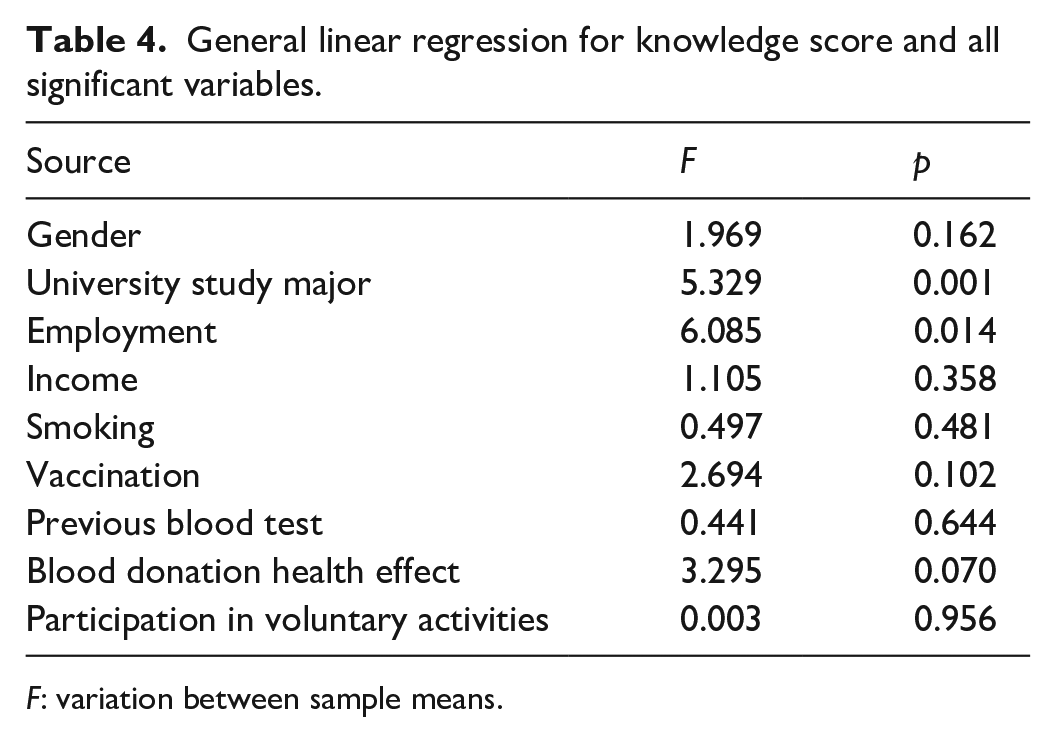
F: variation between sample means.
Attitude
Attitude was assessed based on a calculated result of eight questions. The sum of the scores for each of the eight questions yielded an attitude total score of 32 points. The participants’ median score in the attitude section was 26.0 points, and the mean was 25.7 (range 12–32 points). Using an attitude cut-off of 17 of 32 points as representing a positive attitude, 97% of the participants had a positive attitude.
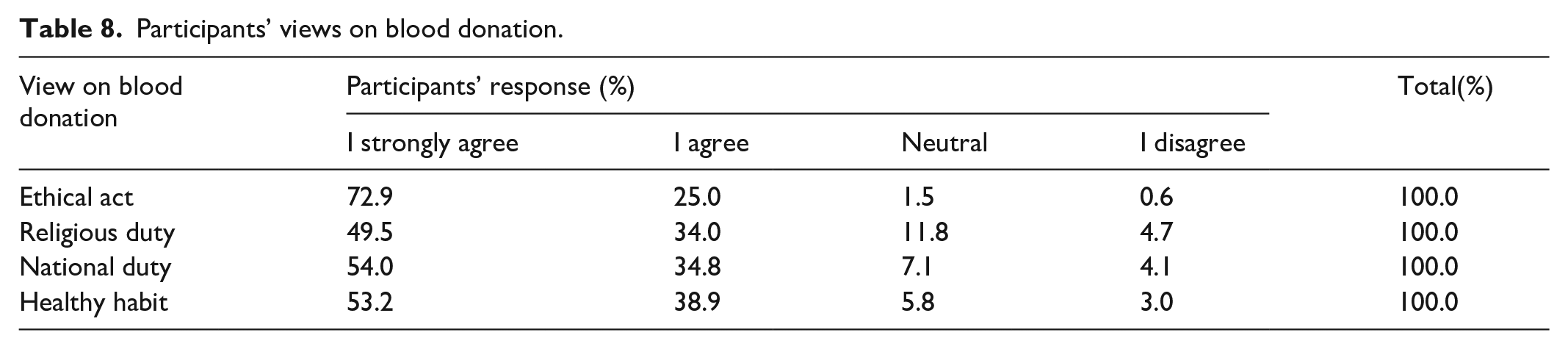
Tables 5 and 6 depict the associations between the attitude score and the demographics and the health characteristics respectively. Univariate analysis revealed that marital status, employment status, income and previous blood donations were significantly related to a positive attitude towards blood donations. The general linear regression for multiple variables revealed only income to be statistically significant in that those with higher income were more likely to have a positive attitude towards donation (Table 7). Participants’ views on blood donation in terms of it being an ethical act, a religious or national duty and a healthy habit are summarized in Table 8.
Associations between the attitude score and the demographics.

Associations between attitude score and health characteristics.

General linear model for attitude score and variables.

F: variation between sample means.
Participants’ views on blood donation.
When it comes to motivational factors, a great percentage of the participants (77.8%) agreed that mobile blood donation caravans roaming around public areas will further motivate them to donate blood, whereas almost two-thirds of them agreed that both getting free blood tests (67.5%) in return for blood donation or getting a day off work (67.3%) will make them more likely to donate blood in the future. On the other hand, about 9.5% of them agreed that receiving monetary compensation in return for blood donation will increase their likelihood of donating blood.
However, older participants were more likely to agree that blood donation is both a national duty and a religious duty (both with a p-value < 0.01). In addition, participants who achieved higher levels of education were more likely to agree that blood donation is both an ethical act and a healthy habit (both with a p-value < 0.01). Interestingly, participants with higher income were more likely to agree that blood donation is an ethical act, a religious duty, a national duty and a healthy habit (p-value < 0.01).
Discussion
Our study showed that the majority of blood donors are males. In Jordan, according to the directorate of blood bank, the proportion of females among blood donors is 6.7%, whereas in our study, females constitute 8.6% of the study population This is consistent with previous reports from Saudi Arabia and Nigeria.10,18 On the other hand, reports from Iceland and Germany showed a more even distribution.19,20 Despite the fact that females only comprised 8.6% of our study population, they were more knowledgeable of blood donation in general when compared to males. This can be attributed to the fact that medical-related professions were more common among female donors when compared to male donors (35.6% and 5.5%, respectively).
Only 24.5% of our study population were older than 40 years of age. Older first time donors have not donated previously because of an impression of being ineligible to donate. This highlights the need to raise awareness regarding eligibility criteria for donation.
The rate of first time donors among different populations is variable. Suemnig et al. 21 reported a first time donor rate of 14.3%, whereas Niazkar et al. 22 reported 26.5%. In addition, a previous study from Jordan revealed a first time donor proportion of 25.4%. 16 In our present study, about one-fifth (19.4%) of the participants were first time donors.
In our study, more than half of previous donors had four or more previous donations. The most common cause behind previous donations was voluntary donation. This is consistent with previous reports, which found altruism and the wish to help others to be the most common driving force behind blood donation.13,23
It has been reported that proper knowledge of blood donation was indeed an important factor for donating blood. In a study conducted among the Saudi population, Alfouzan 13 reported that more knowledgeable subjects tended to donate blood more than those of lower levels of knowledge. Interestingly, first time blood donors in this study who reported not having donated blood before because they would only do so to replace blood units exclusively needed by their family members, were more likely found to believe that blood donors and recipients should be first degree relatives. This indicates that correction of such a misconception may alter donation attitudes among the Jordanian population.
In contrast to studies conducted in Tanzania 24 and Nigeria, 25 which inferred that voluntary donations were correlated to secondary school education, our study did not detect a correlation between participants’ attitude towards blood donation and their corresponding level of education. However, in our study, participants with a higher level of education were found to be more knowledgeable of blood donation in general, as they were found to achieve relatively higher total knowledge scores than those with lower levels of education.
A strong ethical and religious drive was noted among our study population. In accordance with previous studies among Saudis,10,13 most participants from our study agreed that blood donation is an ethical act, and both, a religious and a national duty. In fact, in our study, this drive was mainly observed among older participants, as well as those with a higher level of education and a higher income.
A previous report on barriers to blood donation in Jordan 16 revealed that participants having not received blood when needed was the single major barrier affecting blood donation among Jordanians, comprising 78.4% of the participants’ answers. This was followed by side effects of blood extraction (18.8%), having health problems (9.6%) and fear from blood (7.8%). In our present study, lack of awareness regarding blood donation and/or having never been asked to donate blood before were the predominant barriers (50.9%) to blood donation among first time donors, followed by absence of the need for direct donations to family members (11.5%), conflict with participants’ working hours (11.5%) and fear of the blood donation process in general (7.7%).
It has been previously reported by Thomson et al. 26 that 80% of first time donors globally would never return to donate. Therefore, the efficacy of various methods used in attempts to increase the return rate of first time donors was assessed in previous studies. Hashemi et al. 27 found that different interventions, including phone reminders, educational and emotional letters, along with motivational meetings, were effective in improving the return rate. In our study, donors would likely return if mobile blood donation units were available in public areas, and if they get free blood tests or a day off work in return for their donation.
On the other hand, monetary compensation was disfavoured as an incentive to blood donation in several previous studies. A study which probed the factors motivating the Nigerian population towards blood donation found that only 13.6% of the respondents would donate blood in return for money. 25 Similarly, a study conducted in the United States to assess blood donor attitudes towards various incentives reported that only 30% of the donors would be encouraged to donate if they received cash. 28 Data obtained from our study were much in line, as 90.5% of our participants objected donating blood in return for money.
In Jordan, citizens’ national identity (ID) card includes holder’s blood type. In our study, only 396 participants (74.0%) reported that they have ever undergone testing to know their blood type. Only 70.1% of them reported that their actual blood type matches the one stated on their ID. The reasons for this discrepancy is probably related to the source of the info on the national ID card which is usually the holder him/herself and the issuing government agency does not ask for an official document for the blood group test result. It is well known by medical personnel in Jordan that you cannot rely on it for management. This discrepancy in reporting calls for the need of applying more strict measures to ensure the correct documentation of blood groups on national ID cards. Indeed, knowledge of the distribution of ABO blood groups is essential for safe transfusion of blood in cases of emergency. 29
This study has some limitations. One of the main limitations is that this study included participants who are donors at the time of data collection, so that it does not represent the entire population but those who were somehow already motivated to donate blood. In addition, it was conducted over a short period of time, so there is limitation in representing that period of time only.
Conclusion and suggestions
Blood donation is an essential component of patients care and efforts should be made to increase recruitment of voluntary donors and increase return rate of first donors. Based on our findings among blood donors at JUH and KHCC, we suggest:
– Blood donation awareness campaigns need to target people with least knowledge towards blood donation found in our study, such as the unemployed and those who have not completed their education beyond high school. Programmes, such as school educational courses or school visits to blood banks, are suggested.
– Females comprised only 8.4% of total donors’ population. Measures to encourage females to participate should be implemented. Television advertisements or campaigns to target university students or health club members can be of help.
– Correction of misconception or inaccurate information such as that blood units has no expiry date, that blood donors and recipients should be first degree relatives or that blood banks in Jordan had sufficient blood units.
– Consider designing and starting a blood donation motivation scheme. Mobile units, free blood tests and days off work were thought by our study population to increase their likelihood of donation.
Supplemental Material
sj-doc-1-smo-10.1177_20503121241259340 – Supplemental material for A survey assessing knowledge and attitude about blood donation among blood donors in Jordan
Supplemental material, sj-doc-1-smo-10.1177_20503121241259340 for A survey assessing knowledge and attitude about blood donation among blood donors in Jordan by Rahaf S. Omaish, Zahraa A. Al-Fayyadh, Shifar M. Al-Habashneh, Safa Y. Al-Mashhdi, Salah Y. Khasawneh, Isam A. Naber, Sana L. Bourghli, Tariq N. Al-Adily, Firas M. Al-Fararjeh and Maher A. Sughayer in SAGE Open Medicine
Supplemental Material
sj-docx-2-smo-10.1177_20503121241259340 – Supplemental material for A survey assessing knowledge and attitude about blood donation among blood donors in Jordan
Supplemental material, sj-docx-2-smo-10.1177_20503121241259340 for A survey assessing knowledge and attitude about blood donation among blood donors in Jordan by Rahaf S. Omaish, Zahraa A. Al-Fayyadh, Shifar M. Al-Habashneh, Safa Y. Al-Mashhdi, Salah Y. Khasawneh, Isam A. Naber, Sana L. Bourghli, Tariq N. Al-Adily, Firas M. Al-Fararjeh and Maher A. Sughayer in SAGE Open Medicine
Supplemental Material
sj-docx-3-smo-10.1177_20503121241259340 – Supplemental material for A survey assessing knowledge and attitude about blood donation among blood donors in Jordan
Supplemental material, sj-docx-3-smo-10.1177_20503121241259340 for A survey assessing knowledge and attitude about blood donation among blood donors in Jordan by Rahaf S. Omaish, Zahraa A. Al-Fayyadh, Shifar M. Al-Habashneh, Safa Y. Al-Mashhdi, Salah Y. Khasawneh, Isam A. Naber, Sana L. Bourghli, Tariq N. Al-Adily, Firas M. Al-Fararjeh and Maher A. Sughayer in SAGE Open Medicine
Supplemental Material
sj-docx-4-smo-10.1177_20503121241259340 – Supplemental material for A survey assessing knowledge and attitude about blood donation among blood donors in Jordan
Supplemental material, sj-docx-4-smo-10.1177_20503121241259340 for A survey assessing knowledge and attitude about blood donation among blood donors in Jordan by Rahaf S. Omaish, Zahraa A. Al-Fayyadh, Shifar M. Al-Habashneh, Safa Y. Al-Mashhdi, Salah Y. Khasawneh, Isam A. Naber, Sana L. Bourghli, Tariq N. Al-Adily, Firas M. Al-Fararjeh and Maher A. Sughayer in SAGE Open Medicine
Supplemental Material
sj-docx-5-smo-10.1177_20503121241259340 – Supplemental material for A survey assessing knowledge and attitude about blood donation among blood donors in Jordan
Supplemental material, sj-docx-5-smo-10.1177_20503121241259340 for A survey assessing knowledge and attitude about blood donation among blood donors in Jordan by Rahaf S. Omaish, Zahraa A. Al-Fayyadh, Shifar M. Al-Habashneh, Safa Y. Al-Mashhdi, Salah Y. Khasawneh, Isam A. Naber, Sana L. Bourghli, Tariq N. Al-Adily, Firas M. Al-Fararjeh and Maher A. Sughayer in SAGE Open Medicine
Supplemental Material
sj-docx-6-smo-10.1177_20503121241259340 – Supplemental material for A survey assessing knowledge and attitude about blood donation among blood donors in Jordan
Supplemental material, sj-docx-6-smo-10.1177_20503121241259340 for A survey assessing knowledge and attitude about blood donation among blood donors in Jordan by Rahaf S. Omaish, Zahraa A. Al-Fayyadh, Shifar M. Al-Habashneh, Safa Y. Al-Mashhdi, Salah Y. Khasawneh, Isam A. Naber, Sana L. Bourghli, Tariq N. Al-Adily, Firas M. Al-Fararjeh and Maher A. Sughayer in SAGE Open Medicine
Footnotes
Acknowledgements
The authors would like to acknowledge and thank all voluntary blood donors all over the world and especially those who participated in our survey. They also would like to acknowledge and thank Khawla Ammar of the research office at KHCC for her insightful statistical contributions during the revision stage. This study had a preprint version available on medRxiv Pre-Print server:  .
.
Author contributions
R.O. draft manuscript writing, data collection; Z.A. data collection; S.M.A. data collection; S.Y.A. data collection; S.K. data collection; I.N. data collection; S.B. data collection; T.A. survey design; K.A. survey review; F.A. conception, survey design; M.S. Conception, design and manuscript editing. All authors: data analysis, final manuscript review, editing and approval.
Declaration of conflicting interests
The authors declared no potential conflicts of interest with respect to the research, authorship, and/or publication of this article.
Funding
The authors received no financial support for the research, authorship, and/or publication of this article.
Supplemental material
Supplemental material for this article is available online.
Ethics approval
Ethical approval for this study was obtained from King Hussein Cancer Center INSTITUTIONAL REVIEW BOARD (APPROVAL NUMBER/ID): 21KHCC011.
Informed consent
Written informed consent was obtained from all subjects before the study.
Trial registration
Not applicable.
References
Supplementary Material
Please find the following supplemental material available below.
For Open Access articles published under a Creative Commons License, all supplemental material carries the same license as the article it is associated with.
For non-Open Access articles published, all supplemental material carries a non-exclusive license, and permission requests for re-use of supplemental material or any part of supplemental material shall be sent directly to the copyright owner as specified in the copyright notice associated with the article.
