



Abstract
Mental health work in Norway has undergone extensive market-based liberal shifts in recent decades, which has put time under pressure. While streamlining services is claimed to improve quality of care, researchers have expressed concern about a devaluation of face-to-face relationships. This article explores how young service users experience the role of time in mental health work and how temporal dimensions affect professional relationships. To do so, we draw on the case of young service users from two third-sector organisations that provide low-threshold mental health services in Norwegian municipalities. In total, 14 semi-structured interviews with service users were conducted and analysed through a hermeneutic phenomenological approach. Hartmut Rosa’s theory of resonance, as well as the concepts of chronos and kairos, were applied to shed light on the temporal and relational experiences of participants. The findings showed how time was experienced through presence and availability, including sharing vulnerable moments and being flexible in the use of clock time. Additionally, the findings revealed that professionals who stayed connected and supported young users over time obtained a more holistic view of the person and were able to provide stability during difficult phases. Through such continuous relationships, the young people experienced gradual inner and outer transformations where they saw themselves in a different light and explored new ways of being.
Keywords
Introduction
This article explores how young people experience the role of time in mental health work. Extensive research has highlighted the tension between the temporal demands of care and the dominant logic of increasing efficiency through strict time management (Antoni et al., 2023; Sabelis, 2001; Tronto, 2003). Research by Antoni et al. (2023) found that professionals who worked with young people in vulnerable situations grappled with time pressure and scheduling to make time for care. Studies of young service users in mental health care found that they wanted temporal improvements, such as more accessibility, appointments outside school hours, and longer visits, to avoid the feeling of being rushed (Persson et al., 2017). In this paper, we further explore how young service users experience temporal dimensions in professional relationships through the case of third-sector organisations that provide low-threshold mental health services in Norway.
National surveys of Norwegian adolescents have shown a gradual increase in mental health problems, particularly during the last decade (Madsen and Von Soest, 2021). This increase requires more research on which interventions effectively prevent mental difficulties and promote mental health (Skogen et al., 2018). Young people in Norway have reported that a lack of availability is the main obstacle when seeking help with mental health issues (Helsedirektoratet, 2018; Prop. 121 S, 2018–2019: 45). Furthermore, many municipalities lack services that can provide long-term follow-up of young people who have received assessment/treatment from specialist mental healthcare services (Prop. 121 S (2018-2019), p. 52). Long-term mentoring relationships have been associated with increased self-worth and improved social and relational coping (Grossman and Rhodes, 2002). Dallos and Myhill (2024) discovered that young people found it easier to talk about difficult issues when it was not felt as an expectation, as in counselling or therapy; instead, they preferred to speak about difficulties when such topics emerged spontaneously in a conversation, often in informal settings.
Researchers have highlighted how time is a relational and processual phenomenon that needs to be paid attention to (Kuepers et al., 2023). Time pressure and acceleration have been frequently addressed in care professions such as nursing and healthcare (Martinsen, 2018a, 2021; Morinière, 2023). Healthcare professionals experience time as a scarce resource that affects the enactment of care, meaning less possibility to build relationships, maintain a holistic lens, and be present for patients (Morinière, 2023). Initiatives have been made to shift economic paradigms in care, such as ‘Making care fit’ (Kunneman et al., 2023) and ‘Unhurried conversations’ (Ballard et al., 2024). These initiatives emphasise the need to make time for the person behind the patient role, as unhurriedness is essential for quality care.
When care professionals are forced to perform faster, this impacts not only the amount of time spent caring for each individual but also the holiness of being present with another – of allowing oneself to be touched and moved by the other (Martinsen, 2018a, 2021). Feminist writings on the ethic of care have emphasised how care is a situated, relational practice (Lawrence and Maitlis, 2012) that involves deep relational quality and interpersonal connectedness (Gilligan, 1982; Held, 2006; Tronto, 1993). Research has shown how professional care work is often subjected to the economic view of time as a scarce resource that needs to be tightly controlled to avoid being wasted (Antoni et al., 2023; Morinière, 2023). The perception of time as money pinpoints the human quest to control time in order to control the world (Tronto, 2003). However, time spent caring is not primarily about mastery or control (Tronto, 2003).
In this article, we draw on Hartmut Rosa’s (2013, 2019, 2020, 2024) theory of acceleration and resonance to analyse how temporal dimensions interact with and affect relational work. Rosa diagnoses our late-modern societies with acceleration, which refers to a continuous speeding-up process based on the capitalist logic of growth (Rosa et al., 2017). At an individual level, acceleration implies increasing the pace of life, leaving less time to dwell on experiences, sensory impressions, and relationships (Rosa, 2024). As relational beings, this instrumental way of relating to the world makes us disconnected and alienated (2019, 2020). The cure against this alienation, according to Rosa, is the development of responsive relationships, defined as resonance. However, resonant relationships with other human beings are time-demanding relationships (Rosa et al., 2017) that escape our attempts at control (Rosa, 2020). It takes time to establish and maintain relationships that are truly significant for the individual (Rosa et al., 2017). Thus, Rosa’s theory can shed light on how the capitalist view of time as money affects the relational dynamics of time by reducing the potential for resonance.
Aim
This article aims to explore young service users’ experiences of time in mental health work. More specifically, we focus on temporal dimensions in professional relationships and how these are experienced from the service user’s point of view. We ask the following research question: How do young service users experience the role of time in mental health work?
Theoretical background
With the research question in mind, we present some theoretical perspectives that underpin this study. Rosa’s (2019) theory of resonance is elaborated on, as it connects time to relational experience through the concepts of acceleration, alienation, and resonance. We then address the concepts of kairos and chronos to shed light on time’s objective and subjective dimensions.
The theory of resonance
Rosa’s (2019) theory of resonance can be used both as a social critique of late-modern society’s demand for production and efficiency and as an attempt to describe humans’ existential experiences of being in the world (Rosa, 2024). According to Rosa, the tempo of modern life and institutional practices is characterised by acceleration, an exponential increase in the number of activities in the same allocated period (Rosa, 2013). This leads to the paradox that although we continuously accelerate to save time, time does not appear to be more abundant. On the contrary, our institutions and care practices are marked by the shrinking of the present, making our relationships with ourselves, each other, and the world increasingly alienated (Rosa, 2013, 2024). Alienation describes the experience of the world withdrawing from us. It is as if the other stops responding and becomes mute (Rosa, 2020). Rosa (2022) points out that the prevailing mindset in which young people are brought up today revolves around constantly optimising their parameters in various areas of life, leading many to experience burnout and alienation. Rather than working on self-optimisation, Rosa proposes that our sense of being connected to the world depends on how we perceive our impact on others. If others respond to our thoughts and feelings and somehow answer them, we experience connection, but if others seem indifferent or dismissive, we experience alienation. Without connection with our surroundings, our relationship with ourselves is also hindered, and the possibility of a good life becomes impossible (Rosa, 2024).
Rosa (2019) claims that resonance is the way out of alienation. Resonance derives from the Latin word resonare, meaning to resound (Rosa, 2019). It describes a two-way movement between the subject and the other, thus pointing to the mutuality of all human relationships (Rosa, 2024). According to Rosa (2020), resonance can be defined by four characteristics. First, when something or someone resonates with us, we are touched or moved. Something affects us, and it calls for an answer. Second, this leads to our response. This response is not an echo of the call; rather, it is an active response with its own voice. There is a mutual connection that affects both the subject and the other, leading to a sense of self-efficacy. This is an existential human experience: I can reach out and be reached by the other – like an infant smiling at its mother and noticing how the smile creates a response in the mother’s face. Third, when we resonate with another human being or something outside ourselves, this meeting transforms us. The transformation can be of huge significance, but it can also be small or volatile. However, resonant experiences change our status quo and thus always involve a risk. The fourth characteristic is uncontrollability. Rosa emphasises that there is no method or recipe to ensure resonant experiences. It is impossible to predict how resonance will transform us or what the consequences may be. This fundamental uncontrollability stands in a tension-filled relationship to standardised procedures for calculating, managing, predicting, and controlling outcomes and results (Rosa, 2020).
Kairos and chronos
We additionally conceptualise and build our understanding of time through the ancient Greek terms kairos and chronos (Ramo, 2004). While there is no rigid dichotomy between the two, these terms can clarify how the subjective experience of time does not necessarily equal the objective time measured. While chronos is often translated as objective, quantitative time as it appears in clocks or calendars, the role of kairos is more rarely addressed (Ramo, 2004). Kairos refers to the subjective experience of time. It can address a specific temporal event (Kuepers et al., 2023) and could be translated as the right moment (Ramo, 2004). Such moments can happen when we are deeply engaged with something or someone, leading to a sense of time standing still or flying by, thus describing time’s more relational, uncontrollable dynamics. Kairos aligns with Rosa’s concept of uncontrollability, which in the theory of resonance becomes a positive force that prevents our relationships from being instrumentalised (Jordheim, 2022). However, kairos in itself is neither positive nor negative per se. Such moments of uncontrollability can also shake up something that is in order, or disturb the predictable, stabilising rhythm of time experienced as chronos (Jordheim, 2022). This calls upon a sensitivity to the temporal dimensions of care, ranging from the everyday grappling with time pressure and priorities of chronos, to the attentive presence of kairos that is required to seize the moment and move into the unknown.
Material and methods
Design
This qualitative study was rooted in a hermeneutic phenomenological approach (Binder et al., 2024). It had an interpretative orientation with a hermeneutics of empathy which aims to understand how participants make sense of their realities, assuming that the language they use is a tool for communicating meaning (Braun and Clarke, 2022). In-depth interviews with young service users were conducted to get as close to the participants’ experiences as possible, while acknowledging that our understanding was developed iteratively based on pre-existing knowledge and theoretical perspectives.
Context of the study
The participants were approached through two third-sector organisations that provide low-threshold mental health services in Norwegian municipalities. These services work as a supplement and alternative to municipal services and specialist mental healthcare. As low-threshold services, they are characterised by being easily accessible, offering early interventions, and being flexible enough to adapt to users’ wishes and needs, such as extended opening hours (Prop. 121 S, 2018–2019: 47).
In addition to municipal social and mental health services for young people in Norway, child and adolescent mental health services (CAMHS) are offered until the age of 18, targeted at those with more severe mental health problems (Prop. 121 S, 2018–2019: 51). There is reason to assume that more young people than necessary are referred to CAMHS, partly because of a lack of knowledge about low-threshold services that could offer an alternative (Prop. 121 S, 2018–2019: 52).
The third-sector organisations in this study are located in different municipalities that are connected to big cities in the east, south, and west of Norway. The employees are mainly social workers, therapists, and deacons, and the services are grounded in a faith-based tradition connected to the Church of Norway. Many young people using their services have already been assessed or treated at CAMHS. The services are not treatment-based, but support young people by building long-term relationships and collaboration with social and health systems, schools, families, and important others. Their services are organised differently, where one works primarily with individual follow-up through peer activity groups, while the other primarily works with individual follow-up through counselling. Both services are free and voluntary. Each service user is assigned an employed professional who typically follows the young person for a long time and who collaborates closely with other networks in the young person’s life.
Participants
The employees recruited seven participants from each service (a total of 14 participants), who either were or had been service users. There were nine young women, four young men, and one transgender person in the study. Their ages were between 16 and 25 years, and all had a minimum of 1 year in contact with the services, most of them much longer. The average length of the participants’ contact with the service at the time of the interviews was approximately 4 years. They had comprehensive experience of other social and mental healthcare services, which they drew upon during the interviews.
Data collection
The first author conducted the interviews, which lasted between 45 minutes and 2 hours. The initial research question guiding the interviews sought to find out what the young people experienced as helpful in the low-threshold services, what they were missing, and how the support provided was similar to or different from other types of professional help that they had encountered. During the interviews, the first author became intrigued by the young service users’ emphasis on time connected to care and how they generally experienced time as a scarce resource in mental health work. This emphasis triggered the first author’s curiosity about the role of time in the therapeutic relationship. Thus, the interview guide was adjusted during the first part of the data collection to pay closer attention to temporal dimensions.
Data analysis
The transcription of the interviews was analysed using reflexive thematic analysis (Braun and Clarke, 2022). Thematic analysis allows for theoretical freedom and can provide a rich, detailed, and complex account of data (Braun and Clarke, 2006). Although thematic analyses can take multiple forms depending on epistemological positioning, a common factor is the emphasis on the interpretative nature of developing themes and acknowledging researchers’ subjectivity (Braun and Clarke, 2022; Finlay, 2021).
Through the first round of systematic coding, 407 data extracts were coded from the dataset. These data extracts were text segments in which the young service users talked about their experiences of struggling and coping in life, their experiences of the professional care they had encountered, and, more specifically, how they perceived their relationships with their professional helpers in the low-threshold services. Throughout several rounds of reading the data extracts and whole transcripts (together with the second and third authors), we used thematic maps to visualise how the provisional themes might be connected. Time was chosen as the theme to proceed with, as it appeared to be often implicit, albeit vital for the young people’s experiences of professional help; additionally, it seemed to be one of the most distinct features of the low-threshold services. The analysis was then further developed by applying theoretical perspectives on time and Rosa’s theory of resonance to gain insights into how time could be connected to the participants’ experiences of the therapeutic effect in the professional relationship. This resulted in the themes we present in this paper.
Ethical considerations
To co-create the necessary trust and feeling of safety that was regarded as important for the interviews, the first author reached out to the young service users via their contact person in the services. The participants received written information about the study and had a conversation with the first author before each interview, in which they could ask questions about the study, their participation, and their consent. As the youngest participants were 16 years old, no parental consent was required (Backe-Hansen, 2023). However, the vulnerability of participants was taken into account and discussed with the professionals engaged in the study, to ensure that those recruited fully understood what participation involved and were able to protect their rights. Furthermore, professionals were available for conversations with any participants who requested this following the interview.
All participants were assigned fictive names. The study was approved by the Norwegian Agency for Shared Services in Education and Research (ref. no. 696295).
Reflexivity
As qualitative researchers, we acknowledge our positionality and active role in all parts of the research process, including the presentation of the findings below. Two of the authors of this article are both researchers and practitioners in mental health work and therapy. The first author previously worked as a practitioner in low-threshold services for youth. This proved to be a resource in many parts of the research process. For example, it gave access to the field, helped in recruiting the participants, and enabled the collection of a rich amount of data during the interviews. However, a potential challenge when knowing a field well is to look at things from different perspectives and to be surprised by our findings (Binder et al., 2024). As such, discussions with academic peers and the co-authors of this article were valuable sources of deeper reflexivity. The role of being a therapist differs from the role of being a researcher. Nevertheless, the therapeutic experience was perceived as helpful in creating open dialogues with the participants. Several participants also commented that the interviews provided an opportunity to talk about things that were rarely put into words and that felt meaningful to reflect upon.
The two third-sector services are pseudonymised as YOUTH TALK (YTALK) and YOUTH ACT (YACT) in the quotes from the participants.
Findings: The relational dynamics of time
In this study, we wanted to explore how young service users experience the role of time in mental health work. We developed our findings through the analysis based on three main themes, each with two subthemes, illustrated in the figure below. The main themes are as follows: (1) the professional as present and available; (2) the professional as a witness through continuity; and (3) the young person’s inner and outer transformation. The figure illustrates how the themes interact in a process that develops over time (Figure 1). The relational dynamics of time in young service users’ experiences of mental health work.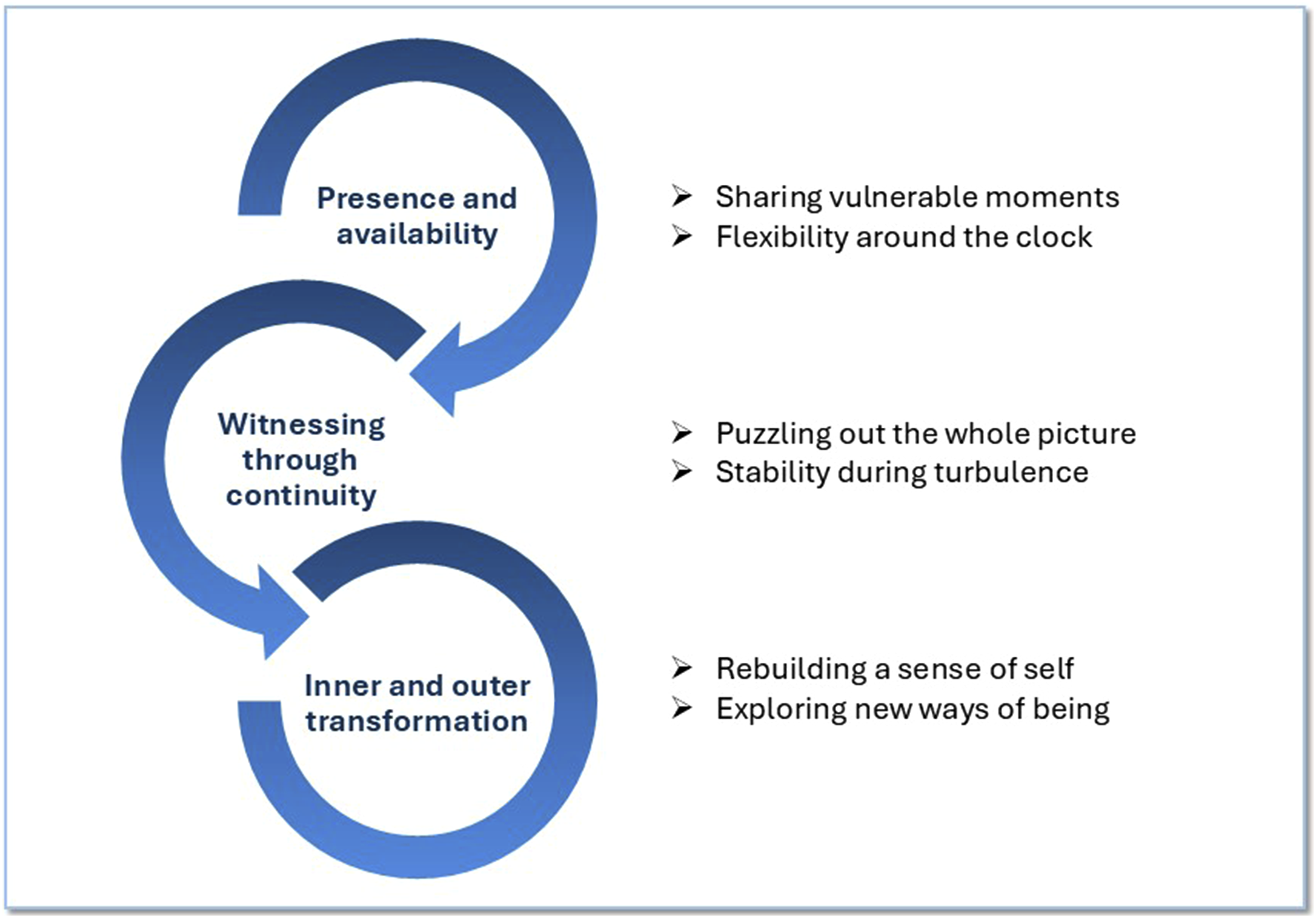
The professional as present and available
A core finding was the young service users’ emphasis on how the professionals in YTALK and YACT were present and available in timely situations. The young person could sense if the professional was present with their attention, which was often described in terms of showing genuine interest in the young person as a whole human being. Presence and availability in timely situations included sharing vulnerable moments and being flexible in the professionals’ use of time.
Sharing vulnerable moments
Sharing vulnerable moments was a specific temporal event that many participants talked about. When the young person had revealed something personal and then experienced the professional as present in a way that made the young person feel less alone, these temporal events seemed to strengthen their connection.
Nadia spoke as follows about her first meeting at YTALK: Anne made me realise, the first time I came here after school.. she wanted me to say a little about myself and what had happened, and then I just ended up sitting there and talking about absolutely everything that has happened in my life, because I just automatically started to connect things. Ehm, and I think I talked for like two hours. (…)
Nadia’s experience of time in this first meeting was multi-dimensional. She explained how her past flowed into the present and made her see new connections between what had been and how that affected her now. And she continued: And Anne didn’t say a word. She just sat there, I think, at least she said very little; she just sat and listened and listened, and the more I talked, the more I saw that her eyes were like OMG. Also, I don’t think I shed a single tear. I just said it like it was nothing. Then she made me realise that there are so many other things that have happened in my life that I have never gotten help with. And she prepared me for a vulnerable period ahead. (Nadia)
The look in Anne’s eyes showed that she was attentively present and touched. This vulnerable moment became a turning point for Nadia and the starting point of a long journey together.
Tony told of difficult traumas during childhood that they had shared with several specialists and professionals, without ever getting the recognition they needed. When Tony shared one of the most difficult stories with Greta, the professional at YTALK, she reacted differently: She has been the first to do a lot of things. She was also the first to speak very directly; the first time she made me cry. She said very directly that what happened to me during childhood was NOT okay. Because most adults in that system, the CAMHS system, say, ‘Yeah, they shouldn’t do that’. They kind of dance around the specific word. (Tony)
Greta’s timely reaction made Tony cry and by recognising the experiences without reservation, this moment created a new sense of redress.
William, on the other hand, shared what he called ‘his darkest secret’ in conversations with Gina, his conversation partner at YTALK. He explained how much shame and guilt he had felt and how he was afraid that if he shared this with Gina, she would never look at him in the same way again: I was all alone at that moment. And I thought I was completely crazy. But I wasn’t. I was just sad. And she made me realise that it’s okay to regret things and that everyone deserves a second chance. (William)
Revealing his darkest secret was a moment of truth for William, loaded with potential for rejection or redemption. However, seeing himself through Gina’s eyes made William view things in a new light and enabled him to forgive himself.
Flexibility around the clock
Related to being present in timely situations, the young service users also explained how the professionals had been available at times when they had extra needs for care. This could include periods of the young person’s life during which things were especially unpredictable and where the professionals scheduled more time and even time outside working hours to maintain their relationship. For Mira, such efforts from Ellen at YACT were considered the most genuine expression of care: They took their time wherever and whenever to be there for us. Even outside of YACT, Ellen often asked me, ‘Well, should we grab a bite to eat?’ Then we usually went out for a coffee or something like that. (…) She would also do such things when she saw that we needed something extra. (Mira)
Previous encounters with many professionals who were trying to help Mira because it was in their job descriptions, had not made her convinced that she was worthy of being cared for. Through Ellen’s personal engagement and willingness to carve out extra time in her calendar, however, Mira realised that Ellen actually cared. Instead of being a one-way relationship of giving and receiving care, Mira emphasised the mutuality of their relationship: I never got the impression that she was there for the money. I think it was just that… I think they had fun with us too. That they also managed to create a relationship with us. (Mira)
Thus, the professionals’ prioritisation to spend time with the young people seemed connected to the young people’s experiences of care and mutuality in the relationship.
The availability of professionals at YTALK and YACT clearly differed from most other social and mental health services that the participants had encountered: YTALK is just so available, and I feel a lot of such programs or services for young people lack that. They kind of always have specific opening hours that are like four hours a day, and the phone closes at that time and the messages close at that time, but it’s not like that here. (Nadia)
Nadia explained how the timeframe of 45 minutes in the psychologist’s office was a framing that restricted the sharing of life experiences that were not regarded as relevant enough for the set agenda: Here I can talk about small things that affect my everyday life and kind of look deeper into it, while there I can only talk about the biggest things. And if I’m going to bring in some of the small stuff that affects me, I just feel like I have to explain it first, since I don’t have room to talk about it because I only have 45 minutes. So it’s like, I don’t feel that I can talk about such small things, for example, at CAMHS because I don’t have the time. Then I would have to spend the time getting my psychologist to understand whatever it may be, for her to understand the whole picture. (Nadia)
Several participants expressed the tension arising from having to stick to the agenda at CAMHS without time to make connections to other parts of life that in their views were intertwined. Anders described conversations at CAMHS that he characterised as being without flow, where the professionals seemed to stick to forms, making it difficult to talk about feelings: When I am here, it’s easier to talk about my feelings than at CAMHS. (…) It felt so systematic in a way. There was no flow in it. It was more like, they asked me questions, then I had to answer. Here it was more like, at YACT, we could be more friendly, in a way. And yeah, things went much easier. Could lower my shoulders a little bit. (Anders)
As YACT is a more activity-oriented service, the conversations there did not represent an equivalent to the assessments and treatment procedures at CAMHS. However, the flexible and relational approach seemed to reduce Anders’s experience of alienation and allowed him to share thoughts and emotions in his own time.
Witnessing through continuity
The professionals who had stayed there through rocky and turbulent times seemed to function as life witnesses for the young people. Several participants had been connected to YTALK and YACT throughout many years of adolescence. These participants emphasised the meaning of continuity in professional care, which had given them a sense of belonging. This had been lacking in many areas of their lives. As witnesses to the different phases the young person had gone through, these professionals could obtain a holistic view of the person behind the problem.
Puzzling out the whole picture
William spoke about how time had enabled a more holistic picture of who he was: For me, it matters that it [time] provides a much more holistic picture of who I am. I mean, time is everything at that age. (…) And it’s not just like, ‘she’s been part of his stories’. No, no. To understand me today, you have to know everything. You have to know what has shaped me. (…) Well, time is important, and not just to begin this type of relationship. It’s a very unique relationship. There is a lot of vulnerability involved. A lot of shame. Fear. Well, for many, there is an incredible number of scary things around something like this. So time, not only is it important for that reason, but also because it gives a much more holistic picture of, not only who one is, but who one has been and can become. (William)
Having a professional like Gina who had known him through different stages helped William sew together parts of the puzzle into a more integrated whole. In mental healthcare, he had met professionals who only received a snapshot of who he was. This relationship, however, contained the larger context that those snapshots were a part of and provided a resonant wire connecting the past, present, and future.
Stability during turbulence
Several participants talked about turbulent periods in their young lives when it had been too difficult to keep appointments or even answer messages. Karoline described how such a period had made her lose contact with her friends and peers and become increasingly isolated. It had meant a lot that Ronja at YTALK didn’t give up on her: I had a very depressing phase after the summer. And I didn’t talk to her. Or I kind of ghosted her basically (...) but she still sent several messages each month to see if I was okay. So I think that was very significant – that she didn't give up. (...) Otherwise, I wouldn’t have come back if I hadn’t received any messages, or something like that; then I would have kind of thought that there was nothing I could come back to. (Karoline)
Because Ronja kept in touch and told Karoline she was still there, Karoline eventually reached out again. Continuity and stability had crumbled in many of Karoline’s relationships with her friends and peers. As such, this had given her a new experience of how a relationship could stand the test of time.
Similarly, Anders talked about periods of life when he had dropped out of school because life was too hard and when Jan, his professional buddy at YACT, had insisted on not losing touch: Jan showed up at my door in my dad’s house when dad drank a lot. I wasn’t doing well at home with my dad. I never came to school; I just stayed in the house (...) Yeah, it made an impression on me because Jan called me: ‘Well, are you coming today?’ ‘No, I’m not coming’. I used to say that a lot. Then he said, ‘Yes, you’re coming; we’ll come and pick you up’. And then he just came and picked me up. (Anders)
During the difficult periods, Anders’ everyday life lacked rhythm and sense of coherence. The relationship to Jan and YACT represented a stabilising factor in an otherwise chaotic existence. Now, several years later, Anders was at a different place in life and could reflect on how this continuity had given him something to hold on to.
Inner and outer transformation
The participants’ experiences of professionals who were attentive and present without standardised schemes and time pressure seemed to create space for vulnerable topics that had rarely been addressed elsewhere. When being met at their innermost, the young people saw themselves and their stories in a different light, thus creating opportunities for other narratives of who they could be. Such narratives were allowed to grow slowly and steadily, opening the door for alternative ways of moving forward into the future.
Rebuilding a sense of self
Several participants shared stories of how their relationships with professionals over time had contributed to various inner and outer transformations. For Iben, this had been a process of learning to trust her own reactions and emotions after being involved in a manipulating environment for many years: Now I feel like things are real again. I went for quite a long time and felt like things weren’t really happening, because I couldn’t trust myself when I existed. And it was very exhausting. (…) So I’ve received a lot of confirmation from Sara that my reactions are completely legitimate and not overly dramatic. (Iben)
After the years of manipulation, Iben had needed repeated confirmation from Sara at YTALK over time, before she could gradually rebuild her sense of self. Iben emphasised how crucial Sara’s involvement had been: I got a stomach ulcer. These have been turbulent years, these last years (...) But after I was sent to the nutritionist, I was forwarded to a psychologist. But no one caught the root of the problem. That didn’t happen until I had talked to Sara for six months (...) And I can’t see who else would have given me the confirmation I’ve received over the past year, either. When I didn’t get it from home, and I didn’t get it from friends. In other words, there are so few who manage to understand how complex this situation has been. (Iben)
Exploring new ways of being
Many participants described how transforming patterns of thoughts and behaviour had been a gradual process that required a great amount of patience from professionals. For Mira, this transformation evolved after spending time with adults who allowed her to explore another version of herself: I think it was how calm adults tolerated me. Because I challenged Ellen for quite some time, and she was like, ‘Pull yourself together; I know you can do better than this’. She saw me, in a way, and not just the person I pretended to be. It was just so reassuring – these calm adults who supported me and showed that they were there for me. (Mira)
Ellen’s expectations of Mira had a witness function, telling Mira that she had seen a different version of who she could be, and this convinced Mira that she was someone worthy of being cared for. Gradually, she began to make other choices in her everyday life: There became less and less contact with them [old friends] because I made new friends through YACT, and so I started hanging out more with those I found through YACT, and then I stopped talking and hanging out with the others as much, and I simply grew up. I realised that what I was doing was so stupid, so I just moved on from them. I’m very grateful for that. Some of them are in institutions, others in prison, and others are drug addicts. So I’m very glad that she [Ellen] caught me. (Mira)
Similar to Mira’s experience of exploring new ways of being through a stable and supportive environment at YACT, Anders expressed how it had been important for him to be part of an environment in which he was allowed to grow: Getting away from family and stuff, it actually helped me find myself. To find out who I was. Because I felt that my family held me back in the old me. They got mad at me because they just expected me to still be who I was before. They never accepted that I was allowed to grow. But YACT always has. They have always made me develop. (Anders)
Jan and the other adults at YACT had witnessed another version of him than the one he felt allowed to be at home. Seeing himself through their eyes enabled him to see what they saw, and he could gradually integrate more of this version of himself into his self-perception: Because then I often forgot about the problems I had at home. Then suddenly I felt like a person who laughed and could come up with something funny, joking. It was a good feeling. It wasn’t something I felt often in those days. So YACT was the only time I got that kind of feeling. (Anders)
This transformation accompanied a meaning-making process in which Anders developed a stronger sense of self-worth and self-efficacy.
The availability, flexibility, and continuity that characterised the relationships with professionals at YTALK and YACT were mainly described as an approach that differed from what the young people had experienced at CAMHS. However, a couple of participants had also developed close relationships with professionals at CAMHS.
This was the case with Jenny, who had met her psychologist at CAMHS when she was very young. The relationship between Jenny and her psychologist grew so strong that when she celebrated her confirmation day at the age of 15, she invited him. When asked what it was that made this relationship so meaningful to her, she replied as follows: He really helped me through those years. (…) I don’t know how, but he just made me open up and talk about how I was feeling. It took some time, but I eventually became confident in him. Maybe it’s got something to do with that he wasn’t like, ‘hey, what’s going on?’ It’s more like he was interested in getting to know who I was, what school I went to, what I liked to do in my spare time. He took a little more time to get to know me, and I think that means a lot – that we spent a long time getting to know each other. (Jenny)
Time was a factor of great importance for building a relationship that became meaningful to her. Her psychologist had shown patience in getting to know her, although she struggled for a long time before she could open up. He had witnessed her becoming and provided a resonant wire connecting her past and present sense of self.
Discussion
We began this article by exploring how young service users experience the role of time in mental health work. In response to this question, we discuss two sets of overall contributions. First, we consider how the theory of resonance might provide insights into the young service users’ experiences of time and professional relationships. We highlight how resonance requires stepping into the unknown. Second, we discuss how these insights could have implications for mental health work, which has undergone extensive market-based liberal shifts in recent decades (Karlsson, 2018). Such shifts can be seen as an attempt to control the unknown.
Into the unknown: The risky business of resonant relationships
A core finding in the present study was that young service users emphasised relational qualities connected to time when pinpointing how professionals had been helpful to them. According to Rosa (2019), resonance and acceleration have a tension-filled relationship because resonant experiences fundamentally affect how we experience time. When the clock equals time in professional care, we lose our connection to the bodily time in which we are always embedded, which we experience through our senses (Martinsen, 2021). The participants expressed how bodily time made clock time disappear for a while. By being in the present and experiencing interconnectedness with the professional, the young people could open doors to difficult experiences and emotions that had been locked away. Such vulnerable moments required the mutual bodily presence and tuning in of both the young person and the professional. This is in line with Rosa (2024), who argues based on findings from empathy research and neuroscience that time pressure blocks the possibility of resonance. When we are in a hurry, we strive to be goal-oriented and focused, which does not allow us to be moved or disturbed. The young person could easily sense if the professional was not there, and they were then quick to shut down. By contrast, when the participants experienced resonance, such moments reduced their loneliness and enhanced their sense of coherence, which gradually contributed to transformations in the young people’s lives.
A key characteristic of resonance is uncontrollability. Rosa (2020) argues that all real life comes into being in encounters that cannot be fully controlled. This was evident in all the participants’ stories. The moments that had been most substantial were kairos-moments when something unplanned occurred. This underlines that although scheduling, evaluating, and calculating mental health work are all important for ensuring responsible practices, relational work with people differs fundamentally from working with objects or numbers. However, such kairos-moments alone did not create transformation. Weingarten (2000) describes witnessing in the context of therapy as a practice that involves risk. Witnessing requires the willingness to let go of control, as by grasping the experience of another, we risk being transformed ourselves. Witnessing also requires time, which means staying with the other long enough to extend one’s own perception of reality until it coexists with the reality of the other (Weingarten, 2000). Professionals who had provided the stable rhythm of continuity through long-term relationships seemed to function as witnesses who could establish a resonant wire connecting the past, present, and future. The participants gradually began to see themselves through different eyes because the professionals had been witnesses over time, not only to their struggles but also to their strengths and possibilities, thus empowering other narratives of who they could be. The impact of chronos was crucial in this regard.
Tronto (2003) points to how the postmodern compression of time can change the nature of care into a commodity. The participants emphasised how different it was to be met as whole human beings rather than just a problem to be solved. When the professionals had time to really listen instead of just sticking to the agenda, they could lower their shoulders and allow themselves to open up. This is in line with Dallos and Myhill (2024), who found that young people preferred to speak about difficult topics when they could emerge spontaneously in a conversation. In light of the current debate on standardisation in mental health work (Karlsson, 2015, 2018), these findings can illuminate the importance of informal and open dialogues. As the number of tasks assigned to professionals seems to increase in inverse proportion to the time allocated to solve them, this is not an easy mission. However, there are ways to integrate collaborative approaches, such as shared decision-making, within various time frames (Montori et al., 2023). This could enhance the mutuality in professional relationships. Resonance does not necessarily represent a time-consuming contrast to streamlining care, but an essential dimension that can be adapted to different contexts.
Attempts to control the unknown: Relational time as counteraction?
A large body of research has suggested that professional care and mental health work are under pressure from neoliberal policies and new public management (NPM) (Antoni et al., 2023; Dahl, 2012; Karlsson, 2015, 2018). Some researchers have proposed an emerging care crisis in the Nordic welfare states in which increasing demands for standardisation and documentation leave less time for hands-on care (Dahl, 2012; Jensen and Nielsen, 2022). Studies have shown that rising managerialism in public welfare services has led to a devaluation of face-to-face relationships as well as intolerance for problems without clear solutions, such as long-term illnesses or difficulties (Gripsrud et al., 2020). Reforms based on NPM are expressed in mental health work by the quantitative measuring of time, such as counting the number of consultations, the flow of service users, the reduction of waiting lists, financial earnings, and budget control (Karlsson, 2018). Such demands often clash with an ethics of care emphasising how care involves deep relational quality and interpersonal connectedness (Gilligan, 1982; Held, 2006; Tronto, 1993), as well as with psychotherapy research that underpins the importance of the relationship rather than specific treatment models (Wampold, 2015).
Our findings confirmed and elaborated on previous research by showing how the time-constrained procedures the participants had experienced at CAMHS often made it difficult to open up and share their thoughts and emotions. This is in line with Karlsson (2015, 2018), who points out how extensive reforms in Norwegian mental health work over the past decades have forced professionals to act in more standardised ways, resulting in depersonalised relationships with service users. However, our findings also provided nuances to this somewhat gloomy picture by showing how the young service users experienced a deep relational quality with professionals through the multiplexity of time.
The participants’ descriptions of moments when the professionals were present and available illustrated how chronos and kairos were intertwined when the professionals had greater flexibility in their timetables and work schedules. By prioritising more time when care was needed, stretching the timeframe at vulnerable moments, going out for coffee outside working hours, and picking up adolescents who couldn’t keep appointments, the professionals at YTALK and YACT made time for personalised relationships with service users. With fewer demands for streamlining in their relational work than professionals at CAMHS, these professionals could make use of clock time as a resource for relational time. For the young service users, spending time together was experienced as an expression of genuine care.
However, there were also examples of how the participants encountered professionals who carved out relational time in the more regulated framework of CAMHS. This could be interpreted in terms of what Martinsen (2018b) calls counteractions to the economic use of time in public welfare. Such examples showed how the bodily presence and attentiveness of professionals, as well as patience and continuity in the relationship, created care spaces within less flexible timeframes. Thus, this study suggests implications for practice within mental health work also in public systems under pressure. Although the third-sector services in this study were characterised by a flexible institutional framework that allowed the professionals great freedom in their use of time, several findings from the young service users’ experiences can be integrated into public welfare. For example, by prioritising young people’s preferences regarding relational quality, efforts should be made to ensure that young service users can stay connected to the professional with whom they have already established a resonant relationship. Building mutual trust is a time-intensive endeavour and, once established, should not be wasted by directing young service users to new professionals with every new problem they encounter. Further, our findings showed that relational qualities like humour and small talk were not redundant waste of time, but rather vital elements to foster the openness required to share difficult experiences and emotions. Considering the implications of our findings alongside previous research, one might question whether prioritising quantitative measures over relational quality truly leads to more time-efficient approaches to care.
Concluding remarks
To conclude, this study highlights multiple aspects of how and why time matters in mental health work. By exploring time’s role in the participants’ experiences of how professional care contributes to transformation, it seems that time and relationality are interconnected phenomena that should not be treated separately. Rosa’s theory provides insights into how demands for acceleration and control impact mental health work’s relational and temporal dimensions, which has been supported by a large body of research (Antoni et al., 2023; Dahl, 2012; Karlsson, 2015, 2018; Morinière, 2023). We suggest that the concept of resonance can be useful by illuminating the risky and meaningful dimensions of relational work. As our findings have shown, young service users experienced time as vital for resonant relationships through presence, availability, witnessing, and stability. The continuous relationships with professionals fostered the young people’s inner and outer transformations where they gradually could explore new ways of being in the world.
Footnotes
Declaration of conflicting interests
The author(s) declared no potential conflicts of interest with respect to the research, authorship, and/or publication of this article.
Funding
The author(s) received no financial support for the research, authorship, and/or publication of this article.
Ethical statement

Data Availability Statement
The datasets analysed during the current study are not publicly available due to the written consent form where data availability was not provided. Data are however available from the corresponding author upon reasonable request and with permission of the participants.