



Abstract
The functioning of the sibling subsystem is often overlooked in research on attachment relationships, despite its both threatening and protective potential. Taking a multi-case approach, this study sought to build theory regarding how the mother–child relationship and the mother’s view of each of her children impact the sibling relationship. Three families were assessed using the Meaning of the Child Interview, a method of analysing parental discourse in a semi-structured interview to understand the parent–child relationship, and a sibling free-play procedure. The study illustrated how in more struggling relationships, the child represented a particular threat or challenge to the mother, and how the child’s accommodation to this influenced the dynamics of the sibling relationship. The sibling may be recruited to care for their sibling to ease demands on their mother, serve as an ally with their mother against their sibling, or siblings may support each other to compensate for what is lacking in the child–parent relationship. This was further influenced by wider systemic challenges to both children and mother, such as parental conflict or settling in a new country.
Keywords
Introduction
Attachment theory offers an interpersonal understanding of human thinking, feeling, and behaviour, but at times has been criticised for overly focused on the mother–child dyad. Such a focus neglects the network of relationships in which the parent and child are situated (Dubois-Comtois and Moss, 2008), and the importance of relationship triangles in making sense of family interaction (Dallos et al., 2016). Each family member can be seen to belong to multiple subsystems of the larger family system. This includes the spousal subsystem, co-parent subsystem, and the sibling subsystem in addition to the parent–child subsystem (Pinel-Jacquemin and Zaouche Gaudron, 2012). All of which are continuously interacting with and influencing the other in the form of triadic relationships; the parents and their child, two siblings, and a parent, for example (Crittenden & Dallos, 2009). Siblings can be defined as children who are biologically related or have lived together for a significant period as in the case of a stepsibling. The sibling relationship exists within the family system, thus functioning in connection with the caregiving system and the spousal relationship (Farnfield, 2009), making it problematic to study in isolation.
Attachment in the family system: The dynamic maturational model of attachment and adaptation
Attachment theory is an evolutionary theory explaining how children use the proximity and support of their parents to survive and manage danger in the environment. Crittenden’s Dynamic Maturational Model of Attachment and Adaptation (DMM: Crittenden et al., 2021a) gives attachment theory an explicitly systemic focus, in its explicit attention to the wider systemic influences in the environment that children organise their strategy of attachment around (Crittenden et al., 2014), and the systemic function of attachment behaviour (Dallos et al., 2019). Attachment is not simply a function of the dyadic relationship but rather reflects the child’s response to the complex network of relationships in which s/he is situated.
Attachment strategies shape not only behaviour but also how information about self and context derived from our senses is assimilated (Crittenden & Landini, 2011). Children learn to depend upon the information that helps them stay safe and discard what is irrelevant or potentially dangerous. More specifically, in predictably threatening environments, children organise Type A strategies around cognition; externally derived information about what authority figures want, seeking to prevent rejection, a punitive response, or withdrawal of care by trying to fit in with, or please parents. In more unpredictably threatening situations, children organise Type C strategies around affect, internal signals of arousal; in particular feelings of anger, fear, and desire for comfort which they exaggerate to make carers more predictably attentive and protective. In safer and more comfortable environments, where a slower, more integrated response that makes use of higher cortical processes can be afforded, Type B patterns integrate cognition and affect, internal signals of arousal, and external predictions about how attachment figures might respond (Crittenden et al., 2021a).
As the child matures, development offers increasing options to the child, and attachment patterns can become increasingly sophisticated and able to manage complex environments. In adulthood, they influence how parents process information about danger not just for themselves but also to protect and nurture their offspring (Crittenden et al., 2021b). However, this does not necessarily happen in a uniform way, as different children can elicit varying threat responses in the parent, depending on the history and systemic context in which these relationships develop. For example, birth order and changes in the spousal relationship can elicit different responses in the parent (Crittenden & Dallos, 2009; Grey & Farnfield, 2017a).
Attachment and sibling relationships
Despite its systemic potential, there has been limited research of sibling relationships using the DMM. Crittenden used the CARE-index assessment with parent–infant and sibling–infant dyads and found that the children of maltreating mothers were significantly more likely to maltreat their infant siblings (Crittenden, 1984). Two DMM-based studies have examined whether siblings share the same attachment strategies. Farnfield (2017), assessed 30 sibling dyads using the DMM School-age Assessment of Attachment and found 80% had a shared secure (B) or insecure (A or C) pattern. However, when looking more specifically at the attachment strategies he found siblings were unlikely to share normative A or C strategies, associated with relatively unendangered contexts. However, 30% shared higher A strategies that arise in the context of serious threat, suggesting that as danger increases there are fewer adaptive strategies available for sibling pairs (Farnfield, 2017). Kozlowska and Elliott (2017) similarly found only six of twenty six sibling groups shared the same attachment strategy.
Other, non-DMM, attachment-based research has found that sibling attachment concordance may impact on the sibling relationship itself, as siblings who shared an attachment pattern were seen as having warmer relationships with each other. Shared representations of their environment and attachment figures were more predictive of the quality of the sibling relationship than the individual’s attachment security (Kriss et al., 2014).
A child’s ability to mentalise (make adequate sense the mental life of self and others) has been linked to their attachment strategy, and parental caregiving, and appears to impact the sibling relationship (Luyten & Fonagy, 2014; Paine et al., 2021). In play, higher level mentalising, associated with B strategies, can be seen as the child’s integration of externally generated information, and internally generated information, and the ability to be creative, to engage in humour and repair relationships (Farnfield & Onions, 2022). Paine et al. (2021) found that sibling dyads with more positive rapport used more internal state language, more references to cognition, and had more shared humour during their play. The use of internal state language during play has also been negatively associated with the amount of conflict observed in sibling dyads, and internal-state language during conflict was negatively associated with relationship antagonism, indicating again that mentalising appears to have an impact on the quality of sibling relationships (Howe et al. 1998, 2002).
Caregiving and sibling relationships
Several studies have found that maternal caregiving impacts sibling relationships. Maternal enjoyment of the parenting role has been linked to more pro-social, affectionate behaviour between siblings, while maternal negativity and depression have been linked to increases in sibling hostility and conflict (Brody et al., 1986; Lemery and Goldsmith, 2003; Jenkins et al., 2012). Mothers’ use of positive guidance to coach social skills with siblings was negatively associated with sibling conflict, while authoritarian involvement was linked to increased sibling conflict (Chen, 2019). Parental emotional experience of parenting, their relationship with the other parent, as well as their mental health status, and the quality of their individual relationships with their children, all impact on sibling hostility, cooperation, conflict, and affectionate behaviour (Brody et al., 1986; Lemery and Goldsmith, 2003; Jenkins et al., 2012).
Notably, parents do not always treat their children equally and that can impact on how they treat each other. Children who perceive themselves to have of greater conflict with their mother compared to their sibling had more sibling conflicts (Shanahan et al., 2008). Pauker et al. (2017) found that older siblings who were disfavoured showed higher levels of social understanding with their sibling, compared with favoured older siblings interacting with disfavoured younger siblings. The authors suggested this was the result of older siblings watching and learning from their parent’s interaction with their siblings. This result aligns with Crittenden’s (1984) study finding that children of parents who were classified as sensitive in their CARE-index assessment with their infants showed the most sensitivity with their infant siblings.
Research question
These results indicate that differential maternal sensitivity can impact sibling conflict, warmth, sensitivity, and social understanding and that the birth order of the disfavoured sibling can also impact these factors. However, the predominately quantitative methodology of these studies abstracts general factors from their particular systemic context, and so cannot look at how these interact, or infer the particular processes by which this might happen. By analysing relationships at this local level, with triadic, systemic, and contextual information intact, this study asks how and in what way maternal caregiving, and in particular, maternal perceptions of the child, influences sibling relationships.
Methodology
Study rational and design
A multi-case study design was selected for this research as it is qualitative, exploratory, and theory-building. Case study methodology enables the researcher to look holistically at how relationships function within their real-life environment and examine in depth what factors are impacting them (Diaz, 2009). Most previous research in this area has been quantitative and focused on a specific aspect of caregiving, or the caregiving experience on a specific aspect of the sibling relationship, such as conflict. This study sought to fill the gap in research by gaining insight into how individual caregiving relationships are functioning, and how the sibling relationship is functioning to theorise on how they are linked together.
Each case was examined individually, and a respective case formulation was made regarding how the parent–child relationship and the parent’s view of their children influenced the sibling relationship. A cross-comparison of cases and previous research was then made, where theory about how the parent–child relationship and the parent’s view of the child impacts the sibling relationship was built.
Two assessments were collected from each family: a Meaning of the Child Interview (MotC) and a sibling free play video.
Meaning of the child interview
The MotC is a DMM-based assessment of parental discourse chosen because of its ability to shed light both on the parent–child relationship and its systemic context (Grey & Farnfield, 2017a,b). It utilised a modified version of the Parent Developmental Interview (PDI: Aber et al., 1985) with questions addressing the systemic context of parenting. A coding of an MotC produces an evaluation of relational risk and patterns of caregiving as well as the parent’s ability to mentalise for their child. Parental patterns of caregiving related to how they might be experienced by the child; sensitive patterns evidence mutually pleasurable relationships; controlling patterns demonstrate a need to change the child, in a way that might be experienced as intrusive; unresponsive patterns indicate parental psychological withdrawal. Interviews are also assigned a risk category based on the degree of sensitivity (Grey and Farnfield 2017b). MotC discourse was analysed qualitatively to gain an understanding about how the parent views each of their children, their ability to take their perspective, their engagement in reflective functioning, and how the parent–child relationship is functioning (Grey & Farnfield, 2017a).
Although the MotC does not assess attachment, the interview poses questions that probe the parent’s upbringing and relationship with their own parents can provide relevant information regarding their attachment strategy and how it may be informing the parent’s caregiving. These questions were coded using the DMM method of analysing adult attachment-related discourse (Crittenden & Landini, 2011). Although this relatively short section does not allow the specificity of a full Adult Attachment Interview (AAI), used qualitatively for case formulation in this way, such analysis has proved fruitful in studies using a similar methodology (Dallos et al., 2020; Grey et al., 2021). Interviews took place by Zoom owing to COVID-related restrictions.
Play video
Mothers were instructed to film their children playing in the same room together for 10–15 min. Whilst the context of this research within the COVID pandemic necessitated this, the presence of the mother in the sibling play was helpful given the research aim of evaluating the influence of the mother–child relationship on the sibling one. The actual length of videos ranged from 6 to 18 min. The videos were coded using constructs from the two DMM-based assessments that evaluate the relational function of behaviour: Infant CARE-index (Crittenden 2010) and the Child Attachment and Play Assessment (CAPA: Farnfield, 2016).
The CARE-index evaluates how patterns of infant behaviour and caregiver behaviour function within the relationship. It offers an understanding of the quality of the dyadic relationship, as well as the risk within the relationship (Crittenden, 2010). Seven aspects of behaviour are examined in the coding of a CARE-index: facial expression, vocal expression, position and body contact, arousal and affection, turn taking, control, and choice of activity (Crittenden, 2010). These aspects of behaviour were applied to the sibling play video to produce a coding of each child’s pattern of behaviour and a score of dyadic synchrony. Dyadic synchrony refers to the level of cooperation and sensitivity within a dyad, which we have represented categorically as collaborative, managing, struggling, and in crisis. In all cases, one child (usually, but not always the older child) appeared to have more power within the relationship, frequently leading the play, with the other responding and adapting to stay in the interaction. To capture this, we tentatively applied both the caregiving/parental constructs of the CARE-index (sensitivity, unresponsiveness, and control) with the child patterns (cooperativeness, difficulty, passivity, and compliance). Each is explained more fully below, in context. Given this adaptation, all these categories are only used analogously and qualitatively to highlight important aspects of the dyadic interaction.
Because the Infant CARE-index was designed to be used with parents and infants, the constructs from the CAPA, which is designed to be used with children ages three to eleven, were required to better understand each child’s behaviour as well as the quality of their play and to consider how self-protective strategies may impact the sibling relationship (Farnfield, 2016).
The CAPA uses narrative story stems which produce stress to assess children’s self-protective attachment strategy. Playing freely with one’s sibling is not considered sufficiently stressful to allow a full attachment assessment. However, assessment constructs from the CAPA such as the nature of the child’s play, management of arousal, and signifier attachment behaviours (Farnfield & Onions, 2022) were visible in the sibling play video and were examined for how they functioned dyadically and a tentative attachment strategy was assigned.
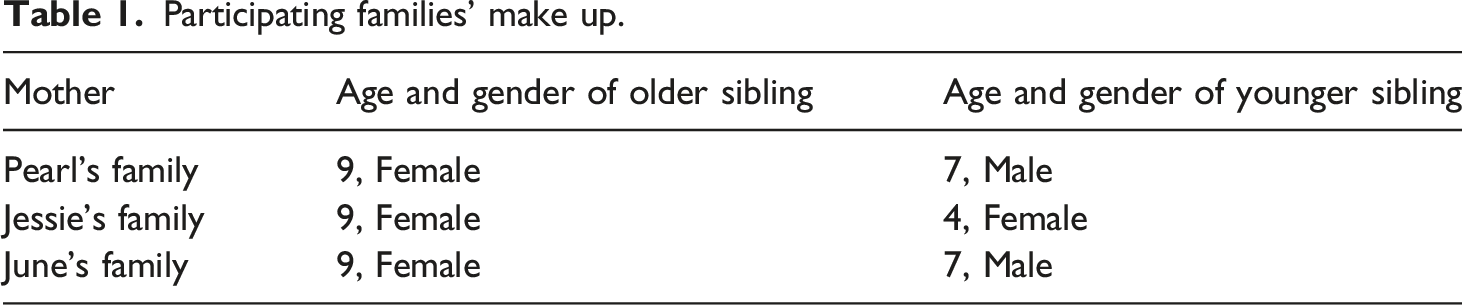
Participants
Participating families’ make up.
Ethical implications
This study received ethical approval from the University of Roehampton. All parents gave consent. Personally identifying information has been removed, or altered in ways irrelevant to the analysis, to protect the identity of participants.
Peer evaluation
Initial analysis was carried out by the first author, but to integrate multiple perspectives, both procedures were coded separately by other trained coders and their analysis incorporated into the case formulations (in keeping with the study’s qualitative methodology). Training and accreditation in the attachment procedures require formal tuition in the coding process and considerable time in analysing practice videos and interviews. The coding and case formulations were then reviewed by the other authors and revised by discussion.
The aim here was to consider alternative explanations and interpretations of the data and select the best fitting one. Coding of attachment procedures is based on the identification of discrepancies in spoken discourse and videoed behaviour, and an interpretation of their psychological meaning (Crittenden & Landini, 2011). Whilst many if not most individual quotes or moments of interaction are capable of multiple interpretations, it is usually possible to identify a common pattern across the whole transcript or video, theorised as reflecting a likely underlying attachment organisation. This process is aided by training, reliability testing of coders, and case formulation integrating multiple perspectives; a process that cannot be made entirely visible in the selection of excerpts and examples to illustrate the findings below.
Findings and discussion
Pearl’s family
Pearl’s family consists of Pearl (Mum), Bree (9), and Ben (7). Bree and Ben live with Pearl full time. Pearl separated from Bree and Ben’s father during Pearl’s pregnancy with Ben. The children see their father regularly.
Assessment results
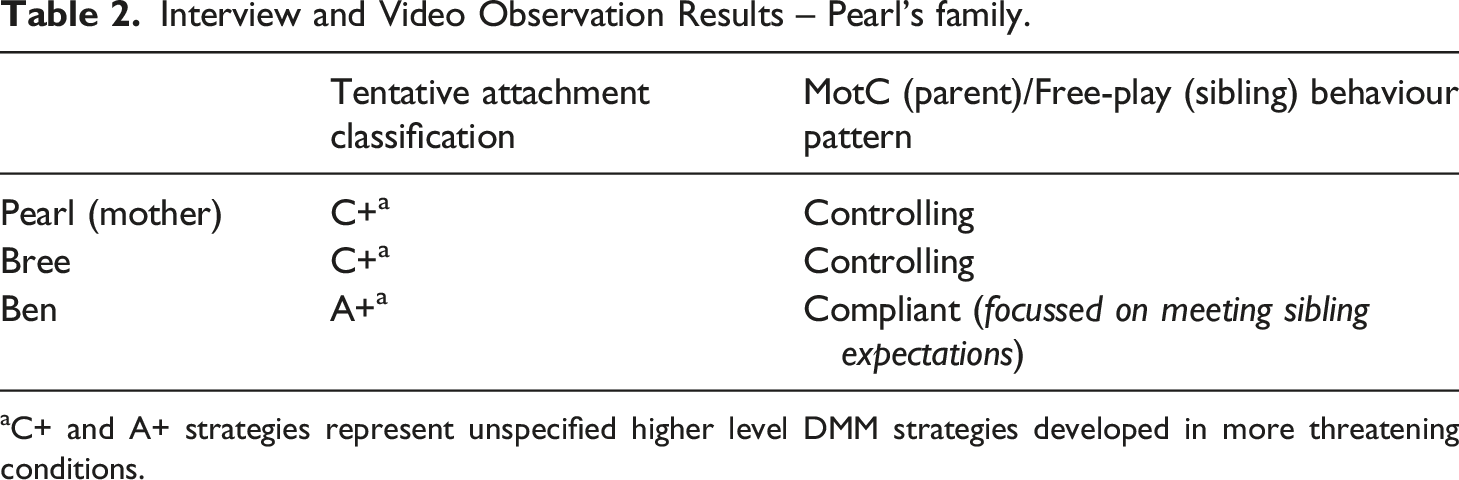
aC+ and A+ strategies represent unspecified higher level DMM strategies developed in more threatening conditions.
Relational synchrony/risk results from MotC and sibling CARE-index.

Family formulation
Pearl was judged to be using a C strategy, which suggests she prioritises affective information about how she feels when trying to predict danger and ensure safety for herself and for her offspring. Our classification would indicate that Pearl may have experienced others as unpredictable, and even deceptive; she cannot know for certain how key figures in her life will respond to her bids for nurture or protection. Trying to ‘work out’ from external signals, what will make her safe has failed her. This would imply that Pearl relies on her own internal signals of fear, anger, and distress, amplifying them in her relationships to make them more predictable and her world safer.
Our analysis of her caregiving discourse suggests Pearl carries this into her caregiving and may be experienced by her children as intrusive, or even controlling. From Pearl’s point of view however, feeling unable to predict or rely on others, hers is a parent-led caregiving strategy, where she needs to make sure that the children do not stray too far from her in terms of their separation and individuation, such that she would be unable to adequately protect them.
The problem with this pattern of what George and Solomon (2008) called ‘close protection’ is that the child is left either to fall in with the parents and comply, losing a sense of themselves in the process, or fight off their parent to maintain a sense of their own identity. Bree, in our view, appeared to respond by engaging her mother in a struggle, using both coy and angry displays to keep Pearl attentive, essentially fighting fire with fire, using a similar affective based (C) strategy to her mother.
In contrast, we judged Ben to be taking the alternative route of trying to fall in with what is expected of him. He was seen as doing all he could to care for his mother and do the right thing based working out his mother’s perspective, whilst inhibiting his negative affect, (and so could be termed as using an A+ attachment strategy). However, this does not always work for him, as in the MotC and in the Sibling CARE-index, we considered that his sister and mother had expectations for him that he was developmentally unable to meet, likely contributing to his high levels of anxiety, evident in the video. For example, Pearl called Ben her ‘my little saviour’, inviting him to take a quasi-parental role (her ‘comfort’):
When he's, when any of us are emotional, he's the best cuddler like, I'll come and he'll take it (…) I'll call him my little saviour. Because he's strong. He is a strong boy. He's my little saviour. That's what I like. Yes, he’s my comfort as well.
However, when he is unable to meet this need, Pearl expresses hostility towards him, referring to him as a ‘little shit’.
In her MotC, Pearl’s view of Bree is more positive than her view of Ben. Her accounts, our analysis suggested, offered more awareness of who Bree is as an individual, and she noted her own tendency to see Bree as older than nine, but didn’t allow Ben similar leeway, judging him more harshly for any negative behaviour. This may be because Pearl is drawing on representations of men based on experiences of chronic rejection by key male figures she has depended upon in the past. Her father, brother, and ex-husband all let her down badly. Her father was unavailable to her, and as a child she was drawn into in his conflict with her mother in a triangulated fashion. Her discourse suggested that Pearl experienced her brother as the favoured baby, fuelling her sense of rejection from her parents. Echoing this prior rejection, Pearl’s ex-husband left her when she was pregnant with Ben. The combined effect of all of this, may be to make Ben inherently a more threatening figure to Pearl than Bree, because of his shared maleness and by extension his ability to reject or abandon her.
At times in her discourse around him, Ben even seems to blur as an individual with them at times and this would seem to influence Pearl’s parenting of him, although she is somewhat aware of this:
Ben reminds me of Derek the dad, when he tells me stories of what he was like as a child and my youngest brother. My baby, brother, Greg. So, when I'm angry, sometimes I shout out Greg, instead of Ben. Because it’s just like ahhh, so, that's who he reminds me of.
Pearl’s discourse suggests to us that she recruits Bree as an ally against Ben. This may serve to help her feel validated in her frustration toward Ben, and safer in regard to the threat she experiences from him, because she feels Bree is on her side. For example, in the coder’s interpretation of Pearl’s account below, Ben is assumed to be the ‘bad guy’ and Bree is allied with mum in the use of the word ‘us’:
Bree, she’ll tell, [
Here, we judged, Bree’s negative behaviour, beating up her brother, is minimised and exonerated because she was acting in a parental manner, and Ben was in the wrong.
The sibling relationship was coded as in crisis, seen in what appeared as a clear lack of empathy, lack of playful quality, and some hostility in the sibling play observed. In the video, we saw Bree derogate and hurt her brother, consistently try to win against him. Some of her behaviour could also be seen as provoking him into a collapse of his people-pleasing strategy, where his usually inhibited negative feelings suddenly emerge in an unregulated manner. For example, the following interaction excerpt, in the view of the coder, whose comments are in bold, Ben tries to cooperate, and puts on an upbeat ‘happy’ demeanour that masks signs of anxiety, until it all gets too much, and he breaks up the game:
‘Take a card pick it up’ he says, in sing song voice [
By allying with her mother’s negative view of Ben, Bree is likely to find Pearl more available to her, as they connect in negativity towards Ben. This may be one reason Pearl showed more sensitivity toward Bree in our analysis of her parenting interview.
Case summary
In the free play we observed, supported by our analysis of Pearl’s caregiving discourse, differences in Pearl’s view of her children seem to shape the sibling relationship through creating competition and triangulation. Where Bree, who can be seen as the favoured child, takes her mother’s negative view of Ben and gains care and attention for herself through allying with her mother. Pearl is enabled to validate her negative view of Ben through bringing Bree onto her side. Ben is attempting to minimise rejection through conformity and compliance to both of them, but at the moment the strategy does not seem working for him, at least on the basis of what we observed. Under presume from both his mother and his sister, Ben was seen as losing his ability to manage his difficult feelings, which become temporarily disruptive, thereby confirming the negative views that his mother and sister hold about him.
Jessie’s family
Jessie’s family consists of Jessie (Mum), Betty (7), and Sophie (4). Jessie is married to her children’s father, and he lives with them.
Assessment results
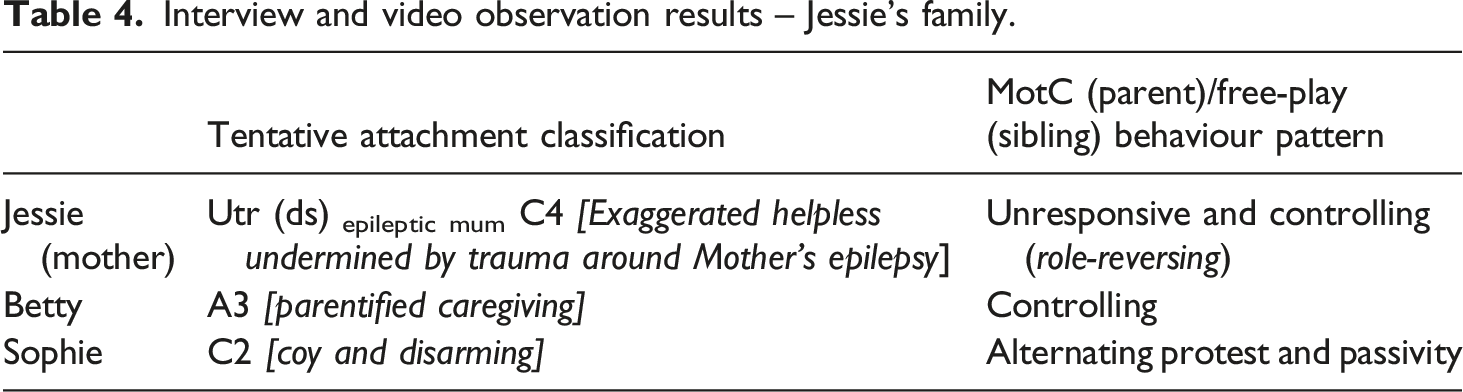
Relational synchrony/risk from the MotC and sibling CARE-index.

Family formulation
In childhood, Jessie had to work very hard to be seen, and she received little comfort or protection. Her mother had epilepsy and Jessie had to care for her during and after seizures, when she was in an altered mental state. Her discourse discussing this topic suggests this is trauma that continues to have an impact on her relationships, despite efforts to put it behind her. In her youth, Jessie started self-harming and restrictive eating, which likely functioned to highlight her own needs which may have otherwise been overlooked. As an adult, Jessie continues to elicit care and attention through her illnesses and difficulties. To some extent, this also informs her perceptions of her children. Jessie idealises their care-giving qualities, but finds their demands on her very draining, and so rejects with anger their signals of need and vulnerability:
It’s not so bad, when you are having a mother-shit day, but when you feel like ‘I’m on it right now’: I bought them apple juice, I’ve got the crisps, I’ve got the fucking meatloaf and I was like ‘I’m totally trying my best here’ uhm, and, like, and it somehow makes it worse because I was thinking well, it’s really good for them to go and play together, you know, and, like, and I want them to, not always want to come to me like, without ‘Mommy you can sort it out?’, so it all kind of makes it worse, because you are like ‘Fucking hell, if I hadn’t been trying right now, trying right now, I would have been like, okay!’
Jessie seems to have a representation of her ideal child who is a ‘strong independent woman’, ‘thinks for themselves’, and so needs her parents less. Her children and the demands they place on her may remind her of her childhood trauma of caring for her ill mother, thus at times making caring for her children feel threatening to her. Our analysis would suggest, that when she feels threatened, her attachment response is to make herself appear more vulnerable, so others protect her, which may include her children at such times, belittling somewhat their need of her.
This representation of the child she wants appears to shape Jessie’s perception of her children and her interactions with them. She loves that Sophie expresses her anger and is fierce, but is dismissive of Betty’s empathy and sadness, which is seen as a weakness:
She (Sophie) is fierce is what she is, (…) She’s really, uhm, independent. She’s very, uhm, very different to Betty, Betty is very… if Betty upsets somebody (…). Betty gets very, very anxious and she’s really worried about that. Sophie, if you say, ‘You’ve upset your sister, your sister’s getting upset, you know, perhaps you should apologize’ she just goes like ‘N-yea’. She’s like ‘Oh, well, I pissed her off, she would have to deal with it’.
We saw Sophie as using a C strategy, organising her behaviour around her own feelings. This enables her to be the ‘fierce’ daughter her mother desires, as she displays her anger, mollified by ‘cute’ disarming behaviour, mollifying her mother should she feel unable to cope. We judged Betty to be using a role-reversed (A3) strategy. This suggests that she inhibits what she wants and feels to please her mother or ease things for her, so that her mother can be more available to her. This caregiving role may have been influenced by Betty’s difficult birth and Jessie’s experience of post-partum depression.
Jessie adopts a predominantly child-led parenting stance, in offering perceptions of her children that justify a ‘don’t interfere’ approach. Jessie did not need to protect Betty because Sophie was able to:
A boy got one of his swords then like, poked Betty, (…) I was like, ‘oh God, I better go and do…’ you know? No, no, no, I didn’t even need to do anything because Sophie was there with her rubber sword going ‘Don’t poke my sister with that!’ (laughs) and threatening him. And I was like, ‘Good God, girl you are…’ (…) she’s got bubbles, she’s really a feisty little beastie really, and that’s what I love.
At other times, this interaction was judged by us as possessing a role-reversed quality, as Mum avoids angering Sophie because Betty adopts a seemingly parental peacekeeping role:
Sophie wanted a yoghurt … one flavour was Betty’s favourite, and Betty was like, uhm… l was like was saying to Sophie, well, like ‘it’s not fair because if you take that one, that’s Betty’s favourite - whereas you like both of them’… I just remembered that I couldn’t screw it up, because she started to scream, and Betty was like, ‘oh, it’s okay, I like the other one as well’. So, I was like, ‘okay thanks!’
Jessie’s view of her children seems to shape the roles that they play in their relationship with each other. In the play video, Betty’s behaviour towards Sophie was seen as controlling in nature, in effect acting as a bossy parent. She echoed her mother’s commands to Sophie when Sophie did not listen. Mum did not reinforce her words, and these kinds of inconsistencies towards Sophie may contribute to what we saw as Sophie’s more affectively led attachment pattern, relying on her own internal feelings rather than external adult pronouncements as a guide to staying safe. Although Jessie’s role as camera-person may exaggerate this, the fact that Betty so quickly steps in to compensate suggests a habitual pattern of family interaction: ‘Yeah, so I’m your baby!’. ‘Mmhm’ says Betty, wrapping her arm around Sophie, who munches her bread audibly like a baby. ‘Look you can be my pet!’ says Betty
Betty’s focus on keeping the peace likely contributes to her sensitive behaviour with her sister and their reasonable dyadic synchrony. In this analysis, Betty needs to be somewhat responsive to Sophie to ensure a smooth dynamic that will please her mother. Sophie is somewhat cooperative with Betty to maintain her attention and care. The mutual support available in the sibling relationship facilitates the children making less demands of their mother, enabling her to function better, but the system overly depends on Betty’s inhibition of her need for comfort and support.
Case summary
We suggest that Sophie fulfils Jessie’s representation of the ‘ideal’ child she wishes that she could have been in childhood. In Contrast, Betty is representative of the empathetic qualities that Jessie fears due to their association with her childhood caregiving trauma which she has linked to her mental health challenges. These views contribute to Jessie treating her children differently, which impacts dynamics within the sibling relationship: Betty takes on the role of mediator and mother’s helper to ease her mother’s struggle with parenting and make space for her mother to be psychologically available to her. A risk in this dynamic is that Betty will internalise her mother’s tendency to favour Sophie, believing she is not as worthy of her mother’s favour.
June’s family
June’s family is made up of June (mum), Sadie (9), and Tim (7). June separated from the children’s father, David, in the last year. Tim and Sadie live with June and see David regularly. June’s family has lived in the UK for 4 years, having immigrated from Australia.
Assessment results
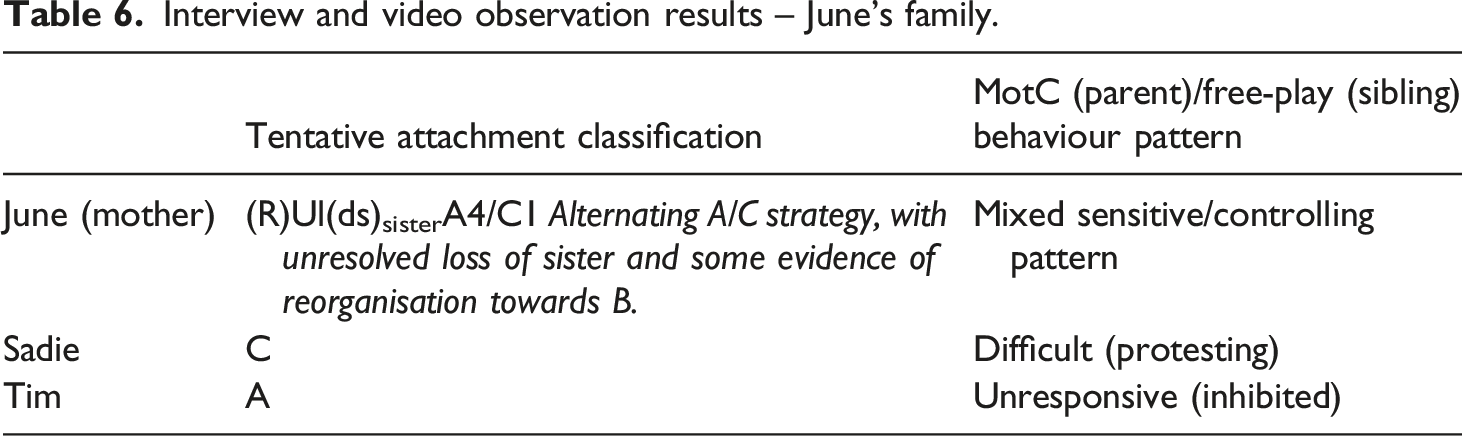
Relational synchrony/risk results from MotC and sibling CARE-index.

Family formulation
June experienced her parents as inconsistently demanding and distanced. She responded by alternatingly striving to meet their expectations, with periodic displays of anger in order to establish and maintain their attention. June worked on processing her childhood experiences in therapy but continues to be troubled by the loss of her older sister who cared for her during her childhood, which she tries unsuccessfully to ‘shelve’; put behind her. This may be linked with June’s fear of abandonment which, our analysis suggests, she projects onto her children, albeit with some awareness: I feel their levels of anxiety quite as being quite high. And therefore, I would imagine it’s, you know, ‘what could mum do to to make this go away? Would she up and leave?’ (…) that’s something that I’m aware of in myself. That was, I definitely have sort of um, abandonment, fears, and so on.(…) I would imagine that that’s something that they would possibly consider as well. Whether or not that’s true, or my projection, I don’t know.
June understands her children well, but experiences some frustration that the children are not meeting her expectations, and need to keep them close. In our view, neediness was more apparent in her relationship with Tim, whereas frustration was more obvious with Sadie, which could explain differences in the children’s strategies. The likely consequence of this would be that June’s need of Tim has resulted in him inhibiting his own desire for comfort to ensure hers is met. Sadie by contrast appears to be engaging in a characteristic C strategy struggle to ensure her feelings are seen and attended to and not submerged beneath her mother’s expectations.
Sadie seems to remind June of her mother who could be judgemental and controlling, and she describes Sadie as ‘mean’; making her feel manipulated, and so more reactive towards Sadie. June feels guilty about these reactions and tries, in our view, to give Sadie what she wants to compensate. Such inconsistency may perpetuate the struggle with Sadie, reinforcing her C strategy.
June’s ex-husband was intermittently absent throughout their relationship as his career required frequent travel. This may have contributed to June’s view of Tim as a peacemaker, fixer, and reliance on him as the ‘man’ of the house where he will ‘negotiate peace’ between her and Sadie. Our analysis would suggest that June’s somewhat role-reversed view of Tim has led him to be more mature or ‘adult’ like in his relationship with his sister. However, we did not see him adopting a caregiving role, perhaps because June is responsive enough to both Tim and Sadie to make this less necessary than in Jessie’s family. In the play video, Tim appeared reserved and logical in his interaction with his sister. He attempted to set clear boundaries with her. She responded with coercive behaviour alternating intrusive, coy, and angry displays towards him until he withdrew from the interaction, leaving her to play alone for the remainder of the video.
For this reason, we considered that the nature of this interaction was best captured by assigning Tim the ‘parental’ unresponsive pattern, and Sadie the reactive ‘child’ pattern of difficult/protesting, despite Tim being the younger child. This pattern seems common as June described a similar incident in her interview, where Sadie sought to cajole Tim into helping her:
She wasn’t asking for his help. She was telling him to help her. Um. And he was saying no, and I’m not sure why. Because I, I, maybe because the way she was asking, she was being really bossy and a bit mean, and saying, ‘You must help me, you must help me’ otherwise you won’t, you know, ‘I won’t give you a sweet’ or whatever she was, I don't know what she was saying. And he just walked away, and said I’m not helping you, and she got really angry.
June described being inconsistent and at times passive with her children, stating that she does not like to get involved in their conflicts. This may have contributed to the children’s difficulty in resolving their conflicts, evident in the video, which contributed to their lower dyadic synchrony. Mum’s view of Tim as a tender protector may be accurate from her perspective, and perhaps with Sadie in other contexts, but it does not mean that he has the necessary tools to resolve conflict with Sadie. In our view, Sadie uses an affective C pattern to ensure she remains visible to her mother, and her mother available to her. This would likely prompt her to engage Tim also in a struggle, but both the video and June’s examples would suggest that Sadie pushes too far, frustrating him to the point where he retreats, likely in order to inhibit his negative feelings. Thus, her strategy may make things better with Mum, but elicits annoyance and irritation in Tim. Sadie was left alone and sad at the end of the video, singing very loudly as if trying to call someone back to her.
Other systemic issues may contribute to a sibling relationship that seems poorer than one might expect from their mother’s sensitivity. They emigrated twice during the children’s early childhood; and there was conflict between the parents, both rendering the parents unable to give space to scaffold the children’s communication and cooperation with each other. There was a significant amount of arguing in the home prior to the parent’s separation the previous year, which seems to be echoed in the siblings’ current difficulty in managing conflict.
Case summary
June’s preoccupation with abandonment may be contributing to the mildly anxious pattern of parenting we observed. In our judgement, Tim is better able to reassure her than Sadie, having organised an A strategy in which he minimises his own needs and is available to assist his mother in her conflicts with his sister. Sadie elicits in June feelings of being controlled, reminding her of her mother. She is reactive to Sadie when triggered but then feels guilty and tries to compensate by giving Sadie what she wants, helping perpetuate the cycle. Sadie handles Tim similarly, but as he is not her attachment figure her behaviour is intrusive and annoying to the extent that he retreats and separates from her as their parents have separated.
Cross-case analysis and discussion
This study had no sibling pairs who shared a common pattern of attachment in line with prior research indicating that sibling groups are unlikely to share attachment strategies when they are not exposed to high levels of danger (Kozlowska and Elliott, 2017; Farnfield, 2017) or conversely, safety and security (Kriss et al., 2014). Kriss et al. (2014) suggested that siblings with discordant attachment patterns were more likely to have competitive or hostile relationships with each other, as we saw also in this study, because they didn’t see themselves reflected in their sibling(s) or share an understanding of their environment. These differences in attachment strategies could, in our study, be explained by mother’s differential representations of their children, giving each child a different threat or challenge to organise around.
However, our findings suggest a more complex picture, as although differential treatment was observed in all cases; siblings in Pearl and June’s family had more conflictual relationships than in Jessie’s, where the sibling relationships appeared to be compensating for that was missing from the parent–child relationship. This suggests that it is important to look at not just the presence of preferential treatment or differing attachment strategy, but what the meaning of this is for each sibling and their parents, and the responses each of them are organising around this.
In each family, we found differential treatment of siblings shaped by the mother’s representations of threat, as developed in their respective childhoods. One child was viewed as more of a threat to the mother and spoken of more negatively. It is notable that Pearl and Jessie shared an attachment pattern with the child that they viewed more positively. This leads to the question of whether having a shared attachment strategy with their child can help the parent understand their child, mentalise for them, and provide more sensitive caregiving for them.
The mother’s relationship with the child was associated with more threatening childhood attachment representations, resulting in conflict with the child that spilled over into the sibling relationship. This was true in Pearl and June’s families. In Pearl’s family, Ben was associated with a negative representation of rejection, and his sibling joined in with his mother’s hostility towards him. In June’s family, Sadie reminded her mother, June, of being controlled by her own mother in childhood, which seemed to be the cause of more conflict between them. In both cases, the siblings had conflicts that were not resolved in the play videos. This aligns with the research that has found children’s perceptions of differences in maternal warmth and amount of conflict with their mother have been linked to higher levels of sibling antagonism and conflict (Shanahan et al., 2008).
Pearl and June were single mothers, and both reported conflict between themselves and their children’s father. In June’s case, the separation was relatively recent. Less supportive and more conflictual co-parenting relationships have been associated with less sibling warmth and more sibling conflict (Volling et al., 2002; Poortman and Voorpostel, 2009). The siblings in both these families had conflictual relationships. Blanket generalisations from this would be inappropriate, except to emphasise the importance of examining the broader family system and level of support when investigating the functioning of the sibling subsystem, even beyond the triadic focus of our current study.
Study limitations
This study is limited in its systemic information by the lack of data from fathers, who were only included indirectly through the analysis of the mother’s discourse about them. Also significant was the lack of formal attachment assessments of either parent or child, using instead dyadic, relational procedures. This gave us more information on interactional processes between the parents and the children, and between siblings, but offered less reliable information on child attachment. Additionally, a short play-based assessment could not be said to capture every aspect of the sibling relationship, and our inferences from this may not tell the whole story.
Surprisingly, the mothers we studied all used A+ or C+ strategies, DMM strategies associated with higher levels of danger, and two of the mothers had markers for unresolved trauma/loss. This is consistent with research indicating high amount of attachment insecurity in normative populations (Baldoni et al., 2018). However, sibling relationships may be more positive and cooperative in families where parents have experienced less trauma and have more reflective functioning abilities. As with all case study research, theory must be treated with caution, bound up in some degree bound by its locality, and needs to be researched and developed in new and different contexts.
Conclusion
This study utilised an innovative qualitative approach to examine how the parent–child relationship impacts on the sibling relationship. Our analysis suggested that key aspects of the sibling relationships we observed appeared to serve a function for the child in their relationship with their mother (the parent we studied). These challenges had origins in the mother’s own childhood experience, where the child represented a specific threat or challenge to the mother that their early and more recent history had made them sensitive to. This may suggest that linear models of the ‘transmission’ of attachment (Van IJzendoorn, 1995), focussing exclusively on associations between parent and child attachment patterns, and abstracted mediating factors, may neglect the way in which specific representations of attachment may exert powerful systemic influences. The dynamics of one relationship can serve to ‘shore up’ issues or imbalances in another. Attachment strategies are inextricably bound up with the context in which they emerge (Baim et al., 2022), and static models of the relationship between child and adult attachment can miss how different aspects of a family system, social context, and personal history can interact with one another in clinically relevant ways.
For example, problems in the sibling relationship may be the price paid by children to make their relationship with their mother, which they depend on for survival, more manageable (as in Pearl and June’s families), or conversely the sibling relationship may be recruited to compensate for what might be lacking in the child–parent relationship (as appears to be the case in Jessie’s family). We would argue that our study demonstrated the value of taking a case-related approach, as the importance of specific, local, threats in the parents’ or family history, in shaping the nature of the sibling relations, can easily be missed in group-based research dealing with the relation between generalised, impersonal variables. This can lead to an impoverished understanding of the systemic nature of family difficulties.
Footnotes
Declaration of conflicting interests
The author(s) declared no potential conflicts of interest with respect to the research, authorship, and/or publication of this article.
Funding
The author(s) received no financial support for the research, authorship, and/or publication of this article.