




Abstract
The study explores fathers’ caregiving experiences and roles during the COVID-19 pandemic, as well as felt impacts of restrictions on the father-child relationship, using the Dynamic-Maturational Model of Attachment and Adaptation (DMM). Six fathers were interviewed using the Meaning of the Child (MotC), and an attachment theory informed Thematic Analysis (TA) established three main themes: ‘Threatening proximity’, ‘Absent fathering’, and ‘Confused need and anger’. During lockdown restrictions, many participants perceived the higher-than-usual proximity and intensity of family relationships as threatening to themselves and their children. For most of the fathers interviewed, this encouraged a passive fathering stance, centred around the idealisation of independence and emotional and relational absence. Most fathers also felt their own needs conflicted with their childrens’, leading to increased anger in the relationship, which tended to be feared and distanced from, or experienced as residing only in the child. Several fathers shared unresolved childhood experiences around their own fathers’ confusing anger which still informed their mental processing. The overall sense of feeling ‘trapped with [their] children’, and the resulting experience of retreating from the inter-personal space and active fathering role, made it more of a struggle for these fathers to focus on providing protection and comfort to their children (and partners) in the context of a life-threatening, global pandemic. Whilst this study focussed on a general population, implications for clinical contexts are discussed.
Keywords
Introduction
‘More than 150 years after the Industrial Revolution had removed most fathers from their homes for the working day, fathers – in their millions – were coming home’ (Burgess and Goldman, 2021a, p. 2). The ‘new fatherhood’ (Gregory and Milner, 2011) is a global phenomenon, with more fathers than ever involved in early caregiving (Ahnert and Schoppe-Sullivan, 2020). The recent COVID-19 pandemic amplified this trend in the UK, especially during the early stages of far-reaching social distancing measures such as ‘lockdowns’, during which fathers dedicated almost twice as much time per day to child-care, reaching an all-time eight daily hours’ average (Andrew et al., 2020). Suddenly, fathers were closer than ever to their children, at least physically. But how were father-child relationships impacted by such a sudden increase in proximity? Were fathers able to provide protection and comfort for their children in the face of the uncertainties and unpredictable dangers posed by a global pandemic? And did fathers’ caregiving increase or reduce the impact of the pandemic on their children’s wellbeing? In seeking answers using attachment theory, the present study addresses several research gaps, both in fathers’ caregiving representations more generally, and in the context of the pandemic.
John Bowlby (2005) envisaged the existence of two intertwined systems crucial to attachment and human survival: The child’s need to seek comfort and proximity (attachment system), and the parent’s corresponding drive to provide comfort and protection (caregiving system). Perhaps as a result, there has been a trend in the literature to over-focus on the ‘security’ of the parent-child relationship, rather than the environmental conditions that may or may not support the relationship, something that Bowlby was very aware of (Duschinsky 2020). Given the need to look at the impact of a worldwide and sudden change to the environmental context of parent-child relationships, the present study makes use of the focus of the Dynamic-Maturational Model of Attachment and Adaptation (DMM: Crittenden, 2016) on individual, dyadic and systemic adaptation to environmental and relational dangers. This approach allows us to examine how fathers and their children adapted to the environmental context of a threatening global pandemic, and how their relationships were impacted by it. Even ‘insecure’ attachment can be seen as an accommodation or a compromise made with real or perceived dangers – a self-protective, and even a child-protective strategy to manage dangers. This approach has real potential to shed light on the ways fathers’ caregiving experiences were shaped by both the dangers and the sense of threat created by the world-wide pandemic.
The caregiving ‘Gender Bias’
‘Well, a child doesn’t need two mothers’ (attributed to Bowlby in Newland and Coyl, 2010, p. 27). Bowlby’s intense focus on mothers, at least in his most public-facing work, could be seen as undermining the role of fathers to the detriment of understanding their role, as well as diverse family structures more generally. Particularly Bowlby’s use of the term ‘monotropy’ as ‘the bias of a child to attach himself especially to one figure’ (quoted in Duschinsky, 2020, p. 22) supported the notion of fathers as secondary in importance to mothers, and sparked controversy and misunderstanding amongst attachment theorists. In parallel with theoretical developments, research into fathers’ attachment ‘progressed only in fits and starts’ (Bretherton, 2010, p. 11), a development which is rooted in the exclusion of fathers in Ainsworth’s initial infant studies using the Strange Situation Procedure (SSP: Ainsworth et al., 1978). It took about 30 years after the establishment of attachment theory, however, until sufficient evidence in favour of infant-father attachment allowed researchers to start and fill the gaps in how fathers impact their children’s psychosocial development (Grossmann et al., 2002).
Apart from fathers’ simple exclusion in research, a major obstacle to their recognition was due to research findings based on the SSP and AAI which operate with the construct of parental sensitivity, itself based upon maternal caregiving. Lucassen and colleagues (2011) found a reliable, but significantly weaker association between fathers’ sensitivity and security of infant-father attachment as is commonly evident for mothers. This is unsurprising, as the very concept of sensitivity was based on the SSP procedure, which was ‘developed and validated on mothers and their infants’ (Steele et al., 1996, p. 552) alone. This contributed to a ‘sensitivity bias’, presenting fathers as less sensitive and relevant to attachment and child development.
Particularly longitudinal research (e.g. Grossmann et al., 2008) started addressing the issues around such a ‘sensitivity bias’. For instance, a recent study found no gender differences in the ways ‘insecure’ pre-school attachment to each parent predicted the development of externalizing behaviour in both boys and girls (Deneault et al., 2022). Such findings question the sole focus on parental sensitivity and lead to the hypothesis that different factors apply to paternal caregiving. For instance, when measuring sensitivity in play and fathers’ role as a secure base from which the child can safely explore its environment and seek challenges, their impact may be greater than mothers’ (Grossmann and Grossmann, 2020). There is also evidence suggesting that parental sensitivity towards infants depends more on the individual context of the interaction rather than the gender of the caregiver, with natural contexts such as routine caregiving and free play associated with higher levels of sensitivity in either parent (Branger et al., 2019). Frequently, findings supporting fathers’ relevance share a wider definition of father-child attachment beyond sensitivity, attending to factors like pleasure in parenting (Aytuglu and Brown, 2022), or mentalizing capacities (Bakel and Hall, 2020), the ability to understand child behaviour in terms of underlying mental states.
Fathering during the COVID-19 pandemic
The recent COVID-19 pandemic and resulting restrictions such as nationwide ‘lockdowns’ have drastically altered our daily lives for an extended period of time, with unprecedented longer-term impacts on father-child relationships. Nevertheless, in a representative survey, 65% of UK fathers reported short-term improvements in both their relationships with their children and felt competence as parents following confinement (Burgess and Goldman, 2021b). This contrasts with early research findings suggesting fathers’ mental health and perceived stress levels during lockdown were reflected in their relationships with their children, and more so than those of mothers (Russell et al., 2020).
There is little evidence to date about attachment and caregiving representations during the pandemic. Lucassen and colleagues (2021) found that heightened stress levels due to the pandemic were associated with an increase in ‘coercive’ parenting of pre-schoolers, to the same extent for fathers as well as mothers. Along the same lines, Taubman – Ben-Ari and Ben-Yaakov (2020) found both parents experienced the same distress levels around raising an infant at the time, whereas ‘attachment avoidance and anxiety’ were associated with increased apprehension regarding the pandemic. Although this relation was somewhat weaker in fathers, they were under-represented in this convenience sample of the Israeli population. Meanwhile, Liang and colleagues (2021), using similar measures, identified parental attachment patterns as a risk or resilience factor for parents’ emotional regulation, which was felt by their children during the pandemic. Similarly, a Canadian study found parental depression correlated with lower parent-child attachment security as well as internalizing behaviour on behalf of their children (Dubois-Comtois et al., 2021). However, fathers were under-represented in the latter two studies which included no more than about 10% male participants within their samples. Current quantitative findings therefore established a gender gap in parallel to the wider research landscape.
None of the above research projects included qualitative methods. O’Sullivan and colleagues (2021), however, employed interviews to explore in-depth the impacts of the pandemic on 48 families, interviewing both parents and their children, though only six participants were fathers. The authors found children displayed increased attachment behaviours such as demanding more attention, and ‘negative behavioural changes’ like reverting to bedwetting or ‘clinginess’ during the pandemic. Lastly, Muzi and colleagues (2021) found evidence for the stability of internal representations of attachment by comparing adolescents’ attachment representations with pre-pandemic data, with no significant changes in insecurity/security in this period. However, they did not assess caregiving and included a majority of girls in their group of participants.
An expected side-effect of the pandemic and resulting restrictions was the (temporary) altering of caregiving roles in modern-day families. Evidence suggests a decrease in working hours in mothers of small children four- to five-fold in comparison to fathers during the early stages of nationwide lockdowns in the US. This development contributed to a growth in the gender labour gap of up to 50% (Collins et al., 2020) which is somewhat reflected in attitudes about parenting roles between March 2019 and August 2020 (Mize et al., 2021), indicating an overall reversal of gender equality. In contrast, a UK survey found fathers experienced benefits due to increased homeworking, the ability to work more flexibly, and spending more time with their children (Chung et al., 2020). However, pre-pandemic evidence indicates fathers’ sensitivity towards their children may be lowered, and anger and frustration heightened if they feel obligated to dedicate more time to childcare in the early years (Brown et al., 2012). In contrast, early findings indicate that the increase in fathers’ involvement in caregiving was beneficial to the emotional wellbeing of their children (Mangiavacchi et al., 2021).
Altogether, preliminary evidence suggests both attachment and caregiving played an important role in father-child relationships during the pandemic. However, these findings are conflicting and do not contribute to an understanding of how their relationships were affected. We need to better understand not just if, but how the individual and localised caregiving context contributes to both relational opportunity and risk and the nature and role that differing parental scripts play in facilitating safety, nurture and protection (Grey 2023), within the backdrop of a worldwide pandemic. This suggests a need to look more ideographically at processes, how and why aspects of individual fathers’ lives and contexts, together with the wider context of the pandemic, combine and influence each other, moving beyond how de-contextualised factors vary in large groups (Maxwell, 2012).
Research aims
For these reasons, the present study sets out to explore the following over-arching research question: ‘How did the COVID-19 pandemic and its resulting restrictions impact fathers’ experiences and representations of caregiving?’
The analysis explores the following sub-questions: 1.) How did fathers’ experience the impacts of the pandemic and resulting restrictions, particularly during lockdown, on their relationships with their children? 2.) In what ways did fathers’ caregiving alleviate or exacerbate the impact of the pandemic on the relationships with their children?
Methods
Research design
The present study aims to explore the impact of the recent COVID-19 pandemic on father-child relationships by examining the meaning fathers attribute to their child and caregiving experiences within this extraordinary context. By employing a qualitative methodology, the present study sets out to examine the caregiving experiences of six participants, both on a group basis, using Thematic Analysis (TA: Braun and Clarke, 2023) and on an individual basis, using the Meaning of the Child (MotC) system of analysis (Grey and Farnfield, 2017a; 2017b). The MotC analyses caregiving representations with an explicitly systemic focus, examining parental discourse about the child and caregiving in the context of the family and social context in which the relationship is operating. The MotC employs attachment theory-driven discourse analysis, first developed in the Adult Attachment Interview (Crittenden and Landini, 2011; George et al., 1985), to understand how the meaning the parent gives to their caregiving is shaped by the need for self and child protection from danger (Grey, 2023). Integrating the ideographic focus of the MotC with TA’s focus on looking for patterns of meaning between participants, allows mitigation of data fragmentation, a common risk in TA. Too quick a separation of meaning from the interview and participant’s relational context can lead to a loss of information about processes; how different aspects within the interview itself, and beyond it, each participant’s history, relationships and internal life, may exert influences on other aspects in analytically and theoretically relevant ways (Maxwell, 2012).
Recruitment
A non-clinical population was recruited to explore how normative, relatively ‘safe’ fathers adapted to the sudden experience of unfamiliar dangers brought about by the pandemic. The study was advertised to German-speaking schools in the Southeast of the UK, via social media, and the professional and private networks of the lead researcher in the UK, Germany, Switzerland and South Africa. The recruitment method was chosen due to convenience as the lead researcher was employed by a German-speaking school in the UK and had a particular interest in the experiences of German-speaking fathers. Interested participants completed a short registration form collecting demographic information and details about their living situation and family constellation since the onset of the pandemic.
Participants
All participants spent the initial lockdown period (March–June 2020) in the same household with their partner and child(ren), although one participant continued working offshore on a fortnightly basis. Three participants were domiciled in the UK with their partners and child(ren) since the onset of the pandemic, two in Germany, and one in China. Following the initial lockdown, one family had moved within the UK, and another from China to the UK with the eldest child moving out of the family home after lockdown restrictions were lifted. All participants were in heterosexual relationships with their children’s biological mothers, one participant was divorced from the birth mother but they continued living in neighbouring households, co-parenting their child. All but one family had at least one parent who immigrated to the current country of residence. Five participants considered German their mother tongue, and one English. Interviews were carried out in the respective mother tongue. Three participants were employed full-time throughout the pandemic, one was retired, one had a reduced workload due to sabbatical, and one had lost his employment position at the onset of the pandemic, returned to employment 7 months later, and then was made redundant again shortly before the interview. None of the participants’ children were involved with statutory services at the time of data collection and none reported any pre-existing longer-term mental health problems or physical disabilities in their children. Except for one participant who disclosed in interview that they were receiving counselling, no participants disclosed any ongoing mental or physical health challenges in need of clinical attention.
Overall, the group of participants constitutes a non-clinical, white, middle-class population, with low levels of risk or life-threatening danger at the onset of the pandemic. The selected group is heterogeneous regarding their living situation, family constellation and ages of both children (2 to 22 years) and fathers (30 to 75 years). It is acknowledged that the vast differences in age, language and context will have impacted on the relational experience. Recruitment proved difficult, perhaps due to the stress these families were facing at this time, and the need for a tight timescale needed to ensure that the issues being studied remained live for participants. There was a need for a range of experience as well as homogeneity in those studied. The number of fathers (6) represents a balance taken between the complexity of the analysis that triangulated two analytic methods; the desire to increase the depth of the analysis by the ability to compare and contrast the situations of different participants, and the need to preserve the richness of the data with regard to the ideographic context of each participant, which could be easily lost through aggregation.
Data collection
Qualitative data were collected by the first author, using an adapted version of the established Parent Development Interview (PDI: Aber et al., 1985), which invites parents to reflect upon their child, their relationship with the child, and their experience of parenting and of being parented. The time frame was adjusted to the COVID-19 pandemic and certain questions were added to retrospectively explore any changes in the relationship since the Spring of 2020. Its original structure was maintained to assure fathers’ reflective capacities are prompted as intended by the procedure.
Interviews took place in the Spring of 2022 over Microsoft Teams, a video-conferencing software previously used in qualitative research (O’Sullivan et al., 2021). Videos were audio-recorded and transcribed verbatim. All interviews were conducted and transcribed in the participants’ mother tongue (German or English) with identifying information removed or altered.
Data analysis
All interviews were transcribed by the first author and then blind-coded in the original language by one of the co-authors, a German-speaking, trained coder in the MotC coding system. Additionally, one interview was translated from German to English and subsequently blind-coded by another co-author, a fully reliable, expert MotC coder, to integrate multiple perspectives. Findings were incorporated into a single formulation and differences resolved by discussion.
Simultaneously, the first author carried out a TA, first reading and re-reading transcripts to gain familiarisation with the material. Analysis was first done on a ‘semantic’ level, only attending to what was said (Braun and Clarke, 2023), before exploring the ‘latent’ attachment function of the discourse, taking into account the MotC coding patterns. These track whether parents use a ‘parent-led’ strategy of caregiving to ensure the child’s safety, a ‘child-led’ strategy to maximise parental functioning and resources, or have the capacity and relative safety to enable them to use both flexibly according to context in a ‘collaborative’ fashion (Grey, 2023), as well as a focus on dangers in the environment that these caregiving patterns might be organised around. In doing so, the approach was both inductive, working ‘bottom-up’ from the collected data; and theory-led, ‘reading between the lines’ to capture implicit meanings (Terry et al., 2017). This approach also enabled an attachment-focused analysis throughout and allowed consideration of how the themes interrelated.
TA was chosen due to its flexibility to include and integrate these two processes which allowed exploring both fathers’ intentions and unexpressed scripts, similar to Bond and colleagues (2020). Excepting for the integration of the MotC coding, we have broadly followed the method outlined by Braun and Clarke (2023), although we hesitate to claim the ‘reflexive TA’ label, owing to the integration of the attachment analysis which follows procedures of coding reliability and blind coding, which are standard in attachment research. This raises the concern of ‘positivistic creep’ that these authors suggest undermines the theoretical assumptions of the method. We would argue, in keeping with Maxwell (2012), that these strictures, applied only to the MotC element of the analysis, are intended to ensure ‘theoretical validity’ – fidelity to shared theoretical assumptions in the interpretation of attachment-related discourse, in order to explore the potential of the theory to make sense of the lives of participants, rather than making any claim to objectivity.
The analysis was carried out in German and selected quotes were translated verbatim at the final stages, cautiously comparing meanings. Culture-specific expressions were translated in keeping with the originally intended message and where this was not possible, transliteration was used to provide an equivalent English expression. This may have led to slight alterations in meaning, however, the extent to which the same meaning can co-exist in two different cultures is debatable, especially in qualitative research (Regmi et al., 2010).
Ethics
Ethical consent was obtained by the University of Roehampton before recruitment of participants commenced. All participants were informed about the aims of the study and data protection regulations and their consent was obtained before interview arrangements were made.
Findings
Classification of caregiving
From the perspective of the formal MotC classification of caregiving discourse, somewhat surprisingly, given the diversity of the groups studied (see above), all participants in this study were assessed as using an overall ‘unresponsive’ or ‘child-led’ (child-independence promoting) MotC pattern (Grey 2023). This emotionally disconnecting defensive pattern was evident in all interviews, for example, through the absence of sensory-derived ‘images’ in the memories related, the use of technical language and stereotyped, and somewhat ‘concrete’ descriptions of their children. All of these are interpreted in the MotC as functioning to put some distance between the self and the emotional impact of parenting. Participants also struggled to mentalize for their child(ren). Two participants additionally demonstrated some ‘controlling’, or ‘parent-led’ elements, which in these cases indicated frustrations with their children breaking through a defensive ‘wall’ of emotional distance. At the same time, it must be emphasised that there were also indicators of sensitivity – love, commitment and moments of connection. Even the defensive patterns are better seen as a contextual compromises with stressful conditions, motivated by a desire to protect the child from feeling the difficult things that the parents were struggling with (Grey 2023), as became apparent in the wider TA.
Thematic Analysis – summary
Table of themes.
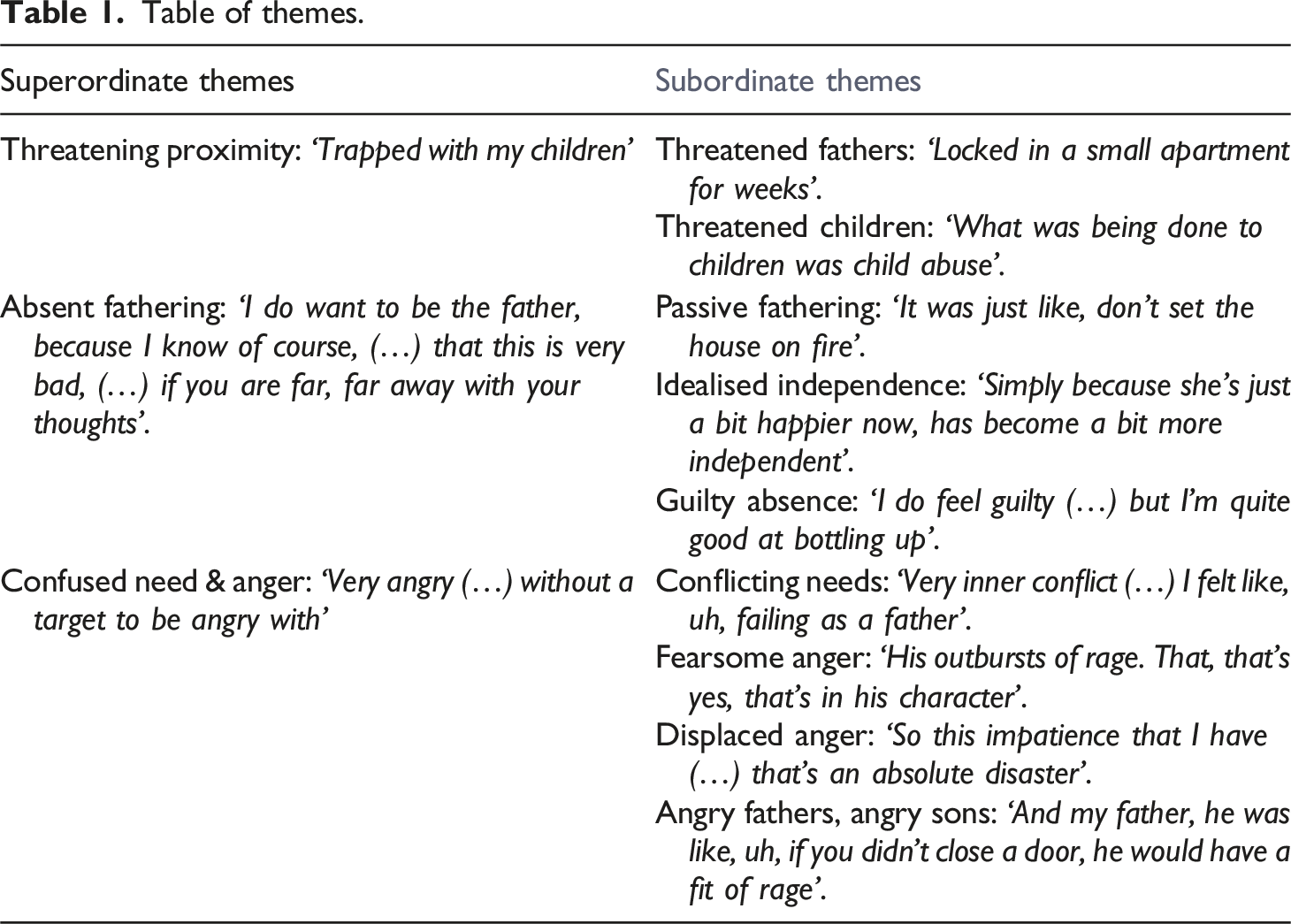
Theme 1 – threatening proximity: ‘Trapped with my children’
Threat or danger in the DMM involves relational and social danger as human beings depend on social cooperation for their survival (Crittenden, 2016). In this sense, all fathers experienced higher levels of environmental threat to themselves and/or their families, which often seemed to be related to, or even exacerbated by, the closer-than-usual proximity due to protective measures. Many fathers adopted distancing coping strategies, trying to reduce the emotional impact of the increased threat both on themselves and their families.
Threatened fathers: ‘Locked in a small apartment for weeks’
Most participants experienced the sudden increase in proximity and intensity in their relationships with their children as challenging if not threatening to themselves. In feeling ‘trapped’ with Lorenz (age four) and Daniel (age two), and equalising this experience with the virus ‘kill[ing] a load of old people’, I've had a lovely time being with my children, but, yes, it's been, it's been trapped with my children, rather than just having a lovely time with my children (...). And I think trapped is right, because, erm (5 seconds pause, deep breath…) because basically Covid should have been allowed to run free and kill a load of old people (laugh).
Similarly,
And
Threatened children: ‘What was being done to children was child abuse’
Most participants noticed the risks to their children’s wellbeing closely while being confined to their homes and families.
Similarly,
The increased proximity intensified
Theme 2 – absent fathering: ‘I do want to be the father, because I know of course, (…) that this is very bad, (…) if you are far, far away with your thoughts’
Fathering in the context of the pandemic was characterised by passivity and reactivity, with most participants distancing themselves from their children and affective aspects of caregiving. In seeking an idealised notion of independence in their relationships and children, fathers justified their mental unavailability, which often caused them to feel guilty.
Passive fathering: ‘It was just like, don’t set the house on fire’
Most fathers demonstrated a rather passive, reactive role in parenting their child(ren), stepping away from the child and caring responsibilities.
Also,
In contrast,
Idealised independence: ‘Simply because she’s just a bit happier now, has become a bit more independent’
Perhaps in an attempt to justify their passivity, several participants encouraged and idealised their child(ren)’s independence, distancing themselves from difficult emotions triggered by the child’s needs and caregiving responsibilities in the context of the pandemic.
Contrarily to most participants,
Guilty absence: ‘I do feel guilty (…) but I’m quite good at bottling up’
Several fathers realised to an extent how their passivity and idealisation made them psychologically absent. This often led to feelings of guilt towards their children, which were then avoided in turn.
Similarly,
Finally,
Theme 3 – confused need and anger: ‘Very angry (…) without a target to be angry with’
Most fathers felt their own needs conflicted with those of their children. Often as a result, they experienced increasing anger in themselves and/or their children, which was either dismissed in a distancing way, as if participants feared it, or displaced onto the child. In some cases, participants recounted childhood experiences characterised by unresolved anger on the part of their own fathers.
Conflicting needs: ‘Very inner conflict (…) I felt like, uh, failing as a father’
Most fathers felt their own needs were neglected or even threatened by the experience of caring for, and meeting the needs of, their children and/or partners during the pandemic.
Similarly,
And finally, I was almost catatonic in the, corridor (…) And the, the feeling of, the two kids crawling over me, err in the corridor was...I couldn't believe that I've reached this point in life. Having done my best by other people as often as I could, to be treated like this.
Fearsome anger: ‘His outbursts of rage. That, that’s yes, that’s in his character’
Alongside unmet and conflicting needs, most participants experienced increasing anger in their child(ren) and/or themselves. A frequent way of managing the emotion was to dismiss it, de-personalise it or locate it firmly within the child, as if participants feared their child’s anger, if not the child itself.
And some days Kevin decides, to constantly wet himself, or to just pull down his pants and urinate somewhere on the floor, something like that, and those are moments, when I just, um.. notice that anger arises in me, because I don't understand, why he's doing it.
Conversely,
Displaced anger: ‘So this impatience that I have (…) that’s an absolute disaster’
As a result of the ‘threatening proximity’ and/or their ‘conflicting needs’, several fathers experienced a displacement of their anger onto their child(ren).
Angry fathers, angry sons: ‘And my father, he was like, uh, if you didn't close a door, he would have a fit of rage’
Several fathers reported early experiences with their own fathers’ aggression, anger, or even physical punishment, which informed their mental processing around anger. None of them were able to fully integrate this confusing information with their current caregiving, somewhat hindering the implementation of intentions to be different as a parent themselves.
Discussion
The present study sought to explore how the COVID-19 pandemic and its resulting restrictions impacted on father’s experiences and representations of caregiving.
In regards to the first research sub-question, participants described a range of experiences indicating their relationships were heavily impacted by the pandemic. The theme ‘Threatening proximity’ indicated that all participants perceived increased levels of environmental threat or danger both to themselves and their families in the context of lockdown restrictions. The closer than usual proximity made several fathers feel ‘trapped’ or ‘locked in’. Participants felt challenged if not threatened by the situation they found themselves in, as their children challenged their trust in new, unfamiliar ways. The unusual intensity of relationships within the family led many participants to perceive risks to their children’s wellbeing more closely as well. These findings are in line with Roos and colleagues’ (2021, p. 11) theme of ‘Too much time together’, which similarly identified the increased intensity and proximity as problematic for parents, with less time available for the marital relationship.
Fathers adopted distancing coping strategies to reduce the emotional impact of the ‘Threatening proximity’, which was evident in the theme ‘Absent fathering’. As they were confronted with a sudden increase in proximity and intensity of relationships due to protective (lockdown) measures, participants responded with passivity, distancing themselves from their child(ren) and affective aspects of caregiving.
A particularly challenging aspect of caregiving during the pandemic was around balancing fathers’ own needs with those of their children. The theme ‘Confused need and anger’ demonstrated participants’ feelings of coming last, which often led to increased anger, both in fathers and their children. This put strains on their relationships, especially when the child’s affect was feared and disregarded, or fathers displaced their anger onto the child. This closely mirrored Barrow and colleagues’ (2022) findings with adoptive fathers who both impersonalised and distanced themselves from feelings of anger and frustration, whilst still experiencing relational ruptures. As with this group, indications of childhood trauma were found in several fathers’ accounts, which was elicited by the sense of threat arising from the pandemic, exacerbating ruptures in the parent-child relationships. Despite conscious intentions to parent differently from their own experience of being parented, these can collapse due to experiences of high emotional arousal and danger (Dallos, 2019), which was particularly the case around anger, aggression and violence, as described in the sub-theme ‘Angry fathers, angry sons’. Parents’ explicit positive intentions about being more involved and parenting less passively were frequently over-ridden under pressure.
In response to the second research sub-question, it appears that father’s caregiving might have exacerbated the impact of the pandemic on the relationships with their children. The overall unresponsive, or child independence promoting MotC patterns often led participants to respond self-protectively, psychologically distancing themselves from anticipated and observed risks to both themselves and their child(ren). The notion of ‘Absent fathering’ can be regarded as part of a wider strategy in which fathers’ self-protective instincts overruled child-protection and caregiving instincts to reduce the intensified affect perceived due to the ‘Threatening proximity’ and ‘Confused need and anger’. This was at the expense of participants’ ability to see their child in the context of the pandemic, and ultimately meant they were less attuned to perceiving and responding to their children’s attachment signals, to comfort them, and protect them from the dangers feared and distanced upon. Instead, participants’ ‘Absent fathering’ was characterised by passivity, with an emphasis on encouraging independence in their children, sometimes to the point of idealisation. This fed into the overall unresponsive patterns and may have further negative implications for their relationships, especially at times when fathers noticed their own absence, which frequently led to guilt on behalf of the participants.
Similarly, due to their processing of anger, which was either dismissed, de-personalised, located firmly within the child, or displaced onto the child, most fathers in this study experienced a distancing from this difficult emotion. Anger was experienced more intensely due to the pandemic and the ‘threatening proximity’ which led to conflicting needs within the families. However, participants did not express feeling equipped to process the emotion and discuss it with their children in a meaningful way, instead they diverted onto practical aspects of caregiving.
The presented findings should be regarded in the light of several limitations. Firstly, this was a qualitative study, exploring in-depth the experiences of six participants in differing contexts, which will impact on the transferability of the study’s conclusions. It was unsurprising that fathers’ experiences greatly differed but this was also due to the diverse family constellations, living situations and countries of residence during the pandemic, with varying restrictive measures applying. Geographical factors were excluded, despite having proven to influence fathers’ experiences of anxiety and relational impacts depending on how heavily their area was affected by the pandemic (Trumello et al., 2022).
Secondly, by solely focussing on fathers, the perspective of other family members was disregarded, and even though the MotC includes systemic views, the direct voice of children and mothers was missing. Hence, we couldn’t explore whether fathers perceived more stress and relational impacts as opposed to mothers, a finding supported by other studies (Russell et al., 2020). Thirdly, we were only able to focus on caregiving rather than attachment discourse (i.e. relating to the father’s own experience of the study). This limited our knowledge of how fathering during the pandemic was informed by participants’ own experiences of being parented. In combination with an AAI, future time-specific studies using the MotC could address this in more detail.
Lastly, the nature of the interviews taking place over 2 years after the initial COVID-19 outbreak had several implications: The data may have been significantly altered due to recollection as participants looked back. Fathers may also have generalised their experiences, summing up a long and complex period of time in a short interview. And caregiving strategies as well as attachment relationships could have shifted within this time window due to the changes in each family’s environment and individual context, as each father adjusted to a ‘new normal’.
Conclusion
The present study shed light on the difficult experience of feeling ‘trapped with my children’ during the COVID-19 pandemic, which was generally characterised by a sudden increase in proximity between the six interviewed fathers and their children. Lockdown restrictions led to higher relational intensity and perceived levels of danger to both fathers and their children, which led participants to adopt an unresponsive, or child-led caregiving approach, stepping away from the child and the emotional impact of caregiving. In adopting an absent, passive fathering stance focused on idealisation of their children’s independence, the fathers in this study may have failed to provide protection and comfort in the face of uncertainties and unpredictable dangers posed by the global pandemic. However, the biggest challenges to father-child relationships were found in conflicting needs within the families which often led to anger on behalf of participants. This challenging emotion was at times informed by fathers’ childhood memories and elements of unresolved trauma resulting in ‘Angry fathers, angry sons’. Given the low-risk, non-clinical context of the study, one can only assume how father-child relationships in contact with clinical and/or statutory services may have struggled during and after the pandemic, an area clearly meriting further exploration.
