




Abstract
A key aim of domestic violence death reviews (DVDRs) is to recommend improvements to domestic violence service responses, thereby preventing future domestic violence-related deaths. However, there is little scholarship examining the implementation of DVDR recommendations. This study analyses all recommendations made by two Australian DVDR bodies, from the time of each body's establishment until September 2023, alongside government responses and implementation information. Our findings show that despite high levels of initial government acceptance of DVDR recommendations there remains a considerable implementation gap. We consider implementation barriers, suggest improvements to recommendation monitoring and identify areas for future research.
Keywords
Introduction
Domestic violence death reviews (DVDRs) are now a familiar feature of the domestic violence prevention landscape, operating in at least seven high-income countries worldwide. Also known as domestic homicide reviews (DHRs) or domestic violence fatality reviews (DVFRs), these multi-agency bodies have been established over the last three decades in response to increasing concern about high rates of domestic violence fatalities, especially of women. While recent data show that most homicides worldwide involve a male victim (81%), females are far more likely to be killed by an intimate partner or family member in the private sphere (United Nations Office of Drugs and Crime, 2022). In 2021, 56% of all female homicides worldwide were perpetrated by an intimate partner or family member, and an estimated 45,000 women and girls were killed in this context (United Nations Office on Drugs and Crime, 2022). While these statistics paint a sobering picture, they likely underestimate the true prevalence of domestic violence-related deaths, with four out of every 10 female homicides in 2021 lacking the necessary contextual information to determine whether they could be classified as gender-related killings (United Nations Office on Drugs and Crime, 2022).
The establishment of DVDRs in multiple functioning democracies worldwide reflects a shared understanding that domestic violence-related deaths “exhibit predictable patterns and etiologies” and, as such, are preventable (Websdale et al., 1999, p. 61). DVDRs examine domestic violence-related deaths to identify “learnings” that may help to prevent future deaths – that is, they “illuminate the past to make the future safer” (Mullane, 2017, p. 261). By examining the life of the victim and perpetrator in the weeks, months or years preceding a fatality, DVDRs can, for example, identify common features or dynamics of domestic violence deaths as well as highlight gaps or limitations in system responses to domestic violence. DVDRs accordingly represent a “paradigm shift”, viewing domestic violence deaths through “the lens of preventative accountability” (Websdale et al., 1999, p. 61). DVDRs focus not on attributing blame, but on improving responses to domestic violence in particular localities or jurisdictions. In this way, they create “new democratic spaces, opportunities, and practices” (Websdale, 2012, p. 27).
While DVDRs vary greatly in their remit, composition and procedures (Bugeja et al., 2015), most attempt to leverage their learnings by making recommendations. These are generally aimed at changing the policies, practices and processes of government agencies, non-government organisations (NGOs) or individuals involved in domestic violence service provision. Despite the obvious importance of this recommendation-making function, there has been limited scholarship analysing the extent to which DVDR recommendations are implemented (Chanmugam, 2014; Cook et al., 2023; Dawson, 2017, 2021; Jones et al., 2022).
In this article, we empirically investigate the monitoring and implementation of the recommendations made by two Australian state-based DVDRs – namely, the DVDRs in New South Wales (NSW) and Queensland (QLD). We briefly outline the development of DVDRs internationally and in Australia, before discussing concerns that have been raised about the monitoring and implementation of DVDR recommendations worldwide. We then present an implementation analysis of all 197 recommendations made by the NSW and QLD DVDRs from the point of their establishment in 2010 and 2016 respectively, until September 2023, highlighting key findings, suggesting improvements and identifying areas for future research.
The establishment of DVDRs worldwide
DVDRs first emerged in the United States in the 1990s. By 2020, there were between 200 and 225 such bodies – known typically as DVFRs – operating at local, regional and state levels across 46 states (Websdale, 2020). There is considerable variation in the structure and composition of United States-based DVDRs, with Websdale (2020) observing that they may operate as (i) bodies within the criminal justice system; (ii) ad hoc commissions established to investigate individual domestic violence deaths; and (iii) bodies that examine aggregate domestic violence deaths in a particular jurisdiction. Despite this variation, DVDRs in the United States share “a mission to better understand and address domestic violence homicides (and, in many cases, related suicides)” (Pow et al., 2015, p. 198). Over time, they have evolved beyond including only government agency representatives (e.g., from departments of police, health, victims' services, etc.), and now also include “relatives, coworkers, friends and neighbors of those who died or those who killed, pastors, school counselors, animal control officers, drug and alcohol counselors, mental health professionals, physicians, nurses, and many others” in the review process (Websdale, 2020).
DVDRs emerged later in England and Wales where they have a legislative basis in section 9 of the Domestic Violence, Crime and Victims Act 2004 (United Kingdom). This provision, introduced in 2004 but only implemented in 2011, provides for the establishment of local multi-agency panels to review the circumstances of domestic violence deaths. These panels (known as DHRs) seek to ensure that agencies have “appropriate support mechanisms, procedures, resources and interventions” in place for domestic violence victims and while there is some national coordination and oversight of DHRs through the United Kingdom Home Office, they have been described as a predominantly “localised endeavour” (Rowlands, 2020, p. 6). By 2020, it was estimated that there had been over 800 DHRs conducted in England and Wales (Monckton-Smith, 2021, p. 215).
Since 2002, DVDRs (or “Domestic Violence Death Review Committees”) have also been established in seven provinces in Canada (Dawson, 2017; Reif & Jaffe, 2019). DVDRs also currently operate in New Zealand (the Family Violence Death Review Committee), Portugal and Northern Ireland.
Australia has a federal system of government under which legal, policy and service responses to domestic violence are largely the responsibility of state and territory governments. Accordingly, all Australian DVDRs operate at a state level. The first Australian DVDR was established in Victoria in 2009 (Coroners Court of Victoria, 2012) and was soon followed by bodies in NSW (2010), QLD (2010), South Australia (2011), Western Australia (2012), the Northern Territory (2016) and the Australian Capital Territory (2021) (see Australian Domestic and Family Violence Death Review Network, 2018; Berry, 2021; Northern Territory Government, 2021). Only Tasmania is yet to establish a DVDR, although it is represented on the Australian Domestic and Family Violence Death Review Network, a national DVDR collaboration that has, to date, focused on the collation of national data (Australian Domestic and Family Violence Death Review Network and Australia's National Research Organisation for Women's Safety, 2022).
Most Australian DVDRs are located in the coronial jurisdiction, although the DVDR in Western Australia is located in the Ombudsman's office and the DVDR in the Australian Capital Territory is situated in the Office of the Coordinator-General for Family Safety. Australian DVDRs rely primarily on government and NGO records in coronial or prosecutorial briefs of evidence for their review activities and do not, for example, involve family members in their processes (Australian Human Rights Commission, 2016). Most Australian DVDRs publish their findings, either in stand-alone reports or the annual reports of their auspice body (e.g., the Coroner's Court).
Since their establishment, some Australian DVDRs have evolved in response to concerns about their functionality. For instance, in 2017, the Victorian DVDR was given a legislative basis in the Coroners Act 2008 (VIC). This followed recommendations of the Victorian Royal Commission into Family Violence, which heard from stakeholders that inadequate funding had hampered the DVDR's ability to achieve its purpose (State of Victoria, 2016). Similarly, the QLD DVDR was originally established in 2011 in the Office of the State Coroner (Bugeja et al., 2013, p. 362), but in 2015, a new body was introduced: the Domestic and Family Violence Death Review and Advisory Board. This was in response to recommendations of the Special Taskforce on Domestic and Family Violence in Queensland, which had observed that the original DVDR did not have sufficient resourcing or prominence with government policy makers (Special Taskforce on Domestic and Family Violence in Queensland, 2015, p. 113).
The monitoring and implementation of recommendations
DVDRs have multiple purposes, including to raise awareness of fatal domestic violence; collate data; establish a culture of learning among government agencies and NGOs; encourage coordination between typically siloed stakeholders who respond to domestic violence; and memorialise victims. In addition to these functions, many DVDRs make recommendations. In the United States, DVDR recommendations are “typically put into a report format and shared with stakeholders” (Bent-Goodley, 2013, p. 385). In England and Wales, DHR recommendations are included in Action Plans which specify “who will do what, by when, [and] with what intended outcome” (Home Office, 2016a, p. 22). In New Zealand and several Australian jurisdictions, including the two jurisdictions we examine in this article, recommendations are included in public reports.
It is generally accepted that the complex, multi-causal nature of domestic violence deaths makes it impossible to attribute any reduction in fatalities to a particular change in policy or practice (Storer et al., 2013). Nevertheless, DVDRs are premised on the theory that there is a causal relationship between reform and harm reduction. They represent one aspect of the state's commitment to assessing domestic violence risk and protecting the community (Websdale, 2020) and may attempt to “rebuild the relationship between State and wronged citizen (or at least, their surviving family)” (Rowlands & Cook, 2022, p. 561). As such, as observed by the United Kingdom Home Office (2011, p. 3), DVDR recommendations are “arguably the most important aspect of the process in that the outcomes of the review should lead to actions”. A failure to implement DVDR recommendations represents a lost opportunity to learn from the past to enhance the safety of domestic violence victims in the future. In addition, inaction in the face of DVDR recommendations may undermine public trust and confidence in the bodies or make individuals or agencies reluctant to participate in their processes (see Home Office, 2011). Any diminishment in public or stakeholder “buy-in” to DVDR processes will also affect the ability of DVDRs to achieve their other purposes, such as encouraging collaborative inter-agency responses to domestic violence.
Scholars and stakeholders have raised concerns about the lack of monitoring and implementation of DVDR recommendations worldwide. In 2015, for instance, Bugeja et al. noted that only seven jurisdictions globally had mechanisms for monitoring recommendations (Bugeja et al., 2015). In England and Wales, DHR participants have expressed uncertainty about whether their recommendations are being monitored (Broughton, 2021), while a report of the then Her Majesty's Inspectorate of Constabulary on policing domestic violence noted concerns that there was “no way of getting all of the organisations involved to implement the decisions arising out of the DHR” (2014, p. 111). DVDRs may also repeat recommendations, indicating that changes have not been “successfully embedded” (Jones et al., 2022, p. 13; see also Broughton, 2021). There are growing calls from within the academic community for a greater focus on “monitoring the recommendations themselves, their implementation as well as evaluating them for impact” (Jones et al., 2022, p. 16; see also Reif & Jaffe, 2019; Storer et al., 2013). Beyond increasing transparency and accountability in DVDR recommendation monitoring, an enhanced focus on the effectiveness of the recommendation-making function of DVDRs might also help to improve and refine DVDR processes. For instance, Rowlands and Bracewell (2022, p. 528) argue that more information about recommendation implementation might “increase recursivity, providing a feedback loop between practice and research while improving DHR report quality”.
DVDRs are also themselves grappling with this issue. In its seventh report, for instance, the Family Violence Death Review Committee in New Zealand noted that no government agency was required to implement its recommendations and observed that its recommendation for an after-care process for families and whānau remained unimplemented after almost a decade (Family Violence Death Review Committee (New Zealand), 2022, p. 28). In Ontario, Canada, concerns about “recommendation fatigue” and a lack of accountability around recommendation implementation are being considered as part of a review of that DVDR (Nease, 2022). Similarly, in its 2019–2021 report, the NSW DVDR made no new recommendations and indicated that it no longer had the resources to monitor implementation of its earlier recommendations. That report also highlighted that only 40% of its recommendations had been implemented (Domestic Violence Death Review Team, 2022).
Concerns about the lack of monitoring and implementation of DVDR recommendations are similar to those that have been raised about the quality and effectiveness of recommendations made by other death review bodies, such as coroners (Bugeja, Ibrahim, et al., 2012; Bugeja, Woolford, et al., 2018; Grech, 2004; Moore & Henaghan, 2014; Sutherland, Bugeja, et al., 2014; Sutherland, Studdert, et al., 2016) and child death review teams (Wirtz et al., 2011). They also mirror concerns about the efficacy of public inquiry bodies more broadly (e.g., Buckley & O’Nolan, 2013; Mintrom et al., 2021; Stark, 2019; Stutz, 2008).
This article accordingly makes an important contribution to emerging scholarship about the monitoring and implementation of DVDR recommendations by empirically analysing the recommendations made by two Australian DVDR bodies – namely, the NSW DVDR Team and the QLD Domestic and Family Violence Death Review and Advisory Board. Compared with other DVDRs in Australia and worldwide, these DVDRs have unusually transparent reporting and monitoring processes. Their recommendations are reported publicly and government responses to recommendations are published on their websites. In addition, both DVDRs are either permitted (NSW) or required (QLD) by legislation to monitor the implementation of their recommendations, and, accordingly, government implementation material is also publicly available. As such, these two bodies represent a uniquely rich source of information about the monitoring and implementation of DVDR recommendations from which other DVDRs worldwide can learn.
Aims and methods
This descriptive, non-experimental study draws upon two sources of publicly available information – the recommendations of the NSW and QLD DVDRs (“recommendations”) and official government responses/implementation statements about these recommendations (“response and implementation materials”) – to answer the following questions:
To what extent have recommendations of the NSW and QLD DVDRs been accepted and implemented? Are there features of DVDR recommendations that affect their implementation?
We first identified and collated all 197 recommendations made by the two DVDRs from the time of their establishment (2010 for NSW and 2016 for QLD) until September 2023. These are contained in the annual or biennial reports of each DVDR body and published on the Coroners Court website in each jurisdiction (Coroners Court of NSW, 2023; Coroners Court of Queensland, 2023). We then uploaded each recommendation, along with response and implementation materials (which are also available on the Coroner's Court websites), into qualitative data analysis software NVivo12.
Given the absence of any directly applicable theoretical frameworks within which to analyse the implementation of recommendations of DVDRs, we adopted an inductive approach to data analysis (Linneberg & Korsgaard, 2019). After familiarising ourselves with the dataset, we designed an initial coding framework. This captured the following:
recipient entities named in recommendations (e.g., state police). It was not always possible to identify a “lead” recipient entity, so where multiple recipient entities were named these were all coded as recipient entities. actions anticipated by recommendations (e.g., establish a program, conduct training). Where multiple actions were anticipated the recommendation was coded across each category (e.g., a recommendation could be coded as both requiring recipient entities to conduct training and improve record-keeping). initial government responses to recommendations (e.g., accept, reject, partially accept). government and coder adjudications about the implementation status of recommendations (e.g., implemented, partially implemented, not implemented). the year the recommendation was made in the DVDR report. This was coded using the report year (e.g., a recommendation in a “2013–2015” report was coded as a 2015 recommendation).
Further counting rules are specified, where relevant, throughout this article. To test and refine this initial coding framework, both researchers (EBN and AG) undertook a pilot process that involved coding 34 cases (all recommendations naming state police). We discussed the results of this pilot process, resolving any differences in approach by consensus and revised the coding framework to include some additional sub-categories. During the pilot phase, we also developed an additional code to capture whether recommendations were framed to compel or suggest an action. With this code we sought to distinguish between recommendations with “soft framing” that urged the recipient to “‘review’, ‘consider’ or ‘continue’ a course of action” (Sutherland et al., 2016, p. 453) and those with “hard framing”, or that directly compelled an action. For instance, a recommendation urging a government to “give consideration to” an action was coded as having soft framing.
After this iterative preliminary process, EBN undertook 90% of the coding, while AG coded the remaining 10% of cases. While much of the coding involved categorising unambiguous “surface-level features of the data” (O’Connor & Joffe, 2020, p. 6), we considered that utilising two coders could help ensure credibility and trustworthiness in respect of coding branch four, which required us to analyse implementation materials and adjudicate whether recommendations had been implemented or not. The relatively confined nature of the dataset enabled us to continue to discuss our coding throughout the data analysis stage and to make coding decisions by agreement in cases of uncertainty, further contributing to the robustness of our analysis.
Our approach was consistent with qualitative content analysis (Cho & Lee, 2014), which “focuses on the characteristics of language as communication with attention to the content or contextual meaning of the text” (Hsieh & Shannon, 2005, p. 1278). We adopted a conventional (as opposed to directed) approach in order to allow “categories and names for categories to flow from the data” (Hsieh & Shannon, 2005, p. 1279). This approach was appropriate as it supports the quantitative expression of codes across key domains of interest contextual to the research questions (Mayring, 2000). Later in this article, we note potential future directions for theoretical development and theory testing within this research area, building on this study's preliminary findings around implementation.
Limitations
This study analysed publicly available response and implementation materials, which may be out of date. Furthermore, agencies or organisations may have taken additional actions to implement DVDR recommendations beyond those described in implementation materials. Relatedly, it should be noted that while response and implementation materials in both jurisdictions are coordinated by the state government in a “whole-of-government” response or a government-led implementation update, the processes governments use to develop implementation materials (including the extent to which they engage with NGO or government recipient entities named in recommendations) are not always clear. Finally, our study did not enable us to determine if a recommendation's intended “outcome” was in fact achieved. Such an analysis would require independent engagement with individual agencies and organisations, which was beyond the scope of our study.
Findings
Since their establishment in 2010 and 2016, respectively, the DVDRs in NSW and QLD have made a total of 197 recommendations. This includes 122 recommendations made by the NSW DVDR 1 and 75 recommendations made by the QLD DVDR. 2 While DVDRs do not necessarily make recommendations based on individual deaths, their reports suggest that in making the 197 recommendations the NSW DVDR had reviewed over 181 deaths and the QLD DVDR had reviewed over 112 deaths following histories of domestic and family violence.
The most common recipient entities named in DVDR recommendations across both jurisdictions (N = 197) were state governments (41.6%, N = 82); state departments of justice or child safety (26.4%, N = 52); state health departments or agencies (17.3%, N = 34); state police departments (17.3%, N = 34); other state government agencies, NGOs or professional bodies (12.2%, N = 24); Commonwealth government agencies (4.6%, N = 9); and Commonwealth NGOs or professional bodies (3.6%, N = 7). 3
The most common action required by DVDR recommendations was a change in policy, including the development of a new strategy or framework (N = 65, 33%). It was also common for DVDRs to recommend training, education or accreditation (N = 44, 22.3%). “Working together” was an action recommended in 7.6% of recommendations (N = 15), highlighting the importance of inter-agency collaboration in responses to domestic violence. Many recommendations additionally named more than one recipient entity, suggesting that the DVDR expected some degree of inter-agency coordination or government/NGO partnership during the implementation stage.
Acceptance of DVDR recommendations
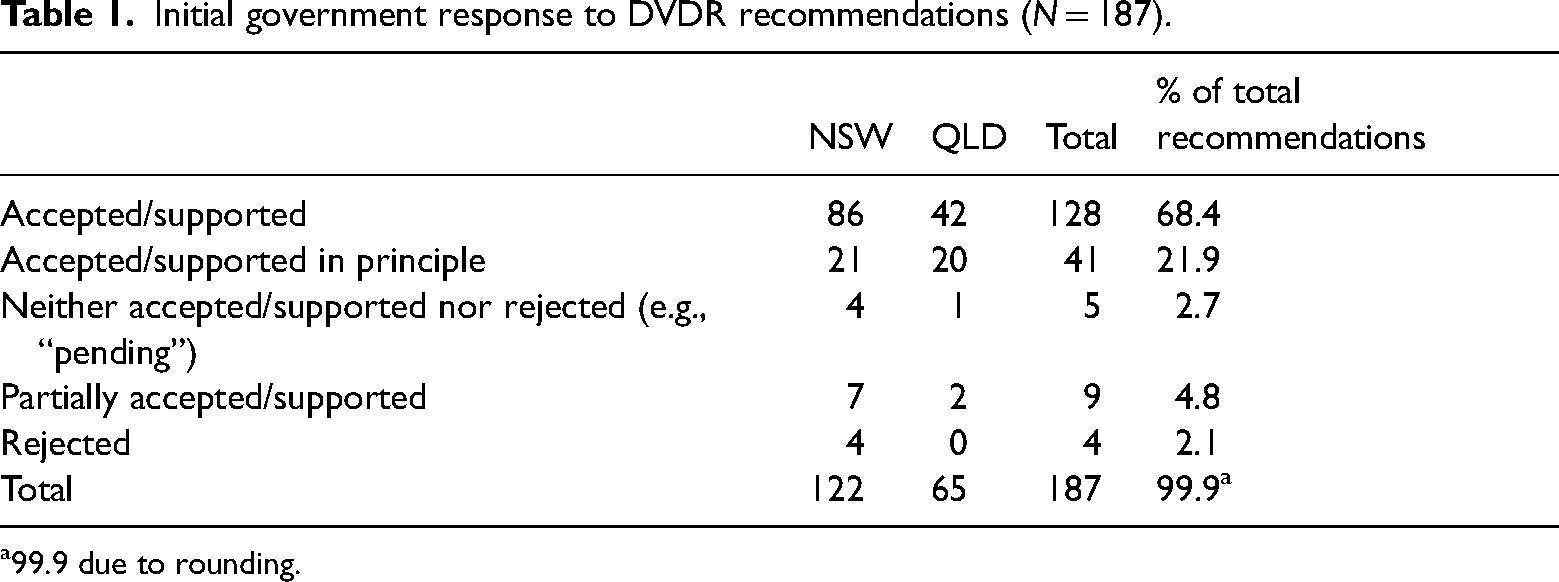
As of September 2023, the NSW and QLD governments have formally and publicly responded to 187 of the 197 DVDR recommendations in whole-of-government responses. The majority of these recommendations were “accepted” (QLD language) or “supported” (NSW language) (N = 128, 68.4%), or accepted/supported “in principle” (N = 41, 21.9%) (see Table 1). This means that in total, 90.4% of recommendations (N = 169) were initially accepted/supported or accepted/supported in principle by government.
A further nine recommendations were partially accepted/supported (N = 9, 4.8%). The terminology of “partial” acceptance was used by the QLD government in response and implementation materials to describe a small number of recommendations where part of the recommendation was supported. This terminology was not explicitly used in NSW, but we applied it in coding where one sub-recommendation was supported while others were supported in principle and/or not supported. 4 Therefore, taken together, 95.2% of all DVDR recommendations received whole, in principle or partial acceptance/support by government (N = 178).
Very few DVDR recommendations were explicitly rejected/not supported by government (N = 4), amounting to only 2.1% of all recommendations. Reasons were typically given for rejection or non-support. For instance, Recommendation 12 of the NSW DVDR's 2013–2015 report recommended that Housing NSW develop and distribute a housing rights card to public housing tenants. This was explicitly not supported following inquiries and discussions about its “feasibility”. Similarly, Recommendation 34 of the NSW DVDR's 2015–2017 report recommended that Victims Services publish information to make defendants aware that they could challenge the making of a provisional restitution order (for statutory victims’ compensation) where they had an ongoing relationship with the victim of crime. This recommendation was not supported, with the response noting that generic information was available for the challenging of restitution orders, there was sufficient discretion to consider the defendant's situation, and providing this information may encourage defendants to maintain potentially harmful relationships with victims to avoid payment of the restitution debt.
Initial government response to DVDR recommendations (N = 187).
99.9 due to rounding.
A further five recommendations (2.7%) were neither accepted nor rejected, for instance being marked as “noted”, “pending” or subject to “ongoing consultation” in the initial government response.
Implementation of DVDR recommendations
For 16 of the 197 DVDR recommendations, no implementation materials were available at the time of writing (September 2023). All 16 of these recommendations were made by the QLD DVDR in its two most recent reports. In implementation materials (which are coordinated by the state government in both jurisdictions studied), the government usually made a formal statement about whether a DVDR recommendation had been implemented or not. In addition to this, implementation materials typically described the actions that had been undertaken to progress the recommendation.
For over a third of DVDR recommendations, the government stated that the recommendation was “implemented” (QLD language) or that implementation was “complete” (NSW language) (N = 68, 37.6%) (see Table 2). This included one recommendation that was implemented independently of the DVDR's recommendation. For 50 recommendations, the government stated that implementation was “ongoing” or “underway” (27.6%). The government explicitly stated in monitoring and implementation materials that the recommendation had not been implemented in only nine cases (N = 9, 5%). In three of these nine cases, the recommendations were not supported or were rejected by the government in its initial response.
Government adjudications on recommendation implementation (N = 181).
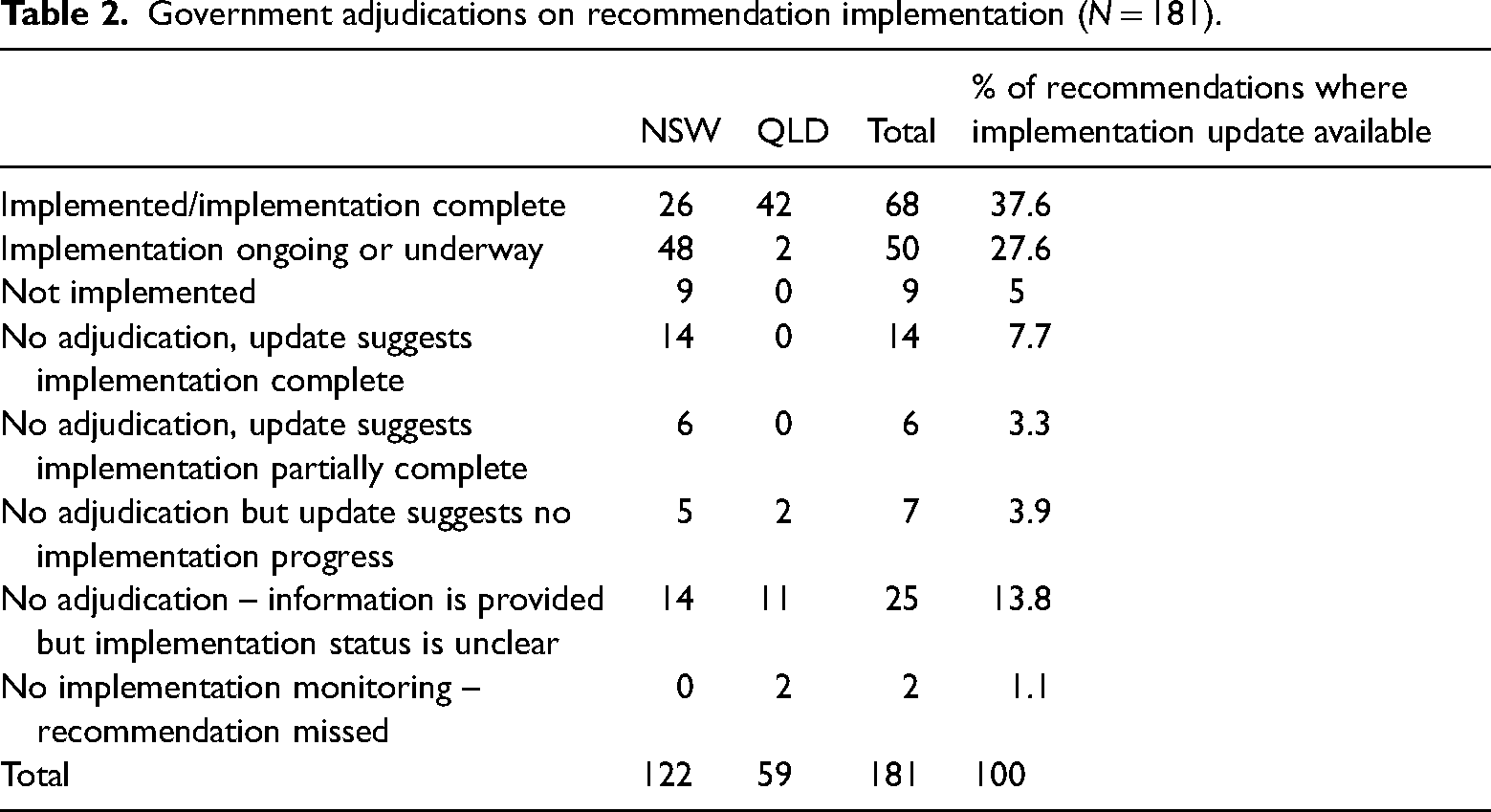
Governments’ practice of indicating whether recommendations had been implemented or not was inconsistent both over time and across the two jurisdictions studied. In particular, there was a period where the NSW Government's monitoring did not state a clear position on implementation and, in QLD, there were several instances where the government did not state a position on implementation for some recommendations, while other recommendations in the same response were marked as implemented. In most cases where governments did not explicitly state whether recommendations were implemented or not, the implementation update nonetheless appeared to indicate a position on a recommendation's implementation status (N = 52). In 14 of these cases, the implementation update suggested that the government considered that work on the recommendation was complete. For instance, Recommendation 13 of the NSW DVDRs 2011–2012 report directed the NSW Government to write to the Commonwealth Department of Immigration and Citizenship to encourage a variety of improvements to its practices, including the introduction of training programs and increased access to emergency funding for victims of violence. While the NSW Government did not indicate a position on implementation, it noted that it had written: to the Department of Immigration and Citizenship … to encourage the development of appropriate training for officers in relation to Domestic and Family Violence (DFV), particularly in an immigration context. We understand that officers now receive training in relation to how to respond in situations of DFV, including guidance about the interaction of DFV and visa status. (Domestic Violence Death Review Team, 2017, p. 176)
In a further six cases, the update suggested that the recommendation was partially implemented and in seven cases, the update suggested that no progress had been made around implementation. For an example of the latter, Recommendation 23 of the NSW DVDRs 2012–2013 report recommended that “the Cancer Institute (NSW Health), in consultation with NSW Kids and Families (NSW Health), coordinate the distribution of domestic violence information to every woman in NSW who has a mammogram”. The NSW Government initially supported this recommendation, indicating that NSW Kids and Families would “liaise” with the Cancer Institute to progress it. However, subsequent implementation materials did not indicate a position on implementation and stated that “PARVAN [NSW Health] notes that this action is incomplete and that sign off on actioning this item is currently pending sign off procedures…”. This did not represent a clear government position on implementation and we coded it as “no government adjudication but update suggests no progress on recommendation” (see Table 2).
Interestingly, for 25 recommendations where the government did not express a clear position about implementation, it was not possible to determine if the recommendation had been implemented or not, from the materials provided. In some cases, it was unclear how the information provided in implementation materials even related to the original recommendation. Implementation materials in these instances typically included general policy information unrelated to the specific DVDR recommendation.
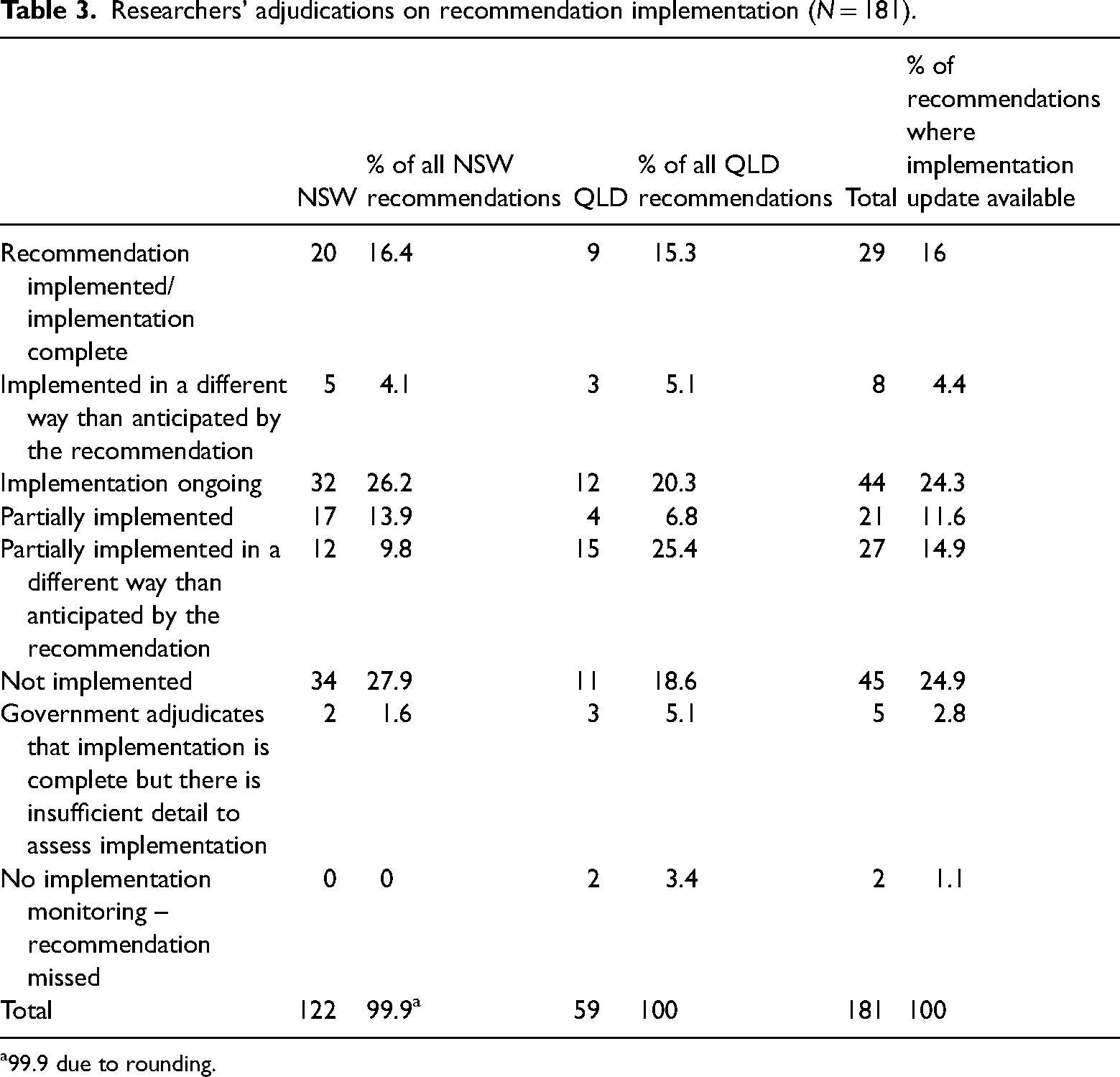
Further to this point, the QLD Government's implementation materials indicated that over 70% of the QLD DVDRs recommendations had been implemented, although this adjudication was not always then supported by the accompanying information. Our analysis (discussed further below) suggests that the QLD government may take an overly favourable approach to adjudicating the implementation of DVDR recommendations.
Researchers’ adjudications on recommendation implementation (N = 181).
99.9 due to rounding.
In contrast to the governments’ combined stated position that 37.6% of DVDR recommendations have been implemented, our analysis of implementation materials identified that only 16% of DVDR recommendations have been implemented (see Table 3). Similarly, our analysis revealed that almost a quarter of DVDR recommendations have not been implemented at all (24.9%), which contrasts with the combined stated position of the two governments that only 5% of DVDR recommendations have not been implemented.
Are there features of DVDR recommendations that affect their implementation?
Noting the very high levels of initial government acceptance of DVDR recommendations and the subsequent lack of implementation action, we next considered what may have influenced this. 5 Although many external factors may influence recommendation implementation, such as a lack of time and resources, resistance to change or uncertainty about how to effectively implement change within agencies or bodies (Starr et al., 2004, pp. 51–52; Sutherland et al., 2014), our analysis focused on several high-level factors that we could assess based on the information available to us in the recommendations themselves, as well as in the monitoring and implementation materials: the timing of recommendations, their framing, their content and the agencies or bodies they named.
Recommendation implementation by year (N = 181).
The timing of recommendations
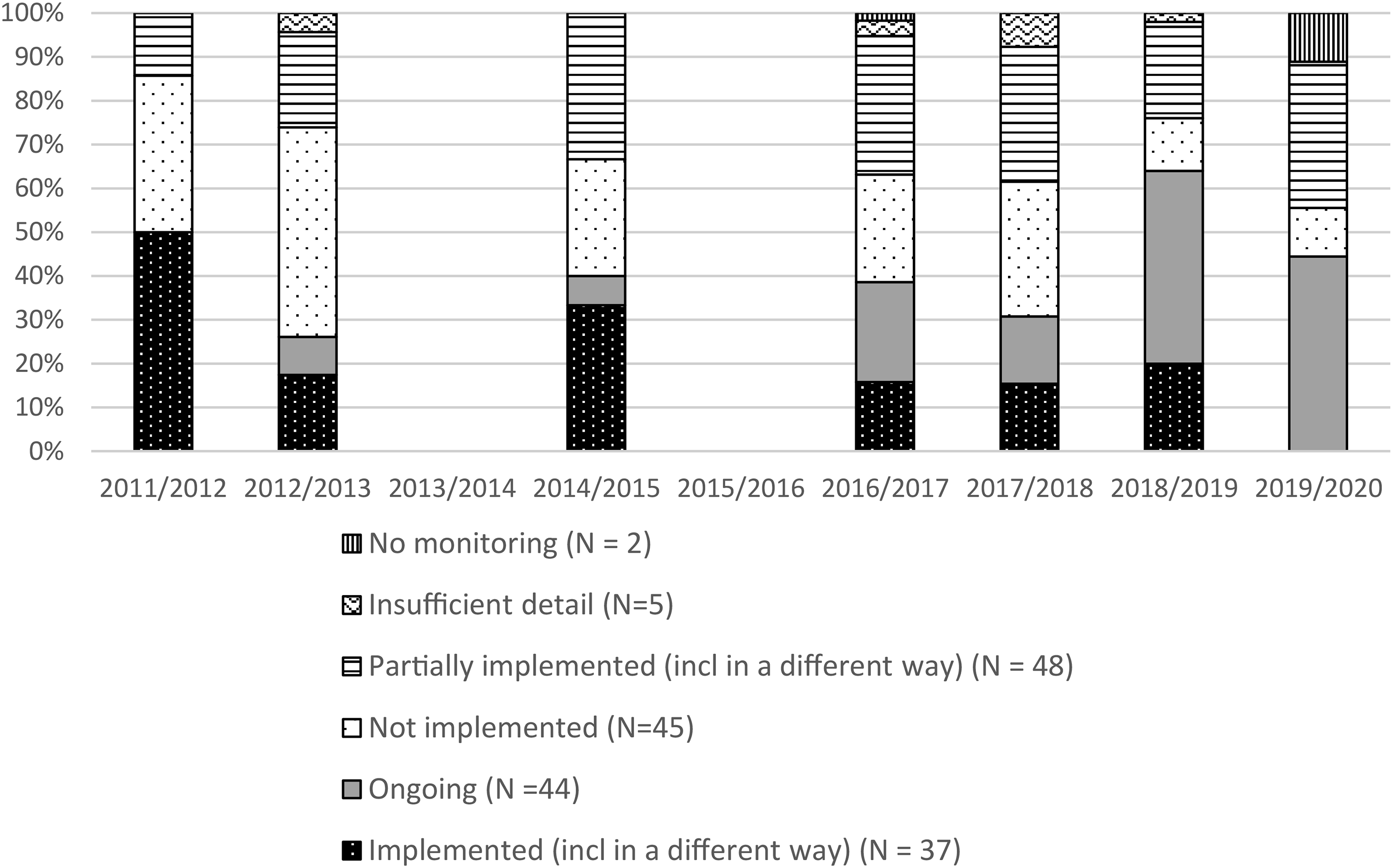
We considered whether the age of a recommendation could affect its likelihood of implementation. For instance, older recommendations may be more likely to be implemented than more recent recommendations, or alternatively could have become “stale” and irrelevant with the passage of time, resulting in a lack of implementation (Mok, 2014). Our analysis revealed that half of the DVDR recommendations made in 2011–2012 had been implemented and over a third (35%) remained unimplemented at the time of writing (see Figure 1). For most other years, only between 15% and 32% of recommendations had been implemented. Many of the recommendations made over the years remain partially implemented or implementation is still ongoing (including 15% from the 2011–2012 period, despite these recommendations being over 10 years old). 6 This suggested to us that the year of the recommendation may not, itself, be a good explanation for a lack of, or incomplete, implementation.
The framing of recommendations
Another factor that we considered could influence implementation was whether a recommendation was framed to compel, or simply suggest, an action. We accordingly compared the implementation of recommendations that used soft framing, such as those that urgedconsideration of an action, with those that used hard framing, or directly compelled an action. Our analysis of all 197 recommendations revealed that 87.8% (N = 173) sought to compel a particular action, such as requiring a government to implement a policy or strategy, while only around 12% (N = 24) used soft framing. 7
Recommendation implementation by framing of recommendation (N = 181).
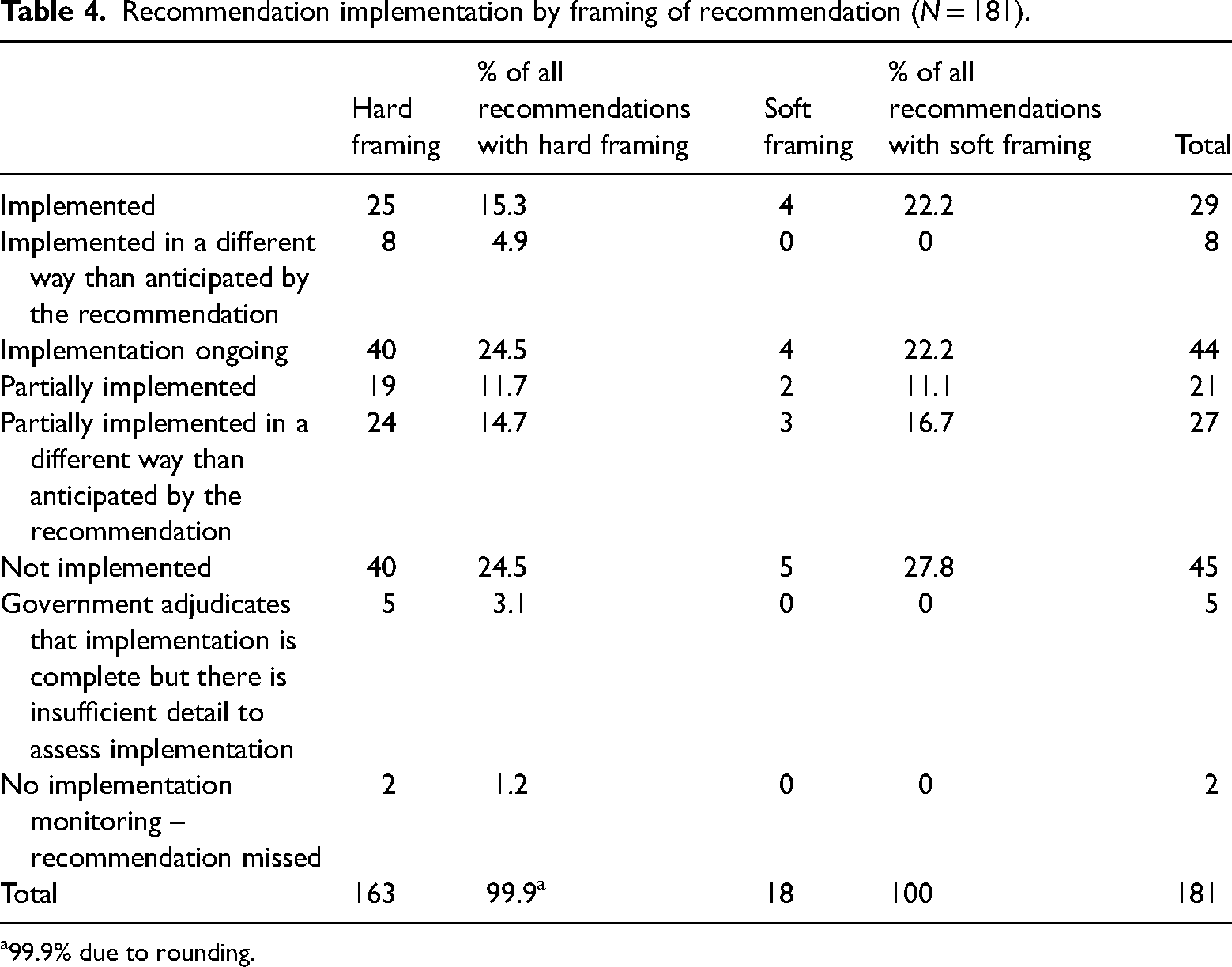
99.9% due to rounding.
While we considered that hard framing was useful, as the burden of action was clearer and it appeared to be more difficult for responding governments to deal with the recommendation in a dismissive or inauthentic way (e.g., by indicating that they had “given consideration” to an action without actually taking steps to progress it), our implementation analysis did not suggest that the way recommendations were framed made a great deal of difference to implementation (see Table 4).
The action anticipated by the recommendation
We also considered whether the substantive content of the recommendation – that is, the specific action or reform recommended – could affect implementation. We examined whether simpler recommendations that appeared to require narrow or “technical” actions (Stutz, 2008) would be more likely to be implemented than wide or systemic recommendations. For instance, while a recommendation to host existing information on a website may be relatively easy to complete, a recommendation to develop a new departmental strategy may be more complex and time-consuming to implement. To undertake this analysis, we looked to the nature of the action that appeared to be anticipated by the recommendation (see Table 5).
Recommendation implementation by action (N=181).
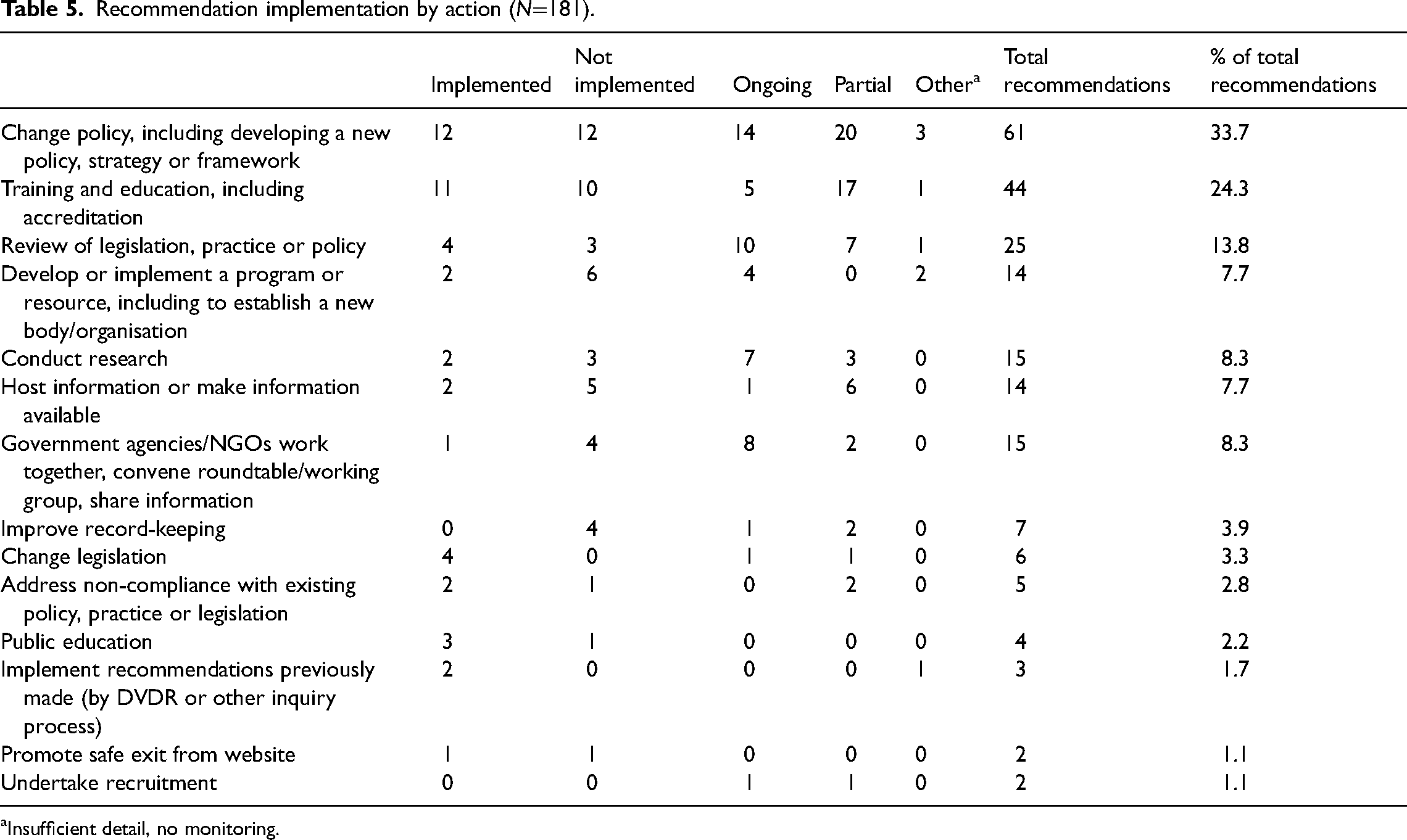
Insufficient detail, no monitoring.
There was some evidence to indicate that recommendations requiring specific or technical actions, such as a change in legislation, practice or a public education campaign, were more likely to be implemented. For instance, one recommendation concerning the inclusion of a quick-exit button to facilitate victims’ safe exit from the NSW Police Force's website was implemented, albeit several years after it was initially made. 8 Three of the four DVDR recommendations concerning public education initiatives were implemented. This included Recommendation 9 of the QLD DVDR's 2018–2019 report which recommended that service responses, training and awareness campaigns in relation to older people experiencing violence include explicit reference to intimate partner violence as experienced by older people. Implementation materials indicated that a range of actions and initiatives had been undertaken in response to this recommendation. Furthermore, two of the three recommendations encouraging the implementation of earlier DVDR or inquiry recommendations were implemented. Of the six recommendations requiring legislative change, four had been implemented.
It also appeared that recommendations: (i) requiring a review of legislation, practice or policy; (ii) requiring the conduct of research; or (iii) directing agencies to work together, were more likely to be partially implemented or in progress (around two-thirds of recommendations in each category), perhaps indicating that these types of recommendations are more time-consuming to implement. Similarly, about half of recommendations to change or develop policies, strategies or frameworks, or to introduce training and education, were partially implemented or in progress.
Interestingly, there was a lack of implementation of recommendations to improve record-keeping (four out of seven recommendations had not been implemented), which appeared to be a relatively straightforward action, challenging any view that technical or narrow recommendations were more likely to be implemented. We consider that further research engaging with recipient entities around the burden of action practically required by recommendations within the relevant institutional or organisational context will likely enable more definitive conclusions to be drawn around how and whether the actions required by a recommendation influence the likelihood of the recommendation being implemented.
The recipient entity
We also considered whether the entity named in the recommendation may have influenced implementation (see Table 6). Interestingly, the DVDR recommendations that initially appeared most likely to be implemented named Commonwealth entities, either government departments/agencies (44.4%) or Commonwealth NGOs/professional bodies (28.6%). However, further analysis suggested that this was likely due to the way these recommendations were framed. All of the Commonwealth-focused DVDR recommendations that had been implemented involved the state government acting as a conduit of information by writing to or otherwise engaging with the Commonwealth entity and “encouraging” it to take a particular action. Accordingly, the action required by the recommendation was extremely narrow and easily achieved: it did not actually require action by any Commonwealth entity.
In terms of other recommendations, 28.8% of recommendations naming state departments of justice and child protection services had been implemented, 19.4% of recommendations naming state governments had been implemented, 14.7% of recommendations naming state departments of health and 17.6% of recommendations naming state police departments had also been implemented.
Of the recommendations that had not been implemented, most named Commonwealth NGOs or professional bodies (57.1%), Commonwealth government departments (33.3%), state police departments (29.4%), other state government departments, NGOs or professional bodies (29.2%), state governments (17.9%), state departments of justice and child protection (15.4%) and state health departments (14.7%).
Implementation by entity named in recommendation (N = 181).
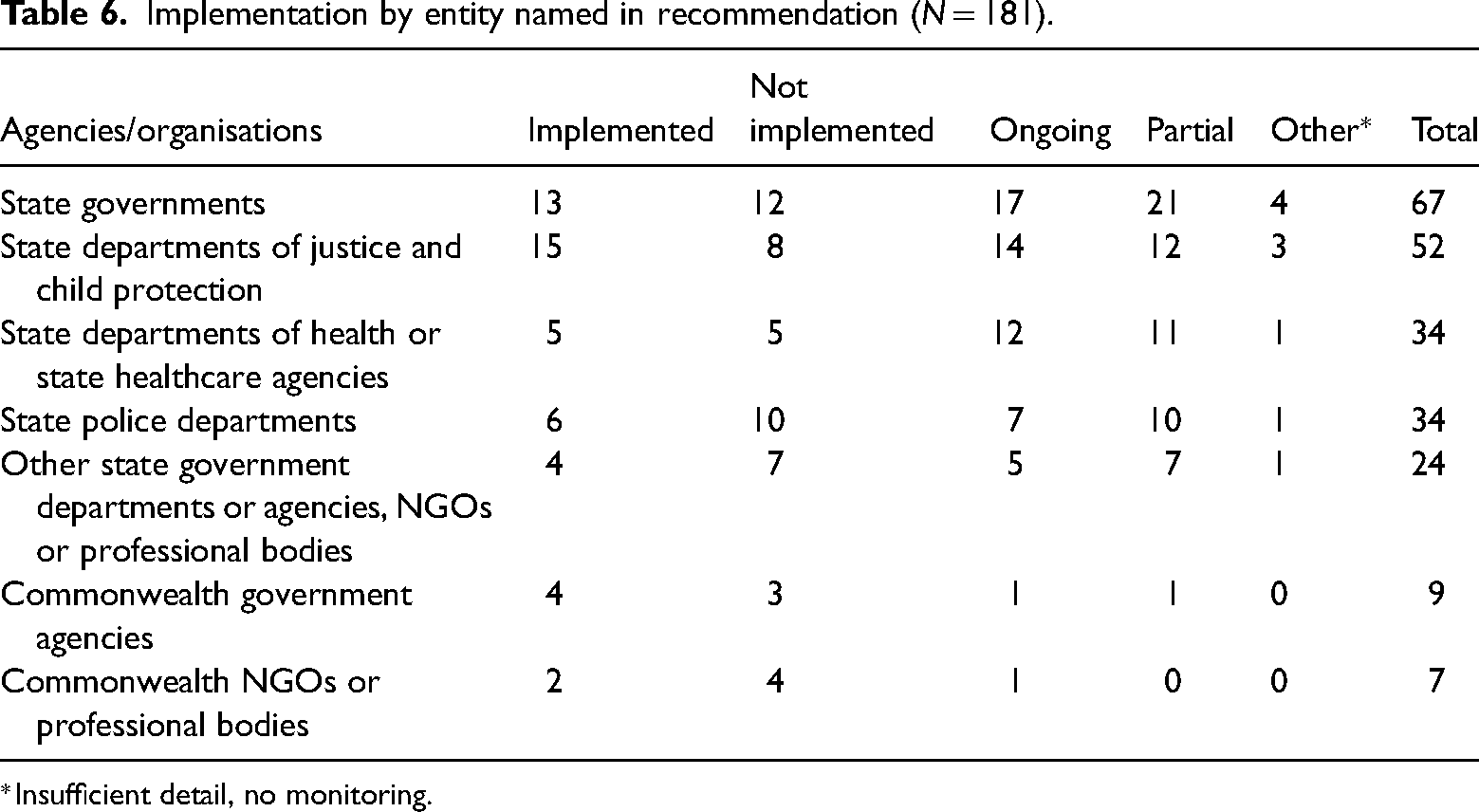
*Insufficient detail, no monitoring.
The unimplemented recommendations that named Commonwealth agencies, NGOs or professional bodies typically were made to the entities themselves and required them to take a particular action. This could be contrasted with the implemented Commonwealth recommendations, discussed above, which were framed to only require a state-level body to perform a technical administrative action, such as writing to a Commonwealth body or agency to alert it to the DVDR's recommendation. For example, Recommendation 14 of the NSW DVDR's 2013–2015 report was made directly to the Family Court and Federal Circuit Court of Australia, requiring those courts to incorporate quick-exit buttons on their websites and update online safety and family violence referral information. The most recent implementation update for this recommendation highlighted that, for monitoring purposes, the DVDR's recommendation had been reframed and tasked to a state government body (Women NSW). According to the implementation update, these actions had nonetheless not progressed: Women NSW wrote to the Family Court of Australia and the Federal Circuit Court of Australia in March 2016 regarding the implementation of this recommendation. Based on a review of the Courts’ websites it does not appear that the relevant brochures have been updated, nor quick close buttons incorporated. Women NSW will contact the Family Court and the Federal Circuit Court to ask for an update on the earlier request. (Recommendation 14, NSW DVDR. 2013–2015)
Similar issues arose in relation to recommendations targeted towards other Commonwealth entities, such as the Royal Australian College of General Practitioners. There was often no action taken on these recommendations, apparently due to a lack of compulsion (or perhaps a lack of state government engagement with Commonwealth entities about recommendation acceptance and monitoring).
Discussion
When compared to other DVDR processes in Australia and worldwide, the reporting and monitoring of the state-level DVDRs in NSW and QLD is relatively transparent. All reports, government responses and implementation updates relating to these bodies can be easily accessed from a central online location. This can be contrasted to the situation in other jurisdictions, such as England and Wales, where DHR reports have historically been published on the individual websites of local Community Safety Partnerships or Public Service Boards, or not published at all (if, e.g., they might adversely affect the welfare of children or other persons connected with the review) (Broughton, 2021, p. 170; Home Office, 2016b, p. 24). While efforts have recently been made to centralise the findings of DHRs (Home Office, 2023), the monitoring of these recommendations remains opaque, with there being “relatively little information available about progress against recommendations from individual DHRs” (Rowlands, 2020). However, notwithstanding the comparative transparency and accessibility of recommendations, government response and implementation materials for the selected Australian DVDRs, we experienced considerable challenges in assessing whether their recommendations had been implemented.
Some of these challenges arose as a result of inconsistencies in the framing of recommendations over time. For instance, since 2019–2020, the QLD DVDR has mostly directed its recommendations to the “Queensland Government” rather than nominating a lead agency responsible for implementing the recommendation (as it had done in earlier reports). It is unclear what precipitated this change in approach, although it may address difficulties associated with changes in the machinery of government, including the restructuring of state government agencies. We identified, however, that while this approach provided the QLD government greater latitude to determine which bodies should be involved in the implementation of recommendations, it limited our ability to analyse the agencies or organisations that DVDRs identified as requiring reform, cross-jurisdictionally and over time.
There were also significant inconsistencies in recommendation monitoring over time. For instance, in implementation materials, governments sometimes clearly stated a position on whether a recommendation had been implemented or not, while at other times only provided general information. This made it difficult to compare government perspectives on implementation, both within and across jurisdictions, and to easily apprehend whether recommendations had been implemented.
We also identified challenges arising from the way recommendations were framed. For instance, the soft framing of some recommendations made it impossible within our kind of analysis to ascertain whether the outcome the DVDR intended had been achieved. Even where recommendations had hard framing, however, governments sometimes indicated that the recommendations had been implemented when only the minimum task required had been completed (e.g., writing a letter). In our view, interpreting recommendations as requiring only the lowest level of action is unlikely to realise the original aspirations of the DVDR in making the recommendation or align with the important reform and educative purposes of DVDRs more generally (Mullane, 2017).
Our research also revealed that the monitoring of some DVDR recommendations had been overlooked, with two recommendations apparently never being the subject of any implementation update, and elements of other recommendations similarly being ignored or disregarded in implementation materials. While we did not to quantify instances of the latter, examples of this included Recommendation 16 of the NSW DVDR's 2012–2013 report, which recommended that three entities – the Fertility Society of Australia, the Australian and New Zealand Infertility Counsellors Association and the Fertility Nurses of Australasia – develop a communication strategy to ensure practitioners provided appropriate referral information to clients experiencing or demonstrating domestic violence behaviours. The most recent implementation update in 2017 indicated that in response to this recommendation: NSW Health wrote to the peak body, the Fertility Society of Australia, in 2016 regarding this recommendation and offering support to implement this recommendation. This offer has not been responded to. PARVAN will follow up with the peak body before…[sic]. (Domestic Violence Death Review Team, 2017, p. 189)
In conducting this study, we also observed that government implementation updates were frequently lengthy and often included significant detail about existing domestic violence policies or practices without explicitly linking this information to the DVDR's recommendation. This is consistent with Sutherland et al.'s (2016) finding that over half of the mandatory written responses to coronial recommendations in Victoria failed to explicitly state the action taken in response to recommendations. The lack of clarity in implementation updates may reflect a “public relations approach” to implementation monitoring – that is, an approach designed to minimise the public relations consequences of inadequate implementation and give the impression that change is occurring on the ground (Elliott & McGuinness, 2002; Rowlands, 2023; Sutherland et al., 2016). In cases where implementation updates were ambiguous, we were required to engage in the difficult exercise of interpreting if and how the information provided demonstrated that the recommendation had been implemented. The opacity of this approach is undesirable and inhibits analysis of the progress of important domestic violence service system reforms.
Our research also highlighted that both the NSW and QLD DVDRs appear to struggle to make effective recommendations to Commonwealth entities. Most DVDR recommendations aimed at reform of federal policies or practices directed a state body to liaise with the Commonwealth to progress the reform. As with the implementation of recommendations that used soft framing, it did not appear in these cases that the recommendation's anticipated outcome had been achieved or was even being considered in the monitoring process. This disconnection between state-level DVDRs and the Commonwealth appeared to persist across the years studied despite the Commonwealth Government playing an increasingly important role in the Australian domestic and family violence policy landscape, including around DVDRs (Bugeja et al., 2013, p. 357; Council of Australian Governments, 2010, p. 27). While this may be a challenge particular to state-based Australian DVDRs given the country's federalist structure, DHRs in England and Wales have identified similar challenges in the implementation of national recommendations. In Australia, this suggests a need for enhanced guidance about the process of making of recommendations to Commonwealth entities, alongside the establishment of a formal mechanism or system enabling Commonwealth entities to respond to, and be accountable for, implementing DVDR recommendations.
Despite the challenges we experienced in assessing implementation, our analysis highlighted some important key findings. We identified that DVDRs in NSW and QLD have, to date, directed recommendations to a broad range of entities and that the actions anticipated by these recommendations, such as changes to existing policies or the introduction of education and training programs, are similar to those anticipated in the recommendations of other DVDRs worldwide (Bracewell et al., 2021; Jones et al., 2022). This suggests that there are important similarities in the function and findings of DVDRs across jurisdictions and reinforces the relevance of our implementation analysis for DVDRs operating beyond the Australian context.
Perhaps most importantly, our analysis also revealed that there were very high levels of initial acceptance of DVDR recommendations (up to 90.4% were accepted or accepted in principle), and that this could be contrasted with relatively low levels of subsequent implementation (our analysis showed that only 16% of DVDR recommendations were fully implemented).
This lack of implementation of DVDR recommendations was a concerning finding for which there may be several explanations. First, it may be that some recommendations take significant time to fully implement, including those requiring complex, multi-agency actions and government coordination. It may be unreasonable to expect implementation of these recommendations within only a few short years of the recommendation being made. Our analysis highlighted, however, that a third of recommendations made by the NSW DVDR in its first substantive report around 10 years ago remain unimplemented, including recommendations requiring only seemingly straightforward actions.
Second, it may be that the shifting tides of policy, changes to the structure and composition of government agencies over time, as well as the time taken to produce DVDR reports, may ultimately render some recommendations obsolete. Similar observations have been made in relation to coronial recommendations. For instance, Sutherland et al. (2014) found that 36% of recommendations made by coroners in Victoria, Australia, between 1 November 2009 and 31 July 2012 were not implemented because they had been “supplanted” by prior action by the recipient entity. It may be unreasonable, therefore, to expect the implementation of DVDR recommendations that are superseded by new policies or processes, especially where these substantively address the recommendation's intended outcome. However, while this is a compelling reason not to implement a recommendation, implementation materials did not typically provide a clear articulation of how agencies or organisations had achieved, or were aiming to achieve, albeit by a different means, the DVDR recommendation's intended outcome.
Third, a lack of implementation could be attributable to barriers facing recipient entities, such as inadequate time or resources, resistance to change, or uncertainty about how to effectively implement change. These barriers are unlikely to be reflected in written materials and assessing them would require an implementation analysis approach that engages directly with recipient entities and DVDRs. Alternatively, under-implementation could indicate that the official “government” response to recommendations does not represent the perspective of the entities ultimately then tasked with implementation, which may consider the recommendations unfeasible, undesirable, impracticable or incapable of implementation (Buckley & O’Nolan, 2013; Moore & Henaghan, 2014; NSW Auditor-General, 2021; Stutz, 2008; Sutherland et al., 2014).
Finally, there may be a level of government performativity in the high level of initial acceptance of DVDR recommendations. Accepting DVDR recommendations creates an opportunity for governments to publicly demonstrate a strong commitment to ending violence against women. Subsequent implementation activity, however, occurs with little public interest or scrutiny, creating opportunities for governments to resist reform and revert to a “business-as-usual” approach. Concerns about performativity have also been raised in respect of public inquiries more generally, with commentators noting that these may serve an “agenda management” function as opposed to operating to effect real change (Prasser, 1994). If a performativity explanation undergirds a lack of implementation, this has very serious implications for DVDR practice, suggesting that even future improvements to monitoring may be undermined.
Perhaps to this point, our study also revealed that the NSW and QLD governments took a more favourable position on the implementation of DVDR recommendations than our independent analysis of the implementation materials suggested was warranted. This raises serious questions about the desirability of government self-assessment with respect to the implementation of DVDR reforms.
Issues around implementation are not unique to DVDRs and a lack of or inadequate recommendation implementation has been observed in relation to a range of permanent and ad hoc public inquiries in Australia and internationally (e.g., Elston & Zhang, 2023; Jordan et al., 2018; New South Wales Auditor-General, 2021; Stark & Yates, 2021). As the two DVDRs we studied are a form of permanent domestic and family violence inquiry that operates within government, our findings in respect of implementation point to a need to engage more deeply with broader theories of policy and recommendation implementation, both as they relate to public inquiry processes (see, e.g., Stark, 2019) and to domestic and family violence policy (see, e.g., Javakhishvili & Jibladze, 2018). Having established that there is indeed an implementation gap in this area, we consider that more empirical and theoretical work is required to understand and articulate the precise nature and causes of this gap.
At this stage, however, to address the various issues with both monitoring and implementation, we conclude that there is a need to enhance both DVDR recommendation-making and monitoring processes in the two jurisdictions studied. First, we consider that some of the difficulties around implementation could be addressed through greater guidance and uniformity around the framing of DVDR recommendations. This could, for instance, take the form of national or international guidelines on best practice in recommendation formulation (Bugeja et al., 2018). In particular, we consider that recommendations should generally use hard framing, specify appropriate lead agencies, identify intended outcomes, nominate specific timeframes for completion and provide an indication of their implementation priority. If Australian DVDRs were to adopt such an approach, which is similar to the “Specific, Measurable, Achievable, Realistic, Timely (SMART)” method used by DHRs in England and Wales, it may support future implementation analyses through a clearer accountability framework. We note, however, that the SMART method has been criticised for stymying creativity, focusing on outputs instead of outcomes and encouraging a mechanistic approach to DVDR recommendation making (Rowlands, 2023). Any guidelines should, therefore, ensure that recommendations can be made that move beyond “superficial aspects of procedures” and encourage “deeper learning” (Buckley & O’Nolan, 2013, p. 31).
Second, governments could ensure greater uniformity in their approach to providing initial responses to recommendations and seeking implementation updates from recipient entities. Initial responses to recommendations, for instance, should contain an explicit “statement of intent” that indicates whether the recommendation is accepted, rejected, under consideration, or supplanted (Sutherland et al., 2014). In implementation updates, governments could require recipient entities to follow a standard response template “designed to elicit the precise nature of the response and its connection to the recommendation that triggered it” (Sutherland et al., 2014, p. 455). This more uniform approach could help ensure, for example, that governments provide clear reasons for a full or partial rejection of a recommendation, use consistent adjudication terminology (based on agreed definitions of when a recommendation should be considered “implemented” or “partly implemented”) and provide regular and specific summaries of implementation activity where implementation is ongoing.
We suspect, however, that changes to DVDR recommendation-making practices and existing government monitoring practices alone are unlikely to wholly overcome the difficulties associated with limited external scrutiny over government-led monitoring processes. This is especially so if there is indeed a level of government performativity embedded within these processes. We therefore consider that, above all else, there is a pressing need to establish an independent, external body to undertake independent and critical monitoring of all DVDR recommendations in Australia. Monitoring should be undertaken in dialogue with DVDRs, government agencies, NGOs and other stakeholders to ensure that implementation is assessed against the outcomes DVDRs anticipate and that recommendations are, in fact, implemented. An example of a similar monitoring process is the Family Violence Implementation Reform Monitor, an independent statutory officer appointed to report regularly on the implementation of recommendations of the Victorian Royal Commission into Family Violence between 2017 and 2023. In developing monitoring processes in the DVDR space, consideration should also be given to how to effectively support DVDRs to make Commonwealth-focused recommendations and how to ensure these federal recommendations are wholly implemented. An independent monitoring body could also provide support and training to those tasked with implementing DVDR recommendations and ensure that implementation is consistently, authentically and critically tracked. An independent monitoring body would also increase transparency and accountability by serving as a national repository of DVDR recommendations and could produce high-level reports about the implementation of DVDR recommendations across Australian jurisdictions.
Although further action is required to ensure the effective implementation of DVDR recommendations, we believe that it is unlikely that all barriers to implementation will be wholly overcome by enhanced independent monitoring. More research is required into the external factors which may inhibit and/or prevent the effective implementation of DVDR recommendations not only in Australia but worldwide. It may be useful, for example, to conduct qualitative research examining the views of recipient entities about the utility and feasibility of DVDR recommendations, or to analyse the processes used by DVDRs to garner stakeholder buy-in and “stress test” draft recommendations during their recommendation-making processes. In addition to testing and generating theories from both the policy implementation and public inquiries literature when examining DVDR recommendation implementation, there is also a need to locate studies examining recommendation implementation within a broader framework of scholarship examining government responses to gendered violence reform.
Finally, while the implementation of DVDR recommendations is of great importance, we acknowledge the significant practical and symbolic contribution of DVDRs beyond their recommendation-making function. Ongoing efforts are also required to support DVDRs in their efforts to collate and disseminate data, promote public education and bear witness to the cost of domestic violence in our communities.
Footnotes
Acknowledgements
The authors would like to acknowledge colleagues from UNSW Law and Justice, Dr. James Rowlands and the two anonymous peer reviewers from the Journal of Criminology for their constructive and supportive feedback on this article. Any errors are our own.
Declaration of conflicting interests
Emma Buxton-Namisnyk previously held the role of Research Analyst on the NSW Domestic Violence Death Review Team.
Funding
The authors received no financial support for the research, authorship, and/or publication of this article.
