




Abstract
“I have never had a case that involved a female perpetrator of coercive control, and no such cases are documented in the literature” (Stark, 2007, p. 377). Stark's observation has become somewhat of a “truism” in the wider debate surrounding coercive control. Yet simultaneously coercive control is asserted as a gendered process, understandings of which appear to have elided and conflated victimhood and perpetration with femininity and masculinity. The purpose of this paper, based on empirical data, is to unpick some of these elisions and conflations and offer a more nuanced understanding of these debates using the lens of hegemonic masculinity. This paper is based on data derived from a national online survey conducted in Australia in 2021. The aim of this paper is to explore, and better understand male reported experiences of coercive control victimisation. The survey was completed by 1261 people, 206 (17%) of whom identified as men. These 206 responses are the focus of this paper. Representing one of the most comprehensive studies of men's self-reported experiences of coercive control, this survey data provides some insight into how male victim-survivors define and understand what they considered to be their experiences of coercive control. The findings provide an opportunity to offer a more nuanced appreciation of men's experiences of being in control, out of control or losing control.
Introduction
Fuelled by the widely regarded work of Stark (2007), understandings of, and endeavours to pursue improved policy responses to coercive control, have climbed up policy and law reform debates over the last decade. This has been especially the case within the Anglo-speaking world where the criminalisation agenda, and the adequacy of justice system responses, has animated significant debate (see, inter alia, Barlow & Walklate, 2022; McMahon & McGorrery, 2020; Walklate & Fitz-Gibbon, 2021). Coercive control refers to the abusive pattern of behaviours within an intimate partner relationship where one partner, most commonly the male, uses a range of abusive behaviours to exercise control over their female partner (Neave, 2020, p. v). Behaviours falling under the umbrella of coercive control can include physical, sexual, verbal, emotional and psychological abuse, property damage, financial abuse, technology-facilitated abuse, harassment and intimidation, stalking, and social isolation (Australia's National Research Organisation for Women's Safety, 2021; Neave, 2020).
Coercive control is gendered and there is considerable empirical evidence in support of this observation. However, Stark's (2007, p. 377) statement that “I have never had a case that involved a female perpetrator of coercive control, and no such cases are documented in the literature” has rather been taken as a truism. Such an assertion elides and conflates victimhood and perpetration (women are victim-survivors, men are the perpetrators) with femininity and masculinity (not all women are victims and not all men are offenders: women can be offenders too). Durfee (2011) has suggested that these elisions and conflations have contributed to the vociferous presence of men's organisations sometimes with a resultant retrograde effect on policy.
In Australia debates concerning the criminalisation of coercive control are contested and on occasion quite heated (see, inter alia, Fitz-Gibbon et al., 2020; McGorrery et al., 2020). This paper, emanating from the first Australian study to specifically examine victim-survivors’ views on the criminalisation of coercive control, takes the elisions and conflations referred to above as its starting point. Rooted in empirical evidence from national survey data gathered in 2021, the paper offers an analysis of men's self-reported experiences of coercive control through the lens of hegemonic masculinity, a widely recognised concept delineating the ideas, values and structures which privilege normative, heterosexual, male dominance over other men, women and other minority groups.
The paper falls into four parts. The first part reviews what is already known about men's experiences of coercive control. The second part presents an overview of the methodological approach taken to the wider study and the data set reported on here, including a description of the survey sample and the thematic analysis approach taken to the analysis of the qualitative responses received. The third part provides an analysis of the key findings emanating from this data and the fourth part offers a critical review of the value of the lens of hegemonic masculinity as one way of understanding men's self-reported experiences, and the impacts of, coercive control. In conclusion, the paper offers some suggestions as to how these findings might inform practice responses to men experiencing and reporting coercive control.
Men as victims of coercive control
Stark's (2007) assertion (as quoted above) appears to have embedded an assumption, especially in policy and practice circles, that it is exclusively male perpetrators who use the processes of coercive control to victimise their female partners. Although we do not contest the importance of this and we acknowledge the gendered nature and consequences of coercive control, Stark's assumption is problematic for several reasons, not least because it renders men as potential victims of coercive control invisible. Thus, the nature and extent of this invisibility attract considerable debate.
In reviewing the available literature on male victimisation and coercive control some care needs to be taken in understanding the nature of the challenge it poses to Stark's (2007) assertion. For example, much of the work centring men's experiences of coercive control emanates from different conceptual starting points concerning the nature and impact of intimate partner violence (IPV), uses differently constituted data samples and offers differing visions of intervention (Robertson & Murachver, 2011). Nevertheless, it is important to acknowledge that if coercive control is taken as gendered (qua Stark, 2007) this does not mean men cannot be victim-survivors of this kind of abuse, but rather they are less likely to be so as much of the well-established literature on coercive control documents (for a review see Barlow & Walklate, 2022).
Administrative data in the United Kingdom, Australia and elsewhere has long pointed to evidence that some men clearly are the victims of IPV (see, for example, Australian Bureau of Statistics, 2017; Office of National Statistics [ONS], 2021). Of note, and a challenge in the context of the current paper is that whilst coercive and controlling behaviour became a stand-alone criminal offence in England and Wales in 2015 the available ONS data on this offence are not disaggregated by sex. As such, it is not yet possible to determine the degree to which this particular offence has been differentially utilised to criminalise the actions of male, female and/or non-binary offenders. In Australia, the Australian Bureau of Statistics ([ABS], 2017) reports on the proportion of men and women who have experienced violence or abuse from an intimate partner. That data indicates that 17.3% of women and 6.1% of men had experienced physical or sexual abuse from a current and/or former partner since the age of 15 years old. For emotional abuse from a previous and/or current partner the figures were 23% and 15.9%, respectively (ABS, 2017). Of course, at the time this data was gathered, coercive control was not an individually recognised criminal offence in any Australian state or territory, except for Tasmania where an equivalent offence has been in place since 2004 if little used (on this, see further McMahon & McGorrery, 2016). Thus, it is not possible to present police or court data on reported experiences of coercive control. However, the administrative data does point to men's experiences of criminal victimisation more generally and this is one place in which to begin an exploration of their possible experiences of coercive control. Much of this work centres men's relationship within their understandings of masculinity.
Some time ago Messerschmidt (1993, p. 150) observed: Wife beating/rape is a specific practice designed with an eye to one's accountability as a “real man” and, therefore, serves as a suitable resource for simultaneously accomplishing gender and affirming patriarchal masculinity’.
Thus, early work on men's experiences of victimisation clearly points to their reluctance to express such experiences in terms of victimhood (see, inter alia, Stanko & Hobdell, 1993). At the same time, when men do give voice to such experiences, these are unlikely to be expressed in terms of fear and vulnerability. Indeed, work on the fear of crime, for example, points to men's greater propensity to express anger rather than fear (Ditton et al., 1999). Specifically, Javaid's (2018, p. 200) empirical work on male victims of rape points to the problems faced by men when expressing feelings of vulnerability since expressing these kinds of feelings can mark them out as not “real” men. As Weiss (2010, p. 277) summarised; “In short, men's victimisation undermines the dominant ideals of masculinity.” Moreover, Machado et al. (2016) observed that the men in their sample of male domestic abuse victims simply did not recognise their experiences as victimisation nor did they seek help in relation to them. Hine et al. (2022) go on to suggest that this reluctance to embrace themselves as victims of domestic abuse is an ongoing barrier for those individuals’ reporting behaviour as well as for those offering support. Lysova et al. (2020) offer some insights into the problems experienced by men who do report their abuse to the criminal justice system and the paucity of positive and/or understanding responses they received. Contrary to the view found in Stark's (2007) work, as Lysova et al. (2020, p. 1265) go on to assert; “men have been found to experience intimate terrorism at a greater scale than was previously argued.” So, if this is the case what, if anything, is known about men's experiences of coercive control and their willingness or otherwise to report such experiences?
Recent work by Walker et al. (2020) explored behaviours men considered “boundary crossing” (including, for example, impeding their right to safety, privacy, self-esteem). In their sample, 55.4% of men talked of a pattern of abusive behaviours which for them constituted boundary crossing behaviour including physical, sexual and controlling abuses. For some, this also included undermining their relationship with their children alongside filing false accusations against them. Over 90% of the men in this work reported having told a friend or family member about their experiences and those who did so were met with very mixed responses. These findings are endorsed by the work of Taylor et al. (2021, p. 18) who state that: The dominant narrative of men as perpetrators and women as victims appears to have created myopia whereby individuals who do not fit the standard narrative are discredited.
The impact of experiences such as these on men has been expressed by Bates (2020) as spending their lives “walking on eggshells,” and by Westmarland et al. (2021) as “living a life by permission.” Indeed, a recent study by Policastro and Finn (2021) reported that the “odds of men being subjected to surveillance by their intimate partners were significantly higher than females.” In addition, Bates and Carthy (2020) have drawn particular attention to the impact that coercive and controlling abuse has on older men with one of their respondents stating, “she had me believing I had Alzheimer's.” In sum, Graham-Kevan et al. (2021) suggest that the impact of the behaviours documented in this work (all of which fit under the rubric of coercive control) resulted in eight out of ten of the men in their sample displaying symptoms not unlike posttraumatic distress.
To summarise research to date evidence that men are unlikely to frame their interpersonal experiences in terms of being victims of any kind of crime let alone of IPV, neither are they likely to express fear in the face of these experiences. Indeed, any fears expressed are likely to be more associated with the fear of not being seen as masculine if they were to disclose their victimisation alongside the real fear that they would be met with disbelief upon doing so. This fear is especially borne out by experiences with criminal justice professionals (Migliaccio, 2001). Of course, men are not the only group to experience the heteronormative barriers of the criminal justice system in this way (see inter alia, Donovan & Barnes, 2020) but this evidence, and the debate it has generated, suggests men's experiences of coercive control demands closer scrutiny. This is especially the case in a context in which the public space given to men's experiences of IPV more generally, and coercive control particularly, has grown alongside the growth and presence of men's movements (Durfee, 2011). These developments have coincided with the increasingly vocal concerns with, and media coverage of, issues surrounding children and child custody when partners separate. The use of children, by both men and women, as a weapon of control during and after relationship breakdown is a significant concern (Harman et al., 2020). The different ways in which coercive and controlling behaviour can manifest itself under these conditions has given space to the development of the concept of “parental alienation.” This concept has been especially harnessed by men's movements and has featured increasingly in public debates about the nature and impact of coercive control on men as victim-survivors. Consequently, it will be of value for the purposes of this paper, and the data analysis that follows, to say a little more about it here.
The concept of parental alienation has its origins in the work of American psychiatrist Richard Gardner who, in the early 1980s developed the notion of “parental alienation syndrome” (PAS). This idea emanated from his clinical practice in which, according to Meier (2013, p. 2) he described how “vengeful mothers employed child abuse allegations as a powerful weapon to punish ex-husbands and ensure custody to themselves.” Again, according to Meier's (2013) reading of Gardner's work, Gardner theorised that these campaigns against the father were intended to “brainwash” their children against them. On the empirical validity or otherwise of the presence of this syndrome, Meier's review suggests that there is no robust empirical evidence in support of PAS. However, it has more recently morphed into the idea of parental alienation. Whilst there is no one single definition of parental alienation, it is generally used to capture the different ways in which one parent may manipulate a child in such a way as to undermine the child's relationship with the other parent. In a systematic review of the research conducted on parental alienation, Doughty et al. (2021, p. 72) conclude that there is a paucity of robust empirical studies on this. They go on to comment that it is thus, “unsurprising that the concept is promoted by organisations representing parents and therapists, rather than by those that represent or advocate for children.”
The absence of robust work in relation to the efficacy of this idea has not impeded its persistent presence as both a tool and a bargaining point in relation to custody disputes in Australia and elsewhere. Indeed, as the recent work by Douglas (2021, p. 239) documents, and has been evidenced by others (see, for example, Hooker et al., 2016), abusive men can and do use custody and care issues to threaten their female partners. Of course, it is also likely that some women engage in similar strategies under similar circumstances (Harman et al., 2020). The motivations for doing so may, however, differ for men and women, and there is limited evidence on which claims about its use by women (as opposed to men) are based.
Returning to the question of masculinity, one way to make better sense of what occurs at this emotion fuelled juncture in relationships involving children which can be problematic for all parties involved, might be to reflect upon these processes through the lens of hegemonic masculinity. Thus, the question to ask about parental alienation, men's experiences of the impact and reporting of coercive control, and what men's experiences and the responses they receive is, what does this reveal about when men might feel in control, out of control, or losing control? In other words, is the lens of hegemonic masculinity helpful in casting light on men's experiences of these processes? The national data set on which this paper draws offers some exploratory observations on issues which remain relatively under-explored in the literature reviewed above namely; men's reported experiences of coercive control, the impact that these experiences have had on them, and their understanding and articulation of parental alienation.
The Australian criminalising coercive control study
The data reported here is from a national project examining the views on the need for, benefits, risks and impacts of criminalisation. The purpose of this national study was fourfold: to document victim-survivors’ views on proposals to criminalise coercive control, to offer some insights into the views of victim-survivors on the role of law and the (potential) impacts of criminalisation on their justice and safety outcomes, to document their current experiences of reporting different forms of coercive control victimisation, and to make policy and practice recommendations to improve criminal justice and service system responses to coercive control across Australia. It is a multi-methods research designed project combining a scoping review, a victim-survivor national online survey, and in-depth interviews with victim-survivors.
The data drawn upon for this paper was collected through the online survey component of this project during May-June 2021. The survey was hosted on the Qualtrics online platform and promoted through a range of strategies including social media platforms (i.e. Twitter, LinkedIn), organisation networks and newsletters (i.e. Australia's National Research Organisation for Women's Safety—ANROWS; Australian Women against Violence Alliance—AWAVA), and IPV sector organisations. The survey instrument provided the space for respondents to provide anonymous answers to a range of open-ended and closed questions. The resulting data set offers the opportunity for both quantitative and qualitative analysis of the responses. This is not a statistically representative survey data set, and no claims are made about the generalisability of the data in this respect.
The purpose of the survey was to capture a broad snapshot of victim-survivor experiences of, and views on, coercive control during a time at which debates concerning the criminalisation of coercive control in several Australian states had a high public profile but limited broad engagement with the viewpoints of individuals with lived experience. The survey contained several open-ended questions, including the three open text questions which are drawn upon in this paper, asking respondents how they defined coercive control, how it impacted on their everyday life, safety and wellbeing, as well as how their experience impacted on the safety and wellbeing of their family (including any children). Responses provided to the open-ended questions varied significant in length with some participants providing a few key words while others opted to document their response in paragraphs. When bought together the qualitative data contains extremely rich insights. All qualitative data was analysed utilising a thematic analysis approach, whereby the research team conducted a close reading of the qualitative text to identify common themes and patterns in the responses received within and across each of the open-text questions. For this paper, we combine a descriptive quantitative snapshot and specifically unpack the findings of the thematic analysis of the open-ended responses provided by those participants who identified as men.
The survey generated a total of 1,261 responses from victim-survivors across all Australian states and territories. Of these responses, 206 respondents identified as male (for an overview of the broader sample, see Reeves et al., 2021). All the men quoted in this paper defined themselves as heterosexual, in middle age, living in urban or metropolitan areas, white, and fathers.
Men's experiences of coercive control: Australian survey data
The men who responded to the online survey predominantly identified as white (84%), heterosexual (83%), Australians (80%) with citizenship and/or dual citizenship (86%). The majority of male respondents identified as fathers (89%), living in a metropolitan area (68%). Only 3% of the male survey respondents identified as Aboriginal and/or Torres Strait Islander. Other demographic data collected is presented in Table 1 (below).
Male survey respondents characteristics.
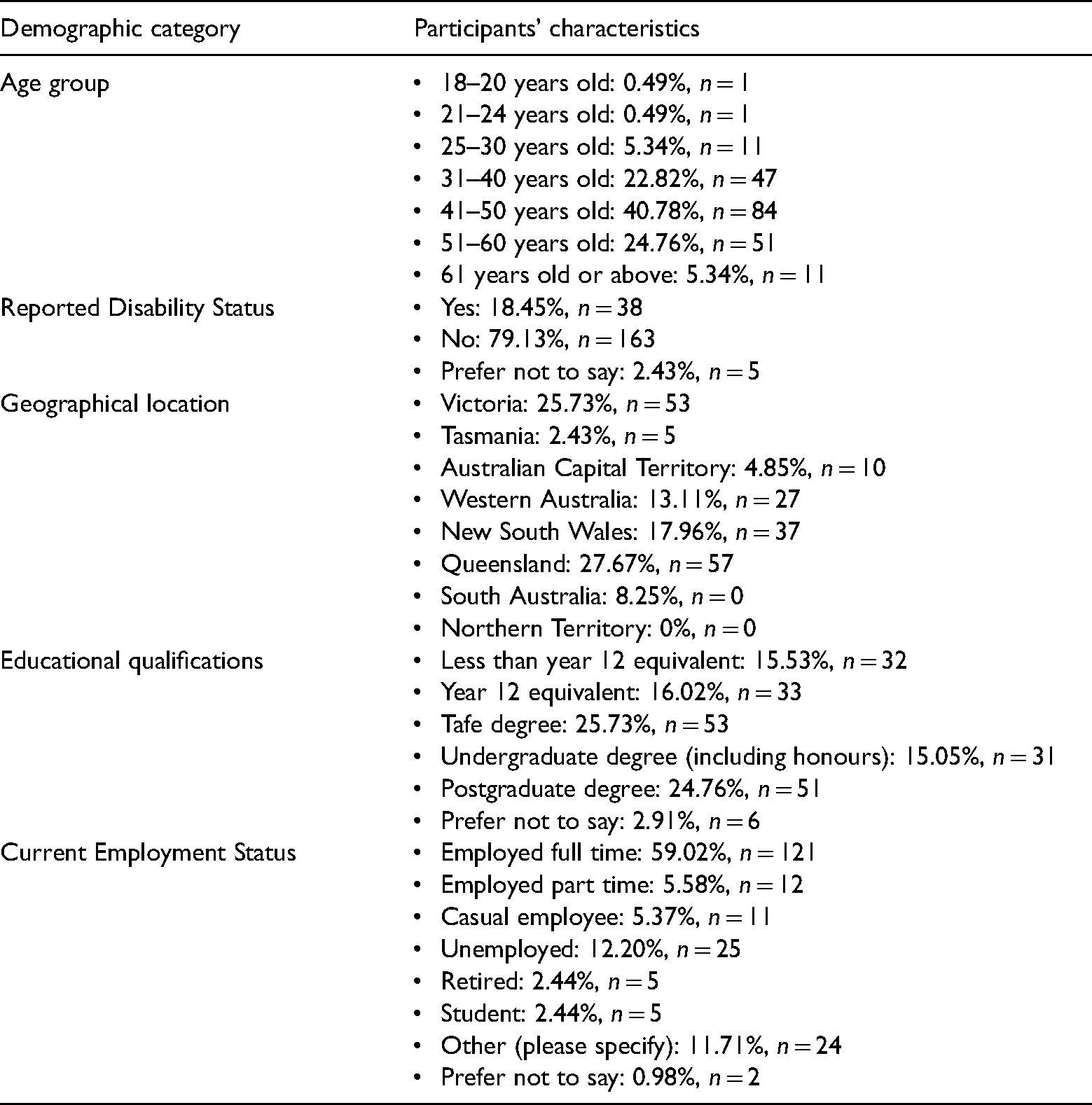
The high proportion of men who fall into the 31–60 age bracket is consistent with the wider survey sample (Reeves et al., 2021). Further, all male participants who fell into these age groups had children (n = 165), thus demonstrating the potential relevance of experiences of “parental alienation” for the sample examined in a later section of this paper.
Unsurprisingly the geographical distribution of the male survey respondents seems to be a direct reflection of the states in which the criminalisation of coercive control had a high public profile at the time at which the survey was open: namely Victoria, Queensland and New South Wales. These are also the states with higher populations and also leading Australian policy agendas in family and domestic violence reform.
We note the relatively high level of educational qualification reported by the men in this sample, perhaps matched by the secure employment status enjoyed by the majority of survey respondents, as illustrated in the data provided (Table 1 above).
The proportion of male respondents who reported a disability is in line with the proportion of men in Australia reporting as living with a disability and experiencing a form of IPV (AIHW, 2020, p. 24). The most common forms of disability among the sample of male respondents were physical impairment (31%), poor mental health (26%) and “other” (16%), however, those who selected “other” often cited experiences that fit within the poor mental health category (e.g. depression and anxiety).
In addition to providing demographic information, the survey asked respondents to describe their experiences of coercive control. Respondents were asked first who was subjecting them to coercive control. Table 2 provides a snapshot of this data.
Male respondents reported coercive controlling person.
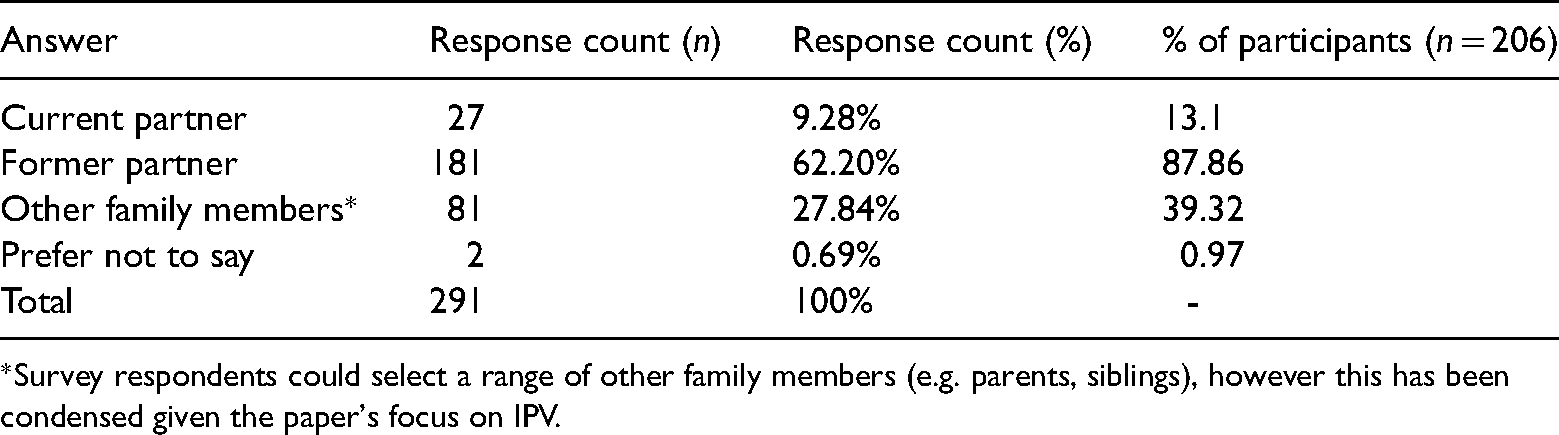
*Survey respondents could select a range of other family members (e.g. parents, siblings), however this has been condensed given the paper's focus on IPV.
The survey asked respondents whether they recognised the abusive behaviour they experienced as coercive control at the time it occurred, allowing a yes or no response. In total, 59% of male respondents did not recognise the abuse experienced as coercive control at the time it occurred. The survey also asked respondents whether the behaviour experienced was ongoing, with 66% of male respondents noting that their experiences were ongoing. Three-quarters of male respondents stated their experience of coercive control had been ongoing for 7 or more years.
Survey respondents were asked to specify from a list which forms of controlling behaviour they had experienced. Table 3 (below) overviews the responses received from male respondents. Respondents were free to choose as many of the options as applied to them.
Male respondents reported experiences of coercive control.
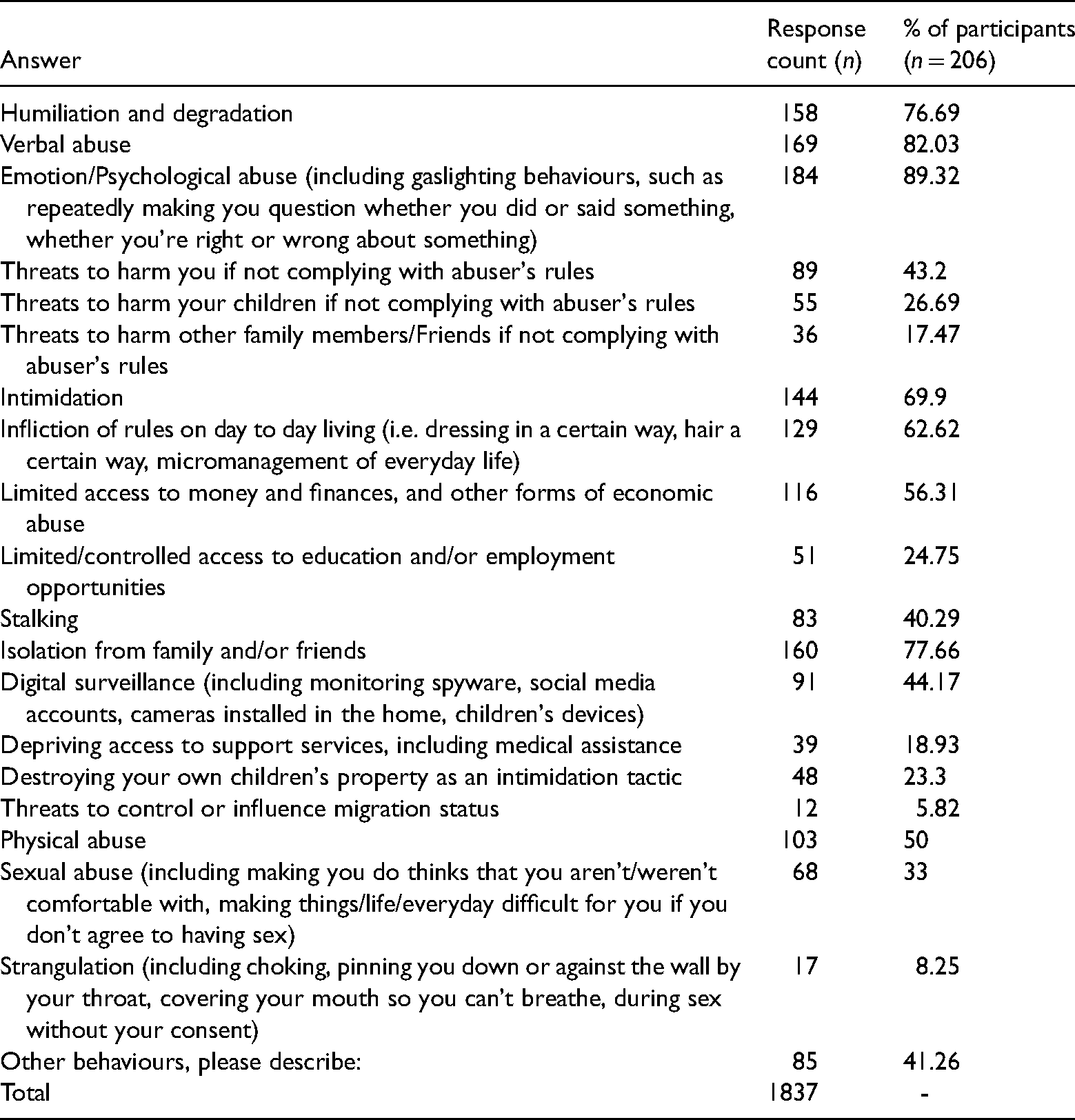
The range of reported experiences of coercive control among this sample reflects remarkable symmetry with what is known about coercive control more generally and reflects similar experiences to that documented among women victim-survivors (see inter alia Stark, 2007). They also constitute a powerful catalogue of experiences of coercively and controlling abusive behaviours. It certainly lends some weight to the empirical work already available evidencing such experiences as reported by men (see for example, Westmarland et al. 2021).
The question remains, however, how we should make sense of these experiences, the impact that they have on men, and the kind of responses these men received upon reporting their coercive control victimisation. Findings from the thematic analysis of the qualitative data received from male survey respondents present rich and illuminating understandings of these men's experiences of coercive control, the impact it has upon their sense of safety and well-being, and the responses they receive when seeking help. This data echoes some of the findings reported from the studies referenced above. Here three themes are pursued in more detail: the impact of coercive control on male victim-survivors, the responses these men experienced to help-seeking behaviour, and their views of on “parental alienation” as a form of coercive control.
Reported impact of coercive control on male victim-survivors
Respondents were asked to describe in their own words what impact their experience of coercive control had had on them. The qualitative answers to this question make salutary reading. In many ways, these responses provide some insight into and resonate with, the continuum of consequences of coercive control reported by women. The men in our sample specifically described experiences of depression (28 responses); anxiety (28 responses), and stress (15 responses). Nine respondents within the sample reported needing therapeutic help for symptoms of PTSD, and 10 respondents reported attempted suicide. The following quotes are illustrative of the complex and different ways in which such reported experiences became all-embracing for some of these male respondents. For example, one male respondent described: Over time I just ended up losing my identity. It was like I became a non-person in the relationship and just in general. It didn't happen overnight but by the end of it, I realised that my supports were gone, I wasn't allowed to do things my friends were doing etc and had to do exactly what my Ex told me. But it often wasn't telling me. It was often more like I had to do what she wanted, or her behaviour would become unbearable. Often it was also she would “take care of things” for me rather than I do them, and there was always some reason why I couldn't do it, and over time, she just took full control. The psychological abuse of the children has impacted daily- the parental alienation is probably the worst part of this as [it] encompasses so many aspects. All the things that have been done to me are now being done the kids.
The impact of this sense of having one's everyday behaviour controlled was evident in the descriptions provided by other male respondents, as captured in the following two extracts: Over time I started to doubt myself in every way. At work everyone seemed to think I was a great guy who helped everyone. At home I was described as useless, stupid, lazy, with no financial sense. Over time I started to think I must be all the things that she said and I lost my confidence and started to become anxious and then experience panic attacks, some of which put me in hospital.
Another commented: Always walking on eggshells. Always worrying what is about to happen. Never having money of my own even though I was the only person working in the relationship. Being scared of a new partner doing the same.
For some men, the everyday experiences of control resulted from their partner's efforts to isolate them from family or friends, and/or to control their access to employment, both characteristics of Stark's (2007) conceptualisation of coercive control as a liberty crime. As one male respondent described: She controlled our entire lives, who we saw, where we went, what job opportunities I took (I'm a freelancer). I lost so many friendships because she’d fall out with the friend over something and then forbid me to see them. She'd also convince me people had wronged us in some way but it turned out to be her lying about and manipulating the situation. She would go through my emails and texts and go off if she found I was still friends with someone she didn't like or if she didn't like and conversation had gone. I didn't speak to my sister for 3 years over a situation that my ex-wife completely orchestrated. She refused to work but then limited the jobs I could take and constantly guilt tripped me for being away from her and the children. But she also wanted to live a certain lifestyle, which I couldn't maintain if I didn't work long hours. She'd constantly compare me to friends who were earning more money. It made finances very difficult and stressful, and I constantly felt like I was failing as a husband and a father.
Describing the range of coercive and controlling behaviours they had experienced one male respondent specifically challenged the gendered framing of this form of abuse. He said, It scares me that we are still framing this as a gender issue. This is such a big subject and things like not being allowed out with mates, being told how to dress or wear hair, being nagged and guilt tripped into doing something you’re not comfortable with, denial of access to children following separation - all those things are squarely within this definition but ignored when a female does it. That needs to change.
Interestingly, and in stark contrast to women's experiences of coercive control as documented elsewhere (Stark, 2007), male respondents rarely described the impacts of the abuse on their sense of physical safety, nor did they describe a fear for their life. As such, these men's testimonies are revealing in themselves. These men's own stories document their experiences of losing control of their lives, the sense of themselves as men, and their perceived failure to live up to the expectations of husband, father, breadwinner and provider, and their subsequent feelings of social isolation. These feelings were quite frequently exacerbated for those who reported their experiences to someone.
Reported experiences of seeking help following male victimisation
Of the 206 male survey respondents, 74% identified that they had told someone about the coercive control they were experiencing. Some respondents reported reaching out to more than one person and/or agency. Most frequently these men reached out to family members or a friend (92%), their doctor/health worker (76%) or the police (46%). In a similar vein to other reported work on this issue (Graham-Kevan & Powney, 2021), the key recurring theme in the responses received by these men can be expressed in the words of two of our respondents: “I was told to go home and man up”; and, “I’m a man who is going to believe me?”
The open text responses revealed the complex and complicated experiences reported by men experiencing coercive control as they reflected on their help-seeking experiences being framed by the problems of being a man (as illustrated in the previous two quotes). As another male respondent reported: Most [people] don't believe a man can be abused emotionally. we are meant to man up and deal with it somehowSome said leave but I did not want to leave my child who I have now lost anyway. I often felt worse as it was embarrassing and degrading and made me feel like a failure.
The experiences of another respondent highlight the mixed messages men can receive at different points of the system: My GP was supportive and arranged mental health support for me. Child protection were useless. Wouldn't even record that my ex-wife beat me up in front of the kids. Family lawyer was sympathetic but recommended that I don't pursue the abuse through the courts or police as it may have a negative impact on my family court outcomes. My psych has been amazing and is helping me find myself again.
The reported experiences of seeking help from the police appear less nuanced, as one said, They ignored me and told me to get over it essentially. They said “you’re a big fella, you can handle her”. Things just got worse because she knew after that that she could get away with anything and they’d not believe me.
For some male respondents their experiences of seeking help had affirmed the belief that service system responses have been designed upon the assumption of male perpetration and female victimisation, and that experiences outside of this binary were met with a cynicism and refusal to offer support. As one respondent described: I tried calling 1800 Respect [national helpline] and was told that I was the perpetrator and that I should change my behaviour. The same thing happened with MensLine. I eventually got through to a support agency (I can't remember which - perhaps Beyond Blue) that acknowledged that my experience was real, but that I should refrain from pressing charges or taking things any further as it would damage my chances of positive outcomes in the family court.
For men these mixed responses were not only problematic but also very revealing about the way in which male victims experience different points of the service system and their interactions with service providers. This is especially the case in relation to the way in which assumptions associated with being a man were perceived to inform the reactions of service providers and the consequences such assumptions can have for men who do not fit with that version of masculinity (see also Taylor et al., 2021). The views of male participants’ reveal the problems experienced by men when they are not in control in a way that readily aligns with the expectations associated with hegemonic masculinity, particularly when those views are held by support service practitioners. For those from whom they were seeking help, these men had also “lost control” of themselves as men i.e. they no longer embodied the characteristics of real men. The uncritical complicity of some service providers with gendered norms when dealing with male victim-survivors operates to reinforce rather than challenge reductive stereotypes, an approach that sits uneasily in the Australian domestic violence reform landscape where the importance of prevention and gender-transformative interventions is increasingly accepted. Moreover, it is worth noting that service responses complicit with “gender-damaging” norms should not be conflated with service responses to alleged male victims of IPV which, in the light of their experiences, are justifiably cautious about the potential misidentification of female victim-survivors as perpetrators (Fleming et al., 2014, p. 1031).
Of course, in between the lines of these stories are processes of separation, divorce, and child custody disputes, and negotiations with the legal and other system processes that emerge at these points in a relationship. Indeed, advice concerning how to avoid the risk of an unfavourable outcome through the family courts is made explicit in the two quotes cited above. Managing the family court is a recurring theme for many of the respondents to this survey, especially in relation to access to children. Indeed, it is interesting to note that despite research suggesting that the case for parental alienation is at best not proven (see inter alia Doughty et al. 2021), the term itself was cited—unprompted—by 31 of the male respondents to this survey. This speaks loudly to the persistent power that this term has, and it is to these experiences of our respondents that we now turn.
Reported experiences of parental alienation among male respondents
As noted above 89% of the male respondents to our survey were fathers. Their concerns about their relationship with their children during and post-separation, alongside the concerns expressed about the impact that their abusive intimate partner relationship was having on their children, were expressed in a wide variety of ways. For the 36 respondents who talked explicitly about “parental alienation” and their “children” in this way, terms like “manipulation,” using them as “pawns,” and their partner's alleged failure to comply with agreed “access” arrangements occurred repeatedly. As with these men's other experiences, experiences relating to their ex-partner and children are expressed in a simple or straightforward manner. For example, one respondent simply said: My daughter grew increasingly distant from me, as I was frequently denigrated in front of her.
Another stated: My ex used our children to manipulate me. If I didn't behave robotically as she wanted (even when I did behave as she said she wanted) it was apparently a total failure, and if I didn't "try harder" she would leave and take the kids and I could "visit" them at her discretion—she was empowered to do that abuse by the weapon - Family Courts. She alienated my oldest child from me.
Several male respondents specifically described the impacts of their experiences of coercive control on their parent-child relationship post-separation, as illustrated by the following quotes all from different respondents: We separated and she used the child as a pawn against my feelings and refused court contact and ordered visits. There were something like 32 breaches of contact orders. But the courts did nothing. It fed thousands of dollars into solicitors’ pockets for no benefit whatsoever. I lost the relationship with my son because of her constant behaviour.
Denied access to my children. Destroying relationship with child. Denigrated in community. False allegations of family violence. Lies leading to financial hardship.
My children are withheld from. She picks and chooses when I can see them. Even when my children ask for 50/50 care she with holds them from me. I have had false AVO [protection order] which I have now defended which was proven just to be used for property again and denied access to my children.
As the work of Andreasson and Johansson (2019) reminds us, parenthood is considered a gender-divided process and has become institutionalised as such in many Western societies. Consequently, post-separation, the assumption is often made that children stay with their mother although it is worth noting that the Australian family court system moved to embed an assumption of shared parenting as part of the Family Law Act 2006 (on this, see further Rathus, 2010). Against wider social changes, understandings of what constitutes being a good father and a good partner are also changing. As Scourfield and Evans (2015) have suggested, for some men being seen not to be able to live up to the social expectations associated with themselves as men, in the examples cited above as fathers, can induce a sense of shame sometimes resulting in suicide. It is certainly the case that for some of the men in our sample their sense of frustration at no longer being in control of themselves as men were focussed on in their articulations of the impact of coercive control on their lives.
Concluding thoughts on hegemonic masculinity and male experiences of coercive control
This paper has provided some unique insights into male self-reported experiences of coercive control, the perceived impacts of a coercive controlling relationship upon men's everyday lives, and their understandings of their masculinised selves. In a rapidly growing area of research, policy and practice, there remains limited understanding of how male victim-survivors experience patterns of abuse broadly, and the impacts of coercive control specifically. Whilst we acknowledge that all forms of IPV are disproportionately experienced by female victim-survivors, there is value in building the evidence base on how men understand and depict their own experiences of coercive control, and what implications this has for their engagement with service system responses to DFV. This article has sought to directly contribute to that gap in current research in Australia and elsewhere.
Of course, this study is limited in so far as it relies on self-reported experiences which inevitably are themselves one-sided. In addition, these respondents all identified as white, heterosexual, fathers, in middle age living in large urban areas and the transferability of these views and experiences to other groups will be limited. However, the hotly debated and contested nature of parental alienation should not detract from the very real experiences of coercive and controlling behaviour described by men in the survey data presented here, previously documented in the work of Bates (2020), Westmarland et al. (2021), and others. The data obtained from male survey respondents in this study suggests that some men are victim-survivors of coercive control and that such victimisation can pose different issues for them than those posed for women, particularly in relation to their understanding of themselves as men. Male victim-survivors may not report fearing for their safety but as this data shows, experiences of coercive control can affect their wellbeing and relationships. Men's experiences of coercive control and the impact of that victimisation also carries implications for the responses they receive and/or do not receive from service providers across the service system. Dominant narratives on masculinity can do a disservice to those men who do not fit within it (see also Taylor et al., 2021) and the consequences of this can carry life-changing impacts in terms of mental health problems and risk of suicide (Scourfield and Evans, 2015). The data here clearly suggest that men's experiences of coercive control and its impact need to be made visible and met through adequate service responses which recognise the powerful influence of dominant expectations of what it is to be a man. At the same time, note needs also to be taken of the ways in which men may present themselves as victim-survivors at different points of the system as a form of furthering their abusive behaviour (Douglas, 2021). Thus it is critical for services to be appropriately informed to mitigate the risk of misidentification of women as perpetrators and the use of systems abuse on the part of male perpetrators.
Footnotes
Declaration of conflicting interests
The authors declared no potential conflicts of interest with respect to the research, authorship and/or publication of this article.
Funding
The authors received no financial support for the research, authorship and/or publication of this article.
