




Abstract
Empirical research on Canadian correctional workers’ successes, challenges, and attitudes towards accommodating gender diversity remains limited. Drawing on data garnered from two open-ended survey questions (n = 70) asking correctional workers in the community or institutions about their perspectives on working with trans populations, we explore how correctional workers in Nova Scotia, Canada accommodate or struggle to accommodate gender diversity in carceral settings. We found that respondents are generally mindful of issues pertaining to the safety and security of trans prisoners, usually espouse open-mindedness, and are generally able to work within correctional parameters to accommodate those with a diverse gender identity. Yet some respondents raised concerns and suspicion towards prisoners who present a safety risk to other prisoners and, in their view, may be manipulating human rights policies to cause harm to others. We take up these tensions critically and discuss the scholarly and practical implications of our findings, as well as possible avenues for future research.
Introduction
In this study, we explore how correctional workers in Nova Scotia, Canada accommodate or struggle to accommodate gender diversity in carceral settings. Drawing on data garnered from two open-ended survey questions in Nova Scotia's Correctional Worker Mental Health and Well-being Study (n = 70), which asked correctional workers in the community or institutions about their perspectives on working with trans populations, we discuss how respondents are generally mindful of issues pertaining to the safety and security of trans prisoners, usually espouse open-mindedness, and are able to work within correctional parameters to accommodate those with a diverse gender identity. That said, some respondents raised concerns and suspicion towards prisoners who present a safety risk to other prisoners and, in their view, may be manipulating human rights policies to cause harm to others. We take up these tensions critically and discuss the scholarly and practical implications of our findings—elucidating considerations for policy makers, gender scholars, and social scientists alike. Further, we draw attention to experiences of correctional workers supervising trans probationers—an unstudied occupational group.
Notably, we do not capture the recent experiences of trans prisoners—which is a limitation. Instead, we examine how correctional workers navigate the changes to correctional service policies that aim to include gender identity and gender expression as a human right within an unchanged infrastructure—legal, physical, training, and other—built upon the notion of sexual genitalia and gender identity as related and indistinct (Sumner & Sexton, 2016). Said another way, with the implementation of new policies in Canadian correctional services that try to address and incorporate gender equality and inclusion into its operations and institutional framework, correctional workers who were trained by, and worked under a seemingly sex (not gender) binary prison system (Ricciardelli et al., 2020), were asked to usher in and conform to new processes and procedures. Empirical research on Canadian correctional workers’ attitudes towards, and their successes or struggles in, accommodating gender diversity remains limited, which we, through the current study, seek to inform.
Legislative background
In 2002, the Northwest Territories became the first Canadian jurisdiction to explicitly prohibit discrimination against trans people by including gender identity as a ground for discrimination in its Human Rights Code (Boyer et al., 2019). On June 19, 2012, the Canadian province of Ontario enacted Toby's Act (Right to be Free from Discrimination and Harassment Because of Gender Identity or Gender Expression), which amended the provincial Human Rights Code to include gender identity and gender expression. In doing so, Ontario became the next province to protect the rights of trans people (Boyer et al., 2019). In 2015, Correctional Services of Ontario began referring to prisoners by their chosen names and pronouns and placing prisoners in facilities and spaces that aligned with their self-identified gender (Tuttle, 2020). The province of British Columbia soon followed suit (Harris, 2016), becoming the third Canadian jurisdiction to situate prisoners according to their gender identity.
On June 19, 2017, Bill C-16 was enacted to amend the federal Canadian Human Rights Act and the Criminal Code of Canada to add gender identity and gender expression to the list of prohibited grounds of discrimination. Correctional Services Canada (CSC), then in response, changed 15 of their policies. Stating “a duty to accommodate based on gender identity or expression, regardless of the person's anatomy (i.e., sex) or the gender marker on identification documents” (Correctional Services Canada, 2017), CSC implemented changes that included the ability for prisoners to choose whether urinalysis testing, strip, or frisk searches are conducted by a male or female staff member, staff use of the prisoner's chosen name and pronouns, and placement into institutions for men or women according to the prisoner's gender identity, “unless there are overriding health or safety concerns which cannot be resolved” (Correctional Services Canada, 2017).
Also in 2017, Nova Scotia Correctional Services implemented a new policy in accordance with the Nova Scotia Human Rights Act. This policy stipulates that self-identification is the lone means for determining a prisoner's gender identity. In addition, this policy includes that: placement in a men's or women's institution should be determined according to gender identity or where the trans prisoner feels safest; trans prisoners will be asked if they wish to be searched by a male correctional worker, a female correctional worker, or have a split search; and trans prisoners should be referred to by their chosen names (Burnet, 2019).
Before these policy changes, the prison system in Canada (and internationally) was sex-binary, segregated based on genitalia and their sex assigned at birth and not by gender identity (Ricciardelli et al., 2020). 1 These constrictions arguably exacerbated trans prisoners’ experiences with harassment, violence, and sexual violence, and risk of contracting HIV and Hepatitis C (Scheim et al., 2013). Despite the progress the new provincial and federal policies ushered in, we emphasize that trans prisoners are not free from risk or harm when under the care of correctional services. We also acknowledge that these policy changes would not have occurred without trans resistance and grassroots advocacy, including the complaints launched against the Correctional Service of Canada by Katherine Johnson and Synthia Kavanagh—two transgender women who were incarcerated on the basis of sex and denied gender-affirming healthcare (see Kirkup, 2018). As Kirkup (2018) argues, broader movements committed to prison reform or decarceration have constituted important sites of resistance to the imposition of biomedical discourses on trans people who become subject to essentialist gender norms and policing.
Trans carceral scholarship
The rights and treatment of trans prisoners are a global issue that scholars and policy makers have responded to differently across jurisdictions in accordance with varying political and societal structures. For example, while Canada has seen major policy shifts and mandates in correctional services to protect and uphold the human rights of trans prisoners (Ricciardelli et al., 2020, pp. 86–89), the United States have been recently criticized for not implementing housing solutions that keep prisoners out of solitary confinement and in safe environments, as well as policies that align with gender-affirming language and practices (Rudolph, 2021).
Though the situation is arguably improving in Canada (Adorjan et al., 2021), once incarcerated, trans people may face challenges, abuses, or discriminations because of their status as an—often visible—gender minority. These may include, but are not limited to, being denied housing on the basis of their gender identity (especially in conjunction with individual safety assessments), refusal by prisoners and staff to use their preferred names and pronouns, policing of their clothing, harassment, assault, suspicion, and invasive surveillance/searches of their bodies (Bettcher, 2013; Dillon, 2011; Goring & Sweet, 2011; Jenness et al., 2010; Stanley & Smith, 2011; Vitulli, 2014). Due to their higher rates of sexual victimization in prisons (Beck, 2014; Read & McCrae, 2016), trans individuals may be placed in solitary confinement (where solitary exists) against their will to protect them from harm (Sumner & Sexton, 2016). Lastly, health services in prisons are generally more limited than in the outside world, and as a result, trans people have reported being denied both general and trans-related health care (Brown, 2014; McCauley et al., 2018).
In trying to better understand what life is like for trans people experiencing incarceration, the voices of trans prisoners are an important consideration. In their qualitative study of 23 trans feminine individuals incarcerated in facilities across several states in the United States, Rosenberg and Oswin (2015) found that trans prisoners endure harsh conditions of confinement, including being housed indefinitely in administrative segregation, laughed at and called names, sexually harassed and/or assaulted, sold for sex, put on display, hurt on purpose, subject to humiliating strip searches in front of other prisoners, receiving unfair or unprovoked disciplinary charges, prohibited from wearing bras/women's underwear and makeup, forced to cut their hair, and denied access to hormones or medical treatment. Participants explained how such bombardment with harassment and violence “demean[ed] their lives, identities, and bodies by making them feel diseased, different, and hypersexualized” (Rosenberg & Oswin, 2015, p. 1278). The role prisons play in regulating and enforcing gender performance and normativity in carceral spaces and the subsequent detrimental effects these practices have on trans prisoners has been documented in other studies (Spade, 2011; Stanley & Smith, 2011). Through their study of 15 trans men who were previously incarcerated in the United States, Rogers and Rogers (2021) found that participants’ experiences with childhood abuse, victimization, and homelessness heavily shaped their pathway to the criminal justice system, and their lack of support systems and negative coping mechanisms influenced future offending. Put simply, this emerging body of scholarship demonstrates how difficult life is for justice-involved trans people before, during, and after incarceration.
While contemporary Canadian correctional workers are largely supportive of trans prisoners and appreciative of the complexities of trans peoples’ experiences, this support is often in tension with the pressures the occupation imposes (Ricciardelli et al., 2020). Prison governance in Canada requires a balance between “two vague and conflicting principles” (Hébert, 2020, p. 223): rights and risks. Finding a balance between a duty to accommodate the needs of trans prisoners and the operation of safety and security often falls on correctional workers. Correctional workers negotiate the strain of meeting the rights and needs of trans prisoners with the occupational demand of mitigating risk and ensuring the safety of all prisoners by trying to place trans prisoners in the most appropriate sex-segregated space (Ricciardelli et al., 2020). The purpose of our study is to take up these tensions and occupational parameters and responsibilities critically, alongside an informed understanding of the nature of correctional work within arguably somewhat sex binary institutions. In doing so, we highlight the various efforts, perspectives, and practices that guide how Canadian correctional workers strive to realize gender diversity and inclusion in otherwise constrictive prison environments.
Method
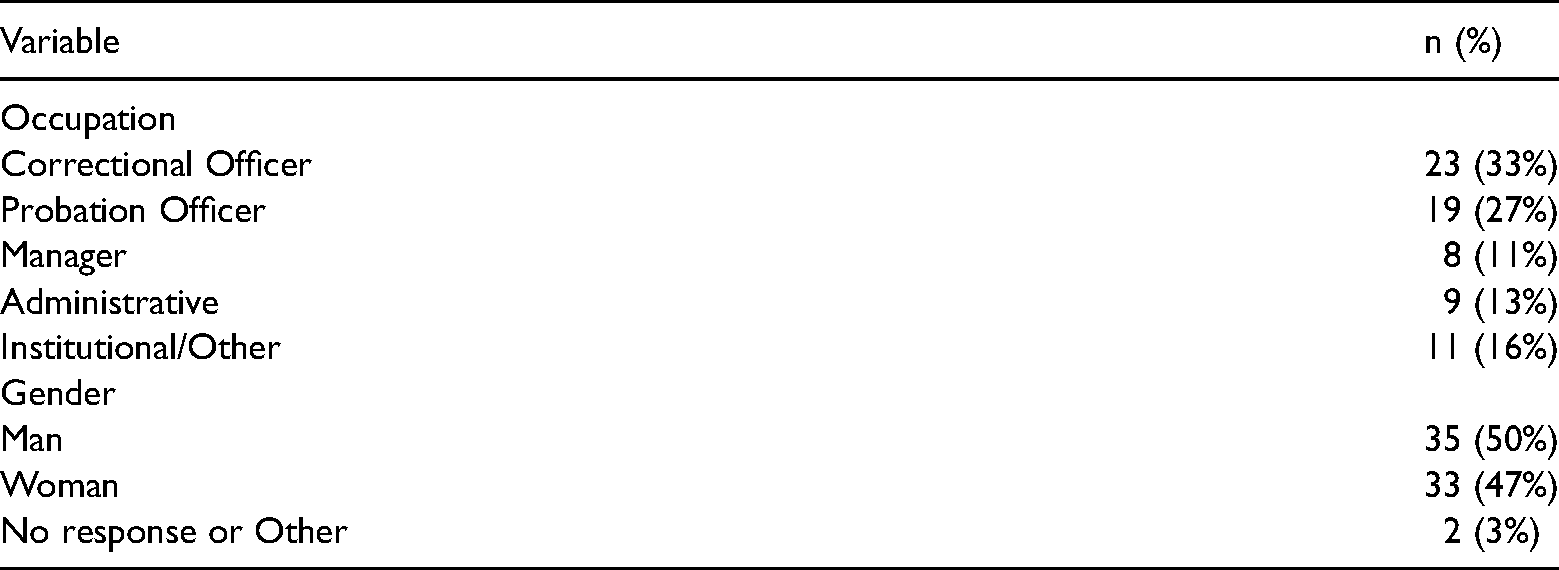
We draw on data from the Correctional Worker Mental Health and Well-being Study, which we administered in the provinces of Ontario, Manitoba, Saskatchewan, Nova Scotia, New Brunswick, Newfoundland and Labrador, and Yukon Territory. The study examined the mental health and well-being, as well as experiences, of correctional workers in each jurisdiction using open-ended items and psychometrics to assess mental health disorder prevalence (e.g., general anxiety disorder, major depressive disorder). The iteration administered in Nova Scotia was unique in that the survey included two open-ended items pertaining to correctional workers’ experiences and work with trans prisoners and probationers in the survey: “Please describe your experiences with diverse transgender prisoners or probationers in the correctional system”; “How do you feel about working with transgender prisoners or probationers?.” A total of 214 Nova Scotia correctional workers, employed in the community, administration, and institutions, participated in the broader survey, ranging from correctional and probation officers, program officers, nurses, rehabilitative staff, other healthcare staff, administrative staff, managers, teachers, and other employees. Of the 214 respondents who completed the survey, 70 participants responded to at least one of the questions under study. Given that the sample is small, and the topic is highly sensitive, we present few demographics of the respondents in Table 1, ensuring that we protect respondent privacy.
Select demographics.
A possibility remains that the 70 participants responding to these two items had strongest opinions (positive or negative) toward the populations, which is a limitation of the current study. A second limitation is that the precise response rate for the survey cannot be calculated due to the overlap between government and union listservs (i.e., we cannot calculate a sampling frame).
Research ethics boards at the University of Regina (file #2017-098) and Memorial University of Newfoundland (file #20201330-EX) approved the study. The survey was anonymous, confidential, and voluntary. With the aid of relevant union membership listervs, and a representative from the Nova Scotia's Department of Justice Correctional Services, representatives invited employees to participate, with the survey closing with the onset of the COVID-19 pandemic in March of 2020. We selectively included open-ended items, recognizing they do take longer for respondents to complete, so as to gather insights into the context around participant responses to the close-ended survey items (Ashbaugh et al., 2010). Experiences of correctional workers with trans criminalized individuals was an area of interest in Nova Scotia and thus an added dimension in the provincial survey.
In Nova Scotia, respondents were able to participate during paid work time (or they could forward the email to their personal email and complete the survey outside of work hours in the privacy of their choosing). The email that was circulated provided a link that, if clicked, directed those interested in participating to the informed consent form, study information page, and survey itself. A randomly generated access code was provided to each participant, which could be used to log in and out of the survey and thus not have to be completed in one sitting. Although difficult to calculate, we estimate that the average survey completion time was around 40 min. Responses varied in length, with some participants noting down a few words and others providing detailed descriptions and illustrative examples.
Our analytic process was thematically inductive (Hesse-Biber & Leavy, 2003) and employed a constructed semi-grounded emergent theme approach (Charmaz, 2014; Glaser & Strauss, 1967). We analyzed data by coding each participants’ words first into “parent” (e.g., primary themes) and then “child” (e.g., secondary themes) and “grandchild” (e.g., tertiary themes) nodes based on emergent themes in QSR NVivo. We combined data from the items under analysis into one file for ease of analysis to gain a sense of the whole data and the key themes across responses (Corbin & Strauss, 2015). We draw on quotes in the presentation of results that highlight respondent voices but ensure we only use quotes that do not identify the respondent nor impinge on their privacy. We did minor edits for the excerpts used to assist with readability, flow, and to correct grammatical and spelling errors, making sure to never compromise interpretations, meaning, or tone.
Results
Business as usual
Across 23 participant responses (39%), a common theme emerged among Nova Scotia correctional workers; namely, that their interactions and experiences with trans individuals were no different than those with others in custody who do not identify as trans. The “business as usual” sentiment was, for some, tied into larger notions of respect and rights regardless of lines of division, such as gender. Here participants explain that “All prisoners are treated with respect regardless of their gender” (P52); “I have and will treat them fairly no matter what gender they identify as” (P117). P52 and P117 both express adherence to a framework of equal and fair treatment throughout the course of their duties that is uninfluenced by gender identities. Other respondents, specifically those who had limited experiences working with incarcerated trans people, also described that despite their inexperience, they anticipated there would be no differences in how they approached or treated trans prisoners. Here, P9 asserted that they had “Limited access, but would not care what they are.” P9's response espouses an inclusive orientation reflective of one that many correctional workers have when entering the profession (Adorjan et al., 2021; Ricciardelli et al., 2020). This orientation was echoed by several other respondents who explain, for instance, “They [transgender prisoners] were treated as to the gender they identified to” (P22); “Treated respectfully like everyone else” (P49); “I have no problem working with transgender clients” (P12); “I feel comfortable and able to work with transgendered [sic] offenders” (P63). All of these quotations provide strong evidence that there are correctional workers in Nova Scotia who aim to facilitate a non-transphobic environment by “work[ing] with,” rather than against, incarcerated trans people.
Four respondents (6%) added, however, that despite “treat[ing] them like everyone else” (P13), interactions with incarcerated trans people did require adherence to gender identity protocols, such as “mak[ing] sure their pronouns and presentation [are] respected (P 56).” Thus, being treated “the same” does not equate to the failure to recognize gender considerations that may otherwise be taken for granted or less relevant in the case of cisgender persons, such as using accurate pronouns and adhering to appropriate strip search policies. For some respondents, adherence to a gender-inclusive and responsive framework are simply a procedural aspect of their job that, as such, does not shape how they view any person in their custody: “[gender identity] just changes location assignment and search procedures - otherwise an inmate is an inmate” (P29); “There are a few transgender individuals who come into our office. They are treated like human beings, same as everyone else” (P58). In this sense, correctional workers report being attentive to the diverse and special needs of incarcerated trans people, but they do not view those accommodations in a negative, overburdening light. Instead, like when managing any prisoner needs, gender considerations are simply part and parcel of their workplace framework. Said another way, “it's part of the job” (P36).
Five other respondents (7%) were less neutral in their assessment of how housing trans prisoners affects their work. In this vein and more positively, they remarked on the positive benefits of being able to work in a diverse setting: “No problem at all, I would enjoy the diversity in the workplace” (P9). P62 also wrote: “No problem working with anyone. Everyone has a right to be who they want to be.” These participants espouse a belief that human rights are a component of their work within a correctional environment that, in some ways, also creates more diversity and inclusivity in their workspace. Another participant stated that the fair and equal treatment of incarcerated trans people is less a point of moral reflection than simply “treat[ing] others as I would want to be treated” (P80), and thus, any “concerns” or judgments about a person in their custody should have to do with their “character” (P49), rather than gender identity. P29 furthered this sentiment with their reflection that there is “no issue as long as rules are followed and respect goes both ways,” indicating that they form the basis of their character judgment of the incarcerated person by assessing their capacity to reasonably conform to the institution's rules and code of conduct, as well as reciprocate the respect several correctional workers provide to the incarcerated population.
Support and positivity in relationships
In total, 18 respondents (26%) commented on the value of understanding and effective, relational dynamics. These dynamics include developing a rapport and providing support, which means being as “understanding” as possible (P19) and advocating for, or being understood as, allies. P107 demonstrated this sentiment, in writing “I have worked with numerous inmates that identify as transgender…I have taken courses on being an Ally and feel I am able to help others understand better and to be the most respectful of those who identify as transgender” (P107). P107 has engaged in activities that encourage the self-work necessary for being an LGBTQ2 + ally and tries to extend the knowledge gained to others to increase inclusivity and thus support a gender-inclusive correctional environment. Another respondent, P14, was forthcoming about their advocacy for incarcerated trans people: “I have worked with, supported, and advocated for individuals on all spectrums of gender identity,” which demonstrates the depth of their experiences working with and supporting very gender-diverse populations.
In thinking about their experiences with incarcerated trans people, participants also reflected on these relationships. For instance, P12 wrote: “the insight of individuals changing genders are sometimes very thought provoking.” P12 admits that criminalized trans peoples’ experiences provide them with a point of reflection. Though it is not mentioned explicitly, such a reflexive process can be a step in furthering their understanding of gender diversity. P12 also wrote that they “have learned a lot from these individuals,” evidencing a growing open-mindedness.
Three respondents (4%) were more specific about how they go about building rapport and relational alliances with trans people. P90 wrote, “they require understanding and I ask questions of them in situations in order to build a relationship.” Here, P90 takes initiative throughout the course of their occupational responsibilities to build their working knowledge of their clients’ needs by asking pertinent questions. Similarly, referencing a hypothetical incident where a client has unmet needs, P72 elaborated on their supportive orientation: “I would not treat my client any differently and would do my best to support my client in seeking the support if they were having difficulties.” Many of the correctional workers who responded try to support criminalized trans people on their conviction, and further support all vulnerable criminalized people who are in need or facing challenges. P77 strongly echoed this theme: “Whatever I can do to support, at their request,” demonstrating that they are actively attentive and responsive to requests for support, of all criminalized people, including those identifying as trans.
Concern with vulnerability
Here, eight participants (11%) shared having concerns about the custodial experiences of criminalized trans people, particularly of their susceptibility to bullying or harassment due to how they identified or how they are placed in carceral spaces—both those in institutions and in the community. For example, one respondent recalled advocating for the safety of their client in light of negative experiences: “One case stands out. Had a transgender probationer doing weekends in custody. Concerned for them after they shared their first weekend experience, and contacted facility to try to ensure the next weekend was less problematic and stressful - for everyone involved” (P 54). In this case, the correctional worker listened to the incarcerated trans person divulge their initial problematic and potentially harmful prison experience, and then responded appropriately by making other institutional officials aware of the problem and advocating for the rights of the prisoner.
Other well-being concerns were documented in the data, especially around mental health needs, which are considerations that also affect staff–prisoner interactions and relationships: “statistically they have more mental health issues that need work” (P94). Any incarcerated person trying to live in an arguably sex-segregated institution that does not match their gender identity may encounter vulnerabilities and an exacerbation of mental health needs, especially if they receive little support or accommodation. P94 recognizes that mental health must be “worked” upon by staff at the institution, not just the incarcerated individual themselves. As documented several times in the data, many correctional workers who responded expressed their support and comfort working with trans populations.
More respondents noted the vulnerability of the criminalized trans population: “This is an extremely vulnerable population that can benefit from supportive staff who have knowledge and comfort in working with the queer population” (P14). P14 recognizes that the presence of supportive staff can make a difference in their clients’ safety and well-being. What exactly makes some incarcerated trans people “vulnerable” was elaborated on by P68: “I find that other inmates bully and harass these inmates and are looked upon as being weak.” Prisons can and do reproduce normative assumptions about gender (Acker, 1990, 1992; Britton, 2003; Kruttschnitt & Gartner, 2004; Stanley & Smith, 2011); specifically, they are societies within themselves that mimic the realities that shape free society (Ricciardelli, 2019), and sometimes assumptions can fuel prison violence and antagonize tenuous relationships among prisoners (Jewkes, 2005). However, P68, like others, is aware of the problematic culture around gender in their institution, and as the data has shown thus far, many correctional workers who responded are trying to be a part of the solution.
Policy gaps
Despite the evident cultural and institutional progress made on building a supportive carceral environment for criminalized trans people, five respondents (7%) expressed the sense that there were still current gaps in the policy frameworks or operational environments. As correctional institutions are largely sex-segregated and perpetuate the notion of gender binaries rather than inclusivity, accommodation, and placement of non-binary individuals becomes a complex matter. Some noted current operating environments could present safety concerns for trans persons and others outside of dominant gender and sexuality categories. For instance, participants wrote: “[it is] difficult to deal with due to the fact that our system operates in a two-gender operations environment” (P71); “Our current policy on transgender inmates is not suitable for the environment. As a whole we need to adopt more LGBTQ friendlier policies which also present a safe environment for those folks” (P34). P71's words suggest “difficulties” tied to working in a sex-binary environment when responsible for a trans prisoner, while P34 advocates for diverse and more responsive policies.
As many correctional workers from our respondents call for urgent and further progressive policies, two respondents lamented that this constrictive environment could jeopardize the safety of staff who sometimes struggle to find resources for their clients. To exemplify, P115 wrote that “Policy isn't thinking about the staff's beliefs and puts staff at risk,” while P55 reported that they have “no concerns except finding appropriate resources for them…[and] trying to assist them in the community.” P115's words illuminate the risk potential due to ineffective policies for trans clients which is only exacerbated by a lack of “appropriate resources” as put forth in the words of P55. The desire to help trans people in their custody or under their supervision resonates strongly in these excerpts. However, so too does the frustration resulting from a lack of appropriate resources available to their clients. In consequence, correctional workers feel that the care and well-being burden falls squarely on their shoulders.
Respondents also expressed the limits of, and problems associated with, working in a sex-binary, but not gender binary, institution. As some incarcerated trans people struggle to find safety, comfort, and accommodation in their carceral setting, one correctional worker identified a tension in policies implemented to support them: “I am fine with all trans people who are not just pushing the limits to try to play games with the policies. Being different is really hard and I want to make it a little better” (P19). Here, there is some frustration present in the words of P19 over the concern that some incarcerated trans people may be over-zealous in their use of inclusive gender policies and thus may place a burden on staff. However, this correctional worker nuances that concern with the appreciation that “being different is really hard” and thus knows that the work they do to try and help and support their non-binary clients can make a positive difference in their lives in a cumbersome setting such as a prison.
Two respondents (3%) identified that, despite being supportive of trans identities, they still believed that incarcerated trans people should be housed on the basis on their biology: “Inmates should be classified by their reproductive organs to keep the populations separate and with their respective gender officers in a supervised environment” (P71); “Offenders should be housed with the same physical gender” (P93). Both P71 and P93, like others, voice concerns about gender, rather than sex, driving prisoner placement policies. We describe in the next section some of the (primarily safety) reasons underpinning this discourse in correctional services. However, these excerpts point to an unresolved tension in confined, sex-segregated prisons; namely, binary institutions will always and continue to struggle to develop sweeping policies that are inclusive of all risks, accommodations, and needs that each respective incarcerated person presents. These correctional workers believe they can work with and protect incarcerated trans people in institutions that privilege housing prisoners on the basis of their biologically ascribed (rather than internal) gender identity. Such a position may create friction with many LGBTQ2 + advocates or legal scholars who believe that a person's internal sense of gender identity should determine where they serve their sentence (e.g., Rudolph, 2021). However, we caution that this positioning is not the product of an individual correctional worker's hatred of trans people, but rather a reformist praxis that believes rights and accommodations of non-cisgender people can still be upheld in primarily cisgender institutions, without the massive structural changes required to make the institution non-sex-segregated.
Another participant described how policies aimed to be inclusive of trans prisoners can sometimes be burdensome for staff who, for reasons related to their own personal sense of security, may not be as comfortable or well-trained in carrying out some of their duties with incarcerated trans people: I have absolutely no issue whatsoever with working with, strip-searching, or anything else with inmates who identify as transgender. I do have some issue with staff being forced to do strip searches on trans inmates when the staff are uncomfortable, have not been properly trained to do a strip search on inmates whose physical gender does not match that of the staff, especially when some staff have a history that includes sexual abuse/rape from someone of the same physical gender … I don't think staff who are uncomfortable or for whom it would be damaging to their mental health should be forced to perform strip searches on inmates who make them uncomfortable because of their sexual history. Use the staff who don't have a problem with it and discipline the inmates who are being sexually inappropriate, regardless of gender or identified gender. I would have no issue with coming from another unit to perform a strip search on a trans person so another staff member was not uncomfortable or so their mental well-being wasn't being risked. (P107)
P107 distinguishes between staff who have the comfort and professional knowledge needed to perform strip-searches of incarcerated trans people with integrity, and those who do not because they have been harassed or assaulted by a prisoner or quite simply do not have the required training (or experience, professional or personal) to carry out this duty. They advocate that those who do have the working knowledge, training, and comfort zones should be available to perform such duties, and in turn, some correctional workers should be able to opt out of such duties for compassionate reasons and that such a policy will create less harm for both staff and prisoners.
Deceit
Some concern was expressed by six respondents (9%) that a sub-group of individuals claimed a trans identity in an effort to be transferred to a women's institution, leading to vulnerabilities for incarcerated women (and for staff). As one respondent noted, this phenomenon could lead to individuals with genuine gender considerations to be subject to unfair skepticism: Our province has a terrible transgender policy and it basically has resulted in a bunch of sex offender men declaring they feel female to try to go to the women's unit. A lot of them get to female unit segregation but a few made it into the units with women and have then sexually harassed or sexually assaulted them. This has left many real trans people afraid to say anything in case no one believes them. I try to be supportive and kind to everyone in that kind of situation and help them through things. Often the strip search is upsetting for them if they have the incorrect genitals still present so I try to express understanding for them. (P19)
P19 asserts that they are supportive and gender-inclusive of many trans people in custody, however they distinguish between prisoners with “real” gender-based needs and vulnerabilities and prisoners who may be manipulating gender-inclusive policies for an array of reasons—to live in a women's facility, to enact harm against women, or for another interest. Said differently, some respondents expressed concern about the motivations and authenticity of the gender identity select prisoners put forth, which is not surprising given the risk laden and unpredictable environment laced with skepticism and distrust that is, essentially, prison. In essence, any policy meant to uphold the human rights of prisoners can be abused, and this correctional worker feels vulnerable when trying to sort through and assess the needs of prisoners who present a great risk to the rest of the prisoner population. Striking a balance between facilitating a gender-inclusive environment and the safety of other prisoners is tricky and tenuous and can create doubt, even legal vulnerabilities for staff, due to concerns about the actions of prisoners toward each other. In select cases, the challenge creates unfair skepticism and suspicion towards trans people who then feel unable to come forward comfortably with their gender identity.
These concerns and accusations were echoed by other correctional workers in our study: I have witnessed more inmates openly abusing the system by stating, “If I do not get what I want by 4 I will identify as a female,” for example. Then Correctional Officers have to give them what they want when they all of a sudden say they’re female even if they are laughing and joking about it. I feel there are not enough resources to prevent this from happening. Not only is it offensive for transgender people who have fought hard for their rights but it gives inmates who actually live their lives as a transgender person a harder time and treated like the “abusers.” (P37)
I believe some inmates use the transgender identity for their own benefit when in actuality they are not [emphasis added]. (P85)
Mainly negative, mainly inmates claiming to be transgender in order to not have to go to a regular living unit, or to have a female perform the strip search instead of a male officer. (P93)
Across these excerpts, there continues to be a controversial separation between “authentic” and “inauthentic” trans identities, rather than a sweeping belief that all trans identities are invalid. The difficulty present is that these correctional workers are left to rely on their own judgments and observations to determine legitimacy, and even then, P37 believes that the policies do not allow for flexibility in their application, which can perpetuate harmful stereotypes and create a safety issue for other prisoners, and as P93 notes, female staff as well.
These difficulties trying to determine the “truth” of identity was further described by P72, who unlike the previous participants, tended to err on the side of caution and provide support to anyone identifying as trans: I do not have any bias about working with transgender individuals, however, I do struggle with working with individuals who appear (based solely on my interactions) [to] have used gender as a way to get out of a situation. Hard to describe my experience, as it comes from a judgement in knowing a particular individual, however, support was always offered to help [the] individual be their true self should they wish.
P72 is highly reflective that their interpretations may be inadequate and come from a place of “judgment” of the prisoners they routinely work with. In response they choose to always be supportive of their clients regardless of their personal beliefs. In trying to find solutions to interpretations and judgment, P31 advocated for “more screening and protection”: I do have this problem working with the female unit. So true transgender, you can obviously tell no problem at all. But now men are claiming to be transgender just to be on the female side. This I disagree with. As these men come in with violent charges towards women. They say they are female but want to be addressed as a male. There needs to be more screening done for these individuals. They are impacted who have been beaten, sexually abused, raped by men who feel very uncomfortable when these individuals enter the day room. It's very unsafe for staff and for other inmates when these individuals make it through the cracks…and it can also encourage sexual activity happening between the man and female inmate on the unit, which is exactly what the man wants. This is the only issue I have. More screening and protection of the staff and female inmates have to be protected.
Again, this respondent is aware that trans identities exist and must be accommodated in a prison setting as well as community correctional spaces. However, they also express concern that some prisoners with a history of sexual offence(s) may be taking advantage of gender-inclusive policies and creating further harm and fear towards especially vulnerable women staff and prisoners who have a history of victimization and/or abuse. P31, echoing others, proposes more appropriate staff be present to screen out any prisoners trying to “abuse the system,” while keeping intact policies serving to protect the rights and dignity of incarcerated trans people.
Discomfort, struggle, and concern
A small number of respondents (6%) expressed discomfort or concern about working with trans people. As described earlier, discomfort could include disagreement with institutional placement based on gender, rather than sex, within the sex-binary system, and concern with the implications for the safety of others when this sex-based binary system is challenged. P110, for instance, expressed that they “Dealt with several…no real issue. It makes me uncomfortable placing a male in female unit with other females. [This is a] lawsuit waiting to happen.” P110 foresees legal ramifications against their correctional institution with gender-based prison placement polices, evidencing how the “logic of risk” can clash with the “logic of rights” (Hébert, 2020; Murphy & Whitty, 2007; O’Malley, 2004).
Another respondent, P64, expressed concern and caution towards trans prisoners because of their perceived risk of encountering suicidal thoughts and behaviors. P64 wrote: “Have seen a few. Weary of them due to high rates of suicidal behavior. Had some interesting conversations encouraging them to pursue who they really are and to feel comfortable with this.” P64 paradoxically demonstrates discomfort working with trans people who, for an array of reasons and struggles, may experience suicidal thoughts and behaviors or self-injurious practices (Read & McCrae, 2016). Such thoughts and behaviors are the occupational responsibility of correctional staff to respond to and intervene in over the course of their frontline work. Yet, P64 also states that they have openly comforted and encouraged incarcerated trans people to be open about their gender identity in carceral spaces because that is “who they really are,” demonstrating understanding and insight as well as acceptance of gender identification.
These competing tensions over the rights and perceived risks of working with trans prisoners were further elaborated on by one respondent. P79 wrote: “I have not had many who have identified as transgender. The one or two that I have encountered, we have worked well together … struggle with the pronoun thing but that is more out of just habit nothing to do with not being accepting.” Here, P79 declares that they are open and accepting of the few trans prisoners they have worked with; however, they admit to struggling to overcome their habit of implementing a trans inclusive practice such as using the correct pronouns when conversing with the trans individual.
Three other respondents (4%) comprising a small sub-group of correctional workers were more overt in expressing their controversial discomfort and fears working with trans populations. Examples here include: “Is this about who we think we are or what could happen, should be same standards, I could think I was a female does that mean I can work in the woman's unit just because I state that? I don't want to but I don't want to be working where dorms have mixed gender people” (P94); “cautious as to what to say and how to say it” (P116); “I am open to working with any individual whether they are transgender or not. I do however feel uncomfortable as a female officer having to strip search a male transgender” (P117). Across the first two excerpts, P94 and P116, there is a sense of distrust and lack of knowledge about the experiences of and accommodations for trans prisoners, which creates discomfort. Without nuancing their beliefs with concerns about risk management and the safety of other prisoners and staff, as other respondents did earlier in our findings, P94 problematically discusses their perception that people who “think” they are female should not necessarily be accommodated by their “perceived” gender identity. They further state that they do not wish to work in an environment where such accommodations are implemented. P116 expresses fear that in trying to accommodate incarcerated trans people, they may be persecuted if they make a mistake. P117 then remarks that while they are comfortable working with incarcerated trans people, they are not comfortable conducting a strip search of a trans woman because they present with male genitalia. Although these passages do not represent the majority of respondents who believe in inclusive LGBTQ2 + carceral policies and practices and who carefully negotiate and work through some of the tensions and concerns they feel, they do speak to the fact that some correctional workers still lack the knowledge and resources to be fully help and respond to the needs of trans prisoners.
Discussion and conclusion
Among the correctional workers who responded to the two questions under study (n = 70), there is a strong sentiment to provide appropriate support for the diverse needs of trans prisoners. Support is sometimes no different than that which is directed at cisgender people in custody, which leads to three important points of analysis. First, it is unfair to overly emphasize that correctional workers aim to provide support that is equitable, fair, and meaningful. Such support recognizes that correctional populations are diverse and each subpopulation poses unique challenges to those working and living in carceral spaces in the community or institution. Generally speaking though, correctional workers in our study show comfort working with LGBTQ2 + communities and advocate for their safety when needed, which compliments extant literature documenting the progress made in many correctional cultures in Canada and across the globe (Adorjan et al., 2021; Rudolph, 2021). Further, our research shows that, for the most part, correctional workers aim to meet the needs and desires of trans prisoners as best they know how, trying to do so with concern and support while recognizing the diverse vulnerabilities trans people may experience.
Second, though correctional workers may espouse open-mindedness and aim to provide support, they do so while being constrained by the sex binary foundations upon which carceral spaces operate. Of course, treating trans prisoners “like everyone else” may not be supportive. With this approach, the referent for equitable treatment is “everyone else,” which is to say that the correctional workers in our survey use a cisgendered sex binary benchmark for equity. As much as the respondents in our study may espouse a desire to be supportive of and equitable towards trans prisoners and probationers, such efforts may be superficial until they begin to address the historically entrenched causes of systemic inequality, discrimination, and oppression within correctional institutions.
Third, Nova Scotia Correctional Services, or any other governing body, is challenged when attempting to rewrite policy because the structures with historically entrenched causes of inequality remain intact. Since these structures continue to exist, correctional workers are left to navigate the tension between providing rights-based support based on gender identity within an existing infrastructure rooted in sex-binarism that sees deviance from this as risk (Hébert, 2020). Correctional workers need training on how to provide the support they espouse that includes advocacy, allyship, and how to address the entrenched causes of gender and trans inequality within their workspaces. We recognize that failing to adhere to gender identity is a human rights violation and everyone deserves to be treated within the space they identify. Prison spaces do not necessarily ease such processes or facilitate equity or inclusion, thus, correctional workers are working largely within and against a system that inherently marginalizes trans prisoners/probationers but leaves the onus on staff to mitigate the consequences of these structures—legally, social, and professionally.
Correctional workers in our study also called attention to institutional deficiencies around trans prisoner placement policy implementation, some of which have been identified in other studies (e.g., Sumner & Sexton, 2016). These included a need for more progressive policies, friendlier LGBTQ2 + prison environments, more training, and more appropriate staff (i.e., medical professionals) with the ability to screen for any perceived or genuine manipulation of the system. They remain aware of the rights of all prisoners, which can at times be in conflict between prisoners. Correctional workers also expressed frustration over a need for appropriate resources, the lack of which pushes more of the burden of care to correctional workers. Further, correctional workers felt a tension trying to carry out wholesale policies within institutions shaped by the structures and residue of a sex-binary carceral space. They sometimes found themselves in conflict trying to manage the needs of trans prisoners, other prisoners, and simultaneously managing risk, as they have been trained (Hébert, 2020). While the concerns of correctional workers were sometimes expressed as concerns about risk management and the safety of other prisoners, our research reveals that these deficiencies resonate at the structural and institutional level more so than with individual correctional workers.
However, not all respondents demonstrated a willingness or comfort to provide support to trans prisoners, which was a more prevalent finding in earlier literature on the experiences of trans prisoners (Bettcher, 2013; Dillon, 2011; Goring & Sweet, 2011; Jenness et al., 2010; Stanley & Smith, 2011; Vitulli, 2014). A very small faction demonstrated a sense of distrust, fear, discomfort, and lack of knowledge about experiences of and accommodations for trans prisoners. Though the sentiments of this small percentage of correctional workers may not be widespread, we must acknowledge the potential harm to trans prisoners and possible negative influence on the more widespread culture of care amongst correctional workers. With that said, if more training was provided, as recommended by some correctional workers who responded to our study, further research might reveal an increase of trust, comfort, and knowledge about trans experiences and accommodations within this small subset of correctional workers. Training needs, we recommend, should include the trans policies and the realities that may be shaping trans prisoners and probationers’ experiences. Policies need to recognize the complex experiences of all prisoners (and probationers), particularly trans prisoners, and enable a trans prisoner to identify in their current gender identity as they desire without always carrying the label of trans.
Future research is particularly needed about the reentry experiences of trans probationers, as well as their experiences in the community—particularly when living in halfway houses or other structures designed to assist with reintegration. Additionally, we encourage future research to include the voices of trans prisoners and probationers in policy development and research—as this is a substantial void in the literature, and in practice, it must be rectified. Further, given our research is limited because we used a survey design and thus had no opportunities to probe for additional information or clarity, a semi-structured interview based study with correctional workers, including health care workers, correctional officers, program officers, and probation officers, is a necessary next step. Research is lacking on how each of these correctional worker subpopulations manages their occupational responsibilities toward trans prisoners, the unique challenges they face in providing support and supervision to trans prisoners, and insight into the complexities of care provision. Of course, we also put forth the need for focused research with trans prisoners and probationers to understand their experiences and interpretations. Their voices should be centralized in discussions around prison and probation policies.
Footnotes
Declaration of conflicting interests
The author(s) declared no potential conflicts of interest with respect to the research, authorship, and/or publication of this article.
Funding
The author(s) received no financial support for the research, authorship, and/or publication of this article.
