




Abstract
This article contributes to the small but growing corpus of literature which analyses the increasing use of digital technologies as part of spatial planning activities. Much of that existing literature focuses on the opportunities such technology brings or explores the use of specific technology. Instead, the article seeks to problematise digital planning, explicitly questioning some of the optimistic claims made on its behalf. To do so, it makes use of a new conceptual framework to reflect upon the promises and potential pitfalls of greater use of digital technology within and beyond planning practice. The paper concludes that digital planning is no more immune to questions about exclusion and power than any other form of activity affecting the built environment, and that it is essential to question the rationale behind how decisions are made regarding the adoption of new technologies in urban planning systems.
Introduction
Cities, and the planning thereof, have increasingly adopted digital technologies over the last 30 years (Daniel and Pettit, 2021; Kitchin, 2018; Wilson and Tewdwr-Jones, 2022). Over this time, digital technologies have developed, rapidly evolving from being large, static, and simplistic, to smaller, mobile, interactive and connected hardware and software (Choudhury, 2014). The ever-improving availability of data and enhanced software capabilities have driven a greater interest in how to use such advancements to improve the quality of planning decisions and the capacity of planners. Digitalisation of planning practice is argued to have many benefits, including increased efficiency of planning processes, increased engagement with stakeholders, better informed decision-making, and more responsive plans (Lin and Geertman, 2019; Russo et al., 2018). These benefits are also suggested to be shared by urban governance more broadly (cf. Willis and Aurigi, 2020).
One of the great hopes for the infusion of digital technologies into urban planning has been its potential to address the long-held ambition to democratise decision making and encourage greater citizen engagement in the planning process (Forester, 1989; Healey, 1998; Innes, 1995). The prospect of ‘digital democracy’ (Hague and Loader, 1999) initially excited many researchers and commentators who saw the potential for technology to provide a new interface with planning systems for many who might previously have been excluded or marginalised from engaging with planning. Reflecting this, in recent times governments and professional bodies internationally have been exploring how to best support the digital transformation of the planning sector (Nummi et al., 2023; PIA, 2022; UK Government, 2020). In many settings these attempts to digitalise planning have been incremental and are still, in comparison to other professional activities such as finance and the law, in their infancy (Riggs and Gordon, 2017; Vonk et al., 2005; Wilson and Tewdwr-Jones, 2022). There remains a significant gap between the promises, types and capabilities of planning software being discussed in the literature versus those used in practice by planners (Potts and Webb, 2023).
One possible reason for the relatively slow infusion of digital tools into planning practice may be accompanying concerns about the potential effects of technology in the often politically charged context that typifies planning practice in today’s global cities (Healey, 2006). Alongside the initial optimism that digital technologies might have progressive impacts there has been growing anxiety that they may also present new challenges to planning practice. Reflecting the very recent and rapid development of new technologies that are likely to impact planning most, particularly artificial intelligence and machine learning, there has been very limited corresponding conceptualisation and consideration of the risks associated with digitalisation of planning systems, particularly the degree to which the porous nature of the digital arena potentially creates a whole new set of issues regarding how inclusion/exclusion are understood and managed. The rapidity with which technology is changing means that, much as scholars are grappling with the implications of AI in cities so must those who are responsible for planning the future of those cities (Cook and Karvonen, 2024).
This paper addresses the need to problematise digital planning and presents a conceptual framework that examines the different levels in planning systems at which specific risks of digital planning may occur. Whilst we do not dispute that digital technologies are highly likely to have profound and long-term impacts on the character of planning practice, in this article we set out to challenge the belief that technology will make planning more efficient or result in ‘better’ outcomes. In particular we focus on the issue of inclusion as the democratising impact of digital technologies is one of the most frequently articulated expected benefits of digital technologies’ infusion into planning.
To achieve this goal the paper has a clear structure. In the second section we provide a review of how different national planning systems and some of the principal professional bodies in the Anglophone world have sought to respond to the challenge that digital technologies present for planning practice before going on in the third section to contextualise the recent and urgent nature of this challenge against the long-standing questions with which planning has always been confronted. In the fourth section we invoke an analytical typology to explore the effects digital planning might have with respect to these questions – specifically, public participation, inclusion, and legitimacy – across a variety of communities of interest. The paper concludes that, in contrast to the hopes for digital planning – streamlined, efficient decision making that is inclusive and accountable – the converse might be true: digital technologies are perhaps as likely to problematise, as they are to simplify, planning.
An emerging agenda for digital planning and urbanism
In the last decade there has been increasing momentum internationally around digitalising and modernising planning systems with a focus on enhancing transparency and efficiency. Digitalisation has been promoted globally as a panacea for many urban and governance problems, including improving the economic and environmental performance of cities, making democracy more participatory and transparent, improving data-drive decision-making, increasing efficiency of the planning system, and much more (Kitchin, 2018). These ‘promises’ have played a significant role in accelerating the digitalisation of cities and urban governance internationally.
Since the early 2010s there has been a strong move towards digitising plan data and digitalising spatial planning processes in Europe stimulated by improvements in technological capability and a desire for increased consistency, cost efficiency, and improved workflows within planning systems (Hersperger et al., 2022). The digitalisation agenda in Europe has been facilitated by a series of top-down European Union directives (e.g. the Infrastructure for Spatial Information in Europe Initiative), which focus on making national standards for geographical and other datasets to make them more accessible and interoperable (Fertner et al., 2020). Simultaneously, in 2020 the UK Government published the Planning for the Future White Paper highlighting a need for planning reform with a focus on digitalising the planning system as a means of making it ‘simpler, clearer and easier to navigate’ (UK Government, 2020: 6). The UK Government’s push for digitalisation reflects a need to modernise the ‘archaic’ and largely analogue state of technology used by planners, while also increasing inclusivity and efficiency of the planning system to respond to a national housing shortage more effectively (Boland et al., 2022). Although there have been calls from the UK government, industry, and politicians for greater infusion of digital technology into UK planning practice, the Digital Task Force for Planning report (Batty and Yang, 2022) represented a significant moment as it was the first independent, sustained statement of the case for the disruption of ‘traditional’ planning practice in the UK.
While most digitalisation initiatives internationally have largely been instigated by top-down governance structures, professional planning bodies have also played a role in pushing a largely technologically optimistic digitalisation agenda. In the last five years some professional bodies, such as the American Planning Association (APA) and the Royal Town Planning Institute (RTPI), have published reports and run webinars for their members outlining the potential opportunities and implications of digitalisation (Gomez and DeAngelis, 2022; RTPI, 2022). Beyond informative documents and webinars, the Planning Institute of Australia (PIA) established a PlanTech National Working group in 2020 who published a PlanTech Strategy and in 2022 a series of 10 PlanTech Principles describing their position on how the Australian planning system should approach digitalisation (PIA, 2022). One common feature of all these documents is the effects digital technologies may have on public engagement in the decision-making process, the inclusion of seldom heard groups in these processes and the legitimation of the decision-making process. While the APA’s documentation suggests a slightly more critical approach to digitalisation than the RTPI or PIA, there is little evidence to suggest professional planning bodies are concerned with the risks such technologies may pose to planning processes, outcomes, or communities.
Despite the above, the reality of smart cities and digital planning is that government bodies and private technology companies (rather than professional bodies) play a central role in determining how and which technologies are integrated into government functions such as planning. Consequently, governments are increasingly reliant on private enterprises who lobby for the use of their specific technologies, and in turn cede power from government into algorithms and software to make decisions (Basu, 2019), though some cities, for example Barcelona, are resisting the privatisation of data (Fernandez-Monge et al., 2023). The impact of this is a slow, and progressive ‘corporatisation and privatisation of urban governance’ (Kitchin et al., 2019: 212), which risks planning becoming a technocratic black box with little consideration for, or a biased interpretation of, the public interest. Planning is of course just one aspect of the contemporary city, and the concerns summarised here also feature in the wider urban literature. Whether in relation to the scope for digitalisation to have negative impacts on neighbourhoods (Galster, 2023) or AI urbanism and the potential for prejudicial characterisations to become inbuilt into how such systems manage cities (Cugurullo et al., 2023), urban scholars have raised concerns about technology in urban governance in the Global North and South (Alizadeh and Prasad, 2024; Bobbins et al., 2024).
In the next section we briefly look back at how planning has historically dealt with these issues of participation, public interest, inclusion/exclusion and power, in order to frame our analytical work in the fourth section. It is important to stress that this brief review cannot do justice to the richness of the literature on these topics.
Inclusivity, planning and legitimacy
A brief history of planning for people
If we take 1898, and the publication of Ebenezer Howard’s ‘To-Morrow’, as the beginning of modern planning, for roughly half of the following 125 years the role of the public in the planning of their places and spaces was not an issue that garnered much attention. While for most of this period planning has sought to establish its legitimacy by claiming to be acting in the public interest (Campbell and Marshall, 2000), until the 1960s it had little interest in understanding what the public actually wanted from their neighbourhoods, towns and cities. Howard and the contemporaneous developers of ‘model villages’ such as Port Sunlight, Saltaire, New Lanark and Bourneville have been categorised as benevolent paternalists (Batchelor, 1969), and the great designs and plans of the mid-20th century from the likes of Le Corbusier and Abercrombie were likewise not overly concerned with the opinions of those they planned for (Kynaston, 2007; Marmot, 1981). It was the challenges and tensions of the 1960s, with slum clearance, racial divides and social unrest, that prompted theoretical and practical discussions of the need to open up the technical processes of planning to citizens, and to abandon the idea that those processes were apolitical and purely scientific (Arnstein, 2019; Damer and Hague, 1971; Davidoff, 1965).
The work of Arnstein and others established public engagement ‘as a central shibboleth of planning theory and practice’ (Brownill and Inch, 2019: 7), and it has remained so today, to the extent that for some, the legitimacy of planning as a state-led activity rests on the success of such engagement (Healey, 2006). There are multiple debates about different aspects of engagement in planning, which we will not re-tread here – Brownill and Inch’s paper is an excellent review of that literature. It is, however, worth picking out two key areas of argument which are key to the success or otherwise of digital planning – the inclusiveness or otherwise of attempts to engage the public in planning; and the perpetually thorny issue of the public interest.
Engagement, inclusion/exclusion and power
It is very easy when writing about these topics to conflate the terms participation, engagement, and inclusivity. A helpful contribution by Quick and Feldman (2011) distinguishes them by using public engagement as the overarching term for a more collaborative approach to governance, with participation and inclusion as ‘independent dimensions’ of this broad approach. In their terms, participation practices can be defined as ‘efforts to increase public input oriented primarily to the content of programmes and policies’; and inclusion practices as ‘continuously creating a community involved in coproducing processes, policies, and programmes for defining and addressing public issues’ (Quick and Feldman, 2011: 272). This distinction allows us to critically appraise engagement practices as undertaken by planners and others seeking to involve the public, and it can easily be seen that many such practices would fall into the participation rather than inclusion bracket. It is also the case that planning can be accused of failing to address wider structural issues such as racial exclusion or consider the underpinning morality of planning decisions (Wachs, 2016). We do not disagree with such criticisms and commend the literature which does engage with these challenging questions (cf. Silver, 1991), but there is no space here to discuss them in depth.
Similarly, there is a large corpus of literature exploring the use of power in planning (cf. Forester, 1989), and the potential for planners to prioritise participation rather than inclusion to lead to the perpetuation, or indeed exacerbation, of existing imbalances of power (Sturzaker and Shucksmith, 2011). Of course, some of the structural factors behind such imbalances remain beyond the reach of planners, so attempts to adjust practices of planning may fail in light of the broader issues at play (Sturzaker and Gordon, 2017). As we will return to below, the extent to which digital planning tools and techniques support inclusion as opposed to participation will be one critical test for the bold claims made for them.
The public interest
As noted above, a claim to be acting in the public interest has been a key component of the legitimacy of planning since its inception and remains central to the professional codes of conduct for planners in various contexts (Hickman and Sturzaker, 2022). However, parallel to the move towards public engagement in planning since the 1960s has been the recognition that there is no unitary public interest, largely because there is no unitary public –Davidoff’s 1965 argument for advocacy planning was equally concerned about reflecting the plural nature of contemporary society. Given that pluralism, and the nature of planning in making decisions which affect society, it is inevitable that such decisions will benefit the interest(s) of one group over another (Tait, 2016). Balancing the costs and benefits of decisions to different groups is central to the activity of planning, but it has been argued that ‘proceduralism’ has led to a reduction in the space available for professional judgement and reflection in planning today (Slade et al., 2019). The similar trend of ‘technocracy’ in planning (Parker et al., 2019) is likewise seen to narrow what is believed to be in the public interest, privileging certain forms of knowledge over others. Studies of planning in practice have revealed that such privileging limits the opportunities for different conceptions of the public interest to be expressed, and hence excludes the public from decision-making (Weston and Weston, 2013), but that it may be possible, through conscious attention to modes of representation and deliberation, to recognise the different forms and scales of the public interest which exist in any given context (Maidment, 2016).
Digital planning might assist with the latter, or conversely exacerbate the former trend. It is important to recognise, as we go on to discuss in depth, that the deployment of digital planning technologies is not normatively neutral, as with any other decision made around the process or outcomes of planning. It is also important to remember that digitisation is being introduced into conditions of, in some cases, extreme inequality and differential access to resources in contemporary cities. In the remainder of this paper, we seek to use a typology of engagement drawn from a similar context of inequality to explore how the digitalisation of planning might have progressive, or regressive, impacts depending upon choices made by planners and others.
Conceptual framework
Planning is far from the first system to be the subject of attempts at ‘digitalisation’. Parallels can be drawn from previous work in fields such as agriculture, and the introduction of digital technology to farming practices around the world. Analysis thereof shows that benefits and harms from such changes are not equally distributed, with poorer farmers often being unable to maximise the opportunities which might theoretically be available to them. Whether because of lower literacy levels, poorer access to digital infrastructure or simply a lack of capital to invest in newer technology, digitalisation in African agriculture has widened, not narrowed, gaps between the haves and have nots (McCampbell et al., 2021). The conceptual framework used by McCampbell and colleagues in relation to this specific question of the impacts on agriculture in continental Africa offers a sensible way of thinking about three levels of digitalisation that might apply to a (planning) system, as Figure 1 illustrates. Figure 1 emphasises that digital inclusion and exclusion occur to different degrees, and at different scales and contexts, within planning systems, as we explore further below.
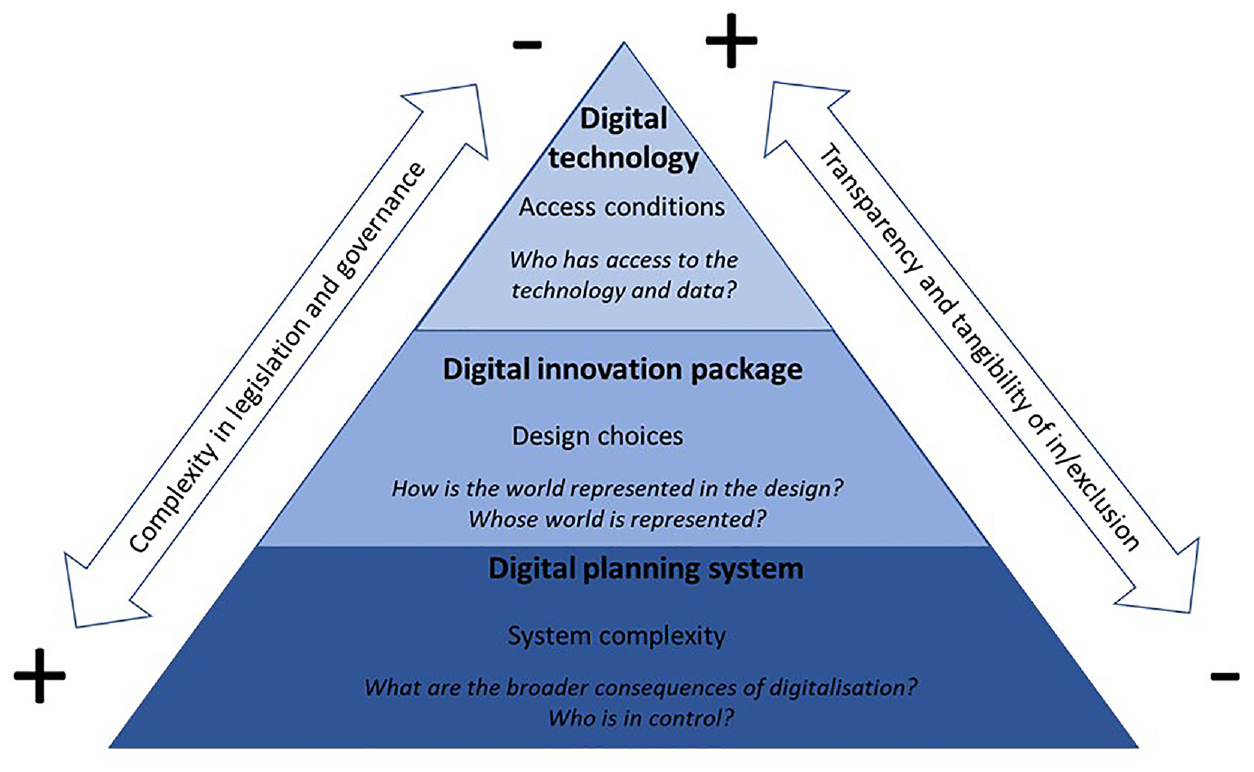
The levels at which digital and data inclusion and exclusion can appear Source: adapted from McCampbell et al. (2021: 203).
We have chosen to adapt the framework used by McCampbell and colleagues because it was devised to look at digitalisation within a system already characterised by inequality (agriculture in Africa), and the extent to which the introduction of digital technologies would reduce, or exacerbate, that inequality. Our proposition is that urban planning is likewise a system which is riven with inequality, and therefore considering how digitisation interacts with such inequality is a vital, and underexplored, question. In the three subsections below, we analyse the layers in this diagram in turn, before bringing the three together in our conclusion.
Digital technology: The digital divide and engaging citizens
In planning systems digital inclusion and exclusion are most tangible at the individual level, relating to who has access to digital technologies and planning processes, and the factors influencing individual citizens’ engagement with digital planning systems. The goal of soliciting meaningful public engagement from individuals and groups in the community has been a touchstone of inclusive planning practice in many contexts around the world for decades – in large part as a response to the top down ‘planning disasters’ of the 1950s and 1960s (Arnstein, 2019; Damer and Hague, 1971). However, soliciting broad public engagement has often proven to be a challenge. Some scholars argue that digital technologies are the answer to this problem and can substantially increase the transparency, inclusivity of public participation processes and engagement with planning issues more broadly (Kleinhans et al., 2015; Stratigea et al., 2015). It is hoped that online participatory tools such as web-based applications (e.g. FixMyStreet, PlaceSpeak), or social media (e.g. Facebook, Nextdoor, Twitter) can give citizens more access to digital planning by increasing their capacity and flexibility to engage with planning issues. This is because they can do so at their own convenience rather than attending an in-person town hall event at a specific time for example (Wilson et al., 2019). Digital technology is also suggested to be a means of engaging with citizens who have traditionally been difficult to engage in planning processes, such as teenagers (Hasler et al., 2017). Despite the purported opportunities and benefits of digital technologies in public participation, digital technologies present new challenges for inclusion in planning, particularly relating to accessibility, ability, and reliability/trust.
Even in the Global North, where digital technology has the greatest uptake, there is a digital divide (e.g. Lucendo-Monedero et al., 2019) between some groups and individuals in society – often those who are economically less well off or otherwise excluded/in a minority group have a significantly reduced capacity for digital engagement. Despite constantly improving availability, and accessibility of technologies in the past 20 years, many citizens remain unable to participate in planning processes due to lack of access to specific technologies such as the internet, and/or a lack of digital skills needed to fully engage with available technologies (Charlton et al., 2023; Kolotouchkina et al., 2023). For example, the UK Office for National Statistics found in their 2020 Opinions and Lifestyle Survey that only 54% of adults aged 75 years and over use the internet, and 4% of UK households do not have access to the internet at home (ONS, 2020). Further, much of the most interesting planning globally is taking place in areas where digital technologies are either less ubiquitous or where the use of technology is state-circumscribed. For example, government-led adoption of digital technologies for participation in countries such as Iran has been met with wariness from citizens due to concerns around efficacy, and whether such processes are genuine in their engagement with citizen perspectives on planning issues (Shahab et al., 2021). This suggests that digital-only or digital-first approaches have the potential to exacerbate the digital divide by automatically excluding certain individuals and groups, leaving such citizens disenfranchised, and the planning process vulnerable to biases and the uneven distribution of planning outcomes.
The fact that digital technologies are not uniformly used or accessible may have the result of narrowing public participation (Wilson and Tewdwr-Jones, 2022). This point is broader than simply referring to older people who may not possess the means or the desire to engage digitally – there is anecdotal evidence that many younger people are increasingly disengaged from some digital platforms (Kale, 2018). This challenges the current arguments in the literature surrounding the use of digital technologies to better engage with younger citizens. Further, the scope for more people to be involved through technology does not automatically mean that engagement has been more effective – quantity does not equal quality (Wilson et al., 2020). Just as social media has not made electoral democracy more transparent and objective, so too is there evidence that digital technologies are making decision making more difficult as reliable information is increasingly difficult to discern (Hollander et al., 2020). Some online platforms used in consultation processes require little verification of an individual’s identity (e.g. Twitter, which was recently rebranded as ‘X’), or enable anonymous participation (e.g. online surveys), enabling citizens to obscure or entirely hide their identity (Pantić et al., 2021). This anonymity means that individuals or groups with alternate and possibly nefarious interests may seek to deliberately subvert democratic planning processes (Hegelich and Janetzko, 2021; Hollander et al., 2023). The result of this may be that citizens’ campaigning on local planning issues may not always be premised on wholly accurate facts and certain inaccurate perspectives may be amplified while others are excluded or ignored.
Digital innovation package: Representation and the human element
Digitalisation of the planning system and the selection of specific technological packages inherently includes risks to the inclusivity of the planning system because ‘it requires decision-making about the world that the technology and the data collected represents’ (McCampbell et al., 2021: 207). While technologies that emerged in the 2000s, such as social media and mobile devices, provided greater connectivity between individuals, more recent advances in technologies such as artificial intelligence (AI), machine learning, and algorithms have revolutionised the way in which we shop, travel, study, and interact with the world in recent years. AI and the unprecedented ubiquity of data from digital devices provides planners with the equally unprecedented capacity to automate their work and gain insight into human behaviours, desires, and movements within urban environments (Son et al., 2023). However, the adoption of this increasingly smart package of technologies represents a significant risk to the public interest and inclusivity of the planning system and its decisions.
The data collection methods and algorithms used to analyse the data generated by citizens are rarely developed in collaboration with communities, leading to planning processes and decisions made using AI and algorithms becoming ‘black boxes’ with limited transparency (Sanchez et al., 2023). AI is trained by providing it with different data sets and teaching it to identify patterns, as such ‘if the data used to train the model does not represent the entire community, the outcomes and decisions will be biased’ (Sanchez et al., 2023: 181). This is particularly concerning as some scholars argue that the use of algorithms that assess large quantities of data may lead to assumptions that using a data-driven approach can ‘depoliticise planning’ due to the verifiable and accessible nature of data in most cities (Safransky, 2020). Consequently, this leads to the risk of assumptions in the public that planning decisions derived from AI are more objective than those made by human planners, despite concerns regarding the biases, and fairness of the algorithmic design (Safransky, 2020).
The common questions that planning practice must resolve – urban design, the provision of public goods attendant to consented development, debates about the character of new development relative to the environment that accommodates it – all require the mediation of competing interests. At the moment these are human negotiations that proceed on the basis of qualitative judgements, and some have suggested that using this emerging digital innovation package to automate or otherwise digitise these judgements is impossible, at least given current technologies (Potts, 2020). The pace of change in this field, however, has led others to raise concerns that such automation is indeed a ‘risk’ of ‘embracing the seductive promises of PropTech’ (Chapman et al., 2020: 46). Technology is seen by some as a means to reduce the time taken to make planning decisions – often described as ‘delay’ (UK Government, 2020) by politicians and the development industry. One person’s ‘delay’, of course, is another’s essential period of time for consideration of complex development proposals, and it is also the case that proper engagement with the public takes time.
This potential injection of digital technologies into this space of what has historically been human-to-human negotiation opens up a new front on a long-standing debate in planning theory regarding the uneven exercise of power. From Forester (1989) to Mouffe (2002) there has been long standing anxiety regarding how power and agency are exercised through planning systems. This valuable work which has had such a formative effect on planning theory inherits the a priori position that power is human-agential. In the short run this position may remain relevant with the question becoming how the increasingly sophisticated package of emerging technologies being adopted amplifies or disrupts existing power relations. However, over the medium term and beyond there is the potential for digital technologies, particularly in artificial intelligence and machine learning, to participate in planning activities that were historically the preserve of human negotiation.
This debate about how far digital technologies such as AI should be embedded into planning processes requires revisiting the broader question of whether ‘technocracy’ leads to the (over) emphasis of technical knowledge in the management of contemporary cities (Raco and Savini, 2019), at the expense of softer and more inclusive skills. This has historically been understood as part of the post-political turn, and the exclusion of perspectives that might challenge prevailing orthodoxies. The use of specific PlanTech/PropTech packages is feared by some to presage further technocratisation of planning, privileging certain perspectives over others and removing or minimising the opportunity for community engagement or even professional input by planners. As a precedent, we can point to experiences of the outsourcing of previous generations of PlanTech, such as GIS, as part of the New Public Management paradigm, with opportunities to reform and democratise decision-making missed (Daniel and Pettit, 2021).
A digital planning system?
The implications of the preceding two categories are that the future of planning practice is likely to demand reconsideration of some ‘traditional’ questions of inclusion/exclusion that will take on a new dynamic in the digital age. In this regard there are at least two issues for the future governance of planning systems that will require renewed focus.
First, as shown by the arrow on the left side of Figure 1, system complexity is likely to increase as anxieties about the reliability of data simultaneously increases, and there is a need for greater levels of regulation and governance structures to address such concerns. The potential for the spread of misinformation with the advent of artificial intelligence and machine learning is now a central concern regarding the development of these technologies in general (Epstein et al., 2022; Kreps et al., 2022). With respect to planning, the potential for misinformation to spread is likely to increase as the fora in which planning deliberations take place are redistributed away from the traditional venues (city halls, community centres) to mass social media, filtered by interest groups and corporate interests. A survey conducted by the Royal Town Planning Institute and reported in March 2023 points to this direction of travel with 87% of UK planners saying that ‘social media fuels misinformation on local planning issues’ (RTPI, 2023). Planning will be no more immune from the quest to preserve truth and rational discourse in the face of misinformation than any other sphere of public life/civic society.
Second, there is a real danger that the nascent infusion of digital technologies into planning could result in traditional power asymmetries being amplified, particularly that between well-resourced and well-organised commercial entities and a diffuse, under-resourced ‘public interest’. Some have likened the contemporary moment to the dominant mode of planning in the mid-20th century, one characterised by modernity and the reification of technical expertise. Then, as perhaps now, technocracy led to the dominance of a particular view of the city, reflecting particular power dynamics (Cook and Karvonen, 2024). In the 1960s, addressing this imbalance was understood to require training to ensure citizens were able to play equitable roles in the planning process, along with a re-framing of expert–citizen relations (Arnstein, 2019). For example, almost 20 years ago Curwell et al. (2005: 55) argued for ‘the importance of e-skills development in new forms of e-planning for planners, developers and citizens’ as this would be ‘important for achieving a wider e-enabled sustainable knowledge society’. However, subsequent years, and particularly the growth in AI and machine learning, may potentially result in an even greater power imbalance than has historically been the case – one that citizen training may be insufficient to overcome (Cook and Karvonen, 2024). The prime example in this space is Carr and Hesse’s (2020: 69) work on the involvement of the tech giant Alphabet Inc. in the development of the Toronto waterfront, which alerts us to the ways in which ‘municipalities and their modes of urban planning are vulnerable to the political economic manoeuvrings of large corporate power’ (see also, Carr, 2021). As illustrated by the arrow on the right side of Figure 1, the increasing reliance of planning systems on private technology companies and their ‘black box’ software packages (including algorithms with unclear assumptions) may mean that planners are less capable of being transparent in their decision-making. The integration and reliance on algorithms and other software may also inadvertently mean that public urban data is used to benefit the private sector, which in turn may exacerbate social inequalities, and increase exclusion.
Conclusions
This paper has been written during a time when ‘AI’ has become a familiar term for many of us – following several decades where it was portrayed in the popular media, in often dystopian terms, as a (hopefully) distant threat. The recent emergence of large language models such as ChatGPT is forcing policy makers, and wider society, to grapple with sometimes uncomfortable questions. In this article we have sought to engage with such questions in relation to digital planning.
We firstly reviewed existing literature on the topic from around the world, noting significant variations between countries and contexts, and identifying a series of common themes, considering the effects of digital technologies on public engagement in decision-making processes, inclusivity (or otherwise) of those processes, and how planners and others have sought legitimacy for decision made – perennial issues for planning in general. We then introduced our conceptual framework, adapting that developed by McCampbell et al. (2021) which explored digitalisation in a different but conceptually similar context, one characterised by inequality. Through that framework we have sought to problematise digital planning at three levels – Digital Technology, Digital Innovation Package and Digital Planning System. In relation to all three levels, the typology which we have developed illustrates that many of the questions that have defined debates on inclusion in planning take on a different form of significance to how they have been formulated in the past. For example, the ‘traditional’ questions – who should we be planning for, where does power lie and which interests are most prominently considered and which are excluded – remain relevant but the emergence of digital technologies is likely to make these questions even more abstruse: misinformation and the use of non-human-agents in its propagation together with the activities of ‘bad actors’ have profound implications for the theoretical frameworks we have historically employed to consider them, most notably the all-too-human, communicative turn. In this paper we have sought to initiate a debate on what a theoretical framework might look like to understand planning in a digital age and, in so doing, build upon the questions posed by Anderson and Jung in this journal in relation to the use of data in smart cities: ‘by and for whom (or what) [will data be used], how, in relation to what technologies, innovations, and processes, and towards what outcomes and futures?’ (Anderson and Jung, 2023: 14). These, then, are pertinent questions for urban scholars in general and planners specifically.
While the great hope of digital planning advocates is that it will speed up the decision-making process, open up processes and replace those mythological recalcitrant planners, we find grounds to believe that precisely the opposite may prevail. The capacity afforded by digital technologies to spread misinformation rapidly, very convincingly and in a highly targeted way, combined with the rise of strident forms of identity politics, means that digital technologies may actually result in more complex and lengthy decision-making processes. It is certainly far too early to conclude that digital technologies will make planning easier.
Fundamentally the reason why digital technologies may make less of an impact on planning than some expect is that it is a public-facing activity. Planning often takes longer than politicians might like because professional planning practice is (human) behaviourally complex and the outcomes upon which we settle, in liberal democracies, are often compromises. Consequently, it is perhaps inevitable that digital technologies will come to play more of a role in planning practice (particularly the ‘back office’ administrative aspects of the activity) and the public’s engagements with it, continuing a trend of the last three decades or more (Wilson and Tewdwr-Jones, 2022). However, it is far from clear that it will make things more straightforward or more readily present publicly acceptable answers to the questions with which planning deals – so long as we are planning for people.
There is little doubt that technology can be used to make planning more democratic, to open up engagement, to build public trust in planning institutions, and to strengthen the legitimacy of planning decisions. The converse, however, is also true – every choice made in relation to the digitisation of planning, as with the profession more widely, is a trade-off, with unequal distribution of costs and benefits. As has recently been suggested in these pages, perhaps we need to move beyond a binary assumption of smart city tech as being simply ‘pro- or anti-democratic’ (Tseng et al., 2024: 125), and recognise that a dialectical approach holds more value, highlighting how urban communities can become involved in shaping collective knowledge, even on digital platforms. More generally, however, there is a need for scholars of planning and other fields to continue to engage with these issues, and not to fall into the trap of ‘techno-utopianism’.
Footnotes
Declaration of conflicting interests
The author(s) declared no potential conflicts of interest with respect to the research, authorship, and/or publication of this article.
Funding
The author(s) received no financial support for the research, authorship, and/or publication of this article.
