




Abstract
Based on the preparation of grouting materials with high-volume mineral admixtures, the effects of chemical admixtures including early-strength components and retarding components on the grouts with volume mineral admixtures were investigated. The results show that early-strength components have little effect on the grouts with high-volume mineral admixtures. Retarding component sodium gluconate does not play a great role for the grouts with high-volume mineral admixtures. However, the incorporation of borax and sodium tripolyphosphate can greatly improve the properties of the grouts, mainly due to their composite effect. The appropriate compound content is 0.4 wt% borax and 0–0.2 wt% sodium tripolyphosphate of cementitious materials. When 0.4 wt% borax and 0.2 wt% sodium tripolyphosphate were added to the grouts with volume mineral admixtures, initial fluidity and 30-min fluidity are 340 mm, and 1-, 3-, and 28-day compressive strength are, respectively, 41.6, 57.1, and 81.5 MPa. These values far exceed the standard requirements. It also shows that early-strength components and sodium gluconate can be neglected when high-volume mineral admixtures are added to the grouts.
Keywords
Introduction
Cement grouts are widely used for diverse grouting applications including crack and joint, posttensioning duct, anchorage, ground treatment, borehole backfill, collapse stabilization, rock or soil permeability reduction, concrete repair, and oil well completion. 1 –6 To ensure high fluidity, stability, and adequate mechanical properties, chemical admixtures are used separately or together in grout mixes with the aim to obtain appropriate properties. 7
Chemical admixtures are chemical ingredients added to grouts during mixing to improve the properties of the mixes in their plastic or hardened state. Uses of chemical admixtures have greatly increased during the last three decades and are now incorporated in most mix designs. 8 It is known that chemical admixtures not only increase the workability but also modify the physical properties of cement pastes by reducing macrovoids and improving the bond strength of the polymer cement mortars to aggregates. 9,10 Depending on the type and the amount of admixtures, different advantages can be achieved through their use.
Chandra and Björnström 11,12 found that fluidity and slump loss varied with the type and dosage of superplasticizer. Łaźniewska-Piekarczyk 13 demonstrated that the type of chemical admixtures and their interaction significantly influenced the properties of very high-performance self-compacting concrete. Sahmaran et al., 14 AzariJafari et al., 15 Lenart, 16 Bizinotto et al., 17 and Habib et al. 18 studied the effects of chemical admixtures on the properties of cement mortar. Another study of Habib et al. 19 pointed out chemical admixtures enhanced the hardening and plastic properties of the cement pastes. El-Gamal et al. 20 investigated the effects of superplasticizers on the hydration kinetic and mechanical properties of Portland cement pastes and obtained the addition of sodium lignosulfonate or naphthalene sulfonate-formaldehyde condensate caused a notable improvement in the mechanical properties of the hardened pastes. Zhao et al. 21 found that superplasticizer reduced the thickness of water diffusion layer and increased the flowability of the paste. Zhang et al. 22 presented starch-based admixture reduced hydration heat in cement composites. Saric-Coric et al. 7 reported that chemical admixtures such as high-range water reducing admixtures and viscosity-modifying admixtures were used separately or together in grout mixes to obtain appropriate properties. Anagnostopoulos 23 investigated the effect of a new-generation polycarboxylate superplasticiser on the rheological property, mechanical strength, final setting time, and bleeding of cement grouts in comparison to those of a polynaphthalene superplasticiser. Hanehara and Yamada 24 explored the interaction between cement and chemical admixture from the point of cement hydration, absorption behavior of admixture, and paste rheology.
However, one of the disadvantages of grouting materials is their cost, associated with the use of chemical admixtures and the use of high volume of cement. One alternative to reduce the cost of grouting materials is the use of mineral admixtures, especially the addition of solid wastes, such as fly ash (FA), silica fume, and blast furnace slag. 25 –29 Another way is to use as little chemical admixture as possible. The studies by using a ternary complex system of sulfoaluminate cement (SAC), aluminate cement (CA), and gypsum to prepare the grouts have been carried out in our previous work. 30 –32
The purpose of this article is to research the effects of chemical admixtures on the properties of the grouts with high-volume mineral admixtures. To further reduce the preparation cost of grouting materials with high-volume mineral admixtures, the addition and dosage of chemical materials are determined.
Materials and methods
Raw materials
The ternary complex system included rapid-setting SAC (grade 42.5) and CA (grade 50) produced by Yangquan Special Cement Factory (Shanxi, China) and natural dihydrate gypsum. The chemical composition of SAC, CA, and gypsum was presented in Table 1. The physical properties of the SAC and CA were given in Table 2.
Composition of SAC, CA, and gypsum (wt%).

SAC: sulfoaluminate cement; CA: aluminate cement.
Physical properties of SAC and CA.

SAC: sulfoaluminate cement; CA: aluminate cement.
The mineral admixtures used in grout mixes were FA (grade I) from Shaanxi Deyuan Fugu Energy Co., Ltd (Shaanxi, China) and ultrafine slag (UFS, specific surface area of 408 m2/kg) from Taiyuan Iron and Steel Group (Shanxi, China). The chemical composition of FA and UFS was listed in Table 3. The sand was quartz sand (sand II), weeding out particles larger than 5 mm, and the fineness modulus was 2.7.
Composition of FA and UFS (wt%).

FA: fly ash; UFS: ultrafine slag.
In addition, chemical admixtures contain early-strength components including lithium carbonate (A, chemically pure) and sodium sulfate (C, industrial) and retarder components including borax (industrial), sodium gluconate (G, industrial), and sodium tripolyphosphate (S, chemically pure), polyether defoamer (X, industrial), and naphthalene superplasticizers (N). The naphthalene superplasticizers allowed a water reduction rate of more than 20%.
Preparation of the grouts with high-volume mineral admixtures
In the study, the contents of SAC, CA, and gypsum in the ternary complex system were determined in previous study 31 and were 67, 23, and 10 wt%, respectively. The grouts with high-volume mineral admixtures were prepared by 1:5 of UFS ratio to FA replacing 40% of cementitious material. 32 The chemical admixtures including early-strength components, retarder components, and SPs were added mainly to detect whether they can improve the performance of the grouts. The general experimental scheme was presented in Table 4. In Table 4, the additives were calculated by the weight percentage of cementitious materials, and quartz sand was used to supplement the remaining part. The dosage of water was determined as a percentage of the grouts. Samples 1–4 were grouting materials with different contents of early-strength components (A and C). Samples 5–9 were grouting materials with different contents of G. Samples 10–18 were grouting materials with different contents of borax and S.
The general experimental scheme (g/kg).
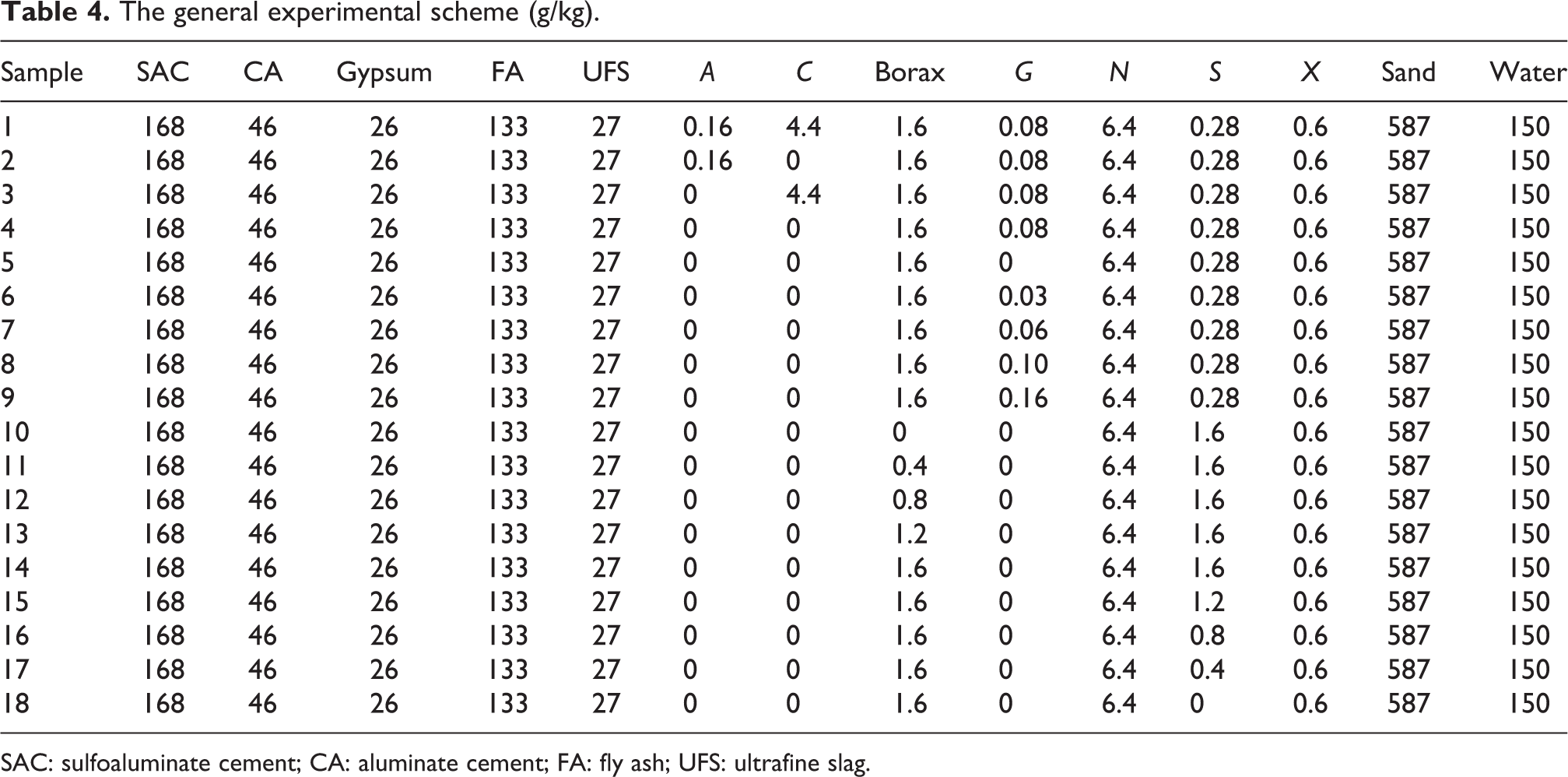
SAC: sulfoaluminate cement; CA: aluminate cement; FA: fly ash; UFS: ultrafine slag.
Test methods
Setting time and fluidity tests were conducted on the basis of the Chinese Industry Standard JC/T 986-2005 (Beijing, China) “Cementitious grout.” 33 The fluidity of the grouts was measured using slump cone, with lower diameter, upper diameter, and height of 100, 70, and 60 mm, respectively. After pouring fresh mixtures in the cone to full capacity, the cone was lifted straight upwards to allow free flow. The fluidity was determined by measuring the diameters of the mixtures at two vertical directions. To determine the fluidity loss, the fluidity of the mixtures was measured repeatedly at 30 min after mixing. According to the International Standard ISO 679-2009 “Cement–Test methods–Determination of strength,” 34 the strength of grouting materials was measured, mainly including 1-, 3-, and 28-day compressive strength. The samples were prepared into standard mortar prisms (40 mm × 40 mm × 160 mm). The morphology of the hydration product was examined by S-4800 field emission scanning electron microscope (FESEM, S-4800; Hitachi, Japan).
Results and discussion
Effects of early-strength components on the properties of the grouts
In the research of super early-strength grouting materials, it was found that early-strength components contributed a lot to the hour strength of the grouts. 32 However, when the grouts mixed with high-volume mineral admixtures were applied to reinforce old buildings, the properties of the grouts were found to be worse. Therefore, it is necessary to study the effects of early-strength components on the grouts with high-volume mineral admixtures. The results are shown in Figures 1 and 2.
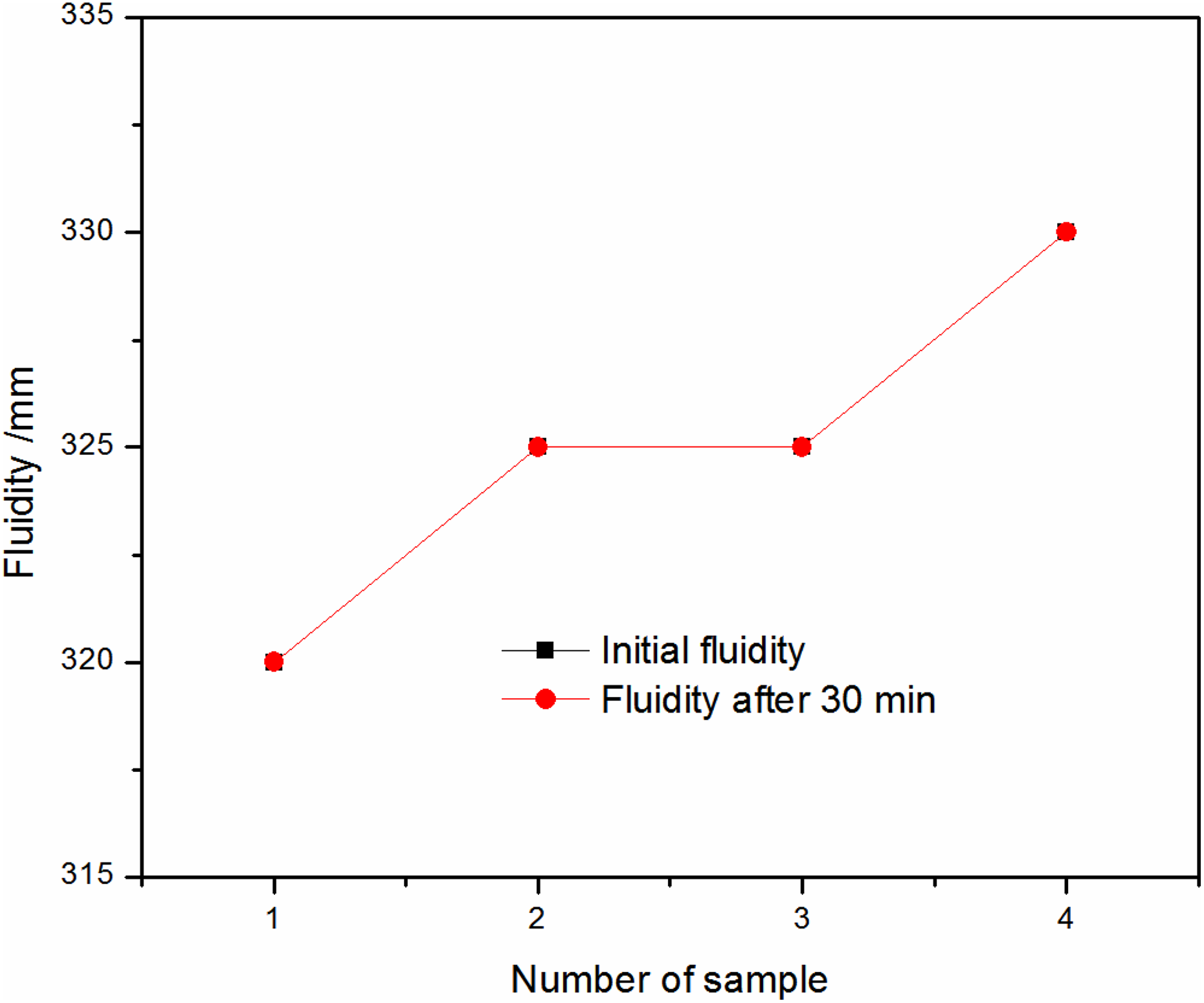
Effect of early-strength components on the fluidity of the grouts.

Effect of early-strength components on compressive strength of the grouts.
Figures 1 and 2 present the effects of early-strength components on the fluidity and compressive strength of the grouts with high-volume mineral admixtures, respectively. It is clear that early-strength components A and C have little effect on the fluidity and 30-min fluidity of the system, while they have a certain influence on the compressive strength of the grouts at different ages. From Figure 1, the fluidity has no loss for each sample. In addition, the initial and 30-min fluidity of the grouts mixed with A or C alone (samples 2 and 3) are the same (325 mm), slightly higher than those of the grouts mixed with A and C together (sample 1), and slightly lower than those of the grouts without early-strength component (sample 4). Moreover, the initial and 30-min fluidity of the grouts mixed with A and C together are obviously lower than those of the grouts without early-strength component, which is resulted from the characteristic of early-strength component. In any case, these fluidities far exceed the standard requirements. The standard requirements of initial fluidity and 30-min fluidity retention value on cementitious grouts are ≥260 mm and ≥230 mm, respectively.
The standard requirements of 1-, 3-, and 28-day compressive strength of cementitious grouts are not less than 22, 40, and 70 MPa, respectively. In Figure 2, 1- and 3-day compressive strength of the grouts with early-strength components A and C alone or together is higher than those of the grouts without early-strength component, which is obviously due to the role of early-strength component. However, 28-day compressive strength of the grouts without early-strength component is obviously higher than that of the grouts with A and C alone or together, which is consistent with the performance of early-strength components in concrete. In addition, 1- and 3-day compressive strength of the grouts with A and C together (sample 1) is obviously higher than those of the grouts with A or C alone (sample 2 or 3), while 28-day compressive strength of the grouts with A and C together is slightly higher than that of the other samples. Most importantly, 1- and 3-day compressive strength of all samples far exceed the requirements, while 28-day compressive strength of the grouts with early-strength component just meet the requirement and 28-day compressive strength of the grouts without early-strength component reaches the maximum. This indicates that early-strength component has played a side effect in the preparation of grouting materials with high-volume mineral admixtures. Therefore, it is possible to prepare the grouting materials with high-volume mineral admixtures and without adding the early-strength component.
Effects of sodium gluconate on the properties of the grouts
To further reduce the preparation cost of the grouts, the effects of additives on the properties of the grouts were studied. The effects of sodium gluconate on the grouts with high-volume mineral admixtures (samples 5–9) were displayed in Figures 3 and 4. As seen in Figure 3, there is no loss of 30-min fluidity for the grouts with sodium gluconate. That is to say, the 30-min fluidity is consistent with the initial fluidity. The fluidity of the grouts without sodium gluconate is the same (320 mm) as that of the grouts with 0.03 and 0.10 g of sodium gluconate. The fluidity of the grouts with 0.06 g of sodium gluconate is 325 mm and slightly higher than that of the grouts without sodium gluconate. Furthermore, the fluidity slowly increases with increasing the dosage of sodium gluconate, and the fluidity of the grouts with 0.16 g of sodium gluconate increases to 330 mm. In short, the addition of sodium gluconate does not play a great role for the grouts with high-volume mineral admixtures.

Effect of sodium gluconate on the fluidity of the grouts.
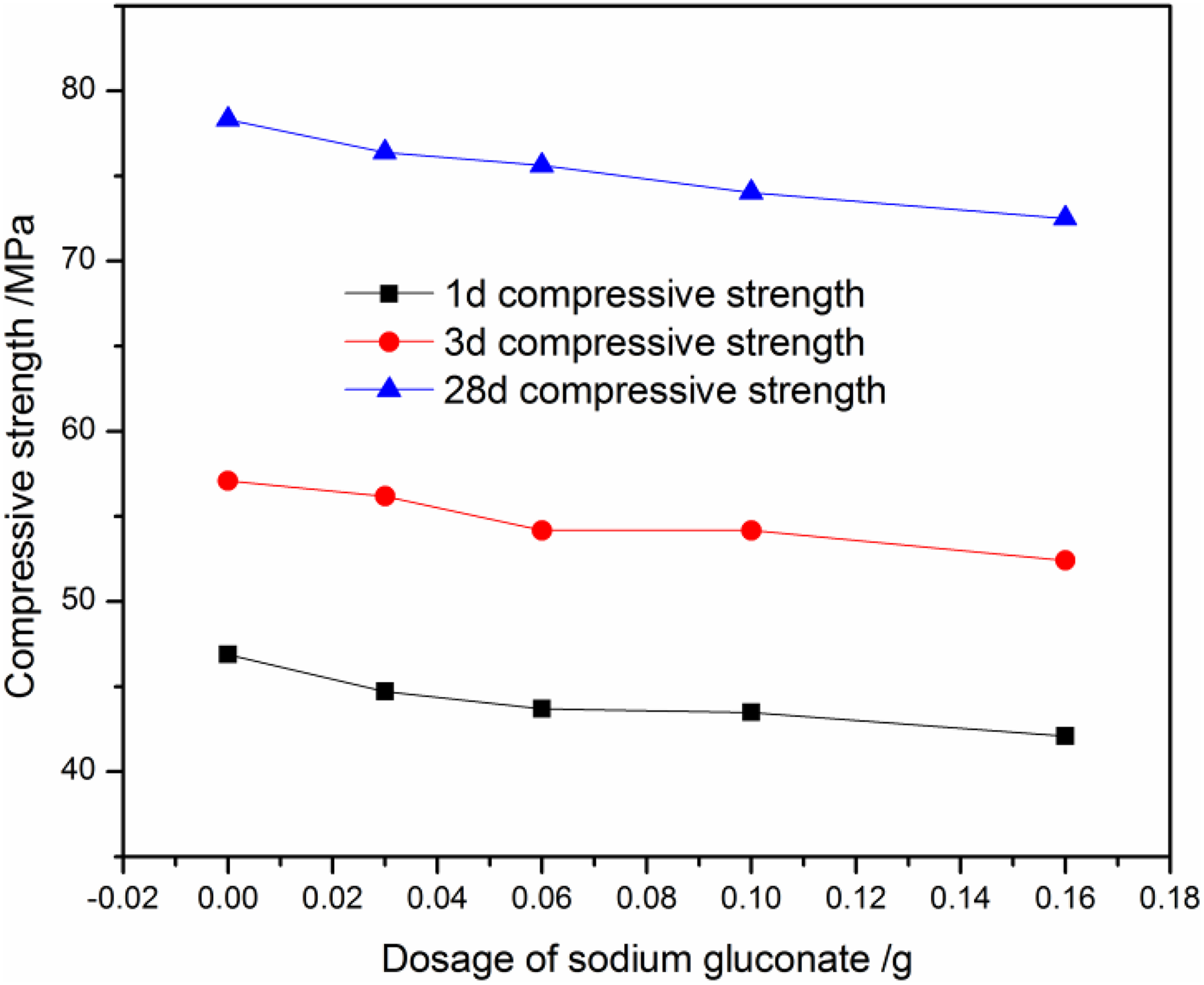
Effect of sodium gluconate on compressive strength of the grouts.
Figure 4 presents the relationship between the strength of the grouts and the content of sodium gluconate. It is obvious that 1-, 3-, and 28-day compressive strength of the grouts slowly decrease with increasing the dosage of sodium gluconate. This is mainly caused by the retardation of sodium gluconate. One- and 3-day compressive strength of all samples far exceed the requirements, while 28-day compressive strength of the grouts containing high content of sodium gluconate just meets the requirements. Therefore, sodium gluconate in the grouts with high-volume mineral admixtures can be ignored.
Effect of borax on the properties of the grouts
Figures 5 and 6 show the effects of borax on the properties of the grouts with high-volume mineral admixtures (samples 10–14). In Figure 5, the fluidity of the grouts obviously increases as the amount of borax increases. The initial fluidity and 30-min fluidity of the grouts without borax are, respectively, 320 and 315 mm, while those of the grouts added 0.4 g borax increase to, respectively, 325 and 320 mm. When the amount of borax is added to 0.8 g, no loss of fluidity occurs. At this time, the fluidity is 330 mm. The fluidity reaches the maximum (345 mm) as the amount of borax is increased to 1.6 g. This fully demonstrates that the addition of borax has a good retarding effect.

Effect of borax on the fluidity of the grouts.
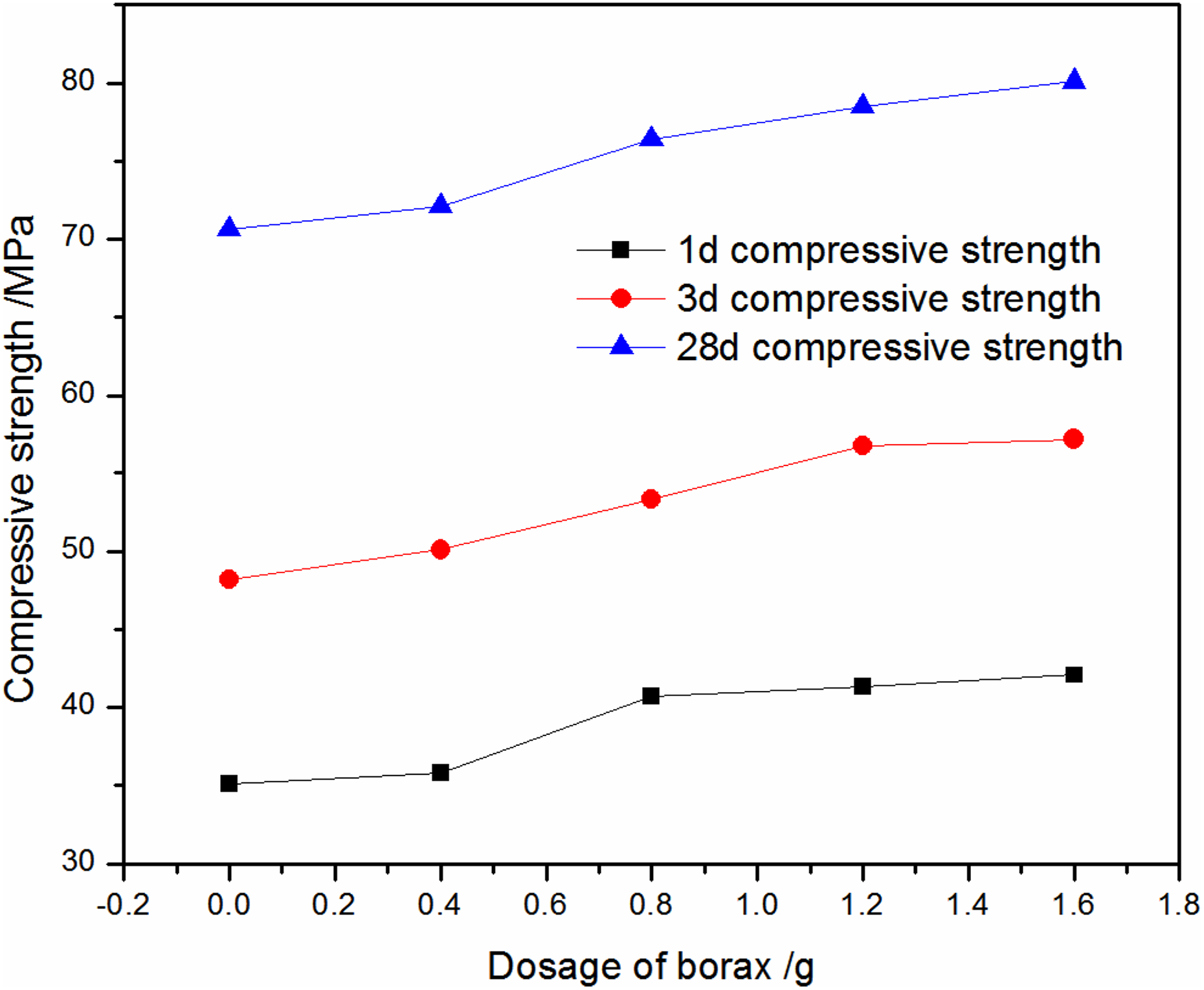
Effect of borax on compressive strength of the grouts.
Figure 6 is the effect of borax on the compressive strength of the grouts. It can be seen that the compressive strength of the grouts gradually increases with the amount of borax. Compressive strength slowly increases when the amount of borax is 0.4 g, while strength greatly increases when the amount of borax is 0.8 g. When the amount of borax is added to 1.2 g, 1- and 3-day strength keep steady. However, 28-day compressive strength continues to increase and far exceeds the standard as the borax content is 1.6 g. The higher the borax content, the higher the strength exceeds the standard. This shows that the addition of borax has a positive effect on the strength of the grouts with high-volume mineral admixtures.
Effect of sodium tripolyphosphate on the properties of the grouts
Figures 7 and 8 present the effects of sodium tripolyphosphate on the properties of the grouts with high-volume mineral admixtures (samples 14–18). From the above, the addition of borax is beneficial to improve the performance of the grouts with high-volume mineral admixtures. Therefore, the effect of sodium tripolyphosphate on the grouts is based on the addition of borax, and the amount of borax added is 0.4 wt% or 1.6 g. Figure 7 is the fluidity of the grouts with the addition of sodium tripolyphosphate. Obviously, there is no loss of 30-min fluidity for the grouts with sodium tripolyphosphate. In addition, the fluidity gradually increases with the increase of sodium tripolyphosphate. When sodium tripolyphosphate is increased by 0.4 g, the fluidity of the grouts increases sharply, which is 20 mm higher than that of the grouts without the addition of sodium tripolyphosphate. Then, the fluidity of the grouts increases slowly with the addition of sodium tripolyphosphate. When the dosage of sodium tripolyphosphate is 0.8 g and 1.2 g, the fluidity remains unchanged (340 mm). The fluidity achieves the maximum (345 mm) as the dosage of sodium tripolyphosphate is increased to 1.6 g. This indicates that the addition of sodium tripolyphosphate plays a good retarding role.

Effect of sodium tripolyphosphate on the fluidity of the grouts.

Effect of sodium tripolyphosphate on compressive strength of the grouts.
The effect of sodium tripolyphosphate on the compressive strength of the grouts is shown in Figure 8. One-day compressive strength decreases slowly and then increases with increasing the amount of sodium tripolyphosphate, but the change is not big. However, 3- and 28-day compressive strength first increase and then decrease gradually with increasing the amount of sodium tripolyphosphate. When the amount of sodium tripolyphosphate is 0.4 g, 3-day compressive strength increases from 56.3 MPa to 60.5 MPa, while 28-day compressive strength increases from 78.6 MPa to 82.4 MPa. After then the strength gradually decreases. Three- and 28-day compressive strength, respectively, attain 55.4 and 76.4 MPa as the amount of sodium tripolyphosphate is 1.2 g. The compressive strength increases again as sodium tripolyphosphate increases to 1.6 g. Combined with the analysis of the fluidity, the appropriate dosage of sodium tripolyphosphate is 0–0.8 g, which is 0–0.2 wt%. In a word, the composite effect is obvious as the borax content is 0.4 wt% and the sodium tripolyphosphate content is 0–0.2 wt%.
According to the previous research, 32 compared with the traditional grouting materials, the cost of grouting materials with high-volume mineral admixtures was reduced by about 16%. However, based on the grouting materials with high-volume mineral admixtures, the cost of grouting materials optimized by chemical admixtures can be reduced by about 10%.
Microscopic analysis of the grouts
Figure 9 shows SEM images of the microstructure of the hydrated grouts mixed with high-volume mineral admixtures and added with 0.4 wt% borax and 0.1 wt% sodium tripolyphosphate at different hydrated time. From Figure 9(a), a large number of fine needle ettringite exist and these crystals are short after 1 day of hydration, which shows the ettringite crystals have a steady growth at 1 day of hydration. These fine needle ettringite can make the grouts possess primary strength. After 3 days of hydration (Figure 9(b)), fine needle ettringite crystals obviously grow into coarse and long needle shape, and a small amount of fine needle ettringite also exist. This indicates that the formation reaction of ettringite still progress. After the hydration of 28 days (Figure 9(c)), longer needle ettringite crystals appear and are interlaced, which make the strength of the grouts higher. Without early-strength components, the addition of mineral admixtures can make the ettringite crystals longer and act as reinforcement. As the main hydration product in the ternary, ettringite is essential to enhance the hardened strength of the system.
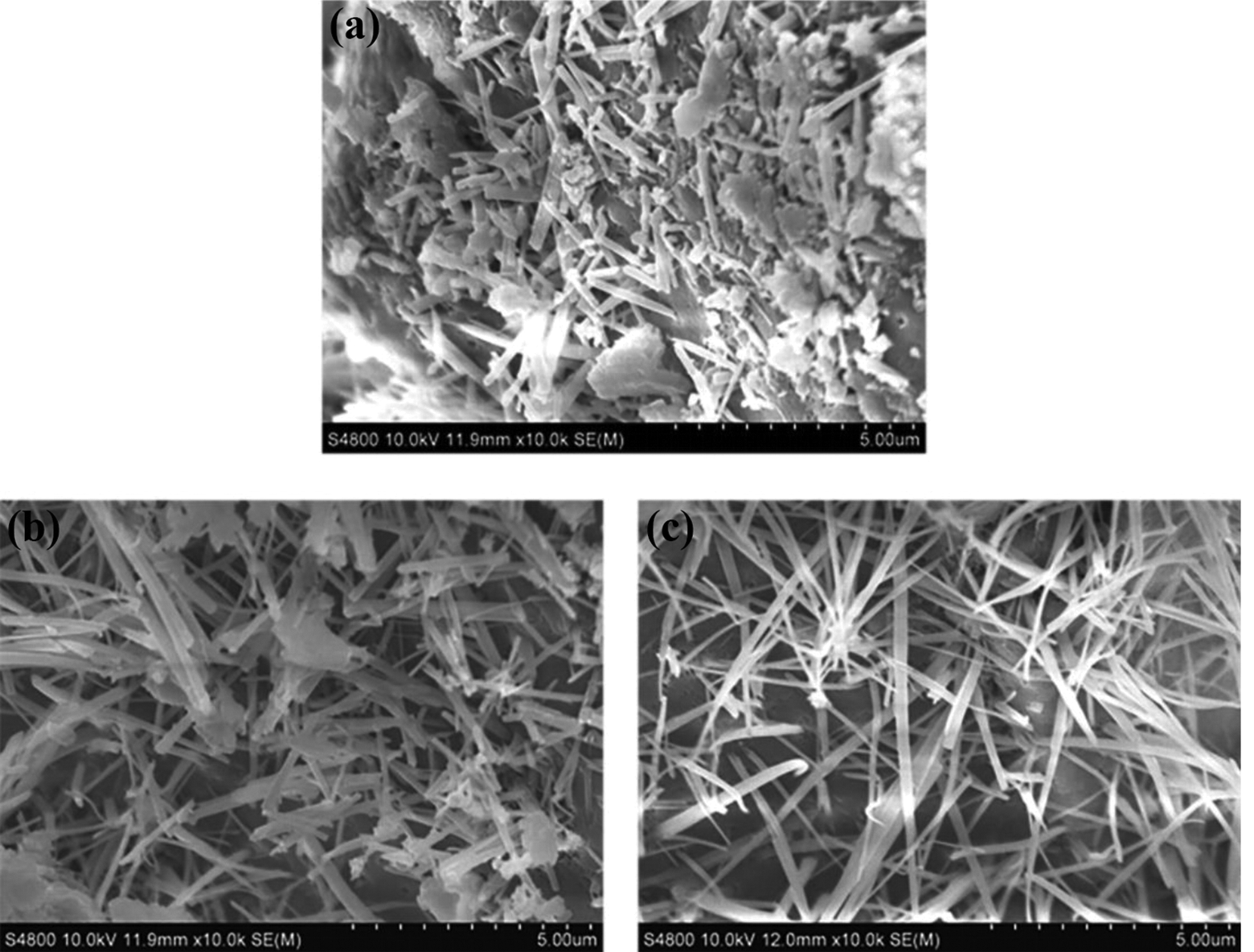
SEM images of the hydrated grouts: (a) 1 day, (b) 3 days, and (c) 28 days. SEM: scanning electron microscope.
Conclusions
The main conclusions drawn from the research can be summarized as follows: Early-strength components do not play a very significant role in the grouts with high-volume mineral admixtures, which may be related to the addition of mineral admixtures. After mixing with early-strength components, 1- and 3-day compressive strength increases while 28-day compressive strength decreases. In view of the cost, early-strength components can be ignored. The addition of sodium gluconate makes the strength of the grouts gradually decrease. This indicates that sodium gluconate plays a side effect. The addition of borax has a positive effect on the properties of the grouts with high-volume mineral admixtures. The fluidity of the grouts reaches the maximum (345 mm) and 1-, 3-, and 28-day compressive strength are, respectively, 42.1, 57.2, and 80.1 MPa as the amount of borax is up to 1.6 g. The incorporation of borax and sodium tripolyphosphate can greatly improve the properties of the grouts with high-volume mineral admixtures. The suitable dosage of sodium tripolyphosphate is 0–0.8 g. When 1.6 g borax and 0.4 g sodium tripolyphosphate were added to the grouts with volume mineral admixtures, initial fluidity and 30-min fluidity are 335 mm, and 1-, 3-, and 28-day compressive strength are, respectively, 42.1, 60.5, and 82.4 MPa.
Footnotes
Declaration of conflicting interests
The author(s) declared no potential conflicts of interest with respect to the research, authorship, and/or publication of this article.
Funding
The author(s) disclosed receipt of the following financial support for the research, authorship, and/or publication of this article: The research was sponsored by the Solid Waste Comprehensive Utilization Science and Technology Project of Xiangyuan County (2018XYSDYY-07) and the Key Research and Development (R&D) Projects of Shanxi Province (201803D31029).
