



Abstract
Human functional brain imaging research over the last 2 decades has shown that data from resting-state brain activity can help predict various psychological and pathological variables and brain function during tasks. However, most variables have been attributed to the individual brain. Recently, several studies have aimed to understand interpersonal relationships based on inter-individual similarity or dissimilarity of functional connectome. In this commentary, we introduce the studies that have opened up a new era of interpersonal research using human brain imaging.
Keywords
Introduction
Our brains constantly process vast amounts of information, even while resting. Twenty years have passed since the “default mode” of the organized functional brain was found in resting-state brain activity, 1 which had originally been ignored as a “baseline” for studying brain functions during tasks. Resting-state brain activity is now a major target of human brain imaging research.
The main topic of resting-state functional brain research is the “functional connectome,” which is a matrix of functional connectivity (temporal correlation) between all brain regions. The temporal resolution is related to the reliability of each functional connectivity, while the spatial resolution is related to the precision of the functional connectome (ie, the number of regions that can be examined). In another word, the higher the spatial resolution, the more brain regions form the connectome and the more information the functional connectome contains. Functional magnetic resonance imaging (fMRI) has a relatively low temporal resolution because it measures blood oxygenation, but it has a high spatial resolution and can measure deep brain regions. Therefore, fMRI has been widely used to acquire an information-rich functional connectome. Resting-state fMRI measurements can be performed in as little as 10 minutes and do not require any tasks, making it easy to collect data as long as one has access to an MRI system. However, resting brain function is attracting the attention of many researchers, not only because of the simplicity of data acquisition, but also because the data has fruitful information.
Previous studies have examined if the functional connectome has the potential to predict psychological/pathological characteristics of individuals. It has been shown that the resting-state functional connectome has information that can predict various psychological constructs (eg, Big Five personality traits 2 ) that represent general tendencies of behaviors and thoughts, and that the similarity of the functional connectome across individuals represents similarities in psychological constructs. 3 Furthermore, it has been revealed that the resting-state functional connectome can predict brain activity patterns while performing various socio-cognitive tasks 4 that require abilities essential for social interaction, such as emotion processing, language, and social cognition.5 -8
In this context, research objectives go beyond the within-individual prediction; parameters tied to dyadic relationships such as compatibility become the main targets of prediction. This paper introduces 2 recent studies published at similar time periods,9,10 which investigated psychological phenomena that have been explained intuitively but not yet scientifically proven: distance among individuals in a social network 9 and the compatibility of a dyad. 10 These studies defined new brain science indices and opened up a new era of interpersonal research using state-of-the-art methodology. Specifically, these studies are significant in that the methods proposed in these studies enabled the application of machine learning algorithms using neuroimaging data and prediction of psychological phenomena caused by the interaction between individuals that cannot be predicted by self-reported psychological indices. 11
“Like Attracts Like” Relationship Predicted Using Connectome Similarity
The tendency to be attracted to similar people, that is, “like attracts like,” has already been the subject of research in psychology; however, despite intuitive certainty, no clear relationship has been found between similarity and self-reported personality traits.12,13 Hyon et al 9 focused on the possibility that the functional connectome may predict tendencies of behaviors and thoughts that cannot be captured through self-report indices. They constructed a machine learning algorithm to predict social proximity based on the similarity of functional connectome patterns between 2 individuals and evaluated its prediction performance. The social network structure (ie, information on the presence weighted by emotional closeness or absence of personal interaction) was obtained from a survey of every resident of a village in a rural area of Korea. Brain activity data was obtained from a subset of the residents through resting-state fMRI. The similarity of the functional connectome in every dyad was calculated and used as the features of the machine-learning algorithm.
Before this study, the similarity of functional connectome has been the correlation value of vectorized functional connectome. 14 However, correlation values are insufficient features for machine learning algorithms, because they aggregated the information content of resting-state functional connectome patterns into a single index. In this study, the authors newly defined “connectome similarity” (“Connectivity difference calculation” in Figure 1; although this figure is for Kajimura et al 10 , the definition of connectome similarity is the same.), which has the same number of elements as the vectorized functional connectome, by calculating the absolute value of Euclidean distance for each element of the vectorized functional connectome. This enabled machine learning and the prediction of parameters associated with paired data, such as distance in a social network, without losing the information of the functional connectome.
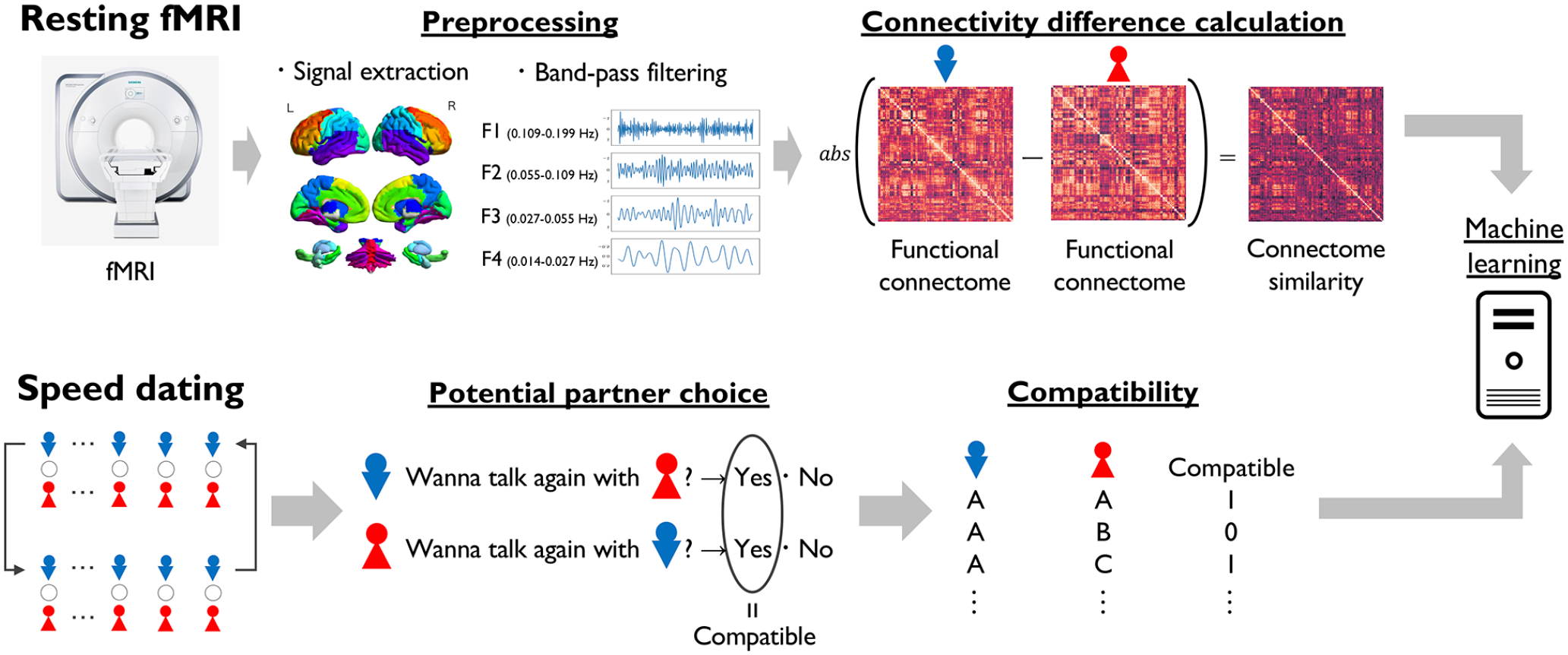
Schematic flow of experimental paradigm of Kajimura et al. 10
The results showed that the connectome similarity significantly predicted social proximity, even after controlling for the effects of age, gender, and Big Five personality traits. The most significant feature contributing to the prediction was the similarity of the default mode network, which is involved in various social cognitive processes. These results suggest that people get along with people whose brain functions are similar to their own, that is, there is a biological basis for “like attracts like.” However, there is also a possibility of reverse causality; brain function of individuals who get along with becomes similar to each other. Longitudinal studies are needed to reveal the causality.
The Feeling of “Being on the Same Wavelength” Predicted Using Connectome Similarity
The feeling of “being on the same wavelength,” or compatibility, can be felt even after only a few minutes of conversation with a person whom one has just met. 15 Is it possible to predict such a feeling using fMRI? Predicting compatibility between opposite-sex individuals is more difficult than predicting friendship as both similarity 16 and complementarity 17 affect compatibility. Indeed, some studies have attempted to predict compatibility between opposite-sex individuals based on self-reported psychological measures. 11 However, they failed to predict compatibility, in spite of testing more than 100 measures.
In this study, 10 similar to Hyon et al, 9 we focused on the possibility that the functional connectome can predict tendencies of behaviors and thoughts that cannot be captured by self-report indices and constructed a machine learning algorithm to predict compatibility based on similarities and differences in functional connectome patterns between 2 individuals (Figure 1). The connectome similarity defined in this study is the same as that of Hyon et al. 9
In this study, we conducted a speed-dating experiment with approximately 40 participants. 18 Participants had a 3-minute, face-to-face conversation with participants of the opposite sex, which was repeated until all possible pairs had conversed. Following this, participants were asked to select at least half of the opposite-sex participants who they would be interested in conversing with again. Pairs in which both participants selected each other (ie, mutually liked) were labeled as compatible pairs, and the other pairs were labeled as incompatible pairs. The participants underwent the resting-state fMRI session several days before the speed-dating experiment. Although traditional resting-state fMRI studies have only used the low-frequency band (<0.1 Hz) to reduce noise in the data, 20 recent findings have revealed the importance of frequency-dependent information 21 and the relevance of higher frequency data to complex information processing. 22 Therefore, in this study, we used the exploratory wavelet transform method 23 to decompose brain activity data into 4 different frequency bands, and the functional connectome was calculated for each one to predict the compatibility. The validity of the connectome similarity and each frequency band data were verified using publicly available data (Human Connectome Project; https://www.humanconnectome.org/) before the main analysis. The machine learning algorithm was constructed using the connectome similarity for each frequency band. For performance evaluation, the original study employed a stratified 10-fold cross-validation (CV). However, this CV does not take the dyadic effect into consideration and involves the risk of information leaking (Figure 2). Thus, a revised method, that is, leave-one-pair-out CV (Figure 2), has been proposed in the correction report. 19 This method prevents information leakage related to the dyadic effect when applying a machine learning algorithm to a data set in which an individual is involved in multiple dyads (eg, data set for a speed-dating experiment).
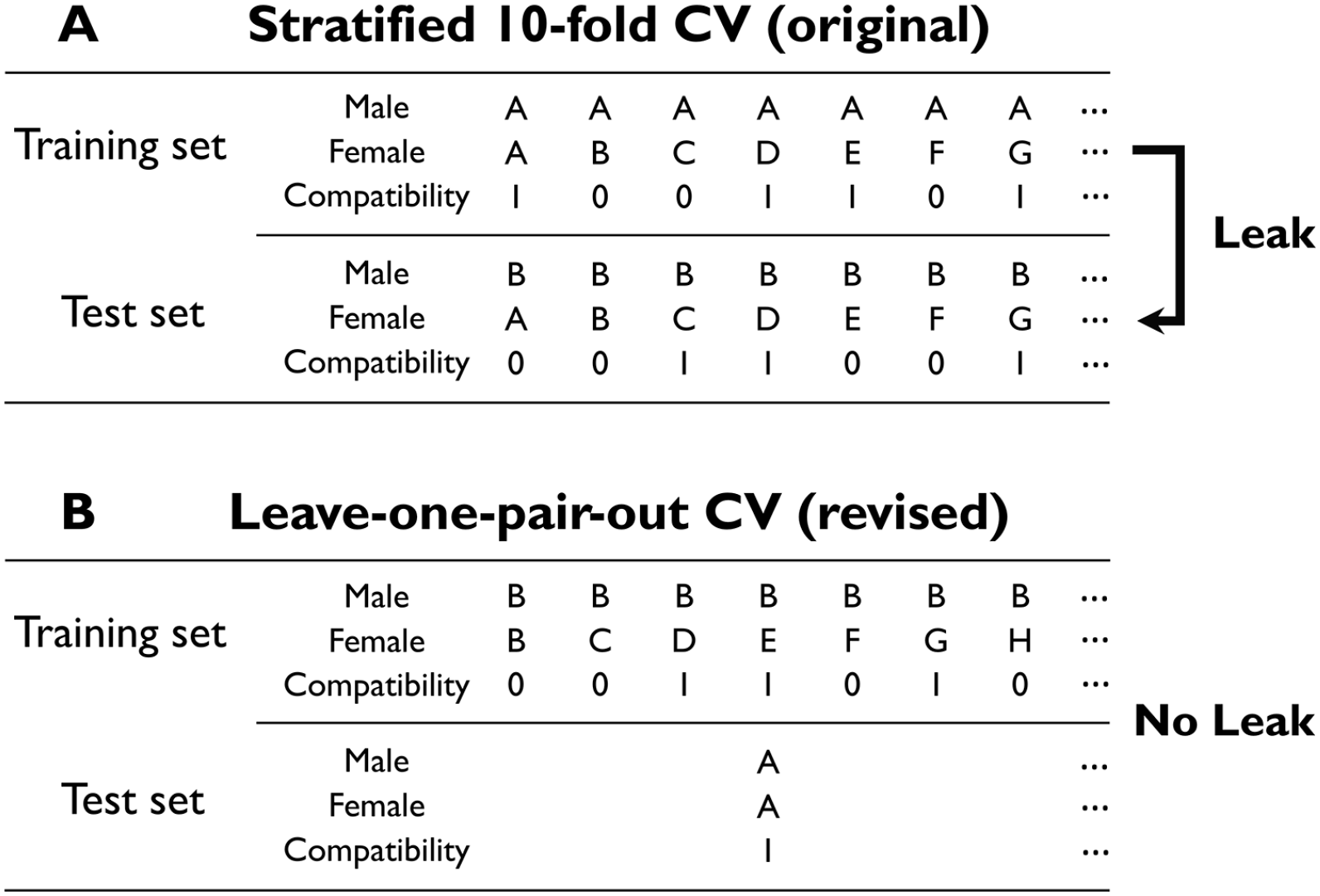
Description of the (A) original and (B) revised cross-validation (CV). In the original stratified 10-fold CV (A), while information of male A in the training set is not included in the test set, information of females (Female A to G) are included in both the training and test set and this can inflate the prediction power inappropriately (ie, information leak). On the other hand, in leave-one-pair-out CV (B), data in the test set (Male A and Female A) is not included in the training set, which prevents information leak.
The results showed that the prediction performance was significantly higher than when the labels were randomized in the highest frequency band (Figure 3). The results also showed that similarities and dissimilarities of brain regions and networks which are involved in social- and emotion-related information processing, facial expression recognition, and mentalizing, contributed to the prediction (Figure 4). These results suggest that people feel a sense of compatibility with a partner whose brain functions are compatible with theirs, that is, there is a biological basis for the feeling of “being on the same wavelength.”
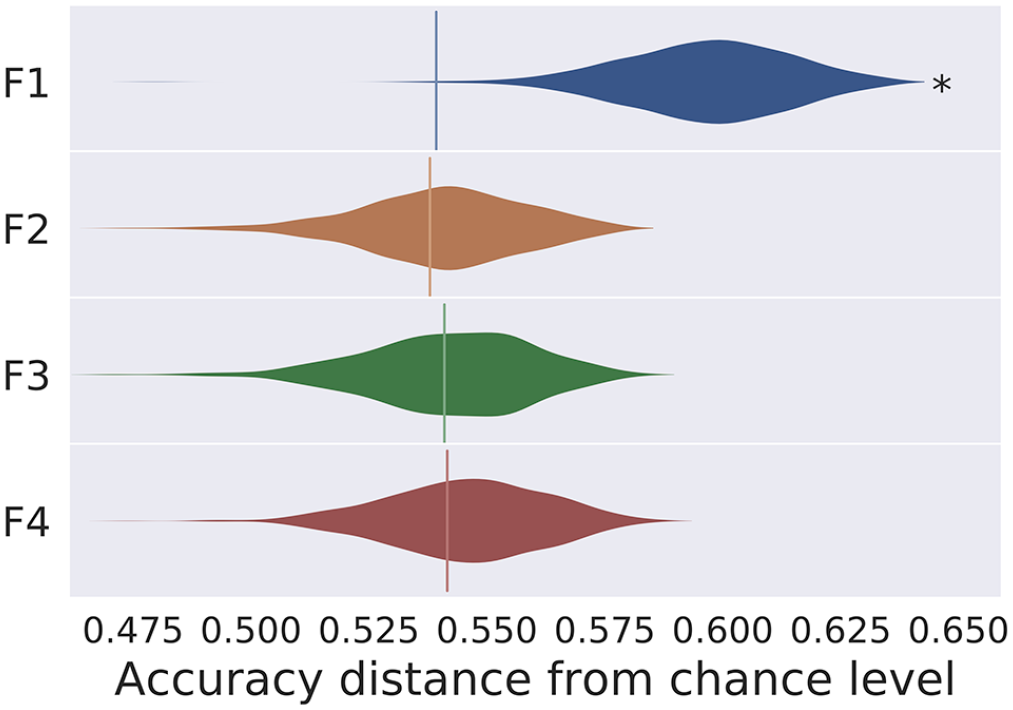
Distribution of differences between the classification accuracy with true labels of pairs and that with a randomized label for each frequency band. Vertical lines indicate chance levels. F1: 0.109 to 0.199 Hz, F2: 0.055 to 0.109 Hz, F3: 0.027 to 0.055 Hz, F4: 0.014 to 0.027 Hz, *: P < .05 after FDR correction.

Top 100 feature values, that is, absolute values of differences between functional connectivity that contributed to compatibility classification for F1 (0.109-0.199 Hz). Red and blue lines represent similarity- and dissimilarity-based contributions, respectively. Dots on the circle represent ROIs, whose sizes were defined by the total number of significant feature values in which the ROIs were involved.
Conclusions
The 2 studies introduced in this commentary focus on the phenomena of “like attracts like” and the feeling of “being on the same wavelength,” in social psychology. These have been understood intuitively, but their existence and biological mechanisms have not been scientifically addressed until recently. The absence of neuroscientific investigation was due to both phenomena requiring interaction between individuals, which cannot be handled by established methodology for individual-based analyses. Thus, more robust evidence is needed (eg, registered reports and replications). Nevertheless, it is expected that the neuroscience methodologies of connectome similarity and leave-one-pair-out CV defined in these studies could play an important role in understanding the wide variety of interpersonal relationships in the real world.
Footnotes
Funding:
The author(s) received no financial support for the research, authorship, and/or publication of this article.
Declaration of Conflicting Interests:
The author(s) declared no potential conflicts of interest with respect to the research, authorship, and/or publication of this article.
Author Contribution
SK wrote the manuscript and prepared the figures. AI edited and commented on the manuscript.
