




Abstract
Background:
Even though a disease might be labelled as ‘rare’, it is estimated that 450 million people globally are affected by rare diseases, and 70% of these conditions are among children. All children have the right to good quality healthcare and to be heard despite the country or state they live in. While children’s drawings are increasingly used in qualitative research to understand children’s experiences and perceptions of illness, few studies in the rare disease field utilize this method.
Objective:
This study examined drawings of children with rare diseases to gain insight into their experience living with their condition.
Design:
A qualitative phenomenological research study was employed to explore and understand children’s and young people’s experiences and perceptions of living with rare diseases through research participants’ artistic expression in drawings and responses to semistructured interview questions.
Methods:
A purposively selected sample of children (n = 7) attending tertiary paediatric healthcare was invited to participate in a once-off art session facilitated by an art therapist, followed by semi- structured interviews. A practical iterative framework for art-based data analysis was developed to incorporate art interpretations, semi-structured interviews and reflexive analysis.
Results:
As drawing is an open visual medium, a framework was developed to analyse the drawings thematically. The themes that emerged from the drawings were fitting in versus feeling different and supportive relationships. These themes highlight the contradictory experience of living with a rare disease and the role of family and friends in influencing the participants’ experiences.
Conclusion:
Developing an art analysis framework benefitted the thematic analysis of the participants’ drawings. This study concludes that art can help offer opportunities for children to express themselves and for health and social care professionals to understand the impact of rare diseases on their everyday lives.
Plain language summary
Living with rare diseases is an ongoing psychosocial challenge for children and their families. We performed this study to explore and understand the day-to-day challenges of living with a rare disease from children’s and young people’s perspectives. This study used art as a research medium for children’s artistic expression in drawings and responses to interview questions. Using art allows children and young people to use their skills, knowledge, and interests and participate actively in research through fun and engaging activities. Children participating in the study were asked to draw what it is like to live with their rare condition. This session was facilitated by an art therapist. A practical framework was created for data analysis of each of the drawings, and the findings were analysed thematically to generate themes to answer the research question. The themes that arose from the data included ‘Fitting In versus Feeling Different’ and ‘Supportive Relationships’. The findings show that children and young people with rare diseases navigate their identity based on their knowledge and understanding of their condition, interactions, and daily situations. This study demonstrates that art is an effective medium for promoting inclusion and participation from children in research when applied with acknowledgement of its limitations.
Keywords
Introduction
Rare diseases are heterogeneous in their signs and symptoms but are grouped together due to their low incidence rates. There are about 10,000 known rare diseases. 1 Approximately 80% of rare diseases are of genetic origin, and 70% affect children. 2 Rare diseases are associated with mortality, morbidity and disability, often involving multiple body systems and medical specialities.3,4
The use of children’s drawings in qualitative research to explore and understand children’s individual experiences and worldviews has increased. 5 Research in psychiatry, psychology, art therapy and education has long included the study of children’s drawings to inform how adults can better understand and work with children from their perspectives. 6 Drawings can provide multiple meanings, represent identities, concepts, emotions, perceptions and information, and holistically show the relationship between these elements. 7 This child-centred data collection method incorporates children’s skills, competencies and interests, allowing them to participate actively in research through a fun and engaging activity.7,8 Drawing can also offer children the means to contribute to research beyond their verbal language abilities through visual communication of their knowledge. 9
Although drawings in research can be used as a stand-alone tool for expression, it is common for participants to draw and then discuss their drawings, to share their expertise and prevent over- interpretation or misinterpretation by the researcher. 10 Children’s interpretations of their drawings, obtained through verbal interviews, can provide context and add data if the child is not familiar or comfortable with drawing. 11
In health research, experiences of hospitalizations and being critically ill can be difficult for children to articulate as they may not yet have acquired appropriate language to express themselves, have found the experience traumatic or had a limited understanding of what is going on, and thus have difficulty expressing their experience in words. 12 Several studies have investigated children’s experiences of different aspects of hospitalization.12–16 Children with rare diseases face significant psychosocial challenges. 17 Despite this, few studies explore children’s experiences of living with a rare disease as most focus on parental, familial or healthcare provider experiences and their perspectives of children’s rare disease experiences.18–20 To the authors’ knowledge, no studies have explored this phenomenon through drawing.
This study examined the drawings of children living with rare diseases to gain insight into their experience of living with their condition. This study was one component of the multidisciplinary sand play, art, music, photovoice, interviews and survey (SAMPI) project, which aimed to enable children and young people living with rare diseases to express their experience of living with a rare disease through art-based research methods.
Methods
Research design and methodological approach
This qualitative phenomenological research study informed by the philosophical constructs of Heidegger 21 was employed to explore and understand children’s and young people’s experiences and perceptions of living with rare diseases through research participants’ artistic expression in drawings and responses to open-ended interview questions. As a human science, the study of health and care has long used creative methods inspired by phenomenology. Phenomenology is about studying lived experiences, and hermeneutics involves multiple interpretative processes and ideography concerned with an individual’s detailed and unique experiences. 22 This study described how individuals make sense of the lived world and interpret implicit meanings of the lived experiences. The consolidated criteria for reporting qualitative research were used during the design of this study. 23
Participants and recruitment
For inclusion in the SAMPI project, participants had to be between 4 and 16 years old with a known diagnosis of a rare disease and attend one of the tertiary paediatric healthcare services in Ireland. They had to provide informed assent, participate in the art-based research methods, and speak and understand English. Purposive recruitment was performed in person during rare disease clinics on the basis that participants had a rare disease. This approach allows researchers to delve into specific aspects of the rare disease rather than the diagnosis, such as its impact on daily life and healthcare challenges. Due to the rarity of rare diseases, limited-lived experiences available for study and the extenuating circumstances of pandemic restrictions restricting research activities, achieving data saturation was a significant challenge. However, in similar small-scale studies, data saturation has not been applied to small-scale studies due to illness rarity. 24
Seven children aged between 7 and 13 participated in the art research method: 3 boys and 4 girls. Four participants dropped out of the study due to COVID-19 travel restrictions and infection and prevention control reasons. The demographics of the participants are presented in Table 1. All the participants had a rare disease, including phenylketonuria, a craniofacial condition, homocystinuria (HCU), dystonia and Gaucher disease. The named conditions are defined in Table 2. Participants were shown An introductory video to inform them of the project concept and goals and introduce the researchers.
Participant demographics.
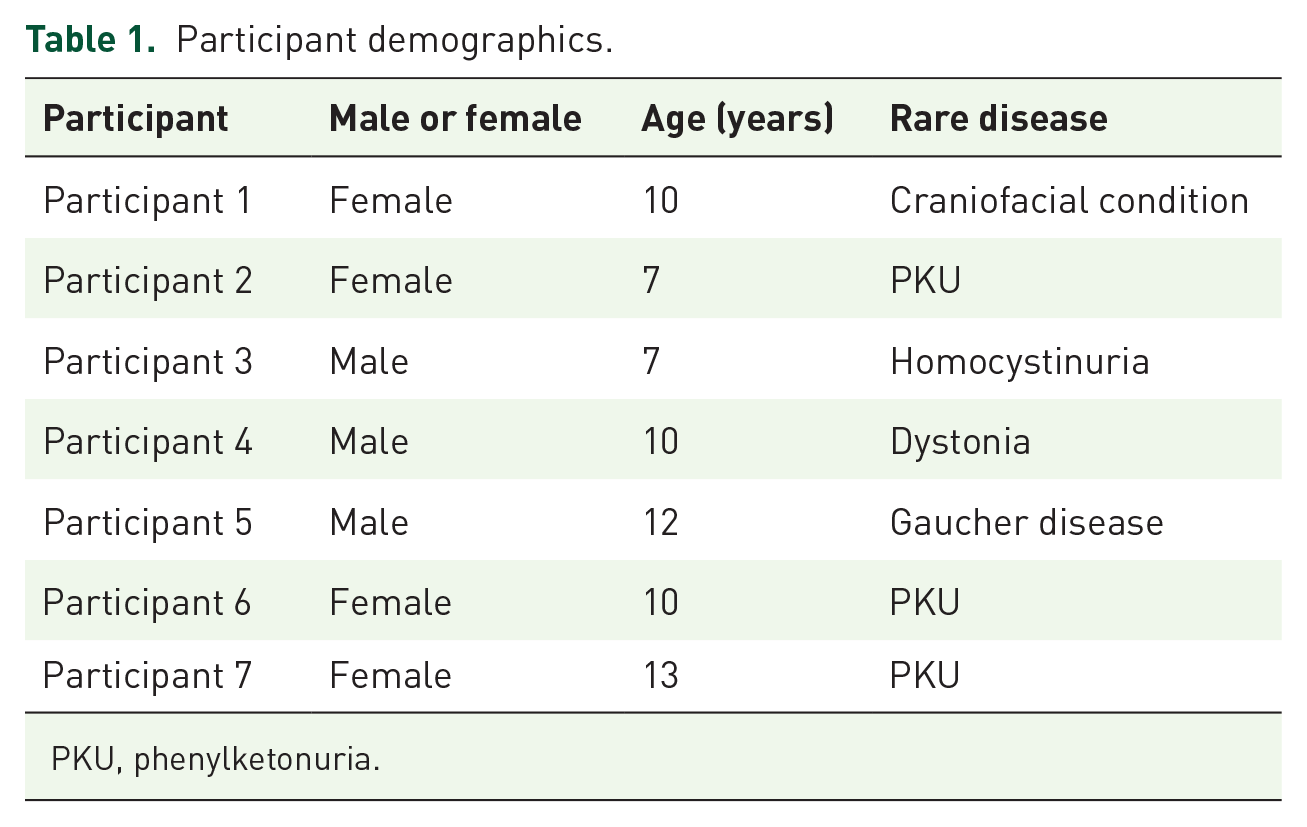
PKU, phenylketonuria.
Definitions of participants’ rare diseases.

CBS, cystathionine beta-synthase; PKU, phenylketonuria.
Data collection
All participants were recruited purposively through rare disease clinics in one acute paediatric healthcare setting and had been living with their diagnosis for several years. All sessions were performed at the paediatric hospital the participants attended. They were facilitated and audio- recorded by an art therapist who was experienced in working with children with chronic illnesses in a paediatric hospital. At the beginning of the session, the art therapist introduced themselves and the study to build a relationship with the participant. No other person was present during the session. The art therapist then asked the participants to draw about living with their condition. No further specific direction was given to allow them to create drawings expressively and creatively that fulfilled this brief with their meaning. A range of artistic materials was available to the participants: writing and colouring pencils, markers, pastels, paint and watercolour paint.
Each drawing session lasted 25 min, after which the art therapist and participants discussed the drawing. In this study, the questionnaires were meticulously designed by experienced art therapists who work with children alongside research teams to ensure their validity and effectiveness. Creating questions for qualitative interviews was guided by a focus on generating open-ended, engaging inquiries capable of eliciting detailed and meaningful responses. These questions were formulated based on an evidence synthesis completed as part of the project, 30 which provided a solid foundation for their development.
The sample questions were initially piloted with small groups to validate and refine the questionnaire’s effectiveness. This pilot phase was crucial for testing the questions in real-world settings and making necessary adjustments based on the feedback received. The aim was to refine the questions better to suit the participants’ needs and understanding, thereby enhancing the quality and reliability of the data collected.
The finalized questionnaires employed for data collection in this study are a product of this rigorous development and validation process. Participants were also asked to give their drawing a title. The art therapist completed a reflective observation diary after each session. No repeat sessions were held. Transcripts of the sessions were not returned to participants for comment or correction due to practical constraints, but participants were given the opportunity to take their artwork home. This approach acknowledges the personal and expressive nature of the art created during the therapy sessions. It allows participants to reflect on their work, which can be a significant aspect of the therapeutic process.
Data analysis
As drawing is an open visual medium, 7 a practical iterative framework for art-based data analysis was developed and influenced by Furth 31 to analyse the drawings (Figure 1). First, the drawings were analysed using questions included in Supplemental Table S1. These were influenced by Furth and were selected for their commonality across the drawings. 31 Following this, the transcripts of the sessions were read and re-read, ensuring that any new ideas and insights were generated and compared to triangulate the data and further understand the drawings. Finally, the art therapist’s reflective observation diaries were consulted for further contextualization and information not captured in the drawings or the transcripts. This process was continuously performed to ensure the findings were data-driven and obtained inductively. It allowed the researcher to approach the drawings from a perspective of ‘not knowing’ and respect the drawings as the participants’ expressions of their experiences. 6 Each drawing was analysed separately according to the framework. Findings were then collectively analysed, and themes were devised iteratively. Braun and Clarke’s guidelines 32 were employed for the thematic analysis to identify, analyse and report on patterns within the interview data. The results were validated through peer debriefing. A coding tree to illustrate the data analysis of the transcript data is included in Figure 2.

Framework for analysing children’s drawings for health research. Drawing analysis elements adapted from Furth. 31 Explanations are provided in the Supplemental Table S1.

Coding tree of transcript data for thematic analysis.
Author’s perspectives
AO led the art sessions and interviews and kept a reflective diary throughout the process. NB led transcription and analysis in collaboration with AO and SS. The research team has clinical and research experience with children and young people with rare diseases. AO is a registered art therapist, and SS and NB are registered Children’s Nurses and researchers. AO, SS and NB are all female; AO and NB have attained master’s level credentials; SS has attained a doctorate degree. There was no professional relationship between AO and researcher, and the interviewee was considered during data analysis through the researcher’s reflexive diary entries.
Results
The drawings completed by the participants reflect their different ages and personalities. They ranged from scene snapshots to visual narratives. The descriptions of the participants’ drawings were taken from the participants’ interpretations of their own drawings, as captured by the transcripts and are available in Table 3. According to the art therapist’s reflective diaries, all participants were friendly and eager to draw during the session.
Description of participants’ drawings.

PKU, phenylketonuria.
Thematic analysis
The overall themes emerging from the drawings were fitting in versus feeling different and supportive relationships.
Fitting in versus feeling different
Participants 1 and 3, possibly due to a lack of knowledge or a desire for avoidance, did not draw anything explicitly related to their condition despite the brief. Participant 1 highlighted their responsibility to their team members and illustrated their feelings of fitting in as they focused on scoring goals for their team. In contrast, Participant 3 focused on acting independently while running an errand for their family. The contrasting title for a drawing depicting a seemingly innocuous activity may indicate this participant has other feelings about their condition that they did not share with the art therapist.
Participants 4 and 5 focused on drawing themselves as fitting in but highlighted how their condition affects them, either in the drawing or in the transcript. Participant 4 alluded to their condition in their drawing, portraying themselves without hands or feet as they bear the physical manifestations of their condition. Participant 5 included aspects of their condition in their drawing but focused on other aspects of their life, such as school and playing outside and at home.
Participants 2, 6 and 7 depicted their conditions overtly in their drawings. These participants emphasized what makes them different from other children and young people, often focusing on negative or inconvenient aspects of their conditions, including being teased, diet restrictions and how they are treated differently from their peers.
Supportive relationships
All the participants referenced the people in their lives in their drawings, whether family members or peers.
All the participants referenced family as being a part of their drawing. This was shown in different ways— either depicted in the drawing, stated to be in the drawing but not depicted, or referenced in their transcript. The art therapist only asked questions about hidden family members if the participant mentioned their presence in the drawing.
Family members were commonly drawn in knowledge authority or supportive roles in managing participants’ conditions. Participants 2, 5 and 6 explicitly drew family members. Only Participant 2 referenced loss in their drawing, recalling fond memories of their grandmother in the transcript. Drawings that featured hidden family members, including those that are off- page’ or in buildings, were drawn by participants 1, 3, 4 and 7. These participants described their family members as a source of support or unconnected to their condition. Participant 1 indicated that their mother and sister supported them at their Gaelic football matches. Participant 7 discussed how their mother supports them with their condition by not making it a big deal. However, Participant 3 drew their family at home waiting while they ran an errand, and Participant 4 stated their family was inside the house they had drawn, each doing a separate task.
Four participants referenced their peers in their drawings, differing in their representation of their friendships’ positive and negative roles. Participant 1 claimed their teammate thinks they are very dedicated to their sport. Participant 2 drew their friend as teasing them for their condition. Despite this, the love tree featured in the drawing as a source of support features their own heart, the heart of the same friend and another friend. Participant 5 detailed the supportive nature of their friends in their drawing and in the transcript, where they mention their friends’ protective disposition towards them. Participant 7 expressed that besides their best friend, their friends have a limited understanding of their condition and its meaning.
Discussion
This study utilized the phenomenological philosophical construct to understand the lived experience of children with rare diseases through art as a creative method. These findings contribute to the first detailed creative methods inspired by phenomenological accounts of such experiences. The personal accounts highlight two superordinate themes central to this experience, fitting in versus feeling different and supportive relationships.
The findings of this study support existing literature on the psychosocial impacts of living with a rare disease for children and address the lack of children’s rare disease experiences in the literature.17,30 Through their drawings, though participants expressed isolation and loneliness, physical restrictions and trepidation regarding communicating about their condition to others, they also highlighted the positive aspects of their conditions. They emphasized the benefits of supportive relationships with friends and family members.
How the participants drew themselves, as discussed in the theme fitting in versus feeling different, highlights the significance of identity for children with rare diseases. This overlooked element in rare disease research provides important contextual information when exploring the rare disease experience. 17 This, combined with the participants’ experiences of living with their conditions, demonstrates that care for children with rare diseases needs to include appropriate psychosocial, psychoeducational and creative arts interventions. These interventions are currently not standard in care for children and their families in every rare disease service. Integrating psychological supports through arts-based modalities has been identified as an indicator of service quality for paediatric healthcare settings. 33 Creative arts interventions such as art therapy, dance-movement therapy, drama therapy and music therapy offer an engaging and supportive environment for emotional self-expression, interaction and change. 33
The significance of the impact of family and peer relationships for children with rare diseases is highlighted in the theme of supportive relationships. Though adolescence is a period of individuation, the presence of a chronic illness at this life stage is typically associated with increased dependence on family and caregivers. 34 However, this was not noted in the findings of this study. All the participants in this study included their family in their drawings in some way. Participant 2 was the only participant to draw family members outside of their immediate family. Participants 5 and 6 drew their mothers at the edges of their drawings, indicating a background or supervisory role 29 and participants 1, 3, 4, and 7 mentioned their family as part of the drawing in the transcript but did not draw them. While this highlights the strong role of family in their lives, the lack of focus on family members may indicate the participant’s individuation is progressing positively, despite the presence of their condition. It also aligns with the transition of parent–child relationships from direct to distal supervision, as participants begin to spend more time with their peers as they navigate late childhood and early adolescence. This period is a significant time for identity formation and experimentation. 35 The drawings may indicate the participants’ progress in developing a strong sense of identity, accountability, and feeling of ownership of their rare disease, despite their youth.
In this sample, the older participants (aged 11–13 years) rely more on describing the narratives of their drawings with words rather than solely visually. Only one younger participant (participant 2, aged 7 years) named the figures in their drawing. While the older participants could directly connect their experiences with their condition, explain how their condition affects them, and provide detail about how their experiences made them feel, the younger participants focused on single events to provide a window into their experiences of living with a rare disease. Age may also have influenced the type of drawing participants produced. The only fantastical drawing was produced by one of the youngest participants in the sample (participant 3, aged 7 years), while the oldest participant (participant 7, 13 years) produced the most literal drawing, a spider diagram of words.
The use of drawings in this study allowed the participants to share their experience of living with a rare disease in a non-intimidating and enjoyable way, regardless of their developmental stage. It also adhered to a core principle of child-centred research, which is the use of methods suited to children’s level of understanding, knowledge, interests and location in the social world, and respect for the participating children as their own persons. 6 This principle is a core tenet of the SAMPI project. Recognizing children as experts in their own experience is critical for meaningful participation in research. 36 Giving children the opportunity to participate in research and the freedom of expression aligns with articles 12 and 13 of the United Nations Convention on the Rights of the Child (UNCRC). 37 Creative research approaches such as art enable the upholding of these rights when conducting research with children and young people and, therefore, should be considered when doing this type of research. However, the limitations of these approaches must be addressed by researchers, for example, that drawings are not considered in isolation but with other sources of information. This ensures that any inferences made are triangulated between data points and have sufficient rationale for inclusion in analysis.
Limitations
A limitation of analysing children’s drawings is that interpretations are more likely to be subjective, harder to validate and at risk of over-interpretation. Therefore, it is crucial to analyse drawing data holistically, incorporating how the drawing was conceptualized and produced. Other research methods should be included in the understanding of the drawings. 7
The sample used in this study is small, and from a single paediatric tertiary hospital. Most participants had one type of rare disease. Therefore, future research into the use of creative modalities for understanding children’s experiences of living with rare diseases should aim to incorporate other types of rare diseases from multiple sites in acknowledgement of the common collective incidence of rare diseases.
Conclusion
Previous research has highlighted the psychosocial challenges children with rare diseases face, such as isolation, loneliness and stigmatization. This study describes how children with rare diseases position their identity in relation to their illness, and the role of friends and family in supporting their efforts to engage in everyday life. It addresses the gap in the rare disease literature around children’s experiences of living with rare diseases by gaining their perspectives directly through art, a fun and engaging medium for children at any developmental stage. The results of this study support existing calls for incorporating psychosocial and psychoeducational interventions in rare disease care models for this population’s well-being. It also supports using creative research modalities when conducting research with children.
Supplemental Material
sj-docx-1-trd-10.1177_26330040241265449 – Supplemental material for The use of art as a creative research method to understand psychosocial care needs for children with rare diseases
Supplemental material, sj-docx-1-trd-10.1177_26330040241265449 for The use of art as a creative research method to understand psychosocial care needs for children with rare diseases by Niamh Buckle, Amy O’Neill, Alison Sweeney, Sandra McNulty, Shirley Bracken, Atif Awan, Shannon Sinnott, Lisa Gibbs, Philip Larkin, Thilo Kroll and Suja Somanadhan in Therapeutic Advances in Rare Disease
Supplemental Material
sj-docx-2-trd-10.1177_26330040241265449 – Supplemental material for The use of art as a creative research method to understand psychosocial care needs for children with rare diseases
Supplemental material, sj-docx-2-trd-10.1177_26330040241265449 for The use of art as a creative research method to understand psychosocial care needs for children with rare diseases by Niamh Buckle, Amy O’Neill, Alison Sweeney, Sandra McNulty, Shirley Bracken, Atif Awan, Shannon Sinnott, Lisa Gibbs, Philip Larkin, Thilo Kroll and Suja Somanadhan in Therapeutic Advances in Rare Disease
Footnotes
Acknowledgements
We would like to express our sincere gratitude to our funder, Children’s Health Foundation at Children’s Health Ireland, for their support. We would also like to acknowledge and thank the members of the wider SAMPI research team, Dr Yvonne Rogers and Doris O’Toole, for their contribution to the SAMPI project and for their assistance in reviewing this article.
Declarations

Supplemental material
Supplemental material for this article is available online.
References
Supplementary Material
Please find the following supplemental material available below.
For Open Access articles published under a Creative Commons License, all supplemental material carries the same license as the article it is associated with.
For non-Open Access articles published, all supplemental material carries a non-exclusive license, and permission requests for re-use of supplemental material or any part of supplemental material shall be sent directly to the copyright owner as specified in the copyright notice associated with the article.
