




Abstract
This article is written by the parent of a child living with PMM2-congenital disorder of glycosylation (abbreviated to PMM2-CDG). It provides a parental perspective of the journey taken from diagnosis to present day and details the effect of off-label treatment with epalrestat.
Plain Language Summary
PMM2-CDG is a rare multisystem disorder that involves a normal, but complex, chemical process known as glycosylation. Glycosylation is the process by which sugar chains (glycans) are created, altered and chemically attached to certain proteins or fats (lipids). When these sugar molecules are attached to proteins, they form glycoproteins. Glycoproteins have various important functions within the body, like the development of the brain, and coordination, and are essential for the normal growth and function of coagulation, hormonal regulation and organs like the liver and heart. PMM2-CDG can affect virtually any part of the body, although most cases usually have an important neurological component. PMM2-CDG is associated with a broad and highly variable range of symptoms and can vary in severity from mild cases to severe with disabling or life-threatening symptoms. Most cases are apparent in infancy. PMM2-CDG is caused by mutations of the PMM2 (phosphomannomutase-2) gene and is inherited as an autosomal recessive condition (two copies of an abnormal gene product must be present in order for the disease or trait to develop.
Effective treatment for PMM2-CDG remains an unmet need. A potential path to therapy for PMM2-CDG is repurposing already approved drugs like epalrestat, which was found as a drug target in a worm model by drug screening.
It is important to share these perspectives so researchers, clinicians and other parents and patients can learn from each other’s journeys and, importantly, to highlight that you are not alone.
The beginning of our journey
Ethan’s family doctor/primary care provider tried to reassure us that our son was developing normally. So did a neurologist. So did a second neurologist. But we were not convinced. Something about our son was different.
When Ethan was about 3–4 months old, we noticed a few out-of-the-ordinary behaviours. Ethan would lay passively on his back without moving. Ethan did not try to rotate from his back to belly. He also struggled to track objects or movements with his eyes.
The road to a diagnosis
Thankfully, we followed our parental instincts. After we persisted for weeks, Ethan’s neurologist finally set up an MRI (magnetic resonance imaging) appointment for Ethan. To the surprise of Ethan’s medical team, the MRI revealed Ethan had severe cerebellar hypoplasia (the ‘small brain’ or hindbrain was severely underdeveloped). A follow-up genetic testing, performed at the age of 1 year, confirmed Ethan had compound heterozygous PMM2 gene mutations – indicating a rare diagnosis of PMM2-congenital disorder of glycosylation (PMM2-CDG).1 –3 By the diagnosis, Ethan’s developmental abnormalities, delayed emotional and motoric responses to external triggers, delayed speech and cognitive development and inability to maintain body balance were obvious.
Individuals with PMM2-CDG can experience a wide spectrum of symptoms with varying severity. 4 Ethan’s underdeveloped cerebellum, strabismus and global developmental delay are all consistent with other individuals with PMM2-CDG. PMM2-CDG can also produce more severe symptoms: hydrops fetalis, seizures, blood clotting and more. Many infants diagnosed with PMM2-CDG do not survive past the first year of life. 4 Although existing clinical reports suggesting a high probability for survival and more positive prognosis for those individuals developing only neurological symptoms of the disorder added some notes of optimism, learning these facts from a parental perspective was not emotionally easy.
Living with PMM2-CDG
Many – like Ethan – lead productive lives. Ethan is now 7 years old, has healthy internal organ function, and has physically grown to a normal height and weight. He attends public school with a personal support worker. He eats food mostly independently. He pedals his modified tricyle outdoors – keeping up with his unaffected brothers. Ethan loves tinkering with his toy cars and excavators, watching TV, and playing video games. Though his condition is rare, Ethan has the same interests and desires of any young person (Figure 1).
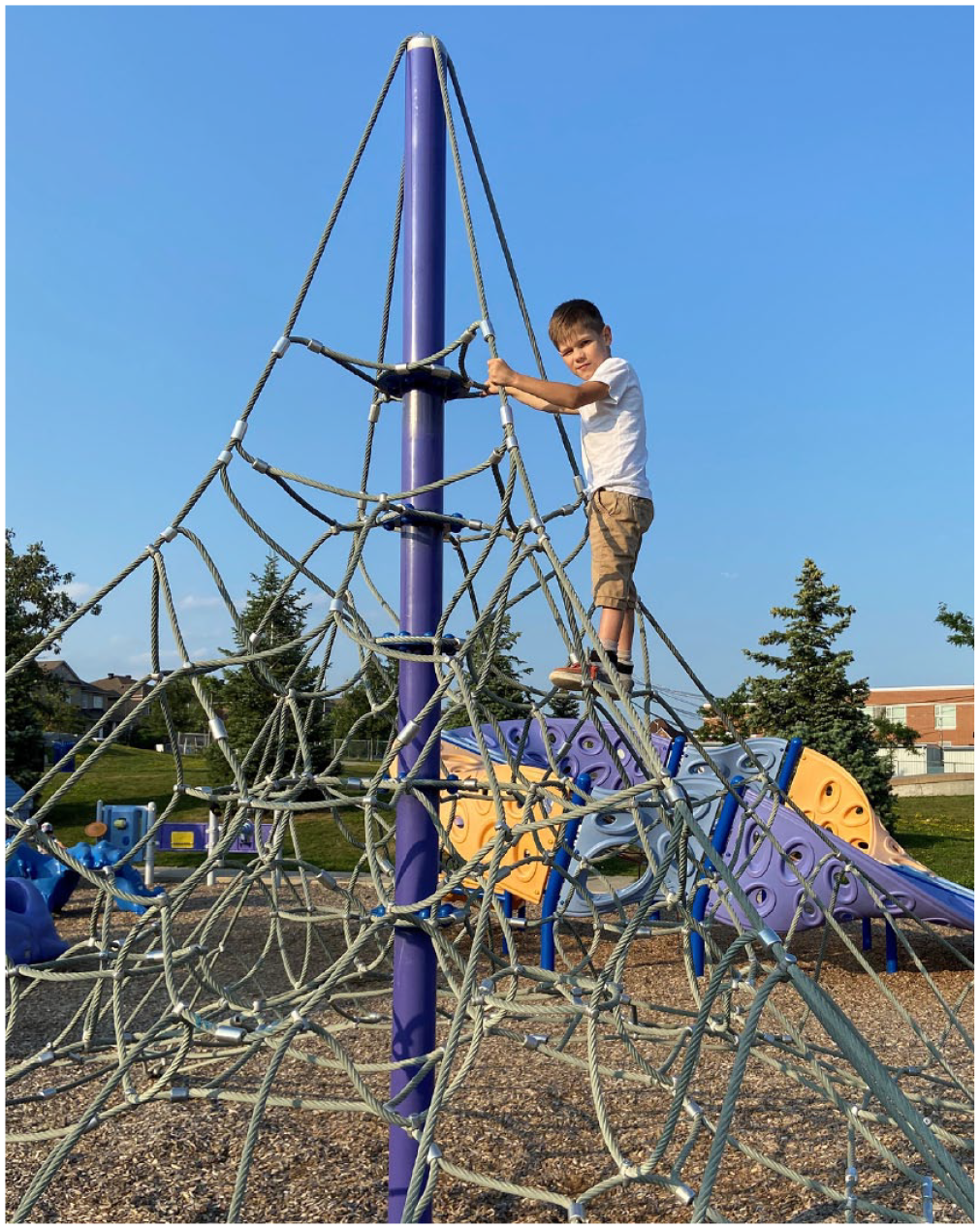
Ethan summits the rope pyramid at his local playground.
His symptoms are mostly linked to his reduced cerebellum: impaired body balance, partial limbal ataxia, speech limitations, slower communicative response, reduced pain sensitivity and delay in cognitive development. These symptoms also correlate with peripheral hypomyelination–induced reduced neuronal conductivity.
Since the moment Ethan was diagnosed with PMM2-CDG, we have challenged him with activities aimed to stimulate muscular and cognitive development. Ethan walks for an hour each day on a treadmill (Figure 2). He rotates through leg-strengthening floor exercises. He completes speech therapy once a week. In our home, we installed a suspended support system, through which Ethan holds his upper body upright by grabbing suspended rings and propelling his legs forward.

(a) Treadmill exercise: regular walking pace, 1 h per day with 1 kg weight on each foot. On (b), he is holding the side bar with one hand.
These undertakings require immense physical effort from Ethan, which does sap his motivation to continue participating. But Ethan always loves challenges.
Off-label treatment with epalrestat
As parents, we have been searching for new treatments and wanted to be aware and up to date on all news about CDG. In 2020, Ethan was enrolled in the CDG natural history study, and since then, he has been followed by the Frontiers of Congenital Disorders of Glycosylation Consortium. We got very excited when we heard about a new potential therapy, called epalrestat treatment, or aldose reductase inhibitor therapy. This drug is not yet approved in Canada or the United States, but is available and has been safely used for diabetes-related neuropathy in Asia for decades. 5 After we learnt that the drug was shown to improve glycosylation in PMM2-CDG patient cell lines,6,7 and that an American girl was safely treated ‘off label’ with this drug for more than a year, we couldn’t wait to try the new therapy in Ethan.
Since October 2020, Ethan has been participating in ‘off label’ treatment with epalrestat. On the low dose of ‘off label’ therapy, we have already seen Ethan gradually improve in a variety of aspects:
Muscle tone: Ethan maintains straighter body posture, reduced slouch, smoother limb movements. He lifts his legs easier and shows greater dexterity with a spoon or a fork.
Body balance: Ethan can now stand alone with no support for long periods of time. While standing, he can make some movements with his hands without losing his balance. Ethan can also now make four constitutive, controlled, unsupported steps before falling. Recently, he has become capable of walking independently with holding a 4-leg support walking cane in each hand.
Alertness: He responds to auditory or visual triggers faster. He now engages surrounding activities and conversations.
Speech and language: Ethan speaks clearer and is easier to comprehend. He forms longer and more complex sentences in both Russian and English.
Sensory sensitivity: His sensory awareness has increased. For example, 2 months after treatment began, he started complaining about itching or tickling at his ankle after wearing his orthotics – something he never mentioned before.
Blood testing results: Ethan’s liver function and TSH test results have improved since treatment began.
Even more encouraging, we have not detected negative side effects so far. We started with 0.8 mg of epalrestat per kg of body weight, 3 times per day. Ethan now takes 3 mg per kg body weight, 3 times per day. The drug is administrated orally, after it was crushed to powder and suspended in water. So far, the beginning of the treatment, as well as every increase in the drug’s concentration was associated with temporal constipation and mood instability. Ethan’s digestion and mood have stabilized and generally stayed consistent through treatment as well.
Looking to the future
Our ultimate goal is to prepare Ethan to his maximally independent and joyful adulthood. Although we have no tools to predict how Ethan’s development will proceed, we are nevertheless encouraged by his overall betterment. Currently, while keeping our eyes open towards appearance of more efficient therapeutics to CDG, we intend to continue the epalrestat treatment, when correlating it with physical and cognitive exercises.
Yes, he has days where he still struggles to control his emotions. Yes, he needs more time to focus and to express himself. Yes, he is still frustrated by his physical limitations. But watching Ethan take his first independent steps brings us joy and satisfaction. With his growing skillset, we dream of Ethan blossoming into a physically independent adult.
