



Abstract
Quantitative research on the “durability” of peace following civil wars typically captures the breakdown or survival of “peace” in a binary manner, equating it with the presence or absence of civil war recurrence. In the datasets that underpin such studies, years that do not experience full-scale civil war are implicitly coded as “peaceful.” Yet, post-civil war environments may remain free from war recurrence, while nevertheless experiencing endemic violent crime, state repression, low-intensity political violence, and systematic violence against marginalized groups, all of which are incongruent with the concept of peace. Approaches to assessing post-civil war outcomes which focus exclusively on civil war recurrence risk overestimating the “durability” of peace, implicitly designating as “peaceful” a range of environments which may be anything but. In this article, we discuss the heterogeneity of violent post-civil war outcomes and develop a typology of “varieties of post-civil war violence.” Our typology contributes to the study of post-civil war peace durability, by serving as the basis for an alternative, categorical conceptualization of “peace years” in conflict datasets.
Introduction
Most quantitative studies that examine the varying “durability” of peace following civil war essentially equate “peace” with the absence of civil war recurrence (Florea, 2012). The durability of peace is measured in a binary fashion, as whether a civil war “recurs” within a specified time frame, or as the time until civil war recurs. In Mason’s (2019) recent overview of the quantitative evidence on the durability of peace, all the studies reviewed adopted one of these two approaches. However, the threat of organized violence after civil wars end is not limited to their potential resumption. The aftermath of civil war is often characterized by uncertain and contested political authority (Florea, 2018a), weak state capacity (DeRouen et al., 2010), and economic devastation (Licklider, 1993), all of which can make for a particularly febrile environment in which society is vulnerable to multiple forms of organized violence, which may undermine the “durability” of peace. For example, while the Spanish Civil War (1936–1939) did not “recur,” in the decade following the Nationalist victory hundreds of thousands of suspected republicans and communists were put to death at the hands of the state (Holguín, 2015). The 1971 civil war in Pakistan that resulted in the secession of Bangladesh did not “recur” either, though soon after independence marginalized indigenous groups in the Chittagong Hills took up arms in pursuit of greater autonomy (Dowlah, 2013). The post-Qadhafi landscape in Libya continues to be dominated by hundreds of small, competing armed groups in a country that since 2011 “has lacked not only a central authority worthy of that name, but also strong national political or military forces, as well as stable local authorities” (Lacher, 2020: 1).
In this article, we argue that a minimalist conceptualization of peace, which equates it with the absence of civil war occurrence, does not adequately capture the heterogeneity of outcomes that countries may experience in the aftermath of civil wars. By advancing this claim, we contribute to a growing body of work which explores the variability of post-civil war outcomes. Several scholars have made the case that forms of violence short of civil war recurrence should not be overlooked when assessing the durability or quality of post-civil war peace. Suhrke (2012), for example, explores the vulnerabilities to violence of various types of “post-war” peace, namely, “victor’s peace,” “loser’s peace,” “divided peace,” and “pacified peace.” These various forms of post-war peace are classified according to “the nature of the war, the way it ended in terms of the political bargain and balance of power on the ground, the political-normative framework for the new post-war order, and the presence and absence of institutions for managing violence…” (5). Another effort to systematize understandings of the different “varieties” of “peace” which may emerge after civil wars is that of Jarstad et al. (2019), who have sought to “identify, characterize and theorize the multiple, diverse forms of peace that can be empirically observed in post-war societies” (2).
Rather than exploring varieties of post-conflict peace, we focus instead on the heterogeneity of post-civil war environments which continue to experience significant levels of organized violence. Such outcomes cannot be described as forms of “peace,” though they are often implicitly labeled as such by quantitative studies when they fall short of full-scale civil war recurrence. In other words, it is not our purpose to describe different varieties of post-civil war peace, but rather varieties of post-civil war violence. These are compatible goals, not least because descriptions of “the variety of ways in which peace manifests itself in the aftermath of armed conflict” (Jarstad et al., 2019: 4) should be coupled with an understanding of the plurality of violent processes that can undermine peace. In this way, the full heterogeneity of post-conflict outcomes can be explored, whether these are peaceful, or violent. To this end, our key contributions in this article are a discussion of the varieties of violence that can occur in the aftermath of civil war and a typology to empirically categorize these varieties. It is hoped that this will provide greater theoretical and methodological clarity around post-conflict outcomes, therefore facilitating further comparative empirical work on the subject. For example, a clear typology of post-conflict outcomes could allow researchers to more effectively investigate enduring empirical questions, such as whether victories or negotiated settlements tend to result in different forms of post-war violence.
As noted above, we are not alone in advocating that other forms of organized violence beyond civil war recurrence be considered in assessments of peace durability, nor is the typology we present the first of its kind. Boyle (2014) in particular has produced a compelling argument which both describes and seeks to explain the prevalence of various forms of strategic violence that may occur in post-conflict states, including the continuation of wartime violence as well as violence organized around new political cleavages. His work presents three ideal-type categories of violent act—expressive, instrumental, and strategic—and differentiates these “by the nature of the intention behind the act” (25) and the identity of victims to create a typology of “violent actions.” Corinne Bara, Annekatrin Deglow and Sebastian van Baalen (2021) have noted that civil war recurrence is often studied separately from other forms of post-war violence, and propose a conceptual framework which seeks to encompass “all forms of physical violence committed after a civil war has been terminated…” (3). Their framework is based on three dimensions—whether the state is involved, whether organized non-state groups are involved, and whether the violence is driven by a political incompatibility—and identifies eight forms of post-war violence. Grandi (2013) has also offered a typology of post-war violence, based on an assessment of strategic aims and the degree of organization of perpetrators. The approach we outline is simpler, but also broader than these previous efforts. Rather than classifying “violent actions” as strategic or otherwise, our typology aims to classify broader “varieties of organized violence” which can be deployed as a descriptor of the prevailing situation in a given country in a given post-conflict year. When classifying these varieties of organized violence, we reserve judgment as to the intentions (whether strategic or not) which drive them and hence avoid the “epistemological problem of detecting intentions for violent action” with which Boyle grapples (2014: 24). We also avoid attributing intention to forms of violence both because we believe this to be mutable (the strategic intent of violent actors is liable to change over time) and contested by violent actors themselves, as attested to by the fragmentation that they often experience.
The typology that we offer instead looks to three more immediately observable patterns of actor behavior as a basis for classification; the type of actors involved; the targets of violence, and the violent methods deployed. Using these three dimensions, we identify five “varieties” of post-civil war violence: (1) civil war recurrence, (2) subsequent civil war, (3) residual political violence, (4) criminal violence, and (5) state violence. In this sense, our work builds on that of Chrissie Steenkamp (2011) who highlights the salience of political, social, and economic violence that can occur at different levels during the implementation of peace accords, but does not offer an explicit typology for cross-case comparison. There are also similarities between the categories included within our typology and those identified in Bara et al.’s (2021) conceptual framework. Our typology, however, is more aggregated, comprising five as opposed to eight categories, and does not assess the presence or character of political incompatibilities. Instead, it is based on three observable dimensions relating to actor identity and behavior and is hence well-adapted for large-N studies which necessitate the coding of outcomes for potentially hundreds of cases over multiple years.
The remainder of this article is divided into three sections. Firstly, to underline the relevance of our typology, we provide a brief overview of our argument that binary measures of peace durability do not adequately capture the heterogeneity of violent post-civil war outcomes. We also discuss why existing efforts to broaden the concept of “peace” do not appear to have permeated the quantitative literature on the durability of peace. We then establish the conceptual basis for our alternative approach by analyzing the varieties of violent threat that can emerge in post-civil war environments. Finally, we offer a typology of five post-civil war “varieties of violence” which can be used to capture outcomes at an annual level.
Binary measures of peace and their shortcomings
Most quantitative studies of post-civil war outcomes adopt a unidimensional concept of peace, equating it with the absence of civil war recurrence (Fortna, 2003; Mason, 2019; Quinn et al., 2007; Toft, 2010a; etc.). Coding decisions as to whether a given civil war “recurs” are typically made using a “battle-deaths threshold.” For example, Jana Krause, Werner Krause, and Piia Bränfors Krause et al. (2018) code “recurrence” when a minimum of 25 battle-related deaths occur in a calendar year, while Monica Duffy Toft (2010b) adopts a higher threshold of 1000 battle-related deaths. This essentially binary approach to assessing peace durability is convenient for the development of outcome variables in statistical models. Yet, conceptual validity can be improved if other varieties of violence are considered, including those which may not meet the specified casualty thresholds for “recurrence” (Florea, 2012), or which cannot be captured by quantifying battle-related deaths simply because they do not assume the shape of “battle.”
There are numerous examples that illustrate the tendency of post-civil war environments to experience violent outcomes that are inimical to the very idea of “peace,” but which fall short of civil war recurrence. For instance, one influential study (Toft, 2010b) has pointed to El Salvador and Uganda as examples of “durable” peace following respectively a negotiated settlement and a rebel victory. In both cases, this finding is called into question if a broader lens is applied which takes account of varieties of violence beyond civil war recurrence. In the years following the negotiated end to El Salvador’s civil war, the country came to experience one of the world’s highest rates of organized violent crime (Hume, 2007: 741), much of it perpetrated by “demobilized” combatants. As for Uganda, the country experienced several years of armed conflict in its northern regions as members of the defeated government’s armed forces re-mobilized to resist the new order (Golooba-Mutebi, 2008; Mutibwa, 1992; Tripp, 2010). The experience of the Democratic Republic of Congo (DRC) also illustrates the shortcomings of a binary, minimalist conceptualization of peace when assessing post-civil war outcomes. The two regional wars which tore the DRC apart following the ousting of the long-term dictatorship of Mobutu Sese Seko, and which resulted in nearly two million (mostly civilian) deaths (Nzongola Ntalaja, 2002) came to a “formal” close in 2001 with “Global and All-Inclusive Peace” accord signed in South Africa. The UCDP/PRIO Armed Conflict Dataset (Gleditsch et al., 2002) and the UCDP’s Conflict Termination Dataset (Kreutz, 2010) both record no incidents of further conflict until 2005. From a minimalist point of view, this would suggest that the “peace” survived for at least four years after the accords were signed. A more realistic view, however, would suggest that “peace” never emerged at all. Irrespective of the political achievements of the agreement in terms of power-sharing and nascent institution-building, the years following the accord were characterized by the continuing presence of multiple armed groups in the east of the country who clashed repeatedly among themselves, with government forces, and with the United Nations peacekeeping mission deployed in the country (De Heredia, 2017). The International Crisis Group estimates that during this period of ostensible “transition,” up to 1000 people were dying daily as a result of the ongoing insecurity and its wider impact (ICG, 2005). This highlights gaps in datasets and related studies which are based primarily on battle deaths. More broadly, these examples illustrate that the absence of civil war recurrence alone sets a very low bar for assessing the “durability” of post-war peace.
Nevertheless, binary conceptualizations of peace remain the norm in quantitative studies of post-civil war outcomes. This is despite a number of scholars who have argued for a broader theoretical view of peace (Florea, 2012; Harbom et al., 2008; Höglund and Kovacs, 2010; Jarstad et al., 2019). Most of these efforts to widen the concept of peace have sought to capture the various “positive” dimensions of peace as first outlined by Galtung (1969), who argues that while the “absence of violence” remains a valid principle when assessing peace, this must take into account an extended concept of violence to include “structural” violence, understood as societal inequalities—particularly in the distribution of power and resources—which prevent individuals from realizing their potential. Perhaps unsurprisingly, given this rather expansive starting point, many of these recent approaches have adopted exceptionally broad canvases. Kristine Höglund and Mimmi Söderberg Kovacs (2010), for example, build on Galtung’s work to propose a “peace triangle,” which calls for the analysis of attitudes, behaviors, and issues when assessing the quality of post-conflict peace. Similarly, in a bid to transcend the negative versus positive peace dichotomy, Peter Wallensteen (2015) has outlined the concept of “quality peace,” which entails both the resolution of the incompatibility that resulted in conflict, but also the establishment of post-war conditions which “make the inhabitants of a society (be it an area, a country, a region, a continent, or a planet) secure in life and dignity now and for the foreseeable future.” (6) Caplan (2019) similarly argues that because peace can be a relative term, with different meanings in different contexts, assessments of its robustness should take into account the “beliefs, opinions, and preferences of those directly involved, which, to a large extent will be the outgrowth of local historical experience and local value systems.” (107) Such understandings of peace necessitate an in-depth understanding of the context of each society for which the analysis is conducted. For this reason, in their entirety, they are unlikely to inform the development of a feasible approach to measuring peace durability for quantitative research. Jarstad et al. (2019), for example, explicitly note that their framework for analyzing varieties of peace is best suited for application to qualitative case studies.
These efforts to broaden the concept of peace should certainly be welcomed as a much-needed drive to capture the variety of outcomes which emerge in the wake of violent conflict. Their multi-dimensional approach and long-term horizons make them well suited to the in-depth analysis of specific conflict situations, perhaps with a view to designing and implementing interventions aimed to improve the prospects for lasting peace. However, they are generally not well suited for large-N cross national studies because their micro-level, multi-dimensional, context-dependent, and long-term emphases cannot easily be distilled into a viable and valid outcome variable. This is reflected by the fact that as far as we are aware, no major quantitative study of the durability of peace has utilized an outcome variable which goes much beyond a dichotomous judgment of whether a conflict “recurred.” Michael Doyle and Nicholas Sambanis’ (2000) article on peacebuilding is one possible exception, but only insofar as it captures whether or not a “minimum standard of democratization” occurs in addition to the end of war, residual violence, and contested sovereignty. In the end, their dependent variable remains a binary assessment of whether a peacekeeping deployment was a failure or a success (Doyle and Sambanis, 2000). Another exception is Joshi’s (2020) article, which explores the relationship between post-civil war one-sided violence and peace agreement implementation.
We believe that quantitative studies can yield valuable insights into the nature of post-conflict environments, but that this potential can be more fully realized with a disaggregated measure that captures the diverse set of violent outcomes short of civil war recurrence, but which are not “peaceful.” This is undoubtedly a challenging task, but it is not one that researchers should shy away from, not least because the years implicitly coded as “peaceful” (i.e., those in which casualty counts did not reach the level required for “civil war” coding) by conventional civil war datasets are not analytically equivalent, and treating them as such can lead to a conflation of “positive peace” with “negative peace” (Florea, 2012). Our article seeks to address this issue by proposing a conceptualization of “peace durability” which considers a given post-war environment’s resilience to various forms of organized violence. In defining “organized violence,” we adopt Tilly’s (2003) definition of collective violence, as comprising deliberate acts which inflict physical damage on persons or property, and result at least in part from coordination among persons who perform the damaging acts. Any effort to define the exact time period for which it remains appropriate to define a given context as “post-civil war” is vulnerable to charges of arbitrariness. That said, we suggest a period of ten years because this is a short enough period for the legacies of warfare, such as armed actor and cleavage persistence, to be observable, but also sufficiently long for variation in the type and magnitude of organized violence to occur.
To operationalize our concept of “peace durability,” we first provide an overview of the different varieties of organized violence that can emerge in the aftermath of civil war, and then outline a typology for classifying these using three dimensions. As noted above, others too have highlighted the vulnerabilities of post-war environments to various forms of violence (Boyle, 2014; Grandi, 2013; Steenkamp, 2011; Suhrke, 2012). Our article draws on these previous works to develop a straightforward typology for classifying varieties of post-civil war violence across numerous cases.
Varieties of post-civil war violence and conflict
This section establishes the conceptual basis for the typology that we propose in the subsequent section. Here, we review the varieties and sources of violence that societies can experience in the aftermath of civil wars which fall short of war recurrence. In this sense, we seek to identify and describe the various violent phenomena that may occur during the “peace years” found in conventional conflict onset and termination datasets.
Violence beyond the state
Most studies of civil war onset, duration, and termination are state-centric in their focus. This is understandable given that civil war is often defined as a condition of multiple, or fragmented, sovereignty, in which armed non-state groups violently contest a state’s authority within a given territory (Florea, 2018b; Quinn et al., 2007). A state‐centric approach is reflected in many prominent datasets on civil conflict (Kreutz, 2010; Pettersson et al., 2019; Sarkees and Wayman, 2010). Quantitative work that analyzes these datasets typically examines the influence of state characteristics, such as level of development, regime type, geography, and ethnic competition, on the risk of civil war onset, outcome, or resumption (Fearon and Laitin, 2003; Mason and Greig, 2016; Phayal et al., 2019; Quinn et al., 2007).
In order to explore the wider variety of post-civil war outcomes beyond war recurrence, it is helpful to examine research which explores social, organizational, and individual dimensions of civil war (Debos, 2016; Kalyvas, 2003, 2006; Lacher, 2020; Lombard, 2016). Kalyvas (2006), for example, has argued that social cleavages and rivalries, particularly at the local level, are as much a product of wartime experiences as they are a cause, and that reasons for individual participation in violent acts may have little to do with the state-level objectives espoused by leaders of armed groups. One implication of this is that peace agreements or other forms of civil war termination may address the state-level objectives over which wars were ostensibly fought, while social cleavages in communities forged or cemented by the experience of wartime violence may persist and become a lingering source of resentment and, potentially, renewed violence. This can risk undermining the “durability” of post-war peace. For example, in the aftermath of the 2013 Seleka rebel takeover, the Central African Republic witnessed widespread and largely uncoordinated violence in the form of revenge killings and lynchings, in which the state—insofar as it could even reasonably be said to exist—played no part (Lombard, 2016; Smith, 2015). Similarly, in Libya, the post-Qadhafi era has been characterized by violent contestation between rival militia in which the state has “existed only as a vestige, not as an actor in the conflicts” (Lacher, 2020). In Somalia, when Mohamed Siad Barre was overthrown by the United Somali Congress (USC), “law and order” broke down so absolutely that it became virtually impossible to “distinguish between the violence committed by marauding soldiers, USC fighters and supporters, or simply armed bands of robbers” (Kapteijns, 2012: 118).
In some cases, more organized non-state actors may persist in the aftermath of civil war and challenge the state indirectly, though rarely or only sporadically engaging in active conflict against the government. Such actors might include pro-state militias, locally organized defense groups or other violent specialists that were formed during war and for whom post-war demobilization is not perceived to be in their members’ best interests. The persistence of these groups is inimical to the project of building a durable peace in both principle and practice. In principle, they represent a parallel monopoly of violence that implicitly undermines the authority of the state. In practice, such groups are often violent and unaccountable, meaning that even in the absence of outright civil war the population is unable to enjoy many of the most tangible benefits of peace, including security of persons and property. In Chad, for example, dozens of armed groups, formed throughout decades of chaotic civil conflict, persist to this day, and play a highly visible and semi-formal role in Chadian politics, manning ad-hoc customs checkpoints and local defense groups, occasionally assisting government forces against rebel incursions, and all the while negotiating access to state positions and resources (Debos, 2016). In the aftermath of the 2001 war in Afghanistan, a host of regional warlords rose to prominence, many of them maintaining local power throughout the various stages of the post-invasion insurgency by developing symbiotic relationships with the national government and international actors (Malejacq, 2016). Such environments, characterized by some as “grey zone conflicts” in which “low intensity is a key characteristic and hostilities frequently emerge between parties that are politically and economically interdependent” (Belo and Carment, 2019) should be considered when assessing the durability of post-war peace. While they are likely to be associated with considerably less violence than outright hostilities between armed groups and the state, they nevertheless represent a situation in which control of organized violence is decentralized, which can be used to negotiate access to state positions and resources, or engage in other profitable activity which is beyond the ambit of the state.
Another “non-state” form of violence which can emerge in the aftermath of civil war is criminal violence. This may arise due to a failure to reintegrate former combatants, a lack of alternative livelihood options, or the state’s inability to uphold the rule of law. In some instances, the intensity and sophistication of criminal violence can be so great as to lead some scholars to describe situations such as the conflict between the Mexican government and various drug trafficking organizations as “criminal insurgency” (Bergal, 2010; Correa-Cabrera, 2017; Sullivan, 2009: 2). In El Salvador and Guatemala, both post-war states, drug-related violence has reached a scope and intensity similar to that of Mexico. Most scholars have maintained, however, that large scale criminal violence and civil wars should be treated as conceptually distinct because of important differences between the motivations and objectives of participants of rebel groups and criminal groups (Gersovitz and Kriger, 2013; Kalyvas, 2015; Sanín, 2004). As such, outbreaks of criminal violence in the aftermath of war, irrespective of how high their casualty counts may be, should not be treated as an instance of civil war recurrence. Instead, given the intensity that criminal violence can potentially assume, it is crucial to consider it as a conceptually distinct outcome when assessing post-war peace.
A crucial point to raise relating to “violence beyond the state” is that its victims may be marginalized groups located at the social and geographical peripheries, meaning it may be particularly challenging to detect. Proxy measurements of peace outcomes which rely on conventional conflict datasets typically capture deaths resulting directly from “battle” events. While casualty figures ostensibly include civilians, data are rarely disaggregated, and almost never capture violence against marginalized groups such as women, children, and ethnic or religious minorities. This lack of attention to marginalized groups plays into a public/private distinction which de-politicizes the experience of certain groups, while privileging the experience of others, a process which may commence during peace negotiations and can continue into the post-conflict environment (Aolain, 2006).
To a certain extent, such an uneven focus is inevitable. Not all such violence is related to the conditions prevalent in post-war environments, and therefore, it is not always necessarily relevant to studies of post-war peace durability. This is particularly true of highly individualized forms of interpersonal violence. However, there is substantial evidence linking such non-political violence to the after-effects of wars. For example, intimate partner violence (Bradley, 2018) and self-harm (O’Connor et al., 2014) are both affected by wartime experience, while there is evidence of post-war crime waves emerging in the aftermath of numerous civil conflicts. In some cases, such violence is so widespread and systematic that its presence may indicate a breakdown of peace. For example, in post-conflict Guatemala, gender-based violence has occurred at an intensity and with a level of organization that surpasses any usual understanding of domestic violence, drawing condemnation from around the world (Ruhl, 2007: 199–200). Such violence is better understood as femicide, or “the killing of females by males because they are female” (Russell and Harmes, 2001: 3 original emphasis). The high levels of femicide in Guatemala and other post-conflict societies can be partially understood as a result of engrained patriarchal norms, the legacy of war, and the associated normalization of violence (Carey and Torres, 2010: 160; Steenkamp, 2005). However, it is also shaped by the political and institutional legacies which connect the past conflict to the current political system. State-sponsored sexual violence from during the conflict was never punished, with many of the perpetrators continuing to serve in politics and the security services (Manjoo and McRaith, 2011: 28). As Victoria Sanford argues, there is a clear line between unpunished wartime sexual abuse and the current failure to protect women (2008). This permissive attitude towards gender-based violence partially explains how street gangs have come to treat violence against women as a rite of passage (Sørensen, 2014: 213). However, beyond this, there is evidence that femicide in Guatemala functions as form of social cleansing, with the collaboration of elements within the state and the police force (Sanford, 2008). The mutilation and public display of female bodies served as a warning against social or political transgression during the civil war, and continues to function in a similar way today (Carey and Torres, 2010; Sanford, 2008).
The varieties of non-state violence outlined above are important to consider in assessments of post-civil war environments. For various reasons, they are overlooked by many of major datasets which are used for evaluating the durability of peace, which tend to focus exclusively on conflict between the state and armed groups which exceed a certain threshold. That said, some datasets do exist which seek to capture such violence in which the state plays no obvious role, for example, the ACLED database (Raleigh et al., 2010) and the UCDP non-state violence dataset. However, these datasets have clear limitations, particularly when looking at less recent cases. To our knowledge, most existing quantitative studies of the durability of peace have not made use of these resources when assessing the durability of post-civil war peace.
Violence by the state
An exclusive focus on civil war occurrence also ignores another important source of post-conflict violence and insecurity: the state itself. Many post-war societies experience significant state repression, often perpetrated by a hybrid of state security forces and paramilitary groups (Carey and González, 2021). This may be directed against former rebels or perceived “counter-revolutionaries,” but may also involve state-aligned forces targeting the population for political, personal, or economic reasons. For example, post-conflict Guatemala saw state forces attack protestors (Granovsky-Larsen, 2018; Yagenova, 2015: 329–311), assassinate transitional justice activists (Curiel, 2007; D’Aubuisson and Dudley, 2017) and extort communities in former rebel areas (Löfving, 2004). In the aftermath of Fidel Castro’s victory in Cuba in 1959, suspected counter-revolutionaries and their sympathizers were persecuted by revolutionary militias and committees, and Cuban jails soon incarcerated more political prisoners than under any other previous regime (Thomas, 1986). The level of violence committed by the Khmer Rouge following their capture of power in Cambodia in 1975 reached what some commentators have described as “genocidal” proportions (Chandler, 1991; Kiernan, 2002). Other cases such as Rwanda, North Korea and Vietnam have been highlighted as examples of “repressive peace” (Eck, 2015; Samset, 2011). This refers to contexts which are politically “stable” insofar as the state enjoys a monopoly over the use of organized violence, but whereby a regime’s hold on power is maintained through severe internal repression. Davenport has also argued that countries which have experienced civil war are more likely to emerge into a state of “tyrannical peace” Davenport (2007), in which the government violates both civil liberties and personal integrity.
State violence of this sort is typically not considered in quantitative assessments of the “durability of peace,” and this is reflected in the major datasets underpinning research on the subject. The UCDP dataset on one-sided violence does attempt to systematically capture the incidence of state violence, but as far as we are aware the information that it contains has not been used to enrich quantitative studies on the durability of post-war peace.
A typology of varieties of post-civil war violence
In this section, we draw on the discussion above to present a typology of potential violent post-civil war outcomes which can enhance the literature on the durability of peace. This typology is based on three dimensions: The identity of the actors involved (i.e., the perpetrators). The identity of the targets (i.e., the victims). The violent methods employed.
By combining these dimensions, we present a typology of five possible outcomes which can characterize the “peace years” implicit in conventional civil war datasets. These categories are not mutually exclusive. The varieties of violence experienced in each post-war environment are liable to change over years and the experience of one variety of violence does not preclude the experience of others, whether at a later point in time or simultaneously. Any combination of these varieties of violence, we argue, is grounds for suspecting that while a country may not be “at war,” it also cannot be said to be experiencing a “durable peace.” Considering the presence or absence of these various forms of violence provides us with a multi-dimensional view of the “durability” of post-civil war peace.
It is important to reiterate that the categories we identify represent an attempt to clarify, refine and systematize post-war violence in a way which can facilitate comparative research. Many studies and datasets exist which contain useful information on the varieties of post-civil war violence that we describe, and we aim to highlight these where it is possible.
Civil war recurrence
Definition
The protagonists of the previous civil war resume hostilities, and the resultant fighting meets or exceeds the casualty threshold for definition as civil war, typically set at 1000 battle deaths in a calendar year.
Identity of actors
Civil war recurrence has the benefit of being relatively easy to identify. It involves the resumption of armed hostilities by the belligerents of a recently concluded civil war, usually over the same core incompatibility.
Identity of the targets
In instances of civil war recurrence, the armed forces of the state and rebel groups target one another. Civilians are also often targeted by both government and rebel forces, often deliberately, though sometimes inadvertently as a result of indiscriminate tactics (Kalyvas, 2006; Stanton, 2016; Weinstein, 2007).
Methods employed
The methods employed in instances of recurrence will likely resemble those of the recently concluded war. If the balance of power between the two sides is relatively even, recurrence is likely to resemble conventional warfare. If there is a high degree of asymmetry between the two sides, the weaker party is likely to resort to guerilla warfare or clandestine political violence (Della Porta, 2013). A key criterion, however, is that fighting between the belligerents reaches a specified intensity threshold for it to constitute civil war. Numerous studies and datasets have established this threshold at 1000 battle-related deaths in calendar year.
Subsequent civil war
Definition
Hostilities break out between protagonists that are different from the previous civil war, and the resultant fighting meets or exceeds the casualty threshold for definition as civil war, typically set at 1000 battle deaths in a calendar year.
Identity of actors
The distinction between civil war recurrence and a subsequent civil war breaking out is not always made in studies of the durability of peace, with some defining peace “as continuing until the war resumes with the same pair of protagonists,” and others as “ending when any new civil war occurs” (Mason et al., 2011). We argue that when assessing the durability of post-civil war peace, it is important to distinguish between civil war recurrence and a subsequent civil war breaking out, not least because the causes of each may be different.
While civil war recurrence involves a resumption of a preceding civil war by the same protagonists fighting over the same incompatibility, a subsequent civil conflict should be understood as the outbreak of a conflict that reaches the defined intensity threshold for civil war, and which involves at least one “new” belligerent. The distinction between civil war recurrence and a subsequent civil war can be illustrated by way of example. For instance, in Angola, intense fighting between the government and National Union for the Total Independence of Angola (UNITA) rebels resumed following peace agreements in both 1992 and 1998. These were clear cases of civil war recurrence, given that the violence involved the same actors fighting over the same issues, at a level of intensity that meets the definitional requirements for civil war. However, in the years following the overthrow of Qadhafi in Libya, high intensity fighting broke out among the various militia groups that had cooperated to overthrow the dictator and by 2014 had reached such a magnitude that it could be classified as a new civil war (Lacher, 2020; Laessing, 2020).
We argue that while cases such as Angola can be understood as conflict recurrence, cases like Libya are more accurately classified as subsequent civil war. This analytical distinction is important because the two forms of violence may have different antecedents. Recurrence, for example, presupposes that both belligerents’ organizational structures and potential military capacities survive the termination of the previous civil war. This could happen for several reasons, including the failure or lack of demobilization efforts, such as in Angola, or because the nominally “defeated” party fled to a territory not controlled by the state and was able to rearm and renew hostilities, such as in Rwanda in the aftermath of the Rwandan Patriotic Front (RPF)’s victory, or in Chad after Hissène Habré was expelled by Idriss Déby’s rebels. At the same time, a subsequent conflict may indicate that background conditions such as state weakness or economic inequality are driving new types of conflict. These are not novel categories, but in our opinion represent an important clarification which is too often overlooked in the existing quantitative literature.
Identity of the targets
As with civil war recurrence, in subsequent civil wars, the armed forces of state and non-state actors target one another, though civilians are also often targeted, either deliberately or inadvertently.
Methods employed
Like civil war recurrence, the methods employed in subsequent civil wars will vary in nature from irregular, highly asymmetrical warfare to more conventional warfare, often depending on the balance of power between the belligerents.
Residual political violence
Definition
Armed non-state actors, formed prior to or during the previous civil war, persist in the post-civil war environment and carry out acts of political violence against state targets, other non-state actors, and/or civilians. The conflict does not meet the casualty threshold for definition as civil war, typically set at 1000 battle deaths in a calendar year.
Identity of actors
Residual political violence typically occurs in post-civil war contexts where the state does not command a monopoly of violence, but where the damage resulting from hostilities between antagonistic armed groups does not reach the level required for definition as “civil war.” Residual political violence thus refers to low-intensity violence such as assassinations, bombings, and sporadic attacks perpetrated by non-state groups. Its “residual” quality derives from the fact that the perpetrators are in some way linked to the preceding civil war, often because they are non-state actors such as rebel or paramilitary groups that failed to demobilize following the formal cessation of hostilities, or alternatively new groups formed to violently contest the post-war status quo. This differentiates it from idiosyncratic terrorism, which is “unique, unusual, or unexpected, given the type of terrorism and time period” (Norris, 2020: 4).
Identity of targets
Residual violence may be directed towards a variety of targets. Non-state groups may target each other, government forces and infrastructure, or civilians. A distinguishing feature of residual violence is its low intensity, which does not meet the threshold for definition of a state of civil war.
Methods employed
Residual violence is also distinguishable from other varieties of post-civil war violence because of the methods employed by violent actors. In contexts of residual violence, actors adopt a range of methods which fall short of full-scale guerilla or conventional warfare, such as assassinations, kidnappings, terrorist attacks, and extortion, among others. In this sense, the methods employed resemble those embodied by the concept of “clandestine political violence” as outlined by Della Porta (2013). Residual violence may also involve some evolution in the participating organizations and tactics deployed, as well as a change in the intensity of violence. But it also involves crucial points of continuity in terms of the political cleavages and actors involved. As discussed previously, Guatemala moved from a left-wing versus right-wing civil war characterized by rural insurgency and counterinsurgency to an environment of right-wing paramilitarism and targeted assassinations, alongside rampant street crime (Ystanes, 2016: 227–231). The key actors moved from being the official army to clandestine paramilitary groups, the goals changed from outright victory to intimidation and impunity, and the tactics shifted from counterinsurgency to targeted killings. However, this right-wing political violence was not novel or idiosyncratic but was rather an evolution of the dynamics present during the height of the conflict.
Such residual violence has long been a feature of post-civil war environments. In the aftermath of the American Civil War in the 1860s, some members of the defeated side organized themselves into paramilitary groups such as the Ku Klux Klan and the White League to pursue violence against ex-slaves (Horwitz and Anderson, 2009: 128–130). In the late 1940s and early 1950s, after the Costa Rican civil war ended with the Ejército de Liberación Nacional (ELN) capturing state power, unreconciled elements of the ousted regime withdrew to neighboring Nicaragua and attempted a number of daring, yet invariably unsuccessful attempts to violently sabotage and destabilize the new government (Bowman, 2002).
Drawing on data from more modern civil wars, Aliyev (2019) has argued that the presence of pro-government militias can undermine post-civil war peacebuilding efforts because a full end to conflict would result in their demobilization and the loss of opportunities for private gain. Instead, their preferred outcome is often a situation of “no peace, no war” in which they can continue to survive and profit. Evidence from several contemporary post-civil war contexts indicates that non-state groups, including but not limited to pro-government militias, thrive in such contexts. Chad, for example, has long stagnated in what Debos (2016) has described as the “inter-war”: “spaces and times that are affected by violence even if there is no direct fighting between rebel an governmental forces,” in which a plethora of armed groups subsist through engagement in a variety of formally illicit activities, typically involving the extortion of unarmed civilians. Louisa Lombard (2016: 22) has described a similar situation in the Central African Republic, where despite many years of peacebuilding efforts by international organizations, “pluralized capacities for violence” remain the norm, as armed groups continue to be present, “either as standing forces or as networks that could easily be re-mobilized.” In El Salvador, Douglas Farah (Farah, 1996) has observed how even after the signing of peace accords, right-wing paramilitary groups continued to assassinate moderates and leftists. Measuring such violence is made difficult by its often-clandestine nature and therefore may require case-by-case research. However, the Global Terrorism Database, UCDP One-Sided Violence dataset and ACLED have all collected data related to residual violence, showing the potential for cross-case empirical work.
Criminal violence/insurgency
Definition
Armed non-state actors, formed during the preceding civil war or its immediate aftermath, carry out acts of violence against state targets, other non-state actors, and civilians while pursuing illicit economic activities, including drug production and distribution, piracy, smuggling, and banditry.
Identity of actors
The perpetrators of this category of post-civil war violence are non-state actors explicitly engaged in illicit economic activities, including drug production and distribution, piracy, smuggling, or banditry. To use Varese’s (2017) definition, criminal groups are organizations which attempt “to regulate and control the production and distribution of a given commodity or service unlawfully.” While groups engaged in criminal violence do not make attempts to capture government power, their presence and activities clearly undermine state authority.
Identity of targets
The targets and victims of criminal groups are likely to vary across cases. Often however, they will include rival criminal groups, state security forces, and civilians.
Methods employed
To control their illicit activities, criminal groups in post-civil war environments have adopted a range of tactics. Typically, criminal violence will involve low-intensity methods, such as targeted killings, kidnappings, and extortion. On occasion however, criminal violence may involve acts resulting in mass casualties. This may occur, for example, when criminal groups engage in sustained hostilities with state security services or other non-state actors (including rival criminal organizations), or when they adopt tactics such as indiscriminate bombings or deliberate massacres of civilians.
This variety of violence is common across a range of post-civil war environments. El Salvador is a frequently cited example of significant criminal violence in the aftermath of civil war (Call, 2003; England, 2012). In post-civil war Libya, several of the militia groups that had organized to overthrow Qadhafi all but abandoned any pretense of “governing,” and became engaged primarily in smuggling people, oil, and weapons to neighboring countries (Lacher, 2020; Laessing, 2020). The rise of piracy off the Somali coast in the aftermath of Siad Barre’s overthrow by the USC in 1991, which had enormous implications for global shipping, is another example of essentially “criminal” post-civil war violence (Harper, 2012).
We acknowledge that criminal violence can be difficult to distinguish from residual violence, not least because groups with explicitly political objectives often do engage in criminal enterprises to finance their activities. For example, right-wing paramilitary groups in Colombia that were formed during the country’s civil war continued engaging in criminal activities following the signing of the peace agreement (Daly, 2016; Nussio and Howe, 2016). Many of the armed groups that have operated in Afghanistan since the early 1990s have financed their activities through opium production and smuggling (Sinno, 2011). To distinguish purely criminal violence from political violence that is financed by criminal activity, it is necessary to carefully assess the role played by the actors involved. If groups seek to replace government authority by establishing alternative political and administrative structures, and providing public services, or alternatively seek co-option within the folds of government, then the associated violence may be classified as more than purely “criminal.” If, however, groups do not take steps to replace or become absorbed into government authority structures, but instead aim to coerce, co-opt, or corrupt the state in order to establish more favorable conditions for illicit activities, then the violence may be considered primarily “criminal” in nature. This distinction draws on the argument advanced by Sullivan (2012), who argues that the defining characteristic of “criminal insurgency” is that “criminal insurgents’ sole political motive is to gain autonomy and economic control over territory.”
State violence
Definition
The state has a monopoly or near-monopoly on the means of coercion and uses this to systematically carry out violence against perceived enemies, both individual and organizational.
Identity of actors
This category of post-conflict violence is distinguishable because the primary perpetrator is the state. Other organized violent actors, if present, lack the capacity to perpetrate sustained violence, often because the state’s security apparatus is highly effective at identifying and eliminating potential threats.
Identity of targets
State violence typically targets real or perceived political opponents, whether organized as formal non-state groups or not. For example, following victories by communist rebel groups in China (1949) and Cambodia (1975), hundreds of thousands of civilians were killed by state security forces for perceived counter-revolutionary crimes (Chandler, 1991; Dikotter, 2013; Walder, 2015). In Spain, the decade following the Nationalist victory witnessed extensive state violence against perceived opponents of the Franco regime, with estimates of the death toll ranging from 150,000 (Casanova et al., 2002: 8) to 200,000 (Beevor, 2012: 94).
The targets of state violence may also be non-state actors committed to armed resistance against the state. In these instances, what distinguishes state violence from civil war recurrence, subsequent civil wars, or residual violence, is that it occurs within a context defined by extreme asymmetry of coercive capacity between the groups involved. Organized groups committed to the violent overthrow of the state may exist, and their presence provides a rationale for state repression, but they lack the ability to pose any serious threat to the security of the regime. In Cuba, for example, Fidel Castro’s fledgling regime faced sporadic armed resistance in the hills of the Oriente province throughout the early 1960s (Brown, 2017). The state’s response to this threat, and other threats from perceived “counter-revolutionary” elements, was highly repressive. Militias and Committees for the Defense of the Revolution, which saw mass participation, were established to root out and eliminate counter-revolutionary threats (Fagen, 1966), and thousands of individuals were imprisoned (Thomas, 1986). The “bandido” counter-revolutionaries in the countryside never posed a serious threat to Castro’s regime, and by 1965, the state’s coercive apparatus “reigned supreme throughout the hinterlands” (Brown, 2017). Somewhat similarly, after the Khmer Rouge captured power in Cambodia, some members of the defeated Republican leadership escaped to Thailand, where they began “talking up ambitious resistance plans” (Conboy, 2013: 27). The actual threat posed to the Khmer Rouge regime, however, was negligible. The largest counter-revolutionary group boldly declared its intention to attract 7000 armed recruits, but in reality its numbers “never exceeded 800, just a tiny fraction of which had access to weapons” (Conboy, 2013). As Daniel Bultmann summarizes, such groups were principally “fighting for their own survival and could not mount a serious attempt to overthrow the communist regime” (Bultmann, 2018). Undoubtedly, however, the presence of such organized threats to the Khmer Rouge fueled the regime’s extreme paranoia and zealous persecution of perceived counter-revolutionaries which would see up to 2 million citizens perish (Chandler, 1991).
In cases where organized groups do eventually attain the ability to provide a serious challenge to the regime, state violence may be better categorized as civil war recurrence, a subsequent civil war, or residual violence, depending on the magnitude of hostilities. A transition from highly asymmetrical state violence to another form of violence would be evident from an increase in casualties resulting from confrontations between the state and hostile non-state groups.
Methods employed
The methods of violence in this category differ from the other varieties explored, again principally because it occurs in a context in which the state enjoys a monopoly of coercion. While assassinations, massacres and bombings may occur, violence is also likely to become bureaucratized through mass imprisonment, routine surveillance, and the establishment of specialized state security organs. The state may also encourage mass participation in repression of real and perceived enemies. In addition to the Cuban example highlighted above, in post-civil war China, several counter-revolutionary campaigns exhorted mass participation in the identification and denunciation of “class enemies” and other threats, resulting in widespread imprisonments and executions (Dikotter, 2013; Walder, 2015).
Varieties of post-civil war violence.
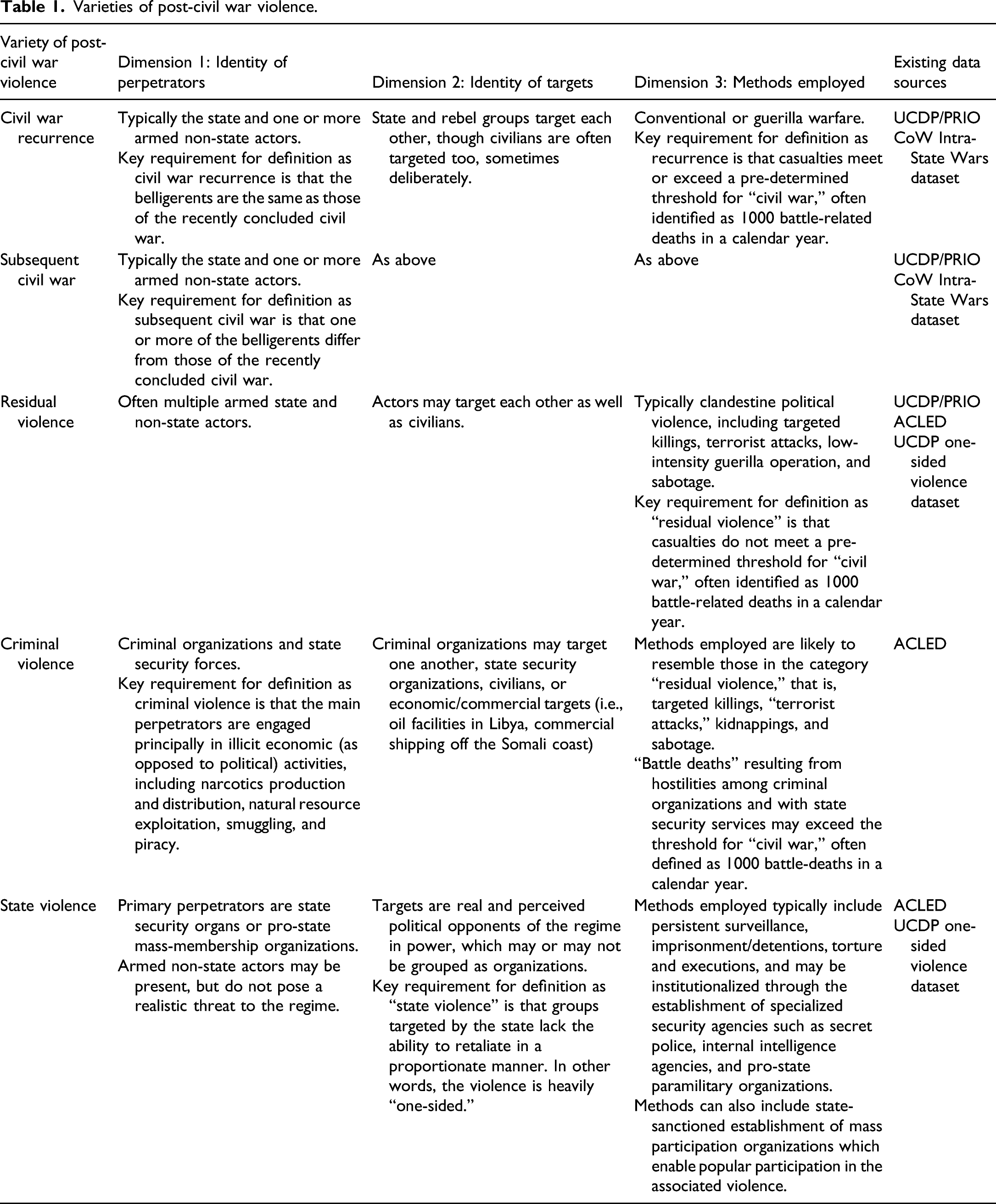
We consider the presence of any of the five varieties of post-civil war violence discussed above to be inimical to the maintenance of a durable and effective peace because of their direct, negative impact on the security of the population, expanding the potential to foster conditions for future conflict escalation as violent actors remain mobilized. The absence of these five varieties of post-civil war violence may not necessarily equate to “positive peace,” given that they are silent as to the prevalence of “structural violence.” However, a post-civil war environment which does not experience these varieties of organized violence does suggest that political competition is managed in a generally non-violent manner, which we believe is indicative of a more “durable peace.”
We acknowledge that this approach sets a very high bar for “durable peace” to be realized, given that any one of the five violent outcomes identified, if present, renders the label inapplicable. This contrasts with those studies which, by measuring the durability of peace through civil war recurrence, set a very low bar. The demanding standard implied by our approach is appropriate, however. It is preferable to describe as “peaceful” only those contexts which meet a relatively strict set of criteria than risk inaccurately labeling as such situations which may not approach the definitional requirements for civil war, but in which the lives of ordinary people are nevertheless plagued by the threat of organized violence. One consequence of adopting such a high bar is that few countries are likely to qualify as experiencing a “durable peace,” at least during the first years following civil war termination. The majority are likely to experience at least one of the forms of post-civil war violence outlined above. Among those countries that do appear to have settled quite rapidly into a durable post-civil war peace using this approach, we can point to Costa Rica following its 1948 civil war, Croatia after 1995 and Tajikistan from 2001.
Conclusion
In this article, we have argued that a binary approach to assessing the durability of post-civil war peace which looks only to the presence or absence of war recurrence does not adequately capture the heterogeneity of violent outcomes that different countries may experience. This risks overestimating the durability of a given peace, as other forms of violence beyond civil war recurrence are ignored. To address this issue, we have drawn on existing literature to review the various forms of violence that can emerge in the aftermath of civil war, and advanced a straightforward typology which can be used to categorize these. This typology, which is based on observable patterns of actor behavior and identity, is a refinement and systematization of existing concepts from across the qualitative and quantitative literature on peace and conflict. It is our hope that it may contribute to the development of a categorical approach to assessing the durability of peace in the aftermath of civil wars, which can augment existing measures of post-conflict outcomes and facilitate further empirical research.
Footnotes
Acknowledgments
Many thanks to Dr Adrian Florea and Dr Huseyn Aliyev for their advice and support.
Declaration of conflicting interests
The author(s) declared no potential conflicts of interest with respect to the research, authorship, and/or publication of this article.
Funding
The author(s) disclosed receipt of the following financial support for the research, authorship, and/or publication of this article: This work was supported by the Economic and Social Research Council (grant number ES/P000681/1).
