




Abstract
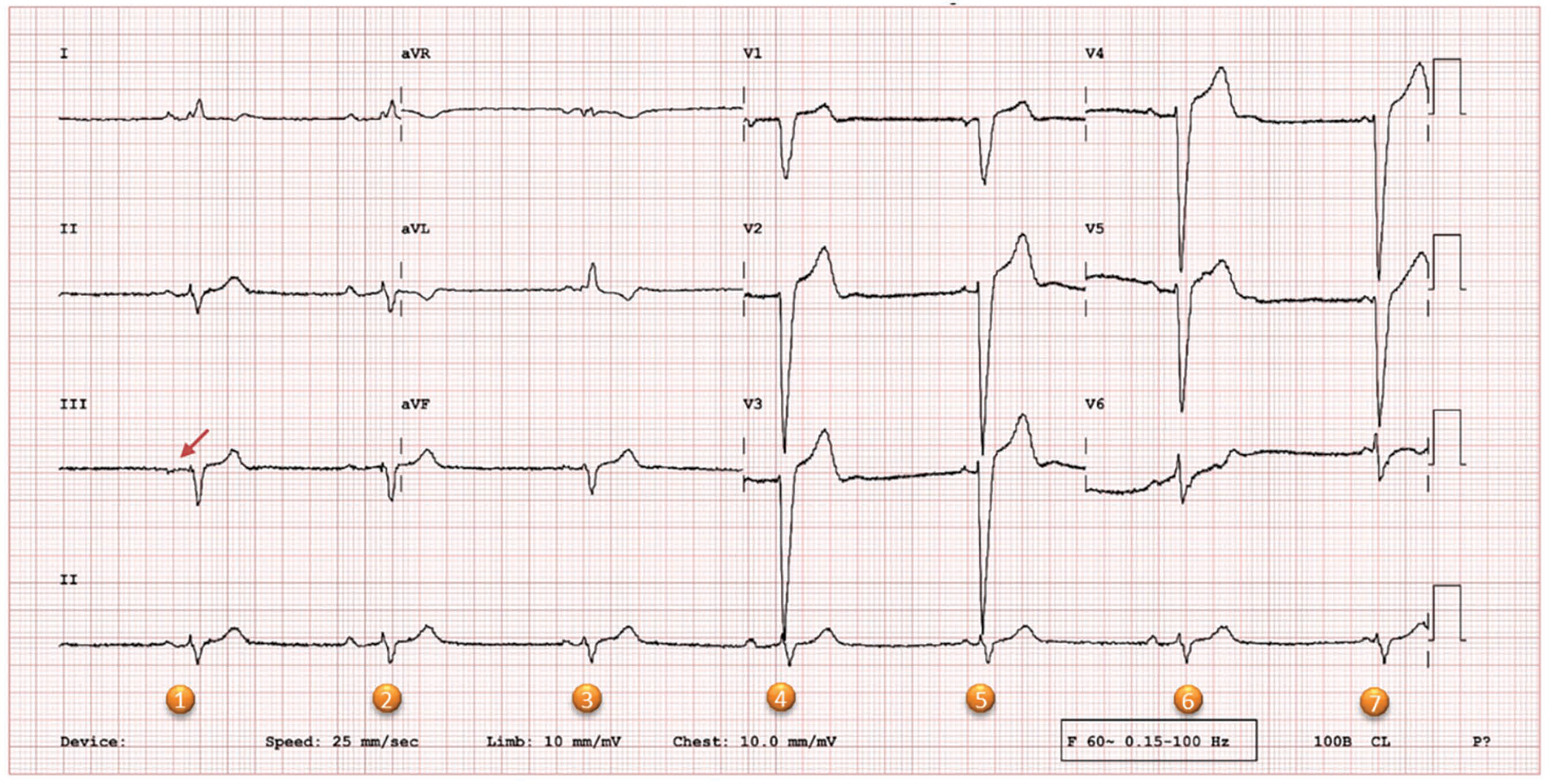
A man in his 60s presented with occasional giddiness to the emergency department. Clinical examination and echocardiogram were within normal limits. His electrocardiogram was reported as having sinus arrhythmia with alternate PR interval prolongation. Does he require pacemaker? The discussion guides the reader with the explanation.
Case Report
12-lead electrocardiogram of the index patient.
A. Lead II rhythm strip magnified with all intervals shown. B. The PR interval is decreasing for each apparently conducted sinus P wave and each PR interval for the atrial ectopic. This is a classic finding of the ventricular escape rhythm “marching on” independent of any atrial rhythm. PR intervals are mentioned in the red/upper panel for ectopic atrial rhythm and in the blue/lower panel.
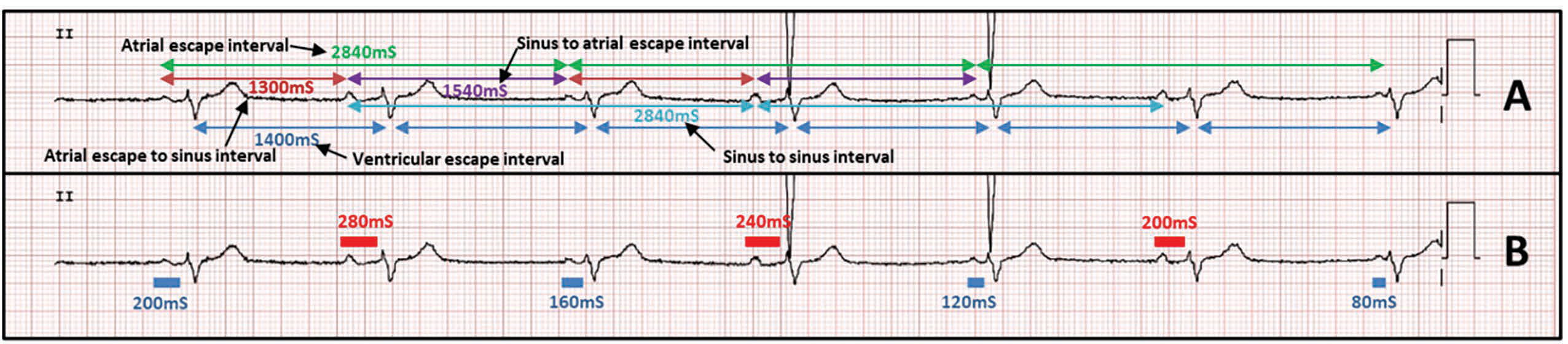
Electrocardiographically, complete heart block is defined by atrioventricular (AV) dissociation manifested by 3 golden rules: (a) the fixed RR interval, (b) the fixed PP interval (except ventriculophasic arrhythmia), and (c) the variable PR interval. Although the first and the third rules are met, the second rule was not met because of atrial escape at a fixed coupling interval with the sinus P wave giving a false impression of alternating short-long PR interval with conducted QRS. However, meticulous analysis of the ECG reveals that the PR intervals, while seemingly alternating at first glance, are not truly alternating. This distinction becomes particularly evident upon close examination of the final complex (Figures 1 and 2).
This case underscores the pivotal role of the “golden rules” in diagnosing complete heart block while highlighting a potential pitfall. Specifically, it emphasizes the importance of meticulous scrutiny of P wave morphology, particularly in scenarios where a seemingly variable PR interval might be present. This is a fascinating case of atrial escape masquerading both sinus and AV nodal dysfunction. The patient underwent dual-chamber permanent pacemaker insertion.
Summary
Meticulous examination of P wave morphology is essential in the evaluation of any arrhythmia.
Atrial escape occurring at consistent intervals in conjunction with a sinus rhythm has the potential to obscure the presence of both sinus bradycardia and complete heart block.
PR intervals that appear to alternate should be meticulously measured using calipers to definitively exclude atrioventricular dissociation.
Authors’ Contribution
SM (conceptualization: equal; formal analysis: lead; writing; original draft: lead; writing; review & editing: lead); JV (conceptualization: equal; formal analysis: lead; writing; original draft: lead; writing; review & editing: lead); NN (conceptualization: equal; formal analysis: lead; writing; review & editing: lead)
Data Availability Statement
All data are incorporated into the article and its online supplementary material.
Footnotes
Declaration of Conflicting Interests
The authors declared no potential conflicts of interest with respect to the research, authorship, and/or publication of this article.
Ethical Approval
Not applicable as it is an anonymous case report.
Funding
The authors received no financial support for the research, authorship, and/or publication of this article.
Informed Consent
Obtained from the patient in line with COPE guidance.
