



Abstract
Introduction:
Structured clinical records are essential for ensuring the quality and continuity of palliative care, particularly in socially vulnerable contexts. Existing digital systems rarely capture psychosocial or subjective data, limiting interdisciplinary collaboration and person-centered care planning.
Objective:
To describe the development and preliminary usability assessment of Prontuário Compassivo, a Brazilian digital platform designed to support clinical documentation and coordination of community-based palliative care.
Method:
This methodological study was conducted between 2022 and 2025, adopting an agile development approach grounded in the Scrum framework and guided by user-centered design principles. The platform was implemented as a responsive web system with secure authentication mechanisms, interoperability through REST (Representational State Transfer) application programming interfaces, and modules integrating standardized palliative care assessment tools. Usability assessment was conducted prospectively between February 2024 and January 2025 within the Favela Compassiva project in Rio de Janeiro. Data collection included direct observation of home visits, field diaries, and interdisciplinary meetings documenting professionals’ interactions with the platform. Usability aspects explored included learnability, ease of use, navigation clarity, and integration into routine clinical workflows.
Results:
By January 2025, the system had generated 520 clinical records used by 71 interdisciplinary health professionals involved in community-based palliative care. Three analytical categories emerged: (1) routine use, (2) challenges related to features and user diversity, and (3) contextual adjustments. These findings indicate that the platform became embedded in routine home-based care activities, although its use varied depending on users’ familiarity with digital tools. Iterative refinements included simplified and extended versions, reorganized navigation flows, and automated referral features.
Conclusion:
Prontuário Compassivo demonstrated technical feasibility, contextual usability, and adaptability in resource-limited environments. Its integration of interprofessional documentation, artificial intelligence resources, and interoperability positions it as a promising digital health solution for improving documentation, communication, and continuity of palliative care in socially vulnerable settings. Future studies should conduct standardized usability testing and evaluate the platform’s impact on clinical outcomes.
Plain language summary
Clinical records that follow a clear structure are important to ensure quality and continuity of palliative care, especially in socially vulnerable communities. However, most digital systems do not include psychosocial or subjective information, which makes teamwork and person-centered care planning more difficult. Objective: To describe the development and initial usability testing of Prontuário Compassivo, a Brazilian digital platform created to document community-based palliative care. Method: This methodological study was conducted between 2022 and 2025, adopting an agile development approach grounded in the Scrum framework and guided by user-centered design principles. The platform includes responsive design, secure authentication, REST API integration, and validated clinical scales. Usability was tested between February 2024 and January 2025 within the Favela Compassiva project in Rio de Janeiro. Data were collected through observation of home visits, field notes, and team meetings. Thematic analysis followed Braun and Clarke’s framework. Results: By January 2025, 520 clinical records had been created. Three main themes emerged: (1) routine use, (2) challenges related to system features and user diversity, and (3) the need for contextual adjustments. Improvements were made through several updates, such as simplified and extended versions, clearer navigation, and automatic referral tools. Conclusion: Prontuário Compassivo proved to be technically feasible, easy to use, and adaptable to low-resource settings. By combining interdisciplinary documentation, artificial intelligence tools, and interoperability, it shows strong potential to enhance record keeping, communication, and continuity of palliative care in socially vulnerable contexts.
Introduction
Clinical documentation plays a central role in how care is coordinated, particularly in palliative care, where clinical decisions depend on the integration of multidimensional information. This specialty, which seeks to relieve suffering and promote quality of life, requires multidimensional and integrated approaches that are often limited by current information systems.1,2 Studies indicate that palliative care records are frequently fragmented, lack standardization, and omit relevant subjective aspects of care.3,4 Moreover, interdisciplinary teams, the cornerstone of this field, face persistent challenges in communication and information sharing, particularly in resource-constrained settings.5,6
In socially vulnerable contexts, such as urban favelas, the lack of digital infrastructure, high turnover rates among healthcare teams, and limited time for consultations further intensify these difficulties. The lack of electronic platforms adapted to this kind of context intensifies the discontinuity of care and hinders shared therapeutic planning.7,8 In these contexts, existing systems often fail to respond to everyday care demands, highlighting the need for solutions that are not only technically robust but also compatible with local workflows and resource constraints. 9
Beyond the technical limitations, studies show that many traditional systems fail to capture sensitive data, such as advance directives, personal preferences, and social context, which may hinder patient-centered decision-making during critical clinical situations.1,6 The absence of structured fields and the prevalence of free-text records complicate the practical use of such information. On the other hand, platforms based on user-centered design and developed with the active participation of professionals tend to generate greater adherence and a more positive impact on assistance. 10
Recent advances in digital health have stimulated the development of electronic platforms designed to support documentation and care coordination in palliative care. Electronic health records tailored to this field can facilitate symptom monitoring, improve access to patient information, and strengthen communication among interdisciplinary teams.1,2 However, the successful implementation of such systems depends largely on their usability. In this study, usability was understood in practical terms as how easily professionals were able to incorporate the platform into their routine activities, navigate its functions, and complete documentation tasks within time-constrained care settings.11,12
In healthcare environments, usability is commonly evaluated through attributes such as learnability, efficiency, error frequency, training requirements, and user satisfaction.13,14 Poor usability may increase cognitive workload and limit adoption by healthcare professionals, particularly in resource-constrained settings. 15
In this respect, this article describes the development and preliminary usability assessment of Prontuário Compassivo, a Brazilian digital platform designed to support clinical documentation and coordination of community-based palliative care. The platform functions as a clinical record management system specifically designed for palliative care, enabling structured documentation of clinical, psychosocial, and biographical information about patients and families. It also supports care coordination through features such as the generation of reports and indicators, automated referrals, and shared access among interdisciplinary team members. Direct users of the system include physicians, nurses, dietitians, social workers, psychologists, and other professionals involved in home-based palliative care, while patients and caregivers benefit indirectly from improved information organization and continuity of care. By combining accessibility, interoperability, and user-centered design, the platform aims to enhance clinical practice, facilitate care management, and generate data to support research and public health policies.
Method
Study design
This methodological study reports the development and preliminary usability assessment of the Prontuário Compassivo digital platform for community-based palliative care conducted between January 2022 and January 2025.
System development
The development process was conducted using the Scrum agile methodology, 16 which emphasizes iterative development cycles and continuous user feedback. The development process was organized into successive sprints lasting approximately 6 weeks each. During each sprint, specific functional components of the platform were designed, implemented, and tested.
Feedback meetings were conducted at the end of each sprint with healthcare professionals participating in the project, allowing adjustments based on practical needs identified during care activities.
The team responsible for the platform development included software engineers and healthcare professionals with experience in palliative care, including physicians, nurses, occupational therapists, dietitians, and researchers involved in this study. This interdisciplinary composition ensured alignment between technological solutions and the practical requirements of clinical care.
Initially, collaborative meetings were conducted to identify functional and technical requirements of the platform, combined with a bibliographic review of digital documentation systems in palliative care. Based on these discussions, priority functionalities were defined considering clinical relevance, technical feasibility, implementation costs, and potential impact on continuity of care.
Workflow of community-based palliative care
Before the implementation of the Prontuário Compassivo platform, palliative care activities in the Favela Compassiva project followed a structured workflow that included patient identification, home-based clinical assessment, interdisciplinary discussion of clinical information, and documentation of care plans. Healthcare professionals conducted home visits to evaluate physical symptoms, functional status, psychosocial conditions, and family context. Clinical information was subsequently discussed during interdisciplinary meetings and manually documented in paper-based records.
This workflow was mapped through collaborative meetings with healthcare professionals and a review of existing documentation practices. The process supported the identification of functional and technical requirements for the digital platform, ensuring alignment with real-world care processes and the operational needs of community-based palliative care teams (Figure 1). These analyses guided the definition of the platform’s functional modules, data entry structure, and usability requirements.

Workflow of community-based palliative care supported by Prontuário Compassivo.
Feature extraction and system requirements
Based on these requirements, the system was developed through short implementation and evaluation cycles, with hands-on testing by healthcare professionals involved in the project. This process supported translating clinical and operational needs into specific system functionalities. Iterative refinements included improved navigation flows, added fields to document previous home visits, integration with local volunteers, and automated referral features.
Platform architecture
The platform’s modular and responsive architecture was designed to ensure accessibility across various devices and operational contexts, including areas with limited technological infrastructure. The iterative development process involved successive platform updates based on feedback collected during system use and interdisciplinary discussions with healthcare professionals, allowing continuous refinement of usability and system functionalities.
During development, exploratory computational models using machine learning techniques were investigated in a controlled environment to evaluate the feasibility of integrating future decision-support functionalities into the platform.
The architecture supports interoperability through application programming interfaces (APIs), enabling integration with external research tools and data analysis environments (Figure 2).

High-level representation of the platform’s responsive architecture.
Scrum development cycles
The development of Prontuário Compassivo followed the Scrum methodology over approximately 18 months. The project was organized into 12 development sprints, each lasting approximately 6 weeks, with continuous feedback cycles involving healthcare professionals and technical teams.
Regular feedback loops played a crucial role throughout the development process. At the end of each sprint, sprint review meetings were conducted with stakeholders, including palliative care professionals and information technology teams. These meetings allowed the evaluation of implemented features and the identification of usability issues.
Sprint retrospective meetings were also conducted after each cycle, allowing the development team to evaluate internal processes and adjust planning strategies for subsequent sprints.
During the development process, several challenges required rapid adaptation. Technical challenges related to system integration emerged during the intermediate sprints, particularly when establishing interoperability with external databases. These issues were addressed by allocating additional development resources and adjusting sprint timelines.
Usability improvements were also implemented in response to early-stage user feedback. Iterative interface adjustments simplified data entry processes and reduced the cognitive workload for healthcare professionals with limited technological expertise.
Sprint breakdown and deliverables
The platform development followed an iterative agile methodology organized into 12 sprints grouped into 4 development phases (Figure 3). Each phase focused on specific objectives, deliverables, and improvements derived from user and stakeholder feedback.

Agile development process of the platform across 12 sprints grouped into 4 phases. The figure summarizes the objectives, deliverables, and improvements based on stakeholder feedback throughout the development lifecycle.
Sprints 1–3: Establishing core features
The first three sprints focused on building the initial prototype and establishing the foundational components of the system. Core functionalities included the development of the basic user interface, patient care plan creation, and medical data entry modules. The objective was to produce a minimum viable product that allowed internal testing of the platform. Key goals included developing the initial interface for care teams, implementing patient record entry fields, and establishing authentication and security mechanisms. Deliverables included a working prototype with basic navigation, essential patient care features, and an early dashboard for monitoring care plans. Feedback from palliative care nurses and physicians highlighted usability challenges, particularly related to the complexity of data entry forms and the absence of clear indicators for urgent clinical tasks. These findings informed subsequent interface redesign efforts.
Sprints 4–6: Expanding functionality and user testing
Following the prototype development, the next phase focused on expanding system functionality and conducting initial user testing with healthcare professionals. New modules were implemented to support care coordination, including task assignment, notification systems, and internal communication tools. Patient records were expanded to include medication schedules, care goals, and advance directives. User testing revealed challenges related to task prioritization and updates to care plans. In response, the task management system was redesigned and enhanced with color-coded urgency indicators to improve workflow efficiency.
Sprints 7–9: System integration and security enhancements
During this phase, development focused on integrating the platform with external systems and strengthening security mechanisms. Integration was implemented through APIs, enabling interoperability with external research databases and statistical analysis tools such as R, Stata, and SPSS. These integrations enabled secure data synchronization while maintaining data consistency across systems. Additional security features were implemented, including enhanced encryption and improved access control protocols to protect sensitive patient information. Feedback from hospital information technology teams contributed to improvements in data import and export functionalities and security protocols.
Sprints 10–12: Performance optimization and final validation
The final phase focused on performance optimization, load testing, and user acceptance testing to ensure the platform’s reliability under real-world operational conditions. Testing revealed performance limitations on lower-end devices. Consequently, the system architecture was optimized to ensure compatibility across a wider range of hardware configurations. The final deliverables included a fully tested and optimized platform ready for deployment, accompanied by training materials and technical documentation.
Implementation and main features
The platform was implemented as a responsive web-based system to support interdisciplinary teams providing community-based palliative care during home visits, case discussions, and follow-up activities. Its implementation prioritized accessibility, shared documentation, and continuity of care across different devices and operational settings.
The main features of the platform include patient registration, home visit documentation, structured clinical assessments, symptom and functional status recording, care plan documentation, interdisciplinary communication, referral management, follow-up monitoring, and generation of clinical reports and indicators.
Preliminary usability assessment
The preliminary usability assessment of the Prontuário Compassivo platform was conducted from February 2024 to January 2025 by the authors, who are also volunteer healthcare professionals in the Favela Compassiva project in the Rocinha and Vidigal communities of Rio de Janeiro. This dual role enabled a deeper understanding of the platform’s application in real-world contexts marked by social vulnerability.
A non-participant observation approach was used, with researchers systematically observing interactions between healthcare professionals and the platform during routine care activities, without direct interference. This strategy was chosen to minimize disruption to care practices and to capture how the platform was integrated into daily clinical workflows. The approach was particularly appropriate in home-based palliative care, where time constraints and environmental conditions affect the use of digital tools. However, it limited the possibility of immediate clarification of user actions and the collection of real-time subjective feedback.
The evaluation focused on key usability attributes, including ease of learning, ease of use, clarity of navigation, integration into clinical workflows, and training requirements. Special attention was given to how professionals accessed information, completed documentation tasks, and used the platform in time-constrained care settings.
In this study, usability attributes were defined qualitatively. Learnability was inferred from how easily professionals initiated platform use with minimal guidance. Ease of use was reflected in their ability to complete documentation tasks during home visits without interruption. Navigation clarity was assessed based on observed difficulties accessing system functionalities. Training requirements were identified through recurring questions, requests for assistance, and variability in user performance. These attributes were not measured quantitatively but interpreted from patterns observed in field diaries and team discussions.
Data collection followed a qualitative approach, based on observations during monthly home visits conducted by 71 volunteer healthcare professionals in interdisciplinary team meetings held immediately after home visits to project patients. Field diaries documented interactions with the system, operational challenges, user behavior patterns, and reflections from team discussions. While this approach allowed for a deeper understanding of usability barriers in real-world contexts, it did not permit the measurement of standardized quantitative metrics, such as task completion time or error rates.
Data analysis followed the principles of reflexive thematic analysis, as proposed by Braun and Clarke, 17 grounded in an interpretive qualitative framework. The analytical process was iterative and involved continuous engagement of the research team with the data. Field notes and observation logs were read repeatedly to ensure familiarity, followed by inductive coding developed from the data rather than predefined analytical frameworks.
Coding was carried out collaboratively by several researchers, with regular discussions to explore alternative interpretations and deepen analytical insights. In line with reflexive thematic analysis, the process did not aim for inter-rater reliability but emphasized reflexivity, critical dialogue, and the active role of researchers in data interpretation.
Themes were developed through the organization and reorganization of codes, guided by patterns identified in the data and their relevance to the study objectives. These themes were iteratively reviewed and refined to ensure coherence and conceptual clarity.
IRaMuTeQ software was used only as an auxiliary tool to support data organization and explore lexical patterns within the dataset. 18 Descending hierarchical classification was applied to identify co-occurring term clusters, which informed but did not determine thematic development. Final themes were constructed through an interpretive process grounded in the researchers’ engagement with the data.
Analytical rigor was enhanced through triangulation of data sources (observations and team discussions), prolonged engagement with the field, and reflective collaboration among researchers. Given the interpretive nature of the study, no claims of data saturation were made; instead, the analysis sought sufficient depth and richness to address the research objectives, consistent with the precepts of Braun and Clarke 17 and reflexive thematic analysis.
The final themes identified were: (1) routine use, (2) challenges related to system features and user diversity, and (3) contextual adjustments and operational needs. These themes represent interpretive constructs grounded in the interaction between empirical data, researchers’ reflexivity, and the study context.
Results
Technical aspects of the platform
The present topic encompasses access and authentication methods, as well as backend and frontend implementation approaches.
Prontuário Compassivo
Conceptually, the Prontuário Compassivo platform was designed to be a vertically integrated solution in palliative care, thereby able to mediate and analyze every step and technical aspect of patient care, with the additional requirement of being usable without technological dependency or restriction to specific hardware.
Initially available as a traditional web application (software executed directly in a web browser), the system offers a responsive interface, which ensures a smooth user experience, adaptable to any device (whether it is a computer, tablet, or smartphone), under the prerogative of a design focused on usability and practicality in completing tasks.
This figure illustrates the initial web-based interface of the Prontuário Compassivo, accessed by users upon successful authentication (Figure 4).

Interface of the Prontuário Compassivo, accessed by users upon successful authentication.
Authentication and safety
The safety of information in Prontuário Compassivo is strictly followed by the principles of confidentiality, integrity, and availability of data. To that end, the system implements several protection layers for access control and cryptography of transmitted information (Figures 5 and 6).

Authentication flow using a Google Gmail account.

Authentication methods of the Prontuário Compassivo.
Privacy compliance
Access to the platform is restricted to authorized health professionals through individual authentication primarily based on a username and password. The system utilizes permission control based on each user’s profile, which separates tasks and ensures the traceability of actions. In addition, all access occurs through a certified SSL/TLS-secured connection (Secure Sockets Layer/Transport Layer Security protocols, which encrypt data transmission and prevent interception), thereby avoiding interception.
The platform employs a multilayered authentication system combining profile-based credentials, single sign-on (SSO), and multifactor authentication mechanisms, including time-based one-time passwords (TOTP) and passkey-based biometric verification.
This hybrid authentication approach was selected to balance data security and usability in community-based palliative care settings, where healthcare professionals require secure yet rapid access to patient information during home visits and interdisciplinary activities.
The use of TOTP provides an additional verification layer through time-sensitive codes, while passkey-based authentication, based on FIDO2 standards (Fast Identity Online, an open authentication standard that enables passwordless login using device-bound credentials and biometric verification), enables secure, passwordless access using device-bound credentials and biometric verification. These complementary mechanisms reduce the risk of unauthorized access, phishing, and credential theft, while maintaining accessibility across diverse user contexts and devices.
The system allows users to choose between authentication methods according to their operational context, supporting flexibility without compromising security. This multilayered strategy aligns with recommended security practices for digital health systems handling sensitive patient data.
These mechanisms enhance user security while optimizing accessibility and reducing credential management complexity. All communication between clients and servers occurs through SSL/TLS-encrypted channels, ensuring data integrity and preventing interception. In addition, the system maintains granular permission control and comprehensive activity traceability, supporting the ethical handling of clinical records and reinforcing institutional accountability in line with General Data Protection Law (LGPD) 19 and international best practices for digital health systems.
Backend and frontend architecture
The backend (data processing layer) of the Prontuário Compassivo platform was developed in PHP, with MySQL used for persistent data storage and management of structured clinical records. This setup enables secure storage, retrieval, and processing of patient information generated during palliative care activities.
The front end (presentation layer), responsible for the graphical user interface, was developed using HTML5, CSS, and JavaScript-based frameworks. The interface follows responsive design principles to ensure accessibility across devices, including computers, tablets, and smartphones, which is particularly relevant for home-based care in community settings.
In addition to the core system architecture, exploratory machine learning models were evaluated to assess the feasibility of incorporating future decision-support functionalities. These models used structured clinical data recorded in the platform, including demographic characteristics, diagnoses, laboratory results, and symptom assessment scores.
A feedforward artificial neural network architecture was implemented, consisting of an input layer based on selected clinical variables, one or two hidden layers with nonlinear activation functions, and an output layer generating probability estimates for predefined clinical events, such as short-term mortality risk and clinical deterioration. Model development and testing were conducted using retrospective data extracted from the platform, with internal validation procedures applied to assess feasibility.
The use of machine learning approaches was motivated by their ability to capture nonlinear relationships among multiple clinical variables, which may not be adequately identified through conventional statistical methods. However, these models were developed as exploratory prototypes and were not integrated into the platform’s clinical workflow. Their outputs were used exclusively for internal testing and methodological evaluation.
Integration with other platforms
To facilitate data automation, Prontuário Compassivo makes available a group of REST (Representational State Transfer) APIs, which enable its integration with other systems (such as other health platforms and lab exam apps), as well as statistics platforms and databases used in clinical practice and research.
Health professionals and researchers can connect the platform to the Microsoft Office suite (such as Excel, Access, and Power BI), to statistics packages widely used, such as R, the Statistical Package for the Social Sciences, and Stata. 20
This ability to integrate favors, above all, interoperability between systems, advanced analysis of clinical data, and the strengthening of healthcare strategies.
Functional modules
As shown in Table 1, the Prontuário Compassivo platform includes a comprehensive set of clinical assessment modules designed to support patient-centered documentation and interdisciplinary collaboration. These modules combine structured instruments for symptom assessment, functional status evaluation, and identification of palliative care needs. The integration of standardized tools such as the Edmonton Symptom Assessment System 21 (ESAS), Karnofsky Performance Scale 22 (KPS), Supportive and Palliative Care Indicators Tool 23 (SPICT), and NECesidades PALiativas tool 24 (NECPAL) enables systematic documentation of patient conditions while supporting interdisciplinary decision-making and continuity of care.
Summarizes the main functional modules of the platform, describing their key components and corresponding purposes in clinical practice.

Note: KPS = Karnofsky Performance Scale; ESAS = Edmonton Symptom Assessment System; SPICT = Supportive and Palliative Care Indicators Tool; AI = Artificial Intelligence.
By organizing these assessments within a single digital environment, the platform facilitates comprehensive clinical documentation and improves accessibility of relevant information for healthcare professionals (Figures 7–9).

ESAS registration module.

Referral report filter.

Functionality curve versus perceived pain generated by the Prontuário Compassivo.
Available assessments
The platform’s creators identified some challenges during the implementation period and in its practical use on the territory. Those challenges were directly related to the particularities of the favela context, including local demands, the organization of care, and the level of familiarity health professionals have with the use of technologies.
In total, 71 health professional volunteers from Favela Compassiva utilized the platform during palliative care interventions, comprising doctors, nurses, social workers, pharmacists, physical therapists, psychologists, dentists, occupational therapists, speech therapists, and dietitians, all with prior experience in palliative care.
Since the interventions in Favela Compassiva were conducted in an interdisciplinary manner, the team collectively discussed patient information before entering it into the platform. Moreover, all professionals involved had access to the platform and were able to input data, which facilitated the shared construction of information, a comprehensive view of the assisted person, continuity of care, and gradual familiarization with the platform.
As of January 2025, the system had registered 520 referrals and clinical records, reflecting ongoing use and acceptance of the platform by health professionals. Table 2 summarizes the main themes identified through thematic analysis during the implementation and practical use of the platform in community-based palliative care. These themes were mainly related to interface usability, variability in users’ digital literacy, and operational constraints associated with home-based care in socially vulnerable areas.
Main themes identified during the implementation period of Prontuário Compassivo and strategies adopted.
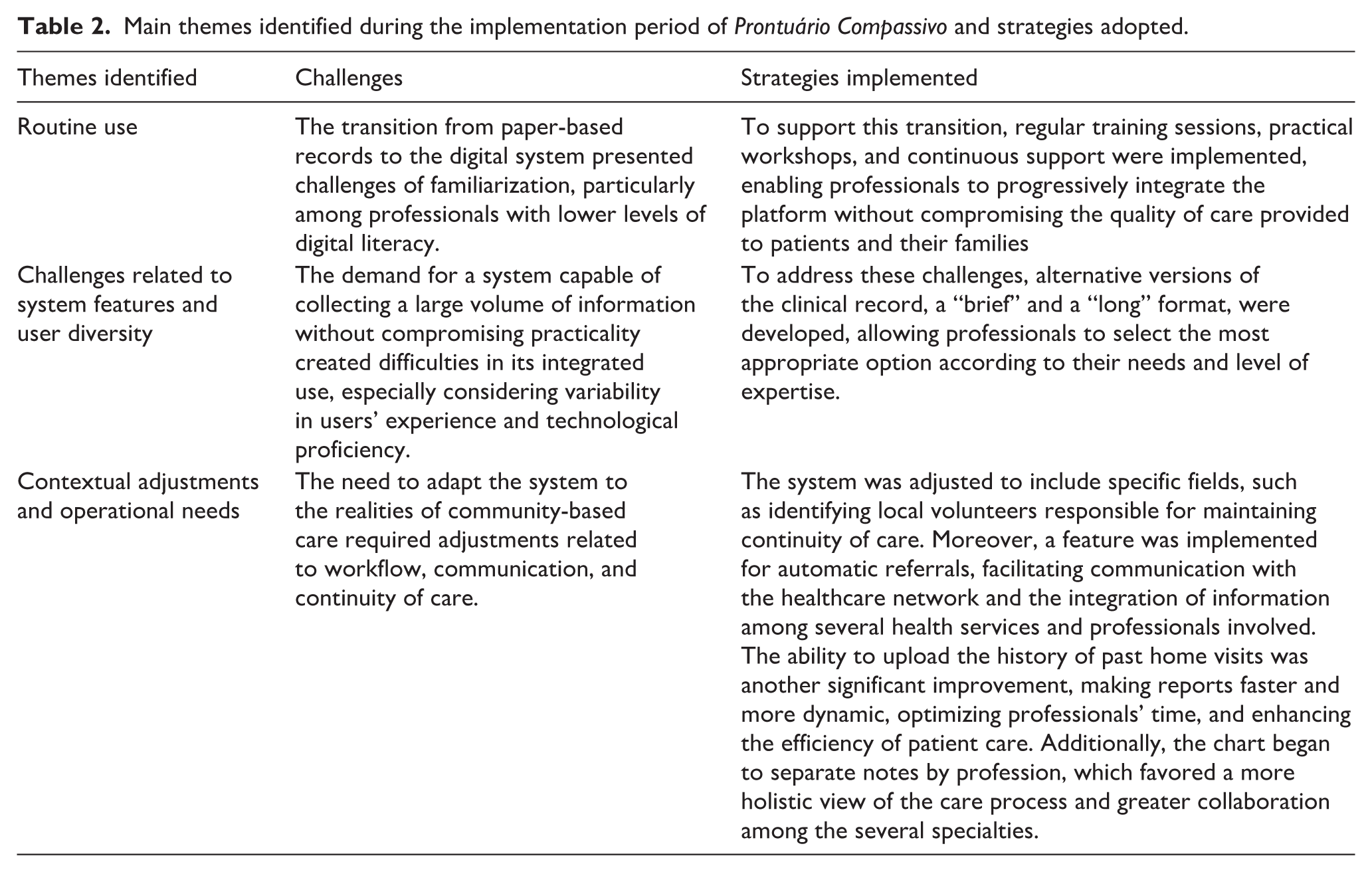
The findings highlight the importance of adapting digital systems to the realities of interdisciplinary teams working in resource-limited environments.
Based on these observations, targeted adjustments were made, including simplification of navigation flows, reorganization of data entry fields, and development of alternative interface versions to facilitate use during brief home visits. These changes improved usability by enhancing learnability, ease of use, and integration into routine clinical workflows.
Impact of Prontuário Compassivo on clinical practice
Before Prontuário Compassivo, patient records were paper-based, fragmented, and often lost, hindering continuity of care and communication among professionals. Information sharing required manual transcription, and key data from home visits or telehealth sessions were frequently omitted.
Following the implementation of the Prontuário Compassivo, the previously semi-structured and paper-based workflow became integrated into a unified digital system. All stages of care, including patient identification, clinical assessment, interdisciplinary discussion, documentation, care planning, referrals, and follow-up, were incorporated into a continuous and structured workflow supported by the platform.
Clinical data can now be recorded and accessed in real time during home visits and interdisciplinary meetings. The platform enables longitudinal tracking of patient information, including symptoms, functional status, and care trajectories, facilitating continuity of care across different professionals and services.
The introduction of mandatory fields and predefined data entry structures significantly improved data completeness and consistency, reducing missing information from 40% to 5%. In addition, automated report generation and notification features enhanced communication with other healthcare services and supported timely decision-making.
The first 520 clinical records registered in the system demonstrate improvements in data organization, earlier identification of clinical deterioration, and strengthened interdisciplinary communication, as reflected by improved data completeness and more consistent access to shared clinical information among team members. The integration of the workflow into a digital environment also reduced reliance on manual transcription and minimized information loss observed in the previous paper-based system.
Cycle of updates and technology innovations
Additional functionalities were added to the platform over time, including automated clinical reports, visualization of patient trajectories, and tools to support monitoring of symptoms and functional status. These features were intended to improve data organization and facilitate interdisciplinary communication among healthcare professionals.
Artificial intelligence-based resources were explored to support data processing and exploratory analysis. These approaches enabled preliminary testing of structured data retrieval and pattern identification within patient records. However, these functionalities were not integrated into routine clinical use and did not directly inform clinical decision-making, remaining experimental within the platform development process.
Additional system functionalities included enhanced reporting and management tools, such as patient timelines, pain characterization, survival analysis (Kaplan–Meier), voice-based clinical assessments, and supply management optimization.
Discussion
The results of this study indicate that Prontuário Compassivo is a promising digital solution for documentation in palliative care settings with high social vulnerability. Featuring responsive architecture, AI resources, advanced authentication, and API integration, the platform had generated 520 clinical records by January 2025. The sustained adherence of interdisciplinary teams demonstrates its technical feasibility, despite challenges such as unfamiliarity with the interface, operational complexity, and limited contextual adaptability. Iterative refinements, including simplified versions and reorganized navigation flows, were crucial to improving usability and integration into clinical routines.
As palliative care services expand, digital platforms enable the qualitative evolution of clinical records across professional categories. 25 In this scenario, Prontuário Compassivo stands out as a locally developed Brazilian solution capable of addressing the country’s social and cultural diversity, which often limits the adoption of foreign systems.
This type of platform is regarded not only as a demand from healthcare service managers but also as a critical need identified by health professionals themselves.5,6 Several countries, including Australia and those in the Americas, have adopted electronic health records and implemented national digital health strategies to foster innovation and improve clinical outcomes. 26 A survey involving 170 palliative care professionals revealed that, although they reported moderate confidence in using digital technologies, they acknowledged the potential of such platforms to enhance clinical practice. Among the most sought-after innovations were electronic health records tailored explicitly to palliative care. 4
Studies conducted in pediatric settings have also demonstrated benefits associated with the use of electronic records, such as continuous data availability, simultaneous access by multiple providers, and remote consultation of information. 6 These findings are consistent with the results of the present study and reinforce the importance of digital systems for ensuring continuity and integration of care.
One of the most notable findings of this study was the reduction in missing data from 40% to 5% after implementation of the digital platform. This finding represents a substantial improvement in data completeness, a critical dimension of electronic health record quality. This improvement is consistent with the use of structured forms, predefined fields, and real-time data validation embedded in the platform, which reduces variability in documentation and minimizes information loss. In palliative care settings, where clinical decisions depend on longitudinal and multidimensional information, improvements in data completeness may directly support continuity of care, interdisciplinary communication, and the reliability of clinical records for decision-making and research purposes.27,28
Prontuário Compassivo features multiple interfaces that enable the integrated documentation of both objective and subjective information, respecting the complexity of interprofessional practices in palliative care. Elements such as life history, personal interests, and patients’ social contexts are essential for building person-centered care plans and are appropriately accommodated within the platform. This characteristic addresses gaps identified in a systematic review of digital solutions in palliative care, which highlighted the limitations of traditional medical records in capturing relevant qualitative data. 2
Conventional medical records often fragment clinical practice by prioritizing technical indicators while neglecting the subjective dimensions of care. 3 The lack of structured fields for sensitive data, such as advance directives, results in free-text entries that hinder retrieval during critical decision-making moments. 6 The system analyzed in this study addresses this limitation by incorporating designated fields for such information, thereby facilitating its effective clinical use.
A comparative discussion between Prontuário Compassivo and other digital platforms in palliative care, particularly in structurally limited settings, highlights key differentiators. The Palliative Care Outcome Scale (POS), as noted by Rugno and De Carlo, 29 has emerged as a valuable instrument for assessing outcomes in palliative care, including quality of life and service organization. Prontuário Compassivo stands out for its responsive design, tailored to vulnerable contexts, and integrates multiple validated platforms (KPS, ESAS, SPICT, NECPAL), offering features such as automated referral generation.
AI-based platforms, as described by Avati et al. 30 and Wilson et al., 31 utilize electronic health records to predict mortality and identify patients eligible for palliative care. While incorporating similar predictive capabilities, Prontuário Compassivo adapts itself to low-resource environments, such as urban slums, where high staff turnover is common. Sandham et al. 32 explored machine learning with Integrated Palliative Care Outcome Scale (IPOS) data to identify stages of palliative conditions. Prontuário Compassivo goes further by offering both “brief” and “extended” versions, codeveloped with professionals working in underserved areas to ensure alignment with local realities.
Adegbesan et al. 33 highlighted the ethical challenges associated with integrating AI into palliative care in resource-limited settings. Prontuário Compassivo addresses these concerns by complying with Brazil’s LGPD and employing a user-centered design approach. Furthermore, Vu et al. 34 noted that most machine learning applications in palliative care focus on mortality prediction with limited external validation. Prontuário Compassivo distinguishes itself through its practical application in vulnerable communities and its iterative development, reflected in 31 successive versions that demonstrate ongoing field-based refinement and validation.
Despite the observed benefits, several challenges arose during the system’s implementation, including user familiarity with the interface, operational complexity, and adapting to local realities, given the heterogeneous levels of digital literacy, limited infrastructure, and connectivity issues in the field. These difficulties have a direct impact on the adoption of technology.35,36 Nielsen et al. 7 warn that when digital platforms fail to meet user needs, there is a high risk of abandonment. Mills et al. 4 further emphasize that digital literacy is a critical factor for the successful implementation of electronic health records, particularly in community-based settings. To overcome such barriers, the use of continuous formative strategies is recommended, including multimedia tutorials, visual guides, and simulations, aligned with the principles of responsive usability. 8
The cognitive and operational overload caused by the platform’s complexity, particularly during short home visits, hindered the comprehensive use of key modules within the platform. This finding aligns with Meyerheim et al., 5 who link highly detailed electronic health records to incomplete documentation. A proposed solution is the implementation of modular versions (basic and advanced) tailored to the available time and specific clinical context. 2
In addition, the high turnover and diversity of care teams highlighted the limitations of one-time training sessions. Inconsistencies in documentation and recurrent user questions underscore the need for ongoing, context-sensitive education. Bush et al. 1 have already emphasized the importance of short-cycle, practice-integrated educational programs as a key strategy for the effective integration of electronic health records in resource-constrained settings.
The effective adoption of digital technology still relies on technical support and an effective organizational structure. Schwappach et al. 37 associate usability limitations with risks to patient safety, which highlights the need for continuous training. Foley and Horwitz 38 emphasize that health systems based on learning require structured support and ongoing training to facilitate professional adaptation.
In this context, active communication among developers, policymakers, and professionals has become fundamental. Literature suggests that continuous training, accompanied by illustrated material, integrated tutorials, and technical support, is essential for qualified use. 5 Moreover, Frauenberger et al. 10 emphasize the importance of participatory design, while Granja et al. 9 highlight the need for a previous analysis of clinical workflow as a prerequisite for effectively incorporating technology.
Regarding long-term sustainability, although the initial development of Prontuário Compassivo was supported by a volunteer-led initiative, the platform has been structured to enable institutional integration and ongoing operation. Server infrastructure and data management are designed to be hosted within secure institutional environments, ensuring compliance with the Brazilian LGPD 19 and established data governance practices in digital health. As the platform scales, long-term sustainability will depend on formal partnerships with academic institutions and healthcare services, which may assume responsibility for server maintenance, system updates, and data governance. This transition from a volunteer-based model to an institutionally supported structure is essential to ensure operational stability, data security, and alignment with national public health strategies, including the National Palliative Care Policy. 39
In this context, the results of this study address key priorities in palliative care digital health, including support for clinical decision-making, early care planning, remote monitoring, and patient-reported outcomes. 37 The implementation of Prontuário Compassivo contributes to the organization of palliative care management by centralizing clinical records within an integrated platform accessible to interdisciplinary teams. This structure enables the generation of key indicators, supports resource allocation, and facilitates evidence-informed decision-making while ensuring compliance with data protection regulations. In addition, the system strengthens communication between professionals and services, promotes continuity of care, and provides a secure environment for data-driven management.
These advances are also reflected in the increased completeness of clinical data observed in this study, which strengthens the reliability of information used in care coordination. The structured database further provides a foundation for future research on usability, applicability, and clinical outcomes in diverse palliative care settings.
Some limitations should be considered. The usability assessment was conducted within a single community-based project, which may limit the generalizability of the findings to other healthcare contexts. In addition, the qualitative design did not include standardized quantitative usability metrics, such as task completion time, error rates, or user satisfaction scores, which are commonly used in formal usability evaluations. Although a substantial reduction in missing data was observed, this finding should be interpreted within the context of an observational design without a controlled comparison group.
Future studies should explore the implementation of the platform in other palliative care services and evaluate its potential impact on clinical workflows, care coordination, and patient outcomes. Investigations involving larger and more diverse professional teams may contribute to assessing the external validity and scalability of the system. Further usability testing using standardized evaluation tools may support system refinement and its broader adoption in digital health initiatives for palliative care.
Conclusion
The results demonstrate that Prontuário Compassivo is technically feasible and adaptable to contexts of social vulnerability, enabling structured documentation of clinical, psychosocial, and contextual information while facilitating communication among interdisciplinary teams. The iterative development process, guided by user-centered design principles and continuous feedback from healthcare professionals, allowed the platform to be progressively refined to meet the practical demands of home-based palliative care. The findings also highlight the potential of digital tools to improve the organization of clinical information and strengthen interdisciplinary collaboration in resource-constrained settings. However, the study was conducted within a single community-based project and did not include standardized quantitative usability metrics, which limits the generalizability and formal comparability of the findings. Future studies should evaluate the platform in other care settings and include standardized usability and clinical outcome measures to assess its broader applicability and impact.
Footnotes
ORCID iDs

Ethical considerations
Ethical approval was obtained from the Research Ethics Committee of the Federal University of Rio de Janeiro (approval number: 7.809.932), Rio de Janeiro, Brazil.
Consent to participate
All participants provided informed consent for the use of their data and signed the informed consent form. The collective contributions were essential for refining the clinical record, ensuring its alignment with local care practices and the lived realities of individuals using community health services.
Author contributions
Funding
The authors disclosed receipt of the following financial support for the research, authorship, and/or publication of this article: This work was supported by the Coordenação de Aperfeiçoamento de Pessoal de Nível Superior (CAPES), Brazil — Finance Code 001.
Declaration of conflicting interests
The authors declared no potential conflicts of interest with respect to the research, authorship, and/or publication of this article.
Data availability statement
The raw and analyzed data related to this study are maintained and managed according to ethical regulations. To maintain confidentiality and anonymity of participants, this information will not be made publicly available. Requests for further information can be directed to the corresponding author*.