



Abstract
Purpose
Trichotillomania (TTM) is characterised by the recurrent pulling out of one’s own hair, resulting in hair loss. It is a poorly understood disorder with no consensus on aetiology or epidemiology. Nested within a larger qualitative study exploring a wide range of TTM topics, the aim of this paper is to report and consider participant views on the acceptability and feasibility of the asynchronous email interview method.
Method
Cross-cultural qualitative research on TTM is sparse; therefore, an international qualitative study with a geographically diverse sample was conducted using an asynchronous email interview method.
Results
Participant perspectives highlighted three themes related to the study method: the value in creating personal connections, cathartic reflections, and perceived strengths and weaknesses. This paper highlights the potential of the asynchronous email interview method for sustaining remote research across multiple locations, using a sample of 20 adults with TTM (18–55 years) from 15 different countries.
Conclusions
This was an acceptable and feasible method for data collection, facilitating remote access while yielding rich data from an often hidden and hard-to-reach population.
Keywords
Introduction
Trichotillomania (TTM) is the recurrent pulling out of one’s own hair resulting in hair loss, with repeated attempts to decrease and/or stop hair-pulling behaviours. TTM commonly results in clinically significant distress or impairment across all aspects of life, with subsequent hair loss not attributable to another medical condition or mental disorder. 1 TTM has been recategorised several times, both as an impulse control disorder and an obsessive compulsive and related disorder, thus signifying that it remains a poorly understood disorder 2 within a largely hidden and hard-to-reach population. The true prevalence of TTM has remained largely unknown for decades due to a lack of large-scale epidemiological studies. 3 More recently, the first large epidemiological survey in a USA general population sample 4 highlighted 1.7% of adults as having current TTM, with the lifetime rate at 2.5%. Similarly, the DSM-5 1 estimates prevalence between 1% and 2%.
Previous research has focused largely on testing pharmacological and behavioural treatments for TTM using quantitative approaches, 5 though there has been some qualitative work, such as exploration of cognitions and beliefs,6,7 and combined approaches using online methods (web-based self-help and telepsychology) coupled with behaviour-based therapy.8,9 Nevertheless, there is a dearth of qualitative enquiry around TTM. Using data from a larger qualitative study which explored a wide range of TTM topics in an effort to further explore TTM from a qualitative perspective, the aim of this article is to report participant views on the acceptability and feasibility of the asynchronous email interview. This focus on methods explores the dearth of qualitative research on TTM, highlights a remote method of data collection that facilitates safe and socially-distanced research in light of the COVID-19 pandemic, and helps to inform decision making regarding data collection methods, especially in relation to sensitive research with hidden and hard-to-reach populations.
Methods
A generic qualitative approach was utilised10,11,12. Caelli et al. 10 defined this as research that ‘is not guided by an explicit or established set of philosophic assumptions in the form of one of the known (or more established) qualitative methodologies’ (p. 4). Exploration of acceptability and feasibility of the method was nested within a larger qualitative study exploring a wide range of TTM topics. It is highly probable that novel and interesting research questions or interview questions may arise that lie ‘in-between’ methodological spaces. 11 These questions may involve topics that have yet to be explored; given the quantity and breadth of potential questions, it would be naïve for researchers to assume that the traditional and more established methodologies would account for every possible question. 10 However, researchers still feel obliged to underpin their research with an established methodology, despite an imperfect fit.
There have been criticisms of using a generic qualitative approach which centre largely around rigour; Neergaard et al. 13 argued the lack of robust critical literature and failure to adopt an established methodology makes for atheoretical research. Parameters for generic research still remain largely ill-defined. 11 In this regard, Caelli et al. 10 offered four requirements for conducting a good generic study; clearly noting the researchers’ position including any presuppositions or personal history that may influence the study, distinguishing between methodology and method, outlining the approach to rigour and identifying an analytic lens. Another option would be consideration of Crotty’s 14 four elements of a well-designed research framework; this involves discussion and demonstration of epistemology, theoretical framework or philosophical stance, and a detailed outline of methodology and methods.
Using a generic qualitative approach within this study provided a flexible approach to assess the data, without viewing or analysing the dataset through the confines of a single established methodology. In order to establish transparency; a relativist ontological position 15 and constructivist position was adopted.16,17 This study used reflexivity, prolonged engagement and an audit trail to establish rigour.
Asynchronous email interview
Computer-mediated communication 18 can either be synchronous (real-time) or asynchronous (not subject to time constraints); this study used asynchronous email interviews to gather data from 20 participants across the world. Benefits of interviewing participants via email include allowing the participant a greater amount of time to think about questions and reply at a time convenient to them while in comfortable surroundings 19 and may contribute toward participant autonomy. 20 This method has cost advantages compared with face-to-face interviews and focus groups across a wide range of locations and does not require specialist recording equipment. 21 Possible disadvantages of using email interviews include the potential for technical difficulties, 22 a lack of non-verbal communication and the sample is restricted to those with access to the internet. 21 Nevertheless, the email interview method has demonstrated effectiveness, 23 it is a method that can be used to collect sensitive and richly detailed data 22 from international or clinically hard-to-reach samples.
Netiquette refers to guidelines about behaviour that are acceptable when communicating with people over the internet. 24 This was taken into consideration when constructing the interview schedule; there were seven sets of questions, each set comprised eight questions which could be viewed on a single screen. Separating the interview schedule into manageable sections provided an opportunity to ask supplementary questions and clarify earlier responses as email exchanges progressed. Throughout the email interview, the nature of communication naturally progressed from formal to less formal; emails began fairly formally with ‘Dear’ and ended with ‘Regards’ or ‘Kind regards’, over the course of the email exchanges this progressed to less formal greetings and participants often used various symbols or emojis to illustrate emotion (e.g. smiles). This change in the formality of language is also noted by Mann and Stewart. 24
Recruitment and procedure
Researchers are likely to encounter barriers when recruiting hard-to-reach populations; people with TTM may not be identifiable in GP databases due to non-disclosure and there may be issues with data protection policies. These aspects influence recruitment strategies when sampling people from hard-to-reach populations and informed the decision to recruit online. A purposive sampling strategy was utilised to specifically recruit individuals who shared a common experience of having TTM and efforts were made to recruit an international sample. There are large online social media communities where people with TTM can join together to talk about their experiences; these online communities provide a powerful ‘virtual’ connection to people throughout the world who have a shared diagnosis. 25 Qualitative purposive sampling involves selecting individuals who are knowledgeable about or have experience with a phenomenon of interest. 26 Further, it allows voices from stigmatized populations to be heard, by reflecting experiences that capture the emic view. 27
The researcher had previously shared their own experience of TTM in an online community; this insider perspective was beneficial in that it promoted trust in participants which contributed toward rapport. 28 A post was placed on a social media TTM group inviting interested individuals to respond by sending the researcher a private message via the social media website with their email address. The initial message seeking participants was written in English and only participants who could read/speak English volunteered their participation. People who expressed initial interest were sent further information about the study. Only people who were interested in proceeding completed the consent form and returned it via email which established formal participation in the study. Participation was entirely voluntary; no incentive or compensation was provided to participants.
Any dropouts were replaced with additional participants until information power was achieved. Information power has been offered as an alternate concept to data saturation; Braun and Clarke 29 emphasize the importance of in-depth engagement with the data in thematic analysis and describe how coding and theme development can move back and forth recursively. Malterud et al. 30 assert studies with broad aims may require larger samples and judgements about sample size can be revisited along the research process. Similarly, Braun and Clarke 29 suggest sample size may utilise a mix of interpretative and pragmatic judgement, with the decision to stop data collection being subjective. Participant 19 spoke extensively about a new topic, preliminary coding from participant 20 largely aligned with previous data and data collection subsequently ceased. Although information power can be used as an alternate to data saturation, criticisms have been noted; Malterud et al. 30 argue ‘a researcher who never challenges his or her participant runs the risk of developing empirical data holding low information power’ (p. 1756). Rather, this study held the view that participants should be permitted to unfold their story freely and with minimal researcher intervention (see Wengraf, 2009 31 ), as a result of this standpoint and coupled with a broad primary aim, a larger sample was recruited to contribute towards information power.
Diagnoses were not formally verified; to mitigate this, eligibility criteria contained several screening questions, as guided by the DSM-5 1 criteria for TTM. Participants were asked to confirm they were aged 18 and above. Other eligibility criteria were subjective experience of: recurring episodes of hair-pulling, attempts to decrease/stop the behaviour, subsequent distress or impairment, and that TTM was not caused by another medical condition. Exclusion criteria included a screening question which aimed to identify any participant who considered him/herself to be at risk. Asynchronous email interviews 22 took place over 8–10 email exchanges and included semi-structured open-ended questions on a variety of TTM topics (e.g. experiences and impact of TTM, feedback on the study method, treatment seeking behaviours, perceived ideal intervention). The questions related to feedback on participating in the study included, for example: how did you find participating in this email interview? and is there anything you think could have been improved/done differently?
Ethical consideration
Full ethical approval was granted by a university research ethics panel. Ethical considerations were informed by guidelines outlined by the British Psychological Society.32,33 Participants provided informed consent, were notified of their rights to anonymity and confidentiality, and could withdraw their data before a specified date. Participants were debriefed and provided with support measures (helpline number and website support for each participating country) at the end of participation.
Analytical approach
Data were analysed using thematic analysis, 34 a method that offers a flexible process of analysing data and is highly compatible with many approaches including the generic qualitative approach. 34 The thematic analysis was utilised in an inductive way to locate semantic level themes; this facilitates the development of themes that are strongly tied to the data itself. Data were analysed using the six-phase process 34 ; interviews were repeatedly read while searching for patterns and meanings, a flow chart of initial impressions were made. Analysis progressed from initial codes to preliminary themes, analysis was refocused at a broader level, candidate themes were refined and reviewed ending with a final list of themes. Interviews were analysed by one author and annotated transcripts and themes were discussed among the team. As considerable time was saved on transcription, interviews were analysed by hand; a conscious and deliberate choice, as the researcher wanted to achieve full immersion, understanding and familiarisation of the data.
Findings
Demographic information of the asynchronous email interview sample.
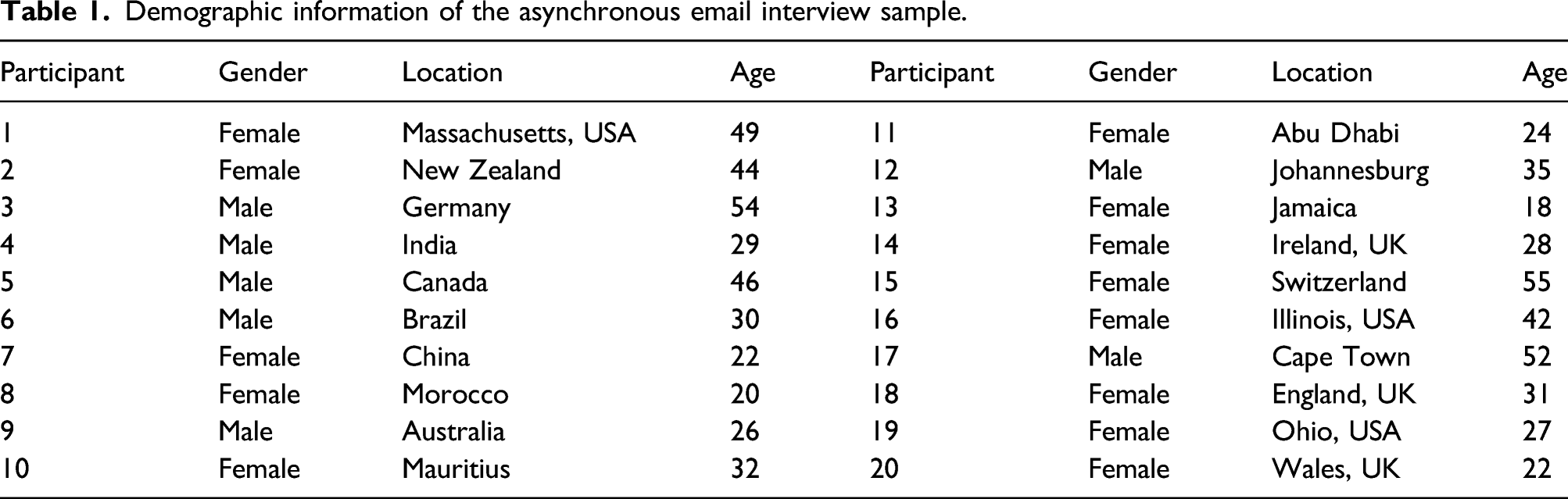
Data analysis generated three final themes relating to the feasibility and acceptability of the asynchronous interview: the value in creating personal connections; cathartic reflections; perceived strengths and weaknesses.
The value in creating personal connections
Participants were directly asked their views on the asynchronous email interview method, and they highlighted practical advice and feedback about their experience participating in the study. Most participants spoke about the email interview positively and found it an acceptable way to talk about TTM; when asked ‘How did you find participating in this email interview?’, one participant succinctly replied: ‘Great! It was nice to talk about living with trich [TTM] and It was also nice to talk to someone who can sympathise with us. It makes a world of difference knowing you are not judging us’ (P17 – Male, 52)
Within the long-term email exchanges, the same participant had also described difficulty communicating in-person with doctors by saying ‘I’m not very verbal, so maybe he [the doctor] thinks that because I don’t talk about the problems that the problems don’t exist and im [I’m] coping with it’; this suggests that the email interview method provided a convenient and acceptable way to talk about TTM, and may be a useful tool for people who have difficulty discussing sensitive topics or expressing themselves in-person. As perceived judgement and perceived stigma is often associated with TTM, this theme further highlights that people with TTM want to feel a connection to someone who may understand their mental health disorder and interact with them in a non-judgemental way: ‘You were nice to talk to on email and I felt like you didn’t judge me or my answers, probably because you also have Trich [TTM], you are the right person to do this research!’ (P14 – Female, 28)
Transparent communication, trust and mutual understanding between participant and researcher facilitated rapport. Participants commented positively on the early disclosure of a shared experience of TTM, this may have served to provide a feeling of validation towards a participant’s feelings or experience of their mental health disorder; this may act as a subtle comfort in helping participants not feel alone: ‘It was nice to know someone is taking this issue seriously. I’ve never had anyone ask these questions before. It’s validating that this is not all in my head and I’m not the only one’ (P16 – Female, 42)
The value of creating a personal connection with participants who want to be understood in an empathetic and accepting manner can facilitate rapport and elicit rich data; participants highlighted that they enjoyed the email interview process and commented positively on communicating with the researcher throughout the long-term interview process: ‘you were kind, and patient with me and continued to keep in touch which was nice’ (P19 – Female, 27) ‘I really enjoyed participating! It was nice to talk to someone who wants to make a difference to our community’ (P11 – Female, 24)
Cathartic reflections
Participants described how participating in the email interview was a thought provoking and therapeutic experience: ‘Thought provoking and difficult at times. It has also been therapeutic to write it down. I could also be completely honest as I know it is confidential and I know I am not being judged by you’ (P18 – Female, 31) ‘brought up a lot of emotions that I thought were behind me, such as the rage and depressive pain. I also found it healing in a way, to be able to tell my story.’ (P1 – Female, 49)
This was echoed in other comments relating to being given an opportunity to reflect on and share personal perspectives on having TTM: ‘nice to voice a personal opinion on the subject and mostly to be involved with something that has been a long and lonely trip’ (P5 – Male, 46)
The process of participation often encouraged self-reflection about living with TTM: ‘Made me think about things I didn’t before. It’s good to get it out of my head’ (P16 – Female, 42) ‘Very interesting to answer questions, but also to think about my trich [TTM] and how its affected me’ (P12 – Male, 35)
Participating in the email interview may have also contributed towards opening a dialogue with significant others about having TTM, as well as deepening other people’s understanding and participants’ own understanding about having the disorder: ‘eye opening, no one or even myself has ever though [thought] this far into my trich [TTM]. I enjoyed reading some of my answers to my husband, so he could continue to have an understanding with my disorder’ (P19 – Female, 27) ‘I found it helpful to help me understand some of the feelings I have about trich [TTM]’ (P20-Female, 22) ‘Made me really think a lot on how much is still left to do in this field so that future generations hopefully can be cured, but if not, at least be understood’ (P2 – Female, 44)
Perceived strengths and weaknesses
Participants were asked their opinion on the strengths and weaknesses of the email interview, with the intention of receiving their direct views on the study method. Feedback highlighted aspects relating to acceptability and manageability of the interview schedule, rapport and perceived confidentiality, and suggested improvements. Findings suggested participants enjoyed the email interview process, with five participants stating that the email schedule was thorough: ‘I think you have covered everything very thoroughly’ (P2 – Female, 44)
Acceptability and manageability of interview schedule
Seven participants said the number of questions per email was manageable, this links with ‘netiquette’
24
guidelines which suggest email communications should be viewed on a single screen: ‘Good questions. Good amount to anwer [answer] in every email. Good to be given time to answer, when we can have some free time’ (P10 – Female, 32)
Participants also commented on the wide range of questions in the interview schedule and acknowledged that this could generate an in-depth view into TTM: ‘The strength about your interview is that you went in depth with asking a lot of questions that can really gain a lot of necessary information’ (P13 – Female, 18) ‘I enjoyed the variety of different questions. The number of questions per email was convenient and the time allowed to answer each set was also very convenient’ (P17 – Male, 52)
Rapport and perceived confidentiality
While describing the convenience and manageability of the interview schedule, many participants provided feedback that the method could easily fit into their daily life while commenting positively on rapport: ‘Because this interview took place over several emails, I feel like we’re basically friends now’ (P12 – Male, 35) ‘You were very nice and helpful. I can answer the questions when I like within 2 weeks that is very convenient. And I can email you if I had any questions’ (P6 – Male, 30)
The method appeared to provide a perceived feeling of confidentiality whereby participants felt they could answer honestly and review answers before emailing back: ‘I think you have covered a wide range of trich [TTM] questions (…) The strengths are that you can be completely honest in how you answer as there is no reaction to what you say unlike in a face to face interview. you also have time to think about your answers and have time to make sure you have included everything you want. There is no pressure and it feels more confidential’ (P18 – Female, 31)
There were comments relating to rapport during the 8–10 email exchanges, with some participants suggesting that the emails had a personal touch and did not feel clinical: ‘Your emails were very nice and polite, you didn’t pressure us and I had the choice of not answering a question if I didn’t want to. You explained things well, and I thought the emails had a personal touch, it didn’t feel clinical or rigid.’ (P11 – Female, 24) ‘you were kind, and patient with me and continued to keep in touch which was nice.’ (P19 – Female, 27)
Due to the flexible nature of the method, interview response times were not strictly outlined; the researcher occasionally sent follow-up emails to check if participants required extra time completing answers or if they were still interested in participating. Follow-up emails did not occur frequently, these email reminders were sent to seven active participants. Non-responders were sent a maximum of three reminders before contact ceased. Boundaries were respected and researcher-initiated contact ceased after the study closed.
Suggested improvements
When participants were directly asked to describe their thoughts on the strengths and weaknesses of the email interview, eleven participants noted no limitations with the study method: ‘I saw no weaknesses, it was well administered.’ (P12 – Male, 35)
One participant said there were a lot of interview questions; this contrasted with two participants who stated they were forewarned about the number of email exchanges: ‘didn’t expect there to be quite so many questions but am happy to help out’ (P20 - Female, 22) ‘It was a long interview but I was prepared for that because you told us right at the beginning of the number of emails’ (P17 – Male, 52)
Another participant provided feedback that there could be potential weaknesses where the researcher is unable to view participants’ body language, hear their voice intonation or identify possible deception during an online interview. Data were accepted at face value; what a respondent says is usually accepted as an accurate reflection of their experiences; with the meaning of data extracts taken to be self-evident
35
: ‘weaknesses are you can write anything you want so how does the interviewer know you are lying giving false results for research? as they cannot see your body language, voice intonation ect [etc] that could show deception as with face to face interviews’ (P18 – Female, 31)
When asked about participating in the email interview, ten participants volunteered no suggested improvements, with many noting the interview involved questions on a wide range TTM topics: ‘No. It had a good variaty [variety] of questions on different topics’ (P4 – Male, 29) ‘I also think you executed the interviews well and I see no need for improvement’ (P13 – Female, 18)
Two participants suggested asking for photos as a visual representation of hair loss. This was taken into consideration and a revised ethics application was submitted to the university ethics panel to include a separate photo consent form. This direct feedback resulted in practical advice that slightly altered the course of the study, resulting in several participants submitting a photo. Participants’ critique of the method arguably enriched the larger study findings by providing a further layer of data; visual representations of TTM. ‘You could have asked us for photos, but I’m not sure if that is important to include in your final project’ (P3 – Male, 54) ‘Perhaps asked for photos so you can clearly see how our trich [TTM] looks as with mine being on my hands it is hard to describe and I guess for you to picture’ (P18 – Female, 31)
There were six participants who suggested other questions that could have been included in the interview schedule; these included topics relating to severity, whether TTM is curable, hereditary and/or genetic, and TTM’s relation to any social disorders.
Discussion
This paper reports findings of an exploratory study that included acceptability and feasibility of asynchronous email interviews. The study method highlighted participants felt comfortable communicating with someone who understood their mental health disorder; this value of creating a personal connection enabled rapport and elicited rich data. The interview felt cathartic and provided an opportunity for people to reflect on and share their experiences of TTM. Participants nominated very few perceived weaknesses of the method; they valued the manageability and confidentiality of the process. Overall, the asynchronous email interview was a feasible and acceptable way to talk about TTM, is useful when discussing emotive topics and enabled remote access to data from an international and clinically hard-to-reach population.
The authors were unable to find research supported by data excerpts published in the last fifteen years that specifically refer to acceptability and feasibility of the asynchronous email interview method, which this article has accounted for. The acceptability and feasibility-based questions within the interview schedule contributed toward an improved understanding of participant experiences of the asynchronous email interview method. Participants reported that the prolonged interview was not too burdensome, while offering a convenient and practical way to talk about their experiences of TTM. Sensitive research has been associated with topics that are difficult for people to talk about, such as personal health issues, topics that cause feelings of vulnerability or embarrassment. 36 The asynchronous email interview method accommodates participation in an environment of the participant’s choosing; this level of convenience may encourage participants to feel comfortable during the interview process and elicit emotive or sensitive data that may not be drawn out during other more traditional data collection methods (e.g. face-to-face interviews).
Participants felt the interview was thoroughly administered, with clear instructions and flexible response times. Participants commented positively on their communications with the researcher; many described how they felt understood in a non-judgemental way, with the interview communications feeling relaxed and non-clinical. Lincoln and Guba 37 assert that rigour is achieved when study findings reflect participant data as closely as possible. By asking participants to provide direct feedback about their experiences of participating in the email interview, alongside their perceived strengths and weaknesses of the study method, others can make judgments on whether these aspects of acceptability and feasibility have contributed toward trustworthiness of the study method.
Findings largely align with previous research which suggests email interviews are cost effective 21 and allow participants to reply at their convenience in comfortable surroundings. 19 Eliminating the need to travel 21 and enabling participants to flexibly answer interview questions at their own convenience which may reduce time out from their daily schedule and contribute toward participant engagement. The long-term nature of the interview may discourage participation and result in dropouts or non-responders. The insider perspective allows access to a familiar lived experience which facilitates the research process in ways an outsider perspective could not. 28 Flexibility of the method and rapid building of rapport during email exchanges may have contributed toward participant retention; the rapport between researcher and participant, both as insiders, often reflects a shared empathy 25 and can engender trust.
When a population is difficult to access, researchers generally describe them as hard-to-reach, 38 they may be hard-to-reach due to physical location, or if participants are subject to stigma. 39 The classifications between hard-to-reach or hidden groups are not mutually exclusive. 40 Many qualitative methods necessitate face-to-face interaction, these may include in-person interviews, focus groups or observational field research which do not ensure anonymity. 40 While qualitative methods are well suited when studying hidden populations as the nature of questions are often exploratory due to understudied populations, 41 there is a heightened risk within these populations that includes psychological risk (e.g. worry and shame) and social stigma (e.g. discrimination). 42 Researchers can proactively design their study to consider participant needs within these populations; people with TTM commonly experience shame and stigma,2,43 the asynchronous email interview method maintained anonymity and contributed toward participant comfort, while successfully recruiting an international sample from an often hidden population.
The culturally diverse range of participants aimed to reflect an international sample, as TTM occurs on a global scale. Most participants were female; consistent with literature that suggests TTM is disproportionally represented by females; 44 future research on international TTM samples may focus on recruiting a more diverse sample. Staggered recruitment may allow additional time to seek demographic details and be more selective of the sample based on age, gender, location and ethnicity to further encourage diversity.
Strengths and limitations
Although email interviewing is not a new method, recruitment using social media has been a novel way of gathering TTM data from a wide range of geographic locations. Long-term participant email engagement and transparent communication facilitated rapport. The method was convenient, allowed participants control over whether, when and how they respond, and enabled access to people who may be difficult to reach for face-to-face or telephone interviews. This method was feasible as it enabled access to a specific population, while eliminating the need to travel which would be impractical in an international study. A practical method; it effectively avoided manual data transcription 21 from audiotape files. Computer-mediated communication can arguably provide a less self-censored means of talking about emotive topics, allows time for reflection and can subsequently elicit greater depth of response. 22 It can therefore be asserted that email interviews may provide a sense of privacy, allowing underserved and stigmatized populations to participate in research that is less intrusive than more traditional interview methods.
Disadvantages include the inability to recruit participants with no access to internet. 45 Interviews that take longer to complete may result in a higher possibility of dropouts. 46 Data quality may be linked to participant comprehension levels. 18 A time consuming method in keeping track of participant logistics when the interview schedule is extensive. Visual cues are absent; it is not possible to see non-verbal cues, emotional reactions or hear voice intonation. Internet recruitment could arguably be a limitation, with preconceptions that internet participants may not respond meaningfully. However, internet sampling procedures are said to provide results consistent with traditional methods. 47 Online data collection proves particularly useful in the current climate; given the global health crisis associated with COVID-19, traditional data collection methods (e.g. face-to-face interviews, focus groups) may be difficult. The internet can be used to help facilitate research on a remote basis while complying with social distancing regulations and enables the ability to work around the closure of universities and suspension of non-essential international travel.
Conclusion
Trichotillomania remains a misunderstood disorder with a poor prognosis and is associated with significant impairments across all areas of life; research using remote methods of data collection can provide access to an internationally inclusive sample and elicit findings to help support hard-to-reach populations. The asynchronous email interview is an acceptable and feasible method of gathering data from an international sample, particularly as it does not rely on live communication across time zones and is useful when travel restrictions are in place due to global health crises as it enables the continuance of research from remote settings. The acceptability and feasibility-based findings are largely consistent with literature on this method in other contexts, while building on other aspects (e.g. facilitating cathartic reflections while providing a sense of privacy, an insider perspective may engender trust, consideration of participant feedback can enrich overall findings by providing further layers of contextual data). The current findings can inform decision making regarding data collection methods involving sensitive research with hidden and hard-to-reach populations, particularly if a lack of qualitative work is evident.
Footnotes
Declaration of conflicting interests
The author(s) declared no potential conflicts of interest with respect to the research, authorship, and/or publication of this article.
Funding
The author(s) received no financial support for the research, authorship, and/or publication of this article.
Ethics statement
All procedures in this study were conducted in accordance with the University of Huddersfield’s School of Human and Health Sciences Research Ethics Panel (SREP/2015/118) approved protocols. Written informed consent was obtained from the participants for use of their anonymized information.
Data availability statement
The dataset used and analysed during the current study are available from the institution of the corresponding author on reasonable request.
