




Abstract
Fieldwork challenges involving hard-to-reach populations and with which many novice researchers grapple are apparent. However, literature on the issues related to female researchers’ experiences with hard-to-reach populations like undocumented foreign migrants is scarce. This article reflects on local female researchers’ fieldwork experiences during a study on the socio-economic impacts of the COVID-19 pandemic on foreign migrants operating informal businesses in the downtown area of Bloemfontein, South Africa. Our findings highlight unique challenges confronted by local female researchers compared to their male counterparts, including the risk of physical and emotional harm. Despite these challenges, female researchers play a vital role in accessing and understanding hard-to-reach populations, contributing immensely to the fieldwork research process. We also recognize the influence of contextual factors, such as xenophobia, on fieldwork dynamics, emphasizing the need to consider broader socio-political factors during fieldwork. To foster more inclusive research practices, we advocate for the involvement of members from hard-to-reach populations as integral members of the research team, offering their invaluable insider perspectives, knowledge and cultural milieu. Looking ahead, we call for greater support for women in research, including gender-sensitive training, and increased awareness of gender-based risks during fieldwork.
African women are increasingly contributing to scientific knowledge generation. This growing representation of female voices in academia is inspiring. However, the academic community continue to grapple with gendered problems experienced by researchers (Somerville & Gruber, 2020). One area where women in academia face challenges is during fieldwork, especially in urban studies. Fieldwork involves observing and collecting data about people, cultures, and natural environments. In the social sciences, fieldwork constitutes an essential part of the research. In African society, which is mainly patriarchal, it can be socially challenging for a woman to declare herself a researcher (Bahati, 2019). This is all the truer in conflict settings (Matamanda, 2022), hostile environments, urban informal setups, and hard-to-reach populations like undocumented migrants (Bhanye, 2023a). In such spaces, researchers face hardship and ethical complexities. Some of the ethical complexities faced by women include navigating power dynamics influenced by gender roles, ensuring their safety and well-being in potentially dangerous environments, mitigating risks of harassment or exploitation, and grappling with cultural norms that may restrict their access or acceptance within certain communities (Moss et al., 2019; Wolf, 2018). These challenges demonstrate the importance of recognizing and addressing gender-specific considerations in research ethics protocols and support systems for female researchers in the field.
Urban informality is a pervasive issue in most African cities and an often-researched topic among urban researchers. Urban informality includes activities in informal human settlements, street vending, and informal public transport. These informal spaces and activities are associated with inequality, poverty, violence, physical vulnerability, and inadequate protective social infrastructures (Bandauko et al., 2022; Bhanye, 2023b; Matamanda, 2020; Nyamwanza & Dzingirai, 2020; Steyn, 2008). As qualitative research is predicated on establishing trusting relationships with groups and individuals in local environments, field-based research in fragile situations and insecure places, like urban informal setups, almost by definition, means researchers put themselves in physical (Matamanda, 2022), and emotional risk (Brougham & Uttley, 2017). The risk of emotional distress applies more when researching migrants operating in the informal sector. In researching urban migrants, researchers increasingly encounter traumatic events and narratives associated with involuntary immobility or clandestine travel across borders to escape poverty, violence, or persecution (Sørensen, 2021; Thela et al., 2017). Studying migrants also poses ethical challenges because of legal precarity, the criminalization and politicization of migration, and power asymmetries (Clark-Kazak, 2021). However, we are seeing both male and female researchers increasingly researching this complex phenomenon (e.g., Bhanye, 2024; Kihato, 2013; Mushonga & Dzingirai, 2021; Whitehouse, 2012).
In this article, we reflect on the fieldwork challenges among hard-to-reach populations – foreign migrants from the perspective of local female researchers. The article is based on fieldwork that was conducted by the first author (a female student) for her BSc (Hons) research project, “Socio-economic impacts of COVID-19 on undocumented migrants in the informal sector in downtown Bloemfontein, South Africa”, with the assistance of another female researcher (the second author). The two female fieldwork researchers were South Africans studying foreign migrants, and perhaps this could have contributed to the unique fieldwork dynamics they experienced during the study. Perhaps if the fieldwork was done by fellow foreign migrants the experiences could have been different. Thus, although the article is about women’s fieldwork experiences in researching hard-to-reach populations the authorship also includes two male academics - the third and fourth authors who supervised the project. While this might raise concerns regarding the gender power dynamics where men are claiming women’s fieldwork experiences, the co-authoring was, rather, inspired by the inevitable need for supervision and writing mentorship support for any novice researcher regardless of gender. In this fieldwork reflection, we do not wish to give the impression that only women have fieldwork problems or that their problems are vastly more difficult to solve than those faced by men. However, there are research problems unique to the status of being female. Existing studies reveal that, during fieldwork research, women often face gender-based violence in the form of verbal street harassment, sexual abuse, rape, intimidation, threats, discrimination, and mansplaining in male-dominated research teams (Ammann, 2019; Fathima et al., 2020; Guillen et al., 2020). These examples escalate in isolated or insecure contexts, such as natural disasters, conflict and post-conflict zones, macho-dominated cultural environments, and migrant spaces (Ammann, 2019; Fathima et al., 2020; Guillen et al., 2020).
Other female researchers indicated episodes of anxiety and emotional pain experienced before, during, and after fieldwork, which sometimes increased while analysing data due to memories of harassment, which demand mental health support mechanisms be put in place (Guillen et al., 2020). At times, being a woman can offer some advantages (for instance, earning a participant’s trust). This is particularly the case in certain settings, for example, in the context of sexual violence, where victims are more open with fellow women (Bahati, 2019). Regarding fieldwork coping strategies to overcome gender-based violence among women researchers in insecure contexts, preliminary studies show different practices that can be implemented. The strategies range from the presence of companions, research assistants or local helpers, mainly men (Bahn, 2012; Matamanda, 2022); to the use of public spaces as meeting and interviews sites (Kenyon & Hawker, 1999; Patterson et al., 1999); dressing down to blend in (Ammann, 2019); booking private accommodation and transportation, which are expensive for postgraduate students (Tilley & Kalina, 2021); and flexibility around altering research plans and daily routines to avoid being predictable and therefore easy to attack (Ammann, 2019; Delamont, 2005; Thummapol et al., 2019).
In this paper, we highlight some of the challenges women face in conducting fieldwork among hard-to-reach populations. The paper is based on rapid ethnographic fieldwork among undocumented foreign migrants in the downtown area of the city of Bloemfontein, South Africa. The fieldwork reflections focused on four major areas: fieldwork preparation and selection of the study area; building trust with the migrants; maintaining privacy and confidentiality; and physical, psychological, and emotional safety. We also present the strategies that were implemented to overcome some of the fieldwork challenges. We conclude the paper with reflections on future directions in doing fieldwork, challenging academia and various other research stakeholders (funders, research ethical committees, supervisors etc.) to rethink fieldwork research; acknowledging female researchers’ unique contribution in the field and experiences like gender-based violence, which they inevitably experience.
Description of the Study Area: Bloemfontein Downtown Area
The study was conducted in the downtown area of Bloemfontein in South Africa (Figure 1). The city of Bloemfontein is located in central South Africa on the southern edge of the Highveld at an elevation of 1400 m, bordering the semi-arid region of the Karoo. It is situated at an elevation of 1395 m above sea level; the city is home to approximately 520 000 residents and forms part of the Mangaung Metropolitan Municipality, with a population of 747,431 (SA Gov, 2021). Bloemfontein’s downtown area is one of the city’s busiest areas, leading to urban challenges like elevated pollution levels and high crime rates. Some sections of the downtown area are experiencing urban decay, with abandoned buildings and low overall living standards or quality of life. Bloemfontein downtown is also the survival ground for several foreign migrants from, inter alia, Lesotho, Zimbabwe, Malawi, the Democratic Republic of Congo, Pakistan, and Nigeria (Kurzwelly & Escobedo, 2021). These migrants operate informal businesses ranging from hair salons, fruit and vegetable stalls, taxi driving, shoe and clothes shops, sewing, flea markets, butcheries, and cosmetic shops. Most migrants are undocumented and prefer living in the downtown area because of the minimal state presence in these spaces, low rentals, and more chance of evading paying taxes. Figure 1 shows the area of study: City of Bloemfontein downtown area. Study map for Bloemfontein’s downtown area. Source: Authors.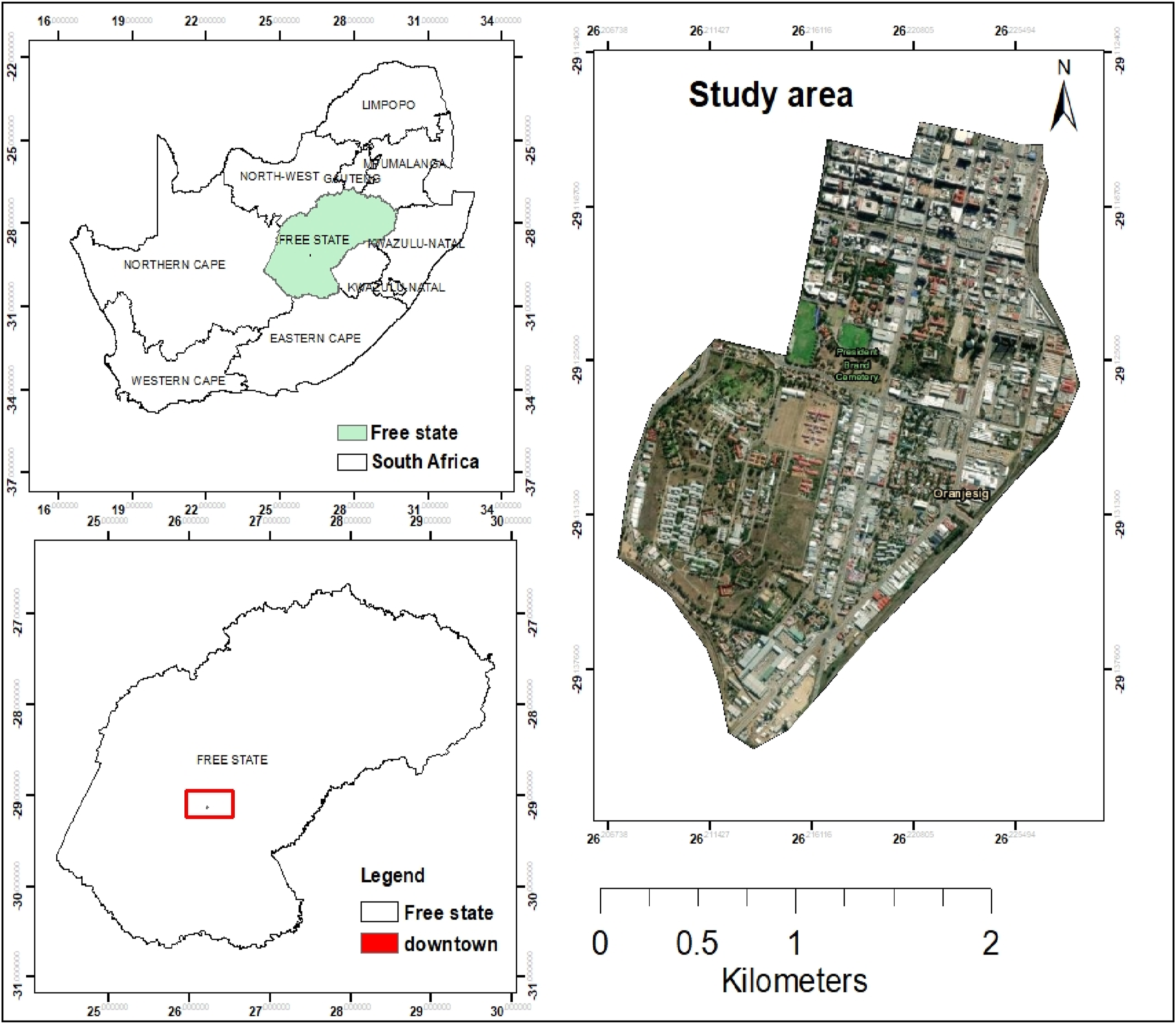
Rapid Ethnographic Fieldwork Among Undocumented Foreign Migrants in Bloemfontein Downtown Area
This study carried out in the downtown area of Bloemfontein was based on rapid urban ethnography. Ethnography is a type of qualitative research and naturalistic inquiry that involves the immersion of the researcher in a particular community to observe their behaviour and interactions up close. Ethnography allows the researcher to deeply understand a group’s shared culture, conventions, and social dynamics. Ethnography exists in many forms, and ethnographers continuously debate about what counts as ethnography and ‘how to represent the field’ (Van Maanen, 2011). As a result, there are distinct versions of ethnographic research that have their own epistemological backgrounds and varied research practices ranging from classic/traditional/realist ethnography, genre ethnography, feminist ethnography, duo ethnography, autoethnography, critical ethnography, digital ethnography and rapid ethnography (Atkinson, 2007). In this study, a rapid ethnographic approach was adopted to understand the socio-economic impacts of the COVID-19 pandemic on foreign migrants operating informal businesses in the downtown area of Bloemfontein.
Demographic profile of participants.

Data were collected by two local female researchers 1 , and while we were able to gather interesting data that answered our research questions successfully, the fieldwork experience was associated with some challenges, which included ethical issues, the migrant nature of the participants, and the gender of the researchers. Some of the fieldwork challenges and experiences as presented in the sections that follow, were difficult to manage and digest. To give a brief demographic snapshot of the participants we interacted with for our three-week fieldwork experience in the downtown area of Bloemfontein; 28 participants became our focus, for in-depth interviews. From the study, there were more women than men, as women were easier to approach for in-depth interviews. The migrants originated from different African countries and engaged in varied businesses. The participants came to Bloemfontein at various times, with some living in the city for more than 15 years. Majority of the migrants also stayed in low-income suburbs.
Reflections on Fieldwork Challenges Faced by Local Female Researchers Among Hard-To-Reach Populations
The methodological challenges that we experienced during the study related to (i) fieldwork preparation and selection of the study area; (ii) building trust with the migrants; (iii) maintaining privacy and confidentiality; and (iv) physical, psychological and emotional safety. We present the strategies used to mitigate and/or resolve the fieldwork challenges we faced as local female researchers (lead author and a female colleague) and include suggestions from the literature. Excerpts from our notes, which captured our thoughts, emotions, questions, dilemmas, and interactions as we engaged with the participants, highlight the challenging moments experienced by the local female researchers.
Fieldwork Preparation and Selection of the Study Area
Choosing an appropriate study site and gaining access is part of the research process, yet a drawback to successfully conducting research (Kondowe & Booyens, 2014). The choice involves careful planning; academic knowledge; practical research experience; researcher knowledge, skills, commitment, and luck (Kondowe & Booyens, 2014; Matamanda, 2022). In preparation for fieldwork, the supervisors assisted with a research proposal that the first author had to submit to the University of the Free State Research Ethics Board. The South African university ethical clearance is a formal process that grants permission for fieldwork after complying with certain criteria. Obtaining ethical clearance for the first author’s research proposal, “Socio-economic impacts of COVID-19 on undocumented migrants in the informal sector in downtown Bloemfontein, South Africa”, was the first major hurdle that she encountered. Studying undocumented migrants is not easy, especially in South Africa, where there are ongoing xenophobic attacks on migrants by the locals. The university ethics board warned that: “This is a high-risk project. The applicant needs to develop mitigation measures before conducting interviews with undocumented migrants, considering the current xenophobic attacks (Operation Dudula, now also targeting undocumented foreign nationals).”
2
The ethics committee recommended that clear mitigation strategies be comprehensively outlined in the application. We highlighted the mitigation strategies to minimize risk for both the researchers and the participants. We responded that we were aware that the study had risks considering the xenophobic attacks. However, the study was worth undertaking to understand migrants’ often ignored and misunderstood realities. Mitigation measures presented to the ethics committee included being accompanied by a fellow female researcher; approaching migrants operating in open and less threatening spaces in the downtown area; and using non-threatening language, which did not portray migrants as outcasts, dangerous, or lawbreakers.
To minimize the risk to the migrants, we would collect data after obtaining informed consent. Thus, participants were to be informed that participation was voluntary after receiving complete information about the study and giving consent. Further, participants were assured of privacy and confidentiality during the research by using pseudonyms. It was only after a thorough modification of the application with the assistance of the supervisors that the University approved the study on the third of August 2022 with the ethical number UFS-HSD2022/0528. Regardless of the important role of the Ethics Committee in ensuring that research is done in a way that protects the dignity, rights and safety of the research participants, the bureaucratic process of obtaining ethical clearance made us view ethical clearance committees and not researchers as gatekeepers of research. The process was a negotiation of a processual bureaucratic system rather than an opportunity to learn about ethical research (Maunganidze & Ruggunan, 2021).
The interest in studying marginalized migrants was sparked by the first author’s frequent visits to the downtown area to obtain cheaper hairdressing and groceries than in the more affluent areas of the city, which were closer to her university residence. The first author’s hairdresser, Ekuwa, a Ghanaian lady, chatted with her regarding the difficulties she faced to earn an income for survival during the COVID-19 pandemic. Through further discussions with Ekuwa, the first author learnt that her situation was not unique and that other migrants also encountered the same difficulties. The first author, together with her friend (the second author who assisted during fieldwork), also observed during their shopping in the downtown area that street vendors, small businesses, hair salons and street dealers who, by their demeanour (language tone, dressing, and entrepreneurial vigour) were foreign migrants. The hyper-migrant activity gave the first author confidence that she would be able to approach more foreign migrants in the downtown area during her study. With the guidance of the supervisors, the first author settled for a study on the experiences of migrants in the informal sector in the downtown area. The supervisors assisted with the draft proposal and advised doing a pilot feasibility study. Thus, Bloemfontein’s downtown area was purposively chosen as the study site. The first author’s hairdresser, Ekuwa, was the first person she interviewed during the pilot study because she was going to answer all the research questions considering the long-term bond, she already had with her. She referred the first author to Dodzi, a Ghanaian male hairdresser, who initially did not want his time wasted but ended up having a fruitful conversation with the first author. The first author later tried to approach a Congolese woman selling fruits and vegetables in the streets. However, she was unable to converse well in English; all she could say and understand were basic greetings and questions like “hello,” “how are you doing?” and “how much is this?” The first author noticed that she was conversing in her native tongue with a fellow male vendor who was next to her. 3
The highlights of the fieldwork preparation and selection of the study area were both challenging, time-consuming and potentially discouraging. However, mentorship and support from the supervisors made the first author carry on with the study.
Building Trust with the Migrants
Building trust with research participants, particularly undocumented migrants, is never easy. Particularly in the South African context, where foreign migrants are vulnerable to xenophobic attacks. Fear of xenophobic attacks was heightened during the fieldwork of this study because of ‘Operation Dudula’ initiated by a splinter group from a “Put South Africans First Movement.” The movement first popularised and renewed anti-immigrant campaigns on social media before finding expression on the ground. Operation Dudula launched attacks on African immigrants, blaming them for crimes and taking employment opportunities from local South Africans. Xenophobic attacks and intimidation in South Africa only became widespread in 2008 in areas like Alexandra, and Johannesburg and later spread to other South African provinces, resulting in 62 deaths, including 21 South Africans, 11 Mozambicans, five Zimbabweans and three Somalis; thousands were injured (Phiri, 2022). Since then, some 40,000 foreign nationals have left the country, and a further 50,000 were displaced (Phiri, 2022). The current anti-migrant movements left immigrants and refugees fearing for their safety and consequently affected doing research on migrants. The first and second authors, who were doing fieldwork, often found it difficult to gain the trust of participants who viewed them as threatening ‘others’ because of their South African origin (Christopher et al., 2008).
Undocumented migrants are also always afraid of having their citizenship status exposed and being sent back to their countries of origin. This was the case with the research participants in this study, for example, we tried to interview a Senegalese man who runs a clothing store. He refused to engage in the interview with the researchers because “…he would never divulge his personal information to strangers.”
He also explained that: “It is difficult to live in the downtown area because the locals here can fool you into believing they are your friends even though they are among the culprits who expose some of us. I can, therefore, not easily trust you with my personal information.”
4
It was clear from his enraged tone that he was expressing something he had previously gone through. Other foreign migrants had challenges trusting us because of language barriers. Because of our South African accent, migrants assumed that we had been dispatched by the authorities to reveal their statuses. For instance, Tami, a street vendor from Malawi, told us: “I do not trust you with the information that I am going to give to you because I do not know you even though you first introduced yourselves that you are who and what you are doing is for school purposes and that the information will be confidential. Therefore, I want the exact proof that you are from the university you are claiming you come from and that you were given permission to do what you are doing.”
5
To earn her trust, we handed her their University Research Letters, student cards, and the ethical clearance document. Other participants also requested these documents for us to earn their trust and engage in the interview. For example, Chuma, a hairdresser from Zimbabwe, said: “I want to see your student cards and the approval from the institution that authorizes you to perform these interviews before I allow you to interview me.”
6
After several attempts to gain the trust of some of the participants, we decided to approach other potential participants. Despite many migrants not agreeing to participate, we did not give up and were able to interview 28 foreign migrants in total. Snowball sampling helped us identify undocumented migrants who were willing to be interviewed because we had referrals. For instance, the Zimbabwean hairdresser Tendai was recommended to us by his fellow hairdresser Farai, also from Zimbabwe. Farai said: “If you guys go to the following street, you will see a dark-skinned man with dreadlocks, and he is always alone, tell him I am the one who referred you guys to him, and I will also call him, and he will also assist you.”
7
The first author’s hairdresser Ekuwa was also very helpful because she referred other migrant hairdressers for interviews. Anitha, a Rwandan woman who runs a flea market, was also helpful, and when we approached her and asked to interview her, she told us: “I have been running this business for a very long time, and even though your topics are different, you are not the first students to interview me. Also, I have a son whose schoolwork occasionally necessitates that he does interviews, so I do not have a problem with my children interviewing me. I trust you when you say the information would be confidential.”
8
We gained the trust of other hairdressers by asking whether we could assist in plaiting their customers' braids while they were occupied with responding to our questions. They did not object to that, and they answered all our questions. Mathabo was one of the participants who let us assist with customers' braids while she responded to our questions. She said: “That is extremely lovely of you even to offer that. It is as if you knew how exhausted I was, so one of you will plait the hair while one is taking notes of my answers,”
9
During fieldwork, we also observed that women were more open than men; they told fascinating tales of how their businesses got started and how things have changed since then. For instance, Tebello, a street vendor from Lesotho, was able to describe the changing landscape ever since she began her enterprise in the downtown area: “It is never easy to operate this kind of business, especially where most people are doing what you are doing. The competition is fierce, and sometimes you have to lower your prices to be able to attract more customers, which in other cases results in you losing a small amount of your profits.” …"I am doing this because I have a family to feed, so it is my responsibility to make sure that I bring something to the table almost daily.”
10
Tebello was also very kind, encouraging us to keep working hard in our studies because taking care of children when you are not financially secure is never easy. She took the time to speak with us, and we took the time to listen to what she had to say. As a result, the interview took longer than intended; nevertheless, we were very patient with her. But with male migrants, it was different, as they did not open up to us like their female counterparts. All they did was respond to our questions without interjecting with long stories. The other reason why we interviewed more women than men was because, while very few women declined our request to speak with them, most men repeatedly declined our requests.
Thus, fieldwork among busy and entrepreneurial populations is not easy. It is a laborious process that requires extra input from researchers to obtain data. In Bloemfontein downtown area, task-based interviews helped us gain trust and data, especially from female participants. Reflection from the field made us aware that research participants were not necessarily powerless. Participants hold some power, as they have the knowledge and lived experience and are in control of what and to what extent personal knowledge is shared. They could withhold their participation at any time with no further obligations (Duncombe & Jessop, 2012). We devised ways like assisting participants in their work (labour) or listening to participants’ long and often sad stories (convivial), to gain trust from these custodians of information.
Maintaining Privacy and Confidentiality
Privacy and confidentiality are essential in research and extremely important when undertaking research with vulnerable groups like foreign migrants who are at great risk of abuse and exploitation (Liamputtong, 2007; Wilson & Neville, 2009). There were many issues about privacy and confidentiality that we faced while working in the field. First, we encountered ethical dilemmas regarding confidentiality and privacy as migrants did not easily release personal information. Even after assuring some migrants of their privacy and confidentiality, they remained sceptical about releasing information. Some indicated that they were afraid of being discovered and sent back to their countries of origin. Some migrants did not want to release their names, incomes, places of residence, or those who assisted them in their migration to Bloemfontein, South Africa. For example, Mohapi, a Lesotho native who operates a fruit and vegetable stall, was against questions involving money to the point where he became offended, saying: “Why are you asking me that kind of a question?, What are you going to do with that information?, Does it form part of your study? Did you even ask other people this kind of question, or is it just me?”
Bertin, a Congolese shop owner, also asked us the same questions as Mohapi, but had more inquiries. He posed the following query: “Are you sure this is for your school purposes, or are you working with some culprits who want to know how much we make so that they can attack us?”
Although we were offended, we had to acknowledge his fears as a foreign migrant and maintain our composure to assure him that we only had good intentions. Another migrant from Zimbabwe, Tendai also questioned whether the information we were gathering from him would be used by people who might start hunting for him.
Throughout this research, we were committed to honouring the inherent rights of participants as human beings, while also protecting their privacy and confidentiality. We assured them that all the information they provided was only for academic purposes. We also assured them that we did not require their names because we used pseudonyms to assemble the data they provided.
We were aware that the presence of others could affect a participant’s ability to disclose information honestly; we conducted the interviews in settings that afforded as much privacy as possible. Participants who operate in congested environments included Farai, a hairdresser. We first obtained permission to speak with him separately to ensure that his information would be kept private and discreet. As much as we made sure our participants were comfortable with the interview, we did not take our safety for granted, realizing that, as women, we were vulnerable to aggression, especially in no-go areas in the downtown area. However, in some instances, we found asking people to leave their workspaces inappropriate and offensive. This was especially the case when migrants were very busy with their work. It was challenging to determine an “ethical line” in this instance. Interestingly, some of the participants in these spaces did not seem concerned about talking in the presence of their colleagues. We found this attitude particularly helpful as we were concerned about potential breaches of privacy and confidentiality. But often, we would pause the interviews and ask whether the participants were comfortable continuing with the interview. Most of the participants agreed to carry on and we chose to respect their choice.
Research among hard-to-reach populations raises privacy and confidentiality challenges due to context-specific realities. First, migration often entails precarious, temporary, or semipermanent legal status (Hari, 2014; Squire, 2018). The right to remain in a state can be denied or revoked for several reasons, including criminality (Benslimane & Moffette, 2019) and inaccurate information on immigration documents or in immigration testimony (Cameron, 2018). Research findings can doubt the credibility or veracity of the information provided in immigration claims or testimonies (Kahn & Fábos, 2017; Neylon, 2019). Second, related to legal precarity, migration is increasingly criminalized (Parmar, 2020; Ben-Arieh & Heins, 2021). As a result, migrants face heightened surveillance and scrutiny (Moffette & Aksin, 2018). In conducting this study, we were aware of the privacy and confidentiality risks that information we gathered could jeopardize residency, migration status, and legal citizenship of the participants and their families, social networks, and communities.
Physical, Psychological and Emotional Safety
Research involving marginalized and vulnerable groups, can threaten the physical, psychological, and emotional safety of researchers, particularly women, novice and/or student researchers (Medeiros, 2017). During fieldwork, we discovered that we were physically, mentally, and emotionally vulnerable since we were in a foreign-dominated environment. The reality is that in such an environment, you can never tell how foreign migrants will respond. Especially when approaching male participants, gender-based violence is a reality. During our fieldwork in the downtown area, some foreign migrants we approached propositioned us for love and sex. In one instance, when we approached a migrant selling fruits and vegetables, we encountered the following reaction: “I don’t have time right now to answer your inquiries; but, if you could give me your phone numbers, I would contact you and answer your questions.”
11
When we declined to give him our phone numbers, he stated he would not help us, even though he was not busy with work. While there are instances where study participants may later on engage through phone calls, in this case, we knew he was trying to get our phone number to propose to us for love, and we decided to leave. This was not the only proposition we received; we were also approached by two male hairdressers, one of whom directly asked us for sexual favours, saying he would pay us handsomely for the services. This experience was difficult to manage and digest. And indeed, one may sometimes ask oneself if there is a place for women researchers in hostile fieldwork settings. After this threatening and traumatic encounter of sexual harassment by the two men, we called our supervisors, who advised us to vacate the downtown area and to take a break to process the experience and resume fieldwork the day after.
Despite having adequate supervisors’ guidance and support, our fieldwork was not only a physically threatening experience but also an emotionally and psychologically challenging experience. Our vulnerability became increasingly evident during the interviews with different migrants. We struggled with emotional responses while listening to some of the migrants’ narratives. Some of the migrants’ experiences that had the most impact on us were those of migration gone wrong, struggles in crossing the border, and harsh experiences at the destination (Sørensen, 2021). Some migrants told stories about their actions to reach their current position. One female participant, for instance, revealed how she had to engage in prostitution for a brief period to save money to launch her business before she could get to where she is now. She stated, “Migrating to Bloemfontein was never an easy journey. I had no relatives or friends, and at the same time, I had no money to sustain myself. I moved here to find something to do so that I will be able to provide for my family, but I could not find a job because of my citizenship status. I found myself having only one option, which is prostitution so that I can take care of myself and my family.”
12
She continued by saying that her family was unaware of that she was engaging in prostitution. All they did was receive remittances, assuming she had landed a well-paying job in Bloemfontein. However, after saving up some cash, she launched her own business selling fruits and vegetables, which she is now surviving from. The story of Pamela made us more aware of the lack of support in the lives of the participants, many of whom were living in poverty and dealing with multiple disadvantages (Sherry, 2013).
In another sad story, Cedric, a shop owner from the Democratic Republic of Congo, also told us that he used his savings to support himself and his family during the COVID-19 lockdowns, but after the lockdown, he was unable to pay for his shop rentals. Regrettably, he was also unable to obtain a bank loan because he lacked the proper documentation. Cedric explained that he had to move around his neighbourhood, going from house to house and asking if they could offer him a job. He even said, “I even had to ask them if they do not have a heavy load of laundry that I can wash and I would not charge them that much, and I was also cleaning their yard, until I had enough money to pay the rest of my rentals. That took me the whole two months.”
13
During fieldwork, we avoided or consciously moderated sensitive questions or emotional triggers that would bring back bad memories and hurtful feelings for the migrants. We did that by paying attention to the participants’ facial expressions and body language as questions were asked and empathising with them when the need arose. As female researchers, we were sensitive to sad stories. There were sober moments when we had to stop the interviews and empathise with the participants before going on. This helped participants relax enough to continue with the interview.
Physical, psychological, and emotional vulnerability are inevitable for researchers among unfamiliar population groups. We experienced physical threats in the form of sexual harassment and emotional vulnerability in the form of sad stories, especially from women. However, we devised some strategies to counter some of these threats. To minimise physical harassment, for example, we took care to dress appropriately during fieldwork in a way that was acceptable to society and to avoid drawing unnecessary attention to ourselves. Dressing otherwise would have looked disrespectful and insensitive to the participants. To counter emotional trauma, we journaled some of the experiences of the migrants. In addition to journaling, we found that regular meetings with supervisors were effective in helping us cope with emotions. The online and physical meetings were done on a regular basis (daily) to discuss issues or concerns raised by the interviews, plans for subsequent interviews, any support needed, and to debrief (Jewkes et al., 2005; Sherry, 2013). Sherry (2013) proposes that quality supervision is essential, as it brings researchers’ emotions to centre stage during fieldwork and assists with professional development. For example, when the two male foreign migrants sexually harassed us, we stopped the interviews for the day and through the instruction of our supervisors. The supervisors calmed us down and even provided counselling, which gave us the confidence we needed to resume fieldwork.
Despite the emotional challenges we experienced as women in the field, there were positive aspects of undertaking research among migrants or hard-to-reach populations. Positive aspects included even little things, such as participating in some of their activities like hair dressing and gaining their trust. Such experiences bear witness to the fact that women researchers can negotiate access in settings to which men would struggle to gain entrance. Female participants often have a certain reticence to engage with male researchers. On the other hand, female researchers can easily enter conversations with female participants that a man would not. For example, in her study on land conflicts in Bukavu, Bahati (2019) noted that her advantage as a female researcher was evident in the spontaneous responses, she received from many female informants who would not have wanted to divulge certain realities to her male colleagues.
Conclusion and Future Directions
This paper reflected on fieldwork challenges among hard-to-reach populations – foreign migrants from the perspective of local female researchers. The paper is based on a rapid ethnographic study on the socio-economic impacts of the COVID-19 pandemic on foreign migrants operating informal businesses in the downtown area of Bloemfontein, South Africa. The major fieldwork challenges were fieldwork preparation and selection of the study area; building trust with the migrants; maintaining privacy and confidentiality; and physical, psychological, and emotional safety. We presented the strategies that the local female researchers implemented to overcome some of the challenges. We conclude that, compared to their male counterparts, local female researchers encounter unique challenges in doing fieldwork among hard-to-reach populations. We also acknowledge that men also face unique challenges when collecting data among hard-to-reach populations such as their advances being construed as making relationship/sexual advances when approaching women. For women, studying the hard-to-reach, complex and heterogeneous group of migrants often puts them in physical, psychological, and emotional danger. At the same time, their fieldwork experiences demonstrate that women researchers have a place in researching hard-to-reach populations. As demonstrated in this study, they can more easily connect with vulnerable research participants and access hidden information.
This study also recognizes the impact of contextual factors such as xenophobia on fieldwork dynamics. The fact that the local female researchers spoke with a South African accent in an environment characterized by xenophobic sentiments likely influenced their interactions with foreign migrants. This highlights the importance of considering the broader socio-political context in which fieldwork takes place. In instances where researchers belong to the dominant or host community, their presence may inadvertently contribute to feelings of distrust or suspicion among the target population. To mitigate such challenges and foster more inclusive research practices, we recommend the involvement of individuals from the hard-to-reach populations as integral members of the fieldwork and data collection team. By actively engaging with some members of these foreign populations as research assistants or collaborators, local researchers can benefit from their invaluable insights, perspectives, and contextual knowledge. These individuals can help navigate cultural nuances, facilitate rapport-building, and enhance the overall quality and relevance of the research findings.
Moreover, the participation of local assistants should extend beyond mere logistical support; they should be regarded as co-creators of knowledge and compensated appropriately for their contributions. Recognizing and valuing the expertise of local collaborators through fair remuneration not only acknowledges their integral role in the research process but also fosters reciprocal relationships built on mutual respect and trust. In planning future fieldwork endeavours, researchers should prioritize the inclusion of diverse voices and perspectives, acknowledging the inherent power dynamics at play and striving for more equitable research practices. Through embracing collaborative approaches that centre the experiences and expertise of local communities, researchers can navigate complex socio-political landscapes more effectively and generate research outcomes that are both ethically sound and culturally sensitive.
Finally, we also recommend that now, more than ever, women conducting research should be supported, considering their substantial contribution. Academia and various other research stakeholders (funders, research ethical committees, supervisors, etc.) should rethink fieldwork research; acknowledging female researchers’ unique contribution in the field and experiences like gender-based violence, which they inevitably experience. It is strategic to consider mixed-gender (male and female) research teams and to properly reflect on security considerations during fieldwork, which might be different for men and women. Currently, data is used by many other scientists and policymakers, disregarding the gender-based risks involved in its collection. Reflection on the gendered nature of data production will raise awareness in academia and among funders about the need for more training and emotional, financial, and material support for women in science. We call for more contributions in which not only female but also male researchers reflect on how their gendered being influences their fieldwork experience. We know very little of the personal, sexual, or identity problems men face during fieldwork.
Footnotes
Acknowledgements
The authors would like to acknowledge the assistance of Mrs Liesl Van Der Westhuizen, who provided language editing assistance on an earlier manuscript version. The authors are also grateful to the Centre for Graduate Support at the University of the Free State, which funded a writing workshop for the Department of Geography, which the third and fourth authors attended and worked on this manuscript.
Declaration of Conflicting Interests
The author(s) declared no potential conflicts of interest with respect to the research, authorship, and/or publication of this article.
Funding
The author(s) received no financial support for the research, authorship, and/or publication of this article.
