




Abstract
There is a growing need to support the health and well-being of retired adults. Some evidence suggests that retirement transition can provide an opportunity for public health initiatives (Heaven et al., 2016). However, to increase the effectiveness of the potential interventions, more holistic models that acknowledge the complexity of the retirement process are needed. The aim of the present study was to gain an in-depth understanding of retirement adjustment and to explore the key components of successful retirement adaptation by examining the lived experiences of retired adults. A qualitative research design was used and included four focus groups (n = 18) and individual interviews (n = 10) conducted with participants, aged 58 to 82 years, retired for various durations from manual- and non-manual occupations. The data were subjected to thematic analysis. A new retirement adjustment (R-Adj) framework that incorporates multiple layers of contributors to retirement experiences was suggested. The three core components of R-Adj were identity rebuilding, social interaction, and independence, all of which anchor on activity engagement. The identified elements of R-Adj remained relevant for positive retirement experiences at different stages. However, the retirement transition might be the optimal time for interventions because it is when the most noticeable changes in social circles, identity, lifestyles, and the most prominent call for independence occur. It is proposed that the R-Adj components should be considered when designing public health initiatives for the retired population.
Retirement from work is one of the major transitions in adult life. Many people look forward to retirement as a period when they will be free from work-associated stressors, have increased control over their lives, and enjoy an opportunity to spend more time with significant others (Hunter et al., 2007; Weiss, 2005a; Zhan et al., 2023). However, evidence suggests that retirement can pose certain challenges (M. Wang et al., 2011). Retirement might be associated with identity crisis, financial challenges, health deterioration, a lack of everyday structure and purpose, and a loss of former social circles (Barnes & Parry, 2004; Moffatt & Heaven, 2017; Van der Heide et al., 2013; M. Wang, 2007). With the gap widening between actual and healthy life expectancy, more people are living in poor health for longer periods of time (Salomon et al., 2012). As a result, they might not be able to enjoy their retirement and may have a greater need for health and social care (Dall et al., 2013).
Transition to retirement can potentially be a promising point for promoting health and well-being in older age. Retirement transition provides a window of opportunity to establish new health habits due to heightened need for and intentions in developing new routines and goals (Moffatt & Heaven, 2017). Furthermore, when old habits are disrupted, people are more likely to be receptive to new information and to adopt a mindset that is facilitative to behavior change (Verplanken & Roy, 2016). A recent review by Cassanet et al. (2023) identified a range of psychosocial interventions that are aimed at supporting mental health and well-being, increasing happiness, and reducing depression during retirement transition. The most commonly applied interventions were retirement planning sessions, psychoeducation, and therapy-based interventions. The review highlighted the positives of psychosocial support during this crucial life transition but warranted further research, as the number of identified studies, especially those that measure long-term effects, was limited. Cohen-Mansfield and Regev (2018) suggested that the effects of behavior change pre-retirement programs seem to be short-lived and that there is a need for engaging community resources to continue addressing post-retirement issues. Also, Rodríguez-Monforte et al. (2020) noted that additional research on how to promote health and well-being during retirement transition, especially with consideration for the social determinants of health, is needed. Therefore, a priority remains for having a comprehensive understanding of contributors to positive retirement experiences and knowing how to promote health and well-being in retirement (Muratore & Earl, 2015).
The lack of consistent evidence on the effectiveness of lifestyle interventions for retirement transition could be partly attributable to the absence of an aging-/retirement-specific theoretical foundation to support them (Lara et al., 2016). Existing retirement theories and frameworks have described a range of factors that affect experiences, for example, role transition and social expectations (role theory; Atchley, 1989), participation in activities (activity theory; Havighurst, 1963), and engagement with meaningful roles and relationships (continuation theory; Phillips, 1957). However, these theories can address only part(s) of the complex psychological, social, and economic retirement phenomena and do not explain retirement trajectories (M. Wang, 2007). More recent theoretical frameworks, such as the resources-perspective approach and the life course perspective, consider a wider range of factors, for example, biological, social, economic, and psychological processes (Elder et al., 2003; M. Wang, 2007; M. Wang et al., 2011). Specifically, in the resources-perspective approach, it is suggested that a resource change could serve as the driving mechanism for changes in well-being during the retirement transition (M. Wang et al., 2011). Yet, it is argued that the resource approach accounts only for a small proportion of the changes in well-being in retirement and that the effects of the resource change should be viewed within the context of various individual and/or situational characteristics (Hansson et al., 2020).
The ecological perspective considers both an individual and the behavior of an individual within the environment where they live and operate. The person–environment fit focuses on the interaction between the multifaceted environment (e.g., relationship, community, society) and the individual and acknowledges the role of environment in shaping a person’s motivation, behavior, and health (Holmbeck et al., 2007). According to the ecological approach, while well-being is often regarded as an individual matter, a broader social conception that focuses on the interaction between individuals should be adopted. Notably, it is through this broader social concept that life satisfaction and well-being can be impacted (Spencer, 2008). There are many layers of potential factors (e.g., family, education, employment) that might affect the behaviors, well-being, and overall experiences of people during their retirement. Therefore, retirement should be studied in its ecological context. The ecological approach can provide a more holistic way of understanding retirement phenomena (Kim & Moen, 2001). An ecological and contextual approach to well-being also provides an opportunity to understand which interventions would be effective and useful within a particular context or community (Carter & Andersen, 2023).
In an attempt to explore the mechanisms that underpin the process of retirement adjustment (R-Adj), certain researchers (e.g., Henning et al., 2019) also turned to behavior change theories such as self-determination theory (SDT; Deci & Ryan, 1985, 2000). The focus of SDT is on well-being, which is particularly important for understanding R-Adj. According to SDT, every individual has basic psychological needs for autonomy, relatedness, and competence that must be satisfied in order to experience psychological health and well-being. Autonomy is related to engagement in activities or behaviors of one’s choosing, relatedness represents feeling connected and understood by others or a feeling of belonging to a given social group, and competence pertains to effective interaction with the environment and to achieving goals (Deci & Ryan, 1985).
Need satisfaction is affected by different social environments and, therefore, is likely to be influenced by major events such as retirement. Recent research has evidenced the associations between changes in well-being over the retirement transition and need satisfaction, particularly autonomy satisfaction (Henning et al., 2019). Additionally, need satisfaction is important for initiating and maintaining new behaviors, and need supportive contexts have been widely used in health promotion interventions (Deci & Ryan, 2000; Weman-Josefsson et al., 2015). Therefore, an understanding of how need satisfaction underlies R-Adj can potentially inform the development of health promotion initiatives for the retirement transition. However, SDT might also have its shortcomings in explaining retirement process. For example, Bauger and Bongaardt (2016) identified autonomy in the form of self-authoring one’s own aims and desires as a predictor of R-Adj. However, they differentiated it from the autonomy described within SDT, which can be attained independently or with the support of trusted others.
Therefore, while a range of theories and approaches have been used to describe retirement experiences and while some can suggest underlying mechanisms behind the R-Adj process, predicting individual retirement outcomes and the role of certain determinants remains a challenge. To overcome this, more evidence that accounts for the links and interplays between various predictors is needed (Hansson et al., 2020). Several of these challenges might be addressed through qualitative research, which can provide a more comprehensive picture of individuals’ lived experiences, the interaction between factors unique to the individuals, cultural differences in retirement practices, and/or different institutional arrangements regarding retirement expectations and norms (Fasang, 2010; Hershey et al., 2007). Qualitative study can be also beneficial as it helps to illuminate how people feel about retirement and how different factors affect their experiences, for instance, what attributes a post-retirement activity or role should possess in order to facilitate positive R-Adj (Amabile, 2019).
The aim of the present study was to explore, through the lived experiences of retired individuals, key components of successful retirement adaptation and their relationships. We identified the psychological contributors to R-Adj and examined their role within the context of individual characteristics and environments. Focus groups and semi-structured individual interviews with retired adults were employed to address the aims of the research. Given that R-Adj is a constantly evolving process, the study was conducted with individuals who were retired for varying durations—those who were retired for less than a year and those who were retired for more than 5 years. This allowed us to gain retrospective reflections from participants on the retirement transition period and the retirement experience trajectories and make comparisons with more “acute” insights from recent retirees.
Additionally, we purposefully recruited retired adults from both manual- and non-manual occupations, as occupational backgrounds can influence R-Adj through different financial conditions, health parameters, or post-retirement engagement in physical activity (Office for National Statistics, 2018; Singh-Manoux et al., 2004; Van Dyck et al., 2015).
Method
Participants
For a purposive sample, 28 retired adults were recruited through diverse sampling approaches such as social media, word of mouth, and communication with third-sector organizations. All participants were from Northeast England and consisted of 12 females and 16 males aged 58 to 82 years (mean age = 68 years). Each participant was offered a £10 voucher for his/her time. One of the inclusion criteria was “withdrawal from employment.” However, given the diversity of retirement pathways, participants self-defined their retirement status (Cahill et al., 2015). Potential participants were also asked about their retirement and employment histories to confirm their eligibility. The qualifications of participants were dichotomized into manual and non-manual based on their description of the former jobs and the UK Standard Occupational Classification (Office for National Statistics, 2010). Four focus groups were formed based on the length of retirement and the nature of the former occupations of participants prior to retirement. Each focus group comprised four to six adults. For those who could not participate in a focus group (e.g., due to personal preference or time constraints), individual interviews were conducted (n = 10). Table 1 presents the sociodemographic information of participants. All participants signed the consent forms before participation. The study was subject to the ethical review and has received ethical approval from the Northumbria University Faculty of Health and Life Sciences Ethics Committee (Submission Ref: 13858).
Participant Information

Note. M = manual; NM = non-manual.
Procedure
All focus group discussions and individual interviews were conducted in meeting rooms on the university campus. Discussions followed a semi-structured interview guide, which focused on R-Adj and what might have contributed to well-being in retirement. The focus group discussions were video- and audio-recorded, and individual interviews were audio-recorded, transcribed verbatim, and anonymized (pseudonyms are used subsequently). For the focus group discussions, participants were encouraged to interact with each other, with the primary researcher intervening solely to keep the discussion on topic and to motivate more reserved members to contribute. All focus groups and interviews were conducted by the first author; the second author attended, assisted in facilitating the focus group discussions, and took notes. Each focus group discussion lasted approximately 1.5 hr, and the interviews lasted between 25 and 60 min.
Data Analysis
Thematic analysis was used in accordance with steps developed by Braun and Clarke (2006): (a) familiarization with the data, (b) generating codes and (c) initial themes, (d) reviewing themes, (e) defining themes, and (f) producing the report. For the initial coding, an inductive approach was implemented, which involved open coding for developing and modifying newly identified themes (Elo & Kyngäs, 2008). An iterative approach, which encourages reading and re-reading collected data, reflection upon existing literature and theories, and revising developed codes, was applied (Tracy, 2019). NVivo 12 software by Lumivero was used for analysis.
To ensure rigor and credibility of the analysis, the data were simultaneously reviewed and interpreted by the first and second authors. The researchers met regularly after coding every two transcripts to discuss and reflect on each other’s codes and themes, and to explore multiple and alternative explanations and interpretations (Smith & McGannon, 2018). If a new theme emerged during the meetings, the researchers went through the data again to identify the evidence. After all the transcripts were coded, the researchers discussed if certain themes could be collapsed (e.g., lower order themes such as “sleeping habits” and “exercising” were labeled under higher order themes “routines” and “maintaining health,” respectively). The researchers also explored the most prominent themes and how they addressed the research question on the key components of R-Adj (Ling et al., 2016). Finally, all authors reviewed the results to determine if the quotations were reflective of each identified theme.
Results
Three prominent themes emerged from the focus groups and individual interviews and were categorized into (a) identity reconstruction, (b) social interaction, and (c) independence.
Identity Reconstruction
For certain participants, especially those who were passionate about former jobs, their identity was shaped by their profession, which provided them with a sense of self-worth, as illustrated by Simon: “When you’ve got a job, you do define yourself a bit by your job. . . And you’ve got in your own mind a higher status of yourself” (FG1). This identity loss seemed to continue for a prolonged period post-retirement, and the sentiment was one of redundancy: “I’m a tiny-tiny cord in the machine. But of course, that cord now is being taken. . . that you are not really needed” (FG1). Expectedly, conscious efforts were made by several recent retirees to mitigate certain challenges. For example, Ronald (a former school head teacher) admitted that he still saw himself as a teacher. However, he consciously tried to detach himself from that identity by looking for other roles as a father or a retiree and avoiding conversations with former colleagues about school updates. He considered detachment from this work identity to be desirable for his mental health: Because I can’t do anything about it anymore, it would be wrong for me to try. . .It’s quite healthy, that degree of detachment. Otherwise, you can spend time ruminating and thinking, “Oh, well, they’re changing this; they’re changing that. I wouldn’t have done that.” (I6)
It appeared that finding new activities and a sense of purpose within them was important for successful detachment from former identity.
Regardless of the type of former occupation or length of retirement, engaging with other activities after participants had left their jobs appeared to give several of them feelings of self-worth and value, which was previously gained through one’s occupation. These activities varied in nature, from volunteering, community involvement, and helping family members and friends, to hobbies, exercising, or studying. In several cases, new activities seemed to facilitate the continuation of a former work identity, as illustrated by Rachel: And now I’m not a midwife. But I think that is one of the reasons I started to do volunteering. I enjoy helping. I suppose if I’ve been in a caring profession, it’s a different way. It’s reading with children, but it’s helping them. (I2)
For others, activities and responsibilities helped them to move from one identity to another, as demonstrated by Ronald, whose main role after retirement became that of a “father for two daughters” (I6), or by Martin (FG1), for whom getting a PhD after retirement provided a new identity as “Doctor Martin.” Studying post-retirement was particularly valued by several participants, as it greatly supported their feelings of achievement. For example, Amanda shared: “I loved college. That. . . get my belief in me again” (FG2). Furthermore, acquiring new knowledge helped participants to “keep (an) active mind” after retirement.
Keeping an active mind was also a priority because it helped to facilitate a “mental attitude to adapt with younger people” (Sarah, FG1). “Old person” identity was not particularly attractive, as it was associated with physical and mental deterioration and death. Participants expressed that society tended to underestimate the contributions of older adults in terms of their experience and skills, which can negatively affect their career choices. For example, “When you get [to] a certain age, it’s not easy to get a job of any sort. You just take what you can” (Olivia, I4). This suggests that the aging perceptions in society can impact the aging experience and identity.
One way to stay “young” as long as possible was to engage in more activities and have goals to accomplish. Having an active lifestyle was universally considered to be pertinent to well-being in retirement, as different activities provided the purpose that was missing in life. For example, Peter explained his motives for volunteering as follows: “When I retired, I needed the reason to get out of bed in the morning. And I needed the reason to keep me out of a pub” (FG4). Simon shared similar reasons for taking part in research studies: “It gives you reason to get up, I suppose. And you’ve got an appointment. You keep to that appointment; you do it. And then, once you’ve done it, you feel a certain sense of fulfilment” (I9). It appears that the primary reason for becoming involved in an activity was not necessarily for the activity itself but for a sense of commitment and accomplishment that was associated with it.
Additionally, filling a day with activities provided a new routine for participants. The concern about losing the structure of time after retirement was commonly shared. For example, James expressed the importance of a routine and the disadvantages of losing it after retirement: “A lot of people who retire are scared of it because they haven’t got anything in place. They haven’t got what we call a routine they look forward to later on after they retire” (FG4).
To summarize, identity reconstruction after retirement was a prevalent theme across the accounts of participants. Involvement in activities and finding personal meaning and structure within them seemed to be key to successful identity transition. The choice of roles was influenced by a range of contextual and individual factors including family situation, personal interests, ambitions (e.g., studying), goals (e.g., maintaining health), former occupation, and available local opportunities in the community.
Social Interaction
Not only can identity be developed through engagement with activities, but it can also be attained by belonging to a social system (e.g., family networks, friends, community), through which a sense of purpose and personal value can be fulfilled. A number of participants, both “long-term” (I8, I9) and recent retirees (I3) recognized a decrease in social communication post-retirement, as their former workplace had significantly contributed to their social life. In addition to offering human interactions, work provided a sense of belonging, connectedness, and emotional support, as illustrated by Helen: “I’ve missed being part of a team. I’m very much [a] team player. And you form a bond with people. . . when you’re in a team, and you share each other trials and tribulations” (FG1).
To regain the benefits of belonging to a social system, participants were motivated to engage with new hobbies, volunteering, and exercising. Activities that were aimed at bringing people together who were in the same stage of life, such as through Elders Council, University of the Third Age (U3A), or Women’s Institutes (WI), had become valuable sources of social support for some to prevent isolation and to build a sense of belonging, as Amanda recalled: “I realized how quickly you can become alone. So, I forced myself to join things like WI and U3A” (FG2). Notably, participants in the focus groups were very interested to learn from each other about available opportunities for older adults in the local area.
Increased social activities after retirement were noted by several participants through which social connections were sought. For example, Kathleen (FG3) tried to have a conversation “with at least one person” every time she engaged with running groups. Similarly, Christopher expressed, “Certainly, I interact when I go and do charity work and driving. When I drive patients. . . I can talk to them” (I7).
The amount of social interaction in retirement was influenced by several factors discussed by participants. For example, health was mentioned as a determining factor: “I don’t go very much, you know. My legs are. . .I can’t go out. I don’t drive to many places, unless I have to. I’ve got no kind of social things, really. It’s just a family and my dog” (I5). Other contributors to social engagement included geographic proximity of family and friends (“She comes around for a tea, and then she goes to her sister on a Tuesday, and we all kind of interact between the three of us because we don’t live very far away from each other” [Jane, FG4]), transport accessibility in the local area (e.g., “Because where we live, the bus services are really poor” [Oliver, FG1]), and the strength of community links.
To conclude, former work provided emotional support, connectedness, and a sense of belonging that were often missing after retirement. Aiming to compensate for the decrease in communication and to prevent loneliness and isolation participants sought varying social activities.
Independence
While belonging to a social system seems to be crucial for well-being, it could also compromise one’s independence. The value of independence was emphasized by participants such as Paul, who seemed resentful of the fact that his lifestyle had been dependent on the plans of his family and friends due to his health conditions: “I’ve been pressurized by friends or family for things that I don’t wanna do. I wanna do what I wanna do, not what they want to do” (I5). For Paul, it was also very important to engage with activities and behaviors of his own choice. Similarly, Margaret had felt obliged to baby-sit because “I feel guilty if I say ‘no’ when I’m not working” (I3). Some would consciously stay away from committed relationships, as they might incur undesirable responsibilities. For example, Patricia left her husband after retirement: “I didn’t want to share finances; I wanted to be responsible for me and what I’ve got and would live with it” (FG4).
Interestingly, although participants shared that increased independence, freedom of choice, and the lack of commitment were the most satisfying aspects of retirement, for those whose retirement was involuntary, increased freedom appeared terrifying at the beginning of retirement. Circumstances could be related to health issues, company relocation, caring responsibilities, or even forced retirement. It appears that unplanned retirement was also more likely to result in feeling lost, as expressed by Peter who was forced to retire from the army: “I had no planning to do, nothing. I was just sitting in the chair there, and I felt terrified for an hour or two” (FG4).
Other prominent factors that may hinder independence in retirement were health and financial conditions. Regarding the former, health represents not only physical conditions but is also key to independence, because “if you’re not in good health, then your life is very much restricted” (Olivia, I4). A similar sentiment was echoed by Tom: “Unfortunately, a few years ago, my tendons and ligaments started giving away on me. So, I couldn’t play anymore. . .I really enjoyed playing squash, not only for the exercise but also for the social activity” (I8).
As mentioned by many (e.g., FG1, FG2, FG4, I7), personal financial condition was a key contributor to their physical and mental well-being, hence their independence. For some, its importance was often linked to their health conditions.
I think if you didn’t have your pension, that would affect your health. . .That would have a not-good effect on your health, whereas if you got your pension, it can, to a degree, help you with your health because you haven’t got to worry. . . . (James, FG4)
With the increased spare time that people have post-retirement, finances could support more activity options such as exercise classes, hobbies, or educational opportunities, which would, in turn, promote independence.
Independent traveling was one of the most anticipated activities among the participants. Several of them considered retirement to be conducive to travel opportunities, with greater flexibility in time use (FG3, FG4) and older age benefits such as a free bus pass and railway discounts (I1). For example, participants in FG2 discussed different creative ways of using the benefits associated with retirement:
There is one of the elders who, sadly, died just before Christmas. He made this mission to write all the booklets about using a bus pass. And you can go and do a weekend away with the bus pass or day trips.
Or [you] can go to Scotland.
There is this Elders website, if you have a look on that.
I’d be interested
However, it was emphasized that traveling and, therefore, personal freedom were also determined by financial situation (I7), health limitations (FG2, I5, I9), and/or external constraints (e.g., living in rural areas with poor public transport networks) (FG1).
In addition to physical independence, intellectual independence through reading and learning was also highly valued. Several participants were devoted to learning different fields of knowledge, as they wanted to make sense of the excessive and often contradictive information: “Who do you actually believe? Who really knows what they are talking about?” (George, FG2). Health-related knowledge was also sought after, as it could provide a sense of control and empowerment: “I’d like to know what everybody should be doing at the retirement age. Should we be doing ten push-ups and press or whatever?! Just what is safe?” (John, FG2). Additionally, intellectual independence was upheld through selectively engaging in intellectually stimulating communications. As developing dementia appeared to be a common fear (FG1, FG3, I1, I2), many participants emphasized the importance of maintaining mental health (FG1, FG3, I3, I4, I5), and some admitted that the reason to engage with intellectual activities was to prevent cognitive decline: “I read. I play online scrabble. [I] enjoy doing that. So, you know, it is mostly reading, really. I suppose that’s kind of mental stimulation” (Brenda, I1).
Therefore, physical and intellectual or mental independence were among the greatest priorities in later life. For most participants, retirement facilitated independence. However, forced retirement could negatively affect one’s feelings of independence and control over situations. Activities such as traveling, education, and exercising were particularly important for supporting independence. However, the choice of activities was determined by health and financial conditions, both of which were common concerns associated with retirement and older age.
To summarize, three main themes for identity, social interaction, and independence appeared to be the most significant psychological predictors of well-being after retirement (see Table 2), and they interact with each other to formulate the lived experiences of the participants. Activities and roles that provide these three elements seemed to lead to more positive retirement experiences.
A Summary of the Factors Associated with Retirement Adjustment

Difference Between Subgroups
In the present study, an attempt was made to explore the experiences of individuals who were retired for various durations of time and from different occupational backgrounds. Several differences between those groups were observed.
First, for the individuals who were retired no longer than a year, detaching from a professional identity seemed to be a more “acute” issue that generated more negative feelings. For example, Ronald shared, “Moving away from that, it’s not anymore. It’s somebody else in charge; it’s nothing to do with you. That’s a hard one” (I6). While those who were retired for 5 years or longer had already adjusted to a new lifestyle and roles, recent retirees were still likely undergoing retirement transition. Second, recent retirees had more appreciation than those who retired a long time ago for the lack of a day routine in retirement (e.g., “I just do what I want; I may want [a routine] one day, but [not] now” [I2]). Recent retirees viewed the lack of structure as an advantage of retirement, something they were looking forward to and enjoyed at the beginning. Early retirement was experienced as a “detox process” (William, FG3) or an “extended holiday” (Ronald, I6).
With regard to occupational backgrounds, the differences in the identified themes were not particularly prominent. One difference concerned the value of a work identity. For participants with non-manual occupational backgrounds, their former work roles seemed more important than it did for manual workers. For example, in FG1, participants discussed that for people in managerial or higher professional occupations, it is particularly challenging to lose their status:
And you are not really needed. And that gave yourself a self-fulfillment status, you know.
And you’re praised for work you’ve done, but that’s all gone.
I know people who struggle to get rid of that. They retired at the same time as me. Some of them can’t get used to the fact that they have to, but they don’t think they have any status left.
Retirees found it more difficult to separate themselves from their work identities if they felt particularly valued at their former job, regardless of its nature, if they felt very connected to their workplace social circle, or if the work was a major part of their pre-retirement lives. Also, for those who changed their work roles frequently during their employment life and/or did not enjoy their jobs, it was easier to disassociate themselves from their work roles: “I suppose it was important to me because it paid bills but doesn’t mean I enjoyed it particularly. It’s to say I enjoyed some of the jobs I did but not the last one” (I4).
Overall, factors other than the nature of the former job seemed to have a bigger influence on the differences between the retirement experiences of participants. For example, the strongest desire for independence was expressed by participants with caring responsibilities (I3) or by those who faced health problems that restricted their choice of daily activities: “I wanna do what I wanna do, not what they want me to do because I find it is very-very pressuring” (I5).
Discussion
The primary aim of the current study was to further our understanding of R-Adj by exploring the lived experiences of retired adults. Three prominent themes were identified: identity rebuilding, social interaction, and independence. The identified themes are confirmatory of the existing literature on R-Adj (Haslam et al., 2018). Crucially, our research has demonstrated how the identified components of R-Adj interact, through which a new framework on R-Adj is developed. We also demonstrated how this framework could potentially be used to inform individual- and population-based health promotion activities for retirement.
Main Findings
The identity reconstruction theme resonates with existing evidence on the key role of identity rebuilding in R-Adj (e.g., Cassanet et al., 2023; Haslam et al., 2018) and existing retirement theories (role theory; Phillips, 1957). Many retired adults in the present study experienced an identity crisis due to the loss of their work role. This was still an ongoing process for several recent retirees, which is aligned with the existing evidence that retirement is associated with identity transition and the search for a new meaning (Haslam et al., 2018; L. Wang et al., 2014). To compensate for that loss, the participants consciously or unconsciously tried to substitute it with new activities and roles, reinforced the importance of other spheres of their lives, or reactivated old habits and interests. However, not every activity can provide a new meaning, and recently retired individuals often go through the exploration process to find such fulfilling and satisfying activities (L. Wang et al., 2014). Our findings suggest several attributes that might enable identity reconstruction and successful retirement adaptation.
One of the factors was social relationships. A major drawback of retirement for our participants was the loss of former social circles from which personal/social identity is defined. Maintaining or re-establishing new social connections after retirement was a positive contributor to R-Adj for many, as meaningful social relationships could provide emotional support, and a sense of connectedness and belongingness, and in turn, this would lead to greater enjoyment and engagement with new activities and roles. This, indeed, echoes the conceptualization of the need for relatedness in SDT (Deci & Ryan, 2000). To cultivate relatedness, our findings pointed to the need for intellectual stimulation and an aspiration to have a positive impact on others, for example, on younger people. Several participants from the present study appreciated communication and positive influence they could provide to “youngsters.” Such interaction might support social bonds between generations, feelings of participation in society, and self-esteem among older adults (Skropeta et al., 2014).
While in previous literature, high-quality social relationships are viewed as a basis on which self-worth and competence are developed, our findings somewhat refuted this connection (L. Wang et al., 2014). In certain cases, a lack of accomplishment or self-worth hindered satisfaction with a new role, despite the presence of close social relationships. Contrarily, several other roles were highly valued for providing a sense of achievement and mastery, even when they did not involve meaningful relationships. Therefore, regardless of the existence of social relationships, an increased sense of self-worth and competence obtained from the role or activity generally seemed to increase enjoyment in retirement.
Another factor inextricably linked to identity transition and R-Adj is independence in the choice of new roles and activities. A novel finding in the present study is the weight given to physical, intellectual, and social independence, over and above what previous research suggested (Hansson et al., 2020; Haslam et al., 2018). Although social bindings were valued, having a choice on when to be socially engaged and to what extent seems pertinent to individuals. This urge for independence extends beyond the freedom from family and social commitments, to the choice of day-to-day and leisure activities. This highly guarded priority reflects the desire of participants to gain control over their own lives to maintain/strengthen their physical and mental health, through engaging in physical and intellectual activities.
In more recent retirees, a yearning for freedom manifested in the desire for the “honeymoon” phase and detachment from a day routine, which is also aligned with existing retirement literature and theories (e.g., stage theory; Atchley, 1976). The separation from a prior routinization is a common process after work exit. Recent retirees tend to enjoy personal habits, breaking business routine, and avoiding schedules (Luborsky, 1994). Freedom from obligations and work stressors is the most anticipated among recent retirees (Weiss, 2005b).
The differences in priorities can also be influenced by the age of the participants. For example, Neubauer et al. (2017) reported that environmental mastery or competence was a more important predictor than autonomy of subjective well-being among very old adults (87–97 years). This might be due to the fact that as the perceived physical capability of very old people decreases, competence satisfaction becomes a higher priority (Neubauer et al., 2017). Contrarily, the need for independence may have been magnified in our younger participants (59–82 years) in recognizing the imminent gradual health decline in the future.
This feeling of control and independence can be gained through establishing a new routine. As evident in several recent retirees, the lack of planning for the new routine before or during retirement negatively affected their sense of purpose, and those who were retired for a while admitted that having a new routine facilitated their satisfaction with retirement. This is also applicable to planning for new domestic arrangements such as housekeeping duties or plans for leisure time in order to promote social harmony post-retirement. Ekerdt and Koss (2016) suggested that daily routine was essential for retired adults in order for them to fully use the potential of a newfound autonomy, fit all the different activities, and adhere to the ideas of active aging. One important condition for planning to facilitate a greater enjoyment with life and retirement is that activities should have been chosen based on individuals’ own preferences as opposed to a family-imposed schedule or other social obligations.
Overall, the role of the identified contributors to R-Adj and several behaviors could be explained by SDT. Retired participants often seemed to feel the decrease in relatedness (e.g., loss of work-related belongingness), competence (missing the feeling of being useful), and autonomy satisfaction (lack of choice due to financial or health restrictions). Furthermore, certain experiences suggested active need thwarting (e.g., aging stereotypes, imposed family obligations), which had a negative impact on R-Adj. Participants attempted to engage with roles and activities that would compensate for the loss in need support, and success in finding such need supportive contexts predicted identity rebuilding, well-being, and positive retirement experiences. In certain cases, the attempts to regain missing need support encouraged participants to engage with health behaviors, for example, through joining sports clubs. Importantly, individual differences in how the retirees fulfilled the core components to retirement satisfaction existed. It was evident that individual preferences, resources, and circumstances largely affected the choice of activities. For some, social interaction was the determining factor in selecting exercise clubs or groups, whereas others tended to make their choices based on the perceived health benefits or opportunities available in their areas. Therefore, when measures are considered to enhance retirement satisfaction, these individual differences must be taken into account so that autonomy can be fulfilled.
Retirement Adjustment Framework
Based on our findings, a provisional R-Adj framework on factors that contribute to positive retirement experiences has been proposed (see Figure 1). This framework suggests a set of relationships between the themes and how they interact with each other. For example, roles and activities that people choose might affect their social environments. In turn, social interaction and belongingness to social groups shape the identities of people. Independence affects the amount of interaction with others, but social environments might also inhibit or support the feelings of independence. The center of the figure indicates “Activities,” which refers to the range of activities with which people may engage with such as hobbies, exercising, volunteering, or family commitments. The central location is given to the activities as they become the main source of new identities, independence, and social interaction. At the same time, identities with which people associated themselves, the ability to provide social support, and independence influenced the choice of activities.
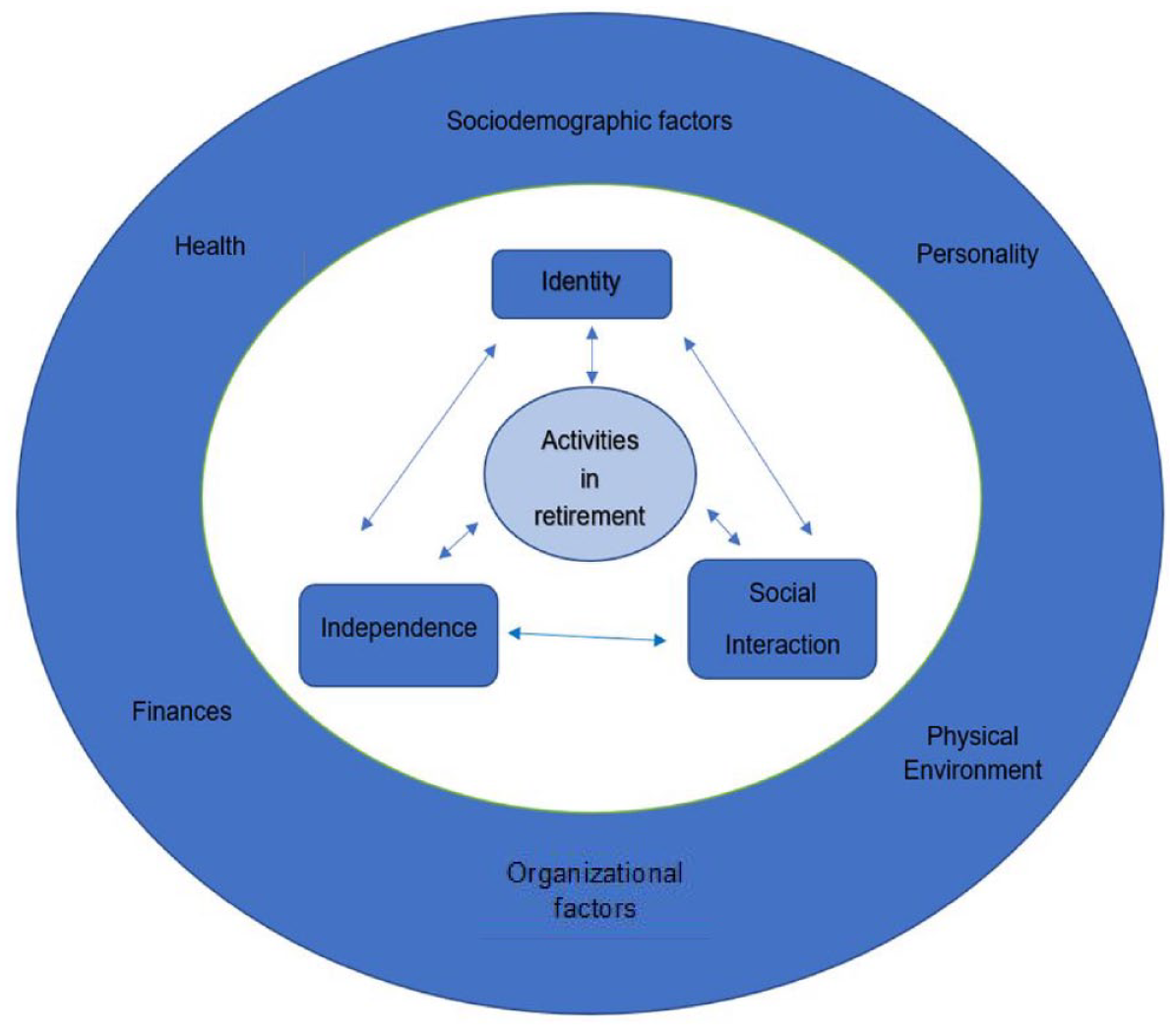
Retirement Adjustment Framework
A range of activities and the degree of involvement varied significantly between participants and appeared to be considerably influenced by different individual factors, many of which can be seen as resources (M. Wang, 2007; M. Wang et al., 2011). These factors include personality, finances, health status, sociodemographic characteristics, physical environment, and structural and organizational factors, all of which are located in the outer layer of the framework. Not only do the factors in the outer layer affect the choice of post-retirement activities, but they also create conditions for social interaction, identity formation, and providing independence. For example, the results demonstrated how the health and financial situation of participants can affect their independence and social interaction with others. Sociodemographic characteristics (e.g., former employment role) influenced the identities of people and the activities in which they engaged after retirement (e.g., the choice of volunteering role). Additionally, physical environment (urban or rural area, transport links) and organizational factors (benefits and entitlements for pensioners) had an impact on the amount of social interaction, freedom to move, and choice of activities. Differences concerning need for social engagement and activities could also be shaped by personality differences among retired individuals (Thomas et al., 2020).
The relationships between the elements of the proposed framework are provisional and need to be further investigated in future studies. However, one potential use of the suggested framework is to inform health promotion activities for retirement transition, the next section provides examples on how this can be implemented.
Implications
One of the challenges associated with existing interventions that are designed to support R-Adj is their specific focus on one or few psychological factors or activities without consideration for others. For example, Taylor et al. (2021) found that the majority of physical activity programs for older adults focused on one structured exercise, with physical activity being the main outcome of interest, while only a few studies also targeted social functioning and well-being. Furthermore, the majority of interventions that focused on retirement transition addressed only a single lifestyle behavior without consideration for contextual factors (Rodríguez-Monforte et al., 2020). The main focus of the suggested R-Adj framework is on the interaction between psychological predictors of R-Adj and contextual factors, which should be considered in health interventions.
One way to build a routine of activities that potentially provide new self-definitions, support a freedom of choice, and encourage social engagement during retirement based on one’s own preferences, desired roles, and available resources might involve social and health planning. The R-Adj framework could be used comprehensively for pre-retirement planning interventions. First, it can be applied as an educational tool to inform individuals about essential elements of successful retirement transition. The proposed framework can be used to guide and support people approaching retirement by exploring their own resources. For example, the framework may be combined with psychometric assessments such as a personality test (e.g., Rammstedt & John, 2007) or a possible selves tool (Perras et al., 2016). This might help individuals to better understand themselves, the challenges that they might experience in their own retirement journeys, and the psychological resources they have to address these barriers (Thomas et al., 2020). Drawing on the external level of the R-Adj framework, the self-assessment could also include an evaluation of individual financial situations and exploration of activities and clubs available in local areas and communities. Finally, the identified elements could be used to provide psychosocial “wheels” for planning interventions. These mechanisms could include consideration for desirable future selves in retirement. Examples include social roles, developing detailed plans on how to become a desirable self, and setting personalized goals to support autonomy. Planning exercise could also contribute to feelings of accomplishment and achievement and, therefore, support competence (Diseth, 2015).
In terms of implementation, many large organizations provide informational or educational sessions on the financial aspects of retirement preparation to their employees, but there is little support on lifestyle planning (Woodford et al., 2023). Woodford et al. (2023) demonstrated potential benefits and positive perceptions of leisure education programs that were intended to encourage retirement life planning that were offered at a workplace. Such lifestyle planning sessions should be implemented more widely at workplaces and local communities, and the programs could be informed by the R-Adj framework. The suggested self-assessment and planning based on the R-Adj framework could address the learning-related needs identified by Carbonneau et al. (2020) in recent retirees. Examples include promoting more positive views on retirement and leisure-related activities, improving the understanding that individuals have their own retirement needs, and developing knowledge about leisure resources. Given that those who were more connected to their work identities found it especially challenging to detach from them in retirement, preparation for retirement could also include consideration for other potential social identities, for example, in leisure activities and hobbies, and employers could facilitate this process.
In addition to individual-based interventions, there is a need for more population-based health promotion activities for retirement and older age, where contextual factors such as socioeconomic, cultural, and labor particularities are directly targeted (Taylor et al., 2021). Addressing contextual barriers could, in turn, influence individual circumstances and experiences. For instance, more resources (e.g., financial, organizational) can be dedicated toward building community relationships and initiatives. Strong community links and community-based activities can be particularly valuable for those experiencing retirement transition and for the most vulnerable individuals (e.g., those with health issues or who are financially insecure) due to heightened risks of social and physical isolation. Better community connections can provide retired individuals with a sense of purpose, social support, and belongingness and can help them to acquire a new identity (Herens et al., 2015). Additionally, making a variety of community-based activities available and suitable for older adults provides retired individuals with a greater choice, which could encourage a feeling of independence and control over one’s life.
Strengths, Limitations, and Future Research
One strength of the present research was developing a R-Adj framework that captured a range of both individual and contextual contributors to retirement experiences. The findings also suggested that to a large extent, SDT could explain the role of the identified components of R-Adj. Considering the impacts of various connected factors, as demonstrated in R-Adj, and the effects of retirement environments on need satisfaction, well-being, and behaviors is important for improving our understanding of how to promote health and well-being in retirement.
Another strength was the attempt to include participants who were retired for various durations, with labor and non-labor work experiences. Results demonstrated that for individuals who were retired for less than a year, detaching from a professional identity seemed to be a more prominent issue as early retirement is likely to be associated with identity transition and the search for a new meaning (L. Wang et al., 2014). Recent retirees also seemed to have more appreciation than those who retired a long time ago for the lack of a day routine, which is also aligned with existing evidence and theories (e.g., stage theory) (Atchley, 1976). This desire for the “honeymoon” phase during retirement transition can be viewed as a yearning for freedom from obligations and work stressors (Weiss, 2005b).
Several limitations of this study are acknowledged. Comparative views between recent retirees and those who were retired for a longer period relied on the retrospective accounts of participants. A longitudinal qualitative study that would track the same participants through their retirement journey might enhance our understanding of a frequently changing retirement experience, key events, their subjective approvals, and the decision-making process (Heaven et al., 2016).
Due to practical reasons, focus groups were combined with semi-structured interviews instead of the former being adopted alone. Nonetheless, conducting both interviews and focus groups can enhance data completeness. Each method may reveal different aspects of the research phenomena and, thus, contribute to a more comprehensive understanding of them. In the present study, the findings from interviews and focus groups complemented each other. Although each focus group revealed more themes such as the effects of aging stereotypes on the behaviors of individuals or independence after retirement, the interviews allowed details about the individual circumstances of each participant to be captured. Additionally, the main themes were corroborated across the interviews and focus groups, which may be used for confirming the trustworthiness of the findings (Lambert & Loiselle, 2008).
It is also worth noting that the majority of the participants characterized themselves as financially secure, and all participants self-identified as White. Retirement experience and lifestyle behaviors are likely to be shaped by socioeconomic background and cultural norms (Johnson, 2012). Therefore, the inclusion of both ethnic minorities and people from marginalized backgrounds would be an important consideration for future research.
Conclusions
Retirement pathways can vary considerably, which creates challenges for the exploration of retirement phenomena. Despite the diversity of circumstances and mindsets among retired adults, the present study has identified three psychological components that contribute to R-Adj: identity, social interaction, and independence. Importantly, the study demonstrated that to better understand retirement experiences, psychological predictors of R-Adj should be viewed in their connection with contextual factors. Health interventions that are aimed at promoting positive retirement should also consider the interactions between various factors and the role of need supportive environments in facilitating health and well-being.
Footnotes
Acknowledgements
We wish to thank Northumbria University for the support in the research participants’ recruitment. We would also like to acknowledge and thank the participants who kindly dedicate their time and shared their experiences, thoughts, and feelings.
Declaration of Conflicting Interests
The authors declared no potential conflicts of interest with respect to the research, authorship, and/or publication of this article.
Funding
The authors received no financial support for the research, authorship, and/or publication of this article.
