




Abstract
Transgender individuals, often marginalized and stigmatized by broader society, turn to the transgender communities for support. However, the centralization of power and authority in the hands of the Guru forces the Chela or followers to live a life of bonded labor. The present study intends to investigate and comprehend the challenges transgender women face within their community incorporating verbal, psychological, physical, financial, and sexual abuse inculcating an understanding from the sociological perspective of power relations. The aim of the study is accomplished through using both primary and secondary data. The study utilizes both quantitative and qualitative data, with a sample size of 150 drawn from three districts in Odisha. The findings suggest that respondents living within the transgender community face several acts of violence and abuse by other transgender. From the several acts of abuse, verbal abuse is the most prevalent form of violence within communities. Hence, the transgenders stand strangled in multiple marginalities and face cumulative violence in society, within their community, and from their rival transgender groups.
Keywords
Introduction
Transgender women often leave their families at a young age due to their non-conforming gender behavior and identity. The issue of transgender individuals originates within their families, where the pivotal role of acceptance or rejection significantly influences their experiences. Discrimination from families, peers, and society contributes to their school dropout rates. 1 Studies indicate that transgender children face higher rates of school victimization, leading to increased dropout rates and lower literacy levels.2-4 Limited educational attainment and lack of vocational skills drive transgender individuals toward jobs with low wages, underemployment, or unemployment. 5 This situation exacerbates high levels of poverty and increases their involvement in activities such as prostitution, social isolation, and begging. As a result, the transgender joins the transgender community for food, shelter, and survival. Research shows that the discrimination and harassment faced by victims has mental health outcomes or health-harming behavior6-8 and a higher prevalence of substance use. 9
Despite facing numerous challenges, the transgender population continues to grow steadily. There is tremendous research on their social position depicting their survival challenges, violence, and harassment in day-to-day life. However, research on specific issues such as difficulties within their own transgender community remains inadequate, particularly in Odisha. Therefore, this study attempts to investigate and comprehend the experiences of transgender individuals after getting integrated into their community. Before moving further, it is methodologically pertinent to be familiar with certain terms used in the article. To begin with, the transgender community, also known as the hijra community or Gharana in India, especially for transgender women, serves as a shelter home with its own customs, age-old traditions, and kinship system; Guru is the head of the community and Guru’s followers are known as Chela. In this research, the respondents used the local word “Chali” in the place of Gharana or community. Finally, the word “Badhai” is used by the community for their traditional occupation which is giving blessings to the people on auspicious occasions.
The research seeks not only to highlight the problems they encounter but also to gain a deeper understanding of the violence and abuse they endure at the hands of their Gurus, senior members, and transgender individuals from outside their group. The study attempts to understand and analyze issues like: How the Guru–Chela power relationship is structured, the inter-community and intra-community transgender social relationships, the various types of violence among the transgender, the role of Gurus in exploitation in the name of protection, the nature of punishment inflicted by the Gurus, and overall downtrodden situation.
Theoretical Viewpoints
The transgender community generally found in most of the South Asian countries comprises transgender women following their rules, regulation, kinship, and Guru–Chela system, where the Guru is the supreme head of the community having power and authority over the Chelas. Transgender individuals leave their homes, join a community to live freely as feminine, and work under a Guru for livelihood opportunities. As Guru provides shelter and home to the transgender, they shared a parental bond between themselves. 10 However, the Guru controls the life of the transgender including the income, occupation, behavior, dressing pattern, etc. like a bonded labor. 10 There are certain expected behaviors from Chela and if he does not adhere to these behaviors, they may face consequences such as beating and fine in the form of a monetary sum. 11 Some researchers conclude that the transgenders are forced into prostitution by their Guru for more income. A report named “Modern Slavery in Pakistan” mentioned trafficking of transgender for sexual exploitation by the Guru by deceiving the Chela. It considered the Guru–Chela system as sexual exploitation and a kind of slavery system. 12
In this background, the contextual understanding of the “Guru–Chela” power relations can be analyzed in sociological terms. Whether it relates to their mere depiction of authoritarian rules or formulating a repressive kind of norms, the Chelas are always seen under a false consciousness of power dynamics. Power is conceptualized from a post-modern dimension showing a changing paradigm shift in the approach of the Gurus toward their Chelas. This debate has been contextualized in the framework of post-modern theorist Michele Foucault’s concept of “Disciplinary Power” 13 which has been emphasized relating to the power dynamics of the Guru to discipline their Chela and to understand power through the prism of violence and harassment. Disciplinary power objectifies individuals and exercises its power on individuals which individuals normalized. In the disciplinary world of power for it to continue its exercise, certain features are present in the form of punishment to control the behavior of individuals such as punishment for incorrect behavior, failure in adhering rules, and punishment to correct the individual’s faults, establishing good and bad hierarchies on subjects and reward.13,14
Hence, in every society, one can easily find the oppressive group who on the basis of tradition, ideology and legitimate authority are under power of dominant group. The transgender community, which is based on traditional rules and regulation, gives power to the Guru, who is at the top of the hierarchical system and controls the life of the Chela or the subordinate member. As described by Foucault, a punishment system is in place to discipline and control the Chela, involving fine or “Dand,” as well as physical and mental abuse of the Chelas, who is at the bottom of the hierarchy. Hence, there are numerous problems faced by transgender people within their own community due to the group rivalry, which most of the time results in the death of the victims. The challenges to survive in the heteronormative society do not end after joining the community, but also increase the chances of falling prey to the violence and harassment.
Significance and Research Gap
When studying the transgender community in India, previous research studies have predominantly concentrated on the challenges faced by the transgender from the non-transgender communities or from mainstream society. Therefore, the inter-community level (transgender and society) depicting issues of marginality, social exclusion, stigma, identity crises, and livelihood problems is found to gain importance rather than the intra-community level existing within their own community, commonly referred to as “Gharanas” or specifically in Odisha as “Chaali.” The violence and abuse experienced by transgender individuals or Chelas while living under their Guru, and the dynamics of power relationship shared by the Guru–Chela system remain largely concealed from mainstream society.
With this backdrop, the research article seeks to explore issues within the transgender community at the intra-community level—problems that are often hidden by its membe₹It focuses on the experiences of transgender individuals facing various forms of abuse, including verbal, physical, psychological, financial, and sexual violence, both within their own group and from members of other transgender communities. Although there are an inadequate number of research articles on this issue, some new articles support the argument regarding the conflict between transgender communities and the problems faced by transgender within their own groups, especially in India.15-20
Methods and Materials
Considering inadequate literature concerning the problems within the transgender communities, exploratory research has been opted to achieve the research goals. Both qualitative and quantitative methods are employed to gather data from the respondents. The quantitative data are utilized to comprehend their demographic pattern and the qualitative data are utilized to address the primary research objective. Data collection involves the use of interview schedules that include Likert scale. The quantitative method has been used to analyze the number of respondents who have faced abuses and the qualitative method is used to analyze the reason and consequences behind the abuses. Both structured and unstructured sets of questions are used to collect data: quantitative structured data are focused on information regarding their demography and qualitative unstructured questions are asked during the interview process for an in-depth understanding of the problem under study.
In response to the unavailability of the official transgender population, a sample size of 150 has been selected purposely. The respondents have been selected by using snowball and convenience sampling as the study population is scattered and infinite. The study was conducted across three districts in Odisha: Khordha, Sambalpur, and Sundargarh. The number of respondents representing each district is selected by researchers’ convenience. Questions regarding their experience after joining the community and the problems they faced within the community are emphasized including the type of violence and abuse they are currently facing or previously faced within their community as a subordinate member.
Results
Demographic Profile of the Respondents
The study participants are aged between 16 and 45 years, with over half falling into the age 18-25. All participants belong to the transgender community and follow a system involving leaders and followers (Guru–Chela system). Most respondents are engaged in prostitution followed by begging (referred to as “Collection”), predominantly at traffic lights, markets, and in trains. A smaller number still pursue their traditional occupation known as “Badhai” which is dancing, singing, and receiving alms during any occasion such as: marriage, birth of a child, and festivals. The sample includes a higher proportion of respondents from Other Backward Classes, followed by Scheduled Castes, General category, and Scheduled Tribes. The majority of transgender individuals work as prostitutes followed by begging and Badhai. There is a disproportionate representation of Hindus compared with Muslims and Christians among the respondents. Additionally, a significant majority of respondents dropped out before the completion of intermediate schooling.
Violence and Harassment Faced by Transgender Within Their Community
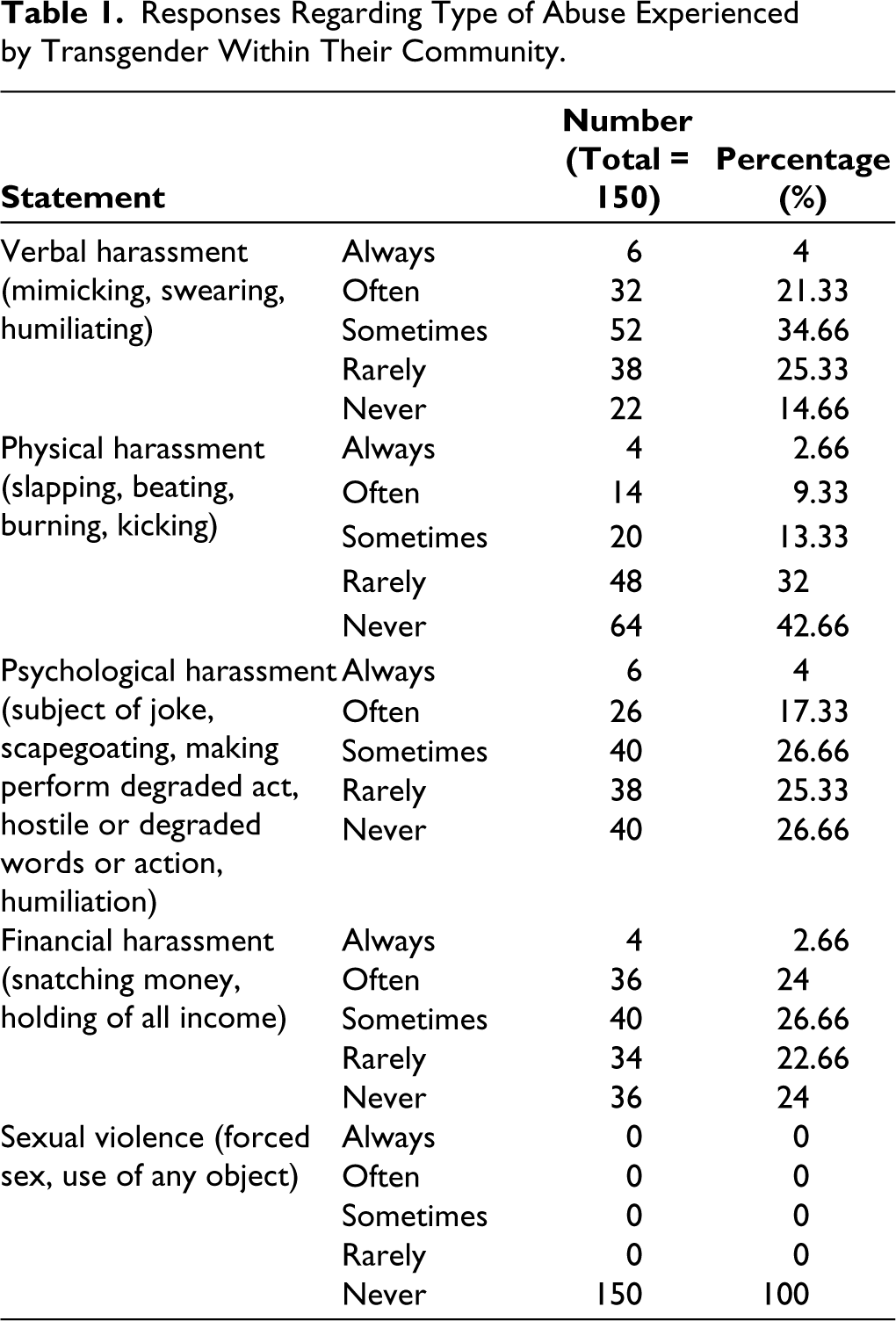
The present research found that within transgender community, the Chelas suffer discrimination and harassment due to their subordinate position. Majority of the respondents are either currently facing or have faced verbal, physical, psychological, and financial abuse within their community. Table 1 represents the number of respondents who experienced any of the mentioned violence and abuse.
Responses Regarding Type of Abuse Experienced by Transgender Within Their Community.
Verbal abuse
Result shows that majority of the respondents reported verbal abuse during their residing period within their community. Specifically, 34.6% acknowledged encountering verbal abuse sometimes, followed by 25.33% of respondents who says they rarely face any kind of verbal violence, 21% of respondents reported they often face verbal violence, and 4% of respondents say they always face verbal violence within the transgender community. The pervasive stigma forced them to compel to this Guru–Chela system where the community members are abided by the rules regulations under which their subordinate position in the system forced them again in a marginal situation.
Physical abuse
The findings indicate the prevalence of any kind of physical abuse within the transgender community. Almost half of the respondents admitted of never facing any kind of physical violence, while other half of the respondents acknowledged encountering physical violence. Thirty-two percent of respondents have faced or have been facing physical violence, while 13.33% agreed facing physical abuse sometimes. Moreover, 9.33% face physical violence often and 2.66% always face physical violence within transgender community. In many instances, the Chelas are subject to physical abuse by the Guru who is the head and owner of that community and wields significant power over Chela. The Chela is abided by all the orders of the Guru. If the Chela fails to meet the expectation of the Guru, it results in slapping and beating. Most of the time to regulate the behavior of the members, the Guru is found to beat them. However, there are some Gurus who abuse their power. To share her experience, Kajal said:
“My Guru asks me to buy alcohol at midnight. If I get late in buying alcohol, Guru beats me a lot.”
Psychological abuse:
The result supports the prevalence of any form of psychological harassment within the transgender community. In spite of the 26.66% who reported not to have faced any kind of psychological harassment, other respondents reported always (4%), often (17.33), sometimes (26.66), and rarely (25.33%) having encountered psychological violence. Most of the respondents reported facing psychological harassment not only from the Guru but also from the other senior membe₹The causes of psychological harassment are many, such as incompatibility with other members, the abusive nature of Guru and other senior members, and transgender people from the rival community. During fieldwork, findings suggest that the new transgenders who reside in the community without choosing any Guru abused verbally and psychologically by the senior members as deviant. Moreover, some transgender people are mocked and humiliated by their fellow members due to the prevalence of more masculine characteristics within their body, such as body hair, masculine voice, male attitude, etc.
Financial abuse
The result shows the predominance of financial abuse faced by transgenders within their community. Although 24% of respondents rejected having faced any kind of financial abuse within their community, the number accepting it is larger. However, the frequency of encountering financial abuse is different, such as 22.66% of respondents accepted having this abuse rarely, followed by 26.66% facing this sometimes, 24% facing this often, while only 2.66% of respondents always experience financial abuse. Naina said:
“Most of the time we do not disclose our actual income, because if our Guru knows she will demand more money.”
The respondents reveal that they conceal their true income from their Guru because of abusive behavior. They already face significant financial strain from their costumes, makeup, and daily expenses, and the Guru’s demands add to this burden. Barsa said:
“My Guru takes all my earnings daily and only gives me a portion back for my basic needs. If I don’t give her money, Guru pulls my hair and beats me severely.”
Sexual violence
The research did not find any instance of sexual abuse among the respondents by their fellow and group member. However, it cannot be concluded that the transgender persons do not face any kind of sexual violence, as in most of the cases, they are forced into prostitution by their Guru or due to the unavailability of the income source and financial necessity.
In addition to this, the respondents disclosed that in every community, there are certain guidelines for Chela which proclaim the dominant and legitimate authoritarian position of Guru, such as to speak in a low voice, to keep their clothes off from the Guru while they walk, sitting on the ground when the Guru is present, not interrupting the Guru while they speak, handling all household chores, not clapping when the Guru and other senior members are around, cleaning the spit of Guru, and strictly adhering to the Guru’s instructions, eating after the Guru has eaten. Despite this, Guru controls the behavior, dressing pattern, occupation, staying place, decision regarding healthcare accessibility, and so on of Chelas. In cases of violating the rules, the Chelas become subject to multiple acts of violence and harassment by the Guru and senior member. Most of the time, the Chelas are beaten abruptly by the Guru in the name of discipline. However, these acts are normalized by the Chelas.
Furthermore, many Gurus lead opulent lifestyles and wield significant societal power such as high status and financial stability. To sustain their lavish existence and expand their influence in terms of territory, finances, and followers, Gurus engage in inter-group rivalries. These rivalries often escalate into acts of violence such as murder, attempted murder, assaults between transgender individuals, and gang conflicts. As the number of Gurus increases in a specific area, territories are partitioned to prevent conflicts between transgender groups. Transgender individuals are forbidden from residing or working in the territories controlled by other Gurus. To mitigate conflicts among different transgender groups, control their followers (Chela), and regulate the community, fines or penalties are imposed on those found guilty, which are determined during community meetings. These circumstances have made transgender individuals vulnerable to cumulative abuse, false accusations, and violence within their own community.
Discussion
The study intends to highlight intra-community power dynamics among transgenders with the lens of power conceptualized by Foucault. According to the disciplinary power of Foucault, the power dynamic mostly exists in the interpersonal relationships where the subject class is suppressed willingly in the name of discipline. The findings of the study exemplify the power shared by transgender in the context of interpersonal relationship, the institutionalized power and authority of the head or Guru, and rules and regulations that control the overall life of the subordinate or the Chelas. The unequal distribution of power results in violence, harassment, and exploiting behavior of the Guru.
In the transgender community, certain dynamics contribute to development of authoritative structure over time. To begin with, transgender individuals often live in communities due to lack of family support. Second, these communities serve as means for livelihood and provide shelter, fostering new relationships. Third, like any community, they adhere to rules and regulations of community for sustaining under a Guru. Fourth, community members typically work under a leader, or “Guru” who governs the household. Fifth, as community leaders, Gurus have expectations from their followers, known as “Chelas,” concerning social and financial matters, which can often lead to unfavorable changes or disadvantages for the lower-ranking members.
The authoritarian position of Guru over the members of community, the lack of social support, and fear of transphobia consequently result in cumulative abuses and harassment among the Chela or followe₹The present research shows the prevalence of verbal and physical abuse among the transgender. Although the number of respondents who reject such violence is less, the number of respondents accepting or encountering the abuse could not be ignored. The transgender communities are known to be the most invisible and secretive in India. Therefore, it is very difficult to have conversation with them and study the problems that they face within their own community. As they are very hideous about their group, the respondents opine that they are directed by their Guru to not to disclose certain things outside their group. Therefore, in the present research, the number of respondents accepting the abuse and harassment on them might be higher.
The main reason to experience financial abuse is that most of the respondents are working under Guru as beggar or as prostitute. To avoid any kind of conflict within different community, the Gurus divides areas where trespassing is not allowed. The person from one community is prohibited to enter and work in the region of other community. So, the Guru who has areas under her power takes some money from the Chela who works in her region.
The respondents mentioned that traditionally transgenders considered their Guru as sacred. A portion of their income is donated to the Guru as a sign of respect. However, over time, the Guru assumes an authoritative position especially in controlling the life of Chelas including their income. The rules and regulations are set by the Guru who sets a control on the Chela. Moreover, some Chelas are forced to give some of the fixed amount on a monthly basis ranging from ₹5,000 to 10,000, while others pay sum of ₹200 to 500 on a daily basis. These characteristics of transgender community mentioned by Goel 11 as hijra prestige economic system, where the Chela needs to follow certain norms and Guru regulates the life of the Chela. The research also finds the incidents of physical abuse in case the Chela fails to fulfill the demand of their Guru.
Transgenders face physical violence within their community from the senior most member of the community or from the Guru. In an interview of transgender Gurus by Shah, 10 one Guru mentioned that “to discipline the Chela occasionally beating is necessary.” There is higher prevalence of substance use among the transgender community. Most of the time, the Guru physically abuses the Chela in intoxicated state. 10
The research did not find any kind of sexual abuse within the transgender community; however, research found that they are forced into prostitution. There are certain previous research studies that supported this argument. In the article “Modern Slavery in Pakistan,” 12 it is stated that transgenders are commercialized into sexual exploitation by their Guru. The Guru–Chela system paved the way for sexual exploitation of the transgender. However, the abuse is not only limited to the Guru but the senior members also abuse the subordinate member of their group. The transgender communities reject any statement regarding following the Hindu caste system while choosing occupation for them. But some articles proposed that they follow caste system while choosing occupation such as the transgender belonging to the lower caste are not allowed into “Badhai” and the only occupation they left with is begging and prostitution. 11
The research also shows that the masculine transgender, such as having excess body hair, masculine tone, and those who look more masculine are subject to ridicule and face psychological harassment such as humiliation and subject of joke. This psychological harassment results in mental health outcome and insecurity about their body and they are forced to go through medical intervention to become more feminine and for better mental health outcome. Various research studies suggest that these medical procedures have negative impact on their body in the long.21-24
Despite having such repercussions of being in the community, the respondents decided to remain in the community due to the unique link that sharing common social identity exists among membe₹The kinship system that exists within the community is unique in itself which not only provides a new parental figure but also a supportive network that helps them navigate the challenges posed by patriarchal mainstream society. The process of resocialization upon joining the community enables the transgender individual to embrace the traditions of the hijra system. The answer reveals that upon rejection of their family, the community is the only place they can live freely as a transgender woman without fear of discrimination and where acceptance of their identity is genuine.
Conclusion
The research findings indicate that transgender individuals face significant challenges within their communities, especially by the Guru and senior membe₹Lacking societal options for living their lives, they often turn to these communities, only to become targets of those in positions of power and authority. These issues are compounded when rival transgender groups use violence against them. The present research concludes that traditional system of their community grants the Gurus considerable power, which is often misused for personal gain. However, the number of individuals coming out as transgender women and joining the community is increasing due to the acceptance of their identity in such communities.
Footnotes
Notes
Acknowledgements
The authors are very grateful to the research supervisor for her guidance throughout the research process. The authors extend their sincere gratitude to the respondents for their responses and coordination.
Declaration of Conflicting Interests
The authors declared no potential conflicts of interest with respect to the research, authorship and/or publication of this article.
Ethical Approval
The ethical approval was obtained from the Institutional Ethics Committee (IEC) of Gangadhar Meher University, Odisha, India.
Funding
The authors received no financial support for the research, authorship and/or publication of this article.
Informed Consent
All the participants included in the research provided information regarding research aim, questions, objectives of the research, and respondents right to ensure voluntary participation. The research strictly maintained ethics of research and confidentially including the identity of the respondents.