




Abstract
Aims:
The current study attempted to explore how gender roles and work-family conflict contribute to fear of success in urban, married, middle-aged, and working women.
Materials and Methods:
A mixed method was used in which “gender role,” “work family conflict,” and “fear of success” were measured using the Indian Gender Role Identity Scale, 1 the Work Family Conflict Scale (Carlson et al.), 2 and the Fear of Success Scale (Canavan-Gumpert et.al.), 3 respectively, followed by an interview of 10 voluntary participants for a period of 30 min each.
Analysis:
A stepwise multiple regression analysis of work-family conflict and gender roles on fear of success was computed as part of the quantitative analysis of the data. Open codes and focus codes were computed as part of the qualitative analysis of the data.
Results and Conclusion:
The results of quantitative data analysis revealed that both dimensions of “work-family conflict,” i.e., “time-based work to family” and “time based family to work,” are significant predictors of “fear of success” and that there is a significant negative correlation between “masculinity” and “fear of success.” The analysis of qualitative data revealed that the majority of the participants have talked about unpleasant consequences related to success in or being engaged in a formal job. The findings have been discussed in the context of the internalization of societal expectations and implicit coercions in urban, middle-aged, and married working women.
Keywords
Introduction
“Fear of Success” (FoS) is a paradoxical psychological concept that proposes that some individuals tend to be afraid of and consequently avoid success. The concept of FoS was initially identified as a neurotic problem by Freud, 4 who described the individuals afflicted by FoS as “those wrecked by success.” Other clinicians and psychotherapists followed suit and provided descriptions of people whose neurotic problems seemed to deteriorate when success was imminent. 5 The basic difference between the theorists lies in the manner in which they have described the origin and manifestation of FoS as well as the construction of success. However, the commonality between all the otherwise discernible conceptualizations of FoS is that each of the theories views FoS as unconscious and irrational but having predictable socially and psychologically significant consequences.
In comparison to Freud’s version, where success is defined as the attainment of anything that symbolically represents the destruction of the same-sex parent, Sullivan conceptualizes success as any event that is a symbol of the child’s autonomy and competence in areas where the mother has been inadequate. In contrast, Horney tries to conceptualize FoS from a social standpoint and comments on the importance of the goal and the presence of competitors as critical indicators for success. According to her, women are fearful of taking an active part in competitive situations as they perceive that success will engender negative consequences such as loss of femininity, social esteem, and social rejection.
Thanks to the increase in economic burden affecting every strata of the society in every corner of the world along with the availability of more facilitatory government regulations in favor of women’s empowerment and birth control facilities and a general sanction by the society regarding presence of women in the workforce, the number of women in the labor force has increased dramatically in the last few years, even in developing countries like India. However, literature suggests that women consistently experience higher frequency and intensity of FoS which also interferes with their career choices and development.6,7
In most parts of the world, women are still expected to abide by the stereotypical gender roles 8 where they are supposed to share the major burden of household responsibilities such as domestic chores and child rearing. The implicit social pressure to prioritize family and female gender roles are often at odds with the expectations from the woman employee in the job sector. This gives rise to work-family conflict (WFC), which has been defined by Flippo 9 as a form of inter-role conflict in which role pressures from the work and family domains are mutually incompatible in some respect. Though WFC is prevalent in both working men and women, it is more likely to occur in women 10 because social processes are more likely to interfere with women’s performance in the organized work sector.
This brings forth the pertinent issue of gender roles, which probably latently mediates the experience of WFC and FoS. Gender roles are sociocultural expectations regarding appropriate behaviors that society imposes on individuals on the basis of their sex assigned at birth. Since the 1970s, feminist theorists have challenged the determination of gender roles on the basis of the sex binary. At present, gender is understood as a socially determined process or principle of social organization through which men and women achieve identities and power in relation to one another. Gender role differences are reflected in the division of labor and their differential evaluation. Hence, gender identities that emerge through social interaction may also serve to privilege men in comparison to women.
The present study thus tries to find out the relationship between WFC, FoS, and gender roles in middle-aged married adult females working in the organized sector.
It is pertinent to comment that the psycho-sexual aspects of motivation to avoid success in this study have been explained and/or explored in terms of gender role identity. Gender is a multifaceted construct, with its manifestations apparent in traits, roles, and attitudes. Though theorists have differentiated between gender roles and gender trait stereotypes, the two concepts, i.e., gendered traits and gendered role enactment, are overlapping and mutually inclusive (Deaux & Lewis; Biernat).11,12 Yuan et al. 13 tried to explore the moderating effect of age on the relationship between work family conflict and life satisfaction in females and found that age becomes a stronger moderator in the relationship between work family conflict and life satisfaction as the age of the female participants increases, i.e., the negative relationship between work family conflict and life satisfaction is stronger for middle-aged females. Recent studies also suggest that for younger people (young adulthood), it is far easier to accept egalitarian gender roles, which might play a role in easing down the incompatible relationship between demands made in home space and work space. 14 Such observations make it imperative that the interrelationship between WFC and FoS be studied in middle-aged females.
Methods
Participants
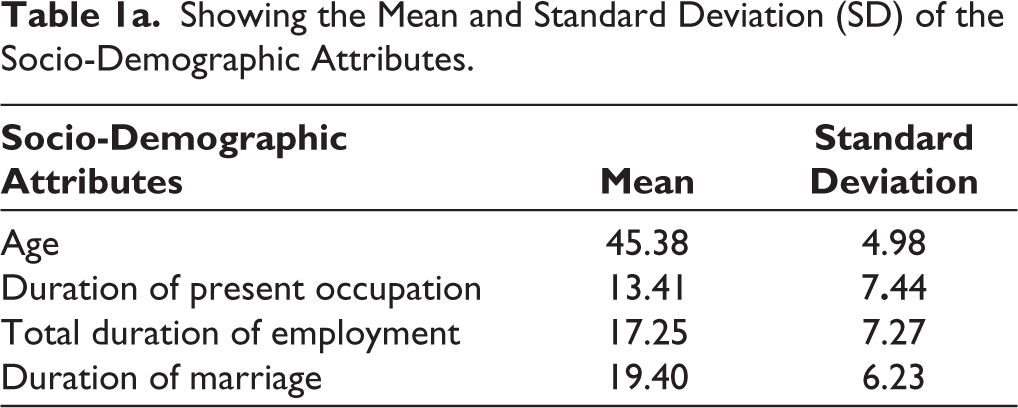
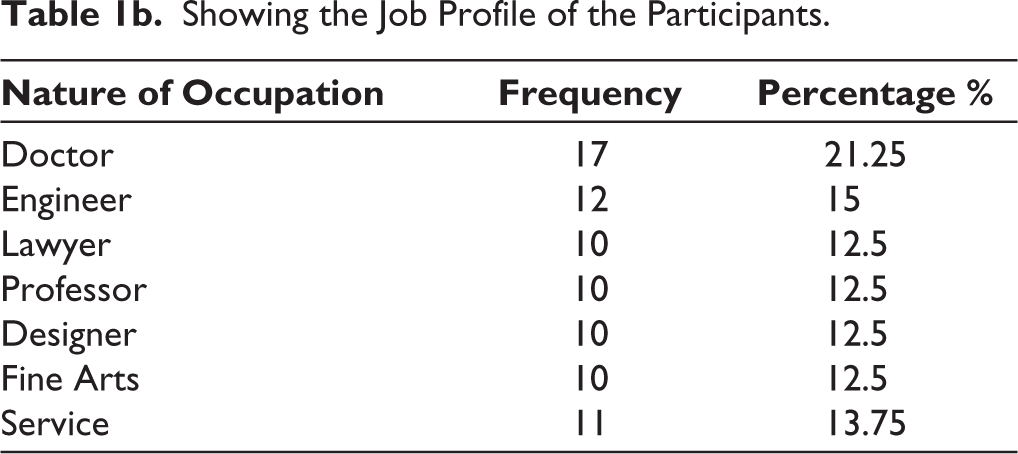
The participants of the study comprised 80 female adults (age range from 40.4 years to 50.36 years), married (minimum duration of marriage being 13.17 years) (refer to Table 1a), working in the organized sector (refer to Table 1b) with a minimum per capita income of ₹35000 per month. The minimum duration for which they have been in employment was 9.98 years, and the minimum duration for which they have been engaged in their present occupation was 5.97 years.
Showing the Mean and Standard Deviation (SD) of the Socio-Demographic Attributes.
Showing the Job Profile of the Participants.
A total of 10 participants were also part of an interview that explored their subjective experience of dual careers (having to manage work and family responsibilities simultaneously).
Tools Used
A socio-demographic data sheet was used to elicit relevant socio-demographic information such as name, age, sex, education, occupation, duration of the present occupation, etc.
The Indian Gender Identity Role Scale (IGRIS) was prepared by Basu 1 to measure culture-appropriate gender identity and role, consisting of 30 items with a test-retest reliability of 0.89 (masculinity) and 0.79 (femininity).
The Work Family Conflict Scale, prepared by Carlson et al. 2 and consisting of 18 items, measures work-family conflict in two directions: (i) work interfering with family (WIF) and (ii) family interfering with work (FIW), and with a reliability of 0.70.
The Fear of Success Scale is a self-administering scale prepared by Canavan-Gumpert et al. 3 with a reliability of 0.8.
A personal interview was conducted with 10 voluntary participants for a period of 30–45 min to understand their subjective experience of leading a dual-career life.
Ethical Considerations
The participants were informed about the nature of the study and that the information gathered would be kept confidential and used for academic purposes only. The participants were further informed that there will be no direct benefit (financial or otherwise) for participating in the study and that there will also be no negative consequences for refusing to participate in the study. Only participants who gave voluntary informed consent were recruited for the study.
Analysis
Quantitative data: appropriate statistical analysis was done, viz., descriptive statistics and regression of WFC and gender role on FoS.
Qualitative data: The data was transcribed and then converted into open codes and focus codes to arrive at a thematic interpretation.
An open code can be considered to be the simplest psychologically meaningful unit of the textual data written by each participant.
A focus code can be construed as the clustering of open codes into higher categories based on a common theme.
Results
Discussion
Discussion of Findings from Quantitative Data Analysis
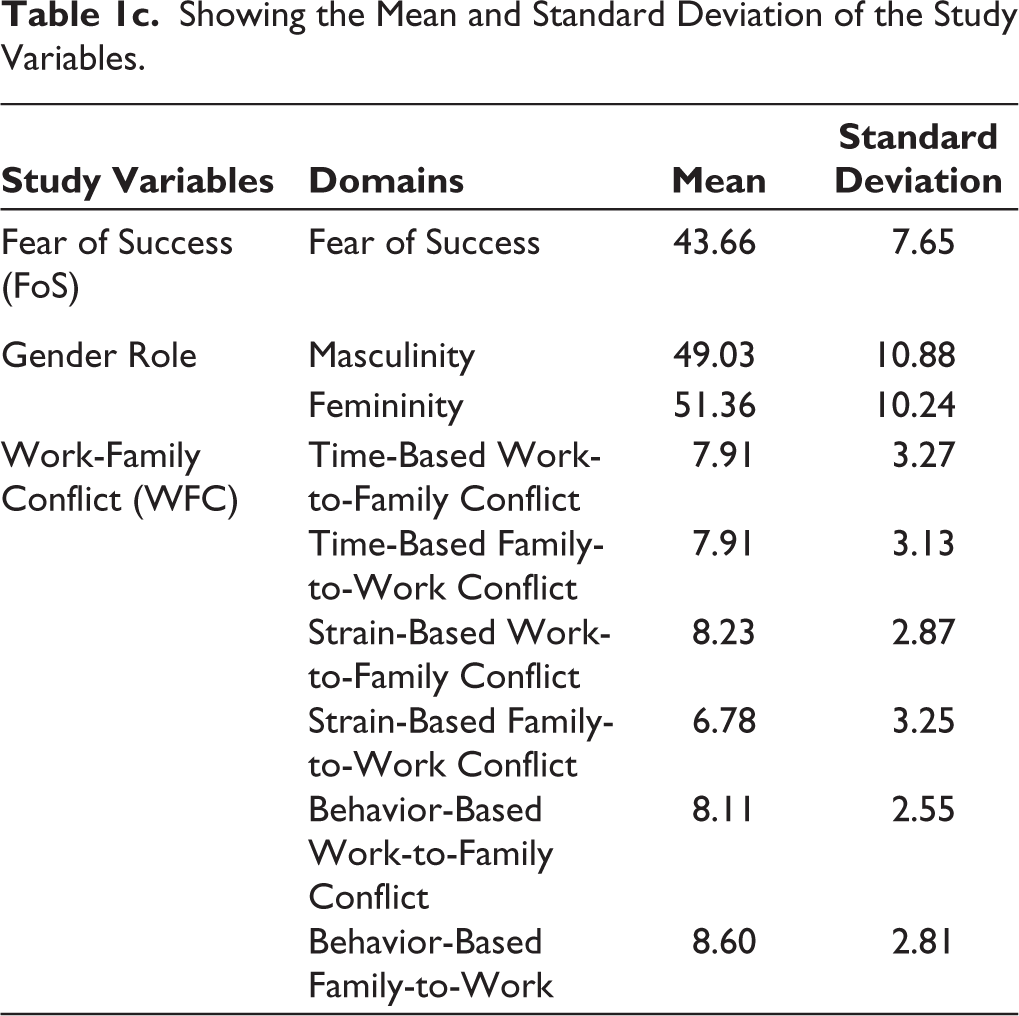
The findings of the present study reflect that in urban, middle-aged, working women, the two dimensions of WFC, i.e., “time-based family-to-work conflict” and “time-based work-to-family conflict,” contribute to variations in FoS. Work-family conflict has also been explained in terms of role theory or inter-role conflict, 15 wherein the nature and complexity of the roles expected of a person in work and family situations may be mutually incompatible and lead to conflict (refer to Table 1c). Such a model also emphasizes that role pressures are intensified when any one or both of them are salient or central to a person’s self-concept and/or when noncompliance with role demands is associated with intense social ostracization. It is needless to say that a similar situation may be present in “dual-career” women, and it is fairly well established in research literature that “dual-career” women experience work-family conflict because the implicit social demand to follow the injunctions of conventional female gender roles and the demands of the organization in which they are employed are often at odds with each other. 16
Showing the Mean and Standard Deviation of the Study Variables.
The findings of the current study also display that “masculinity” (a component of IGRIS; Basu) 1 contributes to the variation in FoS in urban, middle-aged working women, wherein “masculinity” and “FoS” are negatively correlated (refer to Table 2a). It is important to note that, as per the IGRIS, a description of oneself in terms of gender-specific traits forms a part of one’s identity and has been conceptualized as gender role identity. Also, it needs to be mentioned in this context that Constantinople, in her classic paper, 17 refuted the concept of unidimensionality of gender role identity and proposed that masculinity and femininity are not mutually exclusive but are concurrent and overlapping. This implies that the more a woman appraises herself beyond traditional femininity, less her experience of fear is related to success. Such a finding is congruent with the original propositions of Horner,18–20 that the incidence of fear of success is substantially higher in female college students than in male college students, based on the notion that FoS is strongly associated with the traditional role of women in society. According to Zuckerman & Wheeler, 21 FoS is a latent disposition that is internalized as a part of sex-role socialization quite early in life. The role of femininity in FoS was indirectly established by Mandal, 22 who found that machiavellianism is a predictor of FoS in college students and that machiavellianism is negatively correlated with femininity (refer to Table 2b).
Showing the Table for Stepwise Multiple Regression of Work-Family Conflict and Gender Roles on Fear of Success.

Summary of Models.

Discussion of Findings from Qualitative Data Analysis
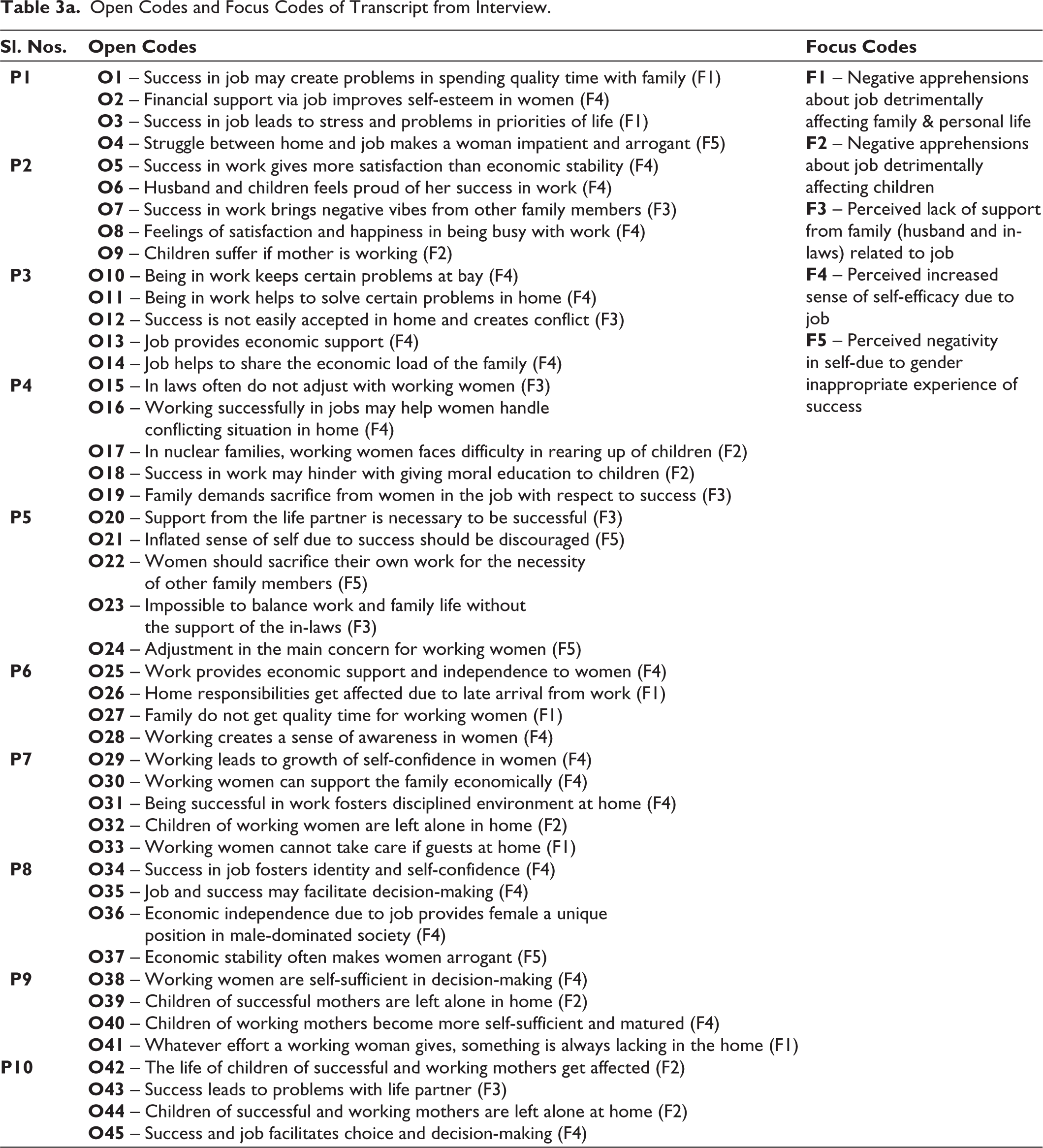
It is evident from the data analysis (refer to Table 3a) that around 55% of the focus codes (refer to Table 3b) generated from the interviews center on the unpleasant consequences related to a woman attaining success, notably negative apprehensions related to family life, rearing up of children, perceived lack of support from family regarding job role, and negative self-appraisal for considering success as gender inappropriate. The findings of this study have an interesting similarity with the original findings of Horner.18–20 In her original research, Horner used a very simple method where men and women were required to complete a story about a hypothetical character (John or Anne) who is supposedly a medical student. Horney found that 65% of female students completed the story relating to the character Anne in a pessimistic way, indicating that successful women eventually become lonely, ill, or neurotic. Horner explained that such a fear related to success represented a motivation to avoid success for the underlying fear of losing femininity, as success is traditionally perceived as antagonistic to femininity. In relatively recent research, Mandal 22 used mixed-methods research to explore FoS, gender, and machiavellianism in Polish college students. She also found that the most frequently appearing content elements of the FoS among college students were social and family difficulties, e.g., loneliness, failed marriage, absence of children, and negative self-evaluation. It is quite intriguing to find similar expressions related to FoS among people from disparate geographical locations and periods of time, decades apart. This brings forth the possibility that FoS is a dispositional attribute developed through socialization in a “gendered” society, and it indicates a situational motivational conflict between the need for achievement and the need for affiliation, where a high need for affiliation is more characteristic of women. 9
Open Codes and Focus Codes of Transcript from Interview.
Summary of Focus Codes from Interview.

However, paradoxically, around 45% of women participants in this study have also reported feelings of increased sense of self-efficacy for being engaged in a formal job. The positive effects of being engaged in a formal job on the self-perception of women have been reported in studies. 23 At the same time, studies have also reported that the association between employment and self-perception and wellbeing in women is moderated by employed women’s attitudes toward having an independent career and husbands’ appraisals of their wives’ work roles.
These findings suggest that even when employment status imparts an affirmative effect on the self-appraisal of women, such self-perceptions are mediated by social or familial acceptance of the modified social or sex role of the employed woman and their internalized standards regarding the appropriateness of an independent job role for a woman. This brings us back to the original research idea: the prevalence of fear of success in urban, educated, and employed women.
General Discussion and Conclusion
According to Engle, 24 FoS often acts as a barrier in the smooth progression of a working woman’s career and may manifest as a disruptive force in her ability to complete a task. Environmental and social coercion to act as per gender roles and apprehended social rejection for the failure to do so create a sense of anxiety for women with respect to achieving success, and this, in turn, causes women to feel afraid to pursue a successful career or inhibit their aspirations and even capabilities. According to Barnett, 25 FoS is one of the basic factors that influence career success in women, and similar social coercive forces often worsen the motivation of women to climb the organizational ladder. 26 This brings forth the need to begin a dialogue on feminine gender and female work-related stressors. In the modern world, work-related stress has been recognized as one of the most significant occupational hazards.27,28 Such stressors have been found to be associated with poor job satisfaction, a decline in job performance, absenteeism, the intention to leave the job, particularly for women, as well as family problems, diminished physical and psychological well-being, and reduced marital satisfaction.29–33 This necessitates the development of family- and gender-friendly policies to improve gender balance in the labor force, well-being, and organizational effectiveness.
Footnotes
Declaration of Conflicting Interests
The authors declared no potential conflicts of interest with respect to the research, authorship, and/or publication of this article.
Ethical Approval
Institutional ethical committee approval was sought from the Department of Psychology, University of Calcutta, Kolkata West Bengal, India.
Funding
The authors received no financial support for the research, authorship, and/or publication of this article.
Informed Consent
The participants recruited in the study were consented to the submission of the article to the journal.