




Abstract
In the Indian context, the term ‘sex’ and sex-related concepts are still considered as taboo, sexual education is an important topic to explore. The laws and beliefs of a community may influence the attitudes of its members . For the majority of the time, people’s behavior will mirror their attitude. Teachers are the second parent to offer sexual education to youngsters. Regarding the implementation of a proper sex education in the school, it would be crucial to examine the teachers’ attitudes. The purpose of this study is to comprehend the school teachers’ perspective on sexual education and its execution in the Wayanad district of Kerala. This mixed-methods study included 40 Wayanad district upper elementary and secondary school teachers. After receiving clearance from the institution’s ethical committee and consent from the school administration, the professors were contacted. Along with the personal data sheet, the “Attitude scale toward sex education” and a semi-structured interview were used to collect data. The majority of instructors (58%) had a negative outlook on sexual education. There were no gender variations in school instructors’ attitudes regarding sexual education. The qualitative research demonstrated a disparity between the attitudes of school instructors toward sex education and their execution of sex education program in school settings. This study indicated the necessity to enhance the sexuality knowledge of school instructors in Kerala. It was also determined that government and societal support are crucial for implementing a sex education program in school settings.
Introduction
Due to the general traditional and cultural standards of Indian society, ‘sex’ and sex-related phrases are still considered taboo because of which sexual health-related issues are not thoroughly discussed in society. 1 People in India lack information about sexuality and sexual health due to cultural and religious taboos. Human sexuality is an umbrella term that includes “Human sexual anatomy, personal relationships, sexual development, reproduction, sexually transmitted diseases, sexual activity, sexual orientation, gender identity, and contraception.” 2 Sexuality, according to many scientists and physicians, is a large tree with many branches. Unwanted pregnancies, sexually transmitted illnesses such as HIV, marital rape, sexual harassment, sex trafficking, and challenges connected to sexual orientation are just a few of the issues that might arise when it comes to sexual health. Many researches have shown that a lack of sexuality knowledge and scientific proof has a negative impact on human sexual health. Incorrect information can lead to confusion, which can lead to individuals refusing to follow or embrace healthy activities. 3 This became one of the causes of STIs such as HIV, unsafe abortions, and unexpected pregnancies, among other things. Because of the society’s cultural and traditional standards, sexual health and associated topics are rarely discussed extensively in India. 1
Kerala State has India’s highest literacy rate. Wayanad District has the lowest literacy percentage in Kerala state, according to the Kerala government’s state profile. Sexual exploitation of children and women, early marriages, and unintended pregnancies are all on the rise in Kerala. 4 One of the causes of these issues is a lack of sexual awareness. People’s awareness and comprehension of sexuality may differ from other districts in Kerala because Wayanad District has the lowest literacy rate. In most cases, the family provides the essential framework, knowledge, and understanding of sexuality. The literature evidence shows that parents are reluctant to talk about sexuality because they feel it uncomfortable and lack information about it. 5 Teachers are the children’s second parents, and kids spend the majority of their time at schools. As a result, pupils have a strong desire to be connected to their educators. Students choose teachers to educate them about sex education, as per the literature. 6 Teachers play a vital role in delivering comprehensive sex education to students, as they possess the necessary expertise in understanding and addressing the unique needs of children, ensuring a professional approach to this type of learning. 7 According to research conducted in India, teachers have a more friendly perception toward sex education than parents. According to one research conducted in Finland, instructors were supportive of imparting sex education in a scientific manner among students in order for them to behave responsibly. 8 The deeper level knowledge of teachers’ attitudes and execution was absent in the Indian studies. However, we conducted researches on teachers, parents, and students to determine their attitudes toward sex education. This allowed the researcher to determine how closely their attitudes and implementation are linked as well as the problems of imparting sex education to pupils. There are no clear evidences for the role of teachers in administering sex education from the south Indian setting. Before delving into the implementation, it is critical to understand their attitude toward sex education. As a result, it is critical to understand teachers’ attitudes toward sex education and how they would teach it to their pupils.
Material and Method
Design
A descriptive method was chosen to better understand the attitudes of school teachers and how they implemented sex education. The participants in this study were 40 upper elementary and secondary school teachers from Kerala’s Wayanad district (20 females and 20 males). The samples were chosen using a multistage random sampling technique from several schools in the Wayanad area. The study also included a semi-structure interview to learn more about how instructors implement sex education and an “Attitude scale toward sex education” to gauge their feelings about it. After obtaining permission from several government schools in the Wayanad area, the study was carried out. The data was collected with ethical considerations in mind. In the research, neither the subjects’ physical nor mental health were affected. They gave their informed consent, and the study was kept completely confidential.
Tools
The tool used in the study was “Attitude scale toward sex education.” It was developed by Donna Lalnunfeli in 2015. The scale has 35 items in which 20 were negative items and 15 items were positive. The test result will give an individual’s positive, moderate, and negative attitude toward sex education. The tool is followed by a Likert’s scale. The reliability of the attitude toward sex education scale was found to be 0.78. The validity of the scale has been established empirically by taking scores of teachers, students, and community, regarding attitude toward sex education. Thus, the coefficient of validity was found to be 0.83 by using the product moment method. The data collection was completed with the researcher-developed semi-structured interview.
Result
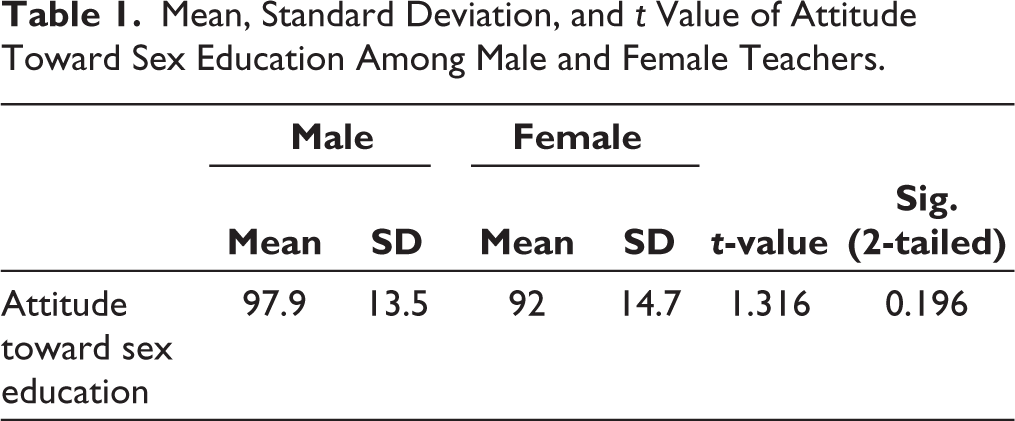
According to the qualitative data gathered by the researcher, there was no significant difference in attitudes toward sex education between male and female participants (Table 1). Both genders had negative and unfavorable attitudes regarding sex education in this study, although the differences were not significant. The t test analysis displayed both the upper primary and secondary school teachers were having no
differences in their attitude toward sex education (Table 2).
Mean, Standard Deviation, and t Value of Attitude Toward Sex Education Among Male and Female Teachers.
Mean, Standard Deviation, and t Value of Attitude Toward Sex Education Among Upper Primary and Secondary Teachers.
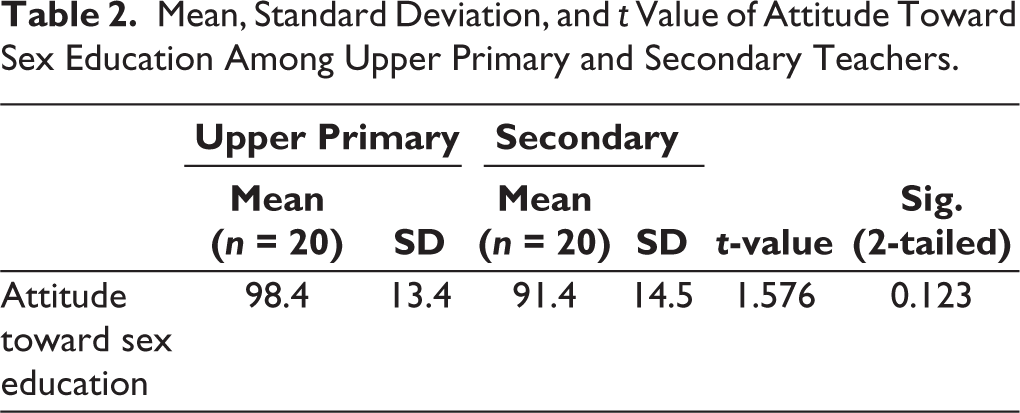
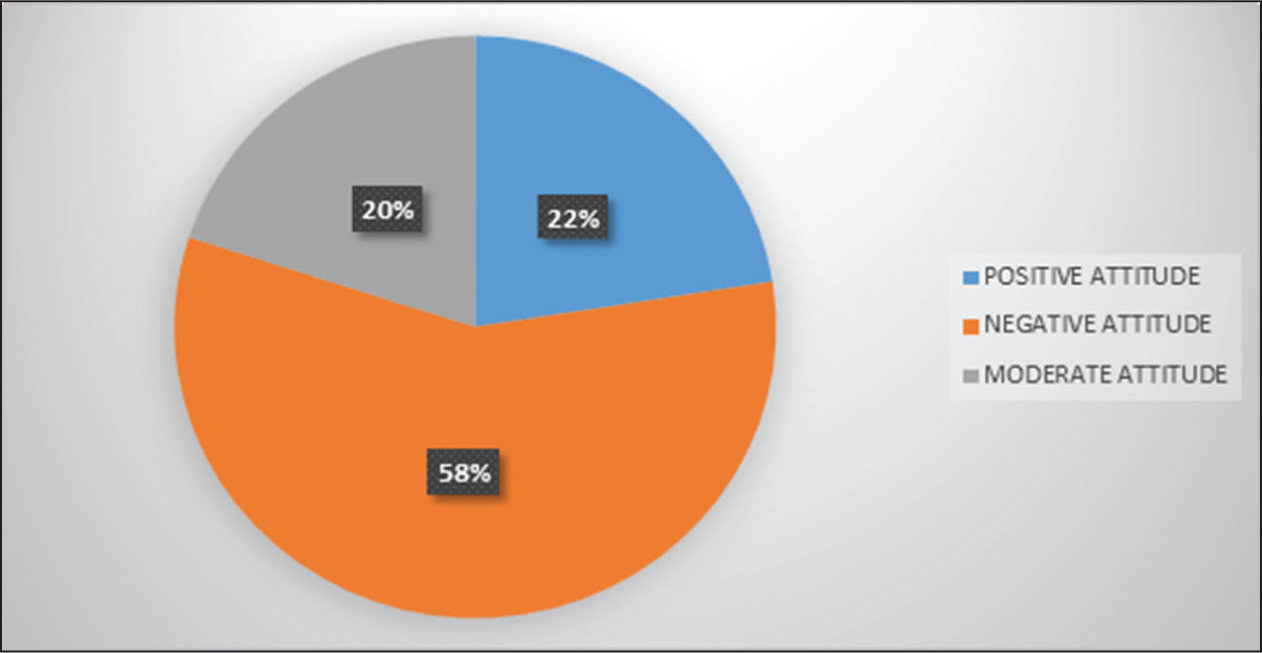
The present study results showed that the school teachers’ attitude was not different according to the increment in the level of classes. The school teachers’ different attitude toward sex education were plotted in Figure 1. It shows more than half of the participants (58%) exhibited a negative attitude toward sex education. However, 22% of the samples showed positive attitude toward sex education and the remaining 20% displayed moderate attitude toward sex education. The outcomes of the qualitative analysis revealed some discrepancies in school teachers’ attitudes and execution of sex education programs. The research also revealed a few common causes for the disparities in their attitudes and behaviors around sex education.
Plotting the Total Participant’s Attitude Toward Sex Education.
Discussion
The current study found that attitude among school teachers did not differ based on gender. Other relevant studies conducted in India contradicted the conclusions of the current study. According to Lalnunfeli, female teachers had a considerably different attitude toward sex education than male teachers. 7 Toor’s findings stated that male teachers had higher positive views than female teachers. 9 In support of this, Bordhan and Pandey discovered a similar result, such as compared to female teachers, male teachers had the highest favorable attitude toward sex education.10,11 The findings of the current study revealed no significant differences in attitudes toward sex education between males and females. The teachers had similar levels of knowledge, awareness, and prior experience. When the means of both genders were compared, both genders tended to have a negative attitude.
According to the current study’s findings, there was no significant difference in attitudes toward sex education among upper primary and secondary school teachers, and this suggested that teachers’ attitudes toward sex education were consistent regardless of their degree of instruction, implying that the participants’ identified attitudes were consistent across secondary and upper primary school levels. In contrast to the findings of this study, Ogunjimi revealed that attitudes about sexuality education might alter depending on the degree of instruction. 12 According to Aniebue, secondary school teachers were more supportive of sex education. 13 Kajang et al. discovered that secondary school teachers had a favorable attitude toward sex education, which supports this. 14 Depauli and Plaute stated that primary school teachers had more support and had a favorable attitude toward sex education. 15 According to the different literatures, there may be disparities in attitudes regarding sex education among upper primary and secondary school teachers. The previous literature and the current study results showed discrepancies, which could be due to cultural differences. Since all studies were conducted in western countries, more research with a larger sample size may be required to get a proper conclusion.
When it came to school teachers’ attitudes toward sex education, it was discovered that the majority of them (58%) had a negative perspective. However, the other majority (22%) had a favorable attitude toward sex education, while the rest (20%) had a moderate view. Nair et al. concluded that in Kerala, the teachers were not provided with a proper sex education class for their students, and they were confused about the themes presented in the school context. 16 As a result, the teachers had a negative attitude toward sex education themes. In India, Toor did a similar study to analyze the attitudes of school teachers, parents, and teenagers toward sex education, and found that school teachers had the highest favorable attitude toward sex education. 9 Bordhan revealed that the majority of school instructors had a positive attitude toward sex education, which is consistent with the research. 10 Similarly, Pandey believes that teachers who have a positive attitude toward sex education are more effective. 11 According to the majority of Indian literature, school teachers have a positive attitude toward sex education when compared to other demographics such as parents and pupils. However, when school teachers were interviewed, it was discovered that most of them (58%) had an unfavorable view on sex education. The participants’ previous experiences with sex education andtheir understanding of the subject might be the source of this critical attitude. Their previous experiences and knowledge may have influenced them to view sex education negatively. People create their opinions based on what they have experienced in the past and what information they have gathered from their immediate surroundings; therefore, they may generalize based on comparable situations and experiences. 17 That might be a person’s understanding and awareness of sex education. Most of the educators had a negative attitude toward sex education, implying that they had formed unfavorable attitudes toward sex education based on their gained information and awareness from their surrounding environment. Taylor agrees by stating that the cognitive content consisted of their beliefs about a specific stimulus, item, or event that might influence their attitude. 18 Further, it also stresses an individual’s views and knowledge. 18 The majority of the participants in the current study were critical about sex education, which might be due to their conservative attitude toward sex education.
Through qualitative and quantitative research, the current study attempted to understand the disparity between school teachers’ attitudes and the implementation of sex education program. And the research found a few consistent causes for the disparity. It is possible that a person’s behavior and attitude are linked and also this behavior is a result of one’s attitude. According to the findings, there is a disconnect between teachers’ attitudes and their actions. There have been teachers who had a good attitude toward sex education but have been unable to execute it in their schools. A few participants also had a negative attitude toward sex education, despite the fact that they were conducting a sex education program. As a result, there was a misalignment in their attitudes and actions. The current study discovered a few common factors that influenced teachers’ attitudes and behavior. The majority of school teachers who had a good attitude toward sex education could not put a sex education curriculum in place. The research revealed a few issues that hampered their efforts to provide sex education. They had few support mechanisms, such as administration support and pastoral support, and at the same time, they were missing support from parents. De Reus (2019) reported a negative experience from parents in his study such as, lack of involvement, and parents acting as barriers to imparting sex education, which is consistent with the current study findings. 19
Another major issue found by the study was that the teachers were not given any sex education training. According to Wight et al., instructors get rudimentary sex education instruction. 20 De Reus et al., stated that instructors do not receive thorough training to deliver sex education and that a good training program is needed. 19 Martínez et al., went on to say that the teachers lacked the necessary training to teach sex education. 21
According to the current study’s findings, only a tiny percentage of adults with a moderate attitude toward sex education had established sex education programs in their schools.
The findings suggested that teachers who took a moderate approach to sex education performed fine though they face few obstacles such as including a lack of parental support, religious backing, and sex education training. Roudsari et al., performed a study in Iran and discovered that sexuality taboos and religious ambiguity influenced sexual health education as factors affecting sex education implementation. 22 Das study in India found that Indian society views sexuality as a taboo topic both socially and spiritually. 23 Khubchandani et al. conducted a study in India and discovered that religious, social, and cultural values influenced adolescent sexuality education. 24 According to Ismail et al., the Indian cultural taboo on sexuality poses a hurdle to adopting sex education. 3 The outcomes of this study corroborated previous research, indicating that religious limitations had a significant impact on the implementation of sex education.
According to the current study’s findings, school instructors with a negative attitude were only partially conducting sex education. That is to say, they were not ready to teach sex education at a higher level, but they did try to teach sex education at a basic level. The survey revealed several similar thoughts among individuals with a negative attitude: they received a strong support system from their surroundings, which indicated that individuals with a negative attitude and who were implementing sex education had support from their families, co-workers, religion, and administration. The data also shows that these participants received some financial assistance from the students’ parents. As a result, the support system may influence the participants’ behavior in implementing sex education. Corngold stated in his study that in order to properly conduct a sex education program, time, resources, and most importantly, parental and community support were required. 25
The outcomes of this study may aid educational institutions in providing support, motivation, training, and encouragement to school instructors who are delivering sex education program in their respective schools. The government may also be able to provide parents with awareness program or sensitization to encourage them to help school instructors provide sex education. The outcomes of this study can potentially be used as a guide to help people rethink their opinions about sex education. A future study might focus on the variations in instructor attitudes among different levels of courses, which could efficiently administer the sex education curriculum in an age-appropriate manner. Further study in various demographics, such as parents and students, may assist the government and policymakers in determining the authorities’ problems in establishing a sex education program in the country. Other factors, such as knowledge and perception, can also help study sex education and its implementation.
Conclusion
With the help of quantitative and qualitative research methodologies, the current study explored the relevance of school teachers’ attitudes and implementation of sex education programs. Majority of the students in the study population has a negative attitude toward sex education. This study discovered a few roadblocks that instructors face while delivering sex education programs in the classroom. Our analysis revealed a disparity in attitudes and behavior among school teachers when it came to sex education. Support mechanisms inside and outside of the school and a sex education training program for teachers may have a significant impact on teachers’ attitudes and implementation of sex education programs in school settings.
Footnotes
Acknowledgements
My thanks go to my guide and other resource people who assisted me with my research. I am also grateful to the administrators of various government schools in Wayanad district, Kerala, India for allowing me to gather data.
Declaration of Conflicting Interests
The authors declared no potential conflicts of interest with respect to the research, authorship, and/or publication of this article.
Ethics Statement
This study was approved by the Departmental Research Ethics Board, Department of Psychology, School of Social and Behavioral Sciences, Central University of Karnataka, India (Ethical clearance number: CUK/DREB/Psy/EC-09/2020-15, dated:20-02-2020).
Funding
The authors received no financial support for the research, authorship, and/or publication of this article.
Informed Consent
The participant has consented to the submission of the article to the journal.