




Abstract
Background:
Violence against females is a violation of human rights and discrimination, causing physical, sexual, psychological, and economic harm, and involves threats of coercion or arbitrary deprivation of freedom.
Aim:
The goal of this study was to find solutions that speak volumes about the proactive approach toward addressing and mitigating sexual harassment. This study has the potential to drive meaningful change and improve the safety and well-being of women within university settings in Afghanistan.
Methodology:
The method used in this study was an online survey containing 19 questions. Overall, 69 students from different universities, most of them from Kabul University of Medical Sciences, participated in the survey.
Result:
The study shows a high prevalence of harassment among female Afghan university students, with verbal assaults being the most common form and many witnessing only harassments. Participants generally support legal measures against harassment, but fear of identification, blame, or confusion may lead to underreporting or concealment of incidents due to factors like fear of identification or blame. The study underscores the need for a comprehensive strategy, including legal reforms, safe reporting mechanisms, supportive environments, and cultural barriers, to eradicate sexual harassment in academic settings.
Conclusion:
Sexual harassment is a global issue, particularly prevalent in Afghanistan, but lack of accurate statistics has hindered effective prevention. Surveys and research can provide reliable data, enabling universities to understand the extent of the issue and implement targeted interventions. This proactive approach helps create safer academic environments, highlighting the importance of accurate statistics in addressing sexual assault among female students.
Introduction
Higher education institutions must provide a secure environment for teachers, staff, and students, but sexual harassment remains a significant issue. Studies 11 show it’s prevalent across diverse nations and education levels. Recognizing this issue is crucial for implementing proactive measures and robust policies to prevent such behavior and foster safer environments. 2 In the US, 86% of female students and 62% of college students experience sexual harassment, with the Bureau of Justice Statistics stating that colleges and university students are at high risk of sexual violence.1,2
Based on the Equal Employment Opportunity Commission’s (EEOC) definition, sexual harassment is unwelcome sexual advances, requests for sexual favors, and other verbal or physical harassment of a sexual nature. Unlike the common thought of people that sexual harassment is only physical, in fact, it can include many types: verbal; whistling at someone, making kissing sounds, asking personal questions; non-verbal; staring at someone, following a person for no reason; and physical; standing close, hugging, or touching. 3
Although in most countries, including Afghanistan, there are no accurate statistics on sexual harassment of women, the overall picture shows an increase in the number of incidences. These assaults are seen in different public places, including universities, hospitals, schools, offices, and even judicial institutions, with no law against them. 4 Also, different factors are related to this issue depending on different cultures and societies. In Afghanistan, cultural and social problems, poverty, a low level of education, and patriarchal society are recognized as the main leading causes. 5 Based on a patriarchal culture, women are considered to be the main victims of most crimes, but are still prevented from leaving home, which promotes violence against women.
Another problem and challenge is that such behaviors against women and girls are committed not only by uneducated people but also by educated ones at universities, hospitals, and other educational centers. Despite girls’ access to education, the percentage of girls in schools is lower than that of men. Thus, harassment of girls in educational institutions prevents them from attending classes and discourages them from studying, which can further decrease their percentage compared to that of men. 6 According to a report from WHO, in 1991 at a university in Kenya, 71 girls were sexually assaulted by their peers. Another sad truth mentioned in this report is that harassment at universities was not only conducted by classmates but also by teachers under the pretext of good grades or the threat of failure in exams. 7 Quantitative results of a study conducted at the University of Mazandaran under the title “Social Analysis of Factors Affecting the Rate of Street Harassment of Women and Girls” showed that in the past year, 70.6% of women have been harassed by men several times or once a month. 8 On the other hand, in Afghanistan, according to the Women and Children Research Institute (2015), among the 346 women who were interviewed in 7 provinces of Afghanistan, 90% of the women were harassed at least once in public, and the results also showed that 87% experienced harassment at work and 91% at school. 9 Moreover, a survey carried out in Daikundi also shows that 85% of the 115 women interviewed have experienced sexual harassment in their lifetime. 10 In addition, a study conducted in 2010 by the Kabul University Institute for Gender Studies on more than 200 female students from three Afghan universities found that 55% of these girls had experienced some form of sexual harassment or discrimination, of which 48% had spoken bad language and 43% had experienced sexual discrimination. 8.9% of boys have also experienced bad language. 11
Problem Statement
Kabul University of Medical Sciences is one of the educational institutions in the country where almost half of its students are female, not an exception in this case. Harassment of female students at Kabul University of Medical Sciences takes place in various verbal and physical forms, and this action creates an atmosphere of fear and unhappiness for them. This action may cause them to have mental and psychological problems, prevent them from reaching their goals, and even cause some girls to drop out of school.
Research Objectives
Evidence-based approaches are an opportunity to bring about change because, in this way, we can inform the community as well as provide real examples and cases to challenge authorities to bring about positive changes in this aspect of the prevention of sexual harassment at universities.
The following are the objectives of this research:
To identify the common factors that may lead to harassment at universities. To find out how female students experience harassment, how to deal with it, and the effects that it has on their lives such as mobility, work, participation, etc. To demonstrate the role of community and family in the prevention of women’s sexual harassment. To provide a brief review of the functions of the responsible institutions to prevent harassment.
Research Questions
Understanding the Nature and Impact of Harassment on Female Students in Afghanistan Universities:
Who are the primary perpetrators of harassment against female students at the universities? What types of harassment do female students experience, and in which academic settings? How do these experiences affect the mental well-being of female students?
Assessing Past Interventions and Exploring Future Strategies to Address Harassment:
What previous efforts have been made to address harassment at the universities, and how effective were they? What future strategies or measures can be implemented to prevent and combat incidents of harassment? What roles and responsibilities do the universities, students, and other stakeholders have in eliminating harassment?
Barriers and Facilitators to Reporting and Addressing Harassment:
What factors hinder female students from reporting instances of harassment to the universities administration? Who are the key influencers or entities in the efforts to eliminate harassment, and how can their roles be optimized? How do female students typically respond or react when faced with instances of harassment on campuses?
These three overarching research questions aim to encompass the core inquiries providing a comprehensive framework to investigate harassment issues in Afghanistan Universities while exploring intervention strategies and reporting barriers.
Methods and Materials
The method used for data collection was an online survey. The questionnaire consisted of 19 closed-ended and open-ended questions that students could answer according to their own assumptions and experiences. The questionnaire was shared through social media for a period of 2 weeks. Sixty-nine students between the ages of 19 and 27 have participated in this online survey. The expectation for the number of participants was quite high, but due to some reasons such as the usage of an online survey, cultural and traditional beliefs, and some criticism from male students, the number of participants was limited to 69 female students. Unfortunately, during the research process on social media, we faced some critical encounters from some male students, which led to the refusal of some female students’ participation in this research, and maybe it had an impact on some answers as well.
The closed-ended questions facilitated the collection of quantitative data, enabling statistical analysis to uncover patterns, frequencies, and correlations related to various aspects of sexual harassment. Simultaneously, the open-ended questions encouraged participants to express their experiences, emotions, and nuanced perspectives, offering qualitative depth and richness to the findings.
The subsequent analysis of these responses culminated in a comprehensive depiction of the prevalence, nature, and impact of sexual harassment among female students. This synthesis of both quantitative and qualitative findings aims to provide a holistic understanding of the multifaceted dynamics surrounding incidents of sexual harassment within educational environments.
Prior to the start of this study, the research protocol (proposal in local language) was submitted for review to the research ethics committee of Kabul University of Medical Sciences. This committee usually consists of qualified experts from different faculties, including curative medicine, dentistry, public health, midwifery, and nursing, who transparently provide comment, guidance, and approval of research. This study was supervised and confirmed based on the ethical principles (10 specific principles of Helsinki: scientific requirements and research protocols, informed consent, privacy and confidentiality, research registration and publications, and so on) of this committee. All data from this study, in conjunction with the participants’ informed consent, is stored for ethical issues with this committee.
Results
The study comprised a comprehensive questionnaire consisting of different issues including demographical information, the possible factors leading to harassment, the effects of harassment, the possible actions against harassment, and the possible functions of institutions for preventing harassment (Table 1).
Survey Questions With Their Responses.
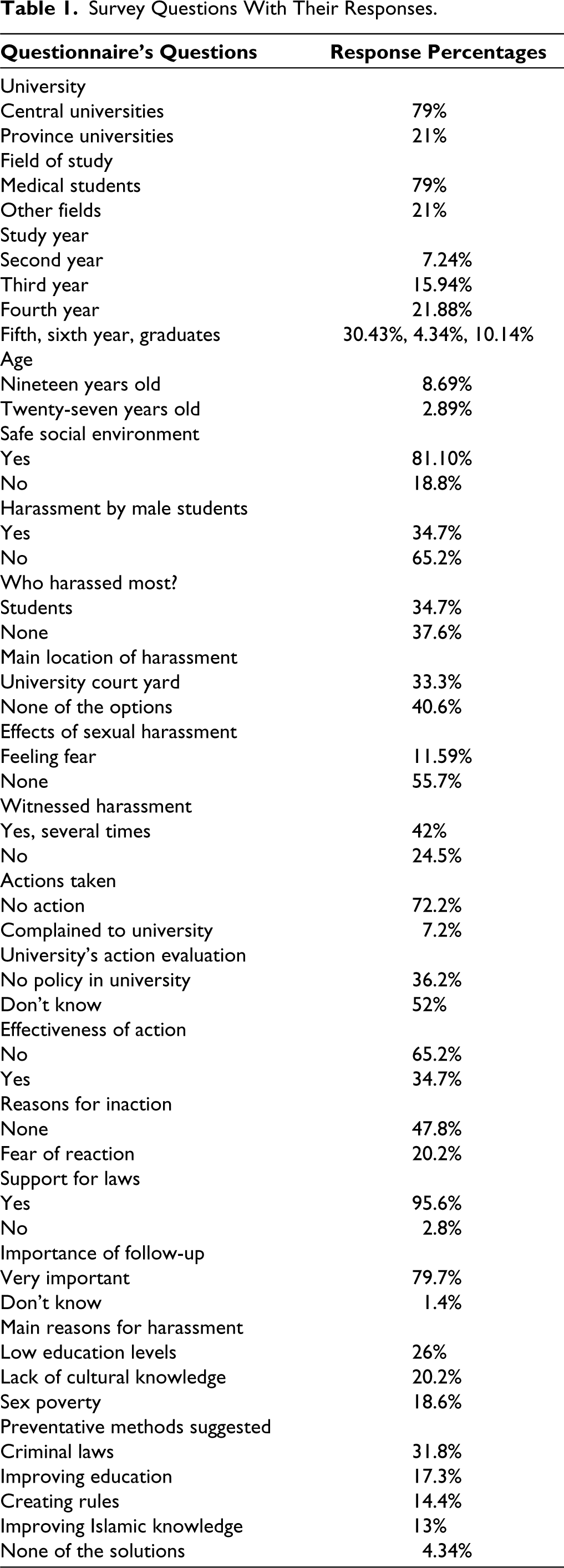
The survey shows a diverse representation of participants, with 79% enrolled in central universities and 79% pursuing medical studies. The academic year distribution is diverse, with 30.43% being fifth-year students and 4.34% sixth-year students. The age distribution is varied, with 8.69% at 19, 15.94% at 20, 27.5% at 21.5% at 21, 20.28% at 22, 18.84% at 23, 5.79% at 24, and 2.89% at 27 years old.
The study reveals that 34.7% of participants experienced harassment by male students in university settings, while 65.2% did not. The primary perpetrators of harassment varied, with students being the most common. The locations of distressing incidents were mostly in the university courtyard, with no specific location mentioned. The nature of harassment varied, with 17.4% reporting verbal harassment, while smaller percentages reported messages, calls, ogling, and physical actions. The findings highlight the multifaceted nature of harassment in university environments.
The outcomes reflect the diverse effects of sexual harassment among respondents. Among participants, 11.59% reported feelings of fear, while 2.85% acknowledged experiencing anxiety and depression. Additionally, 5.79% mentioned being discouraged from attending university, and suffering from low grades, anxiety, and depression, whereas 5.7% noted low grades, fear on campus, and anxiety and depression. Another 2.85% expressed feeling discouraged from attending university and experiencing fear related to it. Moreover, 1.4% detailed instances of absenteeism due to depression, anxiety, and fear, while 55.7% claimed no discernible impact, and 46% provided responses outside the survey options.
Regarding witnessing harassment, 42% admitted to witnessing it multiple times, 8.6% observed it once, and 39% heard about it from friends or classmates. However, 24.5% claimed not to have witnessed any harassment. When asked about actions taken against the issue, only 7.2% reported complaints to university administration, 20.2% engaged in verbal confrontations, 7.2% shared the issue with family, and a staggering 72.2% took no action.
Assessing the university’s response, 36.2% highlighted the absence of policies, 11.5% cited a lack of attention, 5.7% mentioned their complaints being processed, and 52% expressed uncertainty. Evaluating the effectiveness of their actions, 34.7% believed their actions were effective, while 65.2% felt they were not.
Regarding reasons for failing to act against harassment, 20.2% cited fear of the harasser’s reaction, while 47.8% claimed no specific reason for their inaction. Additionally, 13% expressed concerns about being blamed, 13% considered harassment as common and not necessitating action, while smaller percentages associated their inaction with considerations of immodesty and blame avoidance. These findings highlight the complexity and varied responses in addressing and dealing with incidents of harassment within university environments.
The outcomes reflect strong sentiments in support of legal action against such behaviors. A significant majority, 95.6% of participants, advocated for the creation of laws addressing these issues, while only 2.8% opposed the idea, and 1.4% were ambivalent, choosing both yes and no. Assessing the significance of following up on such events, 79.7% deemed it “very important,” 15.9% considered it “good to follow,” while smaller percentages, 2.8%, deemed it “not important,” and 1.4% were uncertain.
Participants provided diverse perspectives on the primary causes of harassment. The data showed that 26% associated it with low education levels, 20.2% with a lack of cultural knowledge, 10% with familial upbringing issues, and 11.5% with the absence of specific laws. Additionally, 18.6% linked it to non-observance of hijab and sex poverty, 5.7% to religious awareness gaps, and 2.8% expressed uncertainty. Notably, 1.5% believed in shared responsibility. These findings underscore the multifaceted nature of perceptions surrounding the roots of such behaviors, suggesting a complex interaction between social, cultural, and educational elements.
A survey on harassment prevention revealed varied perspectives among respondents. 31.8% advocated for criminal laws, 17.3% for enhancing education, 13% for Islamic knowledge, and 2.8% for female hijab observance. 4.34% believed no solution was effective, while 14.4% proposed specific rules. Other suggestions included parental control, gender-based class separation, and encouraging girls to react themselves. Only 1.4% suggested strategic employment of officials. These suggestions highlight the complexity of addressing harassment through legal, educational, cultural, and behavioral interventions.
Finding and Discussion
According to the research, with the age progression of the students, the incidence rate of harassment differs according to age. The level of harassment is low among the first- and second-year classes and students aged 19 and 20. However, it increases among third-, fourth-, and fifth-year students aged 21 to 22 and again reaches its lowest level among the students of the sixth year, the practical period, and among graduated students (Table 1). The reason why students of lower classes said that they have not witnessed harassment remarkably might be because students of lower ages are less likely to detect and define types of harassment. Thus, as they progress in age, the students might be able to detect harassment quickly and take action against it. Hence, they will experience less harassment.
Based on the figures, the harassment rate is at the same level in all universities in the country and among different fields. According to this research, 81% of the students have mentioned that they experience a safe environment at the university, and the remaining percentage said that they are not happy with the university environment (Table 1). Also, 65% of the participants have not witnessed harassment themselves, and the remaining 35% have witnessed harassment (Table 1).
Most of the female participants in this research remarked that the students are the basic group who harass female students, while the majority of the participants selected the ‘none’ option, which indicates that, for different reasons, students want this issue to remain secret as usual, or they were unable to detect the incidence of harassment (Table 1). Based on the participant’s beliefs, the university counteryard is a main place for the harassment of female students (Table 1); lack of disciplinary rules, gender sensitivity, and the non-observance of social etiquette are considered among the causing factors. Among the figures obtained, verbal harassment is considered the most common type of harassment. At the same time, some of the students are victims of phone harassment, which is why they are unable to share their numbers easily (Table 1). A study by the Kabul University Gender Studies Center also found that the majority of harassment of female students was verbal and text message (UNDP and UNESCO 2010). 12 According to the study, some of the students did not experience lifestyle changes in their lives after experiencing harassment at university, while others witnessed the fear of going to university after the harassment. Although the majority of students said they enjoyed a safe campus, a high percentage recalled witnessing harassment of all other students at the university (Table 1). This raises the question of how students say they enjoy a safe environment in universities while the majority have witnessed harassment of other students at the university in this study. Can’t students distinguish harassment? Or can students not psychologically admit that they have been harassed? According to the results of this study, students have not taken any action against harassment, which is due to the lack of an accountable policy against harassment in universities, their lack of awareness of the existence of policies in universities, and their fear of disclosure (Table 1). A limited number of students who have responded to the harassment have stated that they have not achieved any satisfactory results; perhaps this causes students to lose trust in the university policies and the gender department (Table 1). In the end, students believe that making and enforcing a policy in this regard is a necessity to provide a healthy academic environment at the university (Table 1).
Recommendations
To solve and overcome female student abuse and harassment in educational institutions, the following recommendations must be considered:
Formation of a policy against female abuse and harassment. Holding informative seminars on gender issues and women’s rights at universities. Distributing informative brochures and banners in educational institutions to stop violence against female students Increasing social knowledge regarding women’s rights and ways to observe these rights Increasing the religious knowledge of male and female students in this regard Holding seminars to increase self-confidence and prevent stress and depression in female students. Providing different cultural and academic opportunities for female students plays a vital role in increasing their self-confidence and capacity. Establishing an active committee to follow up on harassment cases
Strengths and Limitations
This study’s strength is that it is the first of its kind to be conducted among medical students in Afghanistan; no prior reports exist. Additionally, the research ethics committee of Kabul University of Medical Sciences oversaw and confirmed this study in compliance with the ten specific Helsinki principles (scientific requirements and research protocols, informed consent, privacy and confidentiality, research registration and publications, and so forth).
This data is only a sample of data from a small number of students; it is insufficient to solve and discover all answers to questions. Therefore, more comprehensive data is required to include the majority of Afghans.
Conclusion
The participants of this study considered male students as the main group who cause harassment to female students, while many participants chose the option of none, which shows that female students are not harassed or, for various reasons, do not open up. According to the participants, the university courtyard is the main place of harassment for female students. Lack of disciplinary rules, gender perspectives, and non-observance of social etiquette can be among the factors involved. In the obtained figures, verbal harassment is considered one of the most common types of harassment. Shortsightedness, stinginess, the way girls dress, and the like are common causes of this type of harassment.
Most of the girls who have been subjected to such harassment, either by themselves or by their friends, have taken no action to eliminate the harassment. Because they believe that their action will not be effective. Besides, responsible institutions, such as the gender department of universities, do not have any specific and applicable laws to eliminate harassment and support female students. According to the results of this study, most of the students support the creation and ratification of laws against these behaviors and raising the level of awareness of students as solutions to this social problem.
Footnotes
Acknowledgements
The authors are extremely grateful to the completion of our study would not have been possible without the support and nurturing of our research mentor (Dr. Batol Hashimi, MD, MSc, MBA) for guiding us.
Author Contributions
This study is a culmination of collective efforts and contributions from all authors involved. Each author has played a distinct and vital role in shaping this work. Their individual contributions encompassed various aspects, including conceptualization, data acquisition, analysis, drafting, critical revision, and ensuring the accuracy and completeness of the study. The collaborative efforts of every author have been instrumental in the creation and execution of this research, reflecting a unified commitment to its quality and integrity.
Data Availability Statement
The information backing this study’s conclusions originates from the research ethics committee of Kabul University of Medical Sciences. However, access to this data is limited due to licensing constraints specifically for this study, thus preventing public availability. Nevertheless, upon a reasonable request and with permission from Hedayatullah Ehsan and Zainab Hashimi, the authors can provide access to the data.
Declaration of Conflicting Interests
The authors declared no potential conflicts of interest with respect to the research, authorship and/or publication of this article.
Ethical Approval and Consent to Participate
The Kabul University of Medical Sciences research ethics committee reviewed the suggested research plan in the local language before this study got underway. Competent experts from a range of disciplines, including public health, midwifery, dentistry, nursing, and curative medicine, make up this committee. Their responsibilities include providing candid criticism, direction, and support for research projects. The Helsinki Declaration’s ethical guidelines, which cover matters such as research protocols, informed consent, privacy, confidentiality, registration for research, and other relevant considerations, were followed by the study and validated it. In accordance with informed consent from participants, all data gathered for this study is safely kept under this committee’s jurisdiction to handle ethical issues. The supervision and registration of this study within the research ethics committee of Kabul University of Medical Sciences were done by three professors from. The supervisor of this research is Assistant Professor Dr Mahmoodullah Azimi. For more details and confirmation, these supervisors and mentors from the research committee are responsible for giving confirmation, so the Journal of Publication can make contact with the supervisor of this study, whose more details are as follows: Assistant Professor Mahmoodullah Azimi, MD, MMeDSc, Department of clinical pharmacology, Kabul University of Medical Sciences. Email:
Funding
The authors received no financial support for the research, authorship and/or publication of this article.