




Abstract
“Reboot” coaches claiming to treat pornography addiction increasingly claim to treat erectile dysfunction (ED). They view ED as due to pornography viewing. However, anxiety has long been the best predictor of ED. We hypothesized that those involved in Reboot treatments would report erectile difficulties predicted by anxiety symptoms and not pornography viewing. Six-hundred and sixty-nine participants familiar with Reboot treatments completed a series of online questionnaires. Among those who participated in Reboot treatments, anxiety symptoms predicted ED. Pornography viewing frequency did not mediate or moderate this relationship. Licensed providers should work to dispel this apparent health disinformation by life “Reboot” coaches.
Introduction
Despite dozens of studies that failed to find an association between pornography viewing and erectile dysfunction (ED), 1 some male youth and adults continue to claim that they experience ED due to their pornography viewing. Studies sometimes identify a subpopulation with small and variable relationships of ED and pornography. 2 No specific mechanism has been proposed that could link pornography viewing alone to sexual arousal responses to a human partner. The only study testing actual partners found pornography viewing was associated with “increased” sexual arousal with partners. 3
Anxiety has long been known as the best predictor of ED, 4 including in men under age 30.5,6 This etiology arises from a tendency to respond with anxiety to erectile variability. For example, a sexually inexperienced male who is generally anxious may believe his penile rigidity is less than a new partner expected. Rather than understanding reduced penile rigidity as a common response to anxiety, he believes his erectile response is dysfunctional. He begins to fear that he has ED, and anticipates that future sexual interactions will similarly “fail.” If the anxiety is not addressed, this can become a self-fulfilling prophecy. 7
Reboot/NoFap/NoFapChristians are large, for-profit groups, mostly run by men self-described as “coaches in recovery.” They claim to offer treatments for porn-induced ED, although this is not a recognized diagnosis in any nomenclature. Reboot/NoFap/NoFapChristians may have identified a subpopulation for whom pornography viewing does predict ED symptoms beyond anxiety symptoms alone. Another possibility is that merely engaging in a treatment that they believe works could function as a placebo, reducing anxiety that would improve ED symptoms. As a part of a larger, preregistered study, we recognized these data also contained variables that could answer this question. In the current study, we test if men who participate in Reboot/NoFap/NoFapChristians experience ED symptoms that are predicted by anxiety symptoms. Further, we hypothesized that, if the Reboot/NoFap/NoFapChristians claims were accurate, the frequency of pornography viewing would mediate or moderate the relationship between anxiety symptoms and ED symptoms.
Methods
Advertisements were placed on Reddit (eg, r/pmohackbook), Twitter (eg, @NoFap, @Reboot_Nation), and Discord (eg, “Reboot Warriors”). Advertisements requested men aged 18 or over who had heard of “Reboot” treatments for pornography. The study was approved by the Community-Academic Consortium for Research on Alternative Sexualities (FWA 0014611) Institutional Review Board. Volunteers who consented completed a series of standardized questionnaires. Relevant to this brief communication, participants provided a brief sexual history, and described their symptoms of anxiety, 8 ED, 9 sexual openness, 10 and pornography viewing frequency. 11
The primary analysis was a mediator/moderator analysis. Specifically, we tested whether pornography viewing accounted for any of the variance in the relationship between anxiety symptoms and erectile difficulties. The R v 4.1.2 library “mediate” 12 was used with 1,000 bootstrap simulations estimating robust standard error.
Results
A total of 669 participants completed at least the first questionnaire requesting demographic information. Of those who answered, 296 (63.1%) reported having personally tried a “Reboot” treatment. Those who tried Reboots compared to those who did not were generally younger (age Median (SD) = 36.0 (13.4) vs 27 (11.4), Mann-Whitney = 0.32, CI = 0.26 to 0.37), less sexually experienced (lifetime intercourse partners Median (SD) = 9 (27.3) vs 3 (21.2), Mann-Whitney = 0.34, CI = 0.29 to 0.39), reported more anxiety symptoms (Mean (SD) = 1.9 (1.9) vs 2.4 (1.8), t (351) = –2.7, CI = –0.8 to –0.1), reported more erectile difficulties (Mean (SD) = 20.6 (4.5) to 19.3 (5.0), t (362) = 2.6, CI = 0.3 to 2.2), were more sex negative (Mean (SD) = 2.9 (0.7) vs 2.7 (0.7), t (353) = 3.4, CI = 0.1 to 0.4), and viewed pornography less often (Mean (SD) = 6.8 (1.5) vs 6.5 (1.6), t (379) = 2.3, CI = 0.05 to 0.63).
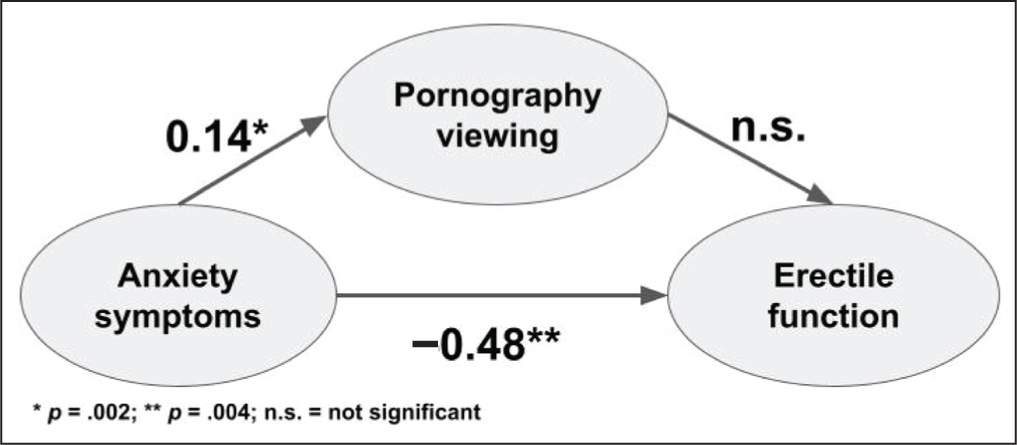
Of men who tried Reboots, the average direct effect of anxiety on ED was significant (est = –0.48, CI = –0.82 to –0.13, p = .006). More anxiety symptoms predicted more ED symptoms after removing variance attributable to pornography viewing (see Figure 1). The average causal mediation effect was not significant. That is, there was no indirect effect, mediation, or moderation, of pornography on the relationship between anxiety symptoms and ED symptoms. The total effect of the model, including direct and indirect paths, was significant (est = –0.53, CI = –0.85 to –0.19, p = .004) and no proportion was significantly mediated by pornography viewing.
Mediation/Moderation Model of Anxiety and Erectile Difficulties by Pornography Viewing.
Post-hoc power was calculated using powerMediation 13 to determine the discoverable slope size between the hypothesized mediator and dependent variables given in these data. The discoverable slope size was small (β = 0.05).
Discussion
Men who reported participating in Reboot/NoFap/NoFap Christians treatments to reduce pornography viewing reported more erectile difficulties (ED) than men who denied participating in Reboot/NoFap/NoFapChristians. Their anxiety symptoms predicted their ED symptoms. This relationship was not mediated or moderated by the frequency of viewing pornography. Tests were powered to detect even a small slope between the mediator and dependent, so this likely was not due to low statistical power. Results appear to be in contrast to the claims of Reboot/NoFap/NoFapChristians that pornography viewing is the etiology of erectile difficulties in this group. Rather, in a group of men who participate in Reboot/NoFap/NoFapChristians, their ED symptoms appear to be due to anxiety.
The group participating in Reboots reported lower pornography viewing than those who were not. Given the shaming aspect of these treatments, participants may underreport their actual viewing. Alternatively, they might be actually viewing less pornography as a result of their participation in Reboot, this just appears not to have had the desired impact on symptoms of ED.
The Reboot/NoFap/NoFapChristians groups rely on discourses that idealize masculine sexual performance with a tone that is often angry and helpless. 14 By framing pornography as a drug that “hijacks” their brain, these men may seek to absolve themselves of “feminine” anxiety. Put another way, Reboot/NoFap/NoFapChristians men may believe that simply being anxious about sex makes them feminine, whereas doing battle with pornography makes them masculine. 14 This myth may protect their self-esteem in the short term, but data suggests that this approach “maintains” their anxiety about their sexuality over longer periods. 15
Another possibility is that men involved in the Reboot community define ED using an inappropriately low threshold for ED. The Rigiscan, a physiological measure of erectile response, has been shown to strongly correspond to physician assessments of ED. 16 However, patients consistently report more erectile difficulties on questionnaires, including the questionnaire used in this study, relative to evidence of same measured by a Rigiscan. 17 Perhaps men in Reboot/NoFap are not actually experiencing ED symptoms, but are very fearful or catastrophize that their erections are not good enough.
Men following Reboot/NoFap/NoFapChristians are likely to benefit from sex education. Such education might correct disinformation posted in the forums, such as normalizing that the most likely cause of their erectile concerns is anxiety. Future studies may test whether the fear of appearing unmasculine is influencing these men to believe disinformation about pornography, rather than explore their own anxiety about sex.
Footnotes
Declaration of Conflicting Interests
The authors disclosed receipt of the following financial support for the research, authorship, and/or publication of this article: JB declares that he has no conflict of interest. NP teaches paid workshops for continuing education to therapists that include the treatment of erectile dysfunction. NP made reports to law enforcement due to threats of harassment and violence posted on Reboot forums that named her.
Funding
The authors received no financial support for the research, authorship, and/or publication of this article.
Ethical Approval
The study was approved by the FWA Community-Academic Consortium for Research on Alternative Sexualities, Institutional Review Board.
Informed Consent
Every participant was provided an information sheet and consented to participate.