




Abstract
Background:
Inadequate knowledge and awareness about transgenderism among doctors can lead to inadequate health-care services to transgender persons.
Objective:
To assess the prevalent attitudes and beliefs toward transgender persons amongst medical undergraduates.
Materials and Methods:
The present cross-sectional observational study included medical undergraduates of both gender in a tertiary care hospital. The students belonged to “early clinical phase” (yet to start clinical postings). The sociodemographic characteristics and academic and social exposure to transgender-related issues were recorded using a semi-structured proforma. Transgender Attitudes and Beliefs Scale was used to assess the attitudes and beliefs toward transgender persons. Statistical significance was set at P < .05.
Results:
Of the 170 second-year medical students, majority reported negligible social exposure (71.3%) and academic exposure (81.6%) to transgenderism. Female students displayed better attitudes and beliefs toward transgender persons than their male counterparts.
Conclusions:
Medical undergraduates require systematic academic exposure to transgender-related health issues. Gender differences exist among medical undergraduates in the beliefs and attitudes toward transgenderism.
Introduction
An increasing number of transgender persons are accessing the health-care system in recent times for various medical, surgical, psychological, and allied services. Stigma is one of the significant barriers encountered by transgender people in accessing health care, especially in developing nations. 1 The term transgender includes people with a different gender identity contrary to their assigned sex at birth as well as those whose gender identity deviates from the conventional binary gender categories. 2
While a fair amount is known about stigma directed at individuals with altered sexual orientations, much less is known about the stigma faced by transgender individuals. Lesbian, gay, bisexual, and transgender (LGBT) persons encounter significant barriers in accessing appropriate and comprehensive medical care.2–4 An absence of gender-bashing or discrimination of transgender people should not be mistaken for an absence of stigma, as stereotypical, negative attitudes, and prejudice may still exist unnoticed. 3
Awareness about transgender health among health-care providers remains inadequate and is considered a major barrier in providing care for transgender individuals. 5 Studies report that even trained physicians are often underprepared to address the needs specific to the transgender population. 6 Among medical students, deficiencies in knowledge and preparedness to deal with health issues of transgender people are noted across various grades. 4 Studies support addition of sections on transgender health in the undergraduate medical curriculum to address the knowledge gap.3,7 Conducting orientation sessions and educational programs improved students’ confidence in caring for transgender people.6,8 There is a pressing need to shift toward pragmatic interventions targeted toward transgender health leading to dual advantages: curricular enrichment and enhanced clinical skills. 9
In the context of lack of awareness in transgender health, it is equally important to explore the various prejudicial attitudes and develop strategies to address them among the student health professionals which will prevent unintentional discriminatory practices toward transgender people. 10 There is a rising need for medical education inclusive of transgender health concepts and principles enabling medical students with academic and clinical skills required to provide the need-based appropriate health-care services to transgender people.11,12
Studies assessing medical students’ attitudes and beliefs toward transgender persons and their health concerns are rare in developing countries like India. Hence, there is a need to assess the existing awareness, knowledge, and attitudes of medical students toward transgender people in developing countries such as India. The present study intended to assess the attitudes toward transgender persons among the undergraduate medical students of a tertiary care hospital.
Material and Methods
Setting, Design, and Period of Study
The present study is a cross-sectional descriptive study done in a tertiary medical college hospital in Southern India. The study was conducted between August 2019 and October 2019.
Study Population and Selection Criteria
The study population comprised of medical undergraduates, aged 18 years and above, of both gender, who were in the “early clinical phase”. For the present study, “early clinical phase” was defined as “students who had passed the first-year examination and were enlisted for clinical postings in the hospital setting”. The definition was formulated upon consensus among the 2 consultant psychiatrists (KS and AS) for 2 reasons: (a) to assess the academic exposure without the concurrent influence of clinical postings leading to wide variations in awareness among students and (b) to get a homogenous sample of students belonging to the same phase of early academic career.
Instruments and Tools
Interpersonal Comfort
The interpersonal comfort subscale contains 14 items which assess factors regarding perceived tolerance in interacting or initiating relationships with transgender (TG) persons in home/workplace/social settings.
Sex/Gender Beliefs
The sex/gender beliefs subscale contains 10 items which assess different beliefs that people may have about a person’s physical, psychological, and social attributes which contribute toward sex and gender roles in society.
Human Value
The human value subscale contains 5 items which assess the value, rights, dignity, and social treatment of TG persons.
The TABS scale has good discriminant and convergent validity. 13 Higher scores indicate better attitudes and beliefs toward transgender health.
Data Collection and Procedure
The medical students belonging to early clinical phase were recruited after obtaining informed consent. The present study was conducted online, and the participants were approached through email from the primary investigator. The principal investigator acquired the contact email addresses of the study participants from the college authorities after ethical clearance. The primary email consisted of study information and link to Google® Forms. Upon accepting the consent, the participants filled their responses for the questions in the semi-structured proforma and TABS. Each individual’s response was assigned a unique code (eg, A001, A002, etc). Apart from the email address, information such as name, enrolment number, or any other personal identity details was not obtained. Following initial announcement and the first survey prompt, email prompts were sent at regular intervals (1 prompt per week) as reminders to maximize the data collection process (except for those who have registered their unwillingness to participate in the study). Confidentiality of the information was maintained throughout the study period. Ethical clearance was obtained from the Institute Human Ethical Committee (IHEC) before the initiation of data collection (Ref. No: ICMR Project/08/2019/17).
Statistical Analyses
Descriptive Analyses
Mean and standard deviation was used to show the distribution of continuous variables like age and subscale scores of TABS. Frequency and percentages were used to depict the distribution of categorical variables like domicile, religion, family type, modes of social exposure, and modes of academic exposure.
Inferential Analyses
The sample was divided into 2 main groups (based on gender) and multiple subgroups (based on domicile, religion, family type, modes of social and academic exposure on transgenderism). Comparison of the primary outcome variable (TABS subscale scores) was done using either the Student t test (gender, domicile) or one-way ANOVA (religion, family type, social and academic exposure). Chi-square test was employed to find the differences in the proportions of various modes of academic and social exposure among various demographic categories. Pearson correlation test was performed to find the association between age and TABS subscale scores.
Normality of the data was checked using Kolmogorov-Smirnov test. A P value of .05 or less was considered to be statistically significant. Data was analyzed using the SPSS v.19.0 software (IBM Corp., Armonk, NY).
Results
Sociodemographic Profile of Study Participants
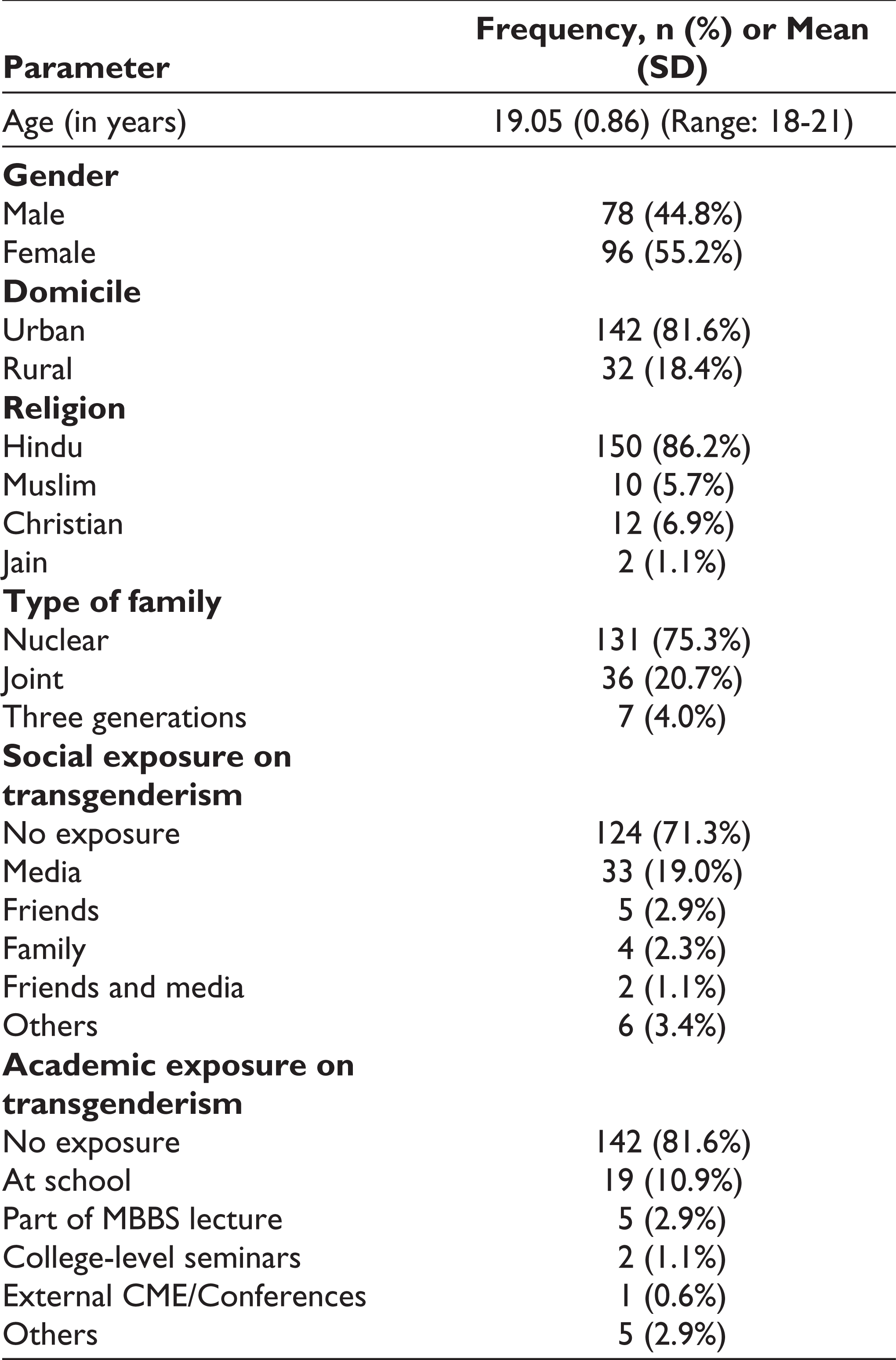
One hundred and seventy-four second year MBBS students participated in the study. The mean age of the students was 19.05 ± 0.86 years. Female students constituted 55.2% of the sample. The students were predominantly Hindus (86.2%), belonged to nuclear families (75.3%), and hailed from urban domicile (81.6%) (Table 1).
Demographic Characteristics of the Study Sample (N = 174)
Exposure to Transgender Health Issues
Two different types of exposure (academics and social) to concepts on transgender-related issues were assessed among the students. The question was phrased as “Were you aware of any common physical or mental or social health issues of transgender people?” If the participant had answered “yes,” the source of information was enquired in both academic (school-level/college-level/external academic events, and others) and social (family/friends/media, and others) domains.
Social Exposure on Transgenderism
Most of the students (71.3%) revealed that they were not exposed to transgender health issues through their social relationships. Media (19%) was noted to be the most common source of social exposure on transgender-related issues.
Academic Exposure on Transgenderism
The academic source of exposure to transgender-related issues was also analyzed. We found that most students did not experience any exclusive academic exposure (81.6%). Compared to college environment, most students revealed they were made aware of transgender-related issues in the school (10.9%). The exposure to transgender health through college-level academic activities was minimal (Table 1).
Effect of Gender on Attitudes and Beliefs Toward Transgender Persons
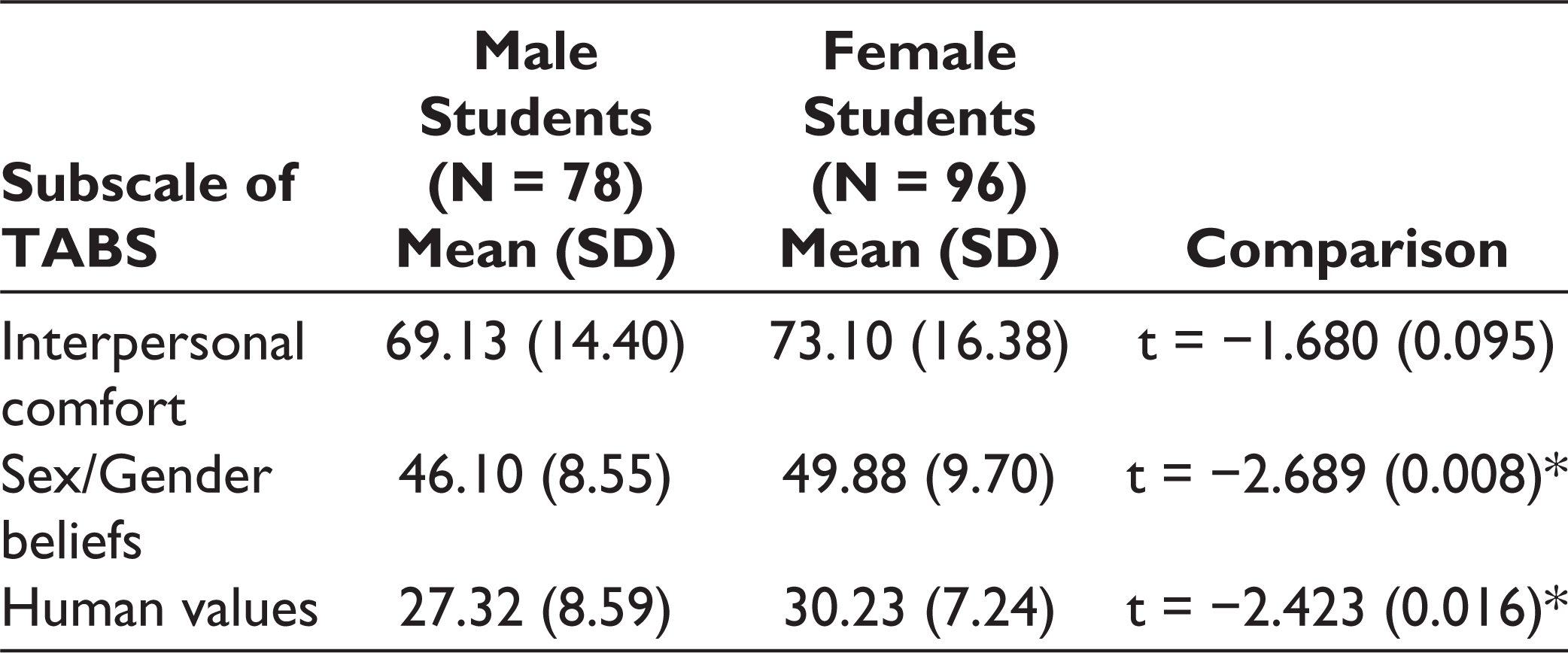
The TABS contains 3 subscales: Interpersonal comfort, Sex/Gender beliefs, and Human values. The 3 subscale scores were compared between male and female students. Though the 2 groups had similar scores in interpersonal comfort domain, the 2 groups significantly differed in the other 2 subscale scores. Female students had displayed better scores in gender beliefs and human values toward transgender persons (Table 2).
Comparison of Attitudes Toward Transgender Persons Between Male and Female Students
Other Observations
The correlation between age and TABS subscale scores was not statistically significant. Descriptive analyses revealed that the sample had unidirectional representation in each of the demographic characteristics namely, urban domicile, Hindu religion, and nuclear family type. Hence, subgroup comparisons of TABS scores within such categorical variables are not presented to avoid misrepresentation of results.
Discussion
The present study aimed to identify the prevalent attitudes and level of awareness toward transgenderism among medical undergraduates during their early clinical training phase. Majority of the students felt that there was no systematic exposure toward transgender people and their health issues. The lack of exposure was evident in both academic and social domains of the student. The observations are similar to a previous study in India which revealed that medical students and interns had inadequate knowledge about the theme of homosexuality, and they endorsed a neutral stance toward homosexuals. 14
Apart from revealing the low levels of awareness among the junior medical students, the present study adds to the literature on the various potential sources of information about transgenderism. Media played a significant role in sensitizing the students toward transgender-related issues. This could probably be due to news items, portrayals of transgender people in movies, and so on.
Study findings reveal that students did not receive any formal or systematic academic sessions in the early academic career in MBBS. Similar to the present study findings, many international studies have revealed that the medical student population is deprived of education on TG health issues and their concerns.12,15 Students also revealed that they learnt about transgender-related issues in the school environment. This finding warrants further research in determining the modes of transgender-related information and who delivered them at school.
Though majority of the students displayed better attitudes and healthy beliefs toward transgenderism, subgroup analyses revealed that female students harbored healthier beliefs toward transgenderism and were more empathetic than their male counterparts. Future studies need to explore the demographic influences on the awareness and attitudes toward TG health.
The present findings highlight the need for introduction of transgender health-related lectures, seminars, and early clinical exposure exercises in the medical undergraduate curriculum. Such demands are supported by studies which revealed that even minor changes in the medical curricula had demonstrated significant improvement in the students’ self-confidence, self-efficacy, and comfort in dealing with the health issues of transgender persons. 16 Studies also support that even occasional lectures and short-term courses can elevate the awareness of TG issues amongst medical students.17,18
The present study has limitations such as the cross-sectional design, involving clinically naïve student population, lack of standard criteria for assessing academic and social exposure to transgender-related issues, lack of a comparison group, possibility of self-report bias, and the lack of generalizability to all grades of medical undergraduates. Future studies are needed to provide a better understanding regarding the moderators of knowledge, awareness, and attitudes toward transgender persons among medical students.
Conclusion
Our study concludes that most medical students in the early phase of MBBS report a lack of academic and social exposure to transgender health issues. However, school and media play important roles in the dissemination of TG health-related information to medical undergraduate students. Significant gender differences exist in attitudes and beliefs toward transgender-related issues. The present study recommends introduction of academic orientation toward transgenderism early in the medical undergraduate career. Such changes will enhance the professional etiquette and care tended toward transgender persons without prejudicial notions from the future doctors of our country.
Footnotes
Declaration of Conflicting Interests
The authors declared no potential conflicts of interest with respect to the research, authorship, and/or publication of this article.
Funding
The authors disclosed receipt of the following financial support for the research, authorship, and/or publication of this article: The study received extramural research grant via the Indian Council of Medical Research—Short-term Studentship (ICMR STS Ref No. 2019-02439).
Appendix
Transgender Attitudes and Beliefs Scale
Please indicate the extent to which you agree or disagree with the following statements.
(A transgender person is one whose sex assigned at birth does not align with their gender identity.)
For example, someone who identifies as male but was assigned female at birth would be considered transgender.
Strongly disagree - Moderately disagree - Slightly disagree - Neutral - Slightly agree - Moderately agree - Strongly agree