




Abstract
Love forms the theme of various poems, plays, historic as well as contemporary literature, and is glorified in art and music, deliberated upon in speeches, celebrated on the silver-screen. Nevertheless, the scientific basis of love remains wrapped in mysticism although there have been advances in pinpointing the hormones, neurotransmitters, and more recently the anatomical pathways that play a role in love, with evidence in imaging modalities. We aim at demystifying the role, function, and workings of love and its counterparts—intimacy, attraction, attachment, and sensuality—in this review.
According to Greek mythology,
humans were originally created with
four arms, four legs and a head with
two faces. Fearing their power, Zeus
split them into two separate beings,
condemning them to spend their lives
in search of their other halves.
—Plato’s The Symposium 1
What more can one say of love that hasn’t already been said? Having been a topic of debate and extensive study, love remains elusive in its idea. “Love” as described in the English language serves a dual role, the role of verb in addition to noun. This duality in its role function is merely one of the layers in its fabric, making it a hard entity to define. It invokes in one, several “feelings,” often accompanied by thoughts and the amalgamation of these multiple feelings resulting in an emotional state that can only best be described as “love.” Additionally, the word alone can be used to describe various contexts, which may seem related but are specific. Other languages have various words that they use to denote the concept of “love”, for example, Greek words like “eros, philia, pragma, ludus, storge, philautia, agape” refer to various types of love and so also terminologies like “prem, mohabbat, ishq” in Hindi. 2 Therefore, with cultural, regional, and language-associated connotations, finding a universally accepted definition is hard. Definitions quoted from the Merriam Webster dictionary for love ranges from “strong affection for another arising out of kinship or personal ties,” “attraction based on sexual desire,” “affection based on admiration, benevolence, or common interests,” “the object of attachment, devotion, or admiration,” to “unselfish loyal and benevolent concern for the good of another.” 3 Therefore, love remains a feeling, a state of emotion, thought, attitude, action, or an experience. In 2009, Maryam and Bhatia approached the process of defining “love” as a comparative concept with an attempt to explain what love isn’t: a demonstration of warmth as a contrast to hate, emotional attachment in a romance against lust/sexual desire, a romantic affair against the platonic feelings of friendship. This remained limited owing to other themes not fitting the comparative box, namely of unconditional maternal love, love in platonic kinship, the intensity of passionate love, or profound devotional/spiritual love. 2 We aim to summarize and stitch together the theories of love, describe love’s predominant components of intimacy, passion, commitment, the roles played by attachment, attraction, sensuality, the neurobiological underpinnings in love and touch briefly upon radiological evidences and love’s impact on well-being.
Methodology
Our review consists of a literature search. The databases searched included MEDLINE, CINHAL, EMBASE, and IndMed. Search terms used included “love,” “theories of love,” and “philosophies on love,” “neurotransmitters in love,” “ neurobiology of love,” “wellbeing in love,” “love and psychology.” Limits were not placed on publication years, and language was limited to English alone. A manual scanning of all the abstracts was done, followed by full texts of the accessible articles were included in preparation of the manuscript. Additionally, books, grey literature in form of newspaper articles, blogs, websites for literary quotes, and so on, on love were used during manuscript preparation. The available literature has been organized under the headings described above.
Theories of Love
Love looks not with the eyes but with the mind, and therefore is winged cupid painted blind.
—A Midsummer Night’s Dream-Shakespeare 4
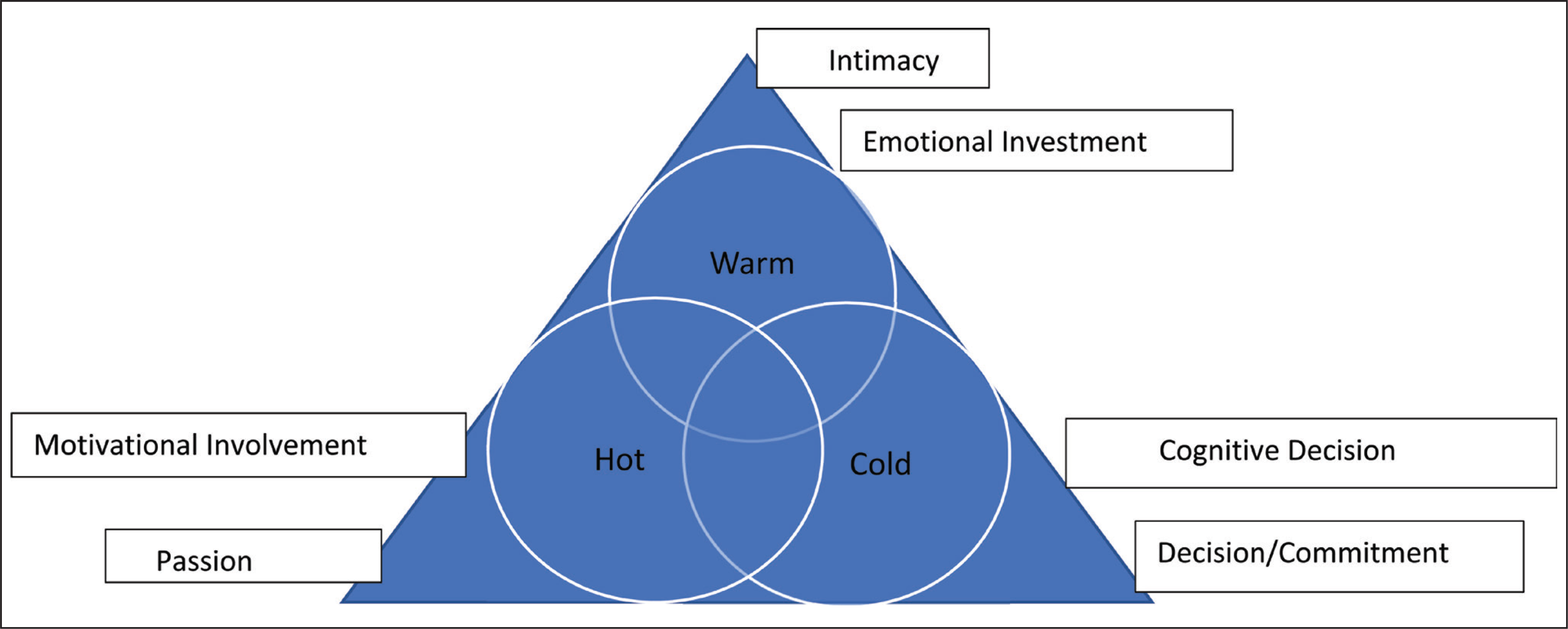
In 1986, Robert J Sternberg promulgated the triangular theory of love, and this tripartite theory has withstood the test of time, perhaps just like the object of its study. This theory had at its core 3 components forming arbitrary vertices of a triangle, namely intimacy, passion, and decision/commitment. For specificity, he defined each component, intimacy implied the sharing, feeling of oneness, and the growth of a bond within a relationship, all equating to a mutual positive affection. The component of passion implies the basic urges of the need for romance, the pull of attraction, physical consummation that accompanies relationships encompassing the key factors of motivation and arousal. The final component of decision/commitment implies the conscious thought and acceptance of loving someone as a short-term goal and making the decision to commit to the promise of a long-term loving relationship. 5 The optimum state of harmony in love would be attained if all the 3 core components balanced out in equal proportions. Additionally, Sternberg explained intimacy to be governed by emotional investment in the relationship connoting “warm,” passion being governed by motivational involvement, connoting “hot,” and lastly the decision/commitment component influenced by cognitive decision-making connoting “cold” (see Figure 1) triangular theory of love. 5 We discuss the various permutations and combinations that occur which form the basis of love relationships.
Pictorial Representation of Sternberg’s Triangular Theory of Love
Attachment Theories
I do love nothing so well in the world as you: Is that not strange?
—Much ado about nothing by William Shakespeare 6
An extrapolation from the Bowlby’s parent-child relationship attachment theories form the basis for the attachment theories in romantic relationships. Adult relationships are comparable in theory to the various attachment patterns as described by Bowlby. 7 The center of one’s attachment, however, is replaced by the partner instead of the mother. The element of communication and synergistic relationship with the early-life caregiver figure, particularly in events of distress, contours the style of attachment in years to come. 8 A primary attachment figure being a steadfast anchor, solid emotional comfort, or a port in a storm forms the attributes of a secure attachment, as against a flailing, unavailable, and vacillating primary attachment figure forming qualities of an insecure attachment, thereby creating in the child an uncertainty. 8 Adolescence and adulthood marks the time of shift of deep affection and interest onto romantic partners, and most often, attachment then begins in the pattern set forth in childhood. Hence, secure attachment styles harbor more chances of success at relationships, with the capacity to meet the 3 components of love in right proportions described above as against the insecure attachment styles. 9
Taxonomy of Love
Love is not love that alters when it alteration finds.
—Sonnet 116 by William Shakespeare 10
Love may be classified into 8 subsets depending on the permutations and combinations of the above components. 5
Nonlove—Absence of all the 3 components, and best explained as most perfunctory relationships in human lives. 5
Liking—A relationship where intimacy dominates with absence of passion and commitment. Friendships fall in this category, where a sense of bondedness and affection takes precedence.
Infatuated love—Best known as “love at first sight.” This refers to the arousal of passionate feelings in the absence of intimacy or decision/commitment. It includes the rapid development of psychophysiological arousal, emerging and dissolving quickly.5,11
Empty love—This love is dominated by decision/commitment component, lacking the other 2 components of intimacy and passion. Empty love characterizes those relationships that have emptied of the initial feelings of intimacy, physical passion, attraction, and only remains after considerable elapsing of time to be based on the conscious decision of commitment to love someone. Interestingly, Sternberg et al 5 described this type of love at 2 ends of a spectrum. In Western society, perhaps this refers to the end of long standing relationship contrasting to the South-east Asian society, where the relationship begins with the conscious decision component and may evolve into other components of intimacy and passion. 5
Romantic love—Romantic love results from the amalgamation of intimacy and passion; a heady mix of emotional bondedness, warmth, and positive affection with the physical attraction and arousal that it invokes. This imagery of love is often depicted in historic literature with Laila-Majnu, Heer-Ranjha, Salim-Anarkali, 12 Romeo-Juliet, Isolde-Tristan, and media portrayals of love. 13
Companionate love—This love implies a state wherein intimacy and commitment survive and often represent the dissipation of passion/physical attraction from a longstanding committed relationship or long marriage. It takes on a role of a deep friendship within a married couple over time as explained by Berscheid and Walster in 1978. 14
Fatous love—This refers to the consolidation of passion and commitment, albeit sans intimacy and forms the hallmark of a whirlwind romance/being swept off one’s feet, symbolized as tales of hasty weddings preceded by impetuous and heady courtship. Intimacy which requires investment and time remains missing from the equation, making the bedrock unstable and therefore, such relationships may soon fizzle out or lead to a divorce. 5
Consummate love—Love in all its completeness, and idealistic form, is the definition of consummate love. Here all the components, namely intimacy, passion, and commitment exist in equal measure. This forms the finish line that all individuals seek and desire, and although some may reach the finish line, the maintenance of this optimum state proves difficult over time. 5
Eastern Philosophies on Love
Z Ding studied the Eastern philosophies of love through 5 spiritual sources, namely, Hinduism, Buddhism, Daoism, Confucianism, and Maoism. 15
Hinduism speaks of 4 predominant areas in life; Kama (pleasure/love), Artha (material gains/possessions), Dharma (righteousness/moral duties), and Moksha (ultimate liberation). 16 Kama is the Hindu God of love and passion, akin to Cupid adorned with a flowered bow and arrows to shoot desire right into the heart. 17 The Rig Veda portrays Kama as “desire of the thirsty steer for water.” The Brahmanas and Upanishads portray the God in an erotic light. As illustrated, on an occasion when Lord Shiva was in deep meditation, Kama in order to divert his attention toward his wife Parvati, shoots an arrow toward him but Lord Shiva converts him into ashes using his third eye. On the plea made by Goddess Rati (the personification of wifely love), Lord Shiva restores Kama, symbolizing true love. 18 The Atharva Veda describes love life as married and family life, encompassing harmony between husband, wife, and children. The Gita speaks of devotional and Godly love as its central theme, endorsing compassion, love to all living forms, and freedom from hatred. 19
Buddhism has principles rooted in universal love, spurning special love for specific things. Their 2 important principles being, “love for Buddha-truth” and “love of the good.” 20 Right kinds of love are compassion, sympathy, benevolence, and mercy. Buddha advocated his followers to cultivate universal love for all humankind and conceptualized it apart from individual love. Inner perfection, self-realization, and the path to salvation must be achieved through the principle of love. 21
Daoism as advocated by Lao Zi aimed to create harmony between Dao (final being), De (universal virtue), Wanwu (natural being), and Ren (human being). Their characteristics of love included love naturism, wherein like nature which loves all equally unlike mankind, it propounded selfless love. 22 In contrast, Confucius spoke of love in the context of Ren (human being) focusing on the present life and not Gods and afterlife. His concept of love revolved around humaneness, goodness, and emphasized that love be a social construct, a combination of individual and universal love thereby satisfying social-political needs and maintaining moral order. 23 Maoism as founded by Mo Zi held contrasting views to Confucianism, emphasizing both Ren (human being/brotherly love) and Yi (righteousness). The theory laid down the practice of all-embracing love, free from discrimination in nations, religions, class, groups, families, and so on.
Evolution of Intimacy in Love and It’s Association With Sensuality
When I saw you I fell in love, and you smiled because you knew.
—William Shakespeare 24
Intimacy shifts in depth, variety, and degree as we move across interpersonal relationships. The part played by intimacy within a couple’s relationship revolves around a fruitful seduction, the bridging of forces thereby enabling the conviction to share one’s deepest secrets/desires/hopes/thoughts and feelings. 25 Maintaining intimacy in a relationship calls for the aptitude for emotional awareness and self-awareness. This aspect of being one but still retaining one’s identity—to be together but yet not loose oneself in the process, necessitates a fine balance of self. 26 Literature has distributed intimacy into 4 types. 27
Physical intimacy—exists across a spectrum ranging from the mildest touch/presence to sensual proximity to a sexual touch. Examples range from mere presence, nearness, being within someone’s personal space, to hugs, kisses, and other sexual acts.
Emotional intimacy—evolves after the attainment of mutual trust and a sense of bonding within the relationship. It involves 2 subareas, of “falling in love”—stemming from physical attraction and neurobiological interactions in addition to the emotions, 28 and of a social construct of communication that is associated with proximity. 29
Cognitive intimacy—occurs when interaction between the 2 individuals involves sharing of thoughts and ideas, beliefs and opinions, and the pleasure taken in exchange of both the similarities and the differences.
Experiential intimacy—results from indulging in activities together, which may or may not include communication.
The role of sensuality lies in physical intimacy. Sensuality, often denoted sexually, does not necessitate sex. It implies the perception of sensations across the body and skin, occurring due to an event or act. Asexual events like experiencing a stroll in the park, and being fully aware and present, is how sensuality has been described by Love. 30 Sensuality is often stifled in trauma survivors, specifically those with history of sexual abuse. This implies its essentiality to a healthy sexual relationship and relatedness to quality of relationship satisfaction. Healthy sensuality involves acceptance of being vulnerable, improving self-awareness, sensate focus therapy, improving interpersonal communication, and mindfulness. 31
The Role of Physical Attraction in Love and Interplay With Passion Component
O love, be moderate, allay thy ecstasy, in measure rain thy joy, scant this excess!
—William Shakespeare 32
Conventionally, attraction is defined as the overwhelming emotion and positive regard that one feels toward someone, which then is demonstrated by the need to reach out to and become closer to the person.33,34 Passion and attraction are often used interchangeably; however, passion may be subsumed under the umbrella of interpersonal attraction. Interpersonal attraction is defined as a variable degree of force that elicits in one, the need to be closer—cognitively, emotionally, physically to a particular individual and thereafter results in positive feelings, thoughts, and behavior toward said person. The cognitive element deals with the prospect of feeling positively or negatively toward someone, the affective element caters to the depth and array of feelings evoked, and the dispositional element involves the keenness to behave in a special manner toward the said person. 35
As mankind has progressed through the ages, it has resulted in the honing of intuitive skills, granting one the ability to appraise potential sexual partners within 100 ms.36,37 Having decided that a person could be a potential attractive partner on the first sighting, it might spur on feelings leading to the display of affection via a copulatory gaze.36,37
Three main factors augmenting the development of interpersonal attraction are physical proximity, physical attractiveness, and a sameness in one’s personality and attitudes.
37
Attraction is arbitrated by
38
:
Physical attractiveness—despite claims that this factor does not factor majorly in liking, research specifies it to hold a significant role. Persons receive favorable judgements when with an attractive counterpart, and generally images of physically attractive people are likely to be more popular. Proximity—studies show a significant factor in evolving attraction is the degree of closeness of their living conditions. Physical proximity among individuals promotes development of friendship. Familiarity—proximity fosters familiarity and familiarity augments liking for something or someone. Similarity—likely couples gravitate toward similar choices, ideals, outlooks, and hobbies, share similar temperamental characteristics, for example, intelligence and physical features—assortative mating.
Styles of Love
Lee in 1977 described 6 styles of love.
39
First 3 form the main styles of love, and subsequent 3 form the combination of the main types. The 3 main types are:
Eros—stems from intense physical attraction. Ludus—love that is fickle and flighty, and lacks commitment. Storge—the evolution of platonic love into romance.
Subsequent combinations are:
Mania—a combination of Eros and Ludus, wherein the relationship is fueled by passion, plagued by jealousy, and has beneath it an anxious attachment. Pragma—when Ludus and Storge combine, results in a pragmatic version of love. Agape—Eros and Storge merge to form the altruistic love style.
Love attitudes scale, a 42-item scale measures the love styles of persons, and was developed by Hendrik and Hendrik. 40 Research on quality and satisfaction levels of relationships associated the Eros and Agape styles to increased satisfaction and commitment levels, contrastingly Ludus was negatively associated with relationship quality. 41 Counterparts of a couple demonstrating varied love styles showed decreased quality in relationships and satisfaction. 42 Recent years have brought about an increase of nonromantic albeit sexual relationships (ie, hookups; friends with benefits) particularly common among adolescents on the brink of adulthood and young adults, further entangling the effort to characterize a romantic relationship. 43
Neurobiology of Love
Love is blind, and lovers cannot themselves see the pretty follies that they themselves commit.
—Merchant of Venice by William Shakespeare 18
Love captured the attention of the biological sciences, setting off a quest for the discovery of the neurobiological basis for love from the anthropological, evolutionary sciences, and neuroscientific standpoint. The initial biological explorations into love, spoke of love akin to a basic drive, identical to hunger and thirst. The authority on early analysis of love, Dr Helen Fischer, gave lust almost an equivalent place to love, believing that it forms the primal call to the initiation of the mating ritual. 2
Lust/The desire for sexual fulfillment arises from the hypothalamic stimulus to produce and release the reproductive hormones namely, testosterone and estrogen from the testes and ovaries, respectively. Testosterone “the macho” hormone is touted as being responsible for libidinal strength and virility, is at play both in male and female sexual arousal. The time of ovulation in females is also marked by an increase in libido, owing to elevated estrogen levels. 44
The close experiential cousin of lust, that is, attraction, remains often intertwined with lust but both can arise mutually exclusive of the other. Attraction is governed by the “reward pathways” in the brain, its director being the neurotransmitter “dopamine.” Dopamine released from the hypothalamus, along with another feel-good hormone, norepinephrine/noradrenaline is responsible for the heady feeling, rush of energy, and overall excitement that occurs in the early throes of love. 45 The seat of the reward pathway, namely the Caudate nucleus, is found to fire much more in the functional magnetic resonance imaging (fMRI) scans of individuals in love as against those not. 45 Research shows a reduction in the neurotransmitter serotonin, during the process of lust-attraction, indicating perhaps why conjectures by researchers were made comparing it with obsessive compulsive disorder (OCD). Marazziti 46 studied alterations at 5-hydroxytryptamine transporter (5-HT) levels and its association with neuroticism, sexual behavior, and OCD. The study evaluated 20 subjects who had fallen in love in the last 6 months, 20 unmedicated patients of OCD, and 20 normal controls. The primary finding of the study was that those subjects who belonged to the subgroup of being in early romantic phase in a relationship were similar to the subgroup of unmedicated OCD patients with lowered density of the platelet 5-HT transporter, which was markedly lower than in normal control subgroup. Earlier literature has linked an overvalued idea, characteristic of early throes of falling in love, to a physiological obsessive state or almost likened it to “microparanoia.”47-49 A certain degree of overlap may occur at an ideational level, involving the dimensions of “certainty to uncertainty” as well as that of “ insight” to “no insight.” 50 Thereby, a continuum from OCD (uncertainty with insight) through the overvalued ideation characteristic of romantic lovers (certainty with insight) to delusional states (certainty with no insight) was drawn. A condition marked by lowered serotonin levels, that causes the obsessive compulsive behavior may hence be comparable to the early phases of obsessive infatuation.51,52
The bedrock of long-term relationships, that is, attachment, factors in on not merely romantic relationships, but bonding in all human interactions from friendships to parent-child relationship. Attachment is ruled by the neurotransmitters, oxytocin, and vasopressin. These hormones, produced by the hypothalamus and released by the posterior pituitary gland, are especially essential to events involving bonding like sex, childbirth, and breast feeding and also physical intimacy not involving intercourse. Oxytocin is touted as the “bonding/cuddle” hormone as it directs attachment and intimacy in relationships. 45
Recent years have found the presence of certain protein molecules, nerve growth factor (NGF) which was found to be elevated in the brains of those in love but remarkably reached baseline at a year’s time. 53 Additionally, a case control study involving 2 groups of 58 subjects, those in love and those in long-term relationships/single, were noted to have elevated levels of 4 particular neurotropins, that is, brain derived neurotropic factor, Neurotropin 3, Neurotropin 4, and NGF in those individuals who were recently in love. 2 Research involving anatomical studies of the brain by fMRI conclude that the brain areas implicated during the “in love” phenomenon are almost identical to the pathways in addiction disorders or the primary centers for hunger and thirst satiation. Early feelings of love may hence be more biological then psychological. 53
Love and Well-Being
Love comforteth like sunshine after rain.
—Venus and Adonis- William Shakespeare 54
A prevailing notion is that a romantic relationship invariably translates to a sense of subjective well-being. Marriage, however, has been quoted to have contrary roles by being causative of underlying psychological support or distress. 55 Additionally, other research cites marriage, specifically, to lower the risk of psychological stress with higher subjective well-being scores.56,57 The essential point however is, that mere involvement in a romantic relationship does not bode for well-being but it is the overall quality of the relationship that ensures it.53,58 Beyond the relationship status lies the quality—impinged upon by emotional satisfaction experienced, sexual satisfaction specifically communication and sexual expression, and lastly the hallmark factor being the level of intimacy attained and maintained. Poor relationship quality has been attributed to several causes, namely, hampered endocrine function, dysfunctional immunity, mental health issues like depression and anxiety, other problem behaviors. As noted by Demir in 2008, 59 robust prognosticators for a healthy relationship include emotional security, a sense of rapport/companionship. Additionally, when intimacy, self-validation, attributes of helpfulness, and reliability are present, scores amounted to 13% upward deviation in the satisfaction scores. Other studies reiterate the same, quoting commitment, trust, intimacy, healthy conflict management styles, and secure attachment patterns as factors for well-being in relationships. 59 Lastly, whether in married/unmarried couples, the element that is vital to the mix is love. Married couples identify love as the single-most prerequisite for commitment and bonding to their partners, and unmarried couples firmly attribute their satisfaction in relationship to its presence. Relationships though can be bidirectional, a greatly satisfying relationship enhancing physical and mental well-being or a superior well-being nurturing attributes that further one’s relationship. 8
Conclusion
Love continues to be a conundrum, despite being studied from anthropological, psychological, neurobiological, or neuroche-mical and lately radiological perspectives. The infusion of intimacy, attraction, sensuality, passion, attachment, and commitment may either brew the right potion leading to a healthy, quality union, or fall short in one of these proportions resulting in unsatisfactory relations. Regardless, the mere attainment of the object of love may not be the key one seeks to ensure healthy relationship, instead one would essentially need to strive to sustain the right balance of ingredients.
Footnotes
Declaration of Conflicting Interests
The authors declared no potential conflicts of interest with respect to the research, authorship, and/or publication of this article.
Funding
The authors received no financial support for the research, authorship, and/or publication of this article.