




Abstract
Female Dhat syndrome (FDS) is not yet an established clinical entity, but nonpathological vaginal discharge has been discussed in the scientific literature for quite a long time. Various studies have reported the existence of the phenomenon of nonpathological vaginal discharge. All the existing literature on Dhat syndrome was reviewed. Studies have reported that nonpathological vaginal discharge has a high prevalence among the rural and urban populations of Indian women (around 30%). The symptom of vaginal discharge has been an area of concern for a sizable proportion of women in the community, and anxiety related to this has been a frequent reason to seek medical attention. The ideas associated with vaginal discharge are similar to Dhat syndrome in males. The variations of associated symptomatology, course of illness, and somatization of the complaint make it challenging to diagnose and treat. The diagnostic criterion needs careful evaluation; management needs an appropriate multidisciplinary approach by various health team members, including psychological interventions and adjunct pharmacotherapy in effectively managing the FDS. Dhat syndrome in females has similar phenomenology to that in males. Unfortunately, this is under-researched and hence, underdiagnosed.
Introduction
Culture-bound syndromes have been a subject of scientific interest among researchers and clinicians for a long time. Dhat syndrome is one of the well-established culture-bound syndromes in the South East Asia region among men.1,2 However, there have been reports of a clinical disorder with similar phenomenology among women as well. The entity similar to the male type has confused clinicians for a long time. The typical “Dhat syndrome” incorporates semen loss anxiety. Various research studies have reported that women may also present anxiety and distress regarding normal physiological vaginal discharge and report at various clinical departments across Southeast Asia. 3 The most common associated clinical presentation along with vaginal discharge are feeling of fatigue, irritability, loss of luster, tiredness, and vague pain symptoms.3–5 The variability of the symptoms and the sociocultural taboo regarding the condition make it difficult to diagnose and manage.
Search Strategy and Study Selection
We searched the electronic databases (PubMed, Cochrane Library, ScienceDirect, and Google Scholar) from inception until June 2020. We searched with the following methods like MeSH, or accessible text terms and Boolean operators was employed for PubMed; (Dhat Syndrome, leukorrhea [All Fields] OR (Dhat syndrome among females [MeSH Terms] OR “dhat syndrome” [MeSH Terms]) OR (“leukorrhea” [MeSH Terms] OR “nonpathological vaginal discharge” [All Fields]) OR (“psychiasthenia” [All Fields] AND “female Dhat syndrome” [All Fields]) OR (“nonpathological vaginal discharge, female Dhat syndrome” [All Fields]) OR (“psychasthenia” [MeSH Terms] OR “nonpathological vaginal discharge” [All Fields])). This search strategy and terms were modified for other databases as appropriate. Two independent reviewers did the searches. A manual search was also conducted of the references to the related articles to gather information about the relevant studies. Any studies not available in the English language after the above search were excluded.
Initial PubMed search with the term “female Dhat syndrome only” returned only 20 results. Among these, only 4 articles were related to “female Dhat syndrome.” Therefore, to make the review more comprehensive and informative, we included studies that reported nonpathological vaginal discharge and leukorrhea and its management and psychasthenia. The inclusion of “leukorreha” was done keeping in mind the varied terminologies used to describe the “female Dhat syndrome” phenomenon. After using the above strategy, our search returned 445 results. Only articles in English language peer-reviewed journals were included. Grey literature such as conference proceedings was not included due to the possibility of the incompleteness of the information. We included case studies and review articles as the articles are scarce.
Based on these inclusion criteria, we included 22 articles. Three independent authors participated in study selection, and all authors reached a consensus on the studies to be included. Therefore, like a narrative review, we did not compute effect sizes or risk bias assessment for included papers.
Data Extraction
Included studies were categorized under 4 headings; first, articles that provided evidence for construct/concept validity of “female Dhat syndrome”; second, the theoretical underpinning of the female Dhat syndrome (FDS) and comparison with the male counterpart; third, the manifestations of FDS, and fourth about the challenges in diagnosis and management of the FDS. The data is qualitatively analyzed and thematically reported in the article.
Definition of Female Dhat Syndrome
Although nonpathological vaginal discharge is a common medical condition in females6–8; it is known by various names in medical and folk literature, that is, leucorrhea, FDS, “shwetprader,” or “psychasthenic syndrome.” The standard definition of the FDS lacks as this medical condition remains poorly defined and researched. The FDS can be arbitrarily defined as a syndrome entity presented as anxiety related to perceived excessive vaginal discharge (often colorless and mucoid) with the complaints of chronic fatigue and loss of will to do work along with vague pain symptoms, without pathology.
9
Due to a lack of standard definition and clinical characterization, it is commonly misdiagnosed as reproductive tract infection (RTI) or sexually transmitted infection (STI).
5
Hence, the most common characteristics of the definition include:
Nonpathological vaginal discharge. The amount of discharge may vary from scanty to needing changing of the clothes. Variation in the color amount and type of discharge. Clinically significant distress and impairment due to this condition and accompanying somatic and psychological complaints. Any other medical illness cannot better explain this condition. The patient is concerned and tries to find treatment for this problem and consider it a serious and long-term problem.
10
The Extent of the Problem
Dhat syndrome among males is an established entity under the culture-bound syndromes of psychiatry. In males, Dhat syndrome is presented with anxiety symptoms about the loss of semen, low mood, irritability, loss of willingness to work, and generalized fatigue. Similar symptoms are often reported by women in the general outpatient departments and gynecology departments which are mainly suspected to be RTI or STI, but on the contrary, do not have either of the illnesses. This leads to false-positive case reporting of RTI and STI from the community areas. 11 There have been several case reports that suggest an entity similar to Dhat syndrome.1,12 A study of women in the reproductive age group regarding vaginal discharge reported a high prevalence of cases with excessive vaginal discharge but was examined to be nonpathological. 13 Community-based studies estimate prevalence in the range of 22% to 57%. 14 Studies have often depicted women attributing their physical symptoms to the passing of (normal physiological) vaginal discharge. A systematic study of 200 female patients and 138 healthy women on various physical problems was conducted. They misattributed their physical problems 3.5 times more to (normal) vaginal discharge. Among which, 16 of them were obstinate about it being the sole cause of their problems. This indicates an underlying somatization disorder other than STI and RTIs. 3 Other literature also has reported that both in urban and rural settings, women believe that vaginal discharge is a type of illness. 15 The prevalence of “Dhat syndrome” among rural and urban Indian women is very high, but there is a dearth of literature in this area to find the exact numbers. A study conducted in Northern India reported the prevalence of vaginal discharge to be about 28%, and almost 59% of the women had a consultation regarding their vaginal discharge. The study also reported that all the women in their lifetime had the problem of vaginal discharge and above 90% of the respondents suggested that heat, food, bone-melting, promiscuity, and hygiene were the primary reasons for vaginal discharge. 16
Traditional Underpinnings (Myths and Misconceptions)
While describing the cultural underpinning, the “idioms of distress” should undoubtedly be mentioned. 17 Idioms of distress are cultural syndromes that are usually used to describe a person’s ongoing distress, much like somatization disorders. Characteristically, “Dhat syndrome” is characterized by feelings of weakness, lack of concentration, and mental fragility, directly attributed to the loss of semen through night falls and masturbation. Idioms of distress are somatic symptoms that the sufferers describe; these are found in various culture-bound syndromes worldwide. Some authors have described the nonpathological vaginal discharge as an idiom of distress. 17
Ayurveda has been the dominant system of medicine in India, and various beliefs percolate from Ayurveda to the belief system of people across the country. One of India’s most common and significant beliefs is from the “Ayurveda” system of medicine. The “Charak Samhita” presents bodily functions are a combination of various humor. When there is an imbalance in this humor, it can precipitate various diseases and problems. For example, this states that excessive ejaculatory orgasms can cause an imbalance in men affecting their “Dhatus.” This puts across a series of development of the body starting from the nutrition consumed (Anna), which progressively transforms to blood (Rakta), then bone (Asthi), then Marrow (Majja), and then to Semen (Shukra). Shukra is believed to be the essential fluid that is all-pervading throughout the body, so the loss of this precious fluid can weaken the body and mind. Some people also commonly believe that seminal fluid is derived from the cavernous blood, thus weakening the organ. 18
The form of leucorrhea among women can also be described as a form of the idiom of distress. Leucorrhea, also is known as (white discharge per vagina), is a symptom state associated with a complex of cultural meanings. According to the Ayurvedic system of medicine, leucorrhea is an indication of severe medical illness with not so favorable outcomes. Apart from its possibilities of being a symptom of STI, RTI, HIV, and cervical cancer, the majority of prevalent etiological notions of leucorrhea include dissolving of bones and loss of Dhatu (vital fluid) and overheat. There is a common belief that if the heat in the body will increase, it will lead to the melting of bodily essentials elements, thus will find its way through the vaginal discharge. A study from rural India reported that women also believe that vaginal discharge may also be life-threatening due to the loss of vital nutrients of the body through vaginal discharge even without any evidence of infection or cancer. 16 This anxiety regarding genital secretions loss reflects broader issues of social stress accompanied by belief systems that complicate the diagnosis and management of this issue among the masses.
The most common attribution of vaginal discharge is attributed to diet in India; apart from them, there is increased heat and illness. According to the Ayurvedic concepts, vaginal discharges are equated with seminal discharge (Dhat) in men. People have reported that vaginal discharges also contain the germinal organisms (similar to sperms in men) called “Jaraseem.” The Indian system of medicine portrays semen as an all-powerful and potent fluid that needs to be preserved. 1 There is a supportive dietary theory that determines it to be the ultimate precious fluid of the body made after 7 stages of metabolism and synthesis. Food consumed goes through a high degree of refinement and assimilation to the formation of “Dhatus” after going through chyle, blood, flesh, fat, bone, and marrow. This theory has disconnected the origin of seminal fluid from the male reproductive system. The people’s faith in the traditional medicine system further reinforces such misconceptions, leading to anxieties among men and women.
The Heat Fixation
Studies have reported some common myths about vaginal discharge among women. For example, a widely observed myth is the consumption of foods that create heat. This heat is found from modern medicines and food grown by using chemicals and fertilizers made by crushing animal bones. They create more heat in the body and lead to vaginal discharge, which is a myth. 16
The Hollowing of Bones
Another commonly associated myth regarding vaginal discharge is the hollowing of the bones of the sufferer. Many authors have reported that women believe that when there is discharge through the vagina (similar to semen), the attribution goes to the loss of nourishment of the bones. Therefore, making the pelvic bone weaker and leading to backache and body pains, and weakness.11,13,15
Concept of Internal Body System Disease
A popular myth reported by the studies was about vaginal discharge being an internal body system disease. Many authors have reported that many women believe it to be a disease of the body; some of them added that vaginal discharge could be reduced by maintaining proper intimate hygiene. It cannot be eliminated from the body. They believe that cleaning the outside of the body cannot purify it from inside to the internal degeneration and filth leads to the development of the vaginal discharge.16,19
The Dirty or Filthy Water
There is a common reporting by the authors regarding women’s belief that the vaginal discharge is filthy or dirty water or discharge. The majority of the women believed that the vaginal discharge was a type of dirty water that causes boils and rashes and skin of the perineal region to break. This type of thinking makes them more worried and leads to severe anxieties and frequent medical checkups.15,16,19
Beliefs Regarding Vaginal Discharge Among Females With Dhat Syndrome
There have been a few population studies regarding the issue of vaginal discharge in rural and urban communities and among slum dwellers throughout the nation, and a similar pattern of data has emerged. This article would like to divide them into themes that the authors have reported regarding women’s perceived cause of the vaginal discharge.
Consumption of Heat Foods
Almost all the studies have reported that the consumption of heat-producing foods is the reason for vaginal discharge; they are foods rich in proteins, like eggs, meat, and fish. These can include foods grown with modern fertilizers and techniques and include non-native Indian vegetables. The studies have reported that patients believed that stopping consuming these foods could heal the vaginal discharge problem.12,15,16,19,20
Nutritional Causes
Some of the studies reported that consumption of hot and spicy foods could cause vaginal discharge; the theory they attribute is that all the nutrition is used up to create the vaginal discharge, and when it is lost, more of the nutrients are lost, so the patients who suffer from vaginal discharge need much nutrition to build up the bone loss and overall nutrition. As the women belonged to lower socioeconomic strata, this also gives them much anxiety that they need to consume expensive foods to make up for the nutrition lost via vaginal discharge.5,12,21
Sexual Promiscuity
Sexual promiscuity has been reported as a significant cause of vaginal discharge. The women had reported that the sexual promiscuity of the woman or their husbands led to the development of vaginal discharge in women.16,20,22
Sexual Transmitted and Infectious Diseases and Cancer
Most authors reported that women attributed promiscuity and high-risk behavior and cancer as the reason for vaginal discharge.13,16,23
Tension (stress)
Family tension (familial stress) has been reported by all the authors as the most commonly reported cause of vaginal discharge. The most common reasons for tension were, reportedly, marital conflicts, misbehavior of their husbands, infrequent sexual relationships, painful intercourse, and financial problems in the family. These family problems were attributed to be the most crucial reason for vaginal discharge.1,5,19,22
Sexual Desire and Frequent Pregnancies
Sexual desire and pregnancies have also been attributed to be the cause of vaginal discharge among the women, but only very few women had reported so less than 1%.22,23 This is the most reasonable biomedically correct cause of vaginal discharge in women.
Constipation
It was also reported as one of the causes of vaginal discharge among women in rural areas.15,16 Another most attributed finding was
Use of Birth Control
This includes intrauterine contraceptive device13,23 and oral contraceptive pills, and the use of condoms were also reported as causes of vaginal discharge. 15
Clinical Presentations
The clinical presentations of this illness are varied in different communities, but the themes can be classified into somatization, idioms of distress 17 ; some authors have also described it as psychasthenia. 21 In addition, the symptoms presented for FDS can be physical and psychological.
Physical Symptoms
Excessive Vaginal Discharge
All of the studies reported the passing of excessive vaginal discharge, which led to staining of the undergarments, for which the affected women had to change their undergarments at least once a day.5,16,19,21
Backache
There is a commonly associated belief regarding the condition that bones get hollowed due to vaginal discharges, so almost all the women, more than 90% from the studies, reported backache as a symptom for vaginal discharge.1,4,8,15,16,19
Weakness
Generalized weakness is the most commonly reported symptom of FDS (vaginal discharge); the women reported that due to vaginal discharge, most of them lost the will to do work and felt fatigued. Among the studies, weakness was reported to be the most common symptom associated with the vaginal discharge.4,15,17
Eye Problems
One of the most commonly reported problems of women was also visual problems. It was mainly reported in anticipation of a loss of nutrients through the vaginal discharge, so they would complain that their vision has become weak.3,8,17,22
Body Aches and Other Pains
Body aches and pains in various body parts have also been a common complaint made by women with nonpathological vaginal discharge. They perceived that as the body’s nutritional resources were drained due to the white discharge, therefore they became unfit for heavy lifting and household works. The pains and aches were not specific but vague and involved various body parts.8,13,19 Pain in the lower abdomen is a common issue that leads women to seek medical advice. According to some studies, 90% of women reported having lower abdominal pain unrelated to menstrual difficulties.8,16,23
Burning Hands and Feet
The majority of the women with nonpathological vaginal discharge reported having burning and tingling sensations on their palms and hands. They considered these symptoms are due to the increased body heat, which also causes vaginal discharge.8,21,22
Burning Sensation During Passing Urine
Burning sensation during micturition is one of the most commonly reported symptoms. About 50% to 90% of the women reported having a burning sensation while passing urine which is associated with vaginal discharge.8,21,23,24
Psychological Symptoms
Anxiety-related to vaginal discharge, loss of sexual power, and libido are the most cardinal symptoms of FDS. Studies reported significant anxiety among the women regarding the passage of vaginal discharge, which hampered their daily activities and enforced a treatment-seeking behavior.4,5,17,24 In addition, many females with Dhat syndrome often complain about the loss of libido and sexual power due to loss of vaginal secretions.
Loss of Interest in Work
A significant symptom reported in the literature is the loss of will to do activities. Irritability was reported due to strained marital and sexual relationships and a lack of desire to engage in sexual relationships as they had not been satisfying in the past.
Worry
The women suffering from vaginal discharge reported suffering from constant worrying activities in their family’s financial burdens leading to headaches and feelings of exhaustion.8,22,24
Ideas of Inadequacy
Women who suffer from the vaginal discharge also reported ideas of inadequacy regarding their capabilities in reproduction; many rural women also considered women suffering from vaginal discharge as unable to reproduce or have children.4,5,15
Somatization
It is a common comorbidity associated with nonpathological vaginal discharge, vague bodily symptoms, and the presence of excessive worry regarding health.13,15,21
Low Mood and Dysthymia
The studies have frequently reported and have significant associations with vaginal discharge. Sometimes if with concurrent depression, sexual dysfunction is also reported as issues related to vaginal discharge, there it should be carefully evaluated that patient had suffered from vaginal discharge previously or as a result of depression.3,21,24
Assessment Strategies
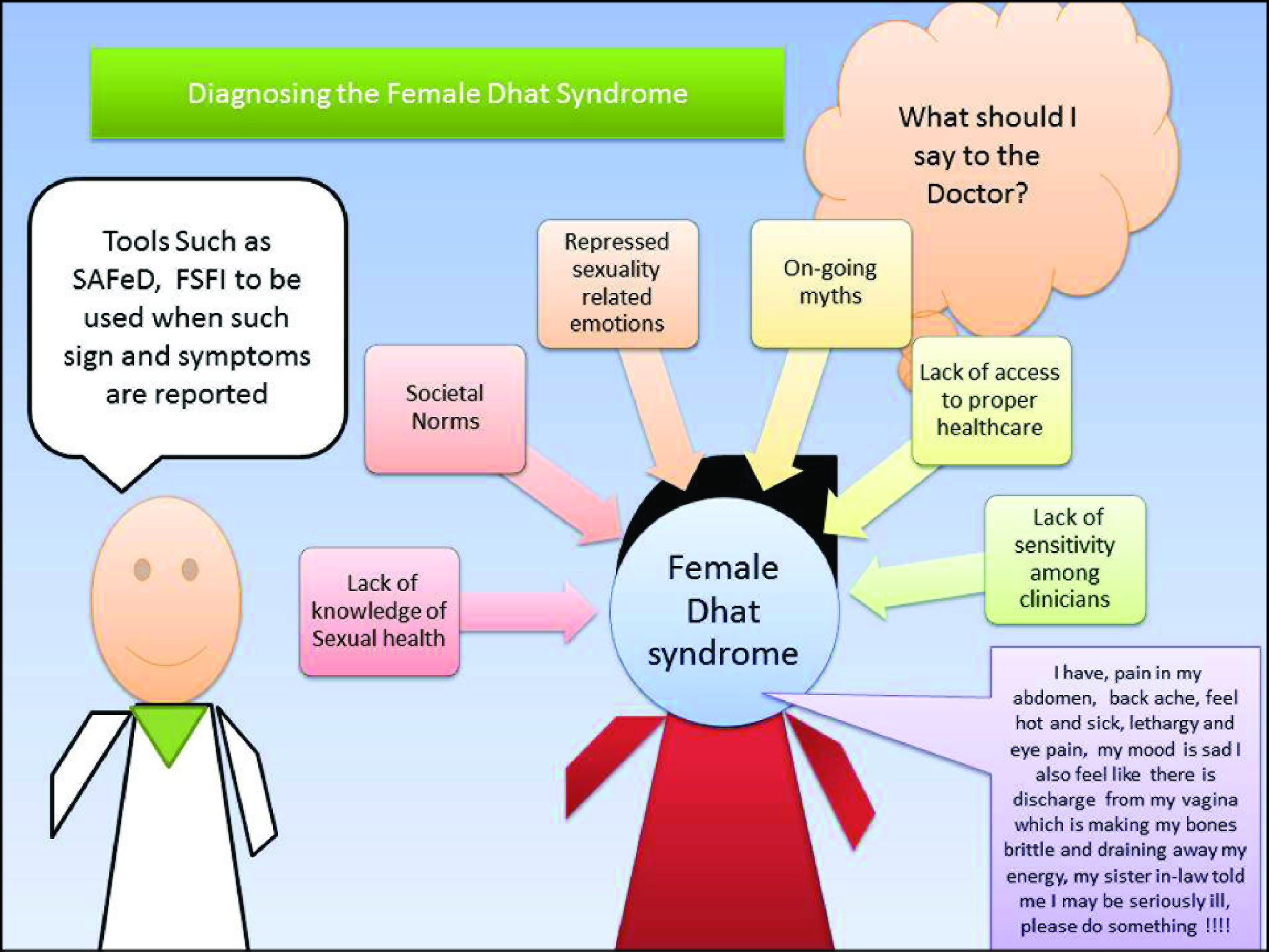
The assessment strategies have been given by a few authors for the problem of FDS. Majorly, this entity is observed through a detailed history taking and clinical physical examination; various tests are conducted to rule out the STIs and other pathological conditions of the reproductive tract. After ruling out all possible medical comorbidities, a provisional diagnosis can be made (Figure 1). The most common scales used and developed for assessing female sexual dysfunction are as follows:
Scale for Assessment of Female Dhat Syndrome (SAFeD): A scale was developed by Grover and Awasthi in 2016 for the assessment of the FDS. The Scale for Assessment of female Dhat Syndrome (SAFed) assesses essential clinical criteria to identify the problem and has the elements to identify the duration, type, color, and nature of the discharge per vagina. There are also the psychological impacts of the illness. In addition, some checklists try to elicit in detail the perceived causes of vaginal discharge, physical/ somatic symptoms, and perceived complications and myths associated with the vaginal discharge and its treatment. This scale also has measures to identify the perceived need for treatment and treatment-seeking behaviors regarding vaginal discharge. Female Sexual Function Index (FSFI): The FSFI is a widely used tool to measure sexual functioning among women.25,26 This tool has been translated into various languages. This scale has 19 items which are rated on a 5-point Likert scale. The scoring of FSFI is done, and lower scores indicated higher sexual dysfunction. It can be used to assess sexual dysfunction in the past month.
27
In addition, this tool can be used as an adjunct to identify the associated sexual dysfunction and comorbidity.
Diagnosing the Female Dhat Syndrome.
Challenges in Diagnosis
Nonpathological vaginal discharge (FDS) is a very tricky condition; there are no established diagnostic criteria, but there is a need for one. The presence of prominent somatic symptoms, anxiety, and depressive symptoms often masks the core beliefs resulting in misdiagnosis.4,5,20,28 FDS needs to be differentiated from somatoform disorder as many patients present with prominent somatic symptoms. As the Dhat syndrome diagnosis is used in males, females with similar manifestations are often diagnosed as a somatoform disorder or anxiety disorder due to the convenience and lack of similar diagnostic categories in the diagnostic system. 12 As women with poor education lack awareness of genital hygiene and ignore symptoms of STI/RTI, these entities need to be excluded before diagnosing a woman with Dhat syndrome.
Similarly, genital malignancies (particularly carcinoma of the cervix) can have a similar presentation. So, before diagnosing Dhat syndrome, women need to be screened through STI kits and Pap smears. Similarly, Dhat syndrome in females also should be evaluated for sexual dysfunction and urinary tract infections. Thus, a combination of careful clinical assessment and careful selection of investigations to rule out medical conditions is useful for diagnosis. There is a need to operationalize the diagnostic criteria and develop tools that measure culture-related attributes of the patients to genital secretions. At the same time, mental health professionals need to learn the importance of culture-specific mental health entities, including Dhat syndrome, for the effective diagnosis and management of female patients with Dhat syndrome.
Management Strategies
The literature suggests that the nonpathological vaginal discharge, if considered as STI or RTI (due to unavailability of the screening tests), may result in resistance to common antibiotics and stigmatization of the women, leading to further distress. The traditional approach to the treatment in the Indian context is highly variable.
Management of Dhat syndrome in females needs the following consideration:
Accurate diagnostic tests for identification and specific treatment of RTIs. Psychosocial interventions that target factors such as beliefs about illness. Sex education to demystify the sexual myths. Depression and somatic preoccupations.
It is recommended that all women with complaints of vaginal discharge should also be screened for psychological issues so that personalized and appropriate care for such problems can be rendered along with the syndromic approach to the treatment of RTIs. Management of Dhat syndrome in females includes psychoeducation, reassurance, and treatment of psychiatric comorbidities. Psychoeducation strategies need to be structured. The standard components for psychoeducation include the elaboration of the female anatomy, production, and secretion of physiological discharges, its role and functions, conditions of increased physiological discharges, the role of traditional beliefs in shaping the attitude and its influence on psychopathology, and the role of thinking, emotions on physical health and behavior. Patients harboring significant anxiety, depressive, or somatic symptoms may be given psychotropic medications for a short time. Selective serotonin reuptake inhibitors, serotonin-norepinephrine reuptake inhibitors, and tricyclic antidepressants are helpful. Anxiolytic may be prescribed for the short term; however, their use should be monitored due to their abuse potential. Women with Dhat syndrome harbor faulty belief related to vaginal discharge and experience various negative emotions. Psychological interventions like cognitive behavior therapy, relaxation therapy, and supportive counseling will help correct faulty cognitions and minimize distress.
Conclusion
Dhat syndrome in females is an under-recognized entity. The existing classificatory systems discuss Dhat syndrome in males; hence, a similar phenomenon in females is often diagnosed as somatoform disorder, anxiety disorder, and depression. There is a need to understand the cultural beliefs in females presenting with vaginal discharge, and the symptoms are not explainable with any medical or surgical pathology. The management of FDS needs a multidisciplinary approach. Early identification and timely intervention of Dhat syndrome in females will help in reducing the unnecessary expenditure in investigation and treatment. A comprehensive evaluation of nonpathological vaginal discharge can limit the cost of care. Proper educational modules should be developed regarding awareness programs on personal hygiene and intimate hygiene for better reproductive and sexual health. Similarly, it should not be pathologized if a female has physiological vaginal discharge without any psychological distress. Health education should emphasize sensitizing females about normal physiological discharge.
Footnotes
Declaration of Conflicting Interests
The authors declared no potential conflicts of interest with respect to the research, authorship, and/or publication of this article.
Funding
The authors received no financial support for the research, authorship, and/or publication of this article.