




Abstract
What distinguishes organizations from other social collectives is a recurring question in organization theory. This article engages with the notion of “organizationality” as a recent proposition stemming from CCO (communicative constitution of organization) scholarship to address this question. We argue that by claiming to synthesize a number of insights worked out in organization studies over the last decades, what we call the “theory of organizationality” commits to a number of unproblematized ontological assumptions, which may be shared well outside its CCO source. Questioning those assumptions may, therefore, be useful to help organizational scholarship as a whole to grow on more solid theoretical grounds, making our ideas clearer not only about what it is we study but also how to relate among our various approaches and with other fields of social inquiry.
Keywords
Introduction
Over the past decades, organization studies (henceforth OS) have leveraged an increasing number of philosophical and sociological theories to explain the emergence, action and transformation of organizations (Putnam et al., 2009; Seidl & Whittington, 2014). In this trend, the growing focus on the processual and relational constitution of organization (Laine & Kibler, 2023; Schwengber, 2024) has led to increasingly broader definitions of what organizations are, to the point of presenting models that could be applied to all social phenomena. This trajectory, anticipated by Chia (1995) thirty years ago, reflects an ontological shift in the field, moving away from models of organizations as bounded entities toward understanding them as ongoing, emergent processes.
The turn to sociomateriality (Kuhn, 2024; Leonardi, 2011; Vásquez & Plourde, 2017) has exemplified and accelerated this rethinking by inviting descriptions of organizations as a mesh of artifacts, technologies, texts, and human and other-than-human agents (Cooren, 2020; Ivancic & Dooling, 2023; Orlikowski, 2007; Pascucci et al., 2021; Symon & Pritchard, 2015; see Cooren & Robichaud, 2012, for an inventory). While these openings have proven productive for some, many authors have made convincing cases that by opening up too much the definition of the organization, OS lost their ways, their objects, or their ability to dialog with practitioners or other fields of social inquiry (King et al., 2010; Lopdrup-Hjorth, 2015; Sillince, 2010). This constant reengagement with the boundaries of the organizational shows how crucial the ontological question (“what is an organization?”) is for OS.
Among the approaches that have most explicitly engaged with the question of the organization’s constitution is the “Communicative Constitution of Organization” movement, or CCO (Schoeneborn & Vásquez, 2017). For a long time, a staple characteristic of CCO scholarship has been its internal debate between entity-oriented and process-oriented conceptualizations of organizations, focusing either on “organizations” or “organizing”; between approaches studying the processual constitution of organizations, or the constitutive effects of communication within organizations (Brummans et al., 2013; Putnam & Nicotera, 2010; Schoeneborn et al., 2019).
While well known within CCO itself, this long-standing debate shows untapped relevance in that it reflects very well, in our view, the ontological tensions that have just as well characterized OS. Just as the field at large has undergone a progressive (and partial) shift towards expanding the organization’s boundaries, CCO theory has done the same. The process-leaning Montreal School is particularly representative of that shift, given its emphasis on the study of communication as the fundamental process through which organized forms, and eventually all social systems, are achieved (Cooren, 2012; Cooren & Seidl, 2020). The “low-threshold” definition of organizations (Schoeneborn et al., 2019) it has helped popularize has sparked similar critiques to those voiced within OS: conceptual fuzziness and limited practical applicability (Brummans et al., 2013), revealing a comparable divide in both OS and CCO.
Recently, the notion of organizationality has been claimed, either implicitly (Schoeneborn et al., 2019) or explicitly (Schoeneborn et al., 2022), to offer a kind of ecumenical ontology, between process and entitative views of organization. As Schoeneborn et al. (2022) indeed point out, “We argue that the notion of organizationality can serve as an umbrella term that can encompass various streams of recent organizational scholarship that are all united by an adjectivistic understanding of organization as a matter of degree” (p. 134). Our focus in this paper is to question and challenge this claim of an umbrella function for the notion of organizationality. We contend that some assumptions made by proponents of what we call the theory of organizationality still need to be explicitly stated.
While this discussion is grounded in a debate that is mostly internal to CCO, we believe that it can be useful to all scholars across OS, as the assumptions we’re about to critique may be shared well beyond CCO and organizational communication. Our contention is that the lack of clarity surrounding these premises prevents the notion of organizationality from being critically examined and simultaneously allows it to function as a consensual “one-size-fits-all” in much of current research. Similar unexamined premises may just as well fit other research strands within OS. Through a critical examination of the theory of organizationality, we bring to bear the tensions that persist between this theory and the more processual view promoted within CCO by the Montreal School’s theory of organization and organizing.
In this article, we therefore show why the theory of organizationality is, in our view, a renewed entitative vision of organization (which it has not recognized yet, to our knowing), and why it is not fully commensurate with the processual approach. As we will see, our argument allows us to reaffirm the thoroughly processual ontology of organization that was advocated in Taylor’s (1988) foundational work and continued in the scholarship it inspired (see Ashcraft et al., 2009; Cooren & Robichaud, 2012; Taylor & Van Every, 2000, 2011; Vásquez & Kuhn, 2019). While this line of argumentation will take us far from what some OS scholars may understand as the jurisdiction of Organization Theory, we contend that this theoretical framework nonetheless presents three main advantages for all research endeavours concerned with the object “organization”:
(1) It settles the ontological debate in a lower-stake situation, allowing OS scholars to somewhat sidestep the issue at a relatively low conceptual cost. Focus can therefore be returned on the structural, operational, behavioural, normative or otherwise pragmatic issues that constitute their specialized area of research.
(2) It supports a non-essentialist view of organization, conceiving of it as the historically situated construct that large segments of social science would also define it to be (Apelt et al., 2017; Cooper & Burrel, 1988; Haveman, 2022 Koschmann, 2024; see also Parsons, 1956).
(3) It therefore favours a continued dialogue between OS and other social sciences by promoting a reflexive and critical stance for OS scholars towards their disciplinary object.
Although points 1 and 3 are explicitly stated by Schoeneborn et al. (2022) as strengths of the theory of organizationality, we believe that a thoroughly processual approach to organizations, focused on “organizing” instead of “organizationality” (Schoeneborn et al., 2019), shows promise in this regard too.
This paper follows a traditional dialectic structure. We first present the main tenets of the emerging theory of organizationality (Schoeneborn et al., 2022), then discuss the distinctive traits of the communication as organizing approach (Bencherki & Iliadis, 2021; Cooren et al., 2006), highlighting that the divergence between these two should not be downplayed. We then develop, in a third section, what the gap between the two approaches implies for organizational research and practices, that is, what this debate changes for anyone, and therefore why one’s stance should ideally be explicitly stated.
Organizationality: A Critical Review
The notion of organizationality was introduced in an article by Dobusch and Schoeneborn (2015) where they argued for three “minimum criteria” (p. 1006) that a given collective entity had to fill, to varying degrees, to be considered an organization (i.e. to possess organizationality). The rationale provided by the authors for formalizing organizationality criteria was that research focusing on organizing processes, as it broadened the range of spaces and fields where it studied such processes, could be “criticized for failing to distinguish organizations from other social collectives, such as communities, networks, or movements” (p. 1006). To cope with this alleged problem, the authors merge the Luhmannian theory of organizations (Ahrne et al., 2016, 2017) with the focus on communication advocated by members of the CCO approach to OS. This results in a theory of organizationality that distinctively defines organizations among other types of social collectives, in a Luhmannian fashion, as “decided orders” (Ahrne & Brunsson, 2011), while emphasizing how these decided orders are produced into being through acts of communication.
More technically, the three criteria that would allow a collective to be defined as an organization are: (1) interconnected decision episodes; (2) collective actorhood, and (3) identity claims (Dobusch & Schoeneborn, 2015; Schoeneborn et al., 2022). The first criterion is drawn from Ahrne and Brunsson (2011), who argued that social collectives gradually become organized as they decide upon their membership, rules, hierarchy, systems of monitoring, and sanctions. The second criterion is based on a number of works in OS according to which organizations are valuable objects of scientific inquiry because, indeed, they act upon the world (King et al., 2010) and because they are able to channel multiple individual agencies into singular collective achievements (Barnard, 1938; Bencherki & Cooren, 2011). The third criterion reflects the notion that an organization needs to be recognized, i.e. that it is indeed commonly taken and represented as an entity, being, or thing, with its agenda, responsibilities, allies, and opponents. For instance, we could imagine a newspaper heading one of its articles with the following title: “ExxonMobil needs better assets in this region if it wants to increase its global outreach.” Moreover, organizations (attempt to) orchestrate these representations in a concerted manner, claiming identities through various processes (King et al., 2010).
While this theoretical model seems very appealing in order to describe the multiple communicative endeavours of an organization – especially those that help the organization create, maintain, and transform itself, called “autopoietic” (Luhmann, 2018) – it is essential to underscore that it has not been so much construed as a descriptive apparatus and more as a definitional one. In other words, the construct it presents offers a priori criteria for determining what entities count as organizations: “We have derived these three criteria from recent works in organization theory that are concerned with the minimum conditions that must be satisfied for an entity to be classified as an organization” (Dobusch & Schoeneborn, 2015, p. 1008). As with any definitional apparatus, it raises the following question: if the model’s purported objective is to set boundaries for its object (organization), what is kept, in this definitional act, outside those boundaries?
We may turn to Apelt et al. (2017), who raised a similar question about Ahrne and Brunsson’s (2011, 2019) theory of partial organizations, a theory that motivated the inclusion of the “interconnected decision-making” criteria in Dobusch and Schoeneborn (2015). According to their critique, Ahrne and Brunsson’s theory falls short of setting convincing boundaries to the organization by allowing too many things to fit their definition. Defining organizations by their decidedness before opening the possibility for partly decided orders (partial organizations) to co-exist with formal organizations within the organizational realm induces, according to Apelt et al. (2017), “considerable confusion” (p. 9). A second problem they raise is how little consideration is given in the model to what lies outside of the organization: how other forms of order might be achieved without decisions and “how organizations and their decision-based processes are related to other forms of social order” (p. 9). On the grounds of these two criticisms, Apelt et al. advocate for narrowing further the definition of organizations developed by Ahrne and Brunsson (2011, 2019), through a deeper resort to Luhmann’s theory of social systems. As we’ll see below, our own take on the weaknesses of a criteria-based definition of organizations leads us in the exact opposite direction. Nonetheless, this review of Apelt et al.’s (2017) counterargument is still useful to show the kind of conceptual confusion that one might end up in when trying to draw up definitional boundaries, especially without solid empirical grounds.
At the beginning of another article addressing the ontological problem, Ahrne et al. (2016) argue that OS face an increasing challenge in that the notion of organization has been receiving decreasing attention in social sciences, which jeopardizes the ability of scholars within the discipline to find a public outside their own community: “organization studies has been less successful in exporting its ideas to other fields of social science; interest in the issues addressed by organization studies is not great outside the field” (p. 93). From the 1970s onwards, they argue, much research in social sciences addressed what goes on in organizational spaces using more traditional sociological concepts. As they point out, “In essence, organizations were conceptualized not so much as local orders, but as orders representing wider social institutions” (p. 94). It is in response to this situation, the authors argue, that the concept of organization must be “resuscitated”: that is, given a clear, distinct definition so that the need for distinct concepts to explain organizations appears more explicitly.
What they call for is to draw an ontological distinction between organizations and other social collectives. Now, should an ontological claim be made on the grounds of a discipline looking for its raison d’être? While scientific validity remains a complex and contentious issue (Hacking, 2000), which should invite caution when assessing any contribution on such grounds, disciplinary self-preservation as a rationale seems quite distant, as a motive, from the usual goal of achieving relative correspondence with empirical data. If sociological concepts are demonstrated to be enough to study whatever goes on in organizations, then a distinct “science of organizations” might indeed not be required, and OS should simply be understood – with all their intricacies and contributions, mind you – as a field of application for sociological inquiry. To be fair, Ahrne et al. (2016) do attempt to provide such empirical grounding for the ontological claim by affirming, following March and Simon (1958), “that organizations influence people’s behaviour in a different way than was the case outside of the organizational context”. If that is the case, then there might indeed be a good argument for the ontological specificity of organization. Unfortunately, the authors do little to back up this claim of a “different” (in kind) influence of organizations on human behaviour.
In parallel, Dobusch and Schoeneborn (2015) import Ahrne and Brunsson’s (2011) argument to organizational communication to argue in favour of the definite usefulness of a distinctive (and therefore, we argue, exclusionary) concept of organization. As the original set of articles, theirs insist on the provision that the concept should be “fluid” enough to include a certain variety of organizational forms. Their argument therefore faces the same difficulties identified by Apelt et al. (2017): How can we support the claim that what we need is a strong notion of what organizations are (that would distinguish them radically from other social collectives), while recognizing that organizations now take so many forms? And which empirical grounds can support this search for the ontological distinctiveness of organizations, in relation to other social forms?
Our contribution to this debate – upon which is based our broader present contribution to organization theory – is in regard to the claim by Schoeneborn et al. (2019, 2022) that the theory of organizationality could be a potential third way within CCO, setting to rest some ontological debate. In our opinion, this claim is indicative of a further issue that may affect any entity-oriented definition of organization: unassessed ontological premises that would require, if critically considered, further development before the attempt is made to draw (even partially) from process-oriented approaches.
As background to their claim, Schoeneborn et al. (2019) map out CCO scholarship over what they present as three different ontological “tensions”. According to them, those tensions would characterize scholarship studying the relationship between communicative acts, on one hand, and, on the other, organized phenomena conceptualized as: (1) a “noun” (organization), or (2) a “verb” (organizing), or (3) an “adjective” (organizationality). These tensions each represent a particular brand of CCO (see Table 1), with the first two broadly corresponding to the two classic tendencies within CCO mentioned earlier, either more entity-oriented or more process-oriented (Putnam & Nicotera, 2010).
The three tensions defining CCO inquiry according to Schoeneborn et al. (2019).

In Schoeneborn et al.’s (2019) conceptualization, the first two tensions are established between two poles: communication as a process (a “verbal thing”) and either organization (a “nominal thing”) or organizing (a second “verbal thing”). 1 For these first two, what changes is the nature of one of the two poles in the communication–organization relation. However, the third tension (the one focusing on organizationality) situates “adjectivity” not at one of the poles of the tension like the two others, but as a bridge, a passage point between communication as a process and organization, again as a noun. In line with our critique, the grammatical metaphor the authors use is notably coherent, here, going even further than what they seem to be arguing. Indeed, an adjective, grammatically, is actualized by association with a noun: qualities are embodied in things. In this respect, it is not surprising that the authors don’t make the adjective “organizationality” stand alone as one of the poles of the tension. Underlying this focus on organizationality-as-an-adjective, we circle back to a conception of organization-as-a-noun. There is a significant shift in paradigms that the authors do not thoroughly discuss, between the first two tensions where the poles are clear and bare, and the third tension where the adjective focus covers up the two poles.
In Schoeneborn et al.’s (2019) graphic representation, of the three tensions, what crystallizes the difference between the first two tensions is how the pole opposite to communication is defined: either it is a thing, “organization,” or a process “organizing”. In contrast the third tension is defined by the mediating space between the two poles, where “organizationality” is found. By focusing attention on the mediating thing between the two poles instead of the way the pole of organization/organizing is defined (critically, in this third tension, as a noun), the authors basically avoid confronting their nominal bias. They even claim that the third tension treats the organization “as neither noun nor verb, but as an adjective” (p. 487), which contradicts the graphic representation they give of that third tension (p. 481) and does not align with what seems to be their ontological parti pris towards organization-as-a-noun.
Following up on the fact that the poles of the third tension are a “verb” (communication-as-process) and a noun (organization-as-a-thing), we see how, then, the third tension appears to be not much more than an addendum to the first tension, reintroducing a “nominal” understanding of the organization through the back door. It would thus be a mistake to think that the notion of organizationality resolves the recurring tension between entitative and processual definitions of organization in CCO. The struggle to determine whether the object of CCO is either “organization”, a nominal thing, a res, or “organizing”, a verbal thing, a process, is not set to rest by what they call the adjectival “third tension”. Moreover, it can be argued, as we’ll see below, that the second tension has already gestured toward resolving the first tension by admitting that things and processes are reversible materializations of one another (see Brummans, 2012, for one complementary version of this argument).
Schoeneborn et al. (2019) trace back the preoccupation with organizationality-as-an-adjective to some texts associated with the Montreal School (typically more concerned with organizing as a process or a verb). However, we believe they miss an important point of divergence between their approach and the Montreal School, which is that “organizationality” in that framework would foremost be the characteristic of a process. In contrast, Schoeneborn et al. (2019) present organizationality as an attribute proper to one and only one type of entity: collectives (more or less partially or fully organized). The third tension could be relabelled. Since an adjective is, by definition, a complement to a noun, the name of this third tension could be organizationality-as-the-quality-of-a-noun, instead of organizationality-as-an-adjective, to make its implicit nominal focus (i.e. its focus on the “entity” [Schoeneborn et al., 2022] that carries the character of organizationality) more explicit. This would show more clearly the kinship between the first and third tensions. We also believe that the “return to the classics” promoted by Ahrne et al. (2016, 2017) and implicit in Dobusch and Schoeneborn (2015) is more plainly represented as such: a return to a (classic) entitative view of organizations. For the sake of clarity, the three trends identified by Schoeneborn et al. (2019) are, we believe, better represented in Table 2, using the notation they use in their article:
The three tensions, relabelled.
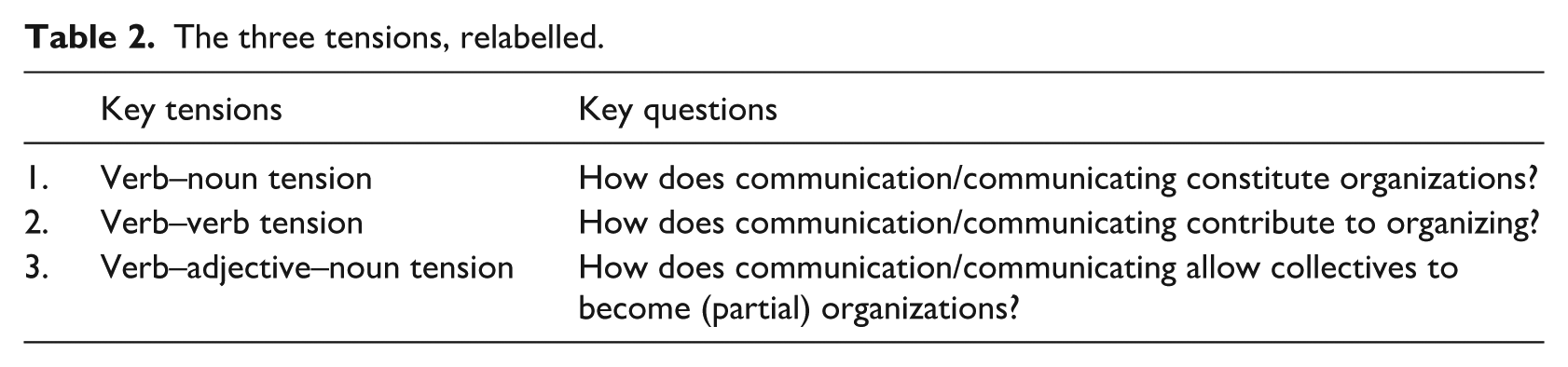
A consequence of this somewhat biased reference to processual approaches is the claim by Schoeneborn et al. (2019) that an interest in uncovering what it means for something to be an organization would somehow set the third tension apart from the first two.
Research in this stream opens up the focus of CCO scholarship beyond established forms of organization and organizing to explore other types of social phenomena, such as networks, markets, social movements, communities, and so on. A central question in this stream of research is what makes these phenomena more or less “organizational” (Dobusch & Schoeneborn, 2015; see also Ahrne & Brunsson, 2011; Ahrne et al., 2016; Apelt et al., 2017). (Schoeneborn et al., 2019, p. 487)
We would argue, in opposition to this claim, that CCO has been for a large part of its institutional existence preoccupied with what makes phenomena more or less organizational (see Boivin et al., 2017, for an analysis of the institutionalization of CCO). This might not have been emphasized enough in previous research, since process approaches can have a tendency to avoid clear ontological commitment. However, in the next section, we show how at least one processual approach to organization – stemming from the Montreal School and explicitly cited by Schoeneborn et al. (2019, 2022) – does have ontological commitments and that, if those commitments are made explicit, they should appear contradictory to the premises of the theory of organizationality and lead scholars to a significantly different understanding of organizations.
Our goal in the rest of this article is, in relation to the preceding points, twofold. (1) We demonstrate how processual approaches, without refuting the existence of organizations, can offer an understanding of what they are that is paradigmatically different from the theory of organizationality and potentially other intermediary perspectives. (2) We show how this alternative ontology may be useful to OS by allowing scholars interested by more pragmatic organizational concerns to move beyond the search for the essence of organization. Contrary to what Du Gay (2020) argues, we contend that more ontological openness, not less, will in the end allow OS to refocus their gaze, when needed, on (formal) organizational matters.
A Fourth Tension: The Organizationality of Communication
Taylor and Van Every’s (2011) definition of organization “as Thirdness” is well representative of a typical Montreal School approach to organizing (Cnossen, 2022). These authors use Peirce’s philosophy to reflect on the common nature of “all purposeful activity” (Taylor, 2014, p. 29). Briefly, in this peircean framework, Thirdness is defined, along with Firstness and Secondness, as a “mode of being” (Taylor & Van Every, 2011, p. 22). 2 Firstness is the realm of immediate qualities, existing as possibilities. Think, for example, of the colours allowed by a programming software for any objects in any video games. Theses colours exist “first” as virtualities rendered possible by the code before users have any actual interaction with them. Secondness is the realm of the encountered, actual quality, now mediated in an actual experience something or someone has of it: an object, a red bird, has been created using the code. Thirdness, then, is the quality not just perceived-as-embodied, but as meaningful and interpretable, in virtue of recurrence or law: red birds in this video game, when they (re)occur, mean that danger is near. “Meaning”, in this framework, is indeed understood as the presence of habits and recurrences. A wolf one encounters is only a wolf. It “means” danger only by virtue of a certain habit it has, allegedly, of attacking humans.
The point Taylor and Van Every (2011) make through this reference to Peirce is that organization is what is created when such recurrence or habit (conceived of as Thirdness) is formed, when meaning is established in any given setting. Communication is the process that allows Thirdness to be created: I tell you that when the light flashes, it means that you need to come down and check if there’s a mechanical fault somewhere in the line of assembly; the recurrence of rain in this region tells us that this is the right spot to establish a vineyard. In this framework, communication applies to much more than exchange of words. Any action making a difference acquires meaning and thus becomes organizational to some extent. As Smith (2022) puts it: “Communication is not reduced to the ability of humans, rather, communication is about holding two things together in a relationship through a third being” (p. 1820). Organizing, then, is the emergence of the habitual, the procedural, and the meaningful (therefore, the foreseeable and manageable): not just boxes and humans and fruits and delivery trucks all coexisting somewhere, but effective shipments of fruits being sent precisely and regularly to the organization’s clients. To organize is to generate Thirdness through communication.
This is the groundwork for Taylor and Van Every’s (2011) theory of the organizing properties of communication (Cooren, 2000). It places Thirdness and organizationality in equivalence, as both are produced through communication. Therefore, it opens a vast field of inquiry for OS, since Thirdness is a pervasive mode of being in the world. This also means that what may happen at the level of the organization may happen at any other level wherever communication is happening. Consider the following excerpt: Now for the issue we are exploring. Since the topic of this book is organization, and since organization implies a network of relationships involving many human actors, as well as their tools, tasks, and objects of attention, the Peircian presentation of Thirdness offered above has a missing dimension: it involves only one actor (a “second”) relating to one object (a “first”). In this respect, Peirce’s analysis was still set within the prevailing Western tradition of seeing meaning as an extension of individual consciousness and practice, rather than as a by-product of communication between people. (Taylor & Van Every, 2011, p. 24)
In this excerpt, Taylor and Van Every argue for scaling up from the level of individual agents meeting and co-orienting towards each other, therefore creating Thirdness, to a sort of macro perspective where we consider networks of such meetings coalescing into “organizations”. But we may also scale back down.
While it must be acknowledged that, at this higher level that is organization, many new products of communication can be observed (the installation of a transcontinental pipeline, a stock exchange crash, a new ice cream flavour being added to the menu of all locations of a global fast food chain), this does not justify any ontological “cut” between levels: there is no change in kind, essentially. Individuals, couples, and organizations all emerge, as Ashcraft (2021) has argued, from communication as a “pre-individual” (p. 574) and constitutive force. “Things are fluid, plural, and above all, relational, made in and through connection” (p. 581). CCO, at least in the specific strand that Taylor and Van Every (2000, 2011) contributed to institutionalize, is well positioned to adopt such a stance, as exemplified by the possibility to mobilize its conceptual apparatus to understand how even individual positions within organizations can be organized, or “talked into being” through communicative events (Clifton, 2017, p. 305; see also Dupuis, 2023, for a similar argument about entrepreneurs).
This is also aligned with Bencherki and Iliadis’s (2021) recent call to better develop what it means to consider “communicating and organizing as a single process” (p. 1). These authors argue that this CCO axiom hasn’t been fully realized yet, as research adhering explicitly to it has mostly focused on only one side (organization) of what is, by definition, a reciprocal relationship of identity. Noting that x = y is informative about both x and y. Yet so far, research has mostly focused on what it means for x (organizing) to be a process synonymous with y (communicating). This focus allowed scholars to describe the emergence, structuring, and destructuring of (formal) organizations (Ashcraft et al., 2009; Cooren, 2015; Cooren & Fairhurst, 2008; Vásquez & Kuhn, 2019) but less attention is being given to the reciprocal, i.e. what this relation means for y. According to Bencherki and Iliadis (2021), it could therefore be productive, in this perspective, to turn away from a focus on organizations and try to theorize more fully how communication achieves such organizing and structuring power anywhere it happens.
As they show, Simondon’s (1995) cybernetic philosophy provides a useful framework to do so. Without delving here into the complexity of Simondon’s thought, it is worth mentioning that one of the key points Bencherki and Iliadis (2021) take away from it is the ubiquity of organizational phenomena. In very succinct fashion: when any two entities are significatively co-present (present to each other; in each other’s perceptual realm), information exchange happens and organize their shared world. This means that communication can be conceptualized as an informational (or energetic) process that circulates and organizes as it passes through different kinds of entities and makes their existence consequential in some real sense, for some other entities. In this way, entities are individuated: they appear on some phenomenological landscape because they communicate to another being their existence. An organization is individualized as communication brings together a host of beings and as their existence as a collective is communicated to their environment.
Taylor and Van Every (2000, 2011) may not frequently cite Simondon’s (1995) intricate cybernetics, but their theorizing of (organizational) communication does understand in a very similar way the parallels that exist between the individuation (as a generative process) of so-called non-collective entities and the individuation of organizations. “As any dictionary will confirm, organization is merely a synonym for organizing, and as such it is a feature of all kinds of human activity, from getting supper ready to waging international war” (Taylor, 2011, p. 1276). It is in this regard that we take their theory to invite us to open the CCO approach to study the organizationality of any social facts (that is, their communicative constitution).
This conception of the intrinsic relationship between communication and organization is, however, not represented in Schoeneborn et al.’s (2019) article. What would most closely resemble it in their conceptualization, the verb–verb tension, is represented as a one-way relation of determination: communication as a process affects or determines organizing, which the authors illustrate with an arrow pointing from communication to organizing. By opposition, the theory of organizational communication presented in this section would identify organizing to communication, as one of its properties (Cooren, 2000). In our opinion, the definition of organizing indexed to organizations as a category of beings held by Schoeneborn et al. (2019) is what keeps them from seriously considering the paradigmatically different ontology we’re presenting here, which situates organizationality as a force of communication for the constitution of organizations.
If one holds to the need to set a strict definition of what organizations are, the constitution of organizations as specific types of social systems cannot be equated to communication because organizations are, in the end, sociohistorical products while communication is a process that transcends that (human) history. Things are different if one lets go of that need to isolate a particular ontological mode of being exclusive to the things we call organizations and start thinking about organizing as the thing that communication does. We can then see how a processual approach may study not only “how organizing as a process (or verb) is achieved” (Schoeneborn et al., 2019, pp. 484–485) but how communication, wherever it happens, may organize the parties involved.
Boivin and Brummans (2022), Chaput (2021), Cnossen (2022), Leybold and Nadegger (2020), and Smith (2022), among many others, all point to an interest for CCO scholars in a more intrinsic, ontogenetic organizationality that appears as and in communicational transactions in a given socio-semiotic space. They all start from a relatively “flat” ontological ground – free of assumptions such as what should and should not be considered an organization. We read in all these examples an attempt, from this agnostic ontological starting point, to study the local economy-ecology of communicative acts (think actor–network theory; Callon, 1986) as, in itself, the organizational–organizing phenomenon.
These examples are, to us, cases of a fourth “tension” (Schoeneborn et al., 2019). The first and third approaches are, as we saw, linked by their focus on an entity. The third tension differs from the first one in that it opens up ontological assumptions by focusing not just on organizations per se but on similar entities that could be more or less organizational. A similar type of relation could be theorized between the second tension and our purported fourth. The latter would open – or flatten – the ontological assumptions of the second, while maintaining, like its predecessor, a strong focus on the processual nature of organizing. The first tension studies organizations; the third, collectives that are organizational. The second tension studies organizing; the fourth, communication that affects things organizationally.
In this regard, we read Latour (2018) to be promoting an approach quite close to the fourth tension when he lists “organization” (or what he calls “[ORG]”) as one of the fifteen, non-exhaustive, “modes of existence” he describes. In his work, [ORG] would be characterized by the amalgamation of “scripts” into courses of action (p. 391). As he said: “The adverb ‘organizationally’ leads to the verb ‘organize,’ which leads to the noun ‘organization’ – and, in particular, to the ones called ‘market organizations’” (p. 401). From processes to entities, not the other way around. What happens to be “piling up the scripts” (p. 399) into a workable yet fragile course of action either for DND players, car manufacturers or union members is how communication happens “organizationally” through and around them. The fourth tension (see Table 3) holds between communication as a process and the organizational attribute it has, therefore making it the verb–adverb tension.
Adding a fourth tension.

Schoeneborn et al. (2019) assert that “the verb–adjective tension has its roots in early CCO scholarship” (p. 409), citing Taylor and Cooren (1997) who asked, “what makes communication organizational?” in support of their claim. We believe that, in this, they tend to confuse asking what makes communication organizational with what makes organizations organizational. The former is the one that properly reflects Taylor’s work and many of the scholars he inspired, offering a social ontology foundation which, if acknowledged and developed, could indeed provide OS a way to connect with other social sciences. The relative disappearance of the formal/modern/capitalist organizations and the questions it raises are much less significant for organizational communication scholars since forms of organizing are fluid and pervasive and, therefore, can be found and studied in many other types of collective (human and non-human) arrangements.
In the end, our contention is that organizationality, counterintuitively, is a property of communication, that transfers into organizations, and that speaking of things as “organizational” is a form of (potentially useful) metonymic expression: we’re attributing characteristics of the process to the result of that process. Again, this may be quite acceptable, as it can be argued that the “result” of a process is, indeed, part of the process. But we should still be wary of not losing sight of this important nuance that it is not the whole process, nor is the process ever reducible to a single result or a collection thereof. Organizations are social units that may bear that name (that are “organizational”) only in the sense that they emerge from communicational constitution. Since other social agents are also constituted in communication, there’s no real ontological boundary between organizations and the rest. Scholars and experts might still be mostly interested in discussing some of the things that communication organizes – organizations – but, from an ontological perspective, organizations are weaves of communication (Taylor, 1988).
Simply claiming we can move up and down from single interactions to organizations without any ontological cut might appear counterintuitive, but we do not see empirical evidence to support making such a cut. As Latour (2018) points out, There is aggregation; there is no break in level. There is mini-transcendence [of interactions scaling up to enormous effects]; there is no maxi-transcendence [of a higher structural level to interactions]. There is piling up; there is no transmutation. There is one level; there are not two. (p. 402)
What we’re representing here is a deeply communicational understanding of the phenomenon called “organization”. The bundling of certain entities to designate those social actors that are so important to contemporary life (formal or semi-formal collective organizations) is only secondary to the initial recognition that communicating always implies a form of organizing, as basic as it might be.
Whether these theoretical objects that are traditional organizations are sufficiently specific in their form of organizing to form the crux of a scientific discipline (OS), or whether the said discipline should step forward and study organizationality unbound by liberal preoccupations for legally recognized “moral agents” is another question. Formal organizations are certainly somewhat specific and they’re certainly important but, apart from the sociohistorical conditions of their proliferation, they might not be that different from many other social actors that are just as well communicatively constituted. Hacking (2000) pointed out that science is not impervious to enabling recognition, identification, and autonomization of the “kinds” it constructs, even if they may be eventually demonstrated to be improperly defined (he gives the example of mental disabilities that used to have a name, but that today are thought of as improperly or insufficiently defined). Applying this insight to organization studies, the point (or call) we’re making is not to start worrying about whether organizations are “real” or not, but simply to critically assess what about them, as objects of inquiry, may be socially constructed.
There is no doubt to us that many scholars have convincingly described and theorized aspects that might be characteristic of a considerable proportion of what we call organizations. That, of course, gives some weight to the claim that organizations are proper objects of study. However, the simple observation that these mostly boil down to questions of degrees: degree of intensity, frequency, layering, streamlining, or autoreferentiality of their activities (See Sillince, 2010, for example), shows that the boundary is at best, fragile, and at worst, unidentifiable – no ontological cut. To “make our ideas clear”, as Peirce (1998, CP 5.388) put it, we need to set the ontological background of our investigations on clear ground, and if there’s little solid ground to be found, then that is the ground on which we must nonetheless explicitly lay our arguments. For this reason, the theory of organizationality might be counterproductive: in seeking to define organizations, it may inadvertently obscure the fragility of their very distinction from other social entities.
How does the Organizationality of Communication Define new Research Agendas?
While many OS scholars do believe in the ontological distinctiveness of organizations as social systems – a defendable position, of course – no consensus has been reached on this yet, especially in social sciences outside organization and management studies. 3 A serious critique of the notion of organization is possible and, in the past, some arguments in this sense were formulated in the CCO “process view” (Putnam & Nicotera, 2010, p. 159), which are not represented in Schoeneborn et al.’s (2019) article. When we take full account of those arguments, what opens up is the possibility to study organizing without the necessity of organization (without having to “resurrect organizations”; Ahrne et al., 2016).
While this possibility might not be particularly appealing to every organization scholar – and is certainly not put forth here as a potentially universal stance – we contend that its mere existence and theoretical grounding carry significant insight for anyone interested in studying organizations. First, being able to study organizing without organizations shows the fragility of ontological claims in general in OS. If we can account for organizational processes without erecting strict boundaries to the ontological domain of “the organizational”, it may appear that those boundaries will not survive Ockham’s razor: their analytic optionality should encourage us to consider proceeding without them. Second, conceptualizing organizationality as an adverb – a modifier of communication – and organizations as only relatively distinct products of the organizing properties of communication suggests a way for any scholar of organizations to connect the distinctiveness of their work with colleagues from other fields. Paying attention to the way that communication processes constitute the organizational phenomena studied systematically opens the possibility of seeking how that process might replicate outside of the formal organizations’ scope.
A short comment on Blaschke’s (2017) attempt to address the micro–macro gap in multi-level organization theory can illustrate more concretely the shift in framing that our approach implies and the complications it avoids. A recurring question in organization theory is how we can account for the passage from individual-level behaviour (including communication acts) to structure-level organizational phenomena (Kuhn, 2012). Blaschke suggests that quantitative tools to measure intertextuality and filiation between communicational events may offer a better way to bridge the gap between these two levels without privileging either – a flaw he identifies in another method typical of CCO research: conversation analysis, by definition focusing on the minute details of organizational life.
Tracking how texts circulate, refer or encompass one another, he argues, can help us move up and down the interaction–organization scale more fluidly and capture the “dislocal” nature of the organization, i.e. the fact that organizations are constituted by communicational acts disjointed spatially and temporally (Cooren & Fairhurst, 2008; Putnam & Nicotera, 2010). While it may seem problematic to say that trivial interactions about the need to order more staples, to repair the coffee machine, or to call back a client can eventually scale up to a whole, proper organization, representing the multiplicity and interconnectedness of such events, especially through the capacity of quantitative methods to process large datasets, may indeed provide a more appropriate and convincing account of this scaling-up phenomenon. In this regard, we thoroughly appreciate Blaschke’s (2017) call for recourse to more methodical representations of the actual networks of communicational events that make up organizations.
However, what is especially interesting for the argument we’re making here is how Blaschke (2017) holds on to a conception of the organization as an entity, and as such is confronted with the need to arbitrarily trace boundaries around the organizational phenomena that he claims to study using network analysis. Otherwise, where would the network stop? Indeed, this systematic tracking of intertextuality (interreferences, common topics. . .) would surely result in an extension of any network we might attempt to draw around an organization to an almost infinite range. The team discussion in the café’s staff room about the latest trends from social media draws in tropes, tones, and figures from way outside of any reasonable boundaries of the organization. Yet these very elements may in turn affect the organization’s culture in, for example, the colleagues’ representation of their craft (Bell et al., 2021).
How telling, then, that the organizational phenomenon Blaschke chooses to study through network analysis is the stranded community presented in the TV show Survivors. In order for the network of interactions not to overwhelm any nominally imposed boundary to “the organization”, Blaschke has to pick an organization on an island, isolated from the world! Of course, a network analysis of an organization might be adequate to identify a certain nexus of communication that could correspond to it, but its boundaries will never be clear-cut or fixed because organizational actors import multitudes of mindsets, preoccupations, topics, and resources from the external world. The thing we’re trying to define has, at best, uncertain boundaries and this, again, weakens any definitive ontological claims. In turn, we could imagine a larger network analysis tying in multiple organizations, sub-cultural groups, leisure communities, and so on, and showing how all of these end up contributing to the organizing of one another, a possibility once envisioned by Latour (1994), inspired by what he saw as tremendous progress in our collective data-processing capabilities. His vision has only gained force since.
Without denying that multiple boundaries do typically regulate and structure organizations in various ways, we would argue that their evolving, aggregative nature makes them not essentially different, if not in terms of quantity and intensity, from boundaries of other collectives. Two conversationalists might just as well performatively establish material, cognitive, and social boundaries (Hernes, 2004) around their activity. For example, they may turn their bodies towards each other to create the best acoustic conditions for the conversation to happen between them and only between them; they may keep from looking at other people around in order not invite them into the conversation; and they may talk about things and ideas that they might be the only two in the room to share references about.
Certain collectives might have more numerous and lasting ways of maintaining those boundaries (Cooren & Fairhurst, 2008), but that does not mean that they’re not produced essentially in the same way: communicatively. The FedEx driver’s habit of stopping on her route at drug store X for a French vanilla coffee, because she likes it there, is not any less organizational than the same habit if it is Roger’s, as he’s helping his friends move. Both habits may impact the future unfolding of action, regardless of one happening in the context of a corporation and not the other. From our point of view, these two habits, these two acts that make sense in their larger context, can both be organizing.
We have already touched upon several practical corollaries, for research, of this fourth approach to organizational phenomena but, for the sake of clarity, let us review them briefly:
- Ontology: In an approach focused on the fourth tension, organizations do not have to be distinguished prior to analysis. Organizationality is found where meaning – that is, Thirdness (Taylor & Van Every, 2011) – is produced. The distinction made, for example, by Ahrne and Brunsson (2011) between organizations, institutions, and networks is not relevant a priori in this fourth paradigm. Certainly, some entities can be characterized by one aspect or another of their functioning, and therefore categories can be established: a “group of friends” will tend to use one linguistic register to communicate with each other, the structure of a “formal organization” will invite bureaucratization, and so on. That said, no clear criteria seem to be sufficient, so far, to establish a priori ontological differences between organizations and other collectives.
- Epistemology: The “radical constructivism” of the Luhmannian framework underlying the theory of organizationality has been contrasted with the specific realist stance we adopt here, inspired by the Montreal School (Schoeneborn et al., 2014), and both entail quite different roles for theory in the formation of knowledge. Of course, to argue definitely in favour of either onto-epistemological stance would be preposterous, but it is nonetheless essential to recognize that these two are quite distant from each other. The processual approach of the Montreal School allows it to maintain an ontological agnosticism (Bencherki, 2018), which leaves open the horizon of possible theoretical developments to be gained from empirical research: the sensible world remains full of surprises. When we take some of the Luhmannian contributions at their word, the opposite happens: this openness does not seem to be totally possible. In this radically constructivist approach to organizations, the meaning of organizationality must be partially and arbitrarily fixed for the Luhmannian researcher to be able to draw from it a “constructed” understanding of the phenomenon.
- Methodology: Finally, addressing “organizationality-as-an-adverb” means focusing on “process data”, with its own set of challenges and indications (Langley, 1999). Such data may be interaction transcripts, narrativized accounts of organizational processes, genealogical analysis of organizational topics, or figures, as well as many, many others. Without pretence at establishing any sort of “list” of recommended methods of data collection, we would simply invite any processually inclined OS scholar to consider how their data reflect the intrinsic temporal nature of the organizational phenomena they’re studying.
While, in our view, communication can always be said to be organizational, it may be so only to a minimal degree, with the scope and duration of its organizationality depending on certain parameters. Examples of such caveats are given in Taylor (1995), where he points out that there needs to be more than the simple transmission of information from A to B for communication to be organizational; transactions are required: communication is organizational only insofar as it achieves synchronous and contextual inter-influence between the partners. Additionally, as Taylor (1995) argues, there needs to be some form of aggregation of communicative acts, leaving “a residue of continuing obligations and commitments joining members into a working cooperative system” (p. 22). This way, the weave thickens and more stable (as well as more powerful) forms of organization can coalesce. These two parameters identified by Taylor are just some examples of how the communicational constitution of organizations can be studied further. They demonstrate that while oganizationality is a property of communication, the two notions are not synonymous, and the relation between them can be studied and specified, both in abstraction and through the study of specific cases.
Once acknowledging that organizationality is to be found within the realm of the communicational, what must be emphatically underscored is that, for research operating in the adverbial tension, it becomes somewhat insignificant to determine which communicational events are “organizational” and which are not. Clearly, if we claim that organizing occurs through the aggregation and interrelation of meaningful communicational events, and if we define meaningful communication as any interaction making a difference somewhere in virtue of a principle, system or habit giving it meaning, then the sheer amount of communicational events potentially involved in some form of organizing becomes simply elusive (a point further discussed in Schoeneborn et al., 2014).
Rather, the adverbial approach – as we see it already active in the works of many colleagues – focuses on how the organizing happens in any particular occurrence. The adverbial tension is that of the communicationality/organizationality of action; how actions (seconds, in Peirce’s philosophy) acquire Thirdness. It thus amounts to questioning, for example, how a conversation gets organized by the communicational constitution of a co-presence, co-orientation, and inter-action of a few humans and other-than-human agents on a social scene (Cooren et al., 2023) or how “a social issue” is organized around the themes of masking and health measures, as different actions (discursive and otherwise) are taken more or less synchronically around these (Chaput, 2021).
The task at hand becomes one of describing the types and details of the transfer or creation of organizationality, from one process to another, as information spreads and relations are made (Kuhn, 2021). Conversely, this understanding of meaning as stemming from thirdness accommodates the influence of structure-like elements in shaping behavior and further organization-making. As we have explained, binary relations are meaningless without a third term that provides interpretive grounding for the situation. The constitution of organizations thus involves establishing texts, habits, references, and tropes that index the meaning of subsequent communication within their scope (Taylor et al., 1996). A simple illustration (recognizing that real-life cases are far more complex) would be that John’s arrival to work (1) and the time being 9:05 (2) carries no meaning unless it has been previously established that arriving after 9:00 counts as being late (3). Meaning needs three.
To say that all of the organizational phenomena used in this article as examples are analogous because they emerged from communication is only the beginning of the story. Perhaps there are patterns. Perhaps organizationality/communicationality can be stronger or weaker (maybe in the manner of an illocutionary force; Searle, 1969), depending on how many of the five criteria identified by Ahrne and Brunsson (2011) are fulfilled by the network where it happens: Who and what participates? Are those participants in a hierarchical relation? Is their participation regulated, controlled or monitored? Again, for us, the use of the notion of organizationality might be less about asking if entities are indeed organizational or not, and more about trying to uncover when and how they participate or are affected by an emergent Thirdness.
Even single persons are organized by the communicational events that give them “texts” to refer to (Taylor et al., 1996), “allies” to associate with (Cooren, 2010), and “matters of concern” to focus on (Vásquez et al., 2018). Finding such patterns through the careful examination of the processes that constitute organized phenomena is one way to formulate sophisticated insights for improving organizational practices (see Fox & Brummans, 2019, for an example with interprofessional collaboration in a healthcare setting). And then, in a broader, philosophy-of-science scope, the adverbial tension shows incredible promise for what Bencherki and Iliadis (2021) call “a renewed philosophy of communication” (p. 2) “where communicating and organizing are truly a single process” (p. 17).
As bodies and minds come across various asperities, or (hard) facts in their phenomenal world (Secondness, would say Peirce), they assimilate (Stiegler, 2021), name, rank, normalize, and value these various segments of their experience. They organize, individually and collectively, in and around those events. On the one hand, this has tremendous implications, since, whenever we as a scholarly community write about authority, membership, social responsibility, communication among members, bullying, culture and what not, we may consider how this applies to a range of entities, not just from Walmart to biking communities, as suggested in Schoeneborn et al. (2022), but across the spectrum of scales of investigation, from the smallest of interactions to interspecies ecological relationships, as suggested by Latour (2013) or discussed by Wilhoit Larson and Mengis (2022).
Conclusion
Maybe organizational communication scholars were onto something quite important when they started seriously researching, almost sixty years ago, the link between these peculiar things named “organizations” and “communication” (Tompkins, 1967). Maybe this was a hint of a grander organizing property of communication (Cooren, 2000). In this article, we’ve made the case that the notion of organizationality has potential for a broad range of research questions and interests if we refrain from setting a priori its domain of application. We have shown some reasons why we think this possibility of a general applicability of the notion of organizationality ought not to be bound by given conceptions of what entities it should apply to or not. The best way to avoid this, in our opinion, is by instead defining organizationality as a property of communication. This argument was made not to discourage research along the other three tensions described by Schoeneborn et al. (2019), but to invite scholars to be cautious of the various onto-epistemic postures that the notion of “organizationality” might conceal.
Koschmann (2024) recently emphasized the importance of ontological clarity, stating: As new ideas are developed and refined there is some latitude for conceptual slippage and imprecision as the details are worked out. But eventually we get to a point where that fuzziness and vagueness is less tolerable and defensible, that enough scholarship has been done to show that various camps are relatively incompatible, and it is time to make tough decisions about where to reside and work. (p. 296)
We believe that not unboxing the ontological assumptions of the theory of organizationality risks leading to more confusion and fuzziness. In this article, we promoted a processual ontology that, while radically open, is quite precise in its own premises. The Luhmannian framework supporting the theory of organizationality might be argued to be just as sound, as far as its ontology is concerned, but it is different. When discussing organizationality, the following question should be asked: The organizationality of what?
Footnotes

Funding
The authors received no financial support for the research, authorship, and/or publication of this article.
Declaration of conflicting interests
The authors declared no potential conflicts of interest with respect to the research, authorship, and/or publication of this article.