




Abstract
This article develops an understanding of coworking spaces as organizational phenomena. Based on an ethnography of betahaus in Berlin, we demonstrate how coworking spaces not only provide a sense of community but also pattern the work activities of their members. We theorize this finding by drawing on the emergent literature on organizationality. Our contribution is twofold. First, we challenge current understandings of coworking spaces as neutral containers for independent work. Instead, we show how coworking incorporates the disposition of becoming organizational. That is, coworking spaces can frame and organize work and may even provide a basis for collective action. Second, we add to research on organizing outside traditional organizations by drawing attention to the complex and shifting interplay of formal and informal relationships in such settings. In doing so, we inform current debates about new forms of organization and organizing.
Introduction
When walking through the streets of Berlin’s hip neighborhoods of Neukölln and Kreuzberg, signposts catch one’s eye: on one corner, it reads ‘Never work alone again!’ and on another ‘Let’s work together!’ Behind each of those ads stands an actual shared, ‘on-demand’ office facility, now commonly referred to as a coworking space. The ubiquity of such advertisement reflects the explosive growth of coworking, not just in Berlin but also globally: according to the Global Coworking Survey, the worldwide number of coworking spaces has grown from 75 in 2007 (deskmag, 2017) to 15,500 in 2017 (deskmag, 2018b). By the end of 2017, around 1.2 million people worked in coworking spaces worldwide, and the number is expected to grow to about 1.7 million by the end of 2018 (deskmag, 2018a).
The emerging cross-disciplinary literature on coworking (e.g. Brown, 2017; Gandini, 2015; Jakonen et al., 2017; Merkel, 2015; Spinuzzi, 2012; Vidaillet and Bousalham, 2018; Waters-Lynch et al., 2016; Waters-Lynch and Potts, 2017) has focused primarily on the community dimension of coworking spaces, that is, the sense of social belongingness they provide to their diverse members (e.g. Garrett et al., 2017; Jakonen et al., 2017). This work portrays coworking as a response to the sense of social isolation associated with independent work and employment outside traditional, formal organizations (Gerdenitsch et al., 2016; Petriglieri et al., 2018). For independent workers—people who are ‘not affiliated with an organization or an established profession’ (Petriglieri et al., 2018, p. 1)—coworking spaces can provide essential platforms for networking, knowledge exchange, and even identification (Capdevila, 2013; Parrino, 2013).
We move beyond this literature by focusing on the organizational dimension of coworking. In doing so, we respond to calls for studying how coworking spaces can function as ‘surrogates’ for traditional, employing organizations (e.g. Petriglieri et al., 2018). Theorizing the organizational dimension of coworking is important because some coworking spaces are becoming potentially powerful ‘social actors’ (King et al., 2010) that can shape urban and economic development, work culture, and even leisure (e.g. Rosman, 2017). Coworking spaces are insightful research settings because they constitute critical ‘interfaces’ (Garsten, 2010) at which the changing discourses and practices of independent work, contemporary capitalism, and new forms of organizing come together. Studying such settings can generate novel insights into the changing nature of work and organization (Barley, 2016; Davis, 2015).
In our ethnography conducted at betahaus, one of the first and largest coworking spaces in Berlin, we observed how the coworking space constituted more than a community of independent workers and entrepreneurs—the focus of prior research (e.g. Garrett et al., 2017; Gerdenitsch et al., 2016). What we found striking about our case was how betahaus (1) effectively patterned the work activities of its members and (2) carried the potential for collective actorhood. That is, the betahaus community acted a lot like an organization despite being experienced as fundamentally different from traditional formal organizations. To better understand this organizational dimension of coworking, we engage with research on partial organization (Ahrne and Brunsson, 2011; Ahrne et al., 2016; Rasche et al., 2013) and organizationality (Dobusch and Schoeneborn, 2015; Schoeneborn et al., 2018; Wilhoit and Kisselburgh, 2015). This emerging literature has developed a useful conceptual language to grasp novel organizational phenomena that push the boundaries of what scholars traditionally have conceptualized as organization. We particularly highlight the usefulness of the concept of organizationality and develop it further by examining how coworking spaces can achieve an ‘organizational character’ (Schoeneborn et al., 2018: 23) by mobilizing an interplay of both formal and informal relationships.
We make two contributions. First, we add to the literature on coworking spaces by drawing attention to their organizational character. That is, we elucidate the dynamics that turn coworking spaces from a loose collection of individuals who are ‘working alone together’ (Spinuzzi, 2012) to a social collective with a distinctly organizational dimension, that is, one that provides not only a sense of community but also discipline, productivity, and routines. Second, we expand the growing literature on organizationality by focusing on the interplay of formal and informal relationships. Whereas prior research foregrounds communicative claims to actorhood in relation to external audiences (Dobusch and Schoeneborn, 2015), we highlight the importance of heeding to the internal interactional dynamics of fluid social collectives to understand the nature of their organizationality. We show that organizationality comes in shades of in-/formality. We introduce the notion of semi-informal organizationality to theorize how betahaus mobilizes a layer of formality (e.g. a membership fee, a few formal rules of engagement, and formally organized events) and co-location to foster a lot of informal activities, which, in turn, organize work patterns.
Theorizing coworking spaces: the missing organizational dimension
Coworking spaces constitute a novel kind of shared offices, where independent workers are said to enjoy ‘a self-directed, collaborative and flexible work style that is based on mutual trust and the sharing of common core objectives and values’ (Foertsch, 2011). On the most basic level, they provide a material infrastructure of permanent and temporary desks and meeting rooms as well as Wi-Fi Internet access and other basic office facilities, such as printing, copiers, and fax (Brown, 2017; Gandini, 2015; Spinuzzi, 2012). While most coworking spaces are open for anyone (who can afford the monthly membership fee), they typically seek to cater to self-employed creative and entrepreneurial workers (Gandini, 2015; Reuschl and Bouncken, 2017). Indeed, coworking spaces are ‘[h]eralded as a solution to increasingly atomised and precarious working patterns within the creative industries’ (Brown, 2017: 112). These working patterns are known to bring about drawbacks, such as ‘isolation, inability to build trust and relationships with others, and sharply restricted opportunities for collaboration and networking’ (Spinuzzi, 2012: 402; see also McRobbie, 2002, 2016). Coworking spaces respond to such drawbacks by offering a place to meet, network, learn from, work, and share everyday life with other independent workers (Fabbri, 2016). Besides, various socializing events, such as parties, breakfasts, and workshops happen on a regular basis.
It is generally considered that the first coworking space—officially advertised as such—opened in San Francisco in 2005 (Foertsch and Cagnol, 2013; Gandini, 2015; Waters-Lynch et al., 2016; Waters-Lynch and Potts, 2017). The concept soon took off across other global hubs for creative work such as New York, London, Milan, or Berlin. Hackerspaces, shared offices like 42 West 24 in New York City, and entrepreneurial centers are often mentioned as crucial precursors to contemporary coworking spaces (Todd, 2018). Many coworking spaces grew out of the creative industries (Lange, 2011; Moriset, 2013, 2017), and are closely tied to the ideals of the sharing economy (Bouncken and Reuschl, 2016). As a form of open community building, coworking was also ‘inspired by the participatory culture of the open source movement and the empowering nature of IT’ (Coworking Wiki, 2018). In the meantime, various types of coworking spaces have crystallized. Some are more commercially oriented and cater to traveling business people, corporate teleworkers, and entrepreneurs, a prime example being WeWork. Others focus more on local community building among independent artists and creatives (Bouncken and Reuschl, 2016; Green, 2016). Most coworking spaces are independent entities, which are privately owned and run. Big corporations are also increasingly creating their own in-house coworking spaces (Moriset, 2013; Nagy and Lindsay, 2018). Similarly, publicly run models exist too, for example, in campus libraries (Lumley, 2014).
While most of the extant literature on coworking is practitioner-oriented (Schürmann, 2013; Suarez et al., 2014), the phenomenon has started to receive attention across academic disciplines, such as applied psychology (Gerdenitsch et al., 2016), geography (Brown, 2017; Capdevila, 2013; Merkel, 2015), entrepreneurship (Bouncken and Reuschl, 2016; Reuschl and Bouncken, 2017), library studies (Lumley, 2014), and increasingly also organization studies (Garrett et al., 2017; Jakonen et al., 2017; Vidaillet and Bousalham, 2018). The organizational dimension of coworking has received only scant attention within this literature. Most academic accounts instead approach coworking spaces as heterogeneous communities (Brown, 2017; Garrett et al., 2017). These are seen to function as providers of social support (Gerdenitsch et al., 2016) and opportunities for learning, networking, and knowledge exchange (Bouncken and Reuschl, 2016; Capdevila, 2013; Spinuzzi, 2012) by intentionally fostering spontaneous encounters among their members (Jakonen et al., 2017). For example, Garrett et al. (2017) show how the members of coworking spaces co-construct a sense of community by ‘endorsing a vision of community, encountering [the values of the community] and engaging in community-like behaviors’ (Garrett et al., 2017: 835, emphasis added).
While this emerging perspective provides first insights into the community dimension of coworking spaces, the latter remain ‘a nebulous term’ (Brown, 2017: 113) replete with contradictions (Vidaillet and Bousalham, 2018). The literature is particularly vague about what kind of social formation coworking represents. Waters-Lynch et al. (2016: 31) therefore specifically ask for scholars to address the following question: ‘How do we conceptualise these coworking entities: as ‘organisations’, ‘markets’, ‘social movements’ or ‘communities’?’ In a recent paper, Petriglieri et al. (2018) similarly call for researchers to examine how coworking might offer independent workers a ‘surrogate’ for more traditional, employment-based forms of organization. In this article, we respond to such calls and focus on the so far undertheorized organizational dimension of coworking spaces. To do so, we draw on the emergent literature on organizing beyond traditional organizations.
From organizations and organizing to organizationality
Over the past decade or so, organizational scholars have begun to take stock of various novel social formations that push the boundaries of how we think about organization. Examples include hacker collectives (Dobusch and Schoeneborn, 2015), terrorist networks (Schoeneborn and Scherer, 2012; Stohl and Stohl, 2011), biker communities (Wilhoit and Kisselburgh, 2015), and social movements (Haug, 2013). These studies stress how traditional concepts of organizations, networks, and markets insufficiently capture the character of such formations.
Two novel concepts have emerged out of efforts to theorize the organizational character of such social formations: partial organization and organizationality. Ahrne and Brunsson (2011) introduced the notion of ‘partial organization’ to simultaneously sharpen the distinctiveness of ‘organization as a decided order’ (p. 84, emphasis added) and extend it to phenomena outside traditional organizations. Partial organization employs some but not all of the five main elements of complete organizations: membership, hierarchy, rules, monitoring, and sanctioning. The core idea is to ‘extract the principle of order that characterizes formal organizations and apply it to their environment, where it exists as “partial organization”’ (Haug, 2013: 713). Elements of organization can thus coexist, overlap, and interact with other types of social order, such as markets, networks, and institutions (Ahrne et al., 2016; Haug, 2013). For instance, markets become partially organized when access to them depends on a set of formal criteria for membership, such as a license (Ahrne et al., 2014). Importantly, Ahrne and Brunsson (2011) forcefully emphasize that (partial) organization always constitutes a deliberately decided, and thus formal, social order and not an emergent, or an informal, one. Although partial organization happens outside formal organizations, it still relies on formality (Ahrne and Brunsson, 2011, p. 100).
The notion of partial organization is useful to capture certain forms of organizing, such as standardization (Brunsson et al., 2012) and meta-organization (Ahrne et al., 2007), but it also has its limits. In particular, Apelt et al. (2017) have argued that the concept of partial organization ‘threatens to blur the lines even more and to result in the loss of a distinctive concept of formal organization’ (Apelt et al., 2017: 9). This is the case because it tends to consider all formal decisions on membership, hierarchy, rules, monitoring, and sanctioning as instances of organization. The concept of partial organization remains too one-sidedly focused on formal relationships.
Indeed, the purpose of our article is to examine how both formal and informal relationships interact in the emergence of organizational features at coworking spaces. For this reason, we engage with the emergent literature on organizationality. Dobusch and Schoeneborn (2015) introduced the concept of organizationality ‘to switch from the binary classification of social collectives as either organizations or non-organizations to a more gradual differentiation’ (Dobusch and Schoeneborn, 2015: 1006). Instead of focusing on what structural elements constitute (partial) organization, the notion of organizationality refers to the extent to which a social collective attains organizational actorhood and identity (see also King et al., 2010). Organizationality thus implies ‘treating organization as neither noun nor verb, but as an adjective’ (Schoeneborn et al., 2018: 13). In short, the core conceptual idea behind the notion of organizationality is that social collectives can be(come) ‘organizational’ to different degrees at different times.
The concept draws on the so-called ‘communication-as-constitutive-of-organization’ (CCO) perspective (Ashcraft et al., 2009; Blaschke and Schoeneborn, 2016; Cooren et al., 2011). CCO research stresses how social formations, including organizations, are communicated into existence: ‘instead of just envisaging communication as something that happens in organization, the CCO movement paradoxically proposes to study how organization happens in communication’ (Cooren et al., 2016: 513). For example, Dobusch and Schoeneborn demonstrate how members of the hacker collective Anonymous achieved organizationality ‘through carefully crafted and staged speech acts that were claimed to have taken place on behalf of Anonymous as an organizational endeavour’ (Dobusch and Schoeneborn, 2015: 1027). Similarly, Wilhoit and Kisselburgh (2015) scrutinize how organizational qualities emerge within the material-communicative practices of bike commuters as they claim the streets in a Mid-Western town in the United States. Both papers highlight the need for a concept of organization as an attribute (or adjective) of entirely informal and fluid social formations that cannot be understood through the traditional notions of organization or organizing.
The concept of organizationality is useful for studying the empirical phenomenon of coworking spaces for several reasons. First, it allows us to capture how organizational characteristics can emerge within more informal, fluid, and open social collectives—something that is crucial for refining our understandings of what constitutes organization (Wilhoit and Kisselburgh, 2015). Second, organizationality does not confine organization to a narrow and somewhat arbitrary list of ‘five structural elements’ (Apelt et al., 2017: 9). Instead, it stresses the multiplicity of ways in which various degrees of ‘organization-ness’ (Wilhoit and Kisselburgh, 2015: 580) can emerge. Thus, it is sensitive toward the potentially organizational character of emergent, informal processes within social collectives that might appear ‘rather unlike an organization’ (Wilhoit and Kisselburgh, 2015: 587). A coworking space might not be organizational for all people at all times. However, as we demonstrate, it bears the potential of patterning work activities and, thus, mobilizing collective action.
Going beyond both the focus on formal elements within partial organization research and the examination of informal social collectives in organizationality research, we focus on the interplay of formality and informality in coworking spaces. The distinction between the formal and informal (Barnard, 1950; Costas and Grey, 2014; Crozier, 1964; Diefenbach and Sillince, 2011; du Gay and Vikkelsø, 2016; Gulati and Puranam, 2009; McEvily et al., 2014; Roy, 1959) constitutes a promising analytical device for advancing the study of organizationality. Formal organization refers to ‘the fixed set of rules, procedures, and structures for coordinating and controlling activities’ (McEvily et al., 2014: 300). The formal is brought about by explicit decision-making. For example, formal organizational membership is typically based on employment contracts. In contrast, the informal refers to ‘the emergent patterns of individual behavior and interactions among individuals, as well as the norms, values, and beliefs that underlie such behaviors and interactions’ (McEvily et al., 2014: 300). Rather than being a decided order, the informal is constituted by spontaneous and emergent social relations and encounters. Indeed, ‘informal relations […] are the meat on the bones of a social system’ (Berliner, 1952: 342). The informal often entails unspoken and invisible patterns of interaction and interpersonal relationships. Thus, informality is not based on authoritative statements, legal contracts, or official rules and regulations. For this reason, it arguably allows for improvisation, individuality, and spontaneity. Traditionally, organizational research has often tended to juxtapose formality and informality (McEvily et al., 2014). In contrast, we examine how formality and informality work together in bringing about organizationality in the context of coworking spaces.
Methods
We followed an ethnographic approach to explore coworking and the social dynamics behind its organizationality. Ethnography allowed us to study ‘work practices and relationships in situ’ (Barley and Kunda, 2001: 84). It is particularly apt for capturing the processual character of social action, the multiplicity of meanings inscribed into it, and the richness of the social, cultural, and historical contexts that cannot simply be separated from the phenomenon studied (Creswell, 2009; Gephart, 2004; Van Maanen, 2011; Watson, 2011). Moreover, the relative openness of ethnographic designs is appropriate for researching underexplored phenomena, such as the organizational dimension of coworking, since it makes it easier to channel the researcher’s attention toward those aspects that emerge as relevant only after ‘getting in’ the field.
Empirical material
The first author spent 6 weeks as a coworker in Berlin’s coworking space betahaus and engaged in over 180 hours of observation in June and July 2011. During this time, he immersed himself in the day-to-day coworking life—something that he was already familiar with as he used to work in betahaus for 3 months in 2009 immediately after its opening. During his stay at betahaus, the first author also participated in two guided tours, joined the weekly betabreakfast event three times, and attended a barbeque evening. In addition, the second author participated in workshops at betahaus, particularly one on ‘Creating the Coworking Space of the Future’ where teams competed on developing creative coworking designs. As her team won this competition, she was given a free desk at betahaus for a month. She collected over 35 hours of participant observations from November to December 2012. In sum, the first and second authors worked for some time at different desks and were able to capture the distinct dynamics of different settings. Even more importantly, we joined betahaus at different times, and different phases of its development. During the fieldwork, we defined our roles as ‘participants as observers’ (Gold, 1958) and developed close relationships with the informants without concealing our identities as researchers. We took extensive field notes concerning the work practices, the interactions, and the informal conversations that we observed, listened to, and participated in.
To complement the observational data, the first author conducted 10 in-depth, semi-structured, formal interviews that lasted roughly between 45 and 90 minutes and two short 10-minute follow-up interviews with coworkers, such as social entrepreneurs, movie-makers, coaches, photographers, and journalists. These were all self-employed, and some of them ran small startup companies of two to five people. The interviews were designed to generate insights into coworkers’ careers, their understandings of their work, and their relation to and experiences of the coworking space. Besides, we conducted 25 informal, ‘ethnographic interviews’ (Spradley, 1979). Some occurred spontaneously during the workday, others intentionally before and after events, such as the weekly breakfast. Moreover, the second author attended and gave a talk at a coworking-related conference where she conducted three additional informal interviews with various self-employed betahaus coworkers as well as with one of the betahaus founders.
We also analyzed official and semi-official documents. These include internal documents, for example, membership forms, price lists, and internal newsletters as well as the betahaus book (Welter and Olma, 2011), and other sources, for example, the official webpage and newspaper articles on coworking. The first author also took pictures of betahaus and its interior. Overall, this study is based on multiple complementary data sources, field observations over extended periods of time (e.g. 2009, 2011, and 2012), as well as different researchers who conducted field research independently of each other.
Data analysis
We analyzed our empirical material following the logic of abduction (Alvesson and Kärreman, 2007; Locke et al., 2008; Van Maanen et al., 2007). The analysis involved three steps and began during fieldwork. Initially, the first author entered the field with a relatively open interest in understanding the social dynamics of coworking, albeit with certain preconceptions drawn from the literature on independent work (e.g. Barley and Kunda, 2006; Christopherson, 2008; Connelly and Gallagher, 2004; Evans et al., 2004). He expected the ethos of betahaus and its members to be entrepreneurial, individualistic, and decidedly anti-organizational. He also expected evidence of precarious work conditions, stress, vulnerability, and risk. However, even at first sight, it was clear that something more complex was going on. Coworkers discursively embraced the anti-organizational and individualistic ethos of independent work, yet, simultaneously they also profoundly valued the coworking space and its effectiveness in structuring patterns of work and interaction. As one of our interviewees explained, coworking ‘doesn’t feel like work’ (Monika). However, from our outsiders’ perspective life at betahaus had a curious resemblance of traditional office work. This tension constituted an empirical ‘mystery’ (Alvesson and Kärreman, 2007): ‘How could it be that coworkers—most of whom deliberately left their “normal office jobs” in order to enjoy a more liberating work- and lifestyle—are now seemingly voluntarily returning to an office?’ Moreover, how come they do not perceive this as contradicting the independent work ethos? This empirical mystery inspired us to engage more deeply with the organizational character of betahaus. The mystery also led to the second author entering the field to substantiate and expand the findings of the first author.
In the second step, data from all sources collected by the first and the second authors were carefully reread and open coded to identify the social dynamics that brought about the organizational character of the coworking community. During this process, now including the third author, we aimed to achieve a balance between the insiders’ emic perspectives and our ‘capacity to generate analytic (or etic) constructs that are removed from the native point of view’ (Barley and Kunda, 2001: 84), essential for constructing a critical account of social life (Van Maanen, 1979). For example, the coworkers referred to how being surrounded by ‘a lot of people’, helped them to work ‘faster’ themselves (first-order/emic level)—something that we interpreted as a form of co-disciplining working through benchmarking (second-order/etic level). We could identify a number of dynamics, such as the patterning of work rhythm, the emergence of work-life boundaries, and even instances of collective action, which we interpreted as being organizational.
In the final step, we went through the emerging results while continually moving between the empirical material and extant research on organizing beyond traditional organizations discussed above. We condensed the social dynamics we identified in step 2 into the categories of value-driven community, rituals, routines, and co-discipline (see below). We recognized that these four elements were organizational to varying degrees and involved different shades of in-/formality. At this stage, we decided to mobilize emerging notions such as partial organization and organizationality as ‘sensitizing concepts’ (Blumer, 1954) for synthesizing the results of our analysis and theorizing the social collective at betahaus. Overall, this data analysis process allowed us to develop our conceptualization of the semi-informal organizationality of betahaus.
Introduction to the case: betahaus in Berlin
At the time of our study, betahaus was situated in one of the central neighborhoods in the German capital Berlin. 1 Among the coworking spaces based in Berlin, betahaus is one of the biggest (about 2000 sqm and over 500 people) and most popular ones: it has enjoyed extensive media coverage by major national newspapers and television channels reporting on the transformation and the future of work (Figure 1). In a way, betahaus has become well known as a brand that houses progressive, entrepreneurial, and professional startups and independent workers. It opened in 2009 and was thus also one of the first coworking spaces in Berlin. Since its founding, betahaus has fostered the ideal of strong community orientation and mainly sought to cater to Berlin’s large numbers of creative workers. Over time and during our research process, more and more other independent workers, such as IT entrepreneurs and software engineers, joined. Some of them ran small startups.
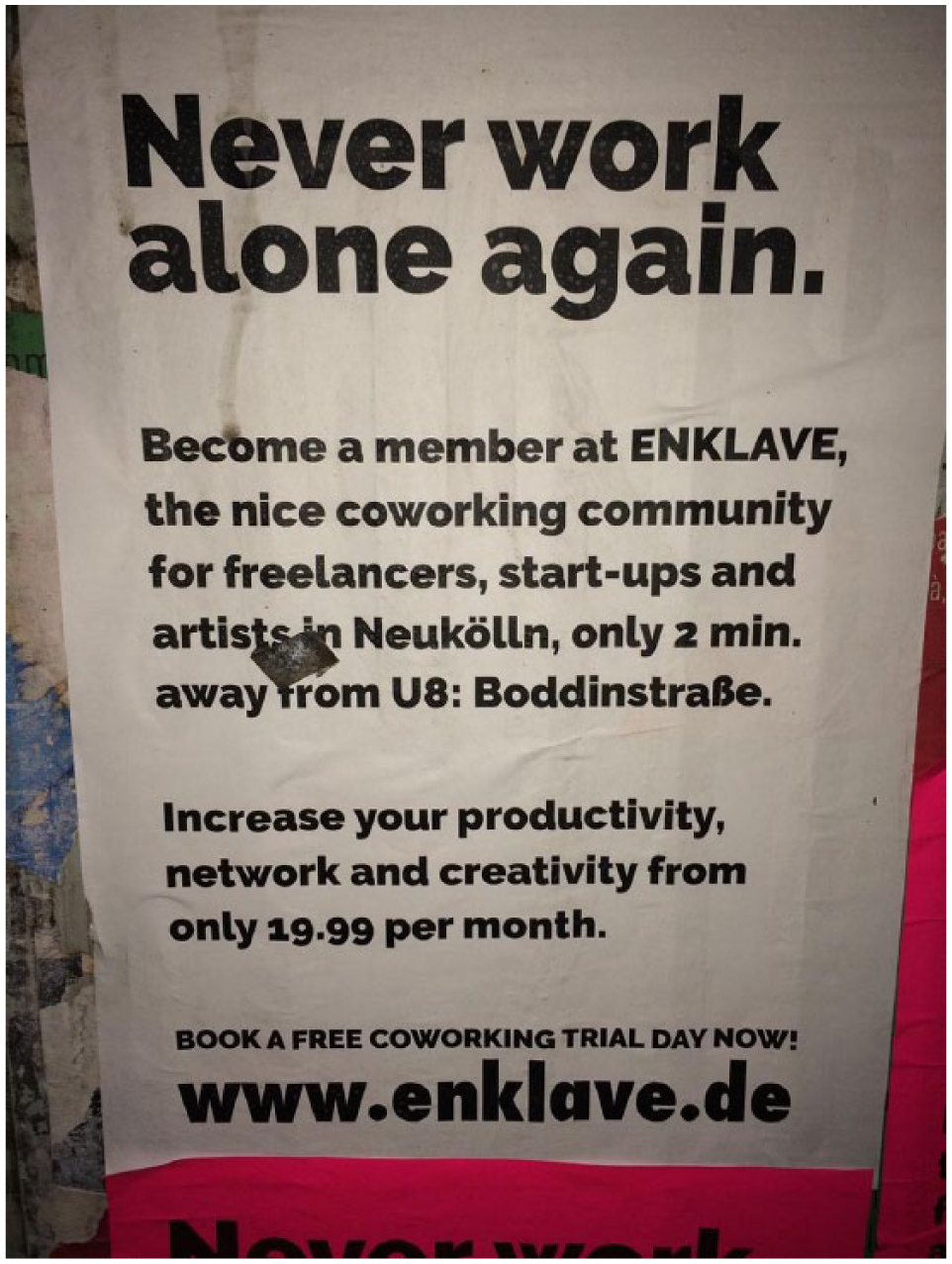
A new coworking space advertises productivity and creativity boosts to independent workers.
At the time of our study, the café on the ground floor welcomed newcomers with a proud statement: ‘betahaus is a coworking space for creatives. We rent out workspace!’. There was a bar in the front, gentle music playing in the background; usually, several people worked on their laptops, while a few others were having a conversation. The café was conceived to be the entrance to the ‘real’ coworking space two floors above where people mostly worked on their laptops. If one wanted to ‘become a member’, that is, to rent a desk, one first needed to register at the bar, which also served as a reception desk. There were two types of desks at betahaus. The more expensive ‘fixdesks’ provided a permanently reserved seat, whereas the cheaper ‘flexdesks’ required one to choose a free spot among the desks marked with a green dot on a daily basis. A fixdesk could be rented for at least a month, whereas flexdesks were available on a daily, weekly, or 12-day basis.
In the café, tables were made of plain, cheap wood, and the chairs look as if they were collected from the flea market (see Figure 2). Upstairs, the coworking space created a similar impression, sporting simple tables, power outlets hanging from the ceilings above every desk, colorful lamps, and old flea market armchairs (see Figure 3). There was a tea kitchen in the second floor (Figure 4). Pretty much everything had an unfinished look, as if in a permanently beta state, as several informants explained the betahaus name. Similarly, the betahaus’ website pointed out: To express our idea of a new workplace, we first came up with terms from the area of software development, such as ‘beta version’ or ‘beta phase’. They best describe the way we’d like to design and develop the betahaus: as an open-ended process. […] ‘Perpetual beta’: the betahaus is never really complete, but keeps on evolving. (betahaus, 2015)
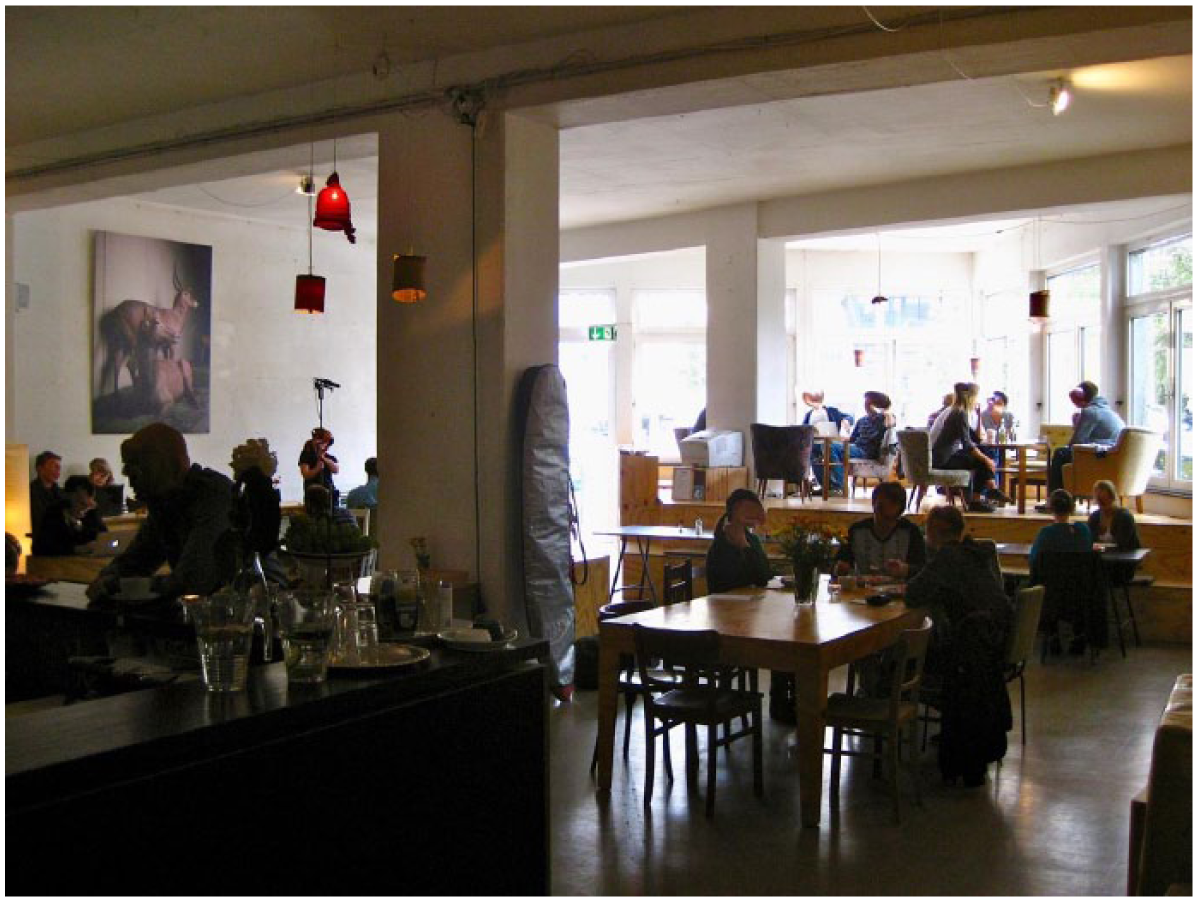
The café on the ground floor.
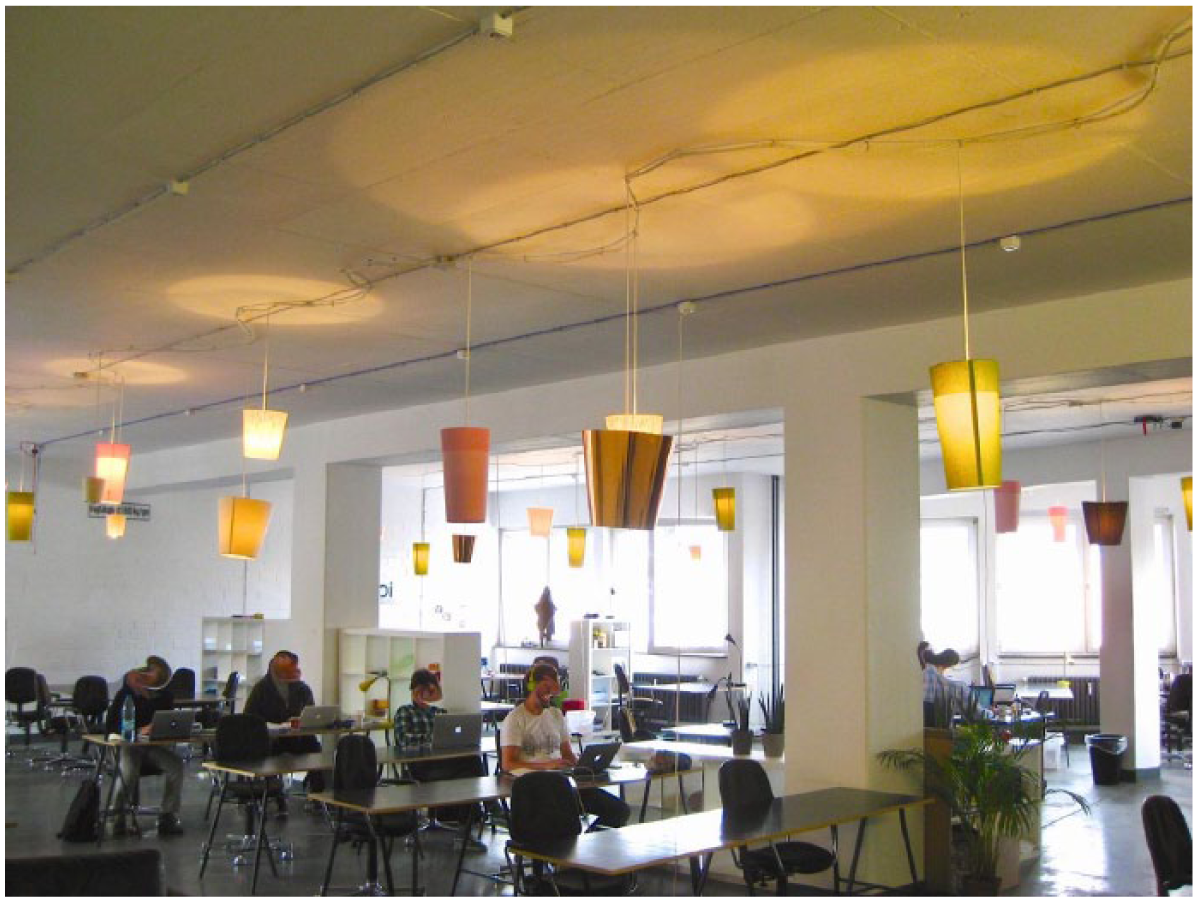
The coworking space on the second floor.
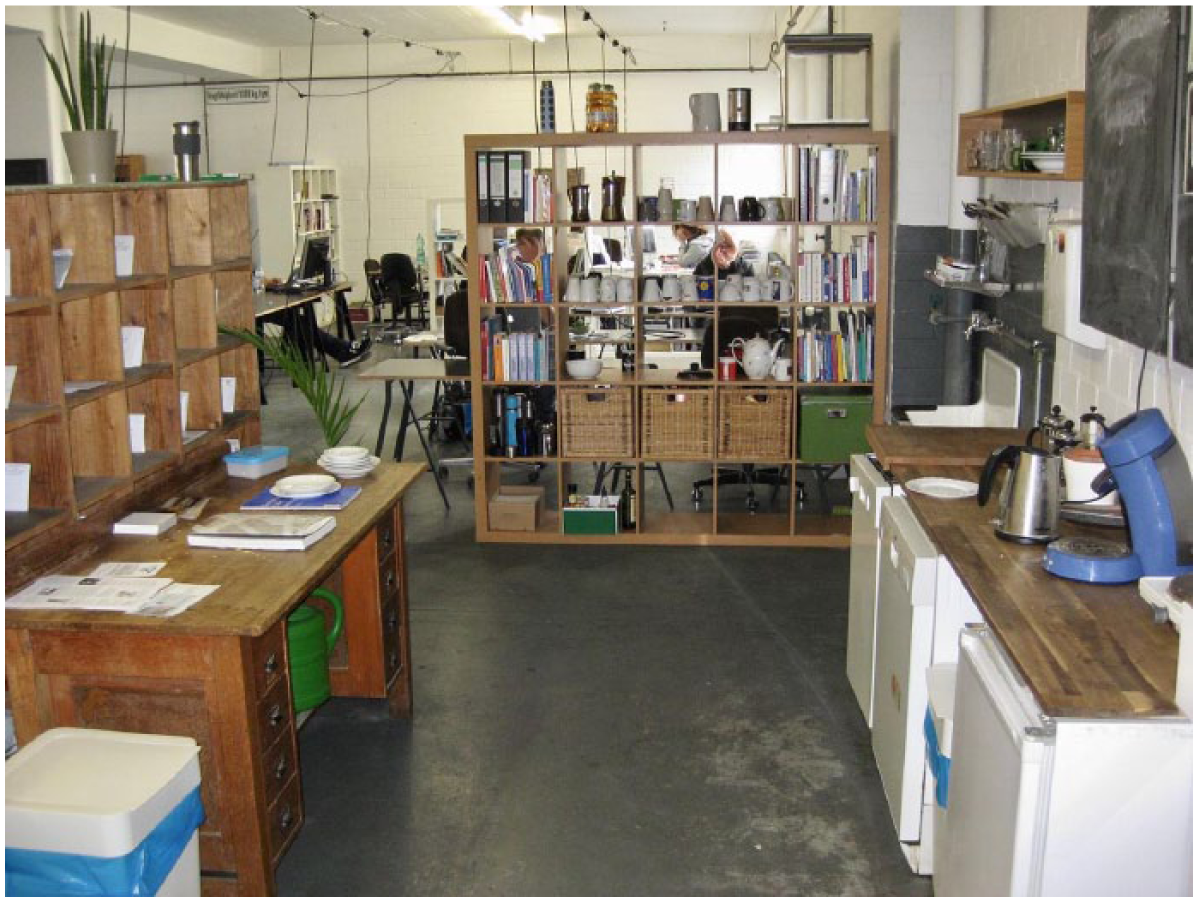
Tea kitchen on the second floor.
A dedicated ‘creative lab’ on the ground floor provided coworkers with tools and resources such as screen-printing equipment.
The formal organization of betahaus—that is, the limited liability company behind its coworking space—was run and managed by its three founders who called themselves ‘space operators’. They were responsible for setting the price for desks, designing the space, and organizing different events. Apart from the founders and several interns, one person was responsible for the catering and the café where different people worked on short-term contracts. Coworkers experienced the ‘space operators’ as crucial for bringing the community to life: The founders of betahaus … on an everyday basis, they act behind the scenes. We don’t have much to do with them, but they vigorously drive the community. […] They actively support you, they ask questions about your business model, they want to know how betahaus and the community can support you. […] They really want to help the people who work here to move forward with their projects. (Norbert)
Overall, betahaus sported very few and somewhat loose formal elements (e.g. a membership fee, a few formal rules, and formally organized events). In the following empirical analysis, we develop how these formal elements interacted with various informal ones to constitute organizationality at betahaus.
Findings: the organizationality of betahaus
Value-driven community
When fieldwork started, we expected life at betahaus to be characterized by an entrepreneurial and individualistic ethos. Contrary to our expectations, coworkers did not just embrace the individualistic aspect of independent work but also highly valued the community aspect of coworking. When asked upfront, people always mentioned the community as the number one reason for becoming members of betahaus. More specifically, people valued betahaus as a place for the creation and living out of a community based on the shared values of sharing, openness, and individuality. For instance, as Norbert pointed out: Coworking is definitely a little bit different than when you rent an office … Ok, actually you sit in an open-plan office, which I think is the foundation. However, what you get here, especially at betahaus, you just get more, you get a community. (Norbert, cosmetics entrepreneur)
As part of the broader coworking movement (Bouncken and Reuschl, 2016; Foertsch, 2011), the ideas of the sharing economy also characterized the betahaus community. The coworkers shared not only space but also contacts and knowledge. When the first author participated in a weekly breakfast, he noticed how coworkers exchanged relevant information about parties, exhibitions, and other social events—something that was particularly useful for those new in Berlin: You get to know a lot about what is going on in Berlin regarding exhibitions, parties, what happens where … it is undoubtedly not the chief focus, but it’s nice. (Otto, social entrepreneur)
Reiterating this observation, people talked about how betahaus enabled them to share ideas, receive honest feedback, and consult other members for advice: I think we are herd animals. I believe one is not born as a loner and needs recognition by others. Also, [here] I get critique, I get stimulation, I get approval … first and foremost I easily get feedback. […] If you have a problem, you know that there is somebody here who knows how to deal with it, who knows how to deal with it better. You just have to go to them and say, ‘Look, I have this situation, I thought about this way of solving it, but I’m not quite happy with it. Do you have an idea?’ (Sandra, graphics and web designer)
Coworkers, like Sandra, felt part of a ‘herd’; they understood they needed a community that can provide them with social connections through which forms of sharing could take place. Such sharing also involved putting others in contact with potential clients and financial investors—something that betahaus fostered through the regular invitations of clients and investors to social events.
Importantly, the betahaus community was not perceived as a closed one. Instead, reflecting the ideals of the open-source movement, it stressed openness toward everyone: ‘betahaus is an open-access coworking space, with no selection process, nor requirements for you to join’ (betahaus, 2018: 5). In an informal interview following a breakfast event, coworkers explained how they enjoyed betahaus because of its ‘openness’ and the fact that ‘it’s laid back and you go there voluntarily’. Coworkers welcomed this openness: [The coworking space lets you] have this flexibility and thereby the feeling that you can breathe, you can come and go whenever you want. (Monika, artist)
Besides sharing and openness, individuality was also significant in the community. Coworkers enjoyed that in the betahaus community they could express their tastes, interests, and ultimately themselves. For example, in informal interviews with the second author, coworkers pointed out how much they enjoy wearing whatever they like when coming to betahaus—something that they strongly contrasted with corporate life. Indeed, colorful and casual clothing, representing the now ubiquitous ‘hipster’ look, was typical. Coworkers expressed how this sense of individuality fostered their creative spirit: This [way of working] encourages free-thinking. That’s why your creativity can unfold much better than before. […] Everything can be individualized, and this stimulates creativity. (Omar, social entrepreneur)
Betahaus’ very interior design, with its improvised and do-it-yourself (DIY) style, also sought to reinforce this sense of individuality and ‘playfulness’—as a space operator explained on one tour taken by the first author.
These observations suggest that there was little formality at the betahaus community, namely, only concerning membership through renting a desk, the organization of regular events, and the general design and administration of the place. Informality particularly shaped how coworkers made sense of and interacted at betahaus. They described how they ‘voluntarily’ (see above) came to the coworking space and its events, enjoyed wearing whatever they liked, interacted with each other without the presence of hierarchical authority, and spontaneously shared ideas and knowledge. Thus, while betahaus provided a formal infrastructure, informal activities mattered as much. Indeed, coworkers strongly contrasted their experience at betahaus with their past corporate lives within formal organizations. August, a former journalist for a major German daily newspaper who launched a magazine, strongly accentuated this aspect of coworking: First and foremost, it is a non-hierarchical togetherness because … at almost all companies you have superiors, who always have a special status … even in the open-plan office, they just have … it is a hierarchical structure. Here you are equal among equals … [At betahaus] I am the master of my time and the master of my actions. (August, magazine editor)
Rituals
Having discovered a strong community orientation among people at betahaus, we delved deeper into the social dynamics that brought the community to life. Here, rituals, a staple of ethnographic analysis, proved useful as an analytical device. Rituals denote patterns of interaction, which provide templates for making sense of social reality (Goffman, 1959; Kunda, 2006). One of the most central rituals at betahaus was the weekly betabreakfast, attended in huge numbers and looked forward to by coworkers. At 9.30 a.m. each Thursday, people arrived in the café and sat around a big table with a simple breakfast buffet. Everyone was invited and even people who were not formal members of betahaus, such as students, clients, or potential investors, regularly participated. The betahaus website explicitly encouraged people to ‘drop by’ at breakfast so as to ‘meet the community’. Indeed, during the breakfast, there was a coming and going of people, and often coworkers turned up late. Coworkers described how the breakfast constitutes an essential opportunity to get to know each other, engage in small talk, and introduce oneself: The principal regular event is the betabreakfast. You can go there, you get breakfast for free, and there is someone from the betahaus or an outsider who would present an interesting project, and then you discuss [it] a bit. (Nigel, entrepreneur)
At such events, the space operators informed and discussed with coworkers about the newest developments at betahaus and welcomed newcomers. The latter used the occasion to present the project they would be working on at betahaus. Overall, a very informal and casual atmosphere characterized the breakfast. People sang songs for their fellow coworkers’ birthdays, joked about each other, and laughed a lot. Apart from the breakfast, coworkers participated in other regular events, such as the weekly yoga class, regular barbeques held on summer nights, parties and concerts in the café, or creative workshops. Some of these events, such as concerts, were even promoted and organized by the coworkers themselves: There is this can-do-mentality. […] Three weeks ago, someone had the idea to put on a stage for Fete de la Musique, and they [the space operators] picked it up and asked the startups: ‘Hey can you support us with a small amount? Or just by doing something?’ And then there was a really cool stage with a solid music program. (Nigel, entrepreneur)
Rituals provided the basis for coworkers to connect, become friends, and share what is going on in their (work) life. For example, at the yearly ‘People at beta’ festival, coworkers spoke about what it meant to become an independent worker. Tim, the CEO and founder of a startup that organizes charity programs for corporations, spoke about the difficulties of setting up a business. He emphasized wanting to engage in ‘an open and honest conversation’ with people, ‘which doesn’t happen enough in Berlin’: I want to tell you the unofficial story. What’s missing in the scene is honesty. People say they got funded two years ago when what’s true is eight months ago …
Tim described the difficulties of finding a financial investor and the mistakes he made. The coworkers thanked him for the helpful insights, as they faced the same challenges, and commented that such honesty was rare to find.
Apart from sharing one’s ‘backstage’ (Goffman, 1959), grievances and difficulties, rituals also served as a platform for testing new ideas in front of a supportive and sympathetic audience of peers before going on the market. At one event where two entrepreneurs ‘pitched’ their idea of a new ‘happiness app’, the second author was struck by the immediate positive response. People reacted with comments like ‘Oh I love this [referring to an app]! I need to get this!’ on the betahaus Facebook site, which was projected on the wall next to where the presentation took place. The former architect Sandra explains how such testing was beneficial: This allows me to get an assessment of my professional situation … how well am I received by people? Am I socially compatible? Or: Why are everyone sitting with the person over there and I’m here all alone? What can I do to change this? So, it is also, in a sense, kind of a mirror of a certain social group, in which I move and I can then see how I feel being part of it—do I get along well with the people? I believe this is the same reason why as a teenager one always wants to be inside a clique or a circle of friends … because you’re looking for something stable, and because you want, also professionally, to find like-minded people who provide you with confirmation, but also with constructive critique.
These rituals show how a mix of formality and informality shaped betahaus life. Concerning formality, most of the rituals were centrally organized by the betahaus management to the extent that they scheduled them, advertised them, for example, on the Facebook website, and provided the spatial infrastructure, and sometimes food and drinks. However, most rituals crucially depended on the informal contributions of betahaus members. Some events even emerged spontaneously out of the coworkers’ initiative. More importantly, the participation in such events was voluntarily rather than mandatory, and how these rituals were carried out was casual and not officially scripted (regarding who sits where, who says what and how long, etc.). The way people opened up and shared their ‘backstage’ stories and experiences further underlines the significance of informality.
Routines
While useful, rituals did not exhaust what was going on in terms of social dynamics at betahaus. Therefore, we reached outside the standard vocabulary of community and ethnography and engaged with concepts originating from organization theory. More specifically, we observed how people enacted various routines on an everyday basis. These routines encompassed repetitive and recognizable action patterns regarding the spatial and temporal configuration of work. In contrast to traditional organization, they did not involve formalization and standardization of work processes and thus did not serve the coordination of work activities among coworkers. Put simply, routines did not pattern the ‘what’ or ‘how’, but rather the ‘where’ and ‘when’ of work.
Enacting spatial and temporal boundaries between work and private life constitutes a common difficulty among independent workers, such as creatives (McRobbie, 2002, 2016). Working at betahaus helped them to manage this issue. There is an enlightening anecdote on this matter that took place when the first author worked at betahaus soon after it opened in 2009: as the managers of betahaus had the idea of leaving the coworking space open 24/7 for everyone, they decided to conduct a survey asking everyone whether they should extend the relative conservative opening hours. The result of the survey was an unequivocal ‘No!’
This is not to say that work and leisure did not mix here; the parties, informal gatherings, and the café were settings in which coworkers hung out privately and made friends (and partners). Notwithstanding this, betahaus coworkers developed a particular working time routine. We observed people coming to work at pretty much the same time in the morning every day (between 9 and 10 a.m.), and at 6.30 p.m. betahaus was almost always empty (apart from the days when workshops took place followed by parties).
Indeed, although coworkers found the concept of routine antagonistic to their self-understanding as self-employed workers, they enjoyed having a more precise boundary between work and life: I don’t have a lot of routines … well, in a way, I do. There is a certain pattern. I get up early, try to do something useful. I go dancing. For example, tomorrow I have a dancing class from 8 till 10 a.m. Then I go to work, answer emails, check my appointments, plan my trips. (Michael, management consultant and coach; emphasis added)
The moviemaker Robert explained how he values the ‘structure’ betahaus offers: Betahaus is … so important … [because it allows you] to separate work from leisure time. I usually work nine hours till 7 p.m. and then when I get home I just don’t turn on the computer anymore, which wouldn’t be the case otherwise. Otherwise, the computer is always on, you check emails and so on. And now it’s off and this way my leisure time has a whole other quality. I think many people feel this way.
For Robert, having a spatial boundary between work and home, induced by the coworking space, facilitated establishing working time routines. These helped him to resist the urge to check emails and remain continuously connected to work and allowed him to turn off his computer when leaving the coworking space. Similarly, another coworker intentionally locked her laptop and all work-related belongings in a locker at betahaus in order not to work at home. Monika, who was appalled by the idea of having a ‘normal job’ and a routinized work day, actually enjoyed the routine, which she also termed ‘structure’: Having a structure is nice. […] I mean … when you are freelancing […] especially when you are doing artistic work, I used to have no studio, I lived and worked in the same place … it makes it difficult to build a structure.
At the same time, working at betahaus also allowed coworkers to pattern the rhythm of work. We observed how coworkers seemed to spend every day similarly: working in front of the computer and occasionally holding meetings with clients or collaborators. They partitioned the workday into time slots, from the morning to the 1-hour lunch break at around 12 o’clock, to the coffee in the afternoon and the end of work. This served to structure work into manageable chunks of tasks. Coworkers regularly took smoking and coffee breaks with others in-between the workday. By following and sharing this work rhythm, they intermingled: When I am here and go to the café downstairs, and I talk to people for a quarter of an hour, it is a nice atmosphere, and we laugh a lot … it’s just so much more fun. So, it is really this social aspect [that is important]. (Sandra)
Coworkers welcomed these routines as a way to manage the boundaries of work and life, which they perceived as difficult to maintain otherwise. This was the case because routines were almost entirely informal to the extent that they emerged spontaneously rather than being prescribed top-down by the space operators. The only formal aspect related to the opening hours, which provided formal boundaries for when work could start and end. As the example of the rejected idea to change the opening hours shows, the coworkers themselves chose and held on to this very formal boundary.
Co-discipline
Another unexpected finding was that coworking engendered a sense of order and discipline among its members. Coworkers reported how the routines that served to package and break up the work activities also provided them with frames to better concentrate on their work. Whereas ‘at home, you can do whatever you like’ (Martin, IT entrepreneur), working at betahaus allowed people to focus, to avoid ‘be[ing] distracted … [and to boost] productivity’ (Robert, moviemaker): I just find it hard to motivate myself at home. […] And here … there are so many people, this also motivates me and, in the end, in the phases when I sit in front of the computer, I am much more concentrated and efficient. […] I think for me this is the fundamental difference—the face-to-face contact and the increased motivation because even if you have to work until late at night, you know that you are not entirely alone. There are others who work as well. (Sandra)
Similarly, Frida, who opened a communication agency with a friend, explained: With us it was like, we thought, we could actually sit in our kitchen, but … we needed a frame … we need a place where we can talk to each other […] And of course there are days where we take it more flexible with the girls… Like someone says ‘Oh, it’s raining so hard, I’d rather work from home today!’ Then we just talk to each other with the messenger, it works. But, after we’ve done it for two days in a roll, you realize how important it is to sit on one desk. It’s just… the work … it’s faster. Insofar, we have a real office here; we have our fixed desk, our furniture, you saw it, it’s all a bit improvised.
Furthermore, being surrounded by others allowed coworkers to compare themselves, their progress, and productivity with others. As Frida continues: So [it is] a bit of a disciplinary measure that you know: “Okay, now I know. I have to appear here and there!” And there is certain social control. If you know that […] Person X, whom I meet every morning at nine at the café and when I’m sick or when I’m lazy, and I’m at home, then […] he will ask me: “Where were you? You’re usually always here at 9!” However, that’s a very subtle social control, but one that works, I think, one that teaches you discipline.
In contrast to traditional organizations, coworkers did not experience this discipline as forced upon them. On the contrary, they articulated it as an individual choice: [At betahaus] you have this flexibility and thereby the feeling that you can breathe, you can come and go whenever you want, even though you probably still sit and work. (Monika, artist; emphasis added)
This shows how the idea of potentiality is at play: potentially one could be somewhere else, do something else. But the fact that one voluntarily chooses to be at betahaus is essential.
In a similar vein to the routines, this form of social control, which we termed ‘co-discipline’ emerged in entirely informal ways. While significantly patterning everyday work activities, co-discipline was enacted spontaneously and voluntarily. The only precondition was the shared routines in terms of space and time.
Discussion
Our findings indicate that the significance of the coworking space lies in providing its members not only with a community of like-minded others (Garrett et al., 2017; Jakonen et al., 2017) but also with organizational elements such as rituals, routines, and co-discipline. To the extent that these elements actively patterned work activities (particularly in terms of time, space, and productivity), betahaus displays organizationality. The following discussion develops how formal and informal relationships interact in the constitution of this organizationality and its significance for understanding coworking spaces.
The interplay of formality and informality at betahaus
Our analysis shows that organizationality at betahaus emerged less from the transactional nature of the relationship between coworkers and betahaus, and more from the interactions among coworkers themselves. For example, the participation in betahaus life was not confined to the paying members—formal membership. Many events at betahaus—such as the breakfast—were openly accessible to everyone who wanted to join, and events had many regular non-member participants. Similarly, some former members continued to participate in events. In this sense, the social collective of betahaus relies much more on fluid and voluntary contributorship than on formal membership (Bencherki and Snack, 2016). This implies that although some relationships at betahaus are transactional, they are transactional in a sense that breaks away from a superior–subordinate relationship. For example, betahaus introduced some formal elements, such as the intentional design of the space, the various events, the membership fees, and a minimal set of rules (e.g. regarding opening hours). These elements constituted the formal infrastructure of the coworking space. Participation and contribution remained optional and not mandatory. This is apparent in the routines, which the coworkers voluntarily enacted to pattern their work activities. Routines and co-discipline, in particular, encouraged coworkers to structure their work activities in ways that make them more disciplined and productive. In this sense, coworking makes it possible for independent workers to modulate their efficiency and effectiveness. Rather than the infrastructure imposing routines and co-discipline, coworkers actively draw on the infrastructure as a frame to structure their everyday activities. Thus, at betahaus, organizationality is both intentionally created and emerging—formal and informal.
Our study thus supports some of the arguments ‘in defense’ of formal organization put forward by du Gay and Vikkelsø (2016). Put bluntly, the coworking space can be understood as a formal organization intentionally set up to provide and sell informality as a service to its members. That is, its organizationality mobilizes a layer of formality (e.g. a membership fee, a few formal rules of engagement, and formally organized events) to foster a great deal of informal activity. Thus, the coworking case demonstrates how some aspects of formal organization might be highly valued even among independent workers. However, focusing exclusively on formality would conceal the critical role of informality for the organizationality of betahaus. This was most visible when it comes to co-discipline. Co-discipline emerges informally out of the combination of the co-location with other workers and potentiality. Thus, it does not represent an enforced form of control associated with formal organization, such as hierarchy, monitoring, and sanctioning. It is also unrelated to occupational norms and identities that can have disciplinary effects; the betahaus coworkers belong to diverse occupational groups. As they can always choose to leave work and do something else, co-discipline is collectively enacted but, importantly, self-chosen. Because no external authority forces coworkers to be productive and go to work, they need to actively decide to do so on an everyday basis. Thus, co-discipline frames work as a single, self-elected possibility against the background of many alternatives (going to the beach, doing groceries, jogging, etc.). Together with the routines and rituals, co-discipline provides a specific mode of patterning and organizing work. This mode depends on a layer of formality. But it is primarily operating on the level of informal social interaction among coworkers, rather than the fulfillment of tasks specified in an employment contract.
Therefore, we label the organizationality we found at betahaus semi-informal. This organizationality is semi-informal to the extent that it constitutes an attempt to in-formalize what has been traditionally accomplished by formal means. Importantly, the informal aspects of betahaus do not simply exist side by side with the formal ones, but instead interact with them in various ways. For example, the few formal rules of betahaus (e.g. regarding working hours) enabled the emergence of informal routines that structure the work rhythm and enact a work-leisure boundary. A related example refers to rituals, such as the breakfasts. These are formally organized, yet lived and practiced in a primarily informal way. By mobilizing this interplay of formality and informality, the coworking space sparks an organizationality that is arguably ‘permanently beta’, that is, simultaneously structured and voluntary, organized and in flux.
Our findings contribute to the emerging literature of organizationality (Dobusch and Schoeneborn, 2015; Schoeneborn et al., 2018) by showing how the interplay between formal and informal relationships can breed varying degrees of organizationality in coworking spaces. Whereas Dobusch and Schoeneborn (2015) stress the communicative constitution of actorhood and identity in relation to external audiences, our study elucidates the importance of internal interactional dynamics for the emergence of organizationality. More specifically, we find that embodied interactions and co-location organize the activities of actors and allow them to act collectively. For example, this is apparent in the case of coworkers collectively organizing events, such as the concert. This indicates how the organizationality of coworking affords a potential to act as a collective, even though this potential might not always be recognized and tapped into on an ongoing basis. Taken together, these findings imply that organizationality, particularly in new forms of organizing, can come in various shades of in-/formality.
Bringing organizationality into coworking
Our study also contributes to the emerging academic literature on coworking. In particular, we extend the current conceptualizations of the social order that characterizes coworking spaces (e.g. Waters-Lynch et al., 2016) by theorizing its organizational dimension. Our analysis shows that coworking spaces can achieve varying degrees of organizationality, depending on their ability to pattern the work activities of their members. In this way, our article shows how coworking spaces provide more than a sense of community to its members (Garrett et al., 2017; Jakonen et al., 2017). While the community is fundamental, the routines, rituals, and co-discipline matter as much. We show how coworking spaces can function as ‘surrogate’ organizations (Petriglieri et al., 2018) for independent workers. This is the case because the organizationality of coworking enables independent workers to deal with work-related issues, such as productivity and work-life balance. It does so by mixing formality and informality in such a way as to create a social order that is more organizational than, for instance, working at a café, but also less binding and more open than traditional formal organizations. By elucidating this organizationality, we contribute to a more comprehensive account of the coworking phenomenon.
The notion of organizationality also emphasizes that coworking spaces have the potential to act as collective actors (Dobusch and Schoeneborn, 2015)—something that has not been accounted for by prior research. We suggest that the collective actorhood of coworking spaces may matter not only internally, but also when coworking collectives act upon and relate to their external environment (relate to business firms, political agencies, investors, urban planners, etc.). Indeed, some multinational operators of coworking spaces, such as WeWork, have grown to become powerful actors with vast potential in shaping not only how people work, but also how they live and spend their leisure time (Rosman, 2017). Their actions and decisions can profoundly shape the urban environment and the contemporary culture of work. Future research needs to explore in further detail the collective actorhood of coworking spaces and examine how they shape cultures of work and life.
Moreover, our findings highlight the need for a more critical engagement with the phenomenon of coworking. For one thing, there is nothing inherent about the organizationality of coworking spaces that guarantees that one’s job is going to be filled with autonomy and self-determination. Where people spend their working days may be a choice, but the details of what they work on may not be their choice, especially, if they have a client with immediate needs. Indeed, while the organizationality of coworking may serve as a way to cope with some of the vagaries of markets forces (e.g. testing ideas backstage before entering the competition of the market), it does not provide the securities afforded by contractual employment. The organizationality of coworking offers little in terms sickness benefits, maternity, or paternity leave, and trade union representation. So far, the literature pays too little attention to such socioeconomic and political implications of coworking. Indeed, the primary focus has been on how it provides solutions to the difficulties independent workers face (Gerdenitsch et al., 2016; Petriglieri et al., 2018). However, how coworking can perpetuate or even generate social problems is yet to be studied. Recognizing the organizational dimension of coworking spaces can be a first step in this direction.
Conclusion
Our inquiry into the coworking phenomenon highlights the usefulness of illuminating new forms of working and organizing through the lens of organizationality (Dobusch and Schoeneborn, 2015). This concept moves the debate further by focusing on shifting degrees of organizationality within various social formations that would otherwise not be seen as relevant organizational phenomena. Organizationality allows for a more open and empirically driven perspective while also providing specific guidance on how to study and conceptualize new organizational phenomena.
Our main contribution is to show how the interplay of formal and informal relationships breeds degrees of organizationality in coworking spaces. Drawing on the betahaus case, we demonstrate how organizationality is enacted not only through the sense of community, but also through routines, rituals, and co-discipline. Organizationality is achieved here to the extent that coworking spaces pattern the work activities of their members, for example, by providing a better focus on work activities and a way to manage the boundary between what coworkers consider work and leisure. This insight also extends prior academic accounts of coworking by providing a conceptualization of coworking as an organizational phenomenon that goes beyond that of community (Garrett et al., 2017).
Our findings also lead us to speculate on how materiality (e.g. Ashcraft et al., 2009) and, in particular, space (Beyes and Steyaert, 2011; Dale, 2005; Dale and Burrell, 2008; Dale and Latham, 2014), can play an essential role in the constitution of organizationality. In our case, the co-location of individuals in a coworking space engenders a degree of organizationality which builds upon the very materiality of the space (its design, architecture, etc.). Further research needs to examine in more detail the interplay between materiality and communication in the constitution of organizationality.
Future research may also explore various further forms and shades of in-/formality and organizationality by focusing on the communicative and interactional processes that bring them about. In particular, this may provide more insight into the dynamics of new forms of crowd-based organizing and platform organizations, such as Deliveroo, Uber, and AirBnB, which in contrast to hacker collectives and biker communities are not completely informal, but entangle formal and informal relationships in complex ways. For example, how do contributorship and (formal) membership intermingle in such settings (see also Bencherki and Snack, 2016)? How can communities of Deliveroo cyclists organize to achieve collective goals (such as better pay and more job security)? The interplay between formal and informal relationships is likely to shape the organizational dynamics of such social formations in ways that are not dissimilar to the dynamics that we have uncovered at betahaus. A key difference, however, pertains to the high levels of virtualization and little co-location in such settings. Future research is needed to reveal the mechanisms and microprocesses that constitute various shades of in-/formality and organizationality in such contexts.