




Abstract
Legitimacy tests occur when an event – such as an organizational accident, revelations about unethical business practices, or the detection of potentially harmful products – calls into question the conformity of an organization’s modus operandi with the expectations of its evaluating audiences. In this paper, we draw on the concept of justification work to improve our understanding of how legitimacy tests arise, evolve and are eventually settled. Specifically, we theorize how legitimized higher-order principles (orders of worth) are mobilized through discursive and material account giving during legitimacy tests. Our framework emphasizes the process of complexifying accounts as legitimacy tests evolve, which can serve to decrease the initial polarization between challengers and focal organizations. Furthermore, we theorize the conditions that affect whether or not a legitimacy test becomes settled, such as social actors’ competence in mobilizing appropriate orders of worth and aligning situational evidence with established societal categories of value.
Introduction
Contemporary organizations face the critical challenge of maintaining legitimacy within increasingly complex environments (Kostova & Zaheer, 1999; Meyer & Rowan, 1977; Neuberger et al., 2023; Vaara & Tienari, 2008). As they generate not only wealth but also societal risks through their activities (Beck, 1992; Tsoukas, 1999), they frequently come under public scrutiny and are held accountable by diverse societal audiences (Bitektine, 2011; Suchman, 1995; Vergne, 2011). The rise of stakeholder management (Freeman, 2010) and democratized platforms for public criticism (Karunakaran et al., 2022; Roulet & Clemente, 2018; X. Wang, Reger, & Pfarrer, 2021) has expanded the range of actors whose evaluations matter and intensified discursive contestation (Roulet & Pichler, 2020). Organizations must therefore navigate competing criteria for legitimacy – technical, moral, legal, scientific and economic – reflecting the diverse expectations of their audiences (Ashforth & Gibbs, 1990; Basu & Palazzo, 2008; Iqbal et al., 2024; Soublière & Gehman, 2019). As a result, their relationship with their environment is often unstable, and legitimacy tests are frequent.
A ‘legitimacy test’ is a moment of critical questioning in which the desirability and appropriateness of an organization’s activities are singled out by its evaluating audiences and widely challenged in the public arena (Bitektine, 2011; Boltanski & Thévenot, 2006; Patriotta et al., 2011). Legitimacy tests can come about via an array of situations that prompt audiences to question organizations’ actions and capabilities, such as organizational accidents (Vaughan, 1999), product recalls (Clemente & Gabbioneta, 2017; Dietz & Gillespie, 2012), deviant actions by their members (Piazza & Jourdan, 2024; M. S. Wang, Raynard, & Greenwood, 2021), or social or environmental harm caused by their products or services (Ferns et al., 2022; Piazza & Perretti, 2015; Weber et al., 2009). The notion of legitimacy test is of strategic importance because it draws attention to the delicate tie between an organization’s activities and the broader socio-cultural context in which it operates. In times of stability, this link is largely taken for granted, but when external audiences perceive that an organization is not conforming with social norms and expectations, that link becomes questioned.
Legitimacy tests compel organizations to engage in account giving by publicly explaining untoward behaviour to bridge gaps between actions and expectations (Scott & Lyman, 1968). A rich literature on crisis communication and reputational judgement views account giving as a socio-cognitive process shaped by interactions with stakeholders, drawing on social perception and impression management theories (e.g. Bundy & Pfarrer, 2015; Coombs, 2007; Elsbach, 1994). From this view, organizational accounts are strategies that aim to shape perceptions and coordinate with stakeholders to prevent, resolve, deflect, or grow from crises (Bundy et al., 2017). Crisis communication scholars also differentiate between breach types (such as challenges, technical-error accidents, and technical-error product recalls (Coombs, 2004)), noting that the form of account depends on perceived responsibility (Bundy et al., 2021; Coombs, 2004, 2006, 2007). For example, recent work highlights the range of discursive strategies organizations use in response to scandals or accusations, including holding statements, direct rebuttals, or silence (Clemente & Gabbioneta, 2017; Clemente & Roulet, 2015; Roulet & Pichler, 2020).
Together, these studies highlight how organizations vary their account-giving strategies in response to legitimacy and reputational threats, depending on conditions such as breach type, existing reputation of the organization and social evaluations. A key insight from this work is that the degree of responsibility an organization assumes can significantly influence public judgement – the more responsibility is attributed to the organization, the greater the reputational damage (Bundy & Pfarrer, 2015; Bundy et al., 2017; Mishina et al., 2012). However, less attention has been given to how organizations construct accounts that reconcile conflicting legitimacy criteria. This matters because legitimacy tests often surface competing commitments – such as market efficiency versus public welfare or environmental sustainability – which may challenge an organization’s moral standing (Koehn, 2013; Sellnow & Seeger, 2013). Notably, scholars have yet to fully theorize how organizations, when faced with such tests, justify their actions by appealing to higher-order principles and values (Patriotta et al., 2011). Justifications often call for organizations to go beyond utilitarian calculations and exercise a degree of ‘moral imagination’ in order to reframe their commitments in ways that resonate with broader societal expectations (Patriotta & Starkey, 2008). Given the frequency of legitimacy tests faced by contemporary organizations, researchers should move beyond categorizing response types to examine how organizations construct justifications that both repair breaches and re-affirm their stated commitments.
In this article, we conceptualize organizational legitimacy as ‘justification work’ – a process enacted through discrete legitimacy tests that link organizational actions to higher-order societal principles. First, we build on Boltanski and Thévenot’s (2006) concept of orders of worth to theorize how higher-order principles are involved in the social construction and resolution of legitimacy tests. By doing so, we enrich current explanations of how focal actors respond to legitimacy tests by specifying the societal-level value systems that underpin their responses, explaining their persuasive power and the conflicts that can arise. Second, we go beyond the dominant consideration in the literature on response types – such as apologies, denials, excuses, scapegoating and so on (Bundy et al., 2021; Coombs, 2004, 2006, 2007; Coombs & Holladay, 2001) – by examining how discursive and material moves connect situational evidence to orders of worth. Third, we explain how the settlement of legitimacy tests depends on different conditions, such as social actors’ competence in mobilizing appropriate orders of worth and aligning situational evidence with established societal categories of value.
In the next section, we go deeper into explaining and theorizing legitimacy tests to provide a clear conceptualization of the focal phenomenon. Following this, we examine the account-giving dynamics underpinning disputes over legitimacy by considering how organizations develop justifications for their actions, decisions and behaviours through associating situational evidence to higher-order principles. We then develop a theoretical framework that conceptualizes the process by which legitimacy tests arise, unfold and are eventually settled. The paper concludes with a discussion of the theoretical implications of our study and future research directions.
Conceptual Background
Legitimacy tests and account giving
Suchman (1995, p. 572) defined legitimacy as ‘a generalized perception or assumption that the actions of an entity are desirable, proper, or appropriate within some socially constructed system of norms, values, beliefs, and definitions’. Organizational legitimacy stems from ongoing social judgements made by evaluating audiences based on the congruence of organizational activities with the norms of acceptable behaviour in the wider social system (Bitektine, 2011; Deephouse, 1996; Roulet, 2020). The concept of legitimacy therefore presupposes an implicit contract whereby an organization commits to complying with social norms and expectations in return for approval and support for its existence (Davis, 1973; Shocker & Sethi, 1973).
Organizations are occasionally subjected to ‘legitimacy tests’, controversial events that pose a challenge to the organization’s modus operandi and call for adaptation and/or repair (Patriotta et al., 2011). Legitimacy tests are instances in which an organization’s commitment to society is called into question. They can be triggered by such events as major accidents, faulty products with potentially harmful consequences, corporate scandals, financial troubles, disputes over organizational malpractice, or litigation on sensitive issues. Examples include the global media’s targeting of Nike’s outsourcing practices in Asia during the sweatshop crisis (Marshall, 1997), controversies over Apple’s factory operations following a series of employee suicides at Foxconn in China (The Economist, 2010), confrontations over the environmental practices or environmental disasters of oil companies, such as Exxon and BP (Ferns et al., 2022; Goldenburg, 2010; Hoffman & Jennings, 2011), controversies regarding product recalls at Mattel (Dietz & Gillespie, 2012) and Toyota (Liker, 2010), targeted campaigns against McDonald’s selling of unhealthy food (Gibson, 2004) and media reports of wrongdoing during the Volkswagen emission scandal (Clemente & Gabbioneta, 2017).
In response to a legitimacy test, organizations need to develop justifications that either re-establish their original commitments or lead to the development of new ones. Justifications are public accounts initiated in response to breaches of social expectations and intended to repair damaged legitimacy. The dynamics of justification can be summarized as follows: instances of organizational misconduct generate public controversies around the appropriateness of the organization’s modus operandi. Controversies are associated with equivocality because they lend themselves to multiple, conflicting interpretations, many of which can seem plausible (Weick, 1993). Equivocality prompts organizations and their audiences to make the situation rationally accountable to themselves and to others through justifications. Justifications stipulate a committing context that introduces stability into an equivocal flow of events, which increases social order (Weick, 1993).
Scholars have predominantly analysed how instances of organizational violations, wrongdoing and misconduct (Clemente & Gabbioneta, 2017; Hersel et al., 2023; Roulet & Pichler, 2020) affect public evaluations of organizational reputation, trust and legitimacy (Coombs, 2007; Gillespie & Dietz, 2009; Pfarrer et al., 2008). This body of work views organizational violations as socially constructed events that are shaped through the interaction between organizational spokespersons and external stakeholders (Barnett, 2014; Greve et al., 2010; Pozner & Hannigan, 2023; Roulet & Pichler, 2020). The social construction of these events is particularly affected by (a) situational attributions, that is, the perceived degree of an organization’s responsibility; and (b) an organization’s response strategy, which is ‘the set of coordinated communication and actions used to influence evaluators’ crisis perceptions’ (Bundy & Pfarrer, 2015, p. 346). The degree to which these two elements are matched will affect the degree of an organization’s social approval loss when facing critical questioning. In other words, an organization’s response strategy, for example, in the form of accepting more or less responsibility, should be consistent with external stakeholders’ situational attributions. The upshot is that crises are situationally managed through discursive response strategies aimed at restoring the organization’s operations and reputation (Coombs, 2007).
Both situational attributions and response strategies are shaped by conflicting evaluative principles, often leading to ambiguity or disagreement over how to construct the situation. The focal organization typically seeks to defend its operations and avoid new material commitments, while audiences act as challengers, aiming to shift organizational positions toward their own interests and positions.
While prior work has focused on the material and situational motives for challengers to question an organization’s behaviour (Fligstein & McAdam, 2011), there are also cultural explanations for these conflicts. Tensions can arise or become exacerbated because organizations and challengers operate in different spheres and follow different commitments. For instance, business organizations reflect market principles; their existing commitments are to generate wealth by efficiently converting resources into products and services. In contrast, NGOs represent global civil society, promoting cultural values such as universalism, individualism, progress and world citizenship. When organizational (mis)conduct becomes contested, the field shifts from economic to symbolic (Tsoukas, 1999). Legitimacy tests thus link an organization’s social space to broader principles and discourses, triggering public negotiations of meaning (Reinecke et al., 2017).
Our analysis treats these negotiations not simply as strategic responses, but as culturally mediated processes that hinge on competing orders of worth (Boltanski & Thévenot, 2006). From this perspective, social actors actively mobilize, contest and reframe cultural repertoires to justify their actions. Grasping these dynamics requires a theoretical approach attuned to meaning-making, justification and contestation in cultural terms. We conceptualize this approach as ‘legitimacy as justification work’: the ongoing cultural labour through which organizations seek to demonstrate worthiness in contested settings.
A Theory of Justification
Organizations are built around commitments – engagements or obligations that justify their core activity while restricting their freedom of action. Rationales for commitments are initially formulated as local self-justifications; they lie at the core of an organization’s identity (Albert & Whetten, 1985). Commitments to identity eventually broaden into commitments to society and are communicated through mission statements, worldviews, corporate purpose statements and core values (Ocasio et al., 2023; Patriotta, 2021). Commitments to society confer legitimacy on an organization and endow it with a ‘license to operate’ (Patriotta et al., 2011). The ongoing existence of organizations therefore depends on successfully managing a key tension: while commitments grant legitimacy, they also constrain organizational agency. Yet, this very constraint – tying the organization to external social evaluations – is what enables organizational action in the first place (Navis & Glynn, 2011).
When facing a legitimacy test, organizations must interpret the ensuing controversy (‘what is going on?’, ‘what does this mean?’, ‘how should we respond?’) while providing persuasive arguments to relevant audiences that justify their views and actions according to their prior commitments and legitimized societal principles (‘this is why what we are doing is consistent with social norms and expectations’) (Weber & Glynn, 2006; Weick et al., 2005). Although public controversies involve multiple actors pursuing idiosyncratic commitments, the justifications offered by them are likely not idiosyncratic. To be persuasive, their justifications must be grounded in competing notions of legitimacy that provide socially acceptable rationales for action. Following Boltanski and Thévenot (2006), we conceptualize these higher-order legitimacy principles as ‘orders of worth’ (OOW).
Orders of worth and legitimacy
The orders of worth (OOW) framework was first developed by Boltanski and Thévenot (2006) to explain how actors justify their actions and settle disputes in situations of plural and contested values. The core idea is that individuals draw on a repertoire of culturally available ‘orders’ (e.g. market, industrial, civic, domestic, fame, inspired and, later, green and projective), each of which defines what counts as legitimate and valuable, and provides criteria for agreement and critique.Central to this framework is the concept of justification – the process by which actors make their actions, decisions and evaluations publicly defensible and morally coherent. Actors engaged in justification work must demonstrate that their position is not merely self-interested but serves broader, more universal principles that can be recognized as legitimate by others. This process is inherently public and requires actors’ ability to connect the immediate concerns of the situation to particular OOWs.Each order of worth provides its own ‘grammar’ of justification, complete with specific criteria for what constitutes valid evidence, appropriate forms of reasoning and legitimate sources of authority. For instance, in the market order, justifications centre on efficiency, competitiveness and customer satisfaction, while the civic order emphasizes collective welfare, equality and democratic representation. The domestic order privileges tradition, hierarchy and personal relationships, whereas the industrial order values technical expertise, standardization and measurable performance.Since its original formulation, the OOW framework has been extended in several directions to enrich the understanding of legitimacy processes, institutional dynamics, strategy-as-practice and corporate social responsibility (CSR). In organization theory, scholars have explored how organizations draw selectively on orders of worth to maintain legitimacy in contested environments (Patriotta et al., 2011). Others have argued that the OOW framework addresses important blind spots of institutional theory in relation to the microfoundations of institutions, legitimacy struggles and the moral and material underpinnings of institutional logics (Cloutier & Langley, 2013). In strategy research, OOW highlights how strategists justify and critique actions in practice (Gond et al., 2015), while in CSR, it provides a critical lens on competing definitions of the ‘common good’ (Gond, 2017). It has also been linked to paradox theory, offering insights into how organizations navigate normative tensions across fields (Gond et al., 2017). More broadly, recent syntheses in the sociology of conventions emphasize the role of OOW in bridging economics and sociology, and in consolidating research on justification and legitimacy struggles across disciplines (Buclet, 2023; Diaz-Bone & de Larquier, 2025). Taken together, this work positions OOW as a flexible framework that bridges debates across sociology, economics, political science and organization studies, while foregrounding how legitimacy and value are actively enacted and contested in diverse social arenas.
According to Boltanski and Thévenot (2006) OOWs are systematic and coherent principles of evaluation that coexist within a social space and to which people most often resort in order to finalize an agreement or pursue a contention. Each OOW qualifies the modes of evaluation that are relevant for judging when disputes over legitimacy arise (Thévenot, 1995). The text box below shows an overview of Boltanski and Thévenot’s OOW framework while Table 1 illustrates the ‘grammar of justification’ underpinning each OOW.
Orders of Worth.
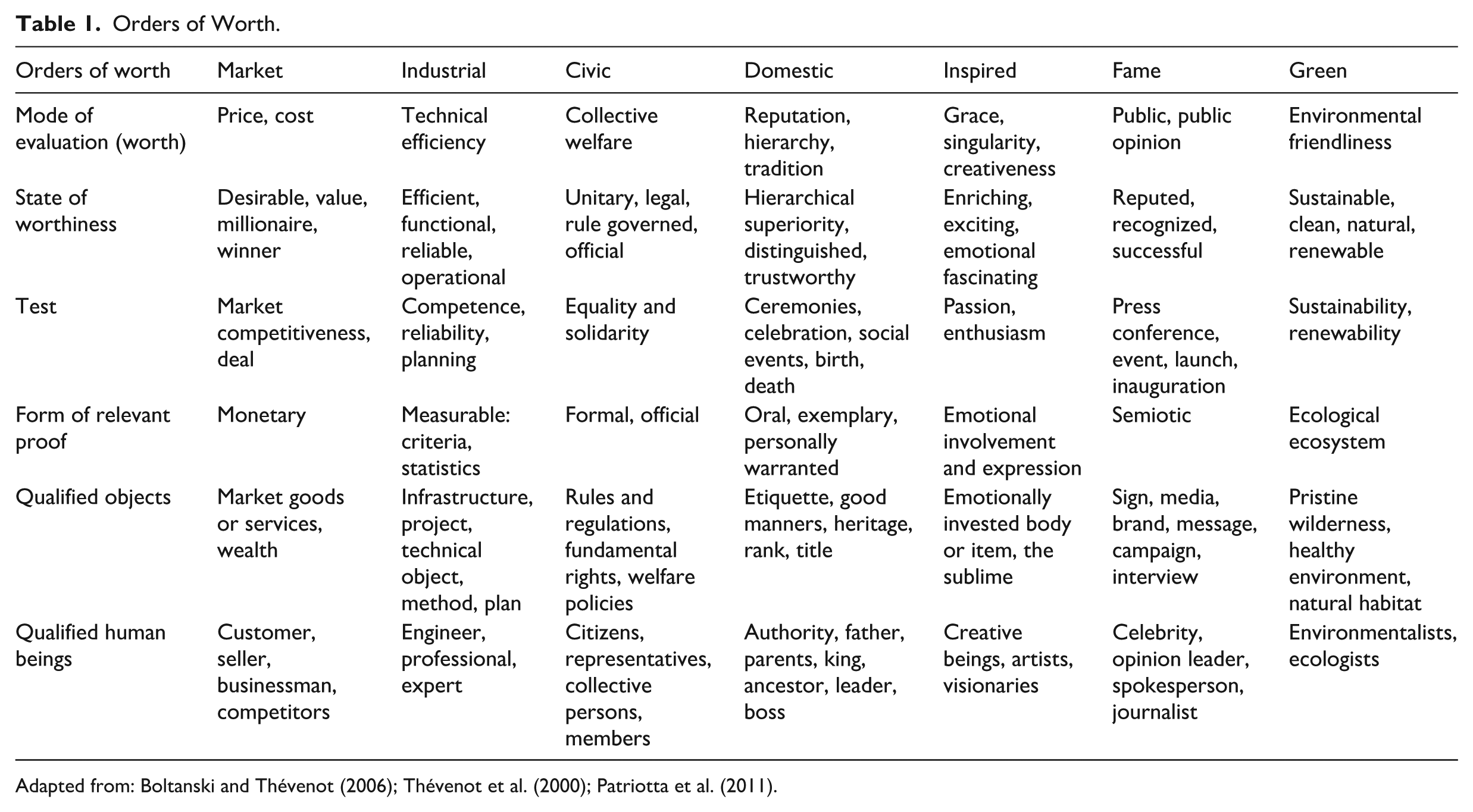
Adapted from: Boltanski and Thévenot (2006); Thévenot et al. (2000); Patriotta et al. (2011).
As shown in Table 1, modes of evaluation in the OOW framework include market competition (market), technical efficiency (industrial), collective solidarity (civic), trustworthiness (domestic), public image (fame) and inspiration and creativity (inspired). Later extensions of the original framework have identified the ‘green’ world as an additional order of worth based on the principle of environmental friendliness (Lafaye & Thévenot, 1993; Thévenot et al., 2000). From this perspective, legitimacy depends on whether organizational justifications, actions, decisions, or behaviours align with the values and criteria of the relevant OOW. To be seen as legitimate, the rationale given for a behaviour or decision must conform to the rules and expectations of the invoked order of worth. For example, a policy prioritizing environmental sustainability might derive legitimacy from the civic or industrial order by emphasizing collective welfare or technical solutions to ecological challenges.
OOWs reflect widespread understandings of the social reality that furnish the criteria by which legitimacy is assessed (Cloutier & Langley, 2013). In this regard, OOWs constitute a ‘political grammar’ that provides a lens for understanding how legitimacy is constructed and contested in different social contexts (Patriotta et al., 2011). Accordingly, we further develop the concept of ‘justification’ to refer to a cognitive association that uses different forms of accounts to link a controversial issue to broader higher-order principles (OOWs) during a dispute over legitimacy. From this perspective, justifications are particular instances of account giving that aim to rationalize an action, decision, or behaviour as being reasonable, appropriate, acceptable, necessary, or correct through the lens of societal standards of value. A justification involves making arguments by associating evidence of actions and decisions with higher-order principles and values to establish legitimacy. Its purpose is to convince others that an action or decision was valid or appropriate, often in response to criticism or questioning. Hence, while account giving involves providing a narrative of who did what, when and how, justifications focus on why something unfolded in a certain way, as well as how certain actions, decisions, or behaviours should be interpreted or judged. From this standpoint, justifications combine cognitive and moral dimensions. Cognitively, they denote the rationalization of a controversial issue based on socially accepted principles. Morally, they are grounded in distinct value systems (OOWs) that provide frameworks for evaluating legitimacy claims.
The justifications that organizations give to respond to legitimacy tests may combine discursive and material moves. Discursive moves are verbal accounts that aim to provide rational, credible and socially accepted explanations of the issue under scrutiny (Gonzales et al., 1990; Phillips et al., 2004; Suchman, 1995). They are usually formulated to support or defend organizational goals, structures and procedures during a legitimacy test. Material moves refer to the engagement of objects in the resolution of a dispute over legitimacy. Of particular relevance from the focal organization’s viewpoint are those material repairs that involve some form of organizational change, such as replacing existing practices and procedures with new ones, committing resources to new areas, incorporating institutionalized structures or goals, and changing leadership (Elsbach, 1994; Meyer & Rowan, 1977; Zuckerman, 1999). Both discursive and material moves require the elicitation of legitimating characteristics from the broader socio-cultural environment. The crafting of socially accepted accounts to defend, excuse, or explain an organization’s activities depends on what rhetorical resources are ‘institutionally’ available. Likewise, material reforms such as organizational restructuring also tend to draw on institutionalized organizational forms in order to signal conformity to certain rationalized myths (Meyer & Rowan, 1977).
A final critical aspect of legitimacy tests is the link between higher-order principles and human competence, the latter denoting the social actors’ capacity to recognize situations and adjust to them accordingly (Annisette & Richardson, 2011; Thévenot, 2002). ‘Competent agents’ (Giddens, 1984) are able to perceive and navigate multiple forms of worth, which they then selectively mobilize in order to justify their behaviour in specific situations. Thus, while higher-order principles provide the symbolic raw material from which organizations develop accounts of the situation, the selection and construction of these accounts will depend on the actors’ competent agency. This has implications for the effectiveness of justifications employed in legitimacy tests. Competence is manifested in a variety of tactics derived from the actors’ ability to combine or move between different OOWs as circumstances change. This might include contenders opening up the legitimacy test to a plurality of OOWs, building coalitions with influential media, political parties or opinion leaders, and using the same OOW to demonstrate the worthiness or unworthiness of people and objects involved in the situation being judged (Patriotta et al., 2011).
Our theoretical approach can be distinguished from other influential accounts of legitimacy and organizational response. For example, world society theory (Bromley & Meyer, 2021) explains how globalized accountability pressures and standardized organizational models create symbolic and substantive commitments across fields. From this perspective, legitimacy tests force organizations to adopt common cultural scripts to demonstrate adherence to universal management principles. However, this emphasis on institutional conformity assumes relatively unreflective organizational actors and gives limited attention to organizational capacity for flexible, context-appropriate crisis responses. Likewise, theories of strategic action fields (Fligstein & McAdam, 2011) and framing approaches (Rao & Kenney, 2008) highlight the skills of actors in negotiating settlements, blending frames, or mobilizing constituencies. Yet these frameworks remain largely analytical, offering limited traction on the cultural substance of the justificatory claims through which legitimacy is asserted or denied. By contrast, our emphasis on justification work foregrounds how legitimacy tests activate, recombine and dispute shared cultural repertoires. In this sense, we build on insights from Jagd (2011), who highlights how competing OOWs generate justificatory dynamics within organizations, and extend the focus to moments of public controversy where such dynamics become especially salient. This perspective not only captures the strategic interaction emphasized in strategic action fields and framing theories but also renders visible the cultural grammars that undergird contestation over legitimacy in practice.
Theorizing Legitimacy as Justification Work
Figure 1 summarizes the process by which legitimacy tests arise, unfold and are eventually settled (or fail to reach settlement). As shown, legitimacy tests unfold through dynamic interactions in which the focal organization and relevant challenging audiences offer competing justifications rooted in distinct OOWs. As the legitimacy test unfolds, focal organizations engage in discursive and material moves to make their positions defensible and socially acceptable. These moves are shaped by OOW and guided by actors’ competence – their ability to align situational evidence with higher-order principles. Over time, the degree of disagreement, or polarization, between focal actors and their challengers decreases if either actor engages in complexifying their justifications, which moves towards a plurality of OOWs that go beyond initial positions. Complexifying often entails the focal organization integrating the challengers’ OOW into their subsequent justifications or attempting to take the dispute in a new direction by introducing a new OOW outside of either actor’s domain into their subsequent justifications. Depending on the efficacy of these justifications (which rests in part on the power of the actors and in part on the degree of resonance of their justifications with what is societally valued), legitimacy tests may either persist or move towards settlement. We explain each of these steps in detail below and illustrate them through prominent historical and contemporary cases of legitimacy tests (see Table 2 for further details on these exemplar cases).

Process Model of Evolution of Legitimacy Tests.
Cases of legitimacy tests.

NPP, nuclear power plant
The construction of initial positions and arguments
The statu nascenti of a legitimacy test is marked by ambiguity and competing interpretations. The meaning of the breach, the actors involved and the appropriate course of action are all subject to sensemaking and contestation (Patriotta, 2016). Under these conditions, organizations are likely to draw their initial justifications from their cultural repertoires, and to mobilize the OOW that justify their behaviours and decisions through their existing commitments and identities.
While competent actors may be expected to frame their initial responses using the OOW they believe their audiences or challengers value, we argue that initial responses are often rooted in identity-preserving accounts aimed at protecting the organization’s internal commitments. In other words, initial justifications often aim less to persuade outsiders and more to uphold organizational identity and commitments – what we call their ‘home domain’. Home domains provide consolidated and preferential lenses through which to interpret the issue at stake – reflecting a habitual alignment with a particular OOW. For example, firms typically default to industrial (efficiency) or market (economic performance) OOWs to ground initial justifications in response to a legitimacy test. In contrast, NGOs and advocacy groups may mobilize principles that are rooted in civic (public interest) or green (ecological responsibility) OOWs.
The energy company Vattenfall, for instance, combined acknowledgements and technical arguments from the industrial world to initially provide a justification as to the causes of a nuclear accident in which it was involved and to attempt to minimize the company’s responsibility (Patriotta et al., 2011). When faced with allegations that they had installed devices in their diesel cars to cheat emissions tests, Volkswagen initially responded with industrial and market justifications, denying that these allegations were true and blaming a few key ‘bad apple’ engineers (Clemente & Gabbioneta, 2017). Historically, McDonald’s countered allegations that it deliberately sold unhealthy food (civic/green) by initially contending that consumers were able to make rational choices, that reasonable consumers were aware of what they eat, and that they were unlikely to be misled by advertising (market). These exemplars reflect a focus on technical compliance and economic performance, thus illustrating how organizations may first resort to justifications that align with their core operational principles.
In a recent scandal in the United Kingdom, thousands of employees of the UK Post Office were falsely accused of stealing from local branch accounts over the course of a decade. Eventually, it became clear that the Post Office’s IT system, called Horizon, was at fault for producing these false losses. But in the first media story to raise questions about Horizon, the Post Office fiercely defended their IT system and their actions of going after their staff through higher-order principles that conformed to their existing commitments and identity – saying: Horizon is an extremely robust system which operates over our entire Post Office network and successfully records millions of transactions each day [industrial OOW]. There is no evidence that points to any fault with the technology [industrial OOW]. We would always look into and investigate any issues raised by sub-postmasters [domestic OOW]. (Thomson, 2009)
As the above examples illustrate, a focal organization’s initial response to a legitimacy test is often grounded in higher-order principles, or OOW, that largely align with its existing commitments and preferences. If that occurs, it results in a high degree of disagreement between challengers and focal organizations. Therefore, initial justifications during legitimacy tests are likely to polarize around conflicting OOWs expressing the home domains of the main contenders.
The evolution of the controversy: Complexifying
As the legitimacy test unfolds, the controversy is likely to grow in complexity. New evidence may emerge about the breach, which may be amplified through media coverage (Clemente & Roulet, 2015; Klein & Amis, 2021; Pozner & Hannigan, 2023) and social media exchanges (Karunakaran et al., 2022). A plurality of actors, such as the media, political parties, NGOs and social movements, may also become involved, and bring their own agenda into the controversy (Barnett, 2014). To the extent that the additional actors that become involved in the controversy are grounded in a different OOW, what may have begun as a dispute over a narrow technical or economic issue can broaden into a multi-faceted contest involving several OOWs. Under these circumstances, to move the controversy toward a resolution, the focal organization will likely complexify its justifications by drawing on multiple OOWs to better incorporate other actors’ concerns. Complexifying can involve adopting the preferred OOW of challengers or expanding into a brand-new OOW that takes the controversy away from the existing polarized positions and into a third domain.
The Vattenfall’s Forsmark accident provides a good example of discursive complexification. The debate shifted from an initial narrow focus on the technicalities of the accident and risk assessment (industrial OOW) to a more general debate on the safety of nuclear plants in Germany (domestic OOW) and to an even broader political debate on the phasing out of nuclear energy in Germany, which placed issues of collective interest (civic OOW) and cost–benefit analyses of nuclear energy (market OOW) in opposition to each other. This evolution compelled Vattenfall to complexify its responses by combining technical defences with arguments for nuclear power as a ‘clean energy’ source (green/market).
Another feature of complexification is that it is likely to move beyond discursive-based justifications to incorporate material moves in responses to the unfolding legitimacy test. For example, after initial market-based denials of responsibility for child obesity, McDonald's eventually introduced ‘New Happy Meal Choices’ allowing healthier substitutions (e.g. milk or juice instead of soda), added healthier menu items such as salads and oatmeal, and started providing nutritional information on packaging. These material changes, coupled with discursive shifts, embraced domestic and green OOWs, reflecting a move towards consumer well-being and a broader acknowledgement of responsibility for societal health. By complexifying its justification, McDonald’s came to embrace the very OOWs that it had been criticized with (domestic, civic and green), backing up this shift with material commitments.
In a similar vein, the escalating diesel scandal forced Volkswagen to complexify its justifications by moving beyond denial and the blaming of individuals (market/industrial OOW). The company eventually admitted wrongdoing, issued apologies and made significant material moves, including massive recalls, the resignation of its CEO and facing over €30 billion in fines and settlements. Critically, Volkswagen also began to invest heavily in electric vehicles (EVs) (green OOW). This material shift signifies a move beyond solely industrial/market OOWs towards acknowledging green (environmental sustainability) and civic (public trust, social responsibility) OOWs, indicating a more profound engagement with the concerns of regulatory agencies, consumers and environmental NGOs.
These examples highlight the interplay between discursive and material moves that actors make to support their evolving justifications, and how this interplay adds complexity in the evolution of justifications that are given in the face of legitimacy tests. Material moves are costly, often requiring structural changes to products, organizational design, production facilities, or supply chains. As a result, during the early stages of a test, organizations typically rely on discursive responses, supplemented by limited, reactive material changes. More substantial material moves – such as modifying products, services, or investments – tend to emerge as the controversy unfolds. These actions can help move the controversy toward settlement by signalling that the organization not only acknowledges a broader set of OOWs beyond its home domain but is also willing to invest in aligning its activities with values that its critics uphold. Such material changes demonstrate socially expected reliability and function as ‘investment formulas’ that grant access to higher states of worth within a given sphere (Annisette & Richardson, 2011; Boltanski & Thévenot, 2006).
Not all actors succeed in complexifying, with some sticking to their original justifications and home domains, failing to recognize that their challengers’ justifications are resonating more with society and key audiences. For example, as the UK Post Office Horizon IT scandal grew – from appearing first in specialty computer magazines to finally reaching Members of Parliament and resulting in the Post Office being forced to undertake a third-party forensic accounting investigation of its IT system and the procedures by which it prosecuted its staff, the organization failed to complexify its justifications. The organization kept sticking to nearly the same word-for-word defence of its systems and procedures as ‘reliable’, ‘robust’, ‘state of the art’ (industrial OOW) and refusing to acknowledge that they should investigate whether or not it held responsibility for the apparent financial losses, especially as a public institution (civic OOW) (Augustine et al., 2024).
As these examples illustrate, the scope of a legitimacy test often expands as controversies unfold, especially when new parties become involved and focal organizations adjust their justifications, potentially invoking new OOWs or those that their challengers value. Being more competent, for a focal firm, means an ability to gradually complexify the justification by moving toward a plurality of OOWs. This shift often reduces the degree of disagreement between the organization and its challengers, especially when discursive responses are coupled with material commitments. As a result, through complexifying, legitimacy tests can evolve from polarized disputes confined to the actors’ home domains into broader debates encompassing multiple OOWs.
The progression of the controversy influences the organization’s position, the higher-order principles it draws upon and the symbolic actions – both discursive and material – that support its justifications. These shifts reflect how micro-level processes of account giving reshape the symbolic space of the controversy and prompt adjustments in the actors’ positions. Moving beyond initial framings signals the focal organization’s willingness to make concessions and adapt its stance to restore legitimacy. As illustrated in Figure 1, such complexifying moves often bring the organization’s position closer to that of its challengers, reducing disagreement and making resolution or settlement more likely.
However, complexifying faces inherent limits that constrain organizational capacity to indefinitely expand justificatory appeals. Organizations encounter a ‘legitimacy bandwidth’ whereby incorporating too many OOWs creates incoherent accounts that can threaten an organization’s core identity and compromise audience understanding of what the organization stands for. Relatedly, the sequence of OOW incorporation creates interpretive locks and path dependency that constrain subsequent options. For example, once Volkswagen embraced a green OOW, returning to purely industrial arguments would seem to be hypocritical or like backsliding. Finally, adding or blending multiple OOWs imposes new commitments and expectations that may compel focal organizations to bring material changes in line with discursive promises (to avoid criticism of hypocrisy or greenwashing; see Lyon and Montgomery, 2015) and lead to greater scrutiny of the organization in the future. These constraints suggest that justification work is non-linear and path-dependent, reflecting the dynamics of emergence in complex social systems (Marku et al., 2025). Under these circumstances, effective complexifying requires strategic selectivity rather than unlimited expansion, with organizations needing to navigate competing demands while maintaining sufficient coherence and authenticity to sustain legitimacy.
Legitimacy test settlement
Legitimacy tests are settled when parties reach a shared understanding of the situation or arrive at a compromise that gradually reduces public scrutiny of the focal organization. This resolution is likely to compel the focal organization to revise its commitments, prompting it to reflect on and potentially reconfigure core aspects of its modus operandi.
Throughout a legitimacy test, organizations experience a persistent tension between preserving their existing commitments and demonstrating societal concern and competence – that is, their ability to effectively mobilize and align their preferred OOW with evolving audience expectations. As shown in Figure 1, the outcome of a legitimacy test (and how far the settlement occurs from each actor’s original position) is shaped by several interacting conditions. These include the relative power of the focal organization: more powerful actors are better positioned to settle controversies within their preferred justificatory domains. Another key condition is the degree to which an organization’s identity-preserving and commitment-preserving OOW resonates with broader societal values. If this alignment is strong, the organization is more likely to secure legitimacy without extensive adaptation. Lastly, competent actors are able to engage in nuanced justification strategies, combining discursive and material responses that adapt to the contours of the controversy.
Iterating over multiple rounds, legitimacy tests are likely to shift away from the extreme degree of disagreement that characterizes the original polarized positions, as each party makes some concessions in the hope of resolution or change and becomes more adept at incorporating each other’s preferred OOW in their discursive and material justifications. In such cases, organizations may reach a resolution that lies between their own initial position and those of their challengers. Alternatively, they may together adopt a ‘third way’ based on the controversy being complexified using a different OOW – transforming, for instance, a debate framed as a clash between economic efficiency and environmental sustainability into one anchored in civic principles of collective welfare. This is most likely to occur when the focal organization complexifies the controversy as it evolves towards bringing in new OOWs that sit outside the home domains of either the focal organization or its challengers. For example, the settlement of Volkswagen’s Dieselgate scandal involved massive fines, leadership changes and a significant strategic pivot towards electric vehicles. This ‘third way’ approach, moving beyond the initial polarized positions (industrial/market vs. green/civic), transformed the controversy into a path where Volkswagen's future aligned with evolving environmental and societal expectations while also following market principles through innovation and new product development, signalling a lasting shift in commitment.
A critical issue in determining where settlement occurs relative to initial positions and commitments is the effectiveness of the arguments advanced by the contenders, and the resonance of those arguments with key audiences. While it might seem intuitive that the credibility of a contender would determine which order of worth prevails, the empirical record offers a more nuanced picture. In the case of Vattenfall’s Forsmark nuclear controversy, for example, pro-nuclear stakeholders ultimately succeeded in securing policy support for nuclear energy – even in a context where opposition to nuclear energy had deep sociopolitical roots (Patriotta et al., 2011). Vattenfall, the energy firm involved, obtained a significant extension to operate its plants despite its association with prior accidents.
This suggests that settlements cannot be explained solely by the intrinsic strength of a particular higher-order principle in society or the prior standing of the actor invoking it. Rather, what often determines the outcome is the degree of competent agency displayed by the actors involved in navigating the legitimacy test. As noted earlier, competence refers to an actor’s ability to assess evolving situations, select resonant OOWs, and adapt their justifications as new information emerges. Legitimacy tests thus depend as much on micro-level account giving and rhetorical agility as they do on cultural context. In the case of Uber, which initially came under scrutiny for entering markets without proper licensing (civic OOW challenge) and refusing to accept their drivers as employees eligible for certain rights and benefits (civic and domestic OOW challenge), the company made very minor discursive or material concessions or justification shifts over time, refusing to complexify their account beyond the market OOW (flexibility, innovation). Their unwavering responses that reflected their existing commitments could be seen as risky in responding to these legitimacy tests, but ultimately the flexibility, innovation and price point that they offered to users resonated with the societal values of market-based tech innovation and ‘creative destruction’, enabling them to largely settle the controversy closer to their home domain.
Of course, it is important to acknowledge that there are many reasons why settlement may not be reached in every legitimacy test. Settlement may be inhibited when the focal organization clings too rigidly to its home domain and resists engaging with alternative OOWs (especially if other OOWs are more valued in society). This justificatory rigidity reflects either a lack of competence or a deliberate strategic choice to preserve identity or avoid costly concessions. When organizations fail to recognize that challengers’ justifications and critiques have gained traction with audiences, they may persist in unilateral justifications that deepen polarization and stall resolution. This kind of impasse was apparent in the UK Post Office scandal, where the organization persisted in invoking industrial OOW (‘robust technology’, ‘procedural integrity’) even as civic and domestic concerns gained momentum in the public arena.
Additionally, even when a focal organization attempts to complexify through material or discursive moves, those moves may fail to gain traction, if audiences perceive them as insincere, lacking in material grounding or hypocritical (Voronov et al., 2023). Such failures of credibility – often labelled as ‘greenwashing’ or ‘window dressing’ – undermine the resonance of the justification, reinforcing distrust and prolonging the controversy.
Moreover, even when organizations attempt to complexify, legitimacy test settlement may fail if the OOWs mobilized by the contenders are fundamentally incommensurable; that is, they are grounded in irreconcilable values. This can occur, for instance, in debates over animal testing, fossil fuel divestment, or surveillance technologies, where the moral foundations of one side (e.g. green or civic OOW) directly negate the principles invoked by the other (e.g. industrial or market OOW). For example, in Larkin et al.’s (2025) study of the failed Google Sidewalk Labs project in Toronto, the controversy over responsible innovation in public–private partnerships reveals a persistent tension between anticipatory governance (which emphasizes precaution, foresight and the public good – linked to civic and green OOW) and deliberative governance (which prioritizes stakeholder dialogue, consent and procedural legitimacy – linked to domestic and civic OOW). These logics are not easily reconcilable. The actors engage in attempting to balance these opposing poles rather than integrating, reflecting a fundamental incommensurability between normative frameworks.
Finally, a lack of settlement may also result when the focal organization faces divergent evaluative demands from multiple audiences, each invoking different OOWs. In such cases, any justificatory move aimed at appeasing one audience may alienate others, creating a ‘legitimacy trap’ (see Suchman, 1995). This is particularly likely in multi-stakeholder controversies where actors such as regulators, activists, customers and investors pull the organization in different normative directions. Returning to the Larkin et al.’s (2025) study of Sidewalk Labs, it highlights how different stakeholders – in this case government agencies, private firms, scientists and publics – have divergent expectations of what responsible innovation entails. Each group appeals to different OOWs, making it difficult to align justifications across audiences or to converge on a shared evaluative basis for action.
Discussion
Our study advances the research on crisis communication and account giving by developing a theory of justification that explains how legitimacy struggles emerge, develop and are ultimately settled. Our theory conceptualizes ‘legitimacy tests’ as critical questioning moments where an organization’s modus operandi is challenged against audience expectations. It reframes the conversation around organizational legitimacy in times of crisis by shifting the analytical focus from response strategies to the social construction of justification, what we label as ‘legitimacy as justification work’.
The paper offers several contributions. First, we theorize how higher-order principles, conceptualized as OOWs (Boltanski & Thévenot, 2006), are involved in legitimacy tests. Thus, we enrich current explanations of crisis responses by specifying the societal-level value systems that underpin account giving, explaining their persuasive power and the conflicts that can arise from the divergent OOWs rooted in organizations and challengers’ existing commitments. Second, we emphasize the interplay between discursive and material moves underpinning processes of justification. Specifically, we explain how these two types of moves are strategically employed by organizations to restore or defend their legitimacy when they are tested. Third, we highlight organizations’ ‘competent agency’ in connecting situational evidence with higher-order principles, providing a nuanced lens for analysing how organizations ground their accounts in broader societal expectations rather than merely managing impressions.
Legitimacy tests as the mobilization of higher-order principles
Our first major contribution is to reconceptualize organizational legitimacy as justification work, emphasizing how organizations actively navigate discrete legitimacy tests by linking their actions and commitments to higher-order societal principles through which they are subsequently evaluated. While earlier work (Jagd, 2011; Patriotta et al., 2011; Reinecke et al., 2017) established the theoretical foundation for understanding legitimacy as constructed through justification processes, we provide the operational mechanisms of how this justification work unfolds – detailing the specific practices through which organizations identify, invoke and align with evaluative principles during legitimacy challenges.
This reconceptualization builds upon and extends existing approaches to organizational crisis response. Previous research on crisis communication has documented how organizations engage in account-giving strategies when facing reputational or legitimacy threats, focusing on response types such as denial, apology, or scapegoating (Bundy et al., 2021; Coombs, 2004, 2006, 2007). Although this work has offered important insights into how crises are managed, it has tended to remain at the level of organization–audience interactions, focusing primarily on cognitive and dyadic relational processes, such as framing and evaluation. While we are not suggesting that these explanations are ‘incorrect’, we argue that they are insufficient because they do not bring broader society and shared cultural norms, values and expectations into the core of theoretical explanations. In contrast, by incorporating OOW, we reveal the fundamental cultural ‘grammar’ underlying these responses. Organizations and their audiences draw on shared societal-level value systems to evaluate whether actions are legitimate, and different actors often rely on conflicting OOWs. This helps explain why some justifications resonate and others falter, as well as why some crises escalate while others are contained.
Legitimacy tests, from this perspective, are not merely technical or reputational events but are intrinsically moralized contests in which organizations must publicly defend their actions by appealing to broader societal values. For example, crises that begin as narrowly defined technical failures, such as defective products or environmental spills, often evolve into broader public debates about corporate purpose, responsibility and the common good. Adopting a cultural lens shows how legitimacy tests can reveal and challenge deeply embedded societal value conflicts, such as efficiency versus public welfare or economic growth versus environmental sustainability. These value conflicts are often unsettled in a society and are prioritized differently within different organizations and audiences (Helms et al., 2012). A crisis that triggers a legitimacy test then not only impacts a focal organization but also unsettles whatever tentative truce existed between the audiences aligned with different societal values. By making these underlying value systems visible, our theory enriches explanations of crisis response and highlights that legitimacy is not simply managed but actively constructed and contested through reference to higher-order principles.
This focus also enables scholars to trace how societal value systems evolve over time and how new OOWs may emerge. While social evaluation and account-giving research often examines short-term responses (Bitektine, 2011; Bundy et al., 2021; Clemente & Gabbioneta, 2017; Roulet & Pichler, 2020), our theory focuses on the longitudinal evolution of legitimacy tests, showing how they expand beyond initial positions and involve a plurality of OOWs as new actors and agendas emerge. This view of crisis progression goes beyond the dominant situational focus in the crisis communication literature, which assumes that organizations select among several response types based on the situational context of the crisis (Bundy et al., 2021; Coombs, 2004, 2006, 2007; Coombs & Holladay, 2001). Instead of following this one-to-one situation–response matching approach, we conceptualize organizational responses as evolving justification trajectories, where organizations iteratively adjust and complexify their justifications as controversies evolve.
Discursive and material moves in justification
Our second contribution is to transcend the primarily discursive focus in crisis communication research by theorizing the interplay of discursive and material moves through which organizations connect situational evidence to OOW during legitimacy tests. Most crisis communication research has conceptualized discursive strategies as impression management techniques (Elsbach, 1994) aimed at shaping stakeholder perceptions without necessarily altering underlying practices. Our theory broadens this perspective by showing that discursive justifications are only one part of the process. To be effective, organizations often pair verbal accounts with material moves, such as policy changes, structural reforms, or product redesigns, that materialize their commitment to the invoked OOWs (McDonnell & King, 2013; Voronov et al., 2023).
Material moves play a critical role in reinforcing the credibility of discursive claims. For example, Volkswagen’s pivot to electric vehicles during the diesel emissions scandal and McDonald’s introduction of healthier menu options both provided tangible demonstrations that backed up their public justifications, helping to shift the terms of the controversy and reduce polarization. More broadly, legitimacy tests entail increasing repair costs as controversies escalate and new OOWs are mobilized. Early on, organizations may contain disputes by relying on discursive justifications rooted in their home domain, thereby preserving existing commitments without structural change. As crises unfold, however, discursive appeals alone may become insufficient, and organizations may need to complement them with more costly material commitments. This iterative trajectory – moving from containment to complexification, and from words to deeds – illustrates how organizations progressively deepen their justificatory efforts, linking immediate responses to broader cultural expectations and reshaping the conditions for settlement. In this way, our analysis advances understanding of legitimacy maintenance (Patriotta et al., 2011) by showing how justifications evolve with the stage of the controversy, the relative costs of discursive versus material resources, and the preservation of organizational identity.
Our focus on the interplay of discursive and material moves also connects to recent scholarship on socio-symbolic work, which examines how actors combine symbolic actions, such as meaning-making and narrative construction, with material interventions that alter practices or structures (Lawrence & Phillips, 2019). By framing crisis response as justification work, our theory extends this literature by showing how symbolic and material efforts are dynamically intertwined within the high-stakes context of legitimacy tests. This perspective highlights that crises are not only moments of organizational repair but also occasions where broader societal values are contested and potentially transformed. In this way, our theory links micro-level account-giving practices to macro-level cultural systems, offering a richer understanding of how legitimacy is actively enacted and repaired.
Competent agency and the settlement of legitimacy tests
Our third contribution is to explain how both the trajectory and settlement of legitimacy tests depend on the competence of actors in mobilizing appropriate OOWs and aligning situational evidence with societal values.
Competent agency (Giddens, 1984; Patriotta et al., 2011) refers to the ability of actors to navigate plural value systems, adapt to evolving controversies and strategically deploy justifications that resonate with key audiences. Organizations that exhibit competent agency are able to recognize when their initial home-domain justifications lose traction with key audiences and recalibrate by complexifying their justifications. This adaptive capacity helps them move controversies toward resolution. Conversely, organizations that lack competence may cling rigidly to their original justifications – despite a lack of alignment with key audiences’ preferred OOWs – deepening polarization and prolonging crises.
Settlement also depends on how convincingly justifications are enacted. Even when organizations attempt to complexify, audiences may reject their moves if they perceive them as insincere or purely symbolic, leading to accusations of hypocrisy or greenwashing (Lyon & Montgomery, 2015). Furthermore, our analysis reveals that some controversies involve incommensurable value systems that make settlement particularly difficult, reinforcing the theoretical importance of OOW compatibility in legitimacy test resolution. Finally, organizational commitments, while conferring initial legitimacy on organizations and their actions, often generate identity-based biases that limit the organization’s capacity to acknowledge alternative viewpoints; they create justificatory frames that make organizations prone to defending their original positions rather than reconsidering them in light of evolving controversies or societal expectations. In this way, our theory explains not only why some legitimacy tests are resolved but also why others remain deadlocked, highlighting the critical role of competent agency in navigating cultural complexity.
Future research directions: Legitimacy in a changing world
Our theory opens several avenues for future research. First, it encourages scholars to study legitimacy tests as evolving and societally embedded cultural processes rather than discrete events. This calls for longitudinal and multi-method approaches that trace how discursive and material justifications unfold over time, and how crises migrate across organizations, fields and national boundaries. Relatedly, comparative studies could reveal how different societal contexts shape the trajectory of legitimacy tests. For example, while legitimacy research has overwhelmingly privileged the context of democratic societies, recent research (e.g. Neuberger et al., 2023) has revealed important differences in strategies that actors deploy to maintain legitimacy in authoritarian societies. This also implies that attending to a greater variety of societal contexts can reveal additional (and not currently recognized) OOWs, as well as different manifestations of competent agency.
Second, our approach is particularly relevant for analysing contemporary legitimacy contests. Both the OOW framework and Meyer’s world society theory were developed in an era when organizations sought legitimacy by being seen as responsible corporate citizens. Today, however, organizations face a fractured political landscape. Initiatives once framed through civic and green OOWs, such as ESG (environmental, social and governance) and DEI (diversity, equity and inclusion), are now attacked as ‘woke capitalism’ by actors invoking market or domestic OOWs. These clashes represent not just strategic disputes but deep moral conflicts over the role of business in society. Our theory provides tools for examining how organizations navigate these polarized environments and how new value systems emerge in response.
Future research could also examine the temporal dynamics of legitimacy tests to better understand how crises emerge, evolve and recur over time. While our theory highlights that legitimacy tests are dynamic and processual, we know little about the early warning signs that indicate when an issue may escalate into a full-blown controversy versus blowing over. Scholars could explore how organizations attempt to anticipate and preempt legitimacy challenges by crafting proactive justifications before a test crystallizes, and furthermore examine how prior crises constrain or enable subsequent responses. Studying recurrent or cyclical crises, such as repeated food safety scandals or recurring privacy controversies in the technology sector, could reveal how past justifications shape the repertoire of responses available to organizations in the future, and how audiences’ expectations evolve based on collective memory of earlier events (Mena et al., 2016).
Finally, future research should explore the role of media and digital platforms in shaping legitimacy tests. As social media accelerates the spread of competing justifications, crises can rapidly escalate and quickly involve global audiences. Understanding how affordances of digital platforms (Wang & Tracey, 2024) enable actors to amplify or challenge organizational accounts is essential for theorizing legitimacy in the contemporary era. Taking this even further, it is worth exploring how non-traditional actors, such as social media influencers, activists and whistleblowers, increasingly shape and amplify legitimacy tests by rapidly mobilizing audiences. In addition, algorithmic systems and AI-driven platforms play a growing role in curating and disseminating information, indirectly influencing which justifications gain visibility. These dynamics shift the balance of power away from traditional elites, even elite audiences like governments or established NGOs, suggesting the need to examine how legitimacy tests are co-produced by both human and technological actors in the contemporary digital landscape.
Conclusion
In conclusion, by structuring legitimacy as justification work, our theory shifts attention from surface-level tactics of crisis management to the deeper cultural processes that shape organizational life. Through its focus on higher-order principles, discursive and material moves, and competent agency, this paper provides a foundation for future research on how organizations and societies co-create the boundaries of legitimacy in an increasingly complex and contested world.
Footnotes

Funding
The authors received no financial support for the research, authorship, and/or publication of this article.
Declaration of conflicting interests
The authors declared no potential conflicts of interest with respect to the research, authorship, and/or publication of this article.