




Abstract
In the wake of the financial crisis, Danish retail bankers have experienced a marked increase in mundane administrative tasks, which do not conform to what they expect their work lives to be. Seeking to understand how the bankers cope with this, the paper conducts a qualitative inquiry into the identity work of Danish retail bankers, focusing on the ways in which they reconcile experiences of boredom with their work-identity. Drawing on pragmatic sociology, this reconciliation is conceptualized as individual justifications of boredom through different orders of worth. The paper identifies three justifications of boredom: (1) Projective boredom posits boring administrative tasks as unwanted and problematic. This justification is generally in line with currently dominant empirical and theoretical accounts of the financial sector and finds no justification for boredom, seeking, instead, to eliminate it. (2) Domestic boredom justifies the boring tasks as a duty performed by the humble and respectable banker, who is concerned with their status in the local community and whose sense of pride has been damaged by the many scandals in the sector. Finally, (3) civic boredom justifies boredom as a sacrifice made by the selfless banker who acts in the interest of the common good, understood as a more responsible, and less greedy, financial sector. Here, the meaninglessness of specific tasks is transcended in the service of a higher purpose, which helps the individual sustain an identity as a solidary professional.
To be honest, the best part of the job is the client meetings, the client approach. Not that the other stuff is boring, but it’s not like it’s the most exciting thing in the world when you have to sit and do admin and controlling tasks.
What happens when workers in an ostensibly agile and knowledge-intensive sector, such as banking and finance, experience boredom? This is our guiding question as we explore the case of Danish retail banking. In the wake of the 2007–2008 global financial crisis, employees of this sector have experienced a marked increase in mundane administrative tasks, which, as the opening quote illustrates, does not conform with the retail bankers’ sense of what makes the job meaningful. Instead, boredom, provisionally defined as “. . .the loss of meaning in the everyday activities that make out the fabric of a meaningful life” (Johnsen, 2016: 1410), has crept in. Seeking to understand how Danish retail bankers compensate for this loss of meaning, we have conducted a qualitative inquiry, focusing on the ways in which our informants reconcile experiences of boredom with their work identity. Drawing on pragmatic sociology, this reconciliation is conceptualized as justifications of the bored self through different orders of worth (Boltanski and Chiapello, 2005a; Boltanski and Thévenot, 2006).
The image of the agile banker is consistent with currently dominant empirical and theoretical accounts of the financial sector, specifically, and of society, more generally. Thus, management and organization studies have provided compelling accounts of the dynamic, abstract, and disembedded character of the financial sector (e.g. Cetina and Bruegger, 2002; Lange et al., 2019; Lightfoot and Lilley, 2017), and “the mystique of finance” (Miyazaki and Riles, 2005: 321) seems to hold a certain allure to researchers, even when critically discussing growing societal financialization (De Cock and Nyberg, 2016). In terms of working lives, the financial sector is generally associated with agile knowledge workers who perform their mysterious tasks at an accelerated pace in an increasingly globalized environment. Ho (2009), for example, has shown how investment bankers learn to consider themselves as incarnations of the market and “strive to become one with its rhythms and movements” (p. 250) while contrasting themselves to ‘“nine to five” corporate workers whose steady, clock-watching routinization produces “stagnant,” “fat,” “lazy” “dead wood” that needs to be “pruned”’ (p. 252). Such descriptions of the banker as an agile and networked subject mirror broader sociological accounts of quintessential subjectivities in contemporary capitalism (e.g. Bauman, 2000; Boltanski and Chiapello, 2005a; Sennett, 1998). These accounts have also been widely applied in studies of management and organization (e.g. Maravelias, 2007; Parker, 2000)—often in conjunction with notions of the post-bureaucratic organization (Garsten and Grey, 1997) or the neoliberal, enterprising subject (Bröckling, 2015).
If one accepts this interpellation and, perhaps, comes to expect one’s professional life to cater to it, boring administrative tasks become unworthy objects of artistic critique in the projective order of worth (Boltanski and Chiapello, 2005a). For some of the bankers in our study, this leads to a certain detachment from their work. However, we also found our informants to draw on other orders of worth, such as the domestic regime where boredom is understood as a duty and the civic order where it is construed as a sacrifice. In identifying and detailing these different justifications, we draw on the framework of pragmatic sociology, combining it with the literature on identity work in order to study the bankers’ internal deliberations about the (lack of) worth of their work identity and the (loss of) meaning of their professional life. This approach enables us to explore the plurality of normative orders, which the bankers draw upon when seeking to justify their identities vis à vis the boring tasks.
The paper proceeds by, first, outlining how the combination of pragmatic sociology and identity work contributes to the existing literature on boredom in knowledge work, generally, and explains typical portrayals of identities in the financial sector, more specifically. Second, we introduce our data and methods before presenting the results of the analysis. The concluding discussion expands on the particular contribution of combining pragmatic sociology and identity work research for the study of boredom and goes on to consider the possibility of “boring reform,” driven by banking identities that differ from the dominant notion of the agile, projective banker of the New Spirit of Capitalism.
Boredom, identity work, and orders of worth
This section offers a brief review of the literature on identity work and boredom in knowledge work, before introducing the potential contribution of the pragmatic sociology of Boltanski and Thévenot (2006) to this literature. The section concludes with an operationalization of the concepts of orders of worth and justification for the study of identity work.
Boredom as identity work
The absence of boredom in management and organization studies of the financial sector may be partly attributed to the predominant description of the sector as an exciting, albeit problematic field of study. In settings of agile knowledge work, where the individual is given space for problem-solving, autonomy and, as a result, self-fulfillment (Blackler, 1995), boredom is not supposed to arise. Thus, researchers are likely to overlook bank employees’ experiences of boredom, and for the bankers themselves discrepancies between their day-to-day work experiences and the meaning they expect to find in their work are likely to prompt identity work (Brown, 2015; Watson, 2008). Here, identity work refers to:
The mutually constitutive processes whereby people strive to shape a relatively coherent and distinctive notion of personal self-identity and struggle to come to terms with and, within limits, to influence the various social-identities which pertain to them in the various milieux in which they live their lives (Watson, 2008:129).
Identity is thus shaped through the meanings that individuals attach reflexively to themselves, as they seek to answer the question “who am I?” (Brown, 2015: 23), and this answer might, accordingly, need revision when one’s work, contrary to expectations, is experienced as boring.
Such a situation has recently been explored by Costas and Kärreman (2016), who show how the contradiction between the allegedly challenging, creative, and “agile” profession of consultancy and consultants’ experiences of tedious, routinized workdays prompts members of this profession to engage in identity work. Here, “the bored self” arises as a response to situations in which “the workings of identity regulation foster expectations of a particular consultant identity, yet consultants experience this very identity as impossible to enact” (Costas and Kärreman, 2016: 76). While frustration or disappointment might be the expected response to such situations of discrepancy, Costas and Kärreman show that the identity work involved in framing the experience as boredom enables the consultants to sustain a certain sense of self:
It allows them to keep up their sense of a superior self (i.e., that they are in fact over-qualified, under-challenged and under-stimulated in their work life). Put differently, they cling on to a self-understanding that informs themselves that they are better and deserve better than this (Costas and Kärreman, 2016: 76).
This bored self, then, is understood as an “arrested identity,” which does not stimulate the possibility of resistance or the mobilization of alternative selves. Rather, the consultants use boredom as a particular strategy of identity work that enables them to endure the disappointment of the actual work experience while still “buying into” the dream offered by the company.
Beginning from Costas and Kärreman’s presentation of boredom as a coping mechanism, this paper explores alternative interpretations and functions of boredom in knowledge professions, suggesting that “the bored self” may not only stem from identity work that deals with unfulfilled agile or projective (Boltanski and Chiapello, 2005b: 166) expectations. In dealing with the boredom of administrative tasks, we argue, other justifications of professional identities are potentially more prominent, some of which might suggest reform of currently dominant discourses and practices of disembedded agility.
Orders of worth
In exploring these alternative understandings and justifications of boredom, we draw analytically on pragmatic sociology (Boltanski and Chiapello, 2005a; Boltanski and Thévenot, 2006) as a means of identifying and explaining the justifications that the bankers employ in their identity work. In so doing, we begin from the observation that the financial sector is widely associated with “the New Spirit of Capitalism” and its concomitant projective logic (Boltanski and Chiapello, 2005a: 166; Huault and Rainelli-Weiss, 2013). Agile, liquid, dynamic, and networked subjects epitomize this spirit (Boltanski and Chiapello, 2005a: 169): “To be doing something, to move, to change—this is what enjoys prestige, as against stability, which is often regarded as synonymous with inaction” (Boltanski and Chiapello, 2005a: 155).
As boredom does not sit well with subjects of the New Spirit of Capitalism, it joined alienation as a key component of the “artistic critique” (Boltanski and Chiapello, 2005a: 38), which was prominent in the 1970’s and contributed to the shift from the large bureaucracies of “the Second Spirit of Capitalism” to the fuzzy, innovative, and ever-changing organizations characteristic of the New Spirit (Boltanski and Chiapello, 2005b: 166). Given the penchant in the financial sector for the projective logic of the New Spirit with its emphasis on activity, enthusiasm, and innovation (Boltanski and Chiapello, 2005a: 103–154), it is not surprising that the (re-)introduction of mundane administrative tasks, which are more reminiscent of the Second Spirit, give the interviewed retail bankers pause with regard to the meaning of their work. That is, boredom cannot easily be justified through the projective order of worth.
Pragmatic sociology, however, posits the existence of a plurality of conceptions of the common good; orders of worth, which actors can rely on in order to morally evaluate everyday situations (Boltanski and Thévenot, 2000: 213). In addition to the projective order of worth, which emerged along with the New Spirit of Capitalism (Boltanski and Chiapello, 2005a), Boltanski and Thévenot (2006) outline six orders of worth. Briefly summarized, (1) the market order values free competition and ascribes worth to opportunistic and wealthy individuals; (2) the industrial order values the efficiency, productivity, and usability; (3) the inspirational order ascribes worth to the creative, authentic, and inspired; (4) fame ties worth to the opinion of other people and value is ascribed to the famous and successful; (5) the domestic order values loyalty, esteem, and reputation, ascribing worth to humble and obedient subjects who acknowledge their “duty” as well as their place in the social order; and (6) the civic order values solidarity and ascribes worth to individuals who “sacrifice” their particular, personal interests and dedicate themselves to the common good.
Orders of worth in identity work
In a review of the extant literature on identity work, Brown (2015: 33) calls for more research into the ways in which “who we were, are, and are in the process of becoming, are fundamentally moral questions” as well as “what types of work are socially permissible or laudable, and what constitutes a technical breach of sociality, or indeed is wholly reprehensible?” (Brown, 2015: 33). This call, we suggest, may be answered by bridging identity work research and pragmatic sociology.
Establishing this connection implies a conceptualization of orders of worth as “resources” (Swidler, 1986), cultural frames (Callero, 2003) or “interpretive repertoires” (Ellis and Ybema, 2010) that inform individuals’ identity work. Such a conceptualization is not foreign to identity work literature (Brown, 2015, 2017), as it is well-established that viable identities “necessarily draw on available social discourses or narratives about who one can be and how one should act” (Alvesson and Robertson, 2016: 11). Further, identities are produced both in soliloquy and “complex social interactions with others who may agree but more likely seek to negotiate or even contest our preferred versions of who we are” (Brown, 2019: 9). Here, combining identity work with orders of worth can be seen as a contribution to the strand of identity work research that is concerned with the successful creation of positive identities (Roberts and Dutton, 2009), and, more specifically, to the rather marginal topic of “virtuous” identities (Dutton et al., 2010: 268). That is, identities that are deemed worthy, we argue, are the result of successfully drawing on available justifications.
The need to justify oneself is likely to arise in situations where tensions and surprises (such as an undesired/unexpected increase in mundane administrative work) cause feelings of confusion and self-doubt, which in turn lead to self-examination (Brown, 2015: 25). These situations mirror the “critical situation,” described by Boltanski and Thévenot (2000: 359), where “people, [. . .] realize that something is going wrong [. . .], that something has to change.” Critical situations are central in pragmatic sociology, as they are sites of disagreement in which people seek to justify their respective positions by relying on different perceptions of the common good. Crucially, these disagreements are primarily described as external to the individual subject, playing out in public and discursive interactions, while we suggest that justification can also pertain to the internal struggles of identity work. This implies that subjects engaged in identity work (e.g. the bankers in our study) draw on different orders of worth in order to justify performing their job even when their and others’ expectations of what the job entails are threatened (in the present case, by an increasing number of boring tasks), thereby reasserting the worth of their work identity. As Boltanski and Thévenot (1999: 365) emphasize, “the reference to different kinds of common good makes it possible to sort out different ways of deciding on a person’s state of worth.” The critical moment, they go on to clarify, is precisely the site of such deliberations (Boltanski and Thévenot, 1999: 367). Accordingly, we suggest that identity work may be seen as a site of internal deliberations around self-worth in which the subject seeks to justify itself reflexively.
Boltanski and Thévenot (1999: 359, 375), however, warn us that not all situations can be interpreted through orders of worth, pointing out how, for example, regimes of love, violence or familiarity are distinct from regimes of justification and suggesting that the available orientations toward these situations, for example, forgiveness, set justification aside, and make orders of worth irrelevant. Furthermore, public orders of worth do not apply to “private arrangements” where people make “local” and “friendly” “person-to-person agreements” concerning a good that is common to them in the specific situation, but “ignores the common good” (Boltanski and Thévenot, 2006: 336–337). As such, one might argue that regimes of public justification do not necessarily lend themselves to the internal dynamics of identity work where arrangements might also be of a more “private” character. Such an argument, however, not only overlooks the foundational relationality of identity (Sluss and Ashforth, 2007 ), but also the many disputes and deliberations—sometimes anticipatory, sometimes evaluative—we wage with other people inside our heads (Nienkamp, 2001). Hence, identity work is both a matter of shaping the “internal” aspects of personal identity and of working on the “external” identity of the person (Watson, 2008)—at times for the explicit purpose of impression management (Brown, 2018: 9). As Watson (2008: 127) points out, “who we take ourselves to be is very much a matter of the person whom we see reflected in the eyes of others, and we ‘manage’ the image of that ‘person’ to influence how those others see us.” This principle is at work both when we are in the company of others, as famously shown by Goffman (1949), and when we deliberate with “imagined others,” such as people who might read a document we are writing. Even the rhetorical process of everyday thought is full of such deliberations, as “our very process of thinking and decision-making involves us in a dialogue in our minds with the arguments of human others” (Watson, 2001: 23). It is in such arguments, we propose, that orders of worth may be employed in order to justify the worth of the external “corporate persona” (Watson, 2008: 122), which may or may not “spill over into” some of the more “private” persona (Watson, 2008: 122).
Accordingly, we argue that orders of worth can inform identity work in the sense of internal deliberations about the worth of one’s work identity. This may be in anticipation or evaluation of a “test” (Boltanski and Thévenot, 2006: 133) that puts this identity into question or as a more indirect confrontation with external accounts that are not aligned with one’s self-understanding and/or critical of it (Ashforth and Kreiner, 1999). We return to this proposition in the wake of our analysis, but first present the methodological considerations on which the analysis rests.
Methodological considerations: Studying bored- and boring- subjects
Preparing for the analysis, this section, first, introduces the context of Danish retail banking and then details our methods of collecting and coding the data, ending with the presentation of our analytical strategy, which draws on pragmatic sociology as a way of identifying different justifications for boring work.
Context: The case of Danish retail banking
Allured by the “mystique of finance” and the attraction of topics like investment banking and high-frequency trading, scholars of management and organization have paid less attention to the significant, albeit more mundane subset of the financial sector that is retail banking (for important exceptions, see Davis et al., 2012; DiSanza, 1993, 1995; Knights and McCabe, 1998; Nayak and Beckett, 2008). A number of studies have, however, identified a “shift” in retail banking from “life time employment, structured careers, and paternalistic welfare-oriented policies to new competitive sales-oriented policies” (Storey et al., 1999: 129; see also Menor et al., 2001). Accordingly, the “traditional” banking career (see e.g. McKinlay, 2002; McKinlay and Wilson, 2006) has been described as “withering,” as “the pace of change in financial services” has “shattered the image of the local financial service provider whose reputation builds on social capital embedded in enduring relationships with and between long-term employees and customers in the local community” (Tempest et al., 2004: 1531). Relatedly, McCabe’s (2009) study of a UK retail bank identifies the emergence of a “discourse of enterprise,” emphasizing responsibility, initiative, employability, empowerment, and building relationships, which is replacing a discourse of “career” that is centered around loyalty, job-security, and technical competence.
In Denmark, where the empirical research for the present study was conducted, retail banking is perceived as quintessential knowledge work (see e.g. Andersen and Prætorius, 2016; Just, 2011), as it typically requires a bachelor-level or vocational education in economy or finance—as well as specialized knowledge of the many, often complex, financial products offered by the bank. Furthermore, developments similar to those reported in the studies of UK banks can be observed. For example, the Danish union for the financial sector, “Finansforbundet,” launched a campaign in 2020 under the slogan “You are what you are. Until you become something new,” 1 addressing the “rapid changes” in the sector and their effects on the future work-life of their members.
Both in Denmark and globally, the financial crisis in 2007–2008 ushered in a legitimacy crisis for the financial sector as well as a widespread recognition of the need for sector reform. While the crisis did lead to calls for radical restructuring of the sector (e.g. Mirowski, 2014), it was predominantly interpreted as a crisis in the system, not a systemic crisis (Jessop, 2010). Consequently, the political response has primarily consisted of various regulatory modifications that stay within the existing parameters of the financial system (Engelen et al., 2012). Despite implementation of various post-crisis regulatory as well as “cultural” adjustments, the Danish financial sector has in recent years been haunted by a slew of scandals, involving money laundering, tax evasion, etc. As a result, the Danish public holds the financial sector in very low regard (Olsen and Kailay, 2019)—as is also the case internationally (e.g. Edelman, 2019). In the analysis, we will show that the bankers interviewed for this study were troubled by the widespread societal image of slick and agile “banksters,” as they describe being reluctant to talk about their work at social events, etc.
In addition to, and partly as a result of, this damaged reputation, new regulation is widely seen as one of the main determinants of the banking sector and the working lives of retail bankers today (e.g. Nordic Finance, 2019; PWC, 2015). From Basel III through EU regulation to national initiatives, the Danish financial sector has seen an intensification of regulatory measures since the financial crisis, and bankers are experiencing their effects. For example, a recent survey of Danish bankers showed that the surge in regulation and administrative tasks is generally viewed as the main cause of increased workloads, lower job-satisfaction, and more conflicts with customers (Aabo, 2018). Mirroring these survey results, most of the interviewed bankers explained that, in recent years, an increasingly large chunk of their work day—for some as much as 80%—has been taken over by administrative tasks. New legal initiatives such as the EU’s GDPR-regulation, national anti-money laundering regulation, and international debt-factor rules were seen as the causes of this upsurge.
In sum, work in Danish retail banking typically consists of advising clients on pensions savings, investments, loans, etc. as well as promoting the different financial solutions on offer. Accordingly, most of the bankers we interviewed had their own portfolio of clients—consisting of somewhere between 350 and 700 clients, depending on the seniority of the employee and the type of clients they worked with. In addition to meetings with clients (our informants usually had one or two meetings a day), a typical work day would also entail preparing loan applications, processing loans, answering emails, and requests from clients as well as managing overdrafts on accounts. It is this “typical workday” that is under cross-pressure, as, on the one hand, social imaginaries of bankers (and their evil bankster twins) raise expectations as to the excitement of the work and increasing regulatory demands, on the other hand, make these expectations more difficult to meet. This engenders complex identity work, as the retail bankers neither want to be seen as evil nor do they want their work to be boring.
Data
We came to focus on this particular and particularly strained situation, as it emerged in interviews with employees and managers in three Danish retail banks. While the banks included in our study vary in size from large and nationwide to small and local, all interviews were conducted in local branches situated in the region of Zealand, which is primarily comprised of rural areas and small towns. The interviews were conducted between October 2018 and February 2019 on location in these branches. We interviewed 16 retail bankers and five managers. The group of interviewed bankers consisted of an equal mix of men and women at varying levels of experience—some approaching retirement, some with only a few years of work experience. The interviewed managers ranged from heads of local branches to chief regional executives.
Given the fairly “public” character of the interviews, we can assume that informants were more inclined toward the use of regimes of justification, as opposed to more private or “familiar” regimes, when giving an account of their work (Bullinger, 2014). As mentioned above, this is not to say that identity work does not also involve more “private arrangements,” which would likely be more observable in ethnographic observations.
Coding
After transcribing the interviews, a 1st order analysis was conducted (Gioia et al., 2013) in which codes were established in primarily data-centric terms, as used by the informants. Both the questions of the interview and the initial round of coding were guided by an over-all ambition of exploring the retail bankers’ own experiences of their job. Here, the collaborative nature of the project allowed for an initial pilot-coding of the same three interviews and a subsequent comparison of codes, which enabled us to condense a rather large number of codes into the following seven aggregated themes (Gioia et al., 2013: 20): Customer relations, sales and advice, management, administration, regulatory measures, and banking in society.
While these codes provided us with an overview of the bankers’ experiences of their work-life, what stood out to us in the coding process was an over-all sense of boredom. Perhaps influenced by the abovementioned narratives of agility and financial abstraction, we were not expecting the gray tales of repetitive administration that we largely received. Further, it seemed that neither were our informants, most of whom engaged in active identity work to explain/justify their boring jobs to us. While not all informants reported explicit experiences of boredom, everyone spoke unfavorably of the increase in administrative tasks over the last 5–10 years. Thus, administration was, as in McCabe’s study (2009), generally reported by our informants as the main source of boredom, but as will be evident from the analysis, boredom featured across all seven themes (i.e. bankers were generally bored when not working directly with customers; managers were criticized for not being sufficiently adept at making the work less boring; regulatory measures were perceived as necessary, despite resulting in more boring tasks; boredom could be used to justify banking in the eyes of society, etc.). As such, everyone was bored; the informants were bored, and we, as researchers, were bored on their behalf.
Our initial impulse was to disregard this finding on the count that, well, it was boring. However, we decided to, instead, explore it further when reflecting on the fact that boredom was, in this case, surprising. Thus, we heeded Alvesson and Kärreman’s (2007: 1266) reminder that it is “the unanticipated and the unexpected—the things that puzzle the researcher—that are of particular interest”:
Whenever one reacts with the feeling ‘that’s interesting’, that reaction is a clue that current experience has been tested against past experience, and the past understanding has been found inadequate (Weick, 1989 : 525; quoted in Alvesson and Kärreman, 2007: 1268)
The feeling of “that’s interesting” was in this case initially a feeling of “that’s boring.” Nonetheless, we found it interesting that the work identities of the interviewed bankers did not necessarily conform to the dominant image of the agile banker, just as it was remarkable how much our informants worked to justify this discrepancy (and, hence, their identities) to us. Accordingly, we began to rethink our assumptions and conceptualizations of the professional identity of the interviewed retail bankers, leading to an abductive process (Charmaz, 2006) that drew on literature on identity work and boredom in knowledge work and finance (as presented in the review section). Here, we were again somewhat surprised, as our informants’ identity work around boredom deviated from the descriptions in the literature (e.g. Caroll et al., 2010 ; Costas and Kärreman, 2016), where boredom generally tends to be unwanted and perceived as a problem.
In our case, boredom often seemed more accepted and to a large extent also justified. As such, we realized that our data could potentially “produce, or inspire the construction of, a variety of alternative ‘stories’” (Alvesson and Kärreman, 2007: 1269) around boredom and identity work. During the next round of adduction, the bankers” heterogeneous understandings and justifications of boring work led to the introduction of French pragmatic sociology, as it occurred to us that the informants drew on different orders of worth when justifying their engagement with boring work. Such orders can, in the words of Boltanski and Chiapello (2005a: 10), “support the performance of more or less unpleasant tasks.” Based on this understanding, we began looking for specific justifications, identifying these according to the orders of worth and spirits of capitalism, as outlined above.
This movement back-and-forth from the specific arguments found in the data and the theoretical categories of justification eventually saturated into a final round of coding or “second order analysis” (Gioia et al., 2013) in which we sought to classify the normative statements made around boredom and boring tasks according to the seven orders of worth. Here, we paid specific attention to the modes of evaluation applied by our informants; that is, what principle allowed them to ascribe more or less worth to boring tasks and to justify their work as retail bankers? In practice, orders of worth are best treated as mutually inclusive (Herup Nielsen, 2018: 53), meaning some statements were assigned more than one code. With specific regard to the justification of boredom, we only found a few instances of the market and industrial orders and almost none tied to fame and inspiration. However, we found that the projective, domestic, and civic orders were frequently used as justifications for boring work, resulting in the identification of projective, domestic, and civic boredom.
Analysis: Justifying boredom in retail banking
The analysis proceeds by introducing the context in which the different bored selves emerge, namely the increase in mundane administrative tasks in the daily work of retail bankers. Subsequently, the notion of “projective boredom,” as extrapolated from existing studies of boredom in knowledge work (e.g. Costas and Kärreman, 2016), is related to the informants’ experience. This leads to exploring two further justifications of boredom, namely “domestic boredom” and “civic boredom,” as these alternative strategies for justifying boredom and integrating it into the bankers’ professional identity emerged in the data. In sum, the analysis consists of four rounds: the first round establishes boredom, with its concomitant loss of meaning, as a common experience of the informants and the second shows how boredom cannot be reconciled with the worthy subject of the New Spirit of Capitalism. Subsequently, round three and four detail how the informants work to provide alternative justifications for themselves and their work, drawing on orders of worth in which boredom can become an acceptable, if not exactly meaningful, experience. The analysis is followed by a recap of the findings and a discussion of justification, boredom, and identity work, focusing on the revaluation of boredom as a civic sacrifice.
Experiences of administrative boredom
New regulation and the resulting burdensome administrative tasks were unanimously described by our informants as the most significant change to their work in recent years. A young retail banker expressed it this way:
Just in the short time I have been in the sector, 4-5 years, I have experienced, you know, that there is more and more administrative work, like money laundering, GDPR, summaries and so on, that we have to live up to nowadays. Not that we weren’t doing it before, there is just more of it now, and it has to be more thorough than we have been used to.
As mentioned, this development is generally seen by the bankers as making their work significantly less enjoyable because it takes time away from their favorite part of the job—the meetings with clients. In the words of an experienced banker:
It is the client meetings, the interactions with people, and being able to say ‘OK, go ahead and buy the house.’ I mean, making their dreams come true, basically, that is the best part of the job.
In a similar vein, many informants mentioned how connecting with clients is the “kind of thing we live for”; that is, what makes the job meaningful. Conversely, the administrative burdens imposed by new regulation are described as “a hassle,” “a bit hairy,” “exasperating,” and “difficult.” Here is a typical description of the changes:
It’s gotten tougher because we spend much more time on administrative stuff. When I started out, when looking at a loan-application, it would say almost nothing about the customer, about disposable income and so on [. . .] And now, we have to fill out everything, like gearing before and after, payment protection, behavior, future – there are so many items. What used to take maybe half an hour now takes like 1.5 hours if you’re quick, but it can also take 2.5 hours. It has changed a lot because of all this regulation, and it didn’t use to be like this.
In addition to reducing the valuable time spent interacting with clients, administrative tasks are deemed problematic because they are boring. Thus, meaningful activities are replaced by tasks that make little or no sense. Some bankers expressed this quite unequivocally:
To me, credit-controlling and that kind of stuff. . . I think it is one of the most excruciating things you could ever be doing. . .
Following on from this evaluation, most of our informants actively engaged in identity work, seeking to justify their experiences of administrative boredom.
Projective boredom
The situation described above is comparable to that identified by Costas and Kärreman (2016) in their study of consultants who find that much of their supposedly creative and challenging work is in fact “dry, dull, monotonous, and repetitive” (p. 74). The “bored self,” which is constructed as a response to this disappointment, still aspires to the ideals of creativity, autonomy, expertise, etc. that are promoted by management discourses. When unable to enact these ideals in daily work reality, invoking boredom allows the consultants to retain a sense of superiority, but also arrests the development of one’s identity and/or mobilization of alternative selves.
This particular construction of the bored self can be understood as “projective boredom” in the sense that it is justified through the projective order of worth (Boltanski and Chiapello, 2005a: 103ff). The projective or “connexionist” (Huault and Rainelli-Weiss, 2013) order of worth, with its emphasis on activity, autonomy, innovation, and connections, is generally considered to be the dominant logic of the New Spirit of Capitalism and to organize the contemporary financial sector (Boltanski and Chiapello, 2005b: 166; Huault and Rainelli-Weiss, 2013). As such, it is also present in the self-descriptions of the local retail banks we visited who promote values such as “expertise and commitment,” “freedom and responsibility,” and “development of competencies.” The aspiration toward these values, and the increasing difficulties of enacting them, prompted some of our bankers to express similar sentiments to those of Costas and Kärreman’s (2016) consultants:
Sometimes I feel like I waste my time on things that are completely ridiculous. I could have used that time to advise customers instead. [. . .] They should find someone cheaper than me to do that kind of stuff. . .
Thus, the discrepancy between projective values and mundane administrative work is, indeed, an issue for some of the interviewed bankers. Among these, some seek to mitigate the discrepancy through self-management techniques:
I might have a week, where I don’t have a lot of client meetings, but where I am just processing, processing, processing. . . And I can just feel how it affects my mood. And then my boss has said [. . .] ‘yes, but when you have processed it, then why not reward yourself? I know that you have a lot of administrative work, but when you are done with this case, then reward yourself; call up a customer, get that contact and connection, and set up a meeting.’ So, you kind of give yourself a pat on the back, after you have done some of the boring stuff.
Here, the projective connection is construed as a reward to get the banker through the boredom of administration. Boring tasks, in the projective logic of the superior bored self, then, are not ascribed any value—they are unworthy objects of artistic critique (Boltanski and Chiapello, 2005a: 38). Accordingly, the competent, self-managing banker in the New Spirit of Capitalism endures boring administrative tasks by sprinkling them with projective oases of action and connectivity.
In sum, when the bankers orient themselves toward the projective order of worth, their identity work resembles that of the bored consultants described by Costas and Kärreman (2016). Here, boredom cannot be justified and continues to be problematic; the bankers have to complete the administrative tasks even as they maintain an identity that is above such meaningless activities. Meaningful work (i.e. meetings with clients) is construed as a scarce resource, and identity work centers on distancing the self from the meaningless, boring tasks (i.e. administration) that, in fact, take up most of the work day.
Domestic boredom
While projective boredom was present, the majority of our informants responded less negatively to the increase in administrative tasks and drew on other orders of worth when seeking to justify their boredom. Somewhat surprisingly, the domestic order of worth was quite prevalent in the justifications provided by the bankers. The domestic order of worth, arguably most prominent in the First Spirit of Capitalism around the end of the 19th century (Boltanski and Chiapello, 2005b: 17–19), values hierarchical and familiar communities where the strong protect their subordinates. However, “the familial analogy refers less to blood ties, than to the fact of belonging to the same household, as a territory in which the relation of domestic dependence is inscribed” (Boltanski and Thévenot, 2006: 90). This emphasis on spatial proximity and community in the domestic order is in opposition to the disembedded mobility of the projective order (Boltanski and Chiapello, 2005a: 133). In the local retail branches, such domestic bonds were often highlighted by the bankers as part of what makes their job meaningful. They emphasized how they enjoy “having the same clients through their whole lives” and becoming “almost friends” with them. Furthermore, the bankers frequently referred to their personal connections with clients and cases; for example, knowing the clients’ parents or having children in the same school.
Moreover, the domestic order of worth emphasizes “duty,” “subordination,” and knowing your place in the hierarchy (Boltanski and Thévenot, 2006: 171). Recognizing that the boring tasks are results of new regulation imposed after the financial crisis, many of the interviewed bankers interpreted these tasks as a duty. Here are two representative examples of such justification:
All these regulations from the Financial Supervisory Authority and what have you. These are things that you just have to implement into your day, and nod your head and say ‘we just have to.’ It may well be that it is a big hassle, and it may well be that it takes a lot of time, but it has to be done. You need to have your house in order. I don’t think it is the most fun thing in the world, but I have it plotted into my calendar at regular intervals in order to get it done. And I think the amount of control functions is overwhelming, but they are ‘a must’ if we want to be here, and that is why it is ‘need to know, need to do.’
Although our informants do not feel personally responsible for the financial crisis, many have a personal investment in the need for sector reform, and they use the domestic order to justify their boredom as an unfortunate side-effect of the necessary change.
In the domestic order, then, boredom is justified through reference to the loss of esteem endured by the banking profession when associated with the negative societal image of the slick and agile “bankster.” Esteem is an important feature of the domestic logic, which values “reputation” and “trustworthiness” (Boltanski and Thévenot, 2006: 166) and ascribes worth to persons linked to “a respectable social group,” which is often revealed in “personal introductions” (Boltanski and Thévenot, 2006: 171). One of the bankers explicitly laments the professions loss of respectability:
We used to have a certain status in society. We were credible, we were trustworthy, we were. . .a good place to seek advice. But that’s really been turned on its head now, hasn’t it?
Many bankers report how the loss affects them in their daily lives. Some indicate that attending social events implies a certain anxiety related to talking about their job and giving personal introductions, which in the domestic logic is a way of displaying worth:
I have definitely had times in my life where I didn’t particularly care for it when the person sitting next to me would ask ‘so what is it you do?’ – ‘well, I work at a bank.’ A lot of times, I just wanted to say ‘I am a nurse’ or something [laughs].
Others describe a general loss of “pride” (Boltanski and Thévenot, 2006: 171):
It affects me a lot. [. . .] and I have always been proud of working in a bank. I have always enjoyed working in a bank. But in the time after the financial crisis. . .And I feel like it’s still like that.
When justified through the domestic order of worth, the boredom associated with the introduction of new administrative tasks is related to the damaged reputation of the banking profession along with a notion of duty and obedience. Contrary to the agile subject of the projective order, the domestic order identifies the worthy subject as a humble and obedient employee who carries out their boring duties ungrudgingly (Boltanski and Thévenot, 2006: 91, 171). Here, boredom may still be experienced as a loss of meaning, but it is one that must be stoically suffered, as the bankers—and the banking profession—struggle to make amends and become respectable, once more.
Civic boredom
In addition to the projective and domestic orders of worth, many of the interviewed bankers drew upon the civic regime as a resource for justifying their boredom. Theoretically based on Rousseau’s Social Contract (Boltanski and Thévenot, 2006: 107), the basic principle of the civic order is that people exist within one of two fundamentally different states: They either act egoistically and according to their own selfish desires or they “escape this selfish, deficient state and reach a second state in which they are concerned not with their own interest but with the interest of all” (Boltanski and Thévenot, 2006: 109). In this order of worth, which Boltanski and Chiapello (2005a: 18) find to be most prevalent in the large bureaucracies of the Second Spirit of Capitalism, individual “sacrifice” (Boltanski and Thévenot, 2006: 110–111) on the part of the collective is ascribed value:
In the civic polity, persons are more or less worthy depending on [. . .] whether the will that drives them to act is particular or on the contrary directed toward the general interest’ (Boltanski and Thévenot, 2006: 114).
Conversely, lack of worth is associated with greediness and “self-serving individualism” (Boltanski and Thévenot, 2006: 193)
Instead of the superior “I’m better than this” justifictaion of the projective order or the obedient “it’s my duty” of the domestic order, the bankers’ boredom, when justified through the civic order, becomes a solidary and amendatory practice of “doing the right thing.” As mentioned, the rise in administrative tasks is largely seen as a result of new regulation imposed after the financial crisis, and the bankers generally acknowledged the necessity of these initiatives as means to mitigate the pre-crisis selfish and greedy behavior:
I get it. I understand all the new regulations, because, you know, we are ‘banksters.’ Unfortunately, we are reaping what we have sowed. I feel really good about all these new rules. Maybe it’s because I’m old, but I have seen how things have gone wrong, and I think it’s a good thing that we maybe. . . be a little more careful. I don’t think it’s necessarily that bad. I mean we have had a housing bubble and a financial crisis, and we have had a lot of customers that we sort of. . . mistreated, right?
In addition to acknowledging a responsibility to act more in the interest of customers and society, the above quotes express an implicit critique of greed and selfish behavior, what yet another informant described as “acting like money vultures.” When the bankers distance themselves from greed and egoism in this way, their identity work reflects the lack of worth ascribed to such traits in the civic order:
People will say [about banks] ‘ah, they are only doing it to make more money’ [. . .] And that is kind of the way things are going – it is becoming more and more like a me-society. It is about ME all the way through, and I will just trample all over everyone else. And I think that is wrong.
This problematization of greed, selfishness, and the “me-society” also implies the ascription of value to acts that are in the interest of society:
You know, banks contribute to society, employ a lot of people, and make sure our customers can loan money to buy their dream house.
In the civic order, then, the boredom associated with increasing administrative work becomes a kind of “sacrifice” (Boltanski and Thévenot, 2006: 110–111), which the solidary and selfless banker makes in the amendatory interest of the common good. Some of the bankers expressed this sacrifice in terms of “working hard” or “struggling” to rectify the past wrongs of the financial sector:
The banks used to do stuff for profit that they should have stayed far away from, but the employees who are here today are all struggling to make things right. If you look at other industries, I don’t think you will find many that have worked harder in the last ten years on doing things right, on treating our customers right, and, you know, doing banking in a responsible way. You won’t find any other industry that has worked harder [. . .] is my claim. We have worked really hard on this for many years now.
This sacrificial or amendatory boredom is not related to duty and reputation as in the domestic regime, but rather to an idea of putting the common good ahead of personal interest. While the domestic justification of boredom relates the past transgressions of the sector to a loss of status, authority, and reputation, the civic justification stresses the intrinsic importance of acting in the interest of the public—not because it will improve one’s standing or because one is told to do so, but because it is the right thing to do.
In sum, the civic order establishes the worthy subject as the solidary and selfless banker who recognizes the past deeds of the financial sector as unworthy expressions of greed and selfishness, which must be rectified in the service of the general interest. As such, boredom is a small price to pay for paving the way for a more responsible and less greedy financial sector. In addition to being justified through a reference to the common good, boredom also becomes a way of justifying the worth of the individual banker whose boredom is construed as a selfless sacrifice in the service of society. Boredom, in a sense, becomes its own justification when inscribed in the civic order; the meaninglessness experienced in carrying out the individual task becomes a sign that it is serving a higher purpose.
Three orders of boredom
In our analysis of Danish retail bankers’ identity work in relation to the boring administrative tasks that increasingly define their job, we found that the bankers draw on three different orders of worth in order to justify their boredom, namely the projective, domestic, and civic orders (see Table 1). The former is congruent with the notions of agility and connectivity that existing research commonly associates with the New Spirit of Capitalism and with the financial sector (e.g. Alvesson and Robertson, 2016; Boltanski and Chiapello, 2005b; Ho, 2009; Huault and Rainelli-Weiss, 2013). When justifying themselves within this order, the bankers are aligned with the “bored self” (Costas and Kärreman, 2016) that sees itself as superior to the “unworthy” mundane tasks that do not live up to expectations of the agile professional identity, enjoying an exciting and dynamic work life. Here, the bankers remain aloof from the boring tasks and, increasingly, struggle to construe their work as meaningful—or rather, exclusively identify with those aspects of their jobs that are meaningful within the projective order of worth. While this “projective boredom” seems to confirm the widely proliferated narratives of agility and disembeddedness in the financial sector, this is not the case for the “domestic” and “civic” orders of boredom.
Three orders of boredom.
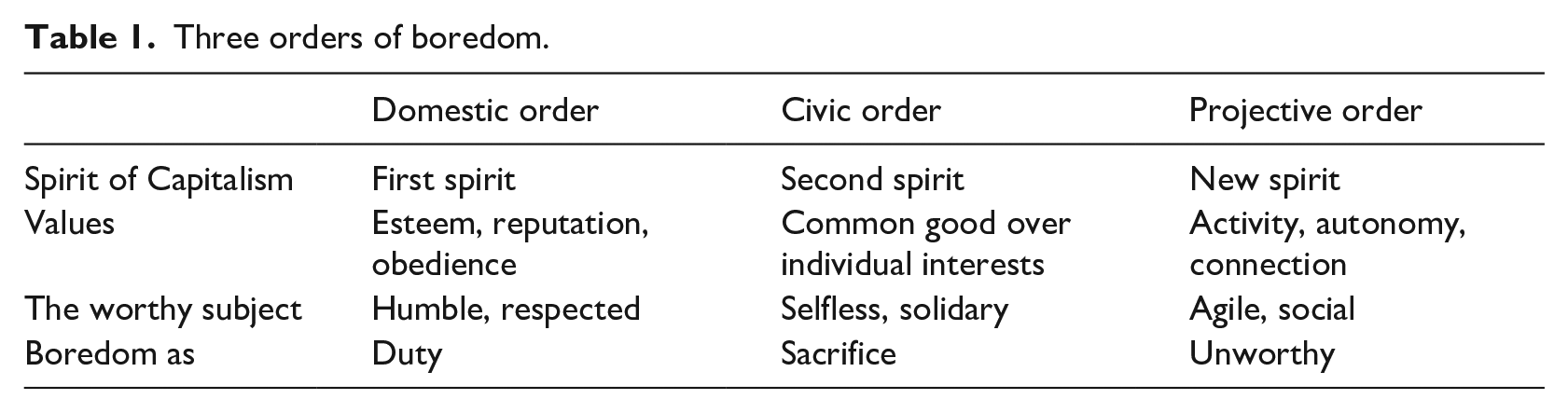
The spatial proximity, concern for one’s status in the local community, and sense of duty of the domestic regime is in many ways the polar opposite of the disembedded and mobile independence of the projective regime. When justified within the domestic order of worth, boring tasks are seen as a duty and related to the damaged reputation of the financial sector with its concomitant loss of personal pride. Thus, domestic boredom is experienced by the humble and respectable banker-self who displays worth through personal introductions at social gatherings. As such, this identity is closer to the “local financial service provider” of yore “. . .whose reputation builds on social capital embedded in enduring relationships with and between long-term employees and customers in the local community” (Tempest et al., 2004: 1531).
Finally, the civic order of worth, which Boltanski and Chiapello (2005a: 18) relates to the large bureaucracies of the Second Spirit of Capitalism, ascribes value to acts of putting the general interest ahead of particular personal interests. When the bankers draw on this order, the boredom associated with the increasing number of administrative tasks is justified as a sacrifice. Such sacrifice is related to the identity of the selfless banker who acts in the interest of the common good. This identity of the sacrificially bored banker who is willing to suffer through tedious administrative work in an attempt to pave the way for a more responsible and less greedy financial sector ascribes positive meaning to experiences of boredom, even as the experiences themselves remain meaningless. Thereby, the individual may transcend negative public images of the banking sector as well as personal experiences of boredom when performing the administrative tasks of banking to establish and sustain a moral identity as the selfless and solidary banker.
Concluding discussion
Having related our informants’ efforts to justify their boring work with the three different orders, we turn to discussing how these findings contribute to the study of boredom at work. First, we detail the interrelations between the meaninglessness of boredom and the rehabilitation of meaning offered through justification. Second, we point to the productive and, potentially, reformatory potentials of boredom that arise from this type of identity work.
Boredom and justification
As shown in the analysis, the experience of boredom tends to prompt justification, as it does not match the dominant account of what it means to be a retail banker. Conrad (1997: 474) has described boredom as “a failure of expectation,” and Carroll et al. (2010: 1035) note how boredom emerges in the gap between dominant discourses of stimulating work, on the one hand, and lived experiences of understimulation, on the other. Faced with such discrepancies, our informants work over time to justify what they do.
While the dominant approach to boredom at work has been to view it as an individual emotional state (Louikidou et al., 2009 ; Vodanovich, 2003), more recent studies have, instead, explored the social origins of boredom and the ways in which its construction is shaped by wider structural forces (Caroll et al., 2010; Costas and Kärreman, 2016). Combining notions of identity work with pragmatic sociology, we position ourselves within the latter approach—with a few central caveats. Importantly, pragmatic sociology proclaims the necessity of moving “from a critical sociology toward a sociology of critique” (Boltanski and Thévenot, 1999). This dictum designates a break with a critical sociological enterprise that aims at revealing the ideological power structures of the social world in favor of a sociology that studies what ordinary actors actually say and do. As such, this approach seeks to reduce the asymmetry between the researcher and the actor under study by opposing any idea of a position of exteriority from where the all-seeing researcher can transcend the social body and reveal the true state of its being, which the actors themselves are unable to recognize (Boltanski, 2011). This, crucially, is “not so much a matter of dumbing down the research as of acknowledging and describing the critical competencies of everyday actors” (Herup Nielsen, 2018: 49).
For the study of boredom, this implies that we must take actors at their word when they say that they are bored—and detail how they say it. Hence, instead of investigating the social origins of boredom or how it is produced by discourses and structures of power, we shift our focus to how actors critique and/or justify their experiences of boredom in and through their identity work. As such, this study contributes to the organizational study of boredom through its exploration of justifications of experiences of boredom ex post. Existing research has already shown that experiences of boredom in contemporary knowledge work require some kind of identity work on the part of the bored subject (e.g. Costas and Kärreman, 2016). We contribute to this literature by contending that such identity work may involve justifying the worth of one’s work identity in light of the experience of boredom, which is often misaligned with dominant projective ideals of agility, self-actualization, excitement, etc. It is this justification of boredom that becomes observable by applying concepts of pragmatic sociology to practices of identity work.
If we understand the experience of boredom as “. . .the loss of meaning in the everyday activities that make out the fabric of a meaningful life” (Johnsen, 2016: 1410), justifying boredom can be seen as an attempt at rendering meaningless activities meaningful (see e.g. Bailey et al., 2019). The changing worth of boredom—from unjustifiable in the projective order through justified in the domestic order to a justification in and of itself in the civic order—shows the variations in these attempts. In the extreme, boredom can itself become a justification; used to defend one’s work identity against more serious attacks. If one has to choose, the boring, but respectable or solidary banker identity seems preferable to the exciting, but morally dubious identity of the bankster. Here, boredom is justified; a hallmark of worth that is meaningful precisely because it is tedious. This runs counter to most research on boredom in which the experience of boredom is typically found to be problematic and unwanted by those experiencing it (e.g. Caroll et al., 2010; Costas and Kärreman, 2016; Louikido et al., 2009
Applying the framework of pragmatic sociology to explore the various justifications for boredom points toward a more general desire for worth in the form of a “virtuous” or “positive” identity (Dutton et al., 2010; Roberts and Dutton, 2009), implying a move beyond the study of boredom toward a more general application of pragmatic sociology in identity work. For now, however, we focus on the issue of whether and how the constructive revaluation of boredom may hold potential beyond the individual banker’s justification of their professional identity—that is, could the identity of the boring banker become a vehicle of reform?
Domestic and civic boredom as drivers of reform?
Pragmatic sociology sensitizes us to the normativities and critical capacities of the actors under study, meaning we must take their justifications seriously. In an effort to do so, we end this paper with a consideration of whether and how the discrepancies between the norms and “moral expectations” (Boltanski and Thévenot, 2000) of the bankers, on the one hand, and their actual work life, on the other, can offer up alternative interpretations of the world that may contribute to making “reality more fragile” (Boltanski et al., 2014: 581). Given that the role of the critical scholar in pragmatic sociology is to “make visible and support contestations that are always-already happening” (Nyberg and De Cock, 2019: 703), we explore whether our bankers’ constructions of a worthy identity that does not conform to the dominant narrative of agile subjects, working in mysterious, fast-paced financial abstraction, holds the potential for “boring reform.” In the analysis of “the mundane quality of the mundane” (Miyazaki and Riles, 2005: 321) in the work lives of Danish retail bankers, we find that while the dominant societal narrative of agility and financial abstraction is present, it is neither the only nor the prevailing account. Rather, other justifications are more frequent, suggesting a multilayered field of normativity within which the bankers can enact their identity work. In so far as our study tempers dominant accounts of the superior bored self as an “arrested identity” “that drains individuals from drives to mobilize alternative selves” (Costas and Grey, Kärreman, 2016: 62), the question is whether the normative yardsticks applied by the retail bankers themselves present viable alternatives—specifically, when their justifications take the forms of domestic and civic boredom.
As aversion toward boredom has helped spur on the New Spirit of Capitalism (Boltanski and Chiapello, 2005a; Sennett, 1998, 2007), embracing boredom might offer hope for reform. Hence, the boredom associated with meticulously bureaucratic and repetitive tasks can hardly co-exist with an agile identity where bankers understand themselves as incarnations of the market (Ho, 2009). Boredom (particularly in connection with traits like humility and sacrifice), then, should not be dismissed as a source of reform, given the current configuration of the financial sector. In this regard, the emphasis on trust and local communities expressed by the bankers when justifying their boredom through the domestic regime might be interpreted as a corrective to the disembedded “slash-and-burn expediency” (Ho, 2009: 6) of projective boredom. However, the domestic notions of “duty” and “obedience” all but foreclose the emergence of new identities beyond the parameters of the dominant order. Hence, domestic boredom provides a potential corrective to projective boredom, enabling a deeper acceptance of boring administrative tasks as a necessary duty, but it does not present any alternative beyond acceptance of the present.
Civic boredom, to the contrary, goes beyond such acceptance and holds more potential to alter the status quo. With its emphasis on solidarity and sacrifice of personal interests in the name of the common good, the civic order seems incompatible with a key component of the quintessential banker identity—and even the neoliberal subject as such (Foucault, 2008: 226)—namely the notion of autonomous self-interest (Alvesson and Robertson, 2016; Ho, 2009). From the greed of Wall Street’s Gordon Gecko to the interpellation to continuously maximize one’s employability in the projective order (Boltanski and Chiapello, 2005b: 166), acting as an autonomous agent on behalf of oneself seems to be a condition of possibility for identity formation. Here, the bankers who justify their boredom through the civic regime offer an alternative performance of identity work that not only makes boredom bearable, but (re-)establishes the responsible, transparent, accountable subject as an attractive identity position.
When considering the alternative potentiality of domestic and civic boredom, the fact that their concomitant identities are constructed from old and familiar normative orders, as opposed to radically new imaginaries, might give us pause with regard to the value of the alternative they offer. However, the fact that the moral expectations on which these potentially alternative identities draw have already been identified as historically robust and enduring orders of worth does not rule out the possibility that something new can emerge from their reenactment in specific social contexts. Hence, inquiring into the normative yardsticks used by the bankers themselves suggests that we should not dismiss the reformatory potential of boredom. Rather, accepting boredom may become a stronger strategy for more foundational change than it lets on. Realizing this potential, however, demands a shift in the identity work of academics as well as of practitioners; we all need to accept that not only are there justifications for boring work, but sometimes boredom is the very justification of work, as the bored self sacrifices immediate meaningfulness in the service of the greater common good.
Footnotes
Funding
The author(s) disclosed receipt of the following financial support for the research, authorship, and/or publication of this article: The research for this article was carried out as part of the AlterEcos-project, funded by the Velux Foundation. Grant number 00013146.

Notes
Author biographies
Erik Mygind du Plessis is an Associate Professor at the Department of Business and Management, at the University of Southern Denmark. His research interests revolve around the ways in which organizational subjects are constituted through dynamics of power and resistance, and he has studied phenomena such as self-help books, whistleblowing hotlines, mindfulness meditation, and informal resistance. His work has been published in journals such as Human Relations, Theory, Culture, and Society and Scandinavian Journal of Management. [ Email:
Sine N Just is a Professor of strategic communication at the Department of Communication and Arts, Roskilde University. Sine was the principal investigator of AlterEcos: Exploring alternatives to currently dominant forms of organizing, and she currently heads Algorithms, Data, and Democracy, a 10-year research and outreach initiative that explores technological and institutional issues of public trust. Sine works at the interdisciplinary nexus of organization and communication studies, and her work has been published widely in international scholarly journals of these fields; for example, Organization Studies, Human Relations, Communication Theory, and International Journal of Strategic Communication. [ Email: