



Abstract
How can actors use the future to politically navigate moral disputes today? This article examines how projected futures are constructed and mobilised to suspend present-day moral dilemmas. Utilising the Economies of Worth and Barbara Adam’s sociology of time, we discursively analyse the moral dilemma between civic virtues and financial savings in UK healthcare austerity (2010–2018). This reveals how the pro-austerity government avoided moral scrutiny of their posited solutions to apparently intractable moral struggles using future projections we term ‘promissory futures’. Promissory futures project desirable futures that ambiguously seem both secured enough to be reliable, and open enough to escape today’s moral dilemmas. Thus, government could use them to shift the temporal focus away from present-day moral critique of how they were balancing austerity’s financial savings against civic virtues, and into a future where savings and civic virtues were compatible. However, promissory futures contain a contradiction: the future cannot be both already-secured and still-open. Thus, critics could eventually deconstruct promissory futures, requiring government to repeatedly reconstruct them. There thus emerges less a definitive moral settle-ment and more a continual process of moral settl-ing, whereby a series of promissory futures together forestall critique of underlying settlements, thus delaying moral struggles’ denouements.
Keywords
Introduction
The path to lower cost is the same as the path to safer care. (Hunt, 2014, UK Health Secretary)
The COVID-19 pandemic has repeatedly highlighted the understaffing and underfunding of health systems, particularly those like the UK’s (Ham, 2023). However, this legacy of the prior decade’s sweeping austerity policies was predictable, with quality indicators plummeting (Nuffield Trust, 2022) and warnings that finance was being prioritised over healthcare rights (Lister, 2010). These policies’ maintenance owed much to justifications like that quoted above: rather than addressing contemporary trade-offs between cost and quality, Hunt shifts the temporal focus, invoking an imagined ‘path’ to a future in which those once conflicting goals will align. Yet how did such questionable future projections help render austerity morally acceptable in the National Health Service (NHS), which UK citizens hold so dear (Buzelli et al., 2023)? We investigate how future projections are mobilised to shape moral struggles and to seem to resolve today’s intractable moral dilemmas.
Scholars increasingly recognise moral values’ importance in sustaining organisations, markets and policies (Demers and Gond, 2019; Morrell, 2006; Shrivastava and Ivanova, 2015). Equally, they highlight the ubiquity of moral pluralism and thus the need for ongoing (re)negotiation of the balance between values (Gond et al., 2016; Patriotta et al., 2011; Reinecke et al., 2017). Studying discursive moral struggles over major social issues has thus emerged as a key strategy for researchers investigating how moral questions shape organisations and society (Cloutier and Langley, 2013; Lemasson, 2017; Patriotta et al., 2011). For elucidation, scholars have drawn on the Economies of Worth (Boltanski and Thévenot, 2006), which is particularly valuable in explaining the dynamics of colliding moral worlds and how settlements – agreements that combine multiple moral worlds – are crafted.
However, moral struggles also have temporal dimensions, as shown by studies where temporality and morality intertwine (Nyberg et al., 2018; Reinecke and Ansari, 2015). In particular, sympathetic visions of the future may be mobilised to bolster corresponding moral positions in the present (Slawinski and Bansal, 2015). Scholarship about the future recognises this capacity for projected futures to shape events today – regardless of whether those futures ever occur (Beckert, 2016; Hernes and Schultz, 2020; Mische, 2009, 2014; Tavory and Eliasoph, 2013). The political process through which certain projections of the future come to influence the present (Oomen et al., 2022) may thus powerfully shape moral struggles.
Inspired by this and writing on the sociology of time (Adam, 2008, 2010), we investigate how actors might strategically deploy different forms of future construction to politically navigate today’s apparently intractable moral dilemmas. Thus, we analyse the discursive strategies adopted in the policy debate over UK healthcare austerity, 2010–2018 (Morrell, 2006; Morrell and Hewison, 2013). We draw on the Economies of Worth (Boltanski and Thévenot, 2006) and conduct an extensive discourse analysis of government, media and related texts. This reveals how government consistently tried to justify that market values and the civic values associated with the NHS could be reconciled by discursively projecting futures in which these once-opposed moral values aligned. These futures depicted compelling scenarios wherein money is saved without cost to quality – based on improving first process efficiency, then organisational management, then interorganisational collaboration. This highlights how actors – here the government – deploy projected futures to render plausible settlements of moral struggles that appear intractable in the present. Critique of such settlements is thus averted by projecting into the future their posited resolutions of today’s moral dilemmas.
We theorise such future projections by drawing on Adam’s (2008, 2010) distinction between two ways of seeing the future: ‘already existing’ (secured and guaranteed) or ever-pliable (open and unconstrained). This helps us identify an important characteristic of the future projections we encountered: they appear secured enough to be reliable, yet somehow also open enough to be of boundless potential. To denote such projections, we use a double-meaning in the word ‘promise’: these futures seem both ‘promised’ (that is, ‘guaranteed’ or ‘secured’) and ‘promising’ (in the sense of ‘having great potential’). We thus term them ‘promissory futures’, denoting their security (Vint, 2019) and potency. This combination of security and potency enables actors to use promissory futures to cast as assured potentially unlimited future achievements, making today’s trade-offs between contrasting moral goals seem unnecessary. However, as the future cannot truly be both secured and open, promissory futures are eventually bound to break. Yet if continually reconstructed, they can still help actors evade present-day moral scrutiny (here, of austerity policies) by projecting moral settlements forward in time.
By highlighting this possibility, we point to previously unidentified temporal dynamics of moral struggles and the significance of temporary moral settlements. First, we contribute the concept of promissory futures through which actors can engage in temporal sheltering; they shelter posited settlements from critique by effecting a temporal shift that defers moral struggles and projects their resolution into the future. Second, while most future-making research focuses on the construction of future projections (Bansal et al., 2022), we highlight how actors strategically reshape them to politically navigate the present, creating a recursive cycle. Third, we foreground a process view of moral settling: despite repeated failed settlements, a series of promissory futures were highly consequential as their ongoing reconstruction helped sustain a decade of austerity policies. These contributions point to actors’ capacity to act on moral struggles in the present by repeatedly reshaping the future.
The ‘future’ in moral struggles
Moral struggles in organisations
Recent research documents the plurality of moral values in modern organisational and institutional life (Denis et al., 2007; Hitlin and Vaisey, 2013). Inside organisations, actors must negotiate multiple moral values – accounts of the goods to which we should aspire – to maintain increasingly hybrid arrangements (Demers and Gond, 2019; Gond and Leca, 2012; Reinecke, 2010). Meanwhile, scholars note organisations’ roles in outward-facing, field-level legitimacy struggles (Lemasson, 2017; Patriotta et al., 2011; Reinecke et al., 2017). Accordingly, moral struggles have become a key site of study. The Economies of Worth perspective, which highlights the ubiquitous, unavoidable plurality of moral orders or ‘orders of worth’ (Boltanski and Thévenot, 2006), has been especially valuable in examining such struggles (Cloutier and Langley, 2013). Distinctively, this approach sees actors as drawing on multiple socially acceptable moral principles (‘worths’) to justify their standpoint.
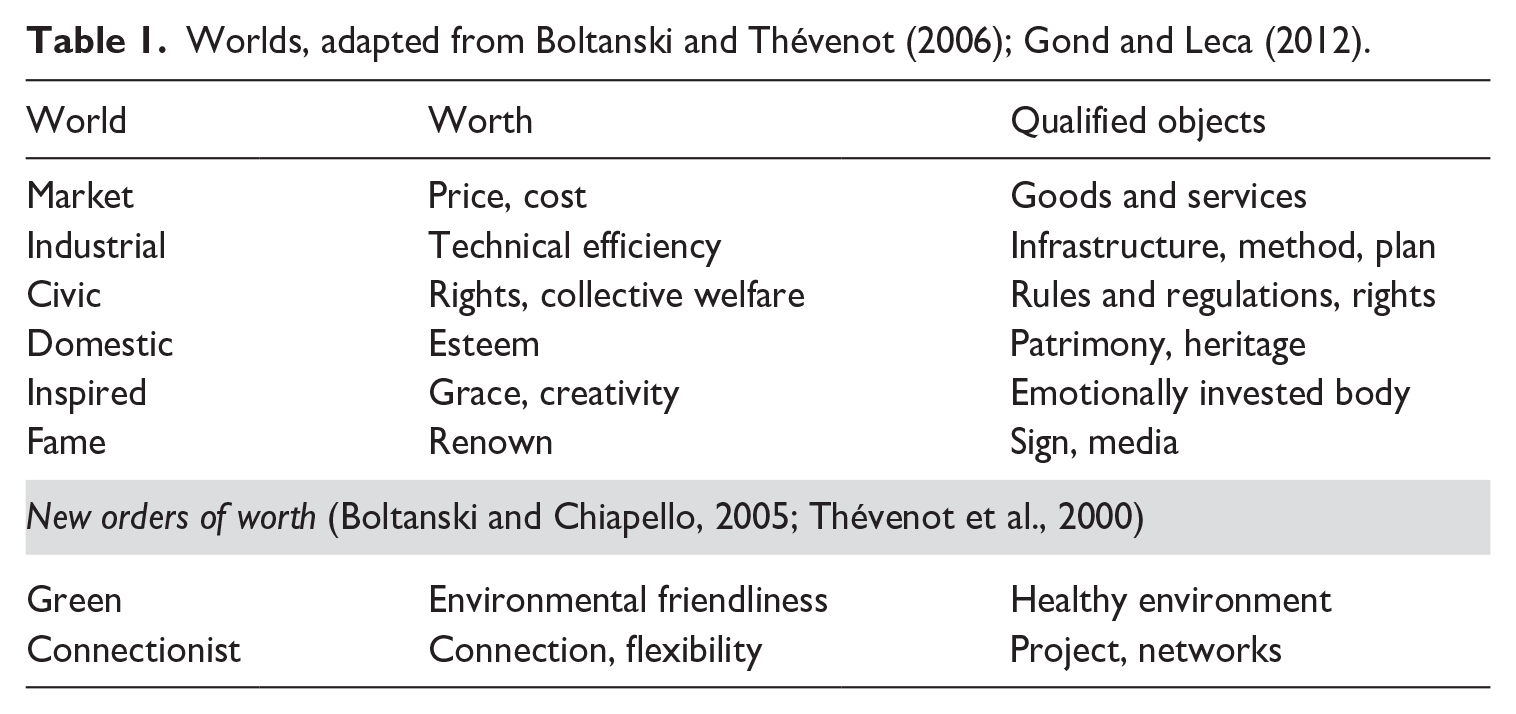
Worths are deployed in moments of evaluation (‘tests’) through a process called ‘justification’. Tests require evidence to evaluate how well a person or thing corresponds with the relevant worth; this is measured using socially accepted tools termed ‘qualified objects’. For instance, if evaluating something according to the market worth, which prioritises financial value, actors might use a profit-and-loss chart. Qualified objects solidify otherwise ephemeral worths by rendering them concrete and temporally stable (Thévenot, 1984). Collectively, established clusters of worths and objects are known as ‘worlds’ (see Table 1).
Worlds, adapted from Boltanski and Thévenot (2006); Gond and Leca (2012).
This pluralism engenders moral disputes requiring settlements between worths. Yet these combinations of contradictory principles are fragile and most enduring when not scrutinised too closely (Cloutier et al., 2017). Settlements are vital to maintain legitimacy, and scholars increasingly study how they are sustained (Patriotta et al., 2011; Reinecke, 2010). For example, a settlement between two worths can be bolstered by creating an object that enables evaluation according to both, helping solidify the compromise (Boltanski and Thévenot, 2006). Otherwise, a settlement may be maintained by defining it against alternatives (Reinecke et al., 2017) or ‘sheltering’ it from critique by using a third worth to validate and navigate between the worths in a settlement, thus preventing it being tested (Demers and Gond, 2019).
Research details the various strategies and social forces shaping settlements’ efficacy. Gond et al. (2016) examine power’s role in a fracking controversy, while Thévenot (2002) explores the role of space in moral disputes. Others highlight how texts become sites of moral argument (e.g. Chiapello and Fairclough, 2002). As these studies show, such research is vital because moral disputes and their settlements intersect with other social forces.
Moral struggles and the politics of the future
One less examined yet potent social force intersecting with moral disputes is temporality – ‘the negotiated organizing of time’ (Granqvist and Gustafsson, 2016: 1009) – particularly future temporality (Butler, 2016; Quattrone and Hopper, 2005; Wenzel et al., 2020). Temporal rhythms normatively imply what ‘should’ happen next (Reinecke and Lawrence, 2023; Southerton, 2020); projected futures can be value-laden (Bansal et al., 2022); and moral compromise can mean reconciling contrasting futures (Slawinski and Bansal, 2015).
This points to the potential for actors to strategically mobilise the future within moral struggles. Contemporary research highlights organisational actors’ active, strategic role in shaping the future. Oomen et al. (2022) describe ‘the politics of the future’ – the social deliberation through which certain visions of the future come to influence the present. These politics can both operate on a grand, societal scale (Augustine et al., 2019) or ‘silently’ shape individual organisations’ dynamics (McGivern et al., 2017). Thus, the future emerges not as a static backdrop but a dynamic force to be actively managed to construe events and actions in particular ways to achieve strategic objectives (Bansal et al., 2022; Reinecke and Ansari, 2015). While the future may be deployed in adversarial mode, revealing new potential futures may also foster coordination (Söderlund and Pemsel, 2022), pointing to the possibility that they could be strategically deployed to reconcile moral disputes.
This emphasis on actors’ ability to strategically shape future temporality echoes wider trends in how research conceptualises the future. First, rather than something ‘given’ to be discovered (as if already extant), contemporary theory conceptualises the future as ‘a state of potentiality’ forged through the active processes of organisational actors (Halford and Southerton, 2023; Hernes and Schultz, 2020; Mische, 2014: 438). This research thus points to ways actors actively construct the future – such as ‘future making’: a process of inquiry whereby actors use discursive and material artefacts to create the future (Comi and Whyte, 2018).
Second, scholarship on the future has emphasised that behaviour is not only the result of past patterns and histories but also profoundly driven by prospective images of the future (Emirbayer and Mische, 1998). As Beckert (2013: 325) highlights, this is highly visible in today’s deeply abstract financialised economy, which rests on imagined futures and ‘fictional expectations’ as the basis on which market participants operate. Future economic growth, for instance, underpins investment decisions today. Thus, even if the future is unknowable, the ‘imaginative experimentation with projected courses of action’ involved in its construction shapes decisions today (Mead, 1932; Mische, 2009: 697, 2014; Tavory and Eliasoph, 2013).
In line with this, some scholars investigate ‘future imaginaries’ (Dries et al., 2023): ‘deep cultural structures . . . that form the pervasive and often unarticulated backdrop to more tangible knowledge, norms, and institutions’ (Augustine et al., 2019: 1936). Others investigate more quotidian futures. Drawing on the phenomenology of Schutz (1972) alongside cognitive and social psychology, Mische (2009, 2014) conceptualises ‘future projections’. In this view, agential action relies on some vision of the futures that said action may enable (Emirbayer and Mische, 1998). These ‘projections’ are thus often more tentative and fragmentary than all-encompassing ‘imaginaries’ but are central to our agency and ability to foresee and enact change (Seligman et al., 2013). Thus, they may in fact help amend the deep cultural structures that imaginaries undergird: yet both concepts recognise that how we see the future shapes the present. For instance, imagining a future in which geoengineering mitigates the climate crisis may reduce our reluctance to pollute today (Augustine et al., 2019). Similarly, employees project imaginary future selves to escape the constraints of, and cope with, their present working lives (Costas and Grey, 2014). Yet so far, studies focus on how such fictive representations are constructed, often through future-oriented narratives (Dalpiaz and Di Stefano, 2018; Dalpiaz et al., 2016), rather than how they are mobilised to shape the present.
Recognising how projected futures can shape the present points to the importance of how we conceptualise that future. Adam (2008, 2010) suggests two ways of doing so: what she calls a ‘present future’, or a ‘future present’. The difference is one of perspective. A ‘present future’ is the future seen as if looked forward to from the present. With time before it arrives, this future remains open; thus, it is not yet secure, but is full of possibilities: ‘a space of pure potential’ (Adam, 2008: 113). Conversely, a ‘future present’ is seen as if synchronous with the viewer, as if it already exists (like we see the present). This future is secured: it will not change. It thus offers a sense of security, but not the flexible potency of an open future.
Both futures may shape moral struggles in different ways. Adam observes that ‘present futures’ (which for ease of expression we call ‘open’ futures) may lower the stakes of today’s moral debates as future harms remain remediable: if technological advances can remedy climate disasters, today’s environmental choices lose some moral charge (Augustine et al., 2019). Yet equally a ‘future present’ (‘secured future’) could make today’s moral choices seem moot: after all, those choices cannot change what is already fated. Politicians, for instance, can cast policies as inevitable to disavow responsibility for them (Borriello, 2017).
This points once again to the potential for actors to strategically mobilise temporality to shape the future (Oomen et al., 2022; Reinecke and Ansari, 2015). Yet research has only recently begun to consider how actors may utilise conceptions of the future to strategically shape moral struggles. Some consider how specific future constructions can be drawn upon to persuasive effect. For instance, Nyberg et al. (2018) argue that clearly linking the present to imagined futures makes framing more compelling. However, we are yet to explore how actors may politically utilise the way the future is conceptualised to navigate apparently intractable moral struggles in the present. For instance, does it matter whether actors project an open or a secured future? How might this quell or intensify moral struggles? And how can actors strategically utilise this to achieve their goals?
In sum, we combine scholarship on moral struggles and future temporality to understand how imagined futures shape moral struggles in the present. To operationalise our concern with moral struggles, we draw on the Economies of Worth to identify the goods at stake and conceptualise their interactions. We operationalise our concern with future temporality through the concept of ‘future projections’. By invoking projections, we signal agreement with the view that the future can affect the present but acknowledge that – in a moral dispute – the futures we find may be more fragmentary and contested than broad social imaginaries. Thus, we ask, how do actors construct future projections to deal with moral conflict between Economies of Worth?
Case and background
Our study focuses on the case of a moral dispute that also entails prominent temporal concerns: the debate over UK healthcare austerity, 2010–2018. May 2010 saw a Conservative-led government elected on a platform of reducing spending across government, which they titled the ‘age of austerity’ (Cameron, 2009). For them, this was an urgent project: they argued that savings needed to be rapidly made to counteract the 2007–2008 global financial crash and what they saw as excessive government borrowing in its wake. Whereas NHS spending had previously trended upwards to allow for population growth and inflation, spending now fell as a proportion of GDP, sending most providers into deficit (see Figure 1).
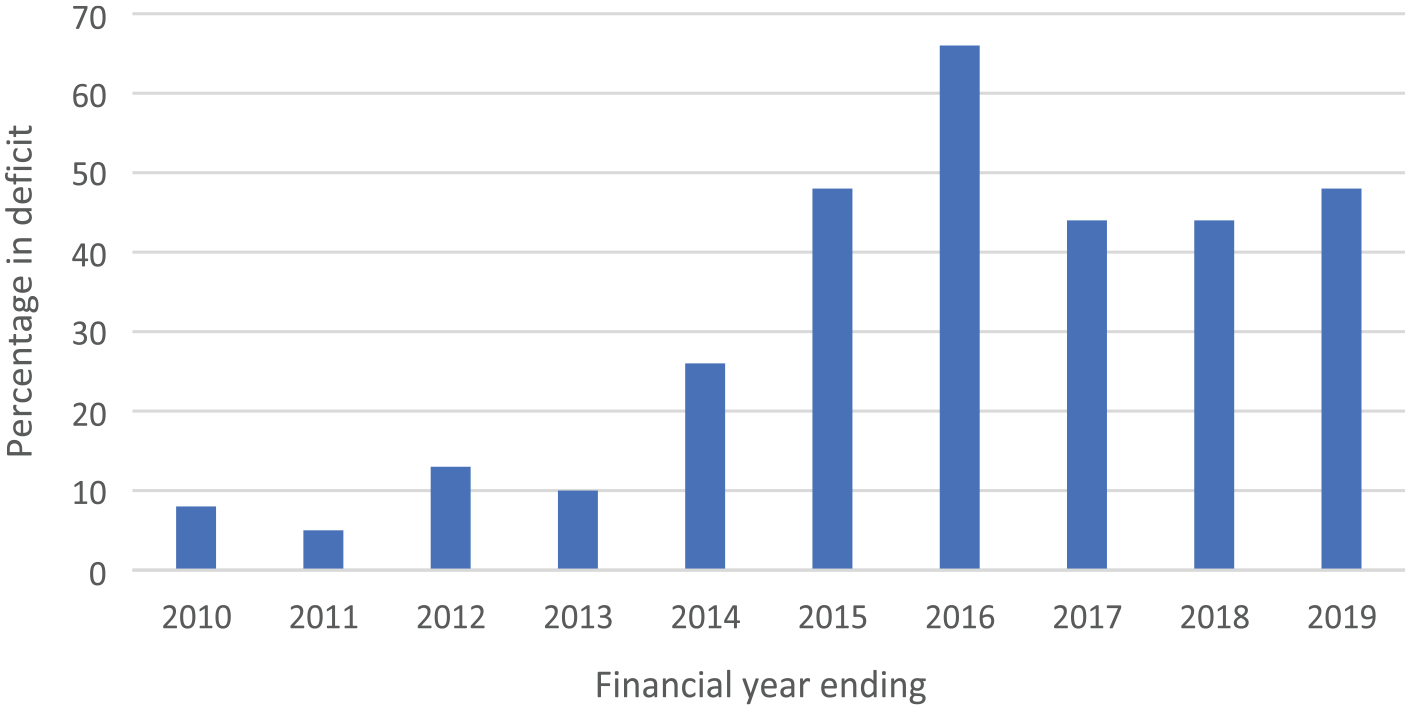
Percentages of NHS providers in deficit (King’s Fund, 2018).
Opposition was vigorous and morally charged. The government argued that the 2007–2008 financial crash necessitated their austerity reforms – an appeal to ‘market’ values (Boltanski and Thévenot, 2006). Yet austerity was controversial in the NHS. Universal, publicly funded and mainly publicly provided, the NHS is a more socialised system than one might expect in the UK. It thus plays a distinctive role in the UK’s moral economy: a ‘civic’ element in an otherwise market system. It remains a key source of civic pride (Buzelli et al., 2023).
Accordingly, these policies sparked opposition from politicians, NHS staff and others. There resulted a moral struggle over whether these policies were right, with market and civic values thrown into opposition. This was risky for the government: seeming to risk the NHS’s principles or quality risked protests and electoral damage (Bramall, 2013). Thus, they maintained that market goals could be reconciled with the civic values the NHS embodied.
We take this controversy as our case for three reasons. First, it was a stark moral dispute, pitting market against civic values. Second, it entailed temporal considerations: the duration of the ‘age of austerity’ and the time horizons of these policies’ consequences were often debated. Third, the recurrent cycle over three Conservative governments allowed us to understand the ongoing reconstruction of promissory futures.
Methods
To address our research question, we examine how the moral dispute was negotiated and the role of future projections therein. In public disputes, worlds are often articulated in language. Following Chiapello and Fairclough (2002), we conceptualise these articulations of worlds as ‘discourses’, which are mobilised in a given context through ‘discursive practices’. Given our interest in not only which discourses were used but also how they were deployed alongside future projections, we explore the discursive practices that activated these discourses and the future’s role therein. To understand how these discursive practices shaped our case’s moral struggle and settlements, we embed this analysis in an overarching ‘temporal bracketing’ strategy (Langley, 1999): an approach that periodises longitudinal data to facilitate cross-period comparison and uncover how events interrelate over time.
Data collection
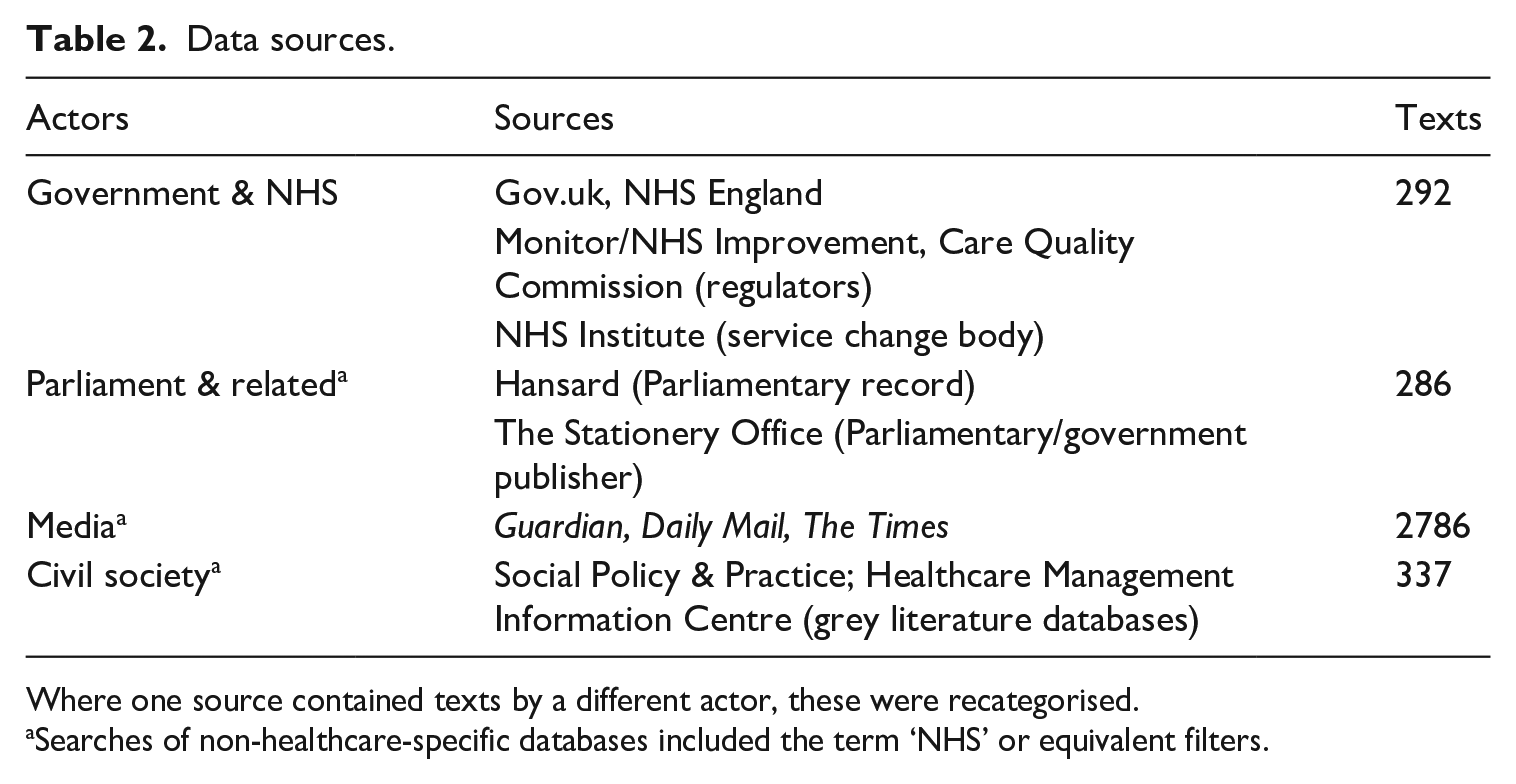
We gathered a large corpus of public texts relevant to healthcare austerity. Long-running, prominent, politicised controversies often involve diverse actors, including government, parliament, media and civil society (Patriotta et al., 2011). To span these actors, we queried several databases for the period May 2010 to April 2018 (see Table 2). We deployed search terms identified by scoping contemporary savings descriptors (‘savings’, ‘efficiency’, ‘productivity’, ‘sustainability’) including names of NHS savings programmes (‘Quality, Innovation, Productivity and Prevention’ (QIPP), ‘Cost Improvement Plan’ (CIP)). After filtering for relevance and duplicates, 3701 documents remained (9.7 million words).
Data sources.
Where one source contained texts by a different actor, these were recategorised.
Searches of non-healthcare-specific databases included the term ‘NHS’ or equivalent filters.
Data analysis
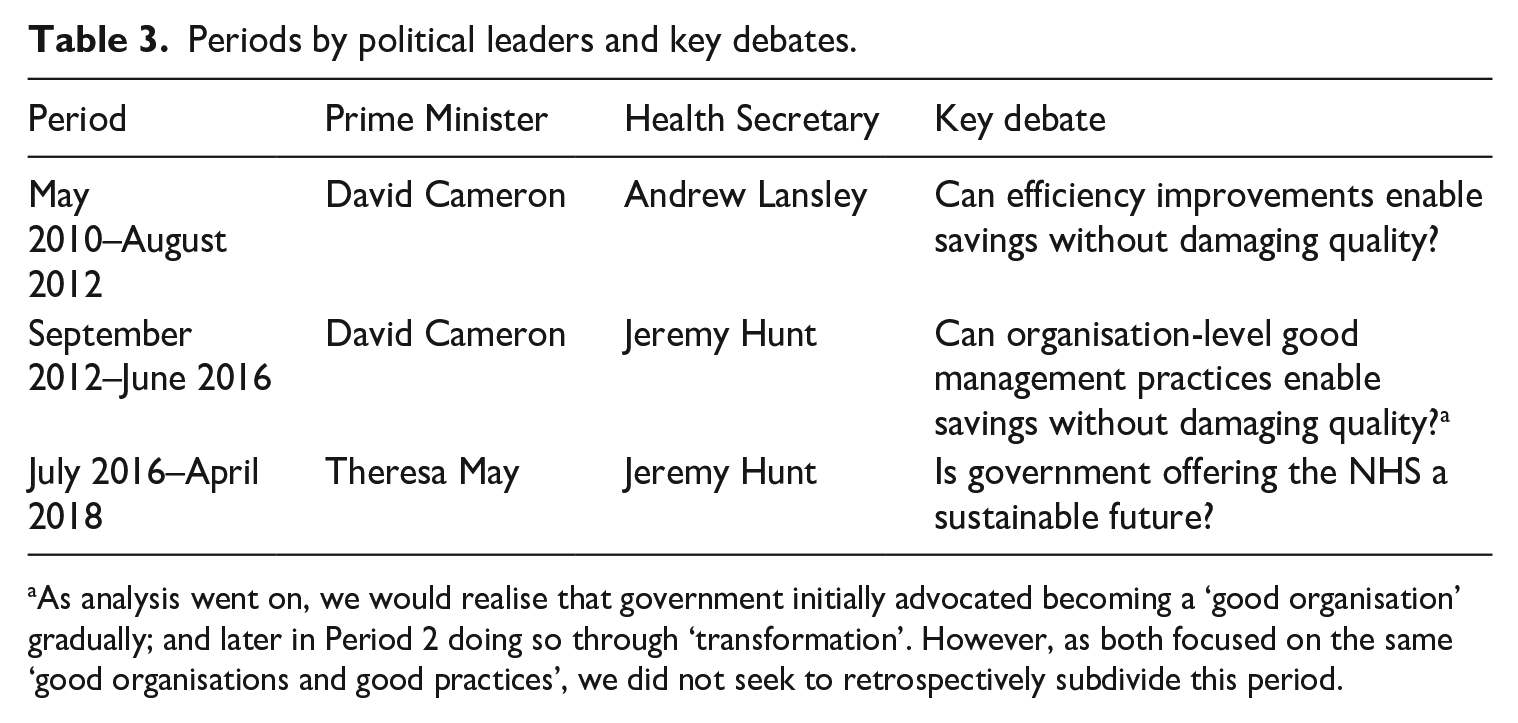
Analysis proceeded in four iterative steps, presented sequentially here for clarity. First, we overviewed the controversy by creating a chronology and prose narrative thereof, using a randomly selected quarter of our corpus. Creating and repeatedly reviewing these accounts, we were struck by the shifting focus of debate, and how these shifts broadly aligned with changes in Prime Minister or Health Secretary. Accordingly, we used these argumentative and political ‘discontinuities’ (Langley, 1999) to periodise our data (see Table 3). This process also highlighted that, across periods, one group (‘Government’) – ministers, departments and central NHS bodies – cast government policies and their combination of market and civic values as viable, whereas the Opposition, unions, think tanks and many media actors (together, ‘Critics’) questioned this.
Periods by political leaders and key debates.
As analysis went on, we would realise that government initially advocated becoming a ‘good organisation’ gradually; and later in Period 2 doing so through ‘transformation’. However, as both focused on the same ‘good organisations and good practices’, we did not seek to retrospectively subdivide this period.
Second, we interrogated each period’s discursive practices. As this necessitated close qualitative linguistic analysis, we purposively subsampled 10 texts per period by reviewing all titles and abstracts. While ensuring varied authorship and publication dates, we selected texts that seemed most relevant to the stories and debates our chronology identified and to healthcare savings overall. To understand which discourses/worlds were deployed in these texts and how, we colour-coded them, guided by Patriotta et al.’s (2011) dictionary of terms related to each world. This highlighted market and civic worths as central, respectively used to support spending reductions and NHS values. First-round coding then interrogated how these and other discourses/worlds were invoked. We scrutinised how each discourse was used, considering factors like topic, context, recurrent terms, metaphors and grammar.
For instance, one code described how government used efficiency-related concepts to envision organisations’ possible futures. These visions were described as if not merely hypotheticals but also actual, present-tense objects. ‘Efficiencies’ or ‘productivity opportunities’ were cast as presently lurking within organisational locations; once ‘identified’ and ‘captured’, they would lower costs without harming quality, obviating today’s moral quandaries. We called this ‘objectifying present efficiencies’. Similarly, we encountered organisational development discourses that envisioned better futures, again cast as present-tense objects. Here, ‘good practices’ were cast as easily adopted entities, which could improve organisations’ generic management capabilities. Through them, hospitals could improve both quality and cost at once. We coded this as ‘constructing good organisations and practices’.
Second-round coding clustered first-round codes into more abstract discursive practices, drawing on the Economies of Worth (Boltanski and Thévenot, 2006), Adam’s (1990) sociology of time and Demers and Gond’s (2019) concept of ‘sheltering’. For instance, we noticed that both codes discussed above described the use of desirable futures in which today’s moral dilemmas would be resolved to avoid moral critique today. We clustered them into a discursive practice titled ‘sheltering settlements with promissory futures’. Especially resonant here was Adam’s (2008) distinction between secured and open futures. It pointed to a striking feature of these ‘promissory futures’: they seem to orient to both secured and open futures at once. Represented by present-tense objects, they seem to already exist, making them seem secured; yet they also seem to offer open futures unfettered by the constraints demanding moral trade-offs in the present. Adam’s insights thus became central to how we conceptualised future temporality, helping us to develop the concept of the ‘promissory future’: a future projection that (1) appeared to avoid otherwise troubling moral questions by seeming (2) secured enough to be reliable, yet (3) open enough to escape today’s moral quandaries. Specifically, we found texts projecting promissory futures in which trade-offs between market and civic worths became unnecessary. As we found further related discursive practices, promissory futures grew central to our analysis.
Third, we used corpus linguistic techniques as ‘checks and balances’ to ensure these discursive practices were representative of the wider corpus (Mautner, 2015), but not simply characteristics of general English. This involved identifying linguistic patterns typifying our discursive practices and checking if they were (a) common across the corpus or subsection thereof in question, but (b) different from the British National Corpus. For instance, when examining the data eventually coded as ‘constructing good organisations and practices’, we were initially struck simply by the prevalence of forms of ‘good’. Yet we soon realised that this was not overwhelmingly greater than in the British National Corpus. We thus refined our perspective, scrutinising what was described as good and so identifying the ‘good organisations and practices’ noted above. By testing and refining in this way, we settled on the four discursive practices described in Table 4 and exemplified in Online Appendix 1.
Discursive practices.
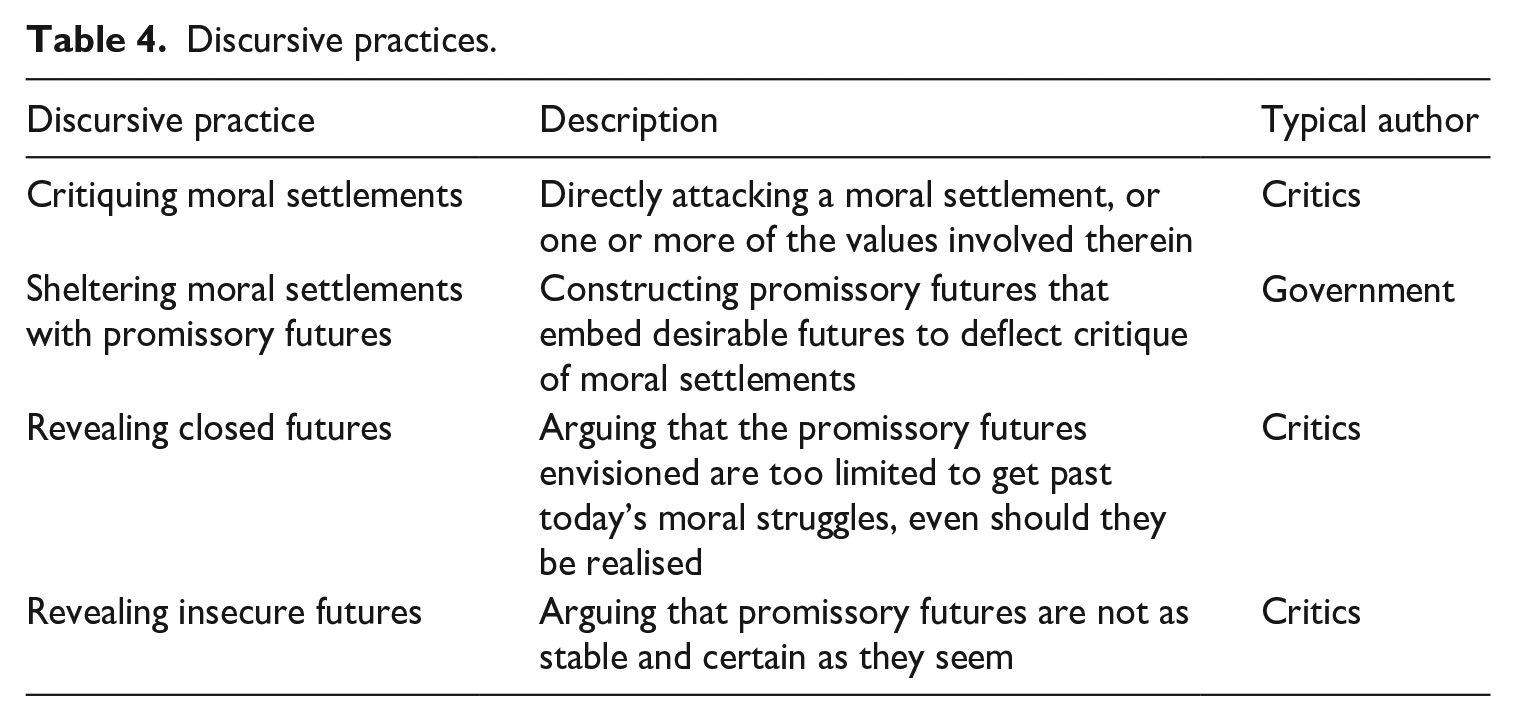
Finally, we further operationalised our temporal bracketing strategy to affirm and develop our theoretical understanding of these discursive practices; and to learn how they shaped the wider controversy. Period-by-period, we scrutinised our discursive practices to develop theoretically informed hunches about how they operated and interacted. We then interrogated these by treating our periods as ‘comparative units of analysis’ (Langley, 1999) to see if posited theorisations identified in relation to one period held in others. Where they did, this bolstered our confidence; otherwise, we returned to our data and reconsidered.
Simultaneously, we examined how discursive practices longitudinally shaped the ongoing controversy. To interrogate this, we examined in turn each discursive practice in each period. We focused on how each one was affected by its period’s discursive and wider context; and how it shaped the context of the next period (Langley, 1999). This pointed to how certain discursive practices encouraged considerable discursive changes between periods (and during Period 2, moderate changes within a single period). For instance, we noticed how criticisms of one period’s promissory futures seemed to set the scene for the promissory futures constructed in the next, as government tried to avoid the same criticism. Iterating between this approach and cross-period comparisons, we gradually developed a robust account of how actors used promissory future projections to shape moral struggles.
Findings
I’ll cut the deficit, not the NHS. (Cameron, 2009, Conservative Leader, quoted in Campbell and Meikle, 2011)
This famous pre-election slogan of soon-to-be Prime Minister Cameron captures the government’s attempt at reconciling market and civic worth. It highlights the Conservatives’ anticipation of criticism from those who feared that their deficit-reduction plans could lead them to cut NHS spending. This slogan counters such criticisms by contrasting ‘the deficit’ and ‘the NHS’ as alternative sites of ‘cuts’, as if cutting one could avoid cuts to the other. This casts deficit-cutting as compatible with – even helpful to – protecting the NHS. This typifies the government’s strategy: aware that harming the NHS was taboo, they argued that its civic values could be reconciled with a market-world deficit-cutting agenda. In calling this a ‘strategy’, we do not imply it was cynically instrumental: we intend no judgements about whether this or other arguments were made in good faith or bad.
Our findings track the government’s attempts to construct this settlement by projecting promissory futures in which market and civic values appeared to reconcile, as summarised in Figure 2. These promissory futures were ambiguous, seeming secured enough to be reliable, yet open enough to suggest an unconstrained, potent future. This enabled them to project as assured certain future realities in which market and civic worths were reconciled, thus protecting that settlement from critique in the present, as Figure 2’s central column illustrates.
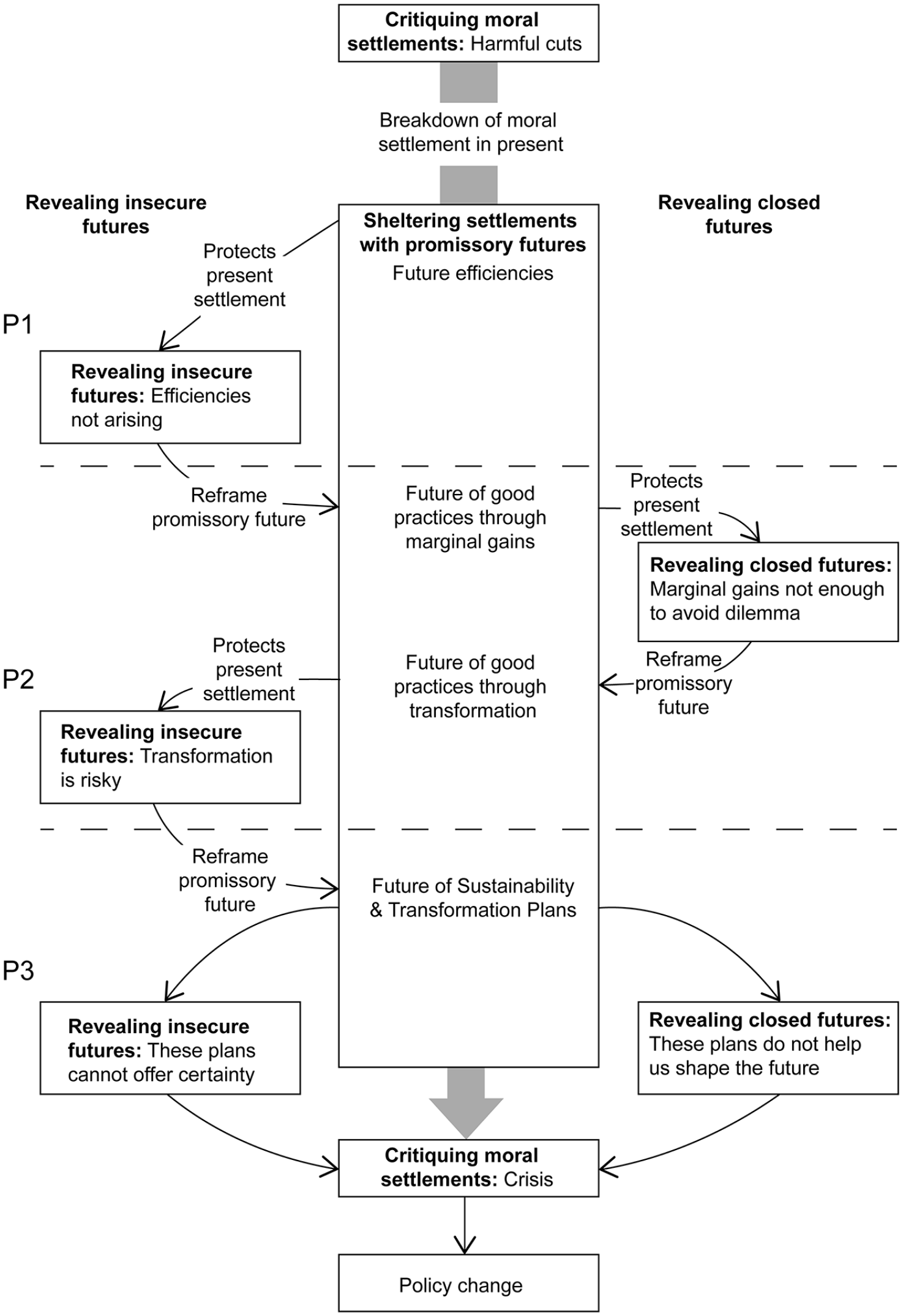
The role of promissory futures in moral struggles.
Yet government could not maintain this for ever: we describe below how promissory futures’ ambiguity masked a contradiction between secured and open futures (Adam, 2008). Thus, critics attacked these futures as either less secured than government claimed (‘revealing insecure futures’), or less open (‘revealing closed futures’). This eventually undermined each promissory future, leading government to amend it. This case thus revealed a cycle of (re)building and defeating promissory futures, as government tried to protect its settlement (see Figure 2). Only when this strategy failed did critique of that settlement return, prompting a softening of NHS austerity. Each section below describes one period of this cycle.
Period 1 (Cameron and Lansley): ‘Efficiencies’
As noted above, the incoming Conservative-led Coalition justified austerity policies by claiming that the market values typifying austerity were compatible with the NHS’s civic values. This section explores how they averted critique of this posited settlement – by projecting a promissory future in which ‘efficiencies’ reduced costs without harming quality. Seeming to calm market–civic tensions, this promissory future grew central to the dispute.
Critiquing moral settlements
In 2010, The Times reported on the conference of the British Medical Association, the doctors’ union and a frequent critic of NHS spending reductions: Hamish Meldrum, chairman of the association’s council, said while doctors accepted that the current climate posed hard decisions for the NHS indiscriminate cost-cutting would cause serious long-term damage. There is a real danger that cutting back on health now will have a long-lasting impact on our ability to maintain high-quality, comprehensive and universal care in the future, he said. (Lister, 2010)
The extract directly highlights the potential moral costs of introducing market values. ‘High-quality, comprehensive and universal care’ invoke the civic world’s welfare and rights-based values, whereas ‘cost-cutting’ and ‘cutting back on health’ pejoratively cast market-oriented actions as jeopardising these civic concerns. Words like ‘cut’, ‘damage’, ‘danger’ and ‘indiscriminate’ – a term usually accompanying words like ‘violence’ – accentuate this sense of moral harm. By early Period 1, this was a prominent concern in the debate, as illustrated by the prevalence of ‘cut’ in non-government texts (see Figure 3). ‘Critiquing moral settlements’ captures direct critiques of the government’s settlement and its moral worths.
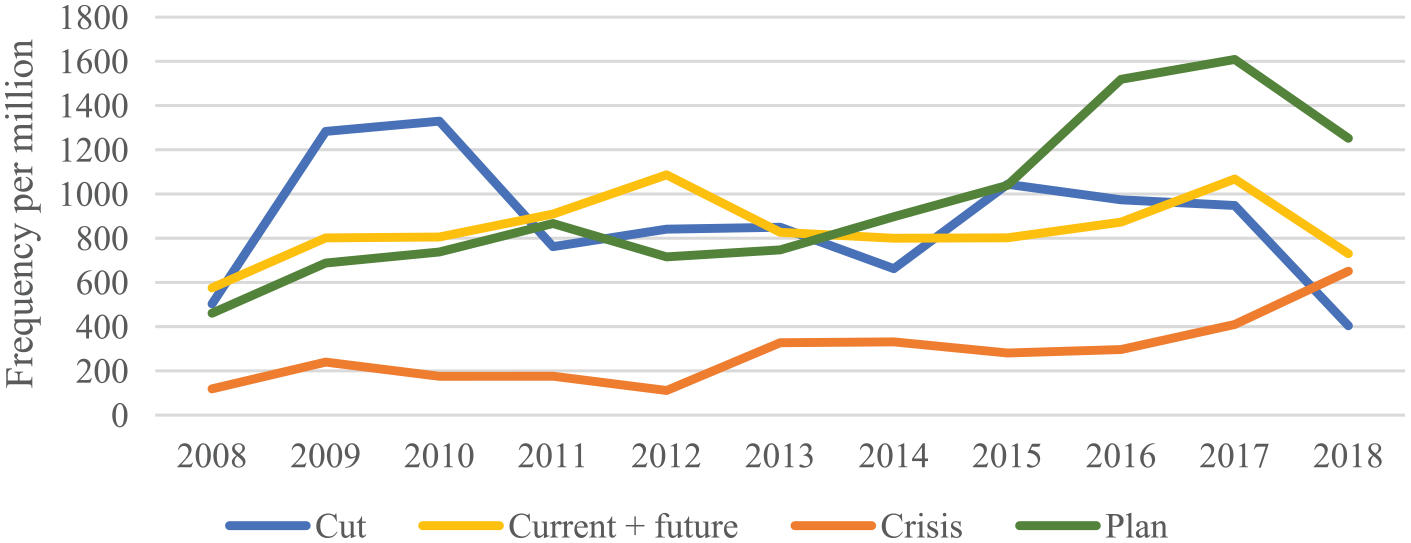
Word frequency in non-government texts.
Sheltering settlements with promissory futures
The government deflected such critiques of the moral settlement underpinning their spending choices in the present by projecting a better future. Organisations could, they argued, offset savings requirements by finding ways to improve costs without harming quality. As this subsection explains, they did so by projecting promissory futures based on ‘efficiencies’ and related concepts.
This argument was typified by Simon Burns, a health minister, in response to a question about the effect of government reforms on healthcare quality: By cutting out
The extract reveals government’s construction of an imagined future that promised to reconcile healthcare quality with cost savings: it contends that by addressing ‘inefficiencies’ – processes with suboptimal input-to-output ratios – unnecessary costs could be excised with no harm to quality. In line with such arguments, government required NHS bodies to make £20b of efficiency savings over five years. This was enforced partly through a so-called ‘efficiency factor’, which reduced remuneration for each operation, consultation or other care process, pressing hospitals to improve those processes’ efficiency. Delivering Sustainable Cost Improvement Programmes (‘Delivering’) was the official NHS guidance on doing so: [Service line reporting] and benchmarking information helps budget holders to identify
In both the quotations above, which exemplify this discursive practice, the underlined terms denote hypothetical futures of improved efficiency. Yet these are acted upon by verbs denoting processes like visual identification or movement (italicised), which (1) usually act on real, physical objects, and (2) presuppose that their objects currently exist in the present: after all, it makes no sense to talk of ‘cutting out’ something non-existent. Thus, while ‘efficiencies’ and related objects denote hypothetical futures, this discursive positioning orients the reader to them as objects existing in the present – that is, how we orient to an ‘already existing’ secured future (Adam, 2008: 112). This helps Burns deflect critique of government policy in the present: he can cast excising ‘inefficiencies’ not as an uncertain hypothetical future, but as the realisation of gains already present within processes today.
But by emphasising organisational agency (the NHS is to ‘find’ savings; staff to ‘identify’ efficiencies so they can be ‘delivered’), these texts also point to a future still-in-the-making, to be shaped by organisations: that is, an open future. Indeed, inciting actors to ‘identify’ something presupposes that it is currently unidentified but extant. Imagining unidentified efficiencies latent within one’s organisation makes it hard to delimit the total efficiencies available: after all, there may always be more out there still to be found. Rather than deliverers of a defined efficient future, organisations are instead cast as explorers of landscapes of as-yet-unidentified efficiencies. This and the emphasis on organisational agency help these texts construct still-unknown open futures, which thus seem of unlimited potential, lending credence to the idea that efficiencies can fill a £20b gap.
The three foregoing paragraphs capture the features of ‘promissory futures’: futures that (1) sidestep today’s moral dilemmas by seeming (2) secured enough to feel reliable, yet (3) open enough to escape the constraints necessitating moral trade-offs in the present. Despite describing not-yet-realised futures, they offer to deflect critique of the moral settlements with which government justifies its spending choices in the present.
This period’s promissory futures centred on efficiency concepts. These were cast as already-existing objects, often by objectifying the property of being efficient into objects like ‘efficiencies’. To test this approach’s prevalence in this period’s government texts, we quantified uses of ‘efficiencies’ as a proportion of all forms of ‘efficient’. The result of 14.78% compared with 1.00% in the British National Corpus was consistent with this discursive practice’s prevalence.
Revealing insecure futures
The construction of promissory futures initially appeased government’s key critics, such as parliamentary committees: cross-party groups appointed to scrutinise policy areas. When the House of Commons Health Committee (2012) investigated the savings programme, its terms of reference were to examine issues including ‘whether the NHS is succeeding in making efficiency gains rather than cuts’. This quotation illustrates two things. First, by contrasting ‘efficiency gains’ with the ‘cuts’ on which moral critique had focused, it implicitly accepts the government’s premise that efficiencies could avoid such morally charged steps. Accordingly, the report focuses on whether said efficiencies were being made, illustrating how even critics came to focus on the promissory future of efficiencies rather than government’s spending choices in the present. In line with this, talk of ‘cuts’ decreased in non-government texts over Period 1 (see Figure 3). Government’s projected future of ‘efficiencies’ sheltered from critique the settlement between market and civic worths that they used to justify policy in the present.
However, the Health Committee’s focus on ‘whether the NHS is succeeding in making efficiency gains rather than cuts’ was double-edged. It also exemplified growing uncertainty about whether those ‘efficiency gains’ would be realised. Indeed, the report later notes: We were concerned to receive evidence which suggested that NHS organisations are according the highest priority to achieving short-term savings which allow them to meet their financial objectives in the current year, apparently at the expense of planning service changes which would allow them to meet their financial and quality objectives in later years. (House of Commons Health Committee, 2012)
The extract is structured around a series of markers of uncertainty. ‘Suggested’, ‘apparently’ and ‘concerned’ each signal uncertainty about the future, the latter with a strong negative valence. Hedging the report’s claims by only stating that they had ‘receive[d] evidence’ of them emphasises this uncertainty. These uncertainty markers cast the future as considerably less secure than government had claimed. Meanwhile, pointing to a lack of ‘planning’ implies that government’s action in the present may be rendering the promised future less secure still. Contrasting the focus on ‘short-term savings’ in the ‘current year’ with the preparation vital to success in ‘later years’ re-emphasises this tension between short- and long-term futures. Collectively, these discursive choices reframe a future of ‘efficiencies’ that had once seemed assured as in fact dangerously insecure. By pointing to this insecurity, this extract re-opens moral questions about whether both ‘financial and quality objectives’ can be achieved.
This was consistent with the wider corpus. Criticisms both highlighted efficiencies’ insecurity (‘just this side of credible’) and pointed to the aforementioned tensions between the ‘current year’ and the future (‘we fear we are behind the curve’). While this critique began early on, the proliferation of those temporal markers ‘current’ and ‘future’ across Period 1’s non-government discourse (see Figure 3) illustrates its growing prominence. This coincided with efficiencies’ increasing failure to materialise, making a future of ‘efficiencies’ seem more short-termist and, partly owing to this, less secured. By 2012, the House of Commons Health Committee (2012: 16) called for something that sounded more reliable: ‘long-term sustainable change’.
Period 2 (Cameron and Hunt): ‘Good practices’ in ‘good organisations’
During Period 2, government attempted to answer this call by reconstructing promissory futures. Rather than only ‘efficiencies’ within individual processes, they now projected a future in which hospitals became all-round ‘good organisations’ comprising ‘good practices’. Initially, government advocated hospitals achieve this incrementally; yet following criticism of this gradualism, they would instead suggest pursuing it through radical ‘transformation’. Below, we explain how these future projections arose and changed, why we conceptualise them as promissory futures and how they sheltered government’s settlement between market and civic worths from critique.
Sheltering settlements with promissory futures
As in Period 1, government maintained that quality and cost imperatives could reconcile; yet here, the site of reconciliation is not micro-level ‘efficiencies’ but whole-organisational design. This is illustrated in NHS England’s (2014) central strategic document of the study’s duration – the Five Year Forward View: We need to take a longer view – a Five-Year Forward View – to consider
The Five Year Forward View (‘Forward View’) suggests that ‘the best experience for patients’ can be reconciled with ‘the best value for money’. To do so, it argues, one must adopt the right organisational ‘models’ through one’s ‘strategic plans’: simply being generically better run, the argument goes, will both reduce cost and improve quality. Of course, the Forward View does not cast this solution as instant: temporal adverbials (‘faster’, ‘as we introduce them’, ‘in recent years’) and other temporal markers (underlined) project this solution into the future. Nevertheless, the Forward View already committed to further savings, to be delivered by these projected futures. Government then enforced £22b of such savings through strict budgetary targets for individual organisations. The Forward View’s projected futures of better quality at lower cost were used to justify savings in the present.
The quotations above clearly emphasise the openness of these futures. With multiple ‘possible futures on offer’, the future remains ‘emerging’ and subject to the agency of ‘local areas’ through their ‘choices’ and ‘strategic plans’. Once developed, those plans will be ‘evaluat[ed]’ to identify the optimal path. This points to the potency an open, adaptive future can have: without knowing that any one ‘new care model’ will ‘produce the best experience for patients and the best value’, the presence of multiple ‘models’, embodying multiple ‘possible futures’, makes it seem possible to select one that will.
Yet as the final phrase ‘the future is already emerging’ highlights, this is not the full story. Certainly, an ‘emerging’ future is an open ‘realm of pure potential’ (Adam, 2008: 113). Yet ‘already’ casts this future as ‘emerging’ ahead of time. Nor does this future exist in the future, but in ‘places’ in the present. This exemplifies a pattern whereby temporal differences are treated as spatial ones: the ‘new care models’ shaping the ‘future’ exist already in ‘parts of the NHS’ and ‘international’ sites. This lends the future the ‘already existing’ (Adam, 2008: 112) quality of locations in the present, typifying the secured ‘future present’. An ‘already emerging’ future embodies both the openness and the security of a promissory future.
Such projections were common in the texts we qualitatively analysed, typified by injunctions to adopt ‘good hospital management practices’ or other ‘good’ organisational characteristics like ‘good leadership’ or ‘good traits’. To see whether this was replicated across the corpus, we first identified the three commonest terms in our corpus that denoted such broad organisational activities: ‘practice’, ‘management’ and ‘procurement’. Next, we tested for how frequently these terms occurred near forms of ‘good’ (e.g. ‘good practice’, ‘better procurement’). As Figure 4 shows, there was a substantial increase in such phrases in Period 2, consistent with this promissory future’s growing prevalence.
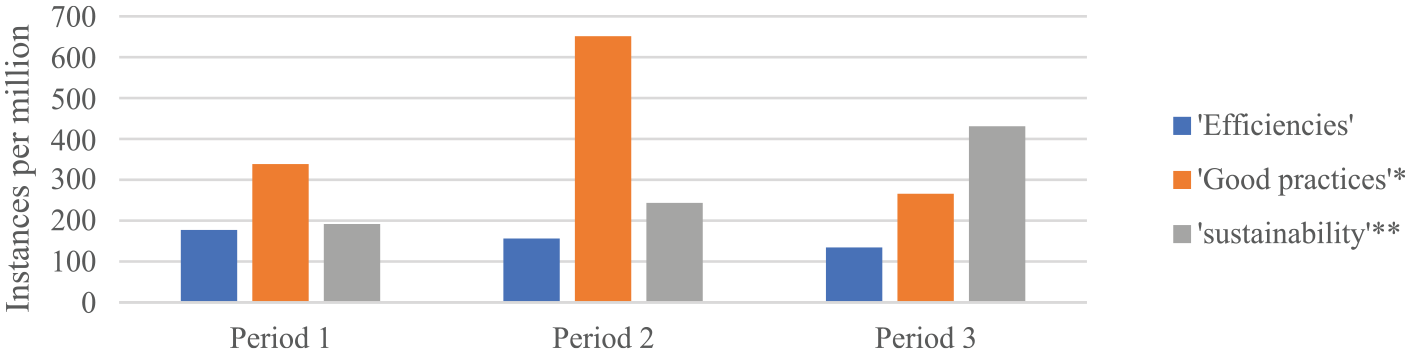
Frequency of key terms related to promissory futures in government and NHS texts.
The government mobilised this promissory future to avert critiques of their posited settlement between civic and market worths and thus of their spending choices in the present. Incoming Health Secretary Hunt (2014) cast a speech titled ‘Good care costs less’ as ‘challeng[ing] head on those who say that the future will be about cost and not quality’: It is one thing to identify lost value, quite another to develop practical strategies to release it. [We should] look at some of the traits shared by organisations that have excelled in improving patient care and eliminating waste. The first is . . . [not] a new big bang approach, but what [is] called the ‘aggregation of marginal gains’.
The ‘good traits’ Hunt incites hospitals to adopt play a similar role to the new organisational models advocated in the Forward View. They denote optimistic futures in which both civic ‘patient care’ and market-oriented financial goals are served. Articulated in terms of undefined ‘value’ and ‘gains’, these futures seem open and potent. Yet embedded in the ‘traits’ of already existing ‘excelle[nt]’ organisations this promissory future of ‘good traits’ simultaneously seems secure. Hunt explicitly uses this future to ‘challenge’ critiques of the compatibility of quality and cost: like Period 1’s ‘efficiencies’, good organisations, traits and practices helped deflect critique of the moral settlement justifying government policy today.
Yet Hunt does not demand organisations adopt said traits immediately. Instead, he calls for hospitals to adopt them through the ‘aggregation of marginal gains’. While a longer-term future remains in view, the idea of ‘marginal gains’ focuses attention on a series of small steps to nearer-term futures, thus seeming more secure. This contrasts with the perilously insecure future that critics had attributed to Period 1’s ‘efficiencies’. As if in response to those critics, Hunt rejects a ‘big bang’ for the security of a future gradually assembled.
Revealing closed futures
The idea of this gradually accreted future of good practices initially deflected critique of the moral settlement with which government justified its spending decisions. Yet as this subsection explains, this future would itself face criticism. Like Period 1’s ‘revealing insecure futures’, this criticism would not directly target government’s moral choices but instead insist that a projected future could not render such choices unnecessary. Yet this time the argument was not that the promissory future was too insecure to rely on its realisation but that even were it realised, it was too closed to escape today’s moral dilemmas. Within a year of the Forward View, two health think tanks criticised the current approach: This summer marks the halfway point in the NHS’s decade of austerity. Changing population needs and a prolonged funding squeeze have placed it under intense pressure. To borrow from the nation’s favourite slogan, the NHS needs to keep calm – but ‘just carrying on’ is not a sustainable strategy . . . We need a new, systematic and comprehensive approach to supporting and implementing change in the NHS, accompanied by dedicated investment. (Charlesworth and Murray, 2015)
The extract highlights the constraints the NHS is under, like ‘austerity’, ‘changing population needs’ and a ‘funding squeeze’. Temporal markers both anchor each constraint in the present and project it into the future: the present participle denoting ‘changing . . . needs’ suggests a present but continuing process; ‘austerity’ is an ongoing ‘decade’; the ‘funding squeeze’ is ‘prolonged’. This projects a long-term future in which today’s problems persist, necessitating ‘change in the NHS’. Thus, the text later invites ‘radical approaches’, including ‘transformation’ supported by a ‘transformation fund’.
Conversely, the extract casts approaches that lack this radicalism – like the government’s gradualist approach to organisational change – as ‘just carrying on’. This label depicts those policies as too tethered to the present to escape today’s constraints and thus its ‘pressure’. A future of becoming good organisations by gradually accreting ‘marginal gains’ would simply not be enough to avoid what another think tank called a ‘looming . . . trade-off between balancing the books and providing a quality service’ (McKeon, 2014: 16): by questioning whether this projected future was enough to escape today’s moral dilemmas, this critique brings back into focus the potential conflict between market and civic worths.
Revealing insecure futures
This represented a major challenge for government: the idea of incrementally creating a future of ‘good organisations’ comprising ‘good practices’ no longer seemed to avert moral dilemmas. Yet rather than completely abandoning the promissory future of ‘good organisations’, government rearticulated it as something to be created through radical transformation. This subsection explains how they did so, and how critics responded.
Facing the criticisms described above, government changed how it articulated the future of ‘good organisations’. In Parliament, Ben Gummer, a Health Minister, noted: [The NHS now] has a five-year forward view, which means that it can begin to transform properly. The very best trusts in the country, such as that in Northumbria, previously run by [now head of the financial regulator], have been able to do that. We want to bring that kind of excellence to hospitals across England, to ensure they provide the sustainable staffing and quality levels [needed]. (Hansard, HC Deb 1 February 2016, vol. 605, c641)
Gummer offers weaker hospitals an optimistic future that combines improved costs with good ‘quality levels’. In line with the promissory futures of ‘good organisations’ and ‘good practices’ characterising this period, he casts this as achievable by ‘bring[ing] . . . excellence’ to those weaker hospitals from ‘the very best trusts in the country’. A broad, open future of unspecified ‘excellence’ is thus located in places in the present (‘the very best trusts’). Like the ‘good practices’ or ‘good traits’ analysed earlier in this period, this future ‘excellence’ is used to justify funding choices today: Gummer casts struggling hospitals as not having made use of the opportunity to ‘transform properly’ as their ‘excellen[t]’ counterparts had.
Yet unlike the other examples from this period, Gummer advocates becoming ‘excellent’ not incrementally but through rapid ‘transformation’. This term, like the ‘step change’, ‘reform’ and ‘turnaround’ found in other texts in this period, is defined by temporal disjuncture: a break with the present and its constraints that offers a more open future characterised by many possible eventualities – what Mische (2009: 699–700) calls a ‘broader’ future. While not temporally distant, this future suggests a radical departure from the present, contributing to its openness. This contrasts with the incremental ‘aggregation of marginal gains’ advocated earlier in this period; and seems to respond to critics’ claims that this ‘aggregation’ would be too gradual to escape today’s moral dilemmas (see ‘revealing closed futures’). Indeed, Gummer goes on to support the ‘transformation fund’ critics had advocated. The desired future remains one of good organisations comprising good practices but is now to be achieved through transformation.
However, this radicalism itself quickly faced criticism. In the same debate, Shadow Health Secretary Jonathan Ashworth discussed organisations recently asked to radically change:
Ashworth repeatedly uses temporal adverbials (underlined) to emphasise the short time horizons within which very significant changes have occurred. He combines this with language connoting uncertainty (‘predicting’, ‘reportedly’, ‘up to’) and refers to facts that had previously been withheld (‘it has become . . . clear’, ‘now we learn’). Together, these suggest a turbulent context of rapid, uncertain change. This turbulence makes the future seem insecure: the plan is only ‘the current plan’, always feeling subject to change; while Ashworth’s closing questions re-emphasise this uncertain future’s insecurity. By stressing this insecurity, the text reopens moral questions about the balance of market and civic concerns, pointing to hospitals struggling to provide ‘healthcare with an inadequate budget’, and ‘headcount reductions’, starkly described as ‘cuts’. Once again, as government’s promissory future faced criticism, questions about the balance between civic and market worths came back into view.
Period 3 (May and Hunt): ‘Sustainability and Transformation Plans’
Government would thus again seek a new way to avoid moral critique. This section explains how they tried to construct a promissory future based on Sustainability and Transformation Plans (later, Sustainability and Transformation Partnerships): geographic clusters of healthcare bodies and the plans to remedy local quality and cost problems they were told to develop. However, these interorganisational projections could not suggest viable promissory futures, enabling sustained critique of government’s underlying settlement.
Sheltering settlements with promissory futures
Sustainability and Transformation Plans were not only a rhetoric but also a key policy instrument in Period 3. While Period 2 had seen the NHS’s savings work focus within individual organisations, these Plans shifted that focus to the interorganisational level. Indeed, a key NHS financial strategy cast its plan as reliant on ‘the Sustainability and Transformation Plans now being developed in communities across England, which will set out the wider, shared action [that organisations] will take together to unleash broader improvement on health, care, and financial sustainability to 2020’ (NHS England and NHS Improvement, 2016). In this account, ‘improvement’ is already present, waiting to be ‘unleash[ed]’, producing benefits to not only ‘financial’ but also ‘health’ and ‘care’ goals. This is explicitly projected forwards ‘to 2020’. In this way, Sustainability and Transformation Plans echo prior promissory futures: they are cast as offering a future potent enough to reconcile cost and quality concerns, but which lies latent in the present, lending it a sense of security.
Indeed, like prior promissory futures, the construct ‘Sustainability and Transformation Plan’ seems to combine orientations to the future. ‘Transformation’ is familiar from Period 2, when it was used to advocate radical change but criticised as offering an insecure future. In apparent response, it is now paired with ‘sustainability’. Invoking a future tethered to the present, ‘sustainability’ tempers transformational radicalism and implies the security critics had felt lacking. ‘Sustainability’ pervaded Period 3’s government discourse (see Figure 4).
Ministers tried to deploy Sustainability and Transformation Plans to deflect critique. In a 2018 debate, a series of Members of Parliament asked a minister about their constituencies. This response to a request not to close small hospitals was typical: ‘I must again refer to the [Sustainability and Transformation Plans] and say that it is for local clinicians and health and local authority leaders to decide what is best’ (Hansard, HC Deb 8 January 2018, vol. 634, c37). Rather than answering the question, the Minister invokes Sustainability and Transformation Plans to project responsibility for doing so both onto local actors and into the futures those Plans would describe. As the construction ‘I must again refer . . .’ implies, such responses had become a trope: government continually used Sustainability and Transformation Plans to shelter from critique the moral settlements that justified their spending choices in the present.
Revealing insecure and closed futures
However, Sustainability and Transformation Plans would prove peculiarly unsuccessful in projecting plausible futures. This subsection explains how critics rapidly cast them as neither secure nor open futures.
The Guardian, a left-leaning newspaper, appraised these Plans as early as 2016: [They] are odd entities, [a think tank] points out. They’re not organisations. They’re ‘footprints’ – lines on maps. There’s no building with a name on the door. It is unusual to find what are in effect high-level
This text interlaces two criticisms of Sustainability and Transformation Plans. First, it stresses that ‘the biggest problems in the NHS’ stand between them and any desirable future. Resolving these major obstacles will involve oppositional processes characterised by the application of force (‘tackle’, ‘push through’) and participants with ‘different agendas’. The text contrasts these oppositional activities with the conciliatory ones (underlined) on which these Plans ‘rel[y]’. This reveals not an open future, but a closed one constrained by the competitive forces governing the present.
Second, the text highlights the immateriality of these ambiguous ‘entities’ by repeatedly stating what they are not (italics). Adjectives of strangeness (‘odd’, ‘unusual’) cast this lack of substance as unreliable, while the final sentences’ weak epistemic modality (‘could’) and direct questioning (‘what happens’) convey further uncertainty. The picture is of flimsy entities always on the verge of ‘disappear[ing]’, and thus unable to project a secure future.
Opponents quickly capitalised on the sense that the government was struggling to project either type of future for the NHS. In a 2018 debate, Shadow Health Secretary Ashworth attacked government’s short-notice disbursal of seasonal financial support, as ‘not planning for the winter: it is more like a wing and prayer’ (Hansard, HC Deb 8 January 2018, vol. 634, c26).
Ashworth’s emphasis here is plain: in offering no ‘plan’, the government was failing to project any future whatsoever for the NHS, leaving them merely ‘pray[ing]’ things would turn out all right. Debate spread about whether the government could offer the NHS a viable ‘plan’, and thus any future at all (see Figure 3).
Critiquing moral settlements
Critics rapidly cast the lack of a clear future for the NHS as a vital moral concern. As this subsection explains, this reignited sustained critique of the government’s posited settlement and the policies that it had been used to justify. This climaxed in the debate quoted above, in which Ashworth argued: When you
Government had argued that ‘winter cris[e]s’ were ‘routine’, seasonal patterns. Ashworth’s repeated clauses beginning ‘when you’ (italics) instead position them as predictable products of financially motivated policy choices in the past. He describes these using verbs of violence (underlined), dramatising the conflict between market and civic worths and echoing the language of ‘cuts’ typifying Period 1’s moral critique. Whereas promissory futures had once projected moral debates forward to futures in which they could be resolved, here Ashworth projects problems back to prior policy choices between market and civic values. Nor was he alone in emphasising the moral consequences of such choices: talk of ‘crisis’ doubled relative to 2016 (see Figure 3). In 2018, the Prime Minister announced a softening of NHS austerity.
Theorising the role of future projections in moral struggles
Synthesising our findings and drawing on the Economies of Worth (Boltanski and Thévenot, 2006) and Adam’s (2008) sociology of time, we now explain the more general process of mobilising future projections to shape moral struggles. Central to this is the ‘promissory future’: we theorise promissory futures as a type of future projection (Mische, 2009) characterised by (1) projecting a wishful enactment of a desired future that avoids today’s moral dilemmas by ambiguously appearing to denote both (2) a secured future and (3) an open future. As ‘realm[s] of pure potential’ (Adam, 2008: 113), open futures are flexible enough to escape today’s constraints; while secured futures are reliable enough to believe in their enactment. By combining both, promissory futures appear to resolve moral dilemmas that seem intractable in the present by projecting their resolution into an imagined, yet seemingly assured future. Figure 5 depicts the role of promissory futures in moral struggles.
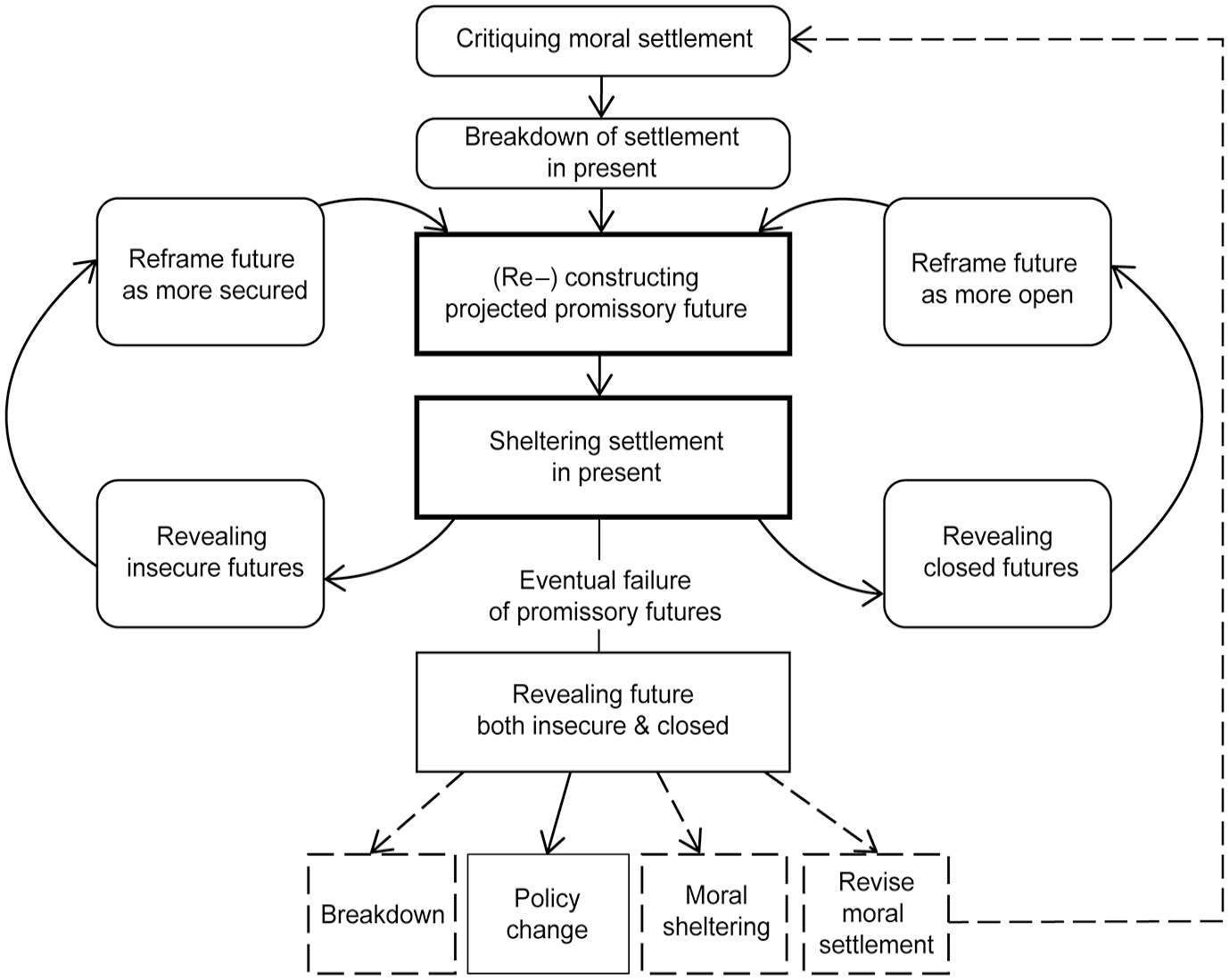
Moral settling through promissory futures.
First, actors construct promissory futures to ‘shelter’ moral settlements from critique by casting the values in those settlements as ultimately compatible – in our case, the ‘civic’ worth of public healthcare and the ‘market’ worth of financial savings. In calling this ‘sheltering’, we invoke Demers and Gond (2019), who use the term to denote actors shielding compromises from tests by invoking a further worth. We suggest extending ‘sheltering’ to include avoiding tests of any settlement whether using further worths or projected futures. The avoidance of critique using projected futures found in our case can thus be termed ‘temporal sheltering’.
Second, as Figure 5 depicts, promissory futures eventually buckle under criticism. While promissory futures ambiguously denote both secured and open futures, this masks a contradiction: the future cannot be both wholly open and wholly secured. If a future remains partly open, it must leave some outcomes not yet fixed and secured; and any future that is at least partly secured necessarily has limits to its openness. As temporal complexity research shows, holding together plural temporal orientations is hard (Pemsel and Söderlund, 2020; Reinecke and Ansari, 2015). Thus promissory futures that stress security are likely to be criticised as closed because they seem too tethered to the present to escape its dilemmas; while promissory futures stressing openness may be criticised as not secured because that openness precludes such guarantees. While such observations may be made of any projected future, they become vital critiques of promissory futures, which must preserve the impression they are both open and secure if they are to shelter settlements. Thus, as such criticisms can undermine a promissory future’s efficacy, actors may adjust subsequent promissory futures to avoid that criticism recurring (Boltanski and Chiapello, 2005). For example, when Period 1’s future of ‘efficiencies’ was cast as insecure, Period 2 saw government suggest ‘good practices’ achieved by aggregating marginal gains – a future that stresses security. Yet precisely because of this emphasis on security, this future was attacked as too closed to escape the constraints necessitating the present’s moral trade-offs. Thus, a back-and-forth dynamic developed in which each promissory future, tailored to avoid the criticism that undermined its predecessor, laid itself open to the inverse attack. This produced a second key pattern, which Figure 5 depicts: an alternation in the attacks that promissory futures faced, driven by their erring alternately on the sides of security or openness. This leads to an ongoing process of reconstructing promissory futures, which we call ‘moral settling’.
Finally, this cycle of adjustment and replacement highlights promissory futures’ growing fragility and explains the likelihood of their eventual collapse. Initially, government tried to construct the most robust promissory future available. Yet, as Van Elk et al. (2023) observe, ideas on which to base settlements are scarce. When each promissory future was undermined by critique, its replacement was chosen from diminishing options, curtailed by the need to adjust for prior critiques. Our case’s trajectory from successful to ineffective futures is likely when promissory futures are reconstructed from ever-fewer options, reducing their efficacy.
When promissory futures fail, they can no longer shelter moral settlements, which are therefore exposed to moral critique. In our case, when moral critique eventually returned, policy change followed. However, as prior work observes, this is not the only possible outcome of critique. Where the costs of substantive change are too great, actors who have exhausted promissory futures may shift to moral sheltering (Demers and Gond, 2019). Otherwise, if eventually engaging with critique seems unavoidable, actors may forward an alternative, ‘negotiated’ justification that accommodates certain critical logics (Boltanski and Chiapello, 2005; Patriotta et al., 2011). Of course, where no such agreement can be reached, this may result in a complete breakdown in which no shared evaluation criteria are reached (Boltanski and Thévenot, 2006). Figure 5 illustrates these possibilities with dotted lines.
In sum, by combining the Economies of Worth and Adam’s sociology of time, we explain: (1) how promissory futures shelter posited settlements from critique; (2) the alternating types of attacks they face; and (3) promissory futures’ diminishing efficacy.
Discussion
This study had two points of departure. First, writers increasingly note the importance of time in moral struggles (Cloutier and Langley, 2017; Reinecke and Ansari, 2015). In particular, recent work highlights the key role of persuasive futures (Nyberg et al., 2018; Oomen et al., 2022). Second, the sociology of time observes the multiple ways in which the future can be conceptualised relative to the present (Adam, 2008; Tavory and Eliasoph, 2013). Thus, we wondered how the type of future conceptualised might shape moral struggles.
Central to our findings is the construct of the promissory future. As noted above, we theorise this as a type of future projection (Mische, 2009, 2014). Other scholars have theorised future projection as acts of future making (Comi and Whyte, 2018), stressing how texts and objects ‘draft’ the future; or as ‘as if’ imaginaries (Augustine et al., 2019), highlighting the socio-cognitive structures they draw on.
What differentiates promissory futures from other projections is, first, denoting open and secured futures at once, second, the ambiguity of doing so and third, their moral implications. On one hand, scholars widely observe the persuasive power of a future that seems secured and certain (Nyberg et al., 2018). Scholars also discuss the power of ‘future perfect thinking’: a mode of strategic reasoning that imagines the future as already secured and reasons back to how to achieve this (Pitsis et al., 2003; Weick, 1995). Yet to feel secured, futures must normally remain in reach of the present, limiting their ability to escape today’s intractable dilemmas (Rindova and Martins, 2022). Conversely, scholars stress the power of futures that seem open. Augustine et al. (2019) note the sense of potential that distant futures can create: because they are far off, they seem able to depart radically from the present. Equally, as ‘future-making’ studies highlight, treating the future as still in-the-making can facilitate creative work (Comi and Whyte, 2018; Whyte et al., 2022). Yet, with so many eventualities possible, very open futures struggle to seem secure (Wenzel et al., 2020).
What is striking about promissory futures is their ability to seemingly unite these distinct types of future, appearing both secured and potent. This duality explains promissory futures’ capacity to shape moral struggles in the present, despite being fragmentary, partial and polyvocal (Beckert, 2013, 2016; Mische, 2009). This supports prior theoretical suggestions that actors may strategically ‘balance the persuasive appeal’ of multiple futures: Rindova and Martins (2022) point to ‘futurescapes’, future-oriented narratives that can balance desirable ‘distant’ and plausible ‘near’ futures. Granted, the constructs are not analogous: futurescapes link near and distant futures, while promissory futures are sites of ambiguity, which somehow seem both wholly open and wholly secure. Yet together they show how actors can do strategic temporal work (Bansal et al., 2022) by acting across multiple futures.
This comparison crystallises that ambiguity is part of what makes promissory futures distinctive. In using this term, we signal a debt to prior accounts of ambiguity in organisation studies. Echoing ‘strategic ambiguity’ that enables progress despite underlying disagreement (Abdallah and Langley, 2014; Eisenberg, 1984), promissory futures display ‘temporal ambiguity’: the ability to denote multiple future construals at once. Relatedly, ‘discourses of transcendence’ are ambiguous rhetorical strategies, which seem to reconcile competing interests (Abdallah et al., 2011). Both recall the Economies of Worth’s own theorisation of compromises, in which ambiguity is vital to combining worths (Boltanski and Thévenot, 2006: 277–281). Like promissory futures, these other ambiguities can suspend moral struggles.
It is the type of ambiguity promissory futures display that enables them to impact moral struggles as they do. Rather than ambiguity between multiple normative stances associated with different stakeholders (Abdallah et al., 2011; Boltanski and Thévenot, 2006; Eisenberg, 1984), promissory futures avoid moral conflict less directly: by pointing ambiguously to a future that seems both open and secure, they offer a future potent enough to resolve today’s moral conflict and assured enough to be relied upon. This enables them not only to blur a given proposal’s position in a moral struggle but also to cast the moral conflict itself as moot.
The study’s core contribution is to demonstrate how promissory future projections can shape moral struggles in the present by temporally sheltering settlements from critique. The subsections below elaborate its implications for: (1) the future in moral struggles; (2) the interactions between present and future; and (3) the ‘successful’ moral settlement.
Paths paved with promises: The future in moral struggles
We contribute to scholarship on moral struggles (Dionne et al., 2018; Patriotta et al., 2011) by theorising temporality’s role therein. While scholars have examined how dimensions such as power (Gond et al., 2016) or space (Thévenot, 2002) shape disputes, less attention has been given to the role of the future. Prior research has treated temporal orientations as facets of opposing moral viewpoints (Thévenot, 2002), and thus contestants in a struggle (Reinecke and Ansari, 2015). In this view, a moral stance can be bolstered through alignment with a sympathetic future (Nyberg et al., 2018).
Conversely, we point to how certain future projections can not only take sides in a struggle between orders of worth but are employed to render conflict tractable in an imagined future (Mische, 2009). Scholars highlight distant futures’ capacity to compellingly project the resolution of today’s problems into the future, noting how this distance renders the future open, enabling actors to envision radically divergent futures (Augustine et al., 2019; Dries et al., 2023). Promissory futures possess a similar sense of openness without the need for temporal distance – for instance, they may use the rhetoric of transformation to suggest rapid divergence from erstwhile constraints. Yet because they are not temporally distant, promissory futures can combine this openness with the security of a future rooted in the present. This arrangement’s innate contradictions withhold from promissory futures the enduring persuasiveness distant futures can have. Yet their combination of openness and security enables them to project near-term futures that temporarily seem to resolve today’s moral quandaries, averting critique of moral settlements. This is vital, as moral disputes often relate to imminent consequences, which demand near-term solutions. Promissory futures can offer such resolutions but require continual reconstruction as each one eventually buckles.
This points to the importance of how – and by whom – promissory futures are used. Our case illustrates their being used effectively over a decade. However, this is achieved by an organisation with the formal authority and agenda-setting power of the state. Power can expand the discursive options available within a dispute (Gond et al., 2016), making it easier to continually reconstruct new promissory futures and keep the debate focused thereon. Yet the ability to avoid critique of moral settlements between orders of worth itself offers to accentuate an actor’s power. If so, promissory futures would become a force that helped entrench existing power dynamics, making this a pressing question for future research.
Our study also points to the ‘dark’ side of future making. In our case, promissory futures were deployed to justify financial restrictions in the present, despite those futures not occurring. Where used deliberately to mislead, temporal sheltering can be seen as ‘future-washing’, a tactic whereby actors deploy future pledges to avoid moral scrutiny in the present without intending to make good thereon. In our case, this enabled the extraction of financial value from a public body based on speculative futures in a manner comparable to private futures markets (Beckert, 2016; Vint, 2019). More broadly, temporal sheltering may provide all-too comforting projections that justify harmful actions today. This points to the value of the concept of promissory futures to emancipatory scholarship: as countries and firms face mounting critique for contributing to the climate emergency, pledges to reach ‘net zero’ carbon by 2050 proliferate. These pledges often project futures in which both environmental and industrial values are satisfied, avoiding moral trade-offs today. While pledges to radically reshape an open future, the risk is that they are trumpeted as if today’s pledges already secure the desired outcomes. If averting critique of underlying tensions between environmental and industrial goals, such pledges can act as promissory futures that help avoid criticism of present-day actions by projecting a future in which moral quandaries are resolved.
Yet promissory futures may also drive more progressive agendas. Whereas existing power structures constrain our sense of what is possible, leading us towards either/or solutions that sacrifice one of several important values, promissory futures can help break free from dilemmas that seem intractable. For instance, prefigurative organising based on ‘real utopias’ rejects traditional assumptions that one must choose between the comfort of the status quo and utopian ideals of a more just and inclusive society (Monticelli, 2022; Reinecke, 2018). This echoes Vint’s claim that utopian fiction has an important role countering ‘capital’s current monopolization of possible realities’ (Vint, 2019: 15–16, quoting Fisher). Just as imagining desirable futures may help inspire positive action today (Gümüsay and Reinecke, 2022), so temporal sheltering may protect valuable moral settlements between orders of worth from entrenched suppositions of those values’ intractable opposition.
Now and then: Reshaping the present
We also contribute to the literature on future projections by tracing the dynamics through which projections can shape ongoing moral struggles. Empirical studies generally focus on how such futures are constructed, often in the distant future (Augustine et al., 2019; Dalpiaz and Di Stefano, 2018). Conversely, this article foregrounds the dynamics through which those futures reshape the present (Mische, 2009). It also highlights how the future’s impact on the present may lead actors today to deconstruct unfavourable future projections. As Figure 5 illustrates, these two effects coalesce into a dynamic, ongoing interrelation between present moral disputes and projected futures. It contributes an understanding of the iterative, recursive dynamics through which future projections interact with the present.
This affirms and complements prior research on how actors use temporal work to strategically bridge multiple futures (Bansal et al., 2022). By tracing promissory futures longitudinally, we show how actors created compelling accounts by bridging futures; but note that this success is transient. Yet we also find that the failure of promissory futures may prompt further iterations thereof. This resonates with Abdallah and Langley’s (2014: 258) suggestion that the failure of ambiguous constructs may prompt ‘a further cycle of strategic thinking and planning’. By tracing multiple cycles of promissory futures, we identify how efforts to ambiguously bridge multiple futures may repeat cyclically, but likely temporarily.
This longitudinal analysis also highlights the interrelatedness of successive cycles of this process. We theorise not just how critics respond to a given promissory future, but how that critique shapes subsequent promissory futures (Boltanski and Chiapello, 2005). That is, we highlight how the future is polyvocally reshaped over time. This echoes Whyte et al.’s (2022; Comi and Whyte, 2018) conception of future making as a distributed process with no pre-determined destination. However, whereas Whyte et al. foreground a joint process of inquiry, we note how the future can be shaped through oppositional disputes in which the future is reshaped not for its own sake, but for its ongoing effects on the present.
Playing for time: From settlement to settling
By explaining how promissory futures facilitate moral settlements, this article contributes to our understanding of a central facet in the process of moral disputes. Research focuses on whether compromises become established, as if this defines successful settlements (Cloutier and Langley, 2017; Van Elk et al., 2023). By this logic, ours appears to be a case of failed settlements: while each promissory future projected a different iteration of the government’s market–civic settlement, none became established. Yet Figure 5 shows how, as a sequence, they enabled a decade of radical policy. These failed settlements succeeded.
This should prompt Economies of Worth scholars to revise our implicit criteria for successful settlements. Recent work acknowledges avoidance as one possible response to critique (Anesa et al., 2024). The concept of temporal sheltering forwarded here notes how actors may evade moral debate not by wholly avoiding critique but by deferring moral choices into the future. Rather than emphasising whether settlements become established, we should recognise that posited settlements can delay a controversy’s climax. Our case shows the potential power of this process but arguably undersells it, since its high-profile topic was unusually fixed on the news agenda. Often, briefly delaying a dispute’s climax will enable that dispute to be forgotten as the news cycle moves on, such as when under-fire governments commission enquiries that will not report for years. Further studies could fruitfully focus on delaying tactics in controversies less fixed on the news agenda than our case has been.
Seen this way, permanence is a poor criterion for settlements’ success. Indeed, while settlements between orders of worth may rely on appearing temporally enduring (Thévenot, 1984), actual permanence may be elusive given their implicit contradictions. Our longitudinal study therefore offers a process view in which settlements are always in the making and erode in the face of criticism but nonetheless suspend moral critique in consequential ways.
This shift in perspective enables us to examine patterns of settlements in new, revealing ways. For instance, reading across government’s multiple promissory futures reveals a trajectory of change. As a series, ‘efficiencies’, ‘good organisations’ and ‘Sustainability and Transformation Plans’ represent not only changes in emphasis, but progressive scalar shifts from intra-organisational processes to whole organisations and then interorganisational coalitions. This leads us to wonder whether, to credibly improve upon a failed promissory future, its successor must seem more all-encompassing. It is only by conceptualising settling processually that this study identifies such questions for future research.
Conclusion
This study set out to investigate how future projections were used to navigate moral struggles and shape moral settlements. Its key contribution is to highlight how the ambiguous melding of a future’s construal as both secure and open can allow what we term ‘promissory futures’ to shelter moral settlements from critique. However, promissory futures cannot combine these contradictory forms of future for long and therefore eventually buckle under criticism. Nevertheless, the resultant cycle of criticism and re-building of promissory futures can powerfully forestall scrutiny of moral settlements.
This observation may be farther-reaching than first appears. Future temporality is a potent factor in moral disputes: within organisations, moral debates very often discuss what to do, making competing future projections central. Even when morally evaluating people’s past actions, we characteristically do so by considering the options they had and the consequences thereof they could have reasonably foreseen: we engage in a kind of retrospective prospection. Seen this way, future projections are central to moral agency.
This study’s limitations open avenues for future research. For instance, in our study one promissory future is forwarded at a time: but actors frequently offer competing future visions, so how might promissory futures compete and interact? Alternatively, while we focus on the future, others highlight how that future’s relations to past and present may be central to facilitating change (Söderlund and Pemsel, 2022): how, therefore, do past and present temporality shape promissory futures’ likely success? Equally, we analyse only how promissory futures render moral struggles more tractable, not less: yet groups like Extinction Rebellion raise today’s choices’ moral stakes by casting our timeline as a crossroads between survival and apocalypse. Studies focusing on them could valuably interrogate this difference and that between groups with extensive, and limited, power (Gond et al., 2016).
Finally, our inductive analysis leads us to theorise this case using Adam’s distinction between present future and future present. Yet there is no reason to think this the only temporal concept useful in theorising moral disputes. Further work could build on the promissory future construct by asking how a present future or future present perspective may be spliced with a ‘future perfect’ outlook (Eisenberg, 1984). Alternatively, insights could be gained by theorising temporality wholly differently: for instance, how does material future making (Comi and Whyte, 2018) interact with the physical ‘qualified objects’ the Economies of Worth casts as instrumental to moral struggles?
Supplemental Material
sj-pdf-1-hum-10.1177_00187267241265921 – Supplemental material for Constructing promissory futures to defer moral scrutiny: The dilemma of healthcare austerity
Supplemental material, sj-pdf-1-hum-10.1177_00187267241265921 for Constructing promissory futures to defer moral scrutiny: The dilemma of healthcare austerity by Sam Van Elk, Juliane Reinecke, Susan Trenholm and Ewan Ferlie in Human Relations
Footnotes
Acknowledgements
We are most grateful to Jessica La and Lucy Meechan for assistance in compiling the data drawn upon in this study.
Funding
The authors disclosed receipt of the following financial support for the research, authorship and/or publication of this article: UK Research and Innovation, Economic and Social Research Council, PhD Studentship.

Supplemental material
Supplemental material for this article is available online.
References
Supplementary Material
Please find the following supplemental material available below.
For Open Access articles published under a Creative Commons License, all supplemental material carries the same license as the article it is associated with.
For non-Open Access articles published, all supplemental material carries a non-exclusive license, and permission requests for re-use of supplemental material or any part of supplemental material shall be sent directly to the copyright owner as specified in the copyright notice associated with the article.
