




Abstract
We are interested in examining the process of scandal creation through the lens of the audience. Extant work tends to address either the effects of organizational scandal, or the role of the media and social control agents in scandal creation, neglecting the audience. To address this gap, we draw on the sociological concept of the relational public to explore how individual or small group assessments become widely held social evaluations among scandal audiences. We develop a three-stage model of organizational scandal creation: first, scandal entrepreneurs and the media frame an organization’s behavior as transgressive to media consumers who react within the relational publics they constitute; next, members of those relational publics judge the act in light of their values; finally, as relational publics spread their judgment to adjacent groups, they aggregate and assemble into a scandal audience, activating the scandal. Our model adds to media-centered theories of scandal construction by highlighting the role of heterogeneous audiences and their values, building a nuanced understanding of the process of social evaluation in scandal creation.
How are scandals created? We know that organizational misbehavior, when framed as transgressive of established values or norms, may embroil individual organizations or entire organizational fields in scandal (e.g., Piazza & Jourdan, 2018). This process is neither automatic nor predictable, however, and the same act of wrongdoing may yield a scandal in one case but little consternation in another. Scandals are thus best understood as neither the direct consequence of organizational transgression nor a reflection of objective assessments of its severity, but as social constructions that emerge as actors react to public attention to an event. Scandal creation should be seen as an observable social process, at the center of which is the scandal audience, a loosely connected social group unified by shared outrage at revelations of transgression, without which a scandal cannot emerge (Adut, 2009). We therefore turn our attention to the heretofore silent partner as we elaborate the scandal construction process.
Much of the organizational wrongdoing literature focuses on scandal’s consequences (Dewan & Jensen, 2019; Graffin et al., 2013), while work on its construction emphasizes its mediated nature (Clemente et al., 2016; Jonsson et al., 2009; Luo & Zhang, 2021). This is consistent with work in adjacent fields describing scandal as a process of constructing and diffusing disruptive media publicity (Adut, 2005, Thompson, 2000), though many contingencies determine which behaviors receive attention, from the severity of the infractions to the offenders’ impression-management efforts (Carberry & King, 2012; Elsbach & Sutton, 1992; Ginzel et al., 2004; Zavyalova et al., 2012). Social evaluation is enacted by audiences (e.g., Ashforth & Gibbs, 1990; Blader & Yu, 2017; Devers et al., 2009; Pollock et al., 2019), but to the extent that they are acknowledged by organizational theory, they are treated as largely passive groups acted upon by social control agents (Greve et al., 2010; Palmer, 2012) and the media (Adut, 2012; Clemente & Gabbioneta, 2017; Clemente et al., 2016; Entman, 2012; Thompson, 2000). Because not all evaluators are equally attentive to all publicized bad behavior (Adut, 2009), we must consider how heterogeneity and the variance in attention across audience segments (e.g., Fini et al., 2018; Pollock et al., 2019) might affect the scandal creation process.
To understand the role of audiences within scandal creation, we draw on theory from relational sociology, which views social and organizational forms as partially constituted by shared cultural consumption patterns (Emirbayer & Sheller, 1998; Mische, 2014). Seen through this lens, audiences are not just communities or institutional orders, but collectives with shared attention and ties to specific information sources (i.e., particular media outlets or authors). This suggests that audiences do not simply comprise pre-existing social categories such as demographics, but rather consist of loosely grouped collectives of people who interact and consume shared information; that is, the primordial form of audiences are discursively constructed publics. More precisely, we use the sociological concept of relational publics, “open-ended networks of actors” (Starr, 2021, p. 57) or collectives “consisting of strangers who realize each other as spectators of the same thing” (Adut, 2012, p. 244), through which shared evaluations emerge (Adut, 2005, 2012). Relational publics are networks linked through disparate cultural and social elements that, though temporary, have sociality and internal coherence, well-defined belief patterns, and regular interaction (Starr, 2021).
We leverage the concept of relational publics to explain the construction of audiences, a concept largely overlooked by work on scandal (e.g., Clemente & Gabbioneta, 2017; Jonsson et al., 2009; Luo & Zhang, 2021). We propose a model of scandal construction that focuses on the interaction of media reporting and relational publics in an emergent social space. We theorize that scandals emerge when publicity around a transgression activates relational publics, which view the act as violating their deeply held values, leading them to assemble into a scandal audience. This requires that the media catch the attention of often-disconnected relational publics through disruptive publicity (Adut, 2005) using frames that highlight the violation of values these publics hold dear, resulting in a potential scandal. Because publics are often emergent and ephemeral (Starr, 2021), it is not necessarily known ex ante which values will anchor them, leading to a recursive system of reporting and public reaction. Disruptive publicity, promoted by relational publics through shared communication networks (Adut, 2012; Starr, 2021)—including public commentary, direct engagement with media, and social media posts—gains traction in a refracted manner, activating relational publics with distinct sets of expectations and values. If multiple publics are activated through interaction with adjacent relational publics, they coalesce into a scandal audience. As not all audiences are aroused by every infraction, or even by the same acts committed by different actors (Adut, 2009; Cavender et al., 1993), only acts seen to violate the values of assembled relational publics will generate a fully formed scandal.
We elaborate this logic to develop a three-part model of scandal construction that highlights audience formation. Building on prior work, we argue that proto-scandals are activated by media coverage leading to public attention; that scandal construction requires the activation of relational publics that see a transgression as violating their values; and that scandals are only realized through the assembly of a scandal audience (Adut, 2009). We add to the organizational scandal literature by explaining a critical, missing link in scandal creation. More broadly, the topic of scandal also represents a theoretical case that enables us to examine audiences in more detail. By importing the concept of relational publics into organizational theory, we also contribute to a more nuanced understanding that opens the black box of audiences. This has theoretical implications for a range of topics of interest to organizational theorists, from social evaluation to legitimacy, categorization, and beyond.
What makes an organizational scandal? A review of the literature
The literature on scandal in organizational theory suggests that scandal follows the disclosure of behavior seen to transgress established norms or values. The disclosure of such an act generates disruptive publicity (Adut, 2005) that taints actors by linking them—directly or indirectly—to the transgression and leads to a public expression of disapproval (Thompson, 2000). Thus, a scandal is thought to unfold in two discrete phases: first, an organization behaves in a way that some deem inappropriate; then, this act is publicized to a set of evaluators (i.e., an audience) as a “transgression of certain values, norms, or moral codes” that society or social subgroups hold sacred (Thompson, 2000, p. 13), then scandal results. A scandal is a type of social event (Hirsch & Milner, 2016) that shifts in focus from private to public over time as the alleged misconduct is publicized and strategic framing spurs investigations by social control agents (Jourdan, 2023). Some scandals involve criminal acts—like Enron (Aven, 2015), Arthur Andersen (Jensen, 2006), or Volkswagen (Clemente & Gabbioneta, 2017)—but many simply represent a violation of expectations, expertise, and values (Jonsson et al., 2009; Piazza & Jourdan, 2018).
Scandals are constructed phenomena, “interwoven with the telling and retelling of stories about events (or alleged events) which lie at their heart” (Thompson, 2000, p. 17). They are set in motion when motivated parties looking to create a scandal—typically social control agents (Greve et al., 2010) and scandal entrepreneurs (Fine, 1997, 2019)—interact with print and broadcast media (henceforth, the media), which label organizational behaviors as transgressive. 1 Scandal requires media-generated publicity (Adut, 2005, 2009; Thompson, 2000) to shape audience understandings of those behaviors, though media narratives may be only loosely connected to underlying facts (Goode & Ben-Yehuda, 1994; Holstein & Miller, 2003; Schneider, 1985). The media set the early tone of a scandal by choosing specific frames, which may be influenced by their own agendas (Clemente et al., 2016). Because media outlets compete by selecting specific frames informed by local concerns, values, and ideological leanings, scandals emerge as actors with different interests struggle to dominate the narrative (Jacobs, 2007), making scandals the “quintessential public event” (Adut, 2012: 12) capable of reshaping the social and moral orders (Jourdan, 2023).
How diverse actors converge upon an account of a social problem—particularly in light of biased media framing (Clemente et al., 2016)—is an important theoretical puzzle (Cornelissen et al., 2014; Klein & Amis, 2021). The media, despite their collective sobriquet, are not a homogeneous group (Roulet & Clemente, 2018), but a field of actors that report on and frame information to readers (Adut, 2005) in the form of a moral narrative and cultural framing (Molotch & Lester, 1974). Recent work on scandal shows that episodes are held together not by a singular framing, but by a social process of multiple framings unfolding over time, united by a central connecting narrative thread (Hannigan et al., 2015).
While the media publicize transgressive behavior, they are rarely the first to know of the issue—even investigative reporters’ hunches come from somewhere. Wrongdoing may be discussed as rumors (Entman, 2012; Fine, 2019; Thompson, 2000), often within the immediate social network of the alleged transgressor. This knowledge circulates locally, sometimes for years or decades before it comes to public attention, as with the scandals involving Oscar Wilde, FIFA, or expense falsification in the British Parliament (Adut, 2005, 2009; Graffin et al., 2013; Piazza & Jourdan, 2018). Hirsch and Milner (2016) propose a threshold model where deviance is known to a small group until outsiders become aware, eventually reaching a tipping point where public knowledge and outcry engender an institutional response. The media, they argue, may not publicize a scandal until forced by powerful, motivated institutional actors.
Who are the actors pushing the media to publicize transgressions? The constructivist perspective on organizational wrongdoing holds that disruptive publicity is stirred up by parties with a particular agenda (Palmer et al., 2016). Like many social problems (Goode & Ben-Yehuda, 1994), scandals are constructed through the efforts of what Fine (1996, 2019) calls scandal entrepreneurs: actors whose goal is to problematize an issue that redounds in their favor (Becker, 1963; Fine, 2019; Molotch & Lester, 1974), though not necessarily in the favor of the institution or society. Key works on scandal (Adut, 2005, 2009; Entman, 2012; Thompson, 2000) argue that scandal entrepreneurs (Fine, 1997, 2019) direct attention to particular transgressions, then suggest further investigation and resolution. Thompson (2000) notes that such efforts become more widespread as the increasing reach of the media enables transgressions to be publicized beyond local audiences, a process accelerated by the involvement of social media.
The ultimate aim of many scandal entrepreneurs is to upset the power dynamics within an institution. Scandalous behavior is “uncovered” by parties with a particular motivation, typically to expose “subculturally or institutionally routine behaviors to those who do not share these standards” (Fine, 2001, p. 146; Fine, 1997). But this is not simply a matter of social worlds and norms colliding, leading to the embarrassment of scandal protagonists. Scandals that remove individuals from positions of power or status (Dewan & Jensen, 2019; Graffin et al., 2013) do so by denigrating their reputations, such that power is critical to the creation of scandal (Thompson, 2000). We note that status does not necessarily imply higher levels of accountability (Giordano, 1983), only that scandal entrepreneurs are likely to highlight the transgressions of high-status targets to serve their own ends. The goal of scandal creation, seen in this light, is either to change (Becker, 1963) or to defend (Fine, 2019) the scandal entrepreneur’s privileged norms and mores through the activation of moral outrage; that is, motivated actors work with the media to publicize transgressions for the express purpose of controlling the social order.
Centering the Audience: A New Model of Scandal Creation
Moving beyond the media
While it is clear from this review that both media publicity and public opinion are essential elements of scandal creation, many key works on scandal (Adut, 2009; Entman, 2012; Thompson, 2000) describe disruptive publicity without investigating the role of observers—the public progenitors of public opinion. Thompson’s (2000) model, for example, suggests that scandal is realized when public disapprobation results from media publicity; complications to that story are functions of the interaction of transgressor and media rather than the public, who receive information and make judgments in an almost automatic way. Organizational theory also tends to focus on media bias in shaping public opinion about transgressions (Clemente et al., 2016; Cohen et al., 2017; Stepanova et al., 2009) and subsequent organizational and institutional responses (Clemente & Gabbioneta, 2017; Pozner et al., 2019), neglecting the audience.
Nevertheless, an audience is implicit in the assumption that the media develop frames that will be found of interest, suggesting that the media and consumers of media jointly tap into a particular cultural toolkit (Giorgi et al., 2015; Swidler, 1986). Counterfactually, were no audience to emerge, public interest would remain flat. Jacobs (2007) examined the American savings and loan crisis of the 1980s as a case of a might-have-been scandal and concluded that no audience emerged because as the scandal “did not meet the requisite dramaturgical standards: the criminal plot was too complicated to communicate superficially, and in particular there was no ‘smoking gun’” (Jacobs, 2017, p. 377). Accordingly, a scandal audience cannot be presumed to exist a priori. Recent work on the temporal aspects of framing point to interactional dynamics (Klein & Amis, 2021; Litrico & David, 2017; Reinecke & Ansari, 2021) and suggests the need to examine this as a social process. By recognizing that scandals are not created by homogeneous media or consumers of media drawing from the same cultural toolkit with the same degree of attention, we follow the recent prompt from Jourdan (2023) and invite the examination of scandal as a social process centered around the audience.
Evidence from individual scandals, which tend to play out in non-linear ways, indicates a link missing from existing theories of organizational scandal creation. Consider an example from Adut (2005): Oscar Wilde became the subject of scandal when a heterogeneous set of media outlets reported on his homosexual relationship with Lord Alfred Douglas, a university student. Wilde’s sexuality had been well known within his social circle but was made the subject of public discussion when Douglas’s father, Lord Queensberry, confronted Wilde in public settings. A scandal only ensued only after Wilde sued Queensberry for defamation, leading to a court case marked by salacious witness testimonies implicating high-status members of British society that attracted media attention. Wilde’s homosexuality had been known in circles that did not label it as transgressive but became a scandal when more evaluators were alerted and the discourse around his behavior was judged according to more diverse sets of values and mores.
This example suggests that is not mere publicity, but rather the interaction of evaluators around that publicity that is central to scandal creation. Building on Adut’s (2005) suggestions that scholars exaggerate the role of the media and that the relationship between the media and the public requires further elaboration (Adut, 2012), and moving to the organizational level, we unpack the assumption that a homogeneous audience responds quickly and uniformly to disruptive publicity. We untangle the endogeneity of media directing and responding to public opinion, such that media focus and public attention are mutually constituted. We then address the ontology of the scandal audience, describing the mechanisms of interaction among various segments of the media audience that constitute public opinion and, through the act of evaluation, complete the process of scandal construction.
Who consumes the media? The role of relational publics
The missing thread in the work on scandal, we believe, is the role played by the consumers of disruptive publicity through the very act of media consumption. To address this shortcoming, we draw on the sociological construct of the public (Adut, 2005, 2012; Starr, 2021). Publics have a long history in social science, from the body politic in ancient Greece to Habermas’s public sphere and extensive recent work on public opinion. Relational sociology has focused on the concept of the public as a social form based on communication and interaction. This work does not depict people in a shared social category, but rather “interstitial networks of individuals and groups acting as citizens” (Emirbayer & Sheller, 1998, p. 738).
Publics in this sense are best understood as groups that cohere based both on shared consciousness in consuming the same media and on interactions deriving from that shared consciousness (Hannigan, 2023). Starr (2021) describes a relational conception of the public as “open-ended networks of actors linked through flows of communication, shared stories, and civic or other collective concerns.” This describes social architectures that “cut across more ‘bounded’ and ‘stable’ social formations; this is the bridging function that gives publics emergent possibilities in the creation of new social movements and imagined communities” (Starr, 2021, p. 69). While members of such publics may be connected directly or indirectly, allowing private information to spread and collective sensemaking to be encouraged, such social connectedness is not necessary for membership or influence; these are networks insofar as people are connected to the same symbolic objects. For publics to exert influence and for evaluations to become social, members need only know that others are tuned to the same stimuli (Starr, 2021).
An audience-centered model of scandal creation
Drawing on the concept of relational publics, we propose an audience-centered model of scandal creation. Our model begins with the impetus that generates media reporting and culminates with the realization of a scandal, though our primary interest is in what happens in between those two poles. We differentiate analytically between proto-scandal, a nascent phenomenon with the potential to become a scandal, and activated scandal, in which a scandal audience is activated. We explore this model, depicted in Figure 1, stage by stage.
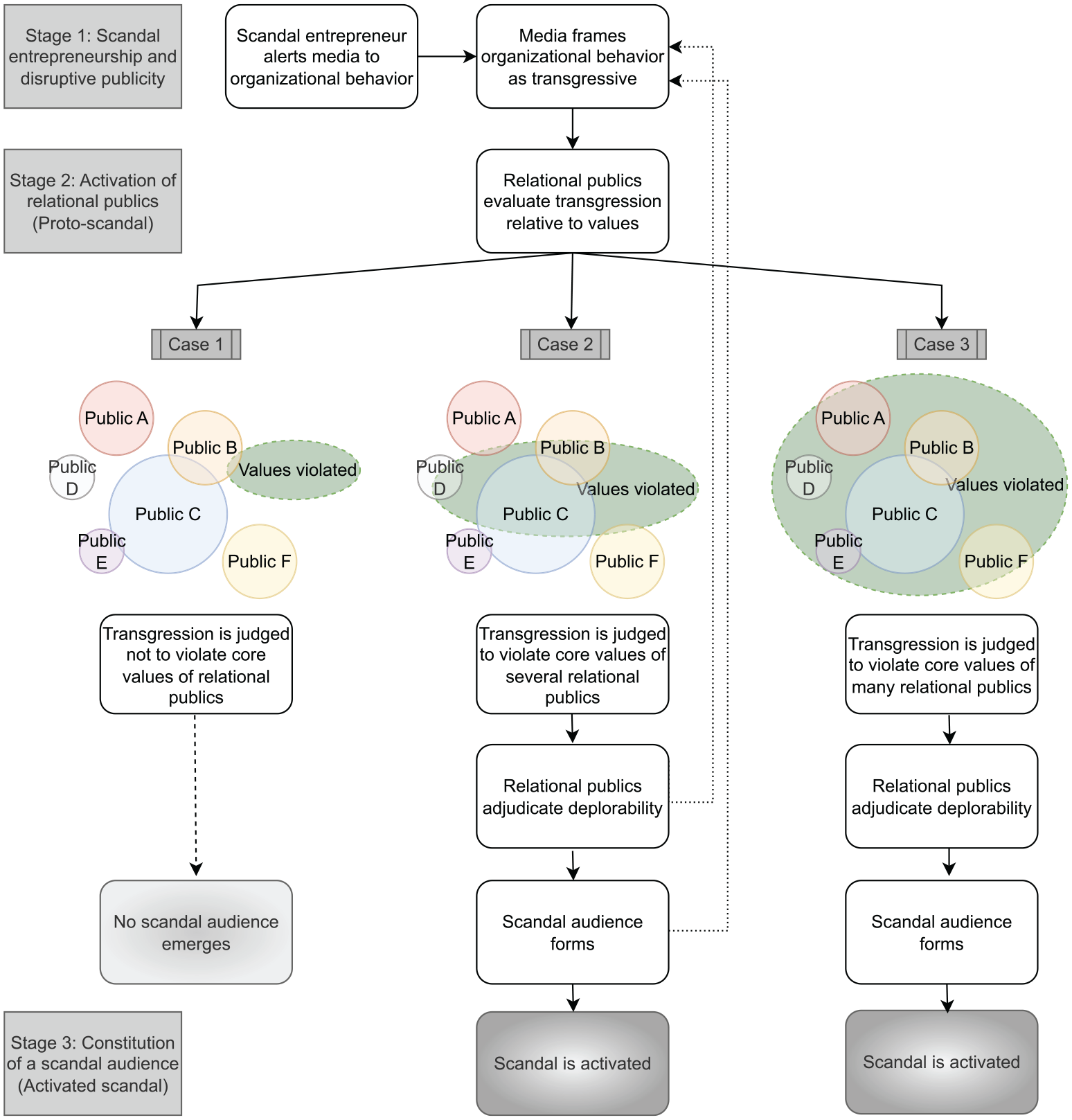
An audience-centered model of scandal creation.
Stage 1: Scandal entrepreneurship and disruptive publicity
Scandal entrepreneurship
Inertia prevents many transgressions from coming to light while generating publicity requires the intention and effort of someone (Adut, 2009; Clemente et al., 2016; Entman, 2012): the scandal entrepreneur. Scandals only have the potential to emerge if scandal entrepreneurs alert the media to what they believe to be transgressive organizational behavior. A critical step in this process is shifting attention away from private circles, where alleged transgressions are rumors and “improvised news” (Shibutani, 1966), and towards broader circles where they might become public knowledge (Jourdan, 2023). Media involvement is essential, as at least one party to the transgression has an interest in secrecy, protecting the transgressor and their social network (Adut, 2005; Near & Miceli, 1986). For the label of transgression to adhere, the behavior must be framed as inconsistent with certain values, placing the actor at risk of scandal. The scandal entrepreneur seeks to spark collective sensemaking through disruptive publicity; if the media’s framing does not resonate, the act will receive little notice and scandal will not result.
Because of the risk to the scandal entrepreneur’s social relationships and the possibility of retaliation (Adut, 2005; Near & Miceli, 1986), their actions are typically motivated by the attainment of some tangible end. Scandal plays an important role in the maintenance of institutions by triggering norm enforcement—albeit selectively at times (e.g., Graffin et al., 2013)—and ultimately, the reassertion or reconfiguration of norms to prevent more widespread violations (Adut, 2005, 2009). Indeed, it is often through the process of creating a scandal that actors make sense of which acts are legitimate and acceptable, and which acts are illegitimate, norm-violating, or morally questionable (Goode & Ben-Yehuda, 1994; Greve et al., 2010; Hannigan et al., 2015; Mohliver, 2019). Secrecy reinforces current institutional structures and social arrangements, whereas the public sensemaking process (Glynn & Watkiss, 2020) that accompanies scandal impacts the schema audiences use in subsequent evaluations (Hopkins, 2015; Lamont, 2012; Piazza & Jourdan, 2018; Zuckerman, 2012). Fine (2019, p. 249) emphasized that “we must interpret scandals and reputation through contested (or contestable) moral narratives (Fernandes, 2018) that make communal cultures explicit (Polletta, 2002).” Thus, scandal entails a type of reputation politics deployed for somebody’s purposes (Fine, 2019).
Media framing of transgressions
Despite their centrality in the process, scandal entrepreneurs alone are insufficient to ignite a scandal, leveraging transgressive behavior to generate a collective “effervescent moment” (de Blic & Lemieux, 2005) that allows actors to compete for dominance over the social narrative. Alerted to organizational wrongdoing by a scandal entrepreneur, the media take center stage. The media’s role in scandal construction cannot be overstated (Clemente et al., 2016; Jourdan, 2023; Pollock & Rindova, 2003). Even obvious wrongdoing does not generate scandal unless the media frames it as transgressive (Adut, 2009; Piazza & Jourdan, 2018). The media select which issues to cover—or to neglect—and which framing to employ, all of which drive public perceptions (Clemente & Gabbioneta, 2017; Clemente et al., 2016). The media set the tone for discourse about the transgression (Entman, 2012), shape public assessments of its severity and its consequences (Desai, 2011; Piazza & Jourdan, 2018), and determine who is reached (Roulet & Clemente, 2018) by virtue of where stories are published. By setting the terms of discourse, the media either promote or snuff out a scandal; that which is not reported cannot become a scandal.
The media do not necessarily create facts, but rather assemble and promote private information strategically (Molotch & Lester, 1974) based on heterogeneous agendas, values, causes célèbres, and extant audiences (Roulet & Clemente, 2018). This is a form of boundary work and exclusion (Fey & Amis, 2023), as media assemble the elements necessary for scandal creation. Facts are not necessary to establish a moral narrative (Fine, 2019); in the absence of facts (Bromberg & Fine, 2002; Zuckerman, 2012), any number of interpretations may be deployed. Media outlets seldom promote a cause without suspecting that it meets the demands of a particular audience (Baron, 2006; Clemente et al., 2016). Media coverage amplifies gossip and rumors (DiFonzo & Bordia, 2007; Fine, 2019; Shibutani, 1966) within open communication networks that form larger publics interested in the issue and its consequences; as Molotch and Lester (1974, p. 101) explain, “[such] information thus does not merely go to publics, it creates them.” If discursively constructed audiences are aligned around media coverage, a “public expression of disapproval” is much more likely to emerge (Fine, 2019, p. 257; Thompson, 2000); thus, the media both guide and reflect the prevailing public opinion (Dewey, 1927; Molotch & Lester, 1974). The media then respond to audience reactions by tailoring their accounts (Clemente et al., 2016; Puglisi & Snyder, 2011; Roulet, 2015), presenting the most resonant frames, and paying more or less attention to certain details. While the power of the media is a function of its ability to marshal an audience, the audience itself emerges and stabilizes itself through this recursive social process.
Stage 2: Activation of relational publics (proto-scandal)
Values-based evaluation by relational publics
Though scandals follow disruptive publicity (Klein & Amis, 2021; Thompson, 2000), public disapproval is neither guaranteed nor automatic. Large swathes of society may be aroused by a given transgression simultaneously—if not uniformly—when the transgressor is highly visible or the transgression universally salient. The literature on social valuations shows, however, that audiences are heterogeneous in their judgments (e.g., Cattani et al., 2014; Fini et al., 2018; Pollock et al., 2019). This suggests that the social process of forming a scandal audience is subject to situational contingencies. Central to our model is a dynamic “macro-framing” view (Klein & Amis, 2021); that is, building on the microfoundations of framing based on interactions (Reinecke & Ansari, 2021) and the macrofoundations of assembling relevant cultural elements (Steele et al., 2020). The majority of scandals are likely constructed through the interactions of smaller relational publics, each with its own set of interests, concerns, values, norms, and expectations against which to evaluate transgressions, making audience-specific concerns more relevant to scandal construction than are characteristics of the transgressor. This points to a process of publics and cultural elements being recursively implicated (Tchalian, 2019) into the proto-form of a scandal audience.
In the proto-scandal phase, the relational publics that consume media coverage of a purported transgression are typically disparate, fragmented groups. Media coverage focuses attention on the values 2 violated by the transgression, tapping into specific cultural material that resonates with one or more relational publics based on shared cognitive frameworks, logics, and yardsticks (Adut, 2005; Ellickson, 2001; Fini et al., 2018). Such publics may be very small and disconnected (i.e., what Fine [2012] calls tiny publics), corresponding to a specific media outlet based on ideology and values. Because other media may engage other relational publics on the same issue, albeit through a different audience-specific lens (Roulet & Clemente, 2018), otherwise disconnected relational publics may be activated by the same transgression simultaneously. Continued media coverage creates cohesion by generating common knowledge that forges connections among unrelated groups (Clemente & Roulet, 2015; Starr, 2021) and, in so doing, shifts shared understandings. The sensemaking process and moral-emotional reactions to transgressions are inherently social (e.g., Collins, 2014; Goodwin et al., 2009; Klein & Amis, 2021; Turner & Stets, 2006; Zietsma et al., 2019), and can unite disparate groups to generate a quasi-coherent, superordinate group around specific issues. This suggests that media frames must resonate with increasingly large audiences for scandal to emerge.
Because outrage around scandals is mobilized as a social problem (Fine, 1997), audiences are primarily concerned with values. Successful scandal creation, therefore, relies on media framings that link the transgression with values shared within publics (Adut, 2005, 2012; Ellickson, 2001; Star, 2021). Relational publics become activated when they understand a transgression to be inconsistent with their values, which may be deeply held at both the individual and relational public levels. Continued media reporting encourages collective sensemaking across relational publics, surfacing salient values in a process that echoes Glynn and Watkiss’ (2020, p. 1345) interpretation of Weick’s famous insight: “How can we know what we think until we see what we say?” The sensemaking process that determines which values are relevant across relational publics typically unfolds over time; values are, after all, often latent and taken for granted, and their meaning and instantiation vary from group to group. Moreover, value incongruence is publicized by actors within relational publics who attach themselves to an issue in pursuit of change. This does not suggest that scandals occur within the boundaries of established institutional orders where values are normally said to reside, but rather at the intersection of orders (Fine, 1997, 2001; Thompson, 2000). Discourse in the media and across relational publics can activate the same values across many unrelated groups, leading to a sharply negative, shared evaluation of the event.
Turning to Figure 1, we develop three representative pathways through which a scandal might emerge. In the first case (far left), we depict a group of disconnected relational publics, arrayed in a multidimensional value space, with little overlap. If the framing of values violated by a particular transgression do not intersect or resonate with many publics, they are unlikely to take significant note of the event and a scandal is unlikely to emerge. In contrast, in the second case (center), the same publics are more likely to take note of a transgression—and thereby construct a scandal—when it is framed as violating their core values, particularly when such values are commonly held across multiple publics. Relative to the first case, in this instance it is much more likely that media coverage activates relational publics in sufficient numbers to generate a scandal audience, though a scandal may not result until those publics have provided feedback with the media and the appropriate framing is constructed. It is important to note that this is a sensemaking process that takes place over time and that the initial media framing may not immediately tap into overlapping values; instead, the majority of scandals result from convergence in framing driven by an iterative, discursive process of issue framing in which the media and media consumers are involved (depicted with dotted arrows in Figure 1). Finally, in the third case (far right), the transgression may violate near-universal values. This case is even more likely to lead to scandal because the number of publics activated and the extent to which relevant values are widely shared imply a high level of engagement with media coverage across publics quickly. The 2015 Volkswagen emissions scandal is perhaps the paradigmatic example of this case, in which the scandal audience is assembled and the scandal created almost instantaneously making recursive interaction between media and audiences unnecessary.
The adjudication of deplorability
The accumulation of negative reactions across relational publics keeps a scandal narrative alive over some time as relational publics reflect on their values. Building upon the idea that relational publics are activated when a transgression violates the values they hold dear, we propose a new construct, deplorability. A transgression is deemed deplorable if it violates relevant values for the collective audience; without a judgment of deplorability, a scandal is unlikely to emerge. This construct is a property of an audience, such that assessments of deplorability increase the likelihood that an audience will negatively evaluate a particular act for a particular organization, generating and sustaining a scandal.
Deplorability is not an absolute judgment tied to characteristics of the transgression, but rather a contextual, socially constructed attribution of a particular act committed by a particular organization developed by a particular set of social groups in situ. It need not be determined by broad audiences but can be arrived at by a subset of relational publics activated by the transgression—indeed, the assessment of deplorability is what drives their activation. Likewise, it is not necessary for every public to judge a transgression as deplorable relative to shared values, and a transgression may be deemed deplorable by non-adjacent relational publics based on very different expectations and values. Such differences become less important as activated relational publics recognize one another as fellow travelers in moral outrage.
The adjudication of deplorability is a critical step in the process of scandal construction. As activated relational publics generate disapproval and outcry, they encourage additional coverage by media outlets and legitimate the work of scandal entrepreneurs, prompting both parties to seize the opportunity to push their case further. Feedback from activated publics (see dotted arrows between relational publics and audiences and the media in case 2, Figure 1) enables both the media and scandal entrepreneurs to develop valuable insight into what frames attract attention, allowing them to refine their frames. This might occur through direct interaction between relational publics and the media in the form of letters to the editor, tips about related transgressions, and other forms of public commentary, or indirect interaction through likes and shares on social media. Increased media attention attracts the interest of adjacent relational publics and provides those already activated with a cultural tool to spread their outrage, such that interaction follows the internal and external social structure of the relational public (Starr, 2021). The recursive dialogue between relational publics, scandal entrepreneurs, and the media can be quick or can span decades, but this feedback loop enables transgressions to be publicized, evaluated, and reframed, dynamically constructing a scandal audience from a collective of relational publics. The scandal audience, in turn, increases the scale of public attention to the transgression, transforming it into a scandal.
Stage 3: The constitution of a scandal audience (activated scandal)
Assembling the audience
Though values are critical for activating a scandal, they take time to surface and become understood by multiple relational publics. Once relational publics have labeled a given transgression deplorable, they further publicize and promote the scandal to groups with overlapping membership, shared norms, or overt allyship and, in so doing, assemble a scandal audience. Scandal audiences are dynamically assembled, so understanding the audience is based on a trace event that only reveals the composition of the audience post hoc. The audience widens as activated relational publics connect to other social groups in their outrage through network ties and, at times, the ongoing efforts of scandal entrepreneurs and the media. An issue that catches the attention of a particular relational public can spread to other communities, constructing an audience that transforms a proto-scandal into an activated scandal.
Note that the relational publics collectively comprising a scandal audience need not have any material social ties, either before or during the scandal. They might recognize each other as like-minded, be made aware of the transgression by the actions and reactions of an adjacent relational public, and find common ground to engage in collective action in response to the transgression, but none of these are necessary for a scandal audience to form. Instead, it is sufficient for each public to share a singular judgment about the deplorability of an act, which is brought to their attention in relatively short order.
Because they comprise loose, temporary constellations of heterogeneous groups aroused by publicity (Dewey, 1927; Hannigan, 2023; Starr, 2021), however, scandal audiences in this proto-scandal state are unstable and unsustainable, corresponding to Fine and van den Scott’s (2011) conception of “wispy communities,” connected—often intensely—in evanescent and limited time and space. Importantly, the power of a scandal audience is not directly tied to its capacity for collective action or its status as a social movement. It need not be constructed through the activation of social capital although, of course, this is a possibility; instead, it is sufficient for a temporary patchwork of relational publics to coalesce based on collective outrage, predicated on the violation of a particular value by a transgressor. After the scandal has run its course, the audience may re-fragment and settles into familiar institutional orders. The disruption created by the scandal is thus a form of social unsettling (Swidler, 1986) generated by highlighting an emergent social problem (Fine, 1997) and bringing values to the foreground.
This suggests that the constituent parts of a scandal audience are always present, but its assembly into a relevant social unit is a function of a particular moment in time and space. Although this implies that their boundaries are fuzzy and indeterminate, scandal audiences do not resemble crowds (Le Bon, 1960 [1895], p. 35), characterized in sociology by negative characteristics like “impulsiveness, irritability, incapacity to reason, the absence of judgment of the critical spirit, the exaggeration of sentiments, and others.” Instead, they are social units cohering around common interests, values, and other cultural elements such as emotional registers (Zietsma et al., 2019), which may change over time.
Scandal activation
The outrage that unifies relational publics into a scandal audience is tightly coupled with media coverage. Such outrage is unlikely to arise in the absence of persuasive media framing of a transgression as deplorable relative to particular values. As media framing sparks relational publics to action, they may help the media sharpen its framing of the transgression, making it more compelling to ever-widening configurations of social actors (see the dotted line feedback loops in case 3, Figure 1), though such interaction may not always be necessary. Because the values in question may be peripheral to the scandal audience except when activated, outrage may fade quickly without repeated media intervention. Momentum can come from social media, though recent work suggests that social media generates spikes of attention that attenuate more steeply than traditional media coverage and are quickly crowded out (Barkemeyer et al., 2020).
This recursive process of diffusion leads to the stabilization of the scandal audience, thus fully realizing the scandal. The assembly of the scandal audience suggests that media framing has activated support sufficient to lead broad segments of society to take for granted that the actor in question has transgressed and that their behavior is deplorable. At this point, media and audience share an understanding of the values that have been violated, and a common frame for discussing the scandal emerges. The media and the scandal audience interact in a cycle of outrage, leading to the reification of the scandal highlighted by prior research (Clemente & Gabbioneta, 2017; Clemente et al., 2016; Luo & Zhang, 2021; Piazza & Jourdan, 2018).
The role of social control agents
Missing from our account so far is an examination of the role of social control agents. Greve et al. (2010, p. 56) define a social control agent as “an actor that represents a collectivity and that can impose sanctions on that collectivity’s behalf,” and define organizational misconduct as acts that violate social control agents’ standards. Accordingly, without the judgment of social control agents, there can be no wrongdoing. Condemnation from at least one legitimate authority is necessary for organizational action to be considered inappropriate.
Though social control agents may certainly play a role in determining the consequences of scandal, their role in its construction is less central. In our model, scandal entrepreneurs and the media—which Greve et al. (2010) did not categorize as social control agents—plant the seed of scandal by revealing the existence of a transgression, whereupon relevant relational publics, activated by their recognition of the violation of critical values, coalesce into a scandal audience. Each of these stages can progress without the involvement of social control agents. A scandal might fail to produce significant regulatory or legal consequences of the type only legitimate authorities can impose, but reputational damage, social denigration, stigmatization, and other consequences are still likely to accrue to the transgressing organization. Moreover, the imposition of sanctions by legitimate authorities is not required by extant models of scandal—a scandal without legal consequences is still a scandal.
The process of scandal construction might be spurred by social control agents acting as scandal entrepreneurs if news of an investigation, an indictment, or a public disclosure may draw media attention and attendant consequences. Even scandals initiated by social control agents, however, are eventually driven by scandal audiences. If no scandal audience coalesces, social control agents may dispose of the transgression without an attendant scandal. Similarly, social control agents may be alerted to wrongdoing by the media and scandal audiences, such that the activities of legitimate authorities follow rather than precede the scandal. As the activities of social control agents and scandal audiences are only loosely coupled, in neither case is a final determination of wrongdoing by a social control agent a necessary or sufficient aspect of scandal creation. Instead, it is the scandal audience that is the sine qua non of scandal creation.
Discussion
We present a model of organizational scandal creation that highlights the centrality of the audience. Our model builds upon prior research by engaging with three critical, unresolved issues. First, we explain that the difference between a potential scandal and a realized scandal hinges on the activation of public attention by media coverage. Next, we describe how proto-scandals are activated when relational publics perceive values to be violated, generating sustained outrage. Finally, we theorize about the assembly of a scandal audience through the process of scandal creation. Our approach makes a significant contribution to the organizational literature by elaborating the ontology of a scandal audience and, thereby, a fully realized scandal.
Prior work frames media bias as an antecedent to scandal formation (Clemente et al., 2016; Cohen et al., 2017; Stepanova et al., 2009). Underlying this work are the assumptions that audiences are stable social groups and that media outlets might tap into the ideological leanings of their core audience to whip up reactions to transgressions by actors in an opposing ideological camp. While compelling, this suggests that scandal is a routine used by the media to enact a normalized system of continual scandal and fails to explain why scandals often fail to emerge (Jacobs, 2007). We address this shortcoming by illustrating why some transgressions do conform to previously theorized patterns: if they are not promoted to the “right” publics—i.e., those whose values are violated by the behavior—and if those publics are not stirred to interrogate the value-violating act, and if no judgment of deplorability is assessed, no scandal will result. This proposition forces us to examine media consumers as equal partners with media creators in the scandal creation process.
Building on this insight, we outline how a proto-scandal might be activated, noting that not all transgressions result in scandal. The recursive process between public activation and media reporting (Tchalian, 2019) increases collective attention to an issue and aligns relational publics as they form into a broader scandal audience. We acknowledge that such recursive framing processes are not always present—it is possible for the media to land on an appropriate framing almost immediately (hence the dotted arrows in between publics, audiences, and the media in Figure 1)—but we suggest that they play a role in the majority of organizational scandals. Audience assembly requires a mechanism for common affinity, such that “in virtually any situation, that audience would not exist unless there was, first, some original message, topic or program motivating said audience to act or interact” (Wakefield & Knighton, 2019, p. 2). Successful scandal creation thus relies on the skillful fusing of cultural elements into a stable and attention-sustaining configuration.
Finally, we highlight the necessity of adjudications of deplorability to the formation of a scandal audience and, ultimately, for scandal creation. Such judgments emerge from shared moral outrage around the violation of particular values, encouraged and sustained by media interaction with audience members. Typically, bi-directional feedback about a proto-scandal leads to the collective crafting of a frame that resonates deeply with the audience’s shared values. Upon surfacing a salient value or set of values, the media reinforce sentiments on a deeper level, further engaging audience attention. If a threshold of targeted engagement is surpassed, the audience deems the transgressor deplorable, and the scandal is activated.
A major contribution of our model is in suggesting an important yet overlooked mechanism through which evaluations become social. Most research in this space focuses on the effects of social evaluations (e.g., Dewan & Jensen, 2019; Luo & Zhang, 2021) rather than their origins (e.g., Mohliver, 2019). Consequently, we know little about the dynamics through which social groups make sense of the information—good or bad—that informs their evaluations. We suspect that this process is neither purely individual nor purely received, but occurs through social interaction and specifically through the interaction of relational publics. One of our goals is to bring this concept into the organizational literature to inspire deeper insight into how and why the social element of evaluations emerges.
Our theory also suggests a rather radical idea: that to understand how and why scandals unfold, it is not enough to study those who transgress or those who publicize the transgression, we must study those who make the evaluations. Because facts often play second fiddle in scandal construction, and disinformation carries currency among relational publics (Starr, 2021), the relationship between transgression and scandal cannot be automatic (Fine, 2019; Molotch & Lester, 1974; Palmer et al., 2016). Neither does the act of a scandal entrepreneur labeling it as transgressive, nor the media reporting on it. Instead, it is necessary for observers, bystanders, and members of the general population to activate, without which scandal entrepreneurs and media reporters are merely screaming into a void. Our model reveals that scandal creation is a process of social possibilities, wherein publics represent an equal partner.
The model we propose maps well to the unfolding of the Theranos scandal in 2015 and 2016, which uncovered a decade-long fraud involving false claims about technology and partnerships by the medical device company. A whistleblower, acting as scandal entrepreneur, alerted regulators to wrongdoing at the company in early 2015, around the same time a piece criticizing Theranos’ lack of transparency appeared in the Journal of the American Medical Association, but neither found a ready audience. Wall Street Journal writer John Carreyrou took up the cause of exposing wrongdoing at Theranos, publishing articles about its deceptions in mid-October 2015. The New York Times joined in that coverage in late October 2015, framing its critique around management and governance failures.
Together, the Wall Street Journal and New York Times garnered attention and, through feedback from relational publics, helped those outlets identify the most appropriate framing for the scandal, which ultimately focused on Theranos founder Elizabeth Holmes’s false claims to clients. The process of finding the appropriate media frame involved engagement from interest groups including investors and those involved in governance to the medical device community, the patient community, scientific researchers, and those fascinated by Silicon Valley. Each of those relational publics valued transparency, which was at the heart of Theranos’s transgressions. This led to the activation of a scandal audience, which ultimately forced regulators to take whistleblower allegations seriously. The resultant scandal played out in newspapers throughout the first half of 2016 and culminated in two high-profile trials that sent Holmes and her former partner, Sunny Balwani, to prison for nearly a decade each. In this case, scandal entrepreneurs spurred media coverage, and the interaction of relational publics with the media helped assemble a scandal audience, which forced the hand of social control agents; significant consequences accrued in relatively short order.
Focusing on the scandal audience also helps us understand the very different case of the singer R. Kelly. Why did his sexual improprieties—which had been reported on by dogged Chicago Tribune journalists for 25 years—not engender significant scandal until 2019? In light of our model, it seems that the publics reached by investigative reporting in the 1990s were not activated for value-inflected reasons. Perhaps Kelly was not a fixture within their cultural landscape, making his transgressions irrelevant to their own lives; or they were fixated on his musical contributions, so the values violated by sexual misconduct were not core to their evaluations of him; or they were so inured to the idea of sexual predation within the communities that Kelly and his victims inhabited that they did not see his behavior as violating values at all.
The landscape of publics, media, and values shifted in the late 2010s, however, providing an opportunity for scandal entrepreneurs motivated to bring him to justice. This included a set of organizations and individuals involved in the social process that we theorize. They began the #StopRKelly movement, facilitated by social media, and engaged with a range of media outlets. The inclusion of more diverse voices in the media—evidenced by filmmaker Dream Hampton’s ability to make and air the 2019 documentary Surviving R. Kelly on a major US cable network—allowed scandal entrepreneurs to reach more relational publics. Simultaneously, values around workplace sexual harassment shifted, particularly in the entertainment industry as exemplified by the #MeToo movement. Together, these forces activated disparate publics in a way that the 1992 Tribune reporting could not; the resulting scandal forced the hand of social control agents, leading to Kelly’s arrest and conviction. It is not that the facts of his transgression changed, but the relationships among scandal entrepreneur, media, and most critically, audiences, and values changed, so that what was once merely rumor finally erupted into scandal.
The R. Kelly case, in contrast to the Theranos example, demonstrates that the transition from proto-scandal to activated scandal is neither smooth nor monotonic, answering the question of why the same behavior might result in scandal for one organization but not for another. Scandal entrepreneurs, the media, and social control agents interact with audiences in making sense of a transgression, and any of those constituencies may become disinterested. There is nothing automatic here; the process of scandal creation is contingent on the intentional and often unpredictable actions of multiple actors and publics, who measure what they know of the transgression against not just their values, but other social evaluations and the normative expectations they engender. This speaks to a recursive, dialogic process of scandal creation, such that the actors we point to in this paper can be thought of as “skilled cultural operators” (Lounsbury & Glynn, 2019, p. 12).
Our concept of a proto-scandal overlaps with the concept of a proto-institution, the “new practices, rules, and technologies that transcend a particular collaborative relationship and may become new institutions if they diffuse sufficiently” (Lawrence et al., 2002, p. 281; Zietsma & McKnight, 2009). Some elements of this concept, including interactions, information flow, and embedded collaboration, overlap with elements of the relational public (Starr, 2021), which are critical to our process as they explain the development of an audience. Although the audience is gathered by institutional forces, its development occurs at a more micro level, as actors connect with and react to a message therefore we must not conflate the concept of an audience with that of an institution.
Future directions
We believe our model suggests a provocative and potentially frame-changing research agenda. Our focus on the role of the audience is testable through both observational and archival research, and scholars might investigate the dynamics of interaction among media, relational publics, and social control agents. Research designs employing text analysis with an interactional lens might enable scholars to trace changes in media framing and volume as well as the social media discourse that emerges as publics are activated and coalesce into a scandal audience. Investigating how and why non-adjacent publics come into conversation with each other in the context of an unfolding scandal could provide interesting insight to scholars interested in collective values, political dynamics, and social movements.
We highlight previously unexamined aspects of scandal creation that have broader implications for organizational theory. The concept of scandal entrepreneurs (Fine, 2019) draws on a long tradition in sociology and institutional theory (e.g., DeSoucey et al., 2008; Dorado, 2005; Fine, 1996; Hardy & Maguire, 2017; Lounsbury & Glynn, 2001) but has not been examined systematically in the context of social evaluation. The idea of scandal as an expression of power, with the potential to changes the social order, has implications for work on social movements and institutional change. Future work might examine scandal as an instrument of social movements as well as the effect of social movements on scandal creation. The necessity of scandal entrepreneurs is also an empirical question, and future work might explore whether motivated investigative journalists are sufficient to begin the process.
In addition, there are practical implications to this work. Understanding how specific frames activate values and thereby mobilize publics could provide a guide for those interested in change, either as scandal entrepreneurs, journalists, social media actors, or social movement organizers. Thinking in terms of public mobilization makes it possible to see how the damage from scandal can be severe, even when the audience does not exhibit more permanent and rational characteristics, as they do in social movements. Organizations interested in avoiding scandal might find inspiration for impression management directed at activating certain values—and diminishing others—for given stakeholder groups, eliminating the need for obfuscation.
Because we focus mostly on organizations in a social process, our theory does not address the full range of potential scandals, and we are fairly agnostic about whether the same process will play out at other levels of society. There is related work in political science around American presidential scandals, but this phenomenon has unique affordances within a networked media landscape that we do not sufficiently cover here (Entman, 2012; Nyhan, 2015). Similarly, we expect the construction of a scandal audience to follow a similar pattern in the case of large-scale social scandals—for example, the Chinese government’s treatment of its ethnic Uighur minority—though again the dynamics are likely to vary in significant, systematic ways. We suspect that those differences are based on factors like the means of reporting, the complexity of the transgression, the physical and psychic distance between transgressor and evaluator, and the intensity of effort on the part of the scandal entrepreneur, though identifying those differences requires deeper engagement with different instantiations of scandal. This might prove a fruitful area of inquiry for future research.
Likewise, we did not focus on social media discretely, in part because social media scandals are more often instantiated at the individual level. Nevertheless, we suspect that social media scandals—Justine Sacco’s viral 2013 tweet and Jeffree Star’s much-shared history of racist rhetoric are excellent examples—follow a similar evolution, though one in which social media users serve as scandal entrepreneur, media reporter, publics, and audience simultaneously. That is, it is not likely the same actors work as informant, reporter, judge, and jury, but rather that sensemaking around transgressions is promoted by many actors in a process similar to the one we describe. Empirical work might explicitly consider social media’s role in social evaluation (Etter et al., 2019; Seidel et al., 2020) and compare scandal construction before and after the widespread adoption of social media.
Conclusion
Our paper makes two main contributions. First, our model more specifically helps to explain how a broad audience—and its attendant outrage—is constructed as disparate relational publics coalesce around the process of social evaluation into a scandal audience. In dissecting the foundations of scandal construction, we attribute agency to all participants in the scandal construction process. After all, almost everybody likes to watch a scandal unfold, even if nobody wants to be at the center of the action. A second contribution is more broadly around opening the black box of audiences, which very little work has addressed to date. Scandal represents a compelling theoretical case for highlighting the ontology of audiences in construction and in process.
Conceptualizing audiences as coming from dynamically formed publics has broader implications for organizational theory. Some work (Hannigan & Casasnovas, 2020; Lounsbury & Glynn, 2019) has begun to consider that the media can enable a diffuse collective of people to perceive themselves as becoming an institutional field, or “imagined community” (Anderson, 2006), through the structuration of social ties. Yet organizational scholarship lags the work of sociologists, who developed the concept of publics (Adut, 2012; Fine, 2012; Hannigan, 2023; Molotch & Lester, 1974), particularly with projected (Mische, 2014) and imagined futures (Beckert, 2016). Moving this conversation into the world of organizational theory should improve our understanding of audiences. We also see the potential for deploying the concept of relational publics to explore social processes in other domains—from social evaluation to legitimacy, categorization, impression management, and even political polarization—in more granular detail; we are sure these ideas will find many interested audiences.
Footnotes
Declaration of conflicting interests
The author(s) declared no potential conflicts of interest with respect to the research, authorship, and/or publication of this article.
Funding
The author(s) disclosed receipt of the following financial support for the research, authorship, and/or publication of this article: Funding for this research was provided by the Leavey School of Business, Santa Clara University, and the the Xerox Canada Faculty Fellowship, University of Alberta.
