



Abstract
Our review of 154 articles published over the last decade portrays an evolution of status research. This body of literature has transitioned from viewing status as a monolithic construct to appreciating its inherently multidimensional nature, characterized by diverse types, functions, levels, and audience structures. Although this shift has expanded our knowledge, it has also introduced increased complexity and fragmentation. To systematize this scattered work on a multifaceted view of status, we develop a comprehensive framework that integrates the diverse research findings. For each constituent part of this framework, we review key themes and insights in the literature and outline future research directions. Our goal is to provide a clear roadmap to navigate the increasing complexity of status research, encouraging more precise theorizing and transversal exploration across the different dimensions of status.
In the decade since the comprehensive review of status in management research by Piazza and Castellucci (2014), the literature has not only grown, but also has diversified considerably, expanding across different academic fields like strategy, organization theory, entrepreneurship, and international business. The pervasive influence of status is now evident in various settings, including financial markets (Bowers, Greve, Mitsuhashi, & Baum, 2014), cultural sectors (Prato, Kypraios, Ertug, & Lee, 2019), scientific fields (Reschke, Azoulay, & Stuart, 2018), and sports (Maoret, Marchesini, & Ertug, 2023). Moreover, the effects of status are manifest in a broad spectrum of phenomena, such as conformity (Durand & Kremp, 2016), misconduct (Han, Pollock, & Graffin, 2023), divestitures (Wang & Jensen, 2019), recruitment (Rider & Tan, 2015), alliance formation (Collet & Philippe, 2014), and dissolution (Weng & Tang, 2023).
While the surge in status research across diverse academic fields, empirical settings, and phenomena has brought forth a wealth of fresh insights and perspectives, it has also ushered in an increased level of complexity. To navigate this complexity, we conducted a meticulous review and synthesis of 154 articles. 1 Our analysis highlights a significant shift in the scholarly understanding of status. While status was previously viewed as an actor’s standing in a single hierarchy, determined by unidimensional evaluations from a homogeneous audience, the concept has progressively evolved into a multifaceted construct. This newer understanding of status encompasses multiple dimensions (e.g., Han & Pollock, 2021), audiences (e.g., Kovács & Sharkey, 2014), and levels (e.g., Jensen & Wang, 2018). Moreover, the once unequivocal benefits accruing to high-status actors are now juxtaposed with pitfalls, such as denigration (Hahl & Zuckerman, 2014), harsher penalties for illegitimate actions (Graffin, Bundy, Porac, Wade, & Quinn, 2013), stronger behavioral constraints (Phillips, Turco, & Zuckerman, 2013), and increased collateral costs for status preservation (Moore, Payne, Filatotchev, & Zajac, 2019).
We synthesize this emerging view on status into a cohesive classification framework that, first, disentangles the distinct types of status into prestige (merit-based) status, iconic (symbolic-based) status, and dominant (power-based) status. For each of these types, we then (i) distinguish among three different functions of status, as a camera filter coloring the evaluation of performance, as a magnifying lens increasing the visibility of accomplishments or misdemeanors, and as a magnet attracting tangible resources and social relationships; (ii) examine how status might operate differently over levels—from individuals to firms, across firm categories, and in its interplay between these levels; and (iii) explicate how different audience structures—i.e., the number and type of audiences, their interdependence or lack thereof, and the status hierarchy among these audiences—can bear different status dynamics. Based on this framework, we identify research avenues into the interrelations among the various status dimensions. Figure 1 outlines our analytical pathway.
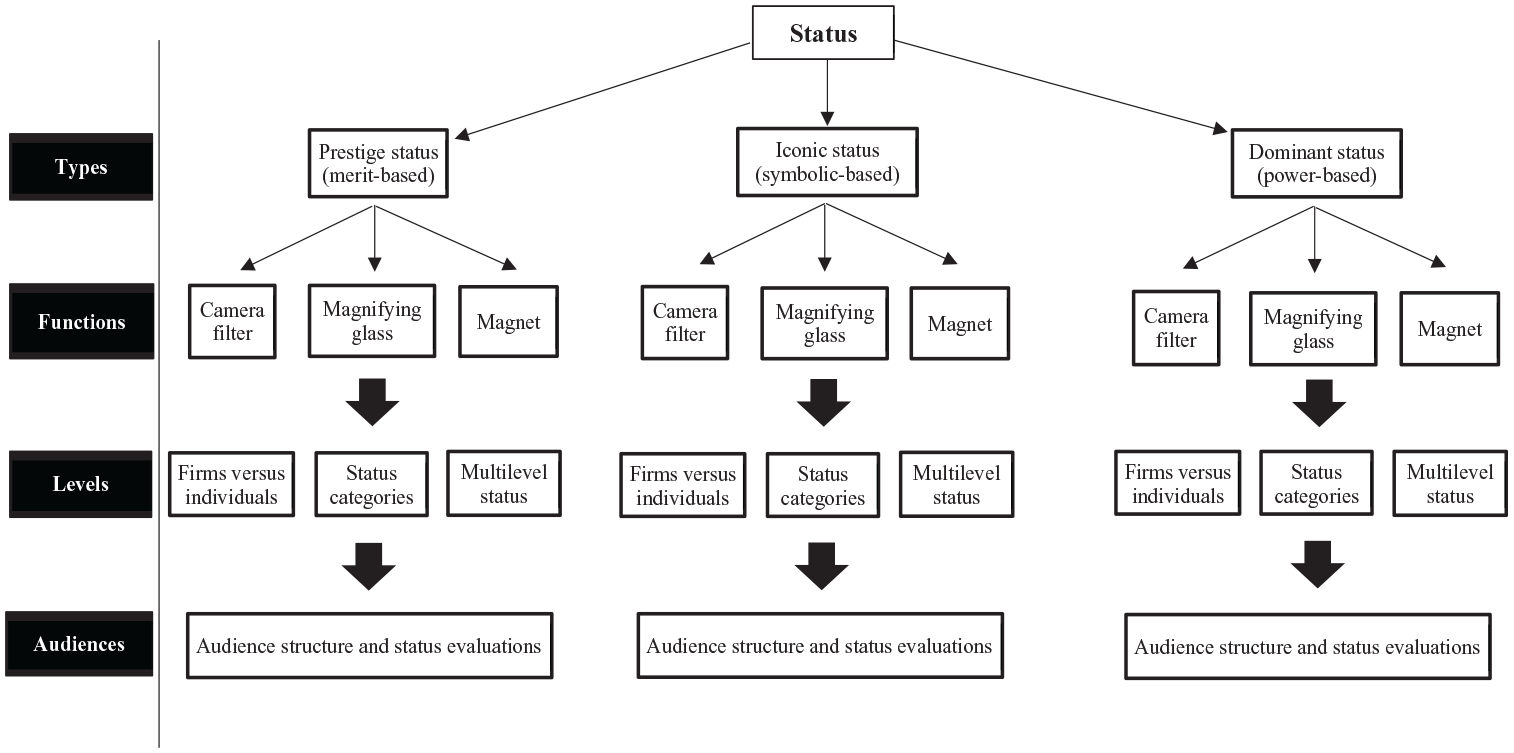
Organizing Structure
Social contexts vary widely. They often involve diverse audience combinations, emphasizing different status types, potentially serving different functions across multiple levels. By categorizing the literature based on these specific status elements, we provide a template for contextualizing and harmonizing seemingly contradictory findings. Moreover, our framework can serve as a navigation tool, guiding future research on in-depth and explicit exploration of the particular combination of different dimensions in the specific setting being studied. Examining different settings’ unique “signature” combinations of type, function, level, and audiences can pave the way for a more nuanced and better-grounded theoretical understanding of the diverse status dynamics across various scenarios.
Multiple Types of Status
To gain a clearer understanding of status, scholars have compared it to concepts such as reputation (Sorenson, 2014), celebrity (Hubbard, Pollock, Pfarrer, & Rindova, 2018), stigma (Pollock, Lashley, Rindova, & Han, 2019), and legitimacy (Bitektine, Hill, Song, & Vandenberghe, 2020). These efforts have shed light on how status and reputation co-evolve (Pollock, Lee, Jin, & Lashley, 2015), how each shapes the outcomes of misconduct (McDonnell & King, 2018), how they distinctly affect resource acquisition (Ertug & Castellucci, 2013, 2015), and the formation of interorganizational ties (Chandler, Haunschild, Rhee, & Beckman, 2013) and alliances (Stern, Dukerich, & Zajac, 2014). Due to its focus on the distinction between status and other social evaluations, this literature has not systematically delved into the inherent variations within the types of status that organizations and individuals may achieve. Consequently, this body of work frequently employs a broad conceptualization of status, mostly as a close variant of “a [high] ranking in a social hierarchy” (the Online Appendix provides status definitions used in the literature). Yet, evolutionary psychology literature has compellingly argued that social systems evolve around two primary types of status hierarchies: dominance and prestige (Cheng & Tracy, 2014; Henrich & Gil-White, 2001), a duality that has recently been acknowledged in management research as well (Bothner, Godart, Askin, & Lee, 2022; Kakkar, Sivanathan, & Gobel, 2020). Dominance-based status is achieved “top-down” by force, intimidation, and the wielding of power. In contrast, prestige status arises “bottom-up” from voluntary deference, accorded due to the possession of valued knowledge and skills. Moreover, recent studies have also begun to explore an additional type of status. They acknowledge that actors gain status not only for the instrumental value of their competences but also from an affective standpoint (de Klepper, Labianca, Sleebos, & Agneessens, 2017), as rooted in the values they embody (Bai, 2017) and which their audiences identify with or aspire to (Verhaal & Dobrev, 2022). Therefore, after a careful review of the relevant literature, we identify three types of status that we label prestige (merit-based), iconic (symbolic-based), and dominant (power-based) status, as summarized in Table 1.
Nomological Comparison of Status Types
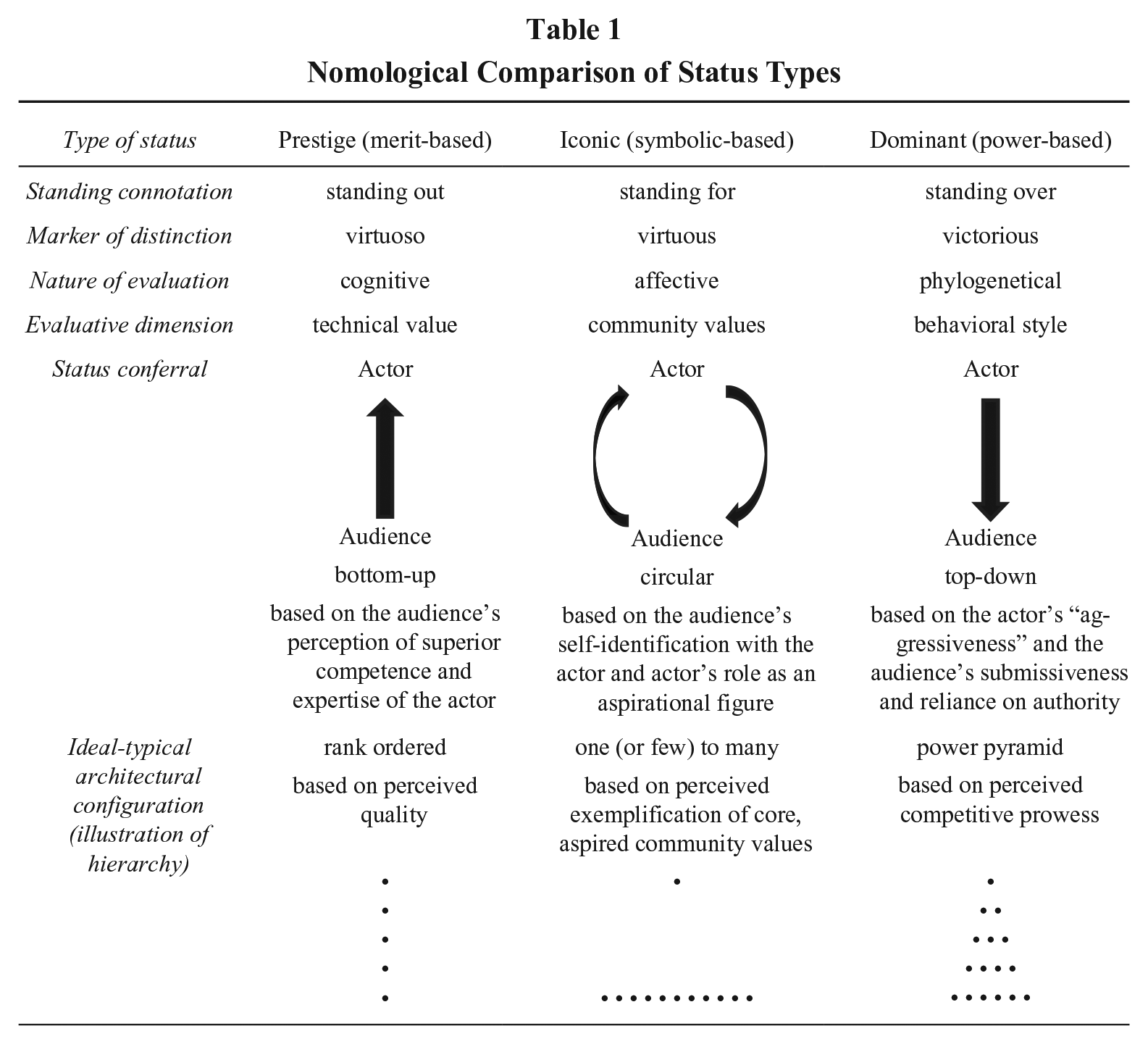
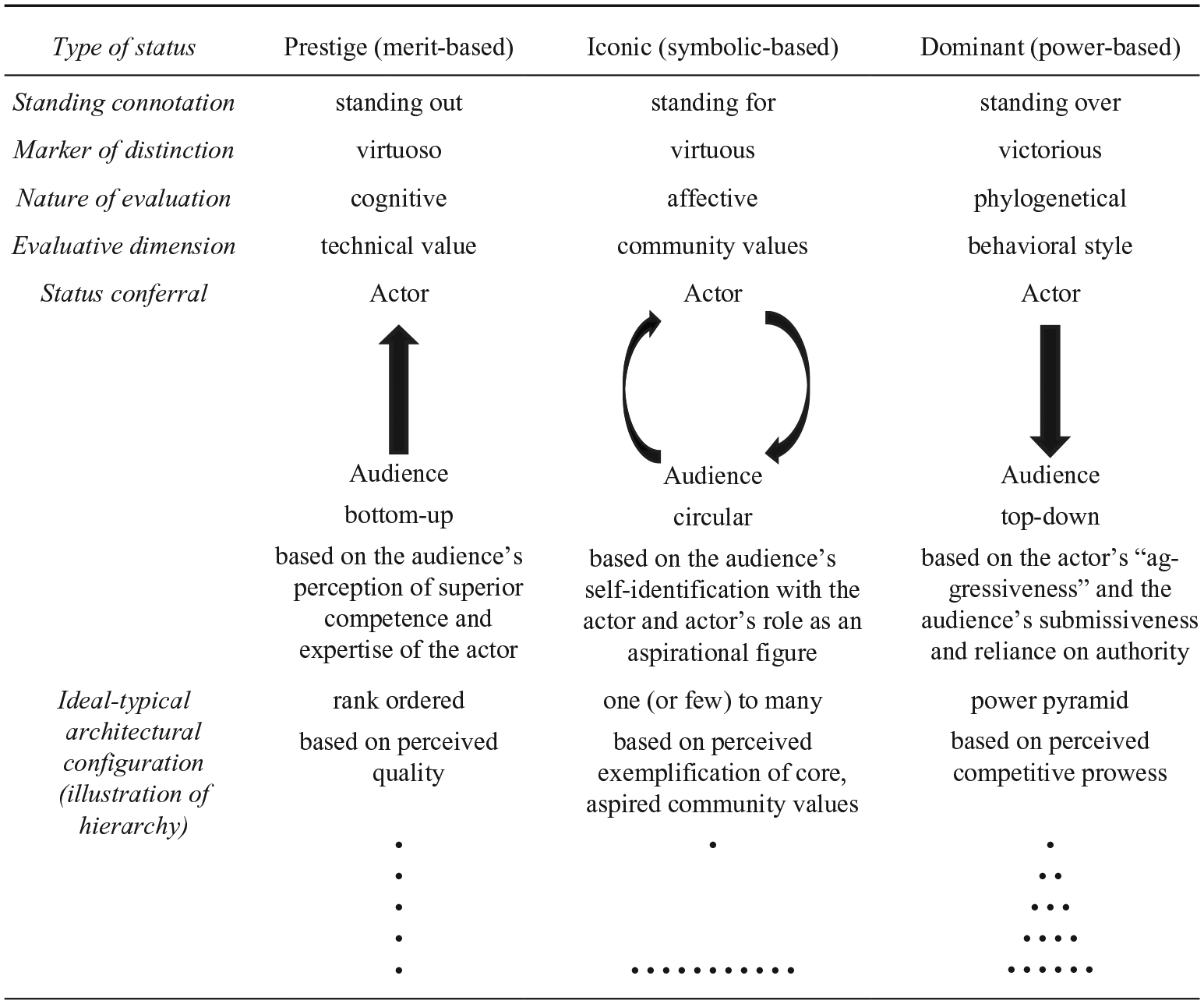
Each of these status types carries different connotations of the etymology of the verb that “status” stems from, which is “to stand.” 2 The first type, prestige status, is a merit-based form of recognition that is conferred to actors that “stand out” due to their perceived superior competencies or abilities. In such cases, high-status actors evoke cognitive admiration for their extraordinary achievements, expertise, and quality. Figures like Marie Curie, Srinivasa Ramanujan, and Judit Polgar serve as examples of merit-based status, having garnered outstanding recognition for their virtuosic accomplishments in their fields. In its ideal type, prestige status takes the form of rankings where individuals are vertically ordered based on perceived differences in their quality.
The second type, iconic status, is conferred to actors who “stand for” the values that are endorsed and espoused by the community they represent (rather than their superior knowledge or outstanding technical competence). In these situations, high-status actors elicit an affective form of deference, driven by the symbolic potency of social identification and aspiration. Emblematic examples of high-status icons are leading social figures, such as Mother Teresa, Martin Luther King, or Greta Thunberg, who have attained recognition for their steadfast and virtuous conduct. The archetypal configuration of iconic status is “one-to-many,” where a single actor (or a select few) is revered and celebrated for their exemplary role.
The third type, dominant status, pertains to situations in which actors “stand over” others. In these instances, the deference granted to high-status actors is rooted in phylogenetic aspects, reflecting the need for leadership and the establishment of orderly structures for social survival. This concept can be illustrated by certain political or business figures, such as Donald Trump, Vladimir Putin, or Narendra Modi, whose modus operandi is based on projecting strength, inducing fear, and instilling a sense of order and structure (Kakkar & Sivanathan, 2017), thereby conveying a victorious persona. The dominant status hierarchy typically reflects the pyramidal structure of power and leadership we observe in many social contexts as seen, for example, in organizational charts.
Prestige (Merit-Based) Status
In its most prevalent connotation, status is deemed to be a reflection of the value of one’s expertise and a testament of their merits. However, status earned through merit can become progressively non-meritocratic over time. This shift occurs because once actors “stand out” as exceptionally competent and are conferred high status, it becomes challenging to demote or dethrone them. In the subsequent sections, we follow the framework presented in Figure 1, to systematically review the literature on prestige status, and mapping, respectively, its multifaceted functions, varying levels, and the diverse audience structures involved.
The Multiple Functions of Prestige Status
In this section, we discern three primary functions of status: (i) a camera filter, (ii) a magnifying glass, and (iii) a magnet. We expound on how each of these functions operates in the context of prestige status, elucidating the different mechanisms that underpin the standing of actors who are accorded status based on their merit. Additionally, we examine how each function either empowers or constrains the behaviors of actors who possess or lack such status.
Prestige status as a camera filter
Research has shown that merit-based status can operate like a camera filter that, by altering the reception of information, can induce a shift in perception. Much like a photographic filter that can accentuate the aesthetic appeal of an image, highlighting its captivating features while “softening” imperfections, status can elevate the perception of an actor’s commendable qualities while obscuring the perception of deficiencies.
We delve into the two facets of this status filter. Initially, we describe how this filter creates a gap between current objective performance and status recognition. Subsequently, we consider how the status filter, when applied to more subjective evaluations, can shape which behaviors or outputs are viewed as meritorious and praiseworthy.
Kim and King (2014) show how high-prestige-status figures in sports gain advantages from a biased perception of their ostensibly objective performance. Their study reveals that umpires in Major League Baseball (MLB) tend to overestimate the prowess of high-status pitchers by enlarging the strike zone in their favor. Paik, Pollock, Boivie, Lange, and Lee (2023) further underscore that once actors achieve status, their subsequent performance bears less significance in retaining it. Specifically, while low-status security analysts must showcase exceptional performance—most notably accurate forecasting—to secure a place in the coveted All-America Star ranking, analysts who have already received this honor face less pressure to prove their accuracy in subsequent forecasts to preserve their status. Biegert, Kühhirt, and Van Lancker (2023) extend this discussion, describing how such mechanisms can create a self-reinforcing dynamic of status over time in the National Basketball Association (NBA). They observe that for players who consistently earn status accolades, such as repeated selection for the All-Star Game, their current on-court performance progressively carries less weight in future selections. 3
The filtering lens of status also colors, perhaps even more vividly, inherently subjective evaluations that lack clear, universally-agreed-upon criteria. For example, Sgourev and Althuizen (2014) explored how atypical artistic creations are seen differently depending on the status of the artist involved. When attributed to high-status artists, such pieces are lauded and celebrated as “notable” works of art, exemplifying the artist’s exceptional creativity. When attributed to low-status artists, these same pieces are instead often discredited and dismissed as clear examples of these artists being “not able.” Perceptions about high-status and low-status actors’ behaviors may also vary based on these actors’ adherence to their role-related expectations. For example, in the context of corporate takeovers, acquisitions by high-status firms of lower-status targets are viewed as more congruent with their respective roles, and hence evaluated more favorably, than the opposite scenario (Shen, Tang, & Chen, 2014). Smirnova, Reitzig, and Sorenson (2022) expand on this mechanism in the context of Stack Overflow, an online community for code developers. The authors illustrate how newcomers to the community, in the nascent stages of establishing their status, tend to be recognized for a role that hinges on straightforward, easy-to-evaluate contributions. However, as these members rise through the status ranks and solidify their standing, the nature of their recognized contributions gradually shifts from transparent, easily assessable endeavors to undertakings that resist easy evaluation or even elude conventional judgement metrics.
The filtering function of prestige status extends beyond merely imparting an enduring aura of superior quality on those actors with certified merit. This perceptual lens also elicits behavioral responses among high-status actors. It emboldens them to undertake risky ventures and explore uncharted territory with confidence and relative impunity. In the tech industry, high-status CEOs tend to channel more resources into high-risk, high-visibility projects than their lower-status counterparts (Fralich & Bitektine, 2020). In the financial sector, banks with entrenched status are more likely to venture into arenas that have yet to receive widespread institutional acceptance (Edman & Makarevich, 2021). In the music domain, artists exhibit bolder stylistic evolution after winning a Grammy award (Negro, Kovács, & Carroll, 2022).
In stark contrast to the favorable perception enjoyed by high-status individuals, low-status actors frequently confront skepticism about their ability and potential. To counteract this skepticism, they often attempt to bask in the reflected light emanating from their associations with higher-status entities, a strategy that, while potentially beneficial, comes with significant costs (e.g., Castellucci & Ertug, 2010). For instance, Bidwell, Won, Barbulescu, and Mollick (2015) show that young professionals in investment banking accept lower remunerations and endure demanding work schedules to establish affiliations with prominent organizations at the onset of their careers. These sacrifices are seen as justified because prestigious affiliations are perceived as vital springboards for future status advancement. Hallen, Cohen, and Park (2023) similarly underscore the need for early-stage start-ups to affiliate with accelerators to secure support from high-status investors. Such endorsements serve as a testament to the start-up’s viability, bridging the trust gap between fledgling ventures and elite investors.
However, actors’ quest for reflected status via affiliations is not without pitfalls. Not only is it costly, but it might not always yield the desired uplift. For example, Betancourt and Wezel (2016) caution that any potential status boost that a low-status company anticipates from hiring a high-status employee could evaporate if the hire spans such a great status-distance that it lacks credibility. Piazza, Phillips, and Castellucci (2020) go further to demonstrate that affiliation with high-status alters may even backfire. The authors find that when emerging artists are opening acts for renowned bands, the latter’s luminosity can eclipse the former, diluting their distinctiveness and stymieing their prospect of success and survival.
In conclusion, the dynamics delineated so far engender a self-reinforcing cycle of status: High-status actors capitalize on the positive filtering function around them to pursue and gain additional status through high-risk high-return ventures and by quality-indeterminate endeavors. Meanwhile, lower-status actors grapple with the challenges posed by the negative perception around them. They find themselves compelled to establish their caliber through outputs that can be evaluated easily and via credible, but often costly, affiliations with more esteemed entities. The self-reinforcing dynamics that solidify status positions can become even stronger due to the other functions of status that we outline below.
Prestige status as a magnifying glass
The second set of advantages conferred to high-status actors is premised on the idea that status functions not only as a “camera filter,” but also as a “magnifying glass” that alters actors’ visibility and channels audience attention accordingly (e.g., Simcoe & Waguespack, 2011). As a “magnifying glass,” status places the spotlight on the accomplishments of high-status actors, thus casting similar achievements of lower-status counterparts into comparative obscurity. Azoulay, Stuart, and Wang (2014) show this effect in the scientific community, in which scientists awarded the Howard Hughes Medical Institute (HHMI) Investigator title experience an increase in the visibility of their work, as evidenced by a surge in citations to their prior work, compared to that of similar quality published by scientists who have not received this accolade. Expanding on this phenomenon, Teplitskiy, Duede, Menietti, and Lakhani (2022) unveil that an HHMI Investigator designation leads to heightened attention not simply in the form of mere rhetorical citations but through more meticulous perusal, as seen in substantive citations that show meaningful engagement and intellectual influence. Seigner, Milanov, Lundmark, and Shepherd (2023) studied how the magnifying glass of status is activated on Twitter, observing that tweets from high-status new ventures attract more audience engagement and that provocative language in those tweets further increases that engagement. 4
Research has also begun to explore the potential downside of the increased attention that is driven by prestige status. For example, Dewan and Jensen (2020) show that when high-status entities are embroiled in far-reaching, multiple-actor scandals, such as options backdating or subprime mortgage fiascos, their status can become a liability. Amid heightened media attention and public interest in accountability, the clout of these high-status firms wanes, and the penalties they face escalate as they become the “big fish” to target.
The skewed attention distribution, due to the “magnifying glass” function of status, also exerts a profound influence on actors’ behaviors. Research indicates that low-status actors often face challenges due to being overshadowed, prompting them to redirect their efforts toward areas that are not dominated by high-status counterparts. For example, Reschke et al. (2018) highlight that the surge in attention driven by status awards causes low-status scientists to reconsider their research directions. Confronted with the overshadowing prestige of their high-status peers, these scientists feel compelled to relinquish scientific territory and abandon their initial research trajectories by opting instead for alternative pursuits in other domains.
Research has also shown that associates of high-status actors often engage in preempting behavior when they fear that they might be indirectly held accountable for these actors’ transgressions. Ody-Brasier and Sharkey (2023) observe that high-status firms, when faced with allegations or proven instances of misconduct, not only draw scrutiny to themselves but also place their service providers into the spotlight, potentially undermining the latter’s status. As a precautionary measure to hedge against this risk, these service providers, particularly accounting firms entrusted to certify balance sheets, levy higher fees on high-status firms.
Prestige status as a magnet
The third function of prestige status that is highlighted in the literature is as a “magnet” attracting tangible resources (e.g., Ridgeway, 2014) and social connections (e.g., Cao & Smith, 2021), as well as business opportunities (e.g., Zhelyazkov & Tatarynowicz, 2021).
Expanding upon Merton’s (1968) Matthew effect, Ridgeway (2014) suggests that prestige status is a key mechanism behind durable patterns of inequality since it is intricately woven into the fabric of how tangible resources, such as fundings or material assets, are distributed in social systems. This “magnet” effect of status, while beneficial for high-status actors, has significant negative externalities for those with lower status, particularly within teams and organizations. Kehoe and Tzabbar (2015) examine this dual impact in an environment with high-task-interdependence, i.e., R&D departments. On one hand, prestigious stars can “lighten the way” for their lower-status colleagues, boosting productivity by granting them access to superior-quality knowledge. On the other hand, these same stars can concurrently “steal the shine” and curtail the generation of innovative ideas among lower-status colleagues by monopolizing resources within the organization. Prato and Ferraro (2018) explore similar ramifications in recruiting, finding that hiring high-status security analysts in brokerage firms may dent the performance of lower-status incumbent employees. This negative effect is attributed to the considerable resources that are needed to attract high-status individuals, which, in settings with low task interdependence, amount to costs that can outweigh their contribution to the organization’s knowledge pool. Wang, Hu, and Liu (2023) provide a parallel analysis, showing that when a high-status analyst departs, coworkers who stay gain more resources, enhancing their performance. Chen and Garg (2018) accentuate this point in sports, observing that NBA teams can inadvertently benefit from the temporary absence of their star members due to injuries. When forced to adapt to the absence of their star players, teams can develop innovative, less star-reliant strategies. Built on a more equitable resource distribution within the team, these strategies lead to improved team performance upon stars’ return from injury.
The second “magnet” effect of prestige status involves its ability to attract connections, thereby serving as a linchpin to accumulate superior social capital. Research in this area has primarily focused on conditions that either magnify or mitigate the relational advantages of high-status actors, highlighting the role of cognitive perceptions, emotional threats, and structural contingencies, as we summarize below.
In terms of cognitive perceptions, Yu and Kilduff (2020) suggest that an accurate cognitive representation of the status order, which aligns with the actual status hierarchy, is fundamental to adopt effective strategic networking behaviors to engage higher-status individuals. Building on this foundation, Cao and Smith (2021) show the role played by the perceived alignment between individuals’ status and their intrinsic quality. The authors suggest that connections to high-status actors are more likely to be initiated (and reciprocated) when the correlation between status and intrinsic quality is perceived to be high.
Focusing on the emotional barriers that hinder low-status actors’ relationships with high-status ones, Keeves and Westphal (2021) bring to light a particular tension that arises when a collaborator attains a significant elevation in status. This advancement can elicit a feeling of under-reciprocation among those who contributed to the ascent, reducing their willingness to aid the recently-elevated collaborator. Harari, Parke, and Marr (2022) explore relationship support from the opposite perspective. Focusing on high-status individuals extending help to those lower in rank, they differentiate between reactive helping (i.e., support rendered in response to an explicit request) and anticipatory helping (i.e., support extended before a request is made). When higher-status actors provide anticipatory helping, low-status recipients may perceive this unsolicited support as a veiled threat to their self-worth. This perceived threat can lead not only to their resisting the assistance but also to revising their assessment of the helper’s abilities and the overall quality of their relationship.
The implications of status (as a magnet) for social connections takes on additional layers of complexity when structural contingencies are taken into account. Rua-Gomez, Carnabuci, and Goossen (2023) investigated how physical and network proximity differently affect women and men in forming ties with high-status scientists in R&D labs. While women derive greater benefits than men from network proximity, i.e., from having shared third-party connections with the eminent scientist, men seem to gain more advantage from physical proximity to high-status colleagues. Collet and Philippe (2014) explored the impact of market contingencies in modulating the magnet effect of status in alliance formation. In an up market, during which uncertainty is seen as upside risk, firms are more likely to form exploratory alliances with firms of different status. In contrast, in a down market, during which uncertainty is perceived as downsize risk, firms are more likely to adopt conservative alliances with firms of similar status.
The third benefit of the magnetic allure of high prestige status extends beyond merely attracting relationships from lower-status actors. It also presents these high-status actors with lucrative opportunities from the low-status actors who want to engage with them. For example, Zhelyazkov and Tatarynowicz (2021) show that, while high-status venture capitalists (VCs) are more inclined to invite lower-status peers to join underperforming ventures, lower-status VCs tend to invite high-status ones to participate in ventures that show a more favorable performance outlook, particularly in thriving market conditions.
Research has also begun to elucidate the nuanced influence on actors’ behavior of resource advantages that are derived from the magnet function of prestige-based status, revealing an energizing effect on high-status individuals and a demotivating effect on those with lower status.
As an illustration of the energizing effect, Maoret et al. (2023) find a post-All-Star weekend surge in the performance of NBA players who are selected to participate in it. This boost is seen in both the additional resources these players receive, such as more passes from teammates or prolonged playtime from coaches, and their enhanced efficiency in converting resources to outputs. The authors argue that these effects are due to greater initiative taking by these players, based on the increase in their emotional energy that is linked to participating in the status-elevating All-Star weekend. As the increase in emotional energy due to that status “shock” dissipates, however, the advantages also disappear, waning after a few games.
Conversely, Bol, de Vaan, and van de Rijt (2018) highlight the demotivation of low-status actors due to resource deprivation. Their study shows that early success in obtaining research funding bestows status on researchers, making them more likely to receive preferential treatment in future funding endeavors. In contrast, an initial setback demoralizes lower-status researchers, making them less inclined to pursue subsequent funding opportunities.
Future research: Transversal exploration of the functions of prestige status
By breaking down the three functions of status—namely, a performance-perception coloring filter, an attention-channeling magnifying glass, and a resource-attracting magnet—we categorize the different strands in the literature, providing a template to map and reconcile seemingly diverging findings. In addition, our categorization lays the foundation for a nuanced examination of the temporal dynamics of status and the potential strategies that low-status actors could adopt to elevate their status.
For instance, understanding the relative strength of these three functions in different contexts can offer insights into the enduring or transient nature of status trajectories. Key to this understanding is identifying the conditions under which each status function is active or suppressed. Such conditions might be shaped, for example, by fluctuating economic conditions modulating resource availability (and affecting the magnet function), paradigm shifts altering the merit assessment criteria (and impacting the camera filter function), or movements that redirect societal focus (and influencing the magnifying glass function).
Additionally, exploring the conditions under which different functions conflict, rather than synergistically enhance each other, could offer novel insights. For example, when audiences perceive performance advantages as stemming from the resource disparity triggered by the magnet function of status, they may also, disproportionality, elevate their performance expectations of high-status actors. In this scenario, audiences might skew the camera filter effect in favor of the “underdog” or low-status actors and downplay, rather than commend, the achievements of privileged high-status actors. Likewise, an overemphasis on the magnifying glass function of status, casting the spotlight only on the highest-status actors, could provoke envy that overshadows the recognition of the merits of those actors. Such exploration of the interplay of the different status functions across various contexts can significantly deepen our understanding of status. This understanding can be further enriched by examining the effects of status and its functions at different levels, which is the focus of the subsequent section.
The Multiple Levels of Prestige Status
The pattern of findings in the literature suggests that status can operate differently across distinct levels of analysis. Specifically, these potentially diverging dynamics center on (i) the different impact of status on firms as compared to individuals; (ii) the hierarchical status arrangement of broader categories, based on industry or geographical location, and how this meta ranking affects firms; and (iii) the interplays across multiple levels of status.
Firm vs. individual prestige status
In the realm of prestige status, there is a contrast between individuals and firms. The literature we reviewed so far, focusing mostly on individuals, suggests that when individuals distinguish themselves for their merit, they often secure relatively enduring status, to some degree resistant to both subsequent declines in their own performance and superior achievements of others. We speculate that this perspective is likely shaped by our acute awareness of the finite nature of the human lifespan and its inevitable cycle. The implicit expectation is that individual performance naturally ebbs with time and, as fields progress, newcomers will inevitably outpace the achievements of their predecessors. As a result, individuals’ achievements are appreciated and revered in the context in which they were realized, recognizing the significance of the era they marked. In short, precisely because humans are not perpetual entities, their past achievements can gain a certain timelessness.
Unlike individuals, firms cannot rest on the assumption of predetermined lifespans or naturally expected declines in performance. Therefore, their past laurels do not ensure future reverence. Compared to high-status individuals, high-status firms are expected to survive and adapt to evolving circumstances. As such, they must consistently demonstrate their superior quality to preserve their prestige status. Indeed, while an individual’s status legacy can weather transformative changes in their field, firms often falter amidst disruptive innovations. 5 For example, companies like Nokia and Motorola, once deemed as the most prestigious firms in the industry, did not exhibit the same resilience of status generally observed for comparable esteemed individuals. 6 Unlike the case for prestigious individuals, the spotlight on these firms centered not on their demonstrated ability to set new peaks in the old technological domain. Instead, the focus was sharply on their inability to adapt to the new emerging technological revolution and the disruptive innovations ushered in by firms like Apple and Samsung, leading to their past merit being framed as a transient phenomenon not deserving current adulation.
Evidence of the precarious nature of firms’ status can be found in recent research that has begun to explore the darker aspects of status for firms that are striving to maintain merit-based status. This research has exposed the anxiety and costs that come with upholding high-status positions. High-status firms, burdened with expectations for superior quality and performance from their audiences, experience significant pressure and anxiety, especially when they struggle to meet these expectations or when their performance falters. Fear of status loss can drive such firms to engage in unscrupulous activities to safeguard their standing. Krishnan and Kozhikode’s (2015) study on the Indian banking industry provides a telling illustration of this dynamic, whereby when high-status banks face a decline in their financial asset quality or lag behind their peers, they are more likely to resort to illicit loan recovery practices. Similarly, Jeong and Siegel (2018) reveal that South-Korean business groups that have mediocre economic performance relative to their industry peers are more likely to resort to bribery directed toward the government.
As high-status firms endeavor to consistently meet the elevated expectations that come with their standing, they are likely to face circumstances leading to increased costs. For example, Moore et al. (2019) show that high-status organizations can end up paying a premium to preserve their social status, because such organizations might be compelled to engage in intense competition for essential inputs to continue to excel, which involves outbidding rivals.
In summary, while high prestige status confers numerous advantages on firms, it can also present challenges by engendering anxiety, spurring unethical behaviors, and requiring greater financial expenditure for its upkeep. To what extent these challenges also apply to individuals with high prestige status is mostly an open question in management research.
Category-level prestige status
While it is acknowledged in social psychology that social categories like gender or race assign a form of ascribed status to individuals (Ridgeway, 1991), management research has broadened this perspective, suggesting that prestige status can also be conferred upon firm-based categories, such as industries and geographical districts. Much like ascribed status that is based on social categories, this categorical status can cascade down and be ascribed to the actors within them. Our review of this nascent literature reveals an evolution mirroring our classification of status functions, illustrating how category-level prestige status can serve as a camera filter that colors the evaluation of actions undertaken by actors within that category, as a magnifying glass intensifying spotlight and heightening scrutiny toward actors within the category, and as a magnet attracting resources, ventures, and human capital.
Sharkey (2014) provides a quintessential example of the impact of category-based ascribed status, positing that certain industries, such as biotechnology, are perceived to possess greater prestige status in the financial market. Mirroring individual status, this category-level status works like a photographic filter, shaping the way in which actions by firms in that category are perceived. Specifically, the dubious practice of earning restatements is seen differently, as reflected in the lower penalty in share prices, when it is adopted by firms that are classified in a higher-status industry.
As far as we can discern, the function of status as a magnifying glass has yet to be explored in this line of work. However, it seems clear that industries and geographical clusters can differ in the attention they receive on account of their status, as seen, for example, in disproportionate media or analyst coverage. In this manner, category status can act as a magnifying glass, amplifying the visibility of the achievements or failures of actors within these categories, thereby contributing to different trajectories of their status dynamics.
Luo, Ma, Makino, and Shinkle (2020) extend the notion of category-based prestige to geographical clusters, asserting that regions can gain status through their high levels of innovative performance. The resulting prestige of these clusters functions as a “magnet” that attracts start-ups and investments, thus potentially setting in motion a reinforcing cycle of the region’s prominence. Furthering this line of thought, Sabanci and Elvira (2023) demonstrated the magnetic pull of industry prestige in talent acquisition, suggesting that high-status industries can lure executives from lower-tier industries at significantly lower compensation.
Multilevel prestige status
Research exploring status at various levels also points to a dual-status dynamic. Actors, whether as firms or individuals, can potentially bask in the glow of two sources of prestige: the merit-based acclaim that these actors have garnered themselves and the halo effect that is rooted in the elevated status of the broader entity (e.g., organization) or category (e.g., social group or industry) with which they are associated. These two layers of status are not isolated silos; they often intertwine, amplifying or sometimes tempering each other. The literature has begun to delve into the intricacies of this dual-status phenomenon across specific levels, such as individuals within organizations, individuals within social categories, and organizational units within firms. Given the relatively scant research on the topic, this area remains ripe for exploration, offering a plethora of avenues for future research.
One set of studies in this stream considers the interplay between individual and organizational status. For example, Durand and Kremp (2016) show that, in the context of U.S. symphony orchestras, decisions by conductors to take risks—by programming avant-garde compositions or deviating from other orchestras’ repertoire—are not based solely on their own prestige status. Instead, these decisions are conditioned by the prestige of the orchestras they lead, in a manner that reveals an intricate, non-linear relationship between multilevel status and risk taking. The interplay between individual and organizational status also plays an important role in how individuals are evaluated. Rider and Negro (2015) investigate this interplay with a focus on the mobility of employees from law firms that fail. Such failures are explicit markers of a decline in organizational status. Although a firm’s failure typically jeopardizes ex-employees’ careers, not all are equally affected. Specifically, employees with high personal prestige, as indicated by markers like superior education levels, are shielded from the adverse effects of the status loss of their employer on their own career trajectory.
Prato et al. (2019) explore the interplay between the status of individuals and the status of their social category within U.S. symphony orchestras. Their findings reveal that an orchestra conductor’s inclination to take risk through unconventional repertoire choices is intricately linked to the interplay between their own earned status and the ascribed status they inherit from their social group. A key finding is that multilevel status inconsistency has different behavioral implications depending on whether the lagging status is the malleable individual status or the more entrenched social group status. Specifically, conductors with low personal (achieved) status but who belong to high-status (ascribed) groups are more predisposed to bridge the multilevel status gap. They leverage their group’s consolidated prestigious standing to engage in risky choices, seeking to earn the individual recognition they feel they merit. In contrast, conductors who have achieved high personal status but belong to low-status social groups are more likely to make safer, more conventional choices lest their own, individual (inconsistent) status is questioned.
Studies investigating nested status hierarchies within organizational structures focus primarily on multi-unit organizations, where the overarching entity and its constituent units might occupy different status positions. For example, Kim (2020) explores the differential effect of an organization’s overarching status and the status of its individual units on internal collaboration and deference patterns. Focusing on patient treatment, the author noted that shifts in “best hospitals” status rankings did not significantly sway physicians’ treatment behaviors. However, when specific specialty units clinched top-tier rankings, they displayed a diminished propensity for inter-specialty collaboration—a phenomenon dubbed the “ego effect.” Concurrently, these top-ranking units were more likely to administer procedures to patients from other specialties, suggesting a “halo effect.” Moreover, research suggests that the status of an organization and its individual units may have not only independent effects but also interact with each other. Jensen and Wang (2018) delve into this interplay by examining the role of status inconsistency across these levels in audience evaluations. The authors argue that such inconsistency can breed ambiguity about a unit’s social identity in the eyes of external evaluators, thus diluting the perceived status of both the overarching organization and its individual units. Shifting from audience perceptions to firm behavior, Wang and Jensen (2019) investigated how multi-level status inconsistency affects strategic decision-making. Their research reveals that diversified firms grappling with status inconsistencies across their units anticipate potential devaluation due to the ambiguity surrounding their status identities. Consequently, these firms are more likely to divest the units that exacerbate this status inconsistency, as a strategic move to streamline and clarify their status positioning.
Future research: Transversal exploration across the levels of status
Although research has begun to unravel the interplay between nested status hierarchies, numerous interactions between the different hierarchical levels of status remain largely uncharted. Several directions arise from the exploration of the interplay between a firm’s own status and the status of the broader category in which it is nested. To illustrate, suppose a premium watch manufacturer emerges from a country not known for its virtuosic horological heritage. Will the firm’s own status shield it from the negative perception around the country status? Or will the country’s low status in the watch-making domain lead audiences to scrutinize the high-status firms’ products more rigorously than they would for a counterpart from Switzerland or a low-status watchmaker from the same country? Additionally, how does the dual-level audience perception constrain the firm’s strategic actions? Similar questions might be raised when exploring the impact of category status shifts. Consider the global luxury automobile industry, where a high-status firm like Rolls-Royce historically basked in high prestige. What happens when the status of the broader category, in this case, the British automobile industry, falters and is overshadowed by Asian manufacturers? Does the individual prestige of Rolls-Royce shield it from negative associations with the faltering category status, more than what might happen for a low-status counterpart, or would it be influenced more by the decline of the status of the broader industry?
Transversal exploration of status across hierarchical levels might also unveil hitherto unexplored, asymmetric dynamics. For example, does the status of individual members elevate the organization’s status more swiftly than the organization can raise the status of its members? More concretely, does (and when) hiring a high-status CEO elevate the status of a firm more rapidly than a firm’s status elevates the status of a newly hired low-status CEO? Similarly, as above, one might study if status fluctuations at these different levels produce divergent outcomes between them. Consider a scenario where an individual’s status starts declining. Is the fallout effect of this decline on the individual’s organization more severe, as compared to the effect of an organization’s status decline on its members?
Our framework not only facilitates transversal exploration across different levels of status but also opens the path to transversal explorations spanning cross-functional and cross-level dimensions. By juxtaposing and intertwining the functions of status at different levels, researchers can develop a more holistic understanding of status dynamics. For example, this exploration might uncover the conditions under which the status of an actor and the actor’s category status might undermine rather than augment each other. Consider industries that attract abundant resources due to their high status, via the function of status as a magnet. In such contexts, even though a firm’s elevated status grants it preferential access, its ability to differentiate itself might be curtailed. In this scenario, even a relatively small share of a vast resource pool might be sufficient to give the opportunity to firms with lower status, but superior quality, to stand out. In other words, in circumstances where category status already functions as a magnet for resources, a firm might benefit more if its own status functions as a camera filter, accentuating its distinct qualities, or magnifying glass, casting light on its achievement, rather than a magnet securing additional resources. 7 Similarly interesting dynamics can be at play in industries where status functions as a magnifying glass, giving those industries—and their members—heightened, undivided attention. In such highly scrutinized industries, firms that are at the apex of the status hierarchy may find themselves exhaustingly and perpetually under scrutiny, vulnerable to the risks of overexposure. 8
The Multiple Audiences of Prestige Status
Central to our discussion of prestige status is not only a refined theorization of its levels but also an in-depth understanding of the audience structures that are involved (Kovács & Liu, 2016). One tenet in status research in the last decade is that more than one audience can partake in status evaluations. We use two dimensions to categorize this emerging literature. We use the horizontal axis to navigate findings about the ramifications of audience impermeability or permeability. This distinction hinges on whether different audiences’ evaluative standards, or preferences that underlie their merit-based status evaluations, are formed in isolation or interdependently. We use the vertical axis to distinguish insights based on attributes of the status hierarchy between audiences, i.e., whether there is such a hierarchy or not. For example, critics and intermediaries often occupy higher rungs of this hierarchy and wield considerable influence in shaping the status beliefs for members of other audiences.
A strand of literature has explored situations in which the distinct audiences that are involved in status evaluations have impermeable (i.e., not mutually influenceable) tastes. When these audiences’ preferences also happen to be conflicting, an actor’s ability to achieve broad recognition across them can be stymied. Documenting this phenomenon, Kovács and Sharkey (2014) observed a puzzle whereby prestigious book awards led to lower subsequent reader ratings of these books. This counterintuitive negative effect arises from the status-granting awards drawing attention to the book from a wider, more diverse audience, whose quality criteria are not the same as those of the audience that was originally and organically attracted to the book. This is a case in which status functions as a magnifying glass, heightening visibility among “foreign” audiences, but not as a camera filter that influences their evaluations. Diverse evaluation criteria can arise not only between different audience groups of end-users (i.e., book readers) but also between diverse audience types. For example, Cattani, Ferriani, and Allison (2014) highlighted the difference between peers and critics in the UK film industry. Peers are more likely to bestow status to insiders in the field, owing to their in-depth industry knowledge, whereas critics tend to favor outsiders bringing fresh perspectives. Similarly, Ertug, Yogev, Lee, and Hedström (2016) illustrated the varied priorities of museums and galleries: while museums make decisions about which artists to exhibit based on indicators of lasting artistic value, galleries make such decisions based on commercial appeal.
Another set of studies leverages the idea that audience groups can be permeable, allowing for mutual preference influence. This aspect has been examined in the context of international business, regarding how macro-economic factors can facilitate status transfer across countries. For instance, Alvarez-Garrido and Guler (2018) explored how endorsements from high-status venture capitalists in one country affect biotechnology start-ups in another, depending on the connectivity between the countries’ venture capital industries. Likewise, Liu and Maula (2021) examined the influence of a foreign venture capital firm’s network status within the host country, especially in countries with less robust regulatory frameworks.
Recent research has shifted focus from the horizontal axis of audiences’ (im)permeability to the vertical ordering of audiences, whereby one (higher-status) audience can influence the opinions of another. This line of inquiry emphasizes the increasingly pervasive role of critics and intermediaries, which have substantial clout in many fields in defining and advocating for a status hierarchy by compiling rankings and ratings (Sharkey, Kovács, & Hsu, 2023). The ratings and rankings tabulated by “third-party” audiences can sway the perceptions of those audiences who rely on them when forming their status opinions of the evaluated entities. For instance, Bowers and Prato (2018) elucidate the top-down influence of intermediaries, focusing on the case of the prestigious magazine Institutional Investor and its influence over the investing public. The reliance of the latter on the former’s rankings opens the door for the emergence of status-related filtering effects, even when these are not rooted in a strict meritocracy of the entities assessed. Specifically, the authors show how arbitrary changes by Institutional Investor in the categories it uses to rank the best analysts on Wall Street (which displace some analysts from their prestigious ranking positions and elevate others, despite no changes in the actual quality in either set), altered the end-user audience’s (i.e., investors) perception of the quality of the affected analysts, thereby enhancing or diminishing the analyst’s influence in the stock market.
Audience structures, both horizontal and vertical, affect not only the co-evolution and spillovers of status between audiences, but also shape the behavior of both the evaluated actors and the audience members themselves.
The growing prominence of third-party rankings and ratings among end-users has spurred research into how evaluated entities adapt their strategies in response to these evaluations (Espeland & Sauder, 2007). For example, private colleges and universities dropping in the U.S. News & World Report’s annual rankings respond by raising their tuition fees, to elicit the perception of high quality and signal their ambition to reclaim status, a phenomenon the authors call the “Chivas Regal strategy” (Askin & Bothner, 2016). Favaron, Di Stefano, and Durand (2022) found that restaurants’ inclusion in the Michelin Guide’s rating causes heterogeneous responses in the operational modifications and market positioning for these establishments based on their standing before these ratings. Castellucci and Slavich (2020) show that such ratings can also bear implications for chefs’ creativity, by influencing an apprentice’s choices with respect to their master’s offerings.
The transition in many settings from expert (critic-based) to intermediary (user-centric) rankings has opened new avenues in this stream of status research. For instance, Shi (2023) explored the implications of such transition among high-status third-party evaluators in the Billboard music rankings, which transitioned from being dictated by expert critics to being influenced by a wider demographic of music consumers. When expert critics, characterized by well-defined and unambiguous preferences, held the reins of the ranking system, the result was field isomorphism and the emergence of well-defined musical genres. However, as the ranking system underwent a democratization and evolved to incorporate evaluations from a more diverse group of music listeners, the landscape transformed. Under this intermediary-led, user-influenced model, artists found themselves in a more fluid environment. The previously established genre boundaries began to blur, and artists became more incentivized to experiment, leading to a cross-pollination of genres.
Just as evaluated actors are influenced by their status positions, audiences also experience behavioral implications that result from their standing in a hierarchy of audiences. For example, a prominent concern for top-tier audience members is the preservation of their elevated status. Accordingly, recognizing the risk of being sidestepped by end-users or other actors, intermediaries engage in proactive strategies to cement their relevance and indispensability. To illustrate, Bowers and Prato (2019) show that the Institutional Investor magazine, which compiles a prestigious ranking for security analysts, might strategically redefine their ranking categories to instigate changes in status hierarchies—so that the status hierarchies they have established do not become too static and the dynamism that is introduced in this manner can stave off the redundancy of annual announcements and ensure sustained relevance for their targeted audience. To uphold their status, intermediaries also need to sustain the engagement of end-users whose input fuels their rankings. Botelho and Gertsberg (2022) suggest that one way to achieve this is by instigating status competition among end-users in the form of evaluators’ awards, certifications, or ratings. The authors exemplify this through the introduction of the Yelp’s “Elite” evaluator status. This award not only created a status hierarchy among end-user evaluators, but it also had a disciplining influence on the recipients of the accolade, reducing their gender biases. Not always, however, do status hierarchies among evaluators mitigate biases. Shen, Kim, and Li (2022) reveal that they could also exacerbate them. When assessing new ventures, lower-status evaluators (as based on their affiliation to less prestigious universities) are more likely to be biased by the venture teams’ connections to top-tier institutions, viewing these connections as markers of team quality. Consequently, these evaluators are less inclined to pose challenging questions to the venture team, potentially reinforcing the bias in the team’s favor.
Future research: Transversal exploration across audiences
There are numerous unanswered questions about the role of multiple audiences in status evaluations, which can inspire future research. One line of inquiry can be the exploration of factors that lead to the emergence of multiple audiences that have divergent or congruent preferences. Relatedly, investigations into the conditions that isolate audiences, resulting in evaluations that are independent and possibly in conflict, or that make them permeable, allowing for the crossover of evaluations between them, are also needed. Answers to such questions can yield novel insights about the differing temporality of status across settings. For example, in situations where audiences have mutual permeability, status hierarchies might be more rapidly unsettled, as the recombination of different evaluation schemas is likely to generate new standards that might jeopardize previous standings. By contrast, when audiences operate in isolation, status metrics within each segregated audience are more likely to remain stable, thus consolidating status hierarchies.
Status temporality is likely to be further influenced when audiences are hierarchically ordered, with some groups having a disproportionate influence on evaluations by others. On the one hand, elite audience groups can solidify the status hierarchy among evaluated actors by acting as a validating entity that certifies and endorses their relative merit in the eyes of the broader audience. By the same token, however, changes in the evaluations of those high-status audience groups also have the potential to significantly disrupt the status hierarchy, given the reliance of other audiences on their judgments.
In considering the multifaceted nature of status, expanding our analysis to include both different audience structures and levels introduces an additional layer that can yield rich insights about the dynamics of status recognition and influence. Emerging research is beginning to tap into this potential. For example, Chae, Song, and Lange (2021) intersect status at multiple levels (firms within countries) and different audiences (foreign vs. local) to show that the attainment of a firm’s status in the eyes of a foreign audience from a distinguished (higher-status) country, referred to as outside status, can exert a favorable influence on how that firm is perceived by the domestic audience in a lower-status country. Acharya and Pollock (2021) intersect the status achieved in the eyes of a micro-local audience and a macro-global audience to explain the likelihood of board of directors’ turnover.
Several opportunities emanate from further pursuing such a multi-audience and multi-level exploration. Consider, for instance, the dynamics between categorical levels, such as industry and geographical location, and their effects on how audiences evaluate firms in these categories. As more firms are drawing distinctions between where their products are “made in” and “designed in,” these firms can tap into the prestige associated with two distinct countries. For example, brands like Panerai in horology attempt to combine the prestige of Italian design with that of impeccable manufacturing of Switzerland. However, the perceptions of such dual categorical status can vary across audiences. For example, audiences who have an established appreciation for watch craftsmanship, such as high-status connoisseurs, might hold a higher regard for purely Swiss brands, as opposed to hybrid entities. Conversely, novice audiences may be more impressed by the dual-country high-status affiliation of Panerai.
This investigation between audiences and levels can be further enriched by examining the repercussions for firms whose prestige is anchored in both their industry and geography affiliations when they shift their operations to nations that are perceived to be of lesser stature in one of the two categories. For instance, when corporations like Apple move their production from China to India, how do Chinese consumers perceive this move, as compared to U.S. customers? The reaction of the different audiences is likely to be affected by their respective view of India’s standing relative to China. If U.S. customers perceive India’s status distance from China to be smaller than Chinese customers do, the former is likely to be less affected than the latter by the relocation of production. Such corporate decisions might not only influence audience perceptions of the firm’s status but might also affect audience evaluations of the corresponding category status. For example, when prestigious companies, such as Apple, shift production from one country to another, the prestige of the original country might suffer a decline, while the new one experiences a boost. In addition, this effect might be more pronounced among audiences that regard the company highly (e.g., iPhone users) compared to other audiences (e.g., Android users).
Iconic (Symbolic-Based) Status
In the second connotation that we identify in the literature, status is anchored not in the admiration garnered for one’s virtuosity, technical mastery, or coveted skills, but rather in the recognition received for one’s virtues (Bai, 2017; Bai, Ho, & Yan, 2020) and their ability to become symbolic, emblematic figures (Verhaal & Dobrev, 2022). This type of status is rooted in championing, upholding, and personifying the core ideals that define a community. It celebrates actors who “stand for” the collective beliefs and aspirations of their audience, serving as beacons of their shared values.
The annals of history and contemporary society are replete with examples of high-status iconic figures such as Mother Teresa, Mahatma Gandhi, and Greta Thunberg. Greta Thunberg’s ascent to a high-status iconic figure in the realm of environmental advocacy helps us clarify the difference between prestige and iconic status. Her status does not stem from her unmatched expertise on the subject, but rather, from her capacity to ardently symbolize the movement’s ethos and galvanize social awareness and urgency about the issue. Iconic status emanates not from the audience’s cognitive assessment of expertise and competence, but from the actor’s ability to inspire, mobilize, and evoke deep emotions, which are driven by the audience’s sense of self-representation or aspiration.
The Multiple Functions of Iconic Status
In this section, we illustrate how the three distinct functions of status operate differently in the context of iconic status as compared to prestige status. This comparison sheds light on the unique characteristics and dynamics of each of these two status types.
Iconic status as a camera filter
Analogous to prestige status, iconic status can operate as a camera filter. However, the filtering lens of iconic status has a dual refractive property. This lens not only molds the observer evaluator’s perceptions about the actor holding the status, but it also reflects the former’s aspirational identity. In this manner, the process of elevating someone’s iconic status becomes entangled with the evaluators’ self-perception, acting as a platform for their own self-enhancement. This process establishes a symbiotic and reciprocal dynamic between the evaluated actor and their observing audience.
In this admiration-identification cycle, the icon assumes the role of a “cultural glue” that binds individuals into a community, thereby reinforcing and perpetuating its cultural and social norms (Collins, 2004). Owing to what Collins calls the “emotional energy” that is generated from this process, audiences’ admiration for high-iconic-status actors can surpass that for high-prestige-status actors and effectively turn into adulation. This can be seen in the form of conspicuous consumption, where the status of iconic brands is harnessed by consumers to showcase their affiliation with a high-status group they identify with or aspire to. This self-identification with the social group represented by the brand can ignite deep brand loyalty, leading consumers to queue at length for new product releases from that brand, and to pay a significant premium for its symbolic value.
As described by Georg Simmel (1957), this phenomenon is at the heart of fashion, where items of clothing and accessories serve as symbols of the values and identities of distinct social groups and are employed by individuals to exhibit their belonging to those groups. Recent organizational research has extended this perspective to other industries that are characterized by a strong adherence to shared values and collective identity, such as craft beers (Frake, 2017; Verhaal & Dobrev, 2022) or local wines (Malter, 2014; Ody-Brasier & Vermeulen, 2020). As suggested by Verhaal and Dobrev (2022: 252), “The social movement–like character of such industries provides a context in which producers’ success is understood to emanate from their staunch support and embodiment of the industry norms and values. In other words, producers widely recognized for their standing within the movement are able to increase their appeal. . .because they become viewed as an archetype for the industry itself.”
Research in management underscores two pivotal aspects of iconic status. First, this type of status is noted for its ability to convey symbolic value that transcends objective evaluation. Malter (2014) studied the symbolic value of iconic actors in the wine industry, finding that iconic wine producers, categorized in the high-status Médoc châteaux bracket, can command higher prices. Notably, Malter shows that this price premium intensifies as the certainty about a product’s quality rises. This phenomenon indicates that, contrary to prestige status, which acts as a quality signal whose value increases in more uncertain scenarios, iconic status reflects mere symbolic values. The source of this premium is not technical prowess in wine production, which can be replicated, but the historical values of the represented community, which cannot be substituted.
Second, research has elucidated the “alter-centric” nature of the symbolic value inherent in iconic status. Sharkey and Kovács (2018) illustrate this aspect in the context of product markets, showing that iconic status is likely to be especially meaningful when the product is procured for others, as opposed to personal, private consumption. Accordingly, the authors show that during occasions such as Christmas gift-giving, consumers’ book choices lean more towards what the community of book-readers might deem “archetypal,” as compared to purchases outside festive seasons which are more likely to be for personal, private use.
Unlike research on prestige status, the management literature on iconic status is nascent, with explicit considerations about behavioral consequences being largely untapped. Nonetheless, it is reasonable to expect that the strong bond established by actors of eminent iconic stature with their represented community elicits stringent behavioral expectations of adherence to the community’s values and standards. Deviation from these standards by high-iconic-status individuals is likely to result in considerable disillusionment and erosion of credibility. Take, for instance, environmental icon Greta Thunberg. Should she indulge in actions that are perceived as incongruent with her message, such as flying on a high-CO2-emission private jet, her credibility and iconic status can be irreparably dented. 9 Likewise, envisioning Mother Teresa, celebrated for her dedication to poverty alleviation, featured on the cover of a fashion magazine in luxurious and opulent attire is likely to be jarring and unacceptable for her admirers. 10
Using Champagne producers as an example, Ody-Brasier and Vermeulen (2014: 109) emphasize the limited behavioral latitude of entities with iconic status by arguing that “growers have clear, normative ideas about what a Champagne house should look like and do.” Accordingly, grape sellers are willing to sell at a lower price to iconic houses that adhere to those values. By contrast, producers who betray these values because they “are no longer headed by a descendant of the founder, are not located in one of the traditional Champagne villages, are relative newcomers to the industry, are part of a corporate group, supply supermarket brands, operate winemaking subsidiaries abroad, or acquire their own vineyards are all viewed in a negative light,” and are charged a higher price. It is important to note that none of these supposed betrayals of community values are in themselves an indicator of lower quality. Similarly, Phillips et al. (2013) identified strict boundaries for high-status firms in the legal sector. The authors found that high-status corporate law firms face greater barriers to diversify into areas such as personal injury law, as their clientele deems such ventures a breach of the iconic identity for which they are admired. In short, while high-prestige-status actors can pursue riskier, exploratory decisions, those with high iconic status are bound to more conservative choices, more aligned with their established identity.
Iconic status as a magnifying glass
When audiences closely identify with the values that are embodied and represented by a high-iconic-status actor, the “magnifying glass” function of status comes into play most prominently in situations where the actor fails to uphold those values. While studies that investigate prestige status often focus on how actors’ status heightens attention to their outstanding deeds, studies that adopt the viewpoint of iconic status generally examine perceived betrayals of values. This distinction might be attributed to the differing challenges in questioning distinct types of status. Questioning the technical competency of a high-prestige-status actor requires the mobilization of a considerable network of actors, artifacts, and resources (Latour, 1987), whereas contesting a high-iconic-status actor’s fidelity to community values is a more accessible endeavor. As high-iconic-status actors emerge as reference points and become the focus of attention in their communities, they find themselves vigorously targeted if they engage in illegitimate actions. For example, in the UK’s democratic parliament—one of the archetypal contexts for iconic status, in which elected officials are expected to represent the values and interests of their constituents—high-status members implicated in a scandal involving their annual expense claims faced heightened scrutiny and more severe repercussions for their transgressions (Graffin et al., 2013).
Under the magnifying glass of intensified scrutiny, firms with iconic status might feel compelled to strategically minimize or understate signals of their status, due to concerns about failing to consistently live up to the lofty expectations that accompany their iconic stature. This behavior can be seen in companies listed in the Dow Jones Sustainability Index that do not publicize their certification to buffer themselves from potential backlash stemming from allegations of hypocrisy (Carlos & Lewis, 2018).
Iconic status as a magnet
Recent scholarship has also shed light on the “magnet function” of iconic status, focusing on tactics that actors might employ to gain such status and the resources it brings, as well as how iconic status can generate homophilous ties constituting closely-knit elite factions.
A key tactic to attain iconic status is the adoption of geographic namesakes. Through namesaking, firms can forge a strong bond with their local community, thereby attracting significant resources (Li, 2023). This is particularly effective in nascent industries where firms can erect barriers to entry for newcomers. Leveraging a first-mover advantage in establishing iconic status, these firms can secure a sustainable competitive advantage. 11
The magnetic pull of iconic status in attracting social connections has been studied especially in relation to homophily—the inclination of social actors to form and maintain connections with peers of analogous attributes (see Ertug, Brennecke, Kovács, & Zou, 2022). Contrary to the meritocratic hierarchy of prestige, which favors status-heterophilous ties—where individuals in the lower echelons might unequivocally aim to engage with higher status parties in an exchange relationship—the realm of iconic status is characterized by an overriding preference for status-homophilous ties. This tendency emerges from the diverse social identities that are linked to different ranks of iconic status. For example, using three groups from the Indian caste system—Brahmin, Vaishya, and Scheduled Tribes—Bhattacharya and Dugar (2014) show that the shared identity within a status tier becomes a mutual support anchor, whereas conflicting social identities, i.e., status differentials, potentially with contentious histories, deter inter-tier collaborations. Bhardwaj et al. (2021) further dissect this dynamic, observing greater social network diversity in middle-status echelons compared to those of high or low status. They attribute this to high-iconic-status figures’ preference in forming bonds within their own echelon, engendering what the authors call an “elite group closure,” and the inability for individuals at the hierarchy’s base to forge or maintain ties with upward tiers. Chung, Lee, and Zhu (2021) explore the “elite group closure” of Taiwanese family conglomerates, whereby high-status groups seek marital unions with their elite counterparts, aiming to bolster their socio-economic clout, frequently overlooking the potential benefits of resource complementarity between firms in this decision.
The Multiple Levels of Iconic Status
While we adhere to the same approach to organize this section as that used in our review of prestige status, due to the more limited literature on iconic status compared to prestige status, some aspects of our discussion in this section will be more speculative.
Firm vs. individual iconic status
A notable distinction between iconic and prestige status lies in their varied impact on firms. First, we observe that firms’ iconic status could be as persistent as individual iconic status, as the enduring iconic status of emblematic companies such as Walt Disney, Ferrari, or Dior transcends the lifespan of their eponymous founders. The resilience of these firms’ iconic status likely stems from the ongoing resonance of the values they espouse and represent with their audiences, rather than from a comparative evaluation of their perceived quality against competitors, as would happen for evaluations that pertain to prestige status. Hence, we speculate that firm’s iconic status might often prove more enduring than its prestige status. Even if industry newcomers might eclipse their organizational prowess and set new performance yardsticks—possibly gaining higher prestige status—the iconic status of these firms might remain intact, since their ability to leverage a historical narrative that is anchored in upheld shared values fosters a form of connection and admiration from their audience that withstands the vicissitudes of time and consideration of “merely” technical merit. 12
Category-level iconic status
Scholars have delved into the mechanisms that suffuse firms’ categories with a value system, thereby engendering admiration and status bestowal from audiences. For instance, Delmestri and Greenwood (2016) charted the institutional work behind the transformation of the Italian spirit grappa from a low to a high-iconic-status industry category. The authors identified three mechanisms that enabled this transition: category detachment, which is the act of separating a social object from its existing category; category emulation, which is the representation of the entity in a way that echoes the commendable practices of another high-iconic-status category; and category sublimation, which is the transition from local, field-specific references to broader, societal-level frameworks. This categorical-level change in status is likely to have triggered a change in the top-down “camera filter,” whereby firms in that industry are now seen in a more positive light and can charge a higher price.
In a complementary manner, Sasaki, Ravasi, and Micelotta (2019) emphasize the institutional work needed to preserve the iconic status of a geographical region. The authors describe how multi-centenary family firms in Kyoto, referred to as shinise, maintain elevated social status within their community by highlighting the sociocultural practices that they must reproduce to safeguard the unique standing of the region. Due to the iconicity of their region, these firms might find themselves in a state of “benign entrapment,” where they are compelled to make significant sacrifices and endure constraints on their autonomy, to uphold the value system that is associated with the admired category to which they belong. This study shows that iconic status that actors inherit from their category can be a double-edged sword. On the one hand, such categorical status functions akin to a camera filter, offering evaluative advantages to firms in the form of enhanced credibility, trust, and reverence. On the other hand, firms that are nested within high-iconic-status categories can be subject to intensifying scrutiny, reminiscent of a magnifying glass’ effect, and a rigid behavioral framework that they must navigate diligently. Deviations from the expected behaviors that form the foundations of the category status can swiftly turn the affiliation advantage into a liability.
Multilevel iconic status
An actor’s iconic status is inherently interwoven with the standing of the community or category they represent, making iconic status intrinsically a multilevel concept. In both public discourse and academic analysis, icons achieve high status when they embody ideals that resonate widely with what is regarded as the majority. Nonetheless, we observe two possible implications that future research should address more systematically.
First, in a narrow and conventional view that arguably mirrors a “colonial” paradigm, icons are elevated to high status only when they represent the values of the dominant majority. This scenario arises especially in contexts where power dynamics are markedly imbalanced in favor of the majority group and in which minority representations are often sidelined and prevented from achieving high iconic status. Such a perspective, whether implicitly or explicitly, endorses a highly skewed, and non-inclusive vision of status iconicity, one that is univocally influenced by the prevailing norms and values of the dominant culture.
Second, adopting a less rigid and more inclusive approach, we might consider scenarios in which a consensus-based hierarchy of status among different communities emerges. In this case, the “majority audience” might be transversal, cutting across different categories. This approach recognizes that members of minority groups, while venerating their own high-status icons with whom they closely identify, can also acknowledge the superior stature of icons from higher-status categories they aspire to. As a result, while the status of icons representing low-status categories are typically limited in scope and scale, icons epitomizing higher-status groups would achieve a more widespread and potent status.
To clarify, consider Ramen Noodles, particularly the instant variety. Instant Ramen was developed as a cheap, convenient food solution and was often associated with economic hardship, student life, or quick sustenance without gourmet appeal. Despite this low-status category, Momofuku Ando, the inventor of instant ramen and founder of Nissin Food Products Co., emerged as its definitive icon. While Ando gained extreme popularity, to the extent of becoming a celebrity in his country, his association with this lower-status category prevented him from achieving the same elevated status we see for icons in higher-status culinary genres. Indeed, the same community that identifies with the values associated with Instant Ramen Noodles is likely to acknowledge the superior status of the more exclusive genre of molecular gastronomy, and consequently acknowledge the superior status of its icon, Ferran Adrià 13 .
Still on the topic of the dual-level properties of iconic status, we discern two dynamics that can affect either the creation or the appropriation of iconic status. First, consider the case in which an individual actor, through their own achieved status, enhances the status of the category they symbolize. This dynamic is often evident during the incipient phase of a category, where the individual icon can act as an institutional entrepreneur, shaping the category they symbolize and simultaneously enhancing its status. For example, Elvis Presley is often regarded as an icon of rock’n’roll, and one of the main contributors to the iconic status enhancement of that genre. Elvis forged the emblematic association of the nascent genre with values of rebellion and freedom of expression. 14
Second, consider the case in which actors appropriate or derive status from the high-status category they become able to symbolize. Take the case of Chanel or Dior, who became iconic brands embodying the elegance of high-end fashion. Their iconic resonance as symbols of luxury and sophistication is enhanced because of their association with a category revered for its exclusivity and aesthetic allure. If high-end fashion were not held in such high esteem, Chanel iconic status might not be as pronounced as it is today. Indeed, firms such as Zara and H&M, while standing as icons of the fast-fashion industry and enjoying immense popularity and reputation for their economic performance, are increasingly burdened by negative perceptions tied to the low status category they represent, stemming from concerns about the category’s unfair working conditions and questionable environmental responsibility.
This multilevel approach underscores the complexity and layered nature of iconic status, highlighting how societal perceptions of status are not uniform but vary depending on the category an actor represents and the audience in question. A deeper examination of the multi-audience perspective of iconic status, to which we turn next, can offer additional insights in the intricate interplay between individual iconic role and collective societal perceptions.
The Multiple Audiences of Iconic Status
Crucial to a multi-audience perspective of iconic status is the nature of the values represented by the icon: whether these values are universal and shared across various communities, specific and indicative of a particular community, or even antagonistic, highlighting opposition between communities. An actor’s challenge in striving to achieve iconic status with two disparate groups reaches its peak in the latter situation, where one audience defines its categorical identity overtly in opposition to another, in an antagonistic manner. In such circumstances, actors who garner iconic status by advocating and symbolizing the values of a specific community will often find themselves relegated to a low-status position in the “contrasting” community. For instance, in the realm of black metal music, artists often achieve high iconic status partly owing to their unpopularity with the mainstream audience. As a result, a band exuding a sprightly image and advocating broadly appealing pop(ular) values of peace and harmony is unlikely to be lauded for its iconicity within the black metal music community. Indeed, when black metal bands began to eschew references to death and black color on their album covers in favor of a more flamboyant color spectrum to appeal to a wider audience, they alienated their core fan base (Sgourev, Aadland, & Formilan, 2023). Conversely, extreme acts that blatantly defy socially accepted norms and are disapproved by the mainstream audience (e.g., Ozzy Osbourne biting the head off a bat during a live performance) may actually amplify the band’s iconic status among its primary audience.
Hahl, Zuckerman, and Kim (2017) extended this argument to illustrate how social schisms empower demagogues. Such figures often resort to deceit and appeal to non-normative private prejudices to distance themselves from the established mainstream system or the existing status quo. Such a strategy becomes particularly potent when an audience perceives itself as marginalized and neglected by the dominant group, thereby identifying as an out-group within a system they deem flawed or illegitimate. In these scenarios, demagogues who fervently champion that audience may emerge as a symbol of defiance and attain iconic status, even if their behavior and statements would be disapproved by the same audience under less polarized circumstances.
Recent studies have also begun to explore the conditions under which value-based evaluations of different audiences enable an actor, who holds high iconic status in one community, to successfully appeal to a community with conflicting values. For instance, in the context of the U.S. House of Representatives, Collet, Carnabuci, Ertug, and Zou (2022) find that the relationship between a legislator’s status and the support for a bill they propose diminishes as the legislator gravitates toward either end of the liberal-conservative axis. In a polarized society, for an individual who is iconic within one ideological pole to extend their influence and reap the advantages of high status in also the adversarial one, it becomes imperative to bridge the ideological divide and tap into the shared values across the communities.
Hahl et al. (2017) highlight the importance of authenticity in shaping status’ perceptions across antagonistic audiences within the context of elite “cultural omnivorousness” — the tendency of high-status groups in Western societies to consume a wide range of genres, both high- and low-brow. The authors show that elite members of erstwhile disparaged high-status categories are perceived as more authentic by their antithetic audience and face less denigration when they partake in lowbrow cultural consumption. However, this effect is observed only if the producer of the cultural product is perceived as authentic.
Dominant (Power-Based) Status
Dominant status pertains to circumstances where actors “stand over” others in a social hierarchy due to their commanding leadership style and behavior. This type of status diverges from both prestige status, which is predicated on exhibiting exceptional (“virtuosic”) competence, and iconic status, which stems from conduct that is exemplary (“virtuous”) for a particular community. Dominant status is secured and sustained through an assertive (“victorious”) demeanor, marked by controlling and decisive actions, frequently disregarding the viewpoints of others (Halevy, Chou, Cohen, & Livingston, 2012).
Dominance is a deeply-rooted evolutionary mechanism for achieving status, evident even among non-human species. Most vertebrates establish dominant social hierarchies through ritual agonistic behavior, where individuals engage in overt confrontations to establish their rank within their group. However, for this social hierarchy to constitute a form of social order, it must remain largely unchallenged.
A social order is achieved and maintained if members of the group recognize and accept their position and do not constantly challenge those who will invariably defeat them, but only confront those they can overpower. Thus, the establishment of a dominance rank stems from an internal cost-benefit analysis among members of the group that hinges on weighing the odds of a successful challenge against the rewards of high dominant status. This evaluative process, rooted in social comparison, has a long phylogeny involving a self-assessment known as resource-holding potential (RHP) (Parker, 1974). Influencing RHP are factors like size, strength, past victories, weaponry, allies, and other elements that enhance one’s fighting capability (Gilbert, Price, & Allan, 1995). The underlying social evaluation compares one’s RHP against that of a potential rival’s, adhering to a “submit to the stronger, challenge the weaker” principle (Krebs & Davies, 1993), thereby influencing an individual’s decision to attack, flee, or submit when faced with a challenge. 15
The Multiple Functions of Dominant Status
Mirroring our approach with other status types, this section focuses on dissecting the three different status functions as they operate in the realm of dominant status, highlighting its distinct nature and behavioral conditioning.
Dominant status as a camera filter
The victorious appeal of actors high in dominant status, akin to a camera filter, can profoundly alter our perception of them. The power of this filter is such that it can distort our judgments by blinding us to glaring transgressions. Throughout history, leaders steeped in dominant status have been viewed through a filter that has enabled them to rally significant support for deeds that, without the haze of their dominance, would be deemed reprehensible if not criminal. Unlike actors high in iconic or prestige status—who could face, respectively, stringent punishment or mere tolerance—those with dominant status can in fact receive praise from their ardent followers for controversial actions.
A poignant example of the extent to which dominant status can filter and distort perception comes from a prominent political figure. During a fervent electoral crusade, this individual expressed his incredulity at the magnitude of authority and influence conferred upon him by his followers, audaciously proclaiming, while simulating the act of discharging a firearm: “I have the most loyal people. . .where I could stand in the middle of Fifth Avenue and shoot somebody and I wouldn’t lose any voters, OK? It’s like incredible.” (CNN, 2016). Rather than expressing the indignation and concern that might have been anticipated if a less dominant figure had made such a comment, the audience reacted with enthusiastic laughter, applause, and passionate exclamations of “we love you!” Kakkar and Sivanathan (2017) propose that perceptions around dominant-status actors might fluctuate depending on environmental conditions. In particular, the filtering effect of dominant status is more likely to emerge and apply in uncertain situations, where individuals seek decisive leadership to restore their sense of personal control. Perceived as unwavering, confident, and resolute, high dominant-status leaders are regarded as being better able to navigate uncertainty, as compared to their respected, knowledgeable peers who are high in prestige.
The observation that the camera filter of dominant status is primarily activated under conditions of uncertainty carries significant implications for strategic behavior. According to Petersen, Osmundsen, and Arceneaux (2023), for example, individuals from socially marginalized groups seeking dominant status might deliberately spread hostile rumors. This strategy aims at unleashing chaos and destabilizing the existing order. The resulting leadership vacuum presents these individuals with the opportunity to assert their dominance by providing guidance in times of turmoil.
Dominant status as a magnifying glass
The underpinnings of social hierarchies of dominance are inherently rooted in structures of attention. This phenomenon is observable in the realm of primatology 16 (Chance, 1967) as well as in human social organization (Fiske, 1993). In both contexts, the ebb and flow of attention reveals the dominant status structure within a group. Individuals at the apex consistently command the center of others’ attention 17 (see Cheng et al., 2022 for a review on dominance, attention, and leadership).
Distinct types of attention underpin different types of status hierarchies (see Figure 1 in Gilbert, 1997, page 118, for a comparison of prestige and dominant status). In dominant status hierarchies, attention is derived from the actor’s resource-holding potential. This form of attention is associated with “aggression” and an underlying demand “to be obeyed, to be reckoned with/submitted to, or to stimulate fear in others.” It reflects a power dynamic where the dominant individual commands attention through authority and control. In contrast, attention in prestige, and arguably also iconic status, hierarchies is linked to what is defined as the social attention-holding hypothesis (Gilbert, 1997). This type of attention is associated with “attractiveness” and the ability “to be valued, to inspire, or to stimulate positive affect in others” In prestige status, Gilbert (1997) argues, “attractiveness” derives from competence and talent; in iconic status, we argue, it stems from affiliative means of identification.
Research on competitive dynamics for attention reveals intriguing behavioral patterns. For example, micro research has examined the implications of coworker competition for attention within organizations. Korman, Tröster, and Giessner (2023) show, for instance, that individuals with inherent dominant traits become more prone to displaying dominant behaviors when their superiors give them privileged attention and compare them favorably to their peers. This favorable attention triggers a hubristic pride in those individuals, which fuels their drive to dominate. In a similar vein, Sun (2022) argues that a perception of rivalry that threatens one’s status within an organization activates social undermining when that threat originates from coworkers who are politically skilled (a trait associated with dominance). However, Bowers et al. (2014) highlight that, in interorganizational competitive markets for attention, behavioral dynamics might be more nuanced, such that the calculative estimates of competitive attack and response to claim or maintain dominance is shaped by actors’ positions on three structures: competitive parity, status disparity, and multipoint contact.
Dominant status as a magnet
Actors seek dominant status to gain privileged access to resources. In primate societies that have a steep dominance status hierarchy, those who are at the apex tend to monopolize food and reproductive resources (Alberts, Watts, & Altmann, 2003). Moreover, through control of food sharing, such individuals gain power to form and maintain alliances, which can further solidify their status (Silk, 2005).
The degree of steepness of dominant status hierarchy, and consequently the resource “magnet effect” of such status, varies depending on environmental conditions. Contrasting two small-scale human societies, Ronay, Maddux, and Von Hippel (2020) propose that immediate-return societies, like the nomadic hunter-gatherers Hadza of Northern Tanzania, rely on community-wide sharing and egalitarianism. The need to cooperate for survival in these systems flattens the dominant status hierarchy. By contrast, more sedentary hunter-horticulturalist communities, like the Yanomamö in the Amazon basin of Venezuela and Brazil, allow dominant individuals to aggressively secure top positions. By creating more opportunities for resources control, these systems facilitate the formation of steep dominant status hierarchies. 18
Because dominant status can be a potent magnet for resources, individuals are drawn into heated competition to reach the summit of such hierarchies, often leading them to resort to social undermining tactics to outshine and displace peers, whether through the spread of rumors, concealing critical information, or more overt sabotage (e.g., Labianca & Brass, 2006). Importantly, experimental findings show that individuals’ behaviors are largely shaped by how they perceive the distribution of resources in the field (Andrews-Fearon & Davidai, 2023). When individuals view the resource landscape as a zero-sum game, where one’s gain is inevitably another’s loss, they are more inclined to indulge in dominance-related aggressive tactics of social undermining. Conversely, when the resource arena is perceived as more expansive, not restricted by zero-sum considerations, individuals tend to lean towards strategies that enhance their prestige. Instead of tearing others down, they focus on building themselves up—demonstrating expertise, mentoring others, and showcasing their unique contributions. The environment morphs from one of rivalry to one of collaboration, where the focus shifts from dominance to coexistence and collective growth. Ronay et al. (2020) argue that this phenomenon is mirrored in the incentive frameworks of the modern business world, where inflated incentives are offered to CEOs regardless of their actual performance. These incentives, the authors suggest, disproportionately motivate dominance-oriented leaders, who are typically less constrained by ethical concerns and more driven by power and financial gain, and leaves prestige-oriented (or iconic) actors less inclined to engage in direct competition with their dominance-focused counterparts.
The Multiple Levels of Dominant Status
We now delve into how dominant status functions at various levels. As the dominant status literature predominantly focuses on individuals, this section will be shorter and more speculative than is the case for prestige and iconic status. By the same token, the multiple levels of dominant status present ample future research opportunities to uncover novel insights.
Firm vs. individual dominant status
The concept of dominant status for firms is relatively uncharted. However, the perspective of resource holding potential (RHP) can point to avenues that are likely to yield intriguing insights. Central to RHP is the idea that social dominance stems from assessing one’s strengths and vulnerabilities relative to an opponent. Translated to inter-firm competition, this principle involves evaluating a firm’s resources in relation to those of its competitors, and gauging the effectiveness of countermeasures the firm has in its disposal in the event of a challenge. Firms with substantial RHP typically possess significant tangible and intangible assets that can be deployed against adversaries. That potential might deter potential market entrants or discourage existing rivals from making aggressive moves (Bowers et al., 2014).
Due to the inherent competitive nature of dominant status, researchers have posited that individuals’ dominant status could be less durable than other types of status, particularly prestige status (Cheng, 2020). The argument is that individuals’ prestige status hinges on lower status actors’ voluntary endorsement of one’s merit and on mutually beneficial relationships that justify the prestige differential. Therefore, prestige status is likely to be questioned only when its recognition seems unmerited or when that recognition fails to yield benefits for others, incurring envy, jealousy, or scrutiny. Dominant status tends to be more volatile because it can trigger a resentment toward the coercive force of dominant actors and facilitate the formation of dominance-leveling coalitions. 19 However, this dynamic might shift at the corporate level. While, as we have suggested, the prestige status of individuals might be more durable than that of firms, the opposite scenario might apply in the case of dominant status. Unlike individual prestige, which can endure beyond a person’s lifetime, dominant status is restricted to the active period of the actors involved. Moreover, the increased potential of accumulating unprecedented resources for firms like Apple and Google, and market dynamics that might inhibit long-term coalitions that can effectively challenge such behemoths, might make firms’ dominant positions more resilient than those of individuals, and potentially also make firms’ dominant status more enduring than firms’ prestige status.
Category-level dominant status
The Resource Holding Potential hypothesis can be applied not only to firms but also to higher levels of analysis, such as countries and industries. In the realm of international relations, for example, weapons testing can function as a form of ritualized RHP display to claim a dominant status position within the international hierarchy 20 (Gilbert et al., 1995). When China launched military maneuvers around Taiwan in response to a visit by the U.S. Vice President to the island, it was effectively claiming a dominant status position with respect to the area in which it was threatened.
The concept of dominant status among countries goes beyond military aspects. In competitive economic interactions, countries often adopt strategies akin to displays of dominance. They use tools such as trade tariffs and monetary policies to signal their readiness to respond aggressively when their economic stature is threatened. The affected nations may choose to adopt a submissive stance, tacitly acknowledging the dominant position of the assertive country, or escalate the confrontation. The recent “trade war” between the two global superpowers serves as an example.
Industries, much like countries, can also be hierarchically ranked based on their assertive, dominant strategies. The oil and finance industries provide prime examples. The dominant status of these industries is rooted in the dependency of multiple sectors on their resources. Their dominant position enables these industries to secure resources and privileges, whether as public funding, lenient regulatory policies, or enhanced business opportunities. The oil industry demonstrates its dominance through the activities of its cartels, which often display a dominant stance through aggressive lobbying and collusive practices.
Multilevel dominant status
A multilevel view on dominant status can offer novel insights about the perception of a firm’s actions. Such perceptions might vary considerably based not only on the firm’s own dominant status position but also on the dominant status position of its industry. For example, in industries that command a higher dominant stature, firms’ dominant behaviors, seen as aggressive or collusive in less dominant sectors, could be interpreted as suitable, expected displays of power and strength. As an illustration, the dominant status of the finance industry is both reflected in and bolstered by their members’ dominant behavior and entrenched cultural norms. Historically, this industry has been a stronghold for “alpha males” radiating a victorious appeal and projecting an aura of success and unyielding confidence, instilling trust in others to manage their personal wealth amidst market volatility. The emblematic competitive ritual of the Wall Street trading floor, with individuals shouting over each other to command attention, epitomized this dynamic interrelationship between the assertive behavior of dominant figures and the industry’s overarching dominant stature. The legacy of a dominant-male dominated industry seems to echo even in today’s online platforms, where women face double standards with respect to how their investment recommendations are perceived, even when relevant and objective information about their performance is readily available (Botelho & Abraham, 2017).
The interplay of multilevel dominant status can also extend to geographical domains, thereby influencing firms’ internationalization process. For example, companies originating from countries with significant dominant status are often granted greater leeway in their internationalization and foreign direct investment. Conversely, firms venturing into regions with a more established dominant status than their home country may face challenges, as their actions are scrutinized more closely due to the prevailing international status dynamics.
The Multiple Audiences of Dominant Status
At the heart of an actor’s dominant status lies a group that willingly submits, expecting leadership and guidance in return. Notably, individuals outside this group, i.e., out-group members, often resist acknowledging the actor’s dominant status and leadership role. Halevy et al. (2012) found nuanced status dynamics based on actors’ behavior vis-à-vis in-group or out-group members. Their study reveals a compelling dichotomy in situations where an actor encounters a social dilemma: specifically, when providing benefits to the in-group comes at the cost of harming the out-group. They found that actions benefiting in-group members without harming the out-group tend to increase the actor’s prestige within the in-group, yet diminish their perceived dominance. In contrast, actions that benefit the in-group at the expense of the out-group boost the actor’s dominant status but reduce their perceived prestige.
Expanding on these insights, and aligning them with our proposed status categorization, an intriguing pattern emerges. Meritocratic prestige status and symbolic iconic status are primarily derived from advancing social interests, either through valuable knowledge and capability (for prestige status) or by upholding societal values (for iconic status) of a group. Dominant status, however, operates on a different spectrum. Anecdotal evidence of high dominant-status dictators and political figures suggests that they might not have tangibly bettered the lives of their supporters. Yet, these individuals are revered, possibly because they are seen as elevating their in-group’s standing by undermining a rival out-group. It is in such adversarial contexts that high dominant-status leaders amass support, thereby solidifying in-group cohesion. As Machiavelli noted in The Prince, external conflict/internal peace: a ruler can use external enemies to distract the population from internal (“in-group”) issues or to strengthen their own position by appearing strong and decisive.
Transversal Exploration Across Status Types
As our review has shown, research is beginning to distinguish the implications arising from different types of status, especially in terms of contrasting prestige and dominant status. Incorporating iconic status into such considerations and engaging with the interplay between the various status types more systematically will produce a more nuanced understanding of status dynamics. We propose two research avenues that we see as particularly promising: examining the impact of simultaneously holding multiple types of status and exploring the transition from one status type to another.
Filtering Effects of Multiple Status Types
Kakkar et al. (2020) examined the differing perceptions of identical, but ambiguous, wrongdoings based on the status of the individual involved. When they are committed by high- dominant-status individuals, these acts are often seen as deliberate efforts by such individuals to maintain their superior standing. However, when high-prestige-status individuals commit the same wrongdoings, they are frequently perceived as an inadvertent error, given the assumption that such individuals, who inherently possess admirable qualities, do not operate for self-interest. A multiple-type status lens can shed further light on whether these transgressions are cognitively perceived as tolerable or unjustifiable. For example, audience perceptions of self-serving violations committed by those who are high in dominant status may be influenced by their iconic status. On the one hand, actors who are high in dominant status and also put on a pedestal of public admiration for their iconic status (due to their perceived adherence to shared values) may be afforded more leniency for their misdemeanors. Political figures who have accrued both iconic and dominant status, thereby attaining an almost unwavering level of admiration and support, offer anecdotal evidence. Such individuals have navigated the sociopolitical landscape to create a persona that embodies societal values but also exudes an aura of authoritative control. This dual status is a potent combination that could drastically color the perception of their transgressions and render them impervious to damaging public scrutiny or criticism from their followers. For example, when an audience evaluates a dominant political figure who also has high iconic status, it might dismiss or downplay evident moral transgressions that clash with their values. While such actions might be intolerable for high-iconic-status actors who lack dominant status, they might be tolerated and even justified when performed by actors who also have high dominant status.
Future research can unpack the complexity of these dynamics, acknowledging that they can fluctuate considerably based on the specific combination between the different types of status (prestige, iconic, and dominant) that an actor possesses and the gravity of the transgression. Additionally, the interpretations of these behaviors are likely to vary based on the levels of analysis (whether it is performed by individuals or firms), the context within which the actions unfold (such as the status type and position of the category in which actors operate), as well as the structure of the audience involved in the status evaluation (for example, based on their position in the hierarchical order and [im]permeability among them).
Cross-Types Temporality
The exploration of temporality across different types of status reveals significant uncharted territory. Future research could explore the varied pathways and conditions that allow transitions between these types. We expect that some pathways present more challenges than others, likely due to the different levels of cognitive dissonance that arise when an actor is granted a specific type of status that does not align with another. Societal norms and values delineate the acceptable extent of such dissonance, resulting in considerable disparities in the efforts required by actors to successfully achieve transversal status in different contexts.
In the realm of politics, for instance, audiences granting dominant status and its concomitant power to a political figure may feel compelled to rationalize this empowerment by feeling the need to also elevate the actor’s iconic status. Nonetheless, there are circumstances in which status inconsistency across types (rather than consistency) becomes a form of equilibrium. For a politician whose dominant status is acquired via populist means and propaganda, attaining high prestige status might be perceived as incongruous. In these contexts, the very qualities that confer prestige might create the perception of social distance. Trust typically vested in highly competent, prestigious actors may waver when these actors offer their opinions amidst politically charged narratives. Eminent scientists, like Anthony Fauci, faced such skepticism around the COVID vaccine. The anchoring of Fauci’s stance and opinions to scientific rigor and doubt clashed with the unwavering assertiveness and decisiveness expected by audiences to attain dominant status through populist means.
The evolution from prestige status to iconic status appears to be more fluid. In sports, for example, individuals attaining prestigious status through exemplary achievements can leverage it to become iconic exemplars by embodying broader communal values. Notable examples include Jesse Owens, who emerged as an iconic figure for the civil rights movement after the Berlin Olympic Games, and Billie Jean King and Serena Williams who leveraged their prestigious status through sports excellence to emerge as icons and ambassadors for gender equality. It is important to note that attaining prestigious status does not automatically lead to iconic status. The cases of sportspeople Tiger Woods and Mike Tyson illustrate this point. Despite the high prestige status in their respective sports, their involvement in controversies and misconducts betraying the values held by their admirers have complicated public perceptions about them. While these figures might still be considered iconic, they are not regarded as virtuous exemplars deserving high iconic status.
An important consideration that might emerge from the exploration of temporality across status types is that the transition between status types is not always symmetrical. For example, contrarily to what we argued for dominant status, audiences may not feel the same need to match high iconic status with high dominant status. In fact, actors who are respected for symbolizing communal values in a non-dominant, egalitarian manner, such as certain Nobel Peace Prize laureates or some peace activists, might encounter additional challenges in attempting to ascend to a position of dominance through fear and aggressive behavior. Similarly, the progression from iconic to prestigious status may pose more substantial challenges than the transition from prestigious to iconic status.
Understanding the nuances and complexities inherent in transitions across status types might be further enlightened by the analysis of the diverse functions, levels, and audiences involved in the status ecosystem. Our review and the classification we provide can serve as a navigational tool for such exploration, aiding more precise understanding of these dynamics.
Conclusion
The past decade has seen a significant expansion and diversification of status research across various subfields of management. The trend toward recognizing status as a multi-faceted construct has considerably enriched our understanding of status dynamics. The shift away from a monolithic perspective has yielded a plethora of insights about the varied and complex implications of status across contexts. However, that proliferation has also created a disparate and fragmented body of knowledge, with findings scattered across subfields, empirical settings, and distinct situations. We consolidate and synthesize these findings into a multi-type, multi-functional, multi-level, and multi-audience perspective on status.
Our review offers two major contributions. First, as outlined in Table 2, we provide a comprehensive typology that serves as a common framework for researchers, allowing for a more precise and nuanced understanding of status dynamics. This approach has enabled us to reconcile seemingly divergent findings, and we hope that it will facilitate theorizing that is more precise and consistent across studies. Second, as we have discussed in the corresponding sections, and as consolidated in Table 3, we advocate a more transversal exploration of status, i.e., going across these various facets, to examine how unique combinations of status types, functions, levels, and audiences intersect and interact in different settings. This approach is particularly relevant in real-world settings, as opposed to lab settings, where the intricacies and nuances of status dynamics can be fully appreciated given the richness of social life.
Main Themes Emerging from the Literature across Status Types, Functions, Levels, and Audiences
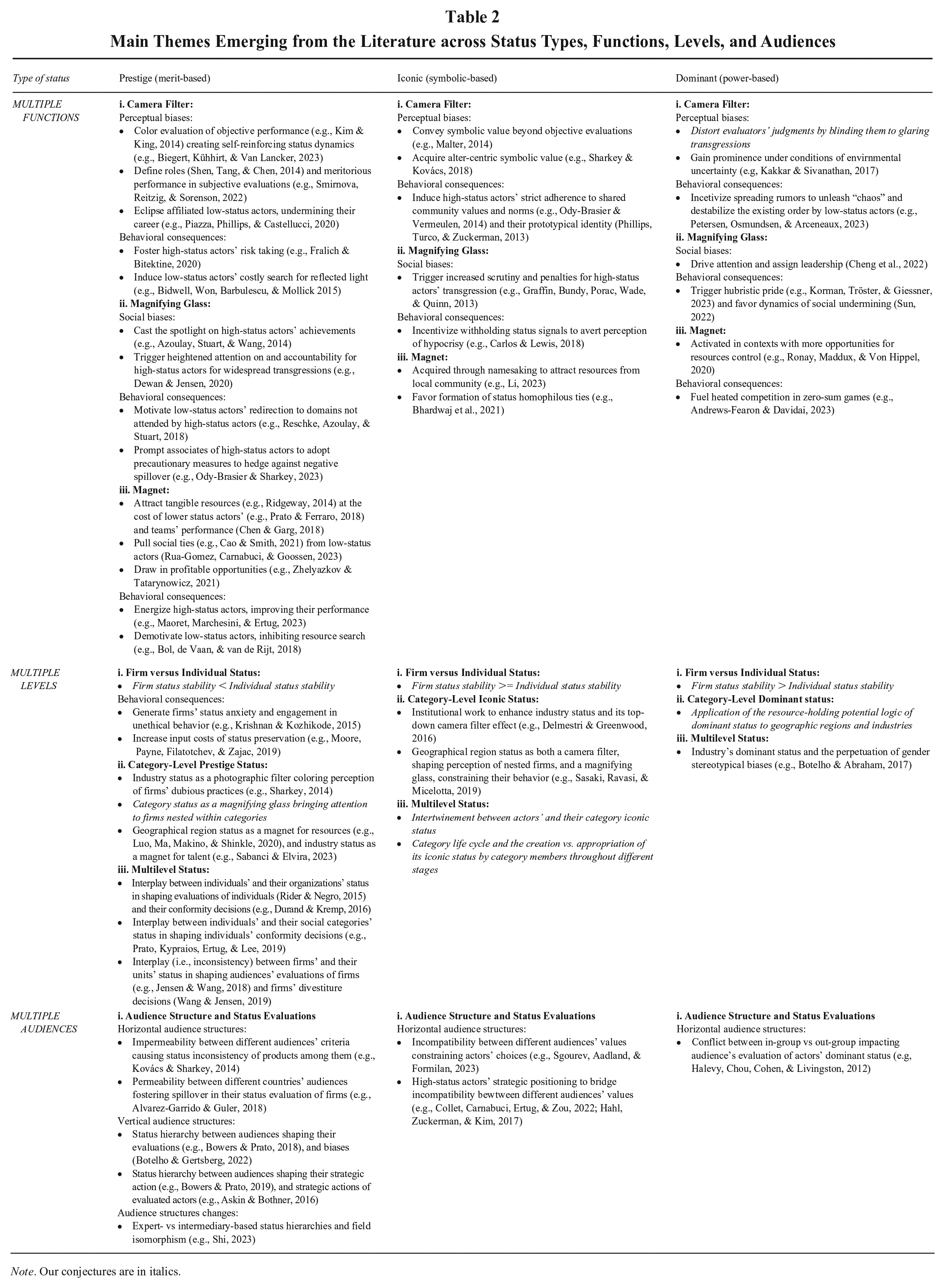
Future Research Directions
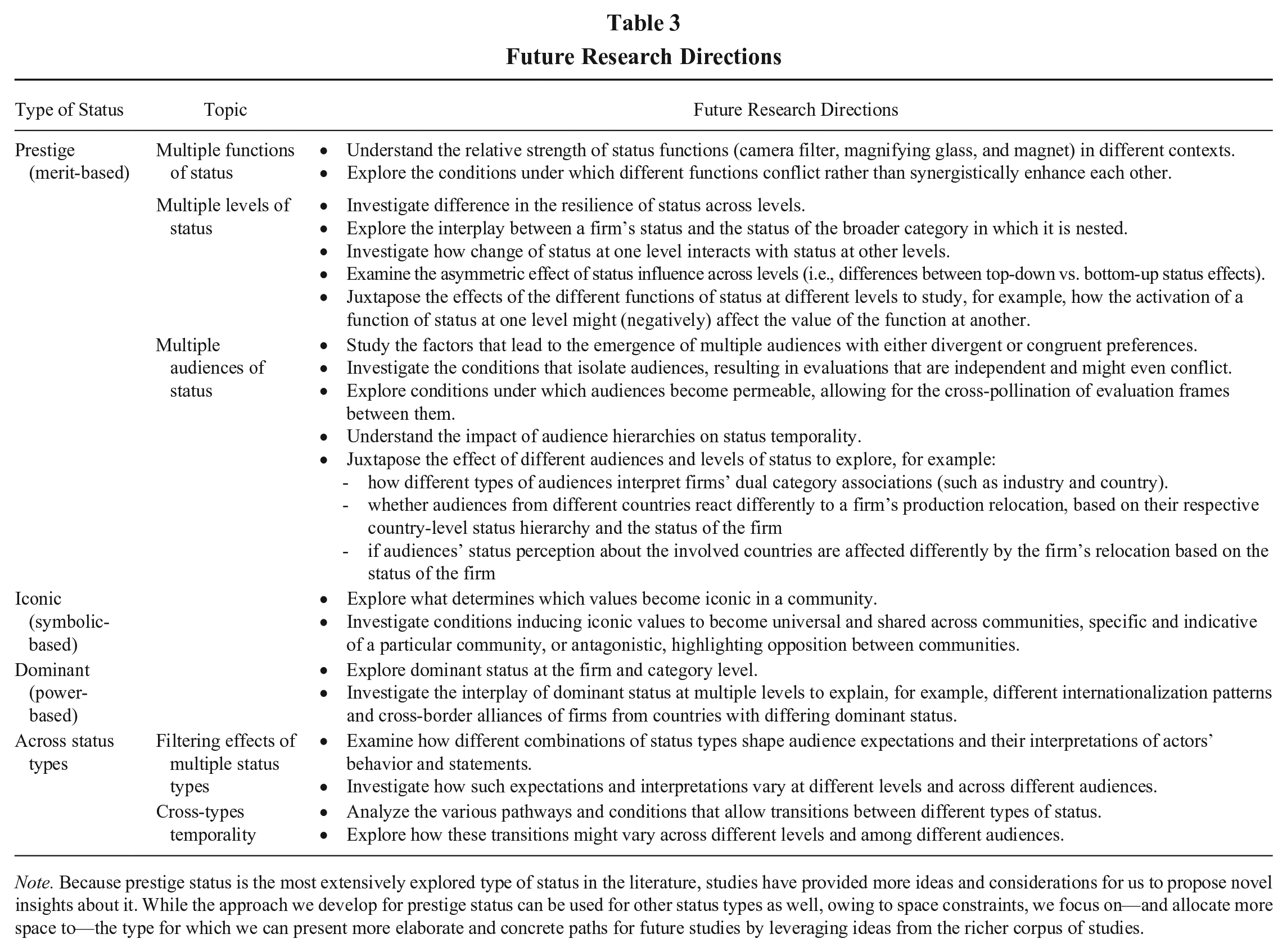
While the complexity of the multidimensional reality of status we invoke presents challenges, our review provides a strong foundation to navigate it. The proposed perspective harnesses the rich and diverse findings of existing research to drive forward a more systematic, nuanced, and integrated understanding of status. Thus, this review is a point of departure rather than an endpoint. We hope our work inspires a more cohesive and integrated trajectory of status research, facilitating a richer and deeper understanding of the implications of status in diverse contexts.
Supplemental Material
sj-pdf-1-jom-10.1177_01492063241226918 – Supplemental material for The Status of Status Research: A Review of the Types, Functions, Levels, and Audiences
Supplemental material, sj-pdf-1-jom-10.1177_01492063241226918 for The Status of Status Research: A Review of the Types, Functions, Levels, and Audiences by Matteo Prato, Gokhan Ertug, Fabrizio Castellucci and Tengjian Zou in Journal of Management
Footnotes
Acknowledgements
We would like to thank our editor, Brian Connelly, and the two anonymous reviewers for their direction, guidance, and comments. Standard disclaimers apply. Tengjian Zou acknowledges the support by the National Natural Science Foundation of China (72202206, 72091312, 72232009), the support by Zhejiang University-The Hong Kong Polytechnic University Joint Center, and the support by the Fundamental Research Funds for the Central Universities.

Supplemental material for this article is available with the manuscript on the JOM website.
Notes
References
Supplementary Material
Please find the following supplemental material available below.
For Open Access articles published under a Creative Commons License, all supplemental material carries the same license as the article it is associated with.
For non-Open Access articles published, all supplemental material carries a non-exclusive license, and permission requests for re-use of supplemental material or any part of supplemental material shall be sent directly to the copyright owner as specified in the copyright notice associated with the article.
