




Abstract
The concept of purpose gained prominence in organization theory in recent years but there are discrepant views of its meaning, which we review as evolving and different perspectives: economic theories of the firm; stakeholder approaches; integrative social contracts; and social mission. We elaborate these perspectives in terms of the ebb and flow of ideas and eras. Against these instrumental views, we revisit the work of Robert Cooper, namely the ever-open purpose of expressive organizations, and contrast this with fixist views of purpose in instrumental organizations. We engage with the logic of open purpose and sketch a way of rethinking purpose as a general orientation that constantly evolves and changes over time in interaction with its ecosystem.
Keywords
‘(. . .) fixed, specific purposes, make fixed, specific structures’
The notion of purpose as the reason for an organization’s existence (Pavez, Kendall, & Laszlo, 2020) has lately gained prominence in popular management circles (Tett, 2021) as much as it has in management and organization theory (Bromley & Meyer, 2021; Gartenberg, Prat, & Serafeim, 2019). The focus on a relevant purpose is supposed to enable organizations simultaneously to do well and do good. Purpose promises to be a multi-functional ‘North Star’ that provides multiple services: it imbues work with meaning at both the individual and team/organization levels, contributes positively to building a reputation of responsibility (Henderson & Van den Steen, 2015) and fosters individual and collective performance (Carton, 2017; Gartenberg et al., 2019). However, the notion is a contested terrain, given persistent debates on the crisis of confidence in organizations and the nature of shareholder capitalism (Child, 2002). Shareholder values is pitted against wider social purposes. Defenders of a Friedmanite view argue that Friedman’s credo (i.e. that the purpose of the firm is to maximize value for shareholders) is still valid as a realistic and objective definition of purpose (Zingales, Kasperkevic, & Schechter, 2020), whereas others argue that a new paradigm is required (Lipton, 2020).
In this article, we depart from Robert Cooper’s (1976) purpose-based classification which distinguishes organizations as instrumental (striving to reach definite goals) or as expressive systems (striving to cultivate various possibilities). As Cooper (1976, p. 1000) wrote, ‘given a fixed, specific purpose, everything adjust itself to that purpose’. Rather than being instrumental entities with specific purposes and practical tools in which a supraordinate goal rules a sub-hierarchy of other subsidiary goals, in expressive systems purpose becomes a transformative idea, a process aimed at revealing latent possibilities. These views, elaborated below, take organizations to be material manifestations in a complex reality. Organizations as expressive systems are oriented towards cultivating possibilities rather than fulfilling specific purposes defined ex ante. These systems operate in an ‘open field’, meaning that humans and their creations are ‘ever-open’, ‘unfinished’, in the sense of Heidegger’s Dasein. The open field, Cooper adds, is a ‘process of experimentation and learning by doing: ideas, products and environments are invented and then understood through feedback’ (Farjoun, Ansell, & Boin, 2015, p. 1792). We ask: How is purpose to be conceived if organizations are represented as expressive rather than instrumental systems? We explore the changing meaning of purpose and provide an alternative lens for its discussion.
We have designed the paper by first contrasting views of purpose embedded in different approaches. These approaches capture recurrent views of organizational finalities that wax and wane as management ideologies change. We do not see different views of purpose as composing a linear progression, a teleology, so much as positing persisting organizational finalities. Each of these views emerges and re-emerges in specific historical context and posits a certain ideological view of what makes the firm what it is. Some themes, such as the profit motive, business in society, organizations and the environment, the morality of business, appear and reappear cyclically. We focus on recent expressions of these concerns, well-established in the literature.
The recent expressions that we discuss are shareholder, stakeholder, integrative social contracts theory and social mission approaches. We contrast these approaches with an alternative ‘ever-open’ view of process in a new representation of what used to be called ‘industry’ (Jacobides, Cennamo, & Gawer, 2018), approached through the metaphorical notion of ecosystems, rather than limiting consideration to an organization’s competitive environment. The interconnectedness of forms of life is assumed, with humans being seen as part of a wider nature to which responsibility is due (Pirson, 2017). We discuss the limits of previous views and present the logic of open purpose as characteristic of expressive organizations. In this view, organizations are represented as material manifestation points in an open field, concepts that we elucidate below, which suggest that fixed representations of purpose are limiting.
The significance of our contribution is to highlight how redefining purpose in business encompasses a broader conception of businesses’ effects on life. As such, each concept of purpose is progressively extended, from owners of capital (shareholders), interested parties (stakeholders), ethical judgements (civic morals) to social mission and values (generalized positivity). By seeing organizations as material manifestation points we represent them as identifiable and relatively constant patterns of movement (Bohm, 1980) that are part of open fields. The open field is an
imbrication of differences, in which events move out in all directions, penetrating and being penetrated by each other and so revealing their uniqueness through contrast with all other events in the field. What matters is that the individual parts gain from the field, and not the field per se. (Cooper, 1976, p. 1014)
Purpose in Organizations as Instrumental Systems
Why do firms exist? What is their reason for being? Different theories have provided distinct answers to these familiar questions about the purpose of the firm. In this section we initially explore the notion of purpose that is expressed in four well-established theories of the firm: the economic theory of the firm; stakeholder theory; integrative contracts theory and the theory of positive organization studies. Although distinct, these views overlap in areas: for example, the positive organization perspective focuses on one key stakeholder: the employee. All these views have distinct core concerns while sharing an instrumental view of organization (Cooper, 1976), the ‘tool’ view as Perrow (1986) named it, in which organizations are conceived as means to attain goals. Subsequently, we present a further alternative, informed by the work of Robert Cooper (1976), that conceptualizes organization-environment fields as ever-open and unfinished. In this view, purpose must itself be open rather than fixed, in which firms are expressive systems, temporal fusions of material manifestation points in an open field.
All these conceptions are important contributions towards understanding the purpose of the firm. We see these different conceptions of purpose as products of their time and space, as responses to specific preoccupations with the role of the firm. They are important to explain the contested nature of societal norms and how the evolution of values occurring at higher-order levels of abstraction (state, market, family) potentially become distilled into organizational practices (Malhotra, Zietsma, Morris, & Smets, 2021). The mutual influence between organizational and societal values is not exempt from conflict and negotiation. Conceptions of purpose thus reflect social, economic and technological circumstances, with different times favouring different views (Barley & Kunda, 1992). In this sense what becomes postulated as purpose can be approached as an expression of wider politico-sociological debates that efficiently encapsulate and reflect current views of the firm.
Economic purpose
For the economic theory of the firm, firms are legal fictions (Jensen & Meckling, 1976) that compensate for market imperfections and cognitive limits making transactions problematic (Williamson, 1975). Contracts allow firms to conduct efficient transactions and to regulate the behaviour of participants (viewed as homo oeconomicus) in the process. In this view, the central purpose of the firm is the creation of shareholder value within the legal rules of the game (Friedman, 1970), shareholders being the critical actors to whom firms owe responsibility, thus biasing analysis towards publicly owned companies (Laplume, Sonpar, & Litz, 2008). The key assumption is that the business firm will be managed in the most accountable and transparent way when the interests of the stockholders are aligned with those of the management. The owners are assumed to be a fictionally collective actor whose interest is profit maximization. The interest is assumed to be best achieved through affording senior management stock options so that the interests of owners and managers are aligned. The needs of other stakeholders are dealt with according to market logic and the letter of the law.
The economic perspective gained prominence in a recent historical era, that of economic neo-liberalism, from the late 1970s onwards, which founded the notion of shareholder democracy as a core tenet of economic neo-liberalism (Harvey, 2007). The ideology accelerated an impetus initiated by incremental reforms over 20 years (Cassis, 2006) that were boosted by the London Stock Exchange’s (LSE) ‘Big Bang’ of 1986. The impetus for the Big Bang was the huge growth in the volume of share trading on the New York Stock Exchange in comparison to the highly regulated and traditional LSE, which restricted the UK government’s agenda for privatization. As the financialization of society progressed, the ideal of a popular capitalism changed. Popular capitalism became an ideology espousing the view that well-informed holders of shares in capital would both feed on and benefit from the economic dynamism created by the market economy (Edwards, 2016).
Purpose as creation of shareholder value
Mark Nevins, a Forbes contributor on ‘leadership strategy’, recalled his early days in business in the early 1990s, with the global management consulting firm Booz-Allen & Hamilton. Attending a forum at which senior executives from major companies were present, he noted the following:
At one point, one of the participants, a CFO, vociferously exclaimed ‘the only purpose of a company is to create shareholder value!’ Heads nodded around the table, and I diligently copied that phrase down, certain that I’d captured a truth as essential as Sir Isaac Newton’s three Laws of Motion. (Nevins, 2019)
Indeed, when a popular idea becomes taken for granted as an ‘essential truth’ it has assumed the status of ideology. The ideology became a bedrock of the theory of the firm. In its several variants (neoclassical economics, institutional economics), the theory of the firm defines the firm as a vehicle, a functional device whose purpose is the maximization of financial value to shareholders in terms of their returns on investments. Companies represent structural cost-saving devices which assist transactions in proceeding smoothly and predictably. Even though only recently conceived, corporate criticism of this credo was initially regarded almost as taboo (Friedman, 1970).
Past orthodoxies may be less than helpful in navigating present times and issues; a great deal has changed over the 40 or more years that the orthodoxy has been dominant. Nonetheless, defenders of this orthodoxy can always emphasize the rationale for their focus in terms of its clarity of purpose, the importance of accountability, as well as the ethics of being philanthropic with other people’s money. For defenders of this credo, purpose as maximization of shareholder value became a dogma, a truth widely acknowledged and not to be disturbed. Most neoclassical economists’ ideological orientation is to regard optimal corporate governance as best achieved when shareholder value is delivered (Lazonick & O’Sullivan, 2000).
Criticism
Several critical voices have contested the validity of the shareholder value definition of purpose (Davis, 2016a, 2016b). Drucker (1987), in an early critique, explained that business ventures founded on such notions are essentially selfish, such that their legitimacy should not be taken for granted. Joseph Stiglitz (in Sorkin, 2020) wrote:
Friedman’s position is based on a misconception of both economics and the democratic political process. (. . .) Today the downside of Friedman’s perspective is even darker: Is it Mark Zuckerberg’s social responsibility to allow wanton disinformation to roam over his social media platform? Is it Zuckerberg’s responsibility to lobby to get rid of a pesky foreign competitor while fighting for his company to be free from anti-competitive restraints and any accountability, so long as it increases his bottom line? Friedman would say yes.
For Davis (2016a, p. 509), contractarian imagery ‘served as a useful provocation, a lever to bust up the unwieldy and shareholder-hostile conglomerates built up over the prior decades’.
Shareholder democracy’s limitations of a too narrow conception of purpose, combined with the significant power of enterprises in shaping everyday social life (Bower & Paine, 2017; Wolf, 2014, 2019), created business organizations as a sphere of non-democracy in otherwise more or less democratic civil societies. The lack of democracy was not just manifest in the overarching principle of hierarchy (Child, 2020) but because, behind the bulwarks of the organization, managerial fiat could rule, at least where share ownership was both widely dispersed as well as vested in institutional holdings. The latter tended to non-intervention and divestment rather than interference in the company’s internal affairs. Under such circumstances, inclusive and diffusely structured networks of economic and social relations constituted a relatively coherent segment of the managerial elite, those enjoying stock options, creating an ‘inner circle’ of control (Useem, 1986), ensuring that shareholder democracy counted for little.
More recently, shifting customer and societal expectations, financial scandals, agency problems and short-termism have forced reconsideration of a firm’s mission and purpose being expressed in quarterly conceptions of value (e.g. Bower & Paine, 2017). O’Neill (2020, p. 16) wrote that ‘Companies need a greater purpose, for their own sake as well as societies’ because ‘As I discovered when leading the independent review into antimicrobial resistance in 2014–15, many market failures are exacerbated by business believing they must purely focus on achieving (often short-term) profit targets and ignore societal challenges they can help solve.’ Indeed, the narrow focus on shareholder value may, as critics argue, even be contrary to the interests of shareholders themselves, especially in the longer term.
Mistrust in companies has increased, especially after the global financial crisis of 2007–8, such that ‘the very idea of capitalism is now debated on the political stage’ (Sorkin, 2019, p. B1), the debate around capitalism constituting a recurrent theme (Boldizzoni, 2020). As Wolf (2014, p. 7) wrote in the Financial Times, ‘shareholder value maximisation’ leads to corporate ‘misbehaviour’ and a failure ‘to generate greater prosperity’ (see also Wolf, 2019). What is significant about respected financial journalists such as Wolf criticizing orthodoxy is that, unlike critical management scholars, they are not criticizing from outside the tent of orthodoxy; they are critical but in the midst of good company rather than being marginal to that company. The recourse to this new criticism was partly a result of the rise in popularity of a new, managerial, view of the firm: stakeholder theory.
Stakeholder theory
Shareholder value is an approach tailored for private sector enterprises. Stakeholder theory is wider; it can be discussed in terms of its implications for organizations in general. With stakeholder theory, Freeman (1984; Freeman & Reed, 1983) approached organizations as elements of civil society and advanced the idea that organizations create value through the search for synergies between divergent and thus potentially conflicting constituents of society, qualified as stakeholders (Cennamo, Berrone, & Gomez-Mejia, 2009). The development of a stakeholder view coincided with the notion that market mechanisms, such as those involved in popular capitalism, were insufficient to articulate business and society in a synergistic way. Persistent inequality, exacerbated by the increasing financialization of society (Davis & Kim, 2015), reduced the power of purpose as defined by economic views stressing shareholder value. The stakeholder view aimed to harmonize interests and to open new vistas on the purpose of the organization and provided a vehicle for the integration of business and society.
Stakeholders were originally defined as those without whom the organization could not survive, or those in whom an organization has a stake. Over time, the meaning of the concept evolved to include potentially any phenomenon or entity affected by the organization. As a result, the number of stakeholders increased ‘dramatically’ (Sternberg, 1997, p. 3). Aligned with a stakeholder perspective, different authors have emphasized the legitimate goals and claims of specific stakeholders, such as employees (Pfeffer, 2010), communities (Brammer & Millington, 2003), society in general (Stern & Barley, 1995) and the natural environment (Heikkurinen, Pinnington, Clegg, Nicolopoulou, & Caraz, 2021).
Purpose as articulation of goals
The notion that there are more stakeholders than those that own capital invested in the business has been espoused by some corporate leaders. Marc Berniof, CEO of Salesforce, wrote (in Sorkin, 2020):
I didn’t agree with Friedman then, and the decades since have only exposed his myopia. Just look where the obsession with maximizing profits for shareholders has brought us: terrible economic, racial and health inequalities; the catastrophe of climate change. It’s no wonder that so many young people now believe that capitalism can’t deliver the equal, inclusive, sustainable future they want. It’s time for a new kind of capitalism — stakeholder capitalism, which recognizes that our companies have a responsibility to all our stakeholders. Yes, that includes shareholders, but also our employees, customers, communities and the planet.
In 2019, in the US, CEOs comprising the Business Roundtable accepted ‘the idea of a purpose beyond profit’ (Tett, 2019, p. 1; Business Roundtable, 2019), and ‘overturned three decades of orthodoxy to pledge that their firms’ purpose was no longer to serve their owners alone, but customers, staff, suppliers and communities, too’ (The Economist, 2019, p. 9). This defence of a form of collective capitalism (or stakeholders’ capitalism) raised doubts about how such a pledge would be enacted, as well as how large, complex companies could be made to serve all their stakeholders.
The meaning of purpose as elaborated by the proponents of stakeholder theory affirms that the goal of an enterprise is to respond to the needs of a group of constituencies. The list of stakeholders expands with changes in the legitimation of social expectations regarding the probability of being heard. The idea that multiple stakeholders can legitimately promote their goals in the citadels that these organizations construct creates a flux and process of contestation. The boundaries of legitimation and the relations between organization and their environments are being redrawn. The idea that a ‘new balance’ needs to be achieved regarding the role of organizations in society (Mintzberg, 2015) is one consequence. Incremental improvements in the management of stakeholder tensions and trade-offs, rather than focusing on a single stakeholder, are proposed as the means to achieve a new balance.
In a stakeholder model there is a loss of focus and the rise of fragmented strategies, compared to a singular focus on shareholder value, as managers navigate the political dynamics of stakeholder management. Legitimation strategies stress the responsibilities to groups without differentiating between the different fragments. The tension here lies in the definition of what value means. What creates value for one stakeholder may destroy value for another.
Criticism
The proponents of stakeholder theory take a critical view of the narrowness of the shareholder perspective as being still managerial in its original intentions, as well as being entity-based. The organization’s purpose is seen as one of reaching a balance between the interests of a plethora of entities. These distinct entities exist in a state of interdependence, as reflected in the classical definition of stakeholder as ‘any group or individual who can affect or is affected by the achievement of the organization’s objectives’ (Freeman, 1984, p. 46). Yet, stakeholders are still treated as independent entities with orthogonal goals and specific interests, leading to potentially politically charged settings as different stakeholders struggle for dominance. Substantively, stakeholder theory is a theory of loosely coupled interdependent entities, a view that creates dualistic logics by separating ‘things’ that are mutually defined and better framed as interrelated elements (Good & Thorpe, 2020).
Unsurprisingly, other objections have been addressed to stakeholder theory, recently achieving focus with criticisms of the Business Roundtable manifesto. The criticism of this manifesto is that management, under the new framework, would no longer be accountable, as it would be stretched too thinly over a number of interests. As pointed out by authors such as Hatherly, Mitchell, Mitchell and Lee (2020) and Laplume et al. (2008), stakeholder theory is an evolving approach, one with strong emotional appeal to a diversity of constituencies. Critics point out that the notion of the stakeholder can now ‘virtually include everyone, everything, everywhere’ (Sternberg, 1997, p. 4). The Council of Institutional Investors, which represents many of the same companies as the Business Roundtable, agreed with this judgement in disputing the Roundtable’s statement (in Sorkin, 2019, p. B1): ‘Accountability to everyone means accountability to no one (. . .) It is government, not companies, that should shoulder the responsibility of defining and addressing societal objectives with limited or no connection to long-term shareholder value.’ The consequence may be, Bebchuk and Tallarita (2020) argued, that ‘embracing stakeholder governance would fail stakeholders’. According to these authors (p. 26), stakeholder governance ‘could well impose substantial costs on shareholders, stakeholders themselves, and society at large, and therefore should be rejected, even by those who are deeply concerned about stakeholders’.
The theoretical argument for a stakeholder perspective is that democracy is contestable and that for too long organizations have sought to exercise a sovereignty of subjection that is not warranted. The practical issue is how managerial effectiveness can be evaluated when a plethora of stakeholders express different expectations. Leaders may be subject to pressures coming from vocal stakeholders with decision-makers becoming embroiled in political processes that divide rather than focus attention. The goal of responding to several stakeholders may constitute an impossible task if left to voluntarism; hence, the importance of regulation, despite its insufficiency in transforming many salient firms into good corporate citizens, as successive scandals denote (Baker, Purda, & Saadi, 2020). A new attempt at establishing the purpose of the firm thus emerged, one that assumed an ethical perspective.
Integrative social contracts theory
Theoretical contributions such as integrative social contracts theory (ISCT) portray the firm as part of a community to which it is bound by two different contracts, a normative contract equivalent to classical social contractarian theories, as well as a contract that exists, implicitly, between the members of an existing social group (Donaldson & Dunfee, 1994). The basic idea of ISCT is that social groups, over time, develop specific norms for their members to act; they do so via microsocial implicit contracts that regulate their transactions, what Durkheim (2013) referred to as ‘civic morals’. These micro-contracts are supposed to be compatible with hypernorms, general principles operating as guides for evaluating lower-level norms, established by leaders. An organization’s purpose is to do business within the boundaries of these social contracts, with the economic function alone being regarded as an insufficiently legitimate form of purpose.
Purpose as membership of moral community
By situating the organization in its community, ISCT depicts corporate purpose as a form of moral alignment with the surrounding logics and culture. Fictionally, while the corporation might be an individual, it is an individual that is a member of a moral community (French, 1979). In this case, it is values and traditions, more than commercial law or sectional interests, that define the purpose of the organization, which is to do business legitimately as a member of a community in good standing. It thus pays significant attention to the existing traditions, as expressions of the millions of local social contracts. In this version, purpose can be defined as an organization’s capacity to conduct its business in line with social expectations while curating its responses in line with changes in these, all the while preserving the essence of tradition.
Criticism
ISCT can be criticized for reliance on local traditions that can introduce an element of moral relativism and even tolerance for established but ultimately unfair practices, such as gender discrimination (Dunfee, 1998). Newer notions, such as shared value (Kramer & Porter, 2011), emphasize the need to treat value as mutually defined by a group of social actors locally, developing local solutions to respond to local problems (Yunus, Moingeon, & Lehmann-Ortega, 2010) with consideration for local ethical challenges (Donaldson & Dunfee, 1994).
Social mission
Globalization had economic consequences, such as increased inequality and related wage stagnation in the West (Weiher & Beladi, 2011). Nonetheless, the focus on the firm as a vehicle whose purpose was the creation of value endured despite the persistence of scandals and corporate misbehaviour (Greve, Palmer, & Pozner, 2010) as well as the widespread presence of unsatisfactory jobs (O’Boyle & Harter, 2013), giving rise to extensive criticism (Zingales et al., 2020). A synthetic understanding of purpose, now interpreted as the emergence of a socio-psychological process of creating social value and human dignity at work, began to gain purchase.
Purpose: work as carrier of positive meaning
In a psychological perspective, purpose denotes meaningful work. Evidence such as the surveys conducted by Gallup (O’Boyle & Harter, 2013) are indicative of the dominance of jobs lacking in satisfaction and purpose. The absence of strong economic incentives, the demise of the traditional career (Davis, 2016b) as well as cumulative evidence of the motivating power of enriching work (Hackman & Oldham, 1976) created the conditions for a re-centring of purpose around innovations creating positive social impact (for the organizations) and fulfilling the search for meaning in positivity (for individual contributors). These factors culminated in a literature focused on the power of purpose as an organizational True North or North Star (Phipps & Shelton, 2020) that referenced an ultimate goal explaining the organization’s raison d’être. Economic value is no longer legitimate if not accompanied by a measure of positive individual and social impact (Cunha, Rego, Simpson, & Clegg, 2020). How to measure this is not easy; one suggestion is to design effective interventions to address a dire societal need in depth, delivered in scalable measures. Organizationally, the mission should be persistently and consistently embedded in an organization and add value to all constituents involved (Big Society Capital, 2015).
Ultimately, if the concern is with the process and pursuit of both economic and social progress, then it is underpinned by a fundamental relationship to what are conceived as wider social values whose moral legitimacy flows from ‘doing good’ and ‘being good’ in specific practices related to individuals, organizations and society. Purpose represents how an organization provides meaning to employees’ work, how it presents a meaningful brand to the world and how it contributes to society (Quinn & Thakor, 2019). When purpose imbues jobs and the organization’s action, human work may be expected to be rich in meaning and dignity as translated in sustainable development goal 8 of the United Nations, having strong motivating power. When this happens, work transcends its more mundane dimension as a job, gaining a spiritual quality, a sense of calling (Wrzesniewski, McCauley, Rozin, & Schwartz, 1997). Purpose-oriented organizations are expected to create value that is not limited to economic gains but is socially innovative.
Criticism
Purpose at the organizational or individual level may function as a double-edged sword. Individually, stressing values such as entrepreneurship, independence and self-actualization may, in practice, lead to precariousness, anxiety and vulnerability when these values are often expressed through being ‘empowered’ as a service provider in the gig economy (Petriglieri, Ashford, & Wrzesniewski, 2019). Organizationally, a sense of purpose founded on contributing social value can enrich work and offer opportunities for its genuine engagement; however, it can also function as a substitute for material rewards and as source of emotional attachment that carries personal costs (Bunderson & Thompson, 2009). It may even work as a managerial tool of control (Bailey, Madden, Alfes, Shantz, & Soane, 2017). Purpose can be a source of passion but also disillusion (Schabram & Maitlis, 2017), as an idealized vision of a job or the organization that it serves is confronted with a different reality. The ideals may be real, yet the practices differ. Purpose statements may be ‘empty rhetoric’ (Winston, 2019) and can be countered by practical actions, as happened with several signatories of the Business Roundtable during the Covid-19 pandemic (KKS Advisors, 2020).
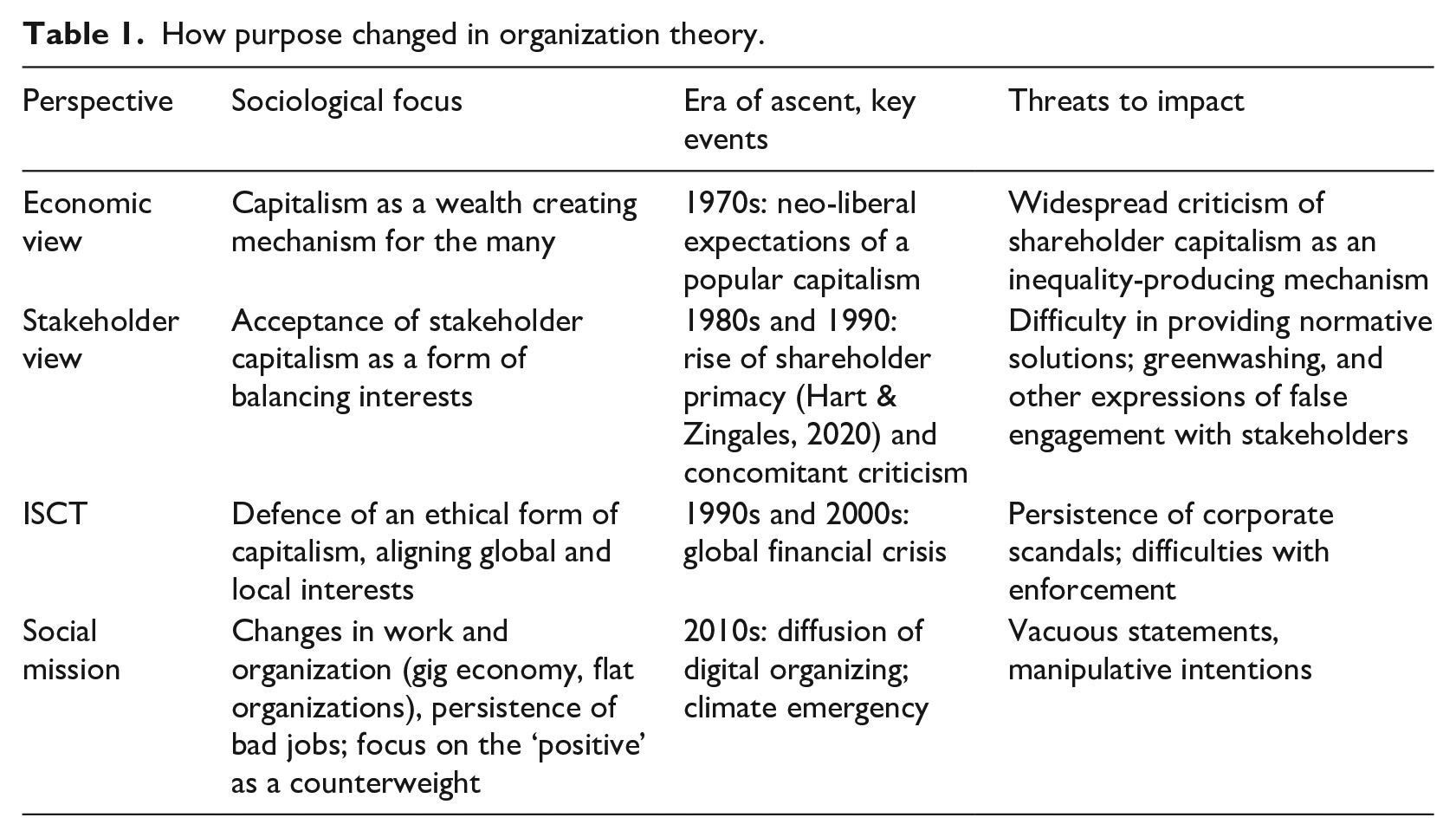
Ideas around the purpose of organizations are thus contested and evolving (Table 1). In this sense, purpose as meaning can be as lacking in value as the previous streams: a popular capitalism that failed to ‘manufacture’ popular capitalists; a stakeholder view that was not able to counter the predominance of the shareholder value paradigm over other interests; ethical views that did not stop corporate scandals; a psychological view that legitimated not only passion but also manipulation. Purpose can reflect genuine concerns with the creation of more humane organizations (Petriglieri, 2020) but it can also reflect an attempt to alleviate organizations from their traditional responsibilities towards employees, such as employment security or a predictable career path. These understandings of organizational purpose assume a measure of organizational stability, which can put stable employment and a measure of continuity as core to management.
How purpose changed in organization theory.
The limits of extant views – or why we need to reconsider purpose
When organizations are viewed as functional systems, ‘things’ with relatively stable identities and specific objectives, they tend to define specific purposes. As noted by Cooper (1976), specific purposes make specific structures. Yet some of the most daunting challenges faced by organizations and by humanity cannot be tackled by independent entities but must be addressed interdependently through networks of collaboration deeply embedded in social, natural and technologically designed contexts with expressive rather than instrumental understandings of purpose. The compound effects of expressiveness and coevolution produce organization as a socially and ecologically circulatory process (Ergene, Banerjee, & Hoffman, 2020). By contrast, organizations taken as instrumental systems (Cooper, 1976) are designed to attain goals external to themselves. Failure to achieve these goals is supposed to lead either to extinction or a structural adjustment to regain fit with changing expectations (Donaldson, 1987). The consequence of such views, according to Ghoshal (2005, p. 13), is to denude ‘the managerial role of any sense of human responsibilities’.
Organizations are now expected to respond to those they choose to hear and that choose to resource them: they are supposed to generate revenues but also to provide decent work, to assuage the ethical implications of what they do, to respect their communities’ voicings and so forth, depending on the volume, insistency and relevant politicality of these. In this perspective, organization boundaries and specialized purposes are artificial constructions that impose conceptual costs through isolating the organization from what is fluid and interpenetrating, such as the external place (Sasaki, Ravasi, & Micelotta, 2019), ethics (Rhodes, 2016) or even viruses (Clegg, 1989; Giustiniano, Cunha, Simpson, Rego, & Clegg, 2020). The essential elements of a purpose flow through evolving and changeable circuits of power (Clegg, 1989) that are necessarily open to events as exogenous contingencies; these disrupt attempts at closure that organizations enact and construct in the face of indeterminacy. We understand organizations beyond limiting ‘entitative’ views and will explore the notion of purpose in organizations as expressive systems.
Purpose in Expressive Organizations
By thinking beyond things and specific goals, an open-ended process view assumes that ‘stability or change are judgments, not real things, because the organization is a process that is continuously being constituted and reconstituted’ (Van de Ven & Poole, 2005, p. 1380). Balance, in systemic process, ‘an active function of balancing flows that can be seen metaphorically as active circulation of energy, rather than a static [or we might say steady] state of balance’ (Ford & Ford, 1994, p. 766). Purpose can be conceptualized in the perspective of material manifestation points (MMPs), not as the instrumental pursuit of some goal or moral obligation (George, Haas, McGahan, Schillebeeckx, & Tracey, 2021) that establishes the dominance of one stakeholder or composes a moral community among many of them but as a dynamic orientation aimed at articulating what cannot be fundamentally separated, in what Pavez and colleagues (2020) called partnerships for good. Different entities exist in a state of mutual constitution: one defines the other and their relationship is dynamic and fluid. In a world that is in flux, fixed purposes can be too restrictive. The expressive organization as a mosaic of possibilities needs to reconsider purpose not as a fixed, unidimensional ‘North Star’, somewhere out here, but as an expansive idea intended to support adjustment to an ever-changing external environment.
Organizations are no longer to be conceptualized as static and stable but rather as ‘interdependent networks of individual, group, and interorganizational dynamics and interactions’ in which ‘flow is all’ (Ford & Ford, 1994, p. 766). Equilibrium is a dynamic process of flows of power; energy has to flow, movement has to occur, for balance to be maintained (Bridoux & Vishwanathan, 2020). Exploring the nature of organizations from a process perspective, the notion of independence and the framing of organizations as entities separated from their environments constitutes a conceptual simplification. Indeed, it is an ontological choice that has important epistemological consequences for how we come to know organizations, imposing important conceptual limitations on organizational analysis. New models of the firm that respond to social needs and goals are necessary (De Bakker, Matten, Spence, & Wickert, 2020). As Crane and Matten (2020) have argued, proposing this requires more than a set of initiatives represented as a ‘CSR’ concept that affirms rather than transcends the self-interests of the firm, as is denotative of expressive organizing.
In Cooper’s conception of field, goals are interrelated, with entities better viewed as MMPs rather than stable things (Cooper, 1976, 1992). In this perspective, ‘people’ and ‘organizations’ are names given to abstractions of recognizable and relatively constant patterns of movement that exist in the universe, that are constantly in motion, identifiable states in an ever-changing world. MMPs presume that matter and energy are mutually convertible. Things are material manifestations of energy (Bohm, 1980), better understood as structures of processes. When framed as material manifestation points, organizations do not have an independent existence as entities. They are temporary ‘resting points’ (Ford & Ford, 1994, p. 766) in a universe of change. Resting points allow observers to attribute to them certain stable qualities, to bracket process elements, giving analytical precedence to epistemologically stable attributions rather than to ontological processes. Instead of representing change as a function of collisions between two elements (e.g. agents and resisters), it is framed as a process engaging permanently changing flows of energy, reinforcing, weakening and reversing them, in a process of becoming (Tsoukas & Chia, 2002). MMPs can be fundamentally ‘fixed’ as things that are passage points for forms of representation and communication that are obligatory; thus, becoming obligatory passage points, these define the temporal shape and structure of the flows of circuits of power (Clegg, 1989).
‘Ever-open purpose’ as a process interweaving multiple MMPs is thus more expansive and energizing than more limited considerations of value; it pluralizes power relations rather than channelling them narrowly through the obligatory needle’s eye of institutional monetary value as the only passage point for consideration. Holistic purpose implies networks of collaboration with enough scale to tackle grand challenges (Gümüsay, Claus, & Amis, 2020). These networks are interdependent-relational rather than independent-entitative and cross-sectoral, which explains the progressive blurring of the boundaries between corporate, state and social sectors (Mair, Battilana, & Cardenas, 2012). Spreitzer (2006) notes that a superordinate purpose may provide a multiplicity of lenses for finding positive meaning by materializing multiple conceptions of purpose and of that which is ‘good’. Therefore, instead of narrowing possibilities for action, a positive holistic purpose opens an organization to learning and renewal. In the ontology of the field, these are necessary ingredients for organizational sustainability.
A process view represents reality as a flux of flows, in which theories need to capture the dynamics of purpose. The notion of shifting flows suggests that purpose should be represented as a guideline, flexible and adaptable, an idea aimed at dynamically connecting an organization with its field through stabilizing multiple passage points rather than making singular, fixed conceptions of value its obligatory measure. To maintain a viable purpose focused on the common good (Nonaka & Takeuchi, 2021), organizations need to enact and interact with communities of practice that incorporate broader concerns, values that can be extended virtually and virtuously. Over time, broader participation instils legitimacy in organizations premised on broadly based sources of value.
Building on these foundations, instead of instrumental orientations we explore another conceptual path: the adoption of a relational ontology and the theoretical lens of process as an innovative and significant contribution to explore the purpose of the firm without a conceptual separation between humans and the rest of nature (Ergene et al., 2020). In such a perspective, the level of analysis is that of the field (Cooper, 1976). In the field, MMPs exist in a state of becoming, inseparable from the unfolding of other MMPs. Relations of predator–prey, for example, are better viewed as constituting one entity rather than two separate parts, as the fate of one is tightly linked to the other. The predator–prey system exists as one single relational unit whose functioning it is not possible to grasp without considering their coevolution in a given setting. Goals are interconnected and interdependent and this system needs to be approached via a relational ontology, one that sees relationality ‘all the way down’ (Slife, 2004, p. 159), meaning that instead of studying relations between independent entities, we cannot even understand entities in the absence of relation and embeddedness: relationships become the figure rather than the background. Organizations are part of natural and social environments that their supply chains may respect or destroy (Banerjee, 2008). Likewise, an organization’s environment includes not just a supply chain of personnel and spatial and material phenomena, such as offices and equipment; it also includes those viruses whom these spaces and things might host. The adoption of the notions of field and process poses conceptual challenges in terms of definition of purpose but also open opportunities for refreshing and adapting the theory of purpose to shifting societal expectations.
When purpose is viewed as the articulation of a diversity of stakeholders, the polyphony of voices sometimes amounts to little more than parallel and separate conversations in which different participants do not listen to the arguments of others. Under these circumstances, the situation can be described as a cacophony rather more than a genuine polyphony (Kornberger, Clegg, & Carter, 2006). Cacophony has been described as a separation problem (Laplume et al., 2008), manifest as a plurality of narratives that cannot converge because order cannot emerge from zero-sum politics in which demands are non-negotiable win–lose. The politics of stakeholding must admit the legitimacy of the interests and objectives of others if polyarchy is to subsume cacophony. To contribute to polyphonic integration or plurality without fraction, we next present the limits imposed by the adoption of entitative views.
Purpose in expressive organizing becomes a guiding principle that helps an organization navigate the field dynamically by understanding the organization as a whole in particular situations, as Barnard (1938) once put it. These situations become increasingly kaleidoscopic, as demands grow for public value to be seen through various lenses. Holistic and dynamic understanding of open purpose is important because, as Bower and Paine (2017, p. 58) observe, ‘strategies are almost always in transition as markets change’ and exist in what Good and Thorpe (2020) call inescapable networks of mutuality. Mutuality may well be radically unstable. There are always many claimants to mutuality that are corralled outside whatever may have been strategically settled for that moment. Therefore, more important than focusing on any specific metric is the capacity to understand the evolution of the open field and the organization’s role in this evolution. Organizations must be seen as fundamentally open and historical (Clegg, 1981), requiring a capacity to zoom out and to zoom in (Carlsen, Clegg, & Gjersvik, 2012), in understanding how organizations’ interests and fields’ interests mix and mingle.
Such an exercise, given its complexity, will necessarily be precarious, imperfect and incomplete. The idea that only objective metrics, focused on the measurement of value, provide the best tool with which to gauge organizations’ purpose, is thus fundamentally misguided (Harris & Tayler, 2019). Seeing open fields of organizing as shifting flows of energy between MMPs helps to reframe the notion of purpose and the obligatory passage points that are established temporally and temporarily, in circuits of power. Purpose changes its nature. It becomes a matter of dynamic equilibrium. Equilibrium, understood as intervention in a field, is the capacity to act with the principle of wholeness in mind or, as Cooper (1976, p. 1014) explained, to portray ‘humility as humble process’ in order to ‘love a system per se’, seeing events as individuated wholes and considering their complementarity. Dynamic equilibrium should frame reality as a state of tense ordering and disordering, articulating conflicting demands, using trade-offs to innovate (Kaplan, 2020; O’Rourke & Strand, 2017), approaching the field with a caring orientation (Taylor, Ladkin, & Statler, 2015).
Malnight, Buche and Dhanaraj (2019) observe that purpose is moving from the periphery of the strategy discipline to the core. When organizations think about their ‘ecosystems, where connected interests and relationships among multiple stakeholders create more opportunities’ (Malnight et al., 2019, p. 73), purpose comes into play. Table 2 summarizes and contrasts the meaning of purpose in instrumental and expressive views.
Purpose in instrumental and expressive organizations (based on Cooper, 1976).

Discussion
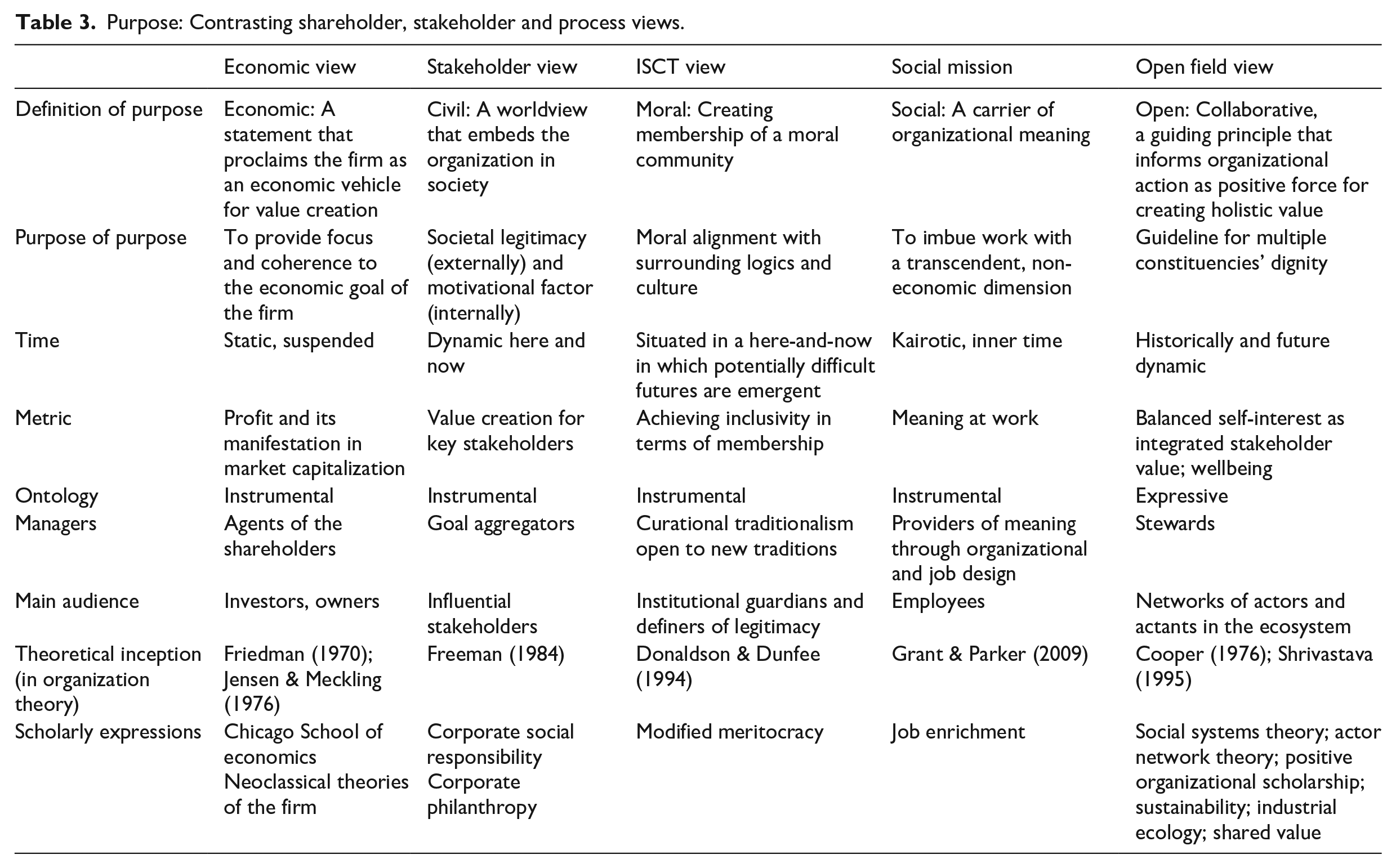
A view of open purpose in expressive organizing provides an alternative to traditional understanding of organizations (see Table 3 for a summary of perspectives), opening new possibilities but raising issues from some established debates around the notion of purpose. In this section we consider some of the central arguments in the ongoing scholarly conversation around purpose, articulating our proposal of purpose openness in relation to prior understandings of purpose. The ever-open purpose is dynamic, paradoxical, complex and contested.
Purpose: Contrasting shareholder, stakeholder and process views.
Purpose is dynamic
Because process approaches emphasize flow and movement as the basis of the world, purpose should be seen from such a lens. What is taken to constitute the purpose of organization does not emerge as an isolated idea but takes life from its institutional embeddedness. Institutionally, several fixed and predetermined goals have been presented as being associated with purpose; by contrast, a process view frames purpose as a guideline for navigating the presence of the organization’s being in the world. A purpose defines the organization’s raison d’être as one that is open to time and contingency, expressing the organization’s embeddedness with the world that sustains it as well as the voices that articulate that world’s diversity and being (Godfrey, Merrill, & Hansen, 2009). Organizations in different moments may have to translate their purpose into different practices. The idea of a fixed goal is only possible in the context of an epistemology of immutable things (Van de Ven & Poole, 2005). The mutability of organizations is demonstrated by the effects of the coronavirus. Organizations have rapidly transitioned from employing nomadic office workers seeking to define personal spaces, despite hot-desking (Humphry, 2013), into virtual working from home.
Purpose is paradoxical
The notion of open process offers consideration of an integrated chain of interests that are interdependent and transcend prior conceptions of boundedness. An open purpose is not a multiplication of independent interests but an acknowledgement that guiding organizational action through dynamic finalities is an exercise in managing contradictions dynamically, over time. These contradictions will inevitably create tensions and paradoxes (Berti, Simpson, Cunha, & Clegg, 2021; Oskam, Bossink, & de Man, 2021), which means that a guiding purpose will confront the organization with the articulation of (rather than the choice between) opposites that are mutually defining and persistent (Smith & Lewis, 2011). For all these reasons, purpose becomes a demanding and often imperfect and unfinished exercise in balance (Pinkse, Hahn, & Figge, 2019) rather than an exclusive focus on a single overwhelming organizational goal. Purpose becomes increasingly fluid and flexible as new publics are absorbed into the body politic as an organization increasingly without bounds.
The implications for a managerial audience are not straightforward, as our model offers a theoretical lens more than a normative orientation. Instead of focusing on a single metric, such as profitable shareholders, satisfied stakeholders, virtuous ethics or the creation of positive social value, organizations will have to consider a balance between different value objectives. No single goal can be privileged as being maximized. Using Simon’s (1987) logic of satisficing, a multiplicity of stakeholder expectations and representations can be acknowledged and striven to be met. In this view, goal accomplishment may be taken as a paradoxical challenge to be navigated via the integration of dynamic, shifting, contradictory goals (Smith, Lewis, & Tushman, 2016) rather than as a problem of seeking maximizing solutions. In a paradoxical logic, instrumental views such as the dualistic understanding of shareholders vs. broader stakeholders leads to dualistic approaches.
Purpose is complex
If we understand organization as an opportunity for managerially prescriptive theorizing, defending open-purpose conceptions has limited value. Yet, if one sees theorizing as a means of sociologically opening possibilities, a process view offers valid contributions. First, it shows that, in plural settings, unitary goals are simplifications of reality. The missions of organizations are too complex to be captured adequately by any single goal (Sundram & Inkpen, 2004). We thus define an open purpose as the dynamic articulation of a set of values and practices that simultaneously strives to serve the organization and its ecosystem in full, via open rather than strictly instrumental purpose. As a result, organizations might want to revise their understanding of purpose as instrumentally fixed in order to see purpose as open in a field that is fluxing, waxing and waning, as contingencies change. This does not mean that organizations are formless or that they lack a strategic coherence: it means that they know that integrating consistency and inconsistency is critical to avoid traps such as inertia, simplicity, or rigidity. In contrast with the closedness of classic theories of the firm, being ‘closed’ in terms of their functional premises, a more evolving or open-ended purposiveness is available to organizations. This logic is illustrated by the case of Buurtzorg, an organization that constantly evolves its purpose, which is to provide care to the elderly, in ways that enhance their quality of life and makes them self-reliant (Laloux, 2014) and changes over time in interaction with its complex ecosystem. In this conception, the ecosystem is not part of an outside organizational environment but a component of the organization’s system itself, a critical setting for its existence. The implication for senior executives lies in the need to develop more cognitively complex and interconnected representations of organizational work, to understand ‘the world as a whole’ (Gröschl, Gabaldón, & Hahn, 2019, p. 751). The notion of open purpose may be useful to enrich embeddedness in the field.
Purpose is contested
As a sociological process, purpose is anchored in ideological orientations that circulate at given times in given contexts, irremediably imbued with the values that these bestow, open to contestation and criticism. Friedman’s view has been ridiculed (Edmans, 2020), stakeholderism deemed as impractical (Barry, 2002), and so on. As a pluralistic concept, any conceptualization of purpose is destined to be contested and criticized – including purpose as ever-open. Yet these difficulties should not discourage the pursuit of broader approaches to purpose as the value of some ideas only becomes clear in retrospect as specific projects’ merits are revealed to extend far beyond the usual metrics (Clegg, Pitelis, Schweitzer, & Whittle, 2020). Purpose, thought of in processually open terms, does not foreclose on value through tight temporal accounting. It is the future, not just the present, that informs purpose in a constantly evolving ontogenesis and feedback.
Research opportunities
Opportunities to advance research lines based on purpose as open are plentiful. One important direction refers to the stability of interests, implicitly assumed in theories of purpose; another aligns with Merton’s classic warning about the unintended consequences of purpose (Merton, 1936). In our view, the opportunities are even more significant than the intended consequences, as good arguments always underpin the definition of the purpose of organizations. In view of organizations as MMPs, stabilities are precarious. Thus, research may concentrate on studying those factors making goals and priorities dynamic, as well as how organizations incorporate these changes in their functioning. The adoption of a sense of purpose that is aspirational, open and favourable to new phenomena, such as employee proactivity, is leading to new phenomena such as worker activism (Markowitz, 2015) and new organizational forms that are closer to customers and communities rather than closed upon themselves. Revisiting the idea of organizations as parts of industrial ecologies (Erkman, 1997) may also inspire new research streams in which sustainability or CSR are not ‘boxed’ in parts of an organization but are instead values that permeate the organization as a whole and even cross-organizational collaborations.
Scholars may also consider how different dimensions of purpose will promote different forms of management and organization. For example, organizations may assume that some challenges may fall within their domain of responsibility, whereas others are too daunting to be tackled by a single organization, thus raising the need to establish organizational multiparty consortia to embrace them, as happens, for example, with grand challenges (Jennings & Hoffman, 2019), aligned with the idea of interdependent purpose. This is well expressed for example in the emergence of new organizational designs, characterized by hybrid organizations, social organizations, or B-Corps (Stubbs, 2017). Of particular importance will be the investigation of the role of integrators, brokers, hubs and other actants that will coordinate a system-wide logic. Here research on ecosystems may be particularly valuable as a starting point as well as, again, the notion of industrial ecology (Graedel, 1996) whose value has perhaps never been totally recognized in organization theory.
Conclusion
Organization theory has traditionally followed an instrumental rather than an expressive logic (Good & Thorpe, 2020). In a time of pandemic contagion, climate emergency, deep economic crisis and grand challenges, the defence of open purpose makes it pertinent to revisit one of the most fundamental organization theory debates: that of the role of firms and other organizations in society, defined in terms of their purpose. We explored the ways in which different forms of understanding purpose are both reflective and promotive of different organizational practices. How we see the purpose of organizations has important consequences not only for further theorizing but also for the organizations we construct in practice. The relativity involved in the articulation of purpose is apparent; in this respect we see our contribution as an invitation to consider purpose as ever-open, part of imagining organizations as expressive units.
Footnotes
Author Notes
Stewart Clegg is now affiliated to University of Sydney, Australia, and University of Stavanger Business School, Norway. Miguel Pina e Cunha is now affiliated to University of Stavanger Business School.
Declaration of Conflicting Interests
The author(s) declared no potential conflicts of interest with respect to the research, authorship, and/or publication of this article.
Funding
The author(s) disclosed receipt of the following financial support for the research, authorship, and/or publication of this article. This work was funded by Fundação para a Ciência e a Tecnologia (UID/ECO/00124/2013, UID/ECO/00124/2019, UID/GES/00315/2019, UID/GES/00731/2019, and Social Sciences DataLab, LISBOA-01-0145-FEDER-022209), POR Lisboa (LISBOA-01-0145-FEDER-007722, LISBOA-01-0145-FEDER-022209) and POR Norte (LISBOA-01-0145-FEDER-022209).
