




Abstract
Purpose is a concept often used in managerial communities to signal and define a firm’s benevolent and pluralistic approach to its stakeholders beyond its focus on shareholders. While some evidence has linked purpose to positive organizational outcomes such as growth, employee satisfaction, innovation, and superior stock market performance, the definition and application of purpose in management research has been varied and frequently ambiguous. We review literature streams that invoke purpose in the for-profit firm and propose a unifying definition. Next, we develop a framework to study purpose that decouples its framing and formalization within firms from its realization, thus helping to avoid conflation of the presence of purpose with positive organizational outcomes. The framework also highlights internal and external drivers that shape the framing of purpose as well as the influence of the institutional context on its adoption and effectiveness. Finally, we provide a rich agenda for future research on purpose.
In their book on corporate purpose, Spence and Rushing (2009: 10) state that “the secret ingredient of extraordinary companies is purpose.” Recent industry evidence suggests that 89% of U.S. consumers think positively about, 86% trust, and 83% remain loyal to firms that put purpose first (Porter Novelli/Cone, 2019). Purpose-driven companies also appear to grow more quickly, outperform the market, and have faster rising stock prices (Kantar Consulting, 2018). For instance, Stengel (2011) finds that companies that have a higher level purpose at their core outperformed the S&P 500 by 400% over a 10-year period. Moreover, younger generations are increasingly influenced by a company’s purpose when deciding where to work, with more employees willing to sacrifice a percentage of their lifetime earnings for greater meaning at work (Porter Novelli/Cone, 2019). In addition, purpose has also been linked to increased employee productivity (Kohll, 2018).
The attention to purpose has reached the highest levels of business leadership. Both the U.S. Business Roundtable and the World Economic Forum have called for a radical reappraisal of corporate purpose to include broader societal and environmental aims and duties (Gast, Illanes, Probst, Schaninger, & Simpson, 2020; Mayer 2020). However, despite some pioneering and promising scholarship on the topic (Gartenberg, Prat, & Serafeim, 2019; Serafeim, 2018; Serafeim & Gartenberg, 2016), many questions remain unanswered. If we are to move from anecdotal to scientific evidence, we require a common language for what purpose is, how it is expressed, and how it manifests.
We begin by reviewing various literatures that invoke concepts that are reflected in the current managerial narrative on purpose. These streams of work can be categorized in two distinct perspectives that we call goal-based and duty-based purpose. Goal-based purpose tends to be organization-specific and is interpreted as a basic form of purpose. Scholars and businesses operating within this tradition focus in particular on mission statements, corporate vision, and strategic intent as expressions of purpose (e.g., Cady, Wheeler, DeWolf, & Brodke, 2011; David, 1989; Hamel & Prahalad, 1989; Lovas & Ghoshal, 2000). Duty-based purpose tends to emerge from a broader set of societal values and expectations and captures a higher order purpose that links to moral and ethical obligations. In this tradition, which has gained attention in recent years, a company’s values, a firm’s social service, and environmental stewardship are expressions of purpose (e.g., Dacin, Dacin, & Tracey, 2011; Hoffman, 2017; Hollensbe, Wookey, Hickey, George, & Nichols, 2014). Drawing on the intellectual lineage of these research streams, we propose a holistic definition of purpose that includes consideration of both organizational goals and the broader societal expectations that shape how these goals are enacted.
We present an integrative framework that introduces the internal and external drivers that lead organizations to become purpose-driven. Our framework explores the continuous processes of framing, formalizing, and realizing purpose in organizations. We then discuss the institutional context that moderates the conditions within which firms operate and can thus affect both the drivers of purpose as well as its implementation processes. The final section presents a research agenda that can serve as a bridge connecting the theory and practice of purpose.
Towards a Common Understanding of Purpose
Understanding of corporate purpose has deep roots in many fields, including legal studies, history, political science, philosophy, and management. While for-profit companies are obviously driven to generate profits and shareholder value, in recent conversations on purpose, profit is seen as a means through which a deeper purpose can materialize. Three strands of the literature inform a goal-based perspective on corporate purpose. These literatures on corporate mission, vision, and strategic intent do not explicitly consider wider societal concerns and thus more closely align with Friedman’s (1970) perspective that “the social responsibility of business is to increase its profits.” Recent perspectives are more aligned with a duty-based conception of purpose and explicitly link purpose in the for-profit firm to wider societal responsibilities of the firm. These emerging perspectives anchor corporate purpose with values and are often intimately connected to social service and environmental stewardship. These traditions provide complementary insights to corporate purpose and advance multiple theoretical lenses through which authors approach the topic of purpose (see Table 1). We discuss these various schools of thought with a view to reaching an overarching synopsis on the definition of corporate purpose.
Managerial Constructs That Inform Scholarly Understanding of Purpose in Firms

Goal-Based Purpose
Corporate purpose can be understood as an organizational objective defined and chosen by the firm itself without necessarily recognizing the wider role of corporations in society as moral actors (Berle & Means, 1932; Smith, 1759). These basic expressions of corporate purpose illuminate how management scholars have broached topics related to purpose in the past, thereby generating crucial insights for our own definition of purpose.
Mission statements
One stream of work is the literature on the firm’s mission statement. David (1989: 92) defines a mission statement as “an enduring statement of purpose that reveals product and market information about a firm’s operations.” Under this definition, the primary focus of a mission statement is to convey information about operations that reflects purpose. Other definitions of corporate mission emphasize target customers and markets, products/services, geographic domain, core technology, concern for survival, growth, profitability, key elements in company philosophy, corporate identity, and public image. Desmidt, Prinzie, and Decramer (2011: 469) describe a mission statement as “a formal document that articulates an organization’s distinct and enduring purpose.”
Under the mission-oriented conceptualization, research emphasizes the processes and forms by which the corporation develops a unified expression of purpose. Research tends to focus on the utility and form of the statement and on the way in which the mission is disseminated and used (Bart, 2001). In practice, corporate mission statements are formalized statements that describe why the entity exists, what it is striving to accomplish, what it stands for, and how it plans to achieve its objectives (Cady et al., 2011). This first pillar of purpose thus highlights the importance of how purpose is framed, the specific text that captures purpose, and how it is disseminated in the firm.
Vision
A related research stream investigates the company’s vision, which aligns with aspirational, relatively abstract, and typically timeless ambitions that the firm seeks to realize and around which individuals, teams, and divisions can come together (Berson, Halevy, Shamir, & Erez, 2015; Horwath & Drucker, 2005). As such, a vision “serves as an enduring promise” that forms a foundation for the firm (Lipton, 1996: 85). The creation and communication of a corporate vision and the process of empowering others to act on that vision are essential, especially in the context of business transformation (Kotter, 1995). Such change requires that structures and routines that do not fit the vision be replaced with new ones and that the vision is embedded in the new processes throughout the firm from marketing and sales to procurement and even IT systems (Avison, Eardley, & Powell, 1998; Kotter, 1995). Some authors argue that corporate vision encompasses mission, strategy, and culture, as all three are needed to enable employees to experience what the organization truly stands for (Lipton, 1996).
The research traditions most closely aligned with the vision-oriented approach to purpose include strategic management, behavioral analysis, and goal-setting analysis, including, for example, real-options theory. Berson et al. (2015) explore the importance of fit between vision and goals and study how this fit affects follower motivation. Cassimon, Engelen, and Van Liedekerke (2016) use real-options thinking to study the timing of investments in corporate social responsibility, suggesting that achieving a sustainability vision is very sensitive to the timing of decisions. In the area of behavioral analysis, various authors have studied how corporate commitment to vision influences employee satisfaction and can attract new consumers (Chang, 2020; Slack, Orife, & Anderson, 2010). The second pillar of purpose thus highlights its enduring and aspirational nature, the importance of embedding purpose in routines, and its capacity to drive employee involvement.
Strategic intent
Conceptually, strategic intent is imbued with a strong focus on beating the competition and reaching a leadership position. Hamel and Prahalad (1989) defined strategic intent as a sustained obsession with winning at all levels of the organization. Their key idea was that organizations should go beyond planning responses to environmental change and develop a more proactive strategy, for example by creating a quasi-crisis in the organization to drive action. Like a corporate vision, strategic intent persists even when unplanned events happen and can energize the members of the organizations behind a collective purpose. In doing so, strategic intent pushes the organization towards a common target by defining the firm’s objective function—that is, which parts of the system the firm wants to optimize—and by reflecting top management’s preferences for the firm’s future direction (Lovas & Ghoshal, 2000).
In addition, Mantere and Sillince (2007: 413) recognized that a company’s strategic intent can be meaningfully interpreted as a rhetorical device “that creates coherence between multiple intents” held by individuals in the organization. The coherence of strategic intent is achieved through rhetorical processes that create consistency, by reducing cognitive dissonance and conflict, and purpose, by redefining the urgency and certainty of certain activities, such that everyone in the organization can see and believe the firm’s overarching agenda (Hamel & Prahalad, 1989; Mantere & Sillince, 2007). The third pillar of purpose thus highlights the importance of focusing on specific actions and convictions that can empower the firm to outcompete its rivals, which leads to fulfilment of specific competitive aspirations.
Duty-Based Purpose
Duty-based purpose explicitly incorporates ethical and/or moral positions. This broader approach may be anchored in explicit values as well as in specific social and/or environmental duties that a firm considers to be core to its existence.
Values
Values can be understood as “conceptions of the good – ideals about what is worth having, doing, and being” (Kraatz & Block, 2017). Firms are typically imbued with values by founders and influential managers because “organizational values should not be produced by company-wide consensus” (Horwath & Drucker, 2005: 8). Values are intrinsic beliefs and core principles that are nonnegotiable for the key decision-makers. Hollensbe et al. (2014) suggest that purpose must normatively incorporate contributions to the common good and values such as dignity, plurality, solidarity, subsidiarity, and reciprocity. Taking such values seriously has implications for business model development and organizational design. Dignity, for instance, implies viewing employees as whole persons and thus inviting them to bring their morals and values to the workplace (Ramarajan & Reid, 2013). The value of plurality stresses the importance of diversity. Business models that seek to serve the bottom-of-the-pyramid are anchored in solidarity (Prahalad, 2005). Subsidiarity suggests decisions should be made at the lowest level possible (Alves & Moreira, 2013), which impacts how organizations are governed, while reciprocity recognizes that building trust is costly and time-consuming but holds great value for the corporation (Swärd, 2016; Zhong, Su, Peng, & Yang, 2017). Stengel (2011) favors a more hedonic list of values that characterize companies that are driven by ideals. These human values are eliciting joy, enabling connection, inspiring exploration, evoking pride, or impacting society. The fourth pillar of purpose emphasizes that for purpose to be credible, it must be anchored in deeply rooted core beliefs and unshakable principles about how people and organizations should interact and transact.
Social service
Some businesses, such as social enterprises, are predicated on purpose. They are created to address a particular social problem, such as poverty, unemployment, or health inequality (Dacin et al., 2011; Mair & Marti, 2006; Zahra, Gedajlovic, Neubaum, & Shulman, 2009). This type of enterprise aligns with the tradition as described by Thomas Aquinas in that business ought to be understood “as an encounter of persons in service of the varied (and never only material) needs of one another” (Dierksmeier & Celano, 2012: 264). From this human-centric vantage point, “purpose operates as a personalized intention to doing good, and a commitment to it depends on the entrepreneurs’ motivation to redesign the connection between business and society” (Zahra et al., 2009: 529).
The emergence of purpose-driven entrepreneurs has led to the viewpoint that entrepreneurship can be meaningfully understood as a platform to pursue multiple goals beyond simply profit (Markman, Russo, Lumpkin, Jennings, & Mair, 2016). Scholars have identified a number of important strategies that social enterprises can deploy in order to avoid “mission drift”—social goal dilution—in the face of rising commercial pressures (Ebrahim, Battilana, & Mair, 2014; Ometto, Gegenhuber, Winter, & Greenwood, 2019). These include socializing organizational members into a coherent organizational identity that anchors the venture’s purpose (Battilana & Dorado, 2010), the creation of “guardrails” that allow social enterprises to respond flexibly to the pressures they face within prescribed limits (Smith & Besharov, 2019), and the “selective coupling” of elements of the venture’s social and commercial goals so that they become intertwined and difficult to unravel. Grimes, Williams, and Zhao (2019: 821 and 840) theorize that “although mission drift may present clear liabilities for organizations, it also may offer unexpected benefits,” especially when it is perceived “as an effective response to values-based complexity in an organization’s environment.” The fifth pillar of purpose highlights the importance of incorporating social goals into the organization and reminds us of the associated challenges and the need to allow some flexibility.
Stewardship
Hoffman (2017) states that the grandest challenge of the 21st century is the arrival of the Anthropocene, an era during which the influence of human activities and the industrial complex has grown so vast that they influence global natural ecosystems and biomes. From this standpoint, it is incumbent upon businesses to design products and services with the realization that humans are environmental stewards of the planet and have an obligation to consider the welfare of future generations in their decision making (McDonough & Braungart, 2002). This represents a radical departure from the traditional profit-maximizing view of corporate purpose. At the very least, it suggests an urgent duty to reduce environmental externalities and to price the remainder correctly to incentivize environmentally conscious design. The literature on environmental stewardship suggests that a growing number of firms are voluntarily reducing negative environmental impact, improving efficiency, and focusing on pro-environmental value propositions. The result has been the creation and diffusion of new, more environmentally sustainable, business models across a range of industries (see Bergquist, Cole, Ehrenfeld, King, & Schendler, 2019; George, Merrill, & Schillebeeckx, 2021).
Recent contributions in the area of sustainable entrepreneurship have stressed the importance of measuring, monitoring, and integrating environmental data into all processes in order to achieve environmental purpose. González-García et al. (2019) argue that this is not purely a corporate goal but also one that is relevant for other organizations and entities such as cities. Measuring and monitoring of the natural world is increasingly enabled by digital technologies that are used, for example, to promote reforestation as well as wildlife conservation on land and in the oceans (Merrill, Schillebeeckx, & Blakstad, 2019; Stephenson, 2019). Such digital solutions also support the emergence of new business models in which entrepreneurs seek to capture some private benefits by supporting and funding public goods (George et al. 2021). The sixth pillar of purpose highlights the importance of stewardship and our duty to care for the natural world.
Synopsis: A Definition of Purpose
We have introduced six research streams that describe how purpose is currently expressed in managerial communities. While some are focused on purpose as a theoretical construct, others also invoke themes that reflect the common understanding of purpose as used in organizations. By bringing these perspectives together, we seek to both frame and illuminate the meaning of purpose itself: Reducing the conceptual confusion and presenting a definition can help us advance empirical research as well as theory development.
We view purpose as directed, at least in part, toward a higher order goal that the firm engages with in an authentic, noninstrumentalist way and that employees find compelling (Henderson & Van den Steen, 2015). This is consistent with The World Economic Forum, which submitted that the purpose of firms ought “to produce profitable solutions to the problems of people and planet, and not to profit from producing problems for people or planet.” We propose a definition of purpose in the for-profit firm that recognizes and combines the key insights from the six pillars of purpose we reviewed above. We recognize that while purpose can be defined in conceptual terms, each firm’s expression of its own corporate purpose is unique. A knowledgeable observer should be able to identify a specific firm based on its purpose. We propose the following definition:
Purpose in the for-profit firm captures the essence of an organization’s existence by explaining what value it seeks to create for its stakeholders. In doing so, purpose provides a clear definition of the firm’s intent, creates the ability for stakeholders to identify with, and be inspired by, the firm’s mission, vision, and values, and establishes actionable pathways and an aspirational outcome for the firm’s actions.
Drivers, Implementation, and Context of Purpose
Now that we have defined purpose, we seek to answer several important ensuing questions: Where does purpose originate? How is purpose internalized in a for-profit firm, and how does the firm go about turning purpose into a reality? And what are the external factors that influence these organizational processes? To address these questions, we propose a framework of corporate purpose that consists of six components.
We start with a discussion of the antecedents of purpose, focusing on both internal and external drivers. We then dive into three processes in which firms engage to implement purposeful organizing. We first consider the framing of purpose, which entails the definition of the firm’s mission statement and vision, the articulation of a clear set of values, and the expression of corporate narratives that connect values, mission, and vision. Next, we dissect the formalization of purpose by examining its three constituent parts: embedding, structuring, and governing. Third, we look at the realization of purpose in the for-profit firm by separating out value creation, value appropriation, and multistakeholder impact as three congruent outcomes. We close this section with a discussion of the institutional context, which plays a crucial role as an enabling and/or constraining factor in the realization of purpose. The framework is represented diagrammatically in Figure 1. Table 2 provides definitions and constituent dimensions.
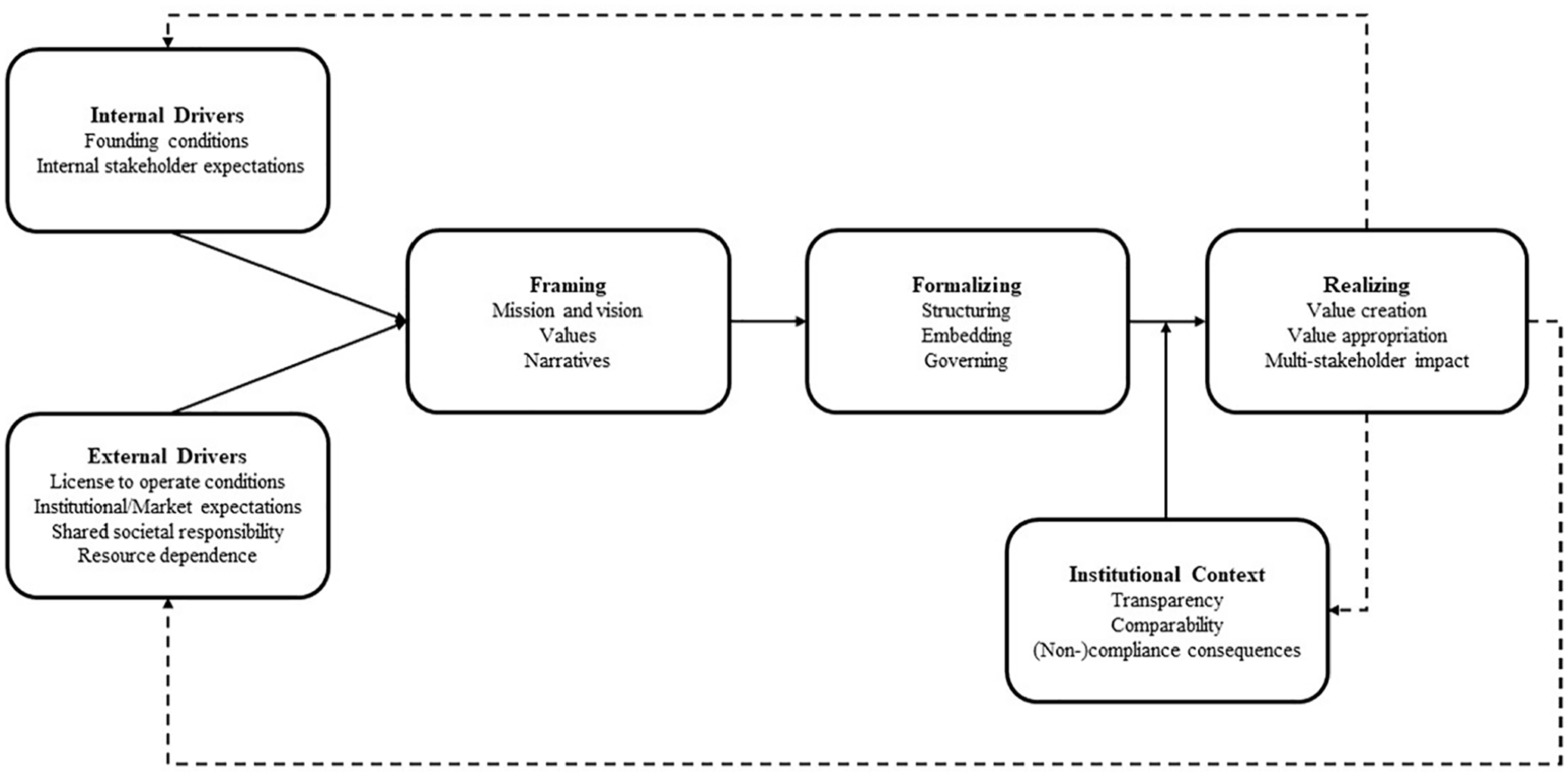
A Theoretical Framework for Purpose
Construct Definitions and Dimensions

Drivers of Purpose
Internal drivers
The internal drivers of purpose in the for-profit firm are rooted in the inspirational convictions and commitments of organizational leaders, most typically a firm’s founders. Founders’ beliefs and values may leave a lasting imprint on the firm far beyond the founder’s time at the helm of the company. For example, while Dame Anita Roddick passed away in 2007, her commitment to duty-based dimensions of purpose like social service and environmental responsibility persists in how The Body Shop operates, despite numerous changes in CEO and corporate ownership following the company’s sale to French conglomerate L’Oréal in 2006 (BBC, 2007). The Body Shop’s firmly engrained core values—identified by its famous founder but persisting well after her death—include the principle of enriching rather than exploiting (environmental stewardship), defending human rights (e.g., Roddick’s involvement with the Angola Tree), activating self-esteem (e.g., no airbrushed, unhealthily thin female models), and supporting fair trade (Roddick, 2005).
One of the ways founders perpetuate their influence in organizations is through the systems they develop to embed their convictions. In a recent study, Akroyd and Kober (2020) report that founders who drive strong employee attachment to a firm and spur passionate alignment with its vision are more likely to design and use management control systems (such as hiring practices and cultural controls) that foster an almost family-like commitment to the firm, while at once reducing the likelihood of bureaucratic structures that could damage firm culture. Such hiring practices may, however, be rare as only 28% of CEOs reported that their organizations attached importance to attracting employees committed to seeing a purpose in their work (PWC, 2016).
Such findings are perhaps surprising because strong employee engagement provides an additional internal driver of corporate purpose. Employees have been found to engage in corporate social initiatives, even in organizations in which salary is lower than in rival organizations, under the anticipation of private benefits such as new skill development or improved career prospects (Bode & Singh, 2018). Participation in such social initiatives also increases motivation and commitment. More generally, firms that allow employees to take part in or lead social initiatives can improve employee identification (Glavas & Godwin, 2013), recruitment (Bode, Singh, & Rogan, 2015), and retention (Jones, Willness, & Madey, 2014). Employee engagement is central in putting purpose into action. Companies acknowledge that this goal is difficult to achieve, as half of CEOs report that their employees have difficulty in connecting their work to their company’s purpose and values, and 67% indicate that their companies lack an understanding of how to translate purpose and values into concrete actions and behaviors (PWC, 2016).
External drivers
External drivers of purpose can be found in various “theories of external influence” such as ecological responsiveness, stakeholder theory, and demand-side research (Schillebeeckx, Kautonen, & Hakala, 2021). These theories argue that firms should proactively respond to sources of external influence in order to protect and potentially improve their value creation and capture potential. Ecological responsiveness implies that, besides efficiency motives and intrinsic drivers, firms respond to ecological pressures to gain legitimacy (Bansal & Roth, 2000), which subsequently grants the firm a social license to operate (Demuijnck & Fasterling, 2016; Mele & Armengou, 2016). Demand-side research argues that firms must fulfil the needs of different types of consumer groups and hence adjust their internal processes and resources to align with downstream pressures (Priem, 2007; Priem, Li, & Carr, 2012; Priem, Wenzel, & Koch, 2018).
More generally, stakeholders can influence how a firm defines and perceives its purpose. In its original conceptualization, stakeholder theory is anchored in a duty-based interpretation of purpose that holds firms responsible for the protection of disenfranchised and affected communities over which it exerts influence (Freeman, 1984). Later works have advocated a more instrumentalist perspective, suggesting firms should prioritize stakeholders by their power, legitimacy, and their contribution (Mitchell, Agle, & Wood, 1997). Through social movements, stakeholders voice their concerns in various ways that can lead firms to revisit or reinforce their purpose.
Finally, long-term environmental dependence can imprint specific values on a firm that guide its operations (Zarea Fazlelahi & Burgers, 2018), while sudden environmental shocks such as the pandemic may also test firms’ purpose and/or drive them to discover, revisit, or even reinvent it (Armano, 2020; Bhattacharya, 2020; Valentine, 2020). Gradual environmental changes may also drive firms to revisit their purpose. In the United States, institutional changes such as the partial retreat of the government, the reduction of federal spending on social services, reduced funding for nongovernmental organizations (NGOs), and increasing costs of socioecological programs have created an environment in which social enterprises and purposeful organizations have emerged to fill the gaps (Zahra et al., 2009).
Implementing Purposeful Organizing
Succeeding in fulfilling corporate purpose requires more than the internal influence of founders and employees and the external influence of various stakeholders. While these drivers can trigger its emergence, corporate purpose must be implemented at all levels of the organization to become fulfilled. Three constituent dimensions of activity must unfold for this to occur: (i) framing purpose into a cohesive mission and vision, and a powerful narrative that marries goal- and duty-based pillars; (ii) formalizing purpose into organizational practices and processes by embedding, structuring, and governing it; and (iii) realizing purpose by allocating resources to it, transcending value creation or appropriation questions, and generating multistakeholder impact.
Framing
A critical requirement for framing a meaningful and effective purpose is to engage members of the organization to generate a distinctive, actionable idea of what its purpose should be. For most purpose-driven organizations, this starts with defining a set of values that typically originate with the founders of the company (Horwath & Drucker, 2005). Whether these values are hedonistic as Stengel (2011) suggested or duty-based as proposed by Hollensbe et al. (2014) is less important than that the firm actively seeks to frame and communicate them as part of a coherent organizational identity (Aust, 2004). Yet while founders and, in some cases, other organizational leaders and events may imprint values onto the organization (Hsu & Lim, 2014; Marquis & Tilcsik, 2013), these values are building blocks of corporate purpose rather than purpose itself.
Purpose arises when firms encode their values into a clear mission statement that encapsulates what the firm aims to achieve in the short run as well as into a broader vision that sets aspirational long-term objectives and provides a guiding light for strategic decision-making. For example, outdoor clothing brand and B Corp Patagonia espouses the values of quality, environmental protection, and innovation. Guided by those values, the company has developed innovative business practices including the “Worn Wear” program, which gives customers in-store credit when they return no longer useful Patagonia clothes to the store. This approach aligns with Patagonia’s newly constituted mission statement that “we’re in business to save our home planet,” which suggests that the company actively seeks to offset its carbon impact. Agricultural commodity trader Olam’s stated purpose is to “re-imagine global agriculture and food systems,” which notably transcends the organization’s own narrow interests and aligns its long-term vision with changing how the entire food ecosystem functions.
To guide action within the organization, these values, mission, and vision statements must coalesce into coherent narratives that tell the story of the organization. Narrative devices such as complete stories and story fragments help organizational members and stakeholders make sense of their environment and can guide them towards action (Bock, Warglien, & George, 2021; Shapiro, 2016). It is important that when delivered externally, these narratives are credible. Firms that are caught greenwashing or using false or misleading advertising suffer negative consequences while those that are transparent about poor environmental performance may actually reap rewards (de Jong, Huluba, & Beldad, 2020; Philippe & Durand, 2011; Schillebeeckx, 2020).
Formalizing
Once an organization has framed its purpose, formalization becomes the next critical challenge. Because purpose in its current understanding goes beyond profit maximization, purpose-driven corporations must design their core activities, structures, and processes with their own hybrid nature in mind (Battilana & Lee, 2014: 398), which is challenging. This involves the embedding of purpose in organizational routines and practices, the structuring of the organization’s business model, partnerships, organizational form, and legal status so that these align with the firm’s purpose, and the implementation of governance practices that ensure purpose is an integral part of the firm’s management control systems and decision-making.
Embedding purpose in a firm’s internal routines, daily interactions, and hiring practices minimizes ambiguity as to how employees should act. This has implications for how employees are rewarded. Former Barclays CEO Anthony Jenkins said that Barclays made a deliberate choice to remove sales incentives in its branch network, because these incentives were deemed incompatible with the bank’s purpose (White, Yakis-Douglas, Helanummi-Cole, & Ventresca, 2017). Formalizing a business values scorecard can also guide organizational behavior and ensure that all internal processes and routines remain aligned with the values the company espouses and its overarching purpose (Jazayeri & Scapens, 2008). In addition, firms can use training courses and, if required, means of enforcement to ensure that employees abide by codes of ethics (Adam & Rachman-Moore, 2004). Finally, a core step toward embedding purpose is to set diversity targets that align with, advance, and exemplify that purpose (Roberson, Buonocore, & Yearwood, 2017). When such targets start at the top of organizations, they have been found to create beneficial trickle-down effects to other levels (Gould, Kulik, & Sardeshmukh, 2018).
In terms of structuring, the focus is to ensure that the implementation of corporate purpose is an organization-wide responsibility rather than one of specific departments. Recent efforts document the emergence of new organizational designs and hybrid organizational forms that consider the challenges of integrating purpose into organizational structure. Hybrid organizing is understood as “the activities, structures, processes and meanings by which organizations make sense of and combine multiple organizational forms” (Battilana & Lee, 2014: 398). Companies can thus engrain purpose in their business model, partnerships, organizational form, and legal status. Yet doing so imposes familiar challenges. Business models that support different types of value creation or cross-sector partnerships tend to have higher coordination costs and experience conflicting logics (Battilana & Dorado, 2010; Bode, Rogan, & Singh, 2019). While new organizational forms emerge because of their superior fit to a particular environment or because of their superior ability to economize on welfare-reducing transaction costs, until they are institutionalized they may experience legitimacy discounts (Hannan & Freeman, 1977; Luo & Kaul, 2019; Wry & Lounsbury, 2013). The complexity of running a Benefit Corporation or B Corp, with its more expansive fiduciary duties and higher requirements in terms of transparency and accountability, is such an example (Montgomery, 2014).
Finally, formalizing purpose affects the governance of firms, if only because purpose can serve as a control system that reduces the need for monitoring (Cady et al., 2011). In general, diversity in the firm’s governing bodies, the number of independent board directors, and/or female board representation have positive effects on firm value (Fernández-Gago, Cabeza-García, & Nieto, 2016; Miller & del Carmen Triana, 2009). Beyond the board, the effective governance of organizational arrangements can create incentives to deploy resources that align with a broader set of objectives than pure profit (Cabral, Mahoney, McGahan, & Potoski, 2019). However, this remains rare in companies, as is evident from the paucity of CEOs who consider the cultural fit between their company’s purpose and the purpose of an merger and acquisition (M&A) or joint venture (JV) target an important decision criterion (PWC, 2016). The high incidence of M&A failures serves as testament to how important and costly overlooking these “softer” aspects may be (Fernandes, 2019; Koi-Akrofi, 2016; Kumar & Sharma, 2019).
Realizing
For realizing corporate purpose, we move beyond “the classical conception of value as a result of the difference between willingness-to-pay minus cost” (Cabral et al., 2019: 468). This perspective is recognized in the literatures on inclusive growth and social entrepreneurship and even in recent contributions to utilitarian reasoning (Dacin et al., 2011; George, McGahan, & Prabhu, 2012; Jones & Felps, 2013). Some authors go further and advocate for “ecological-centrism,” because “the natural environment [is] the foundation on which society resides and economy operates” (Markman et al., 2016: 673). Following our earlier definition of what purpose is and does, we contend that realizing purpose requires private and public value creation. At times, this may imply bypassing opportunities to appropriate value from activities that are not aligned with the firm’s framed and formalized purpose. For-profit firms that are driven by purpose seek to achieve multiple goals and prioritize them differently across time and space.
Realizing purpose involves value creation through the achievement of excellence in executing the firm’s proclaimed purpose. Barclays identified its purpose “as helping people to achieve their ambitions in the right way” (White et al., 2017: 104). While “in the right way” leaves much to the imagination, the explicit inclusion of a morality clause guides the firm as to how value creation can manifest. As in the business-model literature, value creation and value appropriation are understood as two separate objectives of a firm (Amit & Zott, 2012; Roome & Louche, 2016). Some companies accept reduced value appropriation in order to ensure they can live by their purpose. CVS made the decision to stop selling cigarettes in its stores, even though tobacco was a multi-million-dollar revenue generator (Gartenberg et al., 2019). Despite being a low-cost airline, Southwest Airlines does not charge for checked-in baggage, since doing so would go against their purpose, which is “to connect people to what’s important in their lives through friendly, reliable, and low-cost air travel” (Dvorak & Ott, 2015). At the same time, some companies can reduce costs of capital by investing in environmental, social, and governance (ESG) factors (Gast et al., 2020).
Finally, to realize purpose firms explicitly consider their multistakeholder impact. A regional U.S. bank for instance stopped charging fees for its debit cards. While the fee was waived for customers who maintained a sufficient balance, this waiver policy disadvantaged its less affluent clients. The firm realized this violated its purpose, which was centered on creating strong financial well-being (Dvorak & Ott, 2015). More and more firms are integrating ESG requirements in their business operations and finding ways to become better corporate citizens. For example, DBS Bank, the largest bank in Southeast Asia, is developing multistakeholder assessment tools to help its clients better understand climate risk and also to optimize the risk inherent in its loan portfolio. By explicitly considering environmental harm and sectoral and regional unemployment, the bank is developing a strategy that enables it to accept or reject loans based on a much broader criteria set than debt repayment capacity.
Purpose in Its Institutional Context
The last element of the framework involves recognizing that corporate purpose must consider the institutional context. The wider institutional environment in which firms implement their purpose plays an important role in their ability to attain both their socioecological and financial objectives (Wry & Zhao, 2018). Contextual factors can drive the emergence of purpose but also moderate the likelihood that a firm with a formalized purpose is able to realize that purpose. With increasing transparency, facilitated by the internet, mobile phones, and other digital technologies, companies are increasingly rewarded or punished when actions converge or diverge from their promises and espoused values (Mats Lederhausen, CEO Be-Cause in Seidman, 2016). However, the expectations of stakeholders in different institutional environments may vary, and in some cases conflict. For instance, in China gift giving is considered a normal part of doing business but is viewed as bribery in many other countries (Steidlmeier, 1999). Attitudes to such practices are often culturally engrained and reinforced by formal rules embedded in legal frameworks and written ethics codes (McKinney & Moore, 2008; Sanyal, 2005). Digital technologies thus constitute “disclosure devices” (Hansen & Flyverbom, 2015: 872), which may intensify, and bring into public view, purpose-based tensions that need to be carefully navigated.
Beyond the increasing transparency of information, the institutionalization of reporting practices also enhances the monitoring and comparability of corporate actions and the impact they generate on the world at large. As institutional investors bring sustainability front and center (Fink, 2020) and regulators and standard-setters move from voluntary sustainability reporting to mandatory integrated reporting, the wider role of business in society becomes increasingly formalized (Cheng, Green, Conradie, Konishi, & Romi, 2014; Christensen, Hail, & Leuz, 2019). And as monitoring and measurement for environmental impact improve, it becomes easier to establish the relationships between environmental processes, outcomes, and performance (Delmas, Etzion, & Nairn-Birch, 2013). Similarly, the globally recognized United Nations Sustainable Development Goals provide a framework that can be used to guide resource allocation and facilitate a comparative analysis of how well companies are addressing the underlying targets (Consolandi, Phadke, Hawley, & Eccles, 2020).
Accountability increases potential repercussions, as the raising of compliance requirements forces firms to improve tracking of their social and environmental impacts (Freiberg, Park, Serafeim, & Zochowski, 2020). As the notion of purpose becomes formalized and standardized measures agreed upon (Barby et al., 2021), companies are likely to be held more and more accountable to their stated purpose. We have already seen that such increased accountability can lead to a “compliance mentality” (Gunningham, Thornton, & Kagan, 2005: 302) that is focused on adherence to formal requirements rather than—and even at the expense of—the goals and values underpinning a firm’s purpose. Avoiding such a mindset will have a critical bearing on whether firms realize their purpose and what such realization entails.
A Research Agenda on Purposeful Organizing
Following the definition of purpose and the exposition of a theoretical framework for studying the antecedents, enactment, and outcomes of purpose, we now explore potential opportunities to develop the theory, empirical evidence, and practice of purpose in the for-profit firm. While we proposed an ambitious definition of purpose, more work is needed to carve out a unique space for purpose scholars. Such researchers will need to define the differences and similarities between purpose and cognate domains such as corporate social responsibility, sustainability, and ethics. In doing so, it will be important to consider: What are the topics that are core to purpose research that have so far evaded attention in related fields?
There is still much more to learn about the drivers, implementation, and context of purpose. In our framework, we distinguished between framing and formalizing purpose to parse out the positioning of firms to their stakeholders as separate from actions taken within firm boundaries to enact purpose. Each dimension of purpose framing—mission statement, vision, and narratives—could spurn questions on the boundary conditions and contingencies of why, when, and how it affects subsequent formalizing actions. We also demarcate between the framing and formalizing of purpose and its realization. This is an important step to ensure that we do not infer purpose based on the outcome. Barby et al. (2021) advocate that assessment is aligned with the motives, metrics, money model of purpose. Echoing their ideas, we acknowledge that, to advance understanding, we will need to learn how to measure and operationalize purpose in ways that facilitate quantitative data collection and analysis. Using machine learning and especially natural language processing approaches could be very useful in this area (George, Osinga, Lavie, & Scott, 2016). Finally, our understanding of the institutional contexts that are conducive or harmful to purpose is nascent at best. More work is needed to better understand the sometimes paradoxical findings in the literature and the counterintuitive actions we sometimes see in practice. To guide future research, Table 3 introduces an illustrative set of empirical questions, some of which we explore below in more detail.
Future Research Directions

Shaping Ideas and Narratives
We have proposed that both internal and external drivers can affect the formation of purpose. Future research can investigate how these two types of forces work separately as well as concurrently and how susceptible they are to change. An important set of questions is anchored in imprinting theory, which stipulates that events and characteristics that were present during the founding of a firm will have long-lasting effects and influence the firm’s set of activities for years and maybe decades to come (Hsu & Lim, 2014; Marquis & Tilcsik, 2013). This leads to questions about whether and how purpose changes as founders depart—or alternatively, about the internal and external drivers that ensure that purpose remains stable over time. While the example of Body Shop suggests that purpose can survive long after founder departure, it is unclear whether this is the norm or an exception. Similar questions arise for social enterprises that are founded to address specific societal or environmental ills or emergencies. The mission of such organizations needs to evolve as the nature of the particular challenges that they were created to address evolves: Some social enterprises may come to question their relevance as the specific issue they set out to address is resolved or takes a different form. How do such organizations reframe, broaden, or reinvent their purpose? For instance, the Worldview International Foundation reinvented itself as a reforestation group after realizing in the mid-2000s that its original purpose of helping developing nations with modern communication strategies had been fundamentally altered by social media (Schillebeeckx & Merrill, 2018).
Broader changes in a firm’s community of stakeholders can potentially also influence a firm’s purpose. Recently, many of the largest Silicon Valley tech companies have faced both internal and external scrutiny as to how they deal with political misinformation (Facebook, Google, Twitter), data privacy (Facebook), gender equality (Uber), and climate change (Amazon). As employees give voice to their concerns and stage walkouts or other forms of more tacit protests, how do firms evaluate or reevaluate their existing purpose? Do they reframe or double down on their purpose, and under which conditions will firms abandon social missions? This latter question is especially relevant for companies that take a strong stand on social issues that diverge from dominant political narratives, as Nike did with racial equality during and before the Black Lives Matter movement. Beyond the firm, social movements may also become salient stakeholders once they grow legitimate, powerful, and urgent enough (Mitchell et al., 1997). The Extinction Rebellion movement in the United Kingdom, for instance, is widely credited as the driving force behind the U.K. climate emergency declaration (BBC, 2019).
The survival of purpose is especially salient in the context of mergers and other types of interfirm coordination and collaboration. Does purpose diffuse between acquirer and acquiree, and how does this process happen? For example, how did Ben & Jerry’s enactment of its purpose change following its acquisition by Unilever? Founders Ben Cohen and Jerry Greenfield created what they termed a “values-led business” where “human value” was said to underpin commercial success (Cohen, Griendfield, & Maran, 1998). By some accounts, Yves Couette, the new CEO of the acquired company, played a critical role by engaging in both symbolic gestures to appease Ben & Jerry’s skeptical staff while also making more fundamental changes to the business model without sacrificing the acquiree’s purpose (Caligiuri, 2012). Others have expressed a different view, pointing to areas where Ben & Jerry’s purpose appears to have been diluted. For example, its original commitment to wage equality—including a ratio that connected the pay of its CEO to that of its lowest paid worker—has evolved into a more general commitment to providing employees with a “livable wage,” one of a series of contentious decisions that reflected a “struggle for the soul” of Ben and Jerry’s in the Unilever era (Edmondson, 2014).
In sum, work that examines the underlying causes of purpose internal and external to the firm, why the discourse of purpose has become so prevalent in managerial communities, and how firms frame purpose in response to these external drivers will form the basis of an improved understanding of purpose in the for-profit firm.
Moving from Intention to Action
How does purpose lead to action? Firms are moving beyond narratives to formalizing purpose concretely in organizational routines, behaviors, and practices. An inability to formalize purpose in this way is potentially very dangerous, because it can open firms up to accusations of deception and hypocrisy: The rise of the purpose paradigm has precipitated new forms of activism on the part of “purpose-skeptics” who scrutinize the purpose-related claims of firms and call them out for apparent discrepancies. Indeed, the fear of being labelled as hypocritical and inauthentic—as social washers or green washers—has been shown to significantly temper the claims of purpose-driven firms (Carlos & Lewis, 2018). Grand CEO statements about how purpose-driven their company is—when it is actually merely repackaging existing services in a new, purpose-colored jacket—risk backfiring (Hill, 2020).
The issue of how to formalize purpose is therefore a critical one that deserves attention from management researchers. One important question concerns the governance practices that firms can deploy to support the emergence of purpose-driven strategies and the compliance of organizational members with the expectations associated with these strategies. Here there is arguably a balance to be struck between formal incentives as advocated, for example, by goal setting theory, and the development of informal cultural norms in which purpose is framed in terms of equity and social justice. Finding the appropriate balance is made more difficult by the fact that purpose-driven corporate initiatives are often instigated not by senior managers but by organizational members occupying a range of positions as well as by external stakeholders and key partners across supply chains (Ingenbleek, Binnekamp, & Goddijn, 2007). The governance practices required to promote purpose are therefore likely to involve a combination of top-down initiatives by senior managers and bottom-up advocacy on the part of a range of stakeholders. Considering the factors that shape how this balance is struck has the potential to make an important contribution to research on purpose in the for-profit firm.
A related question concerns the human resource (HR) practices that allow firms to arrive effectively at shared purpose, a question that is complicated in the context of multinational firms operating across multiple jurisdictions. Indeed, a much-debated issue in international human resource management research concerns the extent to which multinational firms conform to globally standardized expectations versus being responsive to local conditions (Preuss, Haunschild, & Matten, 2009). This tension may be especially apparent in the context of the purpose-driven firm, where a desire to meet and exceed international best practice may conflict with local institutions. HR scholars have emphasized the importance of in-role and extra-role behaviors as crucial in supporting corporate responsibility and building organizational citizenship (Dumont, Shen, & Deng, 2017), but how these roles can be constructed and maintained in multiple—and often rapidly changing—contexts, remains unclear. Considering how the construction of roles combines with other HR practices to promote purpose, and the extent to which these practices need to be adjusted across jurisdictions, represents an important avenue for future research.
Finally, it would be interesting to consider the extent to which the formalization of purpose alters investor attention. This question is of particular importance in light of investors’ attempts to account for ESG factors alongside traditional financial measures to evaluate corporate performance. For example, emerging research suggests that effective ESG practices increase firm value (Fatemi, Glaum, & Kaiser, 2018), but the way investors measure such practices and distinguish between rhetoric and reality remains ambiguous and inconsistent. Future research that considers how investors perceive the formalization of purpose and factor it into their decision-making has the potential to make an important contribution. Here it may be interesting to conceptualize purpose as a real option. Scholars have already begun to consider particular types of corporate social responsibility (CSR)—such as CSR focused on creating opportunities for future growth—in these terms (e.g., Husted, 2005), and this emerging work may provide a theoretical basis to examine purpose more broadly. Similarly, considering the role of purpose in shaping investor behavior through an agent-theoretic lens, perhaps as a way of reducing moral hazard and aligning interests, could form a useful conceptual basis for future research in this area.
Generating Impact
Why and when does purpose matter? Ultimately, the purpose of the for-profit firm should matter for all of its stakeholders. At the macro level, entire economies, societies, and communities are likely to be deeply affected by how firms frame, formalize, and realize their purpose. As noted earlier, firms may have to make difficult tradeoffs in order to create public as well as private value, including giving up opportunities for value appropriation that may undermine their purpose. The implications of such tradeoffs are not well understood and require further research. Critical questions concern not only whom the firm ultimately decides to serve but how its decisions are viewed by its stakeholders, an area that might be informed by theories of procedural and distributive justice as well as by research on social movements and stakeholder mobilization (Akemu, Whiteman, & Kennedy, 2016; Folger & Konovsky, 1989; Quattrone, 2015). Also potentially important is the firm’s time frame for realizing its purpose. How do firms weigh short-term costs against longer term potential gains or vice versa, and how do these choices affect the economies, societies, and communities in which they operate, especially in the face of major economic or social crises such as those induced by the Covid-19 pandemic (Craighead, Ketchen, & Darby, 2020)? Additional questions relate to the macro-level trends created by the prevalence and priorities of purpose-driven businesses in a given economy, society, or community. These include, for example, how value creation and capture may be affected by diversity of purpose among for-profit firms versus by convergence of purpose on shared priorities, such as climate change or reducing inequality. The answers to such questions will fundamentally affect the outcomes and impact of purpose-driven firms.
Purpose also has impact at a more micro-level, on the individuals and groups most directly affected by the firm’s rhetoric and actions. Research in organizational behavior and human resource management has long recognized the importance of an organization’s values, culture, and commitments for an array of critical processes and outcomes, including employee attraction, selection, and attrition (Schneider, 1987), employees’ motivation and organizational citizenship behaviors (Grant, 2007; Pratt & Ashforth, 2003), and organizational commitment and turnover (O’Reilly, 1989; O’Reilly, Chatman, & Caldwell, 1991). Decoupling publicly stated purpose from the internal workings of the organization can render it meaningless or even counterproductive, while a compelling purpose that enables employees to connect the firm’s overall aspirations to their everyday work trickles down through the firm’s hierarchy and can be extraordinarily energizing and impactful (Carton, 2018). It is plausible that firms with a strongly embedded purpose are more likely to stay true to that purpose in less munificent environments or during a crisis, while those that pay lip service to it will fail. This has become painfully evident in, for example, the meatpacking sector during the Covid-19 pandemic, where claims of “family-like environment” and “our employees come first” rapidly came to sound hollow as cases and deaths rose disproportionately in their factories (Chadde, Axon, & Bagenstose, 2020).
Beyond its impact on prospective and current employees, the firm’s purpose can also be a powerful factor for building a clear market identity and customer loyalty, as the example of the Body Shop illustrates. Still, there are many questions yet to be explored. For example, as purpose-driven businesses become more widespread, do they crowd out and delegitimize businesses that do not articulate a compelling purpose, or does purpose become taken-for-granted and no longer a particularly compelling message or motivator for employees, customers, investors, or others? Alternatively, will firms need to differentiate themselves from competitors by identifying and pursuing more specific or specialized purposes, in order to attain the benefits that might have been more easily gained when there was less purpose-based competition? It then becomes worthwhile to study whether purpose breadth or purpose depth would be perceived more favorably by stakeholders and whether firms who seek to combine depth and breadth would suffer from the exploration/exploitation-like problems identified in the study of organizational ambidexterity (March, 1991). Relatedly, an institutional logics perspective could investigate whether logics associated with duty-based or goal-based purpose can coexist in a single organization (Orlitzky, 2011).
Perhaps the most critical test of the strength and impact of a firm’s purpose comes when the firm is under pressure and tested by challenging or negative events. This is often when choices between potentially competing goals, values, beliefs, and stakeholders become acute and unavoidable. Sometimes, these pressures relate directly to the firm’s own failure to realize elements of its purpose, such as sustained profitability or success at serving target populations. Sometimes, they result from external pressures that target the firm, or similar firms, directly, such as a consumer boycott or disinvestment campaign. And sometimes they arise from wholly unanticipated systemic shocks, such as Covid-19 or a natural disaster like the Japanese tsunami of 2011. In such situations, the questions that arise relate to organizational agility, resilience, and transiliency, the ability to at once restore some processes while radically changing others (Craighead et al., 2020). When faced with such pressures, are firms better able to realize—or reorient—a purpose that is goal-based or one that is duty-based? When does purpose serve as a valuable heuristic for helping to make difficult choices and when as a barrier to flexibility? Are some formulations of purpose more robust than others? Do the ways in which a firm has formalized (or failed to formalize) its purpose affect the extent to which this purpose ultimately guides the firm’s decisions under pressure or the outcomes of those decisions? By examining questions like these, future research can advance our understanding of when and why purpose matters.
Influencing Markets and Institutions
The role of the wider institutional context in the realization of purpose requires more research. For instance, it has been argued that purpose can serve as a control system that reduces the need for third-party monitoring (Cady et al., 2011). By extension, this viewpoint implies that purpose can compensate, at least in part, for the absence of effective institutions. On the flipside, how companies link purpose to emerging compliance requirements is also a salient question. It is unclear, a priori, whether purpose-driven companies are more likely to become compliance-driven as regulators sharpen regulatory requirements—a topic especially important in the context of sustainability reporting. While regulation may indeed be a rising tide that lifts all boats, it could dissuade companies at the vanguard of responsible business from pushing the envelope even further.
How companies negotiate purpose in response to political or normative changes in society is also poorly understood. Some purpose-driven firms have taken vocal positions that are not aligned with their government. Nike’s continued support for Colin Kaepernick, the first NFL player to kneel during the national anthem, exemplifies this. Nike won international acclaim for its advertisement featuring the former NFL player and increased its sales and valuation, despite locking horns with the U.S. administration (Beer, 2019). This example shows that, at times, the pursuit of purpose may put a firm at odds with powerful actors in its institutional environment and indeed the institutions themselves. For firms that seek to realize value along the three dimensions we have highlighted, it is less a matter of choice and more a matter of duty to “believe in something, even if it means sacrificing everything,” as Nike’s 2018 ad campaign with Colin Kaepernick put it.
The situation becomes more complex still in the context of authoritarianism. Research on purpose has tended to focus on firms located in democratic institutional settings where firms and employees are able to openly criticize political elites and question dominant social and cultural values. The same cannot be said for companies in authoritarian regimes, which are often subject to extensive state surveillance and monitoring, presenting them with significant additional purpose-related challenges. Firms headquartered in democracies, but which operate in settings with authoritarian governments, may face similarly difficult choices and constraints in enacting their purpose. For example, when Google agreed in 2006 to the Chinese government’s demands that it censor its search results in China, it justified its decision on the grounds that it could “broaden the horizons of Chinese users and nudge the Chinese internet towards greater openness” (Sheehan, 2018). However, as ever greater restrictions were imposed upon its search engine, Google subsequently reversed its decision and abandoned the Chinese market; such censorship was ultimately deemed incompatible with its commitment to information transparency, which is at the core its stated purpose.
These examples highlight the potential tension between a firm’s framed and formalized purpose and the (changing) nature of the institutional context in which it operates. Institutions shape the standards of acceptable and appropriate firm behavior and provide the cultural tools—the vocabularies, norms, and practices—that firms use to frame and formalize their purpose. At the same time, firms are not beholden to institutions; they have the capacity to challenge, shape, and deviate from them in ways that are both intentional and unintended. In this regard, the growing literature on “institutional work” offers a promising avenue for purpose research because of its explicit concern with the “processes associated with actors’ endeavors to . . . elaborate and contain institutions, as well as amplify or suppress their effects” (Hampel, Lawrence, & Tracey, 2017: 558). Thus, research on institutional work has the potential to shed new light on how purpose-driven firms navigate the opportunities and constraints presented by their institutional environment.
Conclusion
Perhaps more than ever before, in a world in which viruses can paralyze economies, climate change ravages communities, and the gap between the rich and the poor widens even more, we need to harness the power of the business corporation to achieve a purpose that is anchored in a sense of duty. As management scholars, we have an obligation to dedicate our own scarce resources to a research and educational agenda that recognizes the broad role of the for-profit firm in society and speak for the stakeholders whose voices otherwise risk remaining unheard.
We provide a framework with illustrative empirical questions that can be fruitfully asked to put purpose into practice. We connect our empirical questions to theoretical lenses that can help explain the emergence of purpose, the underlying processes that turn purpose into action, and the contextual factors that simultaneously guide firms to achieve their purpose as well as force them to revisit it. As businesses grapple with issues of sustainability, climate change, resilience, and social justice, our ardent hope is that scholars seize this unique opportunity to provide empirical evidence that nurtures and guides purpose in the for-profit firm in exciting and impactful ways.
Footnotes
Acknowledgements
The authors gratefully acknowledge the helpful guidance of the editor and two anonymous reviewers. Gerard George is Visiting Professor of Innovation and Entrepreneurship and acknowledges the support of the Lee Kong Chian Chair Professor at Singapore Management University.
