




Abstract
Due to the radical uncertainty associated with grand challenges, prior studies have emphasized the need for robust action, which preserves future options while taking existing means and institutional constraints seriously. In this conversation on entrepreneurial futures and possibilities, we suggest that for such approaches to avoid merely reproducing or incrementally improving upon existing ideas and institutions, they must be underpinned by a set of cognitive practices that encourage the systematic interrogation of existing assumptions, the surfacing of bold systemic interventions, and efforts to discourage early dismissals of such interventions based on historically grounded feasibility judgments. To encapsulate these cognitive practices, we introduce the concept of possibilistic thinking, noting how such thinking significantly reorients entrepreneurs’ attention and reasoning processes. We conclude by discussing the tensions associated with possibilistic thinking as well as opportunities for further research.
Grand challenges pose complex social and environmental problems (e.g., inequality, climate change, pandemics) that present radical uncertainty regarding the consequences of current actions while encouraging multiple and conflicting evaluations among relevant stakeholders (Ferraro, Etzion, & Gehman, 2015; George, Howard-Grenville, Joshi, & Tihanyi, 2016). To date, research and theory have approached these constraints by emphasizing the need for effectual and robust action, which allows for creative and distributed solutions while preserving future options (Ferraro et al., 2015; Sarasvathy & Ramesh, 2019). Studies of effectuation emphasize a “logic of control”, wherein actors start with assessments of identity (who am I?), networks, and skills to induce means-driven responses to grand challenges. Similarly, research on robust action draws on philosophical pragmatism, encouraging a set of collaborative processes that result in experimental and participatory responses to those challenges. Despite their theoretical focus on process and practice, both of these literatures imply a set of cognitive efforts that are likely to underpin such experimentation and entrepreneurial action. Specifi-cally, cognitive activities like design thinking, pattern recognition, and the use of heuristic analogies and metaphorical reasoning are frequently promoted as lending support to entrepreneurial action by loosening the grip of pre-existing assumptions and paradigms while increasing entrepreneurial imagination (Cornelissen, 2013; Kier & McMullen, 2018). In her response to our article, Sarasvathy (in this issue) pushes further by acknowledging the importance of possibilisitic thinking, yet suggesting the need to focus such thinking upon the means (“even-if” possibilities) rather than the ends (“as-if” possibilities). In this way, entrepreneurial imagination is reoriented toward overcoming the individual- and venture-level constraints associated with the pursuit of entrepreneurial futures. As she notes (p. 00
Although we recognize the value of this work in specifying an effectual, pragmatic approach to addressing grand challenges, we argue that the magnitude of such challenges requires equally grand entrepreneurial responses that go beyond these more conventional cognitive activities. As Felin, Gambardella, Stern, and Zenger recently argued (2020, p. 4), “The most valuable entrepreneurial ideas are those that are unlikely to permit an easy, immediately-recognizable experiment.” We agree, and thus we see the need to revisit the fundamental principles of grand responses to grand challenges—“bold ideas” and “less conventional approaches to tackling large, unresolved problems” (Colquitt & George, 2011, p. 432). This is consistent with calls to pursue grand challenges by embracing radical new possibilities and new ways of seeing through “loonshots” (i.e., application of widely dismissed ideas written off as “crazy”; Bahcall, 2019), “moon shots” (i.e., “a breakthrough goal on a five-to ten-year horizon into the future”; McGahan, 2018, p. 6), and science fiction (Furr, Dyer, & Nel, 2019). Moreover, we see such attempts to engage with long-term entrepreneurial possibilities as distinct from but complementary to radical shifts in perspective which might include attending to the sacred and the spiritual through embodied moments of inspiration and insight as Chiles, Crawford, and Elias (in this issue) posit in their commentary. In this way, we would argue that the process of possibilistic thinking, as we theorize here, is also entirely consistent with and appreciative of “sources of inspiration, motivation, and explanation rooted in faith or spirit that could broaden our ‘seeing’” (Neubert, 2019, p. 253).
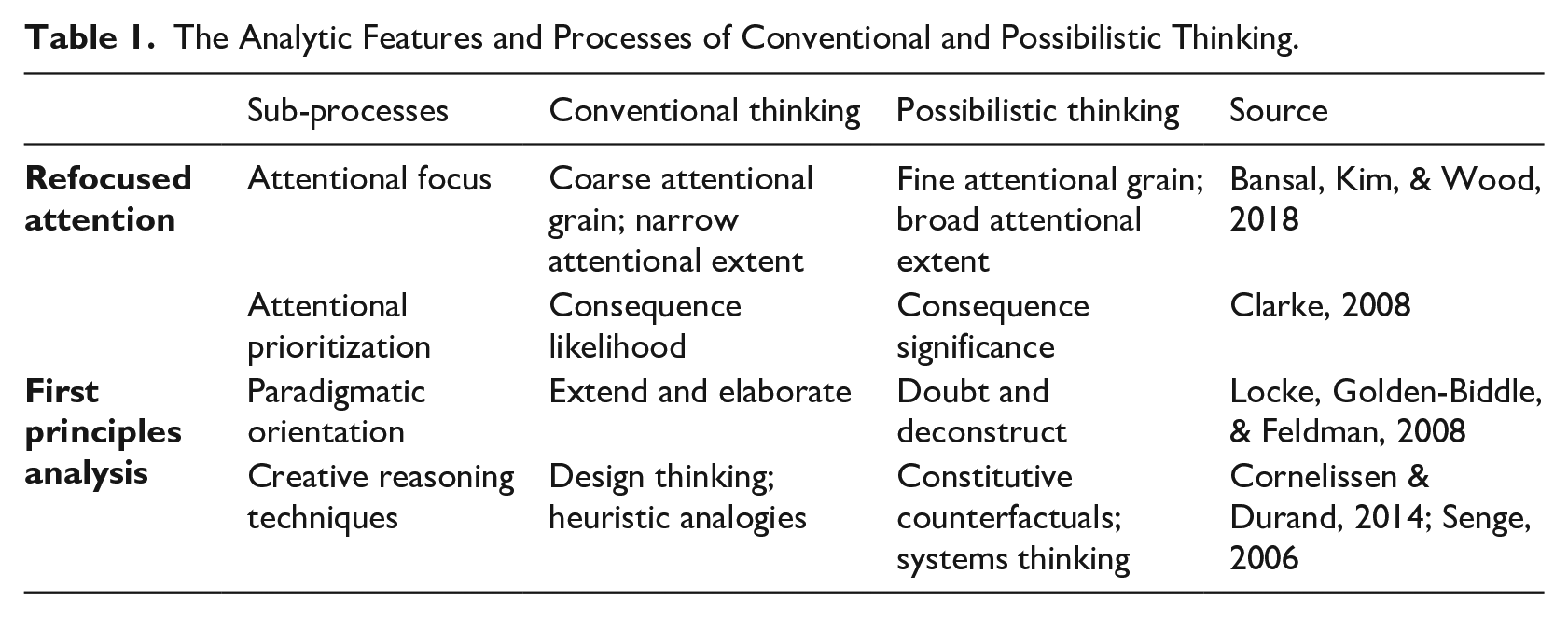
As a complement to effectual and pragmatic responses to grand challenges we introduce and elaborate the concept of possibilistic thinking—a cognitive practice which we argue involves the systematic deconstruction and interrogation of the assumptions upon which existing solutions are based as well as the subsequent development of new “worlds.” This moves innovators beyond the conventional reliance on existing means, recognition of existing constraints, and embrace of distributed experimentation toward foundational reappraisals of those existing means and constraints and the bold reorientation of those distributed experiments. As such, we argue possibilistic thinking contrasts with the conventional and heuristic analogical thinking ubiquitous in much of today’s approaches to solving grand challenges (Etzion & Ferraro, 2010). Possibilistic thinking entails deliberately departing from existing categories that channel attention and define relevant information, thereby allowing for bold thought experiments (Felin et al., 2020; Garud & Karnoe, 2001). In contrast to conventional thinking, we argue that possibilistic thinking prioritizes the scope and scale of potential consequences relative to their probabilities, thereby refocusing attention toward foundational system dynamics, and enabling the detection of critical historical anomalies—the harbingers of future consequences (Bansal, Kim, & Wood, 2018; Clarke, 2008). Once collective attention is reoriented in this way, possibilistic thinking redirects analytical processes toward deconstructing problems into “first principles” or basic assumptions (Furr et al., 2019). We argue that, taken together, such practices comprising possibilistic thinking encourage a process of “worldmaking” whereby groups begin to collectively embrace profound new possibilities that challenge existing paradigms (Garud, Gehman, & Guiliani, 2014; Sarasvathy, 2012; Suddaby & Greenwood, 2005). Table 1 summarizes how possibilistic thinking reorients individuals’ attention and analysis away from conventional cognitive processes.
The Analytic Features and Processes of Conventional and Possibilistic Thinking.
Possibilistic Thinking as Refocused Attention
Moving beyond conventional responses to grand challenges requires an attentional shift away from the mean and toward the tails or outliers. Anomalies represent a discrepant outcome relative to historical patterns and normative expectations (Billings, Milburn, & Schaalman, 1980), and as such are often dismissed by conventional and top-down thinking processes that channel attention to more likely outcomes (Ocasio, 1997; Shepherd, McMullen, & Ocasio, 2017). While convention encourages attention toward those problems with the highest probability of occurring and those solutions with the highest probability of success, grand challenges often require that entrepreneurs take their eyes off the proverbial ball and refocus their attention toward the periphery. Conventional cognitive processes are evident in existing political and public responses to, for example, climate science, economic cycles of boom and bust, and even the recent global spread of Covid-19, wherein individuals consistently reject anomalies as inconsequential even after they accumulate. In post-hoc analyses of disasters, for example, reports frequently attribute those disasters to improper attention to and handling of accumulated anomalous data (Bazerman & Watkins, 2004; Starbuck & Farjoun, 2005). The accumulated anomalies were normalized such that they were not bracketed for further attention, interpretation, and action (Cowan, 1986). Bansal and colleagues’ (2018) recent study suggests that the problem lies in individuals’ and organizations’ overly coarse “attentional grain” (i.e., unit of measurement) and overly narrow “attentional extent” (i.e., range of measurement). In the context of grand challenges entrepreneurs benefit from a widening of attentional extent toward longer time horizons and interdependent systems that match the time scale and complex interdependencies associated with grand challenges. Moreover, they similarly benefit from finer attentional grain that brings awareness to local anomalies and particulars which deviate from global patterns and abstractions, while highlighting the need for new approaches and modes of action. While it may be possible to induce finer attentional grain and broader attentional extent within the context of effectual or pragmatic processes, these processes’ typical reliance on existing means and institutions as starting points for action, collaboration, and experimentation poses limitations for recognizing new possible responses to grand challenges. Wright and Nyberg (2017), for example, document how ostensibly revolutionary aims regarding climate change and corporate environmental practice often get diluted by more pragmatic concerns, thereby encouraging a reversion to business as usual. We argue that such a pattern reflects insufficient and insufficiently sustained possibilistic thinking. In other words, grand challenges necessitate an intentional, sustained attentional step back to possibilities.
But how can attention be reoriented and sustained in such a way, when existing paradigms restrict cognition? We argue that possibilistic thinking decouples consequences from their presumed likelihood, such that historical anomalies, long-term projections, and complex system interactions receive greater attention based exclusively on the magnitude (both in terms of scope and scale) of associated consequences. Such disproportionate weighting of an outcome’s consequences relative to its likelihood is evident in the efforts of high-profile public and private innovators to undertake ambitious and seemingly outlandish projects. For instance, NASA and DARPA have recently attempted to challenge the laws of physics by creating an EmDrive—a type of engine which can propel spacecraft without the need for fuel (Oberhaus, 2019). Similarly, inventor Elon Musk has developed notoriety for his consistent promotion of radical entrepreneurial futures often to address grand challenges regarding climate change, even going so far as to advocate for the terraforming of Mars by way of “a continuous stream of very low fallout nuclear fusion explosions above the atmosphere to create artificial suns” (Musk, 2019).
Possibilistic Thinking as a Return to First Principles
Possibilistic thinking also involves a return to first principles in the context of grand challenges, whereupon doubt is rigorously and systematically applied to challenge taken-for-granted assumptions. Typically, because attention is subject to inherent limitations (Argote & Greve, 2007; Cyert & March, 1963; Simon, 2013), entrepreneurs frequently respond to identified problems and opportunities through heuristics or even “gut feelings” (Huang & Pearce, 2015). Such mental shortcuts are likely to limit entrepreneurial imagination in all but the most exceptional cases. Yet even to the extent that entrepreneurial imagination is invoked during the reasoning process, such imagination is often limited to the use of heuristic analogies, which allow actors to efficiently accommodate existing schemas of knowledge by borrowing concepts from one domain and then applying them elsewhere. Although heuristic analogies may provide temporary mental scaffolding from which to loosen the assumptions associated with existing paradigms, Cornelissen and Durand (2014) offer evidence that suggests such analogies are often restricted to “near” analogies. For instance, Etzion and Ferraro (2010) demonstrate how the Global Reporting Initiative (GRI) invoked the “near” analogy of financial reporting as a tool for helping establish the legitimacy of sustainability reporting in response to climate change. While the GRI promised radical change, third party audits suggest extensive non-compliance of firms’ sustainability reports with GRI standards as well as growing incidents of impression management whereby firms use sustainability reports to conceal otherwise negligent environmental performance (Talbot & Boiral, 2018). In other words, although innovators may use analogies to borrow concepts from one domain to apply elsewhere, the source domains are often proximate to the target domain, thereby restricting the potential for both novelty and, in many cases, impact. In this way, heuristic analogies can be useful in extending but still upholding existing paradigms’ core assumptions. Possibilistic thinking takes a quite different tack.
By emphasizing first principles reasoning, possibilistic thinking conversely operates through deconstructing problems into basic assumptions that cannot be deduced any further. To do so requires first systematically interrogating the adequacy of everyday understanding, living, and working or doubting existing beliefs, habits, and interpretations (Locke et al., 2008). Once left with irreducible assumptions, individuals can then engage their doubt through an abductive leap via mental simulations that surface new possibilities and consider new assumptions. Such mental simulations allow entrepreneurs to sur-face multiple high-level and contrasting alternatives, which Cornelissen and Durand (2014) refer to as “constitutive counterfactuals.” These constitutive counterfactuals propose fundamentally different guiding assumptions and causal explanations to those which underpin existing paradigms. And when mental simulations draw from first principles, the resulting counterfactuals contrast reality (what is or what was) with a mental image of what might have been or what could be (Gaglio, 2004; Roese, 1997; Sanna, 2000). The example of the EmDrive provides a useful illustration, whereby innovators worked back to fundamental principles of thermodynamics and then applied counterfactuals to encourage potentially transformational innovations.
In the context of grand challenges, these mental simulations are elaborative, taking historical anomalies, other weak cues, and first principle assumptions as inputs and then generating more holistic explanations that bolster and reconfigure those assumptions. Whereas conventional responses lack requisite variety for grand challenges (Weick, 1979), the elaborative nature of possibilistic thinking and its mental simulations encourages sustained widening of entrepreneurs’ attentional extent, such that they are able to holistically visualize systems dynamics (Meadows, 2008; Senge, 2006). Doing so aids their ability to find ways to better rearchitect those systems. In contrast to heuristics that often involve deleting antecedents when constructing alternatives (Dunning & Parpal, 1989; Kahneman & Varey, 1990), mental simulations add potential causes and feedback loops to consider what might have been. This engages individuals’ imaginations to consider wider and more creative alternatives that target systems change. The resulting constitutive counterfactuals transpose earlier understandings and distill them into an entrepreneurial vision that provides a motivating guiding image (Cornelissen, 2013). In sum, by encouraging entrepreneurs to couple a return to first principles with mental simulations, possibilistic thinking enables changes that are bolder and more systemic (Mair, Wolf, & Seelos, 2016; Meadows, 2008). Such changes would have been missed or rejected using more conventional modes of thinking (Baron, 2000).
How Possibilistic Thinking Sparks Bold Entrepreneurial Responses to Grand Challenges
Possibilistic thinking represents a substantial departure from both conventional thinking as well as the ideals associated with rational, probabilistic models of decision-making. Moreover, because of the nature of its emphasis on high magnitude consequences and addressing pressing societal problems, possibilistic thinking is often emotionally charged in ways that induce bold action (Miller, Grimes, McMullen, & Vogus, 2012). Indeed, scholars have found that the effects of emotions and a focus on consequences tend to reinforce one another. For instance, events with “sharp and strong affective meaning” (e.g., fear of future threats) make individuals more sensitive to consequences than probabilities (Slovic, Finucane, Peters, & MacGregor, 2007, p. 1342). Specifically, Rottenstreich and Hsee (2001) observe that if individuals find a potential outcome emotionally powerful their attraction to that outcome is insensitive to changes in the outcome’s probability, even when the probability radically changes (e.g., from 0.99 to 0.01). Additionally, mental simulations tend to bolster emotions that fuel action. As Mische (2009, p. 694) notes, such possibilistic mental simulation “provides emotional substratum of the dialectic between the old and the new, between the reproduction and the transformation of social structures” that motivates bold action.
While we have thus far focused on the cognitive mechanisms that underpin possibilistic thinking, we argue that its emotionally charged focus on the magnitude of possible future outcomes serves as a motivational mechanism that compels collective action oriented toward addressing these grand challenges. Possibilistic thinking encourages narratives that, by inducing fear or hope, increase the likelihood that such thinking translates into systems change. One example of such possible systems change comes from the field of laboratory-grown or cultured meat. A growing number of studies point to the devastating long-term effects of the animal agriculture industry and its products on the environment, human health, and animal welfare (Tilman & Clark, 2014). And yet despite such evidence, since 1961 per capita meat consumption has nearly doubled (Godfray et al., 2018). In response, startups like Memphis Meat and Future Meat are looking to science to foundationally rearchitect the systems of production, distribution, and consumption in the meat industry. The entrepreneurial teams behind these laboratory-grown meat companies became aware of the scope and scale of the animal agriculture industry’s effects, and have thus used possibilistic thinking to reimagine how meat is produced and distributed. Working back to first principles and applying mental simulations they realized that they could take a muscle sample from an animal, collect stem cells from the tissue, and then multiply the cells through a bioreactor to produce muscle fibres. One of the companies in the industry, for instance, claims that 80,000 quarter pounders can be produced from one cow-based tissue sample, while significantly reducing the adverse environmental and health effects of the current industry products (Schaefer, 2018). Although the industry has largely lacked prototypes demonstrating the feasibility of its methods or capacity to disrupt one of the world’s most entrenched industries, the magnitude of the possible outcomes combined with charged emotions—fear of the current trajectory paired with the hope of the emerging science—have compelled action and these startups’ rapid growth. The diverse investment they have received from celebrity philanthropists like Bill Gates and Richard Branson to industry incumbents like Cargill and Tyson is a testament to the emotional resonance of possibilistic thinking.
However, to be clear, possibilistic thinking in the context of grand challenges does not represent a panacea for entrepreneurial innovation. As a source of emotionally charged cognition, possibilistic thinking is prone to cognitive biases and their harmful consequences. For example, as entrepreneurs and their teams engage in mental simulations elaborating on anomalies and working back to first principles, they create the kind of vivid, emotionally resonant images that characterize availability bias. Availability bias represents the extent to which an individual’s calculus regarding the frequency of a particular outcome is supplanted by the ease with which that outcome comes to mind (Tversky & Kahneman, 1973). The rise and fall of Elizabeth Holmes and Theranos illustrates one potential downside of the emotional appeal of possibilistic thinking, bold entrepreneurial action, and potential systems change—fraud. Specifically, Holmes (2015) promised technology capable of running blood tests so cheaply, efficiently, and effectively that it would become the standard for preventive medical care and transform care delivery. In other words, she worked back to the first principle of disease prevention and mentally simulated health care delivery if everything could be tested proactively and efficiently as a solution to the grand challenge of accessible, equitable, and high-quality health care. Yet in espousing this narrative based on possibilistic thinking, Holmes deliberately blurred the line between appeals to an entrepreneurial vision that addresses grand challenges and fraudulent claims about actual capabilities and/or technologies, prompting the collapse of the company and the indictment of its senior leaders. The possibility for fraud and exploitation is made more likely when a bold entrepreneurial vision that emerges from possibilistic thinking excites stakeholders and popular imagination (i.e., hype) thereby leading to greater expectations to deliver quickly on that future vision.
Advancing Research on Possibilistic Thinking
Our economies and polities often reward incrementalism, and as such our innovations and the cognitive processes that accompany such innovation are often constrained by convention and probabilistic evaluations. This seems particularly true in the context of grand challenges, wherein solutions to chronic yet complex problems often draw on heuristic or oversimplified analogies (e.g., “war on poverty”, “war on drugs”) or are rhetorically positioned as ambitious multilateral agreements despite the lack of enforceable, substantive commitments (e.g., Paris Climate Accord). Although scholars have suggested the value of robust action in the context of responding to grand challenges (Ferraro et al., 2015; Sarasvathy & Ramesh, 2019) and documented related potential success cases (Porter, Tuertscher, & Huysman, 2020), we have argued that most instances of robust action are still constrained by conventional cognitive foundations. In this way, we suggest that unless robust action is accompanied by possibilistic thinking, we may continue to see the current pattern in which countries, organizations, and cross-sector partnerships set ambitious and even public goals to address grand challenges and yet fail to deliver on such ambition. We believe that these outcomes (or the lack thereof) illustrate the need not only for innovators to move beyond conventional cognitive foundations, but also for researchers to begin to examine the cases in which innovators are clearly doing so.
In this conversation piece, we have argued for the importance of possibilistic thinking as a means for broadening attention and refocusing it on anomalies and consequences, deconstructing existing paradigms by way of first principles reasoning, and engaging in evocative mental simulations to energize bold and systemic action. Approaching grand challenges by thinking possibilistically reorients entrepreneurs toward contemplating long-term systems change. In this section we propose a forward-looking agenda for how our arguments regarding possibilistic thinking can be operationalized, refined, and extended.
We believe that initial inquiries into the processes and consequences of possibilistic thinking would benefit from field studies in locations where innovators are pursuing radical and/or systemic entrepreneurial solutions to grand challenges. Interviews and observations from the field could fruitfully specify how organizational members deal with the many tensions that likely characterize this type of thinking. Researchers might also consider drawing on archival documentation, as Carton (2018) did in his analysis of NASA’s leaders and their discussions during the 1960s regarding the organization’s literal “moon shot.” Such archival documentation lends itself to both qualitative and quantitative analysis of the public and sometimes private statements by executives or letters to shareholders that convey strategic intent (Amernic, Craig, & Tourish, 2007) and the ways in which anomalies and potential future consequences are identified and mental simulations are run. Finally, it would also be worth exploring whether possibilistic thinking can be induced. For example, in the laboratory one might use an intervention that attempts to instill a focus on first principles (e.g., a mindfulness intervention cultivating bare attention; Chiles et al., 2021; Sutcliffe, Vogus, & Dane, 2016) and its consequence for subsequent discourse and interpersonal processes in a laboratory creativity or innovation task.
We have established how possibilistic thinking enables one to cognitively and emotionally meet the scale and scope of grand challenges. We also outlined how it consequently elicits bold and systemic action. However, the extent to which possibilistic thinking realizes its promise requires more research that explores how entrepreneurs, their teams, and organizations turn possibilistically induced ideas into accepted solutions. This necessitates exploring the interpersonal processes of influencing stakeholders of all varieties. Mair and colleagues (2016) offer a potential set of actions that may help translate possibilistic thinking into effective systems change. Specifically, they describe a “scaffolding” process that transforms behavior and interaction patterns through mobilizing (economic, institutional, and social) resources and stabilizing interactions to reflect the desired future (Mair et al., 2016). Exploring the joint effects of possibilistic thinking and the scaffolding process on grand challenges represents a worthwhile step to link a new way of thinking to new ways of acting and interacting that yield tangible benefits. Alternatively, possibilistic thinking may result in efficacious actions through exaptation or “when a characteristic evolved for one purpose is adapted laterally for another use entirely” (Furr et al., 2019, p. 116; Marquis & Huang, 2010). In other words, does possibilistic thinking create positive effects iteratively through exaptation? What is the process and what are the organizational conditions under which possibilistic thinking can lead to adaptive exaptation?
We have posited that possibilistic thinking creates the conditions for more systemic and transformational responses to grand challenges by emphasizing consequences and anomalies in favor of likelihood and feasibility, but its ability to be sustained for long enough to realize those possibilities is unclear. The initial emotional energy that can result from interrogating and deconstructing evocative, high consequence anomalies through constitutive counterfactuals and first principles reasoning is likely to diminish over time, given that the resulting projects involve both uncertain benefits and timetables for realizing those benefits (Bateman & Barry, 2012). Thus, possibilistic thinking has the potential to consume emotional and mental resources in ways that produce exhaustion (Hobfoll, 1988). Consequently, we expect that in settings of possibilistic thinking, the urge to buttress motivation by defaulting back to smaller scale and simpler, more readily achievable goals will increase over time. Under such conditions, we would then expect to see possibilistic thinking result in incremental innovations that fail to address the underpinnings of grand challenges. Future research should examine the extent to which work design, group composition, and leadership may energize and motivate sustained possibilistic thinking when it is most needed. For example, Google X recognizes the difficulty of possibilistic thinking and attempts to harness early energy by solving the hardest problems first, while also emphasizing the amount of learning which might be gained by doing so (Thompson, 2017). Such approaches to work design merit further attention. Adding new, external members to the project or at least consulting them, as through crowdsourcing (Porter et al., 2020), may both elicit more varied inputs to match the varied, multi-stakeholder aspects of grand challenges as well as reinvigorate the energy of initial possibilistic thinking. Digital platforms that are used to broaden stakeholder engagement (Logue & Grimes, 2019) thus might be explored for their potential in sustaining possibilistic thinking. Last, the need to sustain energy and meaning over potentially long periods also suggests that a leader’s ability to create and tailor a motivating entrepreneurial vision (a la Steve Jobs; Cornelissen, 2013) may play a key role in inducing and sustaining possibilistic thinking.
Finally, it is important to acknowledge the potential unintended consequences of possibilistic thinking. Possibilistic thinking typically entails the pursuit of discontinuous innovation, which is often disruptive not only to existing markets but also to existing cultures and relationships. Although such disruption can yield social progress, it can also create unintended cultural and economic ruin in other cases. As such, how do actors engaged in possibilistic thinking consider, discuss, govern, and negotiate (e.g., with stakeholders) the potential societal consequences of their discontinuous innovations? What are the most effective guardrails to ensure against such unintended consequences?
In sum, we see the study of possibilistic thinking as a means for addressing grand challenges in a way that complements and extends prior emphasis on robust action by broadening attention and refocusing it toward anomalies, high magnitude consequences, and long-term, systemic foundations and by reasoning based on first principles and counterfactual mental simulations. The infrequency and the unique processes of such thinking makes it difficult to capture systematic data, but given the potential consequences of such thinking—particularly in the context of grand challenges—we would argue it is worthwhile for scholars to see the possibility in the possibilistic and attend to and elaborate on the foundations outlined here.
Footnotes
Declaration of conflicting interests
The author(s) declared no potential conflicts of interest with respect to the research, authorship, and/or publication of this article.
Funding
The author(s) received no financial support for the research, authorship, and/or publication of this article.