




Abstract
We investigate the nature and impact of recent ‘reflexive theorizing’ in the field of Organization Studies by examining articles that critically reflect on research, practice and the profession more generally with a view to defining, refining or changing future trajectories for the field. We identify a range of discursive practices used in these articles to establish authority, describe the field and make claims about the nature of theorizing. We then present three ‘ideal types’ that represent particular constellations of these discursive practices. We interrogate each of these ideal types in order to demonstrate how particular combinations of discursive practices can limit the potential of reflexive theorizing by shutting down conversations. Finally, we make a number of suggestions for weaving together discursive practices in ways that help to ensure that reflexive theorizing generates new forms of knowledge through conversations which are open to a wider range of voices, and where respect and generosity are evident.
Keywords
In this paper, we investigate the nature and impact of recent reflexive theorizing that has been conducted in the field of Organization Studies (OS) 1 by examining articles that critically reflect on the field, including the type of knowledge that they produce, the way in which they produce it, and the effect that this knowledge has. The launch of this new journal – Organization Theory – is an ideal time to consider what OS scholars think of their discipline, how they have gone about the process of reflecting on it, and what they advocate for its future. More importantly, we want to take this opportunity to caution against forms of reflexive theorizing, seen in some recent articles, which shut down new forms of knowledge under the auspices of ‘better science’ or promote simplistic provocations that suggest most of us are doing meaningless research. Instead, we want to encourage forms of reflexive theorizing that generate new forms of knowledge through conversations which are open to a wider range of voices, and where respect and generosity are evident.
Reflexive theorizing in OS is nothing new. In the 1980s, the ‘paradigm wars’ saw a surge of discussion and debate that sought to open up more heterodox ways of thinking (Hassard, 1993; also see Fabian, 2000). Reflecting on the proliferation of new perspectives, the editors of The Handbook of Organization Studies (Clegg, Hardy, & Nord, 1996) conceptualized theorizing as a series of multiple, overlapping conversations that reflected, reproduced and refuted earlier conversations (also see Cornelissen, 2019; Jack, Calás, Nkomo, & Peltonen, 2008). They saw the opportunity to start new conversations as a result of increased diversity in the conceptualization of OS: there was more disagreement, but also, more points of intersection. A decade later, however, the same editors noted that many conversations had become overly heated with the result that ‘people may have stopped listening and, hence, stopped learning from each other’ (Nord, Lawrence, Hardy, & Clegg, 2006, p. 1).
It seems that the heat may have intensified further. A wide range of articles has been published in the last decade under the auspices of reflexively theorizing on the field. These articles include deliberations on the state of OS research (e.g. Alvesson & Sandberg, 2013; Bell, Kothiyal, & Willmott, 2017; Suddaby, Hardy, & Quy, 2011), sometimes from the perspective of a particular journal or sub-discipline (e.g. Battilana, Anteby, & Sengul, 2010; Janssens & Steyaert, 2009; Newton, Deetz, & Reed, 2011; Parker & Thomas, 2011), and sometimes critiquing the conduct of the academic profession more generally (e.g. Baum, 2011; Tourish & Willmott, 2015). Other articles have scrutinized the relevance of theorizing in OS to business and/or emancipatory practice (e.g. Bartunek, 2019; Cabantous, Gond, Harding, & Learmonth, 2016; Hodgkinson & Starkey, 2011; King & Learmonth, 2015). Another body of work has critiqued the lack of diversity in research practices and publications (e.g. Banerjee, 2011; Kenny & Fotaki, 2015; Love, 2020; Pullen & Rhodes, 2015; Steyaert, 2015). Many of these articles have been dismissive of the current state of OS. They have decried the pitiful state of research, the intensification and commodification of academic work, the consequences of corporatization, the field’s influence on business practice (or lack thereof), the absence of any emancipatory impact and the dearth of diversity. What is not clear to us, however, is whether these articles are capable of generating new conversations that might go some way to addressing their concerns. In fact, it seems to us that some articles are not intended to generate conversations at all.
In taking the concept of ‘conversation’ seriously as a basis of theorizing, we are referring to a particular type of conversation. Clegg and colleagues emphasized the importance of conversations with
emergent vocabularies and grammars, and with various degrees of discontinuity. Sometimes they are marked by voices from the centre of analysis and practice, sometimes they seem to come from left field, out of the blue. They reflect, reproduce and refute both the traditions of discourse that have shaped the study of organizations and the practices in which members of organizations engage. (Clegg et al., 1996, p. 3)
These writers also argued for inclusivity, warned against the privilege inherent in setting conversational parameters, counselled against conversations set up to establish ‘obligatory passage points’ (Callon, 1986) through which all subsequent contributors would be obliged to pass, and advocated against conversational closure. Conversations are not speeches – rehearsed, polished for citational purposes, hermetically sealed, and with an ending known right at the start. Conversations are inviting and welcoming – approached by all participants as a tentative beginning to learning about an open-ended future(s). They require us to listen to others (Swan, 2017) coupled with a recognition that what we will hear will be mediated by the particularities and peculiarities of our own histories (Ahmed, 2000).
The aim of this paper is, then, to reflect on recent journal articles that have, in various ways, considered the ‘state of play’ in OS in order to explore how reflexive theorizing is conducted and to ascertain whether it is likely to generate the type of conversation described here. We start by identifying a range of discursive practices used in recent articles to establish authority, map out the field and make claims about the nature of theorizing (see Table A on p. 24 for more details). This allows us to identify some of the common ways in which reflexive theorizing is conducted. We then present three fictionalized ‘ideal types’ that represent different constellations of these discursive practices in order to construct ‘analytical accentuations’ (Swedberg, 2018) which we can scrutinize further. We show how these ideal types are unlikely to generate conversations that will encourage, sustain or enhance reflexive theorizing in OS. Finally, to escape the straitjacket imposed by these ideal types, we make a number of suggestions for weaving together discursive practices in ways that will help to ensure that reflexive theorizing generates new forms of knowledge through conversations that are open to a wider range of voices, and where respect and generosity are evident.
Discursive Practices and Reflexive Theorizing
In this section, we first present a brief summary of common discursive practices discerned from recent journal articles. Our aim here is not to identify all the discursive practices deployed in reflexive theorizing, but to draw attention to particular ones that are pertinent to our critique. We then construct three fictionalized, ideal types of reflexive theorizing – orthodox, iconoclastic and dissident – from these practices and assess their likely impact.
Discursive practices used in reflexive theorizing
We identified six key discursive practices from a review of journal articles critically reflecting on the field of OS and published during the last ten years. We conducted an interpretive analysis that involved at least two of the authors reading each article and agreeing on the key discursive practices. In most cases, the practices were self-evident, and we did not use systematic coding. Accordingly, our conclusions should be seen as indicative and illustrative, rather than exhaustive. In Table A on p. 24, we provide more details of our analysis, as well as examples of quotations and references for each of the discursive practices introduced in this section.
The first – and most obvious – discursive practice concerns the language and rhetoric used in writing the article. Many articles rely on a provocative writing style, sometimes stating unequivocally that the explicit aim is to be polemical, provocative or perturbing. They often feature inflammatory expressions, incendiary metaphors, erotic language and other transgressive forms of writing to unsettle readers with a view to displacing accepted ways of thinking about the field. Another notable pattern is alarmist writing to indicate the existence of some form of crisis that requires immediate attention. Sometimes this is achieved simply by inserting the term into the title or by referring to a crisis – such as of relevance, confidence, or credibility – in the opening paragraphs. In some cases, doom-laden rhetoric pervades the entire article while, in others, the discussion is more muted, although references to long-standing, intractable problems or dangerous experiments nonetheless convey a degree of alarm. A third pattern is a reliance on technical writing involving dispassionate language as issues are described in measured tones, arguments are worked through carefully and prosaically, terms are carefully defined, and the article is laid out according to familiar templates and professional norms. We noted some overlap among categories: provocative papers were often alarmist, but rarely technical; while some articles featured alarmist writing to set the scene, but then changed to technical writing when detailed arguments were presented.
Second, selfing refers to the discursive practice of constructing a particular kind of identity for the authorial Self. One common pattern is to establish the Self as an expert, thereby creating the traditional identity with whom we are acquainted in academic journals – a scientific researcher whose claims are supported by objective data. Such articles typically feature a wide range of techniques that convey impartiality, logic and precision. Examples include surveys of listed articles from multiple journals, keyword searches of selected journals, comparison data from different journals, extensive tables and graphs, propositions and/or hypotheses among others and, in some cases, multiple techniques are used. A somewhat different pattern constructs the Self as a veteran in the field, whose claims are supported by virtue of tenure, experience and seniority. In this case, the personal experience of the authors underpins their claims – the papers they have read, the reviews they have carried out, the rejections they have endured, the years they have spent in the profession, and the positions they have held. Both experts and veterans sometimes validate their claims by their connections to other Selves. In this case, reference is made to networks of like-minded colleagues who have voiced similar claims to those being promulgated in the article. Sometimes, it is these other Selves – particularly journal editors – who declare the expertise or experience of the authors, rather than, or in addition to, the authors themselves. In stark contrast to these ways of promoting and asserting the authority of the Self, some articles draw attention to the Self as marginalized. In this case, articles discuss the challenges involved in laying claim to authority when the author does not hold a dominant position in the field, perhaps because of gender, sexuality, ethnicity or theoretical stance, as well as the dilemma of wanting to be part of the mainstream at the same time as being outside it.
A third discursive practice is othering, which occurs through the way in which other identities are ‘hailed’ and rendered (in)visible. One form of othering that we found to be particularly prevalent across a wide range of articles is the silencing of other identities, sometimes by ignoring the Other and sometimes by subjecting the Other to censure. In the former case, we often found a complete disregard for identities that might not have had access to the same privileges as those writing the article. In the latter case, extreme criticism is directed at various targets, ranging from named scholars, as is the case in many rebuttals and responses, through to groups of unnamed academics who are branded as having behaved inappropriately in some way. They may simply be incompetent – ‘imposters’ and ‘idiots’ who have made ‘trivial’ contributions by asking ‘narrow’ research questions or writing ‘dull’ papers. They may be researchers who have acted self-interestedly or even unethically to further their careers. They may be deans, department heads, reviewers and editors who have failed to do their job properly. In contrast to this practice, some articles, especially those informed by critical, feminist and post-colonial traditions, aimed at exposing identities that would otherwise remain hidden. These articles point out how certain identities – women, people of colour, members of the LGBTQI community, indigenous peoples, those for whom English is not a first language and even critical theorists – are marginalized and excluded. These articles often make the case that, if such identities were given a voice, new ontological and epistemological vistas would open up in contemporary OS theorizing.
Fourth, contextualizing refers to the way reflexive theorizing is located in a wider institutional and political context. Some articles engage in little or no contextualizing by focusing on the immediate concerns of the article. If the context is mentioned at all, it is described in neutral terms that suggest it is benign or, if it is detrimental, it is presented as inevitable and immutable. Other articles adopt a Foucauldian awareness of the complex web of power relations in which academics and knowledge are positioned. These articles provide a political assessment of the context by referring to the academic community writ large by, for example, acknowledging power struggles over the knowledge that we produce or noting how the neo-liberalist context in which we are situated results in the homogenization and commodification of knowledge. Some articles go even further to include the authorial subject in this web of power/knowledge relations. These articles are politically self-aware in displaying sensitivity to how the author is positioned within the academic landscape as a privileged and disciplined actor, as well as acknowledging the way in which the author has exercised power in crafting their article. They also often acknowledge the paradoxical nature of any project to change the field, admitting that it simply creates a different configuration of power/knowledge relations; it does not and cannot remove them.
Fifth, temporalizing refers to the way in which articles talk about and connect the past, present and future. Some articles look forward into a bright new future by proposing radical changes in scholarship that are clearly demarcated from past and present practices. Not only are current practices unsatisfactory, they are long-standing. There is, therefore, an enduring history of deficiency, which requires a major overhaul. If the necessary changes are made, the future holds new possibilities, novel insights and alternative ways of thinking and seeing. In other words, the past and present elide and must be repudiated, in which case, the future will be not only different, but better. It is to be embraced. Other articles also advocate for change from the present, but rather than reaching out to the future, they talk nostalgically about the past and advocate a return to it. Some articles do so by suggesting that standards have slipped in the present to the detriment of the profession and there is a need to return to the clarity and security of past practices. Other articles suggest that the freedom and inventiveness of the past have been replaced in the present with bureaucratic and dogmatic constraints that are hampering the profession. In both cases, a halcyon past is juxtaposed against a far less appealing present; change is desired but by looking back to the future and invoking a return to past practices.
Finally, aspiring refers to the direction and form of reflexive theorizing called for in the article. Here, we noted a distinction between articles calling for innovation – more novel, interesting ideas often to be generated through debate, divergence and even destruction of the status quo – and articles that are cynical about the value of novelty and call for a more incremental form of progression. Somewhere between these two extremes lie articles that advocate for a form of elaboration – striving for innovation, but by engaging with existing research to stimulate new ideas through some kind of bridging or bricolage, rather than by destroying or ignoring it.
Ideal types of reflexive theorizing
The aim of the previous section was to identify discursive practices commonly used in reflexive theorizing as a basis for assessing whether articles that engage in reflexive theorizing are likely to generate conversations. Our concern is not with any individual practice. However, we are concerned when multiple discursive practices reinforce each other in ways that stymie, rather than generate, conversations. Accordingly, we draw attention to three ideal types of article – orthodox, iconoclastic and dissident – associated with particular constellations of discursive practices. As we will show, articles that resemble one or other of these ideal types are unlikely to encourage, sustain or enhance reflexive theorizing.
Ideal types can be formed in different ways: features found empirically can be stripped back to produce a simplified version or, alternatively, features can be amalgamated into a unified abstraction (Swedberg, 2018). We adopt the latter approach by associating each ideal type with a specific constellation of the discursive practices discussed above, thereby arranging ‘diffuse, discrete, more or less present and occasionally absent concrete individual phenomena . . . into a unified analytical construct’ (Weber, 1904, p. 90, quoted in Morgan, 2006). It is important to remember that although ideal types ‘are generalizations constructed from experience,’ they remain ‘abstract, conceptualized fictions’ (Morgan, 2006, p. 8). Accordingly, we do not claim that specific articles fall into one of the three ideal types (although readers may feel they have read articles that approach one or other of these extremes). Instead, we construct fictionalized, extreme versions of iconoclastic, orthodox and dissident texts to allow us to interrogate different forms of reflexive theorizing in OS.
Orthodox Texts
We refer to this ideal type as orthodox insofar as texts divert attention ‘away from ambiguity and alternative readings and [. . .] undermine the formation of new perspectives’ (Oswick, Keenoy, & Grant, 2002, p. 295). Orthodox texts promote mainstream institutions, established values and accepted practices based on normative assumptions that emphasize the unitary and orderly nature of organizations and the deployment of ‘normal’ science (see Clegg & Hardy, 1996).
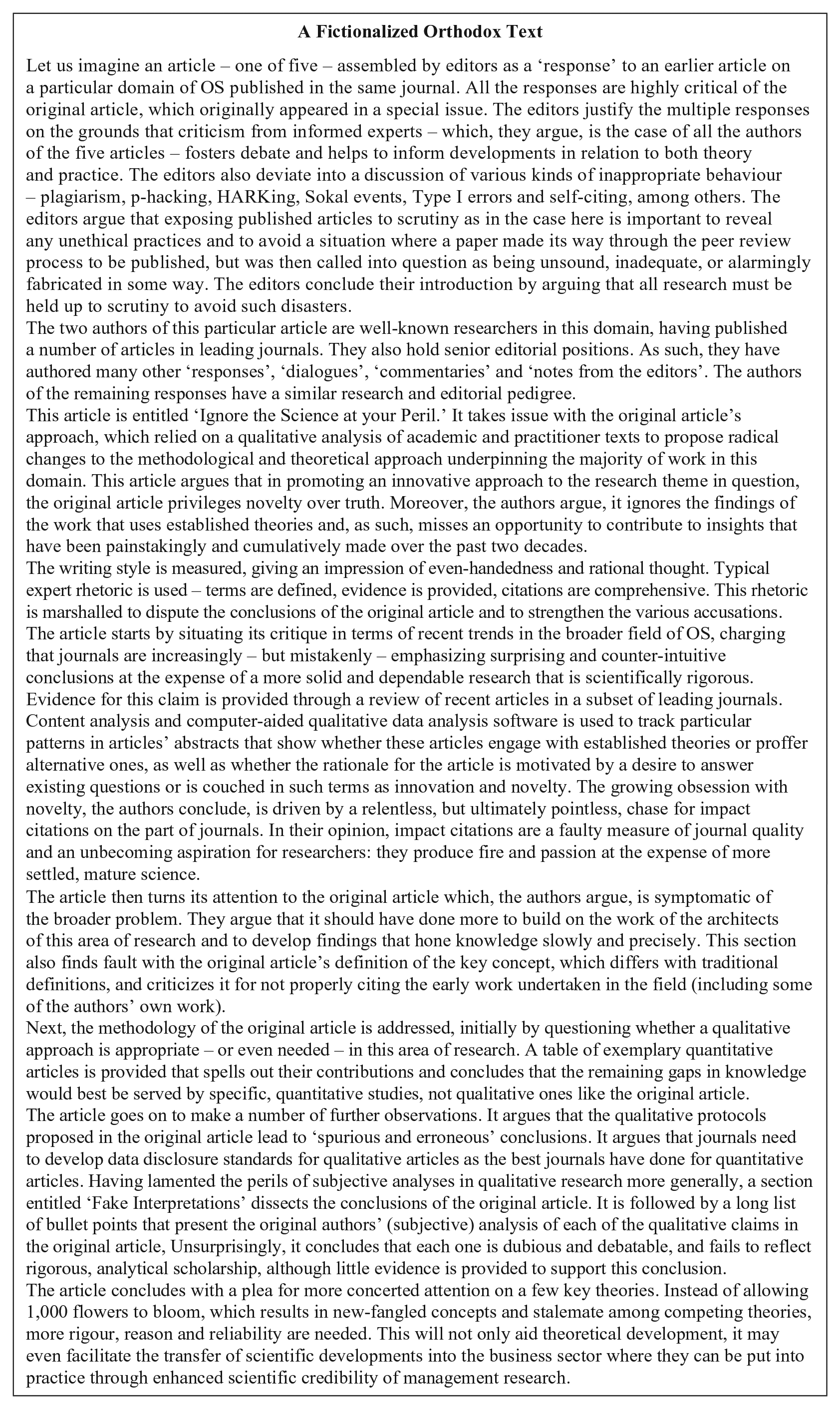
The writing in orthodox texts mainly uses dispassionate language – terms are defined, citations are comprehensive, and claims are backed up by evidence often in tabular and graphic form. Such scientific rhetoric helps to construct a scientific, disciplined, expert authorial Self; as does the editors’ introduction of the authors, reminding readers just how central, powerful – and connected – they are. Othering serves to silence a clear target – the authors of the original article who are in the crosshairs of all the articles in a response section curated by editors. The context is largely ignored – ‘better’ science is all that matters – even though extensive institutional and political resources have been marshalled in organizing this critique. Any relaxation in the commitment to science constitutes a crisis that can be addressed only by painstakingly and incrementally developing select theories through the progressive acquisition of knowledge. Accordingly, aspirations are for theories that can be tried and tested within the parameters of what the authors consider to be rational, objective social science.
A Darwinian understanding of ‘an implicit competition between theories in their ability to capture reality’ (Suddaby, 2014, p. 407) results in orthodox texts promoting the homogenization of a particular kind of science – usually the one espoused by the authors. What is wanted is not new theories, which would merely add to the competition, but for existing theories to work better, thereby increasing their chances of survival. Articles portray a view of knowledge that is progressively and incrementally – rather than theatrically – accumulated. Accordingly, texts do not promote diversity or debate, which would simply challenge existing privileged positions. Instead they search for coalescence around grand theories proffered by a ‘small band of scholars’ with no inclination ‘to incorporate pluralist appreciations’ (Marshall, 2000, p. 171). These articles assume that, as ‘theory progresses in its ability to proximate and predict reality, a single unified theory should emerge’ (Suddaby, 2014, p. 408). Orthodox texts are thus rooted in the modernist project whereby truth is generated by the world of pure logos and characterized by scientific, measured language seemingly devoid of emotion (Clegg, 2013). The dominance of rationality ensures – and obscures – the persistence of hierarchical power structures that serve these academics well as ‘keepers of the rational flame’. In presenting science as pure and untainted, the institutional and political infrastructure, astride of which the authors sit, is ignored. Yet these authors are also gatekeepers, and supposedly neutral protocols – like bringing a large number of highly critical ‘responses’ to bear on to a single article and selecting the authors of those responses – can be harnessed only by those in privileged positions.
Such measures arise because, despite the dominance and privilege of the orthodoxy, there is an unspoken horror lurking in the shadows – the excessiveness of texts which ‘disrupt or provoke’ (Pullen & Rhodes, 2015, p. 88), threatening to undermine the ‘rationality and order of the “masterful” texts’ (Vachhani, 2015, p. 148) and break open the boundaries of the academy. Passion and pathos in research serve to ‘cut into’ truisms and ‘open up that which cannot be controlled’ (Berlant, 2004, p. 447), thereby jeopardizing the use of scientific empiricism and rigorous theorizing in crafting incremental developments in knowledge. There is no room in orthodox texts for surprise, formlessness or unpredictability in new forms of knowledge (Berlant, 2004). Using rationality to regulate the terrain means it ‘separates out mind, body, and passion; [and] separates out truth and knowledge from politics and ethics’ (Hill Collins, 2013, cited in Vachhani, 2015, p. 159). Those who speak out against established ‘truths’ are deemed to be, at best, emotional and, at worst, unprofessional ‘failing the very standards of reason and impartiality that form the basis of “good” judgement’ (Ahmed 2004, p. 170).
Iconoclastic Texts
We refer to this ideal type as iconoclastic texts because they are oriented towards breaking with established theorizing – destroying mainstream institutions, established values and accepted practices (see Marsden & Townley, 1996, on ‘contra science’). We are mindful that contemporary iconoclasts are often considered ‘cool rebels’ but are also aware that the original iconoclasts established a church that some might describe as oppressive as the one they undermined (see Kolrud & Prusac, 2014).
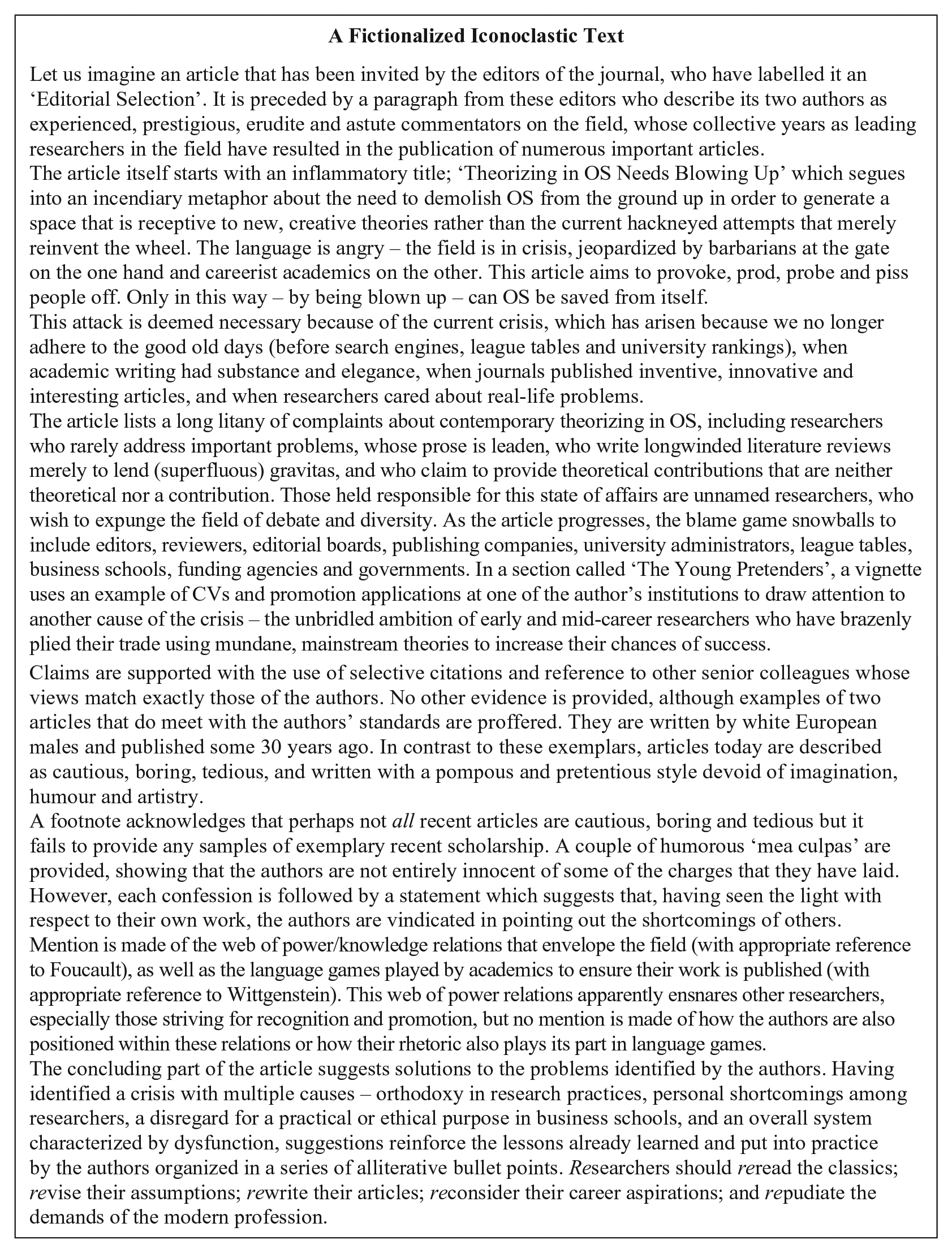
Iconoclastic texts are characterized by provocative, alarmist writing, expressing anger – sometimes paranoia – about the decline of the field. Nostalgia for the past is evident because the present is in crisis. Provocative claims are made, with the experience of the authorial Self, as well as reference to similar, like-minded Selves, often compensating for the absence of evidence. The voice that comes with a senior position in the field is reinforced by the power hierarchy, including the editors who invite and laud authors, absolving them of the need to substantiate their claims. Othering is implicit in this process – omnipotent authors, who have already made their careers, look down on other researchers in the field and find them wanting. Targets of disapproval range from homogenizing ‘North-American-style’ researchers to unadventurous, careerist colleagues. The power/knowledge relations in which the field is embedded are acknowledged (although not reflexively applied) and, to escape them, we must destroy the present and innovate, albeit by returning to the past.
Iconoclastic texts set up their own conditions for theorizing, often going for ‘the man [sic] not the ball’ by citing a lack of scholarship, a careerist mentality, or a capitulation to the conditions of the system. The result carries an exclusionary air born from not recognizing that the authors carry a specific heritage and lineage which, while it may well advocate for plurality, is not marked in any way by an ethos of hospitality or generosity. Drawing on the field’s (and their own) past glories creates a self-oriented standard of theorizing. This history is not everyone’s history (Page, 2017). The conditions of those occupying less privileged positions in the academy are ignored. Instead the commentary focuses on how others fall short of this benchmark, allowing for certain leaps of logic to be made. In the same way as nostalgia works through a fluctuation between fact and experience of a particular version of the past (Davis, 1979), iconoclastic texts cement together selective observations from the situated positioning of the authors. This position is one of privilege; different observations are made on the grounds of legitimacy derived from seniority, longevity, impact and other markers that are not recognized as forms of privilege in the sense of an ‘invisible package of unearned assets’ (McIntosh, 1988, p. 1). As Svejenova (2019, p. 59) notes, the criticism does not only apply to those singled out as specific targets, but ‘also the rest of us, an “ongoing crowd” of meek and submissive organizational scholars who have no better (i.e., our own) idea(s) and ideals than blindly following those of the mighty ones.’ Consequently, the rest of ‘us’ are judged as failing to live up to expectations – pursuing career aspirations at the expense of innovative theory, significant contributions or practical outputs that might be useful to managers.
The iconoclastic text thus builds from a negative engagement with the field, which leads to an approach to theorizing that is proprietorial: it provides no stepladder, ways in or up without a bloodying of the field, while dispensing opprobrium on those who fail to meet specific, situated standards. In seeking to replace one approach to theorizing with another in the authors’ own image, these texts rely on reproducing an Other – those who fall foul of the iconoclastic benchmark by not being radical, sensational or ambitious ‘enough’ according to a bounded set of terms and conditions. In this way, these texts have a doubling effect of producing an equally oppressive regime. The finitude to ‘thinking otherwise’ advocated here is always prefaced by ‘thinking against’, which in turn can hinder new knowledge development and inclusivity (see Eisenberg, 1987). There is, as a result, a theoretical momentum in iconoclastic texts of simultaneous displacement and replacement: the momentum to challenge dominant modes of theorizing serves to reproduce equally powerful voices and ideas, rather than engender a more transformative project.
Orthodox and iconoclastic texts feed off each other: the threat posed by iconoclasts is one reason why the orthodoxy needs to be continually fortified; and the rationality and homogeneity promoted by the orthodoxy are exactly what iconoclasts seek to usurp. However, the two sets of texts talk past each other. Rarely do we see conversations involving both parties: iconoclastic texts rail at the orthodoxy; while orthodox texts ignore many of the changes brought about by iconoclastic thinking. Yet, while apparently an anathema to each other, these two sets of texts are similar in many respects: both are able to be published because authors can leverage prevailing power relations to their advantage; both present omnipotent Selves who look down on others; and both – either deliberately or inadvertently – lay down strictures for future theorizing that involve a continuation of past practices.
Dissident Texts
We refer to the third ideal type as dissident: they engage in debate typically with the aim of acknowledging marginalization and bringing about change (see, for example, Dhaliwal, Nagarajan, & Varma, 2016, p. ii; Sparks, 1997). Dissident texts challenge the mainstream but, rather than trying to destroy it as with iconoclastic texts or reproduce it as with orthodox texts, they seek to move far beyond it.
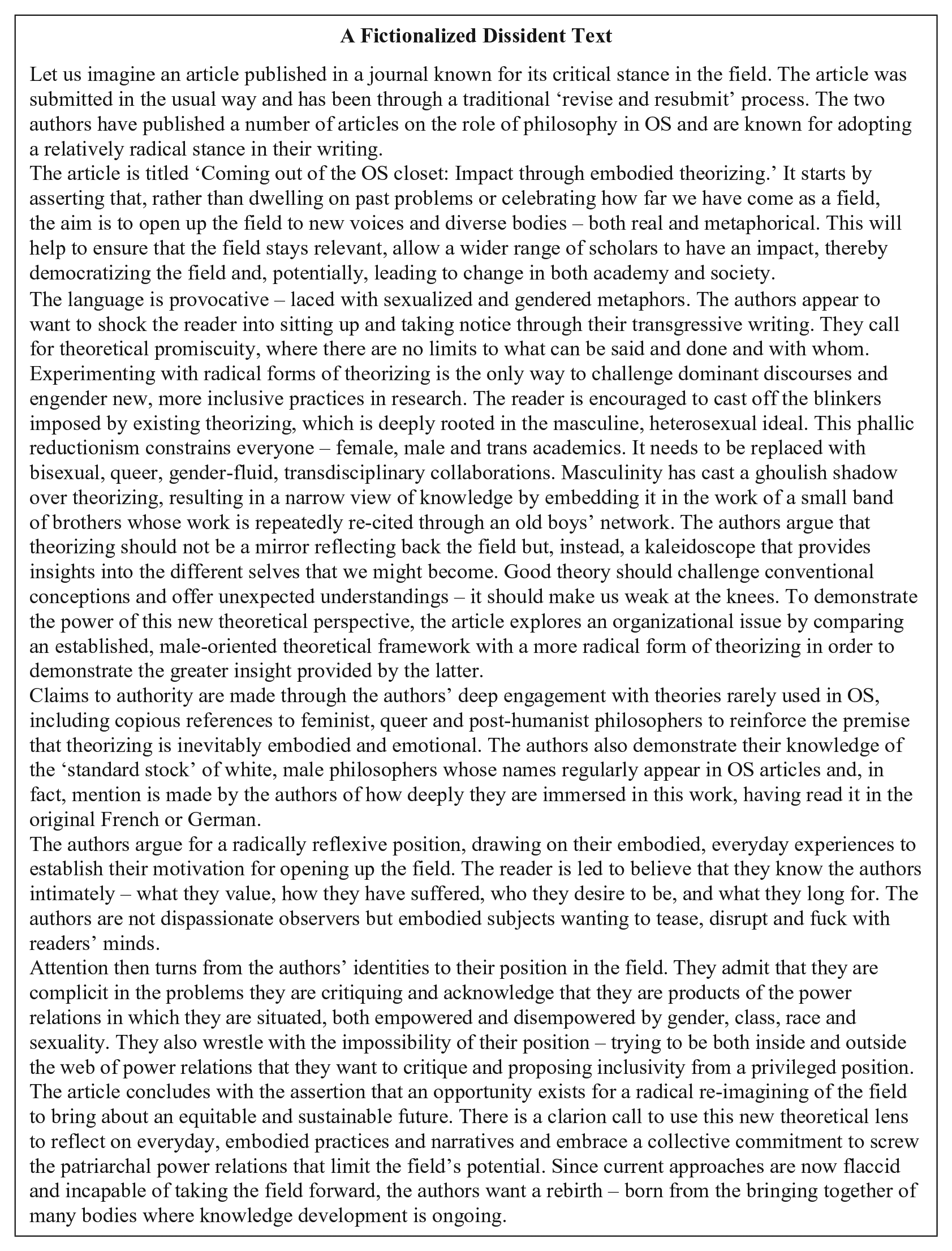
In dissident texts, the writing is provocative, subversive and antagonistic – located in what Berlant (2011, p. 441) calls ‘the sensualist turn’– with references to emotions, body parts and sex acts that do not appear in most academic articles. Selfing here involves emotional openness and honesty, and frequently referring to personal experience in drawing attention to the marginalized situation of the authors and of others whose voices and ways of theorizing cannot reach the pages of journals. Othering mainly emphasizes exposure insofar as it hails those other, marginalized identities that authors seek to include. However, othering can also silence – especially the gendered, racial and class-based voices that dominate the field. Dissident texts are sensitive to context – exploring the conditions that produce particular kinds of knowledge about particular kinds of identity, some of which are significantly privileged – such as male voices. Accordingly, rather than return to the past, dissident texts want to move far beyond it: aspiring to a multi-voiced, diverse future in which Selves and Others that have hitherto been ignored or excluded are relocated front and centre.
The influence of dissident texts has, however, been largely confined to the promotion and inclusion of similar Selves, such as elite, professional, ‘western’ female academics, where there has been a tendency to simplify and reify the categories by which the Other is known (Swan, 2017). Differences between Self and Other have been assumed and appropriated in ways that often advantage the Self, thereby precluding actors from engaging in mutual recognition (Ahmed, 2000) and understanding ‘how different temporalities might attach to particular bodies’ (Page, 2017, p. 23). For example, in relation to gender, Mohanty (1984, p. 339) points out, the sisterhood cannot be assumed simply on this basis: ‘it must be forged in concrete, historical and political practice’. In theorizing within OS, there has been a failure to attend to intersections of race, class and gender – when feminist analyses have been deployed, they are drawn primarily ‘from white women’s feminist theorizing’ (Holvino, 2010, p. 251). The result is that, despite striving for inclusivity, many other identities remain invisible, including people of colour, non-Western ethnicities and indigenous cultures and even early career researchers, the university precariat, and those working outside ‘ivy league’, ‘sandstone’ or research-intensive institutions; while the established, masculine, heterosexual identity has been recognized, although ridiculed and vilified.
Dissident texts are aware of the paradoxes involved in their project. Through their reflexive positioning, authors acknowledge that they cannot exist without dominant norms – be they patriarchal, white, or middle class – which dominate the very writing that seeks to challenge them. Consequently, when it comes to aspirations, dissident texts recognise they are caught in a double bind: it is difficult to articulate a way forward because so much of the argumentation relies on positioning – and privileging – authors as agents of good praxis (see Ahmed, 2000), while offering alternatives simply constructs a new form of hierarchy and domination. Even in pointing to a new, better future, dissident texts are in danger of ‘fixing’ both past and future by ‘having the problem solved ahead of time and feeling more evolved than one’s context’ (Freeman, 2010, p. xiii).
Dissident texts have had much to say about gender, but less about other marginalized identities. The provocation and titillation of eroticism works for gender and sexuality in ways that cannot easily be applied to other identities based on race, geography, language, stage of career or class. Writing ‘honestly’ and ‘openly’ about the Self usually involves writing about personal experiences, emotions and feelings in self-referential autoethnographies that may not be meaningful to other identities. Nor are dissident texts particularly accessible, drawing from erudite knowledge in philosophical treatises in ways that Grey and Sinclair (2006, p. 445) would surely describe as ‘tendentious, jargon-ridden, [and] laboured,’ and rarely translating into practical suggestions. Finally, the implications of successful dissidence create a dilemma even for those who espouse it. What would it mean to open OS theorizing up completely to sites of resistance and empowerment? To lay aside all existing ways of knowing, including the ‘go-to’ feminist and queer philosophers from whom dissidents derive much of their understanding? And to fully embrace not knowing? The loss of privilege, certainty and order could strike fear into the heart of even the most committed dissident.
In concluding this section, we suggest that the closer that articles come to one or other of these ideal types, the more they limit possibilities for new conversations. While individual discursive practices serve as useful rhetorical resources to stimulate conversation, when multiple strands of discursive practice pull each other tight, conversation is stifled. For example, orthodox texts that use technical writing to portray a scientific foundation for their claims, not only fail to contextualize the power/knowledge relations that lie behind it, they pull the discursive curtains tight in order to hide the political infrastructure that sustains their privilege and obscure its workings. Iconoclastic texts that construct a crisis and lay out a hostile future often forget that it is early career researchers, in particular, who are caught in this net – they are the ones who have to navigate it without the advantages of seniority. These texts then pull the net tighter by silencing these researchers – they are precluded from the past for which these articles yearn and criticized when they try to leverage power/knowledge relations in ways that might benefit their futures. Even dissident texts striving to expose and empower Others can be unstitched by the double strands of esoteric writing and narcissistic contextualizing. In other words, the ideal types are straitjackets for reflexive theorizing, not a means of encouraging conversations that will sustain and enhance it.
Weaving a Way Forward
So, what might a more conversational mode of reflexive theorizing look like? We propose a weaving metaphor 2 to show that discursive practices can be woven together in ways that generate conversations in which participants are neither domineering nor dominated, but are welcoming, inclusive and respectful of each other; where they listen, while recognizing there will be limits on what they are able to hear; and where they are both critical and appreciative of the past at the same time as being receptive to learning about open-ended, unknown futures (also see Hamann et al., 2020; Spiller, Wolfgramm, Henry, & Pouwhare, 2020). Our invocation of a craft metaphor is intended to acknowledge the complex and paradoxical nature of organizational theorizing, and speak to its ‘embodied, imaginative, ethical and political nature’ (Bell & Willmott, 2019, p. 2). It is not, then, a template or a list of particular practices but, rather, is intended to suggest ‘know-how’ that may help others weave new patterns in different ways. Accordingly, in the remainder of this section, we attempt to weave particular discursive practices together – not to produce an ideal type straitjacket with threads pulled tight in ways that stifle conversations – but to show how reflexive theorizing might be crafted in ways that encourage conversations.
Weaving is, of course, often seen as women’s work – and we would explicitly encourage more women to publish on different forms of reflexive theorizing in OS. However, men are also weavers and, thus, not excluded from this endeavour. Neither gender, nor age, nor disability 3 necessarily preclude weaving. Weaving also cuts across geography – weaving traditions are found and admired in many different countries and it is a craft where indigenous knowledge is highly valued; and we would certainly encourage more diversity in reflexive theorizing in OS. We are, however, also mindful that some people weave under oppressive, coercive conditions, which serves as a reminder that, while seeking to broaden the inclusion of some identities, there is always the danger of unintentionally exploiting, marginalizing and silencing others.
Weaving requires collaboration and transformation: some raw material such as silk, wool, cotton, metal, grass, bark, etc. has to be extracted and fashioned into different kinds of fabric, which is then incorporated – aesthetically and practically – into other objects. Similarly, reflexive theorizing is not a virtuoso performance, but best done ‘between people rather than by man [sic]’ (Canovan, 2018, p. xx) and by ‘engaging otherness and enacting connectedness’ (Hibbert, Sillince, Diefenbach, & Cunliffe, 2014, p. 279). It involves working with raw materials of previously produced knowledge – whether admired or not – and turning it into new forms of argumentation that may copy, complement or critique the original ideas. Whatever we write comes from somewhere and was written or spoken by somebody; and further relational work is needed for it to take a form that speaks to a given context. Finally, there are always holes in weaving: sometimes the weave is pulled tight and holes are hard to spot; sometimes the holes are part of the fabric and eventual design; and some come from constant (mis)use. There are holes, too, in reflexive theorizing – to which others (editors, reviewers, readers) may point in order to stitch them more tightly or fashion them more creatively.
We now reflect on the discursive practices that we wove together in this article in order to suggest what a new conversational form of reflexive theorizing might look like. As far as writing is concerned, we are suspicious of texts that hide behind science in order to ‘assume intellectual privilege in the discipline through the hegemonic structure of the selective reporting of “context” and “generalizability”’ (Jack et al., 2008, p. 874). We therefore advocate experimentation with less formulaic forms of writing that, instead of replicating certain techniques, lend themselves to more creative and embodied ways of writing (Sommerville, 1991) and liberate knowledge production ‘from its self-imposed conservatism’ (Rhodes, 2019, p. 24). At the same time, we recognize that there are times when more prosaic language may be appropriate. Transgressive writing is often accompanied by rhetorical gymnastics that serve to shine the spotlight primarily on the Self as author; there are times when Others need the limelight. We also counsel against the alarmist, aggressive and often hypermasculine writing that is becoming increasing prevalent: whatever it does, it does not generate conversations or facilitate inclusivity. Similarly, we suggest avoiding overly rarefied language – making ideas accessible, regardless of the degree of intellectual erudition that underpins them, is a first step in opening up conversations with Others, rather than merely with Self-like clones. Accordingly, we have tried to weave a writing style that is, we hope, playful, powerful and accessible. We acknowledge that our writing inscribes, and is inscribed by, ideals of scholarship and intellectualism limited by the contours of our own cultural contexts. Nonetheless, we have tried to craft a pattern in which a wider range of identities who ‘endure the effort it takes to strive to persevere’ stand out from the fray (Povinelli, 2011, p. 9).
We started by using mainly technical writing and familiar citing patterns to review the literature in a way that, together with a bulky table on p. 24, lends considerable weight to our claims to be authoritative, expert Selves. We then presented vignettes of ideal types to draw attention to particular features and their effects. Of course, our crafting of these particular fictions was not innocent. As Morgan (2006) reminds us, such exaggerations are fashioned to play the part required of them in promoting a particular approach at a particular time. So, we do not deny that we are ‘calling out’ power in a profound way by using particular discursive devices. Nonetheless, we hope to make conversations more inclusive, or at least more porous – less ‘holy’ by tightly stitching up omnipotent Selves and more ‘holey’ in allowing other identities and ways of knowing to be seen through the weave.
We also attempted to critically interrogate our Selves as authors (see Cunlifffe, 2009; Skeggs, 2002) by taking contextualizing and temporalizing seriously. Contextualizing involves not only recognizing that the academic environment – the drive towards rankings, citations and ‘big hits’– produces particular kinds of knowledge. It also means situating the Self realistically and honestly in that context. For example, as ‘senior’, tenured academics working for elite institutions (as most authors of articles on reflexive theorizing are), we have largely escaped the strictures of recent changes in the academic context. It did not exist when we started out and, by virtue of our current positions, we can navigate its constraints far more easily than early career researchers, those with different career trajectories or working in different kinds of institutions. In fact, this context creates an economy of valuation which, while it may mitigate against certain types of research, nonetheless increases the value of elite academics (including ourselves). Our privileged position increases the chances of publishing, even in the face of constraint; and, of course, the resulting publications are now worth more. So, instead of criticizing the Other for ‘selling out’, some Selves might admit they have been ‘bought out’.
Temporalizing should avoid reifying the past, regardless of whether the intention is to reject or resurrect it; better to frame versions of the past as open, incomplete and discordant (see Page, 2017). If authors are suspicious of both nostalgia for the past and the desire to do away with it, they are more likely to notice variations in the written, theoretical past that can provide resources – and constraints – for future theorizing. Accordingly, we reviewed past articles not simply to repudiate them, but to identify a reservoir of ideas that will sustain a way forward into the future – weaving together previous, known approaches with new forms of reflexive theorizing. Keeping the past open also allows us to contemplate what has been forgotten and consider how knowledge might have otherwise formed. It reminds us that not all identities have the luxury of the pasts (or presents) of many of the authors who engage in reflexive theorizing, but this should not preclude these other identities from participating in conversations. In fact, they may well have more to say and contribute because of their particular, situated contexts.
Attending to reflexivity through contextualizing and temporalizing should also lead to more exposure of various Others. Rather than being fixed in place by pre-existing meanings as an audience for our theorizing, the Other may become the very basis of theorizing. If we are alert to the complexities and layered meanings of different contexts, identities and power relations (see Page, 2017) and resist the impulse to demonize or ‘stranger’ the Other (Ahmed, 2000; Swan, 2017), the nature of reflexive theorizing has the opportunity to transform. Rather than an opportunity to show (off) what authors know, it becomes a chance to engage with the limits of our knowledge. Moving beyond dialogical processes of rhetoric, persuasion and critique to question one’s own voice, conversations start from a position of authorial vulnerability that accepts one’s own not knowing and embraces indeterminate conditions of possibility. Conversations are incomplete and open-ended, allowing for the elevation of creativity and imagination to the same level of status as logic and analysis or experience and dissidence. In this way, dominant forms of theorizing, which serve mainly privileged members of the field, are less likely to be reproduced (see Moreton-Robinson, 2003).
Conversations are also, of course, about listening, which ‘starts with the assumption that one cannot see things from the other person’s perspective and waits to learn by listening to the other person’ (Young, 1997, p. 49). Listening develops our capacity to theorize more collaborative forms of communication, to enlarge our thoughts, and open up space to allow new meaning to emerge (see Mason, 1993; Hamann et al., 2020). As Ahmed (2000, p. 156) writes, ‘to hear, or to give the other a hearing, is to be moved by the other, such that one ceases to inhabit the same place’. Conversations are thus marked by reciprocity as individualistic renditions of knowledge construction are rejected and the role of the Other in knowledge construction is embraced (Hamann et al., 2020; Love, 2020). Listening does not, however, equate with understanding, nor does reciprocity add up to symmetry. On the contrary, when ‘privileged people put themselves in the position of those who are less privileged, the assumptions derived from their privilege often allow them unknowingly to misrepresent the other’s situation’ (Young, 1997, p. 48). Power asymmetries and inequalities are not to be ignored or even recanted; nor should difference and particularity of the other position be obscured (Westwood & Jack, 2007).
There is, then, a fine art in weaving together selfing and othering: interrogating the Self can easily fall into narcissism, where the Other is forgotten. A generosity of spirit in talking about the Other can descend into claims to speak for – or over – them. Striving to grow and change alongside new theories (see Hibbert et al., 2014) can be an excuse for appropriating Others’ knowledge and culture. The more one thinks one ‘understands’ the Other, the less the opportunity for dialogue and the more for misunderstanding (see Anderson & Goolishian, 1992; Young, 1997). Moreover, this relationship between Self and Other is ‘always in a state of flow, and is consistent with the notion of a respectful, collaborative, evolving narrative’ (Mason, 2015, p. 36).
Finally, we advocate careful consideration of the aspirations of reflexive theorizing. What is the point of the paper? What do authors really want to achieve? Who is the conversation for, and to what end? It is important to remember that, because it is seen as legitimate, important and scholarly, theorizing helps to position authors in the academy. It extracts value from earlier writings in ways that disproportionately benefit the Self. If theorizing sets parameters on the basis of derision and a self-referential new norm, it creates precarious positions for Others, whether intentionally or otherwise (Drichel, 2007).
Conclusions
Our aspirations in writing this article were influenced by our despondency on reading some recent articles. We were disheartened by the catastrophizing in recent articles that paint such a bleak picture of our field and vilify so many members of it. Where authors use ‘we’, but really mean ‘you’, i.e. those of ‘us’ who have neglected important issues in order to publish in leading journals, who resort to tortuous, pompous and verbose prose to create the illusion of theory development, or who make miniscule and meaningless increments to what is already known. We were discouraged by the way in which so many Others are excluded and criticized by those who seem unwilling to recognize their precarious positions. We were dejected by the masculinist and increasingly violent tenor in recent texts and at academic conferences, which remind us of Trump’s tweets or Question Time in the UK Parliament – people talking past each other and, in doing so, excluding countless others from the conversation. And, finally, we were downcast by witnessing omnipotent Selves and their outlandish claims, whose versions of ‘post truth’ and ‘selective amnesia’ culminate in a competition to deny that anything interesting or insightful has ever been published in recent times on anything of any significance.
Our aspiration is, then, to call such articles to account. We want reflexive theorizing to be more than a rhetorical soapbox for intellectual posturing – perpetuating dominance and difference and drifting into a cacophony of self-referential voices. Accordingly, we would like to see reflexive theorizing interweave different discursive practices in ways that open conversations up to a wider range of voices, where respect and generosity are evident and where forms of knowledge emerge in dialogue. It means resisting the urge to stitch straitjackets and, instead, weaving different textures, colours and patterns that are challenging, and sometimes disruptive, but always carry a productive moment of possibility. Calling for more, less, new or interesting theorizing is, in our view, not simply a demand for conversation, but also an ethic of conversation.
Footnotes
Appendix: Discursive Practices Used in Reflexive Theorizing
In Table A below, we summarize the discursive practices discussed in the paper, as well as different categories associated with each practice. The table also provides illustrations of the practices and cites some of the articles using them. To identify these discursive practices, we explored a wide range of journal articles (including rebuttals and responses) published in the last ten years that critically reflect on the field, including the type of knowledge that they produce, the way in which they produce it, and the effect that this knowledge has. Articles include commentaries on the state of OS research and nature of OS theorizing; views from individual journals and particular sub-disciplines (e.g. institutional theory, human resource management, international business); more specialist articles on the treatment of gender and diversity in the field; and papers on the impact of academic knowledge on business or emancipatory practice. We started by searching nine leading journals that publish such articles: Academy of Management Journal, Academy of Management Learning & Education, Academy of Management Review, Administrative Science Quarterly, British Journal of Management, Human Relations, Organization, Organization Science, and Organization Studies. As we identified articles in these journals, we also followed up on promising references that we found in their bibliographies, which led us to other relevant articles published in a range of other journals related to OS, such as Journal of Management Inquiry, Gender Work & Organization, International Human Relations Journal, among others. Our analysis was interpretive and involved two of the authors reading each article and agreeing on the key discursive practices. In most cases, the practices were self-evident, and we did not use systematic coding. Accordingly, our conclusions are indicative and illustrative, rather than exhaustive, since they derive from a partial analysis of an extensive, but inevitably incomplete, ‘pool’ of articles. We are also aware that by concentrating on journal articles, which are typically bounded by their own discursive – and elitist – repertoires, we may have ignored avenues for more heterodox, inclusive approaches.
Author Note
Readers are referred to Table A on p. 24 for more details of the analysis of the discursive practices.
Funding
The author(s) received no financial support for the research, authorship, and/or publication of this article.
