




Abstract
For entrepreneurs, establishing and maintaining new venture legitimacy is a complex endeavor. Various factors complicate this process, including issues of optimal distinctiveness, audience diversity, market category evolution, and multiple legitimacy thresholds. Moreover, the establishment and maintenance of new venture legitimacy is an intricate process that unfolds over time. In this essay, I review and integrate prior work on new venture legitimacy not only to highlight these complications, but also to consolidate insights, theoretical nuances, and empirical observations to describe what happens when entrepreneurs confront multiple complications at the same time. In so doing, I propose that configurational approaches provide a valuable theoretical perspective to enhance knowledge related to new venture legitimacy. I also highlight exemplar studies that have adopted these perspectives, accounting for multiple new venture legitimacy complications in a single analysis. This provides a basis to understand recent advances in the new venture legitimacy literature, and inspires and opens up new research opportunities for further exploration.
Keywords
New entrepreneurial ventures confront a “liability of newness”; their risk of failure is much higher than for established organizations (Stinchcombe, 1965, p. 148). This uncertainty and lack of operating history make it difficult for them to access needed resources to exploit opportunities (Zimmerman & Zeitz, 2002). To overcome this liability, entrepreneurs strive to establish organizational legitimacy: a “generalized perception or assumption that the actions of an entity are desirable, proper, or appropriate within some socially constructed system of norms, values, beliefs, and definitions” (Suchman, 1995, p. 574). Although organizational legitimacy attainment and management is relevant for all organizations (Suchman, 1995), it is in the early phases of venture development—when a venture is still young, resource constrained, and extremely uncertain (McMullen & Shepherd, 2006)—that legitimacy hurdles and challenges are greatest (Fisher, Kotha, & Lahiri, 2016). 1
Prior research has emphasized the importance of attaining and managing legitimacy in order for new ventures to access the resources necessary for their survival and growth (Lounsbury & Glynn, 2001; Überbacher, 2014; Zimmerman & Zeitz, 2002). At this early stage, a new venture is largely controlled by a founder or founding team who serve as legitimacy acquiring agents seeking resources from different legitimacy granting audiences (mostly resource providers), whether the venture may be entering an emerging or established market context (Navis & Glynn, 2010, 2011). The actions of the entrepreneur and the nature of the context are both important for establishing new venture legitimacy; hence efforts to establish new venture legitimacy constitute an extended, ongoing performative act carried out by entrepreneurs in relation to an audience, with important strategic implications for the ventures they are establishing (Garud & Gehman, 2016; Garud, Gehman, & Giuliani, 2014a).
For entrepreneurs, establishing and maintaining new venture legitimacy is complex; research has highlighted various specific contingencies that complicate this process. There is tension between fitting in with market norms, values, beliefs, and definitions, and standing out from others in the market to gain a differentiation advantage (Gehman & Grimes, 2017; Navis & Glynn, 2010, 2011; Zhao, Fisher, Lounsbury, & Miller, 2017). There is a need to establish legitimacy with different groups of stakeholders (Fisher, Kuratko, Bloodgood, & Hornsby, 2017) and to account for different market contexts in which a venture operates (Navis & Glynn, 2011; Tracey, Dalpiaz, & Phillips, 2018; Soublière & Gehman, 2019; Younger & Fisher, 2020). And all this takes place in a processual way over time; legitimacy is not something that is established quickly or simply (Suddaby, Bitektine, & Haack, 2017; Tracey et al., 2018).
Yet, prior research on new venture legitimacy has mostly adopted a contingency perspective, in which researchers attempt to abstract a limited set of structural or organizational concepts and relate them to a limited set of abstracted situational concepts to account for an outcome (Meyer, Tsui, & Hinings, 1993; Miller & Friesen, 1984). In essence, scholars have mainly considered how entrepreneurs grapple with and address one or maybe two legitimacy complications or contingencies at a time; therefore, new venture legitimacy research is mostly unidi-mensional, variance-based, and reductionist. However, as entrepreneurs develop a new venture, most will grapple with multiple complicating factors that interact in complex ways.
Hence, to enrich our understanding of venture legitimacy, it is appropriate to shift from a contingency to a configuration perspective (Fiss, 2007; Meyer et al., 1993; Miller, 2018). In contrast to a contingency perspective, configurational inquiry represents a holistic stance, an assertion that the parts of a social entity take their meaning from the whole and cannot be understood in isolation . . . configurational theorists try to explain how order emerges from those parts as a whole. (Meyer et al., 1993, p. 1178)
Configurations may be internal to an organization, or they may account for how internal aspects of an organization relate to external aspects in the organization’s environment (Hill & Birkinshaw, 2008; Toh, Morgeson, & Campion, 2008). When it comes to new venture legitimacy, configurations that connect internal aspects of a venture with external aspects of that venture’s environment are particularly important, because new venture legitimacy is highly contextual (Fisher et al., 2017; Navis & Glynn, 2011). Under a configurational perspective, nonlinear and reciprocal relationships are acknowledged and factors that are causally related in one configuration may be unrelated or even inversely related in another. A configurational perspective provides the opportunity to acknowledge and embrace organizational and contextual complexities that are central to organizations generally (Misangyi et al., 2017), and new venture legitimacy specifically. In so doing, we can more fully account for the dynamic context and uncertainty challenges that entrepreneurs face as they seek to establish legitimacy for a new venture.
In sum, my overarching thesis is that we need to move from a contingency to a configurational understanding of new venture legitimacy; in so doing, we can shift from a unidimensional, variance-based, reductionist assessment to a multidimensional, processual, inter-temporal assessment of new venture legitimacy. To facilitate this move, in this article I carefully review and integrate prior work on new venture legitimacy with a focus on the complications associated with legitimacy attainment and management. I consolidate insights, theoretical nuances, and empirical observations to theorize what happens when entrepreneurs confront multiple complications of new venture legitimacy; from this I generate new research questions, theoretical conjectures, and relevant directions for new venture legitimacy research.
Specific Complications Related to New Venture Legitimacy
Here, I describe each of the four main complications associated with new venture legitimacy attainment and management addressed in past research literature. Each complication is theoretically interesting and practically relevant in its own right, and each is the focus of a substantive research stream, as reflected in Table 1. But because each complication is usually the primary focus of a research project, there are only a few instances where many of these complications are integrated with one another (see Tracey et al., 2018 and Soublière and Gehman, 2019 for examples of the integration of multiple legitimacy complications). Entrepreneurs developing new ventures usually confront multiple complications at one time; a more configurational understanding of organizations allows examination of combinations of complications and responses to truly advance understanding (Meyer et al., 1993; Tsoukas, 2017). Here, I briefly review the past research underpinning each complication before advancing the new venture legitimacy perspective by integrating these complications in a more configurational way.
Key concepts from past research underpinning the various complications of new venture legitimacy.
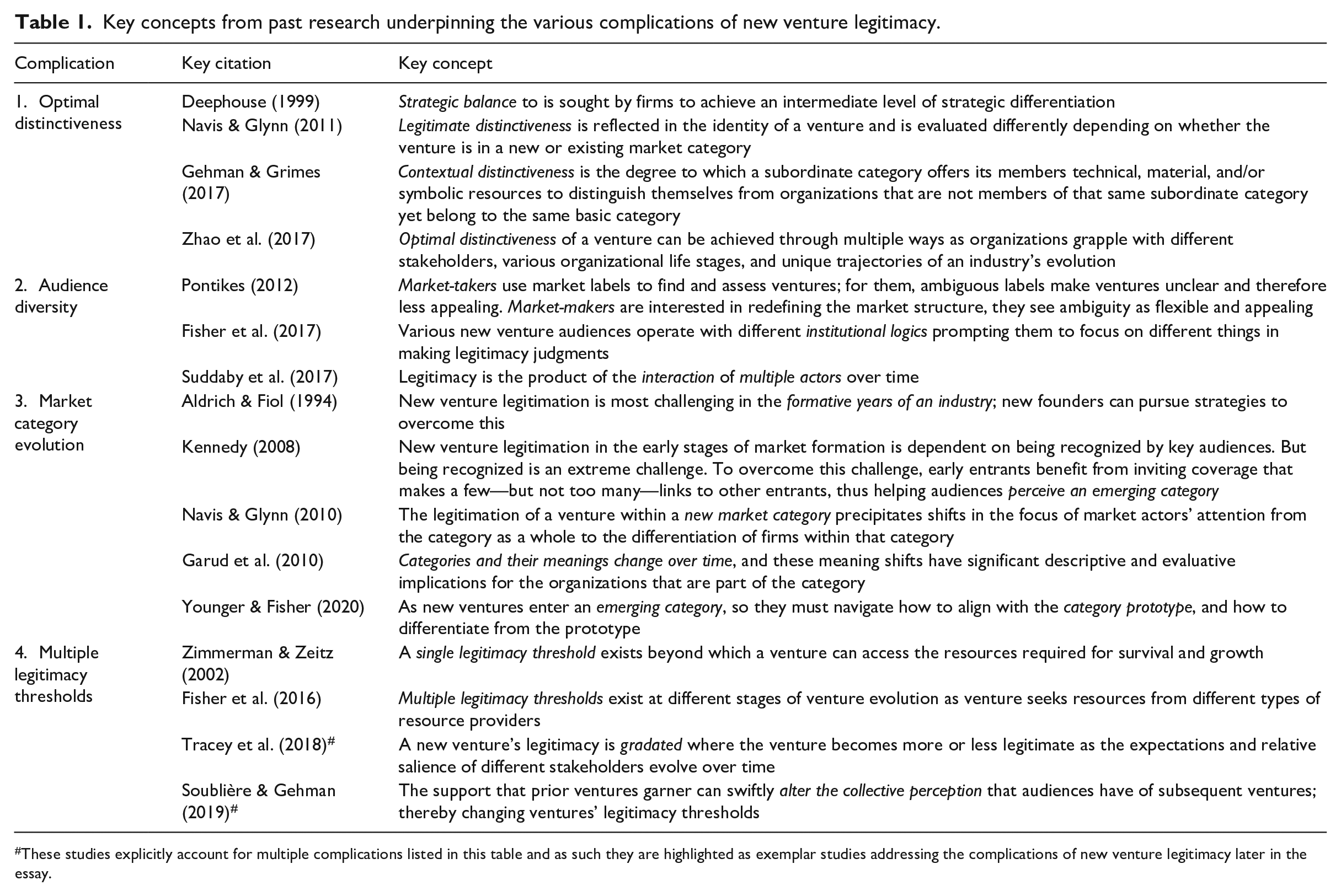
These studies explicitly account for multiple complications listed in this table and as such they are highlighted as exemplar studies addressing the complications of new venture legitimacy later in the essay.
Complication #1: Optimal distinctiveness
For a new venture to be perceived as legitimate—desirable, proper, or appropriate within an established system of norms, values, beliefs, and definitions (Suchman, 1995)—key aspects of the venture need to appear similar to existing ventures, causing pressure to be familiar and fit in. Yet new ventures also need to position themselves as different and novel to be competitive (Navis & Glynn, 2011; Younger & Fisher, 2020). Differentiation is a key source of advantage (Porter, 1996) and novelty is a central aspect of entrepreneurship (Zott & Amit, 2007); with no element of differentiation or novelty, it is difficult for new ventures to compete with established incumbents. Accounting for both pressures, firms strive to be “as different as legitimately possible” (Deephouse, 1999, p. 147). They may do this by seeking an intermediate level of strategic differentiation. In so doing, it is theorized that entrepreneurs manipulate a venture’s identity to appear “legitimately distinctive” (Navis & Glynn, 2011): they espouse legitimating claims that align their venture with conventional expectations, as well as distinctiveness claims that meaningfully distance it from such institutionalized conventions. “A legitimately distinctive entrepreneurial identity is paradoxical because it embeds both conformity and deviance, containing identity elements that are contradictory or oppositional” (Navis & Glynn, 2011, p. 480).
This paradox has prompted researchers to theorize that there is a level of optimal distinctiveness for new ventures—a level of familiarity coupled with distinctiveness at which a firm generates “positive stakeholder perceptions” about its strategic position (Zhao et al., 2017, p. 93). Here, a venture reconciles competing demands for differentiation and conformity. The concept of optimal distinctiveness for firms in general, and new ventures in particular, builds on individual-level social psychology research suggesting that people strive to forge unique identities amid strong normative pressures to conform (Brewer, 1991). When organizations do this effectively, they are evaluated more favorably (Navis & Glynn, 2011; Zuckerman, 1999, 2016). However, Zhao and colleagues (2017, p. 107) clearly highlight that there is more dynamism and complexity in the assessment of organizational optimal distinctiveness assessments than has previously been conceptualized. They suggest that, especially in complex and dynamic markets, stakeholders have different preferences and expectations, and that notions of legitimacy vary across time and space. For this reason, Zhao and colleagues (2017) argue that the strategic positioning of a firm to achieve optimal distinctiveness should move beyond evaluating a stable set of competitors on a single dimension (Deephouse, 1999), and should account for a multitude of factors including different stakeholders (Fisher et al., 2017), various organizational life stages (Fisher et al., 2016), and unique trajectories of an industry’s evolution (Navis & Glynn, 2010). Furthermore, Gehman and Grimes (2017) highlight how category membership in various basic and subordinate categories can prompt organizations to pursue different optimal distinctiveness strategies which are counter to what one might expect. This results in what they refer to as contextual distinctiveness: the “degree to which a particular subordinate category offers its members technical, material, and/or symbolic resources to distinguish themselves from organizations that are not members of the subordinate category yet belong to the same basic category” (Gehman & Grimes, 2017, p. 2295).
Taken together, these insights highlight a need and opportunity to conceptualize organizations as complex, multidimensional entities, and assess different organizational attributes in relation to contextual requirements in order to evaluate optimal distinctiveness (Gehman & Grimes, 2017; Navis & Glynn, 2011; Zhao et al., 2017). Hence, it is evident that optimal distinctiveness challenges for new ventures are dynamic, complex, and nuanced, and that trying to limit optimal distinctiveness measures and assessments to a set of abstracted situational and organizational concepts may seriously oversimplify the issue (Meyer et al., 1993; Miller, 2018; Tsoukas, 2017).
Complication #2: Audience diversity
There is recognition and consensus in the past literature that new ventures need to appeal to different groups of stakeholders when establishing their legitimacy (Fisher et al., 2016, 2017; Pontikes, 2012). Entrepreneurial ventures derive resources from a diverse range of stakeholders (Hanlon & Saunders, 2007). These different stakeholder groups generally have differing norms, beliefs, rules, and procedures for assessing a venture. Since legitimacy assessments are social judgments formed by personal opinions (Ashforth & Gibbs, 1990; Bitektine, 2011; Webb, Tihanyi, Ireland, & Sirmon, 2009), they are heavily audience dependent (Suchman, 1995). This has resulted in calls for research exploring how assessments of new ventures “differ across different audience contexts” (Navis & Glynn, 2011, p. 494; see also Überbacher, 2014).
In this vein, Pontikes (2012) focused on venture stakeholders’ relatedness to the market as a mechanism to categorize different audiences. She distinguished between those that assume the role “of ‘market-takers,’ who consume or evaluate goods, and ‘market-makers,’ who construct markets by developing new niches and enforcing boundaries.” Market-takers, such as general consumers, look for organizational attributes that help them fit a venture into their established categorization structure; as a result, “market-takers may devalue organizations that claim multiple market labels or those that are in ambiguous labels” (Pontikes, 2012, p. 57). In contrast, market-makers (e.g., venture capitalists) are interested in redefining the market structure and, as a result, “this type of audience sees the same ambiguity (in organizational attributes) as flexible and therefore more appealing” (Pontikes, 2012, p. 57). This implies that entrepreneurs may benefit by framing what they do differently for different types of audiences as they attempt to establish new venture legitimacy.
The institutional logics of different new venture audiences are also theorized in prior literature to serve as a mechanism to understand and interpret how they make differing assessments of new venture legitimacy (Fisher et al., 2017). Institutional logics are “socially constructed, historical patterns of material practices, assumptions, values, beliefs, and rules by which individuals produce and reproduce their material subsistence, organize time and space, and provide meaning to their social reality” (Thornton & Ocasio, 1999, p. 804). Institutional logics vary across groups of people who operate with different practices, assumptions, values, and beliefs because of their different environmental contexts. By providing the governing principles that define appropriate behavior for different groups, institutional logics shape judgments about the validity and appropriateness of different practices (Thornton,Ocasio, & Lounsbury, 2012). Hence, to understand how and why different audience groups perceive new ventures as legitimate, the institutional logics that govern new venture audiences—or the values and practices that underlie those logics (Gehman, Trevino, & Garud, 2013)—are examined to account for the social and institutional context of their legitimacy judgments. Fisher and colleagues (2017) suggest that crowd-funders operate predominately with community logics, government agencies with state logics, angel investors with market logics, venture capitalists with professional logics, and corporate venture capitalists with corporate logics. This prompts each type of resource provider to exercise different values and practices and hence judge the legitimacy of a venture slightly differently. For this reason, entrepreneurs need to frame their venture differently to attain legitimacy from these different groups (Fisher et al., 2017); this involves adjusting “language or other symbolic gestures in context either to reinforce existing interpretative frames or to call new frames into being” (Cornelissen & Werner, 2014, p. 197).
All in all, it is evident that in future new venture legitimacy research, audiences should not be “theoretically and empirically collapsed into the aggregate concept ‘organizational environment’ (Singh et al., 1986)”; studies of new venture legitimacy should “systematically distinguish the legitimacy judgments of the different audience types that a new venture faces (Zott & Huy, 2007)” (Überbacher, 2014, p. 674).
Complication #3: Market category evolution
Variation in the development and establishment of the market category context is one of the most theorized and studied complications in the new venture legitimacy literature. This line of inquiry was sparked by Aldrich and Fiol (1994) when they noted that founding a venture is especially risky when entrepreneurs have few precedents for what they want to do. Early ventures in the formative years of a new industry face a different set of challenges from those that enter an existing industry: “their relative lack of legitimacy is especially critical, as both entrepreneurs and crucial stakeholders may not fully understand the nature of the new ventures, and their conformity to established institutional rules may still be in question” (Aldrich & Fiol, 1994, p. 645). New markets, which are “business environments in an early stage of formation” (Santos & Eisenhardt, 2009, p. 644), open up new opportunity spaces for entrepreneurs. Yet they are fraught with uncertainty, because technologies, products, or processes are “untested and incompletely understood” (Tushman & Anderson, 1986, p. 444), product definitions are ambiguous (Hargadon & Douglas, 2001), and the ventures operating in these spaces are often incompletely formed, deficient in resources, and lacking coherent identities (Navis & Glynn, 2010; Wry, Lounsbury, & Glynn, 2011). Consequently, the achievement of legitimacy, which can enable such ventures to acquire resources and create wealth, can be a particularly acute challenge (Navis & Glynn, 2010). Getting recognized when operating in a new market space is particularly challenging (Kennedy, 2008). Entrepreneurs in such a context may garner legitimacy from making explicit links with other new entrants, so as to be counted (Kennedy, 2008), and from working with other new entrants to forge a collective identity (Navis & Glynn, 2010; Wry et al., 2011).
Although market categories emerge as “unstable, incomplete and disjoined conceptual systems held by market actors . . . [they] become coherent as a result of consumers and producers making sense of each other’s behaviors” (Rosa, Porac, Runser-Spanjol, & Saxon, 1999, p. 64). Participants in that emergent category engage in sensegiving to make the new category both understandable and appealing to external audiences—especially resource providers and customers (Kennedy, Lo, & Lounsbury, 2010). In turn, audiences engage in sensemaking, using the category as a reference point to sort, order, and assess firms in the market (Glynn & Abzug, 2002; Hsu & Hannan, 2005; Younger & Fisher, 2020; Zuckerman, 1999). Sensegiving and sensemaking are efforts intended to make the new market category more comprehensible (Suchman, 1995) by clarifying its meaning, structure, and identity, and by making it more attractive and real (Kennedy, 2008; Kennedy et al., 2010). Legitimation is an outgrowth of such participant claims and audience assessments.
Within the context of evolving market categories, two interrelated levels of legitimation are important: the legitimation of the market at the category level and of the venture at the organizational level. These two aspects of legitimation may at times be so interrelated that they become almost analytically indistinguishable due to recursive effects between actions at each level (Soublière & Gehman, 2019). At the market category level, legitimation is shaped by the interplay between actors internal to the category (e.g., entrepreneurial ventures that engage in strategic and symbolic actions) and actors external to the category (e.g., interested audiences who judge its feasibility, credibility, and appropriateness). In their study of early phases of the satellite radio category, Navis and Glynn (2010, p. 442) found that new category legitimation functions as a pivot point that shifts entrepreneurial action and audiences’ valuations from a pre-legitimation emphasis on the category as a whole, as a set of undifferentiated organizational members, to a post-legitimation emphasis on the differentiated individual organizations as unique members of the category.
Central to this process were the linguistic frames and identities employed by entrepreneurs as well as audience responses to those linguistic frames and identities. Wry et al. (2011) extended this theorizing to account for legitimation as a distributed storytelling process around “growth stories,” but noted that certain actors may coordinate their “growth stories” to expand the market in which they all co-evolve. Others may tell competing stories due to diverging interests and varying interpretations of the evolving market.
For entrepreneurs leading new ventures, being cognizant of and responsive to the level of market category development may be critical to their new venture legitimation efforts (Navis & Glynn, 2011; Younger & Fisher, 2020). Broader market forces and collective efforts at legitimation may be outside the control of individual entrepreneurs (Wry et al., 2011; Gehman & Soublière, 2017). However, as entrepreneurs attempt to be responsive to their market context, their legitimation claims within established market categories are typically situated within the category, drawing from or invoking category norms and practices. Ventures may also attempt to individuate from other category members by deviating from the established categorical prototype (Navis & Glynn, 2011). For brand-new market categories, entrepreneurial ventures often attempt to be definitional of the category. In these efforts, entrepreneurial legitimation emphasizes differences from already established market categories, while also aligning with institutionalized understanding of the entrepreneurial role, activities, and orientation (Navis & Glynn, 2011).
Between the two extremes—a brand-new market category and an established market category—many entrepreneurs confront the challenge of establishing legitimacy in what Younger and Fisher (2020) refer to as an emerging market category: evolving spaces where developing organizational forms are perceived to be similar to one another, yet the category is not fully formed and is still growing. In this context, certain pioneering organizations usually come to represent what it looks like to be a category member (Navis & Glynn, 2011; Santos & Eisenhardt, 2009) and as such become prototypes for the emerging category (Mervis & Rosch, 1981; Navis & Glynn, 2010). As new ventures enter such a category, they must navigate how to align with the category prototype, as well as how to differentiate from the prototype. Younger and Fisher (2020) found that entrepreneurs manage their legitimacy in an emerging market category by considering three primary factors: emulation, experimentation, and divergence. Emulation involves mimick-ing the actions, decisions, and image of the category exemplar to capture legitimacy. Experimentation focuses on organizational consideration of “who we are” beyond the category exemplar and whether and how to potentially shift or change. Divergence is forward-oriented and is focused on who the organization wants to be and how it will definitively claim and establish its image accordingly (Younger & Fisher, 2020).
Overall, there is consensus that market category evolution has some impact on new venture legitimation, yet the extent to which an entrepreneur or a venture has agency over and control within such evolution is still being debated. The true nature of that evolution may be more complex than previously conceptualized; it is questionable whether a market category is ever really settled (see Soublière & Gehman, 2019). Yet the broader impact of market category evolution is thought to work as follows: in the early phases of category development, entrepreneurial ventures may work together to legitimate the new market space through a distributed effort. Ventures that enter the category later must grapple with emulating yet diverging from the category prototype—a venture that exemplifies the category. As the category matures, individuation is thought to supersede emulation, while legitimacy becomes more assumed unless specifically threatened (Elsbach, 1994).
Complication #4: Multiple legitimacy thresholds
Zimmerman and Zeitz (2002) proposed that there exists a “legitimacy threshold” for new ventures. This marks a critical threshold that, if cleared, substantially increases a venture’s access to resources and thus its chances of survival. At levels below this threshold, ventures face an existential threat arising from lack of legitimacy, as they are unable to access the resources they need to survive. The notion of legitimacy as a threshold suggests that attaining legitimacy is a single, fixed point that is particularly important in a venture’s early stage of development.
Fisher and colleagues (2016) built on and extended this perspective by developing a more nuanced understanding of legitimacy thresholds, suggesting that new ventures face multiple legitimacy thresholds because they need to appeal to different audiences for resources at different development stages. These audiences have varying and generally more stringent criteria for evaluating ventures as they develop. Underpinning this is the recognition that different audiences have their own particular expectations for what ventures should look like (Ridgeway & Berger, 1986). The expectations placed on a venture become increasingly complex and challenging as it becomes established. Since different stakeholders often compare a venture against a cohort of similar ventures in the same life-cycle stage, over time the organization is evaluated against a more developed, mature, and established set of organizations (Boeker & Wiltbank, 2005; Slevin & Covin, 1997), leading to multiple legitimacy thresholds (Fisher et al., 2016). Vohora, Wright, and Lockett (2004, p. 156) described shifts in expectations for firms as they move through different stages of development, from conception in university research laboratories to growth stages where venture capitalists (VCs) are looking to fund firms, noting that what universities have is not what VCs want to receive. Universities have lots of well-developed technologies but with little proof of concept, no proof of market, and no commercial management. In general, there isn’t the commercial expertise or resources within universities to overcome these deficiencies and develop an opportunity that is fundable.
Similar perspectives are shared in Fischer and Pollock’s (2004, p. 464) description of the differing expectations placed on firms as they transition from private to public companies. They noted that, when firms transform into public entities, they require more formal governance procedures and encounter different reporting requirements from the United States Securities and Exchange Commission. Public entities face increasing demands from investors for short-term performance as well as less tolerance of negative press and performance volatility. Additionally, newly public firms endure scrutiny from an even more diverse array of stakeholder groups with differing demands which, at times, can be conflicting. These higher expectations from multiple audiences change in each stage of organizational development, are important criteria for assessing new venture legitimacy, and bring complexity and challenge into the new venture legitimation process (Fisher et al., 2016; Gioia, Schultz, & Corley, 2000).
Tracey and colleagues (2018), in studying the translation of an organization from one setting to the next, find that legitimation is a process, although the expectations of legitimacy shift very rapidly across multiple stakeholders. Hence, they argue that the notion of a clear and discernible threshold for legitimacy is difficult to justify. They propose a shift from a binary concept of legitimation towards a gradated concept, where a venture becomes more or less legitimate as the expectations of different stakeholders evolve over time. Soublière and Gehman (2019) also shed new light on the relevance and impact of legitimacy thresholds for new ventures. They theorized and tested the idea that when a new venture crosses a legitimacy threshold, it not only has implications for that venture with respect to resource acquisition, but it also has important implications for other related endeavors. While they don’t point to multiple different legitimacy thresholds within a single endeavor, they do highlight the dynamism and variation in legitimacy thresholds within a collective of related endeavors, which further complicate and confound understanding of new venture legitimacy thresholds.
Taken together, the research on legitimacy thresholds suggests that such thresholds may vary within and across new ventures, are not static or stable, and are highly contextualized. As such, there is an opportunity to account for these thresholds in a more dynamic and nuanced way, as the research on new venture legitimacy advances.
The complex processes of entrepreneurship and legitimation
The four complications outlined above all come together and play out in the complex, integrated, multi-level process that constitutes entrepreneurship. This process entails action, information integration, and projection that begins with an individual, but eventually involves social negotiation between multiple agents and manifests in the form of many different artefacts (McMullen & Dimov, 2013). Establishing, projecting, and maintaining legitimacy is a central part of the entrepreneurial process (Fisher et al., 2016; Garud, Schildt, & Lant, 2014b; Lounsbury & Glynn, 2001). This idea aligns with the perspective that legitimacy is not simply a status but is an interactive process; adopting this perspective, researchers examine legitimacy as the product of interaction of multiple actors operating largely, but not exclusively, at more macrolevels of analysis. . . When viewed as a process, legitimacy is understood to occur as the product of consensus between multiple actors in a social field. (Suddaby et al., 2017, pp. 451–2)
This view of legitimacy draws on notions of social construction, which examine the creation and maintenance of meaning accomplished through constant interaction and language use (Berger & Luckmann, 1966). Under this perspective, legitimation is defined as the process by which cultural accounts from a larger social framework in which a social entity is nested are construed to explain and support the existence of that social entity, whether that entity be a group, a structure of inequality, a position of authority or a social practice. (Berger, Ridgeway, Fisek, & Norman, 1998, p. 380)
Seen as a process, legitimacy stems from the various ways in which meaning is socially constructed; legitimation is understood to be a set of activities that describe how an actor acquires affiliation with an existing social order or category.
Implicit in this perspective is the assumption of equifinality, complexity, and diverse configurations. That is, “there is no single best way of achieving legitimacy, but rather a relatively infinite range of processes, events (Van de Ven, 1992), or sets of activities (Malone et al., 1999) that adhere into different configurations of practices or processes through which legitimacy is created” (Suddaby et al., 2017). This configurational process perspective recognizes that entrepreneurial endeavors are never put forth in a vacuum; the actions of the focal venture and prior endeavors can swiftly alter the collective perception of audiences. Hence, legitimation efforts are subject to internal and external recursive effects (Soublière & Gehman, 2019). Although there has always been a hint of recursion in the new venture legitimacy literature (e.g., Lounsbury, Gehman, & Glynn, 2019; Wry et al., 2011), only recently has it been made explicit.
Bermiss, Hallen, McDonald, and Pahnke (2017, p. 547) highlight recursive legitimation effects in an entrepreneurial context by developing a theory of venture founding and support based on the concept of entrepreneurial beacons: a single organization that attracts widespread attention due to its social salience, and that signals the prospects for entrepreneurship within a sector it occupies or supports. Its actions are interpreted as signals of viability, and viability, in turn, constitutes both a resource component (resources will be available to new entrants) and an opportunity component (new entrants will have opportunities to prosper).
Therefore, the actions and salience of a single organization can have a significant recursive effect on the legitimizing process of other firms entering the sector (see also Younger & Fisher, 2020). The relevance of recursive effects in new venture legitimacy processes is further elaborated upon by Soublière and Gehman (2019, p. 35). They developed and tested a theory which unpacks the nuanced “mechanisms by which the legitimacy of individual endeavors ‘flows back’ to other related endeavors (Lounsbury & Glynn, 2001: 548).” They point out that support related to prior endeavors has potential to alter audience response to subsequent endeavors.
When combining the multi-level creative process that constitutes entrepreneurship (McMullen & Dimov, 2013) with the socially complex interactive process underpinning the establishment of legitimacy (Suddaby et al., 2017) and the presence of recursive feedback loops and contextual shifts (Soublière & Gehman, 2019), important nuance and detail may be overlooked by seeking simple, direct, causal, or contingent relationships. The combined richness of the entrepreneurship and legitimation processes necessitates that entrepreneurs are astute and persistent in their efforts to establish a new venture (Fisher et al., 2016, 2017). Additionally, researchers must embrace the messiness of thick, longitudinal, and sometimes ambiguous data, and may need to collect and analyze data over long periods of time to understand activity more fully in the new venture legitimation process (Langley, 1999).
The complications and process implications related to new venture legitimacy are depicted in Figure 1. This provides a graphical summary of the complications and process implications to establish a foundation upon which to examine the configurations that come from combining and integrating related ideas.

Jointly accounting for the complications of new venture legitimacy.
Combining Complications Related to New Venture Legitimacy
Combining any of the above-mentioned complications into more intricate configurations leads to new research opportunities and meaningful theoretical and practical insights. For the purpose of pushing the new venture legitimacy conversation forward, I start with insights about integrating some of the more established and well-understood complications, and methodically add emerging and less-understood factors to identify opportunities and gaps. I then conclude by describing two recent exemplar studies that hint at and reflect elements of the configurational perspective I propose.
Audience diversity and optimal distinctiveness
Audiences focus on various configurations of factors when assessing differentiation and conformity (Fisher et al., 2016, 2017; Pontikes, 2012). Therefore, optimal distinctiveness of a new venture means different things to different audiences. Pontikes (2012) highlighted that audiences with a creative and opportunistic perspective—what she referred to as “market-makers” (e.g., venture capitalists)—are more likely to embrace higher levels of differentiation and ambiguity as part of an optimally distinct configuration. Audiences with more of a sensemaking, consumer perspective—what she referred to as “market-takers” (e.g., traditional consumers)—are more likely to embrace higher levels of similarity and conformance as part of an optimally distinct new venture configuration.
This broad idea can be further extended by theorizing and testing different configurations of conformity and differentiation for audiences operating in different contexts (Fisher et al., 2017). The contextual background against which legitimacy and differentiation are sought, negotiated, and constituted may have a significant impact on what configurations of features and attributes serve to legitimate or differentiate. A contextual background may be theorized in terms of the dominant institutional logics pervading a context (Fisher et al., 2017) or with respect to the values pervading the context within which a venture operates. In contexts or categories where values-laden attributes and practices are salient, ideas about what is legitimate and how legitimacy is constituted most likely differ from contexts where more technical features dominate (Gehman & Grimes, 2017). For example, Gehman and colleagues have theorized and found that organizations that compete in values-laden categories, such as Certified B corporations, are subject to particular legitimacy and differentiation assessments, and hence different optimal distinctiveness challenges, compared to those operating in other types of categories (e.g., Gehman & Grimes, 2017; Grimes, Gehman, & Cao, 2018). Similarly, O’Neil and Ucbasaran (2016) found that an entrepreneur’s own values and beliefs anchor their initial decisions about how to gain legitimacy, and that other perspectives are adapted as their attention shifts to gain legitimacy from diverse audiences. These authors propose that entrepreneurs learn to adapt their legitimation work by engaging in reflection and reflexivity, and to appeal to audiences by relating what they do and why they do it. More generally, Besharov (2014) highlighted how differences in individual values can result in different paths to identification and dis-identification with an organization. Because identification with an organization impacts social evaluations of a venture, including legitimacy judgments, audiences with divergent value profiles will differ in their perspectives on what configuration of attributes constitutes an optimally distinct identity.
An audience’s exposure to prior comparative organizations will also substantively change their perspective, and hence have an impact on their conscious or unconscious calculus of the legitimacy and distinctiveness of a venture. For example, Tracey and colleagues (2018) highlighted that the legitimacy and distinctiveness of an organizational form is highly dependent on where it has been used, both in the past and present; the optimal distinctiveness challenges for entrepreneurs change as the context for their venture varies both geographically and over time. Soublière and Gehman (2019) highlighted that the success or failure of prior products in a category create different contexts for judging the legitimacy of follow-on products in that category. Broadly, the next wave of theorizing should take into account the importance of context; the context in which a venture operates and the contextual conditions in which a new venture audience operates have a significant impact on assessments of optimal distinctiveness of new ventures. But contexts are not stable; they change over time and certain changes in context may lead to systemic shifts in assessments of optimal distinctiveness of new ventures.
The configurational perspective put forth in this essay should be valuable in linking different external, contextual conditions to alternate internal factors: first, to assess the multidimensional constellations of audience and venture characteristics, and second, how different configurations generate variations in assessments of optimal distinctiveness over time (Meyer et al., 1993). Configurational scholars first seek to generate typologies and taxonomies—“sets of different configurations that collectively exhaust a large fraction of the target population of organizations under consideration” (Miller & Friesen, 1984, p. 12). They then relate those configurations to meaningful outcomes, so as to create a more complete, albeit complex, perspective of the factors that coalesce, as well as to assess what impact those configurations have on meaningful outcomes (Meyer et al., 1993; Miller, 2018). Researching the context and configurations of internal and external factors needed to attain optimal distinctiveness and generate new venture legitimacy presents a major opportunity to advance the next wave of new venture legitimacy theorizing and testing. The theorizing and testing of how configurations of optimally distinct internal and external factors change over time, depending on what has already happened in context, really helps move us toward an understanding of the dynamics of new venture legitimacy.
A variety of different empirical methods may be employed to assess different configurations and their outcomes (Meyer et al., 1993). One method that has gained traction in the organizational literature is qualitative comparative analysis (QCA) methodology (Fiss, 2011; Greckhamer, Misangyi, Elms, & Lacey, 2008). QCA is designed to consider multiple pathways, including which conditions are sufficient but not necessary to achieve a certain outcome (Fiss, 2007). This is important if one starts from the assumption that optimal distinctiveness is subject to equifinality (Zhao et al., 2017). Across different audiences, there are multiple optima of distinctiveness and thus different paths to being perceived as legitimately distinct (Navis & Glynn, 2011).
As an example of what such a configurational approach might entail, consider McKnight and Zietsma (2018), who adopted QCA methodology to explore the influence of optimal distinctiveness as reflected in an entrepreneur’s framing and collaborative strategies for commercialization success. They examined ways in which entrepreneurs employ framing and collaborative strategies to appear both different from and similar to incumbents or other new entrants with similar new technology. They argue and find that legitimacy thresholds are highly contextual and, in their context of cleantech firms, newer organizations have “less to lose and more to gain from higher levels of differentiation and lower levels of conformity” than do established organizations. This shifts the legitimacy threshold. While McKnight and Zietsma (2018) don’t explicitly look at different configurations of optimal distinctiveness across different audiences, they do explore these across contexts and highlight how valuable configurational perspectives can be for evaluating varying levels of optimal distinctiveness. This points to the clear need and opportunity for research to theoretically and empirically explore varying configurations impacting optimal distinctiveness across different audience contexts.
Integrating market category evolution and multiple legitimacy thresholds
Integrating market category evolution with audience diversity and optimal distinctiveness adds another layer of complexity. This layer is relevant because the audiences that assess the legitimacy of a new venture are likely to change as a market category develops. Although this has been partially theorized in prior literature (Navis & Glynn, 2010, 2011; Younger & Fisher, 2020), research from various domains reinforces that this should be the case. First, scholars have explicitly theorized how new venture resource providers change as a new venture develops (Fisher et al., 2016). Similar to ventures attracting resources from different resource providers as they develop, ventures entering and growing within a market category at different stages of evolution are likely to garner resources from different types of resource providers. Primary drivers of this are the risk profiles of the resource providers and the varying degrees of risk in providing resources to new ventures at different stages of market category (or industry) evolution.
In the very early stages of market category evolution, risk and uncertainty are extremely high (Aldrich & Fiol, 1994; Navis & Glynn, 2010, 2011), but the payoff for success is great. This attracts resource providers with a high tolerance for risk. As the category develops, contextual factors are better understood and risk decreases, yet the chance to dominate the category and generate outsized returns is also diminished. Hence, resource providers with a lower tolerance for risk are likely to get involved in later stages of market category development; such resource providers are likely to assess the optimal distinctiveness of a new venture differently than those with a higher risk profile (Fisher et al., 2016). However, this pattern may break down in categories such as nuclear power, which remain unstable and in a state of flux due to ongoing contention and shifting labels and associations (Garud, Gehman, & Karnøe, 2010).
While some scholars have considered how resource providers may change as a market category evolves, innovation and marketing scholars have examined how new innovations diffuse and, relatedly, how different types of consumers purchase products at different stages of category evolution. This line of research was kicked off by Rogers (1962) and has been adapted to unpack the differences in consumers who engage with a category at different stages. The early stages of a new category draw the attention of innovators, followed by early adopters, the early majority, the late majority, and finally, in much later stages of category evolution, the laggards (Rogers, 1962). It is reasonable to assume that these different audience types assess both conformity and differentiation in different ways.
Early consumers (e.g., innovators and early adopters) value differentiation, but also are confronted with the highest level of uncertainty and ambiguity. Therefore, there is a great need for new ventures to overcome the uncertainty and ambiguity embedded in their venture context by invoking the familiar (Hargadon & Douglas, 2001). But, if a venture overplays the familiar, they may be less appealing to stakeholders that are intrigued by what they are doing. Stakeholders who readily participate in more mature categories (e.g., late majority and laggards) likely have lower risk profiles and place value on familiarity and understandability. Because audience dynamics change across different phases of market category evolution, not only do optimal distinctiveness configurations vary for different audiences, they also evolve as the market category context evolves. This points to the need to account for legitimacy as a process (Suddaby et al., 2017) and not just a goal to be achieved by new ventures.
As a new venture works to establish legitimacy and integrate the realities of market category evolution, audience diversity, and optimal distinctiveness, its founders are likely to find that establishing legitimacy is not a one-off event. Their legitimacy will be re-evaluated at multiple different junctures against different criteria, causing the venture to negotiate multiple legitimacy thresholds (Fisher et al., 2016; Tracey et al., 2018). Each threshold or revaluation of legitimacy may involve a different audience with different logics and criteria for new venture legitimacy assessment (Fisher et al., 2017); each threshold is assessed in a slightly different category context (Navis & Glynn, 2011). As such, each threshold a new venture faces may be impacted by an array of process elements which may change over time and from one venture to the next. For this reason, it is likely that the non-linearity assumption of configuration theory (Meyer et al., 1993) may offer richness and relevance to the study of new venture legitimacy. Under a configurational theory perspective, social systems are seen as tightly coupled amalgams entangled bidirectional causal loops. Nonlinearity is acknowledged, so variables found to be causally related in one configuration may be unrelated or even inversely related in another. Configurational theorists expect organizations to alternate between disequilibrium and equilibrium, with discontinuous change punctuating periods of stability. (Meyer et al., 1993, p. 1178)
Complexity theory extends this to recognize that dynamic systems never really reach a point of equilibrium (Dooley & Van de Ven, 1999; Tsoukas, 2017) and, although such systems may appear to be random, they actually evolve around identifiable types of attractors in a deterministic way. In other words, configurations emerge, but they seldom if ever return to the same state. The behavior of complex processes is sensitive to small differences in initial conditions, so two entities with very similar initial states can follow divergent paths over time. Consequently, historical accidents or nuances may “tip” outcomes in a particular direction (Arthur, 1989). Importantly, complex systems resist simple reductionist analyses, because interconnections and feedback loops preclude holding some subsystems constant in order to study others in isolation. Because descriptions at multiple scales are necessary to identify how emergent properties are produced (Bar-Yam, 1997), reductionism and holism are complementary strategies in analyzing such systems (Fontana & Ballati, 1999). (Anderson, 1999, p. 217)
Configuration theory holds promise as an intriguing theoretical perspective to advance understandings of new venture legitimacy. Researchers wanting to examine new venture legitimacy in the future, whether they adopt this theoretical perspective wholesale, or use key ideas more broadly or integrated with other theoretical perspectives, should be asking the question: How might configuration theory inform and deepen our understanding of the factors affecting new venture legitimacy?
Figure 2 provides a visual depiction of how configurations of legitimacy complications may be conceptualized, highlighting key conceptual dimensions that are relevant for each complication, and showing how variance on each dimension of each complication might be linked with variance on other dimensions of other complications to create configurations of new venture legitimacy complications. The configurations that are highlighted in Figure 2 are merely illustrative; they do not necessarily point to specific configurations that have been observed in practice or specifically conceptualized by prior scholars.

Conceptualizing configurations of new venture legitimacy complications.
Exemplar studies examining multiple new venture legitimacy complications
Thus far in this essay, I have highlighted the need and opportunity to explicitly or implicitly adopt configuration theory concepts to inform and deepen our understanding of the factors affecting new venture legitimacy so as to jointly account for many of the focal complications. That said, some researchers have already begun to do this; it is aspects of these studies that I describe next as exemplars. Here I highlight two recent studies that account for multiple new venture legitimacy complications in their theorizing and analysis. The first is the article entitled “Fish out of water: Translation, legitimation and new venture creation” by Tracey, Dalpiaz, and Phillips (2018). The second is the paper entitled “The legitimacy threshold revisited: How prior successes and failures spill over to other endeavors on Kickstarter” by Soublière and Gehman (2019). It is interesting to note that these two studies analyze very different types of data and adopt very different methodologies, but they both advance new venture legitimacy research by accounting for various complications of new venture legitimacy in a single study.
Exemplar 1
Tracey and colleagues (2018) set out to study how entrepreneurs create and legitimate a new venture by translating an organizational form from one institutional context into a new context. To do this, they conducted an in-depth analysis of a single Italian business incubator that sought to replicate a relatively new organizational concept from Silicon Valley. Their analysis first illuminated a specific configuration of legitimacy pressures inherent in this type of entrepreneurship. It also brought to bear a confluence of factors that entrepreneurs can utilize to overcome these pressures, including local authentication work, category authentication work, and dual optimal distinctiveness work. The study shows how legitimacy challenges experienced by entrepreneurs may vary as a venture matures, and hence how the configuration of factors used to counter such challenges must also change. In so doing, they highlight that the notion of a legitimacy threshold is more fluid than previously conceptualized and account for new venture legitimacy attainment as an “iterative, dynamic, and ongoing accomplishment rather than a ‘one off’ activity with clear beginning and end points” (p. 1627).
Taken together, this study explicitly accounts for multiple complications outlined earlier and embraces the complex processual nature of new venture legitimacy attainment. The authors account for audience diversity by distinguishing between stakeholders based in different geographical contexts with different expectations of how a given organizational form is “supposed” to function. They account for optimal distinctiveness by theorizing how legitimacy pressures become more intricate when the need to be optimally distinct is considered. They find that optimal distinctiveness has a particular bearing later in the new venture translation process: as the new venture seeks resources beyond the context in which it originated and the competition for limited resources increases, the pressures for both conformity and differentiation from the original organization form increase. At the same time, the local context may evolve such that the organizational form becomes more legitimate there, so more examples of it emerge, increasing local competition. “This presents a double optimal distinctiveness hurdle that has not been identified or examined in the literature” (p. 1654).
Next, they account for multiple legitimacy thresholds by theorizing, from their case analysis, that “the concept of a clear and discernible threshold for legitimacy is difficult to sustain either empirically or theoretically” (p. 1655). In so doing, they move away from a binary conception of legitimation, in which ventures are either legitimate or not, to a more gradated conception wherein ventures become more or less legitimate as the expectations and relative salience of different stakeholders evolve. All in all, Tracey and colleagues use an in-depth, longitudinal, single case study analysis to account for many of the important legitimacy complications laid out in this essay—and they do so through a processual lens. In so doing, their study breaks new ground in the study of new venture legitimacy.
Exemplar 2
Soublière and Gehman (2019) conducted a study in which they theorized and tested insights pertaining to the dynamic nature of new venture legitimacy. They set out to examine how the legitimacy bestowed upon early entrepreneurial endeavors in a product category affects the legitimacy of subsequent endeavors in that same category. They embraced the concept of recursivity from complexity theory to hypothesize how early legitimation efforts in a category have a recursive effect on later efforts. They also explicitly account for multiple new venture legitimacy complications in their study. They account for market category evolution and multiple legitimacy thresholds by theorizing how a new venture legitimacy threshold changes based on what has previously happened within a market category, highlighting that support for existing ventures can quickly change audiences’ evaluation of subsequent endeavors within a category.
Prior blockbuster successes, which gain support far exceeding their legitimacy threshold, encourage key audiences to support other related endeavors. However, unsung successes, which gain enough support to meet their legitimacy threshold but little more, discourage key audiences from supporting related endeavors. Similarly, trail-blazing failures which nearly reach their legitimacy threshold encourage audiences to support other related endeavors. On the other hand, trail-blazing failures which fall well short of their threshold have the opposite effect.
In contrast to the single in-depth qualitative case study analyzed in the first exemplar study by Tracey et al. (2018), Soublière and Gehman (2019) test their hypotheses by quantitively examining 182,358 entrepreneurial endeavors pitched within 165 categories over a six-year period on Kickstarter. From this rich analysis they show that initial outcomes generate legitimacy spillovers, either by encouraging audiences to repeatedly support other related endeavors or by discouraging them from doing so.
So, while these two studies are methodologically very different, they both account for multiple legitimacy complications and, in so doing, they theoretically push the boundaries of what we know about new venture legitimacy.
Discussion and Conclusion
In this essay, I have systematically identified and described complications associated with new venture legitimacy attainment and management. These complications affect ventures most significantly in their early phases of emergence and development, when uncertainty pertaining to the venture is greatest. These complications include pressures to conform and differentiate, audience diversity, market category evolution and dynamism, and multiple legitimacy thresholds. The complications come together in different configurations in socially complex longitudinal legitimation processes. Most prior research has considered how one or maybe two of these complications impact new venture legitimation at a time. The reality for most entrepreneurs, though, is that they will grapple with many (if not all) of the above listed complications and contingencies as they develop a new venture.
Therefore, to enrich our understanding of venture legitimacy, I have not only taken stock of what we know about each of these different complications independently, but also considered what we may discover when we embrace concepts from configuration theory to account for the interaction of multiple legitimacy complications as illustrated in Figure 1 and Figure 2. To do this, I methodically layered in different complications and considered how each would impact legitimacy attainment in new ventures, while also accounting for the prior complications. In so doing, I suggest that configuration theory concepts are extremely valuable to inform and direct this line of inquiry; I also generated new research questions, theoretical conjectures, and relevant directions for new venture legitimacy research. Accounting for new venture legitimacy in this way also sheds light on important issues in scholarly research on new venture legitimacy that have not yet been explored with much rigor; these are what I refer to as the unexplored complications of new venture legitimacy, each of which holds significant promise for future research in this area.
Unexplored complications of new venture legitimacy
When considering new venture legitimacy through a configurational lens, it is evident that, in addition to the complications that have already been explored, there may be new complications that have not previously been accounted for in the literature.
Surviving significant new venture legitimacy threats
Almost all the research to date on new venture legitimacy has focused on legitimacy attainment. Once attained, however, it is also important that legitimacy is not lost; this may lead to a withdrawal or loss of resources and support (Garud et al., 2014b). The concept of legitimacy threats and legitimacy maintenance has been examined quite extensively for established organizations (e.g. Elsbach, 1994; Elsbach & Kramer, 1996). As Suchman (1995) noted, “Anomalies, miscues, imitation failures, innovations, and external shocks threaten the legitimacy of even the most secure organization, especially if such misfortunes either arrive in rapid succession or are left unaddressed” (p. 594). New ventures are much more precarious and vulnerable to threats than established organizations, yet there has been little research considering how a venture might mitigate a significant threat to its legitimacy. Externally, the sudden demise of a category prototype might threaten the legitimacy of all the new ventures in the category associated with that prototype (Navis & Glynn, 2010). Internally, the departure of a venture founder, loss of a key client, or failure of clinical trial might threaten the legitimacy of a venture, meaning that those managing the venture need to scramble and reconfigure factors so as to reestablish lost legitimacy. So, while legitimacy attainment might be seen initially as the highest priority for most new ventures, maintaining or reestablishing legitimacy in the face of legitimacy threats is particularly important when operating in dynamic environments with high levels of technological and market uncertainty (Eisenhardt & Schoonhoven, 1990; Überbacher, 2014).
Using a configurational approach, scholars generate typologies and taxonomies of different configurations that collectively account for a large fraction of the target population of organizations under consideration (Miller & Friesen, 1984, p. 12). Yet the configuration of factors underpinning those typologies and taxonomies to generate new venture legitimacy may suddenly shift with a significant external or internal event. Understanding what prompts configurations of legitimacy factors to shift, and how they shift in response to different internal and external factors, opens up new types of theoretical and practical insight for researchers and entrepreneurs. This type of research might reveal how new ventures can mitigate negative effects stemming from significant legitimacy threats, which aligns with Überbacher’s (2014, p. 685) call for research into the “discontinuities that NVs [new ventures] face in their pursuit of legitimacy, support, and resources.”
One theoretical perspective that will open up opportunities to better understand the impact of and responses to new venture legitimacy threats is event system theory. It highlights that organizations may confront unique and troublesome scenarios if they are suddenly subject to an event that is novel, disruptive, and critical to the functioning of the organization (Morgeson, Mitchell, & Liu, 2015). Such events can originate outside or within an organization and “at any hierarchical level” (p. 515). Furthermore, “their effects can remain within that level or travel up or down throughout the organization, changing or creating new behaviors, features, and events. This impact can extend over time as events vary in duration and timing or as event strength evolves” (p. 515). Event system theory articulates the interplay among event strength and the spatial and temporal processes through which events come to influence new ventures. This theory thereby provides the theoretical apparatus to conceptualize new venture legitimacy threats that emanate from significant events within and beyond a new venture. When integrated with configurational theory, event system theory will allow researchers to understand how novel, disruptive, and critical events might impact the configurations of factors that underpin new venture legitimacy, and how ventures facing such events can preserve and reestablish legitimacy. In such instances, entrepreneurs may depend on legitimacy buffers—“stocks of legitimacy because of the positive reputation of the people within the venture, prior organizational achievements, and/or the positive reputation of the venture’s resource providers”—which protect the venture against significant legitimacy threats that arise from novel, disruptive, and critical events (Fisher et al., 2016, p. 399).
Windows of time for new venture legitimacy
Issues of time and timing are alluded to in some research articles on new venture legitimacy (e.g., Fisher et al., 2016; Navis & Glynn, 2010; Soublière & Gehman, 2019). However, time as a factor that directly impacts or complicates new venture legitimacy has never been theorized or tested. Time is a central aspect of the human experience and thus operates as a “frame surrounding all thought” (Durkheim, 1961, p. 9). It is intertwined with circumstances, events, and processes, and affects how people interact with the past, present, and future (Ancona, Okhuysen, & Perlow, 2001; Chia, 2002). We know that time is central to designing future activities (Emirbayer & Mische, 1998); although extant theory accounts for entrepreneurship as a chain of intertwined events that unfold over time (e.g., McMullen & Dimov, 2013; Wood, Bakker, & Fisher, 2019), it has generally overlooked how temporal considerations impact new venture legitimacy. Entrepreneurs ranging from Bill Gates (Microsoft) to Bill Gross (Idealab) have emphasized that the timing (when, how long, and so on) of their actions impacted the legitimacy and outcomes of their endeavors. Yet entrepreneurship researchers have thus far said relatively little about the need to time-calibrate efforts toward new venture legitimacy attainment and management.
The thesis of the essay is that we need to move from a contingency to a configurational understanding of new venture legitimacy; in so doing we can shift from a unidimensional, variance-based, reductionist assessment to a multidimensional, processual, inter-temporal assessment of new venture legitimacy. Central to this thesis is the need to account for time more explicitly, which may include theorizing sequences of activities and attributes that underpin new venture legitimacy (e.g., Tracey et al., 2018), or unpacking how ventures are evaluated differently over time within their category, depending on what has already occurred in that category (e.g., Glynn & Marquis, 2004; Soublière & Gehman, 2019). Future research questions may also assess if perceptions of legitimacy increase with venture age, if sequencing of legitimation efforts have an impact on legitimation outcomes, or if perceived time pressure has an impact on the types of actions and activities that legitimate a new venture. For example, impulsive entrepreneurial actions may be perceived as legitimate when time pressure is high (Wiklund, Yu, & Patzelt, 2018), but more systematic planning and research legitimates a venture when time pressure is low (Delmar & Shane, 2004).
New venture legitimacy in different market category types
Not all market categories have the same dynamics and attributes. Pontikes and Barnett (2015) outline how some market categories are lenient categories, meaning they have high degrees of flexibility and allow for a wider range of fit. Hence, lenient categories have lower barriers to entry compared to less lenient categories with more definitive boundaries, less flexibility, a narrower range of fit, and therefore higher barriers to entry. Much of the empirical research on new venture legitimacy has been conducted in market categories with low levels of leniency such as the satellite radio category (Navis & Glynn, 2010) or the nanotechnology category (Wry et al., 2011). Yet many new ventures enter market categories with much higher levels of leniency in which barriers to entry are low, flexibility is high, and market category boundaries are porous (Younger & Fisher, 2019). In other words, the market category type can serve as a central attribute in configurational perspectives of new venture legitimacy.
To date, however, there has not been a real effort to theorize and test how different market category conditions or types impact new venture legitimation efforts. Navis and Glynn (2010, p. 439) found in their study of satellite radio that legitimation “precipitates shifts in the focus of market actors’ attention from the category as a whole to the differentiation of firms within the category.” It is highly likely that the sequencing of different types of new venture legitimation efforts observed by Navis and Glynn is contextual for a non-lenient category with few actors, limited flexibility, and high barriers to entry. In more lenient categories, the competitive dynamics and legitimation efforts between early category entrants may differ substantially; ventures in such new categories deal with more category entrants and greater ambiguity of category boundaries and nature. It would be valuable for future research to specify different category attributes as it examines interactions between category development and new venture legitimacy.
Pivoting and new venture legitimacy
The concept of pivoting has come to prominence in entrepreneurship practice (Blank, 2013; Ries, 2011) and more recently in entrepreneurship research (Grimes, 2018; Hampel, Tracey, & Weber, 2019; McDonald & Gao, 2019). Pivoting entails deviating from existing venture plans and reorienting a venture in pursuit of a better fit between evolving products and target customers (Hampel et al., 2019; McDonald & Gao, 2019). Because pivoting typically involves changing some fundamental aspect of a venture, such as product and/or target market, it is highly likely that a venture’s legitimacy is impacted by the decision to pivot; a pivot disrupts the configuration of factors that underpin new venture legitimacy and creates a feedback loop to venture audiences that may be viewed as positive or negative, depending on the perspective of the audience (Hampel et al., 2019). Existing research has begun to explore how entrepreneurs explain fundamental redirections in strategy (e.g., McDonald & Gao, 2019) and manage stakeholder relations in the wake of such changes (e.g., Hampel et al., 2019).
However, the notion of a pivot opens up many more questions pertaining to new venture legitimacy attainment and management. For example, if a new venture pivots and shifts its target market, can they transfer the legitimacy they established in one market category over to another category? Although pivoting would normally have a negative impact on new venture legitimacy (Hampel et al., 2019; McDonald & Gao, 2019), there may be instances where a pivot enhances the legitimacy of a venture for certain audiences. Pivoting is viewed as something that is part of an effective methodology for launching a startup (Blank, 2013; Ries, 2011); therefore, pivoting may garner legitimacy from audiences who buy in to the lean-startup approach as preached by Ries (2011) and Blank (2013). Other audiences may view such strategic moves as unfocused or ineffective, and hence see them as delegitimizing. Overall, the literature on pivoting is relatively nascent, yet pivoting is now viewed as a key new venture action. Research that examines the connection between new venture legitimacy and pivoting, and which adopts a configurational perspective, will certainly add meaningfully to the new venture legitimacy literature.
Taken together, the concepts of legitimacy threats, time, category types, and venture pivots are all complications that further add to the complexity of new venture legitimacy. While each of these complications may individually add to our understanding of the social evaluation of new ventures, their real value will come when they are integrated into configurations with other factors listed in this paper that coalesce to create positive social evaluations of uncertain entrepreneurial endeavors.
Conclusion
New ventures are always going to face legitimacy complications. These complications contribute significantly to the difficulties that entrepreneurs face when starting a new venture. The more we understand these complications, the more we can inform entrepreneurship theory and practice to help entrepreneurs navigate the early phases of venture development. To date, researchers have mainly looked at key complications in isolation, yet most entrepreneurs will grapple with multiple complications at a single point in time as they develop a new venture. Hence, to enrich our understanding of venture legitimacy, I have not only taken stock of what we know about these different complications in order to consider what happens when multiple legitimacy complications come into play, but have also proposed that we more generally shift from a contingency to a configurational understanding of new venture legitimacy. In so doing, we can shift from a unidimensional, variance-based, reductionist assessment to a multidimensional, processual, inter-temporal assessment of new venture legitimacy.
Footnotes
Funding
The author received no financial support for the research, authorship, and/or publication of this article.