




Abstract
The question of how distinctive organizations should strive to be, compared to peers, has seen a resurgence of attention. A central focus in this stream of work has been on identifying optimal distinctiveness—distinctiveness that yields superior performance relative to peers. The resulting recommendation has been that organizations should strive to pursue such optimal distinctiveness. In this paper, we argue that organizations are neither equally motivated nor equally able to pursue optimal distinctiveness and explore the implications of variation in such motivation and ability. We focus on two questions, centered on (1) better understanding the extent to which organizations pursue optimal distinctiveness, for which we offer possible arguments based on four combinations of motivation and ability, and (2) the conditions that shape organizations’ ability and motivation to optimize their distinctiveness. We then offer a number of methodological suggestions that would support further inquiries into these questions and close by delineating a renewed research agenda for optimal distinctiveness.
Keywords
Introduction
The question of how distinctive organizations should strive to be, compared to peers, to achieve superior performance has recently seen a resurgence of attention. This lively and growing research stream has been uniquely successful in bringing together scholars from the fields of strategic management and institutional theory (Zhao, Fisher, Lounsbury, & Miller, 2017). However, we share Zhao and Glynn’s (2022, in this issue) concerns about the continuing lack of consensus and conceptual clarity around optimal distinctiveness. Zhao and Glynn offer a number of important conversation starters about the role of contextual contingencies, temporal dynamics, and differential benchmarks in shaping the performance consequences of distinctiveness. In this article, we take a complementary perspective by identifying a lack of fundamental knowledge about the extent to which organizations are actually able and motivated to pursue optimal distinctiveness.
Central to the literature on distinctiveness is the notion that organizations face the need to balance two fundamentally contradicting tensions (Deephouse, 1999). On the one hand, organizations are pressured to conform to legitimate practices in the face of normative expectations (Deephouse, 1996; DiMaggio & Powell, 1983)—pushing organizations to become similar to peers by following central tendencies in their market, field, or category. On the other hand, organizations also deal with a need for differentiation from such practices, as uniqueness is more likely to yield competitive benefits and sustainable competitive advantage (Adner & Zemsky, 2006; Lieberman & Montgomery, 1988).
Building on these countervailing forces, prior work in this stream has tried to identify what level of distinctiveness yields superior performance. That is, studies investigate the effect of distinctiveness on the performance of organizations and conclude which level (or levels) of distinctiveness are optimal based on the relationships that are found. For instance, several studies have found that moderate distinctiveness yields the highest relative performance (e.g., Deephouse, 1999; McNamara, Deephouse, & Luce, 2003) and have concluded that optimal distinctiveness thus entails being moderately different from peers. Others, such as Cennamo and Santalo (2013), Haans (2019), and Jennings, Jennings, and Greenwood (2009) have found evidence for a U-shaped effect, where optimal distinctiveness is attained when organizations either conform or deviate strongly.
Regardless of the exact relationship between distinctiveness and performance, scholars typically conclude that organizations “need to engage in strategies that achieve optimal distinctiveness” (Zhao et al., 2017, p. 94) and “should be as different as legitimately possible” (Deephouse, 1999, p. 147)—with others expressing that they “believe that entrepreneurs strive for optimal distinctiveness” (Lounsbury & Glynn, 2001, p. 552). The dominant view, therefore, seems to be that all organizations should strive to optimally differentiate themselves from competitors. In this paper, we propose that while such a pursuit is intuitively attractive, we should not take it for granted. Do organizations really aim for optimal distinctiveness? What are the consequences for optimal distinctiveness research if they do not or cannot? And how do the meaning and implications of optimality in distinctiveness change depending on heterogeneity in motivation and ability?
Central to our thesis is the idea that decision-makers are likely neither equally able nor equally motivated to pursue the required positions for their organizations to achieve optimal distinctiveness. For instance, decision-makers often have only limited awareness of the positions and relative performance of other organizations (Baum & Lant, 2003; Li, Netessine, & Koulayev, 2018), which hampers their ability to position their own organizations relative to peers (Carroll & Hannan, 2000). In turn, this limits the extent to which the optimal positioning strategy relative to these peers can be pursued even if it is known what level of differentiation would be optimal. Likewise, the position(s) which would yield optimal distinctiveness may be fundamentally at odds with the organization’s objectives or identity, such that decision-makers may not be motivated to pursue such positions even if they would be able to do so. Finally, thinking further about the notion of optimality in distinctiveness and organizations’ pursuit of it raises the question of whether and how an organization could seek to be optimally distinctive beyond only searching for the highest performance. That is, should the optimal distinctiveness concept be demoted to a simple surrogate for performance, or can we obtain richer theoretical insights about it by better appreciating the possibility of heterogeneity in organizations’ motivations and ability? These illustrative questions highlight the challenges that emerge when considering the ability and motivation to pursue optimal distinctiveness more carefully. They stress that we have strikingly limited knowledge about the extent to which organizations differ in their pursuit of optimal distinctiveness. In turn, this limits the field’s ability to develop generalizable theory about optimal distinctiveness and its implications.
To kickstart the conversation, we offer preliminary answers to two questions, centered on (1) better understanding the extent to which organizations pursue optimal distinctiveness, for which we offer possible arguments based on four combinations of motivation and ability, and (2) the conditions that shape organizations’ ability and motivation to optimize their distinctiveness—thus helping understand which of the four combinations takes precedence when. We follow with methodological suggestions that would support further inquiries into these questions and end by delineating a renewed research agenda for studying optimal distinctiveness.
Do Organizations Pursue Optimal Distinctiveness?
Organizations develop strategies to survive and thrive. Researchers have considered the pursuit of distinctiveness as one of these strategies and have extensively studied how different levels of distinctiveness shape the performance of organizations. In so doing, these studies have attempted to identify what level of distinctiveness yields the highest performance—optimal distinctiveness. In turn, the central recommendation emerging from this body of work has been that organizations should pursue whichever level of distinctiveness is optimal. While, intuitively, it makes sense to make such a recommendation, organizations need not all pursue optimal distinctiveness. For instance, they may pursue distinctiveness simply for its own sake. Likewise, they may not have the capacity to be optimally distinct, which requires both identifying and attaining the position needed for optimal performance. Put differently, while certain positions may offer optimal levels of distinctiveness, organizations likely vary in their motivation and ability to pursue such positions. These two dimensions matter not only conceptually (e.g., Durand, Hawn, & Ioannou, 2019), but also practically since the recommendations from research will vary in applicability depending on organizations’ (un)willingness and (in)ability to pursue optimal distinctiveness. Four primary situations can be distinguished, depending on the presence or absence of motivation and ability. We describe these, in turn, after which we set out their different implications for the study of optimal distinctiveness.
First, organizations may be neither motivated nor able to actively pursue optimal distinctiveness. Instead, they may focus on alternative objectives (such as solving a problem, dominating a market, abiding by superordinate professional rules) and pursue different logics and develop capabilities for the sake of mastering a task (but not a priori for being distinct from peers or rivals). Under such circumstances, where neither motivation nor ability drives distinctiveness, distinctiveness would result from paths, trajectories, and populational properties but would be random in nature (Aldrich, 1979)—echoing classic debates in evolutionary economics about random decision-making and performance and the analogies drawn between biology and economics (Alchian, 1950, 1953; Penrose, 1952). Although such a perspective would not preclude the study of performance implications of distinctiveness, whatever strategy turns out to be optimally distinct would effectively be the result of chance or Darwinian selectionism rather than emerging from informed and intentional choices (which include choices about the conditions of their own selection, e.g., Durand, 2006) by organizational actors.
Second, organizations may be unwilling to pursue optimal distinctiveness even if they are actually able to do so. Indeed, it may be that organizations’ goals are inconsistent with the required positioning for optimal distinctiveness. For instance, in a given situation, profit maximization may require typicality rather than distinctiveness (Hsu, Hannan, & Koçak, 2009), but those in charge of the organization may want to pursue a distinctive position in order to express their authentic creative voice (Jones, Anand, & Alvarez, 2005). In such a case, even though it may be possible for the organization to follow typical practice, and even though such typical practice would yield better performance, the lack of motivation to pursue this position would preclude the organization from achieving optimal distinctiveness.
Third, organizations may be unable to pursue optimal distinctiveness even if they are motivated to do so. For example, they may have only limited awareness of the positions and relative performance of other organizations, effectively flying blind in positioning themselves relative to peers (Carroll & Hannan, 2000). Indeed, decision-makers frequently lack knowledge about their key competitors even along highly visible dimensions (Baum & Lant, 2003; Li et al., 2018), which limits their ability to ascertain how different their own organization is or should be from peers. Likewise, path dependencies developed over time may constrain the strategic options of organizations (Levinthal, 1997; Teece, Pisano, & Shuen, 1997; Vergne & Durand, 2011)—leading to potentially attractive strategic positions to be out of reach for the organization even if the optimal position can be identified.
Finally, one could conceptualize organizations as being both willing and able to pursue optimal positions. Then, each organization could achieve optimal distinctiveness by staking out those positions that yield the highest possible performance—even if, logically, not all of them would reach the optimal position. Furthermore, if all organizations are motivated and able to reach optimal distinctiveness, and if just a limited number of positions yield such optimal distinctiveness (for instance, moderate distinctiveness in the case of the classic inverted U-shaped relationship between distinctiveness and performance), then these organizations would ironically also become optimally similar in that they would pursue the same degree of distinctiveness.
It is important to consider how (assumptions about) the ability and motivation of organizations in terms of pursuing optimal distinctiveness affect how we, as organization theorists, may study the very notion of optimal distinctiveness. If we view organizations as randomly distinctive (lacking both motivation and ability to pursue optimal distinctiveness), then our recommendations pertaining to optimal distinctiveness become greatly limited. Certainly, this would not preclude the identification and explanation of differential performance at varying levels of distinctiveness—the only requirement for such work being that there is variation in the positions of organizations and their performance. However, if organizations would not be interested in nor able to pursue whatever positions are found to be optimal, then the very notion of optimal distinctiveness would only remain descriptive and could not become prescriptive.
If we view organizations as lacking the motivation to pursue optimally distinct positions, then there exists a potential overdetermination bias. That is, if researchers overstate the level of intentionality for organizations then they risk falsely attributing lower performance to improper distinctiveness or inferior capabilities, even if the organization has no desire to be optimally distinctive. Put differently, our recommendations would fall on deaf ears, with decision-makers not being interested in following them. Likewise, if organizations are not able to achieve optimal distinctiveness, then our advocacy for how to achieve optimal distinctiveness may ultimately be concerned with an unattainable strategy for most organizations.
Finally, if we conceptualize organizations as being both willing and able to pursue optimal distinctiveness, then optimal distinctiveness is apparently feasibly obtainable for organizations. This, in turn, would make the issue of equifinality in optimal distinctiveness (Gresov & Drazin, 1997) especially salient—limiting the relevance of the common recommendations pertaining to the degree to which organizations should be distinctive. Indeed, distinctiveness is increasingly conceptualized as multidimensional in nature (see also Zhao et al., 2017), which implies that a given degree of distinctiveness—for instance, “moderately” distinct—can be achieved in manifold ways. As such, research in this quadrant would get especially great mileage out of honing in on the multifaceted ways in which organizations can achieve optimal distinctiveness, rather than keeping it a question of degree.
Our central recommendation in making sense of and building on these contrasting perspectives is for scholars to first and foremost embrace their existence in order to avoid the tepid and impractical general recommendations of being “enough” and “not too” distinctive. Indeed, we anticipate that none of the four scenarios set out above singularly captures organizational reality and that there will be substantial heterogeneity in the motivation and ability of organizations’ pursuit of optimal distinctiveness. We do not see such heterogeneity as a fundamental problem for the field, but instead as offering tremendous research opportunities. Indeed, we view the clarification of assumptions pertaining to the motivation and ability to aim for optimality in distinctiveness as inescapable for optimal distinctiveness research to further develop and establish itself.
To illustrate the implications of heterogeneity in motivation and ability, Figure 1 illustrates two theoretical scenarios building on our matrix of combinations of motivation and ability: Panel A shows a scenario where each organization under consideration (marked with squares) is able, but not motivated, to pursue optimal distinctiveness. In this case, issues such as overdetermination bias (as described above) become particularly salient for organization theorists interested in optimal distinctiveness. In addition, recommendations aimed at helping organizations achieve optimal distinctiveness would likely be centered on increasing or shaping the motivation of these organizations. In contrast, panel B shows a scenario where there is heterogeneity in the quadrant in which each organization falls. Here, organizations differ in their motivation and ability: some are neither motivated nor able to pursue optimal distinctiveness, while others are highly motivated and able, etc. In such a case, developing general theory about optimal distinctiveness and its very meaning and implications will be extremely challenging.
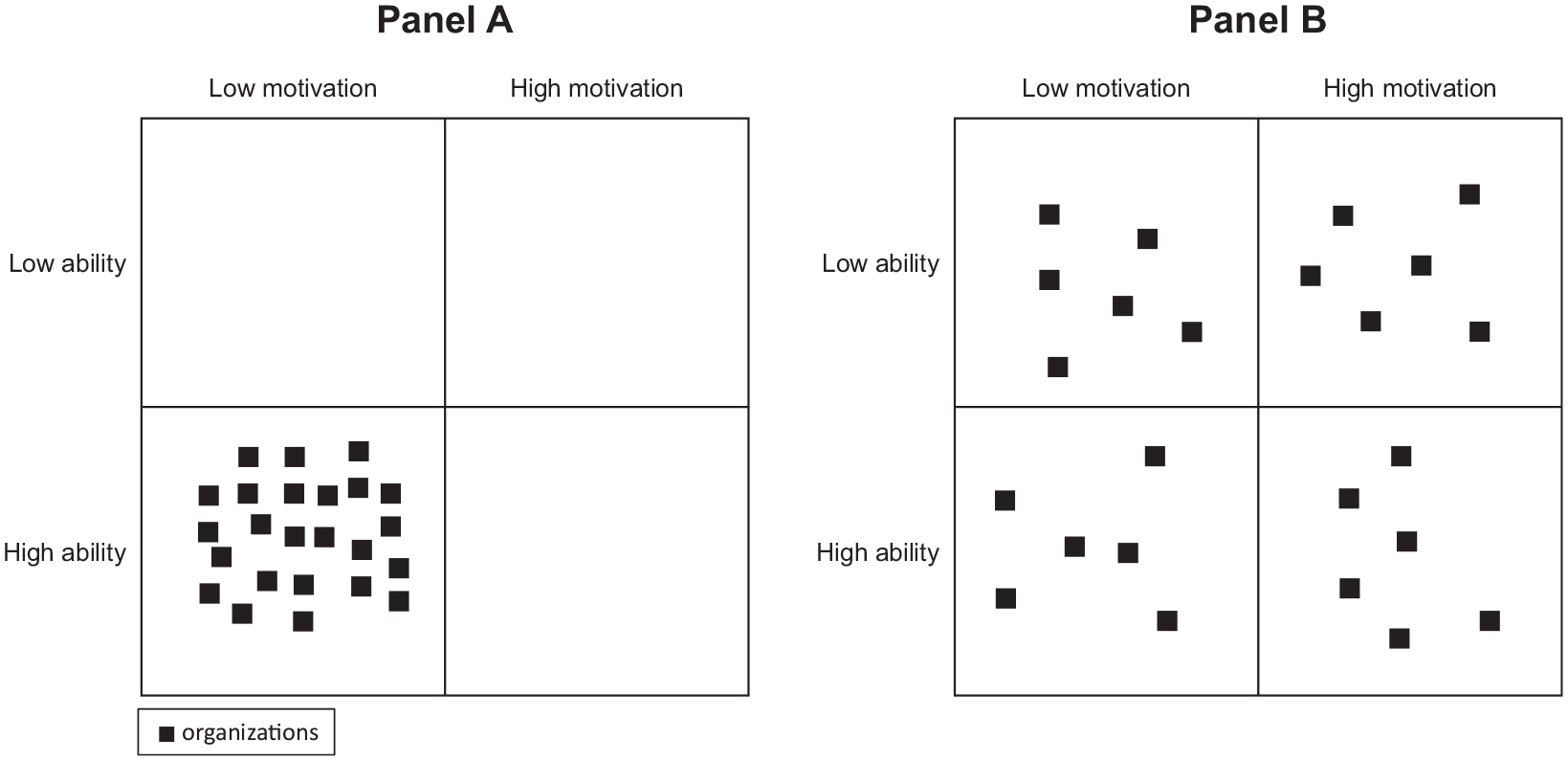
Heterogeneity in the ability and motivation to pursue optimal distinctiveness.
In sum, we view a highly fertile avenue for future research to be to better understand heterogeneity in organizations’ pursuit of optimal distinctiveness. Improving our understanding of such variation would not only yield a sounder theorization about the meaning and implications of optimal distinctiveness, but would also help yield practical insights as to why organizations sometimes fail to accomplish optimal distinctiveness and how such failure may be remedied by targeting either motivation or the ability—with each requiring unique interventions. In furthering our understanding of these matters, we see especially large potential in analysing the conditions that shape organizations’ ability and motivation to pursue optimal distinctiveness.
What Conditions Shape the Motivation and Ability to Pursue Optimal Distinctiveness?
Recent work on optimal distinctiveness has highlighted the crucial influence of factors both internal and external to the organization in shaping the mechanisms of legitimacy and competition avoidance that yield performance effects (see also Zhao & Glynn, 2022, for an excellent overview). For instance, Goldenstein, Hunoldt, and Oertel (2019) offer a contingency perspective to understand how distinctiveness affects new ventures’ survival chances. Similarly, Haans (2019) develops a framework that incorporates category heterogeneity into the study of performance effects of distinctiveness. Along similar lines, Taeuscher, Bouncken, and Pesch (2020) challenge the underlying assumption that distinctiveness necessarily counteracts the attainment of legitimacy and find that the legitimating effect of distinctiveness depends on the presence of alternative sources of normative legitimacy. In line with these recent developments, we also see great value in considering not just how different conditions shape the legitimacy and competition mechanisms central to the performance effects of distinctiveness, but also to what extent such factors may shape organizations’ ability and motivation to pursue optimal distinctiveness.
Each conceptualization of distinctiveness inherently involves at least four interrelated components (presented in no particular order). First, given that optimal distinctiveness is concerned with the attainment of superior performance, one must choose which outcome is used to identify what level(s) of distinctiveness is optimal. Second, as distinctiveness involves a comparison to position(s) of other organizations, one always needs to decide which organizations the comparison is being made to and which organizations do not get taken as market peers. That is, by setting the limits to the category in which the organization operates, an assumption gets made as to which reference group the organization is compared. Third, organizations can be distinctive in different ways, even given a single strategic position. As such, every study concerning distinctiveness must make a choice as to how distinctiveness is conceptualized and define in what way organizations can be optimally distinctive. Fourth, because audience members evaluate and value the organization’s distinctiveness—in turn leading to some positions being seen as more or less legitimate or favorable—which audience(s) one focuses on represents another crucial element to the distinctiveness mix and captures for whom the organization is optimally distinctive. We review these four conditions in order.
Which outcome is used to identify what level of distinctiveness is optimal?
Although work on distinctiveness has most commonly taken (short-term) financial performance as the focal outcome (Deephouse, 1999; Haans, 2019; McNamara et al., 2003), an increasing body of work has started to consider alternative outcomes. For instance, the acquisition of resources (Micelotta, Washington, & Docekalova, 2018), stakeholder attention and market responses (Zhang, Wang, & Zhou, 2020), and organizational survival (Jourdan, 2018) have all been the subject of study for recent work. We anticipate that not only the effects of distinctiveness on these outcomes may differ, but that the processes driving the pursuit of optimal distinctiveness would differ substantially depending on the outcome. For instance, while pursuing optimal distinctiveness in terms of short-term performance will likely entail constant adjustments—thus making such a pursuit highly challenging—the design and pursuit of an optimal position for the longer term might be more feasible.
Further complications emerge from organizations’ tendency to strive for more than just one outcome. Indeed, current research revivifies the idea that pursuing multiple goals generates tensions and trims optimization efforts (Gaba & Greve, 2019; Obloj & Sengul, 2020). Given this, it seems highly timely to consider how organizations balance the pursuit of multiple—possibly incompatible—outcomes in the pursuit of optimal distinctiveness: does the pursuit of multiple goals disallow the attainment of optimal distinctiveness? How do organizations grapple with these tensions and trade-offs when pursuing optimal distinctiveness for multiple outcomes?
Likewise, it is important to account for the fact that (outcomes emerging from) distinctiveness may affect the individual organization and different audiences differently (a point we elaborate upon, further below). For example, distinctive organizations may play an important role in solving “grand challenges” by being a source of novel ideas, yet distinctiveness tends to bring greater costs and uncertainty for the organization than conforming. Then, organizations optimizing for financial performance would exhibit different behavior than those optimizing for social impact (DesJardine, Marti, & Durand, 2020). Put differently, what is optimally distinct for one outcome need not be optimal for another, and researchers will need to continue widening their scope beyond merely financial outcomes to better understand how the multidimensional nature of performance shapes the intentions and actions of organizations when it comes to designing their (in)distinctive strategies in the pursuit of these outcomes.
Which reference group is the organization compared to?
There has been an influx of work that considers how characteristics of the category systems in which organizations reside affect their distinctiveness (Fisher, 2020; Haans, 2019). Such category systems condition not just how distinctiveness is received, but also the extent to which organizations are able to establish and alter their distinctiveness. The departure point of most market category research is a category system with identifiable and unambiguous categories, summarized by an existing prototypical member (Hannan et al., 2019). Within this system, producers position their offerings which audiences then identify and value (Zuckerman, 1999). The thicker the boundaries separating categories, the higher the categorical contrast and the higher the penalty when spanning categories (Hsu et al., 2009)—enabling organizations to crisply define their direct competitors and subsequently optimize their positioning strategies. However, categories change over time and as organizations develop their strategies, in turn shaping the number and nature of relevant dimensions and attributes for organizations to position their distinctiveness on (Rao, Monin, & Durand, 2005; Zhao, Ishihara, & Jennings, 2018).
That category systems differ in their malleability and crispness has other consequences, relevant for defining optimality in distinctiveness. Categorical boundaries do not just erode (Rao et al., 2005) or become lenient (Pontikes & Barnett, 2015), but categories are also nested in trees of more or less exclusive sub-categories (Smith & Chae, 2017). As a result, defining distinctiveness as optimal for an organization or a scholar studying an organization may mean different things at different levels of category nesting. What this implies is that for an organization comparing itself with rivals within one level of the category system (e.g., one of the over 450 four-digit SIC codes) would have a much more narrow and clearly defined set of competitors to base optimal distinctiveness on than when taking one of the ten higher-level sectors—as it has a much larger and more heterogeneous set of peers (Haans, 2019). Likewise, for a scholar studying an industrial sector, the chosen level of analysis within the category system contains implicit assumptions about what being optimally distinctive means and entails. Yet, the nested nature of the category system implies that the organization belongs to both these levels, and the choice on which level to focus for an organization will determine its behavior. For scholars, such nestedness will likewise influence the identification of the optimal distinctiveness point. Further complicating matters is the fact that organizations frequently span categories and operate in multiple types of category at the same time (e.g., the industry and the region of the organization; Gehman & Grimes, 2017), and may thus need to play the optimal distinctiveness game against multiple reference groups simultaneously—challenging once again their motivation and ability to seek optimal distinctiveness in each of these categorical arenas. We therefore call for future research to more seriously consider the implications of the characteristics of the category system in which organizations operate for the pursuit of optimal distinctiveness by these organizations.
Optimally distinctive in what way?
Organizations can also be tactical not simply by choosing to identify with different subordinate and superordinate categories but also by playing with the features their strategic positions extol. For instance, on the one hand organizations may choose to overemphasize highly salient features to reap the benefits of conventionality while aligning themselves more closely with less salient attributes (Durand & Kremp, 2016; Kim & Jensen, 2011). This distinction between conventionality and alignment has important consequences for research on optimal distinctiveness. Indeed, anticipating what the optimal distance is between the organization’s position and the moving category system’s center of gravity (as in the case of alignment) is extremely difficult—leaving organizations generally less able practically to be optimally distinctive in terms of alignment than what scholars have supposed. In contrast, it is likely easier to identify the salient features valued by an audience and to overrepresent them (to be optimally conventional) to garner respect and appeal while simultaneously introducing other distinct features to exhibit novelty. What this reflection indicates is that optimality in distinctiveness may differ depending on whether an organization (1) strives to conform via alignment or conventionality, and (2) possesses the capacity and motivation to strive for optimal distinctiveness based on the selected approach. As such, we echo the calls by Zhao and Glynn (2022) to consider how organizations arrive at optimal distinctiveness—rather than only focusing on the degree to which one needs to be distinctive to achieve optimal distinctiveness.
What prototype or reference point an organization compares itself to and is being compared to also has important implications for the motivation and ability to optimally position oneself. The dominant perspective in the distinctiveness literature, to date, has been the prototype-as-average view (Durand & Paolella, 2013; Haans, 2019). While attractive for researchers given the ease of empirically determining such a prototype, the highly abstract nature of an “average” position likely does not map well onto organizational reality, especially given that such an average organization often does not exist or have much meaning as a reference point (Haans, 2019). This, in turn, limits both organizations’ ability and motivation to position oneself vis-a-vis such an abstract prototype.
However, alternative conceptualizations of prototypes exist (Vergne & Wry, 2014), and recent work has turned its attention in particular to the most salient or exemplar member of a category (Barlow, Verhaal, & Angus, 2019; Younger & Fisher, 2020; Zhao et al., 2018). The motivation and ability of organizations to optimize their distinctiveness can be expected to be different when anchoring on such exemplars. While, on the one hand, the concrete nature of these exemplars should enable organizations to more actively compare and adapt their positioning to them (Younger & Fisher, 2020), these exemplars nevertheless on the other hand tend to be the best performers in their market (Barlow et al., 2019). In turn, this makes it less attractive to try and compete with them. As such, we call for future research to further investigate the implications of different referent points for the pursuit of optimal distinctiveness, and to also consider how organizations utilize different referent points and referent groups. Here, we see the socio-cognitive approach to categorization (Porac, Thomas, & Baden-Fuller, 1989, Porac, Thomas, Wilson, Paton, & Kanfer, 1995) as offering especially great potential for improving our understanding of optimal distinctiveness. Indeed, this perspective puts forward that organizations differ in how they define their competitors and, thus, who they do and do not compare themselves to when identifying their relative positions and performance (Porac et al., 1995), thus shaping whether or not they pursue optimal distinctiveness, to start.
Optimally distinctive for whom?
Finally, in line with different calls (Fisher, 2020; Pontikes, 2012; Zhao et al., 2017), we anticipate that a more complete understanding of the diversity in audiences which organizations face is significant for understanding the behavior of organizations pertaining to optimal distinctiveness. Fundamentally, optimal distinctiveness entails balancing the need to “blend in” relative to peers and to “stand out” in the eyes of audiences (Navis & Glynn, 2011; Zuckerman, 2016). Indeed, one is assumed to stand out when one is distinct from pre-existing prototypes while one blends in by being similar to them (Askin & Mauskapf, 2017; Vergne & Wry, 2014). Thus, in this view, gaining audiences’ attention depends solely on one’s position relative to pre-existing prototypes and does not allow much distancing from the core features expressed by a prototype or from other category members. Work in psychology shows, however, that audience preferences may not always be the most prototypical, as an audience’s theory of value, defined as “how audiences identify issues and solutions, ascribe value, and rank solution providers” (Paolella & Durand, 2016, p. 333), does not unilaterally coincide with proximity to a prototype (Barsalou, 1983; Pontikes, 2012).
Whether and to what extent organizations need to find a balance between “blending in” and “standing out” thus depends on what audiences’ theory of value prioritizes (Durand & Kremp, 2016; Zuckerman, 2017), in turn shaping the extent to which the organization itself may want to and is able to pursue optimal distinctiveness. Moreover, it is likely that audience members vary over time in their categorization processes, moving between prototype-based categorization and goal-based, exemplar-based, or causal model-based categorizations (Durand & Paolella, 2013). This all generates further complexity about what optimal distinctiveness means for a given audience at a given point in time and, in turn, whether or not the organization wants to and is able to pursue optimal distinctiveness, itself (Fisher, 2020).
Another important distinction is that there may be optimal distinctiveness for the organization itself that may not coincide with the globally optimal level of distinctiveness (Denrell & Liu, 2012; Levitt & March, 1988; March, 2006). Figure 2 provides an illustration of this possibility, which shows a case where each individual organization (shown with black squares) has occupied a position that is optimal within its own development trajectory (inverted U-shapes shown with solid lines and consistent with, for instance, the perspective proposed in Deephouse, 1999), but where only organizations on the extremes of conformity and differentiation obtain performance that is the highest when comparing between organizations (the U-shape shown with a dotted line, consistent with for instance Haans, 2019). Certainly, the exact shape that these within- and between-organization curves take may differ, which will affect the extent of misalignment between these curves. Nevertheless, what this illustration shows is that what may seem like a lack of optimally distinctive positioning when comparing performance between organizations may actually be representative of optimally distinctive positions when one conceptualizes optimal distinctiveness as something that is unique to each organization itself. As such, whether one theorizes about developments in distinctiveness within a given organization or about differences between organizations occupying differently distinctive positions (Weick, 1989) may fundamentally change what it means to be optimally distinctive.

Contrasting between- and within-organization curves.
Conceptual Subtleties Have Methodological Implications
Given the importance of understanding (variation in) the motivation and ability of organizations in their pursuit of optimal distinctiveness, we see several methodological avenues as particularly relevant in enabling empirical endeavors into these questions. First, it is crucial that more in-depth processual and qualitative insights are generated to better understand whether and how organizations actively determine (and adjust) their strategic positioning relative to their peers in the pursuit of optimal performance (Cattani, Dunbar, & Shapira, 2017; Mathias, Huyghe, & Williams, 2020) and to gain deeper processual insights into the extent to which organizations (attempt to) position themselves in an optimizing manner as compared to their peers.
An example of such an analysis includes Younger and Fisher’s (2020) description of the processes of legitimate distinctiveness and the construction of market image for startups in accelerators. This study shows how organizations in an emergent category engage in acts of emulation, experimentation, and divergence as they position themselves compared to the category’s exemplar—thus offering deep processual insights into the specific ways in which organizations grapple with their positioning vis-a-vis specific reference points. Similarly, McKnight and Zietsma (2018) offer a configurational approach to understanding unique combinations of strategies and conditions that lead to successful commercialization for distinctive new ventures. Such an approach is attractive, as it helps move beyond a singular point of optimal distinctiveness and into a more multi-dimensional perspective on optimal distinctiveness. Likewise, Tracey, Dalpiaz, and Phillips’ (2018) examination of the translation processes that distinctive new ventures engage in when legitimizing their activities adds new depth and variation to the ways in which organizations may pursue optimal distinctiveness as compared to the more unidimensional and static perspective dominant in the literature (see e.g., Fisher, 2020; Zhao et al., 2017). Further work on understanding the antecedents of distinctiveness should also prove valuable in supplementing these efforts, such as the work by Prato and colleagues (2019), showing that actors’ propensity to conform fundamentally depends on the ascribed status that they inherit from their social group, and by Syakhroza and colleagues (2019), highlighting the role of identity buffers in how insiders adapt their positioning in response to code violations.
Second, we call for a better quantification of the actual efforts put forth by organizations in optimizing their strategic positions towards the outcome of optimal distinctiveness. Beyond the typical distance-based accounts of relative differences between peers, finer-grained methods exist which can approach the reality of trade-offs and asset allocations faced by organizations. These can be either directed toward asset use minimization or toward output maximization. For example, data envelopment analysis (Delmas & Tokat, 2005; Durand & Vargas, 2003) and stochastic frontier approach methods (Chen, Delmas, & Lieberman, 2015) allow deriving efficiency frontiers from available data (without imposing functional forms) and subsequently locating organizations and peers vis-a-vis the efficiency frontier. As such, these methods enable researchers to position productive units, characterized by a vector of inputs and one or several output(s) along an efficiency frontier: a few of the units are optimal while the others fall behind, either because they use too many inputs (for a given output) or because they do not get enough output (from the employed inputs). As such, these methods offer ways to capture and compare the actual ability of organizations to optimally use their assets to reach a set of outputs. Researchers can therefore simultaneously quantify how organizations optimally utilize their strategic inputs (or not) and how they differ from competitors in both strategy and performance when doing so. Subsequently, this allows investigating how changes in strategic assets move organizations away from or toward the efficiency frontier. Such movements would then allow for novel insights with respect to the extent to which organizations intentionally modify their asset allocation and are able to move towards optimally distinctive positions.
Third, we argue that future work should consider the empirical ramifications of theorizing about differences between organizations to identify a generally optimally distinctive positioning strategy and about the extent to which organizations achieve optimal distinctiveness given their own constraints and within their own path-dependent trajectories. To be concrete, studies applying cross-sectional analyses will effectively be unable to explore within-organization trajectories and should focus on between-organization theorization. Conversely, longitudinal approaches frequently take fixed effects regression models as their central empirical approach which, by design, model only variation within organizations over time and parse out variation between organizations.
To illustrate, if we were to estimate a cross-sectional model of how distinctiveness relates to performance, averaged out such that we have a single observation for each organization shown in Figure 2, our conclusion would be that a U-shaped effect of distinctiveness on performance exists. This would lead to the conclusion that organizations with moderate distinctiveness fail to achieve optimal distinctiveness because they are performing worse than peers. However, estimating a fixed effects regression model would lay bare the within-firm inverted U-shaped effect of distinctiveness—with organizations that are moderately distinctive achieving the best possible performance for themselves. What this illustrates is that researchers’ methodological choices with respect to modeling effects between or within organizations can potentially yield very different conclusions about how distinctive organizations should strive to be. To this end, recent methodological advances that can simultaneously tease out such between- and within-organization effects (Certo, Withers, & Semadeni, 2017) are highly attractive as they help reduce the risk that we mis-attribute (sub-)optimal performance to specific positioning strategies and therefore can offer more appropriate insights as to whether or not organizations achieve optimal distinctiveness.
Finally, we propose that it is important for future quantitative work to take further strides in modeling distinctiveness as a self-selected or endogenous strategy when investigating the performance effects of distinctiveness. Here, we see much potential in leveraging the various advances made in this regard in the field of strategic management, such as the use of instrumental variables (Hamilton & Nickerson, 2003; Wolfolds & Siegel, 2019), utilizing field experiments (Chatterji, Findley, Jensen, Meier, & Nielson, 2016), or applying matching on observable characteristics (DesJardine & Durand, 2020). Indeed, studies that do not account for endogeneity in strategic decisions are susceptible to offering misleading conclusions (Hamilton & Nickerson, 2003; Semadeni, Withers, & Certo, 2014; Shaver, 1998; Wolfolds & Siegel, 2019). As a result, it may very well be that for instance the harmful effects of excessive distinctiveness would disappear once selection into such positions is accounted for (see Shaver, 1998, for a classic example). At the same time, if results do not differ between analytical approaches, then the self-selected or intentional nature of distinctiveness may have been overstated. Therefore, explicitly accounting for self-selection in distinctiveness would not only yield analyses more aligned with theorized processes, but will also help get a fuller understanding of the extent to which organizations are indeed intentional in seeking optimal distinctiveness.
These methodological considerations are not merely technical options: they actually touch the heart of our theorization of optimal distinctiveness by enabling explicit investigation into the underlying assumptions of optimal distinctiveness research as it pertains to motivation and ability. Taken together, we therefore anticipate that incorporating these methodological suggestions would generate a better-informed and more appropriate understanding of whether and why organizations do or do not pursue optimal distinctiveness.
Conclusion
Although much progress has been made in describing the many relationships between distinctiveness and different outcomes, we have put forward that the active pursuit of optimality in distinctiveness by organizations needs further clarification. Indeed, while our conceptual understanding of distinctiveness, its operationalization, and its various effects under different circumstances continues to develop, we have proposed that the notion of optimality in optimal distinctiveness also deserves further exploration.
We have put forward that optimality in distinctiveness may or may not be an organizational objective, as organizations have differing abilities and motivations to pursue optimal distinctiveness, and that this variation in ability and motivation has implications for whether and how we may study optimal distinctiveness. For instance, if optimality only lies in the eyes of the (scholarly oriented) beholder, rather than being a central concern for organizations or something that organizations can feasibly attain, then we may need to revisit the concept and demote it to a mere ex post descriptive pattern. Conversely, if organizations actively design their distinctive positioning in the pursuit of optimal distinctiveness then issues of self-selection and endogeneity loom large. As such, more careful consideration of organizations’ motivation and ability in their pursuit (or lack thereof) of optimal distinctiveness would help further clarify the concept and enable us to make more grounded recommendations for practice.
To this end, we have highlighted a range of factors that likely alter the ability and motivation for organizations to strive for optimal distinctiveness and have offered a number of methodological suggestions that would help explicate and understand the as-yet under-theorized variation in the motivation and ability of organizations in their pursuit of optimal distinctiveness. All these conditions influence the very possibility and definition of optimal distinctiveness—just as many of them shape how organizations’ distinctiveness gets rewarded or punished (Zhao & Glynn, 2022). Complicating matters, these factors likely do not occur in isolation but in conjunction with each other in shaping organizations’ pursuit of optimal distinctiveness. Thus, coming to a more coherent and realistic understanding of the complexities behind optimal distinctiveness (Fisher, 2020) will require tremendous effort.
Taking the motivation and ability of organizations more seriously also begs the question whether organizations need to know about the existence of an optimal degree of distinctiveness in order to behave according to the theory of optimal distinctiveness. Indeed, organizations may maximize their value in line with a theory without being knowledgeable about it (see transaction cost economics as an example; Nickerson & Silverman, 2003). We propose that better understanding the motivation and ability of the organizations will help clarify whether or not the theory of optimal distinctiveness has prescriptive and predictive value, or if it only has descriptive value. Certainly, much work awaits to establish optimal distinctiveness as a sound, generalizable, and falsifiable theory—we cannot accomplish this without a better comprehension of the first half of the concept: optimal.
Footnotes
Declaration of Conflicting Interests
The author(s) declared no potential conflicts of interest with respect to the research, authorship, and/or publication of this article.
Funding
The author(s) received no financial support for the research, authorship, and/or publication of this article.
