




Abstract
The contribution of Northern technologies to solving problems in the South is widely studied. However, the dissemination of these technologies in the South is rarely seen as a legitimacy issue. This paper aims to understand how the legitimacy of a new venture is created in an emerging field, considering the indeterminate and unstable nature of the entrepreneurial process. To explore this avenue, we conducted a qualitative study around a unique case: Cyberlibris, a young company operating in the field of e-books, an emerging field within the book industry in the early 2000s. This study suggests that the process of legitimation of a disruptive technology-based innovation carried out by a newcomer is constituted by a tangle of tests, a notion borrowed from pragmatic sociology, but tests change with respect to demands by African schools. First, we highlight three tests within the legitimacy process in the French context (revenue model, publisher conservatism and reading practice changes). These tests are experienced by adapting to the African context. We discuss the paradox between legitimacy and domination in technology appropriation processes.
Keywords
Introduction
Technological innovations are drivers of economic growth, even though their promises and impact on communities are difficult to evaluate (Kuratko & Audretsch, 2022; Morris & Kuratko, 2020; Zahra et al., 2023). The way Northern technologies contribute to solving Southern problems has been widely studied, mostly in terms of adapting to local constraints. However, the diffusion of these technologies in the Global South is rarely considered as a matter of legitimacy, as if these countries were merely dumping grounds. The legitimacy criteria of the domestic market are implicitly considered universal, which can, in practice, constitute a form of neocolonial violence.
The objective of this article is to understand how the legitimacy of a new venture is produced around an emerging technology, given the indeterminate and unstable nature of the entrepreneurial process, influenced by the discovery of intercultural contexts. Hence, we adopt a radically process-oriented perspective of legitimacy.
Entrepreneurship research has highlighted the importance of constructing legitimacy for new ventures (Fisher, 2020), especially when they operate in an emerging field (Aldrich & Fiol, 1994; Delmar & Shane, 2004; McDonald & Eisenhardt, 2020; Stinchcombe, 1965; Zimmerman & Zeitz, 2002). Studies often focus on identifying sequences in which forms of legitimacy are articulated, aiming to highlight relatively stable and almost universal processes of legitimising new ventures (Bitektine, 2011; De Clercq & Voronov, 2009b; Johnson et al., 2006).
However, these approaches downplay the deeply indeterminate, contextualised and unstable nature of the entrepreneurial process and the lived experience of entrepreneurs—the ongoing creation, as well as entrepreneurial practices in situ (Baker & Welter, 2020; Hjorth et al., 2015; Steyaert, 2007). The process is an ongoing becoming that does not exist outside the continuous flow of time unless treated at a given moment as a discrete entity (Rescher, 1996; Whitehead, 1929). The emergence of new technology in an intercultural context leads us to consider that the process of legitimisation itself is subject to uncertainties inherent in the creation process, characterised by experimentation, inquiry and discovery, nurtured by various interactions and conversations that occur along the way.
We propose that, in an intercultural context, the legitimacy criteria, as well as the audiences for legitimation, are not predetermined in entrepreneurial action but are discovered or constructed in entrepreneurial practice through what pragmatic sociology calls legitimacy tests (Boltanski & Thévenot, 1991; Boltanski & Chiapello, 1999). In this regard, we examine how entrepreneurs from the Global North consider, on one hand, the discovery or construction of legitimacy criteria specific to partners from the Global South, and on the other hand, the possibility that other audiences of legitimation matter in this process.
To explore this path, we conducted a qualitative study between 2005 and 2023 focusing on a unique case: Cyberlibris (CL), a young French company operating in the field of e-books, which was an emerging domain in the book industry in the early 2000s. CL primarily targets business schools and academic books. Through encounters and opportunities, the company quickly expanded its operations on the African continent, targeting business schools. Printed books are particularly expensive in Africa and are hard to access. CL offers resources in French and in English and adapts its pricing policy. But what are the legitimacy issues at stake? Does the company universalise or reproduce a legitimacy derived from its market in French schools? Does it create other criteria? Does it enrol other audiences for legitimation?
This study suggests that the legitimation process of a disruptive technological innovation brought by a new entrant consists of an entanglement of tests, but the nature of these tests changes depending on the demands in an intercultural perspective. While we identify three tests in the legitimation process within the French context (revenue model, publisher conservatism and changes in reading practices), our research shows that the tests change in different school and university contexts in Africa. Printed books are not highly revered, and the digital realm poses a test mainly for professors. We highlight co-learning tests between CL and many schools themselves facing challenges, such as growth. Certain audiences also prove crucial, such as students, due to their innovative practices.
In our analysis, we underline a legitimacy paradox related to the test of technology appropriation. Technology is supposed to enable schools and their students to access academic resources, but at the same time, it does not fully empower them and reproduces forms of domination. We discuss the paradox between legitimacy and domination in the technology appropriation processes.
The article begins with a presentation of the theoretical issues raised by studies on legitimacy and introduces the notion of tests. We, then, present the research methodology. Our results distinguish a legitimacy constructed in the French market from different tests experienced with partners from the African continent. We conclude with a discussion.
Tests of Legitimacy: Moving Away from a Universal and Stable Approach to Legitimation
Novelty as a Dual Hindrance to Legitimacy
New ventures often struggle to attract the necessary resources for their survival and development due to their lack of legitimacy among actors who can provide them with the needed resources (Aldrich & Fiol, 1994; Garud et al., 2014; Lounsbury & Glynn, 2001; Überbacher, 2014). The absence of a track record demonstrating the performance of a new venture leads to a lack of trust among stakeholders (Stinchcombe, 1965; Van Werven et al., 2015). Moreover, these stakeholders have heterogeneous expectations that call for complex behaviours (Überbacher, 2014). Legitimacy serves as an essential prerequisite for initiating other organisational activities and the survival of new ventures (De Clercq & Voronov, 2009a; Delmar & Shane, 2004; Garud et al., 2014). Legitimation activities enhance the founders’ ability to build social relationships and initiate routines that facilitate the acquisition and recombination of resources (De Clercq & Voronov, 2009b; Delmar and Shane, 2004; Tornikoski & Newbert, 2007). Strategic legitimacy (Tornikoski & Newbert, 2007), also known as innovative legitimacy (De Clercq & Voronov, 2009a), which involves actively seeking to demonstrate relevance to different audiences, appears to increase the likelihood of organisational emergence while conferring legitimacy to the enterprise (Messeghem & Sammut, 2010).
The legitimacy problem and risks are even higher when the activities of the young venture itself are emergent and in need of legitimacy (Dobrev & Gotsopoulos, 2010; Van Werven et al., 2015). The legitimacy of the new firm is affected by its lack of history and the lack of legitimacy of the new field (Navis & Glynn, 2010; Van Werven et al., 2015). Pioneers in an emerging field struggle to justify their resource demands and allocation choices as external actors lack references to evaluate resource demands and their deployment (Dobrev & Gotsopoulos, 2010; Lomi & Larsen, 1998; Van Werven et al., 2015). They need time to ‘routinise’ activities, establish trust among field members, build relationships with external actors, learn how to coordinate tasks, and motivate and mobilise field actors (Lounsbury & Glynn, 2001).
The Legitimation Process Facing Indeterminacy in the Venturing Process
Various studies have highlighted the existence of a legitimation process by seeking to establish an order in which things must unfold to ensure the survival of a new venture (Deephouse & Suchman, 2008; Lawrence et al., 2002). Several works have identified a sequential and specific process, consisting of varying phases characterised by actions, dimensions and sources of legitimacy, including instances of legitimation to convince (Johnson et al., 2006; Greenwood et al., 2002; Tolbert & Zucker, 1996). However, Drori and Honig (2013) demonstrate that organisational legitimacy is a product of action, continuously reproduced and reconstructed by organisation members in conjunction with external legitimation activities. According to Laifi and Josserand (2016), entrepreneurs engage in bricolage in shaping the legitimacy of elements in their business model, dealing with audiences with divergent interests.
This conception of the legitimation process presents several limitations when considering the experiences of entrepreneurs. Firstly, the studies abstractly decouple legitimation work from the entrepreneurial process. However, legitimation is a part of the entrepreneurial process: legitimation practices contribute to shaping the entrepreneurial project as well as the ‘legitimate’ identity of entrepreneurs (De Clercq & Voronov, 2009b). Secondly, the entrepreneurial process is conceived as a series of ‘discrete entities’ that can artificially be detached from the intrinsic flow of human action, with the process being an attempt to order it through scientific rationality (Tsoukas & Chia, 2002). Thinking of the legitimation process sequentially assumes fixing the ontology of the entrepreneurial process in the form of ‘a series of juxtaposed states’ or ‘positions’ that form only an artificial and abstract reconstitution of duration (Bergson, 1938). By neutralising the contingencies of the entrepreneurial process, it becomes possible to isolate and articulate distinct forms of legitimacy based on stages (Hjorth et al., 2015).
On the contrary, the strong indeterminacy of the entrepreneurial process requires rethinking legitimation practices (De Clercq & Voronov, 2009b). Current research envisions a more emergent, multidirectional and non-linear entrepreneurial process that evolves through exploration behaviours but struggles to detach itself from the equilibrium assumption and causal logic, at best dealing with ‘theoretical’ sequences of disequilibrium (Hjorth et al., 2015; Steyaert, 2007). A processual approach (entrepreneuring) aims to ‘grasp’ the everyday practices of organising people and resources, the specificities of a concrete situation, the interactions at play and the knowledge being constructed (Johannisson, 2011). This approach is particularly relevant in an intercultural context where entrepreneurs encounter varied expectations and are evaluated according to criteria that need to be discovered, by audiences that can change. In this case, legitimacy is constructed along the way, in the form of an entrepreneurial inquiry. Moreover, when creating a venture in an emerging and heterogeneous field, entrepreneurs adopt behaviours where they can hardly anticipate legitimate outcomes, acting based on analogies, sometimes incomplete, to support their reasoning in action (Cornelissen et al., 2012).
The Limits of a Universal and Colonial Approach to Legitimacy
A radically processual approach to legitimacy, therefore, helps mitigate the dangers of universalising legitimacy by considering each intercultural encounter as an opportunity to construct legitimacy differently, with reflexivity, taking into full account practices, contexts and lives. Approaches to internationalising businesses often rely on the idea that entrepreneurs establish the foundations of their legitimacy in their domestic territory, and that international markets require inexpensive adaptations, particularly in North-South relations. Entrepreneurs then tailor their legitimation strategies based on local contexts. This is especially the case when there is a presumed cultural proximity between countries and when relations between countries are still marked by colonial superiority. In such situations, the process of legitimation can mask power dynamics that lead to the denial of the possibility of knowledge, practices and identities. Legitimation practices, considered neutral, universal and objectifiable, can reveal a form of violence exerted in market relations. This manifests as the marginalisation of audience expectations or the delegitimisation of instances deemed ‘contextual’. Additionally, the use of technological devices sometimes serves to erase power dynamics, as this violence is delegated through a displacement of agency, as evidenced by research on ‘development aid’.
The Notion of Test Serves to Destabilise and De-universalise Legitimacy
Our article is based on the conjecture that, in the course of the entrepreneurial process, entrepreneurs develop legitimacy by exploring audiences and co-constructing criteria through what we refer to as legitimacy tests.
The notion of test has been the subject of various studies in pragmatic sociology (Boltanski & Thévenot, 1991; Martucelli, 2015; Nachi, 2006) and has been borrowed by the field of management, although not specifically associated with entrepreneurial legitimation. The emergence of novelty creates a problematic situation that suspends the usual institutional game, requiring a clarification of the beliefs on which actors act (Martucelli, 2015). The problematic situation challenges what is considered true today but also implies that the construction of what would constitute ‘truth’ is itself tested. The test, thus, suspends the legitimacy criteria used to authorise conduct while exploring and testing potential future acceptable criteria around the novelty.
The test is also characterised by its reversibility and the uncertainty regarding its course and produced effects (Boltanski & Thévenot, 1991; Martucelli, 2015). The productivity of tests cannot be anticipated as the evaluation criteria themselves are suspended, and the audiences are still in formation. Furthermore, the arrangement of tests and their effects is unpredictable and dependent on the course of the entrepreneurial process. The legitimacy process, viewed through the lens of tests, highlights the difficulty of predetermining its performance, particularly through the identification of thresholds crossed by creators (Überbacher, 2014).
Finally, it is possible to distinguish between legitimate tests and tests of force (Boltanski & Chiapello, 1999). Legitimate tests involve an evaluation or measurement of the actor in relation to the categories that structure the organisational field (Boltanski & Thévenot, 1991). Conflictual tests operate through multiple displacements that disrupt the ability of institutions and instances of legitimation to qualify the new actor.
Our article aims to understand the possibilities of a plurality of legitimation behaviours in the context of intercultural encounters during the entrepreneurial process. To do so, we explore the notion of legitimacy tests.
Methodology
In this research, the aim is partly to challenge the underlying assumptions of a theory that has gained widespread dissemination and credibility, subjecting it to critical examination (Alvesson & Sandberg, 2013). Several studies have explored the process of legitimation within the framework of entrepreneurial processes, but without considering the indeterminate nature of the entrepreneurial process and, incidentally, of legitimation in an intercultural context. Our work consists of exploring the notion of test following the identification of limitations in the existing understandings proposed thus far. The study of a unique case enables the generation of concepts and theoretical propositions, proving particularly suitable for exploring new avenues, questioning existing concepts or theoretical propositions, creating new knowledge or supplementing an existing or emerging theory (Stake, 1995).
Presentation of the Case and Its Context
The book industry is characterised by production and commercialisation structures that have been in place since the eighteenth century (Mollier, 2007), as well as a strong presence of professional associations, unions and collective structures. These institutions, whether dependent on public authorities or not, are embedded in a field that they regulate and protect. They play various formal roles, such as serving as observers of copyright and neighbouring rights, providing authors with various forms of support, advice and information, safeguarding the interests of publishers, and representing and defending the economic and moral interests of booksellers, among others. Some rules have also emerged through collective practices and gradually gained the status of fiercely defended legal rules, such as copyright or the fixed price of books.
Technological advancements, particularly digitalisation, have caused a disruption in this highly institutionalised sector through the dematerialisation of books. The emergence of e-books has been accompanied by a controversy over standards, technological norms and economic models. The publishing field has witnessed a proliferation of e-book projects and models, driven by both internal and external actors within the industry. Companies such as Google, Yahoo, Microsoft, Sony, Philips Electronics and Amazon have experimented with different and competing e-book models, with varying degrees of respect for intellectual property rights. Several e-readers, employing different technological standards, were introduced to the market starting in the 2000s. The field was marked by Google’s massive and unauthorised digitisation, leading actors in the field to take collective legal action against it.
In this study, we focused on an aggregator of e-books, referred to as CL, a digital library established in 2001 that offers e-book packages to libraries in leading business schools. Through an annual subscription, CL enables remote, simultaneous and unlimited access for its subscribers. Examining the legitimation process of a new company operating within an emerging field within an established industry provides an even greater opportunity to grasp the indeterminacy of legitimation processes.
Furthermore, the entrepreneurs quickly initiated efforts to establish partnerships with schools in French-speaking African countries (North Africa and West Africa). The development of markets in Africa, thus, occurred partly in parallel, which presents theoretical interest in demonstrating the complexity and paradoxes of the process. For instance, a prominent school in Morocco utilised CL from the early years of the company.
Data Collection and Analysis
We conducted 56 interviews between 2005 and 2010 with actors directly or indirectly involved in the creation of CL and engaged in the legitimation process in some way (Table 1). An additional six interviews were conducted in 2023 to update our data and specifically understand the legitimation process with schools in African countries. The interviews provided insights into the connections, interactions and negotiations among the actors (Langley, 1999). They offered rich, nuanced and non-unitary elements for analysis and interpretation regarding what did or did not constitute legitimacy as the process unfolded. Aggregators, leading publishers, fringe publishers, distributors, booksellers, printers, librarians, authors and legal experts were interviewed. Data collection occurred in an ongoing back-and-forth process in the field. The interviews were conducted regularly to capture the emergence and formation of legitimation criteria and objects, as well as the diversity and evolution of behaviours, power dynamics, discourses and positions throughout the process. Additionally, secondary data (press articles, specialised journals, internal documents, blogs, etc.) collected during the process were used to grasp these same evolutions and the ongoing process.
List of Respondents.
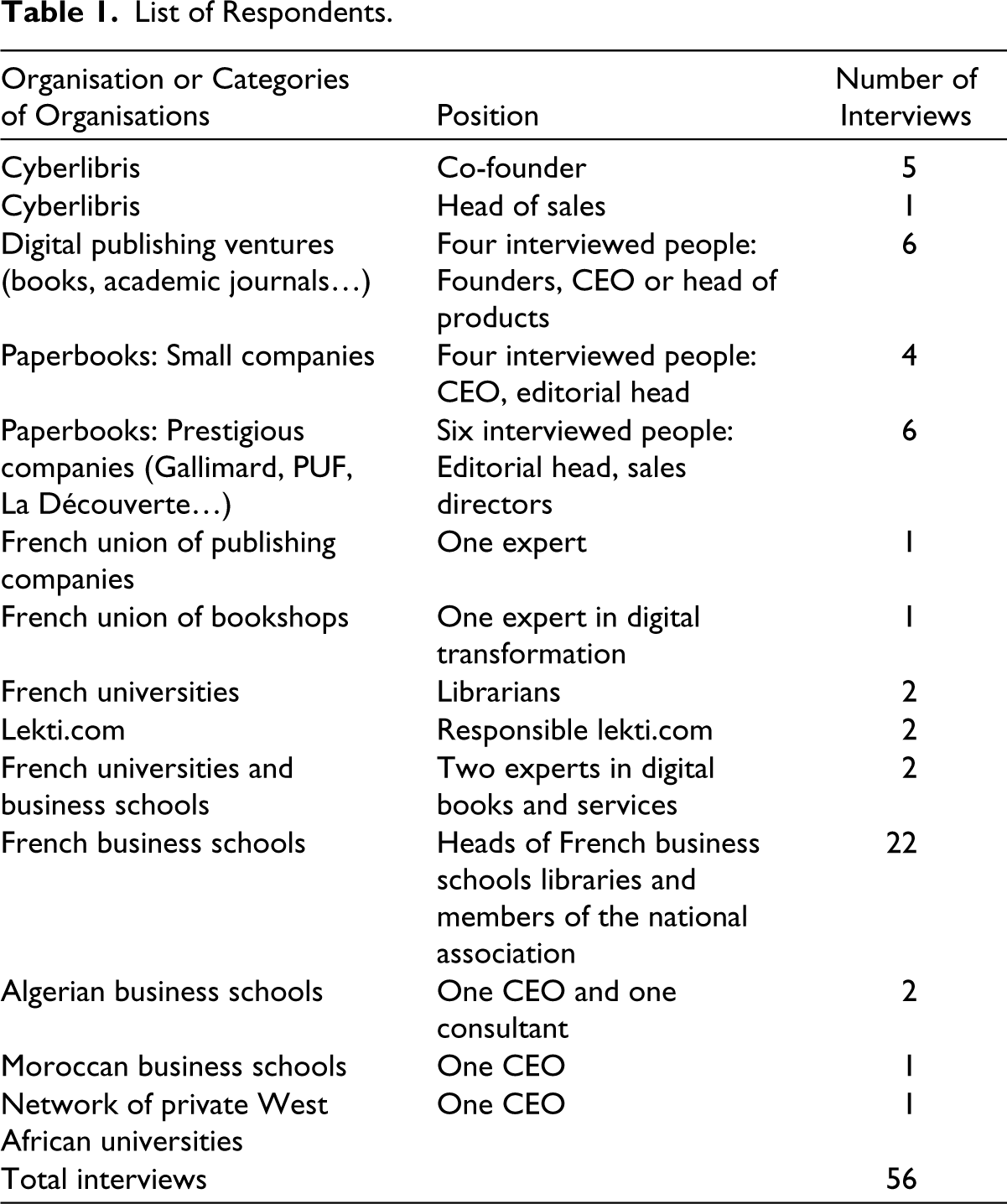
The data analysis initially involved extracting themes from the discourses of the actors on the topics that sparked friction between established actors in the field and CL, regardless of the country of the protagonist. These conflict nodes or challenges were, then, examined, paying attention to the points of debate, the actors enrolled or not by CL during the challenge, the resistance or compromise behaviours on both sides, the rhetorical changes throughout the process, as well as any ‘missed opportunities’. The same actors do not react uniformly to all points of debate and may shift perspectives between challenges, sometimes even within a challenge. Different legitimation instances emerge during the challenges, and transitions can occur from what is being debated to what makes sense in terms of legitimacy. The interviews with partners from African countries and with entrepreneurs in these markets were subjected to two analyses. The first analysis grouped them with the interviews of French protagonists to avoid overestimating variations, while the second analysis was conducted separately to identify possible differences in the legitimation process. We made sure not to essentialise the behaviours of ‘African schools’ and highlighted the nuances among partners, particularly based on the countries involved.
Overall, our results reveal significant differences in how challenges are approached or defined, as well as in the instances that play a role in the process. Three challenges appeared to mark the entrepreneurial process in France. Among the schools in African countries, some challenges were not present, and other paradoxes were raised.
Even though we isolate the challenges, the process is an intertwining of challenges within an indeterminate legitimation process. These challenges are not organised as a sequential sequence considering the ‘open-ended’ nature of the process. They can stretch throughout the entrepreneurial process, aiming to capture ongoing developments and things in the making.
Findings
We extracted various significant challenges, some of which may appear universal but involve diverse protagonists, intensities and resistances. Others seem more directly linked to emerging contexts.
Technological Challenge: Initially Contrasting Processes
While in French schools, the desacralisation of books is slow and poses a conflictual test, schools in Africa seem to seize the opportunity for accessible knowledge through CL. However, this raises an underlying question of reproducing domination through technology.
Around the Offering: From Alternative Discourse to Complementarity Discourse
During CL’s early years, the creators travelled to France to meet ‘all the publishers in Paris’, according to one of them, in an attempt to convince them to join their project. They encountered a lot of mistrust and refusals. At that time, the platform consisted of second-tier Anglo-Saxon books. To compensate for the absence of major French publishers, the entrepreneurs initially decided to play David against Goliath by discrediting monopolies and, to a lesser extent, questioning teachers’ discourse on the sanctity of printed books.
The founder vigorously denounces the monopoly held by certain publishing houses and authors in the book market and its consequences on the diversity of content used. He claims to defend small publishers, unknown publishers and authors by offering them an opportunity in a locked sector where they have little chance to exist. Small publishers and publishers of practical books quickly and regularly join the experience.
On the side of business schools, this incomplete offering remains a serious obstacle to subscription. The entrepreneurs initially exclusively targeted top schools by contacting their management teams. Through personal connections, they managed to secure a few contracts. However, success was not forthcoming. The CL offering did not appeal to the schools, and they were not convinced by the concept. For about five years, the situation did not change much.
In response to the persistent resistance from leading publishers, Bryis emphasises the complementarity of models for both publishers and users. He maintains a subversive discourse but emphasises the differences between models that allow for their coexistence. Once again, the creators use ongoing examples to justify this possibility, referring to other fields where different models (such as sales, rentals, etc.) coexist and to the music industry as a ‘jurisprudence sector’. Some major publishers have embraced the arguments of complementarity (e.g., La Découverte & Dunod), while others remain sceptical.
At the same time, the management of business schools and professors, who were not always receptive to the offering, directed CL towards librarians. Librarians felt slighted that they were not directly contacted for the presentation of the offering. The lack of book choices made them sceptical, but the discourse of complementarity was effectively relayed to them later on. The objective, then, became to make librarians allies and to co-create the interactive platform with them. This manoeuvre found some success among this influential audience.
Digital Publishing: Easy Legitimacy in Southern Countries or Reproduction of Inequalities?
In contrast, the category of virtual books does not encounter the same resistance among the majority of African partners, primarily due to the supportive involvement of school administrations. Despite technological capacity challenges related to internet sustainability, CL is quickly perceived as filling a major gap. It also provides an opportunity to deconstruct dominant behaviours among French-speaking publishers.
‘It also put an end to the power of French publishers who used to send us their old stock of previous editions at exorbitant prices. With Cyberlibris, they no longer have exclusivity, and moreover, they have no reason not to offer us recent knowledge.’ (Director, Business School, Algeria)
‘At our place, it’s difficult to preserve paper books due to the heat and humidity. The import costs are exorbitant, and ultimately, with the development of the internet and smartphones, e-books quickly became the norm.’ (President, School Network, West Africa)
‘CL has democratized access to an invaluable variety of sources. Professors could be difficult to convince because paper represented their monopoly on access to knowledge.’ (Consultant, Business School, Algeria)
Moreover, while Anglo-Saxon publishers struggle to entrust CL with their prestigious collections and books in the highly profitable French market, they are quickly convinced by the possibilities of CL in management schools in Africa, presumed to be less lucrative markets that they neglect. They opportunistically see it as a source of income, which incidentally benefits the students.
However, technology leads to the democratisation of dominant knowledge produced in the North. Despite the efforts of entrepreneurs, CL offers a smaller number of publishers and lesser knowledge produced by researchers and professors from African countries. In Morocco, for example, there is reluctance among management publishing houses to entrust their catalogues, and in Algeria, there is a simple transposition of the dominance of French publishers in the paper domain to the digital domain. Books and publishers in the humanities and social sciences find a niche more easily, according to the founder, but they are not at the core of teaching in schools. The pioneering school in Morocco that adopted CL quickly saw an opportunity to reinvent the classroom experience.
‘The context is brought by the professor who was forced to question what they bring to the students beyond the book. Contextualization becomes essential. We accompanied them in rethinking their pedagogy.’
Diverse Enlistments Around Reading Practices
On the French market: From confrontation to enlistment
The creators of CL first rely on changes in reading practices linked to social, technological and behavioural developments, noting the persistent decline of books, in an attempt to establish their digital library. They emphasise that students no longer purchase books that are drowned in the digital mass and can barely differentiate between free content and databases, validated or not. This approach directly challenges the conservatism of the field and quickly gains the support of marginalised publishers struggling to survive. Similarly, librarians see it as a means to renew their relationship with students. The more prestigious publishers remain cautious, preferring to develop their own models, fearing piracy above all.
Small publisher: ‘It is absolutely evident, and I have proof of it every day, that the possibility for users to easily access digital content via the internet is increasingly apparent and we are increasingly requesting it… It is extremely important for us to appear in search results… because now the reflex of a student is to go on the web…’
Librarian: ‘What I hope for is that when a student seeks information, they log in to the interface for accessing electronic resources and have access to all the subscribed resources, whether on campus or from home, and that’s what we are moving towards more and more. That’s why I support having a virtual library.’
However, CL goes further by claiming to adapt to partial and non-linear reading practices or ‘skimming’ through books, offering a search engine that allows users to target relevant fragments. This ‘demystification’ of the book deeply disturbs the dominant actors in the field, who overwhelmingly reject what they consider to be an undesirable shift.
A book field specialist states, ‘CL crosses a psychological barrier… They have a full-text search engine, which is not the case for EBSCO and CAIRN, which still function with article titles and keywords. So there, you will find reference articles based on themes, but then you have to do the work of a researcher as we practice it today, which is: is this article good, is it related? Whereas with CL’s search engine, you can almost read two pages of a 600-page book. CL is nothing more than an expanded or complete index. And I clearly think that’s what makes CL lack legitimacy.
The frontal approach against ‘hypocritical’ conservatisms seems to show its limitations. The discourse is subsequently softened and refocused on questioning the rationing of supply and the ‘dictatorship’ of the single book imposed by leading publishers but also deeply rooted in the practices of many teachers. The leaders question the ethical aspect of pluralism offered to readers through the abundance of a virtual library. The creators of CL attempt to collectively mobilise the field against certain publishing leaders.
Eric Bryis: ‘If you take a majority of teachers, they are in a way very conformist, they use the same textbook for many years, so they have little motivation to change because their syllabus is based on that textbook, and their PowerPoint slides and so on. Add to that the fact that well-established and cunning publishing houses can cultivate this trend… one of those publishing houses is called Pearson. It’s a disaster! Since when does the pedagogy of a school or a teacher get decided somewhere other than the school and the teacher’s office… except that at a certain point, if everyone in all schools teaches the same courses with the same PowerPoint slides, the same quizzes, we might as well have the Pearson business school, and the matter will be settled.’
This discourse allows for a broader involvement of organisational actors: publishers and schools. Some of these resistant actors have seen their stance shift when the leaders pointed out a reality that particularly frustrates them.
Innovative Students as Creators of Legitimacy in African Schools
Most interviewed school or university leaders in Africa mention that students have played a driving role in reinventing reading practices, seemingly erasing possible resistance from other actors. Firstly, it is evident that the scarcity of other available sources has generated a mechanical interest in CL, which, moreover, faces no direct Francophone competition. Other aggregators, such as CAIRN or EBSCO, mainly cater to researchers by providing scholarly journals. In essence, the students have quickly transformed into natural allies.
‘They protest when Cyberlibris is down. The tool has become central to their learning to the point where it sometimes replaces the classroom (laughs).’ (President, University Network, West Africa)
Additionally, students in schools are better utilising the possibilities offered by CL through their experiences with books. For example, they consult the libraries of experts and take advantage of the opportunity for conversation. Similarly, they actively work with the book’s content using the platform’s functionalities. More notably, the creators of CL have observed a great inventiveness in students’ book consultation practices.
CL creator: ‘Whereas French school students content themselves with the recommended book, here we have observed daily behaviors closer to those of a student browsing through a bookstore and randomly indulging in reading a book out of desire. This has allowed us to better understand random reading behaviors.’
The innovative reading behaviours of students in African schools have, thus, emergently improved the aggregator’s functionalities, offering unprecedented reading paths or surprising associations of readings. However, in certain contexts, particularly in West Africa, the paradox of limited access to resources may explain the innovation in reading behaviours.
Ultimately, the free and pirated access to an ever-increasing number of books and resources does not appear to be a hindrance or competition for CL. Instead, it compels CL to continually enhance its offerings and improve the customer experience, as stated by the director of the business school in Morocco.
The Legitimisation of Identities: Power Conflicts Versus Partnership Co-development
While in France, publishers contest the legitimacy of CL’s identity through its revenue model, schools in African countries find an opportunity, in a very different way, to co-construct their own legitimacy with CL.
Power struggles behind the revenue model
CL’s model disrupts the habits of all actors in France. Remuneration is a sensitive topic in this mature industry, where formal protections such as the fixed price have been established. CL offers a book rental model for campuses or libraries based on a fixed price per individual or per student, regardless of the number of consultations. On the other hand, publishers and authors receive a percentage of this (fixed) revenue based on the number of consultations and page impressions. As a result, the project faces hostility from a large majority of actors in the field, as the price crystallises identity issues. Although the arguments evolve, positions are entrenched, especially due to the resistance of Eric Briys, who claims a subversive model and sees any change as a denaturation of his project.
Beyond the pricing, the entire economic architecture is called into question, particularly the centres of power. Hostility is almost unanimous among field actors who justify the existence of a high fixed price. Their arguments are more about defending the general economy of the system based on the number of copies sold rather than creation. In particular, the alternative model jeopardises the profitability of high and regular print runs, especially in major publishing houses. They also question the regulatory framework for the transfer of digital rights and the respect for authors’ rights in a book rental model. Publishers and existing actors, then, demand a ‘copy-paste’ of the remuneration model for physical books, but their request is rejected.
Eric Briys: ‘I have been told that many times… Publishers would like to guarantee a flow, I would like to be sure that I would receive a certain amount per page, which directly comes from the physical model, because in the physical model, they reason based on the turnover per page, they know the Lang price, they divide it by the pagination, that’s how they reason, and that’s why some books are more expensive than others. And that’s why they want to receive more money per click because their work is better than their neighbor’s. I told them no.’
French leading publisher: ‘I think that in order to attract publishers, there needs to be some proportionality between the volume of book consultations and the revenue obtained by the publisher… And so, because it is not incentivized, I believe that it probably hinders publishers from putting works with significant economic stakes within the scope of CL.’
Several publishers, members of the National Syndicate of Edition and publishing experts have expressed their concerns about the role that a virtual warehouse, and even an author, can play in the near future. In particular, the emergence of a new category is worrisome. For different reasons, small French publishers and Anglo-Saxon publishers have been more open to CL’s pricing and unlimited consultation policy. Culturally, Anglo-Saxon publishers are the first to embrace it. According to e-book aggregators, they are ahead in this field: the coexistence of multiple remuneration models has become commonplace, far from cannibalising sales.
Legitimacy in Co-development Between a New Company and Growing Schools
On the side of school leaders who quickly adopted CL in African countries, no formal power struggles were observed. CL is considered, for various reasons, as an asset for legitimisation in the development strategy of universities and business schools. The perspective of publishers is given little consideration. The founding director of a leading school in Morocco describes it as a parallel growth between their school and CL, as well as a mutual interest in their legitimisation strategies.
‘We were born around the same time. On our side, we were a young school with strong ambitions aiming for a leadership position. We saw it as an opportunity to develop our innovative pedagogical strategy and involve professors and students …. Cyberlibris wasn’t well-established, but that wasn’t our concern. The product needed to meet our expectations.’
Later on, the creation of the Virtual University of Senegal also benefited from an offer like CL to strengthen its model. Several universities in West African countries were also able to temporarily join CL due to bureaucratic issues. Similarly, the establishment of private school networks in these regions seems to have been facilitated by the adoption of a technology with structural effects, beyond cost sharing.
President, private school network, West Africa: ‘In a market where the reputation of schools or universities can vary, having a virtual library like Cyberlibris is a sign of strong consideration for knowledge and respect for students and families. It’s important to provide coherence to a group of geographically dispersed schools.’
Most of the directors interviewed suggest that CL did not follow a classic model of internationalisation from a Northern company to the South. They describe it as a co-development between partners around pioneering technology to address contemporary challenges in education.
Director, Business School, Algeria: ‘There were sometimes hiccups. The system wouldn’t work for a few hours or days. We took responsibility in front of the students. We knew that the CL team was experimenting and doing their best to improve the offering. Just like us!’
Thus, many leaders do not subscribe to the idea that CL engaged in a traditional North-to-South internationalisation model. They describe a co-development between partners around pioneering technology to address the contemporary challenges of education.
Discussion
This article explored the process of legitimisation of new businesses around emerging technological devices in an intercultural context. The aim was to understand how, in this framework, legitimacy is constructed considering the uncertainty and instability inherent in any entrepreneurial process. Our study on CL demonstrates the relevance of conceptualising this process as a series of legitimacy tests (Boltanski & Thévenot, 1991; Martucelli, 2015; Nachi, 2006), which serve as opportunities to explore criteria, confront audiences, enrol certain ones and ultimately shape the entrepreneurial identity of the protagonists. However, it reveals significant differences, particularly in intensity, both in the encountered tests and in the construction of audiences, between the French organisational field and the various African educational contexts explored. Our research also questions the paradoxical role of technological devices throughout these tests. While technology is supposed to provide schools and students with access to academic resources, it simultaneously hinders their full empowerment and reproduces forms of domination. We discuss the paradox between legitimacy and domination in technology appropriation processes.
Unequal Tests Between the North and the South?
The tests experienced in the French organisational field mostly fall into what the authors refer to as force tests. CL questions the categories considered plausible (Garud et al., 2014) by the stakeholders in the historical field of publishing who are unable to produce reliable evaluative judgements about this new category. They rely on old criteria, such as revenue models and reading practices. On the Cyberlibris side, their approach consists of experimenting with different tactics, which take the form of provisional narratives. These ante-narratives (Boje, 2008) can be aggressive or attempts at reconciliation when the challenge for the new business is not central. The creators struggle to identify and enrol audiences that can become their allies and encounter resistance from well-established historical audiences rooted in their practices.
Although the fields in which the management schools in our study operate in African countries are diverse, our analysis highlights legitimate tests that do not disrupt the protagonists. In essence, Cyberlibris occupies an empty space and does not need to make any efforts to delegitimise a central actor: book publishers. Therefore, the stakeholders in the organisational field do not base their judgements on any criteria from the old world, as printed books are not held sacred. In contrast to the French field, the founders are not constrained to test and recruit different audiences, some of which resist. In the majority of management schools, they quickly find allies in the leaders and students who contribute to the legitimisation process.
Co-produced Legitimacy Through Pacified Tests?
Our work emphasises the co-production of legitimacy between the protagonists of higher education in Southern countries and the new business centred around a new technology. Here, we are dealing with stakeholders who face relatively similar constraints in terms of liability of newness (for some schools) or, at the very least, the construction of strong legitimacy in their respective fields. The protagonists are not fully subjected to the judgement and evaluation criteria in a highly institutionalised field. They collaboratively create a plausible world by establishing their own legitimacy criteria. Initially, the technology catalogue may not be as prestigious as desired, and the tool may have some shortcomings. However, users tolerate this experimentation phase because the technology holds a strong promise and can become a strategic resource, contributing to their own legitimacy in their field. Students play a role in shaping CL’s technical legitimacy in the organisational field by allowing the company to explore new practices. Furthermore, students, through their needs, constitute the central audience that organises the field and all its actors.
Rereading: Technological Devices as Reproduction of Legitimate Order
Based on the above, we suggest that legitimacy tests are navigated in a pacified manner with the partners, and the actors engage in a co-construction process of their entrepreneurial journey and legitimacy. Technology plays a central role in this uncertain process.
Another interpretation of the case reveals that forms of inequality and epistemic injustice tend to persist through technological devices. Technology certainly provides access to previously inaccessible knowledge. However, this knowledge largely remains within the dominant management knowledge produced in the Global North and is claimed to be universal. This is evident in the ‘Netflixization’ of industries, where technology and capitalism lead to the subordination or marginalisation of cultures or pockets of knowledge. The maintenance and sometimes deepening of inequalities are masked by the technological device, which is painless and rather exciting, giving the impression of autonomy and empowerment in education.
In the studied case, we suggest a less radical and rather paradoxical interpretation of the role of technological devices in shaping legitimacy processes. Technology enables partial and biased access to knowledge. It should also be considered within a broader pedagogical framework of usage, particularly by teachers, which can dismantle or mitigate certain inequalities. It also allows for forms of bricolage and inventiveness in student appropriation. It is embedded in an ecosystem of both free and illegal knowledge, where new uses are reinvented. However, situated within the capitalist field, technology does not necessarily embody the promises of a common good envisioned through a logic of open access to knowledge, which perhaps better addresses inequalities.
In conclusion, this study highlights the complex dynamics of legitimacy construction for new businesses in an intercultural context. It emphasises the intertwined nature of legitimacy tests, the paradoxical role of technology and the co-production of legitimacy between stakeholders. It also raises important questions about inequalities and power dynamics embedded in technological devices.
Conclusion
This study analyses how the legitimacy of a new company is produced around an emerging technology, given the indeterminate and unstable nature of the entrepreneurial process, as intercultural contexts are discovered.
On a theoretical level, it demonstrates that the construction of legitimacy for a new company in an emerging industry is a series of tests that can vary in nature and intensity depending on the cultural context. It also highlights a model of technology transfer and appropriation in which a new company, whose legitimacy is not established in its domestic market, views internationalisation as a path for development and survival. Through this process, the company manages to build legitimacy internationally by better appropriation of its technology which provides real solutions to significant local challenges. At the same time, it addresses the paradox between legitimacy and domination in technology appropriation processes. In the studied case, international students (from the Global South) perceive the new technology as a means of accessing affordable knowledge, which contributes to legitimising the new company but also empowers them. However, the content offered is primarily developed in the Global North, which reproduces a form of Northern dominance over the South through technology.
On a practical level, this study sheds light on a model for building legitimacy for a new company in an emerging industry that can be inspirational for other emerging enterprises. It demonstrates that internationalisation does not necessarily require entrepreneurs to establish the foundations of their legitimacy in their domestic territory, where legitimacy tests can sometimes be more challenging. In international markets, the emergence of institutional contexts can facilitate the co-construction of legitimacy among actors with converging interests, which may contribute to faster legitimisation of the new company.
Our study has limitations but also provides avenues for future research. We used a single case, which limits the generalisability of our findings. However, we emphasise that our goal is to contribute to the understanding of our world by analysing a phenomenon in depth.
This study illustrates how, in the process of constructing legitimacy around a new technology, certain actors play the role of allies who can facilitate the process. We encourage research on these allies and their roles in the legitimation process to deepen our knowledge in this regard. In a decolonial perspective, we consider allies as entrepreneurs who do not appropriate subaltern voices but make the singular expression of these voices possible.
The current literature on legitimacy focuses on cases where the audience makes legitimacy judgements using known and stable criteria. Our study highlights a context where both the entrepreneurs and the audiences to be convinced are engaged in an inquiry of which they do not know the outcome. We encourage further research on this phenomenon with a pragmatism lens. If the entrepreneuring process is an inquiry, legitimacy consists of a disorganised tangle of tests to be discovered and co-constructed.
Footnotes
Declaration of Conflicting Interests
The authors declared no potential conflicts of interest with respect to the research, authorship and/or publication of this article.
Funding
The authors received no financial support for the research, authorship and/or publication of this article.