




Abstract
Studies have identified the Dark Triad as a predictor of crime. White-Collar Crime (WCC) costs billions of estimated losses and has significant consequences for businesses, employees and consumers. Despite this, research on the Dark Triad and WCC is scarce. This study aimed to explore the relationship between the Dark Triad and WCC. Analyses, which were conducted on a sample of 157 participants, revealed significant relationships between subclinical psychopathy (disinhibition and meanness), narcissism, and attitudes and beliefs towards WCC. Sub-components of the Dark Triad do not have the same predictive powers. These findings have several implications, ranging from exploring which personality traits can predict potential predispositions towards WCC, to offering a much-needed empirical foundation in the development of effective prevention strategies.
The Dark Triad of Personality: Attitudes and Beliefs towards White-Collar Crime White-Collar Crime
White-collar crime (WCC) can be defined as financially motivated and non-violent crime committed by individuals, businesses or government (Friedrichs, 2004; Perri, 2011). In the last few years, a violent component was added to the definition to encompass the harms that it causes to the victims (Cullen et al., 2019). The term, coined in 1939 by the American criminologist Sutherland, overlaps with the term corporate crime and includes several behaviours, ranging from fraud, to insider trading, to Ponzi schemes, to identity theft, to money laundering. In a recent period of 24 months, 47% of companies surveyed in the United States (U.S.) reported experiencing economic crime and fraud (PWC; Rivera et al., 2020). This is the second highest reported level of incidents in the past 20 years, and has cost the U.S. over 42 billion dollars’ worth of estimated losses (Rivera et al., 2020). WCC has cost well-known companies, such as Volkswagen, billions of dollars’ worth of shareholder value and 20 billion dollars’ worth of fines (Katz & Cronin Fisk, 2016). Additionally, Healy and Serafeim (2019) revealed that WCC can cause businesses reputational damage, decreased employee engagement, and impacted profits. These figures indicate that WCC is not only prevalent within organisations, but it also has significant and direct financial and social consequences for businesses, employees, and consumers. This presents the necessity to identify the factors that may predispose an individual to commit WCCs.
External auditors utilise theory-based structures called fraud models to assist fraud prevention and detection (Kassem & Higson, 2012). For example, the ‘Fraud Square (I)’ model focuses on four elements (Incentive; Opportunity; Capability and Realisation (Bressler & Bressler, 2007; Mackevičius & Giriūnas, 2013)), while the ‘Fraud Pentagon (I)’ model focuses on four elements (Pressure, Opportunity, Rationalisation, Competence, and Arrogance (Mededovic & Petrovic, 2015)). The ‘Fraud Diamond’ model (Wolfe & Hermanson, 2004) focuses on four incentives: (1) rationalisation [Belief that violating rules is acceptable], (2) capability [Ability to manipulate others], (3) opportunity [Environmental factors], and (4) motivation [Financial pressure]. In the ‘Fraud Diamond’ model, both situational and individual factors can increase the risk of committing fraud (Carré et al., 2020). However, it could be argued that fraud models overlook individual over psychological differences, which makes it difficult to predict future behaviours of employees. Considering the consequences of WCC, and the lack of psychological knowledge on the individual factors associated with this type of crime, there is a vibrant need to develop effective and holistic models to identify ‘red flags’ in order to prevent or detect WCC within organisations. Recently, Shaw and Kennedy (2019), behavioural psychologists at the FBI, recommend using the Dark Triad in order to assess personal predispositions towards WCC.
The Dark Triad of Personality
The Dark Triad is composed of three facets: Machiavellianism, subclinical narcissism, and subclinical psychopathy (Paulhus & Williams, 2002). Machiavellianism traits involve manipulation to achieve one’s own goals, a lack of morality, a lack of empathy, and cynicism (Jones & de Roos, 2016). Narcissistic personality traits involve feelings of entitlement, superiority, grandiosity, and dominance (Morf & Rhodewalt, 2001). Finally, psychopathic traits involve callousness, lack of empathy, and impulsivity (Paulhus, 2014). The main difference between subclinical and clinical traits is the degree of severity; people located at the lower end of the spectrum will present fewer psychological symptoms, while people located at the upper end of the spectrum will present more psychological symptoms (Paulhus & Williams, 2002). Paulhus et al. (2020), using factor analyses, have replicated the multifactor model structure of the Dark Triad in different samples.
While personality traits associated with the Dark Triad are not necessarily pathological (i.e., subclinical; Paulhus & Williams, 2002), they increase predispositions towards cognitive distortions, antisocial beliefs, utilitarian relationship, lack of perspective, lack of empathy, and callousness (Dirslane & Patrick, 2017; Mededovic & Petrovic, 2015; O’Meara et al., 2011). Although the three facets of the Dark Triad overlap, they have unique characteristics that make them distinct (Furnham et al., 2013; Jones & de Roos, 2017; Paulhus et al., 2020). Several studies have shown that the Dark Triad is a good predictor of coercion (Beckett & Longpré, 2022), stalking (Stefanska et al., 2021; Tachmetzidi Papoutsi, 2021), harassment (Longpré et al., 2022; Pavlović et al., 2019), bullying (Buckels et al., 2018), problematic sexual behaviours (Snow & Longpré, 2022), workplace bullying (Dåderman & Ragnestål-Impola, 2019), violence (Mededovic & Petrovic, 2015) and homicide (Monckton-Smith & Hung, 2013).
In the context of WCC, some of the dark traits have been linked to success within the world of business (Tucker et al., 2016), and it is hypothesised that these traits are common in those residing in the highest levels of organisations (Jonason et al., 2012). Furthermore, the Dark Triad is a good predictor of general delinquency (Wright et al., 2017), and financial misbehaviour (Jones, 2014). Recent studies on fraud models have shown that each facet of the dark traits has been associated with different incentives and outcomes. Narcissism can motivate an individual to act unethically for their own benefit (Harrison et al., 2018). Furthermore, narcissism can alter perceptions of capability, due to beliefs about ability to successfully commit fraud (Harrison et al., 2018). Psychopathy and Machiavellianism are linked to an increased willingness to rationalise fraudulent behaviour (Harrison et al., 2018; Murphy, 2012). Furthermore, Machiavellianism motivates an individual to act unethically by altering their perception of the opportunities that exist to deceive others, including legal and illegal opportunities for profit (Carré et al., 2020; Harrison et al., 2018). According to Jonason et al. (2012), Machiavellians may create opportunities by manipulating their environment. All of these aspects are powerful psychological precursors to unethical behaviours and WCC, further highlighting the need to identify the factors that may predispose an individual to commit WCC.
‘The Fraud Diamond’ (Wolfe & Hermanson, 2004) could support the association between WCC and Dark Triad traits. Psychopathy and Machiavellianism are linked to an increased willingness to rationalise fraudulent behaviour ((Rationalisation); Harrison et al., 2018). Individuals high in psychopathic traits are known to use manipulation in order to obtain financial, professional or personal gain (Paulhus, 2014), and narcissism can alter perceptions of capability due to beliefs about ability to successfully commit fraud ((Capability); Harrison et al., 2018). Machiavellians may create opportunities by manipulating their environment (Jonason et al., 2012), and workplace behaviours such as lying compulsively, publicly humiliating and ridiculing colleagues, and taking credit for other employees’ accomplishments have been associated with corporate psychopathy ((Opportunity); Hare, 1999). Additionally, Machiavellians are goal-driven individuals who manipulate, deceive, and exploit others for their benefit ((Motivation); Christie & Geis, 2013).
Psychopathy
Subclinical psychopaths can be distinguished from clinical through a difference in the level, frequency, or intensity, rather than the nature of their thought patterns or behaviours (LeBreton et al., 2006). The presence of psychopathic traits in the workplace, and especially in the business world, has been reported in previous studies (e.g., Babiak, 2007; Ronson, 2012), and psychopathic traits have been recognised as increasing the risk of fraud (Hare, 1993).
Individuals with psychopathic traits are known to use manipulation in order to obtain financial, professional, or personal gain (Paulhus, 2014). Corporate psychopathy, characterised by a lack of empathy, manipulative behaviour, and poor impulse control (Faggioni & White, 2009), is a term coined to discuss psychopathic behaviours in an organisational context. Workplace behaviours such as lying compulsively, publicly humiliating and ridiculing colleagues, and taking credit for other employees’ accomplishments, have been associated with corporate psychopathy (Hare, 1999). Lingnau et al. (2017) identified a significant relationship between corporate psychopathy and the acceptance of WCC. As such, individuals with psychopathic traits may be more likely to commit WCCs due to their remorseless, calculated, and discrete nature (Hare, 1993), ability to lie, deceive, and manipulate others (Boddy, 2006), excitement in relation to risk, impulsivity and sensation seeking (e.g., Dåderman, 1999), and lack of fear of punishment. However, our knowledge on the impact of subclinical psychopathy on WCC is limited.
The triarchic model of Psychopathy (TriPM; Dirslane & Patrick, 2017) describes three subtypes of psychopaths: disinhibition, boldness, and meanness. Disinhibition involves failure to moderate actions and reactions based on the past or the future, which can often lead to impulsive decisions. Boldness can be considered as fearlessness; individuals are often dominant, and display little anxiousness. Finally, meanness is characterised by a lack of empathy, empowerment through cruelty, and a lack of social connectedness. A previous study has identified that disinhibition, boldness, and meanness predict different workplace behaviours (Neo et al., 2018). Disinhibition was found to predict interpersonal and organisational workplace deviance; Boldness was associated with an adaptive role; finally, meanness was found to predict both lesser engagement in citizenship behaviours, and higher engagement in counterproductive behaviours. However, research on WCC and corporate psychopathy has regularly neglected the boldness subtype (Evans & Tully, 2016). Therefore, it is important that research on WCC examines the impact of subtypes of the TriPM on unethical behaviours and decision-making.
Narcissism
Subclinical narcissism is the presence of narcissistic traits in highly functioning individuals, incorporating traits from their clinical counterparts such as grandiosity, entitlement, dominance, and superiority. Narcissism is increasingly accepted as consisting of two distinct dimensions, labelled grandiose and vulnerable narcissism (Miller et al., 2011). Grandiose narcissism is an overt dimension of narcissism characterised by high self-esteem and interpersonal dominance (Zajenkowski et al., 2018), or grandiosity and exhibitionism (Houlcroft et al., 2012). Meanwhile, vulnerable narcissism is a more covert dimension of narcissism, characterised by hypersensitivity to criticism, and social inhibition or passivity (Ronningstam, 2009). Narcissistic traits have been identified as a fraud risk factor (Price & Norris, 2009), and both vulnerable and grandiose narcissism have been associated with unethical behaviours and decision-making (Poless et al., 2018). In addition, research has identified a relationship between grandiose narcissism and WCC (Campbell et al., 2011). For example, Bucy et al. (2008) revealed that entitlement may be the primary motivation of fraud perpetrators. This could be due to the belief that they deserve special privileges, or more resources than others (Perri, 2011), which could instigate immoral behaviour (Brunell et al., 2011).
Machiavellianism
Machiavellianism is a personality trait that was named after the political philosopher Niccolò Machiavelli (Jones, 2016). It consists of two aspects: interpersonally manipulative tactics, and a cynical view of human nature (Christie & Geis, 1970). Traditionally, the Machiavellian is a goal-driven individual who manipulates, deceives, and exploits others for their own benefit (Austin et al., 2007; Christie & Geis, 2013). Aspects of this trait, such as unemotional decision-making and strategic manipulation, could be advantageous within professions including marketing, business, and sales (Lyons, 2019). However, it could be argued that Machiavelli’s philosophy, and the dispositional tendencies it aligns with, such as greed and selfishness (Jones, 2016), encourages antisocial methods of goal attainment (Christie & Geis, 1970). Machiavellians have been described as self-interested and open to unethical behaviour (Jones, 2016), manipulative and deceptive (Tang et al., 2008), and higher levels of Machiavellianism has been identified on unethical behavioural intentions within the workplace (Belschak et al., 2018; Jones & Kavanagh, 1996). Moreover, Furnham et al. (2013) claimed that it is the corporate Machiavellian that successfully (i.e., without being detected) perpetrates WCC.
Machiavellianism: The Debate
The idea that the Dark Triad is a multifactor model composed of three individual facets has been challenged. Mealey (1995) argued that Machiavellianism is a subclinical manifestation of psychopathy, with the only variation between the two constructs being the degree of severity. Similarly, Vize et al. (2018a), identified that the nomological networks of psychopathy and Machiavellianism overlapped substantially. However, Paulhus and Williams (2002) proposed that while there is some degree of overlap between the three traits, they are separate constructs, which was supported by subsequent research. As shown by Jones and Paulhus (2017), Machiavellian’s longer-term orientation distinguishes them from individuals high on psychopathy, and that individuals high on Machiavellianism appear indistinguishable from the individuals high on psychopathy only under specific circumstances. Furthermore, Rauthmann (2012) argued that Machiavellians can be differentiated from narcissists and psychopaths in self-ratings, ratings of others, and ratings by others. Previous studies have shown that Machiavellians differed from psychopaths with respect to retrospective accounts of negative mate retention tactics (Jones & de Roos, 2016; 2017) and that each facet predicts violent outcomes differently (Longpré et al., 2022). Therefore, in the present study, Machiavellianism and psychopathy will be discussed and operationalised as separate components.
Gender Differences
Men are more likely than women to commit deviant and delinquent behaviours (Herrera & McCloskey, 2001). Furthermore, most crimes are committed by men; 85% of the people arrested are men, and men represent 95% of the prison population (Home Office, 2013). Therefore, it is hypothesised that men will present more attitudes and beliefs supporting WCC. Furthermore, as mentioned above, studies have shown that the dark traits are present across genders, but at different levels (Kay, 2022; Longpré et al., 2022; Neumann et al., 2022; Szabó & Jones, 2019). Men consistently score higher than women on every facet of the Dark Triad (Longpré et al., 2022; Neumann et al., 2022), with psychopathy usually presenting the biggest effect size (Neumann et al., 2022). However, the relationship between the dark traits, gender, and WCC remain understudied, highlighting a need for more research.
The Present Study
Previous research has highlighted the relationship between psychopathic traits and WCC. However, little research has studied the relationship between the three facets (i.e., Psychopathy, Narcissism & Machiavellianism) of the Dark Triad and WCC and assessed the predictive power and interaction between each facet. Due to the difficulty in having access to perpetrators of WCC, this study aims to further explore the link between the Dark Triad traits and WCC by assessing attitudes and beliefs towards WCC within the general U.S. population. While attitudes/beliefs do not automatically lead to future behaviours, the relationship between attitudes/beliefs and behaviours is usually strong across offending behaviours (e.g., Longpré et al., 2022; McCroskey, 1966; Stefanska et al., 2022). Studies have shown that the facets of the Dark Triad are dimensional constructs that can be present among anyone, and across genders, but at different levels (Guay et al., 2007, 2018; Longpré et al., 2022; Paulhus et al., 2020). Therefore, the relationship between the Dark Triad and the perpetration of low levels of WCC should also be found in the general population. The relationship between all three components of the Dark Triad, and attitudes and beliefs towards WCC is a new field of research, and the present study will enrich knowledge on WCC.
The Dark Triad is a predictor of general delinquency (Wright et al., 2017) and financial misbehaviour (Jones, 2014). Additionally, the Dark Triad traits act as powerful psychological precursors to fraud intentions and behaviours (Harrison et al., 2018). Therefore, it is hypothesised that, at a bivariate level, significant relationships will be found between each of the Dark Triad facets and attitudes and beliefs towards WCC.
Men are more likely than women to commit deviant and delinquent behaviours (Herrera & McCloskey, 2001), and men usually score higher on facets of the Dark Triad (Longpré et al., 2022; Neumann, 2020). Therefore, gender differences will be found, and men should report more dark traits and endorse more attitudes and beliefs towards WCC.
Neo et al. (2018) identified that Disinhibition, Boldness, and Meanness predict different workplace behaviours, and Boldness was associated with an adaptive role. Therefore, it is hypothesised that each facet of the Triarchic model, because of their distinct phenotype, should have a different impact on the attitudes and beliefs towards WCC. Furthermore, it is hypothesised that Meanness and Disinhibition will have the strongest relationship.
The presence of psychopathic traits in the workplace, especially in the business world (e.g., Ronson, 2012), has been reported in previous studies. Individuals with psychopathic traits are known to use manipulation in order to obtain financial, professional, or personal gain (Paulhus, 2014), and psychopathic traits have been recognised as increasing the risk of fraud (Hare, 1993). At a multivariate level, based on previous research, it is hypothesised that psychopathic traits will be the strongest predictor of attitudes and beliefs towards WCC.
Machiavellians have been described as self-interested and open to unethical behaviour (Jones, 2016), and higher levels of Machiavellianism have been identified on unethical behavioural intentions within the workplace (Belschak et al., 2018). However, there is insufficient evidence to support an association between Machiavellianism and WCC. Therefore, it is hypothesised that Machiavellianism will not be a significant predictor of WCC.
Methods
Participants
The participants for this study were recruited from Amazon Mechanical Turk (MTurk), a marketplace for virtual tasks. Due to the rise in WCC cases within the U.S., the target population was U.S. residents aged 18 or above. All participants received monetary compensation for their participation, which equated to approximately 25–30 minutes of their time. The initial sample was composed of N = 255. Firstly, 16 participants who responded in less than 500 seconds (approximately 8 minutes) were removed. Secondly, three attention markers (for example, “If you’re reading this, choose strongly agree”) were used to screen participants. If one or more of the attention markers were missed, the participant was removed, which led to a further 77 participants being removed. Finally, five participants were removed due to a lack of variation their responses (i.e., uniform responding across all questionnaire items). The final sample was composed of n = 157 participants (n = 76 females, n = 79 males, and n = 2 transgender or non-binary), aged between 19 and 78 years old (M = 40.24, SD = 14.44). The majority of participants were White (n = 123; 78.3%), married (n = 87; 55.4%), holding at least a bachelor’s degree (n = 105, 67%), and working at least 40 hours/week (n = 96; 61.1%).
Procedure
The project received ethical approval from a university in England & Wales. Consent form, socio-demographic questions, scales, and debrief form were added in Qualtrics®, Provo, UT, a web-based tool that allows users to create and distribute surveys. The survey was accessed through MTurk. It also allowed for anonymity, as respondents and researchers are never in contact. Participants were presented with a detailed consent form that gave an overview of the study, including a warning about its sensitive nature, as well as the necessary information. The consent form also ensured that they were aware of their rights and that their data would be anonymous.
Scales
For the purpose of this study five scales were used. For each scale used in this study, with the exception of the TriPM, a higher score indicated a higher level of the construct. Therefore, the scores on the TriPM were reverse-coded prior to analysis.
Triarchic Psychopathy Measure (TriPM)
The TriPM (Patrick et al., 2009) was used to measure subclinical psychopathy. The TriPM is a 58-item self-report scale that measures three subtypes of psychopaths: 19 items measure meanness (M = 32.03, SD = 10.43, α = .92), 19 items measure boldness (M = 49.75, SD = 9.23, α = .85) and 20 items measure disinhibition (M = 35.56, SD = 10.56, α = .91). Items are measured on a 4-point Likert scale (1 = true, 2 = somewhat true, 3 = somewhat false, 4 = false). The TriPM is reliable and has a good construct validity (Van Dongen et al., 2017).
Five Factor Narcissism Inventory- Short Form (FFNISF)
The FFNI-SF (Sherman et al., 2015) was used to measure Narcissism. The FFNI-SF is a 60-item self-reported inventory (M = 153.69, SD = 36.33, α = .94), derived from the 148-item Five Factor Narcissism Inventory (Glover et al., 2012). Items are measured on a 5-point Likert scale (1 = disagree strongly, 2 = disagree a little, 3 = neither agree nor disagree, 4 = agree a little, 5 = agree strongly). This measure was chosen because a previous study found a strong correlation with unethical behaviours (Deshong et al., 2017). The FFNI-SF is reliable, and has a good construct validity (Eksi, 2016; Sherman et al., 2015).
Five Factor Machiavellianism Inventory (FFMI)
The FFMI (Collison et al., 2018; Vize et al., 2018a) was used to measure Machiavellianism. The FFMI is a 52-item self-reported inventory (M = 161.17, SD = 19.70, α = .82). Items are measured on a 5-point Likert scale (1 = disagree strongly, 2 = disagree a little, 3 = neither agree nor disagree, 4 = agree a little, 5 = strongly agree). The FFMI is a new measure of Machiavellianism that eliminates most of the problems with existing measures (Collison et al., 2018; Vize et al., 2018a). Cronbach’s alphas range from .68 to .82 across studies (Collison et al., 2018).
Generalised Attitude Measure (GAM)
The GAM (McCroskey, 1966; Rice, 2016) was used to measure attitudes towards WCC. In psychology, attitudes refer to a set of emotions and behaviours towards a particular topic, and increase the predisposition to act (Grusec, 2001). Attitudes are usually outside of conscientiousness, and impact one’s behaviours at a latent level (McCroskey, 2006). The GAM is a 12-item self-reported measure, with two overarching factors: (1) Seven items measuring Attitudes towards WCC (M = 12.12, SD = 7.53, α = .85), and (2) Five items measuring Attitudes towards custodial sentencing as a punishment for WCC (M = 28.68, SD = 10.37, α = .96). Items are measured on a 7-point Likert scale. Previous studies have reported good Cronbach’s alphas (McCroskey, 2006), and good predictive validity (McCroskey, 1966; 2006).
Generalised Belief Measure (GBM)
The GBM (McCroskey, 1966; Rice, 2016) was used to measure beliefs about WCC. Beliefs are convictions and assumptions that one holds on to the basis of past experiences (Grusec, 2001). Unlike attitudes, beliefs are usually known by the individuals, and are conscious (McCroskey, 2006). The GBM is a 30-item self-reported measure, with six overarching themes, each measured by five items: [1] The risk of getting caught for WCC is low (M = 19.84, SD = 8.64, α = .93), [2] The consequences of being caught for WCC are not serious (M = 16.97, SD = 8.86, α = .94), [3] Those caught for WCC should receive a prison sentence (M = 27.24, SD = 7.25, α = .89), [4] WCC is on the increase (M = 28.47, SD = 6.18, α = .92), [5] WCC is equally as serious as street crime (M = 24.27, SD = 8.55, α = .94) and [6] Lay juries can cope with the complexity of serious WCC cases (M = 22.31, SD = 8.33, α = .96). Items were measured on a 7-point Likert scale. Previous studies have reported good Cronbach’s alphas (McCroskey, 2006), and good predictive validity (McCroskey, 1966; 2006).
Data Analyses
Analyses were performed using SPSS version 26 (SPSS, Chicago, IL). At a bivariate level, firstly, Pearson’s moment correlations were conducted to assess the relationship between each facet of the Dark Triad, and attitudes and beliefs towards WCC. Furthermore, Student’s t-tests were conducted to assess the impact of Gender (Men/Women) on the score of each scale. Finally, at a multivariate level, linear regressions were conducted to assess which variables predicted attitudes towards WCC.
Results
Pearson’s Moment Correlation Between Psychopathy and Attitudes and Beliefs Towards WCC
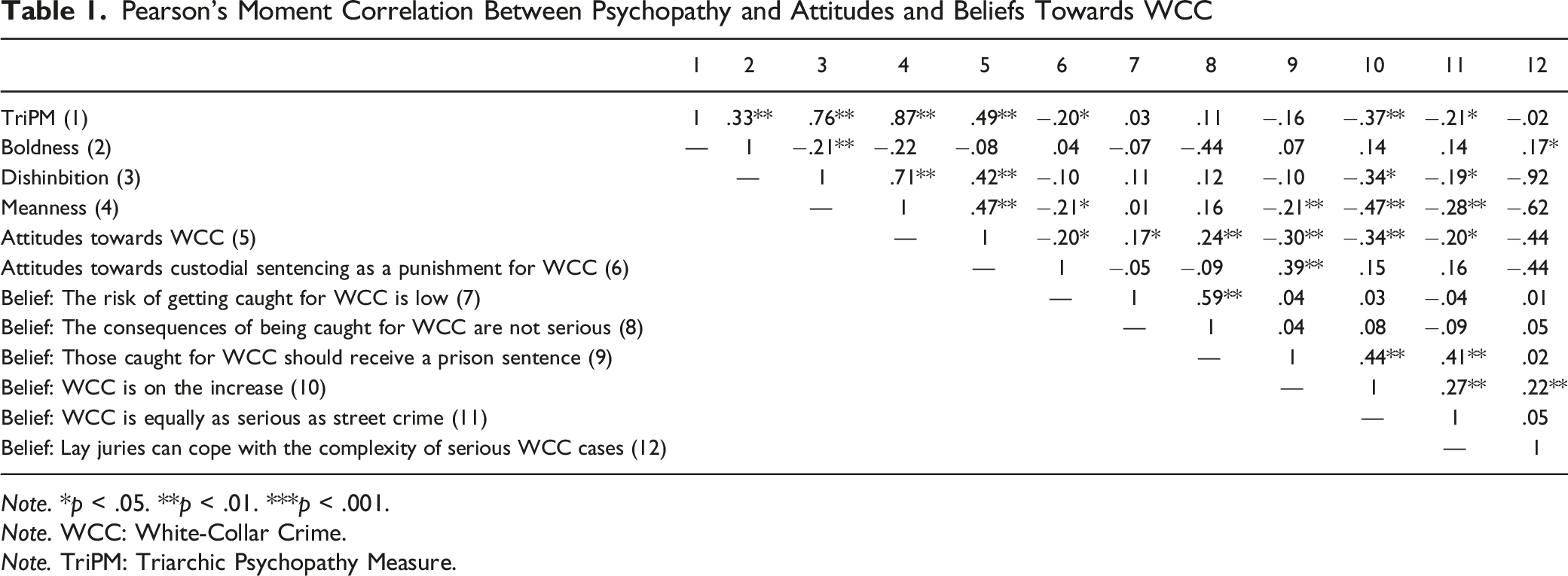
Note. *p < .05. **p < .01. ***p < .001.
Note. WCC: White-Collar Crime.
Note. TriPM: Triarchic Psychopathy Measure.
Pearson’s Moment Correlation Between Narcissism and Attitudes and Beliefs Towards WCC.
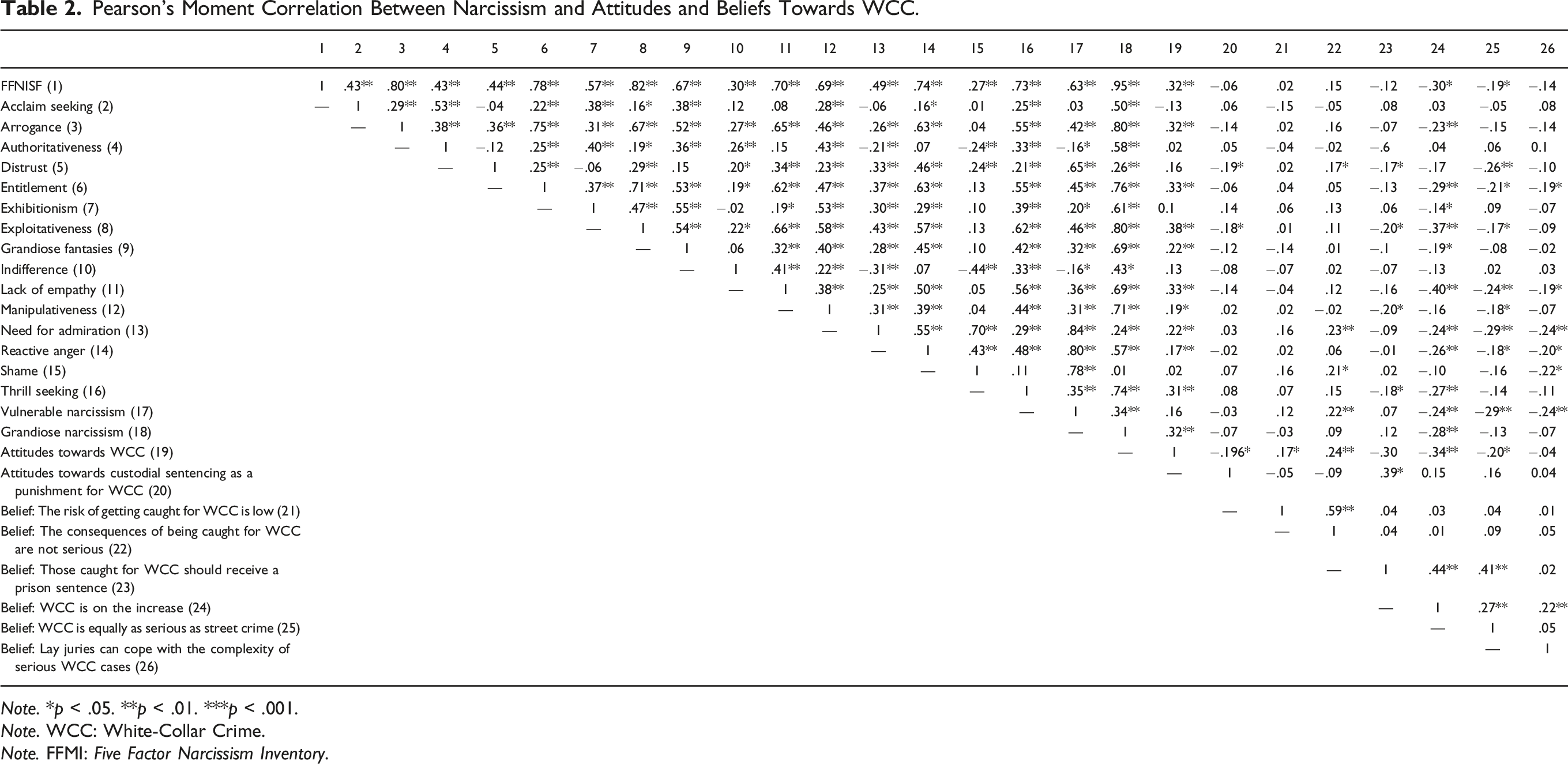
Note. *p < .05. **p < .01. ***p < .001.
Note. WCC: White-Collar Crime.
Note. FFMI: Five Factor Narcissism Inventory.
Pearson’s Moment Correlation Between Machiavellianism and Attitudes and Beliefs Towards WCC.
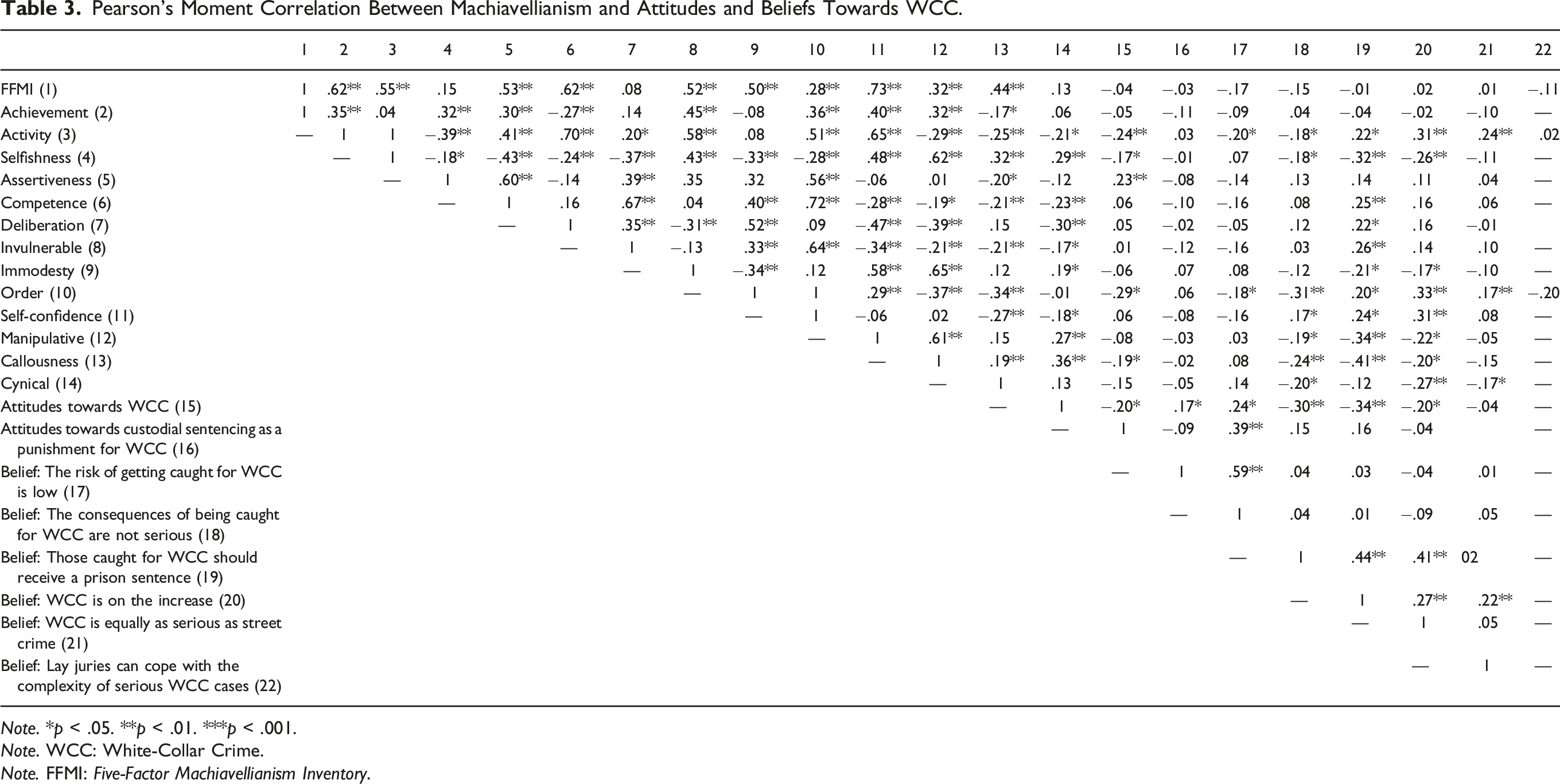
Note. *p < .05. **p < .01. ***p < .001.
Note. WCC: White-Collar Crime.
Note. FFMI: Five-Factor Machiavellianism Inventory.
Independent t-test analysis between Gender and Scales.
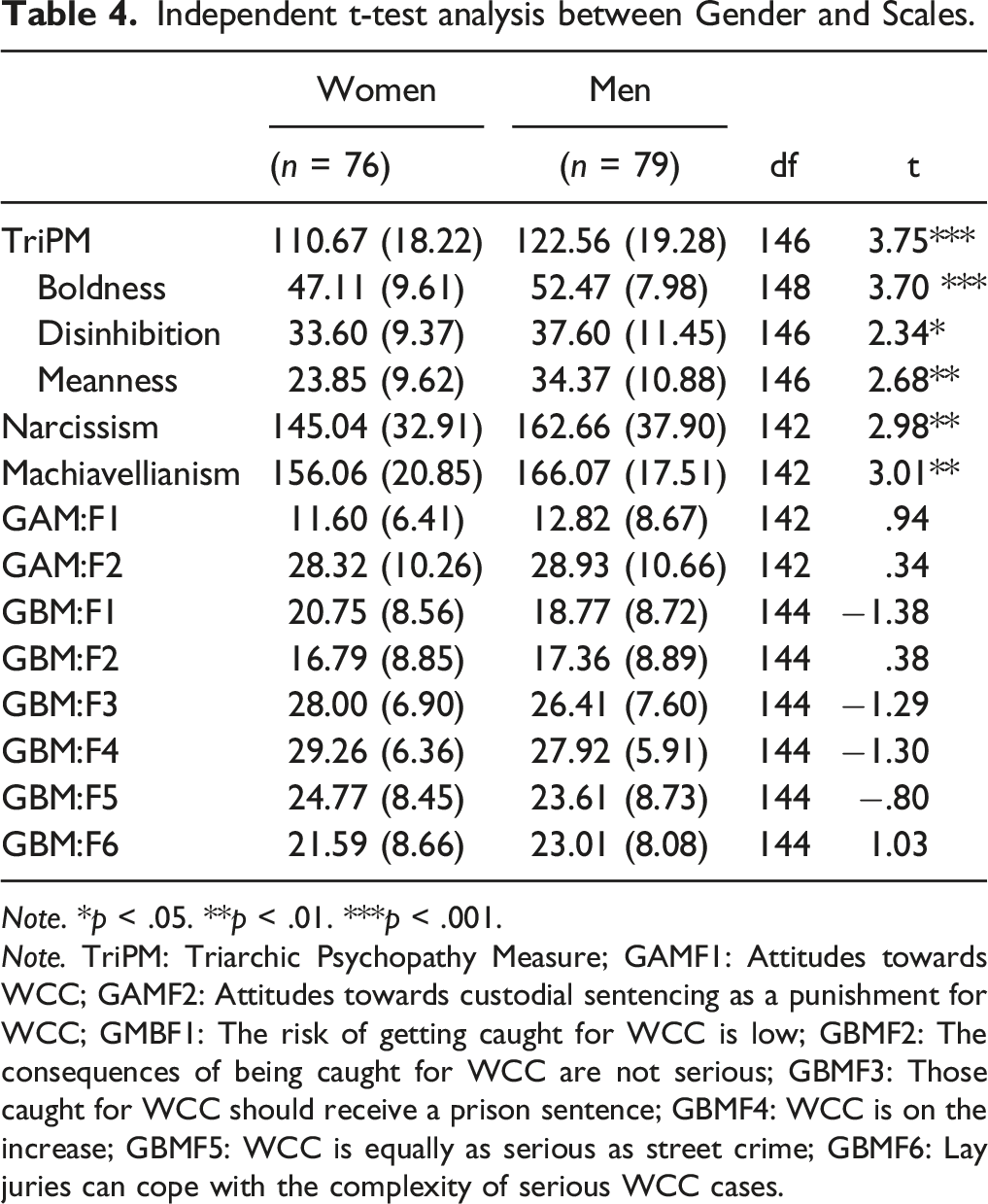
Note. *p < .05. **p < .01. ***p < .001.
Note. TriPM: Triarchic Psychopathy Measure; GAMF1: Attitudes towards WCC; GAMF2: Attitudes towards custodial sentencing as a punishment for WCC; GMBF1: The risk of getting caught for WCC is low; GBMF2: The consequences of being caught for WCC are not serious; GBMF3: Those caught for WCC should receive a prison sentence; GBMF4: WCC is on the increase; GBMF5: WCC is equally as serious as street crime; GBMF6: Lay juries can cope with the complexity of serious WCC cases.
Regression analyses for variables predicting attitudes towards WCC.
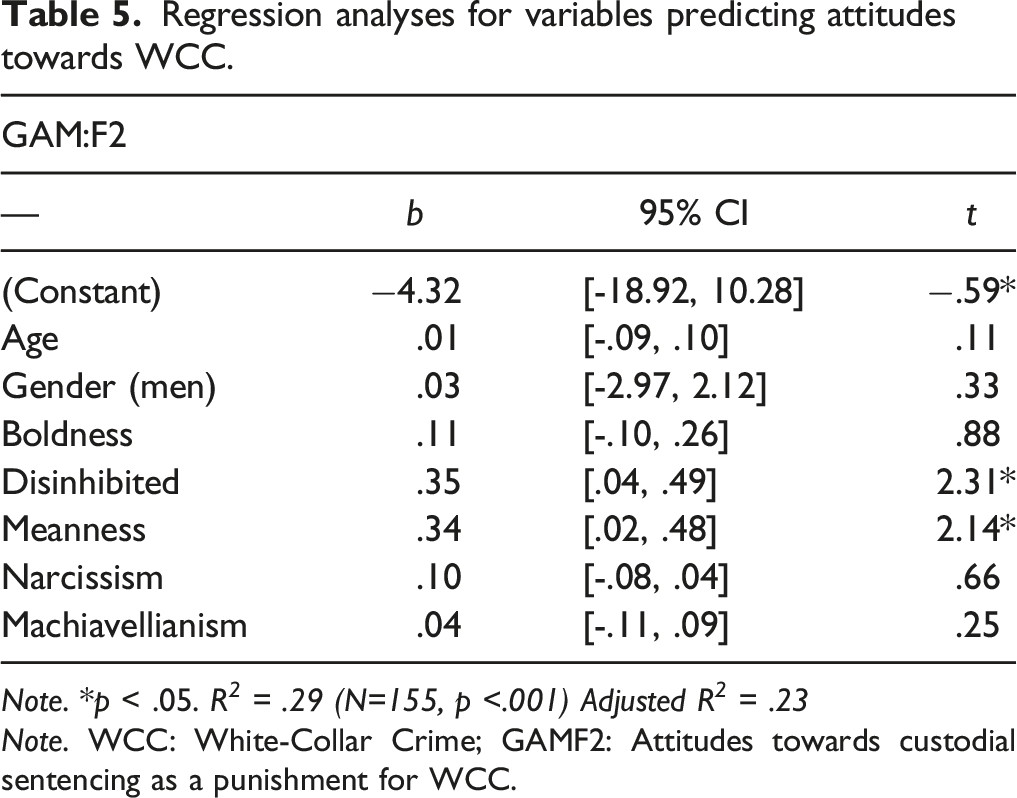
Note. *p < .05. R 2 = .29 (N=155, p <.001) Adjusted R 2 = .23
Note. WCC: White-Collar Crime; GAMF2: Attitudes towards custodial sentencing as a punishment for WCC.
Discussion
Psychopathy
Attitudes towards WCC
As hypothesised, a positive relationship was found between psychopathy and attitudes towards WCC. More specifically, correlations were found between disinhibition, meanness, and attitudes towards WCC. However, no significant correlations were found between boldness and attitudes towards WCC. The regression revealed that disinhibition and meanness were significant predictors of attitudes towards WCC, and boldness was not a significant predictor of attitudes towards WCC.
Beliefs about WCC
Firstly, negative relationships were found between disinhibition, meanness and the belief that WCC, fraud and corruption are on the increase. Secondly, a negative relationship was found between meanness and the belief that those caught for WCC, fraud and corruption should receive a custodial sentence. Thirdly, negative relationships were found between disinhibition, meanness and the belief that WCC, fraud and corruption are equally serious as street crime. Finally, a positive relationship was identified between boldness and the belief that lay juries can cope with the complexity of serious WCC cases.
Versus Literature
The relationship found between psychopathy and attitudes towards WCC provides support for the assertion that psychopathic traits have been identified as a fraud offender risk (e.g., Babiak et al., 2007; Hare, 1993; Harrison et al., 2018). Specifically, the present study has identified that meanness and disinhibition are significant predictors of attitudes towards WCC, but not boldness. This could be explained by the different influences that boldness, meanness, and disinhibition have on thoughts and behaviour. Neo et al.’s (2018) research into workplace malfeasance found that meanness predicted unethical decision-making; disinhibition predicted counterproductive work behaviours and boldness predicted the use of soft tactics of influence, adaptive leadership, and team play.
The impulsive nature and the failure to learn from previous experience of the disinhibition path, as well as the lack of social connectedness and the entitled nature of the meanness path, are good predictors of attitudes towards antisocial behaviours (Longpré et al., 2022), which can be extended to WCC. While the former will act on the presence of an opportunity without thinking about the long-term consequences, the latter will be more proactive in their actions to commit WCC. Furthermore, the absence of relationships between boldness and attitudes towards WCC is not surprising, as boldness was associated with a workplace adaptive role, instead of workplace deviance, in previous research. These findings support previous criticisms about the mismatch between boldness’ conceptualisation and established core features of psychopathy, as well as the lack of incremental value of boldness in the TriPM model (e.g., Gatner et al., 2016).
Thus, our results are consistent with previous studies which supported the maladaptive aspects of psychopathy, as well as highlighting the incoherence surrounding boldness. The current debate surrounding the latent structure (i.e., Triarchic vs. Septarchic) of the TriPM might help to clarify the inconsistencies surrounding boldness (For more details, see Patrick et al., 2009; Roy et al., 2021), and its [lack of adequate] conceptualisation. Furthermore, the present study supports Lignau et al.’s (2017) research, indicating that there is a significant relationship between personality traits that are associated with corporate psychopathy and the acceptance of WCC. It was suggested that this relationship may be due to the selfish, manipulative, remorseless traits of a corporate psychopath. However, Lignau et al.’s (2017) study focused on corporate psychopathy, whereas the present study examined subclinical psychopathy and attitudes and beliefs towards WCC.
Narcissism
Attitudes towards WCC
Firstly, as hypothesised, relationships were found between narcissism (specifically - arrogance, entitlement, exploitativeness, grandiose fantasies, lack of empathy, manipulativeness, need for admiration, reactive anger, thrill seeking, and grandiose narcissism) and attitudes towards WCC. Additionally, a negative correlation was found between distrust, exploitativeness, and attitudes towards custodial sentencing as a punishment for white-collar offenders. However, narcissism was not a significant predictor of WCC in regression analysis.
Beliefs about WCC
Firstly, positive relationships were found between distrust, need for admiration, shame, vulnerable narcissism, and the belief that the consequences of being caught for WCC are not serious. Secondly, negative relationships were found between distrust, exploitativeness, manipulativeness, thrill seeking, and the belief that those caught for WCC should receive a prison sentence. Thirdly, negative relationships were found between narcissism (specifically – arrogance, entitlement, exhibitionism, exploitativeness, grandiose fantasies, lack of empathy, need for admiration, reactive anger, thrill seeking, vulnerable narcissism and grandiose narcissism), and the belief that WCC is on the increase. In addition, negative relationships were found between narcissism (specifically – distrust, entitlement, exploitativeness, lack of empathy, manipulativeness, need for admiration, reactive anger, and vulnerable narcissism) and the belief that WCC is a serious offence.
Versus Literature
As hypothesised, a positive relationship was identified between narcissism and attitudes towards WCC. This is supported by the finding that the FFNI has been correlated with unethical behaviour (Deshong et al., 2017). Additionally, the present study has found a positive relationship between grandiose narcissism and attitudes towards WCC. This is supported by Poless et al.’s (2018) findings that those high on grandiose narcissism have a tendency to make unethical decisions, and are more likely than normal people to engage in unethical behaviour. Furthermore, Campbell et al. (2011) found that grandiose narcissism is correlated with WCC. Furthermore, the present study identified a positive relationship between entitlement and attitudes towards WCC. This is consistent with previous studies that suggested that entitlement within grandiose narcissism may be the primary motivation of fraud offenders presenting narcissistic traits (i.e., Bucy et al., 2008; Perri, 2011). Narcissists may believe that they deserve special privileges or more resources than others, which can instigate immoral behaviour in order to allow the narcissist to ‘get ahead’ (Brunell et al., 2011; Perri, 2011).
Although narcissism was not a significant predictor of attitudes towards WCC in the regression analysis, the present study still supports the assertion that narcissism has been identified as another fraud risk factor (Price & Norris, 2009). A closer look at the correlations analyses revealed that not all sub-components of narcissism (e.g., Acclaim seeking; Authoritativeness) were correlated with WCC, which might explain why narcissism was not a significant predictor in regression. These results reveal that although there is a relationship between narcissism and WCC, this relationship is complex and exists under specific circumstances. Within this dimension, not all individuals will score high/low on the same sub-scales, and narcissism might be a predictor of WCC only when an individual presents a specific sub-clinical entity, namely being high on arrogance, entitlement, exploitativeness, grandiose fantasies, lack of empathy, need for admiration, reactive anger, thrill seeking, and grandiose narcissism.
Machiavellianism
Attitudes towards WCC
No correlations were found between Machiavellianism and attitudes towards WCC. However, negative relationships were found between activity, competence, deliberation, invulnerable, order, self-confidence, and attitudes towards WCC. Positive relationships were found between selfishness, immodesty, manipulative, callousness, and attitudes towards WCC. Negative relationships were identified between selfishness and callousness, and attitudes towards custodial sentencing as a punishment for WCC, and a positive relationship was identified between assertiveness and attitudes towards custodial sentencing as a punishment for WCC.
Beliefs about WCC
No significant relationships were identified between Machiavellianism as a whole and beliefs about WCC. However, significant relationships were identified between components of Machiavellianism and beliefs about WCC. Firstly, negative relationships were identified between activity, order, and the belief that the risk of getting caught for WCC is low, and the belief that the consequences of being caught for WCC are not serious. Secondly, negative relationships were identified between selfishness, manipulative, callousness, cynical and the belief that those caught for WCC should receive a custodial sentence. In addition, negative relationships were identified between selfishness, immodesty, manipulative, callousness, and the belief that WCC is on the increase. Furthermore, negative relationships were identified between selfishness, immodesty, manipulative, callousness, cynical, and the belief that WCC is a serious crime. Positive relationships were identified between activity, order, self-confidence and the belief that those caught for WCC should receive a custodial sentence, the belief that WCC is on the increase, as well as the belief that WCC is a serious crime.
Versus Literature
Machiavellians have been described as self-interested and open to unethical behaviour and associated with greed and selfishness (Jones, 2016). Additionally, research has discovered an effect of Machiavellianism on unethical and undesirable behavioural intentions within the workplace (Belschak et al., 2018; Jones & Kavanagh, 1996). Therefore, it was hypothesised that there would be a positive relationship between Machiavellianism and attitudes towards WCC. However, no significant correlations were found between Machiavellianism as a whole and attitudes towards WCC and regression analysis revealed that Machiavellianism was not a predictor of attitudes towards WCC.
There are several potential reasons for the disparity between the hypothesised and actual findings regarding Machiavellianism and attitudes towards WCC. Firstly, Machiavellianism is the least researched component of the Dark Triad, and the theoretical base for this trait is subject to debate (Rauthmann, 2013). Specifically, there is a lack of research surrounding the relationship between Machiavellianism and attitudes towards WCC. Secondly, this disparity may relate to the measure of Machiavellianism utilised within this study. For example, although Vize et al. (2018b) described the FFMI as a promising new measure that eliminates most of the problems with existing measures, the FFMI has not been validated on different populations (community, clinical, forensic). In the present study, the FFMI has produced lower internal consistency than the TriPM and FFNISF and some of the subscales had unacceptable Cronbach’s alphas. Therefore, repeating this study with a different measure of Machiavellianism may produce different results. Furthermore, similar to narcissism, correlation analyses revealed that not all sub-components of Machiavellianism (e.g., Achievement, Activity) were correlated with WCC. Machiavellian’s longer-term orientation (Jones & Paulhus, 2017) distinguishes them from individuals high on psychopathy and narcissism, and our results suggested that Machiavellianism might be a predictor of WCC only when an individual presents a specific sub-clinical entity, namely being high on selfishness, manipulative, callousness, cynical.
Machiavellianism and Psychopathy
Paulhus and Williams (2002) stated that although there is some degree of overlap between the Dark Triad traits, they should be considered as three separate constructs. However, as explained before, there is a debate around Machiavellianism as a distinct construct from psychopathy. For example, Mealey (1995) indicated that Machiavellianism is a subclinical manifestation of psychopathy, the difference being the degree of severity that should be considered (Vize et al., 2018a). In relation to WCC, Hare (1993) revealed that the ability to commit fraud against others utilising charm, deception, and manipulation is a key tactic of white-collar psychopaths, which overlaps with Christie and Geis’ (2013) definition of Machiavellianism.
In order to assess the relationship between Machiavellianism and psychopathy within this study, the FFMI and TriPM were correlated. A significant relationship was found between the FFMI, the TriPM, and their subscales. This supports research by Vize et al. (2018a), which revealed that the nomological networks of psychopathy and Machiavellianism overlapped. However, the correlations and regressions between psychopathy, Machiavellianism and attitudes towards WCC within this study were different. For example, while disinhibition and meanness significantly predicted attitudes towards WCC in the regression analysis, Machiavellianism was not a predictor of attitudes towards WCC. These findings support Jones and Paulhus (2017) who reported that while individuals high on psychopathy appear indistinguishable from individuals high on Machiavellianism under specific circumstances, they are distinct entities. Machiavellianism, like psychopathy, can be broken into a personality and a behavioural component (Jones & Figueredo, 2013). Although the personality core of Machiavellianism may overlap with psychopathy, the behaviour components of Machiavellianism and psychopathy stand in stark contrast (Jones & Figueredo, 2013). Further research is necessary to ensure the reliability of our findings and examine how our results can be compared when utilising other measures such as the Short Dark Triad test (SD3; Jones & Paulhus, 2003), the actual gold standard in the assessment of the Dark Triad.
Gender Differences: Versus Literature
Gender was not a significant predictor of attitudes towards WCC, and no significant differences were found between men and women on attitudes and beliefs towards WCC. However, men scored significantly higher than women on the TriPM and its sub-factors, which supports the finding that men score higher than women on both categorical and dimensional operationalisation of psychopathy. Additionally, men scored significantly higher on narcissism than women, which is supported by previous studies who reported that men consistently scored higher in narcissism across multiple generations and regardless of age (Grijalva et al., 2015). Finally, men scored significantly higher on Machiavellianism than women, which is supported by previous study using the MACH-IV (Christie & Geis, 1970), who identified that men score higher than women on average, and men are five times more likely than women to get the highest possible result (∼1% vs. ∼0.2%).
Limitations
Although the current study provides several empirical explanations within the WCC literature, it has its limitations. First, there are some limitations regarding the application of the results to real life, as there is a difference between attitudes and real-life commission of WCC. It would be deterministic to assume that all individuals with positive attitudes towards WCC would be inclined to commit real-life WCC. Furthermore, correlations and regressions are unable to interpret cause and effect relationships; therefore, it cannot be construed that the Dark Triad traits directly caused attitudes towards WCC. However, our results revealed a strong relationship between the Dark Triad and attitudes towards WCC. Furthermore, research has supported the idea that the relationship between attitudes and behaviours is strong and stable across different types of crimes (e.g., Hollewell & Longpré, 2022; Stefanska et al., 2022). While our results are consistent with previous study, and provide important information on the impact of personality traits on attitudes towards WCC, they should be interpreted with caution. Future research should focus on replicating our results, as well as examining if the same psychological traits that predict attitudes towards WCC also predict real-life WCC.
Furthermore, this study used self-report questionnaires on a small sample, which comes with some limitations. Self-reported data in relation to sensitive topics might have been influenced by an inherent desire to appear in a socially desirable manner, relies on a level of honesty from the participant and can be subject to response bias. For example, social desirability bias may be a concern when examining narcissistic traits (Lee & Ashton, 2012). However, several safeguards were taken to minimise the risk of using inaccurate responses, ranging from voluntary participation, to complete anonymity, to financial compensation in an attempt to mitigate the risk of presenting social desirability bias. Furthermore, the final sample size was low with a final sample of n = 157 participants, which might have hindered our ability to find some effect. However, a sample of over N = 100 is considered sufficient for this type of study and provides stable results (e.g., Hulley et al., 2013). Linear Regression with 8K (8 predictors) provides stable results with samples over 50 participants. In our model, seven predictors and a clean sample size of n = 157 were used in the analyses. Thus, while the sample size might have limited our ability to uncover moderate effects, analyses revealed stable and significant results that are consistent with previous research. Although our results are consistent with previous studies, they should be interpreted with caution. Future research should focus on official records, instead of self-reported information.
Implications
Theoretically, the findings of this study implicate the knowledge that there is a lack of research examining the Dark Triad within the corporate world and that the cause of WCC is multifactorial (Babiak, 2007). Practically, this research presents the necessity to examine the fraud risk of employees high in certain Dark Triad traits, and to consider whether corporations should take a proactive, rather than reactive, approach to WCC by considering prevention of WCC. Based on these findings, corporations could invest in personality assessment instruments as part of a standardised screening and recruiting process. For example, law enforcement recruitment previously used the Minnesota Multiphasic Personality Inventory (MMPI, Hathaway & McKinley, 1943; MMPI-2, Butcher et al., 1989), to examine personality characteristics and behavioural patterns of prospective employees (Simmers et al., 2003). The MMPI/MMPI-2 includes a psychopathic deviate scale, which measures antisocial behaviour and disobedience. This could serve as a model for implementing such practices in corporate settings. Corporations would need to compare the logical costs to the potential costs of WCC. Although psychopathy has been tied to negative outcomes in the workplace, there is evidence of positive outcomes (Smith & Lilienfeld, 2013). Therefore, this raises a question surrounding whether employee behaviour can be ethically monitored within the workplace to ensure that the presenting traits are adaptive rather than maladaptive. Additionally, the connection between the Dark Triad and attitudes towards WCC implicates the knowledge that the Dark Triad is examined within subclinical boundaries. For example, clinical interventions may aid in the rehabilitation of white-collar offenders high in Dark Triad traits.
Conclusion
In summary, the aim of this study was to examine whether there is a relationship between the Dark Triad, its subcomponents, and attitudes and beliefs towards WCC. The results of this study indicated that disinhibition and meanness, within the Triarchic model of psychopathy, were significant predictors of attitudes towards WCC, but not boldness, narcissism, Machiavellianism, or gender and age. Therefore, although this research found that the Dark Triad predicted a significant proportion of the variance in attitudes towards WCC, not all sub-components of the Dark Triad have the same predictive power.
Future research should focus on other factors that need to be explored, such as sadism, the new component of the now named Dark Tetrad, to improve our understanding of attitudes towards WCC. Based on the finding that meanness was a significant predictor of attitudes towards WCC, the relationship between sadism and attitudes towards WCC is important to explore. Finally, future research should focus on replicating our results using different measures of the Dark Triad as well as examining if the same psychological traits predict real-life WCC as compared to attitudes towards WCC.
Footnotes
Declaration of Conflicting Interests
The author(s) declared no potential conflicts of interest with respect to the research, authorship, and/or publication of this article.
Funding
The author(s) received no financial support for the research, authorship, and/or publication of this article.
Ethical Approval
All procedures performed in studies involving human participants were in accordance with the ethical standards of the institutional and/or national research committee and with the 1964 Declaration of Helsinki and its later amendments or comparable ethical standards.
Informed Consent
Informed consent was obtained from all individual participants included in the study.
